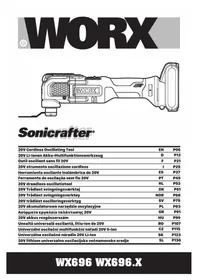
WX696L.1 - Multitools WORX - Free user manual and instructions
Find the device manual for free WX696L.1 WORX in PDF.


| Product type | Cordless oscillating multi-tool |
| Brand | Worx |
| Model | WX696L.1 |
| Rated voltage | 18 V (max 20 V) |
| Oscillation speed | 5,000 - 18,000 oscillations/min |
| Oscillation angle | 3.6° |
| Weight (bare tool) | 0.9 kg |
| Power supply | 20 V lithium-ion battery (compatible with WA series) |
| Recommended charger | WA3742 (0.4 A), WA3875 (2 A) or WA3881 (2 A) |
| Main functions | Sawing, sanding, scraping, grinding, polishing |
| Included accessories | Blades, sanding pads, rasps, knives (depending on version) |
| Accessories compatibility | Standard oscillating accessories from common brands (Fein, Bosch, etc.) |
| Fastening system | Clamping by hex key (wrench) |
| Speed control | Yes, continuous adjustment |
| LED lighting | Yes, battery capacity indicator |
| Workable materials | Wood, plastic, non-ferrous metals, tile, plaster |
| Operating temperature | 0 °C to 45 °C |
| Maintenance and cleaning | Clean with a dry cloth; do not use water or chemicals |
| Lubrication | No lubrication needed |
| Safety | Wear eye, hearing, and dust mask protection |
| Repairability | Repair only by an authorized center; battery not user-serviceable |
| Spare parts | Accessories commercially available; battery and charger specific to Worx |
Frequently Asked Questions - WX696L.1 WORX
User questions about WX696L.1 WORX
0 question about this device. Answer the ones you know or ask your own.
Ask a new question about this device
Download the instructions for your Multitools in PDF format for free! Find your manual WX696L.1 - WORX and take your electronic device back in hand. On this page are published all the documents necessary for the use of your device. WX696L.1 by WORX.
USER MANUAL WX696L.1 WORX
WARNING: Some dust created by power sanding, sawing, grinding, drilling and other construction activities contains chemicals known to the State of California to cause cancer, birth defects or other reproductive harm. Some examples of these chemicals are:
- Lead from lead-based paints;
- Crystalline silica from bricks and cement and other masonry products;
- Arsenic and chromium from chemically-treated lumber.
Your risk from these exposures varies, depending on how often you do this type of work. To reduce your exposure to these chemicals: work in a well ventilated area, and work with approved safety equipment, such as those dust masks that are specially designed to filter out microscopic particles.
WARNING: This product can expose you to chemicals including lead and Di(2-ethylhexyl)phthalate (DEHP) which are known to the State of California to cause cancer and birth defects or other reproductive harm. For more information go to www.P65Warnings.ca.gov.
2
GENERAL POWER TOOL SAFETY WARNINGS
WARNING Read all safety warnings, instructions, illustrations and specifications provided with this power tool.
Failure to follow all instructions listed below may result in electric shock, fire and/or serious injury.
Save all warnings and instructions for future reference.
The term "power tool" in the warnings refers to your mains-operated (corded) power tool or battery-operated (cordless) power tool.
1) Work area safety
a) Keep work area clean and well lit.
Cluttered or dark areas invite accidents.
b) Do not operate power tools in explosive atmospheres, such as in the presence of flammable liquids, gases or dust. Power tools create sparks which may ignite the dust or fumes.
c) Keep children and bystanders away while operating a power tool. Distractions can cause you to lose control.
2) Electrical safety
a) Power tool plugs must match the outlet. Never modify the plug in any way. Do not use any adapter plugs with earthed
(grounded) power tools. Unmodified plugs and matching outlets will reduce risk of electric shock.
b) Avoid body contact with earthed or grounded surfaces, such as pipes, radiators, ranges and refrigerators. There is an increased risk of electric shock if your body is earthed or grounded.
c) Do not expose power tools to rain or wet conditions. Water entering a power tool will increase the risk of electric shock.
d) Do not abuse the cord. Never use the cord for carrying, pulling or unplugging the power tool. Keep cord away from heat, oil, sharp edges or moving parts. Damaged or entangled cords increase the risk of electric shock.
e) When operating a power tool outdoors, use an extension cord suitable for outdoor use. Use of a cord suitable for outdoor use reduces the risk of electric shock.
f) If operating a power tool in a damp location is unavoidable, use a residual current device (RCD) protected supply. Use of an RCD reduces the risk of electric shock.
3) Personal safety
a) Stay alert, watch what you are doing and use common sense when operating a power tool. Do not use a power tool while you are tired or under the influence of drugs, alcohol or medication. A moment of inattention while operating power tools may result in serious personal injury.
b) Use personal protective equipment. Always wear eye protection. Protective equipment such as dust mask, non-skid safety shoes, hard hat, or hearing protection used for appropriate conditions will reduce personal injuries.
c) Prevent unintentional starting. Ensure the switch is in the off-position before connecting to power source and/or battery pack, picking up or carrying the tool. Carrying power tools with your finger on the switch or energising power tools that have the switch on invites accidents.
d) Remove any adjusting key or wrench before turning the power tool on. A wrench or a key left attached to a rotating part of the power tool may result in personal injury.
e) Do not overreach. Keep proper footing and balance at all times. This enables better control of the power tool in unexpected situations.
f) Dress properly. Do not wear loose clothing or jewelry. Keep your hair and clothing away from moving parts. Loose clothes, jewelry or long hair can be caught in moving parts.
g) If devices are provided for the connection of dust extraction and collection facilities, ensure these are connected and properly used. Use of dust collection can reduce dust-related hazards.
h) Do not let familiarity gained from frequent use of tools allow you to become complacent and ignore tool safety principles. A careless action can cause severe injury within a fraction of a second.
4) Power tool use and care
a) Do not force the power tool. Use the correct power tool for your application. The correct power tool will do the job better and safer at the rate for which it was designed.
b) Do not use the power tool if the switch does not turn it on and off. Any power tool that cannot be controlled with the switch is dangerous and must be repaired.
c) Disconnect the plug from the power source and/or remove the battery pack, if detachable, from the power tool before making any adjustments, changing accessories, or storing power tools. Such preventive safety measures reduce the risk of starting the power tool accidentally.
d) Store idle power tools out of the reach of children and do not allow persons unfamiliar with the power tool or these instructions to operate the power tool. Power tools are dangerous in the hands of untrained users.
e) Maintain power tools and accessories. Check for misalignment or binding of moving parts, breakage of parts and any other condition that may affect the power tool's operation. If damaged, have the power tool repaired before use. Many accidents are caused by poorly maintained power tools.
f) Keep cutting tools sharp and clean.
Properly maintained cutting tools with sharp cutting edges are less likely to bind and are easier to control.
g) Use the power tool, accessories and tool bits etc. in accordance with these instructions, taking into account the working conditions and the work to be performed. Use of the power tool for operations different from those intended could result in a hazardous situation.
h) Keep handles and grasping surfaces dry, clean and free from oil and grease. Slippery handles and grasping surfaces do not allow for safe handling and control of the tool in unexpected situations.
5) Battery tool use and care
a) Recharge only with the charger specified by the manufacturer. A charger that is suitable for one type of battery pack may create a risk of fire when used with another battery pack.
b) Use power tools only with specifically designated battery packs. Use of any other battery packs may create a risk of injury and fire.
c) When battery pack is not in use, keep it
away from other metal objects, like paper clips, coins, keys, nails, screws or other small metal objects, that can make a connection from one terminal to another. Shorting the battery terminals together may cause burns or a fire.
d) Under abusive conditions, liquid may be ejected from the battery; avoid contact. If contact accidentally occurs, flush with water. If liquid contacts eyes, additionally seek medical help. Liquid ejected from the battery may cause irritation or burns.
e) Do not use a battery pack or tool that is damaged or modified. Damaged or modified batteries may exhibit unpredictable behavior resulting in fire, explosion or risk of injury.
f) Do not expose a battery pack or tool to fire or excessive temperature. Exposure to fire or temperature above (266 °F) (130 °C) may cause explosion.
g) Follow all charging instructions and do not charge the battery pack or tool outside the temperature range specified in the instructions. Charging improperly or at temperatures outside the specified range may damage the battery and increase the risk of fire.
6) Service
a) Have your power tool serviced by a qualified repair person using only identical replacement parts. This will ensure that the safety of the power tool is maintained.
b) Never service damaged battery packs.
Service of battery packs should only be performed by the manufacturer or authorized service providers.
SAFETY INSTRUCTION FOR CUTTING
- Hold the power tool by insulated gripping surfaces, when performing an operation where the cutting accessory may contact hidden wiring. Cutting accessory contacting a "live" wire may make exposed metal parts of the power tool "live" and could give the operator an electric shock.
- Use clamps or another practical way to secure and support the workpiece to a stable platform. Holding the work by hand or against your body leaves it unstable and may lead to loss of control.
SAFETY WARNINGS FOR BATTERY PACK
a) Do not dismantle, open or shred battery pack.
b) Do not expose battery pack to heat or
fire. Avoid storage in direct sunlight.
c) Do not short-circuit a battery pack. Do not store battery packs haphazardly in a box or drawer where they may short-circuit each other or be short-circuited by other metal objects. When battery pack is not in use, keep it away from other metal objects, like paper clips, coins, keys, nails, screws or other small metal objects, that can make a connection from one terminal to another. Shorting the battery terminals together may cause burns or fire.
d) Do not remove battery pack from its original packaging until required for use.
e) Do not subject battery pack to mechanical shock.
f) In the event of battery leaking, do not allow the liquid to come in contact with the skin or eyes. If contact has been made, wash the affected area with copious amounts of water and seek medical advice.
g) Observe the plus (+) and minus (−) marks on the battery back and equipment and ensure correct use.
h) Do not use any battery pack which is not designed for use with the equipment.
i) Keep battery pack out of the reach of children.
j) Seek medical advice immediately if a cell or battery has been swallowed.
k) Always purchase the battery pack recommended by the device manufacturer for the equipment.
I) Keep battery pack clean and dry.
m) Wipe the battery pack terminals with a clean dry cloth if they become dirty.
n) Battery pack needs to be charged before use. Always use the correct charger and refer to the manufacturer's instructions or equipment manual for proper charging instructions.
o) Do not leave battery pack on prolonged charge when not in use.
p) After extended periods of storage, it may be necessary to charge and discharge the battery pack several times to obtain maximum performance.
q) Battery pack gives its best performance when it is operated at normal room temperature (68 °F ± 10 °F (20 °C ± 5 °C).
r) When disposing of battery packs, keep battery packs of different electrochemical systems separate from each other.
s) Recharge only with the charger specified by WORX. Do not use any charger other than that specifically provided for use with the equipment. A charger that is suitable for one type of battery pack may create a risk of fire when used with another battery pack.
t) Retain the original product literature for future reference.
u) Use only the battery pack in the application for which it was intended.
v) Remove the battery pack from the equipment when not in use.
w) Dispose of properly.
SYMBOL
 | To reduce the risk of injury, user must read instruction manual |
 | Warning |
 | Wear ear protection |
 | Wear eye protection |
 | Wear dust mask |
 | Batteries may enter water cycle if disposed improperly, which can be hazardous for ecosystem. Do not dispose of waste batteries as unsorted municipal waste. |
 | Do not burn |
 | Li-lon battery, battery must be recycled |
 | Avoid danger of injury from the sharp edges of the accessories. |
 | Accessories can become very hot while working, presenting danger of burns! |
 | Make sure the battery is removed prior to changing accessories. |
 | Wear protective gloves. |
 | High oscillation frequency: |
 | Low oscillation frequency: |
 | Lock |
 | Unlock |
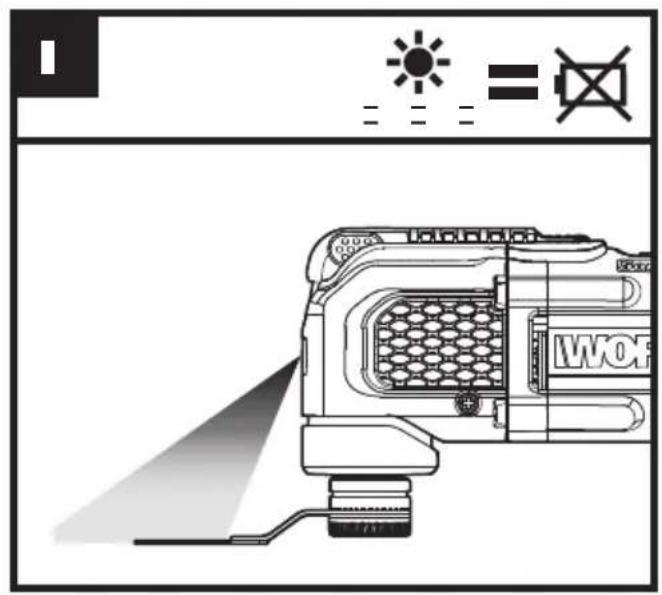
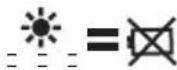 | LED light is a battery capacity indicator and will flash when power gets low. |

call②recycle®
POSITEC Inc. has established a partnership with the RBRC Corporation to recycle any Positec batteries with the RBRC-call2recycle seal. For environmental protection, please do not discard batteries in the trash. After the batteries' life cycle is ended, then please call 1-800-822-8837 for a free service that will properly dispose of the battery.
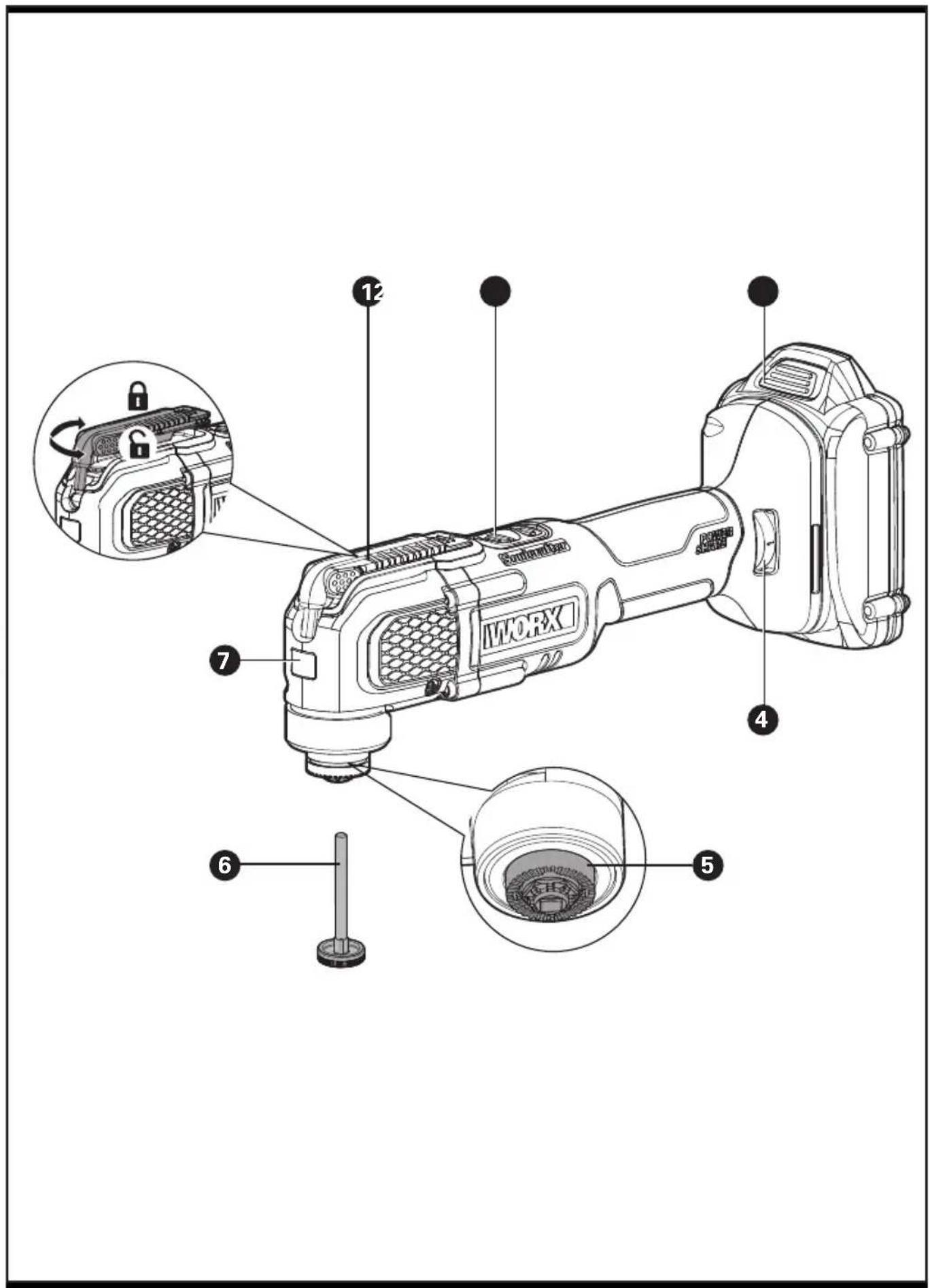
COMPONENT LIST
1. ONBOARD HEX WRENCH
2. ON/OFF SWITCH
3. BATTERY PACK\*
4. VARIABLE SPEED DIAL
5. UNIVERSAL-FIT ACCESSORY INTERFACE\*\*
6. FLANGE
7. LED LIGHT
** Works with other oscillating tool brands' accessories.
The following brands are trademarks owned by third parties which may be registered by their respective owners:
Black & Decker ^® , Bosch ^® , Chicago Electric ^® , Craftsman ^® , Dremel ^® , DeWalt ^® , Fein ^® , Genesis ^® , Imperial Blades, Makita ^® , Mastercraft ^® , Milwaukee ^® , Performax ^® , Porter Cable ^® , Ridgid ^® , Ryobi ^® , Skil ^® , and Tool Shop ^® , Rockwell ^® .
*Not all the accessories illustrated or described are included in standard delivery.
TECHNICAL DATA
Type Designation WX696L WX696L.X (6-designation of machinery, representative of Oscillating Tool)
| WX696LWX696L.X**** | |
| Voltage 20V | --- Max*** |
| Oscillations speed | 5000 - 18000 /min |
| Oscillating angle | 3.6° |
| Tool weight (bare tool) | 1.99 lbs |
***Voltage measured without workload. Initial battery voltage reaches maximum of 20 volts. Nominal voltage is 18 volts.
**** X may be followed by one or two characters. All models are the same except model number and trademark. The suffix in models may be number from "1" to "999" or English letter "A" to "Z" or "M1" to "M9" which means different package or the various of accessories packed in the package.
| Category Model | Capacity | |
| 20V Battery | WA3520 1.5Ah | |
| WA3525 2.0Ah | ||
| WA3575 2.0Ah | ||
| WA3578 4.0Ah | ||
| 20V Charger | WA3742 0.4A | |
| WA3875 2.0A | ||
| WA3881 2.0A |
We recommend that you purchase your accessories from the same store that sold you the tool. Refer to the accessory packaging for further details. Store personnel can assist you and offer advice.

OPERATION INSTRUCTIONS

Note: Before using the tool, read the instruction book carefully.
Intended Use
The power tool is intended for sawing and remodeling wooden materials, plastic, plaster, non-ferrous metals and fasteners (e.g. nails) as well as for working on soft wall tiles and for dry grinding of small surfaces. It is especially suitable for working close to edges and for flush cutting.
Assembly and Operation
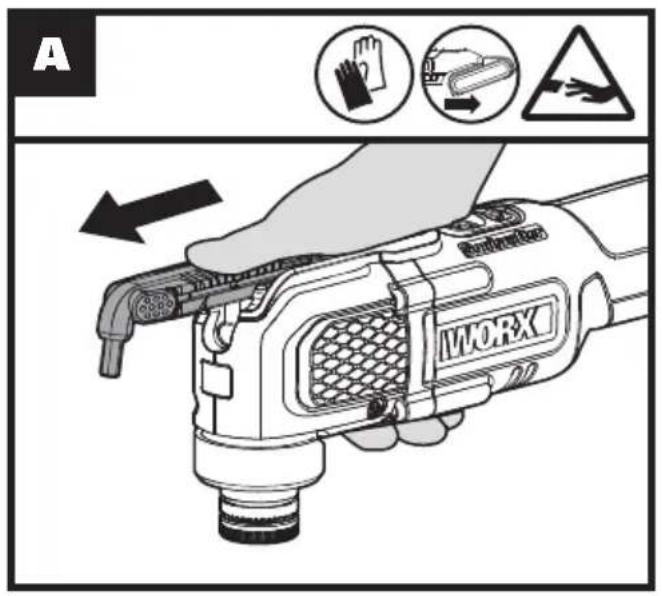
| ACTION FIGURE | |
| Mounting Accessories | |
| --Remove the Onboard hex wrench | See Fig. A |
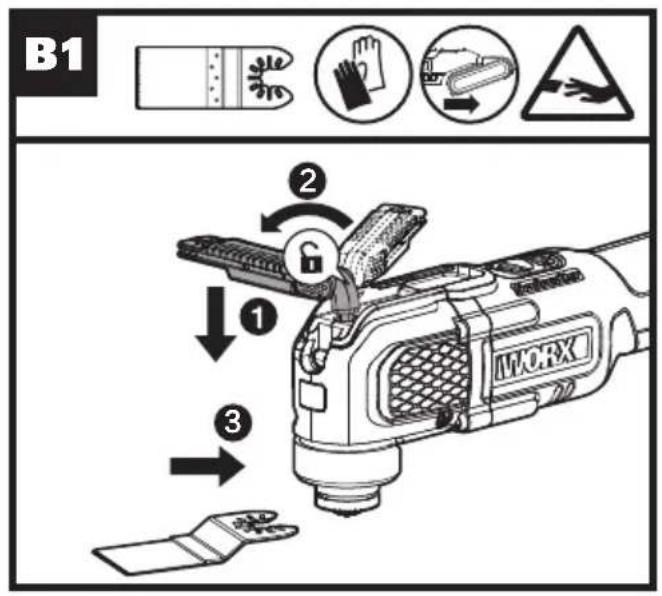
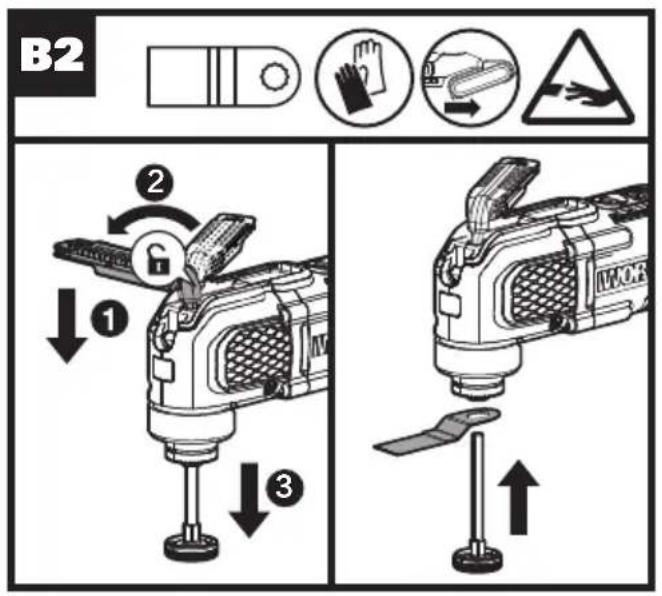
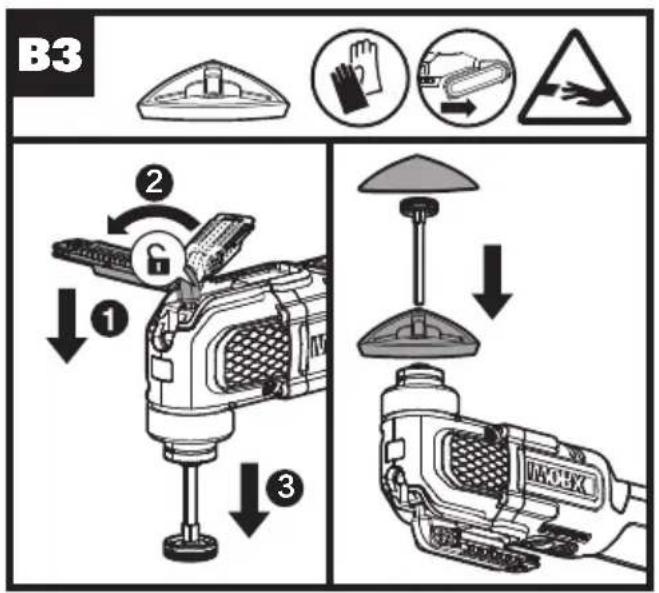
| --Loosen the flange and insert accessories | See Fig. B1, B2, B3 |
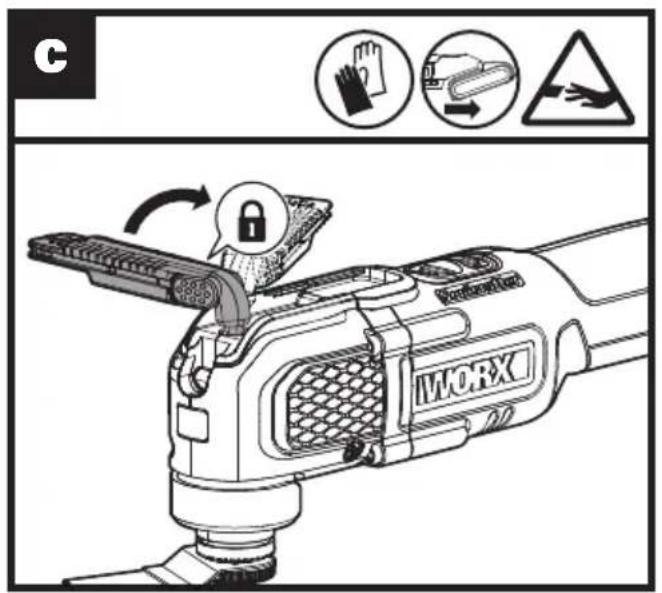
| --Tighten the flange See Fig. C | |
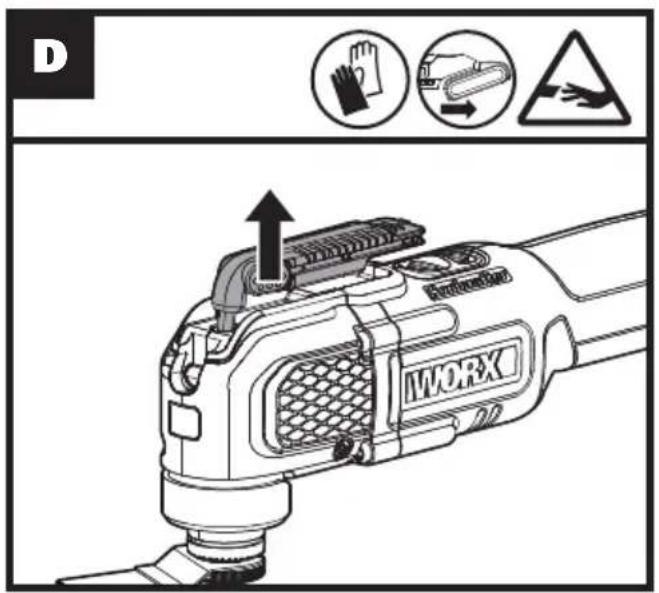
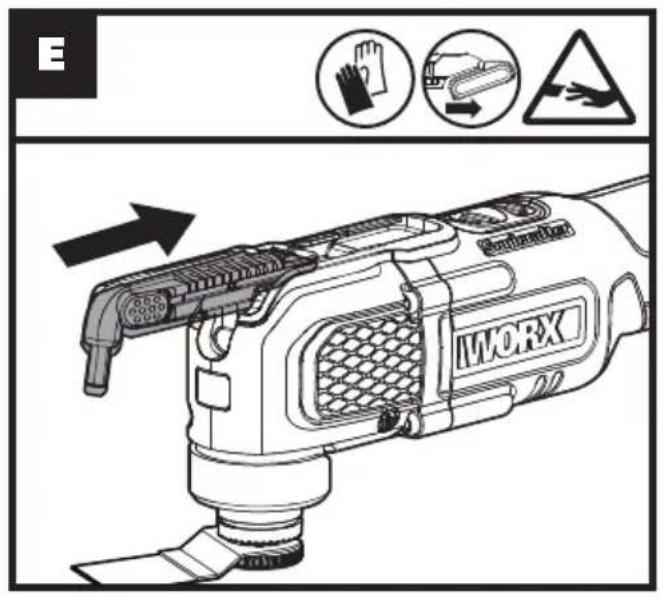
| --Store the Onboard hex wrench | See Fig. D, E |
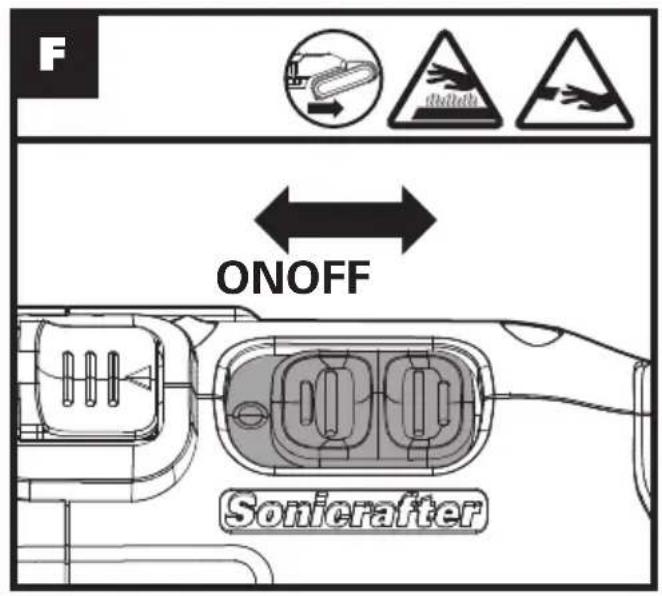
| Operating the On/Off Switch See Fig. F | |
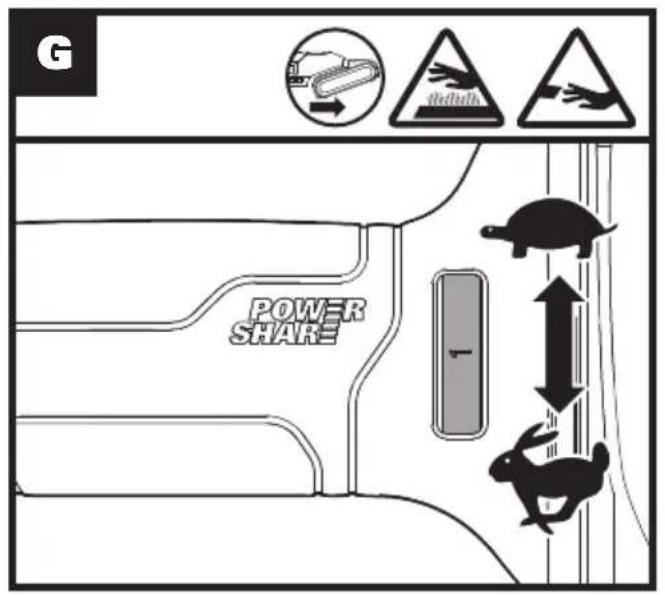
| Using the Variable Speed Dial | See Fig. G |
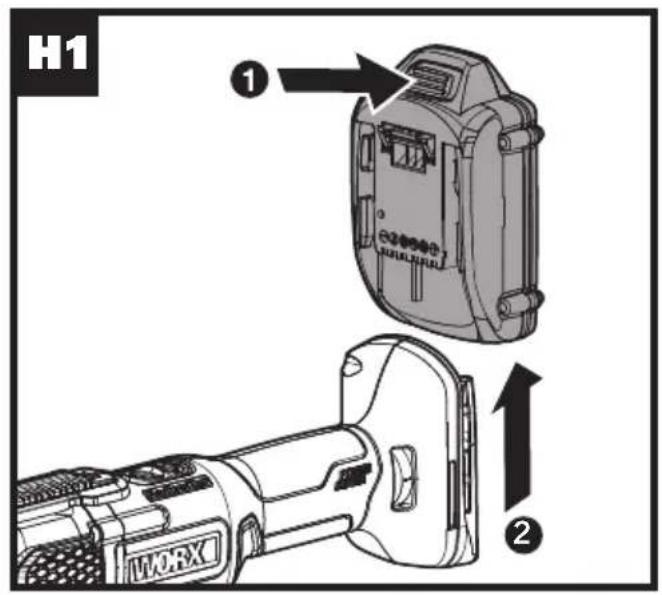
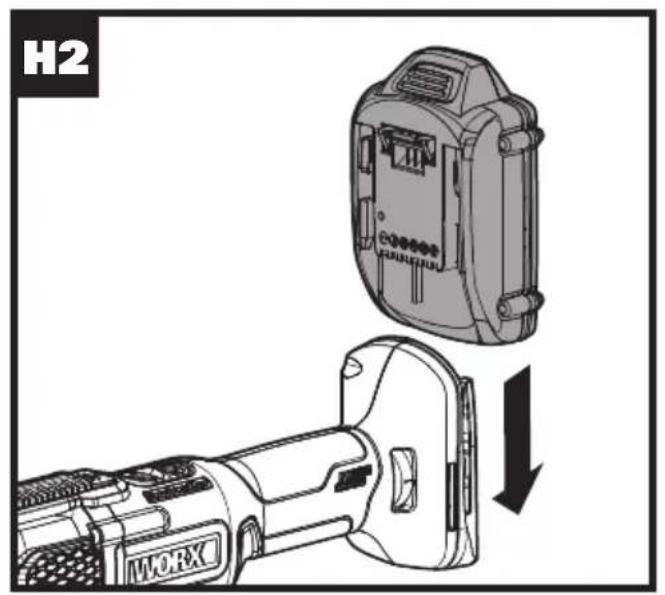
| Remove or Install Battery Pack | See Fig. H1,H2 |
| LED Light See Fig.I | |
The Variable Speed Dial can be used to set the optimum oscillating frequency according to the accessories used and the respective application.
| Oscillation frequency Application | |
| High oscillation frequency: | Sanding, sawing, rasping and polishing stone and metal. |
| Low oscillation frequency: | Scraping, polishing varnishes. |
| Pic Description | Application | ||
| Sawing | 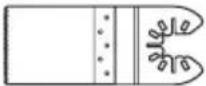 | Universal Bimetal Metal/Wood End Cut Blade | Wood, plastic, fiberglass, nails, non-ferrous metals, thin sheet metal, hardened fillers |
| Standard HCS Wood End Cut Blade | Wood, plastic, drywall | ||
| Precision Japanese-style tooth Wood Cut Blade | Wood, soft plastics | ||
 | HSS Semicircle Saw Blade | Thin wood, plastic, fiberglass, non-ferrous metals, thin sheet metal, hardened fillers, window glazing | |
| Sanding |  | Sanding Pad (Perforated) Wood, plastic, hardened fillers | |
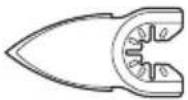 | Sanding Finger Pad Wood, plastic, hardened fillers | ||
| Rasping |  | Triangular Carbide Grit Rasp | Wood, hardened adhesives, thin set, masonry |
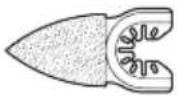 | Carbide Rasp (Finger Shaped) | Wood, hardened adhesives, thin set, masonry | |
| Removing grout |  | Carbide Grit Semicircle Saw Blade | Grout, porous concrete, masonry |
| Diamond-Coated Semicircle Saw Blade | Ceramic and stone tile, backer board | ||
| Scraping | 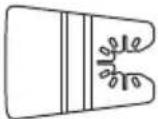 | Rigid Scraper Blade | Old paint, hardened adhesives, caulk, carpet |
| Flexible Scraper Blade | Elastic sealants, paint, adhesive residues, carpet. |
We recommend that you purchase your accessories from the same store that sold you the tool. Refer to the accessory packaging for further details. Store personnel can assist you and offer advice.
NOTE: When plunging and sawing use a slight pendulum motion, to allow sufficient chip removal. The saw blade lasts longer if the wear is distributed evenly. To ensure an even distribution, loosen the saw blade, rotate it and retighten firmly. Cut/Sand with a constant movement and light pressure. Heavy pressure does not increase the cut/removal rate – the accessory merely wears faster.
WORKING HINTS FOR YOUR TOOL
If your power tool becomes too hot, especially when used at low speed, set the speed to maximum and run it with no load for 2-3 minutes to cool the motor. Avoid prolonged usage at very low speeds. Always keep the blade sharp.
Always ensure the workpiece is firmly held or clamped to prevent movement.
Any movement of the material may affect the quality of the cutting or sanding finish.
Start your tool before working and turn it off only after you stop working.
Do not start sanding without having the sandpaper fitted.
Do not allow the sandpaper to wear away, it will damage the sanding pad. The guarantee does not cover sanding pad wear and tear.
Use coarse grit paper to sand rough surfaces, medium grit for smooth surfaces and fine grit for finishing surfaces. If necessary, first make a test run on scrap material.
Excessive force will reduce the working efficiency and cause motor overload. Replacing the accessory regularly will maintain optimum working efficiency.
MAINTAIN TOOLS WITH CARE
Your power tool requires no additional lubrication or maintenance. There are no user serviceable parts in your power tool. Never use water or chemical cleaners to clean your power tool. Wipe clean with a dry cloth. Always store your power tool in a dry place. Keep the motor ventilation slots clean. Keep all working controls free of dust. Occasionally you may see sparks through the ventilation slots. This is normal and will not damage your power tool.
FOR BATTERY TOOLS
The ambient temperature range for the use and
storage of tool and battery is 0^ C- 45^ C( 32^ F- 113^ F). The recommended ambient temperature range for the charging system during charging is 0^ C- 40^ C( 32^ F- 104^ F).
SÉCURITÉ DU PRODUIT
you've got the power
www.worx.com
Copyright © 2020, Positec. All Rights Reserved.