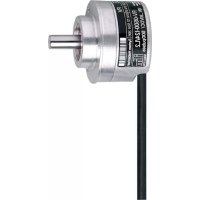
RV6026 - Detector IFM - Free user manual and instructions
Find the device manual for free RV6026 IFM in PDF.


| Product type | Incremental encoder (rotation detector) |
| Brand | IFM |
| Model | RV6026 |
| Category | Detector |
| Power supply | 5 V TTL or 10...30 V HTL version |
| Short-circuit protection | Outputs protected to 0 V (5 V TTL) or to 0 V and L+ (HTL, max. 1 min) |
| Output signals | Digital pulses A, B with 90° phase shift, zero index per revolution |
| Inverted outputs | Yes, for differential input |
| Electrical connection | 5-pin male connector or 13-wire cable (depending on version) |
| Maximum cable length | 100 m (5 V TTL) or 300 m (10...30 V HTL) |
| Minimum distance to parasitic sources | 20 cm |
| Shielding | Braided, connected to housing |
| Mounting | Screw on mounting flange, flexible coupling recommended |
| Maximum shaft loads | Observe the values specified on the label |
| Main functions | Conversion of rotational movements into pulses to measure linear and angular displacements |
| Maintenance | No specific maintenance required; avoid shocks to the shaft |
| Safety | Disconnect power before connecting/disconnecting; insulate unused wires |
| Additional information | Technical data sheet and accessories at www.ifm.com |
Frequently Asked Questions - RV6026 IFM
User questions about RV6026 IFM
0 question about this device. Answer the ones you know or ask your own.
Ask a new question about this device
Download the instructions for your Detector in PDF format for free! Find your manual RV6026 - IFM and take your electronic device back in hand. On this page are published all the documents necessary for the use of your device. RV6026 by IFM.
USER MANUAL RV6026 IFM
Function and features
The encoder transforms rotational movement into pulse sequences. These allow the measurement of linear distances and angular movement as well as the determination of positions.
Electrical connection
Disconnect power from the installation before connecting or disconnecting cables or connectors!
Unused wires must be insulated to avoid short circuits and cross faults.
Short-circuit protection
5 V TTL version: outputs short-circuit protected against 0 V 10...30 V HTL version: outputs short-circuit protected against 0 V and L+ for maximum 1 minute
Standard wiring:
| Flange plug 5-pole | ifm1000.xx ifm | 1001.xx | |
| L+ 2 9 12 | |||
| L+ sensor - 5 2 | |||
| 0V 1 12 10 | |||
| 0V sensor - | 10 11 | ||
| A | 3 | 1 | 5 |
| A neg. | - 2 6 | ||
| B | 4 | 3 | 8 |
| B neg. | - 4 1 | ||
| 0 index | 5 6 3 | ||
| 0 index neg. | - 7 4 | ||
| fault neg. | - | - | 7 |
| free | - | - | 9 |
| free | - | - | - |
| screen | housing | 11 | housing |
| ifm1013.xx Kabel13adrig | ||
| L+ 1 brown/green | ||
| L+ sensor - blue | ||
| 0V 6 white/green | ||
| 0V sensor - white | ||
| A 2 brown | ||
| A neg. - | green | |
| B | 4 | grey |
| B neg. | - pink | |
| 0 index | 5 | red |
| 0 index neg. | - | black |
| fault neg. | - lilac | |
| free | - | - |
| free | - | yellow |
| screen | 3 | housing |
Wiring is also indicated on the housing cap. If there is a deviation, the encoder must be connected as indicated on the label on the housing cap.
The wires L + (sensor) and 0V (sensor) are internally connected to the supply voltage. When using external electronics which regulate the supply voltage these wires can be used as test wires. If unused, these wires must be connected to the supply voltage or insulated.
Depending on the version, the electrical connection is made via the cable or via cables to be obtained separately.
When using suitable cables the maximum cable length is 100m for the 5 V TTL version and 300m for the 10...30 V HTL version.
The cables must be laid separately from interfering sources, the minimum distance is 20 cm .
The braided screen in the cable is connected to the encoder housing.
Output signals
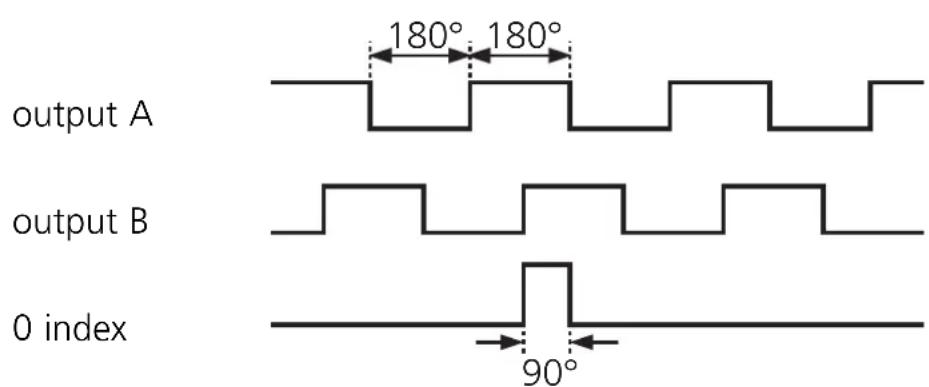
The encoder provides digital pulse sequences at the output stages. The outputs A and B are electrically offset by 90irc . Thus the direction of rotation can be evaluated in the external electronics.
The combined zero index is provided once in a mechanical revolution of the shaft. In case of power failure it can be used as a reference point within a revolution.
The inverted output signals are used for external electronics with differential voltage input to filter interference.
Installation

Do not hit the shaft, do not use a file or similar tool on the shaft: This could destroy the unit!
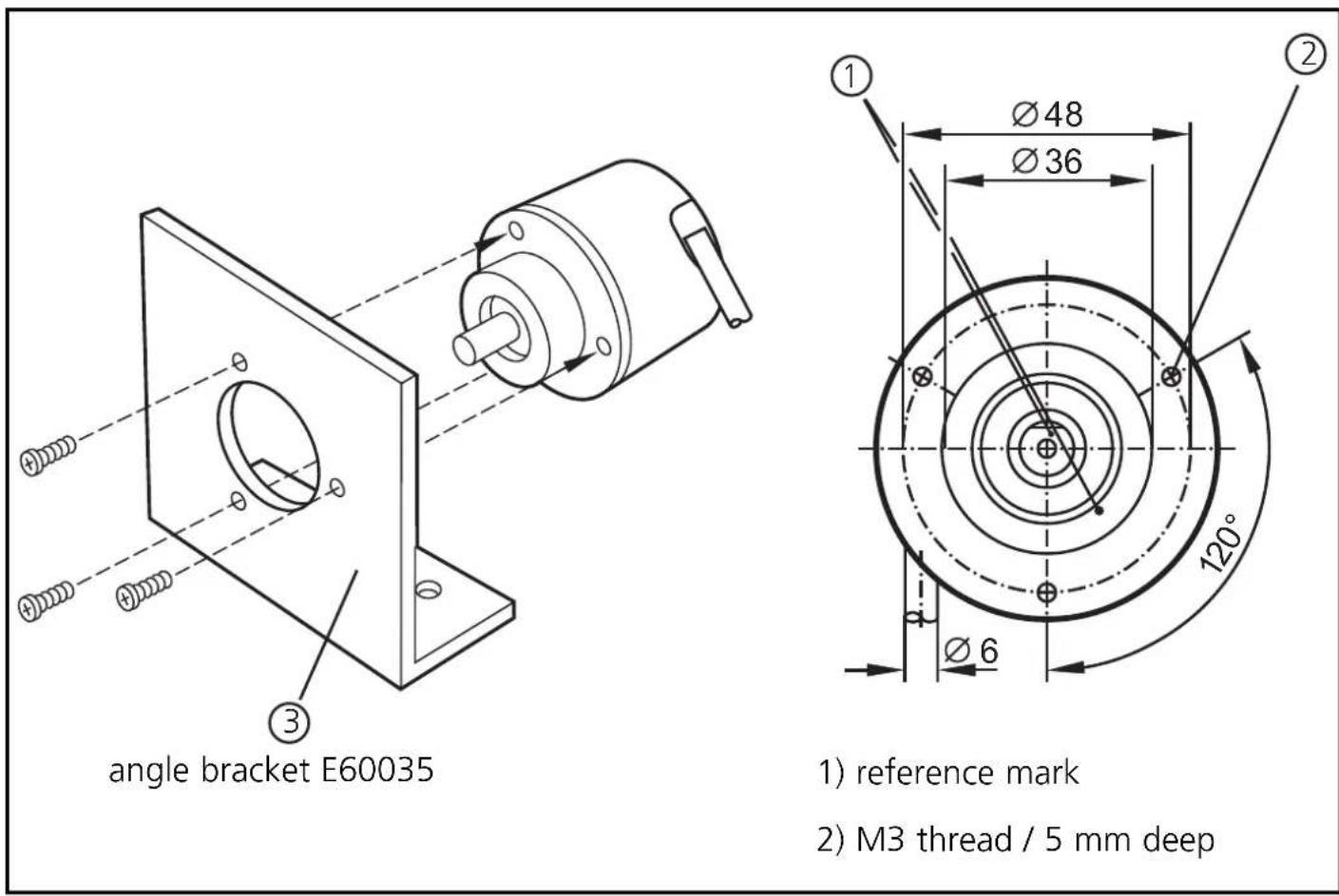
The encoder can be screwed to the angle bracket. The shaft should be connected using a flexible bellows or spring disc coupling to compensate for shaft displacement and to protect the encoder against damage.
Linear movements can be transformed into a rotational movement using a measuring wheel or rack and pinion. For mounting the maximum permissible shaft loads of the encoder must be taken into account.
Mounting the angle bracket on a resilient base protects the encoder against too high a stress due to roughness of the material.
The data sheet, further documents and suitable accessories are available on our website at www.ifm.com.
Brand : IFM
Model : RV6026
Category : Detector