EasyManual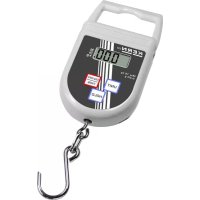
CH 15K20 - Scale Kern - Free user manual and instructions
Find the device manual for free CH 15K20 Kern in PDF.



User questions about CH 15K20 Kern
0 question about this device. Answer the ones you know or ask your own.
Ask a new question about this device
Download the instructions for your Scale in PDF format for free! Find your manual CH 15K20 - Kern and take your electronic device back in hand. On this page are published all the documents necessary for the use of your device. CH 15K20 by Kern.
USER MANUAL CH 15K20 Kern
Further language versions you will find online under www.kern- sohn.com/manuals
Electronic Suspended Balance Operating instructions / Logbook Version
3.2 Observe and keep the operating instructions for a later use ................... 10
1.1 General hints concerning these instructions
Read the operating instructions completely before using this device. Only use the device following the instructions specified in these operating instructions. This helps to keep safe persons and material assets. In these operating instructions you will find the required information about the intended use of your device. These operating instructions have been translated from German. The original version has been created in German language.
1.2 Conventions for presentation
Operating instruction
Steps for assembly / installation activities whose sequence has to be followed upon
Square brackets are used to show buttons Example: [X]-button
1.2.2 Description how to operate the device
Button long-time pressed / Keeping button pressed
Important and obligatory information describe highlighted facts which you must take into consideration and which always are valid (e.g. legal regulations or business terms). INFORMATION
Here you find important obligatory information
1.2.4 Supplementary information, tips and recommendations
2.1 Description of the device
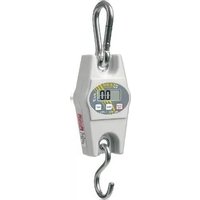
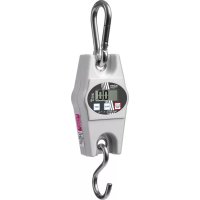
This balance is a suspended balance. Suspended balances are used e.g. for checkweighing in the goods entrance and shipping areas or to determine the weight of e.g. suitcases, fruits or wild animals.
Balance: The balance purchased by you is intended to define the weighing value of weighed goods. It is intended to be used as a “non-automatic balance“, i.e. the material to be weighed is suspended on the balance hook vertically, manually, carefully and without jerks. The balance may only be used for lifting and weighing of freely movable loads. As soon as a stable weighing value is reached, the weighing value can be read. Hand grip: The hand grip of the balance is provided for manual holding. The hand grip must not be connected with the load attachment devices.Description of the device CH-BA-def-2440 en | 7
Example (the actual type plate may differ): Pos. Designation
Data for power supply
Weighing range [Max]
Read the operating instructions completely before using this device. Only use the device following the standards specified in these operating instructions. This helps to keep safe persons and material assets.
3.1 Testing upon acceptance
When receiving the device, please check packaging immediately, and the device itself when unpacking for possible visible damage.
3.2 Observe and keep the operating instructions for a later use
The operating instructions contain important notices for a safe handling of the device. They must be observed by everyone who works with the device. The operating instructions must always be available when the device is operated and they must be kept for the whole life time of the balance.
3.3 General information concerning the warning notices
In these operating instructions warning notices are used in order to warn you of possible damage of persons or material assets under certain circumstances. Signal word Description DANGER The non-observance of the warning causes immediately severe injury, permanent impairment (e.g. loss of a member) or the death of the operator or third parties WARNING The non-observance of the warning may cause severe injury, permanent impairment (e.g. loss of a member) or the death of the operator or third parties CAUTION The non-observance of the warning may cause light injury or transitory impairment (e.g. light cutting) of the operator or third parties NOTICE The non-observance of the warning may cause damage to material assetsGeneral safety information CH-BA-def-2440 en | 11 Warning of personal injury: ⚠ SIGNAL WORD
Symbol Type and source of the risk Possible consequences of the risk Measures to be taken to avoid this risk Warning of damage to material assets: NOTICE
Measures to avoid damage to material assets Symbols in the warning notices: Symbol Significance Warning Signs Warning symbols warn you of dangers which possibly may cause personal injury. The symbol characterizes the type of risk.
Warning of electrical voltage
Warning of explosive material
Warning of suspended load
Warning of falling loadsGeneral safety information 12 | en CH-BA-def-2440 Symbol Significance Mandatory signs Mandatory signs prescribe measures which must be followed upon in order to avoid personal injuries or damage to material assets. The symbol shows the necessary activities or objects to avoid damage to material property.
Marks a prescribed action
- Our balances are non-automatic balances, not provided for the use in dynamic weighing processes. However, the balances can also be used for dynamic weighing processes after verifying their individual operative range, and here especially the accuracy requirements of the application.
- Do not leave any permanent load on the hook. This may damage the measuring system as well as safety-relevant parts.
- Strictly avoid jerky pulling and overload on the balance, of the crane or any type of load attachment devices above the specified maximum load (Max.), under deduction of an already existing tare load. The balance, the crane or the load attachment device could be damaged by this.
- Do not modify the construction of the balance, the crane or any type of load attachment devices. This may lead to incorrect weighing results, safety-related faults and destruction of the balance, the crane or the load attachment device.
- The balance must never be used for transporting persons.
- The balance must never be used for pulling loads over an inclined surface.
- The balance must never be used for detaching, pulling or dragging loads.
- Persons or objects may never stay under the load, as they may be injured or damaged.
- Never operate the balance in explosive environment.
- The balance may only be used according to the described conditions. Other areas of use must be released by KERN in writing.
- The balance must not be used for weighing persons.
- This balance does not correspond to the medical product law (MPG) and is not provided for medical purposes.
- Do not suspend the balance on load attachment devices. The balance must be held by hand.General safety information CH-BA-def-2440 en | 13
3.5 Duties of the owner-operator
The owner-operator will be obliged to:
- Follow the national accident prevention regulations and all safety at work and operating regulations.
- use the device only according to the conditions specified in these operating instructions and observe all safety information and indications mentioned in these operating instructions. Any type of use which is not specified in these operating instructions, will be considered as improper use. The owner-operator will be responsible for injury to persons and damage to material assets, which result from such non-intended use. Messrs. KERN & SOHN cannot be held liable for any damage which results from an improper use of the device.
- Carry out maintenance and have repaired the suspended balance and the load attachment device at regular intervals (for more information see chapter “Cleaning, maintenance and servicing”.
- log all test results and record them in the logbook.
- make sure that the operating instructions are always available on the operating site of the device.
- allow only to sufficiently instructed staff to operate the device.
3.6 Qualification of the users
The owner-operator must make sure that the device is only operated by sufficiently instructed staff.
- Assembly, commissioning, maintenance and servicing may only be carried out by trained specialized staff.
- Only trained and instructed staff may operate the balance.
- Repairs must only be performed by trained specialized staff.
3.7 Organizational measures
- All maintenance works must be documented (see “Checklist „Regular maintenance“ “).
- Spare parts must be documented. Spare parts and repairs
- Only original spare parts may be used.
- Weight-bearing components must not be replaced.General safety information 14 | en CH-BA-def-2440
3.8 Environmental conditions
- The environmental conditions specified in the operating instructions must be adhered to. Observe the technical data in the device overview.
- Do not operate the balance in corrosive environment.
- Protect the balance against high humidity, vapours, liquids and dust.
- Avoid extreme heat as well as temperature variations, e.g. due to direct sunlight
- Major display deviations (incorrect weighing results) may be experienced should electromagnetic fields (e.g. due to mobile phones or radio equipment), static electricity accumulations or instable power supply occur. Change location or remove source of interference.
3.9 Rechargeable batteries and Batteries
General: An improper use of rechargeable batteries or batteries may result in fire, explosion, exhausting poisonous vapours or exposing caustic liquids. So rechargeable batteries or batteries must be generally:
- Protected against fire and heat.
- Never exposed to high pressure or microwaves.
- Not brought in contact with fluids or chemical substances.
- Never short-circuit or put in contact the electrical contacts of rechargeable batteries or batteries with metallic objects.
- Never modify rechargeable batteries, batteries and charging units.
- Batteries may never be reloaded.
- Never use or reload a defective, damaged or deformed rechargeable battery. Inserting. exchanging and storage: When inserting rechargeable batteries and batteries, observe the correct polarity (see specification of “+/-“ in the rechargeable battery or battery compartment). Replace the rechargeable batteries and batteries with types recommended by the manufacturer. If possible, remove the rechargeable batteries and batteries and store them separated (protected against short-circuit) if the balance is not used for a longer time. Leaking battery liquid could damage the balance.General safety information CH-BA-def-2440 en | 15 When battery liquid escapes: Liquid may escape from damaged rechargeable batteries and batteries. Please observe the following:
- Avoid any contact of the escaped liquid with your skin, eyes or clothing.
- Wear protective clothing / protection equipment when you want to touch and to remove a defective rechargeable battery or battery.
- Clean the skin or clothing points having been in contact with battery liquid thoroughly with soap sud and rinse the affected points thoroughly with clear water.
- If the battery liquid came in contact with the eyes, rinse your eyes immediately with clear water. After that consult a doctor immediately.
For works on the suspended balance generally consider:
- Take great care when operating the crane and follow the general rules for crane operation.
- Check all parts (hook, eyelet, rings, rope slings, cables, chains etc.) for excessive wear and damage.
- Work only with appropriate speed.
- Never use the balance for transporting loads.
- Do not stand or go under suspended loads.
- Keep an eye on suspended loads.
- Do not use on building site.
- Never exceed the nominal rated load of the suspended balance or any kind of load attachment device on the suspended balance.
- Always avoid vibrations and horizontal forces.
- Avoid any kind of shock, torsion and oscillating (e.g. caused by inclined suspending)
- Lift the load only as far as necessary.Overview of the device 16 | en CH-BA-def-2440 4 Overview of the device
Balance (Front view)
Button Designation Function
ON/OFF ➢ Switch-on ➢ Switch off (Hold button for a long time) ➢ Taring ➢ Scroll forward in menu
UNIT ➢ Switch-over weighing unit
HOLD ➢ Fix the weight display ➢ Display average value for animal weighing ➢ Confirm menu setting
The current measuring unit is kilogram
The current measuring unit is pound
The current measuring unit is Newton
4.4 Symbols on the device
Do not stand or go under suspended loads.
Do not use on building site.
Keep always an eye on suspended loads.
The product conforms to the requirements of the German Product Safety Act.
This product fulfills the valid European requirements.
Prior to transport remove adhering loads from the balance. During transportation never hold the balance by the hook as this could cause damage to the balance. During transportation hold the balance on the casing, shackle or the holding grip, as necessary.
Returning is only possible according to the regulation of the general terms and conditions. Only use original packaging for returning. Suspended balances, once having been used, cannot be returned. Suspended balances, once having been used and showing traces of wear, cannot more be returned. The suspended balances have been sealed by KERN & SOHN.
- The packaging is sealed by an adhesive tape. A broken seal will be considered as trace of wear and commits to purchase. Returns are only allowed if you determine faults and claim the defect according to the general terms and conditions. Exemplar illustration of a seal Procedure for returning:
- Make sure that all parts of the scope of delivery are complete
- Pack all parts in the original packaging
5.2 Shutdown and storage
- Switch off suspended balance and remove batteries.
- Store the suspended balance in the original packaging.
- Do not store the balance outdoors.Assembly, Installation and Commissioning 20 | en CH-BA-def-2440 6 Assembly, Installation and Commissioning
6.1 Unpacking and check
For returning, please refer to the instructions in chapter “Return transport“ Remove all parts of the scope of delivery from the packaging and put aside the packaging material. Then check if all parts of the scope of delivery are present and free of damage.
6.2 Scope of delivery
- Operating instructions / logbook
6.3 Original dimensions
Prior to commissioning, check the dimensions according to the „Drawings for maintenance“ in the appendix. Enter the measured dimensions in the checklist „Regular maintenance“ in the appendix. To check the dimensions, use always the same measuring principle and suitable test equipment.Assembly, Installation and Commissioning CH-BA-def-2440 en | 21
6.4 Rechargeable battery/battery operation
Risk of fire and explosion due to wrong handling of rechargeable batteries/batteries Fire or explosion may lead to severe injury Follow without fail the indications about rechargeable batteries and batteries in chapter “General safety information“ Never charge the batteries. Only rechargeable batteries may be recharged.
6.4.1 Inserting, exchanging and storage
When inserting rechargeable batteries and batteries, observe the correct polarity (see specification of “+/-“ in the rechargeable battery or battery compartment). Replace rechargeable batteries and batteries only by the same or by a type recommended by the manufacturer. If possible, remove the rechargeable batteries and batteries and store them separated (protected against short-circuit) if the balance is not used for a longer time. Leaking battery liquid could damage the balance.Assembly, Installation and Commissioning 22 | en CH-BA-def-2440 Insert batteries:
1. Push out the battery compartment cover on the back side in direction of the arrow.
2. Connect the block battery by the pressure buttons to the battery contact-clip and
insert it into the battery compartment.
3. Slide-in the battery compartment cover.
6.5 Initial Commissioning
Prior to commissioning check the original dimensions. In order to obtain exact results with the electronic balances, the balance must have reached its operating temperature (see warming up time at chapter “Technical data”. During this warm-up time the balance must be connected to the power supply (mains, rechargeable battery or battery). The accuracy of the balance depends on the local acceleration of gravity. Strictly observe hints in chapter „Adjustment”.Adjustment CH-BA-def-2440 en | 23 7 Adjustment As the acceleration value due to gravity is not the same at every location on earth, each balance must be coordinated - in compliance with the underlying physical weighing principle - to the existing acceleration due to gravity at its place of location (only if the balance has not already been adjusted to the location in the factory). This adjustment process must be carried out for the first commissioning, after each change of location as well as in case of fluctuating environment temperature. To receive accurate measuring values it is also recommended to adjust the balance periodically in weighing operation. INFORMATION
- In the technical data you will find information about the adjustment weights recommended by KERN & SOHN.
- Adjustment weights of different tolerance classes are allowed, but not optimal. The accuracy of the adjustment weight must correspond at least to or, if possible, be better than the readability [d] of the balance.
- The highest load on the balance must not be exceeded during adjustment.
- Info about test weights can be found on the Internet at: http://www.kern-sohn.com
- If the value of the adjustment weight in the menu of your balance is prescribed, you must use such a weight for adjustment. NOTICE
For adjustment make sure that the environmental conditions are stable (e.g. avoid vibration or air flow). Please note that a warm-up time is necessary for adjustment, that the balance is stabilized by itself. For warm-up time, please see the technical data. Make sure that for adjustment, only the adjustment weight is hanging on the hook and no other load. Errors during adjustment or the use of an incorrect adjusting weight will result in an error message. Repeat the adjustment process in this case.Adjustment 24 | en CH-BA-def-2440 Procedure:
Press [UNIT] and hold
< cAL> is displayed Release [UNIT]
Wait until the required adjustment weight is displayed
Suspend the adjustment weight
<F> is displayed If another message appears on the screen, an error may have occurred (see chapter „Error messages“.
8.1 Operating safety instructions
Falling loads due to rupture of the load carrier or misuse Risk of severe injuries or death if persons are hit by falling loads Observe without fail the instructions in chapter „General safety information“ During operation, especially observe the instructions given in the safety information in „Safe working“ Prior to any use, check the balance for accurate function and absence of damage. Never exceed the specified maximum load (Max.) of the balance. ⚠ WARNING
Danger when lifting heavy load Lifting heavy loads may cause injuries and permanent impairments (e.g. damage to the spine) When lifting heavy loads, care of the correct body posture (back straight, lifting from the knees) Squat down if you want to put the load down again Ask another person for help if the load is too heavy for you.Operation 26 | en CH-BA-def-2440
8.2 Loading the balance
For good weighing results observe the following, illustrations see next page:
- Do not suspend the balance on load attachment devices. The balance must be held by hand.
- Do not pull or push the load or the loaded balance.
- Do not pull the hook horizontally. Loading the balance:
1. Position the hook of the balance over the load.
2. Hang the load on the hook.
3. Lift the balance with the load slowly.
Keep balance only by hand
The display lights up and the balance performs a self-test Wait until the weight display appears
The balance is now ready for weighing Switch-off:
Keep [ON/OFF/TARE] pressed
Hang the container on the hook The weight of the container is shown
Zero appears on the display
- After removing the container, the container weight will be displayed as negative value (Minus)
- To delete the tare value, unload the suspended balance and press
Overloading exceeding the stated maximum load (max) of the balance, minus a possibly existing tare load, must be strictly avoided. This could cause damage to the balance. Exceeding the maximum load is indicated by the display < E>. In this case unload balance or reduce preload.
Hang the weighing material on the hook
8.6 Switch-over weighing unit
Hang the weighing material on the hook The weight is indicated
The weight will be displayed in the next weighing unit
- The next weighing unit appears when pressing [UNIT].
The different Data-Hold functions can be found in the function menu (see “Overview of the function menu“. Example for setting < H4>:
Hang the weighing material on the hook
As soon as a stable weight value is measured, it will be frozen <> means the value is frozen
Press [HOLD] to return to the weighing mode.
8.8 Animal weighing function
The Animal Weighing function allows you to measure animals or samples that move whilst being measured.
- If you use a weighing container, tare before weighing (see chapter 8.4).
- The result is a mean value formed by 16 measurements.
Select the animal weighing function in the function menu (see chapter 9.2)
During measurement a countdown appears on the display and <> starts flashing
When the mesaurement is finished, <> and the weighing result are displayed Press any key to exit the display again
8.9 Peak value function
The peak value function displays the highest load value (peak value) of a weighing. The measuring frequency is 200 ms.
Hang the weighing material on the hook
The peak value is displayed by a <> top left in the display The peak value is displayed for approx. 5 seconds. If during the display a greater peak value is measured, the new value will be displayed automatically.Operation CH-BA-def-2440 en | 33
8.10 Other functions
8.10.1 Zero-Tracking
Zero tracking compensates automatically small weight variations, caused e.g. by dirt or temperature changes. The balance continues to display 0. If small quantities are removed from or added to the load, this function, however, can cause a wrong weighing result being displayed (e.g. by slowly draining liquids). In this case the function should be disabled.
The Zero tracking can be enabled or disabled in the setup menu. Information about opening the menu and the operation can be found in chapter „Menu”
8.10.2 Automatic switch-off function
When switch-off function enabled: The balance switches off, if the keyboard is not operated and if within the last 3.5 minutes no weight change has been measured. For use, the balance must be switched-on again.
If no key is pressed in the menus, the balance changes after a certain time automatically to weighing mode.
9.1 Navigation in the menu
Press [HOLD] and keep pressed
The function selected as last will appear on the display (in this example < H1>) Release [HOLD]
Switch off the balance
First press [HOLD] and keep pressed
Additionally press and hold [ON/OFF/TARE]
Press again [HOLD] and keep pressed
Display < tr > appears Release [HOLD] and [ON/OFF/TARE]
Scroll through menu items
Overview of the function menu Adjustment Function Description Chapter
Data-Hold function 1 Weighing value is frozen for 5 seconds after pressing [HOLD]
Data-Hold function 2 Weighing value will remain frozen after pressing [HOLD] until another key is pressed
Data-Hold function 4 Weighing value will remain frozen after reaching a stable value until another key is pressed
Animal weighing function Function for weighing busy loads
Standard settings are marked with a .
Adjustment Function Description
ye5 YesCleaning, maintenance and servicing CH-BA-def-2440 en | 37 10 Cleaning, maintenance and servicing
Short-circuit when liquid penetrates the interior of the device Short-circuit may cause fire and severe injury Do not open the device. No parts need to be cleaned inside the device. Make sure, that batteries or rechargeable batteries do not come in contact with liquids. NOTICE
Do not use aggressive cleaning agents (e.g. solvents), as they cause reactions with and damage the materials. Do not use metallic brushes or cleaning sponges of steel wool, because they damage the surface. Ensure that no liquid penetrates into the device. Recommended cleaning: For cleaning the device use a mild cleaning agent, e.g. a household window cleaning agent and a soft cloth.Cleaning, maintenance and servicing 38 | en CH-BA-def-2440
10.2 Maintenance and repair
Maintenance and servicing may only be carried out by trained specialized staff. ⚠ WARNING
A faulty maintenance may cause the load carrier to break down and falling load Falling load may cause severe injury or death Have serviced the balance at regular intervals by trained specialized staff with competent knowledge of working with suspended balances. Consider the maintenance work as per chapter „Maintenance Table” Consider the national accident prevention regulations and all operator health and safety at work and operating regulations. If safety shortcomings and discrepancies with the checklists occur, shutdown the balance immediately. Have the parts exchanged only by trained specialized staff. Do not repair the balance by yourself.
- Carry out maintenance work as per chapter „Maintenance Table”.
- Maintenance work is restricted to specialist staff possessing competent knowledge of working with suspended balances. Thereby the national regulations for prevention of accidents as well as the working, operation and safety regulations of the owner-operator.
- To check the dimensions only use suitable test devices / feeler gauges.
- The results of the regular maintenance must be entered in the list „Checklist „Regular maintenance“”.
- Clean the load carriers before test procedure.
- Replaced parts must be entered in the list „Spare parts and repairs”.
10.2.1 Monitoring of Test Resources
Within the scope of quality assurance the metrological properties of the balance and of an existing test weight must be checked at regular intervals. The responsible user must define a suitable interval as well as type and scope of this test. Information regarding the test equipment monitoring of balances as well as the test weights required for this is available on the KERN homepage (www.kern-sohn.com). In KERN’s accredited DKD calibration laboratory test weights and balances may be calibrated (return to the national standard) fast and at moderate cost.Cleaning, maintenance and servicing CH-BA-def-2440 en | 39
10.2.2 Maintenance Table
Regular maintenance: Interval Maintenance Prior to each usage
- Check for fault-free operation of the attachment devices Commissioning, every 3 months thereafter
- Check all dimensions and enter them in the checklist „Regular maintenance“
- Check the balance and the attachment devices (e.g. hook, hand grip) for wear and tear, such as e.g. plastic deformation, mechanical damage (unevenness), notches, striation, cracks, corrosion, thread damage and torsions.
- Should a dimension exceed the admitted deviation from the original dimension (see checklist „Regular maintenance“ or should further discrepancies occur, the balance must be shutdown immediately.
- The balance must be repaired only by trained specialized staff. Never do repair it by yourself!
- All repairs and spare parts must be documented by trained specialized staff in the list „Spare parts and repairs“. Note: For maintenance and check for wear and tear, please observe the „Drawings for maintenance“ in the appendix. In the following cases, the load carriers must under no circumstance be used again:
- If deviations are identified during the inspections specified for maintenance.
- If the type plate is missing.
- If the maximum load (Max.) cannot be read clearly.
- If the load carriers have suffered overload or other damaging influences. In this case the load carriers must be removed from operation; a reuse will only be allowed after a successful test.Disposal 40 | en CH-BA-def-2440 11 Disposal
Dispose of old devices and accessories separately from your household waste. Disposal of packaging and device must be carried out by operator according to valid national or regional law of the location where the device is used. The device consists of several components and materials, for example:
- Electronic components (boards, electric cables)
- Synthetic material (housing)
- Metal (hook) An improper disposal of the device may cause damage to human beings and to the environment. A proper and environment-friendly disposal helps to avoid harmful contamination, as well as raw material can be recovered. Disposal of batteries and rechargeable batteries:
Rechargeable batteries and batteries do not belong in household waste. Disposal of rechargeable batteries and batteries must be carried out by the owner-operator according to valid national or regional law of the location where the device is used.Disposal CH-BA-def-2440 en | 41 INFORMATION
The following information is valid for Germany. In our capacity as retailers we are obliged in connection with the distribution of batteries and rechargeable batteries to inform our end users as follows:
- End users are bound by law to return waste batteries and rechargeable batteries.
- Batteries and rechargeable batteries can be returned after use free of charge to municipal collection points or specialist shops. Precautions against short circuit must be taken in cases where the service life of the batteries / storage batteries has not yet expired.
- Return options are restricted to the types of battery and rechargeable battery that we keep or used to keep in stock as well as the quantity commonly disposed of by end users.
- A crossed-out bin means, that you must under no circumstance dispose of the batteries or rechargeable batteries in the household waste. Used batteries or rechargeable batteries may contain harmful substances which can damage human beings and environment if not disposed of properly.Warranty 42 | en CH-BA-def-2440 12 Warranty Loss of warranty due to
- Our conditions in the operation manual are ignored
- The device is used beyond the described uses
- The device is modified or opened
- Mechanical damage and damage caused by media / liquids
- Natural wear and tear
- The device is improperly set up or incorrectly electrically connected
- The measuring system is overloaded
Capacity of batteries exhausted
- After switching on: Weighing cell defective
- During a weighing process: Overload
- During adjustment: Faulty adjustment (adjustment weight exceeded or too low)
In case of a failure in the program sequence, briefly turn off the balance and disconnect from power supply. The weighing process must then be restarted from the beginning. Fault Possible cause Display is not lit up
- The balance is not switched on.
- The battery was not plugged.
- This battery is empty. The balance cannot be switched
- Battery empty or defective
- [ON/OFF/TARE] defective
- [ON/OFF/TARE] not correctly activated The display does not react to load change
- Load cell cable defective The displayed weight is permanently changing
- Draught/air movement
- Vibration at the hook
- Suspended load is moving
- The hook has contact with foreign objects
- Electromagnetic fields / static charging (choose different location/switch off interfering device if possible)
- Load cell defective The weighing result is obviously incorrect
- The balance display is not at zero when balance unloaded
- Adjustment has been carried out with a wrong or an inaccurate adjustment weight
- Wrong weighing unit selected
No deformation, wear and tear or cracks Date Tester Max. admitted deviation from the first measurement 1 % 1 % 5 % 5 % 5 % 5 % Grip Hooks Chain link Other parts Before first use
No deformation, wear and tear or cracks Date Tester Max. admitted deviation from the first measurement 1 % 1 % 5 % 5 % 5 % 5 % Grip Hooks Chain link Other parts Before first useSpare parts and repairs 47 | en CH-BA-def-2440 A3 Spare parts and repairs Suspending balance Model
- Further languages of the current EC/EU Conformity declaration can be found online in: www.kern-sohn.com/ce
- For verified balances (= balances assessed for conformity) the assessment of conformity is included in the scope of delivery.Declaration of conformity CH-BA-def-2440 en | 49CH-BA-def-2440 fr | 1 Français KERN