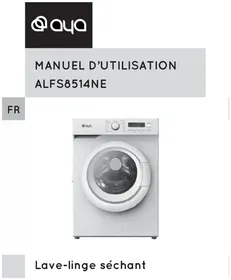
USER MANUAL ALFS8514NE AYA
MANUEL D'UTILISATION ALFS8514NE
FR
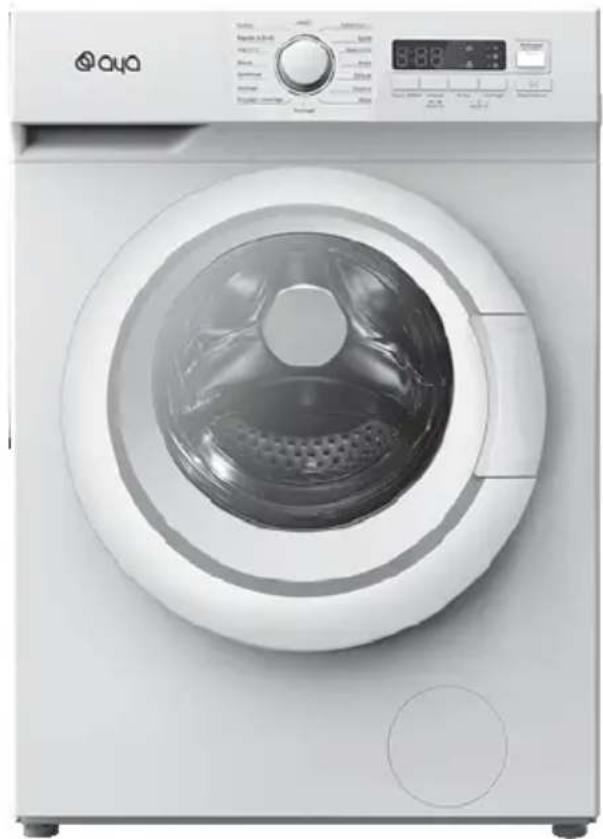
Lave-linge séchant
Table des matieres
FR
CONSIGNES DE SECURITE -1-
DESCRIPTION -10-
INSTALLATION -13-
UTILISATION -16-
ENTRETIEN ET NETTOYAGE -21-
THIS PRODUCT IS FOR HOUSEHOLD USE ONLY!
PLEASE READ CAREFULLY THIS MANUEL BEFORE YOUR FIRST USE AND SAVE IT FOR FUTURE REFERENCE.
Before using this electrical appliance, carefully read these instructions and keep the user manual for future reference:
-
This appliance is intended for domestic use and similar applications, such as:
-
kitchen areas designated for store and office personnel, and other professional environments;
-farms;
- use by guests in hotels, motels and other residential environments;
-
guesthouse environments.
-
If the supply cord is damaged, it must be replaced by the manufacturer, its service agent or similarly qualified persons in order to avoid a hazard.
- Before connecting the appliance to a wall socket, ensure that the local electrical current matches the one specified on the appliance's nameplate. This appliance should only be connected to a grounded socket.
-
Unplug the mains cable from the mains as soon as you stop using it and before any cleaning or maintenance operation.
-
This appliance can be used by children aged from 8 years and above and persons with reduced physical, sensory or mental capabilities or lack of experience and knowledge if they have been given supervision or instruction concerning use of the appliance in a safe way and understand the hazards involved. Children shall not play with the appliance. Cleaning and user maintenance shall not be made by children without supervision.
- Electrical and electronic equipment are collected through a separate form of waste collection. Do not dispose of electrical and electronic equipment alongside household waste. Dispose of them at the appropriate sites. Collection systems and locations (sorting centres, waste disposal centres) are available from local authorities and distributors. By disposing of your end-of-life product at the appropriate recycling sites, you can help protect the environment as well as your health.
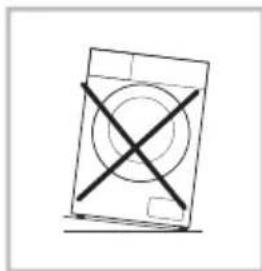
- WARNING: To avoid deteriorating the appliance, transport it in its operating position, along with its transport brackets (depending on model). At the time of unpacking, and to prevent risks of suffocation or injury, keep packaging materials out of children's reach.
- WARNING: When disposing of your appliance, and to avoid any risk of injury, remove what may be hazardous: cut the power cable so it is flush with the appliance. Check with your local services for places where you are allowed to dispose of the appliance. Remove the door lock in order to prevent children from becoming trapped inside.

- Instructions for installing, using, and performing maintenance on the appliance are provided in the sections titled "INSTALLATION", "USE", and "MAINTENANCE AND CLEANING".
- The maximum mass of dry cloth in kilograms is 8 kg , the maximum mass of dry textile material in kilograms to be used in the appliance is 5 kg .
- The appliance must be connected to the water distribution network using a new set of pipes. It is recommended to not reuse old pipe sets.
- The minimum inlet water pressure permitted is 0.05MPa .
- The maximum permitted water pressure of the water supply is 1MPa .
- Never force the door open when the appliance is running.
- Never open the laundry drawer while the appliance is running.
- Keep pets away from the appliance.
- RISK OF BURNS!
Do not touch the drain hose or the water supply hose. The appliance may reach high temperatures while operating.
- RISK OF DEATH BY ELECTRIC SHOCK!
Avoid using multiple plugs or extension cords.
Do not connect the appliance to damaged outlets.
Never pull the cable to disconnect the appliance - always disconnect from the plug.
Avoid connecting or disconnecting the appliance with wet hands as this poses a risk of electrocution.
Never touch the appliance with wet hands or feet.
- Risk of flooding!
Take all necessary measures to prevent the hose from slipping.
- Risk of fire!
Do not leave flammable liquids within close proximity of your appliance.
The openings must not be obstructed by a carpet.
- Child safety!
Never leave children unattended near the appliance. Children may lock themselves inside the appliance, with a risk of death.
The door glass and its surface may become extremely hot while the unit is operating. Therefore, touching the appliance may cause burns to children's skin.
Keep packaging materials out of the reach of children. Children of less than 3 years should be kept away unless continuously supervised.
- The appliance must not be installed behind a lockable door, a sliding door or a door with a hinge on the opposite side to that of the tumble dryer, in such a way that a full opening of the tumble dryer door is restricted.
WARNING!
- The tumble dryer is not to be used if industrial chemicals have been used for cleaning;
- The lint trap has to be cleaned frequently, if applicable;
- Lint must not be allowed to be accumulated around the tumble dryer (not applicable for appliances intended to be vented to the exterior of the building);
- Adequate ventilation has to be provided to avoid the back flow of gases into the room from appliances burning other fuels, including open fires.
- Do not dry unwashed items in the tumble dryer.
- Items that have been soiled with substances such as cooking oil, acetone, alcohol, petrol, kerosene, spot removers, turpentine, waxes and wax removers should be washed in hot water with an extra amount of detergent before being dried in the tumble dryer.

- Items such as foam rubber (latex foam), shower caps, waterproof textiles, rubber backed articles and clothes or pillows fitted with foam rubber pads should not be dried in the tumble dryer.
- Fabric softeners, or similar products, should be used as specified by the fabric softener instructions.
- The final part of a tumble dryer cycle occurs without heat (cool down cycle) to ensure that the items are left at a temperature that ensures that the items will not be damaged.
- Remove all objects from pockets such as lighters and matches.
- Never stop a tumble dryer before the end of the drying cycle unless all items are quickly removed and spread out so that the heat is dissipated.
- For appliances with ventilation openings in the base, a carpet must not obstruct the openings;
- Exhaust air must not be discharged into a flue which is used for exhausting fumes from appliances burning gas or other fuels.
- The appliance must not be supplied through an external switching device, such as a timer, or connected to a circuit that is regularly switched on and off by a utility.
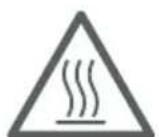
Warning: hot surface. Surfaces may become hot during appliance use.

This symbol shows that the operation manual should be read carefully.
2.2 Programmes
Programmes are available according to the type of laundry.

| Programmes | |
| Cotton | For hard-wearing garments, heat-resistant fabrics made of cotton or linen. |
| Synthetic | For washing synthetic articles, for example shirts, coats, blended fabric. When washing knitwear, detergent quantity should be reduced due to it easily forming bubbles. |
| Intensive | To increase the washing effects, washing time is increased. |
| Mix | Mixed loads consisting of garments made of cotton and synthetics. |
| Jeans | Programme especially for denims. |
| 20°C | For washing brightly coloured garments, protecting the colours. |
| Quick 15' | For quickly washing a small load of slightly soiled garments within 15 minutes. |
| Delicate | For delicate, washable fabrics, e.g. silk, satin, synthetic fibres or blended fabrics. |
| Spin Only | Only spinning with selectable spin speed. |
| Rinse&Spin | Only rinsing and spinning. |
| ECO 40-60 | Default 40°C,not selectable,suitabale for laundry washing at about 40°C-60°C. |
| Sport Wear | For washing active and sportswear. |
| Dry Only | Select it to dry clothes, the temperature is different. The drying time according to the load. Drying type: Condensing, the water will go out through the drain hose. |
| 1 Hour W/D | For a small load of synthetic garments or shirts up to 1 kg (approx. 4 shirts). This programme will help you in shirt emergencies, since the duration for washing and drying is only 1 hour. This programme is not suitable for towels or jeans. |
| Wash & Dry | The standard energy program. |
| Drum Clean | Special programme for cleaning the drum. The drum is sterilised at 90°C. Do not use this programme for washing garments. Add the correct amount of bleach to increase the cleaning effect. Use this programme according to need. |
Washing Programmes Table
| Programme | Load(kg) |
| 8kg Wash/Dry |
| Cotton | 8.0/5.0 |
| Intensive | 8.0 |
| Synthetic | 4.0/4.0 |
| Mix | 8.0/4.0 |
| Jeans | 8.0 |
| ECO 40-60 | 8.0 |
| 20°C | 4.0 |
| Spin Only | 8.0 |
| Sport Wear | 4.0 |
| Quick 15' | 2.0 |
| Rinse & Spin | 8.0 |
| Wash&Dry | 5.0 |
| Dry Only | 5.0 |
| 1Hour W/D | 1.0 |
| Delicate | 2.5 |
EN
| Program Delay | Duration time | | Dry | Temperature (Cold/20/40/60/90) | Spin(1400rpm) |
| Intensive | 3:48 | ○ | | 40/60-- | 0/400/600/800/1000/1200/1400 |
| Sport Wear | 0:45 | ○ | -- | Froid /20/40/60 | 0/400/600/800/1000/1200/1400 |
| Quick 15' | 0:15 | ○ | -- | Froid /20/40 | 0/400/600/800 |
| Jeans | 1:45 | ○ | -- | Froid /20/40/60/90 | 0/400/600/800/1000/1200 |
| Delicate | 0:49 | ○ | -- | Froid /20 | 0/400/600/800 |
| 20°C | 1:01 | ○ | -- | Froid /20 | 0/400/600/800/1000/1200 |
| ECO 40-60 | 3:29 | ○ | -- | -- | -- |
| Spin Only | 0:12 | ○ | -- | -- | 0/400/600/800/1000/1200/1400 |
| Rinse & Spin | 0:20 | ○ | -- | -- | 0/400/600/800/1000/1200/1400 |
| *Dry Only | 3:35 | ○ | standard \ strong \ 30\60\90\120 | -- | 0/400/600/800/1000/1200/1400 |
| *Synthetic | 2:20 | ○ | standard \ strong \ 30\60\90\120\0 | Froid /20/40/60 | 0/400/600/800/1000/1200 |
| *Mix | 1:20 | ○ | standard \ strong \ 30\60\90\120\0 | Froid /20/40/60/90 | 0/400/600/800/1000/1200/1400 |
| *Wash and Dry | 6:53 | ○ | standard | -- | -- |
| *1Hour W/D | 0:58 | ○ | standard | Froid /20/40 | 0/400/600/800/1000/1200/1400 |
| *Cotton | 2:40 | ○ | standard \ strong \ 30\60\90\120\0 | Froid /20/40/60/90 | 0/400/600/800/1000/1200/1400 |

Note!
- The parameters in this table are only for user's reference. The actual parameters maybe different with the parameters in above mentioned table.
DESCRIPTION
EN
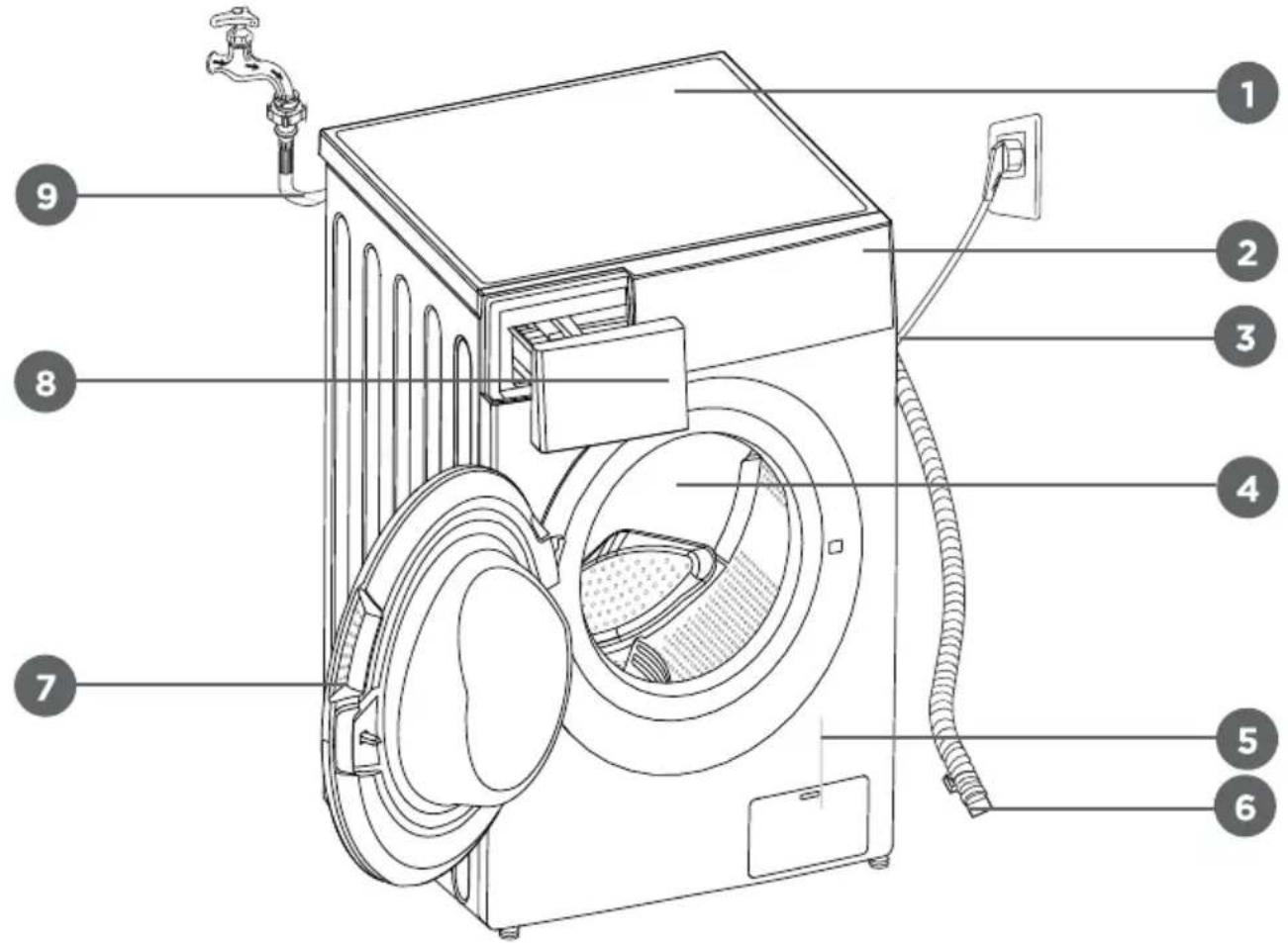
3.1 Front View
- Top cover
4.Drum
-
Door
-
Control panel
-
Service filter
-
Detergent dispenser
-
Power supply cord
-
Drain hose
-
Water supply hose
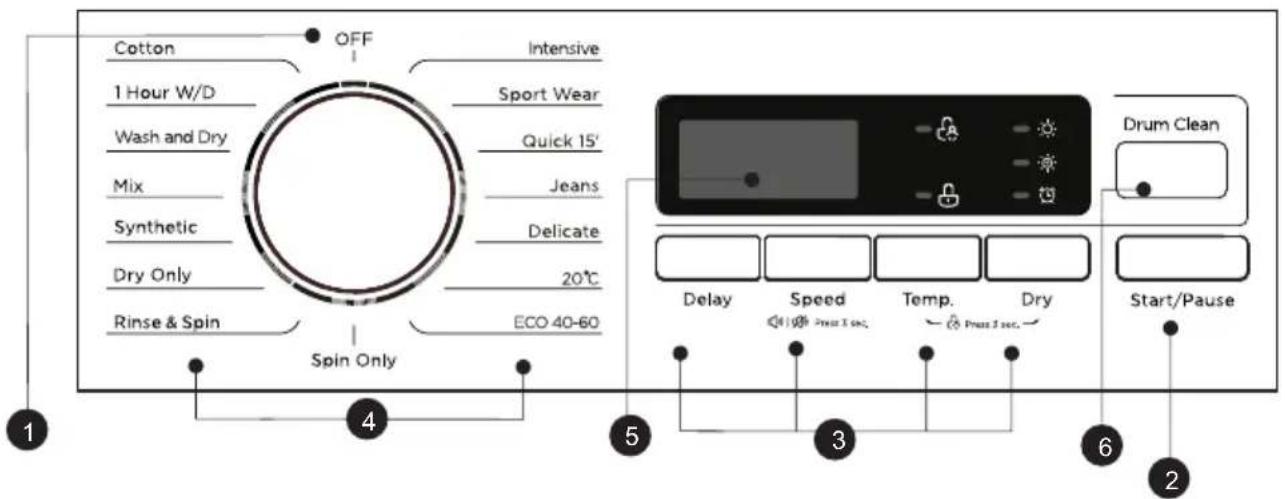
3.2 Control Panel
- On/Off
Switch the product Marche or Arret.
- Start/Pause
Press this button Départ/Pause to start or pause the washing cycle.
- Option
This allows you to select an additional function; it will light up when selected.
- Programmes
Available according to the laundry type.
- Display
The display shows the settings, estimated remaining time, options, and status messages for your washing machine. The display will remain on during the entire cycle.
- Drum Clean
Specially set in this machine to clean the drum and tube.
3.3 Display
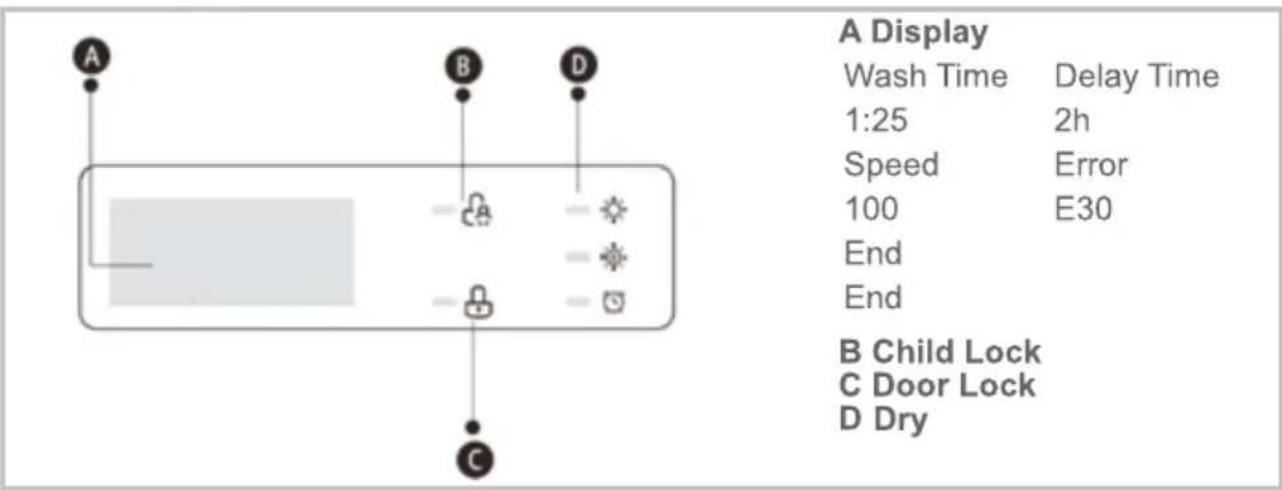
Note!
The line drawings are for reference only. Refer to real product as standard.
3.4 Detergent Dispenser
Pre wash detergent
II Main wash detergent
Softener
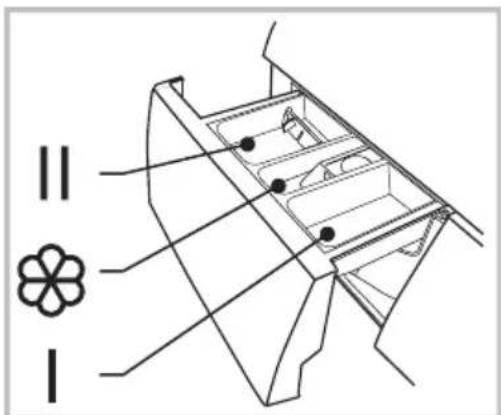
Pull out the dispenser
Caution!
Detergent only needs to be added in "compartment I" after selecting pre-washing for washing machines with this function.


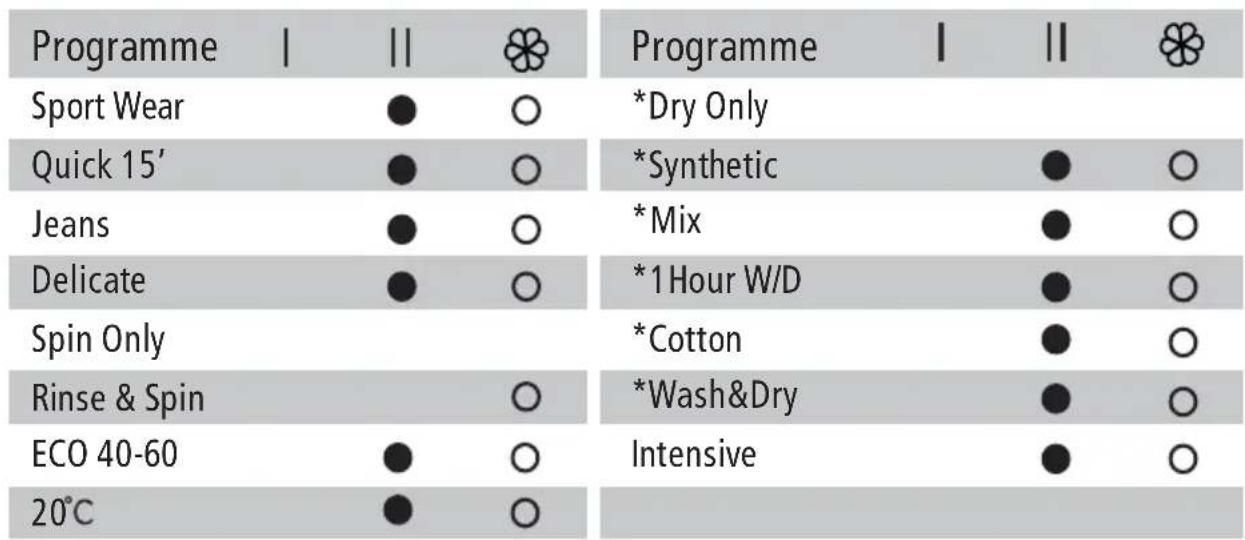
Means must Means optional
Note!
- As for the clumped together or tacky detergent or additive, before they are poured into the detergent dispenser, we suggest using some water for dilution to prevent the inlet of the detergent dispenser from being blocked and overflowing while filling water.
- Please choose a suitable type of detergent for the various washing temperatures to get the best performance with less water and energy consumption.
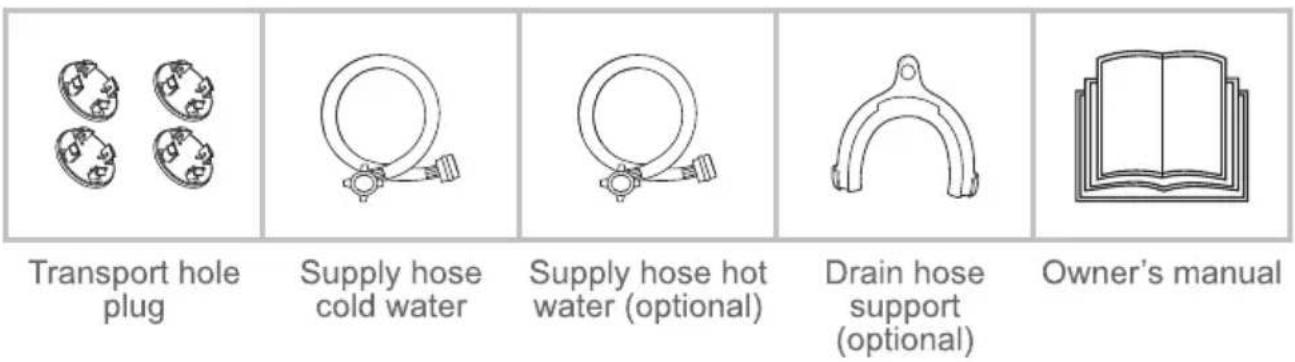
3.5 Accessories
INSTALLATION
4.1 Installation Area
Warning!
- Stability is important to prevent the product from wandering!
Make sure that the product should not stand on the power cord.
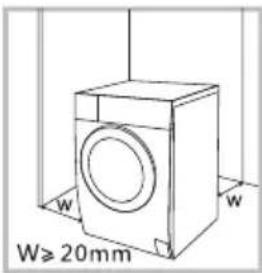
Before installing the washing machine, the location characterized as follows shall be selected:
- Rigid, dry, and level surface.
- Avoid direct sunlight.
- Sufficient ventilation.
- Room temperature is above 0°C
- Keep far away from heat resources such as coal or gas.
4.2 Unpacking the Washing Machine
Warning!
-
Packaging material (e.g. films, styrofoam) can be dangerous for children.
There is a risk of suffocation! Keep all packaging well away from children.
-
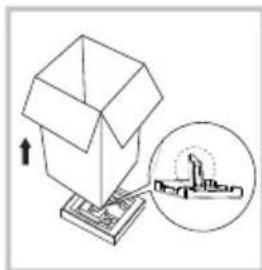
Remove the cardboard box and styrofoam packing.
- Lift the washing machine and remove the base packing. Make sure the small triangle foam is removed with the bottom one together. If not, lay the unit down on its side surface and then remove the small foam from the unit bottom manually.
- Remove the tape securing the power supply cord and drain hose.
- Remove the inlet hose from the drum.
4.2.1 Removing the Transport Bolts
Warning!
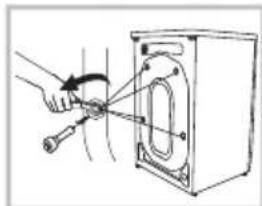
You must remove the transport bolts from the backside before using the product.
- You will need the transport bolts again if you move the product, so make sure you keep them in a safe place.
Please take the following steps to remove the bolts:
- Loosen 4 bolts with a spanner and then remove them.
- Stop the holes with the transport hole plugs.
- Keep the transport bolts properly for future use.
4.3 Levelling the Washing Machine
Warning!
The lock nuts on all four feet must be screwed tightly against the housing.
1. Check if the legs are closely attached to the cabinet. If not, please turn them to their original positions and tighten the nuts.
2. Loosen the lock nut and turn the foot until it closely contacts with the floor.
3. Adjust the legs and lock them with a spanner, make sure the machine is steady.


4.4 Connecting the Washing Machine
4.4.1 Connecting the Water Supply Hose
Warning!
To prevent leakage or water damage, follow the instructions in this chapter!
- Do not kink, crush, modify or sever the water inlet hose.
- For models equipped with hot water valve, connect it to a hot water tap with the hot water supply hose. Energy consumption will decrease automatically for some programmes.
Connect the inlet pipe as indicated. There are two ways to connect the inlet pipe.
4.4.1.1 Connection between ordinary tap and inlet hose
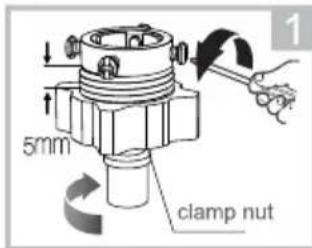
Loosen clamp nut and four bolts
Tighten clamp nut
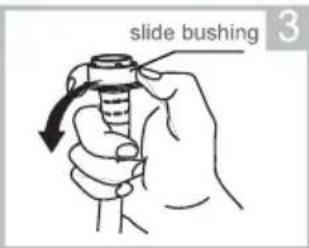
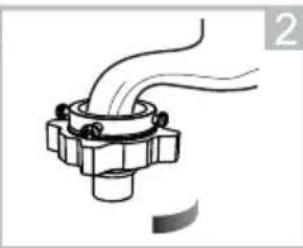
Press slide bushing, insert inlet hose into connecting base
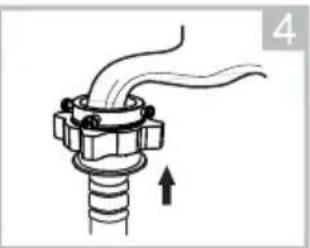
Connection finished
4.4.1.2 Connection between screw tap and inlet hose
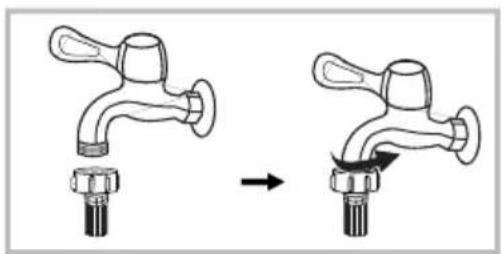
Tap with threads and inlet hose
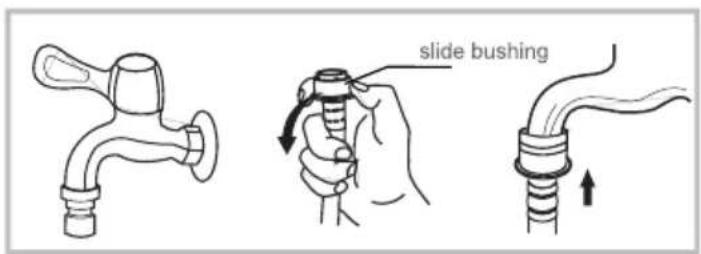
Special tap for washing machine
Connect the other end of the inlet pipe to the inlet valve at the back of the product and fasten the pipe tightly clockwise.
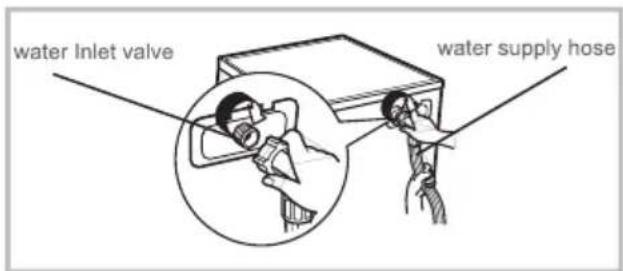
4.4.2 Connecting the Drain Hose
Warning!
- Do not kink or protract the drain hose.
- Position the drain hose properly, otherwise damage might result of water leakage.
There are two ways to place the end of the drain hose:
- Put it into the water trough.
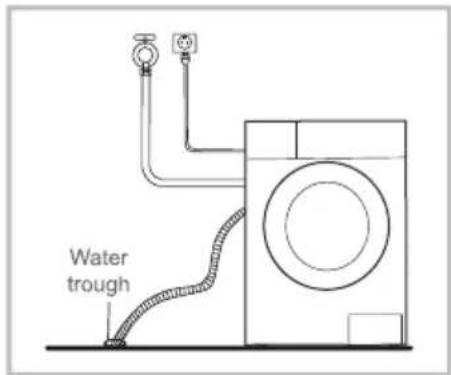
- Connect it to the branch drain pipe of the trough.
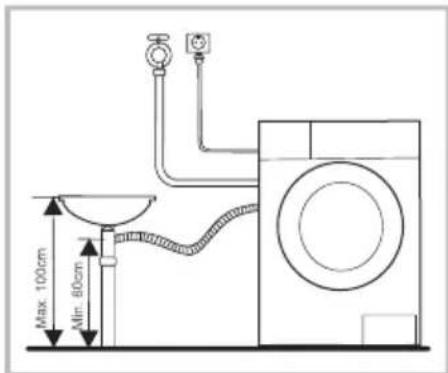
Note!
If the washing machine has drain hose support, please install it as follows.
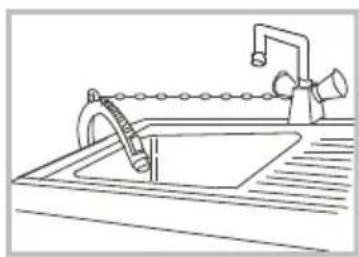
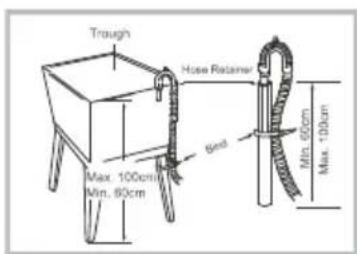
Warning!
- When installing the drain hose, fix it properly with a rope or chain.
- If the drain hose is too long, do not force it into the washing machine as it will cause abnormal noises.
USE

5.1 Quick Start
Caution!
Before washing, please make sure the washing machine is installed properly.
Before washing the first time, the washing machine shall be operated one cycle of the whole procedure without clothes as follows.
5.1.1 Before Washing
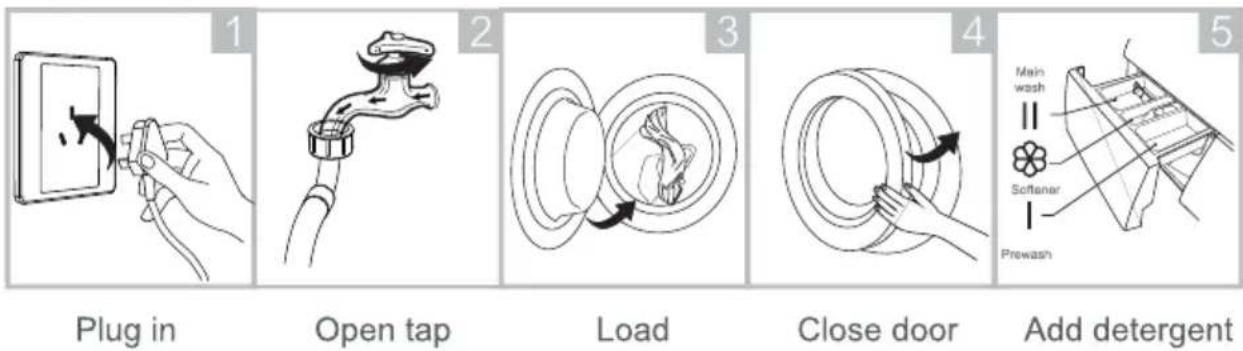
Note!
Detergent only needs to be added in "compartment I" after selecting pre-washing for washing machines with this function.
5.1.2 Washing
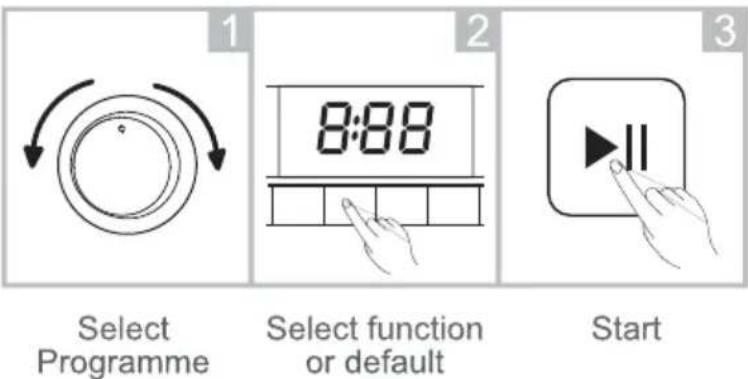
Note!
If default is selected, step 2 can be skipped.
After Washing
"End" on display.
Before Each Washing
The working condition of the washer should be (0 - 40)°C .If used under 0°C ,the inlet valve and draining system may be damaged. If the machine is placed under condition of 0°C or less, then it should be transferred to normal ambient temperature to ensure the water supply hose and drain hose are not frozen before use.
- Please check the labels and the explanation of using detergent before wash. Use non-foaming or less-foaming detergent suitable for machine washing properly.
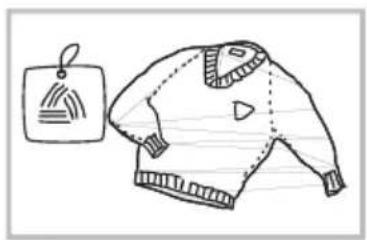
Check the label
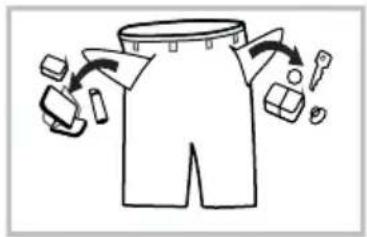
Take out the items out of the pockets
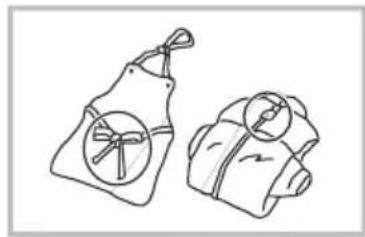
Knot long straps, zips or buttons
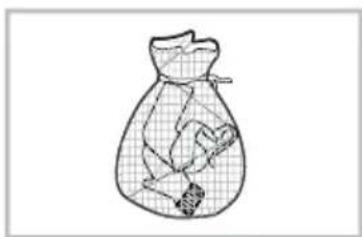
Put small clothes into the pillow slip
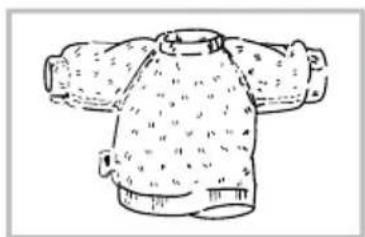
Turn easy-pilling and longpile fabric inside out
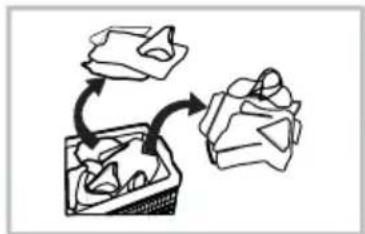
Separate clothes with different textures
Warning!
- When washing a single garment, it may easily cause great unbalance. Therefore it is suggested to add one or two more garments to be washed together so that draining will be done smoothly.
- Don't wash clothes that have been in contact with kerosene, gasoline, alcohol and other flammable materials.
5.1.2.1 Delay
Setting the Delay function:
- Select a programme.
- Press the (Départ différé) button to set the time (the delay time is 0 - 24 h).
- Press the (Départ/pause) button to commence the delay operation.
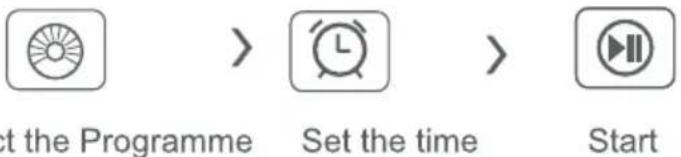
Cancelling the Delay function:
Press the (Départ/pause) button until the display shows 0 hours. The button should be pressed before the programme has started. If the programme has already started, press the (ARRÉT) button to reset the programme.
Caution!
If there is any interruption in the power supply while the washing machine is operating, a special memory stores the selected programme. After the power is restored, the program will continue.


| Programme | Option | Programme | Option |
| Delay | | Delay |
| Sport Wear | ○ | *Dry Only | ○ |
| Quick 15' | ○ | *Synthetic | ○ |
| Jeans | ○ | *Mix | ○ |
| Delicate | ○ | *1 Hour W/D | ○ |
| Spin Only | ○ | *Cotton | ○ |
| Rinse & Spin | ○ | *Wash&Dry | ○ |
| ECO 40-60 | ○ | Intensive | ○ |
| 20°C | ○ | | |
Means optional(Some models have intelligent weighing function, please refer to the actual product; The programme with * can be choose dry function)
Dry
Dry
Press the Dry button continuously to choose the dry level: Extra Dry/Normal Dry / Soft Dry/Time Dry;
Extra Dry: Need to wear clothes immediately, we can choose this function;
Normal Dry: The normal dry procedure;
Soft Dry: Only to dry slightly and then is just ok;
Time Dry: We can choose this function to dry clothes for a specific time. The optional time is 30 Mins, 60 Mins, 90 Mins, 120 Mins (The default spinning time is 10 Mins, the actual display time is 0:40, 1:10, 1:40, 2:10), the corresponding drying capacity is recommended respectively 0.5kg / 1kg / 1.5kg / 2kg .
Pre Wash
The Prewash function can get an extra wash before main wash, it is suitable for washing the dust rises to surface of the clothes; You need to put detergent into the Case (I) when select it.
The laundry will undergo extra rinse once after you select it.
5.1.2.2 Temperature
Press the ( Temp.) button to set the temperature (Cold, 20°C , 40°C , 60°C , 90°C ).
5.1.2.3 Speed
Press the (Vitesse) button to change the spinning speed.
1400:0-400-600-800-1000-1200-1400
| Programme | Default Speed(rpm) | Programme | Default Speed(rpm) |
| 1400 | | 1400 |
| Intensive | 800 | Rinse & Spin | 1000 |
| Sport Wear | 800 | *Dry Only | 1400 |
| Quick 15' | 800 | *Synthetic | 1200 |
| Jeans | 800 | *Mix | 800 |
| Delicate | 800 | *Wash and Dry | - |
| 20°C | 1000 | *1 Hour W/D | 1400 |
| ECO 40-60 | - | *Cotton | 800 |
| Spin Only | 1000 | | |
EN
5.1.2.4 Child Lock

To avoid unauthorised operation by children.
Select programme

Start

Press and hold the (temp.) and (sechage) buttons simultaneously for 3 seconds until the buzzer sounds.
Caution!
When the child lock is activated and the programme starts, the child lock indicator will light up and "CL" and the remaining time alternate every 0.5 seconds on the display. Pressing any other buttons will cause the child lock indicator to flash for 3 seconds. After the programme has finished, "CL" and "END" will alternate for 10 seconds every 0.5 seconds on the display, then the child lock indicator will flash for 3 seconds.
- Only pressing and holding the (temp.) and (sechage) buttons simultaneously cancels the child lock, not power failure or programme end.
- In child lock mode all buttons except the ARRET and (temp./sechage) buttons are locked.
- Cancel child lock mode before selecting a new programme and start washing.

5.1.2.5 Muting the buzzer

SelectProgramme

vitesse

Press and hold the (vitesse) button for 3 seconds to mute the buzzer.
To unmute the buzzer, press and hold the (vitesse) button again for 3 seconds. The setting will be kept until the next reset.
Caution!
After muting the buzzer, no sounds are activated.
5.1.2.6 Cleaning the drum
After the washer dryer has completed the set cycles (25 times), the Drum Clean indicator starts flashing at the end of the last programme to remind you to run the drum cleaning programme.
To cancel the Drum Clean indicator flashing, follow the steps below:
- Press and hold the (nettoyage tambour) button for 3s to reset the counter for another 25 cycles.
- The cycles will again be counted after the drum cleaning programme has finished.
5.1.3 After Washing
"End" is displayed.
MAINTENANCE AND CLEANING
Warning!
Before starting your maintenance, unplug the washing machine and close the tap.
6.1 Cleaning the Cabinet
Proper maintenance on the washing machine will extend its working life. The surface can be cleaned with diluted non-abrasive neutral detergents, if necessary. If there is any water overflow, use a wet cloth to wipe it off immediately. No sharp items are allowed.
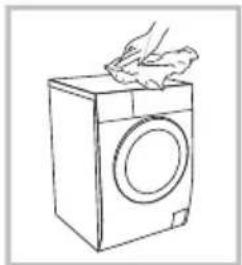
Note!
Do not use formic acid and its diluted solvents or equivalent, such as alcohol, solvents or chemical products.
Note!
Do not use alcohol, solvents or chemical products to clean the washing machine.
6.4.4 Cleaning the Drain Pump Filter
Warning!
Beware of hot water!
- Allow the washing machine to cool down.
Unplug the washing machine to avoid electrical shock before cleaning.
The drain pump filter removes yarn and small foreign matter from the water.
Clean the filter periodically to ensure normal operation of the washing machine.
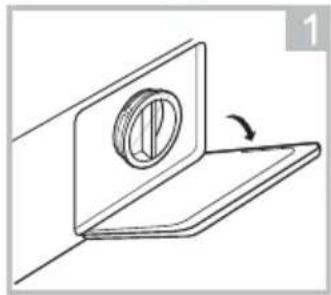
Open the service door
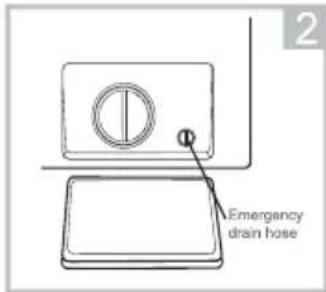
Pull out the emergency drain hose with a 90° turn and remove the cover cap
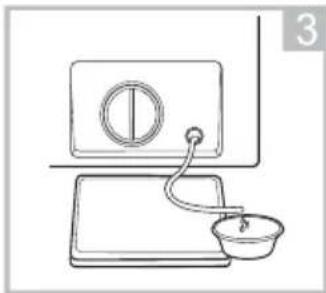
Replace the emergency drain hose after the water has drained
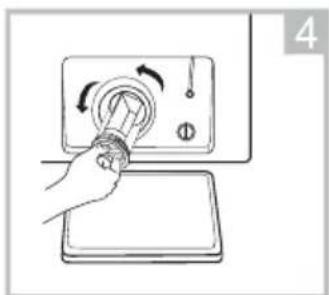
Open the filter by turning it counter-clockwise
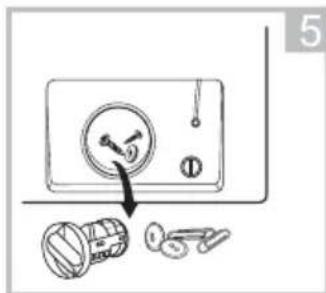
Remove foreign matter
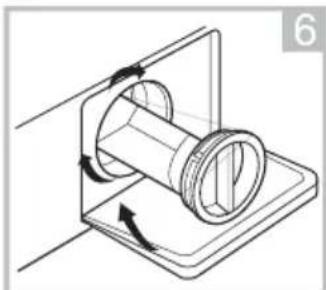
Replace the filter and close the service door
Caution!
Make sure that the filter and the emergency drain hose are replaced properly, otherwise water may leak.
- Not all washing machines have an emergency drain hose, so step 2 and step 3 can be skipped.
- When the appliance has just been used there may be hot water in the pump, depending on the programme. Never remove the pump cover during a wash cycle, always wait until the appliance has finished the cycle, is empty and has cooled down. When replacing the cover, ensure it is securely tightened.
6.5 Troubleshooting
The appliance does not start working or stops during operation.
Try to find a solution to the problem. If this is not possible, contact customer service.

| Problem | Cause | Solution |
| Washing machine does not start | Door is not closed properly | Restart after the door is closed Check if clothes are stuck |
| Door cannot be opened | Safety protection is working | Disconnect the power, then restart |
| Water leakage | Connection of inlet pipe or outlet hose is not tight | Check and fasten water pipes Clean outlet hose |
| Detergent residue in the detergent dispenser | Detergent is damp or clumped together | Clean the detergent dispenser |
| Display does not light up | CPU or harness is disconnected | Check for power failure and properly connected plug |
| Abnormal noise | | Check if the fixing bolts have been removed Check for level floor |
| Error Display | Cause | Solution |
| E30 | Door is not closed properly | Restart after the door is closed Check if clothes is stuck |
| E10 | Water inlet problem while washing | Check if water pressure is too low Straighten the water pipes Check if inlet filter is blocked |
| E21 | Draining takes too long | Check if drain hose is blocked |
| E12 | Water overflow | Restart washing machine |
| EXX | Others | Call customer service if the problem cannot be solved |
Note!
After checking, switch the washing machine on again. If the problem persists, contact customer service.
TECHNICAL DATA
Note!
- Programme setting for testing in accordance with applicable standard En60456 for wash.
- Programme setting for testing in accordance with applicable standard En50229 for wash and dry.
- When using the test programmes, wash the specified load using the maximum spin speed.
- The actual parameters will depend on how the applicance is used, and maybe different with the parameters in above mentioned table.
- The noise emissions during washing/spinning for the standard washing cycle at full load.
Note: More data information, please scan the QR code on the energy label.
The energy efficiency class is from A (highest efficiency) to D (lowest efficiency).
Energy consumption per year, based on 220 standard washing cycles for standard programme at 60°C and 40°C at full and partial load, and the consumption of the low-power modes. Actual energy consumption will depend on how the appliance is used.
3 Water consumption per year based on 220 standard washing cycles for standard programme at 60°C and 40°C at full and partial load. Actual water consumption will depend on how the appliance is used.
4 Spin-drying efficiency class Bona scale from G (least efficient) to A (most efficient).
The standard 60°C programme and the standard 40°C programme are the standard washing programmes. These programmes are suitable to clean normal soiled cotton laundry and they are the most efficient programmes in terms of combined energy and water consumptions for washing that type of cotton laundry. The actual water temperature may differ from the specified cycle temperature. Select the suitable type of detergent for the various washing temperatures to get the best results with less water and energy consumption.
Programme setting for testing in accordance with applicable standard EN60456.
When using the test programmes, wash the specified load using the maximum spin speed.
The actual parameters will depend on how the appliance is used, and may differ from above table.
The noise emissions during washing/spinning are for standard washing cycle at full load.

- The wash and dry cycle is able to clean normally soiled cotton laundry declared to be washable at 40°C or 60°C , together in the same cycle, and to dry it in such a way that it can be immediately stored in a cupboard, and that this programme is used to assess the compliance with the EU ecodesign legislation,
- The most efficient programmes in terms of energy consumption are generally those that perform at lower temperatures and longer duration,
- Loading the washing machine or the washer-dryer up to the capacity indicated by the manufacturer for the respective programmes will contribute to energy and water savings,
- Recommendations on the type of detergents suitable for the various washing temperatures and washing programmes,
- Noise and remaining moisture content are influenced by the spinning speed: the higher the spinning speed in the spinning phase, the higher the noise and the lower the remaining moisture content.
Power supply
Max. current
Standard Water Pressure
220 - 240 V~,50 Hz (EU)
10 A
0.05 MPa - 1 MPa
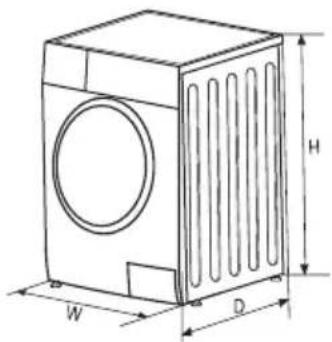
| Model | ALFS8514NE |
| Power Supply | 220 - 240 V~,50 Hz |
| Washing Capacity | 8 kg |
| Drying Capacity | 5.0 kg |
| Dimensions (WxDxH) | 595 x 565 x 850 mm |
| Weight | 74 kg |
| Rated Power | 2050 W |
| Drying Power | 1350 W |
- To contact our After-Sales Service, before going to BUT store, call 09 78 97 97 97 from Monday to Saturday from 8:00 a.m. to 8:00 p.m. (Price of a local call).
- Period of availability of repair spare parts: 5 years.
- In accordance with Article L. 217 of the Consumer Code, your product has 2 year legal guarantee of conformity.
CORRECT DISPOSAL OF THIS PRODUCT

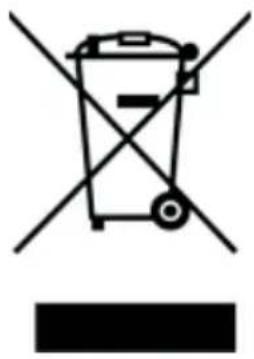
This marking indicates that this product should not be disposed with other household wastes throughout the EU. To prevent possible harm to the environment or human health from uncontrolled waste disposal, recycle it responsibly to promote the sustainable reuse of material resources. To return your used device, please use the return and collection systems or contact the retailer where the product was purchased. They can take this product for environmental safe recycling. Please bring the batteries in the batteries disposal center (contact your retailer in order to protect the environment).