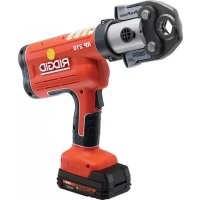
RP 210 - Multitools RIDGID - Free user manual and instructions
Find the device manual for free RP 210 RIDGID in PDF.

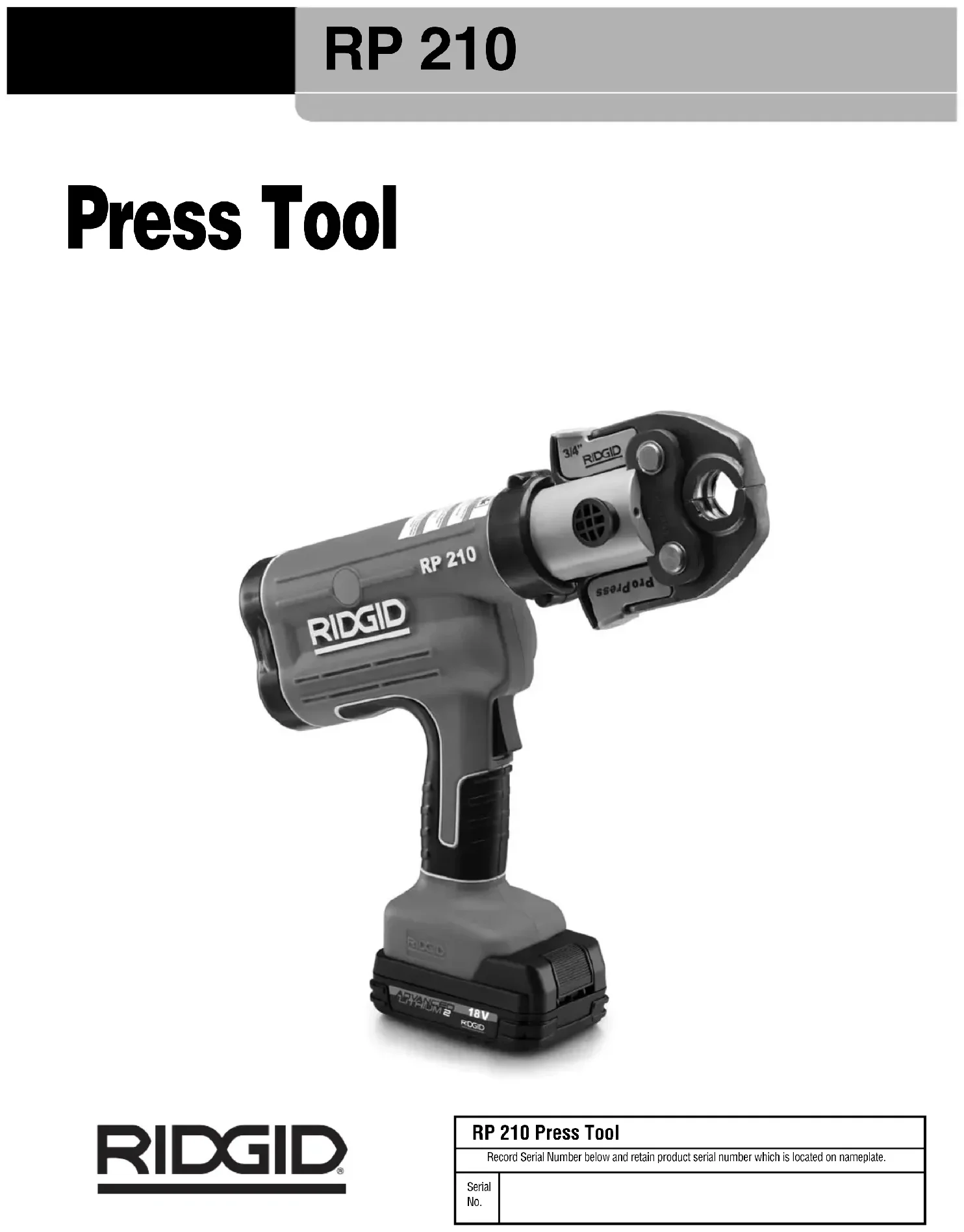


| Product Type | Battery-powered crimping tool |
| Brand | RIDGID |
| Model | RP 210 |
| Weight (without battery pack) | 2.5 kg (5.6 lb) |
| Power Source | 18 V lithium-ion battery pack |
| Available battery capacities | 1.1 Ah, 2.0 Ah, 2.2 Ah, 3.3 Ah, 4.0 Ah |
| Charger | RBC 20 (multiple versions depending on region) |
| Piston Force | 24 kN (5,400 lb) |
| Crimping cycle time | Approximately 5 seconds |
| Operating temperature | -10 °C to 60 °C (down to -20 °C with certain batteries) |
| Main functions | Watertight and permanent crimping of pipe fittings, automatic cycle, LED indicators, decompression button |
| Safety | Safety glasses mandatory, crushing hazard, do not use in explosive atmosphere, use only RIDGID accessories |
| Maintenance | Daily cleaning with a dry cloth, silicone lubrication of the pin, mandatory service after 30,000 cycles |
| Warranty | Lifetime warranty against defects in materials and workmanship |
| Included accessories | Carrying case, jaws (depending on version) |
| Repairability | Service only at authorized RIDGID service centers |
Frequently Asked Questions - RP 210 RIDGID
User questions about RP 210 RIDGID
0 question about this device. Answer the ones you know or ask your own.
Ask a new question about this device
Download the instructions for your Multitools in PDF format for free! Find your manual RP 210 - RIDGID and take your electronic device back in hand. On this page are published all the documents necessary for the use of your device. RP 210 by RIDGID.
USER MANUAL RP 210 RIDGID
natural_image
Red and black RIDGID utility tool with 18V power supply, no visible text or symbols on the device bodyWARNING!
Read this Operator's Manual carefully before using this tool. Failure to understand and follow the contents of this manual may result in electrical shock, fire and/or serious personal injury.
Table of Contents
Recording Form For Machine Serial Number ....1
Safety Symbols....2
General Power Tool Safety Warnings
Work Area Safety....2
Electrical Safety 2
Personal Safety ....3
Power Tool Use And Care ....3
Battery Tool Use And Care ....3
Service....3
Specific Safety Information
Press Tool Safety....4
Description, Specifications And Standard Equipment
Description....4
Specifications....5
Standard Equipment 5
Tool Inspection....5
Tool And Work Area Set-Up 6
Operating Instructions
Preparing The Connection....7
Pressing A Fitting With Typical Scissor Jaws ....7
Pressing A Fitting With Typical Actuator And Press Ring Set ....8
Inspecting The Pressed Connection ....8
Cold Weather Operation 9
Maintenance Instructions
Cleaning And Lubrication....9
Required Maintenance At RIDGID Authorized Service Center 9
Accessories 9
Storage 10
Service And Repair ....10
Disposal 10
Troubleshooting....11
RP 210 Diagnostic Codes ....12
Lifetime Warranty ....Back Cover
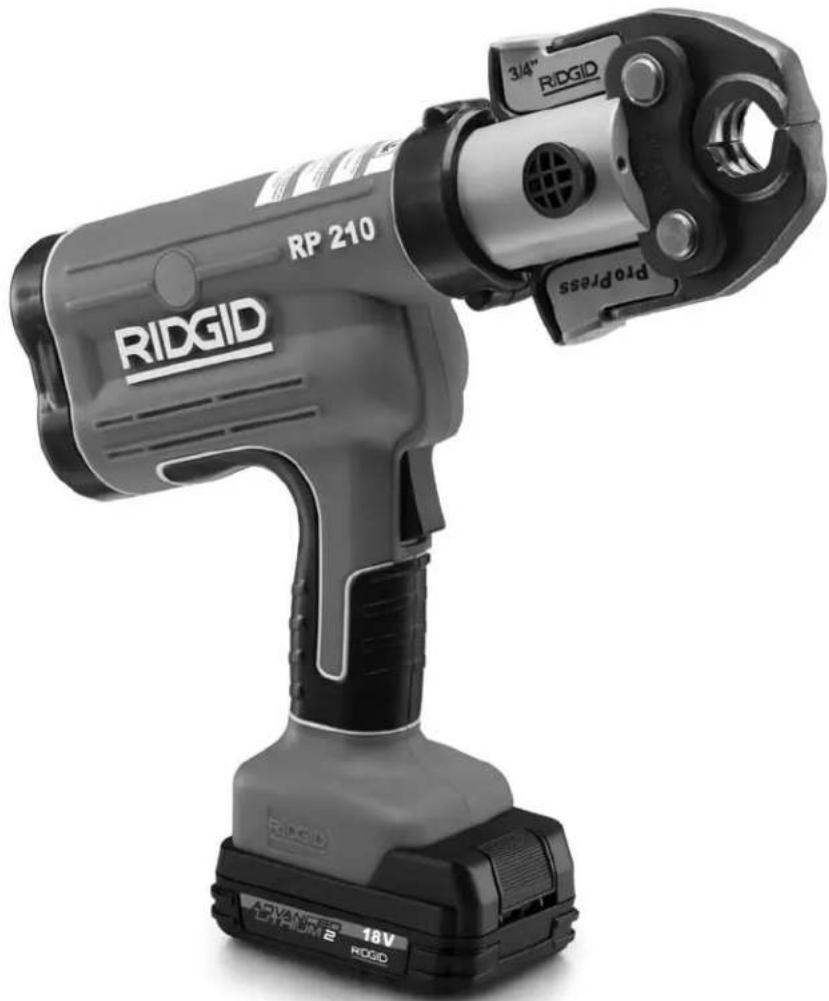
Press Tool
natural_image
RiDGD RP 210 handheld electrical tool with visible components and branding (no text-heavy elements)Safety Symbols
In this operator's manual and on the product, safety symbols and signal words are used to communicate important safety information. This section is provided to improve understanding of these signal words and symbols.

This is the safety alert symbol. It is used to alert you to potential personal injury hazards. Obey all safety messages that follow this symbol to avoid possible injury or death.

DANGER
DANGER indicates a hazardous situation which, if not avoided, will result in death or serious injury.

WARNING
WARNING indicates a hazardous situation which, if not avoided, could result in death or serious injury.

CAUTION
CAUTION indicates a hazardous situation which, if not avoided, could result in minor or moderate injury.
NOTICE
NOTICE indicates information that relates to the protection of property.

This symbol means read the operator's manual carefully before using the equipment. The operator's manual contains important information on the safe and proper operation of the equipment.

This symbol means always wear safety glasses with side shields or goggles when handling or using this equipment to reduce the risk of eye injury.

This symbol indicates the risk of hands, fingers or other body parts being crushed.

This symbol indicates the risk the electrical shock.
General Power Tool Safety Warnings\*
WARNING
Read all safety warnings and instructions. Failure to follow the warnings and instructions may result in electric shock, fire and/or serious injury.
SAVE ALL WARNINGS AND INSTRUCTIONS FOR FUTURE REFERENCE!
The term "power tool" in the warnings refers to your mains-operated (corded) power tool or battery-operated (cordless) power tool.
Work Area Safety
- Keep your work area clean and well lit. Cluttered or dark areas invite accidents.
- Do not operate power tools in explosive atmospheres, such as in the presence of flam mable liquids, gases, or dust. Power tools create sparks which may ignite the dust or fumes.
- Keep children and by-standers away while operating a power tool. Distractions can cause you to lose control.
Electrical Safety
- Power tool plugs must match the outlet. Never
modify the plug in any way. Do not use any adapter plugs with earthed (grounded) power tools. Un modified plugs and matching outlets will reduce risk of electric shock.
- Avoid body contact with earthed or grounded surfaces such as pipes, radiators, ranges and refrigerators. There is an increased risk of electrical shock if your body is earthed or grounded.
- Do not expose power tools to rain or wet conditions. Water entering a power tool will increase the risk of electrical shock.
- Do not abuse the cord. Never use the cord for carrying, pulling or unplugging the power tool. Keep cord away from heat, oil, sharp edges or moving parts. Damaged or entangled cords increase the risk of electric shock.
- When operating a power tool outdoors, use an extension cord suitable for outdoor use. Use of a cord suitable for outdoor use reduces the risk of electric shock.
- If operating a power tool in a damp location is unavoidable, use a ground fault circuit interrupter (GFCI) protected supply. Use of a GFCI reduces the risk of electric shock.
Personal Safety
- Stay alert, watch what you are doing and use common sense when operating a power tool. Do not use a power tool while you are tired or under the influence of drugs, alcohol, or medication. A moment of inattention while operating power tools may result in serious personal injury.
- Use personal protective equipment. Always wear eye protection. Protective equipment such as dust mask, non-skid safety shoes, hard hat, or hearing protection used for appropriate conditions will reduce personal injuries.
- Prevent unintentional starting. Ensure the switch is in the off-position before connecting to power source and/or battery pack, picking up or carrying the tool. Carrying power tools with your finger on the switch or energizing power tools that have the switch on invites accidents.
- Remove any adjusting key or wrench before turning the power tool on. A wrench or a key left attached to a rotating part of the power tool may result in personal injury.
- Do not overreach. Keep proper footing and balance at all times. This enables better control of the power tool in unexpected situations.
- Dress properly. Do not wear loose clothing or jewel ry. Keep your hair, clothing, and gloves away from moving parts. Loose clothes, jewelry, or long hair can be caught in moving parts.
- If devices are provided for the connection of dust extraction and collection facilities, ensure these are connected and properly used. Use of dust collection can reduce dust-related hazards.
Power Tool Use And Care
- Do not force power tool. Use the correct power tool for your application. The correct power tool will do the job better and safer at the rate for which it is designed.
- Do not use power tool if the switch does not turn it ON and OFF. Any power tool that cannot be controlled with the switch is dangerous and must be repaired.
-
Disconnect the plug from the power source and/or the battery pack from the power tool before making any adjustments, changing accessories, or storing power tools. Such preventive safety measures reduce the risk of starting the power tool accidentally.
-
Store idle power tools out of the reach of children and do not allow persons unfamiliar with the power tool or these instructions to operate the power tool. Power tools are dangerous in the hands of untrained users.
- Maintain power tools. Check for misalignment or binding of moving parts, breakage of parts and any other condition that may affect the power tool's operation. If damaged, have the power tool repaired before use. Many accidents are caused by poorly maintained power tools.
- Keep cutting tools sharp and clean. Properly maintained cutting tools with sharp cutting edges are less likely to bind and are easier to control.
- Use the power tool, accessories and tool bits etc. in accordance with these instructions, taking into account the working conditions and the work to be performed. Use of the power tool for operations different from those intended could result in a hazardous situation.
Battery Tool Use And Care
- Recharge only with the charger specified by the manufacturer. A charger that is suitable for one type of battery pack may create a risk of fire when used with another battery pack.
- Use power tools only with specifically designated battery packs. Use of any other battery packs may create a risk of injury and fire.
- When battery pack is not in use, keep it away from other metal objects, like paper clips, coins, keys, nails, screws or other small metal objects that can make a connection from one terminal to another. Shorting the battery terminals together may cause burns or a fire.
- Under abusive conditions, liquid may be ejected from the battery; avoid contact. If contact accidentally occurs, flush with water. If liquid contacts eyes, additionally seek medical help. Liquid ejected from the battery may cause irritation or burns.
Service
- Have your power tool serviced by a qualified repair person using only identical replacement parts. This will ensure that the safety of the power tool is maintained.
Specific Safety Information
WARNING
This section contains important safety information that is specific to this tool.
Read these precautions carefully before using the RP 210 Press Tool to reduce the risk of electrical shock or serious personal injury.
SAVE THESE INSTRUCTIONS!
A compartment in the RP 210 carrying case is included to keep this manual with the machine for use by the operator.
Press Tool Safety
- Use the RP 210 Press Tool only with RIDGID Compact pressing attachments (jaws, press ring, actuator, etc.). Other uses or modifying the RP 210 Press Tool for other applications may damage the press tool, damage the attachments and/or cause personal injury.
- Keep your fingers and hands away from pressing attachments during press cycle. Your fingers or hands can be crushed, fractured or amputated if they become caught between the jaws or between these components and any other object.
- Never attempt to repair damaged jaws, press ring, actuator or other attachments. An attachment that has been welded, ground, drilled or modified in any manner can shatter during pressing resulting in serious injury. Discard the entire damaged jaws. Replace with new jaws. Never replace individual components except for damaged jaw return springs. Please call Ridge Tool Company, Technical Services for availability.
- Large forces are generated during product use that can break or throw parts and cause injury. Stand clear during use and wear appropriate protective equipment, including eye protection.
- Only use RIDGID Press Tools and Jaws when speci fied by the press fittings manufacturer. Use of incorrect equipment and methods can cause incomplete joints, damage the equipment, void warranties or cause severe personal injury or death.
-
Before operating a RIDGID RP 210 Press Tool, read and understand:
-
This operator's manual,
– The attachment instructions,
– The battery/charger manual, - The fitting manufacturer's installation instructions,
- The instructions for any other equipment used with this tool,
Failure to follow all instructions and warnings may result in property damage and/or serious injury.
The EC Declaration of Conformity (890-011-320.10) will accompany this manual as a separate booklet when required.
If you have any question concerning this RIDGID® product:
- Contact your local RIDGID distributor.
- Visit www.RIDGID.com or www.RIDGID.eu to find your local Ridge Tool contact point.
- Contact Ridge Tool Technical Service Department at rttechservices@emerson.com, or in the U.S. and Cana da call (800) 519-3456.
Description, Specifications And Standard Equipment
Description
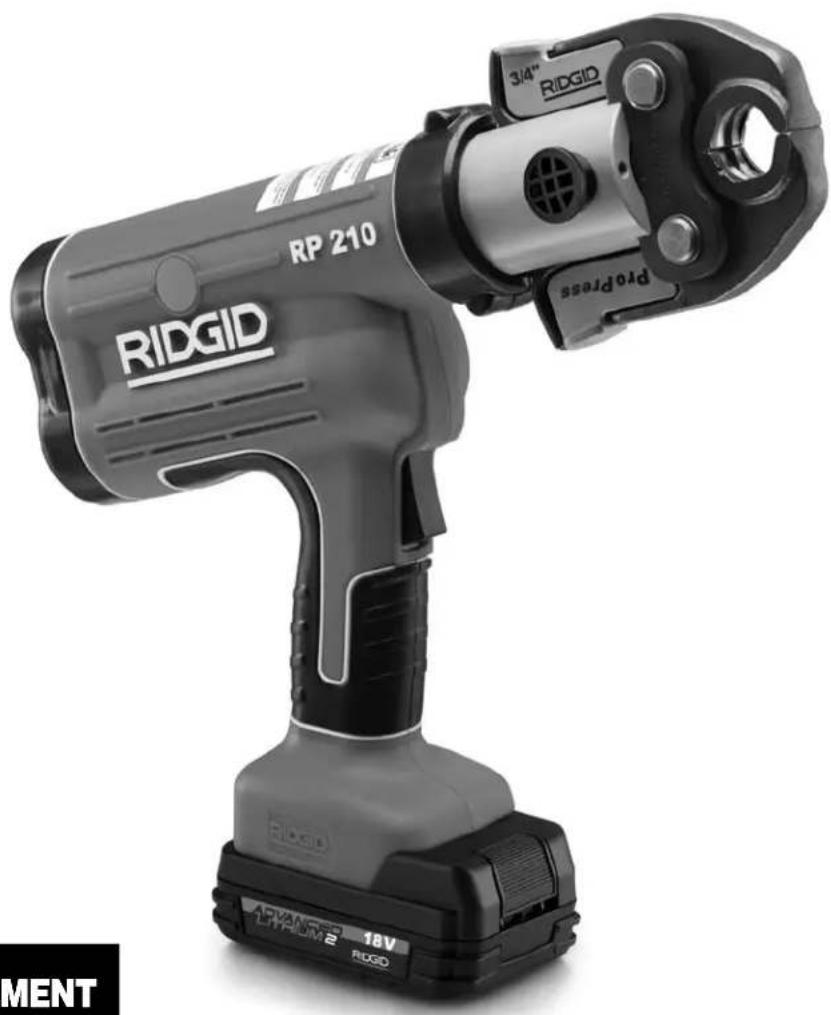
The RP 210 Press Tool, when used with appropriate jaws, is designed to mechanically press fittings onto tubing to create a water-tight and permanent seal. When the switch on the RP 210 is depressed, an internal electric motor powers a hydraulic pump which forces fluid into the cylinder of the tool, forcing the ram forward and applying thousands of pounds of pressing force onto specially designed fittings. Attachments are also available for other uses.
The entire cycle duration is approximately five (5) seconds. Once the cycle begins to deform a fitting, it will automatically continue until completion, even if the trigger switch is released. The LED displays on the back of the tool indicate problems such as improper temperature, open attachment mounting pin or maintenance required.
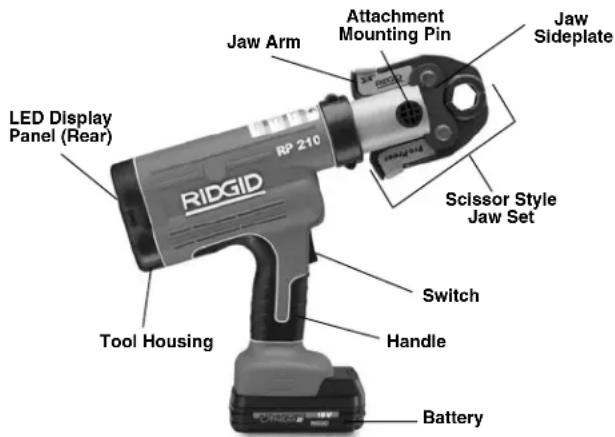
Figure 1 – RP 210-B Press Tool And Compact Series Jaw
Specifications
RP 210-B Battery Press Tool:
Motor
Voltage .....18V DC
Amperage .....18 Amp
Power 324 Watts
Weight....5.6 lbs. (2.5 Kg) (Tool Only - No Battery)
Ram Force ....5,400 lbs. (24kN)
Operating Temperature
Range ....15°F to 140°F (-10°C to 60°C) 0°F to 140°F (-20°C to 60°C) with Battery Maintained Above 15°F (-10°C) or By Using Higher Capa city Batteries. See Cold Weather Operation.
Duty Cycle....3 Crimp /min.
The Press Tool serial number plate is located at the bottom of the handle as shown in Figure 2. The first 4 digits indicate the month and year of the manufacture. (10 = year, 05 = month).
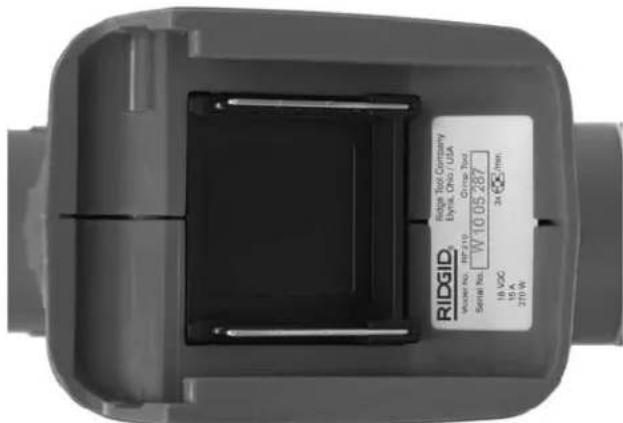
Figure 2 – Press Tool Serial Label
NOTE! RIDGID jaws and attachments are offered in two "series"
- Standard Series
- Compact Series
These series are not interchangeable. Only standard series jaws will work with standard series tools (RP 330, RP 340, 320-E, CT-400). Similarly, only compact series jaws will work with the compact series tools (Compact 100-B, RP 200, RP 210). Please refer to the standard tool's operator's manuals for further information on standard tools and jaws.
NOTICE Selection of appropriate materials and joining methods is the responsibility of the system designer and/or installer. Before any installation is attempted, careful evaluation of the specific service environment, including chemical environment and service temperature, should be completed. Consult Press Fitting System manufacturer for selection information.
Tool Inspection
WARNING
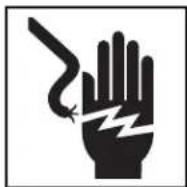
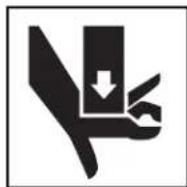
Daily before use, inspect your press tool and cor rect any problems to reduce the risk of serious injury from electric shock, crushing injures, attachment failure and other causes, and prevent tool damage.
- Make sure that the press tool battery is removed. Inspect the battery for damage. If any damage or modifications are found, do not use until the battery has been properly repaired or replaced.
- Clean any oil, grease or dirt from the equipment, especially the handles and controls. This helps to prevent the machine or controls from slipping from your grip.
-
Inspect the press tool for any of the following:
-
Proper assembly, maintenance and completeness.
- Any broken, worn, missing, misaligned or binding parts.
- Make sure that the attachment mounting pin moves smoothly between the fully open and full closed position and locks into each. Confirm that the switch moves freely and does not bind or stick.
• Presence and readability of warning labels. See Figure 3. - Any other condition which may prevent safe and normal operation.
If any problems are found, do not use the press tool until the problems have been repaired.
- Inspect and maintain the tool attachments, battery charger and any other equipment or material in use as directed in their instructions.
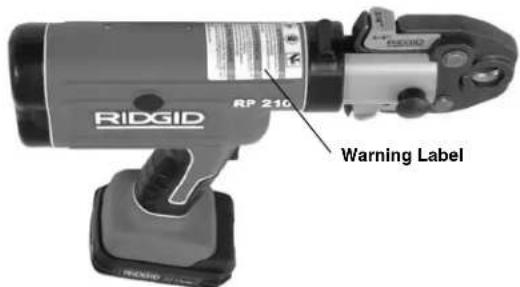
Figure 3 – Press Tool Warning Label
-
With dry hands, insert a fully charged battery. Press the ON/OFF button on the LED panel one time to turn the press tool ON. The green, red and yellow LED on the display panel should all blink one time on power up, and then the green LED will remain on to indicate that the tool is ready for use. For use in cold weather (temperatures below 15°F (-10°C)), see Cold Weather Operation Section. If any other conditions exist, use the Diagnostic Codes information on Page 12 to determine the next step and do not use the tool until it is working properly. With your hands and fingers away from the tool ram, test the operation of the switch to confirm proper operation. When used with an attachment, once the tool sees enough load it will lock on to ensure that a complete press is made.
-
Once the operation has been checked, with dry hands remove the battery.
Tool And Work Area Set-Up
WARNING
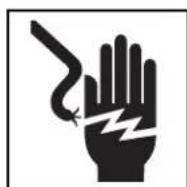
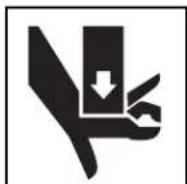
Set up the press tool and work area according to these procedures to reduce the risk of injury from electric shock, fire, crushing injuries and other causes, and prevent tool and system damage.
-
Check work area for:
-
Adequate lighting.
- Flammable liquids, vapors or dust that may ignite. If present, do not work in area until sources have been identified and corrected. The press tool is not explosion proof and can cause sparks.
-
Clear, level, stable and dry place for operator. Do not use the machine while standing in water.
-
Inspect the work to be done and determine the correct RIDGID tool and attachment(s) for the application. Using an incorrect attachment for an application can cause injury, damage the tool and make incomplete connections. For a complete listing of RIDGID attachments available for this tool, see the Ridge Tool Catalog on line at www.RIDGID.com or call Ridge Tool Technical Services (800) 519-3456. Make sure that the tool and attachment have been inspected as directed in their instructions.
-
Evaluate the work area and determine if any barriers are needed to keep bystanders out. Bystanders can distract the tool operator during use.
-
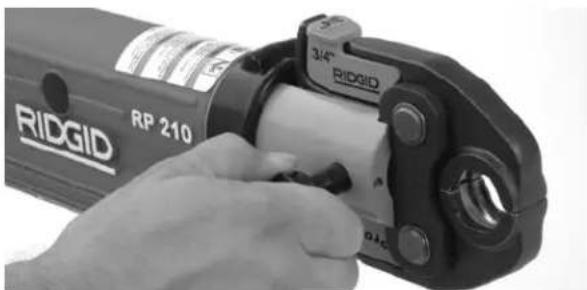
Confirm that the battery is removed and fully open the attachment mounting pin. See Figure 4. If there is an attachment in the tool, slide it out of the tool.
-
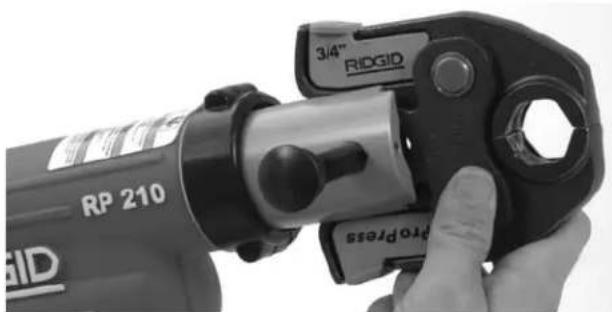
Slide the correct attachment into the press tool as shown in Figure 5 and fully close the attachment mounting pin. The tool will not operate unless the mounting pin is fully closed.
natural_image
Close-up of a hand using a RIDGID power tool to adjust a cylindrical component (no visible text or symbols)Figure 4 – Fully Open Attachment Mounting Pin
natural_image
Close-up of a hand holding a 3/4" RIDGID R10 presser tool, no visible text or symbols on the device itself.Figure 5 – Slide Attachment Into Tool
Operating Instructions
WARNING

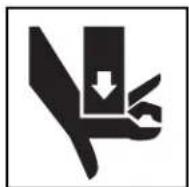
Always wear eye protection to protect your eyes against dirt and other foreign objects.
Keep your fingers and hands away from the tool attachment during the press cycle. Your fingers or hands can be crushed, fractured or amputated in the attachment or tool or between the attachment, work piece and other objects.
Follow operating instructions to reduce the risk of injury from crushing and other causes and to prevent tool damage.
Preparing The Connection
NOTICE These instructions are generalized practices for several types of press tool attachments. Always follow the specific instructions for the press tool attachment being used and the fitting manufacturers specific installation instructions. Failure to follow the specific attachment and fitting installation instructions may result in improper press connections that can lead to extensive property damage.
- Make sure that the work area is free of bystanders and other distractions and that the tool and work area has been properly set up.
- Prepare the connection according to the fitting manufacturers instructions.
- With dry hands, insert a fully charged battery. Depress ON/OFF button on display panel one time to turn tool ON. All three light emitting diodes (LED's) will blink once. Then, the green LED should be solidly illuminated indicating the tool is ready to press. Tool will au tomatically turn OFF if left unused for ten (10) minutes.
- Make sure the tubing is inserted to the proper depth in fitting, as specified in the appropriate fitting system's operator's manual.
Pressing A Fitting With Typical Scissor Jaws
- Squeeze jaw arms to open the jaws (Figure 6).
- Place open jaws around the fitting (Figure 7). Make sure the contour of the jaw set is properly aligned with the contour of the fitting as specified in Fitting Manufacturer's Installation Instructions. Do not hang the jaw set and tool from fitting. Tool could unexpectedly drop and cause serious injury or death.
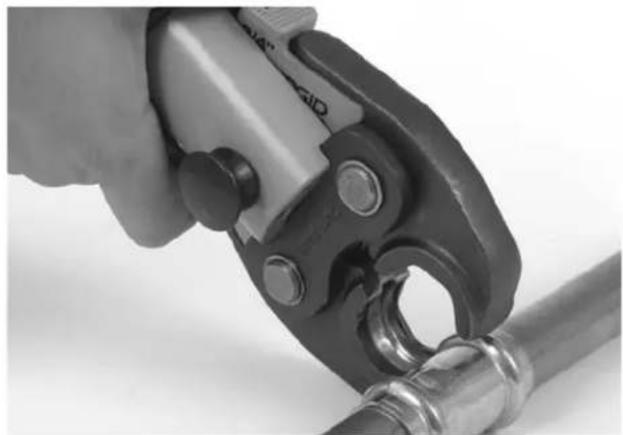
natural_image
Close-up of a hand using a wire crimping tool to handle a pipe fitting (no text or symbols visible)Figure 6 – Opening The Scissor-Style Jaws
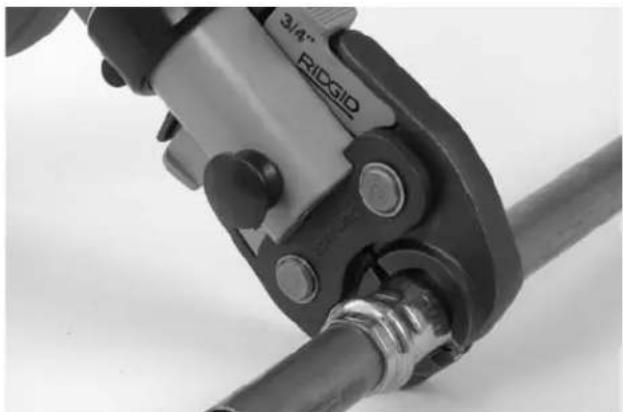
natural_image
Close-up of a mechanical clamp or tool with a 3/4" label, no readable text or symbols beyond the label.Figure 7 – Placing Scissor-Style Jaw Set Around Fitting
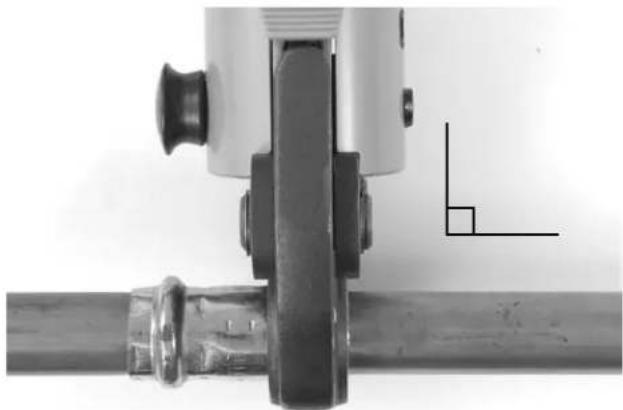
natural_image
Close-up of a mechanical device with a metallic wheel and attached lever, showing a small L-shaped annotation (no text or symbols on the device itself)Figure 8 – RP 210 Tool Square To Tubing
- Make sure the jaw set and tool are square to the tubing and de press the tool switch (Figure 8). Keep fingers and hands away from the jaw set to avoid crushing injuries in jaw set and between jaw set and sur roundings. The press cycle takes about five (5) seconds. Once a press cycle begins and the rollers contact the jaw arms, the tool will lock-on and auto-
matically complete the press cycle. Releasing the switch will not stop the tool once the pressing process has begun. This assures consistent, repeatable press joint integrity.
-
Press jaw arms to open the jaw set.
-
Remove the RP 210 and jaw set from tube. Avoid sharp edges that may have formed on the fitting during the pressing operation.
Pressing A Fitting With Typical Actuator And Press Ring Set
-
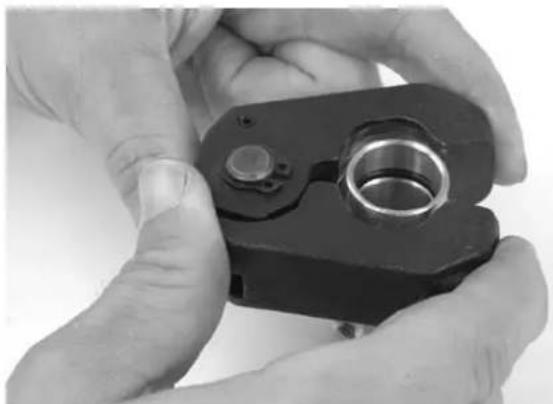
Open the appropriate press ring and place at right angle onto the fitting (Figure 9). Align ring with fitting according to fitting system's operator's manual. Re-check insertion depth before completing press process.
-
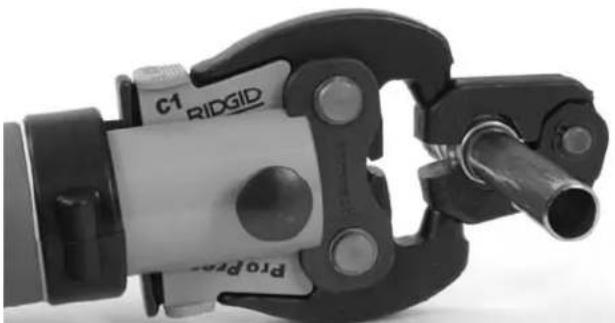
Squeeze actuator arms to open the actuator assembly. Engage actuator ends into the actuator pockets in the press ring (Figure 10). Make sure actuator ends are fully engaged in pockets. Do not attempt to hang tool and actuator from press ring. Tool could unexpectedly drop causing serious injury or death.
Depress the tool switch. The press cycle takes about five (5) seconds. Once a press cycle begins and the rollers contact the actuator arms, the tool will lock-on and automatically complete the press cycle. Releasing the trigger will not stop the tool once the pressing process has begun. This assures consistent, repeatable press joint integrity. To avoid pinch point injuries, keep fingers away from actuator and press ring during the press cycle.
natural_image
Close-up of hands holding a black mechanical component with a cylindrical bore (no visible text or symbols)Figure 9 – Installing Press Ring Onto Fitting
natural_image
Close-up of a mechanical clamp or crimping tool with no visible text or symbols on the main body.Figure 10 - Attaching Actuator To Press Ring
- After cycle is complete, squeeze actuator arms to open and separate actuator from press ring. Remove the press ring from fitting by manually grasping ring halves and opening assembly. Avoid any sharp edges which may have formed on fitting during pressing operation.
NOTICE The RP 210-B Press Tool will turn off automatically if the battery is too low to successfully complete a pressed connection. This will be indicated by blinking of the green LED. A fully charged battery should be inserted in the tool and the pressed connection should be repeated as indicated above. To retract the rollers and remove the tool from the fitting if battery dies or tool malfunctions during pressed connection, it is necessary to press the pressure re lease button on the right hand side of the tool (Figure 11). If this happens, the connection will need to be pressed again to ensure completion.
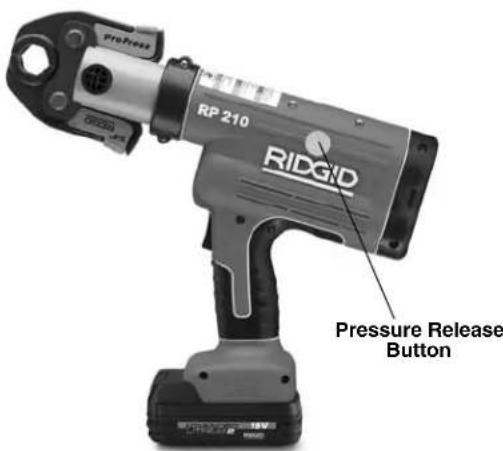
Figure 11 – Pressure Release Button
Inspecting The Pressed Connection
- Inspect the pressed fitting. If the fitting is supplied with a control ring and/or a control label by the fitting man ufacturer, remove it. Control rings and labels are supplied by the manufacturer to indicate that the fitting has not yet been pressed.
Look for the following:
- Excessive misalignment of the tubes. Note that a slight amount of misalignment at the pressed connection is considered normal.
- Tubes that are not fully inserted into the fitting – double check the insertion marks made on the tube to see that they are still aligned with the end of the fitting.
- Incorrect jaw or ring alignment with the fitting contour, distorted or deformed fitting.
- Any other issues per the fitting manufacturer.
If any of these problems are found, then removal of the fitting is required and a new fitting and tube will need to be prepared and pressed in its place.
- Test system in accordance with normal practice and local codes.
Cold Weather Operation
As temperature drops, all batteries experience performance degradation. The lowest temperature at which a tool and 1.1Ah battery can make a complete press is 15^ F ( -10^ C). At temperatures below this, the 1.1Ah battery is not able to provide sufficient power to the press tool. Pressing at temperatures down to 0^ F ( -20^ C) can be done by warming the 1.1Ah battery above 15^ F ( -10^ C) or using a larger capacity battery (2.0Ah, 2.2Ah, 3.3Ah or 4.0Ah).
The red and green LED's on the tool will glow when the tool temperature is between 0^ F ( -20^ C) and 15^ F ( -10^ C). If using a 1.1Ah battery, the tool may not be able to press the connection completely. If this occurs, the tool will stop in the middle of the press cycle and will not release from the connection. To remove the tool from the connection, press the pressure release button on the right hand side of the tool (shown in Figure 11). This connection then must be repressed while using either a 1.1Ah battery above 15^ F ( -10^ C) or using a 2.0Ah, 2.2Ah, 3.3Ah or 4.0Ah battery to ensure a complete connection.
To use the press tool between 0^ F ( -20^ C) and 15^ F ( -10^ C) either:
- Use a 2.0Ah, 2.2Ah, 3.3Ah or 4.0Ah battery.
- Or maintain the 1.1Ah battery temperature above 15^ (-10^) . This can be done by placing the battery in an interior pocket when not in use or allowing the battery to sit in a conditioned room until it is sufficiently warm.
If the tool temperature is below 0^ F ( -20^ C), only the red LED will be on and the tool will not operate unless warmed to above 0^ F ( -20^ C).
Maintenance Instructions
WARNING
Make sure battery is removed from tool before performing maintenance or making any adjustment.
Cleaning And Lubrication
- Wipe the tool clean daily with a clean dry cloth.
- Inspect the attachment mounting pin and lubricate the pin with silicone lubricant as needed.
- Check return springs in attachments with each use. Attachments should open and close freely with only moderate finger effort required.
Required Maintenance At RIDGID Authorized Service Center
After 30,000 cycles, the tool will show a blinking yellow LED on the display panel as long as the tool is turned on to indicate that it is time for maintenance and recalibration. The tool will not run if it is not serviced within 2,000 more cycles (32,000 total) after the yellow blinking LED begins.
Accessories
WARNING
The following tool accessories have been de signed to function with the RP 210 Press Tools. Other accessories suitable for use with other tools may become hazardous when used on the RP 210. To prevent serious injury, use only accessories specifically designed and recommended for use with the RP 210, such as those listed below.
Ridge Tool Company provides Compact Pressing attachments designed specifically for use with RIDGID Compact Press Tools. Only use attachments that are specifically designed to press the fitting system you are installing. For a complete listing of RIDGID attachments available for this tool, see the Ridge Tool Catalog on line at www.RIDGID.com or call Ridge Tool Technical Service Department (800) 519-3456.
RP 210-B Press Tool Accessories
| CatalogNo. Description |
| 31023 Carrying Case (Plastic) |
Battery Packs
| CatalogNo. | Capacity Region | |
| 44693 | 18V 2.0 Ah North & Latin America, Australia | |
| 44698 | 18V 4.0 Ah North & Latin America, Australia | |
| 43323 | 18V 2.0 Ah Europe & China | |
| 43328 | 18V 4.0 Ah Europe & China | |
| 31013 | 18V 1.1 Ah North & Latin America, Australia | |
| 32743 | 18V 2.2 Ah North & Latin America, Australia | |
| 31018 | 18V 3.3 Ah North & Latin America, Australia | |
| 32473 | 18V 1.1 Ah Europe & China | |
| 28218 | 18V 2.2 Ah Europe & China | |
| 28448 | 18V 3.3 Ah Europe & China |
All listed batteries will work with any model RBC 20 charger. The difference between batteries for different regions is in label markings.
RBC 20 Advanced Lithium Battery Chargers & Cords
| Catalog PlugNo. Voltage Region Type | |||
| 43458 12 | 0V North America A | ||
| 43333 23 | 0V Europe C | ||
| 43468 12 | 0V China A | ||
| 44418 23 | 0V Australia & Latin America I | ||
| 44793 10 | 0V | Japan A | |
| 44833 23 | 0V | United Kingdom G | |
| 44798 | — | North America Charger Cord | A |
| 44808 | — | Europe Charger Cord | C |
| 44803 | — | China Charger Cord | A |
| 44813 | — | Australia & LA Charger Cord | I |
| 44818 | — | Japan Charger Cord | A |
| 44828 | — | United Kingdom Charger Cord G | |
Storage
Remove battery from tool and store tool and battery in case. Avoid storing the tool, batteries or charger in extreme heat or cold. The tool temperature sensor will not allow the tool to turn on if oil temperature is not within the temperature range of 0^ F ( -20^ C) to 104^ F ( 40^ C). So it may be necessary to allow the tool to warm or cool to a temperature within the operating range by placing it in a conditioned room before use. This will be indicated by a red glowing LED on the display panel.
⚠ WARNING Store the carrying case in a dry, secured, locked area that is out of reach of children and people unfamiliar with the RP 210 Press Tool. The tool is dangerous in the hands of untrained users.
Service And Repair
WARNING
Improper service or repair can make machine unsafe to operate.
Service and repair on this RP 210 Press Tool must be performed by a RIDGID Authorized Service Center. The tool fasteners have been marked to indicate if service has been performed by unauthorized individuals.
For any repairs or maintenance, contact the Ridge Tool Technical Service Department at (800) 519-3456 or www.RIDGID.com for nearest authorized press tool service outlet.
For information on your nearest RIDGID Independent Service Center or any service or repair questions:
- Contact your local RIDGID distributor.
- Visit www.RIDGID.com or www.RIDGID.eu to find your local RIDGID contact point.
- Contact Ridge Tool Technical Service Department at rtctechservices@emerson.com, or in the U.S. and Canada call (800) 519-3456.
Disposal
Parts of the RIDGID RP 340 Press Tool contain valuable materials and can be recycled. There are companies that specialize in recycling that may be found locally. Dispose of the com ponents in compliance with all applicable regulations. Contact your local waste management authority for more information.
For EC Countries: Do not dispose of electrical equipment with household waste!
According to the European Guideline 2002/ - 96/ EC for Waste Electrical and Electronic Equipment and its implementation into national legislation, electrical equipment that is no
longer usable must be collected separately and disposed of in an environmentally correct manner.
Troubleshooting
| SYMPTOM POSSIBLE REASONS SOLUTION | ||
| Tool will not turn ON when ON/OFF button on display panel is pressed. | Battery is completely discharged or battery has failed. | Insert fully charged battery/recharge dead battery. |
| Battery not properly inserted into handle of tool. | Check to assure battery is fully inserted. | |
| Tool will not run when trigger is depressed. Green light flashes. | Battery is too low. | Insert fully charged battery/recharge dead battery. |
| Tool turns OFF either when trigger is de pressed or in the middle of a press cycle. Red LED glows. | Tool or battery is too cold or too hot. | Bring tool and battery to correct operating range between 0°F (-20°C) to 140°F (60°C) by allowing the tool to sit in a conditioned room. If using tool in cold temperatures, refer to Cold Weather Operation Section of this manual.NOTE! Fitting must be repressed if tool stops in the middle of a press cycle. Failure to do so may result in a leaking fitting. |
| Yellow LED blinks repeatedly as long as tool is turned ON and tool functions properly. | Scheduled maintenance/recalibration is required after 30,000 presses. | Contact Ridge Tool Technical Service Department at (800) 519-3456 for nearest Authorized Service outlet. |
| Yellow LED glows continuously and tool will not begin press cycle when trigger switch is depressed. | Scheduled maintenance/recalibration is mandatory after 32,000 presses. Tool is “locked” and will not function until tool is serviced. | Contact Ridge Tool Technical Service Department at (800) 519-3456 for nearest Authorized Service outlet. |
| Red LED blinks repeatedly and tool will not begin press cycle when trigger switch is depressed. | Attachment mounting pin not fully closed. | Insert attachment mounting pin to the fully closed position. |
| Yellow LED glows when tool is turned ON. | Tool malfunction detected. | Remove and reinsert fully charged battery. Be sure to repress fitting. If LED’s continue to glow, contact Ridge Tool Technical Service Depart ment at (800) 519-3456 for nearest Authorized Service outlet. |
| Jaws are locked onto fitting. | Press was not successfully completed. | Push pressure release valve to remove jaws from fitting. Inspect and repress fitting. |
| The pressed connections produced are not complete. | Used wrong jaws for the tube size or material.The tool was not square to the tube.Jaw contour was not aligned with the fitting contour. | Install the correct jaws.Redo the joint with new fitting and new tube.Make sure that the tool is square to the tube.Redo the joint with new tube and new fitting.Make sure the jaw contour is aligned with the fitting contour.Contact Ridge Tool Technical Service Department at (800) 519-3456 for nearest Authorized Service outlet. |
| Tool is in need of repair. | ||
RP 210 Diagnostic Codes
| LED Status Description Icon | |||
| Green | Glows Tool ON.Blinks Out of acceptable voltage range.— Replace battery with a fully charged battery. |  | |
| Red Blinks | Attachment mounting pin not fully engaged. Insert pin.Glows If only red light is ON, Out of temperature range 15°F (-10°C) to 140°F (60°C). | [ZASW]### | |
| Yellow | BlinksGlows Machine is locked – Service after 32,000 cycles or after a malfunction. | ### | |
Figure 12 – LED Diagnostic Codes
Sertisseuse
natural_image
RidGID RP 210 tool with attached 18V and 3/4" specifications, no visible text or symbols on the device body beyond branding.
AVERTISSEMENT
Préparation des raccords....20
Inspection des raccords sertis ....22
Alimentation......18V
Résistance.....18 A
Puissance
nominale ....324 Watts
natural_image
Close-up of a hand using a 3/4" RIDGID power tool to press a cylindrical component (no visible text or symbols on the device itself)natural_image
Close-up of a hand holding a mechanical tool labeled 'RP 210' and 'RIGID 3/4" (no additional text or symbols visible)natural_image
Close-up of a hand using a wire crimping tool to tighten a pipe fitting (no text or symbols visible)natural_image
Close-up of a mechanical tool with a 3/4-inch pipe fitting and a RIOGID clamp (no text or symbols visible)natural_image
Close-up of a mechanical device with a metallic rod and attached gasket, showing a small L-shaped annotation (no text or symbols on the device itself)natural_image
Close-up of hands holding a mechanical component with a cylindrical bore and flange (no visible text or symbols)natural_image
Close-up of a mechanical clamp or crimping tool with no visible text or symbols on the body itself.natural_image
RidGID RP 210 tool with attached 18V power supply (no visible text or symbols on device body)
ADVERTENCIA
natural_image
Close-up of a hand using a RIGID electrical crimping tool to adjust a component (no visible text or symbols on the tool itself)natural_image
Close-up of a hand holding a 3/4" RIDGID RIGID wrench tool, no visible text or symbols on the tool itself.natural_image
Close-up of a hand using a wire crimping tool to handle a metal pipe (no text or symbols visible)natural_image
Close-up of a mechanical clamp or tool with a metal rod and threaded end (no visible text or symbols)natural_image
Close-up of a mechanical device with a metallic wheel and attached shaft, showing a small L-shaped annotation (no text or symbols)natural_image
Close-up of hands holding a mechanical component with a cylindrical shaft and flange (no visible text or symbols)natural_image
Close-up of a mechanical pipe clamp with labeled components (no readable text or symbols beyond branding)RIDGID® tools are warranted to be free of defects in workmanship and material.
How long coverage lasts
This warranty lasts for the lifetime of the RIDGID ^® tool. Warranty coverage ends when the product becomes unusable for reasons other than defects in workmanship or material.
How you can get service
To obtain the benefit of this warranty, deliver via prepaid transportation the complete product to RIDGE TOOL COMPANY, Elyria, Ohio, or any authorized RIDGID® INDEPENDENT SERVICE CENTER. Pipe wrenches and other hand tools should be returned to the place of purchase.
What we will do to correct problems
Warranted products will be repaired or replaced, at RIDGE TOOL'S option, and returned at no charge; or, if after three attempts to repair or replace during the warranty period the product is still defective, you can elect to receive a full refund of your purchase price.
What is not covered
Failures due to misuse, abuse or normal wear and tear are not covered by this warranty. RIDGE TOOL shall not be responsible for any incidental or consequential damages.
How local law relates to the warranty
Some states do not allow the exclusion or limitation of incidental or consequential damages, so the above limitation or exclusion may not apply to you. This warranty gives you specific rights, and you may also have other rights, which vary, from state to state, province to province, or country to country.
No other express warranty applies
This FULL LIFETIME WARRANTY is the sole and exclusive warranty for RIDGID® products. No employee, agent, dealer, or other person is authorized to alter this warranty or make any other warranty on behalf of the RIDGE TOOL COMPANY.

Parts are available online at RIDGIDParts.com

Ridge Tool Company
400 Clark Street
Elyria, Ohio 44035-6001
U.S.A.
Ce qui est couvert

EMERSON
Commercial & Residential Solutions
EMERSON. CONSIDER IT SOLVED.
Printed in U.S.A. 4/14
EC40659 REV. G
© 2014 RIDGID, Inc.
085-210-025.10


- WARNING!
- Table of Contents
- General Power Tool Safety Warnings
- Specific Safety Information
- Description, Specifications And Standard Equipment
- Operating Instructions
- Maintenance Instructions
- Press Tool
- Safety Symbols
- DANGER
- WARNING
- CAUTION
- NOTICE
- General Power Tool Safety Warnings\*
- SAVE ALL WARNINGS AND INSTRUCTIONS FOR FUTURE REFERENCE!
- Work Area Safety
- Electrical Safety
- Personal Safety
- Power Tool Use And Care
- Battery Tool Use And Care
- Service
- SAVE THESE INSTRUCTIONS!
- Press Tool Safety
- Description
- Specifications
- RP 210-B Battery Press Tool:
- Tool Inspection
- Tool And Work Area Set-Up
- Preparing The Connection
- Pressing A Fitting With Typical Scissor Jaws
- Pressing A Fitting With Typical Actuator And Press Ring Set
- Inspecting The Pressed Connection
- Cold Weather Operation
- Cleaning And Lubrication
- Required Maintenance At RIDGID Authorized Service Center
- Accessories
- Storage
- Service And Repair
- Disposal
- Sertisseuse
- AVERTISSEMENT
- ADVERTENCIA
- How long coverage lasts
- How you can get service
- What we will do to correct problems
- What is not covered
- How local law relates to the warranty
- No other express warranty applies
- Ce qui est couvert
Brand : RIDGID
Model : RP 210
Category : Multitools