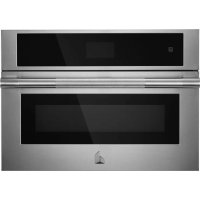
JMC2427LM - Microwave Oven JENN-AIR - Free user manual and instructions
Find the device manual for free JMC2427LM JENN-AIR in PDF.



| Product Type | Microwave oven combined with grill and convection functions |
| Brand | JENN-AIR |
| Model | JMC2427LM |
| Dimensions (W x H x D) | Approximately 76 x 45 x 60 cm (estimate for built-in oven) |
| Weight | Approximately 35 kg (estimate) |
| Power Supply | 240 V, 20 A, 50/60 Hz (line fuse 20 A) |
| Cooking Functions | Microwave, Grill, Convection, Defrost, Auto Cooking, Combined Cooking |
| Controls | Touch screen with diagnostic menu |
| Sensors | Humidity sensor, cavity temperature sensor, magnetron thermistor |
| Accessories | Turntable, cooking rack, support |
| Lighting | Halogen lamp in cavity |
| Ventilation | Cooling and convection fan |
| Safety | Door interlocks (primary, secondary, monitor), safety fuse |
| Maintenance and Cleaning | Clean cavity with a damp cloth, do not use abrasive products, check door seals |
| Spare Parts and Repairability | Manager, inverter, magnetron, thermistors, contactors, fans, control board, user interface, etc. |
| General Information | Technical manual intended for repair technicians. Consumer use via standard user manual. |
Frequently Asked Questions - JMC2427LM JENN-AIR
User questions about JMC2427LM JENN-AIR
0 question about this device. Answer the ones you know or ask your own.
Ask a new question about this device
Download the instructions for your Microwave Oven in PDF format for free! Find your manual JMC2427LM - JENN-AIR and take your electronic device back in hand. On this page are published all the documents necessary for the use of your device. JMC2427LM by JENN-AIR.
USER MANUAL JMC2427LM JENN-AIR
Electrical Shock Hazard
Only authorized technicians should perform diagnostic voltage measurements.
After performing voltage measurements, disconnect power before servicing.
Failure to follow these instructions can result in death or electrical shock.
WARNING

Electrical Shock Hazard
Disconnect power before servicing.
Replace all parts and panels before operating.
Failure to do so can result in death or electrical shock.
Voltage Measurement Safety Information
When performing live voltage measurements, you must do the following:
■ Verify the controls are in the off position so that the appliance does not start when energized.
- Allow enough space to perform the voltage measurements without obstructions.
- Keep other people a safe distance away from the appliance to prevent potential injury.
■ Always use the proper testing equipment.
■ After voltage measurements, always disconnect power before servicing.
FOR SERVICE TECHNICIAN'S USE ONLY
IMPORTANT: Electrostatic Discharge (ESD) Sensitive Electronics
ESD problems are present everywhere. ESD may damage or weaken the electronic control assembly. The new control assembly may appear to work well after repair is finished, but failure may occur at a later date due to ESD stress.
■ Use an antistatic wrist strap. Connect wrist strap to green ground connection point or unpainted metal in the appliance
-OR-
Touch your finger repeatedly to a green ground connection point or unpainted metal in the appliance.
■ Before removing the part from its package, touch the antistatic bag to a green ground connection point or unpainted metal in the appliance.
■ Avoid touching electronic parts or terminal contacts; handle electronic control assembly by edges only.
■ When repackaging failed electronic control assembly in antistatic bag, observe above instructions.
PRECAUTIONS TO BE OBSERVED BEFORE AND DURING SERVICING TO AVOID POSSIBLE EXPOSURE TO EXCESSIVE MICROWAVE ENERGY
a. Do not operate or allow the oven to be operated with the door open.
b. Make the following safety checks on all ovens to be serviced before activating the magnetron or other microwave source, and make repairs as necessary:
- Interlock Operation
- Proper Door Closing
- Seal and Sealing Surfaces (Arcing, Wear and Other Damage)
- Damage to or Loosening of Hinges and Latches
- Evidence of Dropping or Abuse
c. Before turning on microwave power for any service test or inspection within the microwave generating compartments, check the magnetron, waveguide or transmission line, and cavity for proper alignment, integrity and connections.
d. Any defective or misadjusted components in the interlock, monitor, door seal, and microwave generation and transmission systems shall be repaired, replaced, or adjusted by procedures described in service manual before the oven is released to the owner.
e. A microwave leakage check to verify compliance with the CSA should be performed on each oven prior to release to the owner.
f. Do not attempt to operate the oven if the door glass is broken.
FOR SERVICE TECHNICIAN'S USE ONLY
Diagnostics
IMPORTANT: Before powering microwave magnetron, be sure that a load, such as a microwave-safe cup of water, is present in the microwave oven cavity.
Unplug oven or disconnect power before performing the following checks:
A potential cause of a control not functioning is corrosion on connections. Observe connections and check for continuity with an ohmmeter.
All tests/checks should be made with a VOM or DVM having a sensitivity of 20,000 Ω per volt DC or greater.
- Check all connections before replacing components, looking for broken or loose wires, failed terminals, or wires not pressed into connectors far enough. Damaged harness must be entirely replaced. Do not rework a harness.
■Resistance checks must be made with power cord unplugged from outlet, and with wiring harness or connectors disconnected.
IMPORTANT: Do not replace the control if there is no evidence of any failure.
To Enter Diagnostics Mode:
Before proceeding with any corrective action, perform the following steps to enter the Diagnostics mode.
- Enter Diagnostics mode by pressing KITCHEN TIMER>TOOLS>KITCHEN TIMER (repeat two more times).
NOTE: You do not need to wait for any audible or visual feedback from the control between keypad presses.
-
If control does not enter Diagnostics, continue repeating the keypad sequence from Step 1. All the keypads will light up when the control enters Diagnostics.
-
From the Diagnostic menu, scroll to the desired selection using the touch screen.
Error Diagnostics: View and clear the failure history.
Component Activation: Manually activate each relay.
Sensors & Switches: View the traditional oven cavity temperatures and door/latch switch status.
System Information: View the model number, serial number, and software versions.
Exit Diagnostics
General Procedure: Error Codes
NOTE: All failures are stored in the failure history. To check if the error code is still present, start a cooking function and wait 1 minute to check if the error appears.
- Enter Diagnostics mode.
- Touch or scroll to "Error Diagnostics" in the Diagnostics menu, and then touch "OK."
| DIAGNOSTICS HOME |
| Error Diagnostics Troubleshoot Error Codes |
| Component Activation Bake, Broil, Convection, Fans... Sensors & Switches |
- To clear error codes, touch "Clear History."
- If no failures are listed, the message "No Error" will appear on the screen.
General Procedure: Software Version
For Engineering only.
General Procedure: Component Activation
- Enter Diagnostics mode.
- Touch or scroll to "Component Activation" in the Diagnostics menu, and then touch "OK."
NOTE: Touching "Back" will return the display to the main Diagnostics menu.
- Touching the following selections will activate/deactivate corresponding relay.
Selection Relay
| MW Light MW Light Relay | |
| MW Turntable MW Turntable Relay | |
| MW Cooling Fan MW Cooling Fan Relay | |
| MW Grill MW Broil Element Relay | |
| MW Convection Element MW Convection Element Relay | |
| MW Convection Fan MW Convection fan Relay | |
| MW Magnetron/Cooling Fan | MW Magnetron and MW Cooling Fan Relay |
General Procedure: Sensors & Switches
NOTE: This procedure is to view the current status of oven switches and sensor readings.
Display Status
| MW Door Switch Open or Closed |
| MW Cavity Temperature Degrees in Celsius |
FOR SERVICE TECHNICIAN'S USE ONLY
- Enter Diagnostics mode.
- Touch or scroll to "Sensors & Switches" in the Diagnostics menu, and then touch "OK."
- Touch or scroll through the Sensors & Switches menu to view the desired status.
NOTE: Touching "Back" will return the display to the main Diagnostics menu.
General Procedure: System Information
NOTE: This procedure is to view the following system information:
| System Information Display | |
| Model # Model Information | |
| Serial # Product Serial Number | |
| UI Serial # User Interface Serial Number | |
| UI Version User Interface Software Version | |
| HMI Central SW HMI Central Board Software Version | |
| HMI Left SW HMI Left Keyboard Software Version | |
| HMI Left EE HMI Left Keyboard EEPROM Version | |
| HMI Right SW HMI Right Keyboard Software Version | |
| HMI Right EE HMI Right Keyboard EEPROM Version | |
| Kernel Version HMI Central Board Software Version | |
| Touch Calibration Version | LCD/TP FPC Tail Software Version |
| Database Version | HMI Central Board Database Structure |
| Audio Version | HMI Central Board Software Version |
| MWO ACU SW | Microwave Oven Appliance Control Unit Software Version |
| Diagnostics Entries | Number of times Diagnostic menu has been entered |
- Enter Diagnostics mode.
- Touch or scroll to "System Information" in the Diagnostics menu, and then touch "OK."
- Touch or scroll through the System Information menu to view the desired status.
NOTE: Touching "Back" will return the display to the main Diagnostics menu.
General Procedure: Model Selection
NOTE: When a new User Interface is installed, you will be prompted to select a new model number upon power up. To change the model number on an existing user interface, follow the steps below.
- Enter Diagnostics mode.
- Touch or scroll to "System Information" in the Diagnostics menu, and then touch "OK."
- Touch or scroll to "Model Number," and then touch "OK."
- Touch or scroll to the correct model number in the list, and then touch "Select."
Failure/Error Display Codes
No Display - control is blank Switch Mode Power Supply (SMPS), User Interface (UI)
SUGGESTED CORRECTIVE ACTION PROCEDURE
NOTE: Before starting any test, cycle power to the oven (power Off, wait 10 seconds, and then power On).
- Unplug oven or disconnect power.
- Remove plastic cover from UI. Check connection from display to UI. If the display is firmly connected, go to Step 3. If display connection is loose, reconnect and go to Step 10.
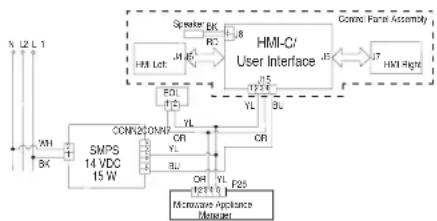
- Check wiring from main line to SMPS (CONN 7).
flowchart
graph TD
    A["Speaker BK"] --> B["HMI Lct"]
    B --> C["Connect Part Assembly"]
    C --> D["HMI-C1 User Interface"]
    D --> E["Microarray Appliance Manager"]
    F["SMPS 14 VDC 15 W"] --> G["CONC20/DMG"]
    G --> H["OR"]
    H --> I["OR"]
    I --> J["OR"]
    J --> K["123V"]
    K --> L["P28"]
    L --> M["HL"]
    M --> N["HL"]
    N --> O["HL"]
    O --> P["HL"]
    P --> Q["HL"]
    Q --> R["HL"]
    R --> S["HL"]
    S --> T["HL"]
    T --> U["HL"]
    U --> V["HL"]
    V --> W["HL"]
    W --> X["HL"]
    X --> Y["HL"]
    Y --> Z["HL"]
    Z --> AA["HL"]
    AA --> AB["HL"]
    AB --> AC["HL"]
    AC --> AD["HL"]
    AD --> AE["HL"]
    AE --> AF["HL"]
    AF --> AG["HL"]
    AG --> AH["HL"]
    AH --> AI["HL"]
    AI --> AJ["HL"]
- Check connection from wiring harness to UI (J15).
- Check proper voltage input at J15-2 (GND) to J15-4 (14 VDC) on the UI by completing the following steps:
- Connect voltage measurement equipment to J15-2 and J15-4 on UI.
- Plug in oven or reconnect power.
- Measure voltage and confirm voltage reading is 14 VDC. If voltage is correct, unplug oven or disconnect power and go to Step 13. If voltage is not correct, go to Step 9.
- Unplug oven or disconnect power. Replace the SMPS.
- Reassemble all parts and panels before operating.
- Plug in oven or reconnect power.
- Check for control board display. If still no display, unplug oven or disconnect power.
-
Replace HMI-Central/UI board.
-
Reassemble all parts and panels before operating.
- Plug in oven or reconnect power. If the UI was replaced, follow the on-screen prompts to select the model number.
- Verify operation is normal. If problem persists, replace the Control Panel Assembly and repeat steps 14 through 16.
FOR SERVICE TECHNICIAN'S USE ONLY
Touch display unresponsive
Touch Display Control Panel Assembly
SUGGESTED CORRECTIVE ACTION PROCEDURE
NOTE: Before starting any test, cycle power to the oven (power Off, wait 10 seconds, and power On).
- Enter the Diagnostic menu, and then touch POWER.
- To reset Touch Calibration: unplug oven or disconnect power, wait 10 seconds, and then plug in oven or reconnect power. If still no response, go to Step 3.
- Unplug oven or disconnect power.
- Replace Control Panel Assembly.
- Reassemble all parts and panels before operating.
- Plug in oven or reconnect power.
- Verify operation is normal.
No Sound Speaker, Control Panel Assembly
SUGGESTED CORRECTIVE ACTION PROCEDURE
NOTE: Before starting any test, cycle power to the oven (power Off, wait 10 seconds, and power On).
- Verify sound is enabled. Touch the Tools menu, and then scroll to the Sound menu. Confirm Key Press, Timer & Alert, and Power On & Off actions are all turned on and set to the desired volume.
- Unplug oven or disconnect power.
- Confirm the speaker is firmly connected to the HMI-Central/UI board at J8. If speaker is firmly connected, go to Step 4. If speaker connection is loose, reconnect and proceed to Step 5.
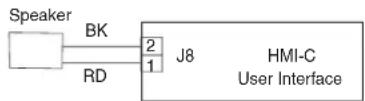
- Replace speaker.
- Reassemble all parts and panels before operating.
- Plug in oven or reconnect power.
- Confirm operation of the speaker. If problem persists, unplug oven or disconnect power, replace Control Panel Assembly, and repeat steps 5 through 7.
FAILURE ERROR LIKELY FAILURE CONDITION
F1 Internal
E0 Oven user interface (UI) failure
SUGGESTED CORRECTIVE ACTION PROCEDURE
NOTE: Before starting any test, cycle power to the oven (power Off, wait 10 seconds, and then power On).
PROCEDURE: Before proceeding, verify the error code by entering the Diagnostics menu and selecting "Error Diagnostics."
NOTE: If other error codes are stored, troubleshoot those other error codes first.
- Unplug oven or disconnect power.
- Confirm the control panel assembly is grounded to the oven chassis. If it is, go to Step 6. If it is not, fix the connection.
- Reassemble all parts and panels before operating.
- Plug in oven or reconnect power and cycle power.
- If error persists, unplug oven or disconnect power.
- Replace HMI-Central/UI board.
- Reassemble all parts and panels before operating.
- Plug in oven or reconnect power and cycle power.
-
If error persists after HMI-Central/UI board is replaced, unplug oven or disconnect power and replace Control Panel Assembly.
-
Reassemble all parts and panels before operating.
-
Plug in oven or reconnect power. Follow the on-screen prompts for model selection.
-
Verify operation is normal. Enter Diagnostics mode, select "Error Diagnostics," and clear the history. If the Control Panel Assembly was replaced, there is no need to clear the error history.
FAILURE ERROR LIKELY FAILURE CONDITION
F1 E4 Microwave Oven Relay 4903 Error
SUGGESTED CORRECTIVE ACTION PROCEDURE
NOTE: Before starting any test, cycle power to the oven (power Off, wait 10 seconds, and then power On). After powering on, be sure that a load, such as a microwave-safe cup of water, is present in the microwave oven cavity, and start a microwave cooking function. Wait 1 minute, and then verify that the failure happens again.
- Make sure that all interlock switches work properly: when door is open, microwave light is On; when door is closed, microwave light is Off.
- Unplug oven or disconnect power.
- Check the following on the Microwave Appliance Manager: a. Wire connections to Relay 4903.
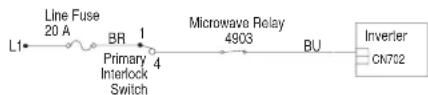
b. Check if Relay 4903 is shorted. If so then go to Step 7.
- Reassemble all parts and panels before operating.
- Plug in oven or reconnect power.
- To check if the error code is still present, be sure that a load, such as a microwave-safe cup of water, is present in the microwave oven cavity, and start a cooking function in the microwave oven. Wait 1 minute to check if the error appears. If error remains, go to Step 7. If not, go to Step 10.
- Unplug oven or disconnect power and replace the Microwave Appliance Manager.
- Reassemble all parts and panels before operating.
- Plug in oven or reconnect power.
- Verify operation is normal. Enter the Diagnostics menu, select "Error Diagnostics," and clear the history.
FOR SERVICE TECHNICIAN'S USE ONLY
FAILURE ERROR LIKELY FAILURE CONDITION
F1 E5 Microwave Oven Inverter Error
SUGGESTED CORRECTIVE ACTION PROCEDURE
NOTE: Before starting any test, cycle power to the oven (power Off, wait 10 seconds, and then power On). After powering on, be sure that a load, such as a microwave-safe cup of water, is present in the microwave oven cavity, and start a microwave cooking function. Wait 1 minute, and then verify that the failure happens again.
- Make sure that all interlock switches work properly: when door is open, microwave light is On; when door is closed, microwave light is Off.
- Unplug oven or disconnect power.
- Check the following on the Microwave Appliance Manager:
a. Relay 4903.
b. Connector P8.
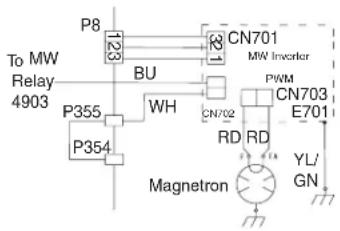
- Check the following connections on the Inverter board:
- If the door works properly and all connections are okay, replace the Microwave Inverter Board.
- Reassemble all parts and panels before operating.
-
Plug in oven or reconnect power.
-
To check if the error code is still present, be sure that a load, such as a microwave-safe cup of water, is present in the microwave oven cavity, and start a cooking function in the microwave oven. Wait 1 minute to check if the error appears. If error remains, then go to Step 9. If not, go to Step 17.
- Unplug oven or disconnect power.
- Replace the Magnetron.
- Reassemble all parts and panels before operating.
- Plug in oven or reconnect power.
- To check if the error code is still present, be sure that a load, such as a microwave-safe cup of water, is present in the microwave oven cavity, and start a cooking function in the microwave oven. Wait 1 minute to check if the error appears. If error remains, then go to Step 14. If not, go to Step 17.
- Unplug oven or disconnect power and replace the Microwave ACU.
- Reassemble all parts and panels before operating.
- Plug in oven or reconnect power.
- Verify operation is normal. Enter the Diagnostics menu, select "Error Diagnostics," and clear the history.
FAILURE ERROR LIKELY FAILURE CONDITION
F2 E0 Keypad disconnected
Keypad E1 Stuck/shorted key
SUGGESTED CORRECTIVE ACTION PROCEDURE
NOTE: Before starting any test, cycle power to the oven (power Off, wait 10 seconds, and power On).
PROCEDURE: Before proceeding, verify the error code by entering the Diagnostics mode and selecting "Error Diagnostics."
-
Unplug oven or disconnect power.
-
Check that connectors J4, J5, J6, and J7 are firmly connected. If they are not, go to Step 3. If they are, go to Step 6.
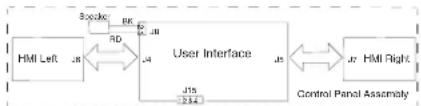
flowchart
graph LR
    A["HMI Left"] -->|Signal| B["User Interface"]
    B -->|J15 3.84| C["Control Panel Assembly"]
    B -->|J15 3.84| D["Output"]
    E["Service"] -->|J2| F["User Interface"]
    F -->|J2| G["Control Panel Assembly"]
    F -->|J2| H["Output"]
- Reconnect any loose connectors.
- Reassemble all parts and panels before operating.
- Plug in oven or reconnect power. If the failure is gone, go to Step 9. If the failure is still present, unplug oven or disconnect power.
- Replace the Control Panel Assembly.
- Reassemble all parts and panels before operating.
- Follow the on-screen prompts to select the model number
- Verify operation is normal. Enter the Diagnostics menu, select "Error Diagnostics," and clear the history. If the Control Panel Assembly was replaced, there is no need to clear the error history.
FAILURE ERROR LIKELY FAILURE CONDITION
F4 E1 Microwave Cavity Temperature Sensor Error
SUGGESTED CORRECTIVE ACTION PROCEDURE
NOTE: Before starting any test, cycle power to the oven (power Off, wait 10 seconds, and then power On). After powering on, be sure that a load, such as a microwave-safe cup of water, is present in the microwave oven cavity, and start a microwave cooking function that uses the temperature sensor, such as a Convect cycle. Wait 1 minute, and then verify that the failure happens again.
- Unplug oven or disconnect power.
- Check that the P22 connection of the Microwave Appliance Manager is firmly connected. If it is, go to Step 3. If it is not, reconnect and go to Step 5.
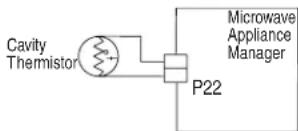
- Disconnect connector P22 from the Microwave Appliance Manager, and measure the resistance of the thermistor. It should be (approximately) 230 kΩ at 77°F ± 10°F (25°C ± 10°C).
- Check thermistor for short to ground. If check on thermistor is not correct, replace the thermistor. If thermistor check is correct, replace the Microwave Appliance Manager.
- Reassemble all parts and panels before operating.
- Plug in oven or reconnect power.
- Verify operation is normal. Enter the Diagnostics menu, select "Error Diagnostics," and clear the history.
FOR SERVICE TECHNICIAN'S USE ONLY
FAILURE ERROR LIKELY FAILURE CONDITION
F4 E2 Magnetron Temperature Sensor Error
SUGGESTED CORRECTIVE ACTION PROCEDURE
NOTE: Before starting any test, cycle power to the oven (power Off, wait 10 seconds, and then power On). After powering on, be sure that a load, such as a microwave-safe cup of water, is present in the microwave oven cavity, and start a microwave cooking function. Wait 1 minute, and then verify that the failure happens again.
- Unplug oven or disconnect power.
- Check that the P21 connection of the Microwave Appliance Manager is firmly connected. If it is, go to Step 3. If it is not, reconnect and go to Step 5.
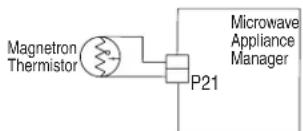
- Disconnect connector P21 from the Microwave Appliance Manager, and measure the resistance of the thermistor. It should be (approximately) 10 kΩ at 77°F ± 10°F (25°C ± 10°C).
- Check thermistor for short to ground. If check on thermistor is not correct, replace the thermistor. If thermistor check is correct, replace the Microwave Appliance Manager.
- Reassemble all parts and panels before operating.
- Plug in oven or reconnect power.
- Verify operation is normal. Enter the Diagnostics menu, select "Error Diagnostics," and clear the history.
FAILURE ERROR LIKELY FAILURE CONDITION
F4 Inputs E4 Microwave Oven Humidity Sensor Error
SUGGESTED CORRECTIVE ACTION PROCEDURE
NOTE: Before starting any test, cycle power to the oven (power Off, wait 10 seconds, and then power On). After powering on, be sure that a load, such as a microwave-safe cup of water, is present in the microwave oven cavity, and start a microwave cooking function that uses the humidity sensor, such as a Steam cycle. Wait 1 minute, and then verify that the failure happens again.
- Unplug oven or disconnect power.
- Check that the P23 connection of the Microwave Appliance Manager is firmly connected. If it is, go to Step 3. If it is not, reconnect and go to Step 5.
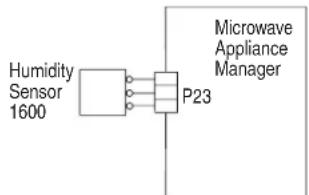
- Disconnect connector P23 from Microwave Appliance Manager and measure the resistance of the sensor: Between pins 3 and 1. It should be approximately 2800 at 77^ ± 10^ ( 25^ ± 10^ ). Between pins 3 and 2. It should be approximately 2800 at 77^ ± 10^ ( 25^ ± 10^ ).
- Check sensor for short to ground. If checks on sensor are not correct, replace the sensor. If sensor checks are correct, replace the Microwave Appliance Manager.
- Reassemble all parts and panels before operating.
- Plug in oven or reconnect power.
- Verify operation is normal. Enter the Diagnostics menu, select "Error Diagnostics," and clear the history.
FAILURE ERROR LIKELY FAILURE CONDITION
F4 E8 Inverter Over Temperature
SUGGESTED CORRECTIVE ACTION PROCEDURE
NOTE: Before starting any test, cycle power to the oven (power Off, wait 10 seconds, and then power On). After powering on, be sure that a load, such as a microwave-safe cup of water, is present in the microwave oven cavity, and start a microwave cooking function. Wait 1 minute, and then verify that the failure happens again.
- Unplug oven or disconnect power.
- Check the following:
a. Cooling fan connection for any loose connectors.
b. Oven installation and make sure there is no air blockage at the bottom vent.
- Reassemble all parts and panels before operating.
- Plug in oven or reconnect power.
- To check if the cooling fan is stalled, be sure that a load, such as a microwave-safe cup of water, is present in the microwave oven cavity, and start a cooking function in the microwave oven. Make sure the fan is running. If it is not, unplug oven or disconnect power, replace the fan and go to Step 8. If it is, go to Step 6.
- Unplug oven or disconnect power.
- Replace the inverter board.
- Reassemble all parts and panels before operating.
- Plug in oven or reconnect power.
- Verify operation is normal. Enter the Diagnostics menu, select "Error Diagnostics," and clear the history.
FAILURE ERROR LIKELY FAILURE CONDITION
F4 E9 Inverter and Magnetron Over Temperature
SUGGESTED CORRECTIVE ACTION PROCEDURE
NOTE: Before starting any test, cycle power to the oven (power Off, wait 10 seconds, and then power On). After powering on, be sure that a load, such as a microwave-safe cup of water, is present in the microwave oven cavity, and start a microwave cooking function. Wait 1 minute, and then verify that the failure happens again.
- Unplug oven or disconnect power.
- Check the following:
a. Cooling fan connection for any loose connectors.
b. Oven installation and make sure there is no air blockage at the bottom vent.
- Reassemble all parts and panels before operating.
- Plug in oven or reconnect power.
- To check if the cooling fan is stalled, be sure that a load, such as a microwave-safe cup of water, is present in the microwave oven cavity, and start a cooking function in the microwave oven. Make sure the fan is running. If it is not, unplug oven or disconnect power, replace the fan and go to Step 8. If it is, go to Step 6.
- Unplug oven or disconnect power.
- Replace the Magnetron and the inverter board.
- Reassemble all parts and panels before operating.
- Plug in oven or reconnect power.
- Verify operation is normal. Enter the Diagnostics menu, select "Error Diagnostics," and clear the history.
FOR SERVICE TECHNICIAN'S USE ONLY
FAILURE ERROR LIKELY FAILURE CONDITION
| F6 E8 | Lost communications with Microwave Oven Appliance Manager |
SUGGESTED CORRECTIVE ACTION PROCEDURE
NOTE: Before starting any test, cycle power to the oven (power Off, wait 10 seconds, and power On).
PROCEDURE: Before proceeding, verify the error code by entering the Diagnostics menu and selecting "Error Diagnostics."
- Make sure the oven is plugged in. Open microwave door to check if light comes on.
- Unplug oven or disconnect power.
- Check the connection between Oven User Interface Board J15-2 (yellow) and J15-3 (orange) and Microwave Appliance Manager P26-3 (orange) and P26-4 (yellow).
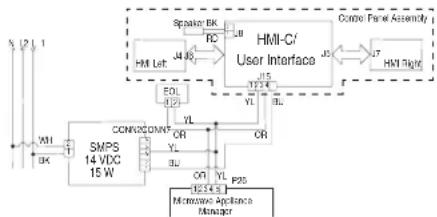
flowchart
graph TD
    A["SMPS 14 VDC 15 W"] --> B["CONTRICONN"]
    B --> C["OR"]
    C --> D["Microwave Appliance Manager"]
    D --> E["Control Panel Assembly"]
    E --> F["HMI-Cf User Interface"]
    F --> G["Speaker BK"]
    F --> H["RL"]
    F --> I["HL"]
    F --> J["UL"]
    F --> K["UL"]
    F --> L["UL"]
    F --> M["UL"]
    F --> N["UL"]
    F --> O["UL"]
    F --> P["UL"]
    F --> Q["UL"]
    F --> R["UL"]
    F --> S["UL"]
    F --> T["UL"]
    F --> U["UL"]
    F --> V["UL"]
    F --> W["UL"]
    F --> X["UL"]
    F --> Y["UL"]
- If harness is correct, replace the Microwave Appliance Manager.
- Reassemble all parts and panels before operating.
- Plug in oven or reconnect power.
- If the error appears again, unplug or disconnect power and replace HMI-Central/UI board.
- Reassemble all parts and panels before operating.
- Plug in oven or reconnect power.
- Follow the on-screen prompts to select the model number if the UI was replaced.
- Verify operation is normal. Enter the Diagnostics menu, select "Error Diagnostics," and clear the history. If the Control Panel Assembly was replaced, there is no need to clear the error history.
Microwave Oven Components
Component Locations
Upper Microwave Oven
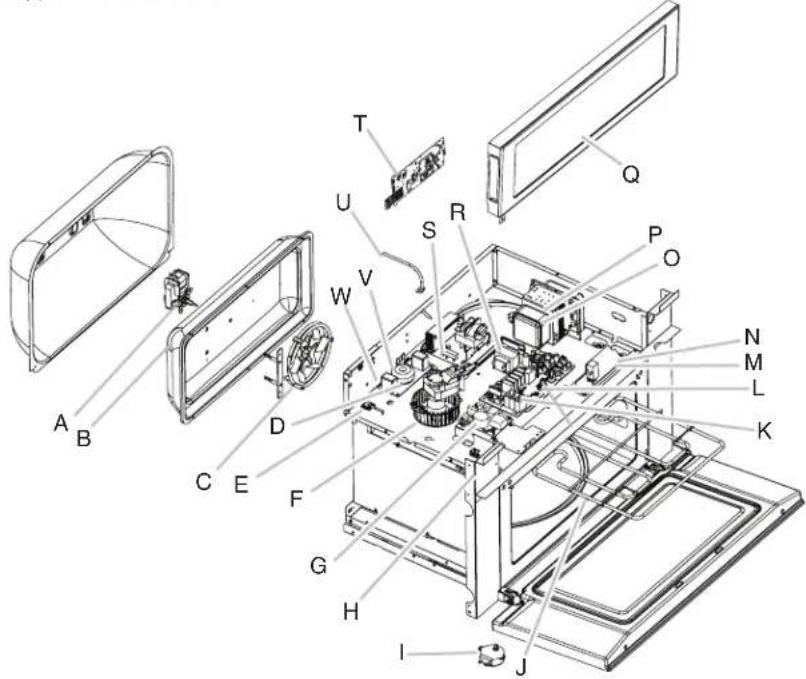
A. Convect motor
B. Convect thermostat (behind cover)
C. Convect element
D. Line filter
E. Humidity sensor
F. Magnetron fan motor
G. Switch mode power supply (SMPS)
H. Secondary interlock switch
1. Turntable motor
J. Broil element
K. Microwave appliance manager
L. Cavity halogen lamp
M. Primary interlock switch
N. Monitor interlock switch
O. Magnetron thermistor
P. Magnetron
Q. Keypad
R. Microwave light transformer
S. Microwave inverter
T. HMI-Central/UI board
U. Cavity temperature sensor
V. Grill thermostat
W. Cavity thermostat
Not shown: Monitor fuse, 20 A line fuse
FOR SERVICE TECHNICIAN'S USE ONLY
Cooling Fan Relay Logic
The microwave oven blower stays On during cooking functions and may stay On for a few minutes after the cooking function has ended.
Component Testing Chart - Microwave
| Component Serviceable Side Procedure Results - Resistance Component Location | |||
| Appliance Manager | Top Check wiring to microwave appliance manager:1. Unplug the microwave oven or disconnect power.2. Visually inspect connectors on the microwave appliance manager, P1, P2, P8, P21, P22, P23, P26, P354, P355 and the top connectors (relays 4903, 4904 and 4905) to see whether there are signs of overheating or any signs of failure due to loose wires, bad crimping, etc.3. Reassemble all parts and panels before operating.4. Plug in microwave oven or reconnect power. | K | |
| Cavity Thermostat | Top 1. Unplug microwave oven or disconnect power.2. Remove wire leads.3. Measure resistance.4. Replace wire leads.5. Reassemble all parts and panels before operating.6. Plug in microwave oven or reconnect power. | Normal = Continuity Abnormal = Infinite | W |
| Magnetron Fan Motor | Top 1. Unplug microwave oven or disconnect power.2. Remove wire leads.3. Measure resistance (ohmmeter scale: Rx1).4. Replace wire leads.5. Reassemble all parts and panels before operating.6. Plug in microwave oven or reconnect power. | Normal = 15 Ω Abnormal = Infinite | F |
| Turntable Motor | Bottom 1. Unplug microwave oven or disconnect power.2. Remove wire leads.3. Measure resistance (ohmmeter scale: Rx1).4. Replace wire leads.5. Reassemble all parts and panels before operating.6. Plug in microwave oven or reconnect power. | Normal =2500 Ω (approximately) Abnormal = Infinite | I |
| Monitor Fuse | Top 1. Unplug microwave oven or disconnect power.2. Remove wire leads.3. Measure resistance.4. Replace wire leads.5. Reassemble all parts and panels before operating.6. Plug in microwave oven or reconnect power. | Normal = ContinuityAbnormal = Infinite | Not shown |
| MW Light Transformer | Top 1. Unplug microwave oven or disconnect power.2. Remove wire leads.3. Measure resistance (ohmmeter scale: Rx1).4. Replace wire leads.5. Reassemble all parts and panels before operating.6. Plug in microwave oven or reconnect power. | Primary Winding = 40 Ω (approximately)Secondary Winding = 0.4 Ω (approximately) | R |
| Line Fuse Top 1. | Unplug microwave oven or disconnect power.2. Remove wire leads.3. Measure resistance.4. Replace wire leads.5. Reassemble all parts and panels before operating.6. Plug in microwave oven or reconnect power. | Normal = ContinuityAbnormal = Infinite | Not shown |
FOR SERVICE TECHNICIAN'S USE ONLY
| Component Serviceable Side Procedure Results - Resistance Component Location | |||
| Primary Interlock Switch | Top Test 1: | Test 1: Door Open = Infinite | M |
| 1. Unplug microwave oven or disconnect power. | |||
| 2. Disconnect the wires at the Primary Interlock Switch. | Door Closed = Continuity. | ||
| 3. Check from the common terminal (brown wire) to the normally open terminal (yellow wire). | |||
| 4. Reconnect the wires at the Primary Interlock Switch. | |||
| 5. Reassemble all parts and panels before operating. | |||
| 6. Plug in microwave oven or reconnect power. | |||
| Test 2: | Test 2: | ||
| 1. Unplug microwave oven or disconnect power. | Door Open = Continuity. | ||
| 2. Disconnect the wires at the Primary Interlock Switch. | Door Closed = Infinite | ||
| 3. Check from the common terminal (brown wire) to the normally closed terminal (blue wire). | |||
| 4. Reconnect the wires at the Primary Interlock Switch. | |||
| 5. Reassemble all parts and panels before operating. | |||
| 6. Plug in microwave oven or reconnect power. | |||
| Secondary Interlock Switch | Top 1. Unplug microwave oven or disconnect power. | Door Open = HContinuity. | |
| 2. Disconnect the wires at the Secondary Interlock Switch. | |||
| 3. Check from the common terminal (blue wire) to the normally open terminal (white wire). | Door Closed = Infinite | ||
| 4. Reconnect the wires at the Secondary Interlock Switch. | |||
| 5. Reassemble all parts and panels before operating. | |||
| 6. Plug in microwave oven or reconnect power. | |||
| Monitor Interlock Switch | Top 1. Unplug microwave oven or disconnect power. | Door Open = NContinuity. | |
| 2. Disconnect the wires at the Monitor Interlock Switch. | |||
| 3. Check from the common terminal (yellow wire) to the normally closed terminal (blue wire). | Door Closed = Infinite | ||
| 4. Reconnect the wires at the Monitor Interlock Switch. | |||
| 5. Reassemble all parts and panels before operating. | |||
| 6. Plug in microwave oven or reconnect power. | |||
| Halogen Light | Top 1. Unplug microwave oven or disconnect power.2. Remove wire leads.3. Measure resistance.4. Replace wire leads.5. Reassemble all parts and panels before operating.6. Plug in microwave oven or reconnect power. | Normal = approximately 3 Abnormal = Infinite | L |
| Inverter Top Check wiring to MW inverter:1. Unplug microwave oven or disconnect power.2. Visually inspect 4 connectors on the MW inverter boards, CN701, CN702, CN703 and E701 to see whether there are signs of overheating or any signs of failure due to loose wires, bad crimping, etc.3. Reassemble all parts and panels before operating.4. Plug in microwave oven or reconnect power. | S | ||
| Magnetron Top 1. Unplug microwave oven or disconnect power.2. Remove wire leads. Check that the seal is in good condition.3. Measure resistance.4. Replace wire leads.5. Reassemble all parts and panels before operating.6. Plug in microwave oven or reconnect power. | Filament Terminals Normal = < 1 Filament to Chassis Normal = Infinite | P | |
| Line Filter Top 1. Unplug microwave oven or disconnect power.2. Remove wire leads.3. Measure resistance.4. Replace wire leads.5. Reassemble all parts and panels before operating.6. Plug in microwave oven or reconnect power. | P31 to P32,P33 to P34 Normal>/= 300 kΩAbnormal</= 100 kΩP31 to P34, P32 to P33 Normal = 0 ΩAbnormal>/= 100 kΩ | D | |
FOR SERVICE TECHNICIAN'S USE ONLY
| Component Serviceable Side Procedure Results - Resistance Component Location | |||
| Humidity Sensor | Top 1. Unplug microwave oven or disconnect power.2. Remove the 3-pin connector from MW Appliance Manager.3. Measure resistance across pins 1 and 3 and across pins 2 and 3.4. Replace the 3-pin connector from MW Appliance Manager.5. Reassemble all parts and panels before operating.6. Plug in microwave oven or reconnect power. | Normal = 2.8 kΩ (approximately) at 77°F +/- 10°F (25°C +/- 10°C)Abnormal = Infinite | E |
| Magnetron Thermistor | 1. Unplug microwave oven or disconnect power.2. Remove wire leads.3. Measure resistance.4. Replace wire leads.5. Reassemble all parts and panels before operating.6. Plug in microwave oven or reconnect power. | Normal = 10 kΩ (approximately) at 77°F +/- 10°F (25°C +/-10°C)Abnormal = Infinite | |
| Grill Thermostat | Top 1. Unplug microwave oven or disconnect power.2. Remove wire leads.3. Measure resistance.4. Replace wire leads.5. Reassemble all parts and panels before operating.6. Plug in microwave oven or reconnect power. | Normal = Continuity Abnormal = Infinite | V |
| Convect Thermostat | Rear 1. Unplug microwave oven or disconnect power.2. Remove wire leads.3. Measure resistance.4. Replace wire leads.5. Reassemble all parts and panels before operating.6. Plug in microwave oven or reconnect power. | Normal = Continuity Abnormal = Infinite | B |
| Broil Element | Rear 1. Unplug microwave oven or disconnect power.2. Remove wire leads.3. Measure resistance.4. Replace wire leads.5. Reassemble all parts and panels before operating.6. Plug in microwave oven or reconnect power. | Normal = 9 ΩAbnormal = Infinite | J |
| Convect Element | Rear 1. Unplug microwave oven or disconnect power.2. Remove wire leads.3. Measure resistance.4. Replace wire leads.5. Reassemble all parts and panels before operating.6. Plug in microwave oven or reconnect power. | Normal = 12 ΩAbnormal = Infinite | C |
| Cavity Temperature Sensor | Rear 1. Unplug microwave oven or disconnect power.2. Remove wire leads.3. Measure resistance.4. Replace wire leads.5. Reassemble all parts and panels before operating.6. Plug in microwave oven or reconnect power. | Normal = 230 kΩ (approximately) at 77°F ±10°C(25°C ±10°C)Abnormal = Infinite | U |
| Convect Fan Motor | Rear 1. Unplug microwave oven or disconnect power.2. Remove wire leads.3. Measure resistance.4. Replace wire leads.5. Reassemble all parts and panels before operating.6. Plug in microwave oven or reconnect power. | Normal = 48 ΩAbnormal = Infinite | A |
FOR SERVICE TECHNICIAN'S USE ONLY
For patent information, please see Pat. www.patent-listing.com
W11324887A
NOTE: This sheet contains important Technical Service Data.
FOR SERVICE TECHNICIAN ONLY
DO NOT REMOVE OR DESTROY
W11324887A
©2020 All rights reserved.
08/20
FOR SERVICE TECHNICIAN'S USE ONLY
flowchart
graph TD
    A["SMPS 14 VCC 15 W"] --> B["CONNOCO DNNP"]
    B --> C["Control del efectivo conelatorio de microcondes"]
    C --> D["HMI-Doncita"]
    D --> E["Contrato de panel de control"]
    E --> F["HMI"]
    G["N L2 L1"] --> H["HL"]
    H --> I["NE"]
    J["PIARANTIE"] --> K["ROU"]
    K --> L["UB"]
    L --> M["HR"]
    M --> N["HP"]
    N --> O["HP"]
    O --> P["HP"]
    P --> Q["HP"]
    Q --> R["HP"]
    R --> S["HP"]
    S --> T["HP"]
    T --> U["HP"]
    U --> V["HP"]
    V --> W["HP"]
    W --> X["HP"]
    X --> Y["HP"]
    Y --> Z["HP"]
    Z --> AA["HP"]
    AA --> AB["HP"]
    AB --> AC["HP"]
    AC --> AD["HP"]
    AD --> AE["HP"]
    AE --> AF["HP"]
    AF --> AG["HP"]
    AG --> AH["HP"]
    AH --> AI["HP"]
    AI --> AJ["HP"]
    AJ --> AK["HP"]
    AK --> AL["HP"]
    AL --> AM["HP"]
    AM --> AN["HP"]
    AN --> AO["HP"]
    AO --> AP["HP"]
    AP --> AQ["HP"]
    AQ --> AR["HP"]
    AR --> AS["HP"]
    AS --> AT["HP"]
    AT --> AU["HP"]
    AU --> AV["HP"]
    AV --> AW["HP"]
    AW --> AX["HP"]
    AX --> AY["HP"]
    AY --> AZ["HP"]
    AZ --> BA["HP"]
    BA --> BB["HP"]
    BB --> BC["HP"]
    BC --> BD["HP"]
    BD --> BE["HP"]
    BE --> BF["HP"]
    BF --> BG["HP"]
    BG --> BH["HP"]
    BH --> BI["HP"]
    BI --> BJ["HP"]
    BJ --> BK["HP"]
    BK --> BL["HP"]
    BL --> BM["HP"]
    BM --> BN["HP"]
    BN --> BO["HP"]
    BO --> BP["HP"]
    BP --> BQ["HP"]
    BQ --> BR["HP"]
    BR --> BS["HP"]
    BS --> BT["HP"]
    BT --> BU["HP"]
    BU --> BV["HP"]
    BV --> BW["HP"]
    BW --> BX["HP"]
    BX --> BY["HP"]
    BY --> BZ["HP"]
    BZ --> CA["HP"]
    CA --> CB["HP"]
    CB --> CC["HP"]
    CC --> CD["HP"]
    CD --> CE["HP"]
    CE --> CF["HP"]
    CF --> CG["HP"]
    CG --> CH["HP"]
    CH --> CI["HP"]
    CI --> CJ["HP"]
    CJ --> CK["HP"]
- WARNING
- Voltage Measurement Safety Information
- FOR SERVICE TECHNICIAN'S USE ONLY
- IMPORTANT: Electrostatic Discharge (ESD) Sensitive Electronics
- PRECAUTIONS TO BE OBSERVED BEFORE AND DURING SERVICING TO AVOID POSSIBLE EXPOSURE TO EXCESSIVE MICROWAVE ENERGY
- Diagnostics
- To Enter Diagnostics Mode:
- General Procedure: Error Codes
- General Procedure: Software Version
- General Procedure: Component Activation
- General Procedure: Sensors & Switches
- General Procedure: Model Selection
- Failure/Error Display Codes
- SUGGESTED CORRECTIVE ACTION PROCEDURE
- FAILURE ERROR LIKELY FAILURE CONDITION
- Microwave Oven Components
- Component Locations
- Cooling Fan Relay Logic
Brand : JENN-AIR
Model : JMC2427LM
Category : Microwave Oven