ManualGo.com
DWS773 - Saw DEWALT - Free user manual and instructions
Find the device manual for free DWS773 DEWALT in PDF.



Download the instructions for your Saw in PDF format for free! Find your manual DWS773 - DEWALT and take your electronic device back in hand. On this page are published all the documents necessary for the use of your device. DWS773 by DEWALT.
USER MANUAL DWS773 DEWALT
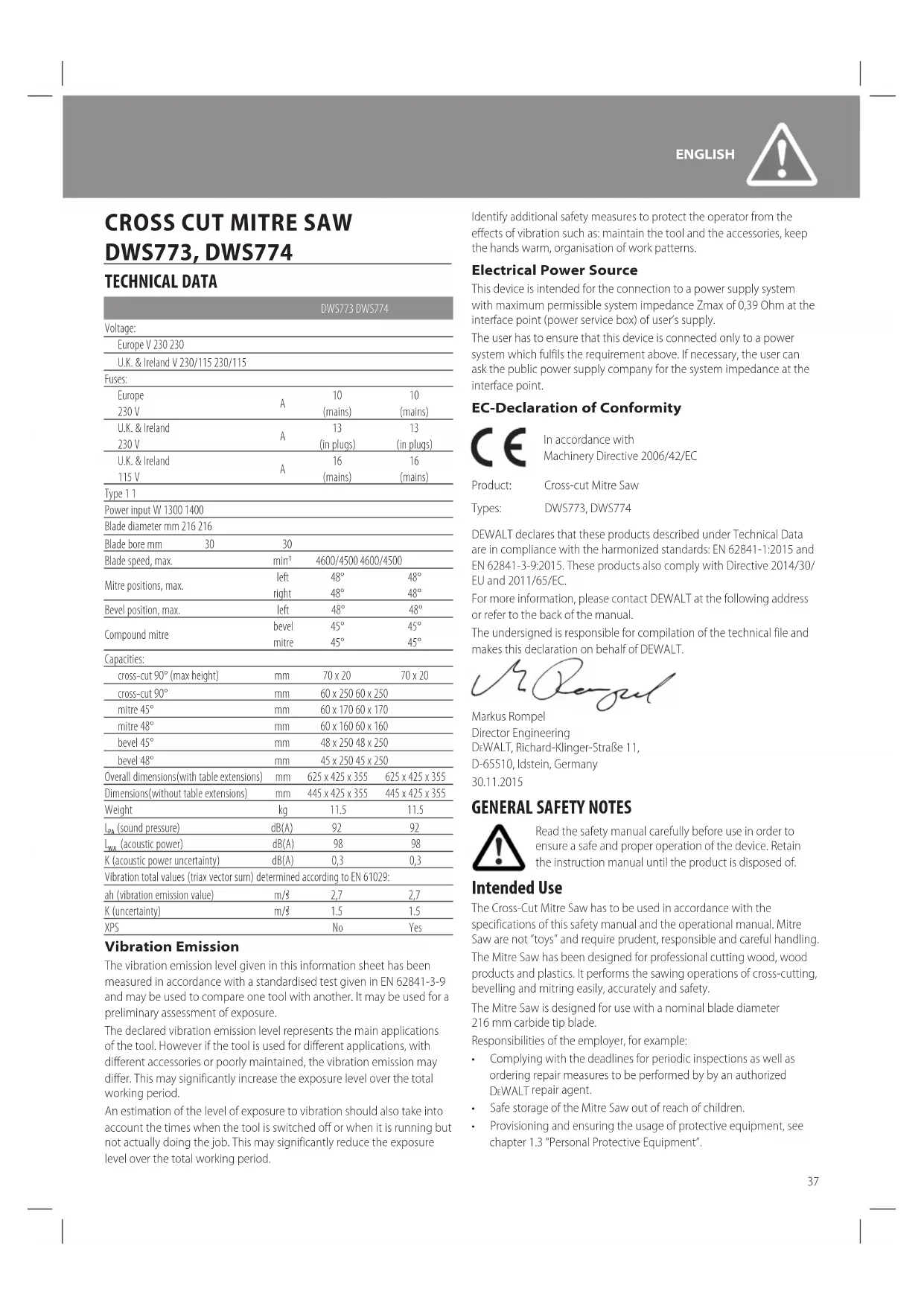
(in plugs) U.K. & Ireland 115 V
(sound pressure) dB(A) 92 92
XPS No Yes Vibration Emission The vibration emission level given in this information sheet has been measured in accordance with a standardised test given in EN 62841-3-9 and may be used to compare one tool with another. It may be used for a preliminary assessment of exposure. The declared vibration emission level represents the main applications of the tool. However if the tool is used for different applications, with different accessories or poorly maintained, the vibration emission may differ. This may significantly increase the exposure level over the total working period. An estimation of the level of exposure to vibration should also take into account the times when the tool is switched off or when it is running but not actually doing the job. This may significantly reduce the exposure level over the total working period. Identify additional safety measures to protect the operator from the effects of vibration such as: maintain the tool and the accessories, keep the hands warm, organisation of work patterns. Electrical Power Source This device is intended for the connection to a power supply system with maximum permissible system impedance Zmax of 0,39 Ohm at the interface point (power service box) of user’s supply. The user has to ensure that this device is connected only to a power system which fulfils the requirement above. If necessary, the user can ask the public power supply company for the system impedance at the interface point. EC-Declaration of Conformity In accordance with Machinery Directive 2006/42/EC Product: Cross-cut Mitre Saw Types: DWS773, DWS774 DEWALT declares that these products described under Technical Data are in compliance with the harmonized standards: EN 62841-1:2015 and EN 62841-3-9:2015. These products also comply with Directive 2014/30/ EU and 2011/65/EC. For more information, please contact DEWALT at the following address or refer to the back of the manual. The undersigned is responsible for compilation of the technical file and makes this declaration on behalf of DEWALT. Markus Rompel Director Engineering DeWALT , Richard-Klinger-Straße 11, D-65510, Idstein, Germany
Read the safety manual carefully before use in order to ensure asafe and proper operation of the device. Retain the instruction manual until the product is disposed of. Intended Use The Cross-Cut Mitre Saw has to be used in accordance with the specifications of this safety manual and the operational manual. Mitre Saw are not “toys” and require prudent, responsible and careful handling. The Mitre Saw has been designed for professional cutting wood, wood products and plastics. It performs the sawing operations of cross-cutting, bevelling and mitring easily, accurately and safety. The Mitre Saw is designed for use with a nominal blade diameter 216mm carbide tip blade. Responsibilities of the employer, for example:
- Complying with the deadlines for periodic inspections as well as ordering repair measures to be performed by by an authorized DeWALT repair agent.
- Safe storage of the Mitre Saw out of reach of children.
- Provisioning and ensuring the usage of protective equipment, see
chapter 1.3 “Personal Protective Equipment”.
ENGLISH38 The Mitre Saw may only be used by persons over 18 years of age or apprentices/trainees over 16 years of age (while in the presence of aresponsible supervisor) who are not under the influence of fatigue, alcohol, medication or drugs. Misapplications, misuse or “fooling around” may cause lethal injuries and serious property damage. For example:
- Overriding of safety mechanisms
- Cutting tree limbs or logs
- Cutting steel or other hard material
- Cutting light alloy, especially magnesium Modifications to the device, additions to the device or conversions as well as maintenance operations and repairs performed by yourself can impair the safety, reliability and proper functioning of the device to asignificant extent and void any warranty claims. DWS774: A failure of XPS, has no effect on the intended operation. UK only The attention of UK users is drawn to the “woodworking machines regulations 1974” and any subsequent amendments. Product code The product code, which also includes the year of manufacture, is printed into the housing. (See page 4.) Example: 2016 XX XX Year of Manufacture Definitions: Safety Guidelines The definitions below describe the level of severity for each signal word. Please read the manual and pay attention to thesesymbols.
DANGER: Indicates an imminently hazardous situation which, if
not avoided, will result in death or seriousinjury.
WARNING: Indicates a potentially hazardous situation which, if not
avoided, could result in death or seriousinjury. CAUTION: Indicates a potentially hazardous situation which, if not avoided, may result in minor or moderateinjury. NOTICE: Indicates a practice not related to personal injury which, if not avoided, may result in propertydamage. Denotes risk of electricshock. Denotes risk offire. General Power Tool Safety Warnings
WARNING: Read all safety warnings and all instructions.
Failure to follow the warnings and instructions may result in electric shock, fire and/or seriousinjury.
The term “power tool” in the warnings refers to your mains-operated (corded) power tool or battery-operated (cordless) powertool.
a ) Keep work area clean and well lit. Cluttered or dark areas inviteaccidents. b ) Do not operate power tools in explosive atmospheres, such as in the presence of flammable liquids, gases or dust. Power tools create sparks which may ignite the dust orfumes. c ) Keep children and bystanders away while operating a power tool. Distractions can cause you to losecontrol.
2) Electrical safety
a ) Power tool plugs must match the outlet. Never modify the plug in any way. Do not use any adapter plugs with earthed (grounded) power tools. Unmodified plugs and matching outlets will reduce risk of electricshock. b ) Avoid body contact with earthed or grounded surfaces such as pipes, radiators, ranges and refrigerators. There is an increased risk of electric shock if your body is earthed orgrounded. c ) Do not expose power tools to rain or wet conditions. Water entering a power tool will increase the risk of electricshock. d ) Do not abuse the cord. Never use the cord for carrying, pulling or unplugging the power tool. Keep cord away from heat, oil, sharp edges or moving parts. Damaged or entangled cords increase the risk of electricshock. e ) When operating a power tool outdoors, use an extension cord suitable for outdoor use. Use of a cord suitable for outdoor use reduces the risk of electricshock. f ) If operating a power tool in a damp location is unavoidable, use a residual current device (RCD) protected supply. Use of an RCD reduces the risk of electricshock.
a ) Stay alert, watch what you are doing and use common sense when operating a power tool. Do not use a power tool while you are tired or under the influence of drugs, alcohol or medication. A moment of inattention while operating power tools may result in serious personalinjury. b ) Use personal protective equipment. Always wear eye protection. Protective equipment such as dust mask, non-skid safety shoes, hard hat, or hearing protection used for appropriate conditions will reduce personalinjuries. c ) Prevent unintentional starting. Ensure the switch is in the off position before connecting to power source and/or battery pack, picking up or carrying the tool. Carrying power tools with your finger on the switch or energising power tools that have the switch on invitesaccidents. d ) Remove any adjusting key or wrench before turning the power tool on. A wrench or a key left attached to a rotating part of the power tool may result in personalinjury. e ) Do not overreach. Keep proper footing and balance at all times. This enables better control of the power tool in unexpectedsituations. f ) Dress properly. Do not wear loose clothing or jewellery. Keep your hair, clothing and gloves away from moving parts. Loose clothes, jewellery or long hair can be caught in movingparts. g ) If devices are provided for the connection of dust extraction and collection facilities, ensure these are connected and properly used. Use of dust collection can reduce dust- relatedhazards. h ) Do not let familiarity gained from frequent use of tools allow you to become complacent and ignore tool safety principles. A careless action can cause severe injury within a fraction of a second.39
4) Power tool use and care
a ) Do not force the power tool. Use the correct power tool for your application. The correct power tool will do the job better and safer at the rate for which it wasdesigned. b ) Do not use the power tool if the switch does not turn it on and off. Any power tool that cannot be controlled with the switch is dangerous and must berepaired. c ) Disconnect the plug from the power source and/or the battery pack from the power tool before making any adjustments, changing accessories, or storing power tools. Such preventive safety measures reduce the risk of starting the power toolaccidentally. d ) Store idle power tools out of the reach of children and do not allow persons unfamiliar with the power tool or these instructions to operate the power tool. Power tools are dangerous in the hands of untrainedusers. e ) Maintain power tools. Check for misalignment or binding of moving parts, breakage of parts and any other condition that may affect the power tool’s operation. If damaged, have the power tool repaired before use. Many accidents are caused by poorly maintained powertools. f ) Keep cutting tools sharp and clean. Properly maintained cutting tools with sharp cutting edges are less likely to bind and are easier tocontrol. g ) Use the power tool, accessories and tool bits etc., in accordance with these instructions taking into account the working conditions and the work to be performed. Use of the power tool for operations different from those intended could result in a hazardoussituation. h ) Keep handles and grasping surfaces dry, clean and free from oil and grease. Slippery handles and grasping surfaces do not allow for safe handling and control of the tool in unexpected situations.
a ) Have your power tool serviced by a qualified repair person using only identical replacement parts. This will ensure that the safety of the power tool ismaintained. Safety Rules for Mitre Saws a ) Mitre saws are intended to cut wood or wood-like products, they cannot be usedwith abrasive cut-off wheels for cutting ferrous material such as bars, rods, studs,etc. Abrasive dust causes moving parts such as the lower guard to jam. Sparks fromabrasive cutting will burn the lower guard, the kerf insert and other plastic parts. b ) Use clamps to support the workpiece whenever possible. If supporting theworkpiece by hand, you must always keep your hand at least 100 mm from eitherside of the saw blade. Do not use this saw to cut pieces that are too small to besecurely clamped or held by hand. If your hand is placed too close to the saw blade,there is an increased risk of injury from blade contact. c ) The workpiece must be stationary and clamped or held against both the fence and the table. Do not feed the workpiece into the blade or cut “freehand” in any way. Unrestrained or moving workpieces could be thrown at high speeds, causing injury. d ) Push the saw through the workpiece. Do not pull the saw through the workpiece. To make a cut, raise the saw head and pull it out over the workpiece without cutting, start the motor, press the saw head down and push the saw through the workpiece. Cutting on the pull stroke is likely to cause the saw blade to climb on top of the workpiece and violently throw the blade assembly towards the operator. e ) Never cross your hand over the intended line of cutting either in front or behind the saw blade. Supporting the workpiece “cross handed” i.e. holding the workpiece to the right of the saw blade with your left hand or vice versa is very dangerous. f ) Do not reach behind the fence with either hand closer than 100 mm from either side of the saw blade, to remove wood scraps, or for any other reason while the blade is spinning. The proximity of the spinning saw blade to your hand may not be obvious and you may be seriously injured. g ) Inspect your workpiece before cutting. If the workpiece is bowed or warped, clamp it with the outside bowed face toward the fence. Always make certain that there is no gap between the workpiece, fence and table along the line of the cut. Bent or warped workpieces can twist or shift and may cause binding on the spinning saw blade while cutting. There should be no nails or foreign objects in the workpiece. h ) Do not use the saw until the table is clear of all tools, wood scraps, etc., except for the workpiece. Small debris or loose pieces of wood or other objects that contact the revolving blade can be thrown with high speed. i ) Cut only one workpiece at a time. Stacked multiple workpieces cannot be adequately clamped or braced and may bind on the blade or shift during cutting. j ) Ensure the mitre saw is mounted or placed on a level, firm work surface before use. A level and firm work surface reduces the risk of the mitre saw becoming unstable. k ) Plan your work. Every time you change the bevel or mitre angle setting, make sure the adjustable fence is set correctly to support the workpiece and will not interfere with the blade or the guarding system. Without turning the tool “ON” and with no workpiece on the table, move the saw blade through a complete simulated cut to assure there will be no interference or danger of cutting the fence. l ) Provide adequate support such as table extensions, saw horses, etc. for a workpiece that is wider or longer than the table top. Workpieces longer or wider than the mitre saw table can tip if not securely supported. If the cut-off piece or workpiece tips, it can lift the lower guard or be thrown by the spinning blade. m ) Do not use another person as a substitute for a table extension or as additional support. Unstable support for the workpiece can cause the blade to bind or the workpiece to shift during the cutting operation pulling you and the helper into the spinning blade. n ) The cut-off piece must not be jammed or pressed by any means against the spinning saw blade. If confined, i.e. using length stops, the cut-off piece could get wedged against the blade and thrown violently. o ) Always use a clamp or a fixture designed to properly support round material such as rods or tubing. Rods have a tendency to roll while being cut, causing the blade to “bite” and pull the work with your hand into the blade. p ) Let the blade reach full speed before contacting the workpiece. This will reduce the risk of the workpiece being thrown. q ) If the workpiece or blade becomes jammed, turn the mitre saw off. Wait for all moving parts to stop and disconnect the40 plug from the power source and/or remove the battery pack. Then work to free the jammed material. Continued sawing with a jammed workpiece could cause loss of control or damage to the mitre saw. r ) After finishing the cut, release the switch, hold the saw head down and wait for the blade to stop before removing the cut-off piece. Reaching with your hand near the coasting blade is dangerous. s ) Hold the handle firmly when making an incomplete cut or when releasing the switch before the saw head is completely in the down position. The braking action of the saw may cause the saw head to be suddenly pulled downward, causing a risk of injury. Additional Safety Rules for Mitre Saws
- Do not use the saw to cut other materials than those recommended by the manufacturer.
- Do not operate the machine without guards in position, or if guards do not function or are not maintained properly.
- Select the correct blade for the material to be cut.
- Use correctly sharpened saw blades.
- Make sure that the blade rotates in the correct direction.
- USE ONLY CROSSCUT SAW BLADES recommended for mitre saws. Do not use carbide tipped blades with hook angles in excess of 7 degrees. Do not use blades with deep gullets. These can deflect and contact the guard, and can cause damage to the machine and/or serious injury.
- Never attempt to stop a machine in motion rapidly by jamming a tool or other means against the blade; serious accidents can occur.
- Before using any accessory consult the instruction manual. The improper use of an accessory can cause damage.
- Ensure that the saw blade is mounted correctly before use.
- Do not use blades of larger or smaller diameter than recommended. For the proper blade rating refer to the technical data. Use only the blades specified in this manual, complying with EN 847-1.
- Do not use HIGH SPEED STEEL blades.
- Do not use cracked or damaged saw blades.
- Do not use any abrasive or diamond discs.
- Use only saw blades where the marked speed is at least equal to the speed marked on the saw.
- Do not wedge anything against the fan to hold the motor shaft.
- Never raise the blade guard manually unless the saw is switched off. The guard can be raised by hand when installing or removing saw blades or for inspection of the saw.
- Check periodically that the motor air slots are clean and free of chips.
- Please be aware of the following factors influencing exposure to noise: ʵ use saw blades designed to reduce the emitted noise; ʵ use only well sharpened saw blades;
- Machine maintenance shall be conducted periodically;
- In case of an accident or machine failure, immediately turn the machine off and disconnect machine from the power source.
- Report the failure and mark the machine in suitable form to prevent other people from using the defective machine.
- When sawing plastic melting of the material is to be avoided. Personal Protective Equipment Loose clothes, jewellery, noise and similar hazards may present adanger to persons. Persons that will be using the device and have to reside in the vicinity of the device, must wear suitable personal protective equipment. Protective clothing protects the skin against mechanical effects, e.g. cuts Safety boots protect the feet against falling objects and the entry of protruding nails Safety gloves protect the hands against mechanical effects, e.g. cuts Marked on tool: Safety goggles: protects the eyes against flying objects, such as splinters and dust Marked on tool: Ear protection: protects the ears against excessive noise Marked on tool: Wear a dust respirator. Young children and the infirm. This machine is not intended for use by young children or infirm persons without supervision. Warning Signs and Labels The device may only be used if all safety labels on the Mitre Saw are both complete and legible. The safety alert symbol is used to alert you to potential physical injury hazards. Obey all safety messages that follow this symbol to avoid possible injury or death. Read the manual before using the device. Risk of electrical hazard Examples of cable damages Do not connect the power cable with the power supply. Danger of cuts41 Keep your hand at least 100 mm from either side of the saw blade This product must not be disposed of with normal household waste Keep away from children Do not use the tool in damp or wet conditions Do not use solvents or other harsh chemicals for cleaning The Mitre Saw requires no additional lubrication 250 – 300 Lux Well lightning of work area (250 - 300 Lux) While using the worklight do not stare at the light. Serious eye injury could result Marked on Tool: Carrying points Repair by DeWALT or by an authorized DeWALT repair agent
handled. Electrical Safety The Mitre Saw is double insulated in accordance with EN 62841; therefore no earth wire is required.
- The electric motor has been designed for one voltage only. Always check that the power supply corresponds to the voltage on the rating plate.
- Do not expose the tool to rain. Do not use the tool in damp or wet conditions.
- Avoid body contact with earthed surfaces (e.g., pipes, radiators, cookers and refrigerators).
- Outdoor use: Electric safety can be improved by inserting an isolating transformer or a (FI) earth-leakage circuit-breaker.
WARNING: Do not abuse the power cable.
- Never yank the power cable to disconnect it from the socket.
- Keep the power cable away from heat, oil and sharp edges. Extension cables
- If an extension cable is required, use an approved 3–core extension cable suitable for the power input of this tool (see Technical Data). The minimum conductor size is 1.5mm2; the maximum length is 30m.
- When using a cable reel, always unwind the cable completely.
- Before use: check the extension cable and replace if damaged.
- When the tool is used outdoors, use only extension cables intended for outdoor use and marked accordingly. Mains Plug and Cord Replacement In case of cord or plug replacement the tool must only be repaired by an authorized service agent or by qualified electrician. The following cords are mandatory:
H05RN-F, 2 x 1.0 mm2 H05RR-F, 2 x 1.5 mm2 Mains plug replacement (UK & Ireland only) If a new mains plug needs to be fitted:
- No connection is to be made to the earth terminal.
- Connect the brown lead to the live terminal in the plug.
- Connect the blue lead to the neutral terminal.
- Safely dispose of the old plug.
- Fitting a mains plug to 115 V Units: The plug fitted should be comply with BS EN 60309 (BS4343), 16 Amps, earthing contact position 4h.
- Check for damage to the tool, parts or accessories which may have occurred during transport.
- Check the content for completeness. Transport CAUTION: Improper transport can cause bruises.
- Do not carry the tool with a finger on the switch. Be sure that the tool is in the “off” position.
- Do not use guards to lift or transport the mitre saw. Storage NOTICE: The mitre saw must be stored in a dry place and locked up securely, out of reach of children. Bench Mounting Ergonomic requirements Ensure the tool is placed to satisfy your ergonomic conditions in terms of table height and stability. The machine site shall be chosen so that the operator has a good overview and enough free surrounding space around the machine that allows handling of the workpiece without any restrictions.42 Adjustments and Replacements The Mitre Saw was accurately adjusted at the factory. Due to shipping and handling or any other reason a readjustment can be required.
WARNING: Electrical shock can cause serious injuries or dead
- Before work: Disconnect the power cable from the power supply. NOTICE:
- Ensure that the arm is securely fixed when performing bevel cuts.
- Check that the blade does not touch the table at the rear of the slot or at the front of the rotating arm at 90° vertical and 45° bevel positions.
- If the saw blade is worn, replace it with a new sharp blade.
- Check the technical data of the new blade: Use 216 mm saw blades with 30 mm arbor holes to obtain the desired cutting capacities.
- Replace the kerf plate when worn. If the kerf plate becomes worn or damaged take saw to an authorised service centre. Operating General
- Use the optional roller tables for large and long pieces of wood.
- Use the optional dust extraction.
- Never use your saw without the kerf plate. Before use
- Check for damage to the tool and the power cable. Take care that the power supply cord is not placed in the cutting area
- Check the upper blade guard, movable lower blade guard as well as the dust extraction tube to determine that it will operate properly.
- Check the lower blade guard , it is designed to close quickly when the lever is released. If it does not close within 1 second, have the saw serviced by an authorized DeWALT repair agent.
- Ensure that chips, dust or workpiece particle cannot lead to blockage of one of the functions.
- In case of workpiece fragments jammed between saw blade and guards disconnect the tool from the power supply. Remove the jammed parts and reassembling the saw blade.
- Allow the blade to cut freely. Do not force.
- Always make dry runs (without power) before finish cuts so that you can check the path of the blade.
- Allow the motor to reach full speed before cutting.
- Make sure all locking knobs and clamp handles are tight.
WARNING: Improper use can cause serious harm.
- Be sure that the tool is in the “off” position before plugging in.
- Do not let persons, especially children, not involved in the work, touch the tool or the extension cord and keep them away from the work area. Body and hand position
- Never place your hands closer than 100 mm from the blade.
- Never cross your hands.
- As you move the saw arm left and right, follow it and stand slightly to the side of the saw blade. Cutting
- Always let the blade come to a full stop before raising the arm. If small fibres of wood still split out at the rear of the workpiece, stick a piece of masking tape on the wood where the cut will be made. Saw through the tape and carefully remove tape when finished.
- Hold the workpiece tightly to the table and the fence when cutting. Keep your hands in position until the switch has been released and the blade has completely stopped.
- When mitring the end of a piece of wood with a small off-cut, position the wood to ensure that the off-cut is to the side of the blade with the greater angle to the fence, i.e: - left mitre, off-cut to the right - right mitre, off-cut to the left After use
- Disconnect the power cable from the power supply.
- Store the Mitre Saw in a dry place and locked up securely, out of reach of children. Dust Extraction
WARNING: Risk of dust inhalation. To reduce the risk of personal
injury ALWAYS wear approved dust mask.
WARNING: ALWAYS use a vacuum extractor designed in
complaince with the applicable directives regarding dust emission when sawing wood.
- Certain dusts, such as oak or beech dust, are considered as carcinogenic.
- Observe the relevant regulations in your country for the materials to be worked. NOTICE:
- Connect the saw to a dust collection device when sawing wood. Always consider factors which influence exposure of dust such as: ʵ good ventilation of the working place; ʵ sharpness of the saw blade; ʵ correct adjustment of the saw blade, ʵ Push the saw through the workpiece. Do not pull the saw through the workpiece. Cleaning and Maintenance The Mitre Saw requires no additional lubrication and has been designed to operate over a long period of time with a minimum of maintenance. Continuous satisfactory operation depends upon proper tool care and regular cleaning.
WARNING: Electrical shock can cause serious injuries or death.
- Before cleaning: Disconnect the power cable from the power supply. NOTICE:
- Use a cloth dampened only with water and mild soap.
- Never let any liquid get inside the tool; never immerse any part of the tool into a liquid.43
- The guide grooves can become clogged with sawdust. Use suitable dust extraction or some low pressure air to clear the guide grooves.
- Disconnect the machine from the mains before carrying out any maintenance work or when changing the blade.
- Never perform any cleaning or maintenance work when the machine is still running and the head is not in the rest position. Disposal Protecting the environment! Separate collection. Products and batteries marked with this symbol must not be disposed of with normal household waste. Products and batteries contain materials that can be recovered or recycled reducing the demand for raw materials. Please recycle electrical products and batteries according to local provisions. Further information is available at www.2helpU.com.44