24VWDV6000 - Vacuum Cleaner Sun Joe - Free user manual and instructions
Find the device manual for free 24VWDV6000 Sun Joe in PDF.



| Product type | Cordless wet/dry vacuum |
| Brand | Sun Joe |
| Model | 24VWDV6000 |
| Motor | 240 W |
| Power source | iON+ 24V lithium-ion battery, 4.0 Ah (model 24VBAT) |
| Battery rated voltage | 24 V DC (no load, 21.6 V under load) |
| Charger | iON+ 24V (model 24VCHRG-QC), input 120 V AC 60 Hz, output 26 V DC 2.2 A |
| Maximum charging time | 1 h 50 min |
| Maximum air flow | 1 m³/min |
| Maximum vacuum pressure | 10 kPa |
| Maximum suction power | 70 air watts |
| Tank capacity | 20 L |
| Hose length | 1.8 m |
| Filtration | Foam filter + cartridge filter + paper dust bag |
| Net weight | 6.1 kg |
| Operating modes | Dry vacuuming, wet vacuuming, blower |
| Included accessories | Flexible hose, telescopic tube, crevice tool, dusting brush, multi-purpose nozzle, air regulation handle, foam filter, paper dust bag, battery, charger |
| Casters | 5 swivel casters |
| Usage | Household use only |
| Warranty | 2 years (residential use) |
Frequently Asked Questions - 24VWDV6000 Sun Joe
User questions about 24VWDV6000 Sun Joe
0 question about this device. Answer the ones you know or ask your own.
Ask a new question about this device
Download the instructions for your Vacuum Cleaner in PDF format for free! Find your manual 24VWDV6000 - Sun Joe and take your electronic device back in hand. On this page are published all the documents necessary for the use of your device. 24VWDV6000 by Sun Joe.
USER MANUAL 24VWDV6000 Sun Joe
IMPORTANT! Safety Instructions
All Operators Must Read These Instructions Before Use
Any electrical appliance can be dangerous if used incorrectly. Some of the safety precautions given in this manual apply generally to many appliances. Other warnings are specific to the use of this cordless wet/dry vacuum.
Always follow these safety guidelines. Failure to do so may result in personal injury or property damage.
⚠ WARNING! This unit can be dangerous! Careless or improper use can cause serious injury.
General Safety
Before using, be sure that everyone using this tool reads and understands all safety instructions and other information contained in this manual. Save this manual and review it frequently prior to using this tool and when instructing others on the proper operating procedures.
Before using the wet/dry vacuum, take the time to familiarize yourself with the controls, especially how to stop the wet/dry vacuum in an emergency. The only individuals who should use the wet/dry vacuum are those who have a thorough understanding of the instructions and who know how to operate the machine. Children should never be allowed access to the wet/dry vacuum.
Retain this manual for future reference.
- Keep filters in place – Ensure that the equipment is assembled correctly and the filters are in the correct position.
- Keep bystanders and children away – All bystanders, including children and pets, should be kept a safe distance away from the work area.
-
Disconnect tool – Remove the battery from the battery compartment when not in use, before servicing, when transporting, or when changing accessories.
-
Do not use in dangerous environments – Do not operate the wet/dry vacuum in gaseous or explosive atmospheres or use the wet/dry vacuum to pick up flammable or combustible liquids. Motors in these tools normally spark, and the sparks might ignite fumes.
- Check for damaged parts – Before using the wet/dry vacuum, repair or replace any part that is damaged. In addition, check any other conditions that may affect the tool's operation.
- Avoid unintentional starting – Make sure the switch is off before inserting the battery.
- Use the right tool – Do not force the tool or any attachment on the tool to do a job for which they were not designed.
- Wear face or dust masks – If operated in dusty environment, the use of a face or dust mask specially designed to filter out microscopic particles is recommended.
- Maintain tools with care – Keep tools clean for best and safest performance. Follow instructions for changing accessories. If the appliance is not working as it should, or has been dropped, damaged, left outdoors, dropped into water, please call Snow Joe ^® + Sun Joe ^® customer service center at 1-866-SNOWJOE (1-866-766-9563).
- Use recommended accessories – Consult the owner's manual for recommended accessories. The use of improper accessories may cause risk of injury.
- Do not force the appliance – It will do the job better and with less likelihood of a risk of injury if it is used at the rate for which it was designed.
- Do not overreach – Keep proper footing and balance at all times.
- Store idle tool indoors – When not in use, the wet/dry vacuum should be stored indoors in a dry and locked-up place out of the reach of children.
- Stay alert – Watch what you are doing. Use common sense. Do not operate the wet/dry vacuum when you are tired or under the influence of drugs, alcohol or other medication.
⚠️DANGER! Do not manually place objects into the vacuum inlet while operating the unit, as this can seriously damage the unit and/or harm the operator. Keep both hands away from the air inlet while the power is on.
DO NOT ATTEMPT to remove material or hold material to be vacuumed when the wet/dry vacuum is on. Make sure the wet/dry vacuum is off when clearing jammed material from the vacuum inlet.
Personal Safety
⚠️DANGER! Do not vacuum, or use this wet/dry vacuum near flammable liquids, gases, or explosive vapors like gasoline or other fuels, light fluids, cleaners, oil-based paints, natural gas, hydrogen, or explosive dusts like coal dust, magnesium dust, grain dust or gun powder. Sparks generated by the motor can ignite flammable vapors or dust.
- Children in the work area must be supervised to ensure that they do not play with the appliance. This appliance is NOT a toy and should never be used as such.
- Never leave a machine that is ready for operation unattended at the workplace.
- Do not pick up anything that is burning or smoking, such as cigarettes, matches or hot ashes.
- Do not use without the filters in place. Double check to make sure the filters are not broken or torn. Do not use filters that are broken or torn.
- Carefully inspect your appliance prior to use and follow all label and marking instructions.
- Always remove the battery before assemble or disassemble the filter.
- To reduce the risk of health hazard from vapors or dust, do not vacuum toxic material.
- Do not store near hazardous material.
- Do not leave the wet/dry vacuum unattended when battery is inside. Remove the battery when not in use.
- Keep hair, loose clothing, fingers, and all parts of the body away from openings.
- Maintain proper footing and use extra care when using the appliance on stairs.
- Service on the product must be performed by qualified repair personnel only. Service or maintenance performed by unqualified personnel could result in injury to the user or damage to the product.
- This wet/dry vacuum is intended for residential use only. Commercial use of this product is prohibited and will void the manufacturer's warranty.
- Never douse or squirt the unit with water or any other liquid. Clean the unit after use every time as described in the maintenance and storage section.
- Prevent cords, plastic bags, or similar items from getting sucked in, as these might wrap around the filter, which may cause an overload or blocking of the motor. In such a case, switch the wet/dry vacuum off. Do not leave the wet/dry vacuum switched on with the motor overloaded or stalled.
-
Always operate the machine in an upright position. Do not operate it tilted to one side or even upside-down.
-
Never hold the nozzle in front of your face (especially your eyes, ears, etc.). Never direct the nozzle towards persons or animals.
- Make sure that the correct filter has been inserted securely before using the appliance. The wrong filter or incorrectly installed filter can cause damage to the appliance and void the warranty.
Specific Safety Rules for Wet/Dry Vacuum
This motor-operated wet/dry vacuum is intended for vacuuming wet or dry material and dust. This equipment is not suitable for vacuuming ashes, coals, toxic, flammable or other hazardous materials. Vacuuming of glowing materials and dusts that are combustible, explosive or hazardous to one's health is prohibited. The manufacturer will not be held responsible for injuries resulting from incorrect use of the device or from use that does not comply with the directions.
NOTE: This wet/dry vacuum is intended for household use only.
⚠️CAUTION! Always switch off the machine and remove the battery before assembling, opening, emptying the container, before connecting/disconnecting the attachments, or carrying out maintenance or troubleshooting checks.
⚠ WARNING! To reduce the risk of electric shock, do not use in damp or wet environments. Do not expose to rain. Store indoors in a dry place.
⚠ WARNING! For your own safety, read and understand the operator's manual. Do not run the unit unattended. Do not pick up hot ashes, coals, toxic substances, flammable materials or other hazardous debris. Do not use the device in an area with explosive liquids or vapors.
- Don't vacuum up liquids that are hotter than 60^ , any poisonous or flammable dusts, or any pointed/sharp objects.
- Do not use the wet/dry vacuum without filters in place. Inspect the filters frequently and replace with recommended replacement if there are signs of wear or deterioration.
- When vacuuming, do not place the equipment on heat sensitive floors. For safety reasons, use a fireproof base when necessary.
- Empty and clean the vacuum before and after vacuuming to avoid the accumulation of debris.
- Do not store the appliance directly beside a hot oven or radiator.
⚠️CAUTION! Do not vacuum hazardous substances (e.g. petrol, solvents, acids or lyes) and ash from unauthorized fuels (i.e. from oil-burning ovens or heating boilers). These substances pose a serious risk of injury.
- Do not use the vacuum in areas where flammable or combustible liquids, such as gasoline, may be present.
- Do not vacuum fine, combustible dust particles that can ignite and potentially lead to an explosion.
- Do not put foreign objects into openings. Do not use the vacuum with any opening blocked; keep all openings free of dust, lint, hair, and anything that may reduce air flow.
• Always check the hose and the unit when vacuuming. - Check the float often.
- If you notice liquid leaking from your appliance, switch it off immediately and remove the battery.
- When using the blower function:
i) Direct air discharge at work area only – never at people or animals.
ii) Do not use blower as a sprayer in wet mode.
iii) Wear a dust mask and protective eye wear.
IMPORTANT! If the hose or tools are blocked, switch off the vacuum and remove the blockage(s) before re-starting your machine.
IMPORTANT! Cleaning filters and replacing them regularly maintains vacuum performance. It's recommended that your filters should be checked, cleaned and replaced periodically.
Battery + Charger Safety Instructions
We pay a great deal of attention to the design of every battery pack to ensure that we supply you with batteries that are safe, durable and have a high energy density. The battery cells have a wide range of safety devices. Each individual cell is initially formatted and its electrical characteristic curves are recorded. This data is then used exclusively to be able to assemble the best possible battery packs.
Despite all the safety precautions, caution must always be exercised when handling batteries. The following points must be obeyed at all times to ensure safe use. Safe use can only be guaranteed if undamaged cells are used. Incorrect handling of the battery pack can cause cell damage.
IMPORTANT! Analyses confirm that incorrect use and poor care of high-performance batteries are the main factors responsible for personal and/or product damage.
⚠ WARNING! Use only approved replacement batteries; other batteries may damage the cordless wet/dry vac and cause it to malfunction, which can lead to serious personal injury.
⚠ WARNING! Do not use a battery pack or appliance that is damaged or modified. Damaged or modified batteries may exhibit unpredictable behavior resulting in fire, explosion or risk of injury.
Do not modify or attempt to repair the battery pack except as indicated in the instructions for use and care.
Have your battery pack serviced by a qualified repair person using only identical replacement parts. This will ensure that the safety of the battery pack is maintained.
⚠️CAUTION! To reduce the risk of injury, charge the Snow Joe® 24V iON+ lithium-ion battery pack only in its designated Snow Joe® 24V iON+ lithium-ion charger. Other types of chargers present risk of fire, personal injury and damage. Do not wire a battery pack to a power supply plug or car cigarette lighter. Such misuse will permanently disable or damage the battery pack.
- Avoid dangerous environments – Do not charge the battery pack in rain, snow or in damp or wet locations. Do not use the battery pack or charger in the presence of explosive atmospheres (gaseous fumes, dust or flammable materials) because sparks may be generated when inserting or removing the battery pack, which could lead to a fire.
- Charge in a well-ventilated area – Do not block the charger vents. Keep them clear to allow for proper ventilation. Do not allow smoking or open flames near a charging battery pack. Vented gases may explode.
NOTE: The safe temperature range for the battery is 41^ F – 105^ F ( 5^ C – 40.5^ C). Do not charge the battery outside in freezing weather; charge it at room temperature.
- Maintain charger cord – When unplugging the charger, pull the plug, not the cord, from the receptacle to reduce the risk of damage to the electrical plug and cord. Never carry the charger by its cord or yank it by the cord to disconnect it from the receptacle. Keep the cord away from heat, oil and sharp edges. Make sure the cord will not be stepped on, tripped over or subjected to damage or stress when the charger is in use. Do not use the charger with a damaged cord or plug. Replace a damaged charger immediately.
- Do not use an extension cord unless it is absolutely necessary – Using the wrong, damaged or improperly wired extension cord poses a risk of fire and electric shock. If an extension cord must be used, plug the charger into a properly wired 16 gauge or larger extension cord with the female plug matching the male plug on the charger. Make sure that the extension cord is in good electrical condition.
- Charger 24VCHRG-QC is rated for 120 volt AC only – The charger must be plugged into an appropriate receptacle.
- Use only recommended attachments – Use of an attachment not recommended or sold by the battery charger or battery pack manufacturer may result in risk of fire, electric shock or personal injury.
- Unplug charger when not in use – Make sure to remove the battery pack from unplugged chargers.
⚠ WARNING! To reduce the risk of electric shock, always unplug the charger before performing any cleaning or maintenance. Do not allow water to flow into the charger. Use a Ground Fault Circuit Interrupter (GFCI) to reduce shock hazards.
- Do not burn or incinerate battery packs – Battery packs may explode, causing personal injury or damage. Toxic fumes and materials are created when battery packs are burned.
- Do not crush, drop or damage battery packs – Do not use the battery pack or charger if they have sustained a sharp blow, been dropped, run over or have been damaged in any way (i.e. pierced with a nail, hit with a hammer, stepped on, etc.).
- Do not disassemble – Incorrect reassembly may pose a serious risk of electric shock, fire or exposure to toxic battery chemicals. If the battery or charger are damaged, contact an authorized Snow Joe® + Sun Joe® dealer or call the Snow Joe® + Sun Joe® customer service center at 1-866-SNOWJOE (1-866-766-9563) for assistance.
- Battery chemicals cause serious burns – Never let a damaged battery pack contact the skin, eyes or mouth. If a damaged battery pack leaks battery chemicals, use rubber or neoprene gloves to safely dispose of it. If skin is exposed to battery fluids, wash the affected area with soap and water and rinse with vinegar. If eyes are exposed to battery chemicals, immediately flush with water for 20 minutes and seek medical attention. Remove and dispose of contaminated clothing.
- Do not short circuit – A battery pack will short circuit if a metal object makes a connection between the positive and negative contacts on the battery pack. Do not place a battery pack near anything that may cause a short circuit, such as paper clips, coins, keys, screws, nails and other metallic objects. A short-circuited battery pack poses a risk of fire and severe personal injury.
- Store your battery pack and charger in a cool, dry place – Do not store the battery pack or charger where temperatures may exceed 105°F (40.5°C), such as in direct sunlight or inside a vehicle or metal building during the summer.
Information about the battery
- The battery pack supplied with your cordless wet/dry vac is only partially charged. The battery pack has to be charged completely before you use the tool for the first time.
- For optimum battery performance, avoid low discharge cycles by charging the battery pack frequently.
-
Store the battery pack in a cool place, ideally at 77°F (25°C) and charged to at least 40%.
-
Lithium-ion batteries are subject to a natural aging process. The battery pack must be replaced at the latest when its capacity falls to just 80% of its capacity when new. Weakened cells in an aged battery pack are no longer capable of meeting the high power requirements needed for the proper operation of your vacuum and therefore pose a safety risk.
-
Do not throw battery packs into an open fire as this poses a risk of explosion.
-
Do not ignite the battery pack or expose it to fire.
-
Do not exhaustively discharge batteries. Exhaustive discharge will damage the battery cells. The most common cause of exhaustive discharge is lengthy storage or non-use of partially discharged batteries. Stop working as soon as the performance of the battery falls noticeably or the electronic protection system triggers. Place the battery pack in storage only after it has been fully charged.
-
Protect the battery and the tool from overloads. Overloads will quickly result in overheating and cell damage inside the battery housing even if this overheating is not apparent externally.
-
Avoid damage and shocks. Immediately replace batteries that have been dropped from a height of more than one meter or those that have been exposed to violent shocks, even if the housing of the battery pack appears to be undamaged. The battery cells inside the battery may have suffered serious damage. In such instances, please read the waste disposal information for proper battery disposal.
-
If the battery pack suffers overloading and overheating, the integrated protective cutoff will switch off the equipment for safety reasons.
IMPORTANT! Do not press the ON/OFF switch any more if the protective cut-off has been activated. This may damage the battery pack.
- Use only original battery packs. The use of other batteries poses a fire risk and may result in injuries or an explosion.
Information about the charger and the charging process
- Please check the data marked on the rating plate of the battery charger. Be sure to connect the battery charger to a power supply with the voltage marked on the rating plate. Never connect it to a different mains voltage.
- Protect the battery charger and its cord from damage. Keep the charger and its cord away from heat, oil and sharp edges. Have damaged cords repaired without delay by a qualified technician at an authorized Snow Joe ^® + Sun Joe ^® dealer or call the Snow Joe ^® + Sun Joe ^® customer service center at 1-866-SNOWJOE (1-866-766-9563).
-
Electrical plugs must match the outlet. Never modify the plug in any way. Do not use any adapter plugs with grounded appliances. Unmodified plugs and matching outlets will reduce the risk of electric shock.
-
Keep the battery charger, battery pack and the cordless tool out of the reach of children.
- Do not use the supplied battery charger to charge other cordless tools.
- During periods of heavy use, the battery pack will become warm. Allow the battery pack to cool to room temperature before connecting it with the charger to recharge.
- Do not overcharge batteries. Do not exceed the maximum charging times. These charging times only apply to discharged batteries. Frequent insertion of a charged or partially charged battery pack will result in overcharging and cell damage. Do not leave the battery connected with the charger for days on end.
- Never use or charge batteries if you suspect that it has been more than 12 months since the last time they were charged. There is a high probability that the battery pack has already suffered dangerous damage (exhaustive discharge).
- Charging batteries at a temperature below 41^ F ( 5^ C) will cause chemical damage to the cells and may cause a fire.
- Do not use batteries that have been exposed to heat during the charging process, as the battery cells may have suffered dangerous damage.
- Do not use batteries that have suffered curvature or deformation during the charging process or those that exhibit other atypical symptoms (gassing, hissing, cracking, etc.).
- Never fully discharge the battery pack (maximum recommended depth of discharge is 80%). A complete discharge of the battery pack will lead to premature aging of the battery cells.
Protection from environmental influences
- Wear suitable work clothes. Wear safety goggles.
- Protect your cordless tool and the battery charger from moisture and rain. Moisture and rain can cause dangerous cell damage.
- Do not use the cordless tool or the battery charger near vapors and flammable liquids.
- Use the battery charger and cordless tools only in dry conditions and at an ambient temperature of 32^ F – 104^ F ( 0^ C – 40^ C).
- Do not keep the battery charger in places where the temperature is liable to reach over 105^ F ( 40.5^ C). In particular, do not leave the battery charger in a car that is parked in the sunshine.
-
Protect batteries from overheating. Overloads, overcharging and exposure to direct sunlight will result in overheating and cell damage. Never charge or work with batteries that have been overheated – replace them immediately, if possible.
-
Store the charger and your cordless tool only in dry locations with an ambient temperature of 41^ F – 105^ F ( 5^ C – 40.5^ C). Store your lithium-ion battery pack in a cool, dry place at a temperature of 77^ F ( 25^ C). Protect the battery pack, charger and cordless tool from humidity and direct sunlight. Only place fully charged batteries in storage (charged to at least 40%).
- Prevent the lithium-ion battery pack from freezing. Battery packs that were stored below 32^ F ( 0^ C) for more than 60 minutes must be discarded.
- When handling batteries, be wary of electrostatic charge. Electrostatic discharges can damage the electronic protection system and the battery cells. Avoid electrostatic charging and never touch the battery poles.
Safety Symbols
The following table depicts and describes safety symbols that may appear on this product. Read, understand and follow all instructions on the machine before attempting to assemble and operate.
| Symbols | Descriptions Symbols | Descriptions | |
 | Safety alert. Exercise caution. |  | To reduce the risk of injury,user must read the instruction manual. |
 | To reduce the risk of electric shock, do not use outdoors or in damp or wet environments.Do not expose to rain. Store indoors in a dry place. |  | Indoor use only. Only use battery charger indoors. |
Know Your Cordless Wet/Dry Vacuum
Read the owner's manual and safety instructions carefully before operating the cordless wet/dry vacuum. Compare the illustration below to the cordless wet/dry vacuum in order to familiarize yourself with the location of the various controls and adjustments. Save this manual for future reference.
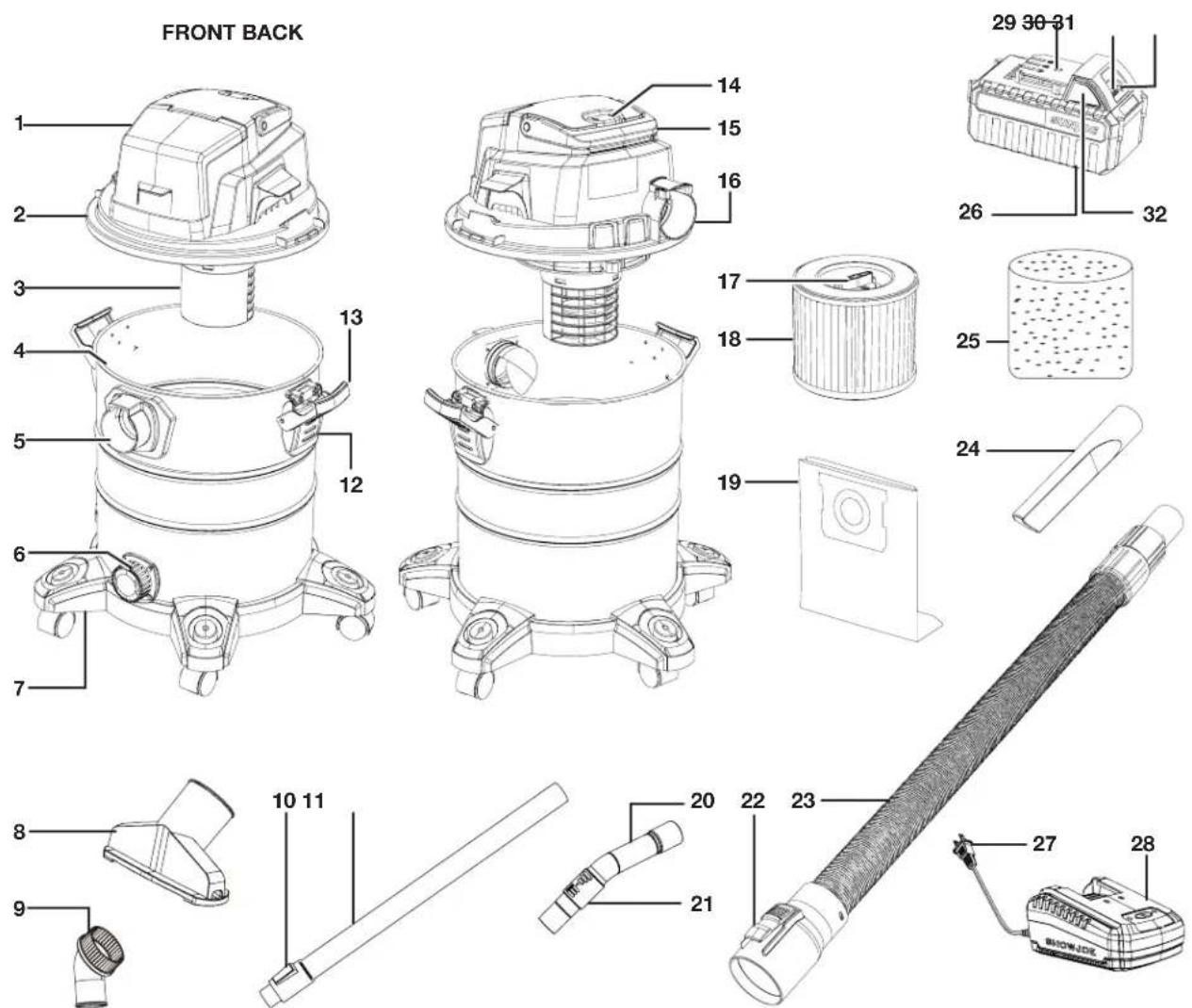
- Battery compartment
- Powerhead
- Filter basket
- Dust tank
- Air inlet
- Drain outlet
- Casters (5)
- Utility nozzle
- Dust brush
-
Telescopic tube lock
-
Telescopic tube
- Motor section latch lock
- Motor section latch
- On/off switch
- Handle
- Air outlet
- Cartridge filter lock
- Cartridge filter
- Paper dust bag
-
Air regulation handle
-
Air block
- Hose releasing button
- Suction hose
- Crevice nozzle
- Foam filter
- 24V iON+ lithium-ion battery (24VBAT) featuring exclusive EcoSharp® technology
-
Charger plug
-
24V iON+ lithium-ion battery charger (24VCHRG-QC)
- Charging socket
- Battery indicator
- Push button for battery indicator
- Push lock buttons
Technical Data
Motor 240 W
Battery Voltage Max ^* 24V D.C.
Battery Capacity 4.0 Ah
Charger Input 120V AC, 60 Hz, 75 W
Charger Output 26V DC, 2.2A
Charge Time Max 1 hr 50 mins
Air Flow Max 35 CFM (1 m³/min)
Peak Horsepower 4.7 HP
Vacuum Pressure Max 10 kPa
Suction Power Max (Air Watts) 70 W
Suction Hose Length 5.9 ft (1.8 m)
Tank Capacity 5.3 gal (20 L)
Filtration ...... foam filter + cartridge filter + paper dust bag
Net Weight 13.5 lbs (6.1 kg)
*Initial no-load voltage, when fully charged, peaks at 24 volts; nominal voltage under typical load is 21.6 volts.
Unpacking
Carton Contents
- Cordless wet/dry vacuum
- Suction hose
- Telescopic tube
• Air regulation handle - Crevice nozzle
- Dust brush
- Utility nozzle
- Foam filter
- Paper dust bag
- Screws (8)
• 24V iON+ lithium-ion battery
• 24V iON+ lithium-ion battery charger -
Manual + registration card
-
Carefully remove the cordless wet/dry vacuum and check to see that all of the above items are supplied.
-
Inspect the product carefully to make sure no breakage or damage occurred during shipping. If you find damaged or missing parts, DO NOT return the unit to the store. Please call the Snow Joe ^® + Sun Joe ^® customer service center at 1-866-SNOWJOE (1-866-766-9563).
NOTE: Do not discard the shipping carton and packaging material until you are ready to use the wet/dry vacuum. The packaging is made of recyclable materials. Properly dispose of these materials in accordance with local regulations.
IMPORTANT! The equipment and packaging material are not toys. Do not let children play with plastic bags, foils or small parts. These items can be swallowed and pose a suffocation risk!
Battery Pack Operation
The equipment is powered by a lithium-ion battery. The battery pack is completely sealed and maintenance free.
⚠ WARNING! Before first use, the battery requires about 1 hour 50 minutes charge time to be fully charged. When the battery is at low capacity, recharge for 1 hour 50 minutes again before resuming operation.
Battery Charge Level Indicator
The battery pack is equipped with a push button for checking the charge level. Simply press the push button to read off the battery charge level from the LEDs of the battery indicator:
- All 3 level monitoring LEDs are lit: Battery charge level is high.
- 2 level monitoring LEDs are lit: Battery charge level is decreasing. Stop work as soon as possible.
- 1 level monitoring LED is lit: Battery is flat. Stop work IMMEDIATELY and charge the battery. Otherwise the battery's service life will be greatly shortened.
| Light IndicatorsLights | |
| Charge level button | |
| The battery is at 30% capacity and requires charging | |
| The battery is at 60% capacity and requires charging soon | |
| The battery is at full capacity |
NOTE: If the charge level button does not appear to be working, connect the battery with the charger and charge as needed.
NOTE: Immediately after using the battery pack, the charge level button may display a lower charge than it will if checked a few minutes later. The battery cells “recover” some of their charge after resting.
Charger Operation
WARNING! Charge only 24V iON+ lithium-ion battery packs with its compatible 24V iON+ lithium-ion charger. Other types of batteries may cause personal injury and damage.
To reduce the risk of electric shock, do not allow water to flow into the charger's AC/DC plug.
When to Charge the iON+ 24VBAT Lithium-Ion Battery
NOTE: The iON+ 24VBAT lithium-ion battery packs do not develop a "memory" when charged after only a partial discharge. Therefore, it is not necessary to run down the battery pack before connecting it with the charger.
- Use the battery charge indicator lights to determine when to charge your iON+ 24VBAT lithium-ion battery pack.
- You can "top-off" your battery pack's charge before starting a big job or after a long day of use.
Charging the Battery
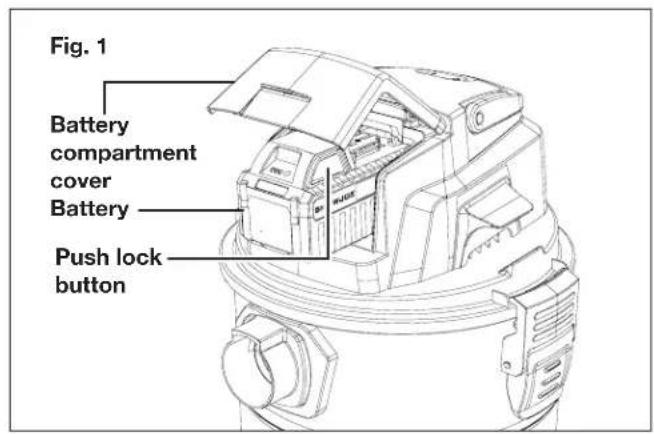
- Open the battery compartment cover, and press the push lock buttons on the battery to pull the battery pack out of the equipment (Fig. 1).
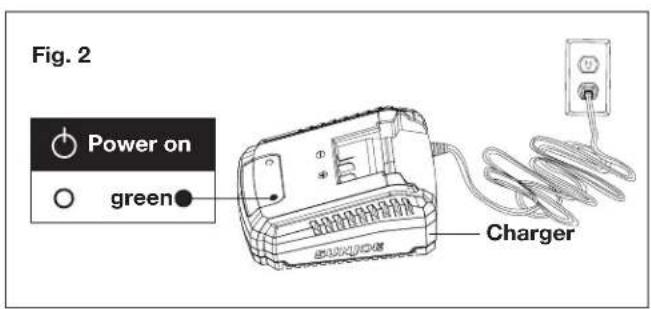
- Check that the mains voltage is the same as that marked on the rating plate of the battery charger. Then, insert the charger's plug into the electrical wall outlet. When you plug in the charger, the top right green light will illuminate and stay green (Fig. 2).
- Place the battery pack into the charger by sliding the pack to lock it into position. When you insert the battery into the charger, the top right green light will go off, and the top left red light will illuminate to indicate that the battery is charging (Fig. 3).
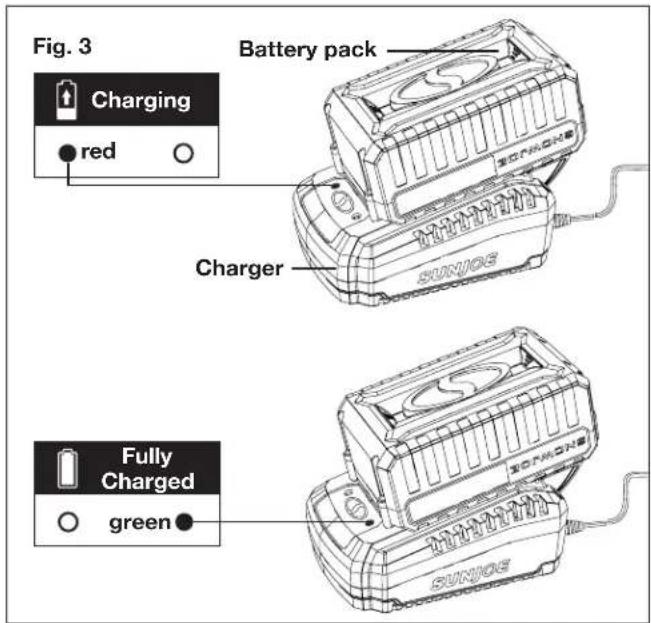
- When the charger light turns green, the battery is fully charged (Fig. 3).
NOTE: A fully discharged pack with an internal temperature in the normal range will fully charge in 1 hr 50 mins (between 32°F/0°C and 113°F/45°C).
-
If the light indicators do not come on at all, check that the battery pack is fully seated into the bay. Remove the battery pack and reinsert. If the problem persists, contact an authorized Snow Joe ^® + Sun Joe ^® dealer or call the Snow Joe ^® + Sun Joe ^® customer service center at 1-866-SNOWJOE (1-866-766-9563) for assistance.
-
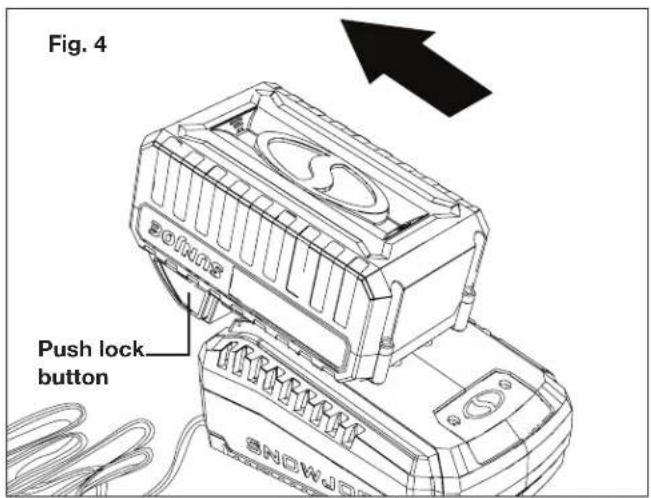
When charging is complete, remove the battery from the charger by pressing the push lock buttons and sliding the battery backward to unlock it from the charger (Fig. 4).
- Timely recharging of the battery will help prolong the battery's life. You must recharge the battery pack when you notice a drop in the equipment's power.
IMPORTANT! Never allow the battery pack to become fully discharged as this will cause irreversible damage to the battery.
Charging a Hot or Cold Battery Pack
The green indicator light on the charger base indicates that the battery pack temperature is outside the charging range. Once the pack is within the acceptable range, normal charging will take place and the red light will be continuous. Hot or cold battery packs may take longer to charge.
| Lithium-Ion Charging Status | |||
| Battery Pack Temperature | Charger Base Indicator Light | Battery Pack Indicator Light | Charging Status |
| Too hot | Green | Flashing together | Not charging |
| Normal range | Red | Flashing one by one | Normal charging |
| Too cold | Green | Flashing together | Not charging |
Assembly
⚠ WARNING! To avoid serious personal injury, read and understand all safety instructions provided.
⚠ WARNING! Do not insert battery until assembly is complete. Failure to comply could result in accidental starting and possible serious personal injury.
WARNING! Before performing any maintenance, make sure the battery is removed from the tool. Failure to heed this warning could result in serious personal injury.
WARNING! To prevent personal injury, make sure the switch is in the OFF position before attaching or removing the suction hose.
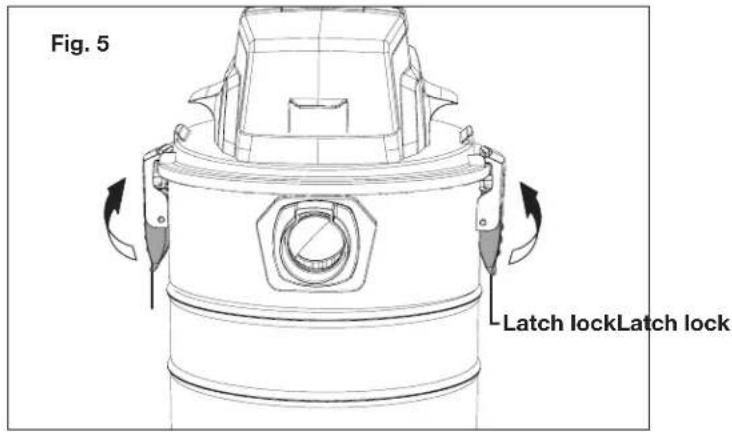
- Unlock the powerhead by flipping up the latches on both sides, and then lift up (Fig. 5).
- Remove all the contents from the tank.
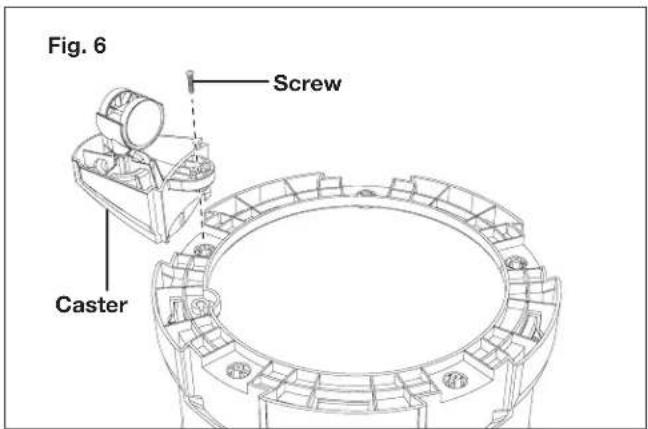
- Turn the dust tank upside down. Fit a caster into the mounting as shown. Fix with provided screw. Do not overtighten (Fig. 6).
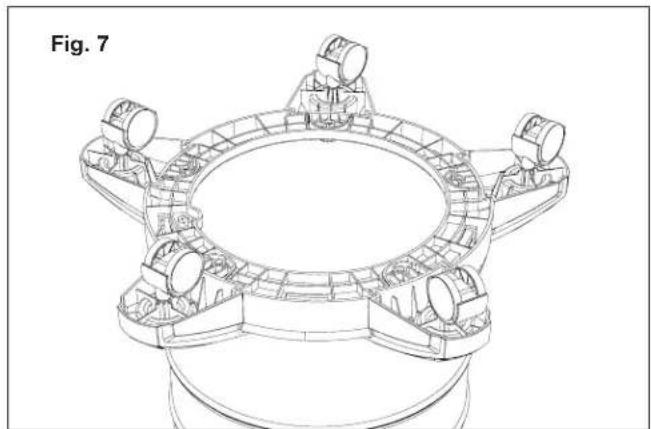
- Repeat to assemble all the 5 casters on the bottom (Fig. 7).
natural_image
Technical line drawing of a mechanical component with multiple cylindrical features and a central circular cavity (no text or symbols)NOTE: The assembly requires 5 screws. The 3 additional screws are spares.
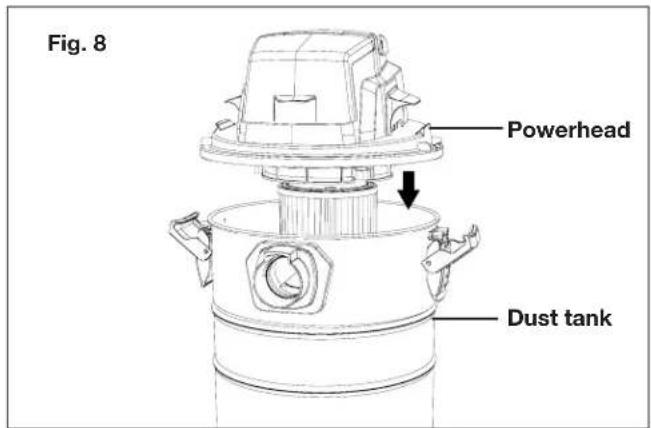
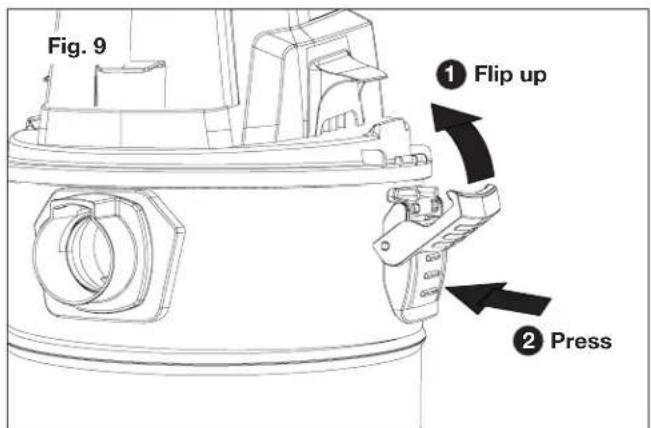
- Turn the dust tank back over onto the casters. Cap it with the powerhead with the desired filter attached. Flip up the two latches located on either side of the dust tank. Press in on the two latches located on either side of the dust tank until they snap into place, securing the powerhead to the tank (Figs. 8 – 9).
NOTE: For dry vacuum cleaning, install the supplied cartridge filter and the dust bag. For wet vacuum cleaning, install the supplied foam filter. See page 12 - 13 for instructions on how to install the filters.
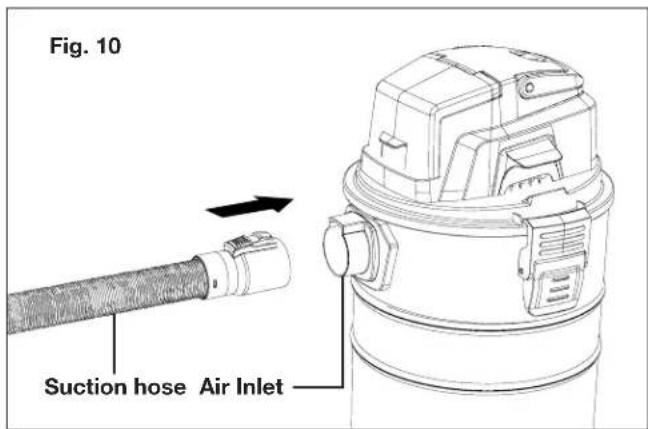
- Insert the end of the suction hose with the releasing button into the air inlet. Push in to lock it in place (Fig. 10).
- Connect the preferred nozzle with the other end of the suction hose. If needed, use the equipped telescopic tube and the air regulation handle, as shown (Fig. 11).
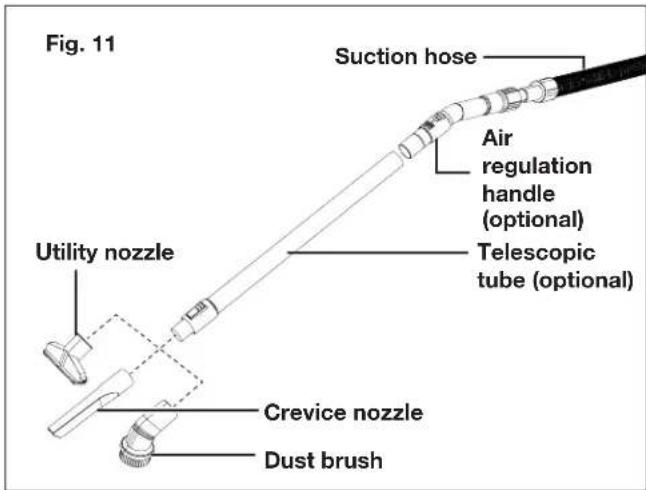
NOTE: This unit is equipped with 3 nozzles. The utility nozzle is for vacuuming solids and liquids over medium and larger areas. The crevice nozzle is for vacuuming solids and liquids in corners, edges and other areas that are difficult to access. The dust brush is good for collecting light material while vacuuming.
Operation
WARNING! DO NOT vacuum hazardous substances.
This cordless wet/dry vacuum is designed to clean hard surfaces. It is only suitable for vacuuming wet or dry light materials. The vacuuming of heavy materials such as metal, stones, branches, broken glass is expressly excluded.
Do not switch on the wet/dry vacuum until it has been completely assembled. Before switching on the unit, always check the filter is assembled securely.
WARNING! Use the wet/dry vacuum only in daylight or good artificial light.
- Make sure the powerhead is properly installed and secured when using. Make sure each latch is locked. Failure to properly secure the locks could cause the powerhead to release from the tank.
- Double check to make sure the filters are not broken or torn. Do not use filters that are broken or torn. Handle the filters carefully when removing and installing.
- To reduce the risk of hearing loss associated with sound level(s), hearing protection is required.
- Be extremely careful when working on slopes and stairs.
• Always move forward by walking. Never run. - Clean up after using the wet/dry vacuum. Dispose of debris appropriately.
• Always use the carrying handle for transporting the equipment.
WARNING! To avoid personal injury, wear ear protectors when operating this unit. Wear a face mask or dust mask in dusty locations.
Dry Vacuuming Mode
WARNING! Make sure to assemble the cartridge filter properly when using the equipment for dry vacuuming. The use of incorrect filter will damage the unit and void the warranty.
The cartridge filter should be pre-assembled on the filter cage. If not, follow the instruction below to assemble the cartridge filter.
- Make sure the battery is removed from the compartment.
- Unlock the powerhead by flipping up the latches on both sides, and then lift up (Fig. 5).
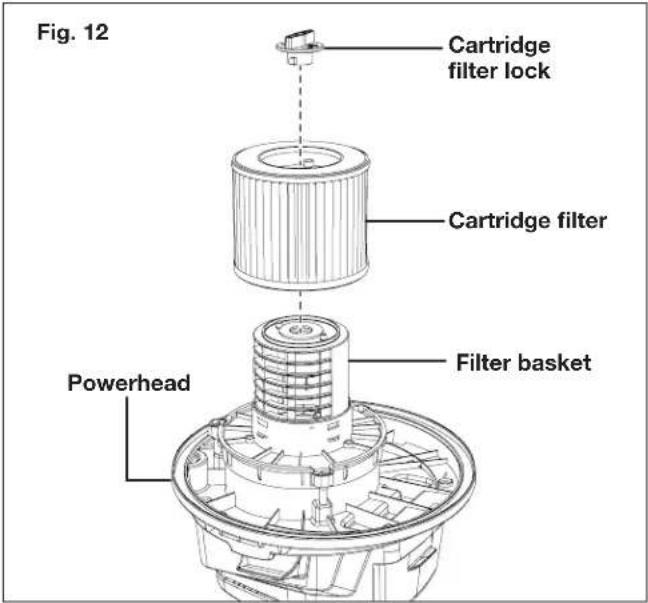
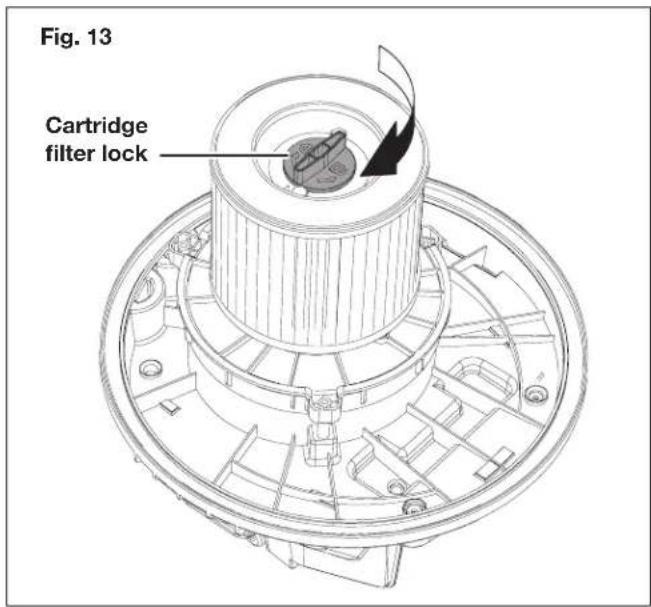
- Turn the powerhead upside down. Put the filter basket onto the cartridge filter. Push down until the filter sits securely. Insert the cartridge filter lock. Turn clockwise to secure (Figs. 12 - 13).
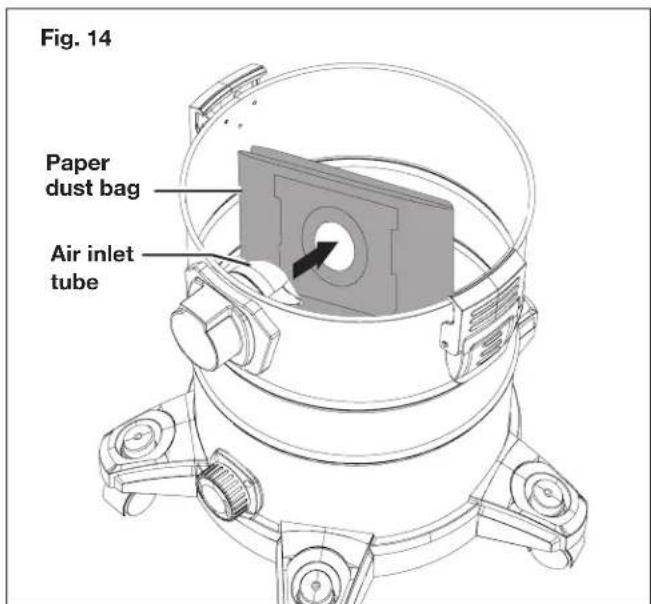
- Before putting back the powerhead, assemble the dust bag by inserting the air inlet tube into the hole on the dust bag, as shown (Fig. 14).
NOTE: It's recommended to use the paper dust bag for dry vacuuming. The paper dust bag will collect all debris and make clean-up after vacuuming much easier.
- Replace the powerhead. Lock the latches on both sides securely (Figs. 8 - 9).
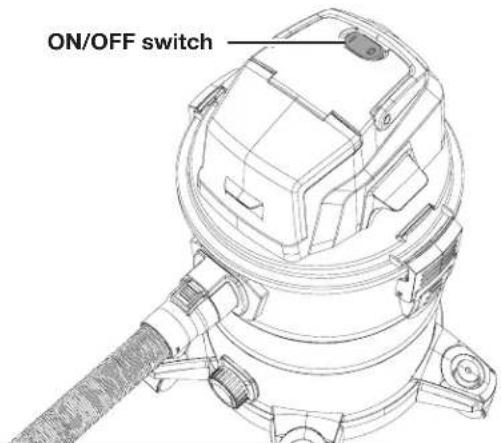
- With the hose and the preferred nozzle connected, insert the battery into the battery compartment, and press the ON (I) side on the ON/OFF switch (Fig. 15).
Fig. 15
⚠ WARNING! Before switching on the wet/dry vacuum, make sure that it is not in contact with any foreign objects.
- After vacuuming is finished, press the OFF (O) side of the ON/OFF switch and remove the battery. Remove the paper dust bag and pour out the debris inside.
Wet Vacuuming Mode
⚠ WARNING! Do not use the cartridge filter or the paper dust bag for wet vacuuming. Follow the instructions below to assemble the foam filter for wet vacuuming.
- Make sure the battery is removed from the compartment.
- Unlock the powerhead by flipping up the latches on both sides, and then lift up to remove (Fig. 5).
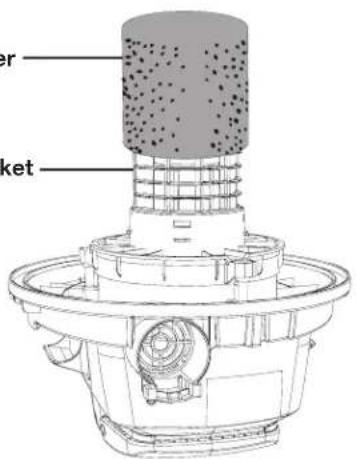
- Turn the powerhead upside down. Install the foam filter over the filter basket (Fig. 16)
Fig. 16
Foam filter
Filter basket
-
Replace the powerhead. Lock the latches on both sides securely (Fig. 8).
-
With the hose and the preferred nozzle connected, insert the battery into the battery compartment, and press the ON (I) side on the ON/OFF switch (Fig. 14).
- After vacuuming is finished, press the OFF (O) side of the ON/OFF switch and remove the battery. Clean the debris and dust in the tank as described in Maintenance section.
Blowing Mode
The cordless wet/dry vacuum also has blower feature. Follow the instructions below to use the blower feature.
⚠ WARNING! Always wear safety goggles before using it as a blower.
⚠ WARNING! Keep children and bystanders away from the working area.
⚠ WARNING! Wear a dust mask if blowing creates dust that might be inhaled.
- Shut off the unit and remove the battery.
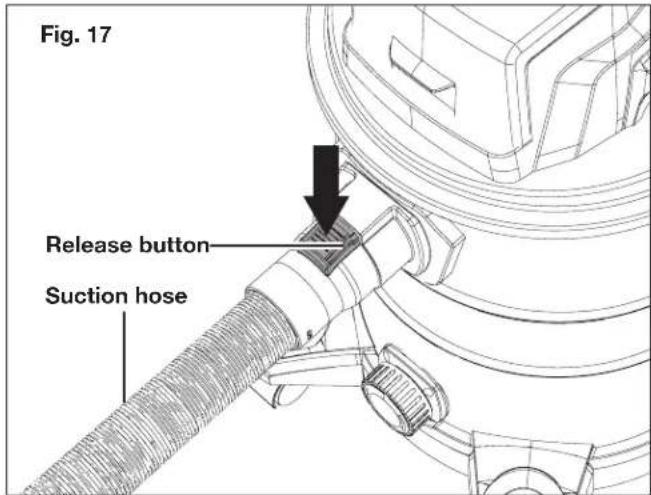
- Disconnect the suction hose from air inlet by pressing the release button on the connector, and pull the hose out from the vacuum (Fig. 17).
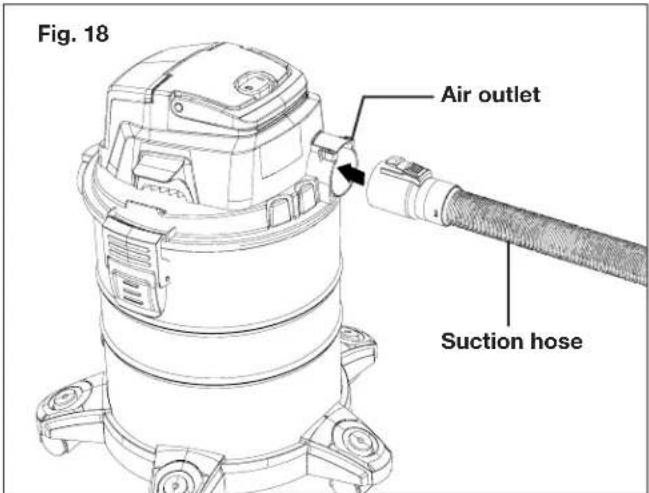
- Connect the suction hose to the air outlet on the back of the powerhead by pressing it securely into the air outlet (Fig. 18).
- With the hose and the preferred nozzle connected, insert the battery into the battery compartment, and press the ON (I) side on the ON/OFF switch (Fig. 12). To stop the unit, press the OFF (O) side of the ON/OFF switch and remove the battery.
NOTE: During the whole blowing process, keep the air inlet clear to maintain stable air flow.
General Operation Tips
WARNING! Do not vacuum drywall dust, fireplace soot or ash with the unit. This is very fine dust which will not be captured by the filter and may cause damage to motor.
WARNING! The foam filter must be used for wet vacuuming, and make sure to clean the foam filter after using.
WARNING! Do not use the cartridge filter and paper dust bag for wet vacuuming. Do not use the cartridge filter for sharp material.
- Place the equipment on a level surface that is not heat sensitive.
• Always use the suction hose. Hold the suction hose at a distance of approximately 0.4 in. (1 cm) above the material to be vacuumed.
WARNING! When vacuuming large quantities of liquids, do not immerse the nozzle attachment completely in the liquid; leave a gap at the tip of the nozzle opening to allow air inflow. The machine is fitted with a float valve that stops the suction action when the collection tank reaches its maximum capacity. You will notice a decrease in motor speed. When this happens, turn off the machine, remove the battery, and drain the liquid into a suitable receptacle or drain.
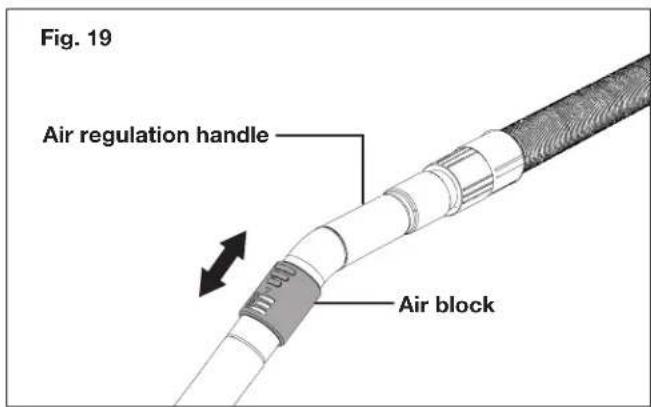
- The air flow can be adjusted when the air regulation handle is connected. Slide the air block as needed to adjust the air flow (Fig. 19).
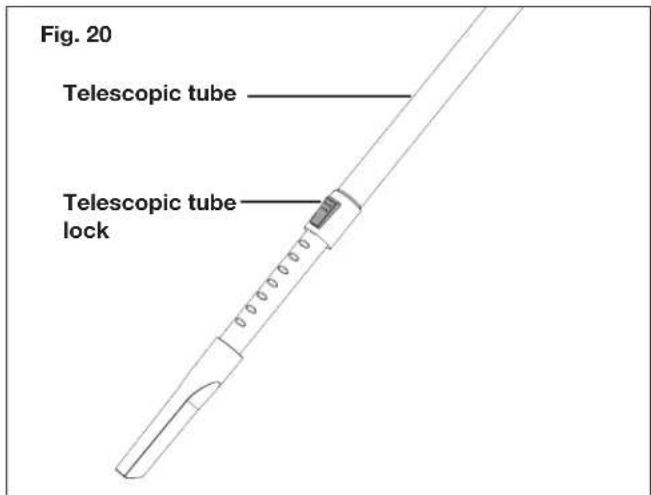
- If needed, use the equipped telescopic tube to reach further distance. Press the telescopic tube lock and extended the tube as shown (Fig. 20).
- Turn off and remove the battery after vacuuming, before cleaning and maintenance. After wet vacuuming, empty the collection tank, clean and dry the inside and outside before storage.
• Empty the tank outside in order to avoid a mess. - Clean or change the filters (see Maintenance section) if the suction performance deteriorates. Never use the appliance without the filter.
⚠ WARNING! Never remove the powerhead without first turning the power switch to the OFF position and remove the battery.
Air Inlet
Never cover the air inlet. Keep it free from obstructions and debris. It must always remain clear for proper motor cooling.
WARNING! To avoid personal injury, do not wear loose fitting clothing or articles such as scarves, necklaces, chains, ties, etc., that could get drawn into the air inlet. To make sure long hair does not get drawn into the air inlet, tie back long hair.
Maintenance
Please contact an authorized Snow Joe ^® + Sun Joe ^® dealer or call the Snow Joe ^® + Sun Joe ^® customer service center at 1-866-SNOWJOE (1-866-766-9563) for all maintenance operations not foreseen in this manual. Any operation performed in an unauthorized service center or by unqualified personnel will completely invalidate the warranty.
WARNING! Remove the battery before performing any maintenance task.
If the battery is still connected, the unit could be accidentally turned on while you are performing maintenance on it, which could result in personal injury.
Drain the Tank
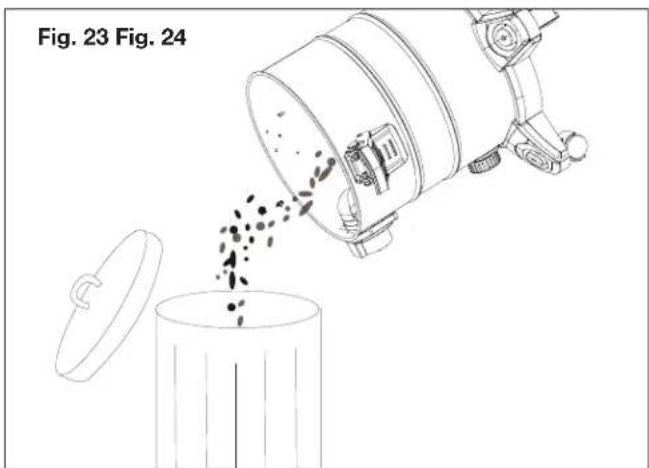
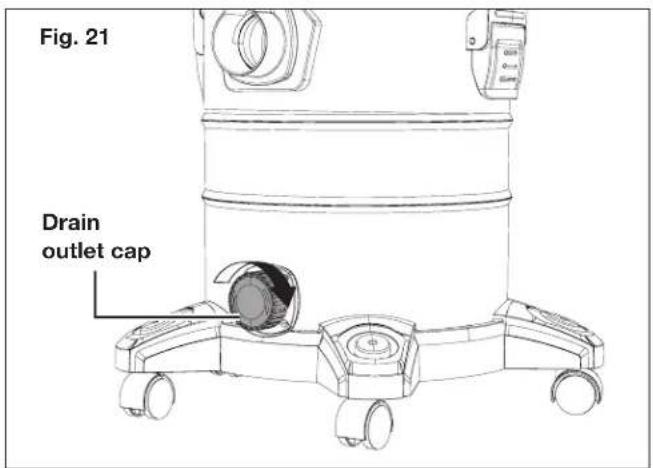
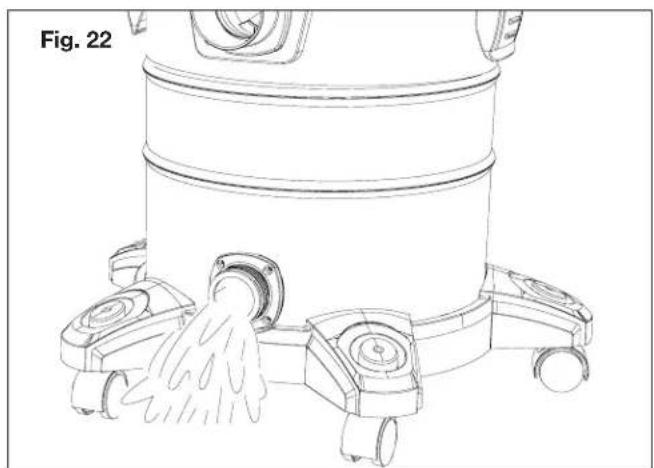
- The tank must be drained and cleaned every time after vacuuming. Remove the drain outlet cap by turning it clockwise and use the drain outlet to drain the liquid waste in the tank (Figs. 21 – 22), or remove the powerhead to pour out any debris or dust from the tank (Fig. 23). Rinse the tank with warm water if needed. Allow it to dry completely.
natural_image
Line drawing of a vacuum cleaner with a hand spraying mist, no text or symbols present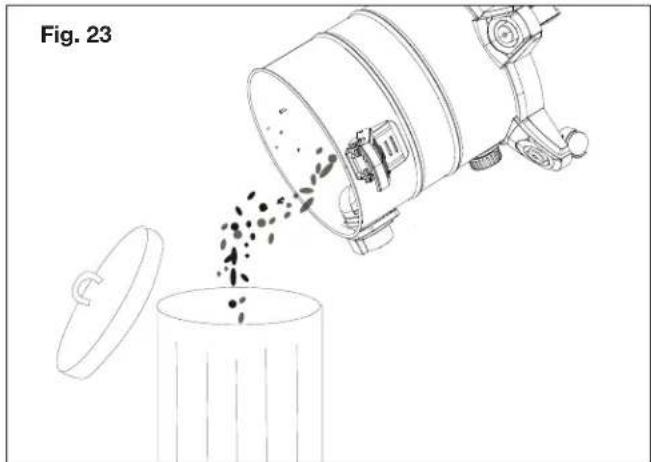
natural_image
Line drawing of a mechanical device pouring granular material into a cylindrical container (no text or symbols)- If paper dust bag is used for dry vacuuming, simply remove the bag and pour out all debris in the bag.
WARNING! Discard the debris and dust according to local laws and regulations.
Cleaning the Foam Filter
WARNING! The foam filter must be washed every time after wet vacuuming.
- Switch off the unit and make sure the battery is removed.
- Unlock the powerhead by flipping up the latches on both sides, and then lift powerhead up (Fig. 5).
- Turn the powerhead upside down. Remove the foam filter from the filter basket.
- Clean the foam filter with soft soap under running water and allow it to air dry.
Cleaning the Cartridge Filter
WARNING! The cartridge filter is not washable.
- Switch off the unit and make sure the battery is removed.
- Unlock the powerhead by flipping up the locks on both sides, and then lift powerhead up (Fig. 5).
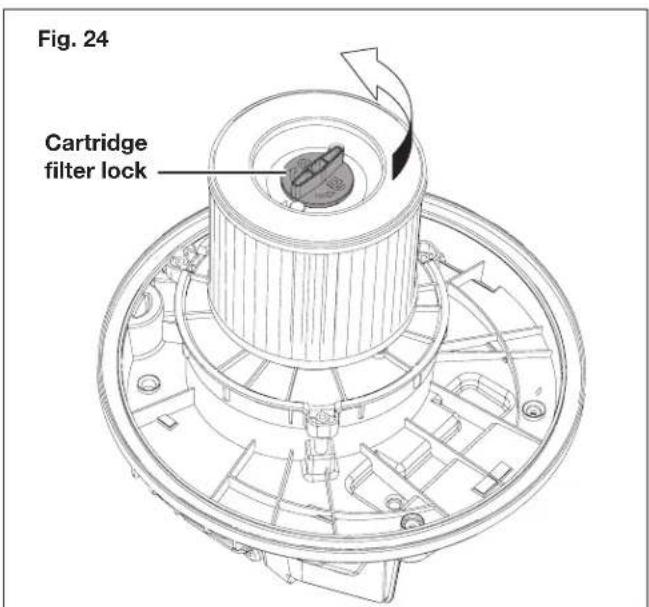
- Turn the powerhead upside down. Unlock and remove the cartridge filter lock by rotating it counterclockwise (Fig. 24). Slide the cartridge filter up to remove it from the filter basket.
- Clean the cartridge filter by gently tapping or brushing dirt off. For optimal performance it's recommended to regularly replace the cartridge filter.
IMPORTANT: Only use original replacement filters specified for this vacuum.
You can purchase replacement filters (Model 24V-WDV6000-HFILTER, 24V-WDV6000-SPFILTER) and other genuine replacement parts by visiting us online at sunjoe.com or calling our toll-free customer service helpline at 1-866-SNOWJOE (1-866-766-9563). The use of filters that do not meet the original equipment specifications may lead to improper performance of the vacuum, may compromise operator safety and will void the manufacturer's warranty.
Proper Care for Battery + Charger
⚠ WARNING! To reduce the risk of injury, always unplug the charger and disconnect the battery pack from the charger before performing any maintenance task. Never disassemble the battery pack or charger. Contact your Snow Joe® + Sun Joe® dealer or the Snow Joe® + Sun Joe® customer service center for ALL repairs.
- To reduce the risk of injury and damage, never immerse your battery pack or charger in liquid or allow any liquid to flow inside these components.
- Clean out dust and debris from charger vents and electrical contacts by blowing with compressed air.
- Use only a soft, clean and dry brush to clean the battery pack and charger, keeping away from all electrical contacts. Certain cleaning agents and solvents are harmful to plastics and other insulated parts. Some of these include gasoline, turpentine, lacquer thinner, paint thinner, chlorinated cleaning solvents, ammonia and household detergents containing ammonia. Never use flammable or combustible solvents around battery packs, battery chargers or tools.
- The iON+ 24VCHRG-QC lithium-ion battery charger has no serviceable parts.
Storage
- Examine the cordless wet/dry vacuum thoroughly for worn, loose or damaged parts. Should you need to repair or replace a part, contact an authorized Snow Joe ^® + Sun Joe ^® dealer or call the Snow Joe ^® + Sun Joe ^® customer service center at 1-866-SNOWJOE (1-866-766-9563) for assistance.
- Examine the filters thoroughly for signs of excess wear or damage. If they are worn or damaged, replace them immediately.
- Store the wet/dry vacuum indoors in a clean, dry and locked location out of the reach of children and animals.
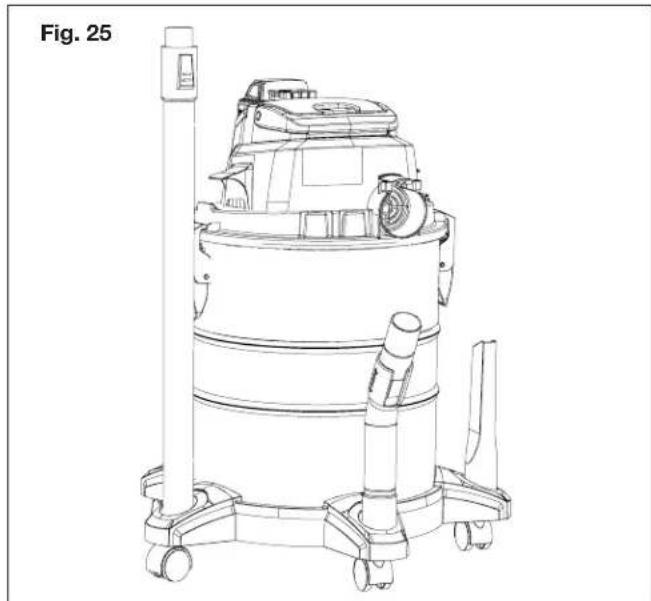
- When not in use, the equipped tubes, handles and nozzles can be temporarily stored on the casters of the unit as shown (Fig. 25).
natural_image
Line drawing of a vacuum cleaner device with wheels and a vertical pole, labeled Fig. 25 (no text or symbols on the device itself)Battery + Charger Off-Season Storage
- Do not expose your battery pack or charger to water, rain or allow them to get wet. This could permanently damage the charger and the battery pack. Do not use oil or solvents to clean or lubricate your battery pack as the plastic casing can become brittle and crack, causing a serious risk of injury.
- Store the battery pack and charger at room temperature away from moisture. Do not store in damp locations where corrosion of terminals may occur. As with other battery pack types, permanent capacity loss can result if the pack is stored for long periods of time at high temperatures (over 120^ F/ 49^ C).
- iON+ 24VBAT lithium-ion battery packs maintain their charge during storage longer than other battery pack types. As a general practice, it is best to unplug the battery charger and disconnect the battery pack when they are not in use. Recharge the battery pack every 6 months to 50% capacity (2 lights on) during off-season storage to maintain optimal battery performance.
Transportation
- Switch the product off and remove the battery.
• Always carry the product by its handle. - If you are transporting the wet/dry vac in a vehicle, brace it properly to protect it from heavy impact or strong vibrations.
- Secure the product to prevent it from falling over or slipping.
Recycling + Disposal
The product comes in a package that protects it against damage during shipping. Keep the package until you are sure that all parts have been delivered and the product is functioning properly. Recycle the package afterwards or keep it for long-term storage.
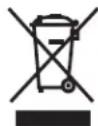
WEEE symbol. Waste electrical products should not be disposed of with household waste. Please recycle where facilities exist. Check with your local authority or local store for recycling regulations.
Battery Caution + Disposal
Always dispose of your battery pack according to federal, state, and local regulations. Contact a recycling agency in your area for recycling locations.
⚠️CAUTION! Even discharged battery packs contain some energy. Before disposing, use electrical tape to cover the terminals to prevent the battery pack from shorting, which could cause a fire or explosion.
⚠ WARNING! To reduce the risk of injury or explosion, never burn or incinerate a battery pack even if it is damaged, dead or completely discharged. When burned, toxic fumes and materials are emitted into the surrounding atmosphere.
- Batteries vary according to device. Consult your manual for specific information.
- Install only new batteries of the same type in your product (where applicable).
- Failure to insert batteries in the correct polarity, as indicated in the battery compartment or manual, may shorten the life of the batteries or cause batteries to leak.
- Do not mix old and new batteries.
- Do not mix Alkaline, Standard (Carbon-Zinc) or Rechargeable (Nickel Cadmium, Nickel Metal Hydride, or Lithium-Ion) batteries.
- Do not dispose of batteries in fire.
- Batteries should be recycled or disposed of as per state and local guidelines.
Service and Support
If your Sun Joe ^® 24V-WDV6000 cordless wet/dry vacuum requires service or maintenance, please call the Snow Joe ^® + Sun Joe ^® customer service center at 1-866-SNOWJOE (1-866-766-9563).
Model and Serial Numbers
When contacting the company, reordering parts or arranging service from an authorized dealer, you will need to provide the model and serial numbers, which can be found on the decal located on the housing of the unit. Copy these numbers into the space provided below.
Record the following numbers from the housing or handle of your new product:
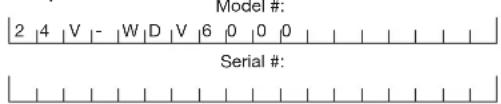
24VCHRG-QC
Federal Communications Commission (FCC)
⚠ WARNING! Any changes or modifications to this unit not expressly approved by the party responsible for compliance could void the user's authority to operate the equipment.
Class B device:
NOTE: This equipment has been tested and found to comply with the limits for a Class B digital device, pursuant to part 15 of the FCC Rules.
These limits are designed to provide reasonable protection against harmful interference in a residential installation.
This equipment generates, uses and can radiate radio frequency energy and, if not installed and used in accordance with the instructions, may cause harmful interference to radio communications.
However, there is no guarantee that interference will not occur in a particular installation.
If this equipment does cause harmful interference to radio or television reception, which can be determined by turning the equipment off and on, the user is encouraged to try to correct the interference by one or more of the following measures:
- Reorient or relocate the receiving antenna.
- Increase the separation between the equipment and receiver.
- Connect the equipment into an outlet on a circuit different from that to which the receiver is connected.
- Consult the dealer or an experienced radio/TV technician for help.
Optional Accessories
WARNING! ALWAYS use only authorized Snow Joe® + Sun Joe® replacement parts and accessories. NEVER use replacement parts or accessories that are not intended for use with this tool. Contact Snow Joe® + Sun Joe® if you are unsure whether it is safe to use a particular replacement part or accessory with your tool. The use of any other attachment or accessory can be dangerous and could cause injury or mechanical damage.
NOTE: Accessories are subject to change without any obligation on the part of Snow Joe ^® + Sun Joe ^® to provide notice of such changes. Accessories can be ordered online at sunjoe.com or via phone by contacting the Snow Joe ^® + Sun Joe ^® customer service center at 1-866-SNOWJOE (1-866-766-9563).
| ModelAccess | |||
| 1 | 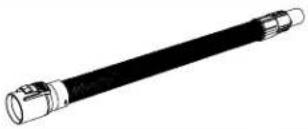 | 24V-WDV6000 suction hose | 24V-WDV6000-HOSE |
| 2 | 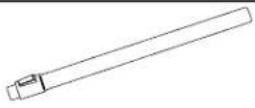 | 24V-WDV6000 metal telescopic tube | 24V-WDV6000-MTUBE |
| 3 | 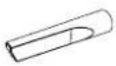 | 24V-WDV6000 crevice nozzle | 24V-WDV6000-CNOZZLE |
| 4 |  | 24V-WDV6000 round brush 24V-WDV6000-RDBRUSH | |
| 5 | 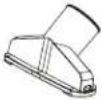 | 24V-WDV6000 utility nozzle 24V-WDV6000-UNOZZLE | |
| 6 | 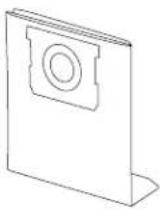 | 24V-WDV6000 paper filter bag 24V-WDV6000-BAG | |
| 7 | 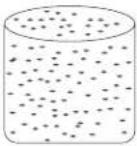 | 24V-WDV6000 sponge filter | 24V-WDV6000-SPFILTER |
| 8 | 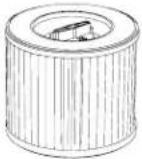 | 24V-WDV6000 HEPA filter 24V-WDV6000-HFILTER | |
| ModelAccesso | |||
| 9 | 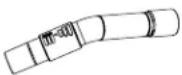 | 24V-WDV6000 air regulation handle 24V-WDV6000-AIRADJTUBE | |
| 10 | 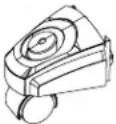 | 24V-WDV6000 caster | 24V-WDV6000-WHEEL |
| 11 | 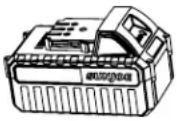 | 24V iON+ 4.0 Ah Lithium-Ion Battery 24VBAT | |
| 12 | 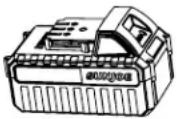 | 24V iON+ 5.0 Ah Lithium-Ion Battery 24VBAT-XR | |
| 13 | 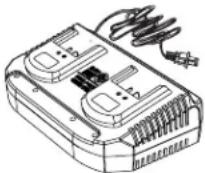 | 24V iON+ Lithium-Ion Battery Dual Port Charger | 24VCHRG-DPC |
SNOW JOE® + SUN JOE® CUSTOMER PROMISE
ABOVE ALL ELSE, Snow Joe, LLC (“Snow Joe”) is dedicated to you, our customer. We strive to make your experience as pleasant as possible. Unfortunately, there are times when a Snow Joe ^® , Sun Joe ^® , or Aqua Joe ^® product (“Product”) does not work or breaks under normal operating conditions. We think it’s important that you know what you can expect from us. That’s why we have a Limited Warranty (“Warranty”) for our Products.
OUR WARRANTY:
Snow Joe warrants new, genuine, powered and non-powered Products to be free from defects in material or workmanship when used for ordinary household use for a period of two years from the date of purchase by the original, end-user purchaser when purchased from Snow Joe or from one of Snow Joe's authorized sellers with proof of purchase. Because Snow Joe is unable to control the quality of its Products sold by unauthorized sellers, unless otherwise prohibited by law, this Warranty does not cover Products purchased from unauthorized sellers. If your Product does not work or there's an issue with a specific part that is covered by the terms of this Warranty, Snow Joe will elect to either (1) send you a free replacement part, (2) replace the Product with a new or comparable product at no charge, or (3) repair the Product. How cool is that!
This Warranty gives you specific legal rights, and you may also have other rights which vary from State to State.
PRODUCT REGISTRATION:
Snow Joe strongly encourages you to register your Product. You can register online at snowjoe.com/register, or by printing and mailing in a registration card available online from our website, or calling our Customer Service Department at 1-866-SNOWJOE (1-866-766-9563), or by e-mailing us at help@snowjoe.com. Failure to register your Product will not diminish your warranty rights. However, registering your Product will allow Snow Joe to better serve you with any of your customer service needs.
WHO CAN SEEK LIMITED WARRANTY COVERAGE:
This Warranty is extended by Snow Joe to the original purchaser and original owner of the Product.
WHAT IS NOT COVERED?
This Warranty does not apply if the Product has been used commercially or for non-household or rental applications. This Warranty also does not apply if the Product was purchased from an unauthorized seller. This Warranty also does not cover cosmetic changes that do not affect performance. Wearing parts like belts, augers, chains and tines are not covered under this Warranty, and can be purchased at snowjoe.com or by calling 1-866-SNOWJOE (1-866-766-9563).
natural_image
Technical line drawing of a circular mechanical component with four protruding ports (no text or symbols)natural_image
Line drawing of a vacuum cleaner with a hand pouring liquid into the air gap (no text or symbols)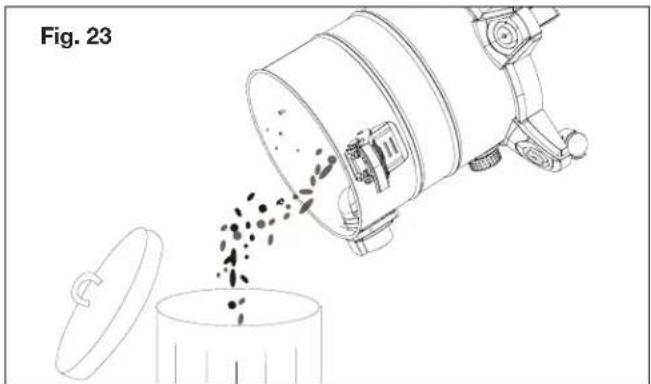
natural_image
Diagram of a mechanical device pouring granular material into a cylindrical container, labeled Fig. 23 (no text or symbols on the diagram itself)natural_image
Line drawing of a vacuum cleaner with control panel and wheels (no text or symbols)natural_image
Technical line drawing of a mechanical component with multiple cylindrical parts and a central circular housing (no text or symbols)natural_image
Line drawing of a vacuum cleaner with pump and wheels, labeled as Fig. 22 (no text or symbols on the diagram itself)