VPTMKK85 - Fridge Veripart - Free user manual and instructions
Find the device manual for free VPTMKK85 Veripart in PDF.



User questions about VPTMKK85 Veripart
0 question about this device. Answer the ones you know or ask your own.
Ask a new question about this device
Download the instructions for your Fridge in PDF format for free! Find your manual VPTMKK85 - Veripart and take your electronic device back in hand. On this page are published all the documents necessary for the use of your device. VPTMKK85 by Veripart.
USER MANUAL VPTMKK85 Veripart
text_image
veripart™KOELKAST REFRIGERATOR RÉFRIGÉRATEUR KÜHLSCHRANK
- VPTMKK85 -

text_image
veripart™Handleiding
Instruction Manual
Mode d'emploi
Bedienungsanleitung
INHOUD
VEILIGHEID 3
- Veiligheidstips 3
WAARSCHUWINGEN VOOR AFVALVERWERKING 22
VEILIGHEID


Waarschuwing!
natural_image
Simple gray rectangular sign with a downward-pointing checkmark, mounted on a pole (no text or symbols)natural_image
Simple diagram of a rectangular object with a cross symbol on its side, mounted on a base (no text or labels)natural_image
Symbol of a trash bin with crossed lines indicating no waste or discharge (no text or labels)WAARSCHUWINGEN VOOR AFVALVERWERKING
- Moving the fridge 40
ELECTRICAL INFORMATION 43
WARNINGS FOR DISPOSAL 44
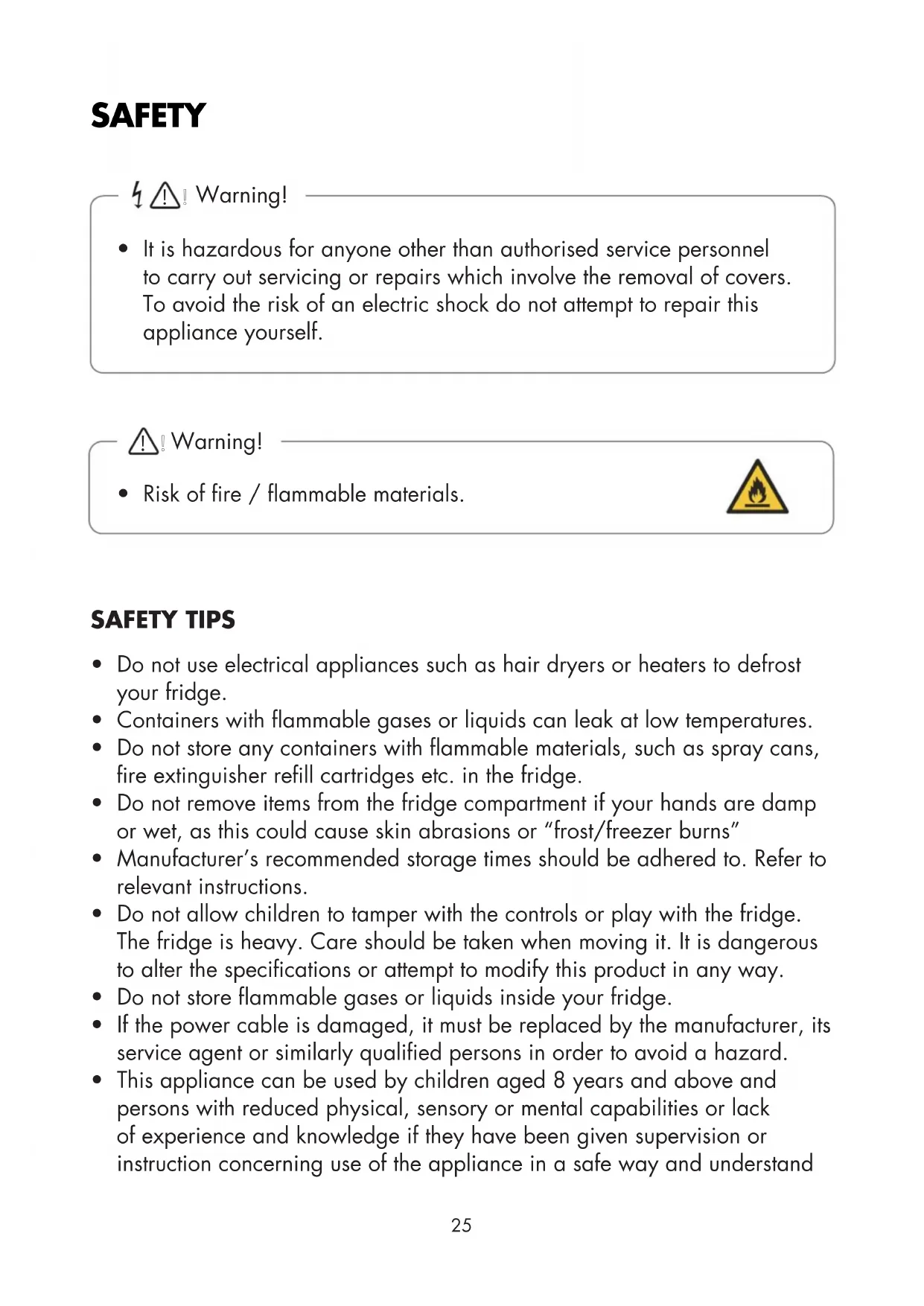
SAFETY


Warning!
- It is hazardous for anyone other than authorised service personnel to carry out servicing or repairs which involve the removal of covers. To avoid the risk of an electric shock do not attempt to repair this appliance yourself.

Warning!
- Risk of fire / flammable materials.
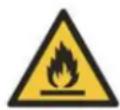
SAFETY TIPS
- Do not use electrical appliances such as hair dryers or heaters to defrost your fridge.
- Containers with flammable gases or liquids can leak at low temperatures.
- Do not store any containers with flammable materials, such as spray cans, fire extinguisher refill cartridges etc. in the fridge.
- Do not remove items from the fridge compartment if your hands are damp or wet, as this could cause skin abrasions or "frost/freezer burns"
- Manufacturer's recommended storage times should be adhered to. Refer to relevant instructions.
- Do not allow children to tamper with the controls or play with the fridge. The fridge is heavy. Care should be taken when moving it. It is dangerous to alter the specifications or attempt to modify this product in any way.
- Do not store flammable gases or liquids inside your fridge.
- If the power cable is damaged, it must be replaced by the manufacturer, its service agent or similarly qualified persons in order to avoid a hazard.
- This appliance can be used by children aged 8 years and above and persons with reduced physical, sensory or mental capabilities or lack of experience and knowledge if they have been given supervision or instruction concerning use of the appliance in a safe way and understand
the hazards involved. Children should not play with the appliance. Cleaning and user maintenance should not be done by children without supervision.
- This appliance is intended to be used in households and similar locations such as:
- staff kitchen areas in shops, offices and other working environments;
- farm houses, or by clients in hotels, motels and other residential type environments;
- bed and breakfast type environments;
- catering and similar non-retail applications.
- Keep ventilation openings, in the appliance enclosure or in the built-in structure, clear of obstruction.
- Do not use mechanical devices or other means to accelerate the defrosting process, other than those recommended by the manufacturer.
- Do not damage the refrigerant circuit.
- Do not use electrical appliances inside the food storage compartments of the appliance, unless they are of the type recommended by the manufacturer.
- Do not store explosive substances such as aerosol cans with a flammable propellant in this appliance.

Warning!
- Refrigerating appliances – in particular a refrigerator-freezer Type I – might not operate consistently (possibility of defrosting of contents or temperature becoming too warm in the frozen food compartment) when placed for an extended period of time below the cold end of the range of temperatures for which the refrigerating appliance is designed.
- The refrigerant used in your appliance and insulation materials requires special disposal procedures.
- When positioning the appliance, ensure the supply cord is not trapped or damaged.
- Do not locate multiple portable socket-outlets or portable power supplies at the rear of the appliance
- Children below the age of 8 years are not allowed to load and unload refrigerating appliances.
To avoid contamination of food, please respect the following instructions:
- Opening the door for long periods can cause a significant increase in the temperature in the compartments of the appliance.
- Clean surfaces that can come into contact with food and accessible drainage systems regularly.
- Store raw meat and fish in suitable containers in the refrigerator, so that they are not in contact with or drip onto other food.
- If the refrigerating appliance is left empty for long periods, switch it off, defrost, clean and dry it, and leave the door open to prevent the development of mould inside the appliance.

Warning!
- This appliance should be properly grounded for your safety. The power cord of this appliance is equipped with a two-prong plug which fits into standard two prong wall outlets to minimize the possibility of electrical shock.
- This refrigerator appliance requires a standard 220-240VAC 50Hz electrical outlet with two-prong ground.
- This refrigerator appliance is not designed to be used with an inverter.
- The cord should be secured behind the appliance and not left exposed or dangling to prevent accidental injury.
- Never unplug the refrigerator by pulling on the power cord. Always grip the plug firmly and pull straight out from the outlet.
- Do not use an extension cord with this appliance. If the power cord is too short, have a qualified electrician or service technician install an outlet near the appliance. Use of an extension cord can negatively affect the performance of the unit.
- Improper use of the grounding plug can result in the risk of electrical shock. If the power cord is damaged, have it replaced by an authorised service centre.
Climate range
The information about the climate range of the appliance is provided on the rating label. It indicates the ambient temperature (that is, room temperature) necessary for the optimal operation of the appliance.
| CLIMATE RANGE PERMISSIBLE AMBIENT TEMPERATURE | |
| SN From +10°C to +32°C | |
| N From +16°C to +32°C | |
| ST | From +16°C to +38°C |
| T | From +16°C to +43°C |

Note!
- Given the limit values of the ambient temperature range for the climate classes for which the refrigerating appliance is designed and the fact that the internal temperatures could be affected by such factors as the location of the refrigerating appliance, the ambient temperature and the frequency of door opening, the setting of any temperature control device might have to be adjusted to allow for these factors, if appropriate.
- If the power cable is damaged, it must be replaced by the manufacturer, its service agent or similarly qualified persons in order to avoid a hazard.
- When operating in an environment other than the specified climate type (i.e., beyond the rated ambient temperature range), the appliance may not be able to maintain the desirable compartment temperatures.
Freon-free
The freon-free refrigerant (R600a) and the foaming insulation material (cyclopentane) are used in this refrigerator. Neither damages the ozone layer and both have a very small impact on global warming. R600a is flammable, and sealed in a refrigeration system that is leakage-free during normal use. But, in case of refrigerant leakage due to the refrigerant circuit being damaged, be sure to keep the appliance away from open flames and open the windows for ventilation as quickly as possible.
PRODUCT FEATURES
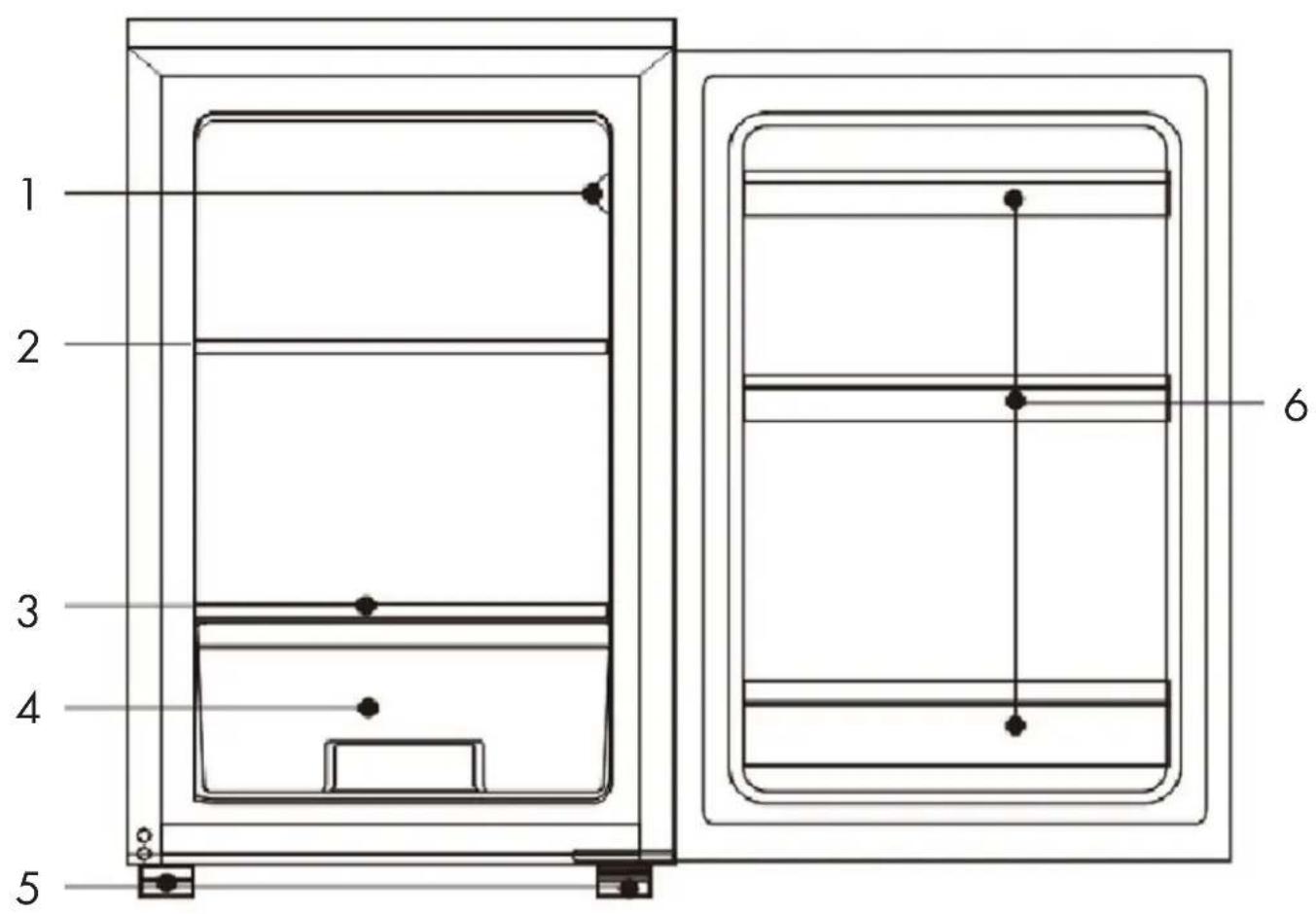
text_image
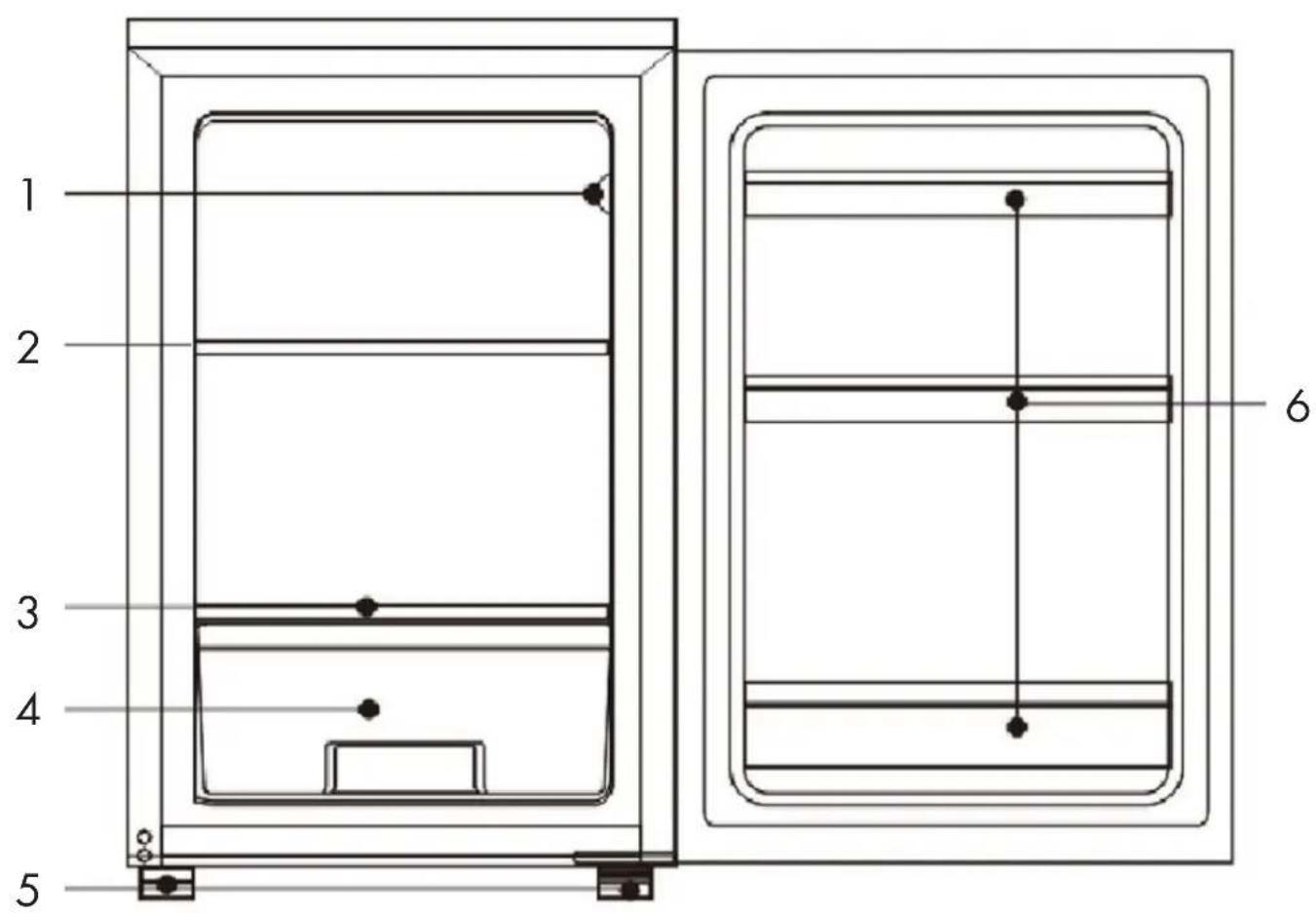
1 2 3 4 5 6- Thermostat
- Refrigerator Shelves
- Crisper Cover
- Salad Crisper
- Adjustable Feet
- Bottle Retainers
INSTALLATION
LOCATION
Location
When selecting a position for your fridge you should make sure the floor is flat and firm, and the room is well ventilated. Avoid locating your fridge near a heat source, e.g. cooker, boiler or radiator. Also avoid direct sunlight in out-buildings or sun lounges. If you are placing your fridge in an out-building such as a garage or annex ensure that the fridge is placed above the damp course, otherwise condensation will occur on the fridge cabinet. When working, the refrigerator gives off heat to its surroundings. Therefore, at least 30mm of free space should be left on the top, more than 100mm on both sides, and more than 50mm at the back of the refrigerator.
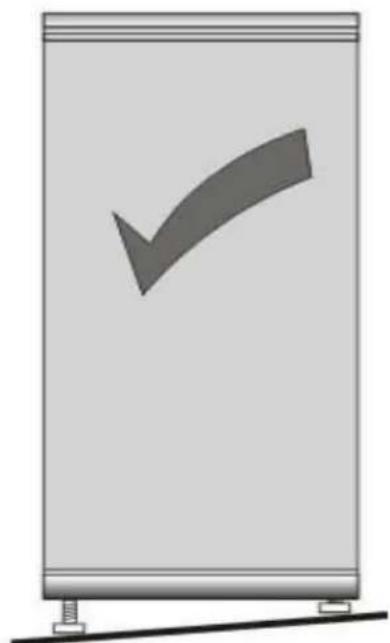
Levelling the fridge
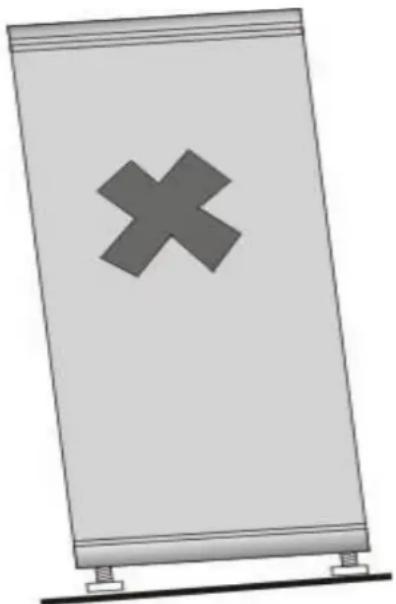
If the fridge is not level, the door and magnetic seal alignment will be affected and may cause your fridge to work incorrectly. Once the fridge is placed in its final location, adjust the leveling feet at the front by turning them.
Cleaning before use
Wipe the inside of the fridge with a weak solution of bicarbonate of soda then rinse with warm water using a damp sponge or cloth. Wash the baskets and shelves in warm soapy water and dry completely before replacing in the fridge. The external parts of the fridge can be cleaned with a non-abrasive detergent diluted in warm water.
natural_image
Simple gray banner with a downward arrow icon, no text or symbols present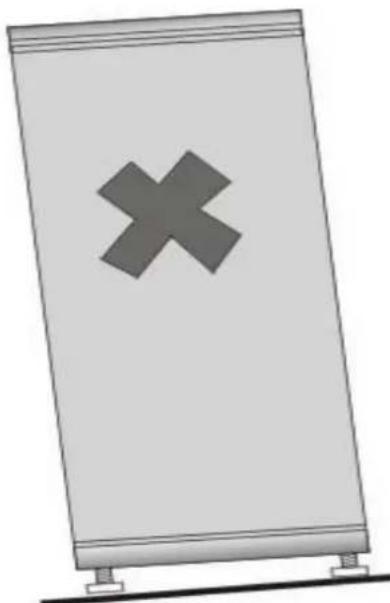
natural_image
Simple diagram of a rectangular sign with a cross symbol, mounted on a base (no text or labels)Before plugging in YOU MUST:
Check that you have a socket which is compatible with the plug supplied with the fridge. Check BEFORE switching on!
Do not switch on until four hours after moving the fridge. The coolant fluid needs time to settle. If the appliance is switched off at any time, wait 30 minutes before switching back on to allow the coolant fluid to settle.
Before filling your fridge:
Before storing foods in your fridge, turn the fridge on and wait for 24 hours, to make sure it is working properly and to allow the fridge to fall to the correct temperature.
START
Testing
- Clean the parts of the refrigerator with lukewarm water containing a little neutral detergent and wipe them dry.

Note!
- Electrical components should only be wiped with a dry cloth.
- Turn the thermostat knob to the "3" position, then plug the refrigerator into the wall outlet. The compressor and the light inside the refrigerator will begin to work.
- Open the door 30 minutes later. If the temperature in the refrigerator has dropped noticeably, the refrigeration system is working normally. When the refrigerator has operated for a period of time, the temperature controller will automatically set the temperature within limits it adjusts.
Temperature Control
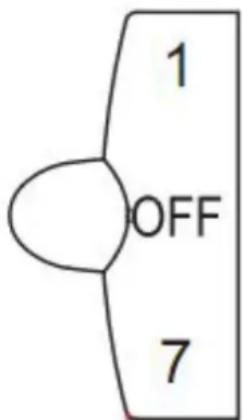
The temperature of the appliance can be adjusted by turning the thermostat dial.
- The thermostat can be set between 1 and 7.
• 1 is the warmest setting. - 7 is the coldest setting.
• The recommended setting is 4. - Set the dial to 0 to turn off the cooling function.
The internal temperature of the appliance may vary based on ambient temperature, the quantity of items stored and how frequently the door is opened.
text_image
1 OFF 7STORAGE OF FOOD
1. How to Use the Refrigerator Compartment
- Cooked dishes can be put into the refrigerator once they have cooled to room temperature.
- Use the egg pockets and bottle pockets for eggs, butter, milk and bottled drinks, etc.
2. Placement of Food
- Leave enough space between foods. If items are stored too closely together, the cold air flow will be blocked, thus affecting the refrigeration effect.
- Food to be stored should be wrapped with clean plastic film and/or aluminium foil to avoid cross-contamination, odours or loss of moisture, and then distributed amongst the compartments and shelves.
- Cool hot food down to room temperature before putting it in the fridge to avoid any increase in energy consumption or formation of frost within the fridge.
IN USE
- The appliance might not operate consistently (there is possibility of defrosting or a rise in temperature in the frozen food compartment) if it remains below the cold limit of the temperature range for which the refrigerating appliance is designed.
- The internal temperatures may be affected by such factors as the location of the refrigerating appliance, the ambient temperature and the frequency of door opening, etc., and, if appropriate, a warning that the settings of any temperature control devices might need adjustment to allow for these factors, will be given.
- The storage time(s) recommended by the food manufacturers should be adhered to.
- A rise in the temperature of frozen food during manual defrosting, maintenance or cleaning could shorten its storage life.
- It is better to wrap frozen food in several layers of food wrapping materials before placing it on the glass shelves.
- Certain care must be taken with frozen food in storage in the event that the appliance is not run for an extended time (interruption of power supply or failure of the refrigerating system).
Tips for keeping food perfect in the fridge
Take extra care with meat and fish
Cooked meats should always be stored on a shelf above raw meats to avoid bacterial transfer. Keep raw meat on a plate large enough to collect juices and cover it with cling film or foil.
Leave space around food
This allows cold air to circulate around the fridge, ensuring all parts of the fridge are kept cool.
Wrap up food
To prevent the transfer of flavours or loss of moisture, food items should be covered and/or packed separately. Fruit and vegetables need not be wrapped.
Pre-cooked food should be cooled properly
Allow pre-cooked food to cool down before placing in the fridge. This will help to stop the internal temperature of the fridge from rising.
Shut the door
To prevent cold air escaping, try to limit the number of times you open the door. When returning from shopping, sort foods to be kept in the fridge before opening the door. Only open the door to put food in or take it out.
Where to store your foods in the fridge
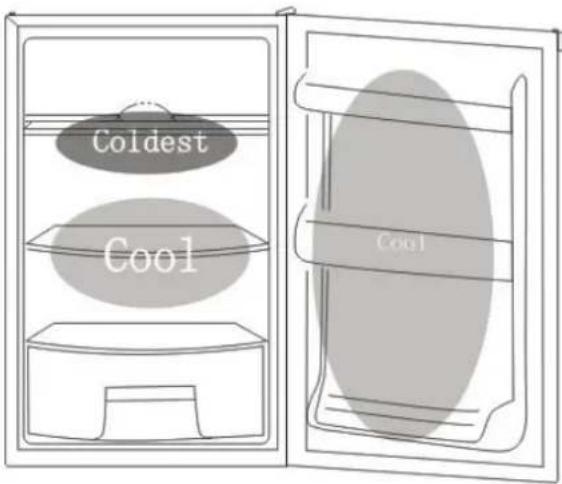
Cool area
This is where to store foods that will keep longer if they are kept cool, such as: milk, eggs, yogurt, fruit juices or hard cheeses (e.g. Cheddar), opened jars and bottles of salad dressings, sauces and jams, fats (e.g. butter, margarine, low-fat spreads cooking fats and lard.
Coldest area
This is where foods which must be cold to keep them safe should be kept:
- Raw and uncooked foods, which should always be wrapped.
• Pre-cooked chilled foods, e.g. ready meals, meat pies, soft cheeses
• Pre-cooked meats, e.g. ham - Prepared salads (including pre-packed mixed green salads, rice, potato salad, etc).
- Desserts, e.g. fromage frais, home-prepared food and leftovers or cream cakes.
text_image
Coldest Cool Cool
Note!
- Always wrap and store raw meat, poultry and fish on the lowest shelf at the bottom of the fridge and do not store it for a long time. This will stop those products from dripping onto or touching other foods. Do not store flammable gasses or liquids in the fridge.
Recommended storage periods
For recommended food storage time, refer to the information given on your food packaging.
CLEANING
Defrosting
-
When the refrigerator has been working for a period of time, the inner surface of the chiller compartments will become covered with a layer of white frost. Because this might increase electricity consumption and lessen the effect of refrigeration, the refrigerator should be defrosted regularly.
-
After defrosting, clear away any water from the water pan as soon as possible.

Caution!
- Never use sharp metal tools as they will damage the refrigerator.
Cleaning inside the fridge
After defrosting, you should clean the inside of the fridge with a weak solution of bicarbonate of soda, then rinse with warm water using a damp sponge or cloth and wipe dry. Wash the baskets in warm soapy water and ensure they are completely dry before replacing in the fridge.
Cleaning outside the fridge
Use standard, non-abrasive detergent diluted in warm water to clean the fridge's exterior.
The grille of the condenser at the back of the fridge and the adjacent components can be vacuumed using a soft brush attachment.
Do not use harsh cleaners, scouring pads or solvents to clean any part of the fridge.
TROUBLESHOOTING AND MAINTENANCE
TROUBLESHOOTING
Power cut
Do not open the fridge door more than necessary.
The fridge is exceptionally cold
You may have accidentally adjusted the thermostat control dial to a higher position.
The fridge is exceptionally warm
The compressor may not be working. Turn the thermostat control dial to the maximum setting and wait a few minutes. If there is no humming noise, it is not working. Contact the store where your purchase was made.
The fridge is not working
Check it is plugged in and switched on. Check that the fuse in the plug has not blown. The fridge should be placed in a well-ventilated room with an ambient temperature between 16^ C and 38^ C. Leave the fridge for 30 minutes.
Condensation appears on the outside of the fridge
This may be due to a change in the room temperature. Wipe off any residual moisture. If the problem continues, contact the store where your purchase was made.
Gurgling, whooshing
These noises are caused by the circulation of the refrigerant liquid in the cooling system. It has become more pronounced since the introduction of CFC free gases. This is not a fault and will not affect the performance of your fridge.
Humming, purring or pulsating
This is the compressor motor working, pumping the refrigerant around the system.
MOVING THE FRIDGE
Location
Do not place your fridge near a heat source, e.g. a cooker, boiler or radiator. Avoid placing it in direct sunlight in out-buildings or verandas.
Levelling
Make sure the fridge is level. using the front levelling feet. If it is not level, the door-sealing gasket's performance will be affected, which could lead to the operational failure of your refrigerator.
After positioning the fridge, wait for 4 hours before using it, so as to allow the refrigerant to settle.
During Holidays
- Turn off the fridge first and then unplug the unit from the wall outlet.
- Remove all the food.
- Clean the appliance.
- Leave the door open slightly to avoid possible formation of condensation, mould, or odours.
- Use extreme caution in the case of children. The unit should not be accessible to unsupervised children.
- Short holidays: Leave the refrigerator on during holidays lasting less than three weeks.
- Long holidays: If the appliance will not be used for several months, remove all food and unplug the power cord. Clean and dry the interior thoroughly. To prevent odour and the growth of mould, leave the door ajar: either block it open or have the door removed if necessary.
How to save energy
- Install the refrigerator in the coolest part of the room, out of direct sunlight and away from heating ducts or radiators. Do not place the refrigerator next to heat-producing appliances such as a range, oven or dishwasher.
- The refrigerator door should remain open only as long as necessary. Do not place hot food inside the refrigerator.
- Organise the refrigerator to reduce door openings. Remove as many items as needed at one time and close the door as soon as possible.
- The refrigerator door should be properly closed to avoid an increase in energy consumption or the formation of excess ice and / or condensation inside.
- Constantly circulating cold air keeps the temperature homogenous inside the refrigerator. For this reason, it is important to properly distribute the food, to facilitate the flow of air.
- Cover foods and wipe containers dry before placing them in the refrigerator. This cuts down on moisture build-up inside the unit.
- Do not overcrowd the refrigerator or block cold air vents. Doing so causes the refrigerator to run the compressor for a longer time and use more energy. Shelves should not be lined with aluminium foil, wax paper or paper towels. Liners interfere with cold air circulation, making the refrigerator less efficient, which could cause food spoilage.
- During prolonged absences (holidays), it is advisable to disconnect the refrigerator, remove all the food, and clean the appliance. The door should be left slightly open to avoid the growth of mould and unpleasant odours.
- During short absences, the refrigerator can remain on. However, remember that prolonged power outages may occur while you are gone.
Servicing
This product should be serviced by an authorised engineer and only genuine spare parts should be used.
Under no circumstances should you attempt to repair the appliance yourself.
Repairs carried out by inexperienced persons may cause injury or serious malfunctioning. Contact the local store where your purchase was made.
When the appliance is not in use for long periods, disconnect it from the electricity supply, empty it of all food and clean the appliance, leaving the door ajar to prevent unpleasant smells.
Replacing the light bulb
-
Before replacing the internal light bulb, always press and turn the thermostat control to dial to position "OFF", then disconnect the mains supply.
-
Hold and lift up the light bulb cover.
-
Remove the old bulb by unscrewing it in an anti-clockwise direction.
-
Replace with a new bulb (Max.10W) by screwing it in a clockwise direction and making sure that it is secure in the bulb holder.
-
Refit the light bulb cover, re-connect your fridge to the mains supply and switch on.
ELECTRICAL INFORMATION
This electrical appliance must be grounded.
This product is equipped with a plug that is suitable for all houses equipped with sockets meeting the current specifications.
If the fitted plug is not suitable for your socket outlets, it should be cut off and carefully disposed of. To avoid a possible shock hazard, do not insert the discarded plug into a socket.
This appliance complies with the EEC Directives.
Correct Disposal of this product
natural_image
Symbol of a trash bin crossed out by two crossed lines, with no text or labels present.This symbol indicates that this product should not be disposed with regular household waste anywhere in the EU. To prevent possible harm to the environment or human health from uncontrolled waste disposal, recycle it responsibly to promote the sustainable reuse of material resources. To return your used device, please use the municipal return and collection systems available or contact the retailer where the product was purchased. They can take this product for environmentally safe recycling.
WARNINGS FOR DISPOSAL
- The refrigerant and cyclopentane foaming material used in the refrigerator are flammable. Therefore, when the refrigerator is scrapped, it should be kept away from any fire source and be recovered by a specialised recovery company with corresponding qualifications and disposed of by other means than combustion, so as to prevent damage to the environment or any other harm.
- When the refrigerator is scrapped, disassemble the doors, and remove the door gasket and shelves; put the doors and shelves in a proper place, so as to prevent trapping any children.
Contact information for professional repair, such as internet webpages, addresses, contact details
| AFTERSALES SERVICE STATION LIST: | |
| Address | Weena 664, 3012 CN, Rotterdam |
| Contact number | 010 798 8999 |
| Website www.coolblue.nl | |

Note!
- The address or contact phone number of the service site is subject to change without prior notice. Please confirm whether the service station is directly affiliated with our company when requiring services.
Relevant information for ordering spare parts, directly or through other channels, is provided by the manufacturer, importer or authorised representative.
The minimum period during which spare parts, necessary for the repair of the appliance, are available.
Instructions on how to find the model information in the product database, as defined in Regulation (EU) 2019/2019 by means of a weblink to the model information as stored in the product database and information on how to find the model identifier on the product.
SOMMAIRE
SÉCURITÉ 47
CARACTÉRISTIQUES DU PRODUIT
text_image
1 2 3 4 5 6natural_image
Simple diagram of a vertical panel with a checkmark symbol, no text or labels present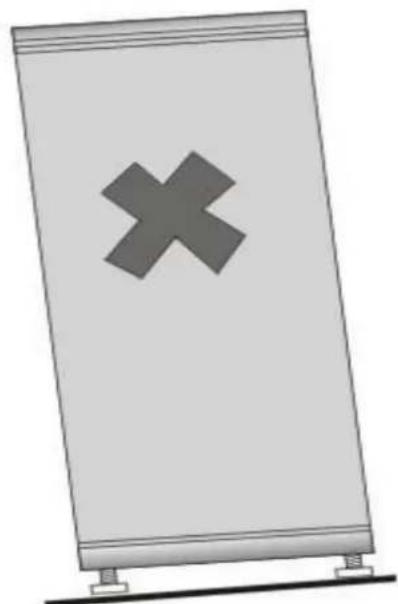
natural_image
Simple diagram of a rectangular sign with a cross symbol, mounted on a base (no text or labels)natural_image
Symbol of a trash bin with crossed lines indicating no waste or discharge, and a solid black rectangle below (no text or labels)natural_image
Simple gray banner with a downward arrow icon, no text or symbols present