ACB09C02 - Air Conditioning Fuave - Free user manual and instructions
Find the device manual for free ACB09C02 Fuave in PDF.



User questions about ACB09C02 Fuave
0 question about this device. Answer the ones you know or ask your own.
Ask a new question about this device
Download the instructions for your Air Conditioning in PDF format for free! Find your manual ACB09C02 - Fuave and take your electronic device back in hand. On this page are published all the documents necessary for the use of your device. ACB09C02 by Fuave.
USER MANUAL ACB09C02 Fuave
natural_image
White portable air conditioner unit with black lid and wheels, no visible text or symbolsMobiele Airconditioner/Luchtontvochtiger
Mobile Airconditioner/Dehumidifier
VEILIGHEIDSWAARSCHUWINGEN
text_image
Diagram of an air conditioner unit with labeled components including a remote control and fan assembly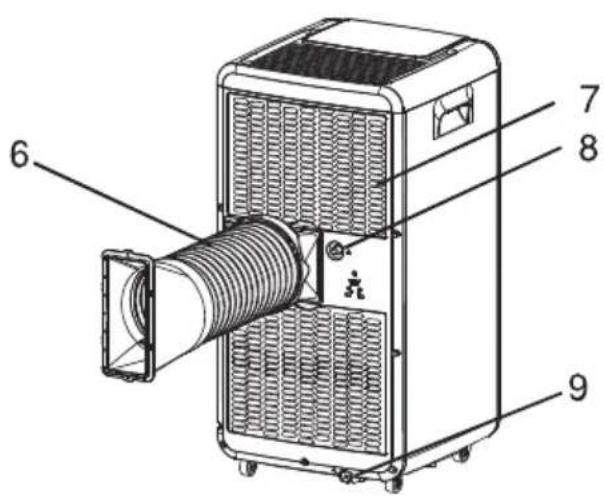
text_image
Technical diagram of an air conditioner unit with numbered parts labeled 6, 7, 8, and 9Installatie
natural_image
Simple line drawing of a trash bin crossed with diagonal lines and a solid rectangle below (no text or symbols)INDEX
Technical Specifications 23.
Safety Warnings 24.
General Safety Warnings 24.
Electrical Safety 26.
Safety in relation to coolant R290 28.
Maximum effect 29.
Description 30.
Installation 31.
Operation 32.
Operation with remote control 35.
Water drainage 38.
Safety 40.
Cleaning and maintenance 40.
Troubleshooting 42.
Removal 43.
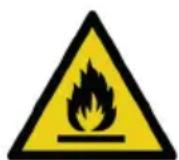
This appliance uses a flammable refrigerant. If the refrigerant leaks or is exposed, it becomes an external source of ignition and is can cause fire!
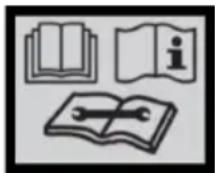
Before use, read this user manual completely and very carefully. Do not install, use or store this appliance in a space that is smaller than 9,6 m ^2 .
TECHNICAL SPECIFICATIONS
| Model | Fuave ACB09C02 |
| Cooling capacity | 9000 BTU (2600 Watt) |
| Max. power consumption | 950 Watt |
| Maximum air displacement | 380m3/h |
| Connection voltage 220-240V~50Hz | |
| Noise level | Sound Power Level 65 dB(A)Sound Pressure Level (high-low) 54 dB(A) |
| Cooling liquid | R290/200g |
| Insulation class IPX0 | |
| Operating temperature 17-35°C | |
| Net weight | 24,5kg |
| Dimensions | 36,7 x 35,3 x 68,4 cm |
SAFETY WARNINGS
Read all safety instructions and other instructions. Non-compliance with all the instructions can result in injuries or material damage.
General safety warnings
• This appliance is suitable only for household use.
- A mobile air conditioner needs air to be able to discharge heat to the outside!
Therefore, never use a mobile air conditioner in an airproof room. Always make sure there is sufficient ventilation. Without sufficient ventilation, a vacuum is created in an airproof room, while a mobile air conditioner is operating, and this vacuum can disrupt the safe operation of geysers, extractors, mechanical ventilation systems, ovens, fireplaces and gas heaters. The vacuum can cause the exhaust gases, which these appliances usually discharge to the outside, to wind up either partially or entirely in the room.
• Install the appliance according to the installation instructions. Incorrect installation can cause water leakage, electric shocks, fire or damage to your possessions.
- Use only the accessories delivered with the appliance and the specific tools for installation.
- Make sure that at all times (also during transport) the entire appliance stands upright. If nevertheless, the entire appliance has been lying horizontally (partly), wait 2 hours before you use it. This is the time span needed by the compressor to do its job correctly.
• Make sure that the appliance stands on an even, horizontal and firm surface.
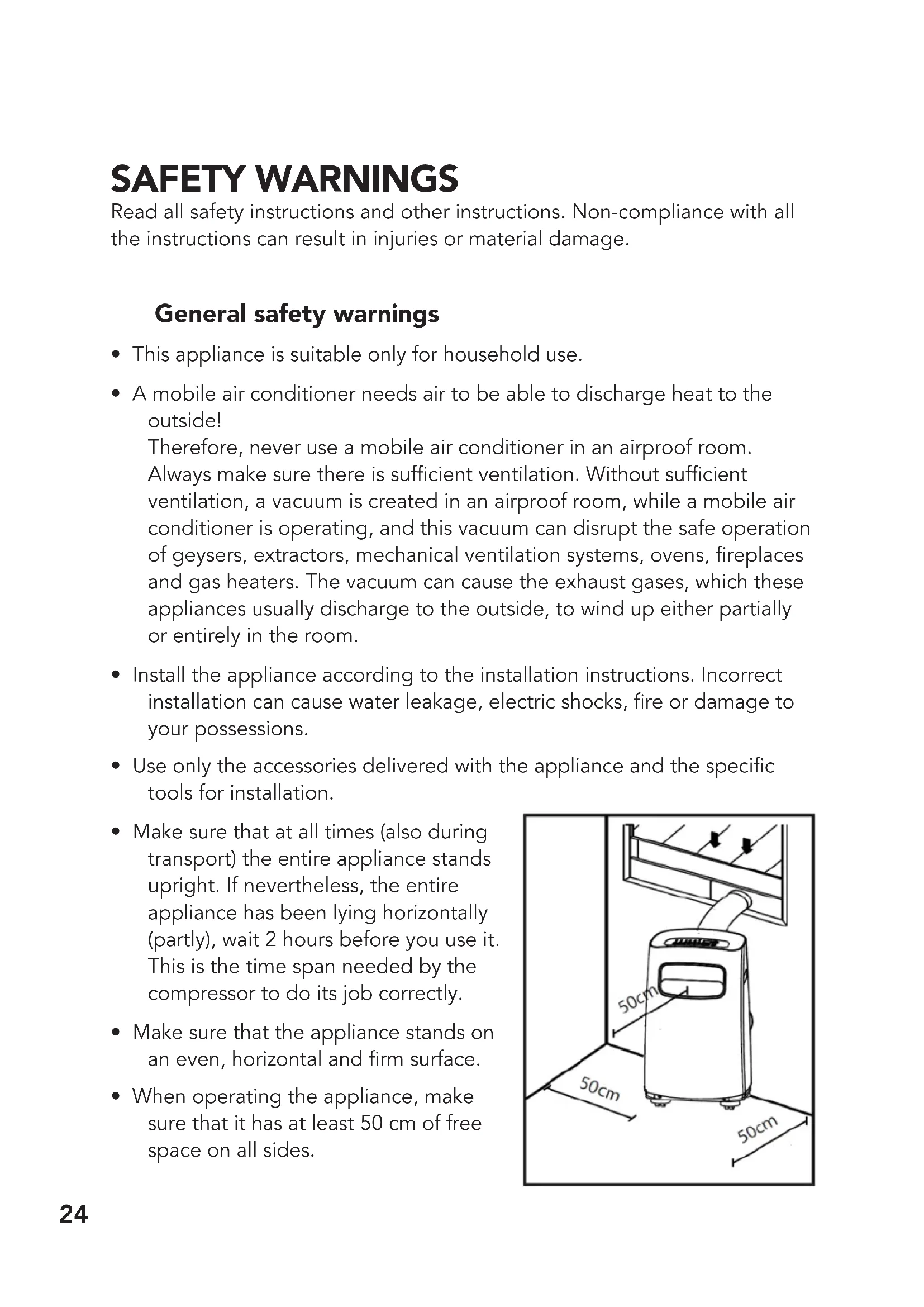
- When operating the appliance, make sure that it has at least 50 cm of free space on all sides.
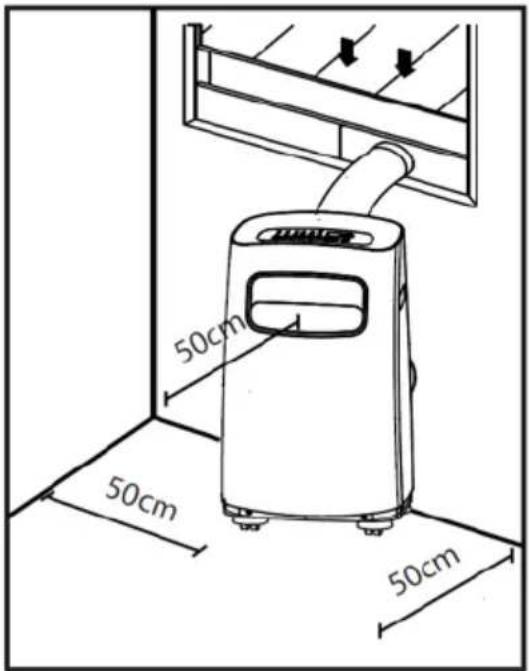
text_image
50cm 50cm 50cm- Make sure that the plug and socket are visible and accessible at all times.
- Do not place any objects on the appliance.
- Do not leave an operating appliance unsupervised, also not for a few seconds!
- Do not use the appliance near fuels, lightly flammable materials or materials that could easily explode (keep a distance of minimum 1 metre). Furthermore, do not use paint, cleaning sprays, insect repellent sprays, etc. on or near the appliance; this can warp the plastic or damage the electric parts.
- Do not touch the appliance with wet or moist hands. Do not use the appliance when standing barefoot.
- Do not use the appliance:
- near a source of fire;
- near splattering oil;
- in direct sunlight;
- near splattering water;
- in a bathroom or near a swimming pool.
- The appliance has wheels for moving it easily. Do not place the appliance on a high pile carpet and do not roll it over objects that might cause it to topple over.
- Do not block the grids from incoming or outgoing airflows: also not partially.
- Do not cover the appliance: this can cause a fire!
- Do not stick fingers or objects, such as pens, etc. through the grids. Warn children in particular about this danger.
• Make sure that the fan is not blocked.
• Children, unauthorised persons and house pets must be supervised.
- This appliance is not a toy; therefore children must not play with it.
- The appliance can be operated by children over the age of 8 and by people with physical, sensory or mental disabilities or who lack knowledge and experience, only if they are supervised or are given instructions on how to use it safely and if they understand the risks involved.
- Unsupervised children may not carry out cleaning and maintenance tasks.
- If you hear a strange sound, smell a strange odour or see smoke, take the plug out of the socket.
- If the appliance topples over during use, switch it off and take the plug out of the socket. Inspect the appliance meticulously to be certain that there is no damage.
- If you suspect damage, contact your supplier or a certified electrician.
- Do not operate the appliance if you notice damage to the appliance, electric cable, plug or cooling pipe or if it is functioning poorly, if it has fallen over or malfunctions in any way. Return the entire appliance to your supplier or a certified electrician for checking and/or repair. Always demand original parts.
- The appliance (including the electricity cable and plug) may be opened and/or repaired only by a person qualified to do so.
- When the water drainage points are not used, make sure that the top and bottom rubber sealing plugs are plugged in firmly in their place to prevent water damage and danger of suffocation.
Electrical safety
- This appliance is suitable only for indoor use.
- Use only a plug mounted on the appliance by the manufacturer and no other means of connection!
- This appliance must be connected according to national wiring codes.
- Before use, check whether the socket that you want to use is earthed, shows no faults and whether the voltage on the socket matches the voltage shown on the type plate of the appliance. Damage caused by faulty voltage is not covered by the warranty!
- If the appliance is not being used or if you are cleaning it or carrying out maintenance or if you want to move it, first switch it off and then take out the plug from the socket. Always move and/or transport the appliance gently!
- In addition, when you start using the appliance, the following applies: First insert the plug into the socket, then switch the appliance to the ON position and only thereafter use the operating button!
- Do not use the appliance in a damp or wet environment, such as a bathroom or laundry area, not in the area of a bath, shower or swimming pool and do not splash water, oil or any other liquid on the appliance.
- Wind the appliance's electric cable completely before you put the plug into the socket and make sure that the electric cable never comes in contact with any hot parts of the appliance or that it becomes hot in any other way. Never route the electric cable under a carpet, do not cover it with mats, runners, etc. and keep the cable away from walking paths. Make sure that the electric cable is not stepped on and that no furniture is placed on it. Do not route the electric cable along sharp corners and after use, do not wind it too tightly!
- Prevent the electric cable from coming in contact with oil, solvent and sharp objects. Check the electric cable and plug regularly for damage. Do not twist or bend the electric cable around the appliance; this can damage the insulation!
- Try as best as possible to avoid using extension cords. If this is unavoidable, then use a cord with sufficient capacity (minimum 3x1.5 mm ^2 ) and don't put it close to walking paths!
- Connect the appliance only to a fixed socket. Do not use a junction box / power strip, etc.
- Do not move the appliance by pulling the electric cable and hold the plug in your hand when you unplug it.
- Do not pull, warp or change the electric cable or submerge it under water. Pulling or incorrect use of the electric cable will damage the appliance and can result in an electric shock.
- Do not use the appliance or switch it off immediately and remove the plug from the socket, if the electric cable, plug or the appliance itself is damaged, broken or malfunctions. The appliance, plug and/or cable must be repaired/replaced by an electrician or a similarly qualified person. Repairs by unqualified individuals are not covered by the warranty and could result in dangerous situations!
Safety and refrigerant R290
- This appliance contains R290 refrigerant. R290 is a refrigerant that complies with European directives. Never puncture the cooling circuit; R290 is flammable (GWP 3)!
- For the dehumidifying process, never us any refrigerant other than what the manufacturer recommends.
- This appliance must be used and stored in a place that has no sources of ignition, such as an open fireplace or gas and electric appliances that are running.
- Do not puncture any of the components of the cooling circuit and do not set the appliance on fire.
- If the appliance is installed, operated or stored in a non-ventilated room, then you must take measures for preventing fire or explosion caused by leaking refrigerant. Make sure that there are no sources of ignition in the same area (such as fire, stoves, electric appliances with sparks, burning cigarettes, etc.).
- The appliance must be stored in a way that prevents mechanical faults.
- Do not install, use or store this appliance in a space that is smaller than 9 ~m^2 .
• R290 is odourless so you will not smell a leak!
- Persons working or interfering with cooling circuits must be in the possession of the appropriate certification, which is issued by a certified body and in which it is stated that the person in question is competent to handle cooling agents in compliance with a specific assessment recognised by associations in the sector.
- The repairs must be carried out based on the recommendations of the appliance's manufacturer. Maintenance and repairs that require the assistance of other qualified personnel must be carried out under the supervision of someone who specialises in the use of inflammable cooling agents.
- Dismantling and recycling of air conditioners must be carried out by a certified technician.
Maximum effect
The maximum surface area, which this air conditioner can cool, depends on various conditions. Conditions that cause the air conditioner to cool smaller spaces are, for example:
- Higher outdoor temperature
- Many and/or large windows
- Flat roof
- Many people in the room
- Many electrical appliances in the room
If these conditions are present to a lesser extent (i.e. lower heat loads), the air conditioner can cool a larger surface area better than if more of these conditions are present (i.e. higher heat loads).
- Do not place the unit in the vicinity of a heat source or in direct sunlight.
- Close windows and doors and keep curtains or hatches closed during the sunniest hours in the day.
- Keep filters clean.
- Modify temperature and ventilation settings once the area has reached the required condition.
Description
- Control panel
- Air outlet
- Signal receptor for remote control
- Remote control
- Handles (both sides)
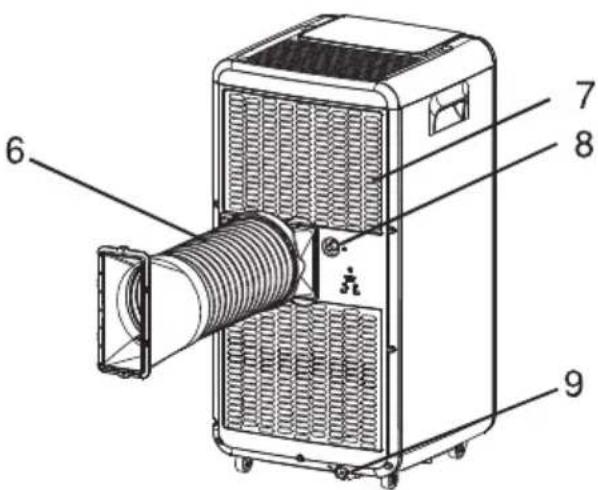
- Hot air exhaust hose
- Air inlet
- Connection point for water drainage hose (dehumidifying)
- Manual water drainage
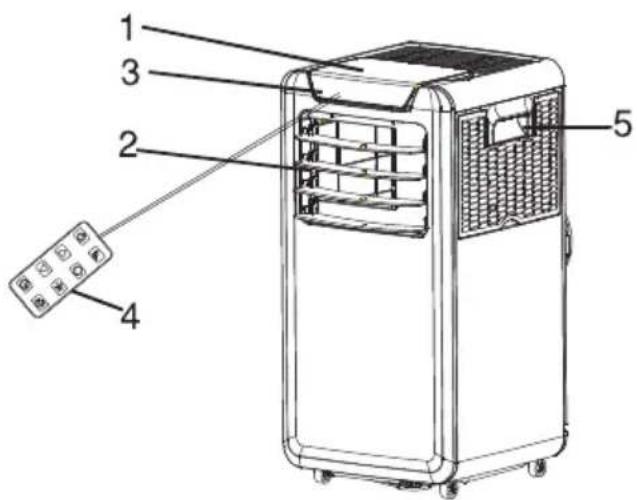
text_image
Diagram of an air conditioner unit with labeled parts including a remote control and fan assembly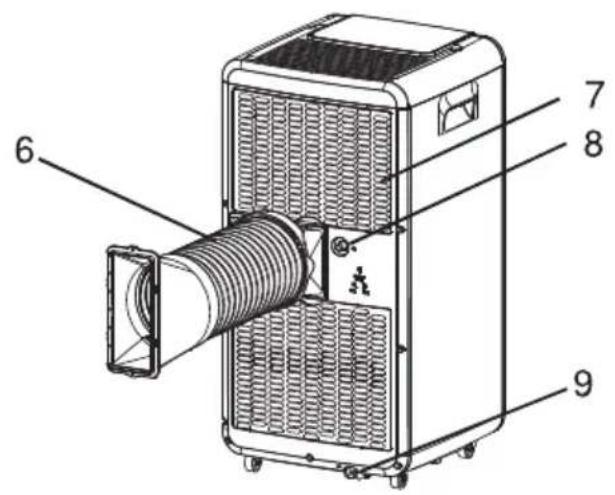
text_image
Technical diagram of an air conditioner unit with numbered parts labeled 6, 7, 8, and 9Installation
The Fuave ACB09C02 is a portable air conditioner that can be moved from room to room.
- Remove the packaging material, keep it out of children's reach and make sure that the appliance remains standing upright.
- Before use, check whether all the accessories are present and whether the appliance and the accessories do not show any damage. Do not start using a damaged appliance, but return it to your supplier!
- Place the appliance on a firm, even, dry and horizontal surface close to a socket and drainage possibility for warm air, for example, by a window that can be slightly opened. Make sure that the appliance has at least 50 cm free space on all sides and observe all the directions stated in the safety instructions.
• To cool, you have to discharge the warm air to the outside.
- Avoid bends or curves in the drain hose. This causes a built-up of exhausted humid air, which can result in leakage, overheating or switching off the airco.
- Warning! Do not use your airco before you have followed all the installation instructions described above!
• Warning! Make sure that no water enters the interior of the appliance!
- Warning! The length of the drain pipe has been adapted specifically to the technology of this airco. Do not replace or extend it using your own hose. This could have an adverse effect on the functioning of your airco. The hose can be extended, but the length should be as short as possible for optimal effect.
- Do remember to prevent break-in! After all, the window is open when using the portable air-conditioner.
Operation
Before using your airco, check:
- Whether it is installed according to the regulations and safety instructions.
- Whether it shows no damage or faults.
- Whether the socket that you want to use has the same voltage as shown on the type plate of the appliance (220-240V / 50Hz).
- Whether there is no other appliance connected to the same socket.
If the above is fully in order, then you can insert the plug into the socket. You can operate the airco via the control panel or the remote control.
Operating via the remote control
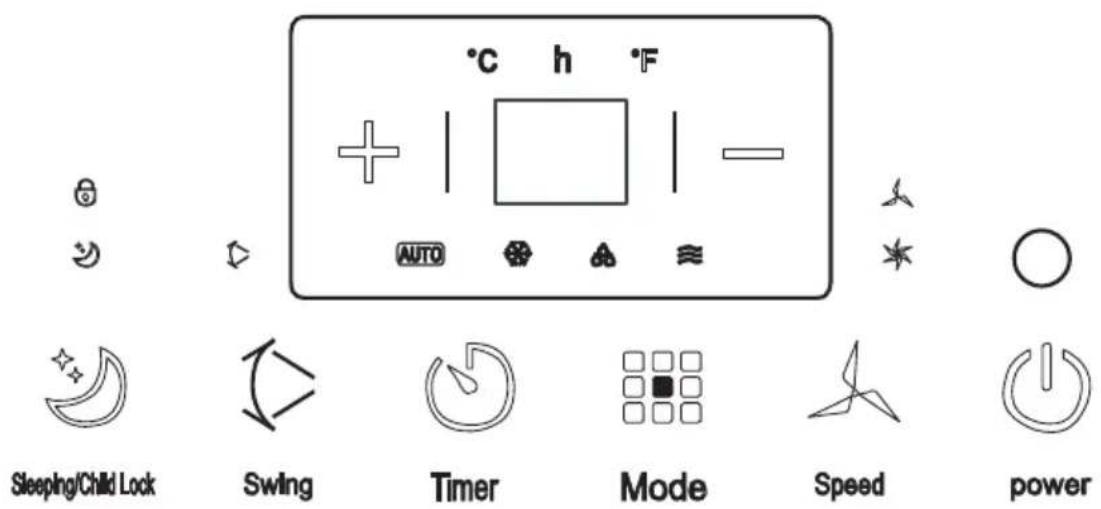
text_image
°C h °F AUTO Sleeping/Child Lock Swing Timer Mode Speed powerON/OFF
This switches the airco on or off.
Temperature
With this, you set the desired room temperature in steps of 1^ C (from 17^ C to 30^ C). The control system can show temperatures in ^ C and in ^ F. If the temperature is shown is ^ F, then press both + and – buttons at the same time for 3 seconds and the temperature will show ^ C again.
Mode
With this you select a particular function: cooling, fanning or dehumidifying. Every time you press the button, you change the function; the light on the control panel shows which function is active. The fan is set automatically.
Timer
This allows you to set a scheduled shutdown. Press the + and - button to set the time per hour.
Swing
This allows you to set the automatic swing function. The blinds will automatically go up an down within an angle of 120 degrees. Press the swing button again to turn off the automatic swing function.
Sleeping/Child lock
This allows you to enter sleep mode. In sleep mode, the fan is set to the low speed and isn't adjustable. The set temperature will increase by 1°C after one hour and by 2°C after two hours. The portable air conditioner will switch off automatically after six hours.
Press and hold the sleep mode button for three seconds to set the child lock. All other buttons are now no longer operable.
Speed
This allows you to set the desired speed. Press the button to select low or high speed. This function isn't available in sleep mode and dehumidify mode.
The LED display shows the set temperature of the cooling function. The room temperature is shown at the dehumidifying and fanning functions. The LED display also shows the following error and safety codes.
Error codes:
E2
Temperature
sensor
error
E3 Condenser temperature sensor error
E4 Water reservoir is full
Water reservoir is full: Connect the drain hose to the bottom water drainage point and let the collected water run off (also see the section on water drainage). If this safety code recurs, contact
your supplier.
Remark: When one of the aforementioned faults occurs, switch off the airco and check for possible obstacles. Restart the airco. If the fault persists, switch off the airco and take the plug out of the socket. Contact your supplier.
Cooling: Press the Mode button until the function light ' Cool comes on, press the + and - buttons to set the desired room temperature (17°C - 30°C). Using the FAN SPEED button on the remote control, you can set the fan speed to HIGH or to LOW.
Fanning: Press on the Mode button until the 'Fan' function light comes on. Using the FAN SPEED button on the remote control, you can set the fan speed to HIGH or to LOW. The temperature cannot be set.
Dehumidifying: Press on the Mode button until the 'Dry' function light comes on. The fan speed and temperature cannot be set. The fan starts automatically on LOW speed (see the section on water drainage).
Operating with the remote control
- Specifications
| Type of remote control Infrared | |
| Type of battery CR2025 3V | |
| Transmission distance 5 metres |
- General
- Use the remote control within a distance of 8 metres from the airco. Direct it to the receiver.
- Make sure that there are on obstacles, such as curtains, doors or alike, are standing in the way of the remote control.
- Remove the batteries from the remote control if the airco is not used for a long period.
- Attention: When you remove the batteries, the remote control deletes all the programming. When you insert new batteries, you have to re-programme the remote control.
- Keep the remote control away from liquids.
- Protect the remote control against high temperatures and exposure to radiation.
- Keep the remote control out of direct sunlight.
- Keep the remote control away from other electric appliances.
- On / Off button
- Temperature up button
- Temperature down button
- Timer on / off button
- Swing button
- Operation mode button
- Fan speed button
- Sleep mode on / off button
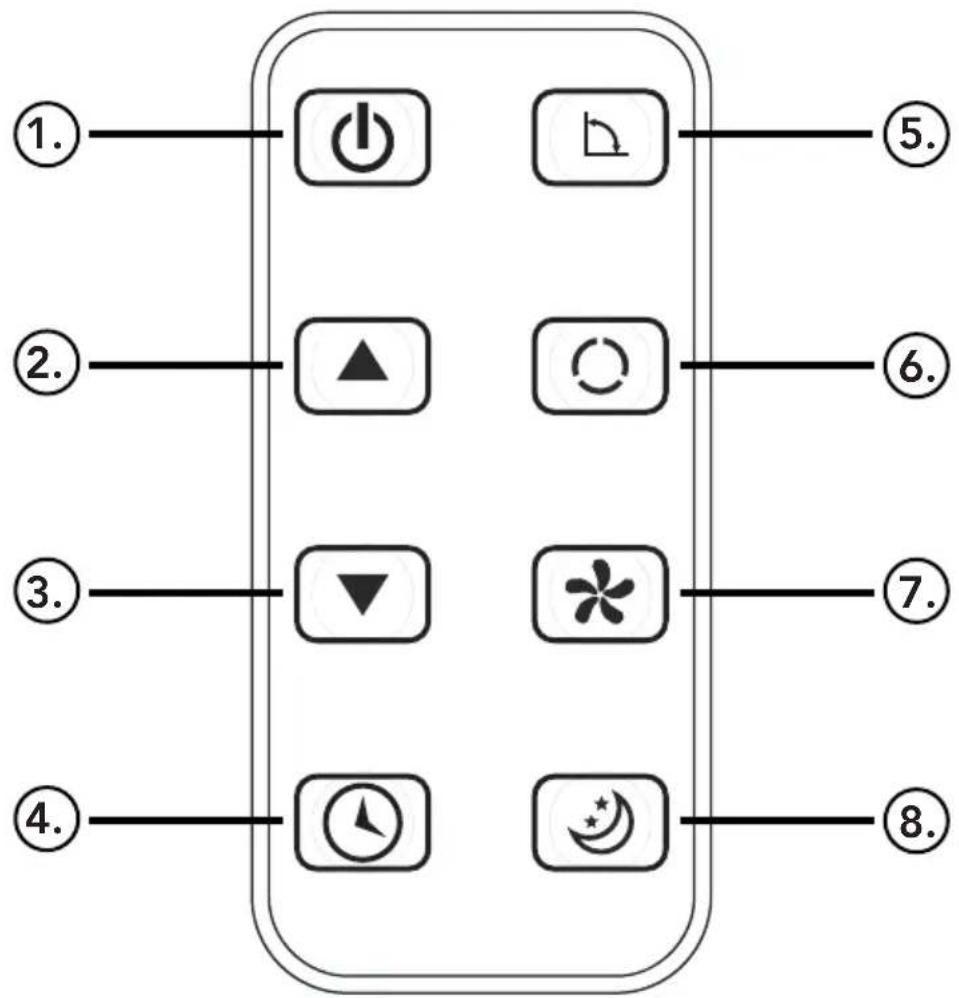
flowchart
graph TD
    A["①"] --> B["Power Icon"]
    C["②"] --> D["▲"]
    E["③"] --> F["▼"]
    G["④"] --> H["钟表 Icon"]
    I["⑤"] --> J["倒 Triangle Icon"]
    K["⑥"] --> L["Circle Icon"]
    M["⑦"] --> N["风扇图标"]
    O["⑧"] --> P[" crescent Icon"]
Other functions
Auto-restart
If the airco switches off unexpectedly due to a power cut, then the previous setting automatically starts after the power is restored.
Adjusting the airflow
The airflow can be automatically adjusted by setting the shutters manually to the desired position. Keep the shutters completely open during use.
Do not place any heavy objects or something else on the shutters, this will damage the airco.
Power Management
If during COOL, the room temperature is lower than the set temperature, the airco will automatically operate in energy-saving function after an interval. The compressor shuts down and the fan starts working on LOW. When the room temperature rises again above the set temperature, then the compressor and fan will start working normally and the energy-saving function will switch off.
Remark: When you cool or dehumidify, always wait 3 minutes after switching ON or OFF before you switch the airco ON or OFF again. The compressor needs this time to recover.
Water drainage
- During dehumidifying
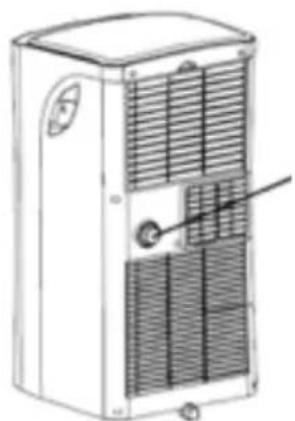
natural_image
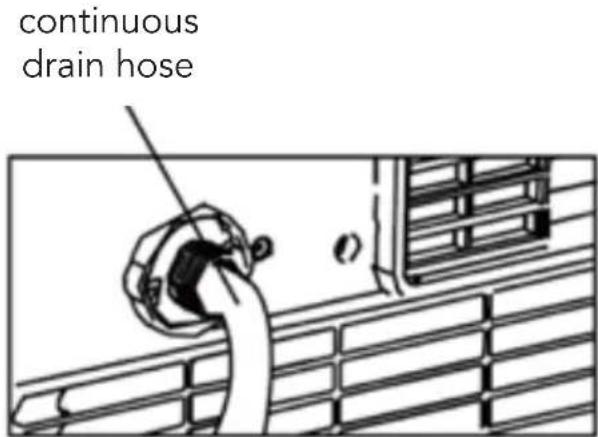
Technical line drawing of a rectangular industrial machine with ventilation grilles and a handle (no text or symbols)remove the drain plug
text_image
continuous drain hoseDuring dehumidifying, additional water is extracted from the air. Therefore, remove the drain plug, connect a drain hose to the water drain connection (10) during the dehumidifying process and route this hose to a lower positioned water drain.
Make sure that the hose is attached firmly and does not leak. Direct the hose to the drain and make sure that it does not bend, which would stop the flow of water. Once you finish using the hose, then put the drain plug and knob back to prevent leakage.
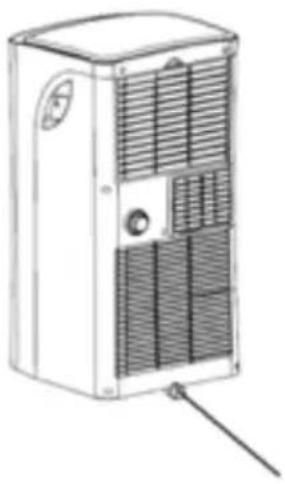
2. During the COOL process
natural_image
Line drawing of a server rack unit with ventilation grilles and a handle (no text or symbols)remove the drain plug
natural_image
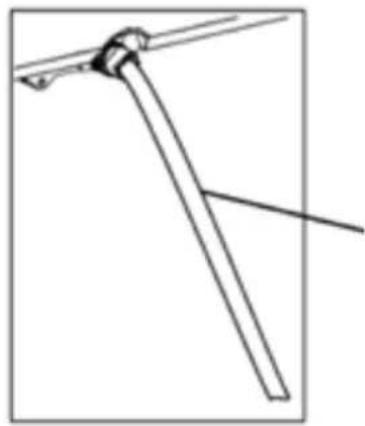
Simple line drawing of a bent rod with a pointed end, no text or symbols presentcontinuous drain hose
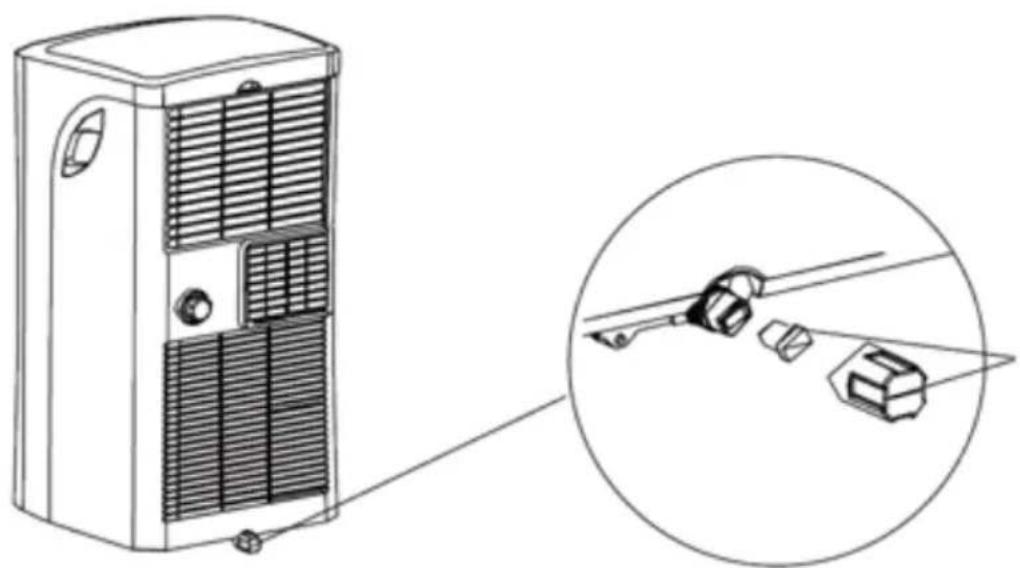
During this process, water is extracted from the air. This largely evaporates, but any excess water accumulates at the bottom water reservoir. When the water reservoir is full, the display will show E4. The motor and the compressor will stop working, but not the fan.
Switch off the airco and remove the plug from the socket.
Move the airco to a drain location and empty the water reservoir by removing the drain plug and connecting a hose. Make sure that as soon as the water reservoir is empty, the drain plug is securely re-inserted to prevent leakage. The symbol E4 disappears. If the error recurs, contact your supplier.
natural_image
Line drawing of a server unit with ventilation grilles and a close-up inset showing mechanical components (no text or symbols)bottom drain plug
Safety
The Fuave portable airco is equipped with overheating protection, which switches off the airco when it overheats. When this happens, you must remove the plug from the socket and let the appliance cool down for at least 30 minutes. Eliminate the cause of the overheating: Was the appliance covered or partly covered? Does it stand too close to a wall or another obstacle, resulting in insufficient air sucked in or blown out?
Afterwards, you can use your appliance again in the usual manner, but first keep on eye on it for the first 30 minutes to see whether no problems recur. If the appliance shows deviations or it overheats again without any explainable reasons, then contact your supplier or a certified electrician for checking and/or repairing.
Cleaning and maintenance
Attention! Before you clean the airco or carry out any maintenance tasks, you must always switch off the airco and remove the plug from the socket! To keep the airco in good condition, regular cleaning is a must!
Cleaning the housing case
Use a soft, moist cloth to wipe the case. Never spray it and make sure that no water penetrates the interior of the appliance! Never use aggressive cleaning agents, benzene, detergents, cloths impregnated with chemicals or other cleaning solutions. This could damage the case. Dry the appliance afterwards with a soft cloth.
Cleaning the air filter
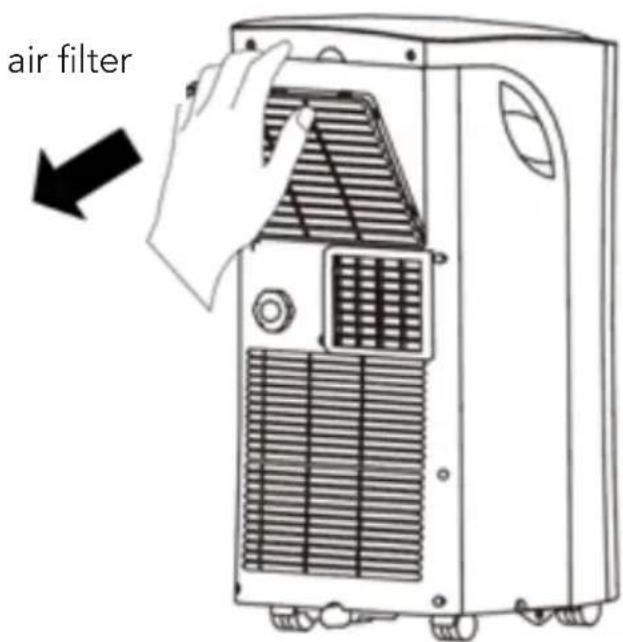
Clean the air filter every two weeks; an airco with a dirty air filter does not operate well. The air filter is located at the rear of the airco and can easily be removed. Use a vacuum cleaner or tap lightly on the air filter to remove loose dust and dirt. Afterwards, rinse clean the air filter in lukewarm water (not higher than 40 °C.) and perhaps use a mild and neutral cleaning agent. Let the air filter dry completely in the shade before remounting it. Watch out! Never operate the airco without the air filter!
text_image
air filterremove the air filter
End-of-season cleaning
If the appliance is stored for a long period, you must take the following measures!
- Completely remove the condense water. Let the airco fan run for 12 hours so that the airco is totally dry on the inside.
- Switch off the airco and remove the plug from the socket.
- Clean the air filter and return it to its place or replace the air filter.
- Rotate the drain hose of the appliance to prevent damage.
- Remove the batteries from the remote control.
- If possible, pack the airco in its original packaging or in a plastic bag and store it in a dry spot. Do not place any heavy objects on the appliance.
Troubleshooting
The appliance does not start when I press the ON/OFF button
- Is the plug inserted into the socket?
- Is the residual-current circuit breaker switched on? No power cut?
- Is the water reservoir full (E4)? Then empty it out.
- The room temperature is lower than the set temperature; adjust the set temperature
The appliance does not seem to cool well
- Measure the temperature of the air blown out. This should be around 10^ cooler than the room temperature.
- Is there direct sunlight? Close the curtains.
- Are there windows or doors open? Close these.
- Are there too many people in the room? They produce heat!
- Is the room too big?
- Is there something in the room that produces heat (or too much heat)? Switch it off or remove it.
- Is the filter dusty or covered with dirt? Clean the filter.
- Is the air inlet or outlet (the hose) blocked? Make sure the airflow is unobstructed.
The appliance makes noise
- Is the surface on which the appliance rests firm, even and horizontal?
- The refrigerant flowing into the appliance also makes some noise. This is normal.
Never attempt to repair the airco yourself!
REMOVAL
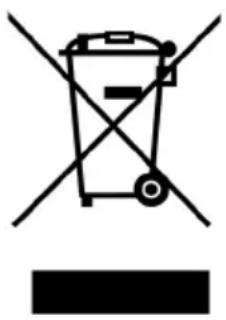
Within the EU, this symbol means that this product cannot be disposed of together with the usual household refuse. Disused appliances contain valuable materials that can and must be reused in order not to harm health and the environment by unregulated refuse collection. Bring the disused appliance to the collection point designated for that purpose or turn to the company where you bought the appliance.
They can make sure that as many components of this appliance as possible will be reused. Dismantling and recycling of air conditioners must be carried out by a certified technician.
natural_image
Symbol of a trash bin crossed with a diagonal line and a horizontal bar below (no text or labels)TABLE DES MATIÈRES
text_image
Diagram of an air conditioner unit with numbered parts and a remote control labeled 4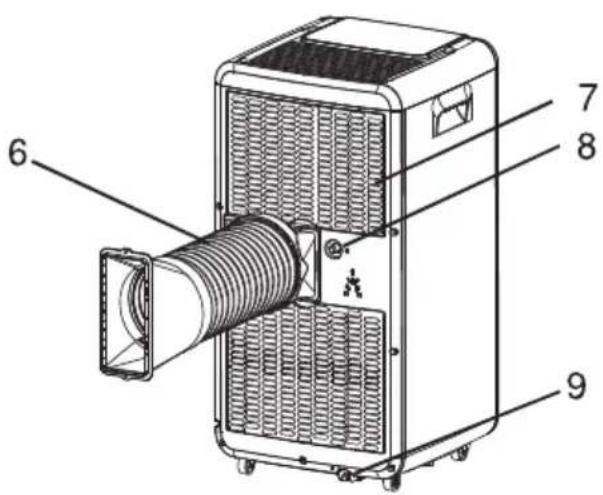
text_image
Technical diagram of a portable air conditioner unit with numbered parts labeled 6, 7, 8, and 9.Installation
natural_image
Line drawing of a server rack unit with ventilation grilles and a handle (no text or symbols)natural_image
Simple line drawing of a bent pipe or rod with a connecting rod (no text or symbols)tuyau d'évacuation continue
natural_image
Line drawing of a server unit with ventilation grilles and a close-up inset showing mechanical components (no text or symbols)natural_image
Symbol of a trash bin crossed with two crossed lines and a solid black rectangle below (no text or labels)INHALT
text_image
Diagram of an air conditioner unit with labeled parts including a remote control and internal compartments