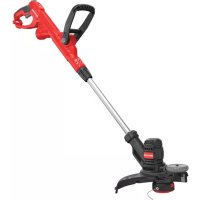
CMESTE920 - Trimmer Craftsman - Free user manual and instructions
Find the device manual for free CMESTE920 Craftsman in PDF.

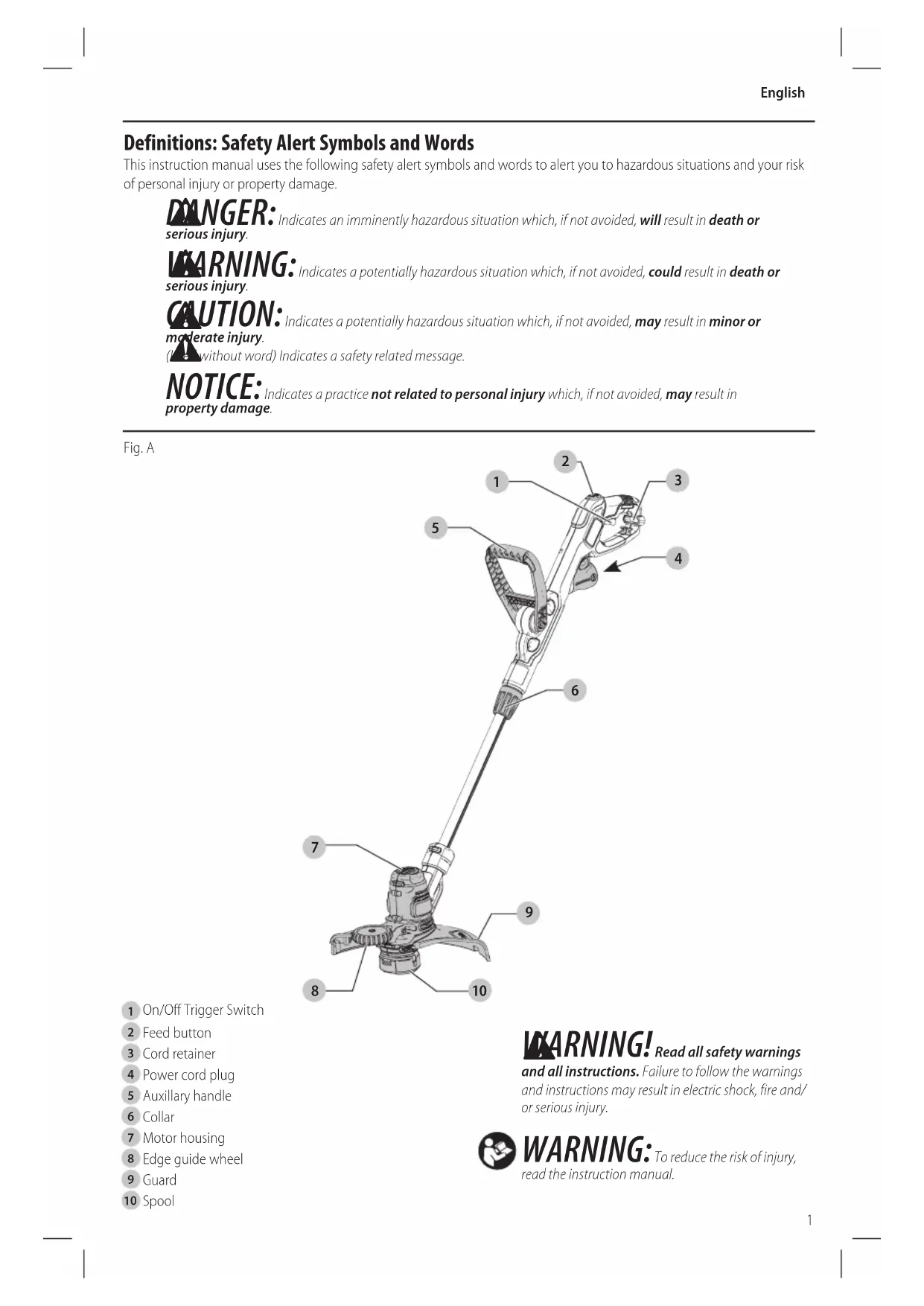


| Brand | Craftsman |
| Model | CMESTE920 |
| Product Type | Electric Corded String Trimmer |
| Power Source | Corded Electric, 120V AC |
| Cutting Line Diameter | 1.65 mm (0.065 in), round nylon |
| Maximum Line Length | Approximately 136 mm (5-3/8 in) extending from spool |
| Line Feed System | Bump Feed Button |
| Cutting Mode | Trimming and Edging (180° rotating head) |
| Guide Wheel | Yes, for edging |
| Auxiliary Handle | Yes, adjustable height and rotation |
| Shaft Length | Adjustable (twist lock) |
| Guard | Yes, with integrated cutting blade |
| Warranty | 2 years (household use) |
| Maintenance | Clean vents with compressed air, sharpen line cutter |
| Safety | Safety glasses and hearing protection required, GFCI recommended |
| Replacement Parts | Replacement spool CMZO98030, 1.65 mm round line |
| Repairability | Authorized Craftsman service center (888-331-4569) |
Frequently Asked Questions - CMESTE920 Craftsman
User questions about CMESTE920 Craftsman
0 question about this device. Answer the ones you know or ask your own.
Ask a new question about this device
Download the instructions for your Trimmer in PDF format for free! Find your manual CMESTE920 - Craftsman and take your electronic device back in hand. On this page are published all the documents necessary for the use of your device. CMESTE920 by Craftsman.
USER MANUAL CMESTE920 Craftsman
INSTRUCTION MANUAL
MANUEL D'INSTRUCTIONS
natural_image
Technical line drawing of a mechanical lever device (no text or symbols)Thank you for choosing CRAFTSMAN!
PLEASE READ BEFORE RETURNING THIS PRODUCT FOR ANY REASON.
If you have a question or experience a problem with your CRAFTSMAN purchase, go to www.craftsman.com
If you can't find the answer or do not have access to the Internet, call 888-331-4569 from 8 a.m. to 5 p.m. EST Mon. - Fri. to speak with an agent. Please have the catalog number available when you call.
SAVE THIS MANUAL FOR FUTURE REFERENCE.
To register your new product, visit www.craftsman.com/registration
English
| English (original instructions) | 1 |
| Français (traduction de la notice d'instructions originale) | 12 |
| Español (traducido de las instrucciones originales) | 23 |
Definitions: Safety Alert Symbols and Words
This instruction manual uses the following safety alert symbols and words to alert you to hazardous situations and your risk of personal injury or property damage.
DANGER: Indicates an imminently hazardous situation which, if not avoided, will result in death or serious injury.
WARNING: Indicates a potentially hazardous situation which, if not avoided, could result in death or serious injury.
CAUTION: Indicates a potentially hazardous situation which, if not avoided, may result in minor or moderate injury.
(### without word) Indicates a safety related message.
NOTICE: Indicates a practice not related to personal injury which, if not avoided, may result in property damage.
Fig. A
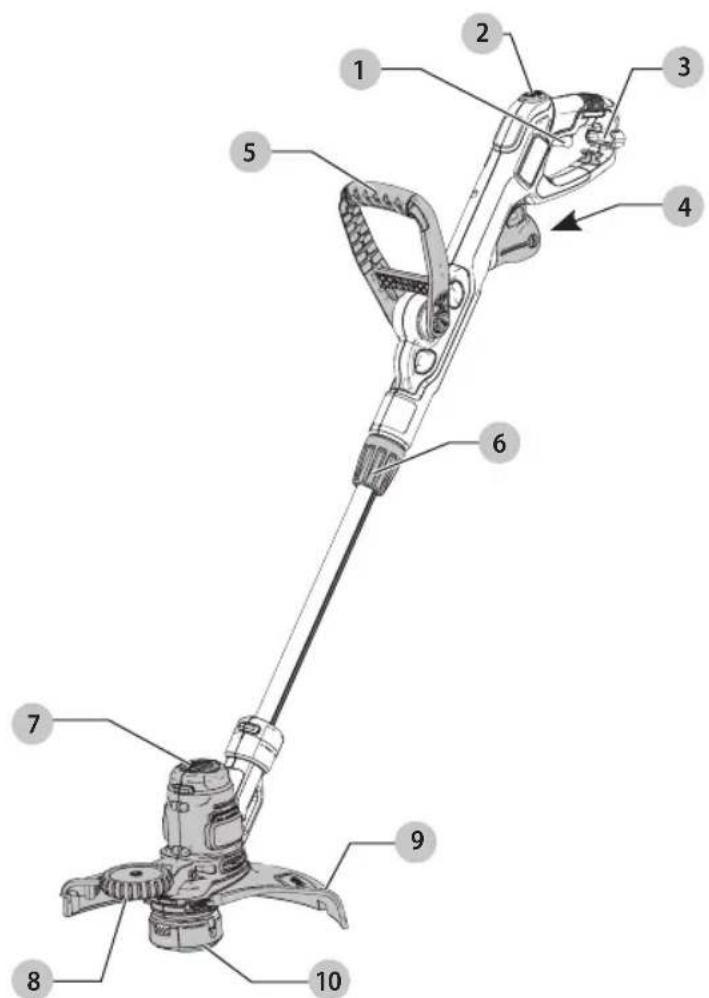
1 On/Off Trigger Switch
2 Feed button
3 Cord retainer
4 Power cord plug
5 Auxiliary handle
6 Collar
7 Motor housing
8 Edge guide wheel
9 Guard
10 Spool
WARNING! Read all safety warnings
and all instructions. Failure to follow the warnings and instructions may result in electric shock, fire and/or serious injury.

WARNING: To reduce the risk of injury, read the instruction manual.
English
Important Safety Warnings
WARNING: When using electric gardening appliances, basic safety precautions should always be followed to reduce risk of fire, electric shock, and personal injury, including the following.
WARNING: Do not remove guard. The guard must be attached during use. Operating this trimmer without the guard will violate the product warranty.
AUTION: When replacing the line, use only 0.065" (1.65 mm) diameter round line. Other diameters or shapes may degrade performance or cause damage to the trimmer.
READ ALL INSTRUCTIONS
- ALWAYS WEAR EYE PROTECTION – Wear safety spectacles or goggles at all times when plugged in. These items are available for purchase.
- GUARD - Do not use this appliance without the guard attached.
- DRESS PROPERLY – Do not wear loose clothing or jewelry. They can be caught in moving parts. Gloves and substantial rubber soled footwear are recommended when working outdoors. Don't operate the appliance when barefoot or wearing open sandals. Wear heavy long pants to protect your legs. Wear protective hair covering to contain long hair.
- NYLON LINE – Keep face, hands and feet clear of rotating nylon line at all times.
- THE ROTATING LINE PERFORMS A CUTTING FUNCTION – Use care when trimming around screens and desirable plantings.
- DO NOT USE materials not recommended, such as metal wire, rope, and the like.
- KEEP ALL BYSTANDERS AWAY – at a safe distance from work area, especially children.
- MAKE SURE that other persons and pets are at least 100 feet (30 m) away.
- TO REDUCE THE RISK of rebound (ricochet) injury, work going away from any nearby solid object such as wall, steps, large stone, tree, etc. Use great care when working close to solid objects and where necessary, do trimming by hand.
- AVOID ACCIDENTALLY STARTING – Don't carry plugged-in trimmer with finger on trigger.
- USE THE RIGHT appliance – Do not use this appliance for any job except that for which it is intended.
- DON'T OVERREACH – Keep proper footing and balance at all times.
- Don't Force Appliance – It will do the job better and with less likelihood of a risk of injury at the rate for which it was designed
- DAMAGE TO UNIT – If you strike or become entangled with a foreign object, stop appliance immediately, unplug, check for damage and have any damage repaired before further operation is attempted. Do not operate with a broken hub or spool.
- DAMAGE TO Cord – Keep power cord away from rotating line. If you damage the cord, unplug it from the power supply before moving the tool or examining the damage. A damaged cord must be replaced before further use.
- SECURE EXTENSION CORD using the cord retainer shown in in this manual.
- DISCONNECT TRIMMER – when not in use, when replacing line, or prior to cleaning.
- AVOID DANGEROUS ENVIRONMENTAL CONDITIONS - Do not use electric appliances in damp or wet locations. Follow all instructions in this Instruction Manual for proper operation of your appliance. Don't use the appliance in the rain.
- DO NOT OPERATE portable electric appliances in gaseous or explosive atmospheres. Motors in these appliances normally spark, and the sparks might ignite fumes.
- STORE IDLE applianceS INDOORS – When not in use, appliances should be stored indoors in a dry, locked-up place out of reach of children.
- STAY ALERT – Do not operate this unit when you are tired, ill, or under the influence of alcohol, drugs, or medication.
- MAINTAIN APPLIANCES WITH CARE – Follow instructions in maintenance section. Keep handles dry, clean and free from oil and grease.
- Ground Fault Circuit Interrupter (GFCI) protection should be provided on the circuit(s) or outlet(s) to be used for the trimmer. Receptacles are available having built-in GFCI protection and may be used for this measure of safety.
- CHECK DAMAGED PARTS – Before further use of the appliance, a guard or other part that is damaged should be carefully checked to determine that it will operate properly and perform its intended function. Check for alignment of moving parts, binding of moving parts, breakage of parts, mounting, and any other condition that may affect its operation. A guard or other part that is damaged should be properly repaired or replaced by an authorized service center unless otherwise indicated elsewhere in this manual.
- DO NOT immerse appliance in water or squirt it with a hose. DO NOT allow any liquid to get inside it.
- DO NOT store the appliance on or adjacent to fertilizers or chemicals.
• DO NOT clean with a pressure washer.
- Keep guards in place and in working order.
- Keep hands and feet away from cutting area.
- KEEP CHILDREN, BYSTANDERS AND ANIMALS AWAY from the work area a minimum of 30 feet (10 meters) when starting or operating the unit.
• INSPECT THE AREA before using the unit. Remove all debris and hard objects such as rocks, glass, wire, etc.
English
that can ricochet, be thrown, or otherwise cause injury or damage during operation.
- Do not leave appliance when plugged in. Unplug from outlet when not in use and before servicing.
- DO NOT use with damaged cord or plug. If appliance is not working as it should, has been dropped, damaged, left outdoors, or dropped into water, return it to a service center.
- DO NOT pull or carry by cord, use cord as a handle, or pull cord around sharp edges or corners. Keep cord away from heated surfaces.
- DO NOT unplug by pulling on cord. To unplug, grasp the plug, not the cord.
- Do not handle plug or appliance with wet hands.
- Turn off all controls before unplugging.
- This appliance is provided with double insulation. Use only identical replacement parts. See instructions for Servicing of Double-Insulated Appliances.
• To reduce the risk of electric shock, use only with an extension cord intended for outdoor use, such as SJW or SJTW. - Make sure your extension cord is in good condition and is the correct size for your appliance. The Minimum Gauge for Cord Sets chart below shows the correct size to use depending on cord length and nameplate ampere rating. If in doubt, use the next heavier gage. The smaller the gage number, the heavier the cord. An undersized extension cord will cause a drop in line voltage resulting in loss of power and overheating
- Maintain Appliance With Care – Inspect extension cords periodically and replace if damaged.
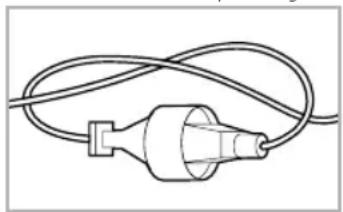
- To reduce the risk of disconnection of appliance cord from the extension cord during operating:
a) Make a knot as shown in below; OR
b) Use one of the plug-receptacle retaining straps or connectors described in this manual; OR
c) Secure the extension cord to the appliance plug as shown or described in the Operating Instructions.
natural_image
Line drawing of a medical or laboratory device with coiled tubing and a central connector (no text or symbols)WARNING:
To reduce the risk of personal injury due to a loose electrical connection between the appliance's plug and extension cord, firmly and fully attach the appliance plug to the extension cord. Periodically check the connection while operating to ensure it is fully attached. Do not use an extension cord that provides a loose connection. A loose connection may result in overheating, fire, and increases the risk of a burning.
WARNING:
Do not use appliance if the switch trigger does not turn the appliance on or off. Any appliance that can not be controlled with the switch trigger is dangerous and must be repaired.
WARNING:
Some dust created by this product contains chemicals known to the State of California to cause cancer, birth defects or other reproductive harm. Some examples of these chemicals are:
• compounds in fertilizers
• compounds in insecticides, herbicides and pesticides
• arsenic and chromium from chemically treated lumber
To reduce your exposure to these chemicals, wear approved safety equipment such as dust masks that are specially designed to filter out microscopic particles.
Additional Safety Information
WARNING:
ALWAYS use safety glasses.
Everyday eyeglasses are NOT safety glasses. Also use face or dust mask if cutting operation is dusty. ALWAYS WEAR CERTIFIED SAFETY EQUIPMENT:
• ANSI Z87.1 eye protection (CAN/CSA Z94.3),
• ANSI S12.6 (S3.19) hearing protection,
• NIOSH/OSHA/MSHA respiratory protection.
WARNING:
Use of this tool can generate and/or disperse dust, which may cause serious and permanent respiratory or other injury. Always use NIOSH/OSHA approved respiratory protection appropriate for the dust exposure. Direct particles away from face and body.
WARNING:
Always wear proper personal hearing protection that conforms to ANSI S12.6 (S3.19) during use. Under some conditions and duration of use, noise from this product may contribute to hearing loss.
• Air vents often cover moving parts and should be avoided. Loose clothes, jewelry or long hair can be caught in moving parts.
Safety Rules and Instructions: Extension Cords
WARNING:
To reduce the risk of electric shock, use only with an extension cord intended for outdoor use, such as an extension cord of cord type SW-A, SOW-A, STW-A, STOW-A, SJW-A, SJOW-A, SJTW-A. or SJTOW-A.
Make sure your extension cord is in good condition. When using an extension cord, be sure to use one heavy enough
ENGLISH
to carry the current your product will draw. An undersized cord will cause a drop in line voltage resulting in loss of power and overheating. The table shows the correct size to use depending on cord length and nameplate ampere rating. If in doubt, use the next heavier gauge. The smaller the gauge number, the heavier the cord. If the extension will be used outside, the cord must be suitable for outdoor work. The letters "WA" on the cord jacket indicate that the cord is suitable for outdoor use.
- An extension cord must have adequate wire size (AWG or American Wire Gauge) for safety. The smaller the gauge number of the wire, the greater the capacity of the cable, that is, 16 gauge has more capacity than 18 gauge. An undersized cord will cause a drop in line voltage resulting in loss of power and overheating. When using more than one extension to make up the total length, be sure each individual extension contains at least the minimum wire size. The following table shows the correct size to use depending on cord length and nameplate ampere rating. If in doubt, use the next heavier gauge. The lower the gauge number, the heavier the cord.
Minimum Gauge for Cord Sets
| Volts | Total Length of Cord in Feet (meters) | ||||
| 120 V 25 (7.6) | 50 (15.2) 100 (30.5) 150 (45.7) | ||||
| 240 V 50 (15.2) | 100 (30.5) 200 (61.0) 300 (91.4) | ||||
| Ampere Rating | American Wire Gauge | ||||
| More Than | Not More Than | ||||
| 06 18 | 16 16 14 | ||||
| 6 10 | 18 16 14 12 | ||||
| 10 12 | 16 16 14 12 | ||||
| 12 16 14 12 Not Recommended | |||||
Safety Rules and Instructions: Polarized Plug
To reduce the risk of electric shock, this equipment has a polarized plug (one blade is wider than the other). This equipment must be used with a suitable polarized 2 wire or 3 wire extension cord. Polarized connections will fit together only one way. Make sure that the receptacle end of the extension cord has large and small blade slot widths. If the plug does not fit fully into the extension cord, reverse the plug. If it still does not fit, obtain a suitable extension cord. If the extension cord does not fit fully into the outlet, contact a qualified electrician to install the proper outlet. Do not change the tool plug or extension cord in any way.
The label on your tool may include the following symbols. The symbols and their definitions are as follows:
| V......volts | IPM......impacts per minute |
| Hz......hertz | RPM......revolutionsper minute |
| min......minutes | |
| or DC......direct current | sfpm......surface feet per minute |
| Class I Construction (grounded) | SPM......strokes per minute |
| ../min......per minute | A......amperes |
| BPM......beats per minute | W......watts |
| ~ or AC......alternating current |
| or AC/DC....alternatingordirect current | visible radiation |
| ClassII | wearrespiratoryprotection |
| Construction(double insulated) | weareyeprotection |
| no....no load speed | wearhearingprotection |
| rated speed | |
| earthing terminal | readalldocumentation |
| safety alert symbol |
SAVE THESE INSTRUCTIONS FOR FUTURE USE
Motor
Be sure your power supply agrees with the nameplate marking. Voltage decrease of more than 10% will cause loss of power and overheating. Craftsman tools are factory tested; if this tool does not operate, check power supply.
COMPONENTS (FIG. A)
WARNING: Never modify the power tool or any part of it. Damage or personal injury could result.
Refer to Figure A at the beginning of this manual for a complete list of components.
Intended Use
This appliance is designed for residential outdoor trimming applications.
DO NOT use under wet conditions or in presence of flammable liquids or gases.
DO NOT let children come into contact with the tool. Supervision is required when inexperienced operators use this tool.
ASSEMBLY AND ADJUSTMENTS
WARNING: To reduce the risk of serious personal injury, turn unit off and disconnect it from power source before making any adjustments or removing/installing attachments or accessories. An accidental start-up can cause injury.
WARNING: Unplug the trimmer before attempting to attach the guard, EDGE GUIDE OR HANDLE. NEVER OPERATE TOOL WITHOUT GUARD FIRMLY IN PLACE. THE GUARD MUST ALWAYS BE ON THE TOOL TO PROTECT THE USER.
Attaching the Guard (Fig. B, C)
WARNING: NEVER OPERATE trimmer WITHOUT GUARD FIRMLY IN PLACE.
- Turn the trimmer upside down so that you are looking down at the spool 10.
English
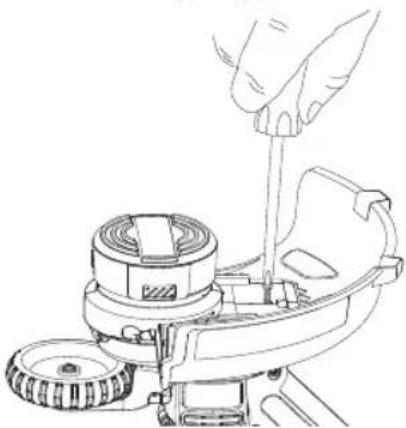
- Remove the screw from the guard with a phillips screwdriver.
- Turn the guard 9 upside down and slide it fully onto the motor housing 7. Make sure the tabs 11 on the guard engage the ribs 12 on the motor housing as shown in Figure B. The locking tab 25 should have snapped into the housing slot 26.
- Continue to slide the guard on until you hear it "snap" into place.
- Insert the guard screw as shown in Figure C to complete the guard assembly.
- Once the guard is installed, remove the covering from the line cut-off blade, located on the edge of the guard.
Fig. B
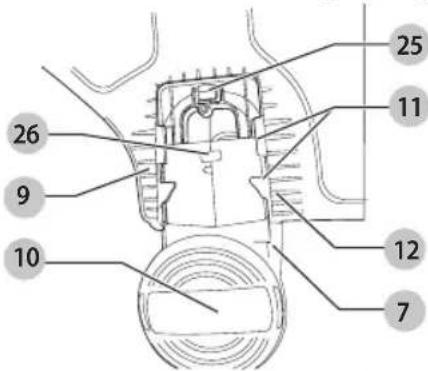
Fig. C
natural_image
Line drawing of a hand using a tool to adjust or install a mechanical component (no text or symbols present)Attaching the Auxiliary Handle (Fig. D, E, F)
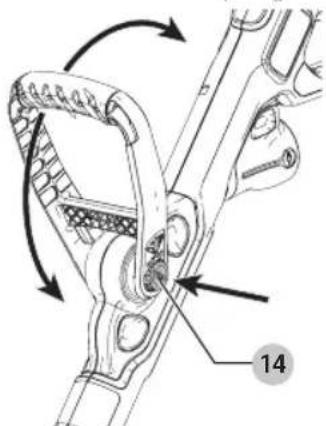
- To attach the handle 5, press in on the buttons 13 on both sides of the upper housing as shown in Figure D.
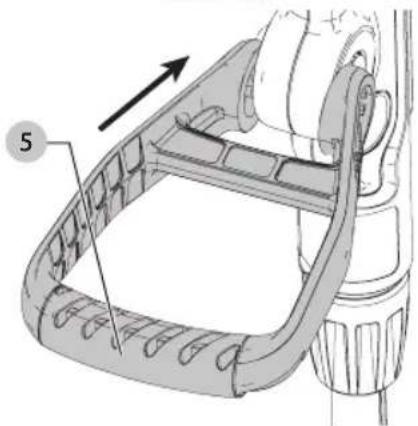
- Position the handle as shown in Figure E, matching up the grooved side of the handle with the grooved button. Partially push the handle on so that it will hold the buttons in when you release them with your hand.
- Push the handle completely onto the housing and position it slightly until it "snaps" into place (Figure F).
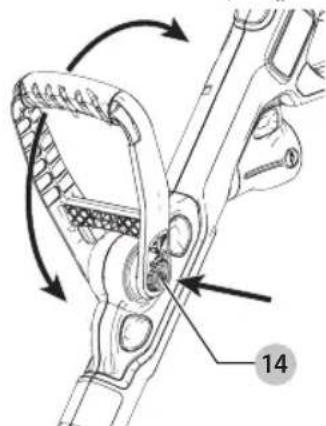
- To adjust the handle up or down, press in on the button 13 and raise or lower the handle.
- The handle should be adjusted so that your front arm is straight when the trimmer is in the working position.
Fig. D
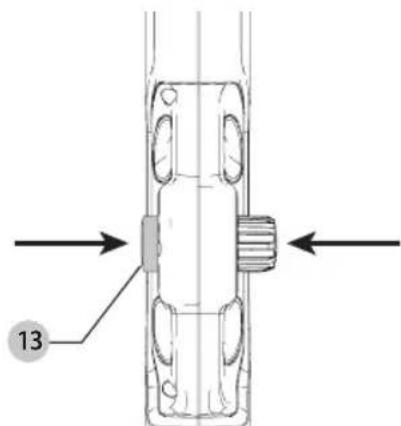
Fig. E
natural_image
Technical diagram of a mechanical component with labeled parts and an arrow indicating direction (no text or symbols present)Fig. F
natural_image
Technical line drawing of a mechanical clamp or bracket assembly with directional arrows indicating motion (no text or symbols present)Height Adjustment (Fig. G, I3)
AUTION:
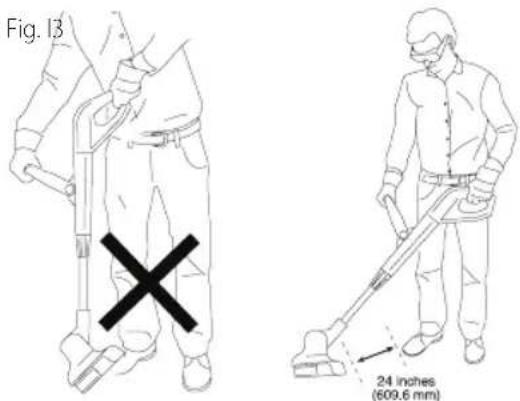
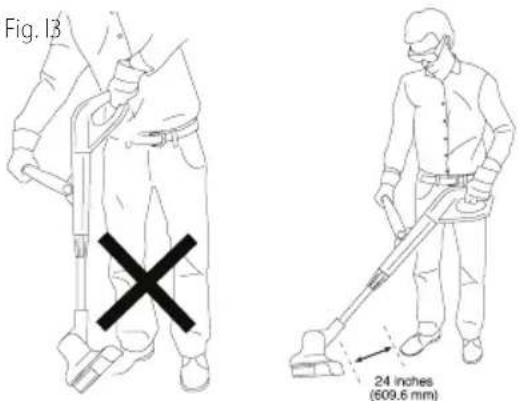
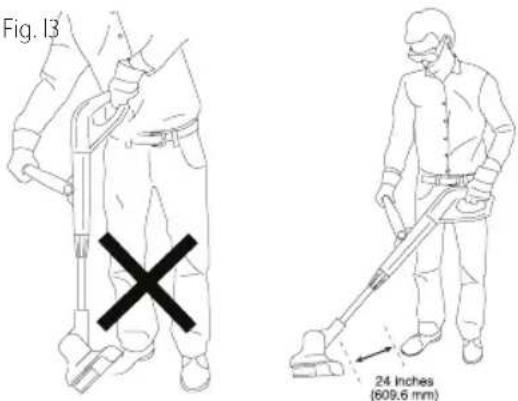
Adjust the length of the trimmer to obtain proper working positions as shown in
Figure 13.
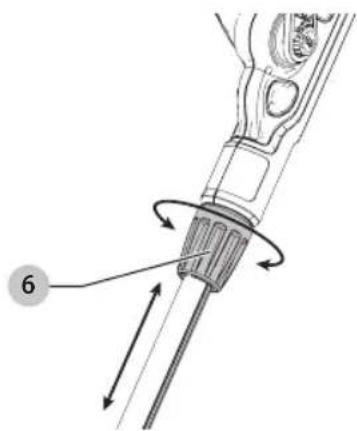
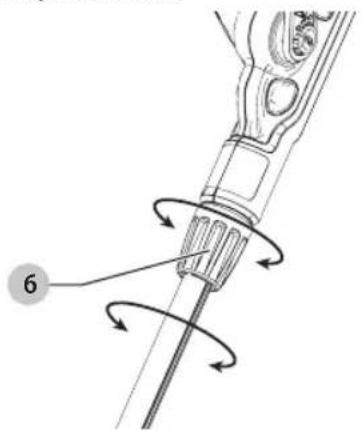
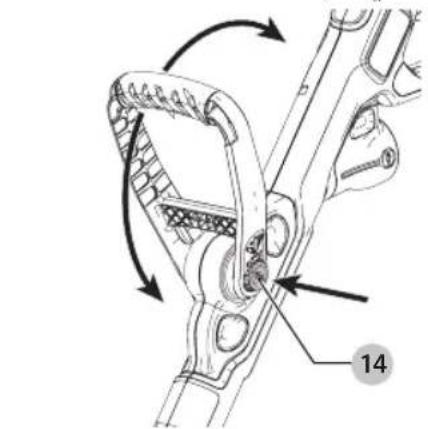
- The overall height of the trimmer can be adjusted by loosening the collar 6 and rotating it in the direction of the arrow shown in Figure G.
- Move the upper housing straight up or down. When the desired height is achieved, tighten the collar by rotating it opposite of the direction shown in Figure G.
English
Fig. G
Attaching Extension Cord (Fig. H)
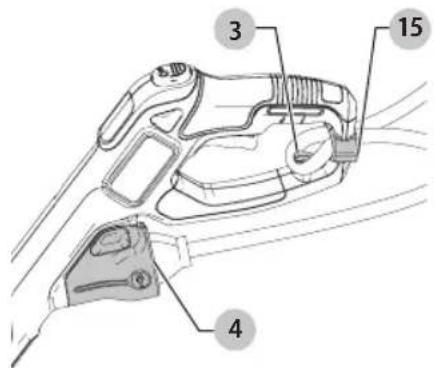
An extension cord retainer 3 is built into the switch handle that prevents the cord from coming unplugged.
- To use this feature, simply double the extension cord about 8 inches (203 mm) from the end, and insert it into the slot 15 in the end of the handle area as shown in Figure H.
- Hook the loop formed by doubling the cord over the tab. Gently tug on the cord to insure that it is firmly retained in the trimmer's handle.
- Plug the receptacle end of the extension cord into the power cord plug 4 in the trimmer.
Fig. H
Releasing the Cutting Line
For shipping purposes, the cutting line is taped to the spool housing.
- Remove the tape holding the cutting line to the spool housing.
- See Replacing the Spool for instructions for removing the spool.
OPERATION
WARNING: To reduce the risk of serious personal injury, turn unit off and disconnect it from power source before making any adjustments or removing/installing attachments or accessories. An accidental start-up can cause injury.
WARNING: Always use proper eye protection that conforms to ANSI Z87.1 (CAN/CSA Z94.3) while operating this appliance.
CAUTION: Before you begin trimming, only use the appropriate type of cutting line.
CAUTION: Inspect area to be trimmed and remove any wire, cord, or string-like objects which could become entangled in the rotating line or spool. Be particularly careful to avoid any wire which might be bent outwardly into the path of the trimmer, such as barbs at the base of a chain link fence.
Proper Hand Position (Fig. I, I1, I2, I3)
WARNING: To reduce the risk of serious personal injury, ALWAYS use proper hand position as shown.
WARNING: To reduce the risk of serious personal injury, ALWAYS hold securely in anticipation of a sudden reaction.
Proper hand position requires one hand on the main handle and one hand on the auxiliary handle 5.
Switching On and Off (Fig. A)
To switch the trimmer on, squeeze the trigger switch 1. To switch the trimmer off, release the trigger switch.
Operating the Trimmer (Fig. A, I–I3, G)
- With the unit on, angle unit and slowly swing the trimmer side to side as shown in Figure I.
- Maintain a cutting angle of 5^ to 10^ as shown in Figure I1. Do not exceed 10^ (Figure I2). Cut with the tip of the line. To keep distance from hard surfaces use edge wheel 8.
- Maintain a minimum distance of 24 inches (609.6 mm) between the guard and your feet as shown in Figure I. To achieve this distance adjust the overall height of the trimmer as shown in Figure G.
English
Fig. I Fig. I1
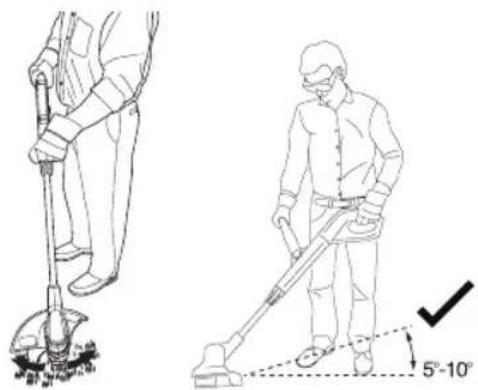
Fig. 12 Fig. 13
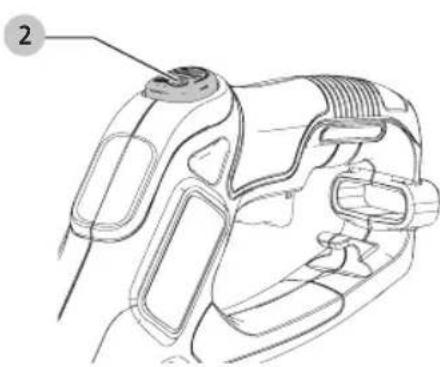
Feed Button (Fig. J)
The Feed feature allows you to advance the length of cutting line available while trimming.
To extend the cutting line, fully depress the feed button 2 while trimming and then release (Figure J).
nOTE: The trimmer will stop cutting when the feed button is pressed and will resume cutting when released.
- For maximum line length, press the button multiple times until you hear the cutting line hitting the guard.
NOTE: Do not continue to press the feed button once the maximum length is reached. This will result in overfeeding and will consume string quickly.
Fig. J
natural_image
Line drawing of a mechanical device interior with labeled component (no text or symbols present)Convert to Edging Mode (Fig. K)
The trimmer can be used in trimming mode or edging mode to trim overhanging grass along lawn edges and flower beds.
WARNING: Disconnect the plug from the power source before making any adjustments.
WARNING:
When being used as an
Edger, stones, pieces of metal and other objects can be thrown out at high speed by the line. The trimmer and guard are designed to reduce the danger. However, MAKE SURE that other persons and pets are at least 100 feet (30 m) away.
- To operate as a maintenance edger, turn the collar 6 as shown in Figure K.
- Hold the metal shaft and rotate the lower housing 180° as shown in Figure K.
- Turn the collar back until tight.
nOTE: The metal shaft and housing will only rotate in one direction.
- To return to the trimming position, loosen the lock collar and rotate the lower housing back 180° and retightening the collar 6.
Fig. K
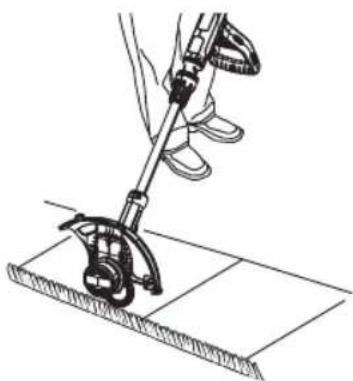
Edging (Fig. A, L)
Optimum cutting results are achieved on edges deeper than 2 inches (50 mm). Do not use this trimmer to create trenches.
- Using the edging wheel 8, guide the trimmer as shown in Figure L.
- Position the edging wheel on the edge of the sidewalk or abrasive surface so the cutting line is over the grass or dirt area to be edged.
nOTE: The line feed system may not operate correctly if wheeled edge guide is not used.
NOTE: You will experience faster than normal cutting line wear if the edging wheel is positioned too far from the edge with the cutting line positioned over the sidewalk or abrasive surface.
-
To make a closer cut, slightly tilt the trimmer.
-
Return to the trimming position by loosening the lock collar and rotating the lower housing back 180°. The tool will lock in the trimmer position.
English
Fig. L
natural_image
Line drawing of a person using a manual push tool on a tiled floor (no text or symbols)Cutting Line / Line Feeding
Your trimmer uses .065 inch (1.65 mm) diameter, ROUND nylon line. During use, the tips of the nylon lines will become frayed and worn. Press the feed button to feed and trim a fresh length of line. Cutting line will wear faster and require more feeding if the cutting or edging is done along sidewalks or other abrasive surfaces or heavier weeds are being cut. Do not bump trimmer on ground in attempt to feed line or for any other purposes.
Helpful Cutting Tips
- Use the tip of the string to do the cutting; do not force string head into uncut grass.
- Wire and picket fences cause extra string wear, even breakage. Stone and brick walls, curbs, and wood may wear string rapidly.
- Do not allow spool cap to drag on ground or other surfaces.
- In long growth, cut from the top down and do not exceed 12 inches (304.8 mm) high.
- Keep trimmer tilted toward the area being cut; this is the best cutting area.
- The trimmer cuts when passing the unit from the left to right. This will avoid throwing debris at the operator.
- Avoid trees and shrubs. Tree bark, wood moldings, siding, and fence posts can easily be damaged by the string.
MAINTENANCE
WARNING: To reduce the risk of serious personal injury, turn unit off and disconnect it from power source before making any adjustments or removing/installing attachments or accessories. An accidental start-up can cause injury.
- Keep the air intake slots clean to avoid overheating.
- Your trimmer line can dry out over time. To keep your line in top condition, store spare pre-wound spools or bulk line in a plastic, sealable bag with a tablespoon of water.
- Plastic parts may be cleaned by using a mild soap and a damp rag.
- The line cutter on the edge of the guard can dull over time. It is recommended you periodically touch-up the sharpness of the blade with a file.
Cleaning
WARNING: Blow dirt and dust out of all air vents with clean, dry air at least once a week. To minimize the risk of eye injury, always wear ANSI Z87.1 approved eye protection when performing this.
WARNING: Never use solvents or other harsh chemicals for cleaning the non-metallic parts of the tool. These chemicals may weaken the plastic materials used in these parts. Use a cloth dampened only with water and mild soap. Never let any liquid get inside the tool; never immerse any part of the tool into a liquid.
Accessories
WARNING: Since accessories, other than those offered by Craftsman, have not been tested with this product, use of such accessories with this tool could be hazardous. To reduce the risk of injury, only Craftsman recommended accessories should be used with this product.
WARNING: The use of any accessory not recommended by Craftsman for use with this trimmer could be hazardous.
CAUTION: Before you begin trimming, only use the appropriate type of cutting line.
Use Craftsman replacement spool no. CMZO98030.
Reload nylon line (either bulk or prewound replacement spool) as shown in this manual.
- USE ONLY .065 inch (1.65 mm) DIAMETER ROUND NYLON LINE. Do not use serrated or heavier gauge line, as they will overload the motor and cause overheating. This line is available at your local dealer or authorized service center.
- Other replacement parts (guards, spool caps, etc.) are available through Craftsman service centers. To find your local service location call: 888-331-4569 or visit www.craftsman.com.
Replacing the Spool (Fig. M–P)
WARNING: To reduce the risk of serious personal injury, turn unit off and disconnect it from power source before making any adjustments or removing/installing attachments or accessories. An accidental start-up can cause injury.
- Unplug trimmer.
- Depress the tabs 16 and remove the spool cap 17 from the spool housing 18 in the trimmer head (Figure M).
Fig. M
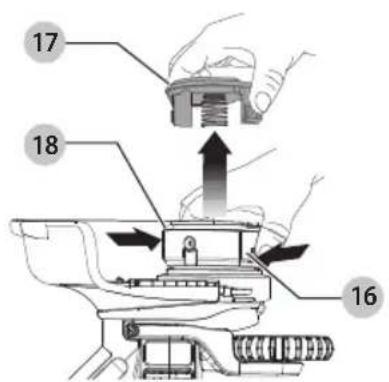
- For best results, replace spool with Craftsman model no. CMZO98030.
- Grasp empty spool with one hand and spool housing with other hand and pull spool out.
- If lever 19 (Figure N) in base of housing becomes dislodged, replace in correct position before inserting new spool into housing.

- Remove any dirt and grass from the spool and housing.
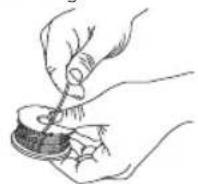
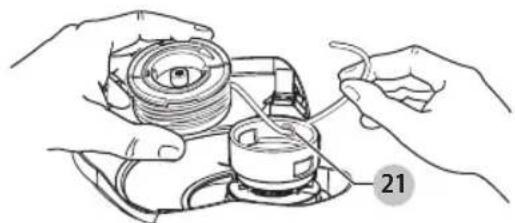
- Unfasten the end of the cutting line and guide the line into the eyelet 21 Figure O.
Fig. 0
natural_image
Illustration of hands assembling a mechanical component with a numbered label (21), no text or symbols present.- Take the new spool and push it onto the boss 20 in the housing (Figure N). Rotate the spool slightly until it is seated. The line should protrude approximately 5-3/8 inches (136 mm) from the housing.
- Align the tabs on the spool cap with the slots 22 in the housing (Figure P).
Fig. P
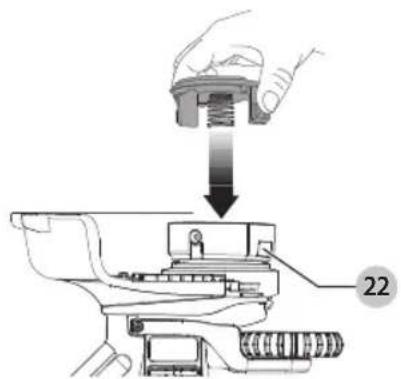
- Push the cap onto the housing until it snaps securely into place.

To avoid trimmer damage, if des beyond the trimming blade, reaches the blade.
Rewinding Spool From Bulk Line
(Fig. Q, R, S)
(use only .065 in. [1.65 mm] ROUND diameter line)
Bulk line is also available for purchase from your local retailer. NOTE: Hand wound spools from bulk line are likely to become tangled more frequently than Craftsman factory wound spools. For best results, factory wound spools are recommended.
To install bulk line, follow the steps below:
- Unplug trimmer.
- Remove the empty spool from the trimmer as described in Replacing the Spool.
- Remove any remaining cutting line from the spool.
- Make a fold at the end of the cutting line at about 3/4 inches (19 mm) 23. Feed the cutting line into one of the line anchoring slots 24 as shown in Figure Q.
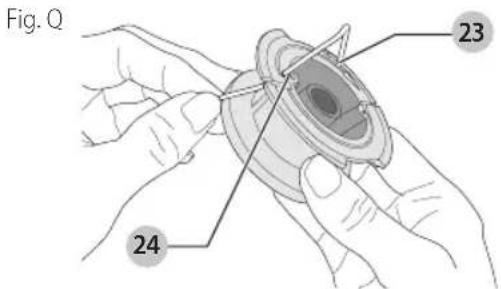
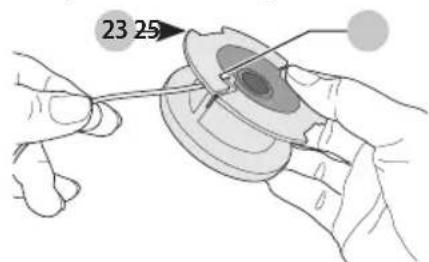
- Insert the 3/4 inches (19 mm) 23 end of the bulk line into the hole 25 in the spool adjacent to the slot as shown in Figure R. Make sure the line is pulled tight against the spool as shown in Figure R.
Fig. R
English
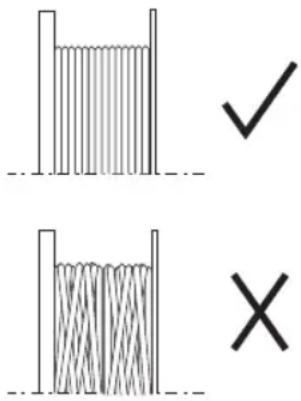
- Wind the cutting line onto the spool in the direction of the arrow on the spool. Make sure to wind the line on neatly and in layers. Do not crisscross (Figure S).
- When the wound cutting line reaches the recesses, cut the line.
- Fit the spool onto the trimmer as described in Replacing the Spool.

Before you begin trimming, only type of cutting line.
Fig. S
Troubleshooting
Trimmer Runs Slowly
- Unplug the trimmer.
- Check that the spool housing can rotate freely. Carefully clean it if necessary.
- Check that the cutting line does not protrude more than approximately 5-3/8 inches (136 mm) from the spool. If it does, cut it off so that it just reaches the line trimming blade.
Repairs
iIMPORTAnT: To assure product SAFETY and RELIABILITY, repairs, maintenance and adjustment should be performed by qualified service organizations, always using identical replacement parts.
TWO-YEAR LIMITED WARRANTY
Craftsman (U.S.) Inc. warranties this product to be free from defects in material or workmanship for a period of two (2) years following the date of purchase, provided that the product is used in a home environment. This limited warranty does not cover failures due to abuse, accidental damage or when repairs have been made or attempted by anyone other than qualified service organizations. A defective product meeting the warranty conditions set forth herein will be replaced or repaired at no charge:
Return the product to the retailer from whom it was purchased (provided that the store is a participating retailer). Returns should be made within the time period of the retailer's policy for exchanges. Proof of purchase may be required. Please check with the retailer for its specific return policy regarding time limits for returns or exchanges.
This warranty does not apply to accessories. This warranty gives you specific legal rights and you may have other rights
which vary from state to state. This product is not intended for commercial use, and accordingly, such commercial use of this product will void this warranty. All other guarantees, express or implied, are hereby disclaimed.
LATIN AMERICA: This warranty does not apply to products sold in Latin America. For products sold in Latin America, check country specific warranty information contained in the packaging, call the local company or see the website for such information.
Imported by
Craftsman Tool Co.
701 East Joppa Rd.
Towson, MD 21286 U.S.A.
TROUBLESHOOTING GUIDE
BE SURE TO FOLLOW SAFETY RULES AND INSTRUCTIONS
For assistance with your product, visit our website at www.craftsman.com, or call the Craftsman help line at 888-331-4569.
| Problem Possible Cause Possible Solution | ||
| Trimmer will not start. Cord is not plugged in. | Circuit fuse is blown. | Plug tool into a working outlet.Replace circuit fuse. (If the product repeatedly causes the circuit fuse to blow, discontinue use immediately and call the Craftsman help line at 888-331-4569. Reset circuit breaker. (If the product repeatedly causes the circuit breaker trip, discontinue use immediately and call the Craftsman help line at 888-331-4569. Call the Craftsman help line at 888-331-4569 or have cord or switch replaced. |
| Circuit breaker is tripped | ||
| Cord or switch is damaged. | ||
| Cutting line is consumed quickly in edge mode. Edging too far from edge of sidewalks or abrasive surfaces. The cutting line is hitting the sidewalk or abrasive surfaces. | Ensure edging wheel is on the edge of the surface and the cutting line is positioned in the grass or dirt area to be edged, not the sidewalk or abrasive surface. | |
natural_image
Simple line drawing of a plug with coiled wires (no text or symbols)AVERTISSEMENT :
fabrication classe II (double isolation)
natural_image
Line drawing of a hand using a screwdriver to adjust or install a mechanical component (no text or symbols present)natural_image
Technical diagram of a mechanical component with labeled parts and an arrow indicating direction (no text or symbols present)Fig. F
natural_image
Mechanical linkage diagram showing a chain with labeled component 14 (no text or symbols beyond label)Fig.12 Fig.13
Bouton Alimentation (Fig. J)
natural_image
Technical line drawing of a mechanical device with labeled component (no text or symbols present)natural_image
Technical diagram of a mechanical component with arrows indicating motion or rotation (no text or symbols)natural_image
Line drawing of a person using a manual push tool on a wooden floor (no text or symbols)natural_image
Illustration of hands using a lathe tool to adjust a mechanical component (no text or symbols present)Dépannage
natural_image
Simple line drawing of a medical or laboratory device with coiled tubing and a central connector (no text or symbols)ADVERTENCIA:
Para reducir el
natural_image
Line drawing of a hand using a tool to adjust or install a mechanical component (no text or symbols present)natural_image
Technical diagram of a mechanical component with labeled parts and an arrow indicating direction (no text or symbols present)Fig. F
natural_image
Mechanical linkage diagram showing a chain with labeled component (14), no text or symbols presentAjuste de altura (Fig. G, I3)
Fig.12 Fig.13
natural_image
Technical line drawing of a mechanical device with labeled component (no text or symbols present)natural_image
Technical diagram of a mechanical tool with directional arrows indicating motion (no text or symbols)Corte de borde (Fig. A, L)
natural_image
Line drawing of a person using a manual tool to lift a carton, no text or symbols presentnatural_image
Illustration of hands using a tool to adjust a mechanical component (no text or symbols present)Importado por Craftsman Tool Co.(U.S.) Inc., 701 E. Joppa Rd. Towson, MD 21286
natural_image
Pure horizontal and vertical lines without any text, numbers, or symbols
natural_image
Pure geometric lines forming a symmetrical shape without any text, numbers, or symbols
natural_image
Pure horizontal and vertical lines without any text, numbers, or symbols
natural_image
Pure geometric lines forming a symmetrical shape without any text, numbers, or symbolsCraftsman
701 East Joppa Road, Towson, MD 21286
Part No. N557609
CMESTE920
SEPT 2017
- Definitions: Safety Alert Symbols and Words
- English
- Important Safety Warnings
- READ ALL INSTRUCTIONS
- WARNING:
- Additional Safety Information
- Safety Rules and Instructions: Extension Cords
- Safety Rules and Instructions: Polarized Plug
- SAVE THESE INSTRUCTIONS FOR FUTURE USE
- Motor
- COMPONENTS (FIG. A)
- Intended Use
- ASSEMBLY AND ADJUSTMENTS
- Attaching the Guard (Fig. B, C)
- Attaching the Auxiliary Handle (Fig. D, E, F)
- Height Adjustment (Fig. G, I3)
- AUTION:
- Attaching Extension Cord (Fig. H)
- Releasing the Cutting Line
- OPERATION
- Proper Hand Position (Fig. I, I1, I2, I3)
- Switching On and Off (Fig. A)
- Operating the Trimmer (Fig. A, I–I3, G)
- Feed Button (Fig. J)
- Convert to Edging Mode (Fig. K)
- Edging (Fig. A, L)
- Cutting Line / Line Feeding
- Helpful Cutting Tips
- MAINTENANCE
- Cleaning
- Accessories
- Replacing the Spool (Fig. M–P)
- Rewinding Spool From Bulk Line
- (Fig. Q, R, S)
- To install bulk line, follow the steps below:
- Troubleshooting
- Trimmer Runs Slowly
- Repairs
- TWO-YEAR LIMITED WARRANTY
- TROUBLESHOOTING GUIDE
- BE SURE TO FOLLOW SAFETY RULES AND INSTRUCTIONS
- AVERTISSEMENT :
- Bouton Alimentation (Fig. J)
- Dépannage
- ADVERTENCIA:
- Ajuste de altura (Fig. G, I3)
- Corte de borde (Fig. A, L)
Brand : Craftsman
Model : CMESTE920
Category : Trimmer