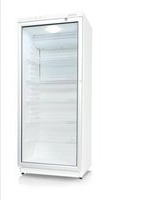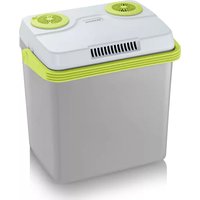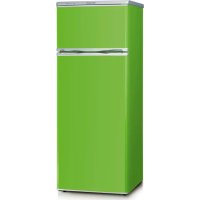
DT 8786 - Freezer SEVERIN - Free user manual and instructions
Find the device manual for free DT 8786 SEVERIN in PDF.



| Brand | SEVERIN |
| Model | DT 8786 |
| Product type | Combined fridge-freezer (4-star freezer) |
| Dimensions (H x W x D) | 1475 x 560 x 630 mm |
| Weight | 45 kg |
| Power supply | 230 V ~ 50 Hz (estimate, see rating plate) |
| Total volume | 209 L |
| Fridge volume | 162 L |
| Freezer volume | 47 L |
| Climate class | N - ST (16 °C to 38 °C) |
| Energy class | E |
| Annual consumption | 184 kWh/year |
| Noise | 39 dB(A) (class C) |
| Freezing capacity | 2 kg/24h |
| Storage time in case of failure | 12 h |
| Door reversibility | Yes (left or right door opening) |
| Fridge defrost | Automatic |
| Freezer defrost | Manual (when ice reaches 2-4 mm) |
| Refrigerant | R600a (isobutane) |
| Interior lighting | LED (2 W max, E14 socket, class E) |
| Warranty | 2 years |
| Main functions | Adjustable thermostat, glass shelves, vegetable drawer, ice cube tray, door storage |
| Maintenance and cleaning | Monthly cleaning with warm water and mild detergent; do not use abrasive products |
| Safety | Child safety (use by children from 8 years under supervision), freezer door lock |
| Repairability | User-replaceable LED; repair by authorized agent for cooling circuit |
Frequently Asked Questions - DT 8786 SEVERIN
User questions about DT 8786 SEVERIN
0 question about this device. Answer the ones you know or ask your own.
Ask a new question about this device
Download the instructions for your Freezer in PDF format for free! Find your manual DT 8786 - SEVERIN and take your electronic device back in hand. On this page are published all the documents necessary for the use of your device. DT 8786 by SEVERIN.
USER MANUAL DT 8786 SEVERIN
natural_image
White refrigerator with two doors, no visible text or symbols on the front panelART.-NO. DT 8782 / DT 8783 / DT 8784 / DT 8785 / DT 8786 / DT 8787
GB Instructions for use Refrigerator 13
natural_image
Technical line drawing of a mechanical component with an inset showing a magnified view of a circular feature (no text or symbols)Before using the appliance, read the following instructions carefully and keep this manual for future reference. The appliance must only be used by persons familiar with these instructions.
Connection to the mains supply
The appliance should only be connected to an earthed socket installed in accordance with the regulations. Make sure that the supply voltage corresponds with the voltage marked on the rating label. This product complies with all binding CE labelling directives.
- Do not operate this unit by means of a transformer.
- To prevent noise vibration, ensure that the power cord does not touch any part of the rear of the unit
General information
- This appliance is a compressor refrigerator, designed for the short-term storage of food in the main cabinet and long-term storage of food in the freezer compartment.
- Refrigeration appliances are classified into certain climate classes. Please refer to the product data sheet for information on the classification for this unit; the data sheet can be found at the end of this manual.
- No responsibility is accepted if damage results from improper use, or if these instructions are not complied with.
Important safety instructions
- This appliance is intended for domestic or similar applications, such as
- in shops, offices and other similar working environments,
- in agricultural areas,
- by customers in hotels, motels etc. and similar establishments,
- in bed-and breakfast type environments.
- This appliance is not intended for commercial use, nor for use in the catering business or similar wholesale environments.
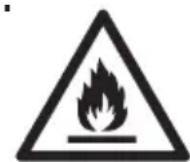
The cooling circuit in this appliance contains the refrigerant isobutane (R600a), a natural gas
with a high level of environmental compatibility, which is nevertheless flammable. Ensure, therefore, that none of the components of the refrigerant circuit become damaged during transportation and installation of the appliance. If damage to the cooling circuit does occur, do not switch on or connect the appliance to the mains power. In the case that there is an open fire or any other sources of ignition in the vicinity of the refrigerant gas, make sure it is removed immediately from this area and that the room is then thoroughly ventilated.
- Warning: Keep ventilation openings, in the appliance enclosure or in the built-in structure, clear of obstruction. Sufficient ventilation must be ensured at all times.
- Warning: Do not damage the cooling circuit. Any escaping refrigerant causes damage to the eyes; there is also a danger of the gas igniting.
- Warning: Do not use any external device (e.g.; heaters or heating fans) to accelerate de-frosting; follow only the methods recommended in this manual.
- Warning: Do not operate any electrical appliances (e.g. ice makers) inside the storage compartment that are not specifically permitted in these
instructions.
- Before it is connected to the mains power, the unit must be thoroughly checked for transport damage, including its power cord. In the event of any such damage being found, the appliance must not be connected to the mains.
- When positioning the appliance, ensure the supply cord is not trapped or damaged.
- Do not locate portable multible socket-outlets or portable power supplies at the rear oft he appliance.
- This appliance is not designed for the storage of explosive substances such as aerosol cans with a flammable propellant.
- If the unit is sold, handed over to a third party or disposed of at a suitable recycling facility, attention must be drawn to the presence of the insulation agent ‘cyclopenthane’ as well as to the refrigerant R600a.
- In order to comply with safety regulations and to avoid hazards, any repairs or modifications to this unit must be carried out by our authorised service personnel, including the replacement of the power cord.
- This appliance may be used by children (at least 8 years of age) and by persons with reduced physical, sensory or mental capabilities, or lacking experience and knowledge, provided they have been given supervision or instruction concerning the use of the appliance and fully
understand all dangers and safety precautions involved.
• Children aged from 3 to 8 years are allowed to load and unload refrigerating appliances.
• Children must not be permitted to play with the appliance.
• Children must not be permitted to carry out any cleaning or maintenance work on the appliance.
- For frequent cleaning we recommend the use of warm water with some mild detergent. For detailed information on cleaning the appliance, please refer to the section De-frosting and cleaning.
- For detailed information on replacing the LED, please refer to the section Interior lighting.
To avoid contamination of food respect the following instructions:
- Opening the door for long periods can cause a significant increase of the temperature in the compartments of the appliance.
- Clean regularly surfaces that can come in contact with food and accessible drainage systems.
- Store raw meat and fish in suitable containers in the refrigerator so that it is not in contact with or drip onto other food.
- If the refrigerating appliance is left empty for long periods switch off, defrost, clean, dry and leave the door open to prevent mould developing within the appliance.
Storing food
- Different areas of the refrigerator cabinet are affected differently by the cooling effect. The warmest area is around the door in the higher part of the cabinet, the coldest around the rear wall and in the lower part of the cabinet.
• The food should therefore be stored as follows: - On main cabinet shelves (from top to bottom): bakery items, ready meals, dairy products, meat, fish and cold meats/sausages.
• In the vegetable compartment: vegetables, salad and fruit. - In the door (from top to bottom): butter, cheese, eggs, tubes (eg mustard), small bottles, large bottles, milk and fruit-juice tetra-packs.
- To prevent the risk of personal injury or damage to the unit, it must only be transported while in its original packaging.
- Caution: Keep any packaging materials well away from children; there is a risk of suffocation.
- The ice removed from the unit during de-frosting is not suitable for human consumption.
- The power cord should be regularly examined for any signs of damage. In the event of such damage being found, the appliance must no longer be used.
• To avoid the risk of fire, do not place any thermo-electric appliances on top of the unit. Do not place liquid containers on top of the unit, to prevent any leaking or escaping liquid damaging the electrical insulation.
This unit is designed for storing food only.
• Alcoholic substances may be stored only in properly sealed containers and in upright positions. - Do not store any glass bottles containing carbonated or other freezable liquids in the unit: such bottles may burst during the freezing process.
To avoid the risk of food poisoning, do not consume food after its storage time has expired. Thawed foods must not be frozen a second time. - Do not lean or put undue weight on the shelves, compartments, door etc.
- Protect the inside of the refrigerator at all times from open flames and any other sources of ignition.
- Remove the plug from the wall socket
- in case of any malfunction,
- before de-frosting,
- during cleaning,
-
before maintenance or repair work is carried out.
-
When removing the plug from the wall socket, never pull on the power cord; always grip the plug itself.
• We reserve the right to introduce technical modifications.
Familiarisation
The components of your refrigerator-freezer unit may differ in quantity and design from those described here. This description refers to a unit of the group of two-compartment refrigerator-freezer combinations.
The unit consists of two parts: refrigerator cabinet (B) and freezer cabinet (A).
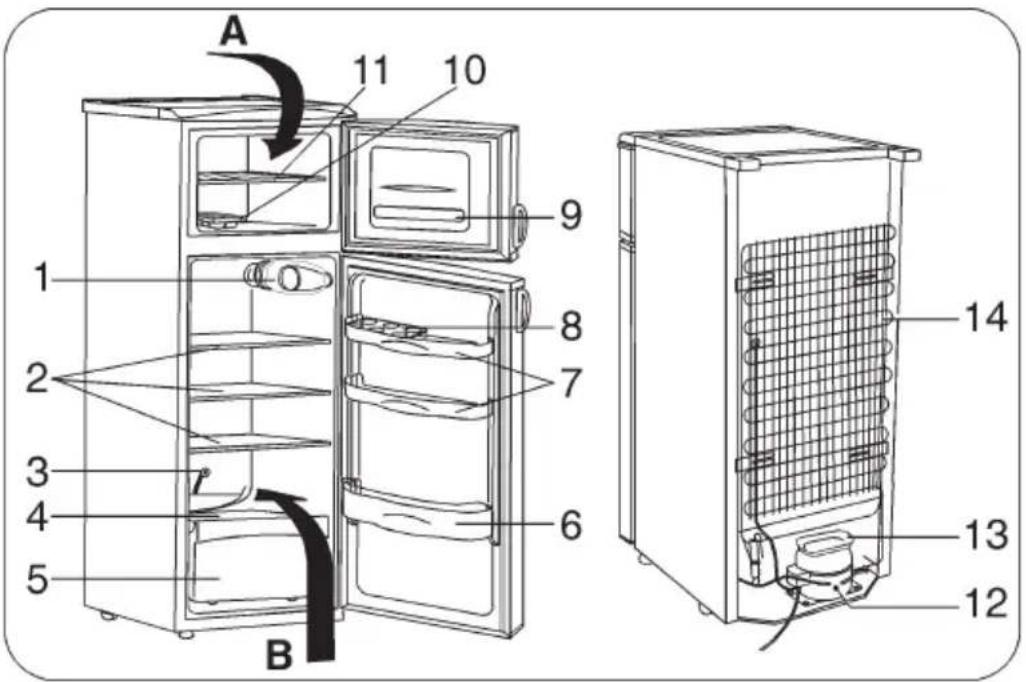
- Temperature control and interior light
- Storage shelves
- Drain channel cleaning tool
- Storage shelf
- Vegetable/fruit fresh storage compartment
- Bottle storage
- Multi-purpose storage
- Egg storage
- Instructions for using freezer
- Ice-cube tray
- Storage shelf
- Compressor
- Melt-water evaporation tray
- Condenser
Before using for the first time
- Remove any exterior and interior packaging materials completely, including the adhesive strips.
- The packaging materials must be properly disposed of.
- Fit the two enclosed spacer elements (1) into the corresponding guide slots on the rear (2).
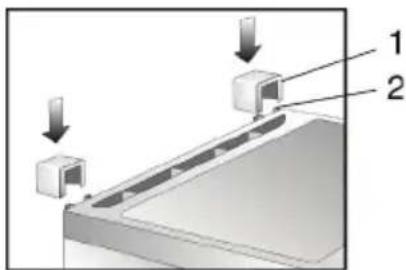
- Before it is connected to the mains, the unit must be thoroughly checked for transport damage, including its power cord.
- Clean the unit as described in the section De-frosting and cleaning.
- The unit should only be transported in its vertical position; do not tilt any more than 30^ .
- Once the unit has been positioned, wait for about 30 minutes before it is connected to the mains.
- If the unit has been tilted more than 30^ during transport, allow it to stand upright for at least 4 hours before it is connected to the mains.
- When the unit is first switched on, a slight 'new' smell may be noticed. However, this will disappear once the cooling process has begun.
Installation
- The appliance should be set up in a well-ventilated, dry room.
- It should be operated in conditions where the relative humidity is no more than 70 %.
- The product data sheet at the end of this manual contains details of the ambient temperature range suitable for this appliance.
- Do not use the appliance outdoors.
-
Ensure that the plug is accessible and can be removed from the wall socket at any time.
-
Do not expose the appliance to direct sunlight, and do not position it next to any heat sources (radiators, cookers etc.). If this cannot be avoided, however, suitable insulation must be in installed between the heat source and the unit.
- The unit must not be installed inside a cabinet, nor directly below a hanging cupboard, shelf or similar object.
- In the case of uneven floors, the adjustable feet on the unit can be used to compensate and ensure optimum stability.
Set-up dimensions
Ventilation
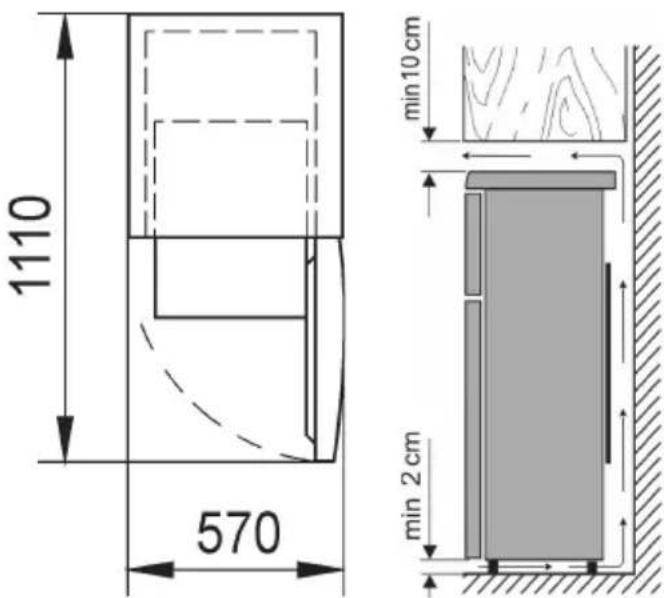
The heated air around the rear of the unit must be able to circulate freely.
Ensure, therefore, that the air circulation behind the unit is not obstructed.
Caution: Ensure at all times that the rear ventilation openings around the top cover are not obstructed.
Reversible door
If required, the door may be reversed, i.e. from right-hinged (default installation) to left-hinged.
To avoid the risk of personal injury or damage to the unit, two people are needed to reverse the door.
Warning: Always disconnect the unit from the mains before any maintenance or repair work is carried out. Before you get started, please note the following:
- Always ensure that the correct number of washers is used on all hinge bolts and screws.
- So that the doors can close tightly against the frame, take the utmost care that they are properly aligned during re-assembly.
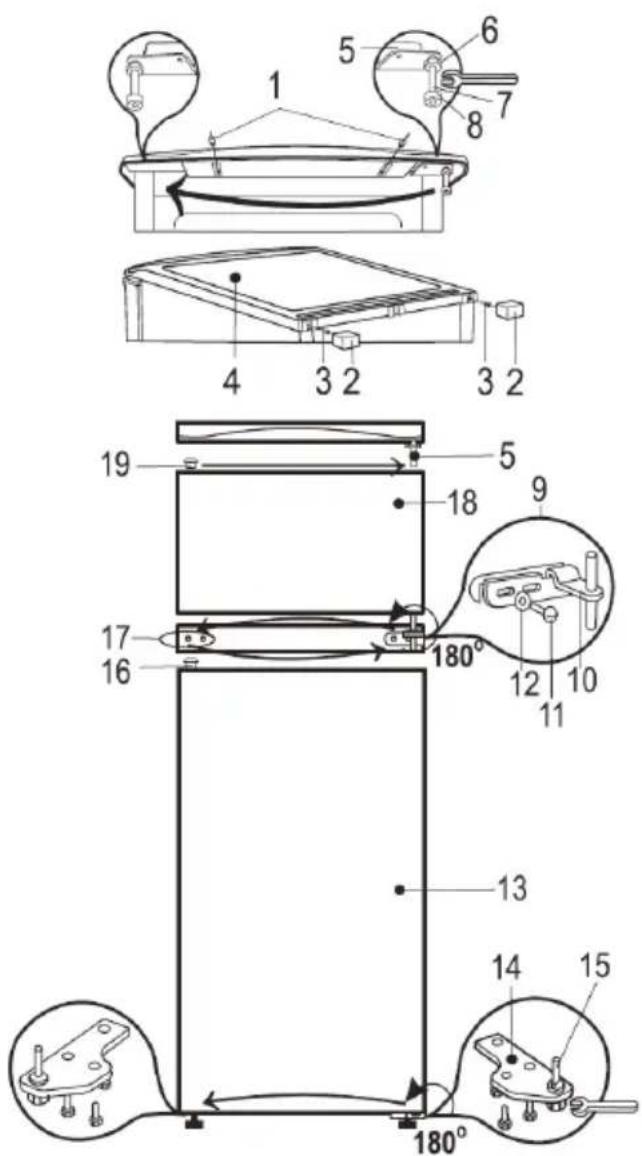
- Remove the two spacers (2) on the rear of the unit.
- Open the freezer door (18).
- Remove the fixing screws (1 and 3) from the top cover (two screws at the front and two at the rear), and take off the cover (4).
- Unscrew the upper hinge bracket (5) and remove it. Caution: the door must be supported while this is done.
• Take off the freezer door (18).
- Unscrew the hinge pin (7) together with the nut (6) and washers (8), and fit the entire assembly to the opposite side of the hinge bracket.
- Undo the fixing screws (11) on the centre hinge bracket (10) and take them off, together with the washers (12).
Caution: Support the door.
• Take off the centre hinge bracket (10) together with the hinge pin washers and the plastic plate (9).
• Take off the refrigerator door (13).
- Tilt the whole unit towards the rear.
- Unscrew the lower hinge bracket (14) and take it off.
- Unscrew the hinge pin (15) from the bracket, and re-insert it from the other side.
- Remove both screws on the left of the underside and replace them on the right.
- Fit the lower hinge bracket (14) on the left of the underside.
- Put the washers on the hinge pin.
- Remove the cap (19) from the freezer door and the cap (16) from the refrigerator door and replace them on the opposite side of the doors.
• Take off the caps (17) from the partition between the refrigerator and freezer compartments and remove the screws.
- Replace both screws on the opposite side and then the caps.
- Fit the refrigerator door (13) onto the pin (15) of the lower hinge bracket.
• Fit the pin of the centre hinge bracket (10), together with the washers, to the refrigerator door (13).
• Fit the centre hinge bracket (10) together with the plastic plate (9).
- Remove both screws from the upper left and replace them on the right.
- Place the freezer door (18) onto the pin of the centre hinge bracket (10).
- Fit the pin of the upper hinge bracket (5) to the freezer door (18), and then fit and secure the upper hinge bracket (5).
Note: If necessary, the alignment of the doors can be adjusted by slightly loosening the hinge bracket screws, but remember to tighten them afterwards.
- Replace the top cover (4) and use the screws (1 and 3) to secure it (two screws at the front and two at the rear).
- Fit the two enclosed spacer elements (2) into the corresponding guide slots on the rear).
If the unit has been tilted to more than 30^ , wait for about 4 hours before re-connecting it to the mains.
Temperature control
The unit is re-activated by connecting it to the mains. It is only switched off completely when the plug is removed from the wall socket.
The temperature in the refrigerator cabinet can be adjusted by setting the temperature control. Turning the control clockwise will decrease the temperature, while turning it anti-clockwise will increase it.
The medium settings are usually most suitable for home use.
We recommend using a thermometer to check the actual temperature inside the cabinet and make adjustments as necessary.
Following a power interruption, or if the unit has been switched off on purpose, it may take 3 to 5 minutes before it switches on again.
In position '0', the cooling function is switched off, though the appliance is still connected to the mains.
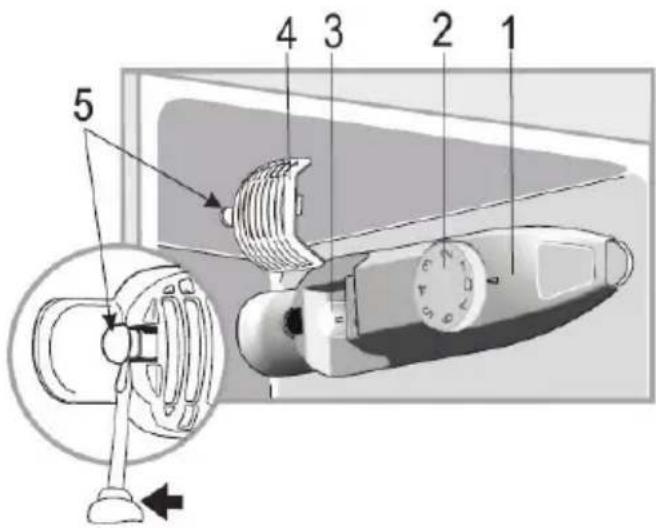
- Control panel cover
- Temperature control
- LED
- Lamp cover
- Locking mechanism
Interior lighting
Changing the LED:
- Remove the plug from the wall socket.
- Use a suitable tool to release the locking tab (5) and remove the lamp cover (4).
• Take out the defective LED and fit a new one (max. 2 W, socket type E14). - Replace the lamp cover.
- Connect the unit to the mains power. It may take 3 to 5 minutes before it switches on again.
Freezer compartment door
To ensure that frozen food will not de-frost prematurely, the door to the freezer compartment should be kept closed at all times. This will also prevent an undue build-up of ice and frost. Ensure, therefore, that the door is only opened briefly to place food in the freezer compartment or to remove it.
Freezing and storing food
The temperatures inside the refrigerator cabinet and freezer compartment depend mainly on the ambient temperature, the temperature control setting and the amount of food stored.
Freezer compartment:
- The freezer compartment is designed for deep-freezing and long-term storage of frozen food, and for making ice cubes.
- To ensure that nutritious elements such as vitamins are not lost, fresh food should be deep-frozen right through as quickly as possible. To that effect, the prepared food should be placed into the freezer compartments, properly spaced in one or two rows.
- Avoid contact with food that has already been frozen.
- Caution: Do not exceed the maximum freezing capacity per day. The product data sheet at the end of this manual contains details of the maximum daily freezing capacity.
- Set the temperature control to Max to accelerate the freezing process. After 24 hours, once the food is well frozen, the temperature control can be set back to its original position.
• The time required to freeze food may be shortened by dividing it into smaller portions.
- Suitable packaging materials for frozen food are transparent (i.e. non-coloured) plastic wrap or bags, or aluminium foil. The packaging materials should be well aired before use; check that the package is airtight before freezing the food. We strongly recommend that you label every item stored in the freezer with all relevant information such as type of food, freezing date and use-by date.
- Do not attempt to deep-freeze carbonated beverages, warm food or any kind of bottled liquids.
- Frozen food can be defrosted in the refrigerator. This way, the food is defrosted at a slower rate, retaining its taste. Furthermore, the frozen food helps to keep the temperature inside the refrigerator at its intended level.
Use-by dates for frozen food are specified (in months) in the table below.
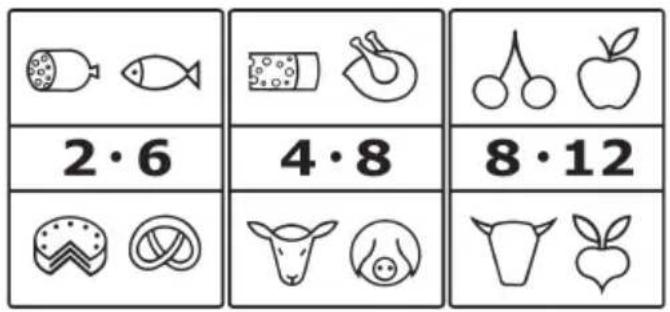
Do not exceed these storage times.
However, always observe the manufacturer's use-by dates for the frozen food.
- If the unit remains switched off for an extended period (eg during a power failure), the door should be kept closed; this will help to maintain the lowest possible temperature in the cabinet. The product data sheet at the end of this manual contains detailed information of the maximum safe storage time in case of malfunction. Even a slight rise in the inside temperature will shorten the storage life of the food.
Main cabinet
- Initially, the temperature control should be set to position 4. If the cooling effect is too strong, lower it to position 1-3; if it is insufficient, raise it to 5-7.
If you notice frost on the rear wall, the most likely cause is that the door has been left open for too long, or that warm food has been placed inside the refrigerator or that the temperature control has been set too high.
- Liquid or strong-smelling food, or food which is likely to absorb strong odours (e.g. cheese, fish, butter), should be stored separately or in hermetically sealed containers.
- Warm food should be left to cool down to room temperature before being placed in the refrigerator.
• Always ensure that the door is properly closed and that the seal is not obstructed by food stored inside the cabinet or door.
Making ice cubes
A special ice-cube tray is provided for making ice cubes. Fill the tray 3/4 full with drinking water and place it in the freezer compartment. The ice cubes are easier to remove from the tray if the tray is left standing at room temperature for 5 minutes.
De-frosting and cleaning
- Always remove the plug from the wall socket before cleaning.
- For frequent cleaning we recommend the use of warm water with some mild detergent. To prevent any unpleasant odour within the refrigerator, it should be cleaned about once a month.
- Any accessories should be cleaned separately with soapy water. Do not put them in a dishwasher.
- Do not use abrasives or harsh cleaning solutions or any cleaning agents that contain alcohol.
- After cleaning, thoroughly clean all surfaces with fresh water before wiping them completely dry. When re-inserting the plug into the wall socket ensure that you have dry hands.
- To save energy and to ensure optimum performance, the condenser (at the rear) as well as the compressor should be cleaned at least twice a year with a broom or a vacuum cleaner.
• Take care not to remove or damage the rating plate inside the cabinet during cleaning.
When de-frosting the freezer compartment
Once the build-up of ice inside the freezer compartment has reached a thickness of 2-4 mm, it needs to be defrosted. This should be done at least twice a year.
- Ensure that the plug has been removed from the wall socket.
- Remove all food from the compartment and store it in a cool location, eg together with pre-frozen freezer-packs in a closed plastic container. Note that, even with a slight increase in temperature, the storage life will be shortened and the food should be used as soon as possible.
- Keep the door open. To accelerate defrosting, one or several containers with hot (but not boiling) water may be placed inside the freezer compartment.
- Warning: do not use any external device or other means (e.g. heaters or heating fans) to accelerate defrosting.
- After cleaning, ensure that the freezer compartment is thoroughly dried and set the temperature control to its maximum position. After 24 hours, it may turned back to its normal setting.
Defrosting the refrigerator cabinet :
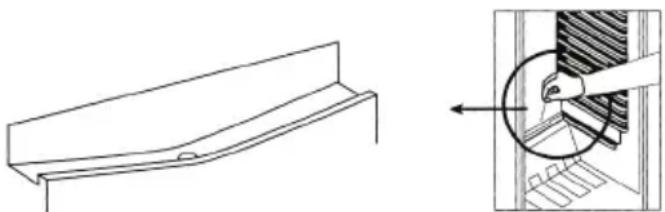
The integral vapouriser is sealed in foam in the rear wall; you may therefore notice a build-up of frost around the rear area. This layer of frost will start melting when the compressor is not working. Through a system of hoses, the melt-water drains into the collection tray below the compressor, where it will be absorbed into the surrounding air. The unit does not therefore require de-frosting, but only proper cleaning instead.
natural_image
Technical line drawing of a mechanical component with an inset showing a hand holding a circular component (no text or symbols)- To enable the melt-water to drain freely, always ensure that the channel and discharge opening in the cabinet are free of any blockage.
Energy saving tips
- The appliance should be set up in a well-ventilated, dry room.
- Do not expose the appliance to direct sunlight, and do not position it next to any heat sources (radiators, cookers etc.). If this cannot be avoided, however, suitable insulation must be installed between the heat source and the unit.
- Do not cover the ventilation openings and grilles, and ensure sufficient air circulation behind the unit.
- The compressor (at the rear) should be cleaned at regular intervals. Accumulated dust causes an increase in energy consumption.
-
Warm food should be allowed to cool down before it is stored inside.
-
To prevent an increased build-up of ice, do not leave the doors of the unit open for too long when loading or taking out food.
- Frequent de-frosting helps to save energy. For detailed information on cleaning the appliance, please refer to the section De-frosting and cleaning.
- Do not set a lower-than-necessary temperature. For detailed information on the temperature settings, please refer to the section Temperature control.
Trouble-shooting
Certain typical sounds can be heard when the appliance is switched on. These sounds are:
- caused by the electrical motor within the compressor assembly; during compressor start-up the sound level will be slightly higher for a limited period of tir
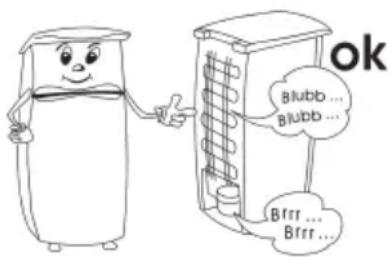
- caused by the cooling agent flowing through the circuit.
The following table lists possible malfunctions and their probable causes and solutions. In the event of operational problems, check first whether a solution can be found using this table. If the problem persists, disconnect the appliance from the mains power and contact our Customer Service Department.
| Problem Possible cause and solution | |
| The appliance is not working at all. | There is a power failureThe main fuse has blown.The temperature control is set to '0'.The fuse in the wall socket (if applicable) has blown. This can be checked by connecting another electrical device to the socket and checking for function. |
| The temperature inside the freezer compartment is not low enough. | Too much food has been stored in the appliance.The doors are not properly closed.There is too much dust on the condenser.Insufficient ventilation: the unit is too close to a wall or other structure or object.The temperature control is set too low. |
| The normal operating sound changes or becomes louder. | Check for proper positioning (uneven floor?).Are any adjacent objects affected by the running of the cooling unit (i.e. causing them to vibrate?)Are there any objects on top of the unit which might be vibrating? |
| Water is collecting on the bottom of the unit. | The melt-water drain system is blocked. Remove the blockage and clean the system. |
Transporting the appliance
To prevent damage to the unit during transport, ensure that all accessories and components inside and around the appliance are securely fastened.
The unit must only be transported in its vertical position; do not tilt any more than 30^ .
Once the unit has been positioned, wait for about 30 minutes before it is connected to the mains.
If the unit has been tilted more than 30^ during transport, allow it to stand in an upright position for at least 4 hours before it is connected to the mains.
Disposal
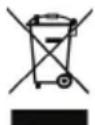
Appliances that are marked with this symbol have to be disposed of separately from household rubbish. These appliances contain valuable resources that can be recycled. A correct waste disposal protects the environment and the health of those around you. To get informed about it, either defer to your municipal administration or the retailer.
- Pull the mains plug out of the socket and disconnect it from the appliance before getting rid of it.
The cooling medium Isobutane (R600a) and the propellant in the isolation Cyclopentane (C5H10) are inflammable substances, thus,
need to be appropriately disposed of.
- Make sure the tubes of the cooling circuit don't get damaged before the proper disposal.
Guarantee
This product is guaranteed against defects in materials and workmanship for a period of two years from the date of purchase. Under this guarantee the manufacturer undertakes to repair or replace any parts found to be defective, providing the product is returned to one of our authorised service centres. This guarantee is only valid if the appliance has been used in accordance with the instructions, and provided that it has not been modified, repaired or interfered with by any unauthorised person, or damaged through misuse.
This guarantee naturally does not cover wear and tear, nor breakables such as glass and ceramic items, bulbs etc. This guarantee does not affect your statutory rights, nor any legal rights you may have as a consumer under applicable national legislation governing the purchase of goods. If the product fails to operate and needs to be returned, pack it carefully, enclosing your name and address and the reason for return. If within the guarantee period, please also provide the guarantee card and proof of purchase.
Information needed by the Customer Service Department
Should repairs to the appliance become necessary, please contact our Customer Service Department, providing a detailed fault description and quoting the model number KS ... on the rating plate of the appliance (see picture). This information will help us to handle your request efficiently.
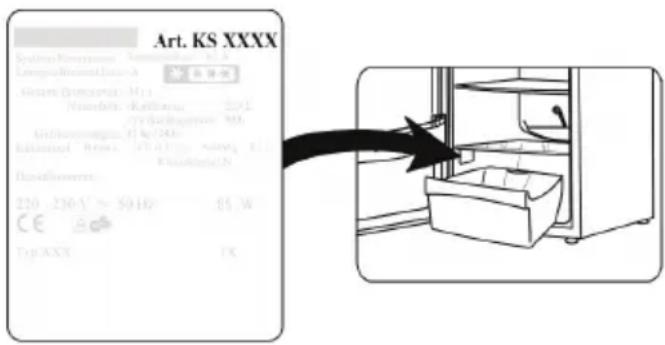
In case of any malfunction or other problem, please contact our Customer Services Department. The address can be found in the appendix to this manual.
Appliance specification sheet
| Model identifier DT 8782 / 8783 / 8784 / 8785 / 8786 / 8787 | ||||||
| Type of refrigerating appliance: | ||||||
| Low-noise appliance: no Design type: Free-standing | ||||||
| Wine storage appliance: no Other refrigerating appliance: yes | ||||||
| Overall dimensions (H x W x D in mm) 1475 x 560 x 630 | ||||||
| Total volume (in l) 209 | ||||||
| EEI 99 | ||||||
| Energy efficiency class E | ||||||
| Annual energy consumption (in kWh/a)* 184 | ||||||
| Airborne acoustical noise emission class C | ||||||
| Airborne acoustical noise emissions (in dB(A) re 1pW) 39 | ||||||
| Climate class N - ST | ||||||
| Ambient temperature (in °C) 16 - 38 | ||||||
| Temperature rise time (in h) | 12 | |||||
| Weight (in kg) | 45 | |||||
| Winter setting | no | |||||
| Compartment Parameters: | ||||||
| Typ | Volume (in l) | Recommended temperature (in°C) | Freezing capacity (kg/24h) | Defrosting type A = auto M = manuel | Fast freezing facility | |
| Fresh food | 162 | 4 | - | A | - | |
| 4-star | 47 | -18 | 2 | M | yes | |
| Light source parameters: | ||||||
| Type of light source | LED | |||||
| This product contains a light source of energy efficiency class | E | |||||
| Electric data | see rating label | |||||
*) The actual consumption depends on the use and the location of the appliance.
Chère cliente, Cher client,
natural_image
Technical line drawing of a mechanical component with an inset showing a magnified view of a circular feature (no text or symbols)Vriezer compartiment:
natural_image
Technical line drawing of a mechanical component with an inset showing a close-up view of a circular component (no text or symbols)natural_image
Technical line drawing of a mechanical component with an inset showing a close-up of a circular feature (no text or symbols)natural_image
Technical line drawing of a mechanical component with an inset showing a close-up of a circular feature (no text or symbols)AVEDA Lifestyle EOOD
ul. Angel Kanchev 1, et. 5
BG 1124
Sofia
Croatia
Koracell d.o.o.
Donje Svetice 40
26 Oaktree Business Park
Trim Co., Meath
Tel.: 046 94 83100
Fax: 046 94 83663
Web: www.bluestone.ie
Italia
ASSISTENZA POST-VENDITA
NUMERO VERDE 800224155
E-Mail: assistenza@severin.com
Indonesia
PT. Setai Modern Elektronik
Email.: info@severin.co.id
Web.: www.severin.co.id
Jakarta
Komp. Glodok Plaza Blok F No. 9, Jl. Pinangsia Raya,
Jakarta Barat
021 65911888 / 021 6592889
Medan
Dr.Waleed Maraga commercial center, Level 1
Khalda, Amman Zip code: 11953
Tel: +962 6 5346429
Fax: +962 6 5341706
Mob Jordan : +962 797426108
Kuwait
Mohammed Abdulrahman Al Bahar
Al Bahar Building P.O. Box 148
Safat 13002 Kuwait
Tel.: +965 4810855
Latvia
SIA GTCL BALTIC
Piedrujas iela 7
LV - Riga 1073
Tel.: +371 29119989
Fax: +371 67297769
Lebanon
Khoury Home
7th Floor, Cité Dora 3 Building, Dora
P.O.Box 70611
Antelias, Lebanon
Tel.: +961 1 244200
Fax:+966 1 253535
E-Mail: info@khouryhome.com
Internet: www.khouryhome.com
Lithuania
UAB Topo Grupe
Savanoriu PR. 206A,
50193 Kaunas, Lithuania
Tel.: +370 660 00200
A.A.K & Partners L.L.C.
P.O Box:-1650, Muttrah
Postal Code - 114
Sultanate of Oman
Tel.: +968 24834470
Fax.: +968 24835186
E-Mail: aakpllc@gmail.com
Peru
SEVERIN PERU / Comercial Rebeca S.R.L
Mezzanine 1, South Center Tower
2206 Venture Street, Madrigal Business Park
Alabang, Muntinlupa City
Tel.: 809 34 41
E-Mail: severinconsumercare@colombophils.com.ph
Polska
Severin Polska Sp.z o.o.
6 Tagore Drive, #03-04
Singapore 787623
Tel.: +65 6455 0005
Fax: +65 6455 4010
Web: www.beste.com.sg
E-Mail: info@beste.com.sg
Slovenia
SEVTIS d.o.o.
Smartinska 130
1000 Ljubljana
Tel.: +386 1 542 1927
Fax: +386 1 542 1926
Slowak Republic
BVZ Commerce s.r.o.
Odbavovací centrum
Závodu míru 974/66a
360 17 Karlovy Vary
Tel.: +420 233 557 825
3rd Floor, Grove Exchange
Grove Avenue
Claremont
South Africa
7708
Tel: +27 21 674 0294
Fax: +27 21 674 0295
Web: http://www.alcdashley.co.za
Mail: service@alcdashley.co.za
Svenska
El & Digital Service AB
Folkungagatan 144
11630 Stockholm
Tel.: +46 8 845180
www.eldigital.se
E-Mail: info@eldigital.se
Switzerland
SPC Electronics AG
Mövenstrasse 12
CH-9015 St. Gallen
Tel.: +41 71 227 99 99
E-Mail: service@spcag.ch
www.spc.ch
Thailand
Verasu Ltd. part.
83/7 Wireless Rd., Lumpini,
Patumwan, Bangkok 10330
Tel.: +662 254 81 008
E-Mail: askverasu@verasu.com
Tunisie
GEI
54, rue du Mercure
Zone Industrielle 2013-BEN AROUS
TUNISIE
Ukrayina
Service for Modern Electronics LLC
Sim'i Khokhlovykh Str.8
4119 Kiev
Tel.: + 38 044 247 67 34
E-Mail: info1@photoservice.com.ua
United Kingdom
Homespares Centres Limited
Peel House
2 Chorley Old Road
BL13AA
Tel.: 01204 558160
Fax: 01204 558169
E-Mail: office@homespares.co.uk
Web: www.homespares.co.uk
Vietnam
BRAND PARTNER
CTY TNHH DOI TAC NHAN HIEU
FLOOR 8, DAG HOLDINGS
87A HAM NGHI
NGUYEN THAI BINH WARD, DISTRICT 1
HO CHI MINH CITY, VIETNAM
Tel.: +84-28-62 899 648
E-Mail: kenny.clark@brandpartner.vn
trang.hau@brandpartner.vn
Stand: 09.2021 (Special Edition)