DigitRadio 570 CD IR - Cd player/recorder TECHNISAT - Free user manual and instructions
Find the device manual for free DigitRadio 570 CD IR TECHNISAT in PDF.


| Brand | TechniSat |
| Model | DigitRadio 570 CD IR |
| Product type | CD player/recorder with Internet radio, DAB+, FM, Bluetooth |
| Dimensions (W x H x D) | 291 x 217 x 145 mm |
| Weight | Approx. 2.5 kg |
| Power supply | DC 9 V, 3 A (external power adapter included) |
| Power consumption | Max. 27 W operation, < 0.9 W standby |
| Radio frequencies | FM 87.5-108 MHz, DAB+ Band III 174-240 MHz |
| Bluetooth | Version 4.2, max. range 10 m |
| WLAN | 802.11 a/b/g/n, 2.4 and 5 GHz |
| Main functions | Internet radio, DAB+, FM, CD/MP3 playback, USB, Bluetooth, Spotify Connect, alarm, sleep, equalizer, app control |
| Audio power | 2 x 5 W RMS |
| Auxiliary input | 3.5 mm jack (AUX IN) |
| USB port | For playing music files |
| Station memory | Up to 20 stations per source (FM/DAB+/Internet radio) |
| CD compatibility | Audio CD, CD-R/RW, MP3 CD (ISO 9660 standard) |
| Care and cleaning | Clean with a soft dry cloth; do not use solvents, alcohol or abrasive products |
| Safety | Do not open the device; class 1 laser; do not expose to water; unplug during storms |
| Repairability | Repairs by qualified personnel only; contact TechniSat customer service (03925/9220 1800) |
| General information | User manual available in multiple languages; software update possible via Internet |
Frequently Asked Questions - DigitRadio 570 CD IR TECHNISAT
User questions about DigitRadio 570 CD IR TECHNISAT
0 question about this device. Answer the ones you know or ask your own.
Ask a new question about this device
Download the instructions for your Cd player/recorder in PDF format for free! Find your manual DigitRadio 570 CD IR - TECHNISAT and take your electronic device back in hand. On this page are published all the documents necessary for the use of your device. DigitRadio 570 CD IR by TECHNISAT.
USER MANUAL DigitRadio 570 CD IR TECHNISAT
9 Spotify Connect....19
11.9 Dynamic Label Plus....23
The Spotify Software is subject to third party licenses found here: https://www.spotify.com/connect/third-party-licenses.

natural_image
Diagram showing two mechanical components with arrows indicating direction of movement (no text or symbols)11.9 Dynamic Label Plus
DAB+/FM/Internet stereo radio with CD player, Bluetooth, Spotify Connect and control via app
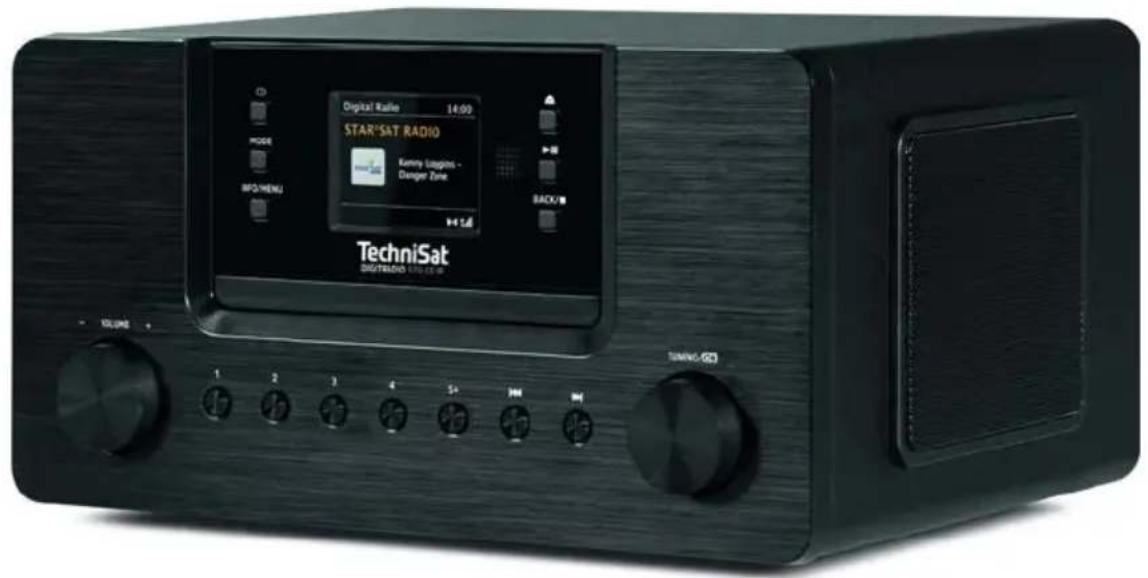
1 Illustrations
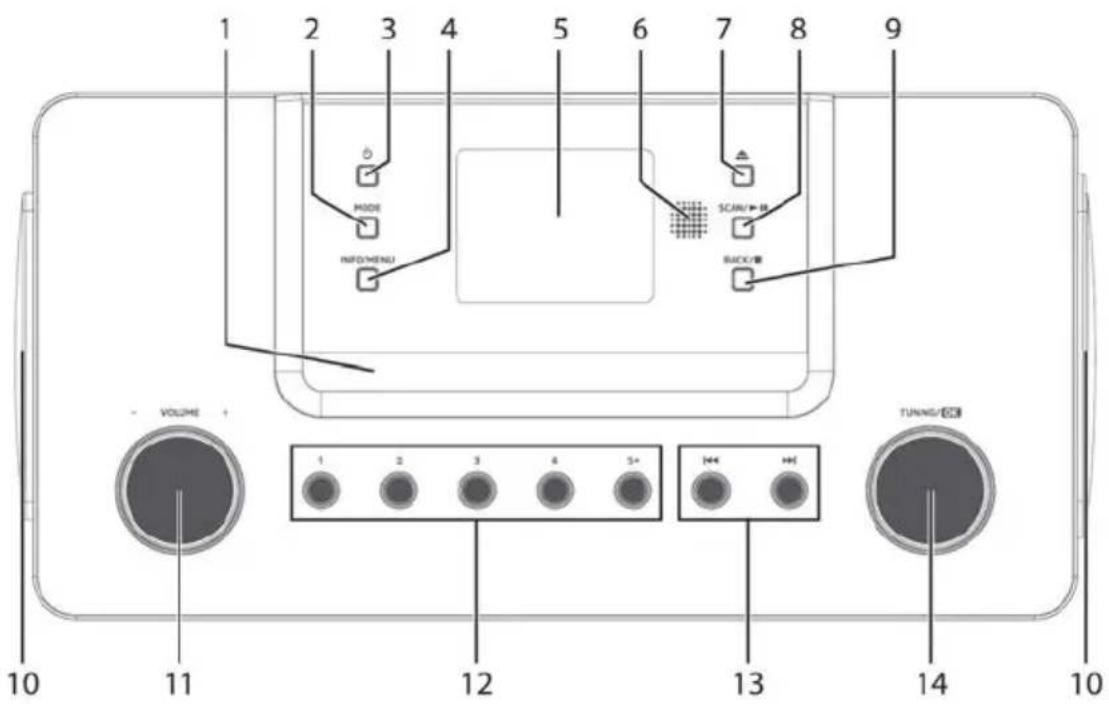
1.1 Front view
1.2 Rear view
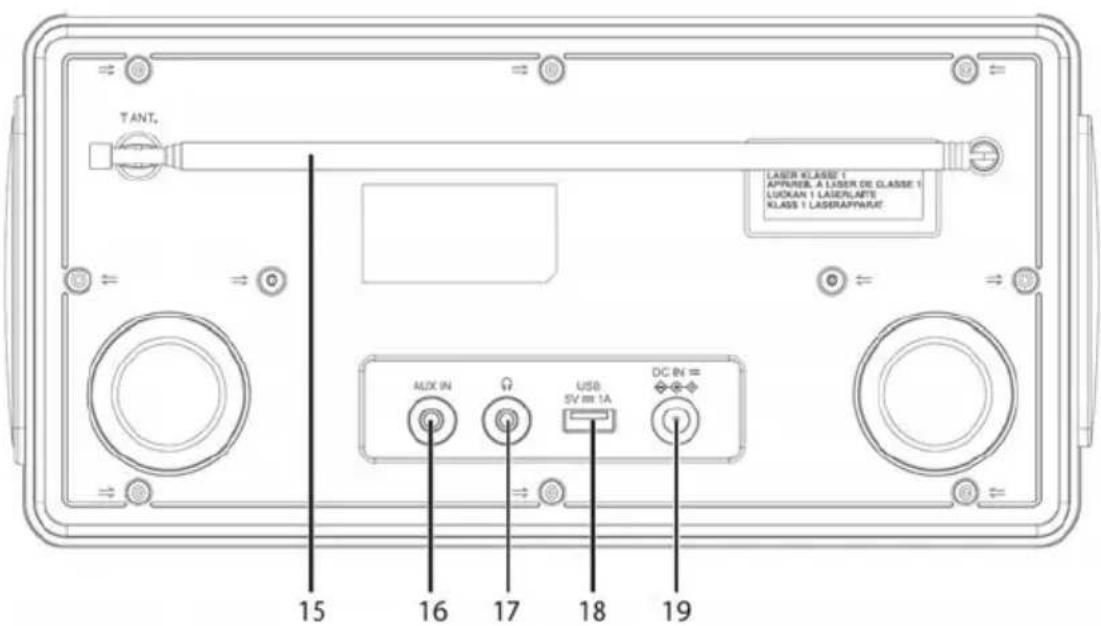
1 CD compartment 11 VOLUME+/-
2 MODE/Source selection 12 One-touch buttons
3 On/Standby/ 13Track search/Forwards/Backwards
4 INFO/MENU 14 TUNING/OK
5 Display 15 Telescopic antenna
6 IR receiver 16 AUX-IN
7 CD Eject 17 Headset connection
8 Play/Pause 18 USB port
9 BACK/Stop 19 DC-IN
10 Speaker
1.3 Remote control
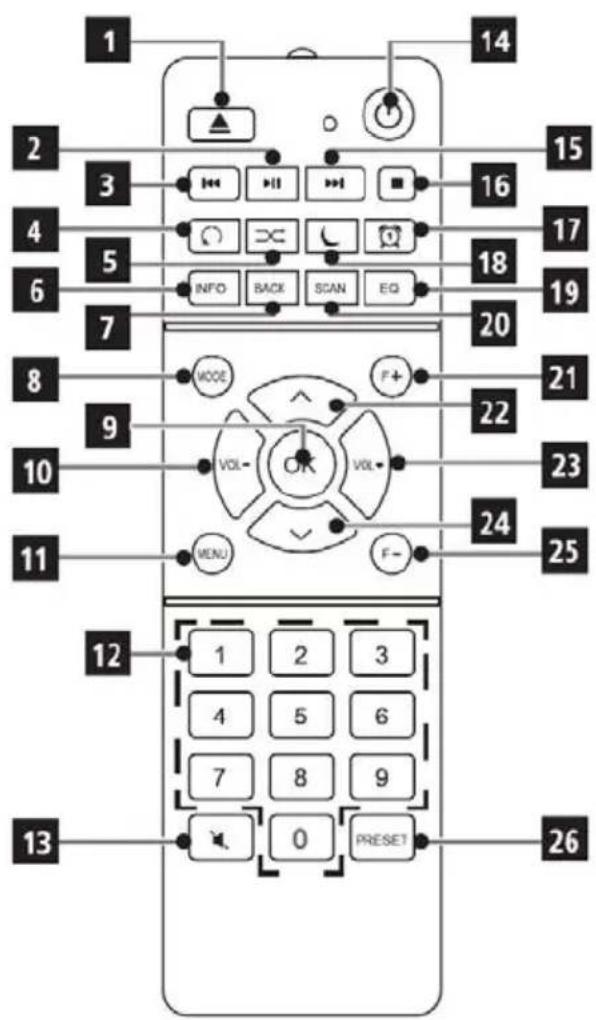
1 CD Eject
2 Play/Pause
3 Previous track/Scan
4 Repeating
5 Shuffle
6 INFO
7 BACK
8 MODE (source selection)
9 OK (confirm)
10 VOL- (quieter)
11 MENU
12 Number keys
13 Mute
14 On/Standby
15 Next track/Scan
16 Stop
17 Alarm
18 Sleep Timer
19 EQ (Equaliser)
20 SCAN (Station scan)
21 F+ (Next folder)
22 ▲/Navigation
23 VOL+ (louder)
24 ▼/Navigation
25 F- (Previous folder)
26 Favourites memory
2 Index
1 Illustrations 40
1.1 Front view....40
1.2 Rear view 40
1.3 Remote control 41
2 Index....42
3 Safety instructions.... 44
3.1 Signs and symbols used 45
3.2 Intended use 46
3.3 Target group for this instruction manual 46
3.4 Using the DIGITRADIO 570 CD IR safely....46
4 Legal notices 48
4.1 Service instructions 49
5 Setting up the device....49
6 Description of the DIGITRADIO 570 CD IR ....50
6.1 Scope of supply 50
6.2 Special features of the DIGITRADIO 570 CD IR....50
6.3 Preparing the DIGITRADIO 570 CD IR for operation....51
6.3.1 Aligning the antenna....51
6.3.2 Connecting the mains adapter....51
6.3.3 Inserting the batteries into the remote control....51
6.4 General device functionality....52
6.4.1 Switching on the device 52
6.4.2 Switching off the device....52
6.4.3 Operating the device with the remote control....52
6.4.4 Adjusting the volume....53
6.4.5 Activating the mute function....53
6.4.6 Accessing displays....53
6.4.7 Displays....53
7 Menu navigation....53
7.1 Selecting the source....54
8 Internet Radio and Podcasts....54
8.1 Station list....55
8.2 Adding Internet radio stations to favourites....55
8.3 Accessing a favourite station....55
8.4 Deleting a saved memory slot....55
9 Spotify Connect ....55
10 Playing music (USB media)....18
10.1 Playing media....18
10.2 Repeat function....18
11 DAB+ (digital radio) function....56
11.1 What is DAB....56
11.2 DAB radio reception....57
11.3 Scanning....57
11.3.1 Manual scan....57
11.4 Selecting the station....57
11.5 Saving DAB stations....58
11.6 Selecting programmed stations....58
11.7 Deleting a saved memory slot....58
11.8 Signal strength....58
11.9 Dynamic Label Plus....59
11.10 Setting DRC....59
11.11 Deleting inactive stations....59
11.12 Sorting the stations....59
12 FM mode....59
12.1 Switching on the radio mode 59
12.2 FM reception with RDS information....60
12.3 Manual station selection....60
12.4 Automatic station selection 60
12.5 Setting mono/stereo....60
12.6 Saving FM stations....61
12.7 Selecting programmed stations....61
12.8 Deleting a saved memory slot....61
13 Bluetooth....61
13.1 Activating the Bluetooth mode....61
13.2 Pairing 62
13.3 Playing music....62
14 Audio/Playing MP3 CDs....63
14.1 General information on CDs/MP3 CDs....63
14.2 Discs you can use....63
14.3 Playing CDs....64
14.4 Picking a track....64
14.5 Quick search....64
14.6 Repeat function....64
14.7 Programming playback....65
15 Audio input 65
16 Other functions....65
16.1 Sleep function....65
16.2 Alarm 66
16.2.1 Setting the alarm time....66
16.2.2 Switching the alarm off after it has gone off 67
16.2.3 Switching off the alarm....67
17 System settings....67
17.1 Equaliser....67
17.2 Audio stream quality 67
17.3 Internet settings....68
17.3.1 WPS connection....68
17.4 Time settings....69
17.5 Language....69
17.6 Factory settings....70
17.7 Software Update 70
17.8 Set-up wizard....70
17.9 Info....71
17.10 Display backlight 72
17.11 Data protection information....72
18 Cleaning....72
19 Troubleshooting 73
20 Technical specifications/manufacturer's instructions....74
3 Safety instructions
Foreword
Dear Customer,
Thank you for choosing the DIGITRADIO 570 CD IR from TechniSat.
This instruction manual is intended to help you get to know the extensive functions that your new device offers and to make the best use of them.
It will help you to use the DIGITRADIO 570 CD IR properly and safely.
It is intended for anyone concerned with installing, connecting, operating, cleaning or disposing of the unit. Keep the instruction manual in a safe place for future reference.
You can find an up-to-date version of the instruction manual on the TechniSat homepage www.technisat.de.
We have kept the operating instructions as brief as possible and have used terminology that everybody can understand.
We hope you enjoy using your
TechniSat DIGITRADIO 570 CD IR!
The
TechniSat Team
3.1 Signs and symbols used
In this instruction manual:

Indicates a safety instruction that can lead to serious injuries or death if not observed. Note the following signal words:
DANGER - Severe injury with fatal consequences
WARNING - Severe injury, possibly with fatal consequences
CAUTION - Injury

Indicates an important instruction that you absolutely should observe in order to avoid problems with the device, loss or misuse of data or unwanted operation. It also describes additional functions of your device.

Beware of electrical voltage. Follow all safety instructions to prevent electric shock. Do not open the device under any circumstances.
On the device:

Indoor use - Devices with this symbol are only suitable for indoor use.

Protection class II - Protection class II-rated electrical devices are electrical devices with continuous double and/or reinforced insulation and no connection options for a protective conductor. The housing of a protection class II electrical device enclosed using insulation material may partially or completely form the additional or reinforced insulation.

Your device bears the CE symbol and complies with all requisite EU standards.

Electronic devices do not belong in the household waste and must be disposed of properly in accordance with Directive 2012/19/EC of the European Parliament and of the Council dated 04 July 2012 concerning waste electrical and electronic equipment. Please return this device to the designated public collection point for disposal at the end of its service life.

Take note of all information and safety instructions in this instruction manual. Keep the instruction manual in a safe place for future reference.

The power supply unit in your device corresponds to energy efficiency class VI.

This symbol indicates the polarity of the DC voltage at the DC connector.
3.2 Intended use
The device is designed to receive radio broadcasts via DAB+, FM and the Internet. Music media can be streamed via a WLAN network connection or Bluetooth. The device has been designed for private use and not for commercial purposes.
3.3 Target group for this instruction manual
The instruction manual is intended for anyone concerned with installing, operating, cleaning or disposing of the device.
3.4 Using the DIGITRADIO 570 CD IR safely
Please observe the following instructions to minimise any safety hazards, to prevent damage to the device, and to help protect the environment.
Please read all the safety instructions carefully and retain them for future reference. Always follow all the warnings and instructions in this instruction manual and on the rear of the device.

WARNING!
Do not open the device under any circumstances.
Touching live parts can be fatal!

Observe all of the following instructions on the intended use of the device and to prevent device defects and personal injury.
- Do not repair the device yourself. Repairs may only be carried out by trained specialist personnel. Contact our customer service department.
- The device should only be operated under the intended environmental conditions.
- Do not expose the device to dripping or splashing water. If water has penetrated the device, disconnect it from the mains and inform the Service Department
- Do not expose the device to heat sources that could heat it up more than it would under normal use.
- In the event of an obvious device defect, the production of an odour or smoke, significant malfunctions, or damage to the housing, notify the service department immediately.
- The device must only be operated at the mains voltage specified on the power supply unit. Never try to operate the device at a different voltage.
- If the device shows signs of damage, it must not be put into operation.
- Do not put the device into operation in the vicinity of bath tubs, showers, swimming pools or running/splashing water. There is a risk of electric shock and/or device defects.
- Foreign bodies, e.g. nails, coins, etc. must not be allowed to fall inside the device. Do not touch the connection contacts with metal objects or your fingers. This may cause a short circuit.
- This device is not intended to be used by people (including children) with limited physical, sensory or mental capacities or lack of experience and/or knowledge, unless they are supervised by a person responsible for their safety or they have been instructed by them as to how to use the device. Never allow children to use the device unsupervised.
- Keep packaging films and small parts away from children. Risk of suffocation!
- Modifications to the device are prohibited.
- The CD player uses an invisible laser beam. If used incorrectly, this can injure your eyes. Never look directly into the open CD compartment.

• This device has been classified as a CLASS 1 LASER.
4 Legal notices

TechniSat hereby declares that the radio equipment type DIGITRADIO 570 CD IR conforms with directive 2014/53/EU. The full text of the EU conformity declaration is available at the following Internet address:
TechniSat is not liable for damage caused by external influences, wear and tear or improper use, unauthorised repairs, modifications or accidents.

Subject to change for amendments and printing errors. Version 07/21 Duplication and reproduction only with the publisher's approval. You can find the current version of the manual in PDF format in the download area of the TechniSat homepage at www.technisat.de.

DIGITRADIO 570 CD IR and TechniSat are registered trademarks of:
D-54550 Daun/Eifel, Germany
www.technisat.de
The names of the companies, institutions or brands mentioned are trademarks or registered trademarks of their respective owners.
The Spotify Software is subject to third party licenses found here: https://www.spotify.com/connect/third-party-licenses.

The device may only be operated in enclosed rooms in the 5 GHz WLAN range in the countries listed below.
| BE CY FI FR HU LV LI | |||
| LU NL ES SE UK CH DE |
4.1 Service instructions

This product is quality-tested and comes with the statutory warranty period of 24 months from the date of purchase. Please keep your receipt as proof of purchase. In the event of warranty claims, please contact the product dealer.

Note!
Should you experience a problem with this unit, or for queries and information, our Technical Hotline is available:
Mon. - Fri. 8:00 am - 6:00 pm at tel.:
(0) 3925 9220 1800.

Repair orders can also be placed directly online at www.technisat.de/reparatur.
If the device needs to be sent to us for any reason, please only use the following address:
39418 Stassfurt, Germany
5 Setting up the device
Place the device on a firm, secure and horizontal surface. Make sure the area is well ventilated.

Note:
- Do not place the device on soft surfaces such as carpets and blankets, or near to curtains and wall hangings. These could obstruct the ventilation openings. The necessary flow of air could be interrupted as a result. This could potentially lead to fire in the device.
- Do not place the device near to sources of heat, such as radiators. Avoid direct sunlight and very dusty environments.
-
Do not select a location for the device with high air humidity, e.g. a kitchen or sauna, since condensation could damage the device. The device is intended for use in a dry environment and in a moderate climate and must not be exposed to dripping or splashing water.
-
Please note that the device feet could leave coloured marks on some types of furniture surfaces in certain situations. Place a protective layer between your furniture and the device.
- Keep the DIGITRADIO 570 CD IR away from devices that emit strong magnetic fields.
- Do not place any heavy objects on the device.
- Route the mains cable in such a way that nobody can trip over it. Ensure that the mains cable or the power supply unit are always easily accessible, so that the device can be quickly disconnected from the power supply!
To ensure connection to the mains, insert the plug fully into the socket.
Use a suitable, easy-to-access mains connection and avoid using multiple socket strips!
In the case of malfunctions or detecting smoke or odour from the housing, remove the plug from the power outlet immediately!
Remove the plug if the device is not going to be used for a prolonged period, e.g. before going away on a long trip.
6 Description of the DIGITRADIO 570 CD IR
6.1 Scope of supply
Before starting up, please check that everything has been delivered:
1x DIGITRADIO 570 CD IR
1x remote control + batteries
1x Mains adapter
1x Instruction manual
6.2 Special features of the DIGITRADIO 570 CD IR
The DIGITRADIO 570 CD IR is comprised of a DAB+/FM/Internet radio receiver having the following functions:
- You can store up to 20 DAB+/FM/Internet radio stations.
- The radio can receive the following frequencies: FM 87.5-108 MHz (analogue) and DAB + 174.9-239.2 MHz (digital antenna).
- Internet radio via WiFi connection.
- Spotify Connect
- MP3-CD Player
- The device has a time and date display.
- Music playback via Bluetooth connection.
- Alarm and sleep timer function.
- Controlled with the TechniSat CONNECT App.
6.3 Preparing the DIGITRADIO 570 CD IR for operation
6.3.1 Aligning the antenna
The number and quality of broadcast stations depends on the reception conditions at the location of the radio. Excellent reception can be achieved with the telescopic antenna.
Release the telescopic antenna (15) from its holder, align it and extend it.

Precise alignment of the antenna is often important, especially on the outskirts of a DAB+ reception area. You can quickly find the location of the nearest transmission tower online by visiting “www.dabplus.de”.

Start the first scan at a window pointing in the direction of the transmission mast. If the weather conditions are poor, DAB+ reception may be limited.

Do not touch the antenna during station playback. This could reduce the reception and lead to sound drop-outs.
6.3.2 Connecting the mains adapter

Ensure that the operating voltage of the power supply unit matches the mains voltage before you insert it into the wall socket.

WARNING!
Do not touch the mains plug with wet hands; electric shock hazard!

CAUTION!
Route the mains cable in such a way that nobody can trip over it.
Connect the supplied power cable to the port marked DC IN (19) on the back of the DIGITRADIO 570 CD IR. Then connect the power supply to the mains.
6.3.3 Inserting the batteries into the remote control
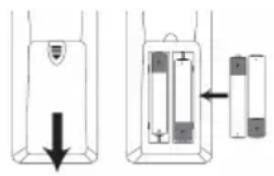
Open the battery compartment on the back of the remote control by sliding it in the direction of the arrow.
Insert the batteries (2 x AAA 1.5 V) in accordance with the polarity indicated in the battery compartment.
natural_image
Diagram showing two mechanical components with arrows indicating motion or assembly (no text or symbols)Close the battery compartment lid carefully again and ensure that the lid retaining tabs engage in the housing.

You will need 2 micro alkaline batteries, 1.5 V, LR03/AAA to operate the remote control. Make sure the polarity is correct when inserting them.
- Replace batteries that are losing power in good time.
- Leaking batteries can cause damage to the remote control.
- If the device is not to be used for a prolonged period, remove the batteries from the remote control.
- Important instructions for disposal: Batteries may contain toxic substances that are hazardous to the environment. Therefore, it is imperative to dispose of the batteries according to the legal provisions in force. Never dispose of batteries in normal household waste.
6.4 General device functionality
Settings and functions can be carried out both using the buttons on the device and with the remote control. The description of the operation in this instruction manual refers to the buttons on the remote control.
6.4.1 Switching on the device
You can use the On/Standby ^① (3) button on the device or the On/Standby (14) button on the remote control to switch the device on or back to standby.

After switching on for the first time, you can launch the set-up wizard (Section 17.8). Here you can set the date and time either via DAB/FM, Internet or have no update (manual). The device will then attempt to establish a connection to a WLAN network. To do so, select the corresponding WLAN network and, if required, enter the WLAN password with the remote control.
6.4.2 Switching off the device
You can use the On/Standby(3) button on the device or On/Standby (14) on the remote control to switch the device on or back to standby. The date and time are shown in the display.
6.4.3 Operating the device with the remote control
With the infrared remote control you can operate the most important device functions from the comfort of your armchair. When operating the device with the remote control, please take into account the following points:
Point the remote control at the front of the device.
Visual contact between the transmitter and the receiver must be guaranteed.
If the range of the remote control reduces, replace the batteries.

The maximum range is approximately 5 metres from the front of the device.
6.4.4 Adjusting the volume
Use the VOL +/- (10, 23) buttons on the remote control or VOLUME +/- (10) on the device to set the volume. The set volume is shown on the display.
6.4.5 Activating the mute function
You can switch off the volume at the touch of a button using the MUTE button (13).

This mode is indicated in the status bar by a corresponding icon.
Pressing the MUTE button again switches the volume back on.
6.4.6 Accessing displays
By repeatedly pressing the INFO (6) button during the playback of a source, certain extra information can be viewed and scrolled through.
6.4.7 Displays
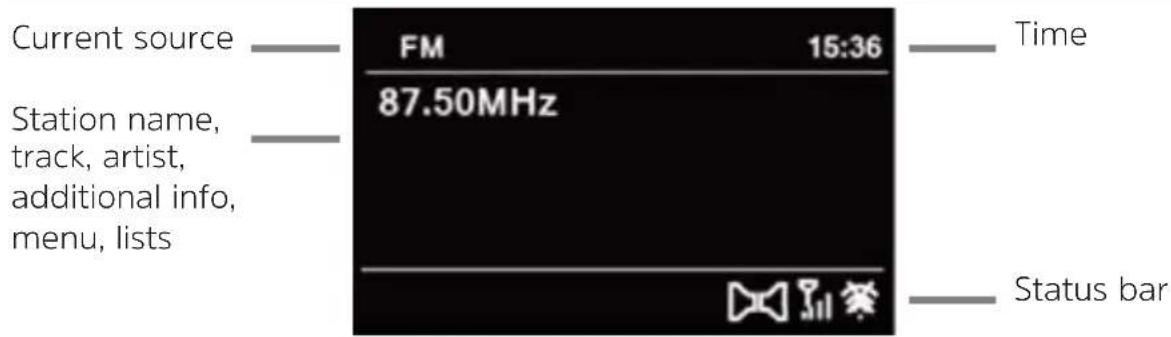

The displays shown can vary depending on the selected function/source. Take note of the instructions on the display.
7 Menu navigation
Menu navigation primarily takes place using the MENU,▲/▼ and OK buttons on the remote control, or the INFO/MENU buttons and the TUNING/OK knob on the device. The menu is divided into the respective submenu for the currently selected source and the main menu. Press the MENU button (on the remote control) or hold down the INFO/MENU button (on the device) until the submenu for the current source opens up.
You can navigate using the ▲/▼ buttons on the remote control or by turning the TUNING/OK knob. Press the OK button on the remote control or the TUNING/OK knob on the device to make a selection.
* highlights the current selection.
Press the BACK button to move back a step.

Closing the menu: Press the BACK or MENU button several times or wait for approx. 15 seconds.
7.1 Selecting the source
Press the MODE button as often as required until the desired source is shown on the display.
Alternatively:
Press the MENU key.
Use the ▲ or ▼ buttons to select the entry [main menu] and confirm your selection with OK.
Use the ▲ or ▼ buttons to select the desired source and confirm your selection with OK.
8 Internet Radio and Podcasts
The DIGITRADIO 570 CD IR is equipped with an Internet radio receiver. In order to receive Internet radio stations/broadcasts/podcasts you need a WiFi router with Internet access.
Press the MODE button repeatedly until [Internet Radio] or [Podcast] appears on the display.
Alternatively:
Press the MENU button and then select [Main menu > Internet radio] or [Podcasts].

If you are starting Internet radio for the first time without having configured a WiFi connection, the search wizard appears showing you all the WiFi stations within range. Use the ▲/▼ and OK buttons to select the WiFi network you recognise and enter the password using the displayed keyboard. Then select OK press the OK button. If the password entered is correct, a connection to the network is now established. The signal bars 📋 the status bar of the display indicate whether a connection exists.

To cancel the input, select ACCESS the OK button. If you make a mistake, you can delete the last letter you entered by pressing BKSP
8.1 Station list
Press the MENU button and select [Station List] or [Podcast List]. Press the OK button.

Under Station List, all Internet radio stations are displayed, sub-divided into different categories.
Select a station by category/country/genre and press the OK button.

To obtain additional information on the station currently being played, press the INFO button several times (Section 6.4.6).
8.2 Adding Internet radio stations to favourites
The favourites memory can store up to 20 stations.
Stored stations are retained even in the event of a power cut.
Set the station you want.
Press one of the number keys 1 - 10 on the remote control and hold down until [saved.] appears on the display.
Saving more stations: Repeat the process.
Alternatively:
Hold down the PRESET button, use the ▲/▼ buttons to select a favourites location 1 - 20 and press the OK button.
8.3 Accessing a favourite station
Briefly press the number key you want 1 - 10. If there is no station saved in the selected programme slot, [Memory slot empty] appears.
Alternatively:
Briefly press the PRESET button, use the ▲/▼ buttons to select a favourites location 1 - 20 and press the OK button.
8.4 Deleting a saved memory slot
Simply save a new station to the specific memory slot.
9 Spotify Connect
Use your smartphone, tablet or computer as a remote control for Spotify.
There is more information at spotify.com/connect.

The Spotify software is subject to third-party licence provisions, which you can find here: http://www.spotify.com/connect/third-party-licenses
10 Playing music (USB media)
You have the option of using the DIGITRADIO 570 CD IR to play music media from a USB memory source. This requires the USB media source to be connected to the USB port.
Press the MODE button repeatedly until [USB] appears in the display.
Alternatively:
Press the MENU button and then select [Main Menu > USB].
10.1 Playing media
If a track is being played, the display shows [F01 T001 01:15]. [F01] stands for the currently selected folder (in this case, the first one), [T001] indicates the first track, followed by the playback length of the current track.
If there are several folders containing music on the USB stick, you can change the folder (F) using the F+/F- buttons.

Play/Pause.

Next Track, hold down for Search.

Press 2x for the previous track, hold down for Search.

Stop playback.
10.2 Repeat function
You can select whether a track, the entire folder/album or all of the tracks are to be repeated.
Press the Repeat button several times.
The selected mode appears on the display using an icon (Repeat Track, Repeat Album, Repeat All).
To switch the function off again, press the Repeat track button as often as required until the icon no longer appears.
Press the Shuffle button (5) to play the tracks in a random sequence.
11 DAB+ (digital radio) function
11.1 What is DAB+?
DAB+ is a new digital format through which crystal clear sound with no noise can be heard. In contrast to conventional analogue radio stations, DAB+ can be used to broadcast multiple stations on one and the same frequency. This is referred to as an ensemble or multiplex. An ensemble is comprised of the radio station, as well as several service components or data services which are broadcast individually by the radio stations. For further information, please visit e.g. www.dabplus.de or www.dabplus.ch.
11.2 DAB radio reception
Press the MODE button as often as required until [DAB Radio] appears on the display.
Alternatively:
Press the MENU button and then select [Main Menu > DAB+].

If DAB is being started for the first time, a complete station scan is performed. The station list is then shown (see Section 11.4).
11.3 Scanning
The automatic scan scans all DAB+ band III channels and thereby finds all stations being broadcast within the reception area.

After the scan is complete, the first station is played back in alphanumeric order.
Press the SCAN button (20) to carry out a full scan. "Scan" appears on the display. The scan starts and a progress bar appears on the display.
When this is complete, press the ▲ or ▼ buttons and OK to select a station.
Alternatively:
Press the MENU button and use the ▲ or ▼ buttons [Full Scan]. Confirm by pressing OK.

If no stations are found, check the antenna and change the installation location if necessary (Section 6.3.1).
11.3.1 Manual scan
Proceed as follows if you want to run a station scan manually:
Select [Menu] > [Set Manually] and press the OK button.
Use the ▲ or ▼ buttons to select a station frequency and press the OK button.

If stations are being broadcast on the selected frequency, this will be indicated on the stability bar (see also Section 11.8). If these stations are not currently included in your station list, they will now be stored there.
11.4 Selecting the station
You can check the stations found on the device. This is done by pressing the buttons ▲ or ▼.
To select a station press OK.Alternatively, you can press the MENU button and use ▲ or ▼ to select > [Station list].
11.5 Saving DAB stations
The favourites memory can store up to 20 stations.
Stored stations are retained even in the event of a power cut.
Set the station you want.
Press one of the number keys 1 - 10 on the remote control and hold down until [saved.] appears on the display.
Saving more stations: Repeat the process.
Alternatively:
Hold down the PRESET button, use the ▲/▼ buttons to select a favourites location 1 - 20 and press the OK button.
11.6 Selecting programmed stations
Briefly press the number key you want 1 - 10. If there is no station saved in the selected programme slot, [Memory slot empty] appears.
Alternatively:
Briefly press the PRESET button, use the ▲/▼ buttons to select a favourites location 1 - 20 and press the OK button.
11.7 Deleting a saved memory slot
Save a new station to the respective programme slot.
11.8 Signal strength
Press the INFO button (6) several times. The signal strength will be displayed.
The bar modulation shows the current level.
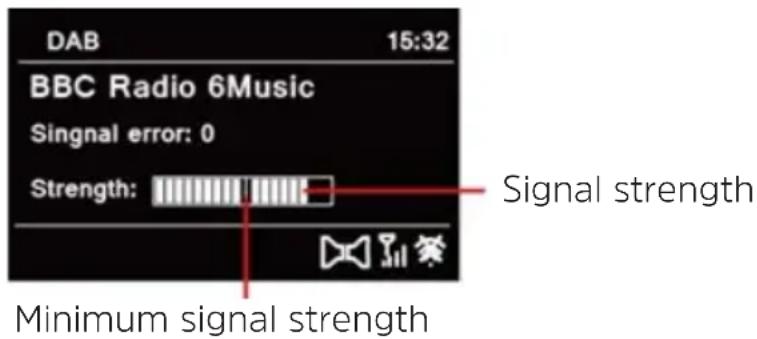

Stations with a signal strength below the required minimum signal intensity are not transmitting a strong enough signal. If required, align the antenna as described in section 6.3.1.

By pressing the INFO button several times, different information can be scrolled through, such as station type, multiplex name, frequency, signal error rate, data bit rate, station format, date.
11.9 Dynamic Label Plus
If supported by the programme provider, the Dynamic Label Plus service also allows, for example, the name of the current programme or the track and artist to be displayed.
11.10 Setting DRC
The compression rate balances dynamic fluctuations and thereby any volume variations that occur.
Press the MENU button and select > [Volume Adjustment], to select the desired compression rate.
Select the compression rate using the ▲/▼ buttons:
DRC high - high compression
DRC low - low compression
DRC off - compression switched off.
Confirm by pressing OK.
11.11 Deleting inactive stations
Press the MENU button and use ▲ or ▼ to select > [Delete inactive stations].
Confirm by pressing OK.
Using ▲ or ▼, select > [Yes] and confirm by pressing OK.
11.12 Sorting the stations
Press the MENU button and then ▲ or ▼ to select > [Station order].
Select a sorting type with ▲ or ▼ and confirm your selection with OK.

You can now choose between: Alphanumeric and provider.
12 FM mode
12.1 Switching on the radio mode
Press the MODE button as often as required until [FM-Radio] appears on the display.
Alternatively:
Press the MENU button and then select [Main Menu > FM].
When you switch on the radio for the first time, the frequency is set to 87.5 MHz.
i If you have already set or saved a station, the radio plays the last station set.
i In the case of RDS stations, the station name is displayed.
Adjust the antenna to improve reception.
12.2 FM reception with RDS information
RDS is a procedure for broadcasting additional information via FM stations. Broadcasters with RDS might, for example, broadcast their station name or the programme type. This appears on the display.
The device can show the following RDS information:
RT (radio text),
PS (station name),
PTY (programme type).
12.3 Manual station selection
Press ▲ or ▼ in FM mode to set the desired station. The display shows the frequency in increments of 0.05 MHz.
12.4 Automatic station selection
Press SCAN (20) to start the automatic scan. The station frequency runs upwards on the display.
or
In FM mode, hold down ▲ or ▼ for approx. 2 seconds to search automatically for the next station with a strong enough signal.
If an FM station with sufficient signal strength is found, the scan stops and the station is played. If an RDS station is being received, the station name is displayed and, possibly, the radio text.
To tune in to weaker stations, please use the manual station selection function.
Under Menu > Scan settings you can set whether the scan only finds strong stations (Strong stations only). To do so press the MENU button and > Scan settings > [Yes]. Confirm the selection with OK. With the [NO] setting, the scan stops automatically at each station. However, these may have interference.
12.5 Setting mono/stereo
Press the MENU button and use ▲ or ▼ to select > [Audio setting].
Select [YES] for playback in mono sound only in the event of weak FM reception.
Confirm by pressing OK.
12.6 Saving FM stations
The favourites memory can store up to 20 stations.
Stored stations are retained even in the event of a power cut.
Set the station you want.
Press one of the number keys 1 - 10 on the remote control and hold down until [saved.] appears on the display.
Saving more stations: Repeat the process.
Alternatively:
Hold down the PRESET button, use the ▲/▼ buttons to select a favourites location 1 - 20 and press the OK button.
12.7 Selecting programmed stations
Briefly press the number key you want 1 - 10. If there is no station saved in the selected programme slot, [Memory slot empty] appears.
Alternatively:
Briefly press the PRESET button, use the ▲/▼ buttons to select a favourites location 1 - 20 and press the OK button.
12.8 Deleting a saved memory slot
Save a new station to the respective programme slot.
13 Bluetooth
13.1 Activating the Bluetooth mode
Press the MODE button repeatedly until [Bluetooth Audio] appears on the display.
Alternatively:
Press the MENU button and then select [Main Menu > Bluetooth].

In the status bar on the display, a flashing [BT] indicates the pairing mode.

If the DIGITRADIO 570 CD IR has already been paired with another device which is within range, the connection is automatically established.
13.2 Pairing
Activate Bluetooth on your music player, e.g. a smartphone or tablet.

If you activate Bluetooth on your music player, please consult the corresponding instruction manual for the device which you wish to pair with the DIGITRADIO 570 CD IR.

Please note that only 1 device can be connected to the DIGITRADIO 570 CD IR at any one time.

Ensure that you do not exceed the maximum Bluetooth range of 10 metres to guarantee excellent playback quality.
Select the list of Bluetooth devices found on your music player.
In the list, search for the item DIGITRADIO 570 CD IR and select it. If the selection requires a PIN, enter "0000" (4 x zero).
If pairing is successful, the [BT] symbol in the DIGITRADIO display stops flashing.
13.3 Playing music
Select a music track on your music player and play it.
The sound is now played via the DIGITRADIO 570 CD IR.

You can use the Play buttons on the DIGITRADIO remote control to control the playback on your music player (only with compatible devices).

Play/Pause.

Next track.

Press 2x for previous track, press 1x to play the track from the beginning:

Stop playback.

Ensure that the volume on your music player is not set too low.
14 Audio/Playing MP3 CDs
14.1 General information on CDs/MP3 CDs
The device is designed for music CDs that are played with audio data (CD-DA or MP3 for CD-R and CD-RW). MP3 formats must be generated with ISO 9660 Level 1 or Level 2. Multi-session CDs cannot be read.
In MP3 mode, the terms "Folder" = Album and "Track" are critical. "Album" corresponds to the folder on the PC, and "Track" to the PC file or a CD-DA track.
The device sorts albums or tracks alphabetically by name. If you prefer a different order, change the name of the track or album and place a number in front of the name.
When burning a CD-R and CD-RW with audio data, various problems can arise which could occasionally compromise smooth playback. The causes of this are faulty software or hardware settings or the blank disc being used. Should such errors arise, you should contact your CD burner/burner software manufacturer or search for the relevant information, e.g. on the Internet.

If you make audio CDs, observe the legal requirements and do not violate the copyrights of third parties.

The device can play CDs with MP3 data and normal audio CDs (.wav). Do not use other file extensions such as *.doc, *.txt, *.pdf etc. when converting audio files to MP3.

Given the varieties of different encoder software, it cannot be guaranteed that every MP3 file can be played without a problem.

If there are any faulty tracks/files, playback will continue with the next track/file.

It is better to burn the CD at a low speed and to create the CD as single session and finalise it.
14.2 Discs you can use
The CD player is compatible with CD, CD-R/RW and MP3 CD media.

If you are transporting the device, remove the disc from the drive. This prevents damage to the CD player and the disc.

The playback quality with MP3 CDs depends on the bit rate setting and the burning software used.
14.3 Playing CDs
Switch to CD player mode by pressing the MODE button.
[CD] is shown on the display.
Open the CD tray using the Eject button (1 or 7 on the device). Then place the CD in the tray with the printed side up and close it again with Eject.
The data on the CD is scanned. The display shows [Loading]. Playback then begins with the first track (audio CD) or the first track in the first folder (MP3 CD).
Do not perform any operation until the CD content has been completely read, to ensure that all the required information on the CD has been read. This process can take some time, particularly with MP3 CDs.
i Please hold the CD by the edge when inserting/removing.
By pressing the Play/Pause button ▶II, you can pause playback (the playing time flashes on the display), or continue playback by pressing it again.
Use the Stop button to play playback. The total number of tracks appears on the display.
i Always stop playing a CD before removing it.
14.4 Picking a track
Use the Previous Track or Next Track buttons to skip to the next or previous track.
The display shows the respective folder [F] and track [T] number.
You can use the F+ and F- buttons to select the folder on MP3 CDs.
14.5 Quick search
While the track is playing, you can perform a quick search forwards or backwards to find a specific section.
Hold down the Previous Track or Next Track buttons to skip forwards or backwards quickly within a track for as long as the button is held down.
14.6 Repeat function
You can select whether a track, the entire folder/album (only for mp3 CDs) or all of the tracks on the CD are to be repeated.
Press the Repeat button several times.
The selected mode appears on the display using an icon (Repeat Track, Repeat Album, Repeat All, Shuffle).
To switch the function off again, press the Repeat track button as often as required until the icon no longer appears.
Press the Shuffle button (5) to play the tracks in a random sequence.
14.7 Programming playback
You can programme up to 20 tracks on a CD in any sequence.
Stop any playback in progress by pressing the STOP button .
Press the PRESET button on the remote control, or 5+ on the device to access the programming mode.
The display now shows [P01] for the first track to be programmed.
Using the / b k n pect a track and press the OK button to accept the storing.
Then [P02] is displayed for the second track which you can also add as described above.
When programming is complete, press the Playback/Pause button.
To delete programming, either press Stop 2 or open the CD tray using the Eject button.
15 Audio input
You can play sound on an external device via the DIGITRADIO 570 CD IR speaker.
Connect the external device to the AUX-IN port (16, 3.5 mm stereo jack) on the back
Use the MODE button to select the audio input. [Aux-In] appears on the display.
The playback is controlled on the external device. Do not set the volume too low to prevent interference.
16 Other functions
16.1 Sleep function
Press the MENU button and then select [Main Menu > Sleep].
You can use the ▲ or ▼ buttons to set the period for Sleep off in 15, 30, 45 or 60 minute intervals, after which the device switches to standby while in any operating mode.
Alternatively:
Press the SLEEP button (18) on the remote control repeatedly.

A moon symbol appears in the status bar of the display with the time still available until the DIGITRADIO 570 CD IR switches to standby.
16.2 Alarm
Press the MENU button and then select [Main Menu > Alarm].
Alternatively:
Press the Alarm button (17) to jump straight to alarm configuration.
16.2.1 Setting the alarm time

The alarm function cannot be operated until the correct time has been set. Depending on the configuration, this either happens automatically or will need to be set manually. The time can either be updated manually, via DAB/FM or via the Internet. For more information on this, see Section 17.4.
Select an alarm time memory Alarm 1 or Alarm 2 using the ▲ or ▼ buttons and confirm with OK.
Then go through all the points one after the other. Confirm each entry with the OK button.
Repeating
You can choose between Daily (every day of the week), Once, Weekdays (Mon - Fri) and Weekends (Sat and Sun). Press the OK button to apply the setting.
Time
Here you can enter the alarm time and date (if required). Using the ▲/▼ buttons, first select the hours and press the OK button to save. Then enter the minutes. Accept this too by pressing the OK button.

If Repeat > [Once] has been selected, you must also enter the date as well as the time.
Mode
You then enter the source. The available options are Buzzer, Internet Radio, DAB+, FM, CD and USB. Press the OK button to accept the setting.
Station
If you have selected Internet Radio, DAB or FM, you can then enter whether or not you want to be woken up by the last station listened to or by one from your Favourites list.
Volume
Use the ▲/▼ buttons to select the volume with which you wish to be woken up.
Saving
Press the OK button to save the alarm.

The alarm is active as soon as you have set the alarm repeat to Daily, Once, Weekend, or Workdays. The status bar shows an alarm symbol with the corresponding number of the active alarm and the alarm time.
16.2.2 Switching the alarm off after it has gone off
Press the On/Standby button to turn off the alarm.

The alarm symbol appears on the display again if the alarm repeat is set to Daily, Weekend or Workdays.
16.2.3 Switching off the alarm
In the menu select the relevant alarm under > Repeat: Off.
17 System settings
All settings explained in this section apply equally to all sources.
Open the menu and use the ▲ / ▼ buttons to select > [System Settings]. Press the OK button to open the system settings.
17.1 Equaliser
Press the MENU button and then select [System settings] > [Equaliser].
Here you can carry out different equaliser settings to adapt the sound to your taste. You can choose from:
Middle, Jazz, Rock, Classic and Pop.
Use the ▲/▼ buttons to select the equaliser setting and press the OK button to accept the setting.
17.2 Audio stream quality
The quality of the audio stream may be adapted to the Internet speed. The higher the quality, the higher the data transfer rate.
Press the MENU button and then select [System settings] > [Audio stream quality].
Select a quality level and press the OK button to save.
17.3 Internet settings
Press the MENU button and then select [System settings] > [Internet settings].
In this menu you will find some settings and information about Internet connection.
Select [Network wizard] to establish a WiFi connection.

The network wizard shows you all the WiFi stations within range. Use the ▲/▼ and OK buttons to select the WiFi network you recognise and enter the password using the displayed keyboard. Then select OK press the OK button. If the password entered is correct, a connection to the network is now established. The signal bars 📋 in the status bar of the display indicate whether a connection exists.

To cancel the input, select ACCESS the OK button. If you make a mistake, you can delete the last letter you entered by pressing BKSP
17.3.1 WPS connection
Select [WPS] if your router has the WPS function. This establishes a direct connection to the router without having to enter the - WiFi password. Whether the WiFi network has the WPS function is indicated by the [WPS] text in front of the network name.

The WPS function can also be activated directly via the menu item [PBC WLAN establishment].

How you activate WPS on your router can be taken from its instruction manual.
Start WPS on your router by pressing the relevant button.
On the DIGITRADIO 570 CD IR, select [Press WPS Button]. Take note of the instructions on the display.
If your router only supports the WPS PIN, select [PIN] on the DIGITRADIO 570 CD IR and take note of the PIN shown on the display. You then need to enter the PIN in the router.

To find out more about the current connection select display settings.

Select Manual setting, if you know your network parameters and you would like to configure them manually. Take note of the instructions on the display.

Select Delete network profile, to delete connections no longer required.

Select Allow WiFi connection in standby mode if the WiFi connection should be retained in standby mode as well. This setting increases power consumption but enables app control via the TechniSat CONNECT app.

The menu item [Net Remote PIN] can be used to configure the PIN for the control with the TechniSat CONNECT app. The standard PIN is: 1234. The TechniSat CONNECT app can be loaded free from the usual app stores.
17.4 Time settings
Press the MENU button and then select [System Settings] > [Time and Date].
Select [Time/Date Setting] to set the time and date manually.
Use the OK button to select a value. Change it using the ▲ or ▼ buttons.
Confirm by pressing OK.
Select [Update settings] to determine whether time updates should be automatic via DAB, FM or the Internet, or whether you would like to enter it manually.
To do so, select [DAB update], [FM update], [NET update] or [No update].
Under the [Time format setting] option you can activate 12 or 24 hour format. Confirm your selection with the OK button.
Under [Set time zone], select the current time zone in your location and, under [Summertime] you determine whether summertime should currently be active. This setting is displayed only if you have previously selected NET update under the update settings.
Under [Standby clock] you can choose between an analogue or digital standby clock display.
17.5 Language
Press the MENU button and then select [System settings] > [Language].
Using ▲ or ▼, select one of the available OSD languages and confirm by pressing the OK button.
17.6 Factory settings
If you change the location of the device, e.g. when moving house, it is possible that the saved stations may no longer be received. In this case you can reset the device to factory settings to delete all the saved stations and then launch a new scan.
Press the MENU button and then select [System settings] > [Factory settings].
Confirm by pressing OK.
Use ▲ or ▼ to select > YES and confirm the confirmation prompt by pressing OK.

All previously stored stations and settings will now be deleted. After resetting, you can start the set-up wizard (Section 17.8).
17.7 Software update
From time to time software updates may be provided which can contain enhancements or error fixes. This ensures that the DIGITRADIO 570 CD IR is always up to date.
Press the MENU button and then select [System Settings]> [Software Update].
Select [Auto Update] if the DIGITRADIO 570 CD IR should search for new software versions periodically.
Select [Check now] if you want to check immediately whether a new software version is available.

If a software update has been located, follow the instructions on the display.

In order to find software updates and upload them, the DIGITRADIO 570 CD IR must be connected to the Internet. Do not switch off the DIGITRADIO 570 CD IR during the update process!
17.8 Set-up wizard
Press the MENU button and then select [System settings] > [Set-up wizard].

When switching on for the first time the set-up wizard starts automatically.
As soon as [Run now] is shown on the display, select [YES].

If you select [No], the wizard closes and you need to perform the required settings manually.
You will be taken through the settings in various steps.
Under [Time format], select the desired display format for the time display (Section 17.4) and press the OK button.
During the next step you must select via which source the time and date is to be synchronised (for more information refer to Section 17.4).

If you have selected [Update from the Net], you must then enter the time zone and summer time /winter time.
Depending on the time and date settings, some of the network settings are now performed.
Select whether the WiFi connection should remain active in standby mode as well. Press the OK button.
Ensure that the device is within the reception range of the desired WiFi network and that you have the access data. In some cases it may be necessary to carry out some settings on the router. In this case, please refer to the corresponding instruction manual.

After a search for available wireless networks you are shown the result.
Select the desired wireless network and confirm the selection with OK. Select Skip WPS to enter the password.

If it is a protected network you will be asked to enter the corresponding access key.
To do this, mark the respective character.
Enter the selected character by pressing the OK button.

Proceed in this way until the complete access key can be seen in the input field.

To cancel the input, select ▶ ANCERSS the OK button. If you make a mistake, you can delete the last letter you entered by pressing B KSP.
Then select and OK the OK button. If the password entered is correct, a connection to the network is now established.
When [Set-up wizard completed] appears on the display, press the OK button.
17.9 Info
Press the MENU button and then select [System settings] > [Info].
Confirm by pressing OK.
The software version is shown.
17.10 Display backlight
It is possible to set the display brightness both for operation as well as for the standby mode.
Press the MENU button and then select [System settings] > [Backlight].
Select [Operation] or [Standby] to apply the setting for operating mode or standby mode.
You can now set the brightness in three stages from High and Medium to Low.
Activate [Auto-Dim] to dim the display automatically in operating mode after the set time period.
Confirm the selection with OK.
17.11 Data protection information
Press the MENU button and then select [System settings] > [Data protection].
Here you will find a link to the current data protection information relating to your device.
You can return to the menu by pressing the MENU button.
18 Cleaning

To prevent the risk of electric shock, you must not clean the device using a wet cloth or under running water. Remove the mains plug prior to cleaning!

You must not use scouring pads, scouring powder, or solvents such as alcohol or petrol.

Do not use any of the following substances: salt water, insecticides, solvents containing chlorine or acids (ammonium chloride), scouring agents.

Clean the housing using a soft, damp cloth. Do not use solvents, spirit, thinners, etc.; you could damage the surface of the device.

Only clean the display with a soft cotton cloth. If required, use a cotton cloth with small amounts of non-alkaline, diluted, water-based or alcohol-based soap solution.

Rub the surface with the cotton cloth gently until it is completely dry.
19 Troubleshooting
If the device does not operate as intended, check the table below for information.
| Symptom Possible cause/remedy | |
| The device cannot be switched on. | The device is not being supplied with power. Connect the power supply unit correctly to the socket and to the device. |
| No sound can be heard. Increase the volume. | |
| The display does not switch on. Disconnect the device from the power supply and then reconnect it. | |
| Poor reception via DAB+/FM. Change the position of the antenna or the DIGITRADIO 570 CD IR. | |
| The device cannot be operated. Disconnect the device from the power supply and then reconnect it. | |
| WiFi connection not available Start | the WiFi wizard again and check that the password has been entered correctly. |
| CD playback drops out or skips. CD | contaminated with dirt. Clean the underneath of the CD with a soft non-fraying cloth or use a special audio CD cleaning device. |
| Device automatically switches off. | Depending on the playback mode, the device will automatically switch to the standby mode if there is no playback, the volume has been turned down and no operation has been undertaken for 15 minutes. |
| Bad Bluetooth connection and drop-outs | Do not exceed the maximum range for Bluetooth of 10 m. |
If the malfunction has not been resolved, even after performing the checks described, please contact the Technical Hotline.
20 Technical specifications/manufacturer's instructions
Subject to technical changes and errors.
| Operating types Internet, DAB+, FM, Bluetooth | CD, USB, Spotify. |
| Power supply DC: 9 V, 3 A via supplied external power supply | |
| Frequencies USW: 87.5 - 108 MHz | DAB+ Band III 174 - 240 MHzBluetooth V4.2: 2.402 - 2480 GHzWIFI 802.11 a/b/g/n:2.412 - 2.472 GHz5.150 - 5.725 GHz |
| (EIRP) transmission power Bluetooth V4.2: | 3.14 dBmWiFi: 9.86 dBm |
| Power consumption in operation max.: 27 W | Standby: 0.89 WStandby with network connection:0.89 WAutostandby after 15 minutes without playing/use |
| Audio output 2 x 5 W RMS | |
| Ambient conditions 5°C ~ 35°C operating | temperature,5 - 90 % relative air humidity (non-condensing) |
| Weight ~ 2.5 kg | |
| Dimensions (W x D x H) 291 x 217 x 145 mm | |
Technical data for supplied power cable
| Manufacturer TechniSat Digital GmbH, Julius-Saxler-Strasse 3, D-54550 Daun, Germany | |
| Model number BQ30A-0903000-G | |
| Input voltage AC 100 - 240 V | |
| Input AC frequency 50/60 Hz | |
| Output voltage DC 9.0 V | |
| Output current 3.0 A | |
| Output power rating | 27.0 W |
| Average efficiency during operation | 87.2 % |
| Efficiency under low load (10 %) | 85.3 % |
| Power consumption under zero load | 0.05 W |
9 Spotify Connect 91
11.9 Dynamic Label Plus....95
4 Mentions légales

natural_image
Diagram showing two battery cell configurations with arrows indicating direction of movement (no text or symbols)11.9 Dynamic Label Plus
9 Spotify Connect....127
11.9 Dynamic Label Plus....131
11.10 DRC instellen....131
4 Juridische mededeling

11.9 Dynamic Label Plus
- Spotify Connect....19
- Dynamic Label Plus
- Illustrations
- Front view
- Rear view
- Remote control
- Index
- Illustrations 40
- Index....42
- Safety instructions.... 44
- Legal notices 48
- Setting up the device....49
- Description of the DIGITRADIO 570 CD IR ....50
- Menu navigation....53
- Internet Radio and Podcasts....54
- Spotify Connect ....55
- Playing music (USB media)....18
- DAB+ (digital radio) function....56
- FM mode....59
- Bluetooth....61
- Audio/Playing MP3 CDs....63
- Audio input 65
- Other functions....65
- System settings....67
- Safety instructions
- Foreword
- Signs and symbols used
- In this instruction manual:
- On the device:
- Intended use
- Target group for this instruction manual
- Using the DIGITRADIO 570 CD IR safely
- WARNING!
- Legal notices
- Service instructions
- Setting up the device
- Description of the DIGITRADIO 570 CD IR
- Scope of supply
- Special features of the DIGITRADIO 570 CD IR
- Preparing the DIGITRADIO 570 CD IR for operation
- Aligning the antenna
- Connecting the mains adapter
- CAUTION!
- Inserting the batteries into the remote control
- General device functionality
- Switching on the device
- Switching off the device
- Operating the device with the remote control
- Adjusting the volume
- Activating the mute function
- Accessing displays
- Displays
- Menu navigation
- Selecting the source
- Internet Radio and Podcasts
- Station list
- Adding Internet radio stations to favourites
- Accessing a favourite station
- Deleting a saved memory slot
- Spotify Connect
- Playing music (USB media)
- Playing media
- Repeat function
- DAB+ (digital radio) function
- What is DAB+?
- DAB radio reception
- Scanning
- Manual scan
- Selecting the station
- Saving DAB stations
- Selecting programmed stations
- Deleting a saved memory slot
- Signal strength
- Setting DRC
- Deleting inactive stations
- Sorting the stations
- FM mode
- Switching on the radio mode
- FM reception with RDS information
- Manual station selection
- Automatic station selection
- Setting mono/stereo
- Saving FM stations
- Selecting programmed stations
- Deleting a saved memory slot
- Bluetooth
- Activating the Bluetooth mode
- Pairing
- Playing music
- Audio/Playing MP3 CDs
- General information on CDs/MP3 CDs
- Discs you can use
- Playing CDs
- Picking a track
- Quick search
- Repeat function
- Programming playback
- Audio input
- Other functions
- Sleep function
- Alternatively:
- Alarm
- Setting the alarm time
- Repeating
- Time
- Mode
- Station
- Volume
- Saving
- Switching the alarm off after it has gone off
- Switching off the alarm
- System settings
- Equaliser
- Audio stream quality
- Internet settings
- WPS connection
- Time settings
- Language
- Factory settings
- Software update
- Set-up wizard
- Info
- Display backlight
- Data protection information
- Cleaning
- Troubleshooting
- Technical specifications/manufacturer's instructions
- Spotify Connect 91
- Mentions légales
- Spotify Connect....127
- Juridische mededeling
Brand : TECHNISAT
Model : DigitRadio 570 CD IR
Category : Cd player/recorder