ManualGo.com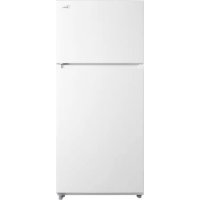
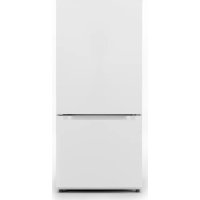
MRT18S2AWW - Fridge MIDEA - Free user manual and instructions
Find the device manual for free MRT18S2AWW MIDEA in PDF.



Download the instructions for your Fridge in PDF format for free! Find your manual MRT18S2AWW - MIDEA and take your electronic device back in hand. On this page are published all the documents necessary for the use of your device. MRT18S2AWW by MIDEA.
USER MANUAL MRT18S2AWW MIDEA
- Before using this product, please read this manual carefully and keep it for future reference. The design and specifications are subject to change without prior notice for product improvement. Consult with your dealer or manufacturer for details. Power supply: 115 V Frequency: 60Hz Capacity: 18 cu. ft. www.midea.comDear user THANK YOU and CONGRATULATIONS on your purchase of this high-quality Midea product. Your Midea refrigerator is designed for reliable, trouble-free performance. Please take a moment to register your new refrigerator. Register your new refrigerator at www.midea.com under the Support tab. For future reference, record your product model and serial numbers located on the back of the refrigerator above the compressor compartment. Model Number________________________________________ Serial Number_________________________________________ REFRIGERATOR SAFETY p. 3
- OPERATION REQUIREMENTS p. 6
- Location Requirements p. 6
- Electrical Requirements p. 7
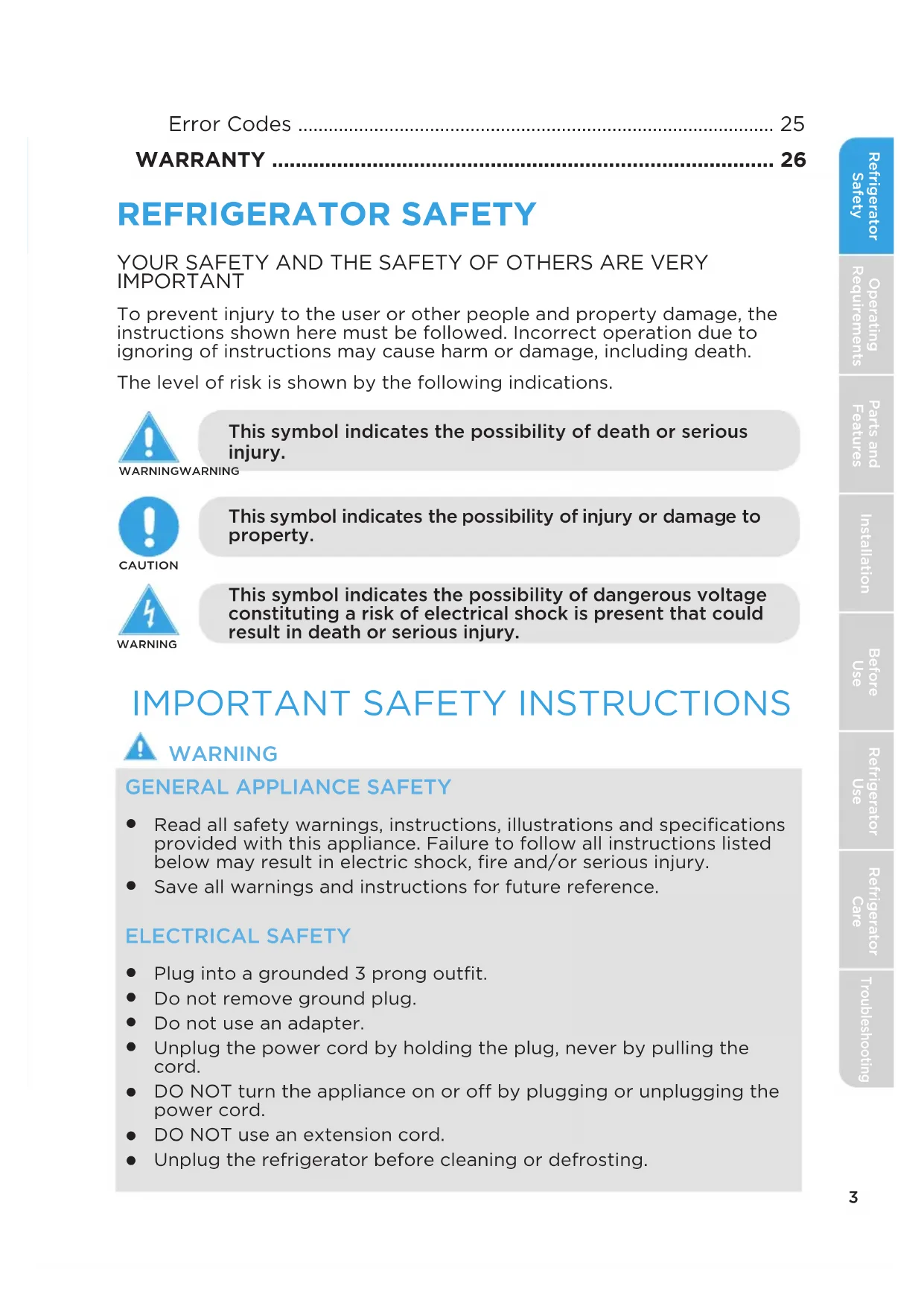
GENERAL APPLIANCE SAFETY
Read all safety warnings, instructions, illustrations and specifications provided with this appliance. Failure to follow all instructions listed below may result in electric shock, fire and/or serious injury.
Save all warnings and instructions for future reference. ELECTRICAL SAFETY
Plug into a grounded 3 prong outfit.
Do not remove ground plug.
Do not use an adapter.
Unplug the power cord by holding the plug, never by pulling the cord.
DO NOT turn the appliance on or off by plugging or unplugging the power cord.
Unplug the refrigerator before cleaning or defrosting.4 Refrigerator Safety Operating Requirements Parts and Features Installation Refrigerator Use Refrigerator Care Troubleshooting Before Use Grounding requirement
This refrigerator must be grounded. This refrigerator is equipped with a grounding plug. The plug must be inserted into an outlet that is properly installed and grounded.
Improper use of the grounding plug can result in a risk of electric shock. Consult a qualified electrician or service person if the grounding instructions are not completely understood or if doubt exists as to whether the refrigerator is properly grounded. LOCATION SAFETY
This refrigerator is intended to be used in household and similar environments.
Install in accordance with the manufacturer’s instructions.
This refrigerator should not be recessed or built-in an enclosed cabinet. It is designed for freestanding installation only. WARNING - Keep ventilation openings, in the refrigerator, clear of obstruction.
DO NOT install near any heat sources, such as radiators, heat registers, stoves, other cooking appliances or in direct sunlight.
DO NOT store or use gasoline or any flammable liquids inside or in the vicinity of this refrigerator.
Flammable refrigerant used. Follow handling instructions carefully. Risk of fire or explosion due to puncture of refrigerant tubing.
Flammable refrigerant used. Do not use mechanical devices to defrost freezer. Do not puncture refrigerant tubing.
This appliance is not intended for use by persons (including children) with reduced physical, sensory or mental capabilities, or lack of experience and knowledge, unless they have been given supervision or instruction concerning use of the appliance by a person responsible for their safety.
Keep key away from children.
Children should be supervised to ensure that they DO NOT play with the appliance.
DO NOT touch the interior of the freezer with wet hands. This could result in frostbite.
Clean only with a damp cloth. Use nonflammable cleaner. SERVICE SAFETY
Disconnect power before servicing.
Flammable refrigerant used. To be repaired only by trained service personnel. Do NOT puncture refrigerant tubing.5 Refrigerator SafetyOperating RequirementsParts and FeaturesInstallationRefrigerator Use Refrigerator Care TroubleshootingBefore Use
Refer all servicing to qualified service personnel. Do not repair or replace any part of this appliance unless specifically recommended in this manual. Servicing is required when the appliance has been damaged in any way, such as the power supply cord or plug is damaged, liquid has been spilled or objects have fallen into the appliance, the appliance has been exposed to rain or moisture, does not operate normally, or has been dropped.
If the supply cord is damaged, it must be replaced by the manufacturer, its service agent, or similarly qualified person, in order to avoid a hazard.
If component part is damaged, it must be replaced by the manufacturer, its service agent or similarly qualified persons in order to avoid a hazard.
Replace all parts and panels before operating.
SAVE THESE INSTRUCTIONS
THIS APPLIANCE IS FOR HOUSEHOLD USE ONLY State of California Proposition 65 Warnings:
WARNING: Cancer and Reproductive Harm
-www.P65Warnings.ca.gov. PROPER DISPOSAL WARNING Suffocation Hazard Before you throw away your old refrigerator:
Remove the door or lid so that children cannot hide or get trapped inside your old appliance.
Leave any shelves in place so that children may not easily climb inside.
Failure to follow these instructions can result in death or brain damage. IMPORTANT: Flammable gas and refrigerant used. It is the consumer’s responsibility to comply with Federal and Local regulations when disposing of this product. Refrigerants must be evacuated by a licensed, EPA certified refrigerant technician in accordance with established procedures.6 Refrigerator SafetyOperating RequirementsParts and FeaturesInstallationRefrigerator Use Refrigerator Care TroubleshootingBefore Use OPERATION REQUIREMENTS LOCATION REQUIREMENTS WARNING Explosion and Fire Hazard Keep flammable materials and vapors, such as gasoline, away from appliance. Failure to do so, can result in death, explosion or fire. This refrigerator is designed to be freestanding only, and should not be recessed or built-in. Place your refrigerator on a floor that is level and strong enough to support the refrigerator when it is fully loaded. Place your refrigerator where there is access to the required electrical connection. See “Electrical Requirements.” Locate the refrigerator away from direct sunlight and sources of heat, such as a stove, heater or radiator. NOTES:– Direct sunlight may affect the acrylic coating and heat sources may increase electrical consumption. – Extremely cold temperatures may also prevent the refrigerator from performing properly. Avoid locating the refrigerator in areas with high humidity. Adequate air circulation is required for efficient operation. Maintain the recommended clearance to ensure adequate air circulation. RECOMMENDED CLEARANCE
a 3" (7.6 cm) Clearance at the top, back and both sides of the refrigeratorNOTE: If you place the refrigerator next to a fixed wall, allow sufficient space on the hinge-side for the door to swing open.7 Refrigerator SafetyOperating RequirementsParts and FeaturesInstallationRefrigerator Use Refrigerator Care TroubleshootingBefore Use ELECTRICAL REQUIREMENTS WARNING Electrical Shock Hazard
Plug into a grounded 3 prong outlet.
Do not remove the ground prong from the power cord plug.
Do not use an adapter.
Do not use an extension cord.
Failure to do so can result in death, fire or electrical shock. IMPORTANT: A 115 Volt, 60 Hz., AC only, 15-amp fused, grounded electrical supply is required.
Use an electrical outlet that accepts the grounding prong. NOTE: The power cord is equipped with a 3-prong (grounding) plug which mates with a standard 3-prong (grounding) electrical outlet.
We recommend that the refrigerator be plugged into an electrical circuit serving ONLY this appliance.
Use an electrical outlet that cannot be turned off with a switch or pull- chain.
a Shelves ( 3 - wire shelf,
Do not puncture refrigerant tubing.
Follow handling instructions carefully.
Failure to do so can result in death, explosion or fire. IMPORTANT: Remove ALL exterior and interior packing materials including the foam packing between the exterior condenser and the refrigerator cabinet.
Do not puncture refrigerant tubing.
Follow handling instructions carefully.
Failure to do so can result in death, explosion or fire. IMPORTANT:
If the refrigerator has been in a horizontal position for any period of time, wait 24 hours to allow the refrigerant to settle before plugging in the refrigerator.
When moving the refrigerator, DO NOT tilt it beyond 45° from upright. NOTE: Tilting the refrigerator more than 45° could damage the compressor and the sealed system.10 Refrigerator Safety Operating Requirements Parts and Features Installation Refrigerator Use Refrigerator Care Troubleshooting Before Use LEVEL REFRIGERATOR IMPORTANT: Level the refrigerator for proper operation and to avoid cooling, frost and moisture problems that can occur when the door does not close properly.
1. Move the refrigerator to its final location. See “Move to Final Location.”
2. Place a carpenter's level on the top of the refrigerator cabinet.
3. Adjust the two leveling feet, (one foot located at each of the two front
corners of the refrigerator cabinet) until the refrigerator is level. NOTE: The leveling feet are easier to adjust if you have someone push against the top front of the refrigerator to take some weight off the feet. To Raise - Turn the leveling feet clockwise. To Lower - Turn the leveling feet counterclockwise.
REVERSE THE DOOR SWING
List of tools to be provided by the user Phillips-head Screwdriver Putty knife Flat-head Screwdriver 5/16" socket and ratchet Masking tape
1. Unplug your refrigerator and remove all food from the door shelves.
Remove all food from the inner door liner. Tape the freezer door in place with masking tape.11 Refrigerator Safety Operating Requirements Parts and Features Installation Refrigerator Use Refrigerator Care Troubleshooting Before Use
2. Remove the left cover plate and the right top hinge cover, then
unscrew screws and remove the right top hinge. Keep the screws to reuse. Left cover plate Right top hinge cover
3. Lift the freezer door up and away from your refrigerator.
4. Unscrew screws of middle hinge, remove the hinge, then lift the
refrigerator door up and away from your refrigerator. Save the screws to reuse. Center hinge
5. Unscrew screws of the bottom hinge, then remove the bottom hinge
from the bottom right side of the refrigerator.
6. Unscrew the hinge shaft from the right side of the bottom hinge and
move it to the left side, then secure the bottom hinge to the bottom left side of the refrigerator, using the screws you removed previously. Reattach the bottom hinge Hinge shaft Remove the bottom hinge Hinge shaft
7. Remove the sleeves from the top right of doors and hole cap from top
left of doors, and assemble them on the opposite sides.12 Refrigerator Safety Operating Requirements Parts and Features Installation Refrigerator Use Refrigerator Care Troubleshooting Before Use
8. Remove the refrigerator door stopper and install it on the other side of
the door. Remove the freezer door self-locking block and stopper save them to reuse take out the left self-locking block and stopper from the accessory bag in the refrigerator and installed on the left of door. Self-locking Stopper Hole cap Stopper Sleeves Sleeves
9. Put down the refrigerator door bottom hinge vertically, take out the
middle hinge of the other side from the accessory bag then assemble the middle hinge on. Attach the left center hinge13 Refrigerator Safety Operating Requirements Parts and Features Installation Refrigerator Use Refrigerator Care Troubleshooting Before Use
10. Put down the freezer door on the middle hinge vertically, then take out
the top hinge and cover of other side from accessory bag, assemble top hinge, hinge cover and hole cover. Top hinge Hole cover (The picture above is only for reference. The actual configuration will depend on the physical product.)
ICE MAKER INSTALLATION INSTRUCTIONS
(OPTIONAL) The refrigerator is ready for ice maker installation, if you need ice maker, optional icemaker kit model # IM1800MD is available from your retailer. Tools Required:
1/4 " copper supply line with shut off valve
1/4 " brass compression nut and ferrule
Minimum/Maximum inlet water pressure, 138/827 kPa (20/120 PSIG). Connect to potable water supply only. The copper tubing and shut off valve are available in a kit from your local hardware or plumbing supply store. Coil enough tubing at the back of the unit to allow movement for cleaning. WARNING Unplug the refrigerator. To eliminate the danger of electric shock during installation, you must unplug the refrigerator from its electrical outlet.14 Refrigerator Safety Operating Requirements Parts and Features Installation Refrigerator Use Refrigerator Care Troubleshooting Before Use
1. Disconnect the unit from the electrical supply.
2. Remove ice tray rack from freezer.
3. Move the freezer shelf to the next position.15
Refrigerator Safety Operating Requirements Parts and Features Installation Refrigerator Use Refrigerator Care Troubleshooting Before Use
4. In order to remove the plug, you
need to squeeze the two ends and pull the plug out, or need to use the tools such as a flat screw driver or needle nose plier. Plug
5. Carefully Remove the plugs /
label from inside the freezer compartment using a putty knife. Label
6. Peel away the label covering the
ice-maker installation hole. Remove Label
7. Using a pair of needle nose pliers,
remove the foam from the hole. Remove and Discard Foam
8. Insert the water inlet tube into
the small hole on the back of the refrigerator. Rotate the hose while inserting until the flat surface of the hose is secure against the back of the refrigerator.16 Refrigerator Safety Operating Requirements Parts and Features Installation Refrigerator Use Refrigerator Care Troubleshooting Before Use
9. Slide the hose through the hole of the
security bracket and the foam insulation pad, with the pad facing the rear of the refrigerator and affix the hose security bracket and foam insulation pad in place using the two (2) screws provided.
10. Push the water supply hose into the water
inlet hose as far as it will go and tighten the Nylon compression nut onto the water inlet hose until it is secure/tight. Then tighten the nut until it is secure but DO NOT overtighten using a wrench. (11)Water Inlet Tube (3)Water Tubing
11. Install the leveling bracket to the bottom
of the ice maker assembly with the screw provided. DO NOT TIGHTEN. This bracket will be tightened later in this installation. Leveling Bracket(7) Screw(6)
12. Start two (2) long ice maker mounting
screws into the freezer wall. Turn each screw five turns clockwise. (5) Ice Maker Mounting Screws
13. With the ice maker in one hand, plug the
wiring harness connector into the connector mounted on the top freezer panel. Make sure the connection is tight and secure. Wiring Harness Connector17 Refrigerator Safety Operating Requirements Parts and Features Installation Refrigerator Use Refrigerator Care Troubleshooting Before Use
14. Mount the ice maker assembly on to
the two (2) screws installed in step # 11. Tighten the screws. Be sure that the water inlet tube is securely inside the fill cup. Screw(5) Fill Tube
15. Adjust the leveling bracket to ensure
the ice maker assembly is totally level. The ice maker will be level when the gap between the freezer wall and the ice maker assembly is the same at the top and bottom. Once completely level, tighten the leveling bracket screw. (1) Ice Maker (6)Screw (7)Bracket Top Bottom
16. Reinstall the freezer shelf below the
ice maker assembly. Set the ice container below the ice maker assembly. (2) Ice Container
17. Connect the wiring harness to the
water valve as shown. Ensure the connection is secure. (10) Water valve
18. Install the mounting box on the
connecting terminal of the water valve and the wiring harness. After the cover is closed, fix the box cover and the mounting box firmly with screws. (12) Box cover (13) Mounting box18 Refrigerator Safety Operating Requirements Parts and Features Installation Refrigerator Use Refrigerator Care Troubleshooting Before Use
19. Locate the factory punched holes at
the lower right panel on the rear of the refrigerator.
20. Push up the white plastic ring at the bottom
of the valve until it doesn't move, then insert the water pipe into it and loosen the plastic ring. (3) Plastic Water Supply Tubing
21. Secure the plastic water tubing to the rear
of the refrigerator cabinet with the two (2) plastic clamps provided. ** NOTE ** Clean the area of the back of the unit where you will be placing the plastic clamp with household cleaner, ammonia or alcohol to provide a clean surface for the adhesive to adhere to. (9) Plastic Clamp BEFORE USE WAITING PERIOD
Before plugging the refrigerator into a grounded 3-prong electrical outlet, allow it to stand upright for approximately 2 hours. NOTE: This reduces the possibility of a malfunction in the cooling system from improper handling during transportation. CLEANING
1. Wash the refrigerator interior using a soft cloth dampened with a
baking soda solution (2 tablespoons baking soda mixed with 1 quart of warm water).
2. Using a soft cloth, thoroughly dry all surfaces.19
The storage life of frozen foods varies and the recommended storage time should not be exceeded. WARNING Electrical Shock Hazard
Plug into a grounded 3 prong outlet.
Do not remove the ground prong from the power cord plug.
Do not use an adapter.
Do not use an extension cord.
Failure to do so can result in death, fire or electrical shock.
1. Plug in your refrigerator. Wait for 30 minutes, and then open the
refrigerator door to determine if the refrigerator is working properly.
2. Place frozen food into the refrigerator as quickly as possible after
purchase. If there are instructions on the package, carefully follow these instructions regarding storage times.
Allow hot foods to cool to room temperature before placing them in the refrigerator. Foods that freeze too slowly may lose quality or spoil.
Overloading the refrigerator forces the compressor to run longer.
Wrap foods properly and wipe containers dry before placing them in the refrigerator. This cuts down on frost build-up inside the refrigerator.
Do not line refrigerator storage shelves with aluminum foil, wax paper or paper toweling. Liners interfere with cold air circulation, making the refrigerator less efficient.
Organize and label food to reduce door openings and extended searches. Remove as many items as needed at one time, and then close the door as soon as possible.
Do NOT add a large amount of unfrozen food to the refrigerator at one time. This will lower the cooling efficiency of the refrigerator.20 Refrigerator SafetyOperating RequirementsParts and FeaturesInstallationRefrigerator Use Refrigerator Care TroubleshootingBefore Use CONTROLS
a Setting button b LED1 COOL indicator c LED2 indicator d LED3 indicator e LED4 indicator f LED5 COOLEST indicator g LED6 Standby mode DISPLAY Once initially powered on, the display screen (including the key light) is on full display for 3 seconds. and then the refrigerator default setting is medium, and the LED 3 indicator will be illuminated. Normal operation display In case of a failure, the appropriate LED light show in combination the failure code (in recycling display). In case of no failures, the actual operation position of refrigerator will be on display. TEMPERATURE SETTING Each time the temperature setting is pressed once, the temperature setting changes one time. After the temperature setting has been completed, the refrigerator will run according to the set value after 25s. From left to right, the temperature is lower. The order of coldness settings is as follows:
LED1 LED2 LED3 LED4 LED521
Refrigerator Safety Operating Requirements Parts and Features Installation Refrigerator Use Refrigerator Care Troubleshooting Before Use STANDBY MODE To enter standby mode, press the setting for 3 seconds when the refrigerator is running. In standby mode, the compressor will not operate and the standby indicator light will be illuminated. To resume normal operation, just press the setting momentarily.
SETTING THE FREEZER TEMPERATURE
Mid COLD COLDER TEMP. CONTROL Turn the controls to adjust the freezer temperature. Place frozen food into the freezer as quickly as possible after purchase. Pay attention to the storage time on the food packaging instructions. The storage life of frozen foods varies and the recommended storage time should not be exceeded.22 Refrigerator SafetyOperating RequirementsParts and FeaturesInstallationRefrigerator Use Refrigerator Care TroubleshootingBefore Use REFRIGERATOR CARE Your refrigerator is designed for year-round use and requires minimal cleaning and maintenance. To keep your refrigerator running efficiently and odor free, we recommend that you clean the refrigerator regularly. CLEANING WARNING Electrical Shock Hazard
Unplug your appliance or disconnect power before cleaning.
Failure to do so can result in death, electric shock or personal injury. WARNING Explosion Hazard
Failure to do so can result in death, explosion or fire. IMPORTANT: To prevent damage to the finish, DO NOT use gasoline, benzine, thinner or other solvents, and DO NOT use abrasive cleaners.
3. Remove and wash the shelves with a mild detergent solution.
4. Wash the refrigerator interior using a soft cloth dampened with a
baking soda solution (2 tablespoons baking soda mixed with 1 quart of warm water).
5. Clean the gasket around the door. Gently wipe the gasket using a soft
cloth dampened with a mild detergent solution. NOTE: Gaskets must be kept clean and pliable to assure a proper seal.
6. Using a soft cloth, thoroughly dry all surfaces.
7. Plug in or reconnect power.
MOVING IMPORTANT: When moving your refrigerator, DO NOT tilt it beyond 45° from upright.
1. Unplug your refrigerator from the wall outlet.
Refrigerator Safety Operating Requirements Parts and Features Installation Refrigerator Use Refrigerator Care Troubleshooting Before Use STORAGE IMPORTANT: Do not store refrigerator in a location that is accessible to children.
1. Unplug your refrigerator from the electrical outlet.
4. Leave the door open slightly to avoid possible formation of
condensation, mold or odor. TROUBLESHOOTING IMPORTANT: DO NOT try to repair your refrigerator yourself. Doing so invalidates the warranty. GENERAL
PROBLEM POSSIBLE CAUSE SOLUTION
The refrigerator does not operate The refrigerator is unplugged. Make sure that the refrigerator power cord is fully plugged into the electrical outlet. The fuse on the circuit is blown or the circuit breaker is tripped. Check the house fuse / circuit breaker box and replace the fuse or reset the circuit breaker. Power failure. If a power failure occurs, the refrigerator turns off. Wait until the power is restored. The refrigerator door does not close completely Food packages are interfering with the door. Move or remove some food items. The door gaskets are dirty. Clean the door gaskets. The refrigerator may not be level. Level the refrigerator.24 Refrigerator Safety Operating Requirements Parts and Features Installation Refrigerator Use Refrigerator Care Troubleshooting Before Use
PROBLEM POSSIBLE CAUSE SOLUTION
Food in the refrigerator is not cold The door has been opened too often or was not closed properly. Make sure that the door is closed properly. A large amount of food was recently added. Allow time for the recently added food to cool, and then check again. The door is not closed completely. Check the door gasket and food distribution, and make sure that the door closes completely. The refrigerator has been disconnected for a period of time. Allow 4 hours for the refrigerator to cool completely before adding food. The temperature control is set too warm. Set the temperature control to a colder setting. The refrigerator makes unusual noises or vibrations The refrigerator may not be level. Adjust the leveling feet located on the front corners of the refrigerator until the refrigerator is level. The refrigerator cabinet is touching a wall. Move the refrigerator away from the wall. Metal parts undergo expansion and contraction. This is normal. Refrigerant is circulating throughout the system. This is normal. Moisture is building up in the interior of the refrigerator The door has been opened too often or was not closed properly. Make sure that the door is closed properly. The refrigerator is located in a humid area. Move the refrigerator to a drier location. The weather is hot and humid. This is normal.25 Refrigerator Safety Operating Requirements Parts and Features Installation Refrigerator Use Refrigerator Care Troubleshooting Before Use
PROBLEM POSSIBLE CAUSE SOLUTION
The compressor turns on and off frequently. The room temperature is hotter than normal. This is normal. A large amount of food was recently added. Allow time for the recently added food to cool, and then check again. The door is not closed completely or was opened too often. Check the door gasket and food distribution to make sure the door will close completely. The refrigerator has been disconnected for a period of time. Allow 4 hours for the refrigerator to cool completely before adding food. The temperature control was not set correctly. Set the temperature control to the correct setting. Refrigerator has an odor Refrigerator needs cleaning. Clean the refrigerator. See, “Cleaning.” Improperly wrapped food is giving off an odor. Wrap food tightly or seal before storing it in the refrigerator. ERROR CODES Fault Code Fault Description LED1 indicator and LED2 indicator Refrigerator temperature sensor circuit LED1 indicator and LED3 indicator Freezer defrost sensor LED1 indicator and LED4 indicator Ambient temperature sensor1 4867-9660-6836.6 08/2024
2 YEAR LIMITED WARRANTY
This warranty is provided to the original purchaser at retail (the “Purchaser” or “you”) by Midea America Corp. (“Midea” or “we”), which warrants all parts of this Product, as described below. Midea warrants this Product to the Purchaser for personal, family or household use. This warranty covers performance and quality issues in materials and workmanship that appear under normal use and maintenance appearing within two years from the date of delivery. This warranty gives you specific rights, and you may also have other rights that vary from state to state. WARRANTY LIMITATIONS This warranty is given only to the original purchaser at retail in either the United States or Canada and may not be transferred to any subsequent buyer. This warranty does not apply to purchasers of our products for use or resale in a business; a separate commercial warranty may protect those purchasers. This warranty does not cover any Product failure caused by: (a) Abuse, damage or use of the Product in violation of the Product instructions. (b) Modification to any Product or part. (c) Failure to maintain the Product or part as described in accordance with the Product instructions. (d) Faulty installation or application. (e) Use of parts or accessories not compatible with this Product. (f) Floods, fires, winds, lightning, accidents, corrosive atmosphere, or other conditions beyond Midea’s control. (g) Interruption in electrical service or inadequate electrical service. (h) Replacement of fuses and replacement or resetting of circuit breakers. (i) Frozen or broken water pipes, water damage, moisture intrusion, mold or other biological growth. (j) The use, combination or linking of the Product to other products, processes or materials not provided by Midea. WARRANTY REMEDY If any quality or performance issue covered by this warranty is discovered during the warranty period, we will, at our option, repair or replace any such Product. This warranty is limited to Product repair or replacement by an authorized Midea servicer or dealer and does not cover any shipping cost, labor cost, customs duties, inland logistics cost, or cost of service, including any diagnostics, removal, transportation, or reinstallation costs. If we ask, you must return the Product to us.
WARRANTY DISCLAIMER; EXCLUSION OF DAMAGES
This is the only express warranty to consumers that we offer on our Products. ANY IMPLIED WARRANTIES BY MIDEA, INCLUDING BUT NOT LIMITED TO WARRANTIES OF MERCHANTABILITY AND FITNESS FOR PARTICULAR PURPOSE, ARE LIMITED TO THE DURATION OF THIS EXPRESS WARRANTY. Some states and provinces do not allow the exclusion of express warranties and/or limitations on how long an implied warranty lasts, so the above exclusion and/or limitation may not apply to you. THE REMEDY DESCRIBED ABOVE IS THE ONLY ONE THAT WE WILL PROVIDE, EITHER UNDER THIS WARRANTY OR UNDER ANY WARRANTY ARISING BY OPERATION OF LAW. WE WILL NOT BE RESPONSIBLE FOR ANY CONSEQUENTIAL OR INCIDENTAL DAMAGES ARISING FROM THE BREACH OF THIS WARRANTY OR ANY OTHER WARRANTY, WHETHER EXPRESS OR IMPLIED, NEGLIGENCE OR OTHER TORT, OR ON ANY STRICT LIABILITY THEORY, INCLUDING BUT NOT2 4867-9660-6836.6 LIMITED TO LOST PROFITS. Some states do not allow the exclusion or limitation of incidental or consequential damages, so the above exclusion may not apply to you.
WARRANTY CLAIMS PROCESS
For more information or to make a warranty claim, please visit: https://www.midea.com/us/support Or contact us at: Telephone: 1-866-646-4332 Email: customerserviceusa@midea.com You must have Your bill of sale, delivery slip, or appropriate proof of purchase to submit a warranty claim. The date of delivery establishes the warranty period, should service be required. DISPUTE RESOLUTION ARBITRATION CLAUSE. IMPORTANT. PLEASE REVIEW THIS ARBITRATION CLAUSE. IT AFFECTS YOUR LEGAL RIGHTS. (a) Parties: This arbitration clause (this “Arbitration Clause”) affects your rights against Midea and any of its affiliates or employees or agents, successors, or assigns, all of whom together are referred to below as “we” or “us” for ease of reference. (b) ARBITRATION REQUIREMENT: EXCEPT AS STATED BELOW, ANY DISPUTE BETWEEN YOU AND ANY OF US SHALL BE DECIDED BY NEUTRAL, BINDING ARBITRATION RATHER THAN IN COURT OR BY JURY TRIAL. “Dispute” will be given the broadest possible meaning allowable by law. It includes any dispute, claim, or controversy arising from or relating to your purchase of this Product, any warranty upon the Product, or the Product’s condition. It also includes determination of the scope or applicability of this Arbitration Clause. The arbitration requirement applies to claims in contract and tort, pursuant to statute, or otherwise. (c) CLASS-ARBITRATION WAIVER: ARBITRATION IS HANDLED ON AN INDIVIDUAL BASIS. IF A DISPUTE IS ARBITRATED, YOU AND WE EXPRESSLY WAIVE ANY RIGHT TO PARTICIPATE AS A CLASS REPRESENTATIVE OR CLASS MEMBER ON ANY CLASS CLAIM YOU MAY HAVE AGAINST US OR WE AGAINST YOU, OR AS A PRIVATE ATTORNEY GENERAL OR IN ANY OTHER REPRESENTATIVE CAPACITY, TO THE MAXIMUM EXTENT PERMITTED BY LAW. YOU AND WE ALSO WAIVE ANY RIGHT TO CLASS ARBITRATION OR ANY CONSOLIDATION OF INDIVIDUAL ARBITRATIONS. (d) Discovery and Other Rights: Discovery and rights to appeal in arbitration are generally more limited than in a lawsuit. This applies to both you and us. Other rights that you or we would have in court may not be available in arbitration. Please read this Arbitration Clause and consult the rules of the arbitration organizations listed below for more information. (e) SMALL CLAIMS COURT OPTION: YOU MAY CHOOSE TO LITIGATE ANY DISPUTE BETWEEN YOU AND ANY OF US IN SMALL CLAIMS COURT, RATHER THAN IN ARBITRATION, IF THE DISPUTE MEETS ALL REQUIREMENTS TO BE HEARD IN SMALL CLAIMS COURT. (f) Governing Law: For residents of the United States, the procedures and effect of the arbitration will be governed by the Federal Arbitration Act (9 U.S.C. § 1 et seq.) rather than by state law concerning arbitration. For residents of Canada, the procedures and effect of the arbitration will be governed by the applicable arbitration law of the province in which you purchased your Product. The law governing your substantive warranty rights and other claims will be the law of the state or province in which you purchased your Product. Any court having jurisdiction may enter judgment on the arbitration award.3 4867-9660-6836.6 (g) Rules of the Arbitration: If the amount in controversy is less than $250,000, the arbitration will be decided by a single arbitrator. If the amount in controversy is greater than or equal to $250,000, the arbitration will be decided by a panel of three arbitrators. The arbitrator(s) will be chosen pursuant to the rules of the administering arbitration organization. United States residents may choose JAMS (1920 Main Street, Ste. 300, Irvine, CA 92614, www.jamsadr.com), or, subject to our approval, any other arbitration organization. In addition, Canadian residents may choose the ADR Institute of Canada (234 Eglinton Ave. East, Suite 405, Toronto, Ontario, M4P 1K5, www.amic.org). These organizations’ rules can be obtained by contacting the organization or visiting its website. If the chosen arbitration organization’s rules conflict with this Arbitration Clause, the provisions of this Arbitration Clause control. The award of the arbitrator(s) shall be final and binding on all parties. (h) Location of the Arbitration Hearing: Unless applicable law provides otherwise, the arbitration hearing for United States residents will be conducted in the federal judicial district in which you reside (in your hometown area) or, for Canadian residents, in the province in which you reside, and, if you choose, will be in-person. (i) Costs of the Arbitration: Each party is responsible for its own attorney, expert, and other costs and fees unless applicable law requires otherwise. Notwithstanding the preceding sentence, and unless applicable law requires otherwise, if you are a consumer under the JAMS rules or the rules of another agreed upon arbitration administrator, Midea will pay or reimburse you for all reasonable fees or costs to the extent required by law or the applicable arbitration administrator’s rules. Whether or not required by law or such rules, if you prevail at arbitration on any claim against Midea, Midea will reimburse you for any reasonable fees paid to the arbitration administrator in connection with the arbitration proceedings. Under no circumstances will Midea seek from you payment or reimbursement of any reasonable fees that Midea incurs in connection with the arbitration. If you are required to advance any fees or costs to JAMS or other agreed upon arbitration administrator, but you ask Midea to do so in your stead, Midea will consider and respond to your request. (j) Survival and Enforceability of this Arbitration Clause: This Arbitration Clause shall survive the expiration or termination, or any transfer, of the warranty on your Product. If any part of this Arbitration Clause, except waivers of class-action rights, is found to be unenforceable for any reason, the remainder of this clause and the warranty shall remain enforceable. If, in a case in which class-action allegations have been made, the waiver of class-action rights under this warranty is found to be unenforceable with respect to any part of the dispute, the parts of the dispute as to which the waiver of class-action rights have been found unenforceable will be severed and will proceed in court without reference or application of this Arbitration Clause. Any remaining parts will proceed in arbitration. QUEBEC RESIDENTS The arbitration provisions of this warranty shall not apply to residents of Quebec.Réfrigérateur à congélateur supérieur version A - 12 - 2019 MODÈLE NUMÉRO MRT18S2AWW