ManualGo.com
EW30DS75PS - Cooker ELECTROLUX - Free user manual and instructions
Find the device manual for free EW30DS75PS ELECTROLUX in PDF.

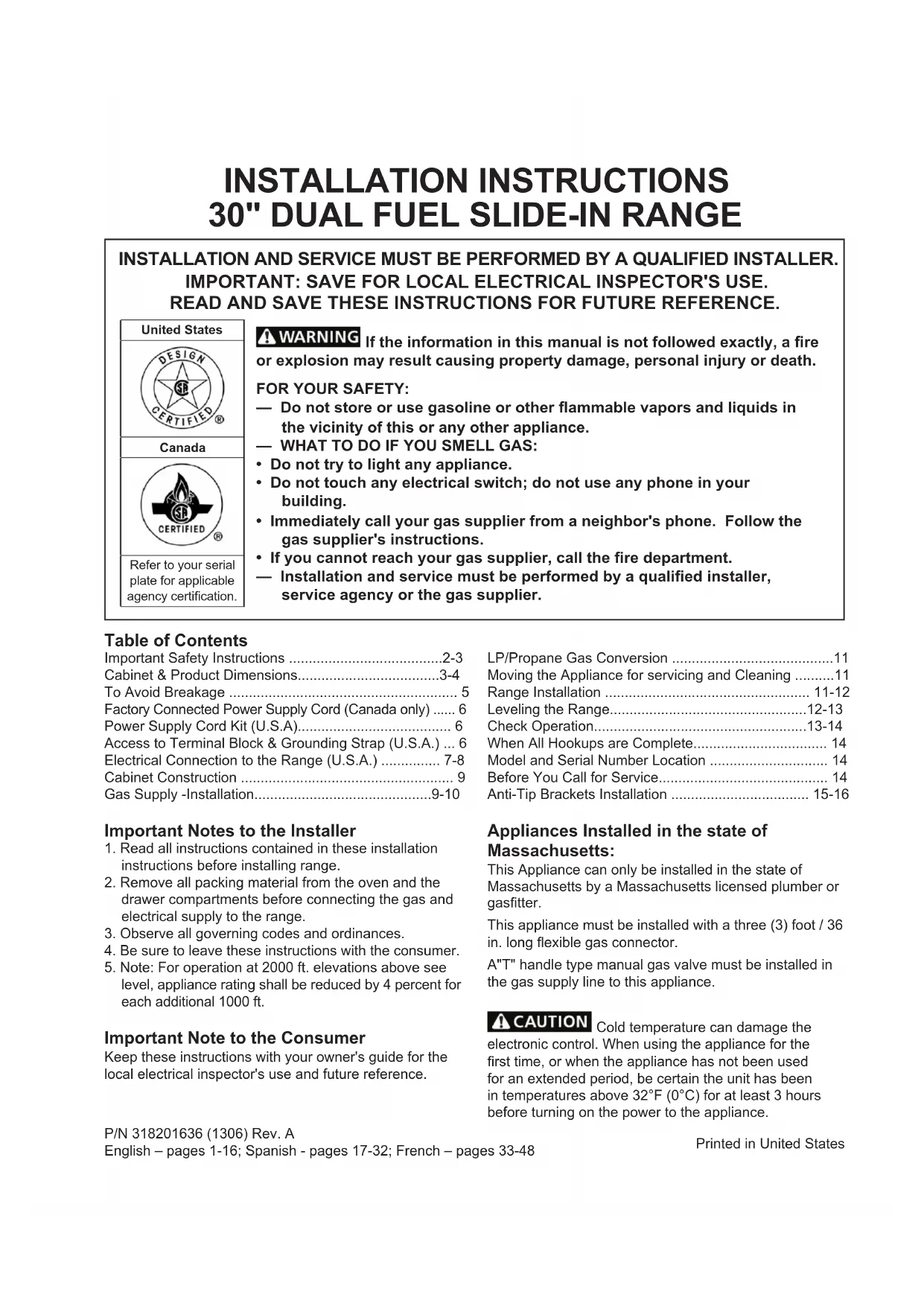


Download the instructions for your Cooker in PDF format for free! Find your manual EW30DS75PS - ELECTROLUX and take your electronic device back in hand. On this page are published all the documents necessary for the use of your device. EW30DS75PS by ELECTROLUX.
USER MANUAL EW30DS75PS ELECTROLUX
Printed in United States Important Notes to the Installer
1. Read all instructions contained in these installation
instructions before installing range.
2. Remove all packing material from the oven and the
drawer compartments before connecting the gas and electrical supply to the range.
3. Observe all governing codes and ordinances.
4. Be sure to leave these instructions with the consumer.
5. Note: For operation at 2000 ft. elevations above see
- level, appliance rating shall be reduced by 4 percent for each additional 1000 ft. Important Note to the Consumer Keep these instructions with your owner's guide for the local electrical inspector's use and future reference. INSTALLATION AND SERVICE MUST BE PERFORMED BY A QUALIFIED INSTALLER. IMPORTANT: SAVE FOR LOCAL ELECTRICAL INSPECTOR'S USE. READ AND SAVE THESE INSTRUCTIONS FOR FUTURE REFERENCE. United StatesCanadaRefer to your serial plate for applicable agency certication. Table of Contents Important Safety Instructions p. 2
- -3 Cabinet & Product Dimensions p. 3
- -4 To Avoid Breakage p. 5
- Factory Connected Power Supply Cord (Canada only) p. 6
- Power Supply Cord Kit (U.S.A) p. 6
- Access to Terminal Block & Grounding Strap (U.S.A.) p. 6
- Electrical Connection to the Range (U.S.A.) p. 7
- -8 Cabinet Construction p. 9
- Gas Supply -Installation p. 9
- -10 LP/Propane Gas Conversion p. 11
- Moving the Appliance for servicing and Cleaning p. 11
- Range Installation p. 11
- -12 Leveling the Range p. 12
- -13 Check Operation p. 13
- -14 When All Hookups are Complete p. 14
- Model and Serial Number Location p. 14
- Before You Call for Service p. 14
- Anti-Tip Brackets Installation -16 If the information in this manual is not followed exactly, a re or explosion may result causing property damage, personal injury or death. FOR YOUR SAFETY: — Do not store or use gasoline or other ammable vapors and liquids in the vicinity of this or any other appliance. — WHAT TO DO IF YOU SMELL GAS: p. 15
- Do not try to light any appliance.
- Do not touch any electrical switch; do not use any phone in your building.
- Immediately call your gas supplier from a neighbor's phone. Follow the gas supplier's instructions.
- If you cannot reach your gas supplier, call the re department. — Installation and service must be performed by a qualied installer, service agency or the gas supplier. P/N 318201636 (1306) Rev. A English – pages 1-16; Spanish - pages 17-32; French – pages 33-48 Appliances Installed in the state of Massachusetts: This Appliance can only be installed in the state of Massachusetts by a Massachusetts licensed plumber or gastter. This appliance must be installed with a three (3) foot / 36 in. long exible gas connector. A"T" handle type manual gas valve must be installed in the gas supply line to this appliance. Cold temperature can damage the electronic control. When using the appliance for the rst time, or when the appliance has not been used for an extended period, be certain the unit has been in temperatures above 32°F (0°C) for at least 3 hours before turning on the power to the appliance.2
30" DUAL FUEL SLIDE-IN RANGE INSTALLATION INSTRUCTIONS
(Models with an Electric Oven and a Gas Cooktop) Installation of this range must conform with local codes or, in the absence of local codes, with the National Fuel Gas Code ANSI Z223.1/NFPA54 or CAN/ACG-B149.1 and CAN/ACG-B149.2. This range has been design certied by CSA international. As with any appliance using gas and generating heat, there are certain safety precautions you should follow. You will nd them in the Use and Care Guide, read it carefully.
- Air curtain or other overhead hoods, which operate by blowing a downward air ow on to a range, shall not be used in conjunction with gas ranges other than when the hood and range have been designed, tested and listen by an independent test laboratory for use in combination with each other.
- Be sure your range is installed and grounded properly by a qualied installer or service technician.
- This range must be electrically grounded in accordance with local codes or, in their absence, with the National Electrical Code ANSI/NFPA No. 70—latest edition in United States or with CSA Standard C22.1, Canadian Electrical Code, Part 1 in Canada.
- The installation of appliances designed for manufactured (mobile) home installation must conform with Manufactured Home Construction and Safety Standard, title 24CFR, part 3280 [Formerly the Federal Standard for Mobile Home Construction and Safety, title 24, HUD (part 280)] or when such standard is not applicable, the Standard for Manufactured Home Installation 1982 (Manufactured Home Sites, Communities and Setups), ANSI Z225.1/NFPA 501A-latest edition, or with local codes in United States and with CAN/CSA-Z240 MH in Canada.
- Make sure the wall coverings around the range can withstand the heat generated by the range.
- Before installing the range in an area covered with linoleum or any other synthetic oor covering, make sure the oor covering can withstand heat at least 90°F above room temperature without shrinking, warping or discoloring. Do not install the range over carpeting unless you place an insulating pad or sheet of ¼" (0,6 cm) thick plywood between the range and carpeting.
- Do not obstruct the ow of combustion air at the oven vent nor around the base or beneath the lower front panel of the range. Avoid touching the vent openings or nearby surfaces as they may become hot while the oven is in operation. This range requires fresh air for proper burner combustion. Never leave children alone or unattended in the area where an appliance is in use. As children grow, teach them the proper, safe use of all appliances. Never leave the oven door open when the range is unattended. Stepping, leaning or sitting on the doors or drawers of this range can result in serious injuries and can also cause damage to the range.
- Do not store items of interest to children in the cabinets above the range. Children could be seriously burned climbing on the range to reach items.
- To eliminate the need to reach over the surface burners, cabinet storage space above the burners should be avoided.
- Adjust surface burner ame size so it does not extend beyond the edge of the cooking utensil. Excessive ame is hazardous. A child or adult can tip the range and • be killed. Verify the anti-tip device has been • installed to oor or wall as per installation instructions. Tip Over Hazard Ensure the anti-tip device is re-engaged to oor or • wall when the range is moved. Do not operate the range without the anti-tip device • in place and engaged. Failure to follow these instructions can result in • death or serious burns to children and adults. To check if the anti-tip bracket is installed properly, use both arms and grasp the rear edge of range back. Carefully attempt to tilt range forward. When properly installed, the range should not tilt forward. Refer to the anti-tip bracket installation instructions supplied with your range for proper installation. This manual contains important safety symbols and instructions. Please pay attention to these symbols and follow all instructions given. This symbol will help alert you to situations that may cause serious bodily harm, death or property damage. This symbol will help alert you to situations that may cause bodily injury or property damage. IMPORTANT SAFETY INSTRUCTIONS30" DUAL FUEL SLIDE-IN RANGE INSTALLATION INSTRUCTIONS (Models with an Electric Oven and a Gas Cooktop)
A.HEIGHT WIDTHC. COOKTOP WIDTHD. DEPTH TO FRONT OF RANGEE. CUTOUT WIDTH*(Countertop and Cabinet)F. CUTOUTDEPTHG. HEIGHT OF COUNTERTOP35 5/8" (90,5 cm) - 36 5/8" (93 cm)30"(76,2 cm)31½"(80 cm)28 5/16"(71,9 cm)30±1/16"(76,2±0,15 cm)21 3/4" (55,2 cm) Min.22 1/8" (56,2 cm) Max24" (61 cm) Min. with backguard36 5/8" (93 cm) Max.35 7/8" (91,1 cm) Min. IMPORTANT: Cabinet and countertop width should match the cutout width.• Do not use the oven as a storage space. This creates a potentially hazardous situation.• Never use your range for warming or heating the room. Prolonged use of the range without adequate ventilation can be dangerous.• Do not store or use gasoline or other ammable vapors and liquids near this or any other appliance. Explosions or res could result.• In the event of an electrical power outage, the surface burners can be lit manually. To light a surface burner, hold a lit match to the burner head and slowly turn the Surface Control knob to LITE. Use caution when lighting surface burners manually.• Reset all controls to the "off" position after using a programmable timing operation.FOR MODELS WITH SELF-CLEAN FEATURE:• Remove broiler pan, food and other utensils before self-cleaning the oven. Wipe up excess spillage. Follow the precleaning instructions in the Use and Care Guide. Cabinet dimensions4
30" DUAL FUEL SLIDE-IN RANGE INSTALLATION INSTRUCTIONS
(Models with an Electric Oven and a Gas Cooktop) 1 1/8" (2,86 cm) FRONT OF CABINET
1. Do not pinch the power supply cord or
the exible gas conduit between the range and the wall.
2. Do not seal the range to the side
between the cooktop and the bottom of the cabinet when the bottom of wood or metal cabinet is protected by not less than ¼" (0,64 cm) ame retardant millboard covered with not less than No. 28 MSG sheet metal, 0,015" (0,4 mm) stainless steel, 0,024" (0,6 mm) aluminum, or 0,020" (0,5 mm) copper. 30" (76,2 cm) minimum clearance when the cabinet is unprotected.
4. For cutouts below 22 7/8" (58,1 cm),
appliance will slightly show out of the cabinet.
5. Allow at least 19 ¼" (48,9 cm)
clearance for door depth when it is open.
- IMPORTANT: To avoid cooktop breakage for cutout width (E dimension) of more than 30 1/16" (76,4 cm), make sure the appliance is centered in the counter opening while pushing into it. Raise leveling legs and the rear adjustable wheels at a higher position than the cabinet height (see page 5), insert the appliance in the counter and then level. Make sure the unit is supported by the leveling legs at the front and the wheels at the back and NOT by the cooktop itself.
To avoid breakage: Do NOT handle or manipulate the unit by the cooktop. The counter-top around the cut-out should be at and leveled (see hatched area on illustration 1). Before installing the unit, measure the heights of the two (2) cabinet sides (H1-4), front and back (Illustration 1) from the oor to the top of the counter. Illustration 1 Shave Raised Edge to Clear Space for a 31½" (80 cm) Wide Cooktop. 1 ½" Max. (3,8 cm Max.) Remove the protective channels on each side of the cooktop (if provided). Slide the unit into the cabinet. Make sure the center of the unit is aligned with the center of the cabinet cut-out. Illustration 2 To successfully install the range, the initial level height from oor to underside of cooktop frame should be at least 1/16" taller than cabinet sides as measured in step 2. Level the range using the two (2) front leveling legs and the two (2) adjustable leveling wheel, so that the height from the oor to the underside of the metal ange is greater than the tallest cabinet After the installation, MAKE SURE that the unit is supported by the two front leveling legs and the two adjustable leveling wheels and NOT by the cooktop. Metal Flange The metal ange under each side of the cooktop MUST be placed over the cabinet countertop for proper unit support. The cooktop should NOT rest directly on the countertop (see illustration 2) or else it could cause damage to the cooktop voiding the warranty. Level the unit if needed. measurement by at least 1/16" (see Ill. 2). Remove and discard the two rear leveling legs, they are only in place to solidify the unit for the transport.
(Models with an Electric Oven and a Gas Cooktop) Electrical Shock Hazard
- Electrical ground is required on this appliance.
- Do not connect to the electrical supply until appliance is permanently grounded.
- Disconnect power to the circuit breaker or fuse box before making the electrical connection.
- This appliance must be connected to a grounded, metallic, permanent wiring system, or a grounding connector should be connected to the grounding terminal or wire lead on the appliance. Failure to do any of the above could result in a re, personal injury or electrical shock. Figure 1
Factory Connected Power Supply Cord (Canada only) This range is equipped with a factory-connected power cord (see Figure 1). Cord must be connected to a grounded 120/240 volt or 120/208 volt range outlet. If not outlet is available, have one installed by a qualied electrician.
Access to Terminal Block & Grounding Strap (U.S.A.) Remove the wire cover here for access to terminal block Figure 2
Power Supply Cord Kit (U.S.A.) The user is responsible for connecting the power supply cord to the connection block located behind the back panel access cover. This appliance may be connected by means of permanent "hard wiring" (exible armored or nonmetallic shielded copper cable), or by means of a power supply cord kit. Only a power supply cord kit rated at 125/250 volts 30 Amps should be used. Cord must have either 3 or 4 conductors. For mobile homes, new installations, recreational vehicles, or areas where local codes do not permit grounding through neutral, a 4 conductor power supply cord kit rated at 125/250 volts 30 Amps marked for use with ranges should be used. Terminals on end of wires must be either closed loop or open-end spade lugs with upturned ends. Cord must have strain-relief clamp. NOTE: Electric Slide-in Range is shipped from factory with 1 1/8" (2.9 cm) dia. hole as shown on gure 3. If a larger hole is required, punch out the knockout. Breaker Size: On a unit with 4800W or less at 240V (see serial plate), a 20A circuit breaker or time-delay fuse is recommended on both side of the line (red and black wire). DO NOT fuse the neutral (white wire) or the ground (green or bare wire). On a unit with higher than 4800W at 240V (see serial plate), follow the above recommendations but use a 30A circuit breaker or time-delay fuse. Risk of re or electrical shock exists if an incorrect size range cord kit is used, the Installation Instructions are not followed, or the strain relief bracket is discarded. Do not loosen the nuts which secure the factory-installed range wiring to terminal block while connecting range. Electrical failure or loss of electrical connection may occur.30" DUAL FUEL SLIDE-IN RANGE INSTALLATION INSTRUCTIONS (Models with an Electric Oven and a Gas Cooktop)
Four Conductor Wire Connection to Range (mobile homes) Where local codes does NOT permit connection of the frame grounding conductor to the neutral wire of the copper power supply cord (see Figure 4):
1. Remove the screw which is xing the rear wire
cover, then remove the rear wire cover (access cover) to expose range terminal connection block (see Figure 2).
2. Remove the grounding strap from the terminal
block and from the appliance frame.
3. Using the nuts supplied with the literature package,
connect the ground wire (green) of the copper power supply cord to the frame of the appliance with the ground screw, using the hole in the frame where the ground strap was removed (see Figure 4).
4. Connect the neutral of the copper power supply
cord to the center silver-colored terminal of the terminal block, and connect the other wires to the outer terminals. Match wires and terminals by color (red wires connected to the right terminal, black wires connected to the left terminal).
5. Put back the rear wire cover using the screw
Electrical Connection to the Range (U.S.A.) This appliance is manufactured with the neutral terminal connected to the frame. Three Conductor Wire Connection to Range (The 3-conductor cord or cable must be replaced with a 4-conductor cord or cable where grounding through the neutral conductor is prohibited in new installations, mobile homes, recreational vehicles or in other areas where local codes do not permit neutral grounding) If local codes permit connection of the frame grounding conductor to the neutral wire of the copper power supply cord (see Figure 3):
1. Remove the screw which is xing the rear wire
cover, then remove the rear wire cover (access cover) to expose range terminal connection block (see Figure 2).
2. Using the nuts supplied in the literature package,
connect the neutral white wire of the copper power supply cord to the center silver-colored terminal of the terminal block, and connect the other wires to the outer terminals. Match wires and terminals by color (red wires connected to the right terminal, black wires connected to the left terminal).
3. Put back the rear wire cover using the screw
removed on step 1. This appliance is manufactured with the frame grounded by connection of a grounding strap between the neutral power supply terminal and the frame. If used in USA, in a new branch circuit installation (1996 NEC), mobile home or recreational vehicle, where local code do not permit grounding through neutral (white) wire or in Canada; remove the grounding strap from the frame and cut the other end, near the neutral terminal. Connect the appliance in usual manner. Figure 3 Silver Colored Terminal 1 1/8" (2,9 cm) Dia. Direct Connection Hole. Punch Out Knockout for 1 3/8" (3,5 cm) Dia. Cord Kit Hole. To 240 V Receptacle A User Supplied Strain-relief Must Be Installed at This Location. Black Wire Terminal Block Cord Mounting Plate Neutral (White Wire) Grounding Strap Red Wire8
30" DUAL FUEL SLIDE-IN RANGE INSTALLATION INSTRUCTIONS
(Models with an Electric Oven and a Gas Cooktop) Direct Electrical Connection to the Circuit Breaker, Fuse Box or Junction Box If the appliance is connected directly to the circuit breaker, fuse box or junction box, use exible, armored or nonmetallic sheathed copper cable (with grounding wire). Supply a U.L. listed strain-relief at each end of the cable. At the appliance end, the cable goes through the Direct Connection Hole (see Figure 4) on the Cord Mounting Plate. Wire sizes (copper wire only) and connections must conform to the rating of the appliance. Where local codes permit connecting the appliance-grounding conductor to the neutral (white) wire (see Figure 5): (The 3-conductor cord or cable must be replaced with a 4-conductor cord or cable where grounding through the neutral conductor is prohibited in new installations, mobile homes, recreational vehicles or in other areas where local codes do not permit neutral grounding)
1. Disconnect the power supply.
2. In the circuit breaker, fuse box or junction box
connect the appliance and residence cable wires as shown in gure 5. Figure 6 – 4-Wire Electrical System (Example: Junction Box) Figure 5 3-Wire (Grounded Neutral) Electrical System (Example: Junction Box) Where local codes DO NOT permit connecting the appliance-grounding conductor to the neutral (white) wire, or if connecting to 4-wire electrical system (see Figure 6):
1. Disconnect the power supply.
2. Separate the green (or bare copper) and white
appliance cable wires.
3. In the circuit breaker, fuse box or junction box:
connect appliance and residence cable wires as shown in gure 6. Terminal Block Silver Colored Terminal Red Wire Neutral (White Wire) Ground (Bare Copper Wire) To 240 V Receptacle A User Supplied Strain-relief Must Be Installed at This Location Black Wire 1 1/8" (2,9cm) Dia. Direct Connection Hole. Punch Out Knockout for 1 3/8" (3,5 cm) Dia. Cord Kit Hole. NOTE: Be sure to remove the supplied grounding strap. Figure 430" DUAL FUEL SLIDE-IN RANGE INSTALLATION INSTRUCTIONS (Models with an Electric Oven and a Gas Cooktop)
column (1,25 kPa) Natural gas. For LP/Propane gas, the regulator must be set for 10" (25,4 cm) water column (2,5 kPa) manifold pressure; the inlet pressure must be at least 11"(27,9 cm) water column (2,75 kPa). The supply line should be equipped with an approved shutoff valve (see Figure 11). This valve should be located in the same room as the range and should be in a location that allows ease of opening and closing. Do not block access to the shutoff valve. The valve is for turning on or shutting off gas to the appliance. Open the shutoff valve in the gas supply line. Wait a few minutes for gas to move through the gas line. The gas supply between the shutoff valve and the regulator may be connected by rigid piping or by A.G.A./C.G.A.-approved exible metallic union- connected piping where local codes permit use. The gas supply piping can be through the back wall (Figure 8, zone 1) or through the oor (Figure 8, zone 2): Zone 1 - Through the Back Wall (7" X 6") - The best place to have your gas line in is between 1" (2,5 cm) and 8" (20,3 cm) from the oor and within 3" (7,6 cm) from the center line. Zone 2 - Through the Floor (~2" X 24") - The gas line can also come through the floor within 12" (30,5 cm) from the center line against the back wall. Min. Cutout Width Formed or tile countertop trimmed ¾" (1,9 cm) back at front corners of countertop opening. Figure 7
Cabinet Construction To eliminate the risk of burns or re by reaching over heated surface units, do not have cabinet storage space above the range. If there is cabinet storage space above range, reduce risk by installing a range hood that projects horizontally a minimum of 5" (12,7 cm) beyond the bottom of the cabinet. Countertop Preparation
- The cooktop sides of the range t over the cutout edge of your countertop.
- If you have a square nish (at) countertop, no countertop preparation is required. Cooktop sides lay directly on edge of countertop.
- Formed front-edged countertops must have molded edge shaved at 3/4" (1,9 cm) from each front corner of opening (Figure 7).
- Tile countertops may need trim cut back 3/4" (1,9 cm) from each front corner and/or rounded edge attened (Figure 7).
- If the existing cutout width is greater than 30 1/16" (76,4 cm), reduce the ¾" (1,9 cm) dimension.
- Countertop must be level. Place a level on the countertop, rst side to side, then front to back. If the countertop is not level, the range will not be level. The oven must be level for satisfactory baking results. Cooktop sides of range t over edges of countertop opening.
Gas Supply – Installation When shipped from the factory, this unit is designed to operate on 4" (10,16 cm) water column (1,0 kPa) Natural gas manifold pressure. A convertible pressure regulator is connected to the range manifold and MUST be connected in series with the gas supply line. To access the regulator, remove the drawer. For proper operation, the maximum inlet pressure to the regulator should be no more than 14" (35,56 cm) of water column pressure (3,5 kPa). The inlet pressure to the regulator must be at least 1" (,25 kPa) greater than the regulator manifold pressure setting. The regulator is set for 4" (10,16 cm) water column (1,0 kPa) Natural gas manifold pressure; the inlet pressure must be at least 5" (12,60 cm) water Figure 8 Seal the openings Seal any openings in the wall behind the range and in the oor under the range after gas supply line is installed. Connect the range to the gas supply Important: Remove all packing material and literature from range before connecting gas and electrical supply. To prevent leaks, put pipe joint sealant on all external pipe threads. Your regulator is in location as shown in gure 9. Do not allow regulator to rotate on pipe when tightening ttings.10
30" DUAL FUEL SLIDE-IN RANGE INSTALLATION INSTRUCTIONS
(Models with an Electric Oven and a Gas Cooktop) All connections must be wrench-tightened Figure 10 FlareUnionFlareUnion GAS FLOW ManualShutoffValvePressureRegulator
Off FlexibleConnectorAccess Cap Nipple Nipple Shutoff Valve -Open positionto applianceto gas supply line Figure 11 Connection to Pressure Regulator The regulator is already installed on the appliance. Do not make the connection too tight. The regulator is die cast. Overtightening may crack the regulator resulting in a gas leak and possible re or explosion. Assemble the exible connector from the gas supply pipe to the pressure regulator in the following order:
1. manual shutoff valve (not supplied)
2. 1/2" nipple (not supplied)
3. 1/2" are union adapter (not supplied)
4. exible connector (not supplied)
5. 1/2" are union adapter (not supplied)
6. 1/2" nipple (not supplied)
7. pressure regulator (supplied)
The gas supply line to the shutoff valve should be 1/2" (1,27 cm) or 3/4" (1,9 cm) solid pipe. The user must know the location of the main shutoff valve and have easy access to it. When using exible gas conduit on the range, allow sufcient slack to pull the range outside the cutout for cleaning or servicing. NOTE: Do not allow the exible conduit to get pinched between the wall and the range. To visually check, remove the range drawer. Use pipe-joint compound made for use with Natural and LP/Propane gas to seal all gas connections. If exible connectors are used, be certain connectors are not kinked. The supply line must be equipped with an approved manual shutoff valve. This valve should be located in the same room as the range and should be in a location that allows ease of opening and closing. Do not block access to the shutoff valve. The valve is for turning on or shutting off gas to the appliance. Once regulator is in place, open the shutoff valve in the gas supply line. Wait a few minutes for gas to move through the gas line. Leak testing of the appliance shall be conducted according to the manufacturer's instructions. Check for leaks. After connecting the range to the gas supply, check the system for leaks with a manometer. If a manometer is not available, turn on the gas supply and use a liquid leak detector at all joints and connections to check for leaks. Do not use a ame to check for leaks from gas connections. Checking for leaks with a ame may result in a re or explosion. All openings in the wall or oor where the range is to be installed must be sealed. Tighten all connections if necessary to prevent gas leakage in the cooktop or supply line. Disconnect this range and its individual shutoff valve from the gas supply piping system during any pressure testing of the system at test pressures greater than 1/2 psig (3,5 kPa or 14" (35,56 cm) water column). Isolate the range from the gas supply piping system by closing its individual manual shutoff valve during any pressure testing of the gas supply piping system at test pressures equal to or less than 1/2 psig (3,5 kPa or 14" (35,56 cm) water column). Pressure regulator location Figure 930" DUAL FUEL SLIDE-IN RANGE INSTALLATION INSTRUCTIONS (Models with an Electric Oven and a Gas Cooktop)
LP/Propane Gas Conversion This appliance can be used with Natural gas or LP/ Propane gas. It is shipped from the factory for use with natural gas. If you wish to convert your range for use with LP/ Propane gas, use the supplied xed orices located in a bag containing the literature marked "FOR LP/PROPANE GAS CONVERSION." Follow the instructions packaged with the orices. The conversion must be performed by a qualied service technician in accordance with the manufacturer's instructions and all local codes and requirements. Failure to follow these instructions could result in serious injury or property damage. The qualied agency performing this work assumes responsibility for the conversion. Failure to make the appropriate conversion can result in personal injury and property damage.
Moving the Appliance for Servicing and Cleaning Turn off the range line fuse or circuit breakers at the main power source, and turn off the manual gas shut-off valve. Make sure the range is cold. Remove the service drawer (warmer drawer on some models) and open the oven door. Lift the range at the front and slide it out of the cut-out opening without creating undue strain on the exible gas conduit. Make sure not to pinch the exible gas conduit at the back of the range when replacing the unit into the cut-out opening. Replace the drawer, close the door and switch on the electrical power and gas to the range.
Range Installation Important Note: Door removal is not a requirement for installation of the range, but is an added convenience.
The range cooktop overlaps the countertop at the sides and the range rests on the oor. The cooktop is 31 1/2" (80 cm) wide.
Install base cabinets 30" (76,2 cm) apart. Make sure they are plumb and level before attaching cooktop. Shave raised countertop edge to clear 31 1/2" (80 cm) wide range top rim.
Install cabinet doors 32" (81,3 cm) min. apart so it will not interfere with range door opening.
Cutout countertop exactly as shown on page 4. For models equipped with Leveling Device:
Make sure the front leveling legs and the rear leveling device are setup higher than the height of the cabinet.
Remove and discard the two rear leveling legs, they are only in place to solidify the unit for the transport.
Install the anti-tip bracket at this point before placing the range at its nal position. Follow the installation instructions on page 14 or on the anti-tip bracket template supplied with the range.
To provide an optimum installation, the top surface of the countertop must be level and at (lie on the same plane) around the 3 sides that are adjacent to range cooktop. Proper adjustments to make the top at should be made or gaps between the countertop and the range cooktop may occur.
To reduce the risk of damaging your appliance, do not handle or manipulate it by the cooktop or control console. Manipulate with care.
Position range in front of the cabinet opening.
Make sure that the cooktop which overhangs the countertop clears the countertop. If necessary, raise the unit by lowering the leveling legs.
Slide the range into the cutout opening and center it before leveling it.
Level the range (see section 9). The oor where the range is to be installed must be level. Follow the instructions under "Leveling the Range- Models Equipped with Leveling Device".
Adjust leveling legs so that the underside of the cooktop is sitting on the countertop. Carefully screw in (refer to Leveling the range: Models equipped with Leveling Device") the back leveling leg until the cooktop overhang touches slightly the countertop. Then carefully screw in the front two leveling legs until the cooktop overhang touches slightly the countertop. Refer to the Use and Care Guide for oven door removal instructions. Figure 1212
30" DUAL FUEL SLIDE-IN RANGE INSTALLATION INSTRUCTIONS
(Models with an Electric Oven and a Gas Cooktop) IMPORTANT If Accessories Needed Installation With Backguard A backguard kit can be ordered through a Service Center. The cutout depth (21¾" (55,2 cm) Min., 22
(56,2 cm) Max.) needs to be increased to 24" (61 cm) when installing a backguard Installation With End Panel An end panel kit can be ordered through a Service Center. Installation With Side Panel A side panels kit can be ordered through a Service Center. Install cabinet doors 32" (81,3 cm) min. apart so as not to interfere with range door opening. For models equipped with Leveling Leg only (no leveling device):
Make sure the four leveling legs (front and rear) are setup higher than the height of the cabinet (shown on page 3).
Install the anti-tip bracket at this point before placing the range at its nal position. Follow the installation instructions on page 15 or on the anti-tip bracket template supplied with the range.
To provide an optimum installation, the top surface of the countertop must be level and at (lie on the same plane) around the 3 sides that are adjacent to range cooktop. Proper adjustments to make the top at should be made or gaps between the countertop and the range cooktop may occur.
To reduce the risk of damaging your appliance, do not handle or manipulate it by the cooktop. Manipulate with care.
Position range in front of the cabinet opening.
Make sure that the cooktop which overhangs the countertop clears the countertop. If necessary, raise the unit by lowering the leveling legs.
Level the range (see section 9). The oor where the range is to be installed must be level. Follow the instructions under "Leveling the Range- Models Equipped with Leveling Legs".
Slide the range into the cutout opening. Figure 13
Models Equipped with Leveling Device Level the range after installation in the cutout opening.
1. Open the range drawer. The leveling screws
control the height of the rear leg.
2. Adjust the appliance legs as follows until the
underside of the cooktop (or cooktop glass) surface is sitting level on the countertop (Figure 13). a. To adjust the front legs, use a wrench on the leg base and turn counterclockwise to lower or clockwise to raise the range. b. Remove the rear legs using a wrench on the leg bas and turn counterclockwise until the legs are removed from the unit. You can discard those legs, they are only in place to solidify the unit for the transport. c. To adjust the rear legs, use a ratchet or a nutdriver and turn the leveling screws counterclockwise to lower or clockwise to raise the range.
3. Check if the range is level by installing an oven
rack in the center of the oven and placing a level on the rack (Figure 14).
4. Take 2 readings with the level placed diagonally in
one direction and then the other. Level the range, if necessary, by adjusting the leveling legs.
5. If the range cannot be level, contact a carpenter to
correct sagging or sloping oor.30" DUAL FUEL SLIDE-IN RANGE INSTALLATION INSTRUCTIONS (Models with an Electric Oven and a Gas Cooktop)
Models Equipped with Leveling Legs Level the range and set cooktop height before installation in the cut-out opening.
1. Install an oven rack in the center of the oven.
2. Place a level on the rack (see Figure 14). Take
2 readings with the level placed diagonally in one direction and then the other. Level the range, if necessary, by adjusting the 4 leg levelers with a wrench (see Figure 26).
3. Taking care to not
damage the countertop, slide range into cutout opening and double check for levelness. Figure 14
Check Operation Refer to the Use and Care Guide packaged with the range for operating instructions and for care and cleaning of your range. Remove all packaging from the oven before testing.
Check Burner Cap Placement Regular burner It is very important to be sure that all surface burner caps and burner grates are properly installed and in the correct locations before operating the appliance. Please note that the burner heads are secured to the cooktop. The cooktop is not removable. Do not attempt to remove or lift the cooktop. To prevent are-ups and avoid creation of harmful by-products, do not use the cooktop without all burner caps properly installed to insure proper ignition and gas ame size. Always keep the burner caps and burner grates in place whenever the surface burners are in use. DO not allow spills, food, cleaning agents or any other material to enter the gas orice holder openings. Check and be sure the size of each burner cap matches the size of the burner head. Check and be sure that all round style burner caps are correctly in place on round burner heads. Check and be sure that all oval style burner caps are correctly in place on oval burner heads (if equipped). Check and be sure that all dual or twin style burner caps are correctly in place on dual or twin heads (if equipped). On round style burners, the burner cap lip (Figure 15) should t snug into the center of burner head and be level. Refer to gures 16 & 17 for correct and incorrect burner cap placement. Once in place, you may check the t by gently sliding the burner cap from side to side (Figure 18) to be sure it is centered and rmly seated. When the burner cap lip makes contact inside the center of the burner head you will be able to hear the burner cap click. Please note that the burner cap should NOT move off the center of the burner head when sliding from side to side. Figure 19 Burner Cap Burner Simmer Precision Flame Burner Head Fig. 18 Burner Head Fig. 15 Burner Cap Lip Correct Burner Cap Placement Fig. 16 Incorrect Burner Cap Placement Fig. 17 Burner Cap Dual Flame burner (If equipped) Remove all tapes from burner cap Be sure that the dual ame burner caps are correctly placed BEFORE using your cooktop. Note: There are no burner adjustments necessary on this cooktop.14
30" DUAL FUEL SLIDE-IN RANGE INSTALLATION INSTRUCTIONS
(Models with an Electric Oven and a Gas Cooktop)
Turn on Electrical Power and Open Main Shutoff Gas Valve
Check the Igniters Operation of electric igniters should be checked after range and supply line connectors have been carefully checked for leaks and range has been connected to electric power. a. To check for proper lighting, push in and turn a surface burner knob to the LITE position. You will hear the igniter sparking. b. The surface burner should ignite when gas is available to the burner. Purge air from supply lines by leaving knob in the LITE position until burner ignites. Each burner should light within four (4) seconds in normal operation after air has been purged from supply lines. c. Visually check that burner has a ame, Once the burner ignites, the control knob should be turned out of the LITE position. d. Try each surface control knob separately until all burner valves have been checked. Each burner location is equipped with a separate electrode.
Adjust the "LOW" Setting of Surface Burner Valves (linear ow) Test to verify if LOW setting should be adjusted: a. Push in and turn control to LITE until burner ignites. b. Push in and quickly turn knob to lowest position. c. If burner goes out, reset control to OFF. d. Remove the surface burner control knob. e. Insert a thin-bladed screwdriver into the hollow valve stem and engage the slotted screw inside. Flame size can be increased or decreased with the turn of screw. Turn counterclockwise to increase ame size. Turn clockwise to decrease ame size (Figure 20). Adjust ame until you can quickly turn knob from LITE to lowest position without extinguishing the ame. Flame should be as small as possible without extinguishing.
Operation of Oven Elements The oven is equipped with an electronic oven control. Each of the functions has been factory checked before shipping. However, it is suggested that you verify the operation of the electronic oven controls once more. Refer to the Electronic Oven Control Guide for operation. Follow the instructions for the Clock, Timer, Bake, Broil, Convection (some models) and Clean functions. Bake–Set the oven to 350°F (177°C) for baking, and check to see if the oven is heating. Broil–When the oven is set to BROIL, the upper element in the oven should become red. Clean–When the oven is set for a self-cleaning cycle, the upper element should become red during the preheat portion of the cycle. Convection (some models)–When the oven is set to CONV. BAKE/ROAST at 350°F (177°C), the convection element cycles on and off and the convection fan turns. The convection fan will stop turning when the oven door is opened during convection baking or roasting. Warmer Drawer (some models)–Set the control knob to HI and check to see the drawer is heating. Figure 20 Hollow Valve Stem When All Hookups are Complete Make sure all controls are left on the OFF position. Make sure the ow of combustion and ventilation air to the range is unobstructed. Model and Serial Number Location The serial plate is located on the oven front frame behind the oven door (some models) or on the drawer side frame (some models). When ordering parts for or making inquiries about your range, always be sure to include the model and serial numbers and a lot number or letter from the serial plate on your range. Your serial plate also tells you the rating of the burners, the type of fuel and the pressure the range was adjusted for when it left the factory. Before You Call for Service Read the Avoid Service Checklist and operating instructions in your Use and Care Guide. It may save you time and expense. The list includes common occurrences that are not the result of defective workmanship or materials in this appliance. Refer to the warranty and service information in your Use and Care Guide for phone number and address. Please call or write if you have inquiries about your range product and/or need to order parts.30" DUAL FUEL SLIDE-IN RANGE INSTALLATION INSTRUCTIONS (Models with an Electric Oven and a Gas Cooktop)
should be installed. Also draw a line on the oor at the range back position if there is no wall.
2. Unfold paper template and place it at on the oor
with the right rear corner positioned exactly on the intersection of the center and back lines you just drew before. (Use the diagram below to locate brackets if template is not available (Figure 21)).
3. Mark on the oor the location of the 4 mounting holes
holes in bracket with marks on oor and attach with 4 screws provided. Bracket must be secured to solid oor (Figure 22). If attaching to concrete oor, rst drill 3/16" (0,48 cm) dia. pilot holes using masonry drill bit.
5. Be sure the 4 levelling legs are at the highest position
6. Slide range into place making sure structure of the
range is trapped by the anti-tip bracket (Figure 21). Lower the range by adjusting the 4 levelling legs until the underside of the cooktop is sitting level on the countertop. Refer to "Levelling the Range" section.
7. After installation, verify that the anti-tip bracket is
engaged by grasping the top rear edge of the range and carefully attempt to tilt it forward to make sure range is properly anchored.
Anti-Tip Brackets Installation Instructions
Models Equipped with Leveling Device To reduce the risk of tipping of the range, the range must be secured to the oor by properly installed anti-tip bracket and screws packed with the range. These parts are located in the oven. Failure to install the anti-tip bracket will allow the range to tip over if excessive weight is placed on an open door or if a child climbs upon it. Serious injury might result from spilled hot liquids or from the range itself. Follow the instructions below to install the anti-tip brackets. If range is ever moved to a different location, the anti- tip brackets must also be moved and installed with the range. Tools Required: Adjustable Wrench Ratchet Drill & 1/8" (0,32 cm) bit 5/16" (0,8 cm) Nutdriver Level The anti-tip bracket attaches to the oor at the back of the range to prevent range from tipping. When fastening bracket to the oor, be sure that screws do not penetrate electrical wiring or plumbing. The screws provided will work in either wood or concrete.
L = Center line) Figure 22 Range Anti-Tip Bracket Floor Mount Screws Floor Rear of Range Wall16
30" DUAL FUEL SLIDE-IN RANGE INSTALLATION INSTRUCTIONS
(Models with an Electric Oven and a Gas Cooktop)B. Drill Pilot Holes and Fasten Bracket - Drill a 1/8" (0,3 cm) pilot hole where screws are to be located. If bracket is to be mounted to the wall, drill pilot hole at an approximate 20° downward angle. If bracket is to be mounted to masonry or ceramic oors, drill a 3/16" (0,5 cm) pilot hole 1-3/4" (4,4 cm) deep. The screws provided may be used in wood or concrete material. Use a 5/16" (0,8 cm) nut-driver or at head screwdriver to secure the bracket in place.C. Level and position the range - Slide range to its nal position. Insert the range leveling leg in the anti-tip bracket. Visually verify if the anti-tip bracket is engaged. Lower the range by adjusting the 4 leveling legs alternatively until the range is level. Check if the range is level by placing a spirit level on the oven rack. Take 2 readings with the spirit level placed diagonally; take a reading in one direction and then in the other direction. Level the range if necessary by adjusting the leveling legs. Leg LevelerRaiseLower Range side FASTEN BRACKET (WALL OR FLOOR MOUNTING) Leveling leg Wall mount Floor Mount Anti-Tip Bracket Rear of Range Wall Plate