RM4040 - Saw REMINGTON - Free user manual and instructions
Find the device manual for free RM4040 REMINGTON in PDF.


| Product Type | Cordless Chainsaw |
| Brand | Remington |
| Model | RM4040 / RM4040B |
| Approximate Weight (without battery, without oil) | 4.3 to 4.8 kg |
| Guide Bar Length | 30.5 cm (12 in) |
| Chain Pitch | 9.5 mm (3/8 in) |
| Chain Gauge | 1.3 mm (0.050 in) |
| Battery Type | 40 V Lithium-ion |
| Compatible Battery Capacities | RM4140 (4.0 Ah) or RM4150 (5.0 Ah) |
| Recommended Charger | RM4110 (input 120 V ~ 60 Hz, output 1.8 A 40 V DC) |
| Chain Oil Tank Capacity | 190 mL (6.4 fl oz) |
| Intended Use | Wood cutting only (felling, limbing, bucking) – occasional domestic use |
| Safety Devices | Chain brake, front/rear hand guard, low-kickback chain, chain catcher |
| Lubrication | Bar and chain oil (not included) |
| Routine Maintenance | Chain tension adjustment, chain sharpening or replacement, cleaning the guide and oil passages |
| Available Replacement Parts | 30.5 cm chain (ref. 713-05074) and guide bar (ref. 795-00321) |
| Warranty | 3 years limited (battery and charger included) |
| Battery Charging Temperature | 0 °C to 40 °C |
| Battery Operating Temperature | 0 °C to 45 °C |
Frequently Asked Questions - RM4040 REMINGTON
User questions about RM4040 REMINGTON
0 question about this device. Answer the ones you know or ask your own.
Ask a new question about this device
Download the instructions for your Saw in PDF format for free! Find your manual RM4040 - REMINGTON and take your electronic device back in hand. On this page are published all the documents necessary for the use of your device. RM4040 by REMINGTON.
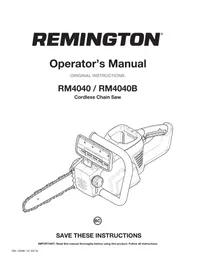
USER MANUAL RM4040 REMINGTON
SAVE THESE INSTRUCTIONS
IMPORTANT: Read this manual thoroughly before using this product. Follow all instructions.
TABLE OF CONTENTS
Service 2
Safety 2
Know Your Unit 10
Essential Terms and Definitions 12
Specifications 13
Assembly 13
Starting and Stopping 15
Operation 16
Maintenance 22
Cleaning and Storage 27
Troubleshooting 28
Warranty 29
NOTE: This operator's manual covers multiple models. Features may vary by model. Not all features in this manual are applicable to all models. The model depicted may differ from yours.
All information, illustrations, and specifications in this manual are based on the latest product information available at the time of printing. We reserve the right to make changes at any time without notice.
The product may vary slightly from the illustrations contained in this manual.
Copyright © 2017 MTD SOUTHWEST INC, All Rights Reserved.
SERVICE
DO NOT RETURN THIS UNIT TO THE RETAILER. PROOF OF PURCHASE WILL BE REQUIRED FOR WARRANTY SERVICE.
For assistance regarding the assembly, operation or maintenance of the unit, please call 1-866-206-2707 (in the United States) or 1-877-696-5533 (in Canada). Additional information can be found at www.remingtonpowertools.com.
Warranty service is available through an authorized service center. To locate a service center in your area, please visit our website or call the number listed above. Service on this unit, both within and after the warranty period, should only be performed by an authorized and approved service center. When servicing, use only identical replacement parts.
SAFETY
The purpose of safety symbols is to attract your attention to possible dangers. The safety symbols, and their explanations, deserve your careful attention and understanding. The safety warnings do not by themselves eliminate any danger. The instructions or warnings they give are not substitutes for proper accident prevention measures.
SYMBOLMEANING

DANGER: Signals an EXTREME hazard. Failure to obey a safety DANGERsymbol WILL result in serious injury or death to yourself or to others.

WARNING: Signals a SERIOUS hazard. Failure to obey a safety WARNING symbol CAN result in serious injury to yourself or to others.

CAUTION: Signals a MODERATE hazard. Failure to obey a safety CAUTION symbol MAY result in property damage or injury to yourself or to others.
NOTE: Advises you of information or instructions vital to the operation or maintenance of the equipment.

CALIFORNIA PROPOSITION 65
WARNING: This product contains a chemical known to the State of California to cause cancer, birth defects or other reproductive harm.
Read the operator's manual and follow all warnings and safety instructions. Failure to do so can result in serious injury to the operator and/or bystanders.
- IMPORTANT SAFETY INSTRUCTIONS
GENERAL POWER TOOL SAFETY WARNINGS

WARNING: Read all safety warnings and all instructions. Failure to follow the warnings and instructions may result in electric shock, fire and/or serious injury.
Save all warnings and instructions for future reference.
The term "power tool" in the warnings refers to your mains-operated (corded) power tool or battery-operated (cordless) power tool.
1) Work Area Safety
a) Keep work area clean and well lit. Cluttered or dark areas invite accidents.
b) Do not operate power tools in explosive atmospheres, such as in the presence of flammable liquids, gases or dust. Power tools create sparks which may ignite the dust or fumes.
c) Keep children and bystanders away while operating a power tool. Distractions can cause you to lose control.
2) Electrical Safety
a) Power tool plugs must match the outlet. Never modify the plug in any way. Do not use any adapter plugs with earthed (grounded) power tools. Unmodified plugs and matching outlets will reduce risk of electric shock.
b) Avoid body contact with earthed or grounded surfaces such as pipes, radiators, ranges and refrigerators. There is an increased risk of electric shock if your body is earthed or grounded.
c) Do not expose power tools to rain or wet conditions. Water entering a power tool will increase the risk of electric shock.
d) Do not abuse the cord. Never use the cord for carrying, pulling or unplugging the power tool. Keep cord away from heat, oil, sharp edges or moving parts. Damaged or entangled cords increase the risk of electric shock.
e) When operating a power tool outdoors, use an extension cord suitable for outdoor use. Use of a cord suitable for outdoor use reduces the risk of electric shock.
f) If operating a power tool in a damp location is unavoidable, use a ground fault circuit interrupter (GFCI) protected supply. Use of a GFCI reduces the risk of electric shock.
3) Personal Safety
a) Stay alert, watch what you are doing and use common sense when operating a power tool. Do not use a power tool while you are tired or under the influence of drugs, alcohol or medication. A moment of inattention while operating power tools may result in serious personal injury.
b) Use personal protective equipment. Always wear eye protection. Protective equipment such as dust mask, non-skid safety shoes, hard hat, or hearing protection used for appropriate conditions will reduce personal injuries.
c) Prevent unintentional starting. Ensure the switch is in the off-position before connecting to power source and/or battery pack, picking up or carrying the tool. Carrying power tools with your finger on the switch or energizing power tools that have the switch on invites accidents.
d) Remove any adjusting key or wrench before turning the power tool on. A wrench or a key left attached to a rotating part of the power tool may result in personal injury.
e) Do not overreach. Keep proper footing and balance at all times. This enables better control of the power tool in unexpected situations.
f) Dress properly. Do not wear loose clothing or jewelry. Keep your hair, clothing and gloves away from moving parts. Loose clothes, jewelry or long hair can be caught in moving parts.
g) If devices are provided for the connection of dust extraction and collection facilities, ensure these are connected and properly used. Use of dust collection can reduce dust-related hazards.
4) Power Tool Use and Care
a) Do no t force the power tool. Use the correct power tool for your application. The correct power tool will do the job better and safer at the rate for which it was designed.
b) Do not use the power tool if the switch does not turn it on and off. Any power tool that cannot be controlled with the switch is dangerous and must be repaired.
c) Disconnect the plug from the power source and/or the battery pack from the power tool before making any adjustments, changing accessories, or storing power tools. Such preventive safety measures reduce the risk of starting the power tool accidentally.
d) Store idle power tools out of the reach of children and do not allow persons unfamiliar with the power tool or these instructions to operate the power tool. Power tools are dangerous in the hands of untrained users.
e) Maintain power tools. Check for misalignment or binding of moving parts, breakage of parts and any other condition that may affect the power tool's operation. If damaged, have the power tool repaired before use. Many accidents are caused by poorly maintained power tools.
f) Keep cutting tools sharp and clean. Properly maintained cutting tools with sharp cutting edges are less likely to bind and are easier to control.
g) Use the power tool, accessories and tool bits etc. in accordance with these instructions, taking into account the working conditions and the work to be performed. Use of the power tool for operations different from those intended could result in a hazardous situation.
5) Battery tool use and care
a) Recharge only with the charger specified by the manufacturer. A charger that is suitable for one type of battery pack may create a risk of fire when used with another battery pack.
b) Use power tools only with specifically designated battery packs. Use of any other battery packs may create a risk of injury and fire.
c) When battery pack is not in use, keep it away from other metal objects, like paper clips, coins, keys, nails, screws or other small metal objects, that can make a connection from one terminal to another. Shorting the battery terminals together may cause burns or a fire.
d) Under abusive conditions, liquid may be ejected from the battery; avoid contact. If contact accidentally occurs, flush with water. If liquid contacts eyes, additionally seek medical help. Liquid ejected from the battery may cause irritation or burns.
6) Service
a) Have your power tool serviced by a qualified repair person using only identical replacement parts. This will ensure that the safety of the power tool is maintained.
Chain saw safety warnings:
- Keep all parts of the body away from the saw chain when the chain saw is operating. Before you start the chain saw, make sure the saw chain is not contacting anything. A moment of inattention while operating chain saws may cause entanglement of your clothing or body with the saw chain.
- Always hold the chain saw with your right hand on the rear handle and your left hand on the front handle. Holding the chain saw with a reversed hand configuration increases the risk of personal injury and should never be done.
- Hold the power tool by insulated gripping surfaces only, because the saw chain may contact hidden wiring. Saw chains contacting a "live" wire may make exposed metal parts of the power tool "live" and could give the operator an electric shock.
- Wear safety glasses and hearing protection. Further protective equipment for head, hands, legs and feet is recommended. Adequate protective clothing will reduce personal injury by flying debris or accidental contact with the saw chain.
- Do not operate a chain saw in a tree. Operation of a chain saw while up in a tree may result in personal injury.
- Always keep proper footing and operate the chain saw only when standing on fixed, secure and level surface. Slippery or unstable surfaces such as ladders may cause a loss of balance or control of the chain saw.
- When cutting a limb that is under tension be alert for spring back. When the tension in the wood fibers is released the spring loaded limb may strike the operator and/or throw the chain saw out of control.
- Use extreme caution when cutting brush and saplings. The slender material may catch the saw chain and be whipped toward you or pull you off balance.
- Carry the chain saw by the front handle with the chain saw switched off and away from your body. When transporting or storing the chain saw always fit the guide bar cover. Proper handling of the chain saw will reduce the likelihood of accidental contact with the moving saw chain.
- Follow instructions for lubricating, chain tensioning and changing accessories. Improperly tensioned or lubricated chain may either break or increase the chance of kickback.
- Keep handles dry, clean, and free from oil and grease. Greasy, oily handles are slippery causing loss of control.
- Cut wood only. Do not use chain saw for purposes not intended. For example: do not use chain saw for cutting plastic, masonry or non-wood building materials. Use of the chain saw for operations different than intended could result in a hazardous situation.
Causes and operator prevention of kickback:
Kickback may occur when the nose or tip of the guide bar touches an object, or when the wood closes in and pinches the saw chain in the cut.
Tip contact in some cases may cause a sudden reverse reaction, kicking the guide bar up and back towards the operator.
Pinching the saw chain along the top of the guide bar may push the guide bar rapidly back towards the operator.
Either of these reactions may cause you to lose control of the saw which could result in serious personal injury. Do not rely exclusively upon the safety devices built into your saw. As a chain saw user, you should take several steps to keep your cutting jobs free from accident or injury.
Kickback is the result of tool misuse and/or incorrect operating procedures or conditions and can be avoided by taking proper precautions as give below:
- Maintain a firm grip, with thumbs and fingers encircling the chain saw handles, with both hands on the saw and position your body and arm to allow you to resist kickback forces. Kickback forces can be controlled by the operator, if proper precautions are taken. Do not let go of the chain saw.
- D o not overreach and do not cut above shoulder height. This helps prevent unintended tip contact and enables better control of the chain saw in unexpected situations.
- Only use replacement bars and chains specified by the manufacturer. Incorrect replacement bars and chains may cause chain breakage and/or kickback.
- Follow the manufacturer's sharpening and maintenance instructions for the saw chain. Decreasing the depth gauge height can lead to increased kickback.

WARNING: Read all safety warnings and all instructions. Failure to follow the warnings and instructions may result in electric shock, fire and/or serious injury.
READ ALL INSTRUCTIONS BEFORE OPERATING
- SAVE THESE INSTRUCTIONS - This manual contains important safety and operating instructions.
- Before using this product, read all instructions and cautionary markings on the battery, battery charger, and the unit(s) powered by the battery.
- Do not handle the charger, including the charger plug and charger terminals, with wet hands.
- Do not charge the unit outdoors.

WARNING: Only use RM4130, RM4140 or RM4150 batteries with this unit. DO NOT use any other type of battery, attachment or accessory with this unit. Other types of batteries, attachments or accessories could lead to serious injury, property damage or damage to the unit. NOTE: Although this unit can use the RM4130 battery, it is not recommended. For best performance, always use an RM4140 or RM4150 battery with this unit.

WARNING:Only charge RM4130, RM4140 or RM4150 batteries with an RM4110 battery charger. DO NOT attempt to use any other battery charger to charge RM4130, RM4140 or RM4150 batteries. Other types of battery chargers may cause the batteries to burst, resulting in fire, personal injury or property damage.

WARNING: Only use an RM4110 battery charger to charge RM4130, RM4140 or RM4150 batteries. DO NOT attempt to charge any other batteries with an RM4110 battery charger. Other types of batteries may burst, causing fire, personal injury or property damage.
GENERAL SAFETY WARNINGS
- Read the instructions carefully. Be familiar with the controls and proper use of the unit. Know how to stop the unit and disengage the controls quickly.
- Stay alert. Do not operate this unit when tired, ill or under the influence of alcohol, drugs or medication.
- Never allow children to operate the unit. Teens must be trained, accompanied and supervised by an adult. Never allow adults to operate the unit without proper instruction.
- All guards and safety attachments must be installed properly before operating the unit.
- Inspect the unit before use. Check for damaged parts. Make sure all parts operate properly. Make sure all fasteners are in place and secure. Make sure all moving parts are properly aligned and are not bound. Replace parts that are cracked, chipped, or damaged in any way. Have all damaged or improperly working parts repaired or replaced by an authorized service center. Do not operate the unit with loose or damaged parts.
- Be aware of risk of injury to the head, hands and feet.
- Carefully inspect the area before starting the unit. Remove rocks, broken glass, nails, wire, string and other objects that may be thrown or become entangled with the unit.
- Clear the area of children, bystanders and pets; keep them outside a 50-foot (15 m) radius, at a minimum. Even then, they are still at risk from thrown objects. Encourage bystanders to wear eye protection. If you are approached, stop the unit immediately.
- This unit is intended for occasional, household use only.
- Do not allow the unit to be used as a toy.
SAFETY WARNINGS FOR ELECTRIC UNITS
General Electric Safety
- Do not expose the unit to rain or wet conditions. Store the unit indoors.
- Do not handle the unit with wet hands.
- Avoid dangerous environments. Do not operate the unit in the rain, in wet conditions or on wet surfaces. Moisture is a shock hazard.
- To reduce the risk of electric shock, avoid body contact with grounded conductors, such as metal pipes or wire fences.
- Do not operate the unit in explosive atmospheres, such as in the presence of flammable liquids, gases or dust.
Battery Charger Safety
- Follow all charging instructions. Do not charge the battery outside the temperature range specified in these instructions. Improperly charging the battery or charging the battery outside of the specified temperature range may damage the battery and increase the risk of fire.
- A nameplate on the unit indicates the voltage used. Never connect the unit to an AC voltage that differs from this voltage.
- An extension cord should not be used unless absolutely necessary. Use of an improper extension cord could result in a risk of fire, electric shock or electrocution.
- Do not use multiple extension cords.
- Make sure the extension cord is heavy enough to carry the current drawn by the unit. An undersized extension cord will cause a drop in line voltage, resulting in a loss of power and overheating. If in doubt, use the next heavier gauge cord. The smaller the gauge number, the heavier the cord.
| MINIMUM WIRE SIZE FOR EXTENSION CORDS FOR 120 VOLT APPLIANCES USING 0-6 AMPS | ||||
| Cord Length (ft.) 25 50 100 150 | ||||
| Wire Size (AWG) 16 16 16 14 | ||||
- Make sure the cords are in good condition. Inspect the power cord and extension cord periodically. Look closely for deterioration, cuts or cracks in the insulation. If a cord is damaged in any manner while plugged in, disconnect the cord from both the outlet and the unit. Do not use a damaged cord. Damaged cords should be repaired or replaced.
- Do not abuse cords. Never pull or carry the unit by a cord. Keep cords away from heat, oil, water, sharp edges, and moving objects. Always grasp the plug when disconnecting a cord.
- Never modify a plug, cord or outlet in any way.
- Ground Fault Circuit Interruption (GFCI) protection should be provided on the circuit(s) or outlet(s) to be used with this unit. For an extra measure of safety, use receptacles with built-in GFCI protection.
- Do not place the battery charger where cords might be stepped on, tripped over or subjected to damage.
- Do not charge batteries in the rain or in wet conditions. Keep the battery charger in a cool and dry area.
- Keep the battery charger away from all liquid.
- Do not allow small metal items or material such as steel wool, aluminum foil or other foreign particles into the charger port.
- Do not probe the charger with conductive material. There is a risk of electric shock.
- Do not cover the battery charger. The battery charger may overheat.
- Do not allow the battery or battery charger to overheat. If they are warm, allow them to cool down. Only charge batteries in temperatures between 32^ and 104^ F (0^ and 40^ C).
- Always unplug the battery charger before cleaning it. Always unplug the battery charger when it is not in use.
Battery Safety
- Do not expose the battery to fire or to temperatures over 176^ (80^) . Doing so could cause an explosion.
- Handle batteries with care. Do not short the battery with conductive materials, such as rings, bracelets, keys, etc. Shorting the battery may cause personal injury, damage to the battery or a fire.
- When the battery is not in use, keep it away from small metal objects, such as paper clips, coins, nails, etc. These items could connect one terminal to another and short the battery.
- Do not attempt to charge a cracked or damaged battery.
- Do not use a damaged or modified battery. Doing so could result in a fire, explosion or personal injury.

WARNING: The battery may present a risk of fire or chemical burn if mistreated. Do not disassemble, overheat or incinerate the battery. The battery may develop a small leak under extreme usage or temperature conditions.
If battery fluid contacts skin:
- Immediately wash the area with soap and water.
- Neutralize the battery fluid with a mild acid (lemon juice, vinegar, etc.).
- Seek immediate medical attenti on.
If battery fluid gets in the eyes:
- Immediately flush the eyes with clean water for at least 15 minutes.
- Seek immediate medical attention.
DISPOSING OF DAMAGED OR WORN-OUT BATTERIES

WARNING: The following toxic and corrosive material is used in this unit's battery: LITHIUM-ION, a toxic material.

WARNING: To prevent contamination of the environment, contact your local waste disposal agency for specific instructions before disposing of damaged or worn-out lithium-ion batteries. Take batteries to a local recycling and/or disposal center, certified for lithium-ion battery disposal.

WARNING: Do not use broken or cracked batteries, even if there isn't leakage. Replace damaged or worn-out batteries with new batteries. DO NOT ATTEMPT TO REPAIR BATTERIES! Repair attempts may result in severe personal injury, due to explosion or electrical shock
To avoid personal injury and damage to the environment:
- Do not attempt to remove or destroy any of the battery components. Do not open or mutilate the battery. If a leak develops, released electrolytes are corrosive and toxic. Do not get the solution in your eyes or on your skin, and do not swallow it.
- Do not dispose of the battery in the regular household trash.
- Do not dispose of the battery in a fire. The cell may explode.
- Do not dispose of the battery where it will become part of any waste landfill or municipal solid waste stream.
- Cover the battery terminals with heavy-duty adhesive tape.
- Dispose of the battery according to local, state and federal regulations.
- Dispose of the battery promptly.

About Call2Recycle Battery Seals
Call2Recycle's industry steward program helps battery and product manufacturers fulfill recycling requirements in the U.S. and Canada, including compliance with extensive state, provincial and federal regulations, such as the Mercury-Containing and Rechargeable Battery Act (The Battery Act). Call2Recycle® Licensees/Industry
Stewards, participating battery and product manufacturers and marketers, purchase the rights to imprint the Call2Recycle Battery Seals on their rechargeable batteries and products. When you see the Call2Recycle Battery Seal, you can feel confident knowing that your battery or product can be safely and responsibly recycled.
About Call2Recycle
Since 1994, Call2Recycle has diverted more than 75 million pounds of rechargeable batteries from local landfills and established a network of 30,000 recycling drop-off locations. More than 200 battery and/or product manufacturers, Call2Recycle Industry Stewards, have united to ensure that batteries are responsibly recycled when they reach their end of life and fund the program that is operated by Call2Recycle, Inc., a 501(c)4 nonprofit public service organization.
To locate the nearest recycling center, please call 1-800-822-8837.
FCC STATEMENT

CAUTION: Changes or modifications not expressly approved by the party responsible for compliance could void the user's authority to operate the equipment.
NOTE: This equipment has been tested and found to comply with the limits for a Class B digital device, pursuant to part 15 of the FCC Rules. These limits are designed to provide reasonable protection against harmful interference in a residential installation. This equipment generates, uses and can radiate radio frequency energy and, if not installed and used in accordance with the instructions, may cause harmful interference to radio communications. However, there is no guarantee that interference will not occur in a particular installation. If this equipment does cause harmful interference to radio or television reception, which can be determined by turning the equipment off and on, the user is encouraged to try to correct the interference by one or more of the following measures:
- Reorient or relocate the receiving antenna.
- Increase the separation between the equipment and receiver.
- Connect the equipment into an outlet on a circuit different from that to which the receiver is connected.
- Consult the dealer or an experienced radio/TV technician for help.
WHILE OPERATING

WARNING: To reduce the risk of electric shock, do not expose the unit to rain or wet conditions. Store the unit indoors.
- Wear safety glasses or goggles that meet current ANSI / ISEA Z87.1 standards and are marked as such. Wear ear/hearing protection when operating this unit. Wear a face mask or dust mask if the operation is dusty. Use a hard hat or other type of safety helmet. Falling debris can result in serious personal injury.
- Wear safety boots and protective gloves. Wear heavy, snug-fitting clothes, including long pants and a long-sleeve shirt. Do not wear loose clothing, jewelry, short pants, sandals or go barefoot. Secure hair above shoulder level.
- Use the unit only in daylight or good artificial light.
- Avoid starting the unit unintentionally. The operator and unit must be in a stable position while starting. Refer to Starting and Stopping.
- Use the right tool. Only use this tool for its intended purpose: to cut wood. Do not use the unit for cutting plastic, masonry or other non-wood building materials. Only use the unit as described in this manual.
- Keep hair, face, hands, feet and all other body parts away from the saw chain when the unit is running. Do not touch or try to stop moving parts.
- Do not operate the unit faster than the speed needed to do the job. Do not run the unit at high speed when not in use.
- Do not force the unit, especially near the end of a cut. It will do a better, safer job when used at the intended rate.
- Always turn the unit off when operation is delayed or when carrying the unit from one location to another.
-
Before setting the unit down, always turn the unit off and wait for all moving parts to come to a complete stop.
-
Do not operate a unit that is damaged, improperly adjusted or not completely and securely assembled. Make sure moving parts stop when the unit is turned off. Do not use the unit if it does not turn on and off properly. Have defective parts replaced by an authorized service center.
- Avoid starting the unit unintentionally. Make sure the trigger lockout is in the locked position before installing or removing the battery. Never carry the unit with fingers on the trigger.
- Remove the battery from the unit when it is not in use.
- Do not use the unit if the trigger and trigger lockout do not start and stop the unit.
- If the unit strikes or becomes entangled with a foreign object, stop the motor immediately, remove the battery and allow the unit to cool. Then, check for damage. If damaged, do not restart or operate the unit until it is repaired. Do not operate the unit with loose or damaged parts.
- Use only original equipment manufacturer (OEM) replacement parts and accessories for this unit. These are available from your authorized service center. Use of any other parts or accessories could lead to serious injury to the user, or damage to the unit, and void the warranty.
- Keep the unit clean. Stop the motor, remove the battery and allow the unit to cool. Carefully remove vegetation and other debris that could block moving parts.
- If the unit starts to vibrate abnormally, stop the motor, remove the battery and allow the unit to cool. Inspect the unit for the cause of the vibration. Vibration is generally an indicator of trouble.
CHAIN SAW SAFETY
- Make sure the saw chain is not in contact with anything before starting the unit.
- When carrying the unit, hold it away from the body, with the guide bar positioned to the rear. Cover the guide bar and saw chain with the scabbard when carrying the unit. Hold the unit by the front handle.
- Keep the work area clean. Cluttered areas invite injuries. Do not start cutting until the work area is clear and free from obstructions. Make sure there is secure footing and a planned retreat path from falling trees or branches.
- Do not cut near electrical cables or power lines. Keep at least 50 feet (15 m) away from all power lines.
- For safer, more effective performance, make sure the guide bar and chain are properly cleaned, lubricated, tightened and sharpened. Check the guide bar and chain at frequent intervals for proper adjustment.
- When cutting a limb that is under tension, use extreme caution. When the tension is released, the limb could spring back and strike the operator, causing severe injury or death.
- Use extreme caution when cutting small-sized brush and saplings, as slender material may catch the saw chain and be whipped toward the operator or pull the operator off balance.
- This saw its classification by UL as a Class 2C saw in accordance with CSA Z62.1-03. It is intended for infrequent use by homeowners, cottagers and campers, and for general applications such as clearing, pruning, cutting firewood, etc. It is not intended for prolonged use. If the intended use involves prolonged periods of operation, this may cause circulatory problems in the user's hands due to vibration. Take frequent breaks and adjust your working position, as needed.
- Do not operate the unit in a tree or on a ladder unless specifically trained to do so.
- Do not use the unit in the presence of flammable liquids or gases.
-
Do not attempt operations beyond the operator's capacity or experience.
-
Always use the scabbard on the guide bar and saw chain during transportation and storage.
- Do not remove cut material, or hold material to be cut, when the unit is running. Always turn the unit off, wait for the saw chain to come to a complete stop, and remove the battery before clearing jammed material. A moment of inattention can result in serious personal injury.
KICKBACK SAFETY

WARNING: Kickback may occur when the nose or tip of the guide bar touches an object, or when the wood closes in and pinches the saw chain in the cut. In some cases, tip contact may cause a lightening-fast reverse action, kicking the guide bar rapidly back to wards the operator. Pinching the saw chain along the top of the guide bar may push the guide bar rapidly back towards the operator. Either of these reactions may cause a loss of control over the saw, which could result in serious injury to the user. Contact with foreign objects within the wood can also induce a loss of chain saw control.
Understanding Kickback
A basic understanding of kickback can help reduce or eliminate the element of surprise and the chance of kickback-related injury. Sudden surprise contributes to accidents.
- Rotational Kickback can happen when the upper tip of the guide bar contacts an object while the chain is moving (Fig. A). This can cause the chain to dig into the object and momentarily stop moving. The guide bar is then kicked up and back toward the operator in a lightning-fast reverse reaction.
- Linear Kickback can happen when the wood on either side of a cut closes in and pinches the moving saw chain along the top of the guide bar (Fig. B). This can cause the chain to instantly stop. The chain force is then reversed, causing the saw to move in the opposite direction, sending the saw straight back toward the operator.
- Pull-In can happen when the moving chain on the bottom of the guide bar hits a foreign object inside the wood. This can cause the chain to suddenly stop. The saw is then pulled forward and away from the operator, which could potentially result in the loss of control of the saw.
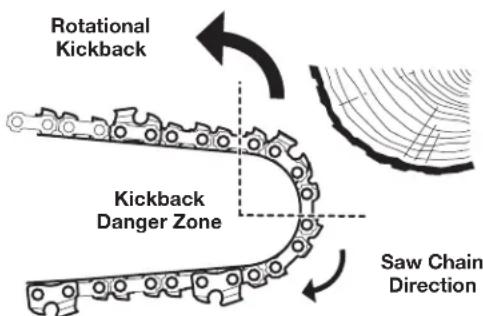
Fig. A
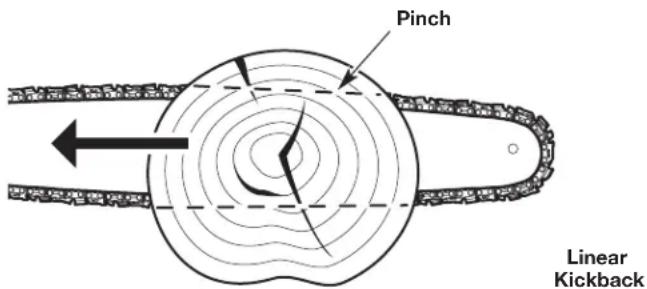
Fig. B
- A low-kickback saw chain is a chain that has met the kickback performance requirements of ANSI/OPEI B175.1-2012 when tested according to the provisions specified in ANSI/OPEI B175.1-2012. A low-kickback saw chain is a chain that is also in accordance with CSA Z62.3. Do not use a replacement saw chain unless it has met these requirements for this specific model or has been designated as a low-kickback replacement saw chain in accordance with ANSI/OPEI B175.1-2012. As saw chains are sharpened, some of the low-kickback qualities are lost and extra caution should be used.
- Do not install a bow guide on this unit. Bow guides have larger kickback zones, which increase the chance of kickback and serious injury. This increase is not significantly reduced by using a low-kickback saw chain. Using a bow guide on this unit is extremely dangerous.
Kickback Safety Precautions
Take the following steps to reduce the chance of accident or injury:
- Do not rely exclusively upon the safety devices built into the unit.
- Do not overreach. Always keep proper footing and balance. Take extra care when working on stairs, steep slopes or inclines. Do not cut above shoulder height.
- Do not make cuts with the tip of the guide bar.
- Make sure the area of operation is free from obstructions. Do not let the tip of the guide bar contact any object, such as a log, branch, the ground or other obstruction.
- Always inspect the wood before cutting. Foreign objects could damage the unit or cause serious personal injury. Never cut through nails, metal rods, railroad ties or pallets.
- Do not operate the unit with one hand! Serious injury to the operator, helpers or bystanders may result from one-handed operation. This unit is intended for two-handed use. Always grip the unit firmly with both hands when the unit is running. Do not let go. A firm grip will help maintain control of the unit and reduce the chance of kickback. Hold the front handle with the left hand and the rear handle with the right hand. Firmly encircle the handles with the thumbs and fingers.
- Stand slightly to the left of the unit to avoid being in the direct line of the saw chain.
- Never start the saw when the guide bar is inside an existing cut. Be extremely careful when re-entering a cut.
- Always begin a cut with the unit running at full speed. Maintain a steady cutting speed. Slower speeds increase the chance of kickback.
- Keep the saw housing pressed firmly against the wood.
- Do not cut more than one log or branch at a time.
- Do not twist the unit when removing the guide bar from a cut.
- Watch out for shifting objects (logs, branches, etc.) that might pinch or fall onto the saw chain during operation.
- Only use wedges made of wood or plastic. Do not use metal to hold a cut open.
- Follow the manufacturer's sharpening and maintenance instructions for the saw chain.
- Only use replacement bars and chains specified by the manufacturer or the equivalent. These are available from authorized service centers. Use of any unauthorized parts or accessories could lead to serious injury to the operator or damage to the unit and will void the warranty.
- Use devices that reduce the risks associated with kickback, such as low-kickback chains, guide bar nose guards, chain brakes and low-kickback guide bars. There are no other replacement components for achieving kickback protection in accordance with CSA Z62.3.
OTHER SAFETY WARNING
- Maintain the unit with care. Follow all maintenance instructions in this manual.
- Do not perform maintenance procedures other than those described in this manual. Do not attempt to repair the unit; there are no user-serviceable parts inside. All service, other than the maintenance procedures described in this manual, should be performed by an authorized service center.
- Do not use the unit if it is not working correctly, has been dropped, damaged, left outdoors or dropped into water. Have the unit serviced by an authorized service center.
- Never remove, modify or make inoperative any safety device furnished with the unit.
-
Before inspecting, maintain ing, cleaning, storing, transporting or replacing any parts on the unit:
-
Stop the motor. Refer to Starting and Stopping.
- Wait for all moving parts to stop.
- Remove the battery.
-
Allow the unit to cool.
-
Secure the unit while transporting.
- Store the unit in a dry place, secured or at a height to prevent unauthorized use or damage. Keep the unit out of the reach of children.
- Never douse or squirt the unit with water or any other liquid. Avoid getting water in the motor and electrical connections. Keep handles dry and clean (free from debris, oil and grease). Clean the unit after each use. Refer to Cleaning and Storage. Do not use solvents or strong detergents.
- Keep these instructions. Refer to them often and use them to instruct other users. If you loan this unit to others, also loan them these instructions.
SAVE THESE INSTRUCTIONS
SAFETY &INTERNATIONAL SYMBOLS
This operator's manual describes safety and international symbols and pictographs that may appear on this product. Read the operator's manual for complete safety, assembly, operating and maintenance and repair information.
SYMBOL MEANING SYMBOL MEANING
|  | · SAFETY ALERT SYMBOL Indicates danger, warning or caution. May be used in conjunction with other symbols or pictographs. |
|  | · READ OPERATOR'S MANUAL WARNING: Read the operator's manual(s) and follow all warnings and safety instructions. Failure to do so can result in serious injury to the operator and/or bystanders. |
|  | · WEAR HEAD, EYE AND HEARING PROTECTION WARNING: Thrown objects and loud noise can cause severe eye injury and hearing loss. Wear eye protection meeting current ANSI / ISEA Z87.1 standards and ear protection when operating this unit. Wear head protection when operating this unit; falling objects can cause severe head injury. Use a full face shield when needed. |
|  | · WEAR FOOT PROTECTION Always wear heavy-duty, non-slip footwear when operating this unit. |
|  | · WEAR HAND PROTECTION Always wear heavy-duty, non-slip gloves when handling this unit. |
| V | · VOLTS - Voltage |
| A | · AMPERES - Current |
| Hz | · HERTZ - Frequency (cycles per second) |
| AC | · ALTERNATING CURRENT - Type of current |
| - or DC | · DIRECT CURRENT - Type of current |
| Ah | · AMPERE-HOUR - Measure of charge capacity |
| Wh | · WATT-HOUR - Measure of energy |
| ·USE BOTH HANDS WARNING: Always use both hands while operating the unit. Never use only one hand to operate the unit. | |
| ·KICKBACK WARNING: Contact of the guide bar tip with any object should be avoided. Tip contact may cause the guide bar to move suddenly upward and backward, which may cause serious injury. | |
| ·KEEP BYSTANDERS AWAY WARNING: Keep all bystanders, especially children and pets, at least 50 feet (15 m) from the operating area. WARNING: Always keep a clear work area and retreat path. Be aware of the location of limbs/branches to avoid falling limbs and debris. | |
| ·CHAIN OIL Make sure the chain oil reservoir is full before operation. Check the oil level constantly so that it does not drop below half full. The saw chain must be continuously coated with oil to function properly. | |
| ←60→ | ·CHAIN DIRECTION Make sure the saw chain faces the direction shown when installed on the guide bar. Refer to Installing the Guide Bar and Saw Chain in the Maintenance section. |
| ·DO NOT USE IN THE RAIN WARNING: Avoid dangerous environments. Never operate the unit in the rain or in damp or wet conditions. Moisture is a shock hazard. | |
| ·DO NOT DISPOSE IN HOUSEHOLD TRASH Recycle the battery or dispose of the battery according to local, state and federal regulations. |
KNOW YOUR UNIT
APPLICATIONS
Felling and limbing trees
- Cutting logs (bucking)
Pruning trees
NO ASSEMBLY TOOLS REQUIRED
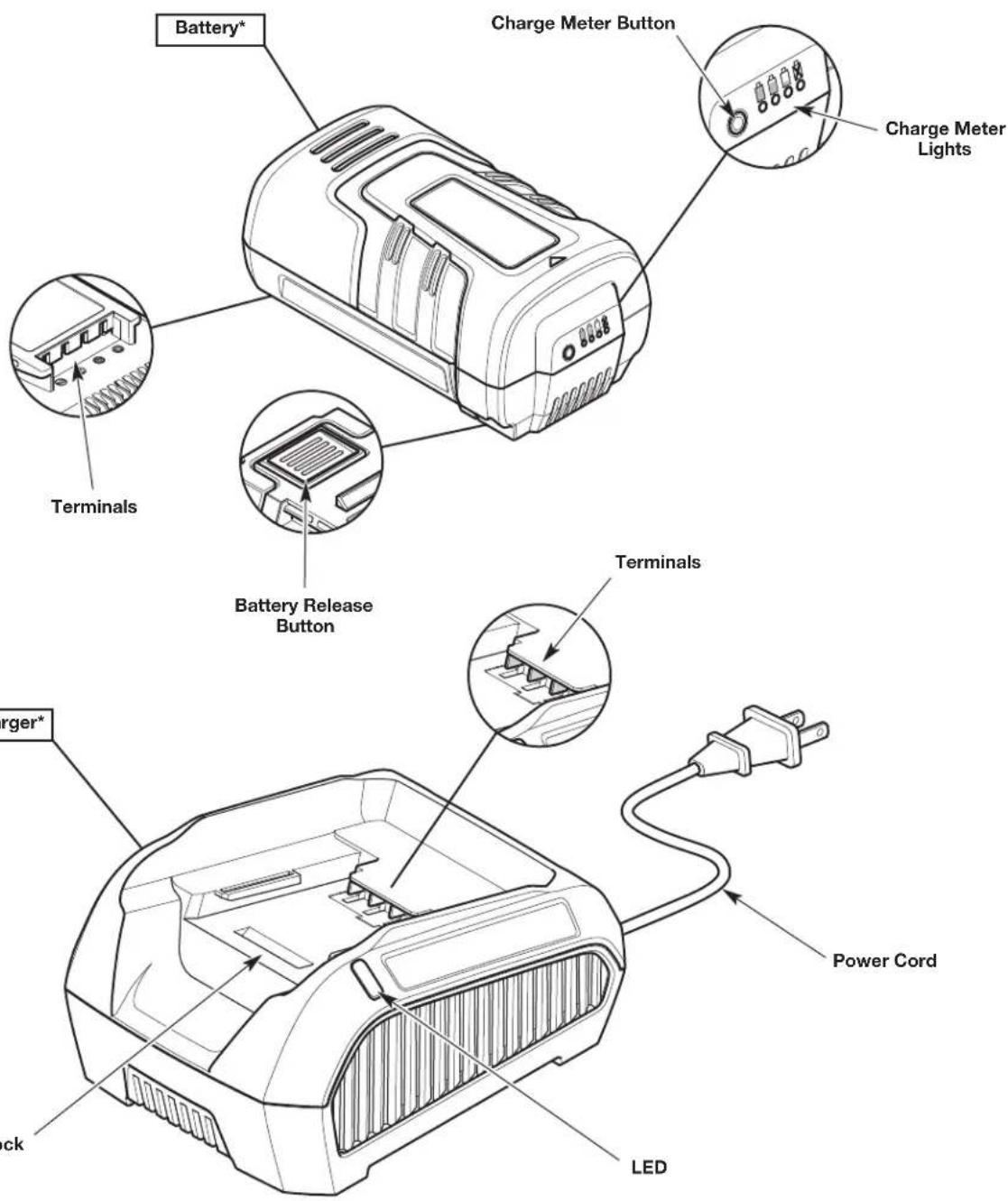
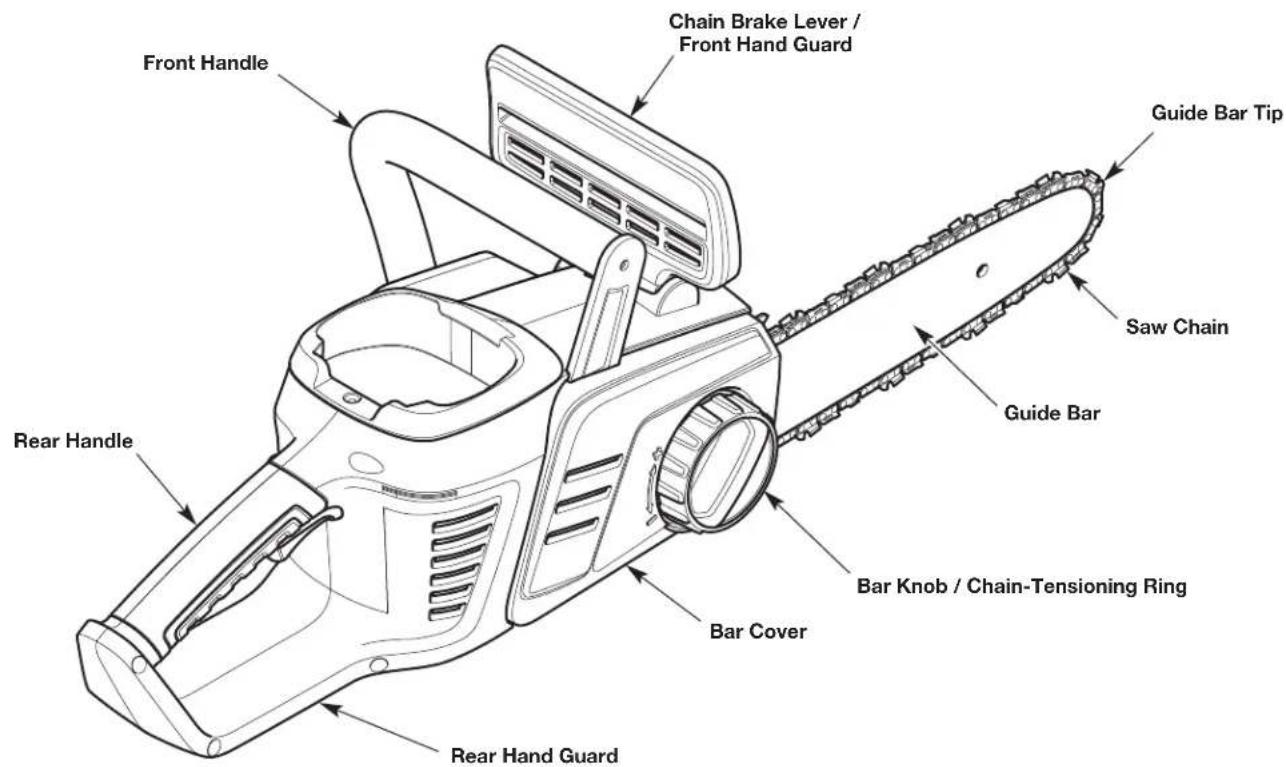
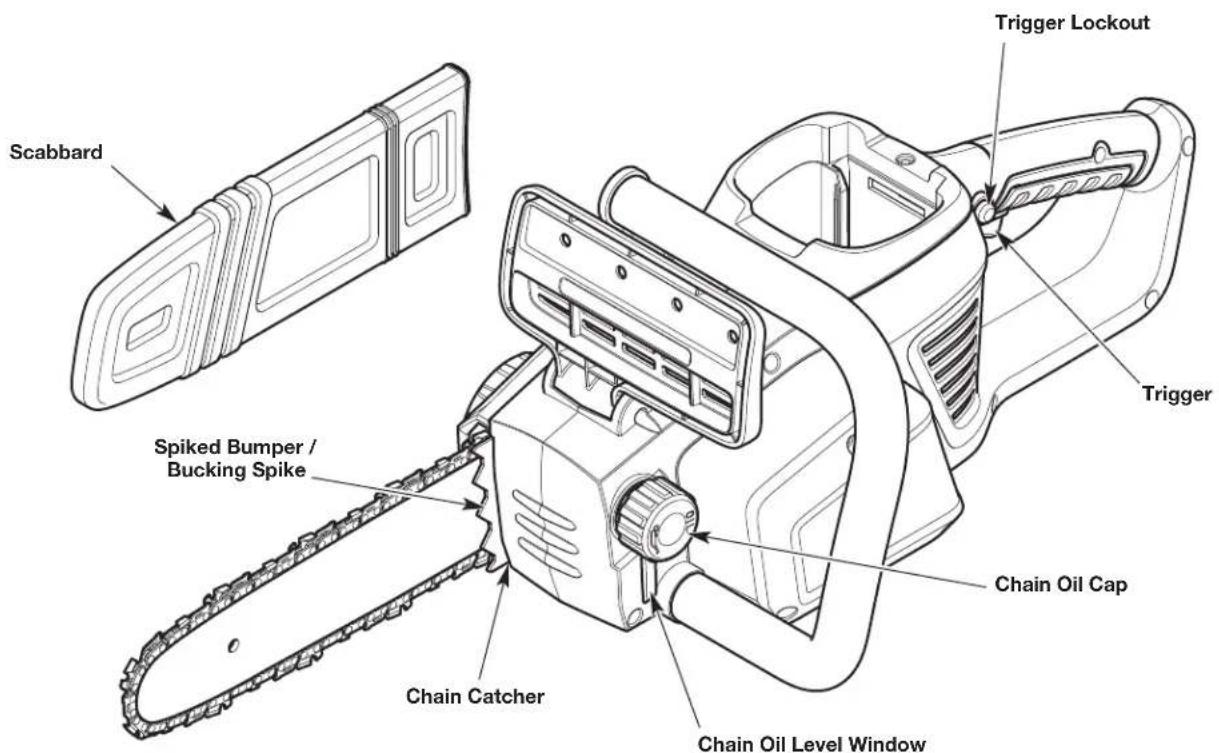
ESSENTIAL TERMS AND DEFINITIONS
- CHAIN SAW - A tool designed to cut wood with a saw chain. A chain saw is an integrated unit comprised of a motor, saw chain, guide bar, and handles that are designed to be held by two hands during operation.
- CHAIN SAW POWERHEAD - A chain saw without the saw chain and guide bar.
- DRIVE SPROCKET - A toothed wheel that drives the saw chain.
- FRONT HANDLE - A support handle located toward the front of the chain saw.
- REAR HANDLE - A support handle located toward the rear of the chain saw.
- FRONT HAND GUARD / CHAIN BRAKE LEVER - A structural barrier between the front handle and the guide bar. The front hand guard helps protect the operator's left hand if it slips off the front handle while the unit is running. The front hand guard is also used to activate the chain brake.
- CHAIN BRAKE - A device used to stop the chain saw. The chain brake helps protect the user by stopping the saw chain in milliseconds. The chain brake can be activated intentionally by pushing the front hand guard / chain brake lever forward. It can also be activated if the operator's hand strikes the front hand guard / chain brake lever during kickback.
- REAR HAND GUARD - A structural barrier below the rear handle. The rear hand guard helps protect the operator's right hand if the saw chain breaks or disengages from the guide bar during operation.
GUIDE BAR - A solid railed structure that supports and guides the saw chain.
GUIDE BAR TIP - The tip or end of the guide bar. - REDUCED-KICKBACK GUIDE BAR - A guide bar that has been demonstrated to reduce kickback significantly.
- SAW CHAIN - A loop of chain with teeth designed to cut wood, which is driven by the motor and is supported by the guide bar. The saw chain is composed of drive links, cutters and side links, held together by rivets.
- LOW-KICKBACK SAW CHAIN - A saw chain that complies with the kickback performance requirements of ANSI/OPEI B175.1-2012 when tested on a representative sample of chain saws. Low-kickback saw chain significantly reduces the chance of kickback and the intensity of kickback, due to specially designed depth gauges and guard links.
- REPLACEMENT SAW CHAIN - A saw chain that complies with the kickback performance requirements of ANSI/OPEI B175.1-2012 when tested with specific chain saws. It may not meet the ANSI/OPEI performance standards when used with other chain saws.
- SPIKED BUMPER - The pointed tooth (or teeth), at the front of the chain saw, used during felling and bucking to help pivot the saw and maintain a stable position while cutting.
- CHAIN CATCHER - A device designed to intercept a whipping chain. The chain catcher reduces the chance of injury if the saw chain breaks or disengages from the guide bar during operation.
OILER CONTROL - A system for oiling the saw chain and guide bar. - SWITCH - A device that, when operated, will complete or interrupt an electrical power circuit to the motor.
- SWITCH LINKAGE - A mechanism that transfers motion from the trigger to the switch.
- TRIGGER - A device that, when operated in conjunction with the switch lockout (trigger lockout), turns the motor on. Releasing the trigger immediately turns the motor off. The saw chain will then coast to a stop.
- SWITCH LOCKOUT (TRIGGER LOCKOUT) - A device that prevents the unit from starting accidentally. The trigger cannot be squeezed unless the switch lockout (trigger lockout) is manually engaged.
- BATTERY RELEASE BUTTON - A device used to disconnect the battery from the battery charger and the unit.
- KICKBACK - A sudden backward and/or upward motion of the guide bar and saw chain. Kickback can occur if the upper portion of the guide bar tip touches an object while the saw chain is spinning (rotational kickback). Kickback can also occur if the wood closes in and pinches the saw chain inside the cut (linear kickback).
- ROTATIONAL KICKBACK - A sudden backward and upward motion of the guide bar and saw chain. Rotational kickback can occur if the upper portion of the guide bar tip touches an object while the saw chain is spinning. The guide bar and saw chain are then kicked up and back toward the operator in a lightning-fast reverse reaction.
- LINEAR KICKBACK (PINCH KICKBACK) - A sudden backward motion of the guide bar and saw chain. Linear (pinch) kickback can occur if the wood closes in and pinches the saw chain inside a cut. The saw is then sent straight back toward the operator.
- NORMAL CUTTING POSITION - The positions assumed while making bucking and felling cuts.
FELLING - The process of cutting down a tree.
NOTCHED UNDERCUT - The first cutting procedure in the tree felling process. A notch is cut on one side of the tree to direct its fall. - FELLING BACK CUT - The final cut in the tree felling process. The felling back cut is made on the opposite side of the tree from the notched undercut.
- BUCKING - The process of cutting a fe lled tree or log into lengths.
- LIMBING - The process of removing branches from a fallen tree.
- PRUNING - The process of cutting limbs from a living tree.
SPECIFICATIONS*
| Approximate Unit Weight (without the battery - without chain oil) | 9.5 - 10.5 lbs. (4.3 - 4.8 kg) |
| Lubrication | Bar and Chain Oil (not included) |
| Chain Oil Reservoir Capacity | 6.4 fl. oz. (190 mL) |
| Guide Bar Length | 12 in. (30.5 cm) |
| Saw Chain Pitch | 3/8 in. (9.5 mm) |
| Saw Chain Gauge | 0.050 in. (1.3 mm) |
| Battery Type (Model RM4140) | 40V, 4.0 Ah Lithium-lon |
| Battery Type (Model RM4150) | 40V, 5.0 Ah Lithium-lon |
| Approximate Battery Weight (Model RM4140) | 2.9 - 3.4 lbs. (1.3 - 1.5 kg) |
| Approximate Battery Weight (Model RM4150) | 3.0 - 3.5 lbs. (1.4 - 1.6 kg) |
| Optimum Battery Charging Temperature | 32° to 104°F (0° to 40°C) |
| Optimum Battery Storage Temperature | 64° to 73°F (18° to 23°C) |
| Optimum Battery In-Use Temperature | 32° to 113°F (0° to 45°C) |
| Battery Charger Input | 120 V 60 Hz AC only |
| Battery Charger Output | 1.8 A 40 V DC |
| Approximate Charging Time (Model RM4140) | 135 minutes |
| Approximate Charging Time (Model RM4150) | 162 minutes |
| Approximate Battery Charger Weight | 1.25 - 1.75 lbs. (0.6 - 0.8 kg) |
- All specifications are based on the latest product information available at the time of printing. We reserve the right to make changes at any time without notice.
REPLACEMENT PARTS
Please contact the Customer Support Department to order replacement parts.
Part #
Description
713-05074 . Saw Chain (12 in./ 30.5 cm)
795-00321 Guide Bar (12 in. / 30.5 cm)
ASSEMBLY

WARNING: To prevent serious personal injury and damage to the unit, never assemble, disassemble or adjust the unit while it is running. Always turn the unit off and remove the battery to prevent the unit from starting accidentally. Always allow the unit to cool before assembling, disassembling or making any adjustments.
ADDING BAR AND CHAIN OIL: INITIAL USE
This unit comes from the factory with the chain oil reservoir empty. Fill the chain oil reservoir with bar and chain oil before starting or using the unit. Refer to Adding Bar and Chain Oil instructions in the Maintenance section.
ADJUSTING THE CHAIN TENSION: INITIAL USE
The saw chain must be properly tensioned before attempting to start or operate the unit. The saw chain may also require additional tensioning as the saw chain heats up during operation. Refer to Adjusting the Chain Tension instructions in the Maintenance section.
WALL-MOUNTING THE CHARGER (OPTIONAL)
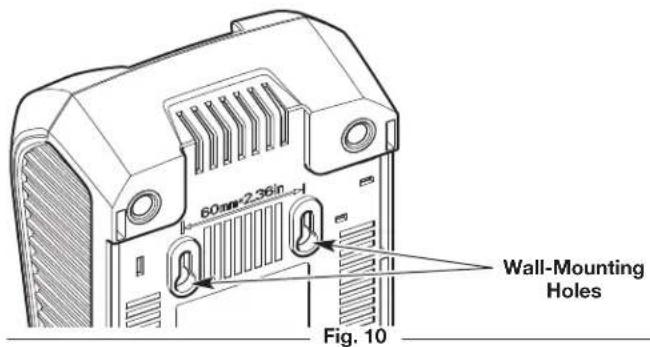
The battery charger can be mounted to a permanent surface, such as a wall or work bench. Use mounting fasteners (not included) capable of supporting the combined weight of the battery and battery charger. Wall-mounting holes are located on the bottom of the charger (Fig. 10).
CHARGING THE BATTERY
NOTE: The battery is not shipped fully charged.
NOTE: Lithium-ion batteries will not develop a memory and may be charged at any time.
For maximum run time, fully charge the battery before each use.
-
Plug the battery charger into an appropriate power outlet. The LED should turn red (constant) (Fig. 12). If it does not:
-
Make sure the battery charger is fully plugged into an appropriate power outlet.
-
Make sure the power outlet is functioning by testing it with another electrical device.
-
Insert the battery into the charging dock (Fig. 11). Push the battery firmly until it locks into place.
-
Examine the LED. The LED will indicate the battery status:
-
Green (blinking): The battery is charging. Charge the battery until the green light stops blinking.
- Green (constant): The battery is fully charged.
- Red (blinking - slow): The battery and/or charger are too hot or too cold. Make sure the battery and charger are in an environment between 32^ and 104^ F (0^ and 40^ C). Allow time for the battery and/or charger to warm up or cool down.
- Red (blinking - fast): The battery is no longer functional. Refer to the Warranty section for replacement information.
-
Red (constant): The battery is not charging. Remove the battery. Make sure the terminals on the battery and battery charger are clean. Re-insert the battery into the charging dock. Push the battery firmly until it locks into place.
-
To maximize the life of the battery, the battery charger will turn off when charging is complete. Once the battery is fully charged, remove it from the battery charger. Optionally, the battery can be stored in the battery charger, but the battery charger should be unplugged from the power outlet.
To remove the battery: Hold the battery charger in place with one hand. Press the battery release button with the other hand (Fig. 13). Slide the battery out of the charging dock.
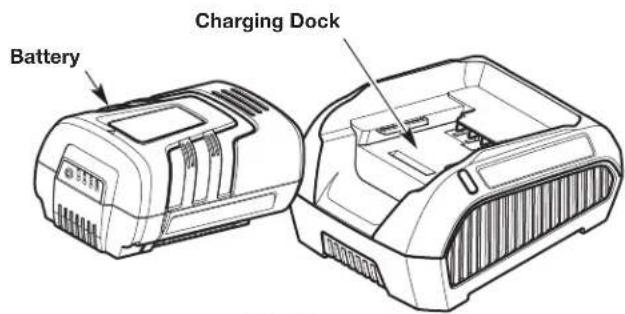
Fig. 11
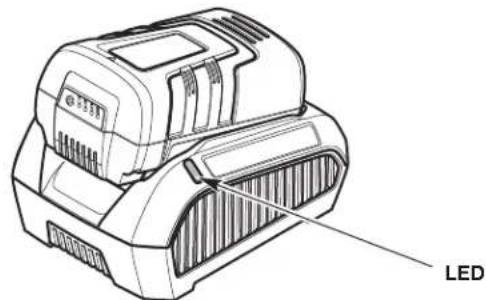
Fig. 12
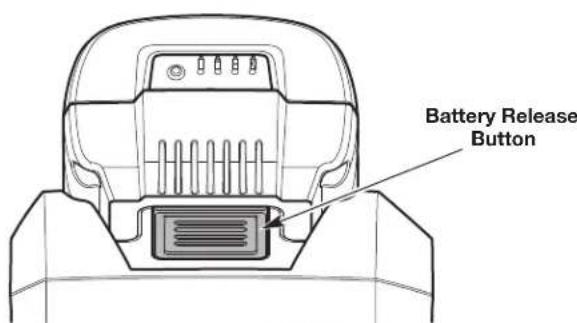
Fig. 13
INSTALLING AND REMOVING THE BATTERY

WARNING: Avoid accidentally starting the unit. To prevent serious injury, DO NOT press the trigger lockout and DO NOT squeeze the trigger when installing or removing the battery. Refer to Starting and Stopping. Remove the battery from the unit when it is not in use.
Installing the Battery
- Grasp the front handle firmly (Fig. 14).
- Slide the battery into the battery port (Fig. 14). Push the battery firmly until the battery locks into place (Fig. 14). There should be an audible "click."
- Gently pull the battery to make sure it is securely locked in place.
Removing the Battery
- Grasp the front handle firmly (Fig. 14).
- Press the battery release button to unlock the battery (Fig. 14).
- Pull the battery out of the battery port (Fig. 14).
NOTE: It may require a strong pull to remove the battery.
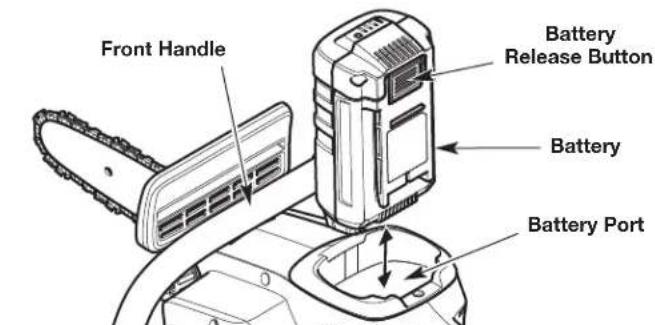
Fig. 14
STARTING AND STOPPING

WARNING: Never operate the unit without the guide bar and saw chain properly installed. Make sure the guide bar cover is securely assembled. Make sure the saw chain is properly tensioned. Refer to Adjusting the Chain Tension instructions in the Maintenance section.

WARNING: The saw chain will spin after the unit starts. Keep hands and feet clear of the saw chain and do not allow the saw chain to contact any object(s).
BEFORE STARTING THE UNIT
- Fill the chain oil reservoir with bar and chain oil. Refer to Adding Bar and Chain Oil in the Maintenance section.
- Install the battery. Refer to Installing the Battery.
STARTING INSTRUCTIONS
NOTE: To help prevent the motor from starting accidentally, this unit has a trigger lockout. The trigger lockout and trigger must both be engaged to start the unit.
- Press and hold the trigger lockout (Fig. 15).
- Continue to hold the trigger lockout. Squeeze and hold the trigger to start the unit (Fig. 15).
- Release the trigger lockout, but continue to squeeze the trigger to the degree needed for the operation.
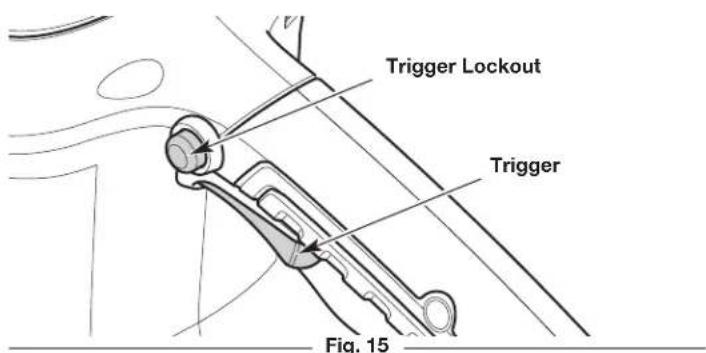
STOPPING INSTRUCTIONS
- Release the trigger (Fig. 15).
- Wait for all moving parts to come to a complete stop.
NOTE: Upon release of the trigger, the trigger lockout will reset to the locked position.
In emergency situations, the saw chain can also be stopped by engaging the chain brake. The chain brake can be activated intentionally by pushing the front hand guard / chain brake lever forward. It can also be activated if the operator's hand strikes the front hand guard / chain brake lever during kickback.
Testing the Chain Brake

WARNING: Always activate the chain brake slowly and deliberately. Keep the saw chain from touching anything. Do not let the chain saw tip forward.
Always test the chain brake before using the unit.
- S et the unit on a flat, level surface.
- Make sure the front hand guard / chain brake lever is pulled back in the disengaged position (Fig. 16).
- Grip the unit firmly with both hands. Refer to Holding the Unit in the Operation section.
- Start the unit. Refer to Starting Instructions.
- While the unit is running, engage the chain brake by pushing the front hand guard / chain brake lever forward with the left hand (Fig. 16). The chain should stop moving abruptly. If it does not have the unit serviced by an authorized service center.
- Stop the unit. Refer to Stopping Instructions.
- Pull the front hand guard / chain brake lever back to the disengaged position.
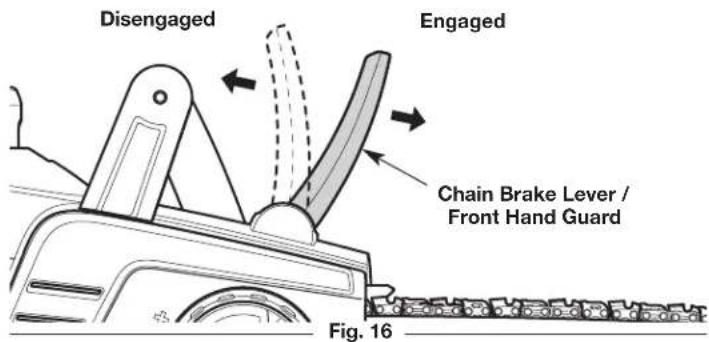
OPERATION

WARNING: Do not expose power tools to rain or wet conditions.

WARNING: Always check the chain tension and adjust as necessary before beginning operation. Refer to Adjusting the Chain Tension in the Maintenance section.

WARNING: Make sure the chain oil reservoir is full before operation. Check the oil level constantly so that it does not drop below half full. The saw chain must be continuously coated with oil to function properly.

WARNING: Always wear appropriate eye, hearing, hand, foot and body protection to reduce the risk of injury when operating this unit. Wear head protection. Use a full face shield when needed. Refer to the Safety section for appropriate safety equipment information.
CHECKING THE BATTERY CHARGE LEVEL
- Press the charge meter button (Fig. 17).
-
One or more of the charge meter lights should illuminate (Fig. 17). The number and color of the lights will indicate the current battery charge level:
-
3 Green Lights = 66 - 100% Charge
- 2 Green Lights = 33 - 66% Charge
-
1 Green Light = 1 - 33% Charge
1 Red Light = 0% Charge -
If the red light illuminates, charge the battery before any further use.
NOTE: While in use, lithium-ion batteries provide power with minimal power fade. When the battery is fully discharged, it will immediately cut power to the unit and require charging.
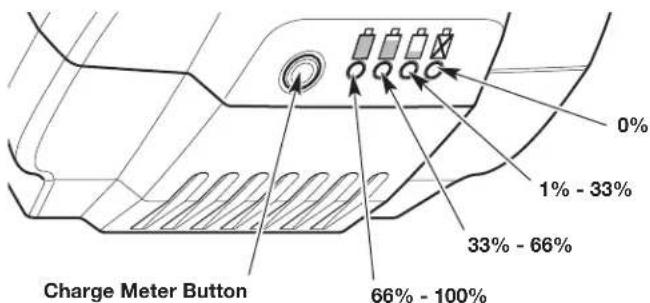
Fig. 17
TIPS FOR BEST RESULTS
- Follow all safety instructions. Refer to the Safety section.
- Only cut wood and materials made of wood. Do not attempt to cut sheet metal, plastics, masonry or any other non-wood materials.
Work slowly and maintain careful control. - Practice cutting a few small logs before beginning a major cutting operation. First-time users should practice cutting logs on a sawhorse or cradle before undertaking other operations.
- Do not attempt to cut trees or logs with diameters larger than 10 in. (25.4 cm).
- When pruning, remove lower branches first to allow clear access to higher branches and to provide space for falling branches.
- When pruning, remove long branches in stages, not all at once.
PREPARING THE WORK AREA
- Clear the area of children, bystanders and pets; keep them outside a 50-foot (15 m) radius, at a minimum. Even then, they are still at risk from thrown objects. Encourage bystanders to wear eye protection. If you are approached, stop the unit immediately. When felling, the safe distance is at least twice the height of the tallest tree in the work area. When bucking, keep workers at least 15 feet (4.6 m) apart.
- Keep the work area clean. Cluttered areas invite injuries. Do not start cutting until the work area is clear and free from obstructions. Make sure there is secure footing and a planned retreat path from falling trees or branches.
- Do not cut near electrical cables or power lines. Keep at least 50 feet (15 m) away from all power lines.
- Use the unit only in daylight or good artificial light.
HOLDING THE UNIT

WARNING: Always use the hand placements specified below whether the operator is left-handed or right-handed. This will help keep the operator slightly to the left of the unit and out of the direct line of the saw chain if kickback occurs (Fig. 20 and Fig. 21). Always keep all body parts to the left of the chain line.
Always grip the unit firmly with both hands when the unit is running.
- Firmly encircle the handles with the thumbs and fingers (Fig. 18). This will help reduce the chance of losing control of the unit if kickback occurs. Any grip with thumbs and fingers on the same side of the handles is dangerous (Fig. 19).
- Stand in a stable position with feet apart and firmly planted.
- Hold the front handle with the left hand. Keep the left arm straight to help withstand potential kickback.
- Hold the rear handle with the right hand. Keep the right arm slightly bent.
- Do not cut above shoulder height. Do not overreach.
- When carrying the chain saw from one place to another, hold it by the front handle, away from the body, and keep the guide bar pointed to the rear.
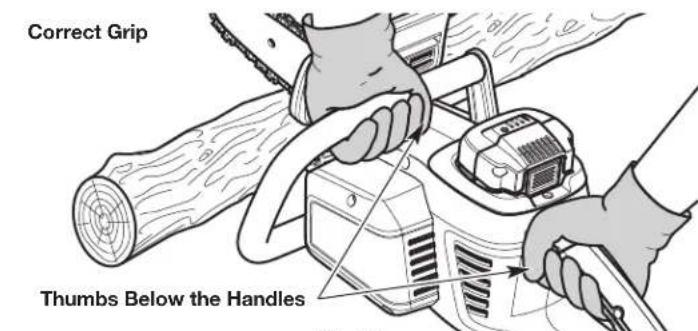
Fig. 18
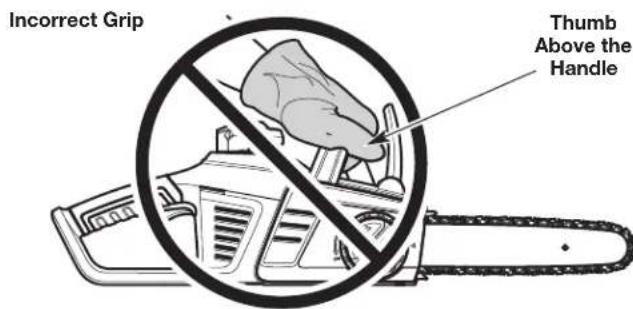
Fig. 19
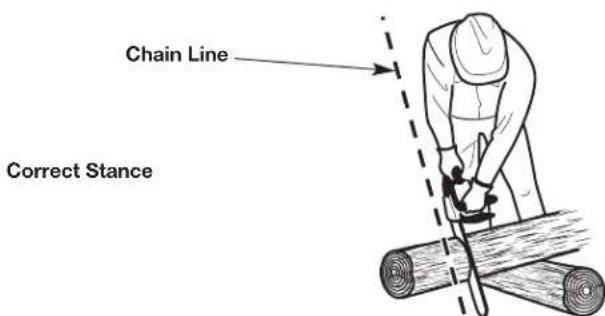
Fig. 20
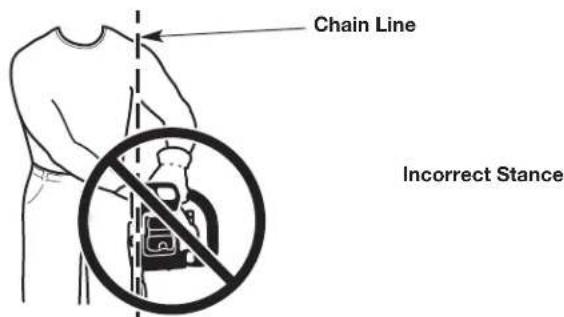
Fig. 21
CUTTING PROCEDURE BASICS
- Start the unit. Refer to Starting Instructions in the Starting and Stopping section.
- Make sure that oil is flowing onto the guide bar and saw chain. A small spray should be visible. When using the unit for the first time, allow 30-60 seconds for the oil to begin flowing.
- Press the unit against the wood and maintain a firm, steady pressure through most of the cut. Do not put pressure on the unit at the end of the cut.
- Keep the unit running through the entire cut.
- Do not try to force the saw through the wood. Allow the saw chain to do the cutting. Exert only light pressure. Forcing the cut could result in damage to the unit or personal injury.
- Release the trigger as soon as the cut is completed. Allow the saw chain to come to a complete stop. The saw chain, guide bar and motor may experience unnecessary wear if the unit is run without a cutting load.
FELLING: SAFETY
Felling is the process of cutting down a tree. Follow these safety precautions to reduce the risk of serious injury, property damage and damage to electrical lines:
- Do not fell trees with an extreme lean. Do not fell trees with rotten limbs, loose bark or hollow trunks. Have these trees pushed or dragged down with heavy equipment.
- Do not cut trees near buildings or electrical lines. Leave these operations for professionals. If a felled tree does contact an electrical line, notify the utility company immediately.
- Check the tree for damaged or dead branches that could fall and cause serious injury.
- Remove dirt, stones, loose bark, nails, wire and other obstructions from the portion of the tree that will be cut.
- When bucking and felling operations are performed by two or more persons in the same general area, they should be separated from each other by a distance of at least twice the height of the tree to be felled.
- Consider the force and direction of the wind. Consider the lean and balance of the tree. Consider the location of large branches. All of these factors influence the direction that the treewill fall. Do not try to fell a tree in a direction other than its natural fall line.
- Do not fell trees during periods of precipitation or high winds.
- Determine a safe and expedient escape route. Clear the area around the tree and make sure there are no obstructions blocking the escape route. Establish a 90^ corridor of escape, approximately 135^ from the line of fall (Fig. 22).
- Stay uphill from the t ree; it will most likely roll or slide after it falls.
FELLING:PROCEDURE
Small trees, up to 6 - 7 inches (15 - 18 cm) in diameter, are usually felled in a single cut. Larger trees require a sequence of two cutting operations: a notched undercut followed by a felling back cut. It may also be necessary to remove buttress roots.
Step 1: Removing Buttress Roots
Buttress roots are large roots that extend above the ground and help support the tree. If the tree has large buttress roots that might impede the felling process, follow these steps to remove them:
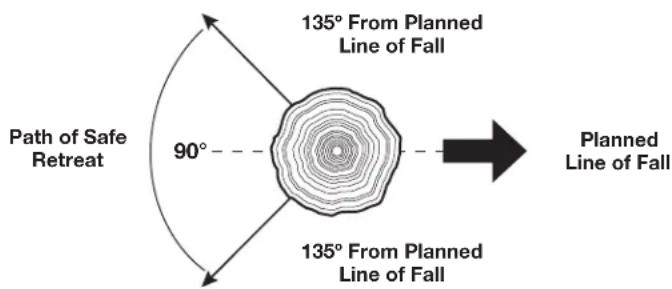
Fig. 22
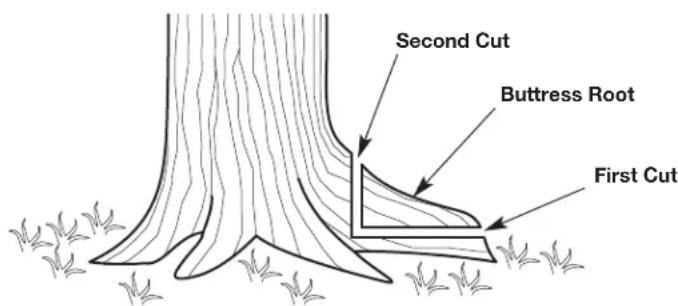
Fig. 23
- Make a horizontal cut into the buttress root (Fig. 23). To prevent the guide bar from being pinched by the weight of the wood, always make this cut first.
- Make a vertical cut into the buttress root (Fig. 23).
- Remove the loose section from the work area.
Step 2: Making the Notched Undercut

WARNING: Never walk in front of a tree with a notched undercut.
This cut determines which direction the tree will fall. Always make this cut on the side of the tree facing the direction where the tree should fall. Make the cut at 90^ to the line of fall.
- Make a horizontal cut into the trunk of the tree (Fig. 24). The cut should be about 1/3 the diameter of the tree and close to the ground. To prevent the guide bar from being pinched by the weight of the wood, always make this cut first.
- Make a 45^ cut into the trunk of the tree, above the first cut (Fig. 24). Continue cutting until the two cuts meet.
- Remove the loose section from the work area.
Step 3: Making the Felling Back Cut

WARNING: Always recheck the area for bystanders, animals and obstacles before making the felling back cut.
This cut fells the tree.
- Make a horizontal cut into the opposite side of the tree from the notched undercut (Fig. 25). Make the cut approximately 2 inches (5cm) above the bottom of the notched undercut (Fig. 25).
- As the cut gets close to the notched undercut, only a thin band of wood will support the tree. This band of wood is referred to as the hinge (Fig. 25). The hinge helps control the fall of the tree. Leave approximately 2 inches (5cm) of hinge in place. Do not cut through the hinge. Cutting through the hinge could cause the tree to fall in any direction.
- Periodically glance up during the felling back cut to see if the tree is going to fall in the correct direction. If there is a chance that the tree might not fall in the desired direction, or if the tree might rock back and bind the chain saw, remove the guide bar from the cut, stop the unit and use wedges to open the cut and direct the fall (Fig. 26). Only use soft plastic or wooden wedges. Drive the wedges into the cut slowly. Once the wedges are in place and the cut is held open, either carefully reinsert the guide bar and continue the cut or slowly drive the wedges in further to push the tree over.
- As the hinge gets smaller, the tree should begin to fall. When the tree begins to fall, remove the chain saw from the cut, stop the motor and set the unit down immediately. Promptly exit the area along the retreat path, but keep watching the tree as it falls.

DANGER: If the tree starts to fall in the wrong direction and binds the chain saw, leave the unit and evacuate the area immediately! Do not try to save the chain saw!

WARNING: Stay clear of spring poles when operating the unit. Spring poles are branches, logs, roots or saplings that are bent under tension by other wood (Fig. 27). When the tension is released, spring poles can strike the operator, causing serious injury and potentially knocking the chain saw into the operator's body. Use extreme caution when cutting spring poles or when releasing the cause of tension
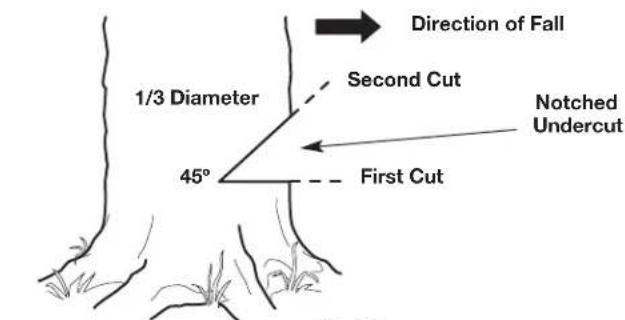
Fig. 24
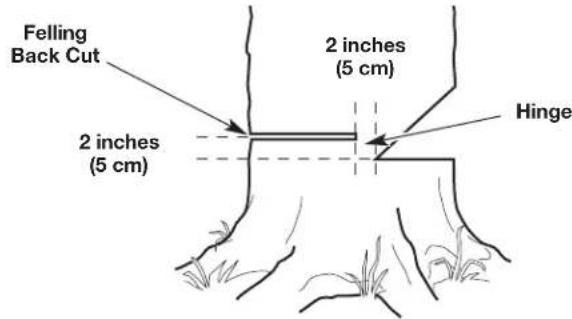
Fig. 25
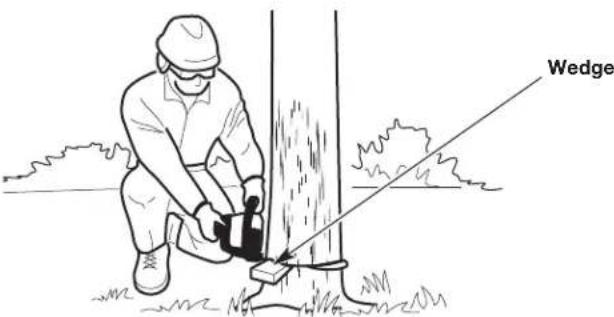
Fig. 26
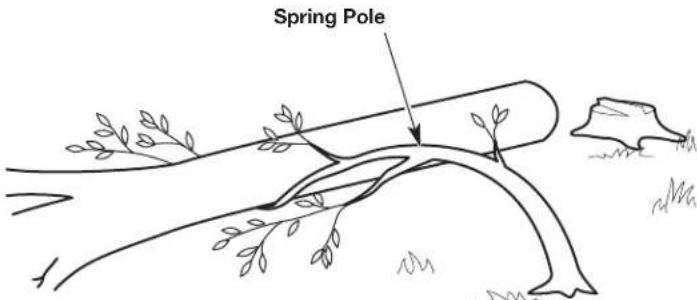
Fig. 27
LIMBING
Limbing is the process of removing branches from a fallen tree.
- Leave the larger support limbs under the tree for last (Fig. 28). These will keep the tree off the ground during the limbing process.
- Cut one limb at a time. Stand on the opposite side of the tree from the limb (Fig. 28). Keep the trunk between the operator and the chain saw. To avoid binding the chain saw, branches under tension should be cut from the bottom up.
- Remove the cut limbs from the work area.
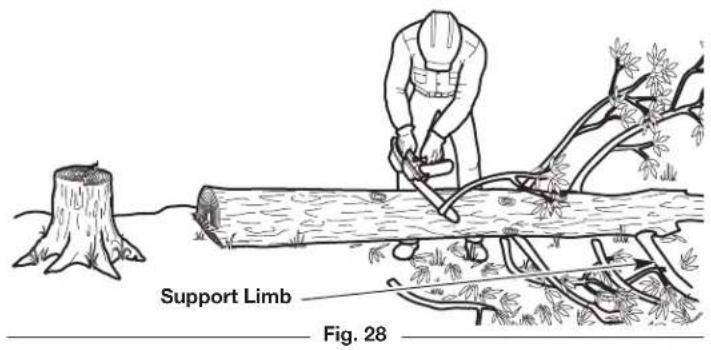
BUCKING: SAFETY
Bucking is the process of cutting a fallen tree into logs of desired lengths. Follow these safety precautions to reduce the risk of serious injury:
- Clear the area of objects or obstructions that could contact the guide bar and result in kickback.
- When bucking on a slope, always stand on the uphill side of the fallen tree.
- If possible, the end of the tree to be cut should be raised off of the ground. A saw horse is ideal for this purpose. If a saw horse is not available, use other logs or any remaining limb stumps. Make sure the tree if firmly supported.
- Do not let the saw chain contact the ground or saw horse.
- Cut one log at a time. Release the trigger and allow the saw chain to come to a complete stop before moving on to the next log.
- Keep feet and all other body parts clear of fa lling logs.

DANGER: Use extreme caution when cutting a fallen tree that is still attached to the root structure. When the trunk is separated from the roots, the stump has a high potential for rocking back into the hole created by the roots. This can result in serious injury or death. Never stand in the hole left by the roots. Never allow others to stand near the root structure.
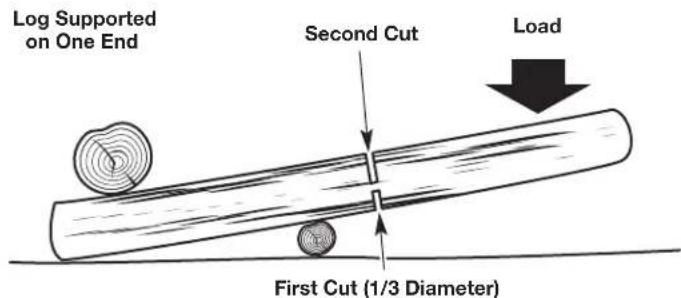
Fig. 29
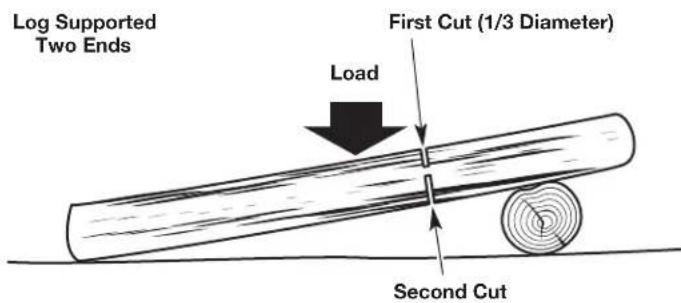
Fig. 30
BUCKING:PROCEDURE
Cutting Logs Under Stress
When logs are supported on one or both ends, the wood tends to bend during the cutting process. This can cause the chain saw to become pinched between the two sides. Pay extra attention.
-
Make the first cut approximately 1/3 the diameter of the log. Do not cut deeper than 1/3.
-
If the log is supported on one end (Fig. 29), make the first cut from below (underbucking). Refer to Underbucking.
-
If the log is supported on two ends (Fig. 30), make the first cut from above (overbucking). Refer to Overbucking.
-
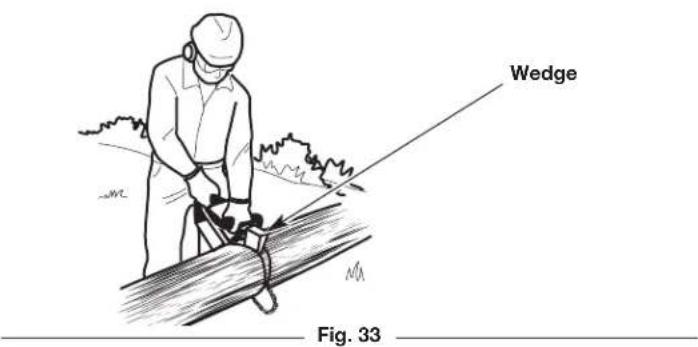
Make the second cut from the opposite side until the two cuts meet. If the diameter of the wood is large enough, insert soft plastic or wooden wedges to hold the cut open and prevent pinching (Fig. 33). Take care not to touch the wedges with the saw chain.
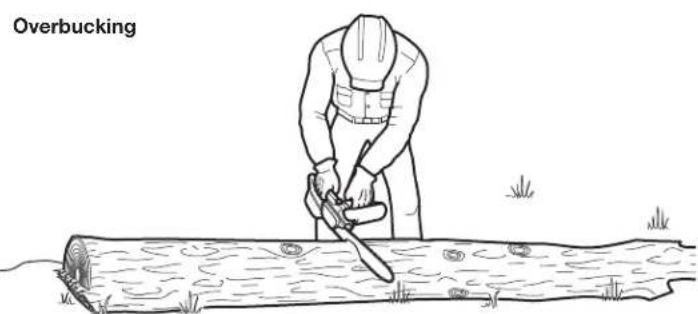
Fig. 31
Cutting Fully-Supported Logs
When logs are supported along the entire length, extra care should be taken to make sure the saw chain does not contact the ground or other support structure (Fig. 31).
- Cut through the log as much as possible, without cutting into the ground or support structure. Cut from above (overbucking). Refer to Overbucking.
- Roll the log over and finish cutting through rough the log from above (overbucking).
Overbucking
- Begin cutting from above, with the bottom of the saw chain against the top of the log (Fig. 31).
- Exert light, downward pressure. The saw will tend to pull away from the operator. Be prepared and hold the saw firmly to maintain control.
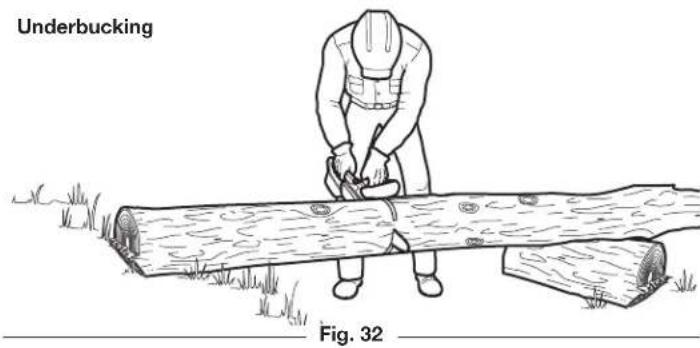
Underbucking
- Begin cutting from below, with the top of the saw chain against the bottom of the log (Fig. 32).
- Exe rt light, upward pressure. The saw will tend to push toward the operator. Be prepared and hold the saw firmly to maintain control.
PRUNING
| WARNING: Do not cut above shoulder height with a chain saw. Use a pole saw to cut limbs above shoulder height or hire a professional. Do not operate the unit in a tree or on a ladder unless specifically trained to do so. | |
| WARNING: Falling branches can cause serious injury. Always wear appropriate head protection. Plan an escape route away from falling limbs. Do not stand, or position any body parts, directly below the branch being cut. |
Pruning is the process of cutting limbs from a living tree.
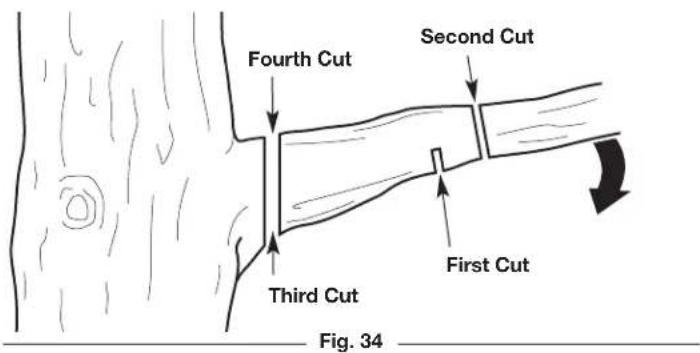
- Make the first cut approximately 6 inches (15 cm) from the tree trunk. Cut upward, from the underside of the limb. Use the top of the guide bar to make this cut. Cut a third of the way through the diameter of the limb (Fig. 34).
- Make the second cut 2 - 4 inches (5 - 10 cm) farther out on the limb. Cut downward, from the top of the limb. Use the bottom of the guide bar to make this cut. Cut completely through the limb (Fig. 34).
- Make the third cut as close to the tree trunk as possible. Cut upward, from the underside of the limb stub. Use the top of the guide bar to make this cut. Cut a third of the way through the diameter of the limb (Fig. 34).
- Make the fourth cut directly above the third cut. Cut downward, from the top of the limb stub. Use the bottom of the guide bar to make this cut. Cut completely through the limb stub to meet the third cut (Fig. 34). This will remove the limb stub.
MAINTENANCE

WARNING: To prevent serious injury, never perform maintenance on the unit while it is running. Always remove the battery to prevent the unit from starting accidentally. Always allow the unit to cool before maintaining the unit. Before maintaining the battery charger, always unplug it from the power outlet.

WARNING: Wear protective clothing and observe all safety instructions to prevent serious personal injury.
MAINTENANCE SCHEDULE
Perform these required maintenance procedures at the frequency stated in the table. These procedures should also be a part of any seasonal tune-up.
All service, other than the maintenance procedures described in this manual, should be performed by an authorized service center.
NOTE: Some maintenance procedures may require special tools or skills. If you are unsure about these procedures, take the unit to an MTD authorized service center.
CUSTOMER RESPONSIBILITY
| FREQUENCY MAINTENANCE REQUIRED | |
| Before each use | ·Check for loose screws, nuts or bolts (tighten as needed) ·Check for damaged or worn parts* ·Check the saw chain sharpness. Refer to Sharpening the Saw Chain. ·Check the chain tension (adjust as needed). Refer to Adjusting the Chain Tension. ·Fill the chain oil reservoir (refill frequently). Refer to Adding Bar and Chain Oil. |
| After each use | Clean the unit and inspect decals. Refer to Cleaning in the Cleaning and Storage section. |
| Every 10 hours | Clean the guide bar groove and oil passages. |
- If maintenance or replacement is required, have the unit serviced by an MTD authorized service center.
MAINTAINING THE BATTERY CHARGER
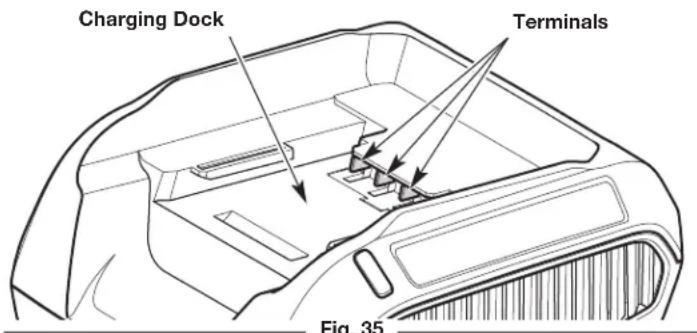
- Keep the battery charger clean and clear of debris. Do not allow foreign material into the charging dock or onto the terminals (Fig. 35). Inspect the battery charger for foreign material before each use.
- Make sure the charger has not been shorted by debris. Inspect the terminals for soot and signs of melting. Do not attempt to use a shorted charger.
ADDING BAR AND CHAIN OIL

DANGER: Failure to fill the chain oil reservoir will cause irreparable damage to the unit. Make sure the chain oil reservoir is always filled. Always use bar and chain oil.

WARNING: Check the chain oil level frequently so that it does not drop below half full.
The guide bar and saw chain require lubrication to minimize friction. Never starve the guide bar and chain of lubricating oil. Running the unit without enough oil will decrease cutting efficiency, shorten the life of the saw chain, cause rapid dulling of the saw chain and excessive wear to the guide bar from overheating. An insufficient amount of lubricating oil is evidenced by smoke, guide bar discoloration or pitch build-up.
Only use bar and chain oil that is formulated to perform over a wide range of temperatures with no diluting required in the chain oil reservoir. Do not use motor oil or any other petroleum-based oil. Do not use dirty, used or contaminated oil. Damage may occur to the guide bar or saw chain. Dispose of old oil according to federal, state and local regulations.
Checking the Chain Oil Level
- Set the unit on a flat, level surface. Position the unit upright (Fig. 36).
- Look into the chain oil level window. The oil level should fill the window at least halfway (Fig. 36). If the oil level is too low, add bar and chain oil. Refer to Filling the Chain Oil Reservoir.
Filling the Chain Oil Reservoir
- Set the unit on a flat, level surface. Position the unit with the chain oil cap facing up (Fig. 37).
- To prevent debris from entering the chain oil reservoir, use a clean cloth to clean the chain oil cap and surrounding area.
- Unscrew the chain oil cap (Fig. 37).
- Carefully pour the oil into the chain oil reservoir. DO NOT overfill.
- Reinstall the chain oil cap. Tighten the chain oil cap firmly.
- Wipe up any oil that may have spilled.
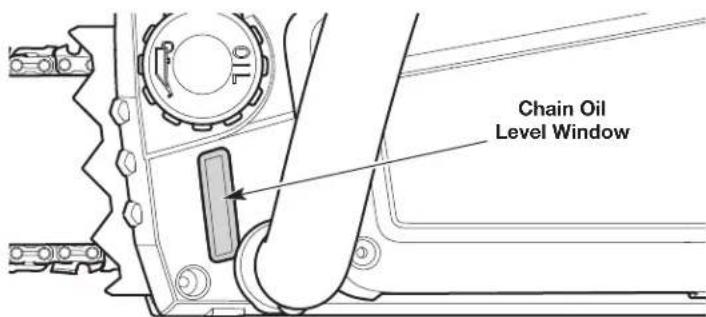
Fig. 36
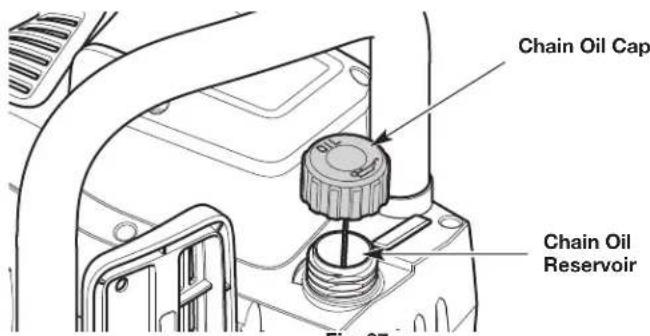
Fig. 37
ADJUSTING THE CHAIN TENSION

CAUTION: The guide bar, saw chain, and saw bearings will wear more rapidly if the saw chain is not properly tensioned. Maintaining proper chain tension will improve cutting performance and prolong the life of the saw chain.

WARNING: To prevent serious injury, never touch the saw chain or adjust the chain tension while the unit is running. Always turn the unit off and remove the battery to prevent the unit from starting accidentally.

WARNING: The saw chain is very sharp. Always wear heavy-duty protective gloves when handling or performing maintenance on the saw chain.
Check the chain tension before and during operation. The saw chain will expand as it heats up during operation. Adjust the chain tension whenever the flats on the saw chain hang out of the bar groove (Fig. 38 and Fig. 42).
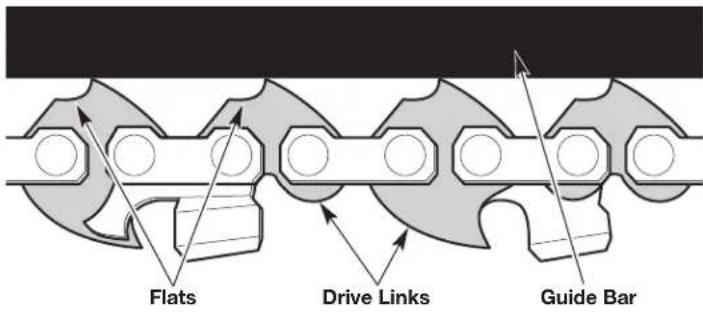
Fig. 38
NOTE: A new saw chain tends to stretch and will need readjustment after as few as five (5) cuts. This is normal during the break-in period. The interval between future adjustments will lengthen quickly.
- Turn the bar knob counterclockwise to slightly loosen the bar cover (Fig. 39). DO NOT remove the bar cover.
-
Hold the guide bar tip up (Fig. 40) and turn the chain-tensioning ring to adjust the tension (Fig. 41).
-
Turn the chain-tensioning ring clockwise to tighten the saw chain.
- Turn the chain-tensioning ring counterclockwise to loosen the saw chain.
The saw chain should fit snugly against the underside of the guide bar. There should be no sag (Fig. 42).
- Continue to hold the guide bar tip up (Fig. 40). Turn the bar knob clockwise to securely tighten the bar cover (Fig. 39).

CAUTION: If the saw chain was tensioned while warm, it may become too tight when cooled. Loosen the chain tension after operation and check the chain tension before the next use.
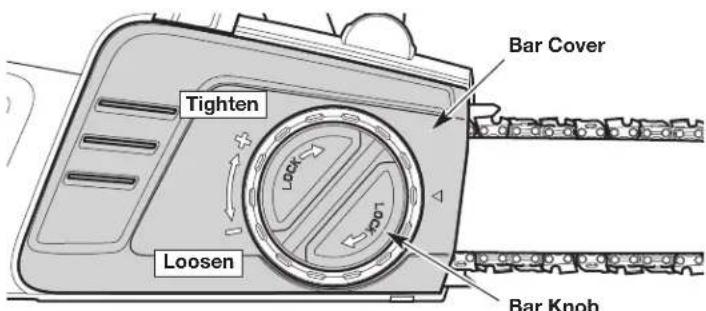
Fig. 39
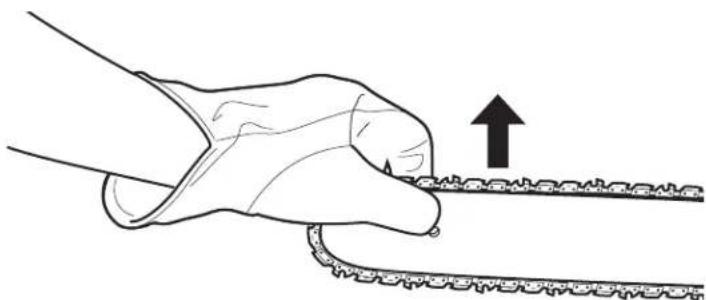
Fig. 40
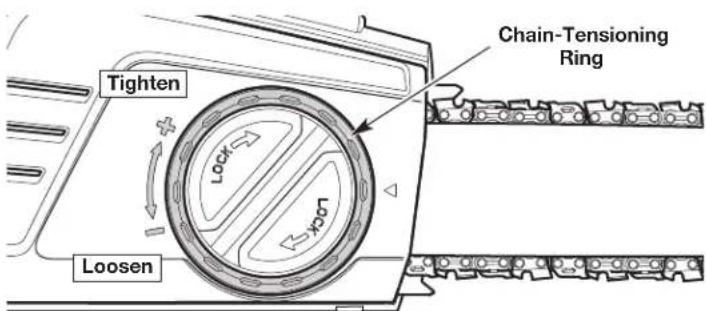
Fig. 41
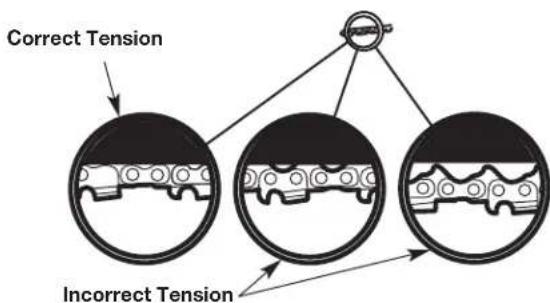
Fig. 42
REMOVING AND INSTALLING THE GUIDE BAR AND SAW CHAIN

WARNING: The saw chain is very sharp. Always wear heavy-duty protective gloves when handling or performing maintenance on the saw chain.
The guide bar and saw chain need to be removed when certain maintenance procedures are performed, such as when rotating the guide bar. When replacing old guide bars and saw chains with new parts, always use the manufacturer's specified replacement parts. Refer to Replacing the Guide Bar and Saw Chain.
Removing the Guide Bar and Saw Chain
- Turn the bar knob counterclockwise to loosen the bar cover (Fig. 39).
- Remove the bar cover.
- Carefully remove the saw chain and guide bar (Fig. 45).
- Remove the saw chain from the guide bar.
- Use a small Phillips screwdriver to remove the screw that holds the bracket onto the guide bar (Fig. 43).
Installing the Guide Bar and Saw Chain
- Place the bracket onto the guide bar (Fig. 43). Align the hole on the bracket with the hole on the guide bar (Fig. 43). Insert the screw into the aligned holes (Fig. 43). Tighten the screw securely with a small Phillips screwdriver.
- Set the saw chain on a clean, flat surface and straighten out any kinks.
- Fit the saw chain into the guide bar groove (Fig. 44). Make sure the cutters point in the correct direction of rotation (Fig. 44). Keep a loop of saw chain at the back end of the guide bar (Fig. 44).
- Hold the saw chain and guide bar together in position over the unit. Loop the saw chain around the drive sprocket and install the guide bar onto the guide bar bolt (Fig. 45). Make sure the guide bar is flush against the mounting surface (Fig. 45). Make sure the flats on the saw chain are in the grooves on the drive sprocket (Fig. 44).
- Turn the chain-tensioning ring (Fig. 41) until the arrow on the chain-tensioning ring aligns with the arrow on the bar cover (Fig. 46).
- Place the bar cover onto the motor housing. Make sure the chain catcher is seated securely in the slot on the bar cover (Fig. 47). Make sure the mounting post is seated securely in the hole on the bar cover (Fig. 47).
- Turn the chain-tensioning ring (Fig. 41) clockwise until the bar cover is connected to the motor housing and the guide bar begins to move forward.
- Turn the bar knob clockwise to tighten the bar cover (Fig. 39). DO NOT tighten the bar knob completely.
- Make sure the saw chain is still in the guide bar groove. Adjust the chain tension. Refer to Adjusting the Chain Tension.
- Hold the guide bar tip up (Fig. 40). Turn the bar knob clockwise to securely tighten the bar cover (Fig. 39).
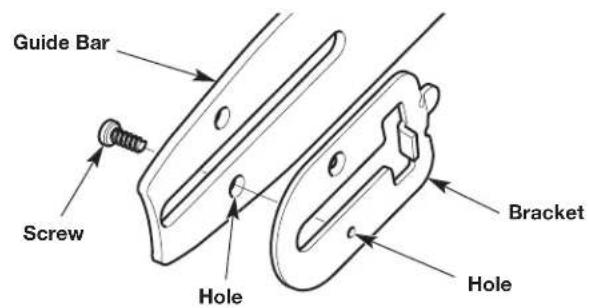
Fig. 43
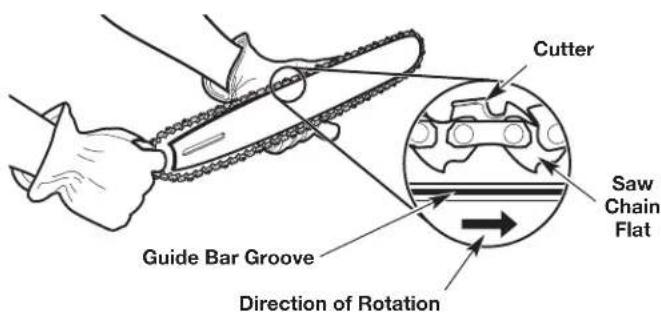
Fig. 44
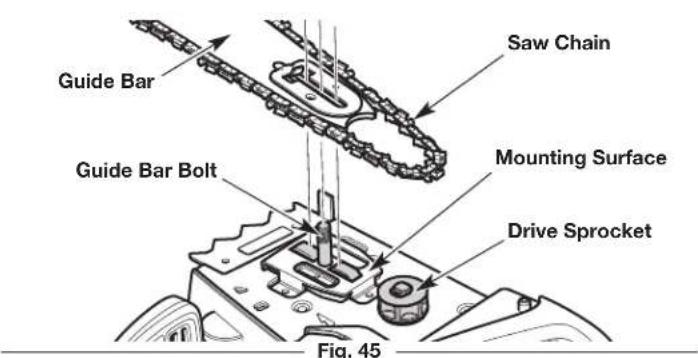
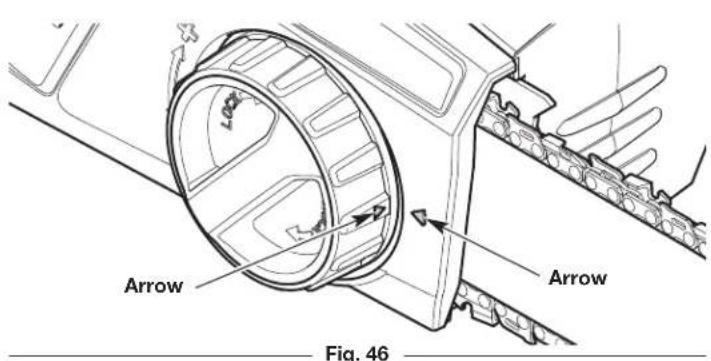
MAINTAINING THE SAW CHAIN
| 警告 | WARNING: The saw chain is very sharp. Always wear heavy-duty protective gloves when handling or performing maintenance on the saw chain. |
| 警告 | WARNING: An improperly sharpened saw chain increases the chance of kickback. Failure to replace or properly maintain the saw chain can cause serious injury. |
| 警告 | CAUTION: A dull or improperly sharpened saw chain can cause excessive motor speed during operation, which can result in severe motor damage. |
For safe, efficient operation, the saw chain must be maintained properly. The saw chain will wear with use, causing the chain to stretch. This is normal. When it is no longer possible to obtain a correct chain-tension adjustment, the saw chain will need to be repaired by an authorized service center or replaced. Refer to Replacing the Guide Bar and Saw Chain.
Always keep the saw chain sharp. During operation, look for the following indicators of a dull saw chain:
- Wood chips are small and powdery.
- The saw chain must be forced through the wood.
The saw chain cuts to one side.
If any of these conditions exist, sharpen or replace the saw chain. Refer to Replacing the Guide Bar and Saw Chain.
NOTE: If you do not fully understand the process for properly sharpening a saw chain, have the saw chain sharpened by an authorized service center or replace the saw chain.
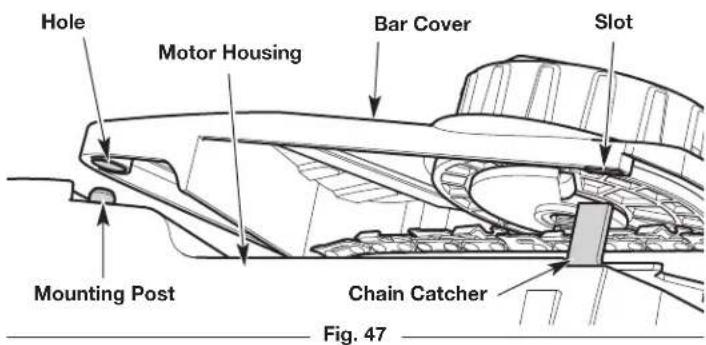
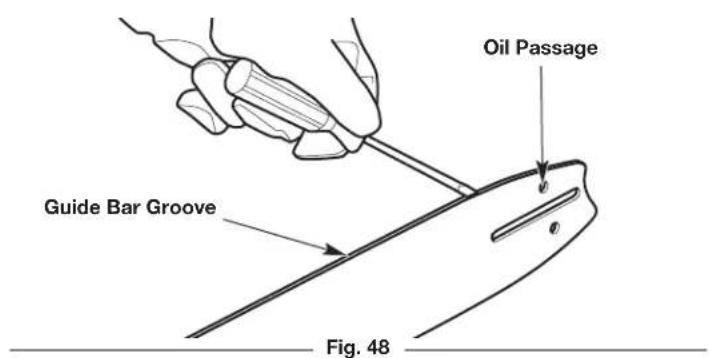
MAINTAINING THE GUIDE BAR
- Rotate the guide bar frequently, at regular intervals (for example, after every 5 hours of operation), to ensure even wear on the top and bottom of the guide bar. Refer to Removing and Installing the Guide Bar and Saw Chain.
- Clean the guide bar groove and oil passages whenever the saw chain is removed, when the unit has been used heavily or when the saw chain appears dirty. Use a screwdriver, putty knife, wire brush or similar instrument to remove debris from the guide bar groove (Fig. 48). Use a small, soft wire to remove any debris from the chain oil discharge hole (Fig. 49).
NOTE: If the oil passages are clear, the saw chain will give off a spray of oil shortly after it begins to rotate during operation.
-
Frequently check the guide bar for damage (Fig. 50). Feathering and burring of the guide bar rails (the ridges on either side of the bar groove) is a normal process of guide bar wear. Such faults should be smoothed with a file as soon as they occur (Fig. 50). A guide bar with the following faults should be replaced:
-
Wear inside the guide bar rails that permits the chain to lay sideways
- Bent guide bar
- Cracked or broken rails
- Spread rails
Refer to Replacing the Guide Bar and Saw Chain.
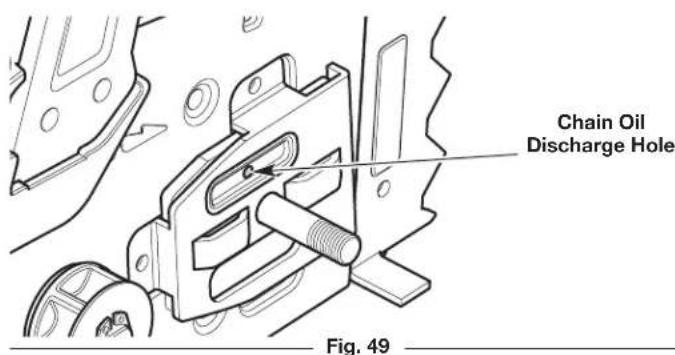
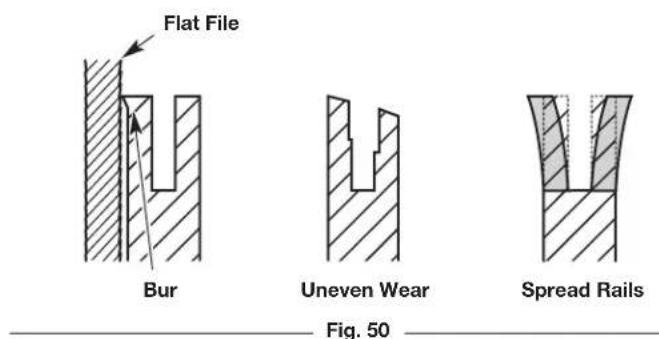
REPLACING THE GUIDE BAR AND SAW CHAIN

WARNING: Always use a low-kickback saw chain, which significantly reduces the danger of kickback. Low-kickback saw chain does not completely eliminate kickback. A low-kickback or "safety chain," should never be regarded as total protection against injury.
When replacing the guide bar and saw chain, only use the replacement parts specified by the manufacturer or their equivalents. Refer to Replacement Parts. Use of any unauthorized parts or accessories could lead to serious injury to the operator or damage to the unit and will Void the warranty.
Always use a replacement saw chain designated as "low-kickback" or a saw chain that meets the low-kickback performance requirements. A standard saw chain (a chain that does not have the kickback-reducing guard links) should only be used by an experienced professional chain saw operator.
CLEANING AND STORAGE
CLEANING

WARNING: To prevent serious injury, never clean the unit while it is running. Always remove the battery to prevent the unit from starting accidentally. Always allow the unit to cool before cleaning the unit. Always unplug the battery charger before cleaning the battery charger.

WARNING: To prevent serious injury, do not use water to clean the unit, battery or battery charger. Do not douse the unit with water. Do not submerge the unit in water or any other liquid. Do not use strong detergents. Household cleaners that contain aromatic oils such as pine and lemon and solvents such as kerosene, can damage plastic.
- Loosen the saw chain if the chain tension was adjusted during operation. The saw chain will contract as the unit cools, which could damage the unit if the chain is too tight.
- Use a small brush or clean, dry cloth to clean the outside of the unit, battery and battery charger.
NOTE: When preparing the unit for long-term storage (30 days or more), remove the guide bar and saw chain. Carefully clean the guide bar cover, guide bar mounting surface and sprocket. Use a firm non-wire brush to clean the guide bar groove. Reassemble the unit.
- Lightly coat the guide bar and saw chain with a corrosion-inhibiting oil.
STORAGE
- Remove the battery from the unit.
- Loosen the saw chain if the chain tension was adjusted during operation. The saw chain will contract as the unit cools, which could damage the unit if the chain is too tight.
- Allow the unit, battery and/or battery charger to cool.
- Thoroughly clean the unit, battery and battery charger. Inspect them for any loose or damaged parts. Replace damaged parts and tighten loose screws, nuts or bolts.
- Cover the guide bar and saw chain with the scabbard.
- Lock up the unit, battery and battery charger to prevent unauthorized use or damage.
- Store the unit, battery and battery charger indoors, in a dry, well-ventilated area.
- Store the battery and battery charger in an area that is between 65 and 75^ F (18 and 24^ C).
Always unplug the battery charger when it is not in use. - Store the unit, battery and battery charger out of the reach of children.
- If the battery is left unused for more than two months, fully charge the battery before use.
NOTE: It is normal for bar and chain oil to seep from the unit when not in use. Please take this into consideration when storing the unit.
| TROUBLESHOOTING | |
| PROBLEM | SOLUTION |
| THE BATTERY WILL NOT CHARGE | |
| The battery charger is not plugged in Plug the battery charger into a plug | 120V 60hz AC source |
| The battery is not fully inserted into the battery charger | Remove and then reinsert the battery into the battery charger completely |
| The battery and/or charger are too hot or too cold | Make sure the battery and charger are in an environment between 32° and 104°F (0° and 40°C). Allow time for the battery and/or charger to warm up or cool down. |
| The battery and/or battery charger are no longer functional | Refer to the Warranty section for replacement information |
| THE BATTERY DIES QUICKLY | |
| The battery is not fully charged Charge the battery completely | |
| The battery and/or battery charger are no longer functional | Refer to the Warranty section for replacement information |
| THE MOTOR WILL NOT RUN | |
| The battery lacks sufficient charge Charge the battery completely | |
| The battery is not installed correctly Remove and reinstall the battery | |
| The trigger lockout was not engaged Press and hold the trigger lockout before squeezing the trigger | |
| THE MOTOR STOPS WHILE IN USE, BUT THE BATTERY STILL HAS SUFFICIENT CHARGE | |
| Device protection systems have engaged | Remove the battery, allow it to cool for 30 seconds, then reinstall the battery |
| THE SAW CHAIN COMES OFF THE GUIDE BAR | |
| The saw chain tension is too loose Adjust the saw chain tension | |
| The guide bar and saw chain are assembled incorrectly | Refer to Removing and Installing the Guide Bar and Saw Chain |
| THE GUIDE BAR AND SAW CHAIN ARE RUNNING HOT, SMOKING OR STUCK | |
| The saw chain tension is too tight Adjust the saw chain tension | |
| The saw chain and guide bar lack sufficient oil Fill the chain oil reservoir | |
| The guide bar groove and oil passages are dirty Clean the guide bar and oil passages | |
| THE SAW CHAIN DOES NOT ROTATE | |
| The saw chain tension is too tight Adjust the saw chain tension | |
| The guide bar and saw chain are assembled incorrectly | Refer to Removing and Installing the Guide Bar and Saw Chain |
| The guide bar and saw chain are damaged | Inspect the guide bar and saw chain for damage. Replace them if necessary |
| The drive assembly is damaged Refer to Service information | |
| THE SAW CHAIN ROTATES, BUT DOES NOT CUT | |
| The saw chain is dull Sharpen or replace the saw chain | |
| The saw chain is on backwards Check and correct the saw chain direction | |
If further assistance is required, contact an authorized service center.
WARRANTY
REMINGTON
REMINGTON LLC
LIMITED WARRANTY
Limited Warranty
The limited warranty set forth herein is given by Remington LLC with respect to new battery-powered, Remington-branded products (hereinafter "Product") purchased and used in the United States and/or Canada to the Initial Purchaser (as defined herein). This Product is not intended for rental or commercial use.
Scope Of The Limited Warranty
Remington LLC offers the following limited warranty to the Initial Purchaser for residential or otherwise non-commercial use: except for the Exclusions (defined herein), during the Warranty Period (as defined herein), this Product (exclusive of the battery and the battery charger) will be free from manufacturing defects, including workmanship and materials. The "Initial Purchaser" is the first person to purchase this new Product from an authorized Remington dealer, distributor and/or retailer of such products. This limited warranty is non-transferable. Subject to the Exclusions and except as otherwise set forth herein, the limited warranty period for this new Product purchased by the Initial Purchaser is three (3) years from the date of purchase, as shown on the original sales receipt for the Product ("Warranty Period").
Defects In Workmanship Or Materials
Subject to the Exclusions and except as otherwise set forth herein, this Product is warranted to be free from manufacturing defects in either workmanship or materials for the Warranty Period. During the Warranty Period, Remington LLC will, at its option, either repair or replace any original part that is covered by this limited warranty and is determined to be defective in workmanship or material.
To Qualify For This Limited Warranty, This Product:
- Must have been purchased from an authorized retailer.
- Must have been purchased within the United States or Canada by the Initial Purchaser.
- Must have been used for residential (non-commercial) purposes only.
- Must have been used in a manner consistent with the normal and proper intended use for this Product.
Who Can Perform Repairs Under This Warranty?
In order to qualify for the limited warranty as set forth herein, the repairs made under this warranty must be performed by an authorized Remington warranty service provider.
How To Get Service Under This Limited Warranty.
To locate a Remington warranty service provider, contact your authorized Remington dealer, distributor, or retailer or contact Remington LLC at P.O. Box 361032, Cleveland, Ohio 44136-0019 or call 1-866-206-2707 or log on to our website at www.remingtonpowertools.com. In Canada, contact MTD Products Limited, 97 Kent Avenue, Kitchener, ON N2G 3R2, or call 1-877-696-5533 or log on to the above website. This limited warranty is provided by Remington LLC and is the only product warranty provided by Remington LLC for this Product. A COPY OF YOUR SALES RECEIPT IS REQUIRED FOR WARRANTY SERVICE.
What This Limited Warranty Does Not Cover.
This Limited Warranty Does Not Cover The Following (the "Exclusions"):
- Product purchased outside of the United States or Canada.
- Damage due to lack of maintenance and/or improper maintenance as described in the operator's manual.
-
Normal wear and tear resulting from use of the Product.
-
Normal Wear Parts (as defined herein) are warranted to be free from defects in material and workmanship for a period of thirty (30) days from the date of original purchase by the Initial Purchaser. For the purpose of this Limited Warranty, "Normal Wear Parts" include, but are not limited to items such as: bump knobs, outer spools, cutting line, inner reels, starter pulleys, starter ropes, drive belts, saw chains, guide bars, cultivator tines and/or blades.
- Use of the Product that is not consistent with the intended use thereof, as described in the operating instructions, including, but not limited to, abuse, misuse and/or neglect of the Product or any use inconsistent with and/or non-compliant with instructions contained in the operator's manual.
- Any Product that has been altered or modified in a manner not consistent with the original design of the Product or in a manner not approved by Remington LLC.
- Wheel rims (when so equipped), are covered for a period of three (3) months from the date of original purchase by the Initial Purchaser for manufacturing defects.
- The battery supplied with this Product is warranted to be free from defects in material and workmanship for a period of three (3) years from the date of original purchase by the Initial Purchaser.
- The battery charger supplied with this Product is warranted to be free from defects in material and workmanship for a period of three (3) years from the date of original purchase by the Initial Purchaser.
This Warranty Does Not Cover And Remington LLC Disclaims Any Responsibility For Matters Including, But Not Limited To, The Following:
- Loss of time or loss of use of the Product.
- Transportation costs and other expenses incurred in connection with the transport of the Product to and from the authorized Remington warranty service provider.
- Any loss or damage to other equipment or personal items.
- Damages caused by improper maintenance or the use of other than the specified fuel, oil or lubricants as approved in the operator's manual.
- Damage resulting from the installation or use of any accessory or part not approved by Remington LLC for use with the Product.
Limitations:
- THERE ARE NO IMPLIED WARRANTY, INCLUDING, BUT NOT LIMITED TO, ANY IMPLIED WARRANTY OF MERCHANTABILITY OR FITNESS FOR A PARTICULAR PURPOSE. NO WARRANTY SHALL APPLY AFTER THE APPLICABLE WARRANTY PERIOD AS SET FORTH ABOVE AS TO THE PARTS AS IDENTIFIED. NO OTHER EXPRESS WARRANTY OR GUARANTY, WHETHER WRITTEN OR ORAL, EXCEPT AS MENTIONED ABOVE, GIVEN BY ANY PERSON OR ENTITY, INCLUDING A DEALER OR RETAILER, WITH RESPECT TO ANY PRODUCT SHALL BIND REMINGTON LLC. DURING THE WARRANTY PERIOD, THE EXCLUSIVE REMEDY IS REPAIR OR REPLACEMENT OF THE DEFECTIVE PART, AS SET FORTH ABOVE. (SOME STATES DO NOT ALLOW LIMITATIONS ON HOW LONG AN IMPLIED WARRANTY LASTS, SO THE ABOVE LIMITATION MAY NOT APPLY TO YOU.)
- THE PROVISIONS AS SET FORTH HEREIN PROVIDE THE SOLE AND EXCLUSIVE REMEDY ARISING FROM THE SALE. REMINGTON LLC SHALL NOT BE LIABLE FOR INCIDENTAL OR CONSEQUENTIAL LOSS OR DAMAGES INCLUDING, WITHOUT LIMITATION, FOR TRANSPORTATION OR FOR RELATED EXPENSES, OR FOR RENTAL EXPENSES TO TEMPORARILY REPLACE A WARRANTED PRODUCT. (SOME STATES DO NOT ALLOW THE EXCLUSION OR LIMITATION OF INCIDENTAL OR CONSEQUENTIAL DAMAGES, SO THE ABOVE EXCLUSION OR LIMITATION MAY NOT APPLY TO YOU.)
- In no event shall recovery of any kind be greater than the amount of the purchase price of the Product sold. Alteration of the safety features of the Product shall void this limited warranty. You assume the risk and liability for loss, damage, or injury to you and your property and/or to others and their property arising out of the use or misuse or inability to use the Product.
How State Law Relates To This Warranty.
This limited warranty gives you specific legal rights, and you may also have other rights, which vary from state to state.