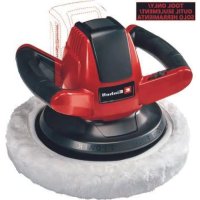
CECB 18254 LiSolo - Sander EINHELL - Free user manual and instructions
Find the device manual for free CECB 18254 LiSolo EINHELL in PDF.



| Product Type | Cordless Polisher (for waxing and polishing vehicle paints) |
| Brand | Einhell |
| Model | CECB 18254 LiSolo |
| Power Supply | 18 V Lithium-Ion Battery (not included, sold separately) |
| No-Load Speed | 2,500 rpm |
| Polishing Pad Diameter | 254 mm (10 inches) |
| Weight | 2.1 kg (4.6 lbs) |
| Package Contents | Polisher, fabric polishing bonnet, synthetic polishing bonnet, instruction manual, safety instructions |
| Battery Charge Indicator | Yes, with 3 LEDs (charge indicator) |
| Intended Use | Waxing and polishing vehicle paints (cars, boats, caravans) |
| Safety | Wearing hearing protection, safety goggles and dust mask is mandatory |
| Maintenance and Cleaning | Remove battery before cleaning; clean with a damp cloth and mild soap; wash bonnets by hand; store in a dry, frost-free place |
| Warranty | 2 years for material or manufacturing defects (domestic use) |
| Customer Service | Contact Einhell USA at 1-866-EINHELL (1-866-346-4355) |
| Recommended Storage Temperature | 5 °C to 30 °C (41 °F to 86 °F) |
| Wear Parts | Polishing bonnets (not covered by warranty, available on website) |
Frequently Asked Questions - CECB 18254 LiSolo EINHELL
User questions about CECB 18254 LiSolo EINHELL
0 question about this device. Answer the ones you know or ask your own.
Ask a new question about this device
Download the instructions for your Sander in PDF format for free! Find your manual CECB 18254 LiSolo - EINHELL and take your electronic device back in hand. On this page are published all the documents necessary for the use of your device. CECB 18254 LiSolo by EINHELL.
USER MANUAL CECB 18254 LiSolo EINHELL
EN Original operating instructions Cordless polishing machine
SP Manual de instrucciones original Pulidora inalámbrica
natural_image
Exterior view of a circular power tool with a mesh base and label (no readable text or symbols beyond branding)7

natural_image
Two circular objects labeled 4 and 5, with no visible text or symbols on the objects themselves.-2-
natural_image
Close-up of a hand using a power tool on a circular base, with a downward arrow indicating action (no visible text or symbols)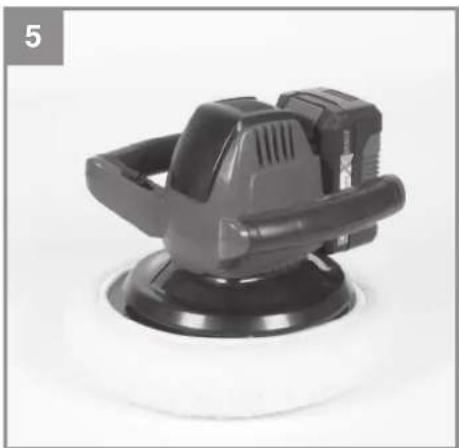
natural_image
Close-up of a black industrial cleaning brush head with a circular base, no visible text or symbols.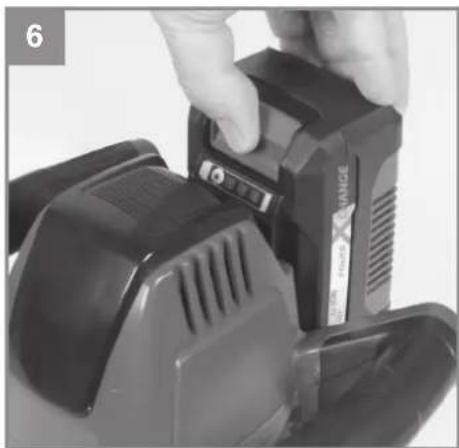
natural_image
Close-up of a hand holding a black electronic device with a labeled switch (no visible text or symbols)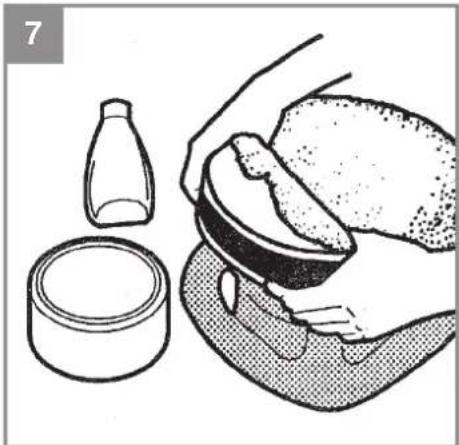
natural_image
Illustration of a hand holding a bowl over a container, with another bottle nearby (no text or symbols)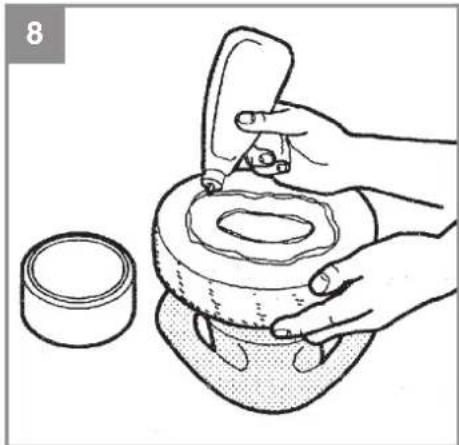
natural_image
Illustration of hands holding a lid and a container, no text or symbols present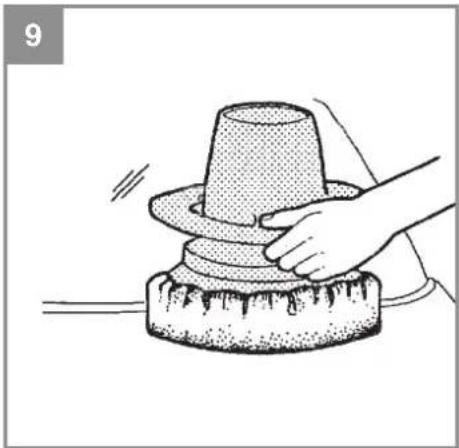
natural_image
Illustration of a hand pressing a circular mechanical component on a base, no text or symbols present
natural_image
Illustration of hands cleaning a car wheel with a mesh material (no text or symbols)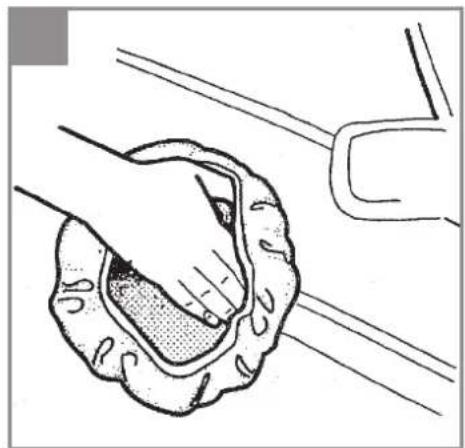
natural_image
Illustration of a hand washing a car seat with a mesh cap (no text or symbols)EN
Table of contents
- Safety information
- Layout and items supplied
- Intended use
- Technical data
- Before starting the equipment
- Operation
- Cleaning, maintenance and ordering spare parts
- Disposal and recycling
- Storage
- Faults
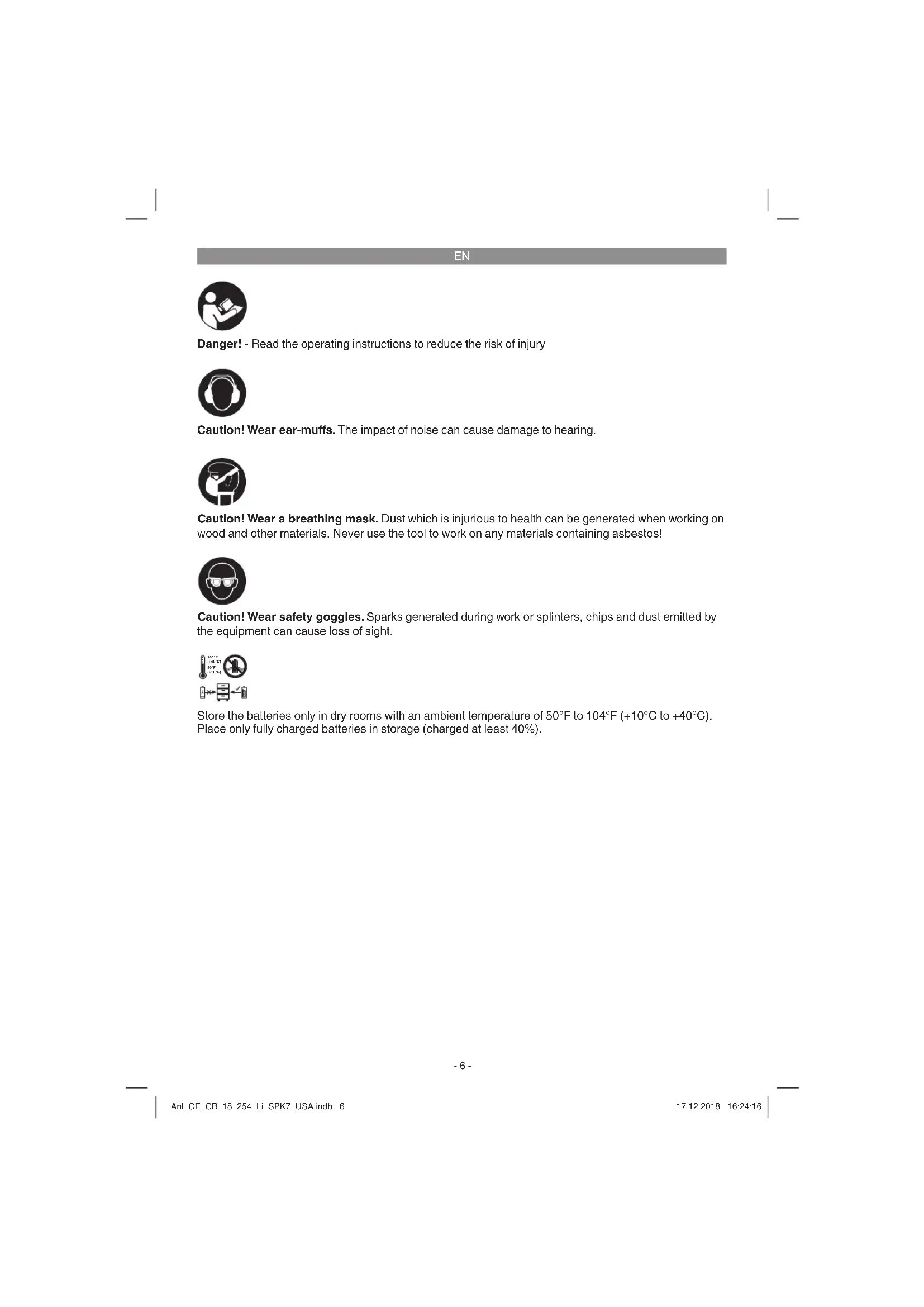
Danger! - Read the operating instructions to reduce the risk of injury

Caution! Wear ear-muffs. The impact of noise can cause damage to hearing.

Caution! Wear a breathing mask. Dust which is injurious to health can be generated when working on wood and other materials. Never use the tool to work on any materials containing asbestos!

Caution! Wear safety goggles. Sparks generated during work or splinters, chips and dust emitted by the equipment can cause loss of sight.

Store the batteries only in dry rooms with an ambient temperature of 50^ F to 104^ F ( +10^ C to +40^ C). Place only fully charged batteries in storage (charged at least 40%).
EN
DANGER!
When using the equipment, a number of safety precautions must be observed to avoid injuries and damage. Please read the complete operating instructions and safety information with due care. Keep these operating instructions in a safe place so that the information is available at all times. If you give the equipment to any other person, hand over these operating instructions and the safety information as well. We cannot accept any liability for damage or accidents which arise due to failure to follow these instructions and the safety information.
1. Safety information
DANGER!
Read all the safety information and instructions. Failure to adhere to the safety information and instructions set out below may result in electric shock, fire and/or serious injury. Keep all the safety information and instructions in a safe place for future use.
General safety information for power tools The term „power tool“ used in the safety regulations refers to power tools operated from the mains power supply (with a power cable) and to battery operated power tools (without a power cable).
1) Work area safety
a) Keep work area clean and well lit.
Cluttered and dark areas invite accidents.
b) Do not operate power tools in explosive atmospheres, such as in the presence of fl ammable liquids, gases or dust. Power tools create sparks which may ignite the dust or fumes.
c) Keep children and bystanders away while operating a power tool. Distractions can cause you to lose control.
2) Electrical safety
a) Power tool plugs must match the outlet. Never modify the plug in any way. Do not use any adapter plugs with earthed (grounded) power tools. Unmodified plugs and matching outlets will reduce risk of electric shock.
b) Avoid body contact with earthed or grounded surfaces such as pipes, radiators, ranges and refrigerators. There
is an increased risk of electric shock if your body is earthed or grounded.
c) Do not expose power tools to rain or wet conditions. Water entering a power tool will increase the risk of electric shock.
d) Do not abuse the cord. Never use the cord for carrying, pulling or unplugging the power tool. Keep cord away from heat, oil, sharp edges or moving parts. Damaged or entangled cords increase the risk of electric shock.
e) When operating a power tool outdoors, use an extension cord suitable for outdoor use. Use of a cord suitable for outdoor use reduces the risk of electric shock.
f) If operating a power tools in a damp location is unavoidable, use a residual current device (RCD) protected supply. Use of an RCD reduces the risk of electric shock.
3) Personal safety
a) Stay alert, watch what you are doing and use common sense when operating a power tool. Do not use a power tool while you are tired or under the influence of drugs, alcohol or medication. A moment of inattention while operating power tools may result in serious personal injury.
b) Use personal protective equipment. Always wear eye protection. Protective equipment such as dust mask, non-skid safety shoes, hard hat, or hearing protection used for appropriate conditions will reduce personal injuries.
c) Prevent unintentional starting. Ensure the switch is in the off -position before connecting to power source and/or BATTERY pack, picking up or carrying the tool. Carrying power tools with your finger on the switch or energising power tools that have the switch on invites accidents.
d) Remove any adjusting key or wrench before turning the power tool on. A wrench or a key left attached to a rotating part of the power tool may result in personal injury.
e) Do not overreach. Keep proper footing and balance at all times. This enables better control of the power tool in unexpected situations.
f) Dress properly. Do not wear loose clothing or jewellery. Keep your hair, clothing and gloves away from moving parts. Loose clothes, jewellery or long hair
EN
can be caught in moving parts.
g) If devices are provided for the connection of dust extraction and collection facilities, ensure these are connected and properly used. Use of these devices can reduce dust related hazards.
h) Do not let familiarity gained from frequent use of tools allow you to become complacent and ignore tool safety principles. A careless action can cause severe injury within a fraction of a second.
4) Power tool use and care
a) Do not force the power tool. Use the correct power tool for your application. The correct power tool will do the job better and safer at the rate for which it was designed.
b) Do not use the power tool if the switch does not turn it on and off. Any power tool that cannot be controlled with the switch is dangerous and must be repaired.
c) Disconnect the plug from the power source and/or remove the battery pack, if detachable, from the power tool before making any adjustments, changing accessories, or storing power tools. Such preventive safety measures reduce the risk of starting the power tool accidentally.
d) Store idle power tools out of the reach of children and do not allow persons unfamiliar with the power tool or these instructions to operate the power tool. Power tools are dangerous in the hands of untrained users.
e) Maintain power tools and accessories. Check for misalignment or binding of moving parts, breakage of parts and any other condition that may affect the power tool's operation. If damaged, have the power tool repaired before use. Many accidents are caused by poorly maintained power tools.
f) Keep cutting tools sharp and clean. Properly maintained cutting tools with sharp cutting edges are less likely to bind and are easier to control.
g) Use the power tool, accessories and tool bits etc., in accordance with these instructions and in the manner intended for the particular type of power tool, taking into account the working conditions and the work to be performed. Use of the power tool for operations different from intended could result in a hazardous
situation.
h) Keep handles and grasping surfaces dry, clean and free from oil and grease. Slippery handles and grasping surfaces do not allow for safe handling and control of the tool in unexpected situations.
5) Battery tool use and care
a) Recharge only with the charger specified by the manufacturer. A charger that is suitable for one type of battery pack may create a risk of fi re when used with another battery pack.
b) Use power tools only with specifically designated battery packs. Use of any other battery packs may create a risk of injury and fire.
c) When battery pack is not in use, keep it away from other metal objects, like paper clips, coins, keys, nails, screws or other small metal objects that can make a connection from one terminal to another. Shorting the battery terminals together may cause burns or a fi re.
d) Under abusive conditions, liquid may be ejected from the battery; avoid contact. If contact accidentally occurs, fl ush with water. If liquid contacts eyes, additionally seek medical help. Liquid ejected from the battery may cause irritation or burns.
e) Do not use a BATTERY pack or tool that is damaged or modified. Damaged or modified batteries may exhibit unpredictable behaviour resulting in fire, EXPLOSION or risk of injury.
f) Do not expose a BATTERY pack or tool to fi re or excessive temperature. Exposure to fi re or temperature above 266°F (130°C) may cause explosion.
g) Follow all charging instructions and do not charge the BATTERY pack or tool outside the temperature range specified in the instructions. Charging improperly or at temperatures outside the specified range may damage the BATTERY and increase the risk of fi re.
6) Service
a) Have your power tool serviced by a qualified repair person using only identical replacement parts. This will ensure that the safety of the power tool is maintained.
b) Never service damaged BATTERY packs. Service of BATTERY packs should only be
EN
performed by the manufacturer or authorized service providers.
Additional safety instructions
We pay a great deal of attention to the design of every battery pack to ensure that we supply you with batteries which feature maximum power density, durability and safety. The battery cells have a wide range of safety devices. Each individual cell is initially formatted and its electrical characteristic curves are recorded. These data are then used exclusively to be able to assemble the best possible battery packs.
Despite all the safety precautions, caution must always be exercised when handling batteries. The following points must be obeyed at all times to ensure safe use.
Safe use can only be guaranteed if undamaged cells are used. Incorrect handling can cause cell damage.
Caution! Analyses confirm that incorrect use and poor care are the main causes of the damage caused by high performance batteries.
Information about the battery
- The battery pack supplied with your cordless tool is not charged. The battery pack has to be charged before you use the tool for the first time.
- For optimum battery performance avoid low discharge cycles. Charge the battery pack frequently.
- Store the battery pack in a cool place, ideally at 59°F (15°C) and charged to at least 40%.
- Lithium-ion batteries are subject to a natural ageing process. The battery pack must be replaced at the latest when its capacity falls to just 80% of its capacity when new. Weakened cells in an aged battery pack are no longer capable of meeting the high power requirements and therefore pose a safety risk.
- Do not throw battery packs into an open fire. There is a risk of explosion!
- Do not ignite the battery pack or expose it to fire.
-
Do not exhaustively discharge batteries. Exhaustive discharge will damage the battery cells. The most common cause of deep discharge is lengthy storage or non-use of partly discharged batteries. Stop working as soon as the performance of the battery falls noticeably or the electronic protection system triggers. Place the battery pack in storage only after it has been fully charged.
-
Protect batteries and the tool from overloads. Overloads will quickly result in overheating and cell damage inside the battery housing without this overheating actually being apparent externally.
- Avoid damage and shocks. Replace batteries which have been dropped from a height of more than one meter or which have been exposed to violent shocks without delay, even if the housing of the battery pack appears to be undamaged. The battery cells inside the battery may have suff ered serious damage. In this respect, please also read the waste disposal information.
- If the battery pack suffers overloading and overheating, the integrated protective cut-off will switch off the equipment for safety reasons. Caution! Do not press the ON/OFF switch any more if the protective cut-off has actuated. This may damage the battery.
- Use only original battery packs. The use of other batteries may result in injuries, explosion and a fire risk.
Information on chargers and the charging process
- Please check the data marked on the rating plate of the battery charger. Be sure to connect the battery charger to a power supply with the voltage marked on the rating plate. Never connect it to a different mains voltage.
- Protect the battery charger and its cable from damage and sharp edges. Have damaged cables repaired without delay by a qualified electrician.
- Keep the battery charger, batteries and the cordless tool out of children's reach.
- Do not use damaged battery chargers.
- Do not use the supplied battery charger to charge other cordless tools.
- In heavy use the battery pack will become warm. Allow the battery pack to cool to room temperature before commencing with the charging.
- Do not over-charge batteries. Do not exceed the maximum charging times. These charging times apply only to discharged batteries. Frequent insertion of a charged or partly charged battery pack will result in over-charging and cell damage. Do not leave batteries in the charger for days on end.
- Never use or charge batteries if you suspect that the last time they were charged was more than 12 months previously. There is a high probability
EN
that the battery pack has already suff ered dangerous damage (exhaustive discharge).
- Charging batteries at a temperature below 50^ F ( 10^ C) will cause chemical damage to the cell and may cause a fire.
- Do not use batteries which have heated during the charging process, as the battery cells may have suffered dangerous damage.
- Do not use batteries which have suffered curvature or deformation during the charging process or which show other non-typical symptoms (gassing, hissing, cracking,...)
- Never fully discharge the battery pack (recommended depth of discharge max. 80%) A complete discharge of the battery pack will lead to premature ageing of the battery cells.
- Never charge the batteries unsupervised.
Protection from environmental influences
- Wear suitable work clothes. Wear safety goggles.
- Protect your cordless tool and the battery charger from moisture and rain. Moisture and rain can cause dangerous cell damage.
- Do not use the cordless tool or the battery charger near vapors and infl ammable liquids.
- Use the battery charger and cordless tools only in dry conditions and an ambient temperature of 50^ F to 104^ F ( 10^ C to 40^ C).
- Do not keep the battery charger in places where the temperature is liable to reach over 40^ C. In particular, do not leave the battery charger in a car that is parked in the sunshine.
- Protect batteries from overheating. Overloads, over-charging and exposure to direct sunlight will result in overheating and cell damage. Never charge or work with batteries which have been overheated – replace them immediately if possible.
- Storage of batteries, battery chargers and cordless tools. Store the charger and your cordless tool only in dry places with an ambient temperature of 50^ F to 104^ F ( 10^ C to 40^ C). Store the lithium-ion rechargeable battery in a cool and dry place at 50^ F to 68^ F ( 10^ C to 20^ C). Protect them from humidity and direct sunlight! Place only fully charged batteries in storage (charged at least 40%).
- Prevent the lithium-ion battery pack from freezing. Battery packs which were stored below 32^ F ( 0^ C) for more than 60 minutes must be disposed of.
- When handling batteries beware of electrostatic charge: Electrostatic discharges
cause damage of the electronic protection system and the battery cells. Avoid electrostatic charging and never touch the battery poles.
Battery Caution + Disposal
Disposal
Should your appliance need replacement after extended use, do not dispose of it with the household refuse, but in an environmentally safe

Waste produced by electrical machine items should not be handled like normal household rubbish. Please recycle where recycle facilities exist. Check with your local authority or retailer for recycling advice.
Always dispose of your battery pack according to federal, state, and local regulations. Contact a recycling agency in your area for recycling locations.
⚠️ CAUTION! Even discharged battery packs contain some energy. Before disposing, use electrical tape to cover the terminals to prevent the battery pack from shorting, which could cause a fi re or explosion.
⚠ WARNING! To reduce the risk of injury or explosion, never burn or incinerate a battery pack even if it is damaged, dead, or completely discharged. When burned, toxic fumes and materials are emitted into the surrounding atmosphere.
- Batteries vary according to device. Consult your manual for specific information.
- Install only new batteries of the same type in your product (where applicable).
- Failure to insert batteries in the correct polarity, as indicated in the battery compartment or manual, may shorten the life of the batteries or cause batteries to leak.
- Do not mix old and new batteries.
- Do not mix Alkaline, Standard (Carbon-Zinc), or Rechargeable (Nickel Cadmium, Nickel Metal Hydride, or Lithium-Ion) batteries.
- Do not dispose of batteries in fire.
- Batteries should be recycled or disposed of as per state and local guidelines.
When shipping or disposing of batteries and cordless tools, always ensure that they are packed individually in plastic bags to prevent short circuits and fi res.
EN
Safety information for polishing machines
• Make sure that the polishing bonnet is securely fastened to the polishing disk.
• Do not touch any rotating parts!
- Before you switch on, make sure that the polishing disk is not blocked and can run without any danger.
• Always check the polishing bonnets and the polishing disk for damage.
- Replace torn or damaged polishing bonnets / polishing disk immediately.
- Do not switch on the polishing machine until the polishing disk is resting on the surface you want to polish.
- Do not use any abrasives; these can destroy the lacquer.
- Harmful dust can develop during dry polishing. Be sure to wear a suitable dust mask to protect you from inhaling this dust.
- Important! Wear safety goggles and a dust mask.
This equipment is not designed to be used by people (including children) with limited physical, sensory or mental capacities or those with no experience and/or knowledge unless they are supervised by a person who is responsible for their safety or they have received instructions from such a person in to how to use the equipment safely. Children must always be supervised in order to ensure that they do not play with the equipment.
Keep this safety information in a safe place.
2. Layout and items supplied
2.1 Layout (Fig. 1/2)
- Handle
- Polishing disk
- On/Off switch
- Textile polishing bonnet
- Synthetic polishing bonnet
- Battery capacity indicator
- Battery capacity indicator button
2.2 Items supplied
Please check that the article is complete as specified in the scope of delivery. If parts are missing, please contact our service center or the store where you made your purchase at the latest within 5 work days after purchasing the article and upon presentation of a valid bill of purchase.
- Open the packaging and take out the equipment with care.
- Remove the packaging material and any packaging and/or transportation braces (if present).
- Check to see if all the items are supplied.
- Inspect the equipment and accessories for transport damage.
- If possible, keep the packaging until the end of the guarantee period.
Danger!
The equipment and packaging material are not toys. Do not let children play with plastic bags, plastic sheets and small parts. There is a risk of choking and suffocating!
- Polishing machine
• Textile polishing bonnet
• Synthetic polishing bonnet
• Original operating instructions - Safetyinformation
Separately available accessories
18V 1.5Ah P-X-C lithium-ion battery
18V 2.0Ah P-X-C lithium-ion battery
18V 3.0Ah P-X-C lithium-ion battery
18V 4.0Ah P-X-C lithium-ion battery
18V P-X-C charger
Explore battery + charger options at einhellUSA.com
3. Intended use
The equipment is designed solely for waxing/polishing and dewaxing paintwork on motor vehicles, boats, caravans or mobile homes.
The equipment is allowed to be used only for its prescribed purpose. Any other use is deemed to be a case of misuse. The user/operator and not the manufacturer will be liable for any damage or injuries of any kind resulting from such misuse.
Please note that our equipment has not been designed for use in commercial, trade or industrial applications. Our warranty will be voided if the equipment is used in commercial, trade or industrial businesses or for equivalent purposes.
EN
4. Technical data
Motor power supply: 18 V Idling speed: 2500 min ^-1 (rpm) Polishing disk: 10 in. (∅ 254 mm) Weight: 4.6 lbs (2.1 kg)
Wear ear-muff s.
The impact of noise can cause damage to hearing.
Reduce noise generation and vibration to a minimum!
- Use only equipment that is in perfect condition.
- Maintain and clean the equipment regularly.
• Adapt your way of working to the equipment.
• Do not overload the equipment.
• Have the equipment checked if necessary. - Switch off the equipment when not in use.
- Wear gloves.
CAUTION!
Residual risks
Even if you use this electric power tool in accordance with the instructions, certain residual risks cannot be eliminated. The following hazards may arise in connection with the equipment's construction and layout:
- Lung damage if no suitable protective dust mask is used.
- Damage to hearing if no suitable ear protection is applied.
- Health damage caused by hand-arm vibrations if the equipment is used over a longer period or is not properly guided and maintained.
5. Before starting the equipment
The equipment is supplied without batteries and without a charger.
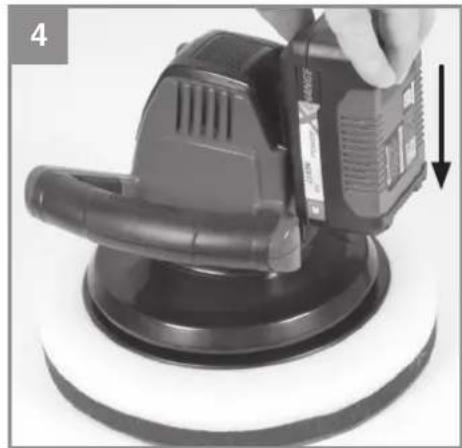
5.1 Fitting the battery (Fig. 4-5)
Push the battery into the battery mount provided. When the battery is positioned as in Fig. 5, make sure that the pushlock button latches in place! To take out the battery, press the pushlock button and remove the battery (Fig. 6).
6. Operation
Warning!
Always remove the battery pack before making adjustments to the equipment.
6.1 Charging the Li battery pack
The corresponding instructions can be found in the original operating instructions for your charger.
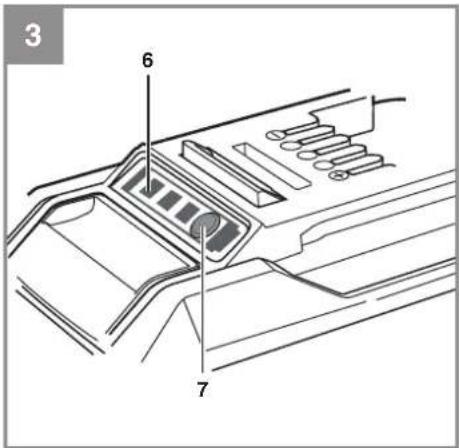
6.2 Battery capacity indicator (Fig. 3)
Press the battery capacity indicator switch (7). The battery capacity indicator (6) shows the charge status of the battery using 3 LEDs.
All 3 LEDs lit:
The battery is fully charged.
2 or 1 LED(s) lit:
The battery has an adequate remaining charge.
1 LED fl ashing:
The battery is empty, recharge the battery.
All LEDs fl ashing:
The battery pack has been deep-discharged and is defective. Do not re-use or charge a defective battery pack.
6.3 Mounting the polishing bonnet on the polishing disk (Fig. 7)
- Turn the car polishing machine upside down so that the polishing disk is facing up.
- Pull the textile polishing bonnet over the polishing disk. Make sure that the textile polishing bonnet is free of any foreign bodies.
6.4 Applying wax/polishing paste to the textile polishing bonnet (Fig. 8)
Note: Use only high-quality waxing and polishing products and follow the processing instructions issued by the manufacturer on the packaging. Distribute the polishing agent evenly as far as the edge of the textile polishing bonnet so that a uniform, thin coating is produced overall.
Note: Applying too much polishing agent will only make it more difficult to remove the layer of polishing agent later from the paintwork and will not improve the results.
EN
6.5 Switching on and applying the polishing agent to the paintwork
Note: The paintwork you want to process must be carefully cleaned and completely dry.
Severely oxidized paintwork requires the use of a special cleaner.
Select a cleaner from the products available to suit the state of the paintwork and the stress it is exposed to.
- Dab with the textile polishing bonnet on different positions of the paintwork you want to polish. This will help to distribute any excess polishing agent over the textile polishing bonnet and/or over the paintwork you want to polish.
- Hold the handle of the equipment firmly in both hands, place the polishing machine onto the paintwork you want to polish (Fig. 9) and switch on the equipment by pressing the On/Off switch (Fig. 1 / Item 3).
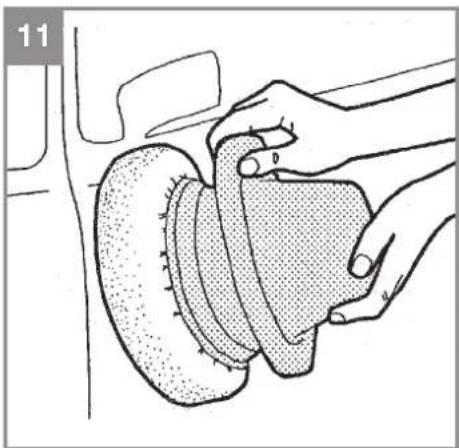
- First work on the large level surfaces such as the engine hood, boot lid and roof (Fig. 10), then on the smaller surfaces such as the doors and mudguards (Fig. 11). Guide the equipment smoothly over the paintwork, exerting no pressure.
- Switch off the equipment with the On/Off switch (Fig. 1 / Item 3) before you remove it from the paintwork you are polishing.
- For areas which are difficult to reach, remove the textile polishing bonnet from the polishing disk and process these areas by hand (Fig. 12).
6.6 Polishing the paintwork with the synthetic polishing bonnet
Note: After the previously applied polishing agent has dried completely on the paintwork, you can begin with the polishing. Damp polish will be smeared by the synthetic polishing bonnet.
- Replace the textile polishing bonnet with the synthetic polishing bonnet. Make sure that the synthetic polishing bonnet is free of any foreign bodies.
- Remove the polish layer in the same order in which you applied the polishing agent to the paintwork. Be sure to follow the instructions issued for using the waxing and polishing agent.
7. Cleaning, maintenance and ordering spare parts
HAZARD!
Always take the battery out of the equipment before starting any cleaning work.
7.1 Cleaning
- Keep all safety devices, air vents and the motor housing free of dirt and dust as far as possible. Wipe the equipment with a clean cloth or blow it down with compressed air at low pressure.
• We recommend cleaning the equipment immediately each time after use. - Clean the equipment regularly with a damp cloth and some soft soap. Do not use cleaning agents or solvents; these may be aggressive to the plastic parts in the equipment. Ensure that no water can get into the interior of the equipment. The ingress of water into an electric power tool increases the risk of an electric shock.
- Wash the polishing bonnets only by hand and let them air-dry.
- When the polishing machine is not being used it should be stored face up with the polishing bonnet removed so that the polishing disk can dry and retain its original shape.
7.2 Maintenance
There are no other parts inside the equipment which require maintenance.
7.3 Ordering replacement parts: Service
- If your power tool requires service, contact an authorized Einhell USA dealer or call the Einhell USA customer service center at 1-866-EINHELL
(1-866-346-4355). Only identical replacement parts should be utilized for repairs. This will ensure that the safety of the power tool is maintained.
- If the battery charger cable is damaged, it must be immediately replaced to avoid a hazard. Contact the Einhell USA® customer service center at 1-866-EINHELL (1-866-346-4355) for assistance.
EN
8. Disposal and recycling
The equipment is supplied in packaging to prevent it from being damaged in transit. The raw materials in this packaging can be reused or recycled. The equipment and its accessories are made of various types of material, such as metal and plastic. Never place defective equipment in your household refuse. The equipment should be taken to a suitable collection center for proper disposal. If you do not know the whereabouts of such a collection point, you should ask in your local council offices.
9. Storage
Store the equipment and its accessories out of children's reach in a dark and dry place at above freezing temperature. The ideal storage temperature is between 41°F and 86°F (5°C and 30°C). Keep the electric tool in its original packaging.
10. Faults
The machine does not work
Check that the battery is charged and whether the charging unit is working. If the equipment will not work in spite of the voltage supply being OK, please send it to the customer service address below.
The reprinting or reproduction by any other means, in whole or in part, of documentation and papers accompanying the products is strictly subject to the express consent of iSC GmbH.
Subject to technical changes
EN
Einhell
EINHELL CUSTOMER PROMISE
QUALITY COMES FIRST. The Einhell name is synonymous with high-performance tools and high-quality European craftsmanship. From cordless screwdrivers to electric lawn mowers, Einhell USA designs and develops state-of-the-art handheld power and garden tools for DIY enthusiasts, hobby gardeners, and handymen.
Einhell USA's quality assurance and engineering teams ensure products are subjected to stringent quality and performance tests. We know that sometimes tough tools go through tough times. In the event that you should experience any issue with your product, you have our commitment that we'll do everything we can to get you back a tool that's ready to work as hard as you do.
PRODUCT REGISTRATION:
Einhell strongly encourages you to register your purchase. You can register online at EinhellUSA.com Failure to register your product purchase will not diminish your warranty rights. However, registering your purchase will allow Einhell to better serve you with any of your customer service needs.
WHAT IS COVERED?
Einhell warrants to the owner that if this Machine fails within 2 years from the date of purchase due to a defect in material or workmanship or as a result of normal wear and tear from ordinary household use, Einhell will send a replacement part or product, as needed, free of charge and with free shipping to the original purchaser. If, in Einhell's sole discretion, the failed Machine cannot be repaired with a part, Einhell will elect to either (A) send a new Machine at no charge and with free shipping or (B) refund the full purchase price to the owner.
WHO CAN SEEK WARRANTY COVERAGE?
This Warranty is extended by Einhell to the owner of this Machine (a "Machine" consists of a product powered by a motor) for residential and personal household use only. This warranty is limited to thirty (30) days from the start of original purchase of any EINHELL brand product that is used for commercial purposes, or any other income-producing purpose. Should ownership of this machine change during the coverage period, please update the Machine's owner information at EinhellUSA.com
WHAT IS NOT COVERED?
This warranty does not cover any product that has been subject to misuse, neglect, negligence, or accident, or that has been operated in any way contrary to the operating instructions as specified in the operator's manual. This Warranty does not cover cosmetic changes that do not affect performance.
This Warranty is only valid if the Machine is used and maintained in accordance with the instructions, warnings and safeguards contained in the owner's manual. Einhell will not be responsible for the cost of any unauthorized warranty repairs. This warranty does not cover any cost or expense incurred by the purchaser in providing substitute equipment or service during reasonable periods of malfunction or non-use of this product while waiting for a replacement part or unit under this warranty.
Wearing parts like belts, augers, chains and tines are not covered under this warranty, and can be purchased at EinhellUSA.com or by calling 1-866-EINHELL (1-866-346-4355). Batteries are covered in full for 90-days from the date of purchase.
Repair, replacement or refund of the purchase price are the exclusive remedies of purchaser and the sole liability of Einhell under this warranty. No employee or representative of Einhell is authorized to make any additional warranty or any modification to this warranty which may be binding upon Einhell. Accordingly, purchaser should not rely upon any additional statements made by any employee or representative of Einhell. In no event, whether based on contract, indemnity, warranty, tort (including negligence), strict liability or otherwise, shall Einhell be liable for any special, indirect, incidental, or consequential damages, including, without limitation, loss of profit or revenue.
Some states do not allow limits on warranties. In such states, the above limitations may not apply to you.
Outside the USA and Canada, other warranties may apply.
SP


- EN
- Table of contents
- DANGER!
- Safety information
- Additional safety instructions
- Despite all the safety precautions, caution must always be exercised when handling batteries. The following points must be obeyed at all times to ensure safe use.
- Information about the battery
- Information on chargers and the charging process
- Protection from environmental influences
- Battery Caution + Disposal
- Disposal
- Safety information for polishing machines
- Layout and items supplied
- Layout (Fig. 1/2)
- Items supplied
- Separately available accessories
- Intended use
- Technical data
- Wear ear-muff s.
- CAUTION!
- Residual risks
- Before starting the equipment
- Fitting the battery (Fig. 4-5)
- Operation
- Warning!
- Charging the Li battery pack
- Battery capacity indicator (Fig. 3)
- All 3 LEDs lit:
- or 1 LED(s) lit:
- LED fl ashing:
- All LEDs fl ashing:
- Mounting the polishing bonnet on the polishing disk (Fig. 7)
- Applying wax/polishing paste to the textile polishing bonnet (Fig. 8)
- Switching on and applying the polishing agent to the paintwork
- Polishing the paintwork with the synthetic polishing bonnet
- Cleaning, maintenance and ordering spare parts
- HAZARD!
- Cleaning
- Maintenance
- Ordering replacement parts: Service
- Disposal and recycling
- Storage
- Faults
- The machine does not work
- Einhell
- EINHELL CUSTOMER PROMISE
- PRODUCT REGISTRATION:
- WHAT IS COVERED?
- WHO CAN SEEK WARRANTY COVERAGE?
- WHAT IS NOT COVERED?
- SP
Brand : EINHELL
Model : CECB 18254 LiSolo
Category : Sander