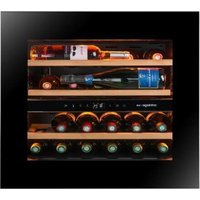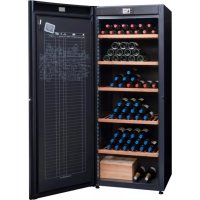
DHA305PA - Wine cellar AVINTAGE - Free user manual and instructions
Find the device manual for free DHA305PA AVINTAGE in PDF.



User questions about DHA305PA AVINTAGE
0 question about this device. Answer the ones you know or ask your own.
Ask a new question about this device
Download the instructions for your Wine cellar in PDF format for free! Find your manual DHA305PA - AVINTAGE and take your electronic device back in hand. On this page are published all the documents necessary for the use of your device. DHA305PA by AVINTAGE.
USER MANUAL DHA305PA AVINTAGE

Clayette coulissante
Before use, please read and follow the safety rules and operating instructions in this manual.
Firstly, we would like to thank you for purchasing an AVINTAGE product and hope that this appliance fully lives up to your expectations.
You have decided to entrust your "grand cru" to a Frio Enterprise group cellar, and we thank you! Our teams are permanently searching for quality and trying to constantly improve our products. So, we remain especially open to any suggestion you might have and to your specific needs. We wish you the most pleasant wine tasting experiences!
Frio Enterprise reserves the right to change the information contained in this guide without notice. Frio Enterprise disclaims any warranty on its devices for any use other than that described in the guide, as well as for any intervention made by a third party not approved by Frio Enterprise or your retailer. The names and brands indicated in this guide are copyrighted. This guide contains proprietary information. It is strictly prohibited to reproduce the information contained in it unless expressly agreed to in writing by Frio Enterprise.
1. GENERAL SAFETY INSTRUCTIONS
Before you use your appliance for the first time, please read this user manual carefully. Store it carefully so that you can refer to it in the future, if necessary. To reduce the risk of fire, electrical shock, or injury when using your appliance, follow these basic precautions.
Generally speaking, your appliance must be maintained by a qualified professional.
For your safety and correct usage, before installing and first using the appliance, read this user manual carefully, including its hints and warnings. To avoid unnecessary mistakes and accidents or to avoid damage to the appliance, it is important to make sure that all people using the appliance are thoroughly familiar with its operation and safety features. Save these instructions and be sure that they remain with the appliance if it is moved or sold, so that anyone using it throughout its life will be properly informed on its usage and safety notices. This will ensure optimum operation of the appliance.
For the safety of life and property and to avoid any risk of injury, keep the precautions of these user's instructions as the manufacturer is not responsible for damages caused by omission.
This appliance is intended exclusively for domestic use and is intended for the storage of special drink products at a storage temperature higher than that of a storage compartment for fresh products. Under no circumstances is it intended to keep food products fresh.
Make sure that your electrical installation's voltage corresponds to that on the appliance's nameplate; the appliance must be connected to an approved, earthed system. Incorrect repairs or connections can cause safety hazards. Have your electrical installation checked by a professional, if you are in any doubt.
This unit must be correctly connected to an earthed socket for your protection. Do not cut off or remove the earth wire on the mains cable supplied.
For safety reasons, do not use an electrical extension cable.
If your appliance is damaged (e.g. a major impact) or suffers harm (power surge due to lightning, flood, fire), it may be dangerous to use. Disconnect the mains plug and have the appliance checked by an approved professional repairer.
To prevent any danger, do not replace a damaged mains cable yourself. Contact your retailer, an approved service center or professional repairer.
This appliance must be positioned such that the mains socket is accessible. Do not move the appliance once it is full: you might distort its body beyond repair. The electrical parts must not be directly accessible.
Keep children away from the appliance.
Do not use this appliance outdoors.
In the event that liquid is accidentally spilled (broken bottle, etc.) on electrical components (motor, etc.), disconnect the mains plug immediately.
To prevent any risk of fire, electrocution or injury, do not immerse the mains cable, plug or the appliance itself in water or any other liquid. Do not handle the appliance with wet hands.
Keep the appliance away from any source of heat and out of direct sunlight.
Do not allow the mains cable to hang from a table or be in contact with sharp edges or hot surfaces.
Do not pull on the mains cable - take hold of the plug to disconnect the appliance.
Ensure that the area where your appliance is positioned can support its weight when loaded (a 75 cl bottle weighs approximately 1.3kg ). Your cellar must be placed on a flat surface. If you have to position it on a rug or carpet, place a support underneath.
To prevent damaging the door gasket, make sure the door is fully open when pulling shelves out of the rail compartment.
Safety of children and other vulnerable persons
This appliance can be used by children aged from 8 years and above, and by persons with reduced physical, sensory or mental capabilities or lack of experience and knowledge if they have been given supervision or instruction concerning use of the appliance in a safe way and understand the hazards involved.
User cleaning and servicing operations should not be carried out
by children, unless they are more than 8 years old and are supervised.
- Keep all packaging away from children as there is risk of suffocation.
Risk of child entrapment. Child entrapment and suffocation are not problems of the past. Junked or abandoned appliances are still dangerous, even if they will "just sit in the garage a few days".
If you are discarding the appliance, pull the plug out of the socket, cut the connection cable (as close to the appliance as you can) and remove the door to prevent children playing from suffering an electric shock or from closing themselves inside it.
If this appliance, featuring a magnetic door seals, is to replace an older appliance having a spring lock (latch) on the door or lid, be sure to make the spring lock unusable before you discard the old appliance. This will prevent it from becoming a death trap for a child. - Keep the appliance and its power cable out of reach of children less than 8 years old.
Before you throw away your old wine cooler: take off the door. Leave the shelves in place so that children may not easily climb inside. - Children aged from 3 to 8 years are allowed to load and unload this appliance.
Children should be supervised to ensure they do not play with the appliance.
General safety
WARNING — This appliance is intended to be used in household and similar applications such as:
Staff kitchen areas in shops, offices and other working environments,
- Farm houses and by clients in hotels, motels and other residential type environments,
Bed and breakfast type environments,
Catering and similar non-retail applications.
WARNING — To avoid a hazard due to instability of the appliance, it must be fixed in accordance with the instructions.
WARNING — Do not store explosive substances such as aerosol cans with a flammable propellant in this appliance, as they could leak or release fluids.
WARNING — If the supply cord is damaged, it must be replaced by the manufacturer, its service agent or similarly qualified persons in order to avoid a hazard.
WARNING — Keep ventilation openings, in the appliance enclosure or in the built-in structure, clear of obstruction and ensure that air can circulate, especially if the appliance is recessed into a wall.
WARNING — Do not use mechanical devices or other means to accelerate the defrosting process, other than those recommended by the manufacturer.
WARNING — Do not damage the refrigerant circuit.
WARNING — Do not use electrical appliances inside the food storage compartments of the appliance, unless they are of the type recommended by the manufacturer.
WARNING — The refrigerant and insulation blowing gas are flammable. When disposing of the appliance, do so only at an
authorized waste disposal center. Do not expose to flame.
WARNING — The refrigerant of these appliances is R600a, flammable and explosive articles should not be put in or near the cabinet, to avoid the fire or explode caused.
Refrigerating fluid
The refrigerating circuit in the appliance uses refrigerating isobutene (R600a), which is a highly inflammable natural gas and is therefore dangerous for the environment. When transporting or installing the appliance, ensure that no element of the refrigerating circuit is damaged. The refrigerating fluid (R600a) is inflammable.
Caution: risk of fire
If the refrigerant circuit should be damaged:
Avoid opening flames and sources of ignition.
✓ Thoroughly ventilate the room in which the appliance is situated.
It is dangerous to alter the specifications or modify this product in any way. Any damage to the cord may cause a short circuit, fire, and/or electric shock.
Electrical safety
✓ We decline any liability in respect of incidents caused by poor electrical installation.
- The power cord must not be lengthened. Do not use an extension cable, or adapter, or multi-way socket.
Make sure that the power plug is not crushed or damaged. A crushed or damaged power plug may overheat and cause a fire.
Make sure that you can access the main plug of the appliance.
Do not pull the main cable.
Ensure that the appliance is always electrically earthed.
If the power plug socket is loose, do not insert the power plug. There is a risk of electric shock or fire.
- You must not operate the appliance without the interior lighting lamp cover.
Disconnect the appliance before replacing the lighting bulb.
✓ The cellar is only applied with power supply of single phase alternating current of 220 240V / 50Hz .
Do not attempt to replace a damaged power cable, contact your after-sales service.
- The power socket must be easily accessible but out of reach of children. In case of doubt, contact your installation technician.
Daily use
This appliance is intended to be used exclusively for the storage of wine.
- Do not store flammable gas or liquids in the appliance. There is a risk of an explosion.
- Do not operate any electrical appliances in the appliance (electric ice cream makers, mixers etc.).
- When unplugging always pull the plug from the mains socket and do not pull on the cable.
- Do not place hot items near the plastic components of this appliance.
The appliance manufactures storage recommendations should be strictly adhered to. Refer to relevant instructions for storage.
- Keep burning candles lamps and other items with naked flames away from the appliance so that do not set the appliance on fire.
- The appliance is intended for keeping beverages in normal household as explained in this instruction booklet.
- The appliance is heavy. Care should be taken when moving it. If your appliance is equipped with castors, remember that these are only designed to facilitate minor movements. Do not move the appliance over long distances.
Never use the base, drawers, doors etc. to stand on or as supports. - To avoid items falling and causing injury or damage to the appliance, do not overload the door racks or put food in the crisper drawers.
Caution: cleaning and servicing
Before carrying out servicing, switch off the power supply and disconnect the appliance.
✓ When cleaning the appliance, do not use metal objects, steam systems, volatile fluids, organic solvents or abrasive substances.
- Never clean appliance parts with flammable fluids. The fumes can create a fire hazard or explosion.
- Do not use sharp or pointed objects to remove ice. Use a plastic scraper.
Important information concerning installation
√ It is intended to be used exclusively for the storage of wine.
This refrigerating appliance is not suitable for the freezing foodstuffs.
✓ The wine cooler is recommended to be designed at 12^ .
This unit is intended for free-standing installation only. It must never be built-under or built-in. For proper operation of the appliance, it is imperative to allow good air circulation around the unit. We do not accept any liability instance of non-compliance with the installation instructions.
Avoid locating the unit in moist areas.
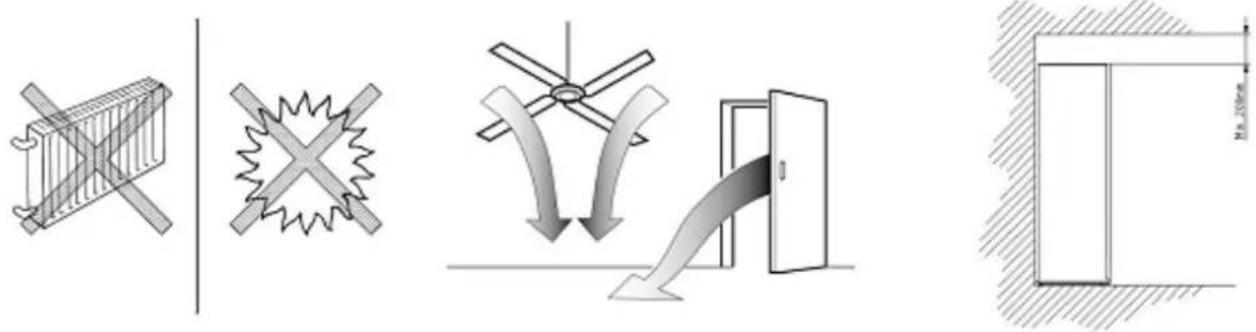
- Keep the appliance away from direct sunlight and sources of heat (stove, heater, radiator, etc.). Direct sunlight may affect the acrylic coating and heat sources may increase electrical consumption. Extreme cold or hot ambient temperatures may also cause the appliances not to perform properly.
Plug the wine cooler into an exclusive, properly installed-grounded wall outlet. Do not under any circumstances cut or remove the third (ground) prong from the power cord. Any questions concerning power and/or grounding should be directed toward a certified electrician or an authorized products service center.
To ensure proper electrical connection, follow the recommendations given in the present manual.
Unpack the appliance and visually check that it is not damaged. Do not connect a damaged appliance. Inform your retailer or point of sale of any damage. In such a case, keep the packaging. - It is recommended that the appliance be allowed to settle for at least 24 hours before connecting the electrical power supply, so that the compressor fluid feed is correct.
Proper air circulation is necessary to avoid overheating. To ensure sufficient ventilation, observe the installation recommendations provided.
In order to avoid fire risk, wherever possible, ensure that the appliance is not in contact with walls or with any hot element (compressor, condenser). Observe the installation recommendations. - The appliance should not be placed close to radiators or cooking hot plates or gas rings.
- Check that electrical sockets remain accessible when the appliance is installed.
Power saving
To limit the electricity consumption of your appliance:
Install it in an appropriate place (see "Installation instructions").
Leave the doors open as little time as possible.
To ensure that the appliance operates properly, clean the condenser regularly (see "Maintenance").
Regularly inspect the door seals and ensure that they are still closing properly. If this is not the case, contact your after-sales service.
- The following combination of shelves is recommended for energy to be used as efficiently as possible by the refrigeration unit. There are four shelves and one display shelf in total.
- The appliance's thermostat is electronic and allows you to set the temperature between 5 and 18 degrees. For wine storage, it is recommended that you set your appliance to 12 degrees. This temperature can be adapted according to the type of wine stored. Setting the temperature above 12 degrees will reduce the energy consumption of the appliance. Setting the temperature below 12 degrees will increase the energy consumption of the appliance. Some models allow you to set different temperature levels in the same cellar. The appliance ensures that the temperature is maintained as long as it is in operation and used under normal conditions. The temperature inside the appliance can be influenced by many factors: room temperature, exposure to the sun, number of door openings and the number of bottles stored... Slight changes in temperature are perfectly normal.
Trouble shooting
✓ Any electrical work should be carried out by a qualified and skilled technician.
- The appliance should be repaired by an accredited repair centre, using only manufacturer's original spare parts.
The appliance is designed for home use only. The manufacturer declines any liability whatsoever in the case of other use.
R600a
Safety instructions
Caution — Do not obstruct the ventilation grills on the appliance. Keep ventilation openings in the appliance enclosure or in the structure for building-in clear of obstruction.
Caution — Do not store explosive substances, such as aerosol cans containing an inflammable propellant, in the appliance.
Caution — Do not damage the refrigerating circuit in the appliance.
Caution — The refrigerating units use isobutane (R600a), and should not be placed close to ignition sources (for example, electrical contacts that are exposed or open contacts that could be closed by the refrigerating fluid in the event of a leak). The refrigerating fluid type is specified on the power cabinet identification plate.
Caution — Do not use electrical equipment in the compartments of the appliance, unless they are of the type recommended by the manufacturer.
This appliance meets the requirements of all applicable European directives and their amendments.

EPREL
To find out more about your product, consult the online EPREL database. As defined in Commission Delegated Regulation (EU) 2019/2016, all information relating to this refrigeration appliance is available on the EPREL Base (European Product Database for energy labeling). This database enables you to consult the information and technical documentation of your refrigeration appliance. You can access the EPREL Database by scanning the QR code on the energy label of your appliance or by going directly to: www.ec.europa.eu and searching the reference of your refrigeration appliance.
2. TECHNICAL DATA
Below is an example of the nameplate:
CLASSE DE PROTECTION CONTRE LES CHOCS ÉLECTRIQUES: I
| MODELE CVP 186 | ROHS COMPLIANT MADE IN PORTUGAL | |
| REFERENCE | DVA 265 PA+ | |
| CAPACITE | 264 BOUTEILLES | |
| VOLUME BRUT | 480 I | |
| GAS REFRIGERANT | R600a 0,030 Kg | |
| AGENT ISOLANT | R134a | |
| PUISSANCE LAMP | 0,5 W | N° SÉRIE |
| CLASSE | 230V - 50Hz | XXXX Y ZZ |
| SN | 106 W | |
| 0,74 A | ||
The nameplate attached to the inside or rear of the appliance (depending on the model) includes the entire information specific to your appliance.
We recommend that you make a note of its serial number in this booklet prior to installation, so that you can refer to it later (technical work, request for assistance, etc.).

Once the appliance is installed and loaded, access to it is not so easy.
CAUTION: no assistance can be provided without this information.
3. A WINE CELLAR - WHAT FOR?
Introduction
Don't forget that wine is a passion. Complex - it evolves very slowly, peacefully! It needs a combination of many conditions in order to blossom and quietly reach its summit. The permanence of these conditions is
crucial! To start, it is necessary to make the distinction between ageing temperatures, preservation temperatures and tasting temperatures.
The 5 golden rules to make this distinction are:
- The ageing temperature: designates a range of temperatures between 10 and 14^ ; ideally, around 12^ , whatever the type of wine to be preserved and aged. But, more than the levels, it is the constancy of the temperature during the ageing period which will allow the wine to fully blossom. Therefore, it is important to avoid any brutal thermal shock.
Humidity: the bottles' cork must be kept permanently humid in order to remain hermetic. At a persistent relative humidity below 50% , the bottles' cork dries out and the wine flows and oxidizes. At a persistent relative humidity above 80% , mildew and mould may appear and labels may get unstuck.
Odors/ventilation: wine breaths through its cork. In the constant proximity of odors, wine denatures.
Vibrations: vibrations cause wine fatigue and disturb its evolution. This is why it is crucial to keep the wine safe from any movement.
Light: light increases the oxidation-reduction potential of wine, accelerating its ageing. This is why it is important to offer it true protective darkness.
In addition, to all this, a basic concept has to be considered. It's absurd to preserve a wine with loving care for years, and then "kill" it by serving it at an inappropriate temperature. When served too cold, a wine's aromas are anaesthetized and its defects are hidden. When served too warm, it will become unbalanced by too much alcohol. The serving temperature is the range of temperatures at which a wine should be served and consumed: from 7^ for "liquoreux" wines up to 18^ for red tannic vintage wines. It is important that these conditions be permanently satisfied!
Let's recapitulate your needs which led to your choice:
√ Do you purchase young wines and lovingly let them age? You are in the domain of ageing!
- Do you purchase wines and champagnes close to their summit to have those near at hand and so be able to savor their rich aromas at the right temperature? You must follow a multi-purpose approach, with preservation and conditioning to temperature!
√ Do you wish to consume your "cru" wines at the right temperature? A conditioning wine cellar will be really appropriate for you (also called a wine serving temperature cellar).
The various wine cellars
Frio Entrepise, a wine cellar specialist, has designed various types of cabinets.
✓ Ageing: the climatic enclosure is designed to guarantee over time as stable as possible the conditions of underground wine cellars which favor the optimum blossoming of "grand cru" wines.
✓ Multi-purpose: which combine wine preservation and temperature conditioning areas in a single or multi-compartment cabinet, etc.
✓ Serving temperature or conditioning: with these three cabinets, you will be able to taste your "grand cru" at the right temperature and let them exhale the lingering fragrance of their aromas.
For detailed information about our various products, go to our Internet site www.avintage.com. To order wine bottle trays, activated charcoal filters, or other accessories, go to the heading "accessories" on our Internet site www.climadiff.com.
Discover the qualities of your wine cellar
Reliability and safety:
All Avintage wine cabinets are manufactured with high quality components. The technologies of the various
used systems conform to the highest reliability and safety standards. The value of their contents deserves the greatest respect.
Ageing wine cellars - homogeneous temperature:
Our teams have thought about and worked on the distribution of cold in order to offer to your wines a homogeneous average temperature without any mechanical air mixing. Therefore, your wine bottles rest in peace!
Multi-purpose wine cellars - different levels of temperature:
Natural stratification allows a staged choice, chambering, preservation, refreshment, a multi-purpose multi-area management!
What is climacontrol?
Your wine cellar is equipped of the Climacontrol® electronic function which manages all the parameters of the wine cellar such as temperature, humidity, winter system, etc. This system is dedicated to the end user to be easy to use and offer security.
4. INSTALLATION INSTRUCTIONS
Before using this appliance
This unit is intended for free-standing installation only. It must never be built-under or built-in. For proper operation of the appliance, it is imperative to allow good air circulation around the unit. We do not accept any liability instance of non-compliance with the installation instructions.
Remove the exterior and interior packing.
Before connecting the appliance to the power source, let it stand upright for approximately 24 hours. This will reduce the possibility of a malfunction in the cooling system from handling during transportation.
Clean the interior surface with lukewarm water using a soft cloth.
✓ When disposing your appliance, please choose an authorized disposal site.
√ Place your wine cooler on a floor that is strong enough to support it when it is fully loaded. To level your wine cooler, adjust the front leveling leg at the bottom of the wine cooler.
Adequate ventilation is required, do not block the front air outlet.
The appliance is for indoor use only.
This appliance is intended to be used exclusively for the storage of wine.
This appliance is using flammability refrigerant. So never damage the cooling pipe work during the transportation.
Attention
Store wine in sealed bottles.
Do not overload the cabinet.
Do not open the door unless necessary.
√ Do not cover shelves with aluminum foil or any other shelf material which may prevent air circulation.
Should the wine cooler be left empty for long periods it is suggested that the appliance is unplugged, and after careful cleaning, leave the door ajar to allow air to circulate inside the cabinet in order to avoid possible condensation, mold or odors forming.
CAUTION: please keep the appliance away from substance, which can cause ignition.
Installation area
Be sure to install it in a suitable spot: far away from any heat source, protected from sunshine, not exposed to low temperatures. This way you will obtain the best operating conditions for the lowest energy consumption.
Also make sure that the surface area where the cabinet will be installed is flat and resistant (weight of the device plus its load; a 75 cl wine bottle generally weighs 1.3kg ).
Do not place it in the open air and be careful to maintain a minimum space of 200mm between the top of the cabinet and the ceiling located above it.
Note: the defrosting water recovery tank located at the back of the cabinet near the compressor could overflow under extreme ambient conditions.
For this reason, we recommend choosing the appropriate kind of wall and floor surfaces in the device's installation area so that humidity or the possible formation of water does not cause any damage.
Connection to the electrical power network
Be sure to read and understand the safety instructions indicated at the beginning of this guide.
If the wine cabinet was tilted very much during its transport or placement, it is important to leave the wine cellar in the vertical position for 24 hours before connecting it so that the lubricating oil can descend and accumulate in the compressor.
Otherwise, the cooling system could completely break down. Refer to the safety instructions mentioned at the beginning of this guide!
Your wine cellar is equipped with a connecting cable and a power plug for a 230V / 50Hz single phase power network (CE standard). It must be connected to an earthed wall outlet with a minimum protection of 10A .
Ambient room temperature limits
This appliance is designed to operate in ambient temperatures specified by its temperature class marked on the rating plate.
| CLASS | SYMBOL | AMBIENT TEMPERATURES RANGE (°C) |
| Extended temperate | SN | From +10 to +32 |
| Temperate | N | From +16 to +32 |
| Subtropical | ST | From +16 to +38 |
| Tropical | T | From +16 to +43 |
This refrigerating appliance is intended to be used at ambient temperatures ranging from 10^ to 32^
IMPORTANT: be careful to not exceed the following minimum and maximum ambient values retained for a good operation of your device. Extreme ambient temperatures (hot and cold) can alter the device's performances, and the possible and desired temperatures may not be obtained.
If you would like to use your ageing wine cellar as a temperature serving one and you would like to have an inner temperature more than 13^ , please respect ambient temperatures here below:
| MONO TEMPERATURE WINE CELLAR | ||||
| Use | AGEING | CONDITIONNING | ||
| Door type | Glass | Plain | Glass | Plain |
| Ambient temperature range to respect | 0-32°C | 0-32°C | 0-32°C | 0-32°C |
| Temperature setting available | 8-18°C | 8-18°C | 8-18°C | 8-18°C |
| Winter system | Yes | Yes | Yes | Yes |
Depending on the models, remove the transport pallet on which your wine cellar is placed by removing the two screws securing it to the frame at the rear of the device. Remove all the wedging or protection elements present inside.
Levels:
Be careful to wedge and adjust the horizontality of your wine cellar (the use of a spirit level is recommended). This will avoid any movement due to instability, generating noise and vibrations, and will ensure the perfect tightness of the door.
To do this, use the adjustable feet at the front of your wine cellar (depending on the models).
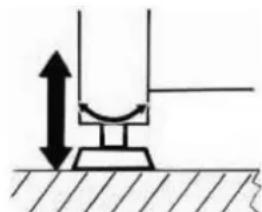
You can also lean the device slightly backward to "force" the condensate water to flow (2/3mm) , which will prevent the formation of all kinds of deposits (scales). The adjustment is made by screwing and unscrewing.
Space
Free standing installation:
Be sure to leave a space of at least 3cm between the wall and the back of your wine cellar to allow the free circulation of air. This device is not designed to be built-in.
Make sure that the surface area where you are going to install the device can support its weight and the
weight of its contents (a 75 cl wine bottle = 1.3kg on the average).
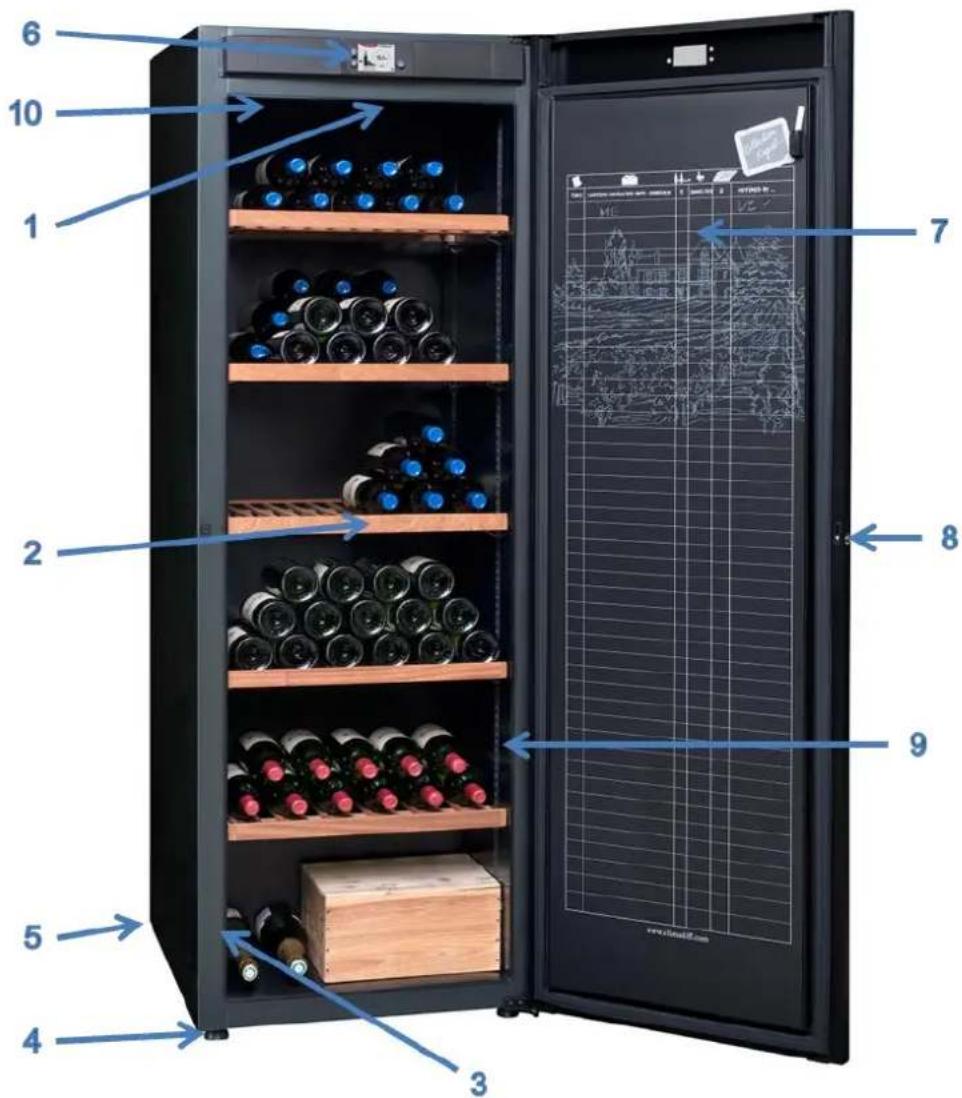
5. DESCRIPTION OF THE APPLIANCE
1 Lighting
2 Wine bottle shelf
3 Rating label
4 Height adjustable feet
5 Castor wheels
6 Temperature control system and thermometer
7 Door
8 Lock
9 Fixing place for shelf
10 Activated charcoal filter
Wine cellar display
Peel off the plastic protection of the screen.

Setting keys:
| Key to increase | |
| Key to decrease | |
| Key to enter the main menu |
Ageing wine cellar:

Multi-purpose wine cellar:
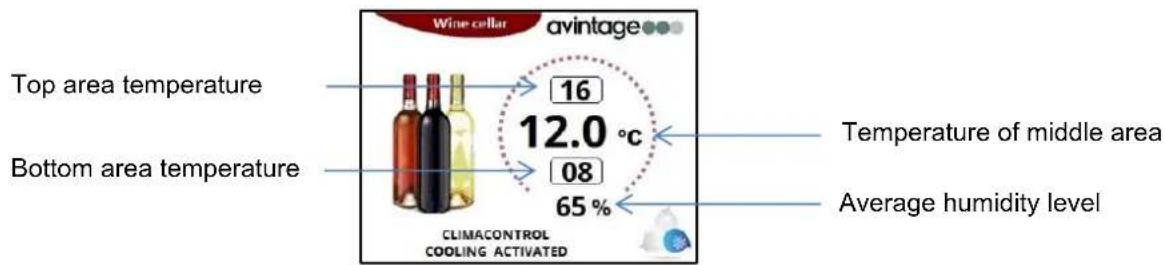
The following pictograms can be displayed:
| The requested temperature is reached, the appliance is working in an economical mode | |
| Pictogram to indicate that the compressor is running, the appliance is cooling down | |
| Pictogram to indicate that the winter system is working, the appliance is warming up the internal temperature (see chapter about “EQUIPMENTS - Low temperature protection “winter kit””) | |
| Pictogram to indicate that the temporary light is on (see chapter about “OPERATING INSTRUCTIONS - Internal light”) | |
| Pictogram to indicate that the permanent light is on (see chapter about “OPERATING INSTRUCTIONS - Internal light”) | |
| Pictogram to indicate that water has to be added (see chapter about “OPERATING INSTRUCTIONS - Humidity rate indicator”) | |
| Pictogram for alarm or working problems with error code (see chapter about “F.A.Q. - There is an error code on the display of my wine cellar”) | |
| Pictogram for silent mode, it is possible to disable temporarily the buzzer sound alarm (see chapter about “F.A.Q. - There is an error code on the display of my wine cellar”) | |
| Pictogram to enter in setup menu | |
| Pictogram for screen safe setting (see chapter about “USE INSTRUCTIONS – Screen safe setting”) |
Celsius / Farhenheit:
Press UP arrow « » for more than 10 seconds to move from a display in Celsius to a display in Farhenheit. Hold this same button for more than 10 seconds to get back to temperatures in Celsius, and so on.
Diagram of the various temperature levels in your wine cellar (depending on the setting)

Top part, ideal for conditioning red wines to the serving temperature
Central part, ideal for preservation.
Bottom part, to have mellow white wines and champagnes at the tasting temperature. "Important : prestigious champagne vintages should be enjoyed around 12^
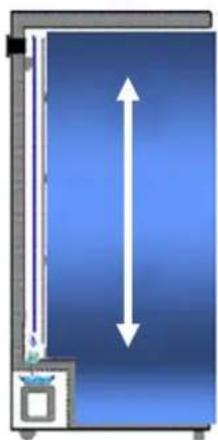
The entire wine cellar is dedicated to the ageing of your wines or, at your choice, to put a the right servicing temperature the wine color of your choice (single adjustable temperature between +8^ and +18^ ).
6. OPERATING INSTRUCTIONS
Temperature control
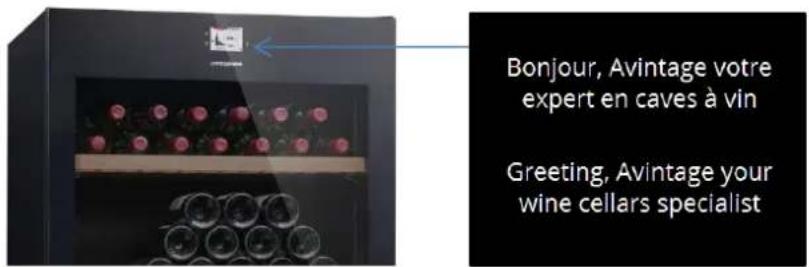

To turn on your wine cellar, connect it to a plug.
During the start-up of the wine cellar or after an electrical power cut-off, the control system is set by a calibration process. During this process, the display and the selection buttons are lit and the alert pictogram (cercle with exclamation point) blinks.
The process can take from 10 to 60 seconds. When the process is terminated, the display and buttons return to normal.
The temperature inside the wine cellar is automatically controlled by the electronic control system.
The system is preset in the factory and operates automatically. The basic parameters were defined for an average central area temperature of 12^ (+/- 2^) . If you change the settings, the last selection will be kept in memory.
When the surrounding temperature is 25^ and the wine cooler has no bottle loaded, it will take around 2h00 to increase the wine cooler's temperature from 5^ to 12^ . Under the same circumstance, it will take around 2h00 to decrease the wine cooler's temperature from 12^ to 5^ . The less the temperature span is, the less time it will take. The setting temperature of upper zone should be lower than the setting temperature of lower zone.
Temperature selection
If a new setting or an adaptation of the preservation temperature is considered to be necessary:
Press the SET key « S » during 3 seconds to enter into the main menu.
The possible settings are: temperature setting, high temperature alarm setting, screen safe setting.
√ The different possible settings will be automatically displayed after some seconds in a sequential mode, or you can select one by pressing successively the SET key « S » until the selected function.
According to your model the below screen is displayed :
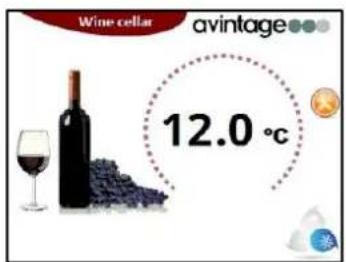

Press the UP and DOWN keys « » to select the temperature requested, and press the SET key “S » to validate your choice, or wait a few seconds and you will be back into the main menu. When the setting is selected, the temperature is in a blinking mode, and then you can adjust it.
To decrease the temperature:
Press the DOWN key « » to decrease the temperature degree to degree.
✓ Validate your selection by pressing the SET key « S »
To increase the temperature:
Press the UP key « △ » to increase the temperature degree to degree.
✓ Validate your selection by pressing the SET key « S »
Ageing wine cellars
The inside temperature is homogenized and the factory setting is 12^ .
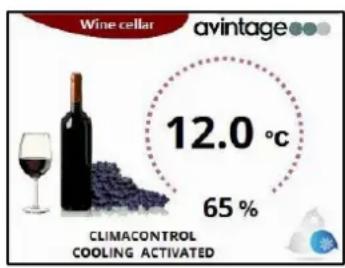
You have the possibility to choose a single temperature inside between +8^ and +18^ allowing you to have an ideal ageing temperature (+12^) or a dedicated servicing temperature for the wine colors of your choice: red, wine, rosé, champagne, etc.
IMPORTANT : In the case you would like an internal temperature of 18^ and that your wine cellar have a glass door, the ambient temperature must be imperatively higher than + 15°C .
Multi-purpose wine cellars
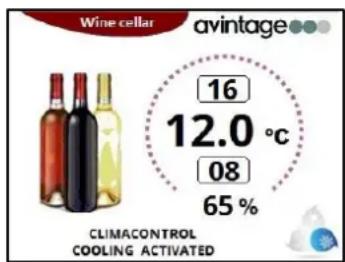
The temperature level programmed in the factory for the middle area is set at 12^ .
You can change this setting, but do not forget the difference temperature between the top and the bottom will remain 8^ . Other possible settings are 6^ - 10^ , 7^ - 15^ , 8^ - 16^ , 9^ - 17^ and 10^ - 18^ .
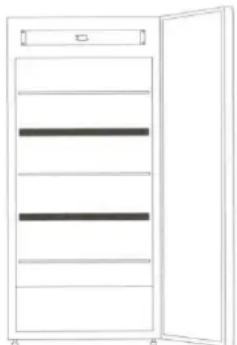
Some polyvalent wine cabinets (particularly DVP305G) are equipped with 2 specific separating shelves. For an optimum temperature distribution and separation, these 2 shelves should not be removed or repositioned.
Operation
In a natural wine cellar, the temperature varies little and, if it does, it generally varies very slowly from one
season to another. So, your Avintage wine cellar mechanically reproduces the optimum conditions of a natural wine cellar, which is indispensable for your wines.
The process relies particularly on an electronic regulation system to very precisely control the temperature. As a result, the wine cabinet operates by cycles: small temperature variations can therefore be observed in the air of the wine cellar enclosure. This is normal and the temperatures which can be randomly read by placing a thermometer in the tank do not reflect precisely the temperature which interests you the most, namely, the temperature of your wine and for which your wine cellar was designed.
It is thanks to this principle of small temperature variations in the air around the set point (temperature set, desired and controlled by the electronic regulation system) that an average stabilized temperature is obtained in the bottle.
The more bottles your wine cellar contains, the greater the thermal mass of your bottles will be, and the less significant will be the impact of possible ambient temperature variations due to the thus-created thermal inertia. Thermal inertia is the tendency of your bottles to keep their initial temperature for a long duration in case thermal equilibrium with their environment is disturbed.
Therefore, it is possible to designate in this way the slow pace at which a possible temperature disturbance would bring your bottles to a new point of equilibrium.
It should be noted that for liquids (except for water) the conductivity drops 0.15% per ^ on the average when the temperature increases.
Who has not one day when guests showed up unexpectedly placed a bottle of champagne or white wine at ambient temperature (20^) in the refrigerator (4^) to chill it? Despite the abrupt and constant environmental thermal disturbance on the order of 16^ , after an hour under these conditions the bottle was still not ready to be consumed (not chilled enough).
Consequently, no need to worry if you observe temperature variations on the order of 2^ around the set point in the cabinet's enclosure - your wines are perfectly preserved! The contents of a wine cellar filled with 200 bottles represents a mass of approximately 260kg (one 75 cl wine bottle = 1.3 kg on the average), which is quite a lot.
By referring to the above example and the conditions under which this single bottle would have been subjected, the small variations observed in the air of the wine cellar and extrapolated to its 200 or 300 bottles have no impact.
Temperature indicator
The electronic temperature indicator informs you about the average temperature in the cabinet. As we previously saw, the compressor's operating cycles or stops allow obtaining a perfectly constant average temperature inside the bottles.
If you place your own thermometer inside the appliance, it will not display the same value as the indicator on the control door panel: the electronic regulation system calculates automatically by an algorithm the temperature average on a time length defined. This average indicates you the wine temperature.
If a quite important temperature difference is noticed between the set temperature and the displayed temperature, it is probably due to a long door opening.
If your thermometer displays different instantaneous temperatures than the set temperature, nothing to get upset about! The liquid's inertia compared to air is based on a factor of 1 to 10 and your wine cellar itself will correct for it (a variation outside the bottle of more than 1^ is evidenced by a variation of only 0.1^ in the bottle's contents).
Temperature alarm
Your wine cellar has a high temperature alarm which is already preset at 30^ . We recommend you not to change the setting. Nevertheless if you want to change the setting, you can adjust it between 25^ and 35^ .
Press the SET key « S » during 3 seconds to enter into the main menu.
√ The possible settings are: temperature setting, high temperature alarm setting, screen safe setting.
- The different possible settings will be automatically displayed after some seconds in a sequential mode, or you can select one by pressing successively the SET key « S » until the selected function.
According to your model the below screen is displayed :


Press the UP and DOWN keys « » to select the temperature requested, and press the SET key “S » to validate your choice, or wait a few seconds and you will be back into the main menu. When the setting is selected, the temperature is in a blinking mode, and then you can adjust it.
Display of settings
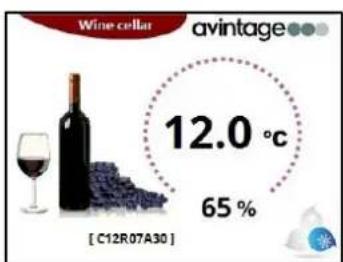
In order to check the settings of your appliance, press the UP key « » and during 10 seconds the setting values will be displayed.
C = selected temperature
A = temperature for high temperature alarm activation

Screen safe setting
Your wine cellar is equipped with a screen safe mode. The time programmed in the factory is 30 seconds but you could adjust it:
Press the SET key « S » during 3 seconds to enter into the main menu.
The possible settings are: temperature setting, high temperature alarm setting, screen safe setting.
- The different possible settings will be automatically displayed after some seconds in a sequential mode, or you can select one by pressing successively the SET key « S » until the selected function.
According to your model the below screen is displayed :
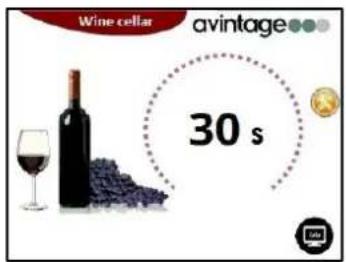

Define the time in seconds to enter in screen safe display. If the value is set to zero (0) the screen safe functionality is disabled.
After 30 seconds or other defined in setup menu, the display change to a black background with the most relevant information showed (temperature and status of the system). If any button is touched the display returns to previous display.
12.0^ C
SYSTEM OK
12.0^ C
ALARM SYSTEM!
Illustration of how the cabinet works
Temperatures and relative humidity of the air at time T following the operating cycle

Air temperature and average temperature in the bottle

Relative humidity
Between 55 and 75% , this is the average relative humidity range recommended to keep the cork of your bottles sufficiently humid to maintain the flexibility and elasticity required to keep it hermetic to liquids, while letting your wines breath. Your Avintage wine cellar automatically controls the relative humidity in the cabinet.
The combination of the circulation of filtered ambient air loaded with humidity in the cabinet, the phenomenon of condensation linked to the cabinet's operation, and the surface area of the inner steel walls coated with a paint of large particle size offers your wines ideal ambient conditions.
Note: under exceptionally dry ambient conditions, it may be necessary to provide for the adding of water. To do this, you can place a wet sand bin in the device or else a bowl of pure water (or tap water provided it does not have a strong smell).
Wait a few days after you have started operating the wine cellar for the first time so that the ideal average relative humidity (around 60% ) is stabilized in the cabinet.
IMPORTANT: the humidity rate can be around 45% or even less if the appliance is plugged in a room with extreme ambient conditions and/or if the room is very dry. Thus, it's necessary to add water (tray, bowl, etc.) in the upper part of the wine cellar.
Relative humidity indicator
The indicated relative humidity value corresponds to a short-term average which is regularly updated. There is nothing to worry about if the displayed relative humidity is momentarily a little lower. This time interval which is usually very short is not sufficient for the corks to lose their elasticity. The following values may be observed on the display:
- 45% appears if the relative humidity at the cabinet's centre is between 40% and 50% .
- 55% appears if the relative humidity at the cabinet's centre is between 50% and 60% .
- 65% appears if the relative humidity at the cabinet's centre is between 60% and 70% .
- 75% appears if the relative humidity at the cabinet's centre is above 70% .
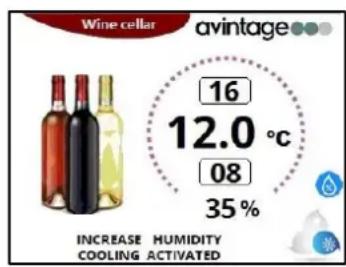
A pictogram and a message will be displayed if the persistent relative humidity is below 45% during 3 consecutive cycles. In that case, place a pot filled of water inside the wine cellar, and check the humidity level after 24 hours.

Humidity adjustment (only for reference DHA305PA)
Your wine cellar DHA305PA is equipped with a system of hygrometry regulation adjustable between 60% and 75% . This humidity rate can be adjusted through the control panel with 5% steps (60%, 65%, 70% or 75% ). As soon as the message "Please refill water" displays, please add 100ml of pure and clean water (demineralized type) following the indication given by the arrow inside the appliance, at the left bottom side on the compressor step. To do this, please use the plastic glass already provided with your wine cellar (1 filled to top glass = 100ml).
Internal light
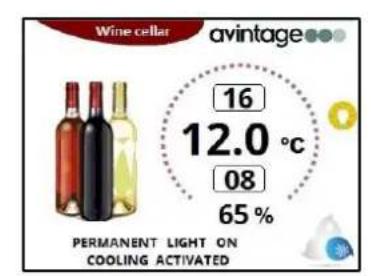
Inside lighting can be switched on by pressing the DOWN button « » located on the control panel and symbolised by the « » pictogram. It offers you the possibility to illuminate your wine cellar while maintaining the preservation conditions of your wines (low emissivity LED).
The light pictogram and a message will be displayed on the screen. If you do not switch it off, it will automatically stop after 5 minutes. Otherwise you can switch it off by pressing again on the DOWN key

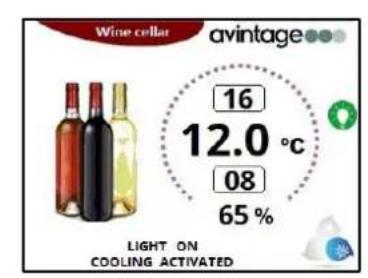
You can also turn on the light in a permanent mode. Press the DOWN key « » during 5 seconds. The pictogram of the yellow light with a message will be displayed on the screen. To switch it off you will have to press again on the DOWN key « »

7. EQUIPMENT
"Winter kit" low temperature protection
The security of a constant ideal temperature inside your Avintage wine cellar:
Will an ambient temperature drop have an impact on the preservation quality of my wine cellar?
No! The temperature inside your wine cellar is automatically regulated with respect to the ambient temperature of the area where it is located thanks to a totally automatic system.
To avoid subjecting your wines to too abrupt temperature changes when the outdoor temperature suddenly drops (but not below 0^ and without freezing), Frio Enterprise has developed an automatic winter system.
Technically speaking, how does the winter system work?
This system is an entirely autonomous system and does not require you to make any intervention. The system becomes active according to your temperature setting and the ambient temperature. It is not possible to adjust the operating temperature of the winter system. This function is completely autonomous and requires no adjustment or action on your part
The winter system turns on after a short time. Resistance then operates very slowly warming gently and silently. Your wines thus remain in optimal conditions of conservation!
IMPORTANT: only the compressor and therefore the refrigeration system generates noise. Heating is done silently by a heating resistance.
If your wine cellar is in any of these possible cases and does not make any noise, don't worry - this is not a failure!
Vibrations
Wine does not like to be disturbed. It especially dreads vibrations. This is why your wine cellar compressor is mounted on special shock absorbers called "silent blocks". Likewise, the inside tank is insulated from the body by a thick layer of polyurethane foam which has the particularity of also absorbing vibrations.
Depending on the models, the wine bottle trays are made of solid wood and absorb vibrations better than metal. On some models, the wine bottle tray supports are also equipped with rubber pads.
Your bottles are sleeping peacefully!
Aeration
A pure air permanently refreshed and filtered. Your wine cellar is equipped with a permanent air refreshing system filtered by an activated charcoal filter.
It is recommended to replace this filter once a year (may be ordered from your retailer or via our Internet site www.climadiff.com under the heading "accessories"). Refer to your wine cellar diagram to see where the filter is located and to the chapter "MAINTENANCE" for the description of the procedure to remove it.
Relative humidity
Fluctuates around 55% (± 10) ; this is the average relative humidity range recommended to keep the cork of your bottles sufficiently humid to maintain the flexibility and elasticity required to keep it hermetic to liquids, while letting your wines breath.
Exposure to U.V.
Warning: pay attention to light; it accelerates the oxidation-reduction process and therefore the premature ageing of wine, which is undesirable.
Solid door: when your wine cellar is equipped with a solid door, so there's no problem. Your wines will remain protected from light.
Glass door: nothing to worry about either! It was treated to filter up to 70% of ultra violet rays!
Sliding rails installation (RAILV3)
1- Prepare your sliding rails in the right direction for installation:
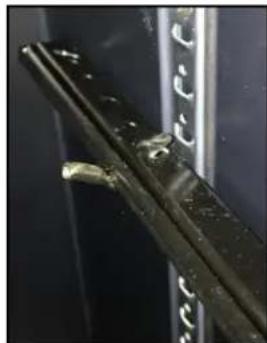
- The part with stems, facing upwards, has to slide outwards the wine cellar
- The other part, with stems facing downwards of which is biased, has to be inserted into holes provided for that purpose in the lateral walls of the wine cellar
Please note that biased stems facing downwards (1) have to be positioned in the holes at the back of the appliance. They are biased in order to keep the shelf straight and prevent tilting.
2- Installation of the right rail:
- Position your rail at the desired height
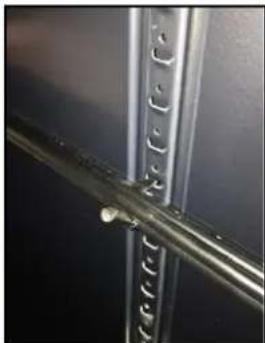
- Firstly, insert the biased stem into the hole at the back of the appliance (2)
- Then, insert the second stem, at the same height than the other, into the hole at the front of the appliance (3)
- Be sure that the rail is level, fixed and doesn't tilt (4)
3- Installation of the left rail:
- Position your rail at the same height than the right rail
- Firstly, insert the biased stem into the hole at the back of the appliance
- Then, insert the second stem, at the same height than the other, into the hole at the front of the appliance
- Be sure that the rail is level, fixed and doesn't tilt
4- Installation of the shelf on the rail:
Pull both rails sliding them outwards the wine cellar (5)
- Position the shelf in such a way that the 4 stems facing upwards are inside the holes provided for that purpose on the shelf
- You can place yourself under the shelf in order to have a better view and to know exactly where holes are (6)
- Rails are slightly movable in order to block and well maintain the shelf on its sliding support

Right rail

Left rail

(1) Biased stem
(2)
(3)

(4)

(5)

(6)

Sliding shelf
How to manage your collection?
The wine cellar register (the original, a Frio Enterprise innovation) will help you do this:
The wine cellar register or prestigious "grand cru" wine table (according to the models and excluding glass doors).
Your wine cellar counter door is specifically designed so that you can write on the wine cellar register with chalk information about the characteristics of your collection or give a list of your prestigious "grand crûs".
Use only chalk to write on the wine cellar register.
To erase information, use a slightly moistened cloth or sponge. Never use a detergent or abrasive materials.

Examples of serving temperatures (to be complied with for your tastings):
Opinions vary, and the ambient temperature, too, but many agree on the following:
| WINES | SERVING TEMPERATURE |
| Prestigious Bordeaux wines – Reds | 16 – 17°C |
| Prestigious Burgundy wines – Reds | 15 – 16°C |
| Prestigious dry white crus | 14 – 16°C |
| Light, young, full flavoured reds | 11 – 12°C |
| Provence rosés, primeur wines (futures) | 10 – 12°C |
| Dry whites and red "local" wines | 10 – 12°C |
| "Local" white wines | 8 – 10°C |
| Champagnes | 7 – 8°C |
| Liquoreux wines | 7°C |
Maturity table (in years):
The time required for each cru, each vintage, each colour to attain its optimum maturity varies. The table below will give to you an idea about the number of years your bottles will need to reach the ideal summit of their maturity, that is, the ideal moment to savour them.
| APPELLATIONS | White Rosé | Red |
| Alsace | 1 - 4 | |
| Alsace grand crus | 8 - 12 | |
| Beaujolais (crus) | 1 - 4 | |
| Beaujolais primeur | 1 - 2 | |
| Bergerac | 2 - 3 | 3 - 4 |
| Bordeaux | 2 - 3 | 3 - 4 |
| Burgundy | 5 | 7 |
| Cahors | 5 - 10 | |
| Cotes de Provence | 1 - 2 | 2 - 5 |
| Cote Rotie, Hermitage | 8 | 8 - 15 |
| Burgundy grand crus | 8 - 10 | 10 - 15 |
| Bordeaux grand crus | 8 - 10 | 10 - 15 |
| Jurancon mellow, liquoreux | 6 - 10 | |
| Jurancon dry | 2 - 4 | |
| Languedoc | 1 - 2 | 2 - 4 |
| Loire | 5 - 10 | 5 - 12 |
| Loire mellow, liquoreux | 10 - 15 | |
| Macon | 2 - 3 | 1 - 2 |
| Montbazillac | 6 - 8 | |
| Savoie | 1 - 2 | 2 - 4 |
| Rhone Valley | 2 | 4 - 8 |
| Yellow wine | 20 |
8. LOADING
Types of bottles
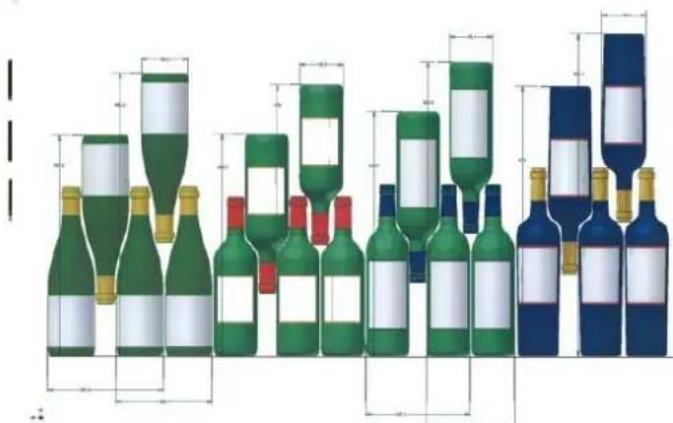
We see here 4 kinds of 75 cl wine bottles: Burgundy and Bordeaux wine bottles of different dimensions. There are many other bottles of various shapes and sizes, as shown below, examples of 75 cl Bordeaux bottles:
You will note the storage differences according to the bottles' heights, diameters and criss-crossing method.
Criss-crossing types
Note the difference in depth!
Top-to-bottom neck-to-neck:
- Loading capacity increased

Top-to-bottom neck between bottle bodies:
Less depth

Lots of space lost!

Wine bottle shelves
Each wine cellar has its type of wine bottle shelf.
Note that there is no ideal storage arrangement. A collection of wine bottles is rich when it is varied. It is up to you to arrange the storage capacity of your wine cellar according to your collection.
Additional wine bottle shelves may be ordered on a paying basis from your retailer or his after-sales service, as well as via our Internet site www.climadiff.com under the heading "accessories".
Reversible wine bottle shelves:
The "Collector ⑧ wine bottle tray is a reversible Bordeaux or Burgundy wine bottle shelf invented by Frio Entreprise to allow making a simple, efficient, reliable and practical arrangement choice.

One side has imprints for "Bordeaux 75 cl type bottles", while the other side has imprints for "Burgundy 75cl type bottles". A pyroetching of the type of bottle appears on the wine bottle tray's sides indicating to you the side to use according to your collection.

Sliding wine bottle shelves:
Depending on the models, the wine cellar is delivered with one or more sliding wine bottle trays.
You may purchase additional adapted wine bottle trays, as well as sliding rails by placing an order with the after-sales service of your retailer or via our Internet site www.climadiff.com under the heading "accessories",
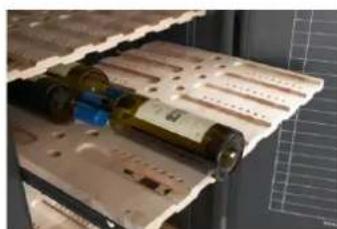
Separating shelves
Some polyvalent wine cabinets (particularly DVP305G) are equipped with 2 specific separating shelves. For an optimum temperature distribution and separation, these 2 shelves should not be removed or repositioned.
Announced capacity
The announced capacity is the maximum capacity calculated with a defined number of shelves, which varies according to the model. This standard is calculated with 75cl bottles of the traditional Bordeaux type. Any other type of bottle size and the addition of shelves will considerably reduce the storage capacity. The capacity of your wine cellar is measured according to the EN62552 standard.
Loading method
Details on capacities:
Capacity indications assigned to the various Avintage wine cellar models are given for guideline purposes. They will help you make your choice according to your desires and your available space. These capacities are defined today based on a standard bottle of the "Bordeaux 75cl tradition" type. In reality, you will probably be collecting bottles of different shapes and sizes. For practical reasons, it is likely that you will fill your wine cellar with a smaller number of bottles than the maximum number it can hold.
For example, if a wine cellar is loaded only with Burgundy wine bottles, there will be approximately 30% fewer bottles than the initial quantity calculated for Bordeaux bottles.
Another important effect on loading is the number of wine bottle shelves: an additional wine bottle shelf is equivalent to the loss of one bottle layer, and even two...
You can add more sliding shelves in your wine cellar if you want to. Just please take in consideration the bottle quantities in that case that will be reduced.
Do not forget to take this aspect into consideration if you wish to have a more functional wine cellar and add a large number of wine bottle shelves: you will have to decide between capacity and practicality!
Loading:
The desired temperature after the wine cellar starts running will only be reached after many hours of operation. We recommend running your wine cellar empty for a few hours before you start loading it.
Your wine cellar is delivered with one or more wine bottle shelves made of metal or wood according to the models:
- Place the supports in appropriate lateral notches inside the cabinet to fit your needs. Make sure that the supports are inserted correctly in the notches (only a slight pressure is necessary to put the angle iron in place and make sure that it holds properly).
- Start by loading the lower part of your wine cellar.
- Then simply stack the bottles with their bases facing backward in the back row and conversely for the front row. The wine bottle trays are to be arranged according to the size of your wine cellar and the shapes of your wine bottles.
IMPORTANT: make sure that the bottles do not come in contact with the inner cabinet's back wall.
If you have a large number of bottles, we recommend that you load 40 bottles at a time and then let the device run for 12 hours before you load another 40 bottles. Repeat this operation as many times as necessary in order to create a thermal mass in your wine cellar.
Additional wine bottle shelves are available on a paying basis from the after-sales service of your retailer or via our Internet site www.climadiff.com under the heading "accessories".
9. MAINTENANCE
Cleaning
Normally the wine cabinet does not require any specific maintenance except that the activated charcoal filter should be replaced once a year. However, if a cleaning would be considered necessary, disconnect and clean the cabinet inside and outside using a soft detergent mixed with warm water (do not use solvents or abrasive agents). Rinse with pure water and let dry before reconnecting. For any other type of maintenance, contact the after-sales service of your retailer.
Any technical intervention performed by an unapproved person may cancel the warranty.
Changing the activated charcoal filter and periodicity
Replacing the activated charcoal filter: it must be absolutely replaced once a year. The filter is a black round plastic part which filters the air entering your wine cellar. You can see it from the inside as well as from the outside. It is located in the upper right corner at the bottom of the wine cellar.

Push the charcoal filter from the outside of your wine cellar in order to remove it from inside the appliance.
CAUTION! The filter is inserted in a plastic part. Do not try to remove all the parts, ONLY the filter. Pulling or pushing the plastic receptacle may be not reparable as foamed in the body.


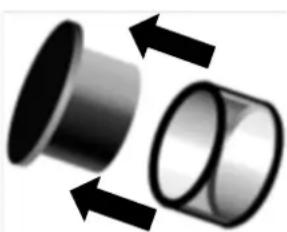
To purchase the filter, place an order with the after-sales service of your retailer, or via our Internet site www.climadiff.com under the heating "accessories",
Extended stop
Completely disconnect the device. Be sure to remove the bottles. Clean and dry the inside of the tank and especially the condensate water recovery gutter located in the bottom part of the cabinet.
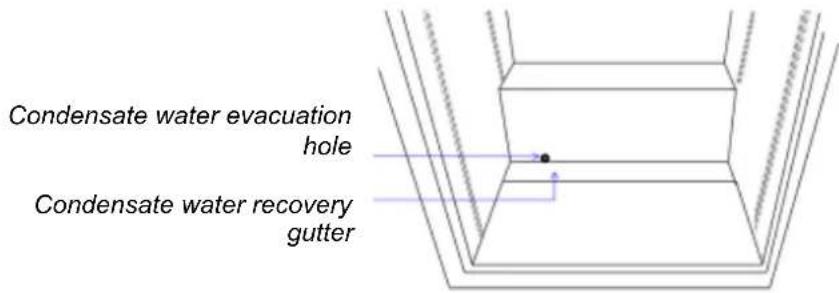
Presence of water is normal
Defrost condensation
The cabinet is equipped with an automatic defrost cycle. When the cooling cycle is finished, the refrigerated parts of the cabinet are defrosted automatically.
The water from the defrost is channelled into an evaporation tray which is located in the back of the cabinet close to the compressor. The heat from the compressor then evaporates the water from the tray that will be drawn up by the charcoil filter, bringing humidity inside.
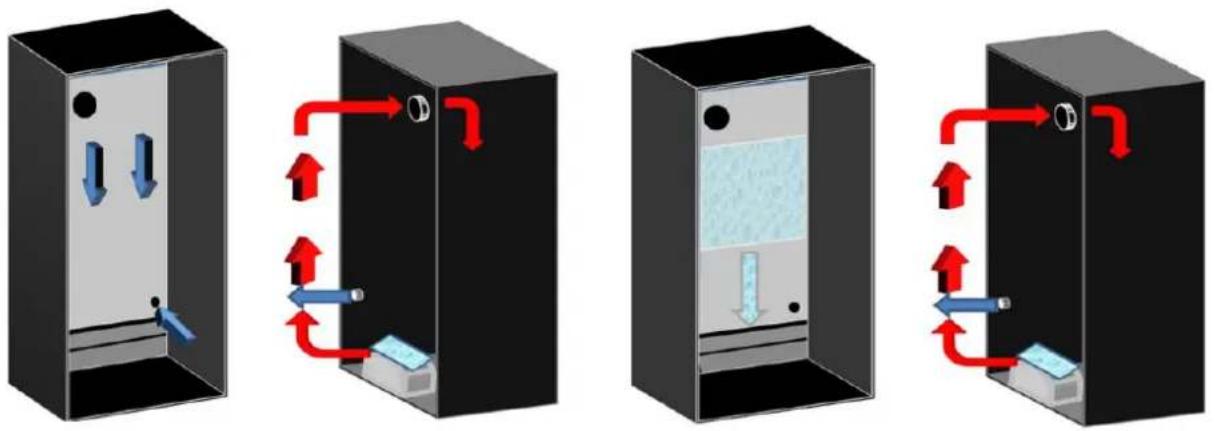
The wine cellar produces cold air that is heavier than the warm air, so it drops slowly. It creates a pression and push out the air by the hole located in lower part of the appliance. When the compressor is on, it heats and makes evaporate the condensate water. The warm air goes up and this wet air is sucked by the carbon filter.
To the evaporator contact, the air humidity turns to ice. When the compressor stops, the internal temperature will increase slowly, the ice will melt. Condensation appears.
The condensate excess will be collected by the water tank located on the compressor. When the compressor starts again to operate, the closed air circulation circuit starts again.
Transporting the wine cabinet
The cabinet should be transported wherever possible in its original package to avoid any risk of deterioration.
If you should transport the wine cellar laying down, it must be protected and laid on the side where the compressor's loading nozzle is facing downward.
If you are standing up the wine cellar from the rear, lay it down on the left side.
10. IN THE EVENT OF A BREAKDOWN
Despite the care we take during production, a breakdown can never be totally ruled out. Before contacting your retailer's after-sales department, please check that:
✓ The appliance is properly plugged in
There is not a power cut in progress
✓ The breakdown is not one of those described in the table at the end of this manual
IMPORTANT: if the power cable supplied is damaged, it must be replaced by the manufacturer, a service centre approved by the brand or the retailer. In all events, it must be replaced by qualified personnel in order to avoid any risk of injury.
IF THESE CHECKS REVEAL NOTHING, THEN CONTACT YOUR RETAILER'S AFTER-SALES DEPARTMENT.
CAUTION!
Unplug the appliance before carrying out any maintenance or repair work.
11. SPARE PART AND SAV
Aesthetic and functional spare parts are available to professional repairers and final consumers for a minimum period of 10 years from the date of placing the last unit in the model on the market.
The list of spare parts and the procedure for ordering them (professional access / final consumer access) are available on the following website: www.interfroidservices.fr or by post to the following address: Interfroid Services, 143 Bd Pierre Lefauchex - 72230 ARNAGE.
All FRIO wine cellar benefit from a 1-year parts warranty.
12. ENVIRONMENT
This appliance is marked according to the European directive 2019/290/UE on Waste Electrical
and Electronic Equipment (WEEE). By ensuring this product is disposed of correctly, you will
help prevent potential negative consequences for the environment and human health, which
could otherwise be caused by inappropriate waste handling of this product.

The symbol on the product, or on the documents accompanying the product, the Crossed Out Wheelie Bin, indicates that this appliance may not be treated as household waste. Instead it shall be handed over to the applicable collection point for the recycling of electrical and electronic equipment, or, if you are buying an equivalent product, to the retailer of the new product.
The user is responsible for taking the appliance to the appropriate collection centre at the end of its useful life. Selective and appropriate collection for the recycling of no longer used appliances and their disposal and destruction in an environmentally friendly manner, helps to prevent potential negative effects on the environment and health, and encourages the recycling of materials used to make the product.
For more detailed information about treatment, recovery and recycling of this product, please contact your local authority, your household waste disposal service or the retailer where you purchased the product.
13. WARNING
As we continuously improve our products for the benefit of our customers, we reserve the right to modify technical characteristics without notice.
Warranties for AVINTAGE brand products are offered exclusively by selected retailers. No part of these instructions may be considered as a supplementary guarantee.
FRIO ENTREPRISE cannot be held liable for errors or technical or editorial omissions in this document.
Non-binding document.
GLOSSARY
Preservation:
Preservation conditions allow protecting wines which are already in maturity and maintaining their qualities over time.
Ageing:
The climatic enclosure is designed to guarantee over time conditions which are as close as possible to those specific to underground wine cellars favouring the optimum blossoming of prestigious crus.
Serving temperature:
The wine cellar permanently maintains bottles at the right serving temperature (tasting T^ : prestigious red cru: 18 to 19^ , light red: 14 to 16^ , white, rosés and vintage champagnes: 10 to 12^ ; liquoreux white: 8 to 10^ , etc.).
Winter system:
Heating system, which allows positioning your wine cellar in an unheated area (but not freezing).
Day's wine cellar:
See serving temperature above.
PREMIUM 1/70 (PREMIUM BGN) wine bottle shelf:
Made of solid wood (water repellent tropical wood); they are designed to ensure an optimised, ergonomic and safe storage of bottles (13 bottles for a layer).
COLLECTOR wine bottle shelf:
Made of wood; their imprints are specifically designed for an optimised, ergonomic, easy to acces and secure storage of bottles. They are reversible (Front side: Bordeaux - Back side: Burgundy, Loire Valley, etc.). Bordeaux: 14 bottles, Burgundy: 13 bottles.
Sliding wine bottle shelf:
Mounted on rails, they facilitate access to a unique layer of prestigious "grand crus".
Wine cellar register:
The original! A Frio Enterprise innovation which allows you to manage your collection by writing about it with a piece of chalk on the inside counter door of the cabinet
Thermal shock:
A thermal shock is a brutal temperature perturbation of about 20^ and more in less than 2 hours. More, it is the repetition of this temperature variation that can damage your wines.
F.A.Q.
Despite the care we bring to our production, a breakdown can never be totally excluded. Before contacting the After-Sales department of your store, please check:
- the cabinet is properly plugged in
- there is not a power outage
- have a look on the troubleshooting guide
ELECTRICITY
My wine cellar does not work:
- No power in the power plug : check your circuit breaker or test your plug
- The plug is not correctly plugged in
- If your wine cellar is in an unheated room, refer to the section "winter kit"
TEMPERATURE
My wine cellar is too cold:
Select a higher temperature
My wine cellar is not cold enough:
Select a lower temperature
The temperature in my wine cellar varies slightly:
- The true temperature to take into account is the temperature in the bottle. Instantaneous variations which you can read correspond to the compressor's operating cycles and stops. It is thanks to this principle of small variations repeated in the air of your wine cellar that a favourable average temperature is obtained to ensure your wines the best conditions of maturity.
- Our wine cellars are extensively insulated to ensure a temperature as stable as possible for your wines. Consequently, a variation of 1^ in the temperature outside the bottle will only be evidenced by a temperature variation of approximately 0.1^ in the liquid.
- If the temperature read in your wine cellar is different from that usually observed and it does not persistently vary (over several hours), please contact the after-sales service of your retailer.
THE COMPRESSOR OF MY WINE CELLAR DOES NOT START RUNNING (ARE YOU SURE? OUR COMPRESSORS ARE SILENT)
- Is the ambient temperature of your room low (below the minimum demanded temperature)?
- Is the selected temperature too high? Select the minimum possible temperature (refer to the chapter "OPERATING INSTRUCTIONS - Temperature setting" according to your model) and check whether the compressor starts running without touching it.
- Is the electrical connection powered? To check this, connect another electrical device to the same outlet.
- If despite both these checks the compressor does still not run, contact the after-sales service of your retailer.
THE COMPRESSOR OF MY WINE CELLAR KEeps RUNNING WITHOUT STOPPING
If no cold effect is observed, call the after-sales service of your retailer.
The system operates only if the inside temperature in the lower part of your wine cellar is below the set temperature. This function is completely autonomous and requires no adjustment or action on your part.
RELATIVE HUMIDITY
What should be the average relative humidity in my wine cellar?
- The ideal average relative humidity should be between 55 and 75% ; do not mistake this value for the instantaneous value which varies as a function of the compressor's operating cycles. Just like for the average temperature, it is this average relative humidity value which counts.
- Depending on the geographical zones and their relative humidity in the air, more water may or may not have to be added. In temperate countries, the relative humidity contained in the air is between 50 and 80% . Therefore, it is not necessary to add water, but it should be regularly checked.
The average relative humidity of my wine cellar remains persistently below 50% : are you sure? (relative humidity fluctuates a lot and rapidly - this is normal):
- Check whether the activated charcoal filter is too old or simply obstructed.
- Make sure that your hygrometer is operating correctly.
- If you moisten a cloth every 2 hours, it will never be dry. This principle applies to corks. The constancy of the relative humidity average allows corks to preserve their elasticity, which is indispensable. Therefore, remember that an instantaneous value which seems low is normal, because it will necessarily rise later.
The relative humidity in my wine cellar remains persistently above 80% . Are you sure? (relative humidity fluctuates a lot and rapidly - this is normal):
- Check whether the activated charcoal filter is too old or simply obstructed.
- Make sure that your hygrometer is operating correctly.
- If you moisten a cloth every 2 hours, it will never be too wet. This principle applies to corks. The constancy of the relative humidity average allows corks to preserve their elasticity, which is indispensable. Therefore, remember that an instantaneous value which seems high is normal, because it will necessarily drop later.
My bottles' labels unstick:
- Your wine is not threatened, but the relative humidity in your wine cellar is too high.
THERE IS WATER IN THE BOTTOM OF MY WINE CELLAR OUT OF THE INTENTED PLACE
- This is not detrimental to your wine.
- Is the wine cellar perfectly horizontal? Does it lean forward?
- Is the drain pipe clogged?
THERE ARE ODOURS IN MY WINE CELLAR
- Has the activated charcoal filter been regularly changed? To be changed every year; can be ordered from your retailer or via the Internet site www.climadiff.com under the heading "accessories".
-
Is the activated charcoal filter simply obstructed by a bottle?
-
The compressor when running generates noise: check its attachment to the rubber shock absorbers (silent blocks) and whether it is in contact with another element.
- Small rattling sounds are heard: they arise from the circulation of the gas in the pipes and are the result of a normal operation of your wine cellar.
MY WINE BOTTLE TRAYS SAG DURING LOADING
- Make sure that the maximum load capacity is not exceeded.
WHAT TO DO IN CASE OF A POWER OUTAGE?
Most power outages are resolved in a short time. An outage of 1 or 2 hours will not affect the temperatures in your cabinet. In order to protect the wines during the outage, open the door as little as possible. For outages that are very long, take necessary steps to protect the wine.
After a power cut, the appliance keeps in memory the last settings you selected or the factory settings if you did not change them.
ALARM PICTOGRAM IS DISPLAYED
When the alarm is on, you can disable temporally the sound by pressing the UP key « » during 5 seconds. A message will be display on the screen to indicate that the alarm is deactivated.
High temperature alarm:
The alarm indicator can be displayed if the inside temperature is too high. A message is displayed on the screen.

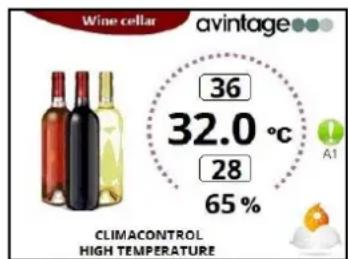
This alarm is on during the first installation of the appliance, time for the appliance to reach the selected temperature. You have to wait several hours before the temperature is stabilised. The alarm can be on if the door has been left opened, or if the door has not been closed properly. The ambient temperature will modify the temperature measure.
If you are not in the here above described cases, and if alarm does not disable, you have to unplug your appliance and call the service centre.
Low temperature alarm:
When the inner temperature reaches 4^ , the low temperature alarm is on.

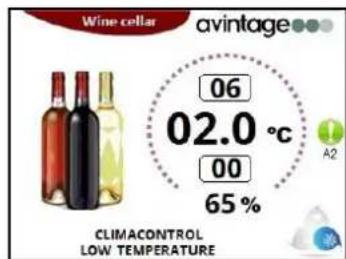
The low temperature alarm is on when the ambient temperature is very cold, or if the door has been left opened in a very cool ambient temperature..
If you are not in the here above described cases, you have to check the appliance settings (Selected temperature). If the selected temperature is correctly set, you have to contact the service centre. If the internal temperature is cooler than the ambient temperature, and that low temperature alarm is on, you have to unplug your appliance and call the service centre.
THERE IS AN ERROR CODE ON THE DISPLAY OF MY WINE CELLAR
The electronic system can detect a default and indicate an error code on the display, as A1, A2, A3, A4 or A5.


In case you see this code, please note it and give it to the technician who will find on our technical documentation the meaning of this code. In that case it is recommended to unplug your product. It will help him to solve easier and faster the possible problem.
For alarms 3, 4 and 5 the following message appears alternating with the main screen, with a 3 seconds periodicity.

When the alarm is on, you can deactivate temporally the sound by pressing the UP key « △ » during 5 seconds. A message will be displayed to indicate that the alarm is deactivated.
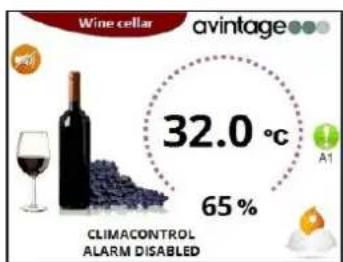

If after one hour, the parameters are not back to normal, the sound alarm will be on again. We recommend you to disconnect your appliance and call the service centre.
But, whatever happens, do not panic if you observe an abnormal temperature or relative humidity value inside your wine cabinet! Only an extended and persistent exposure of your wines to these abnormal conditions might prove detrimental to them.