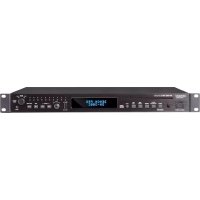
DN300C MKII - Blu-ray player DENON - Free user manual and instructions
Find the device manual for free DN300C MKII DENON in PDF.



| Product type | Professional Blu-ray player |
| Model | DN-300C MKII |
| Brand | Denon |
| Supported formats | Audio CD, CD-R, MP3 CD, MP3 audio files on USB flash drive |
| Inputs | 1 x auxiliary input (3.5 mm TRS), 1 x USB port (mass storage) |
| Outputs | 1 x unbalanced stereo RCA, 1 x balanced XLR |
| Power supply | AC, standard mains plug |
| Dimensions (W x H x D) | 48.3 cm (19 inches) x 4.4 cm (1U) x [depth not specified, approximately 25 cm] |
| Weight | Approx. 3 kg |
| Remote control | Included (playback, tempo, lock functions) |
| Playback functions | Repeat (1, all, folder), random, single track, normal, adjustable tempo (-15% to +15%) |
| Display | Bright screen with mode, track, time indicators |
| Panel lock | Yes (prevents accidental changes) |
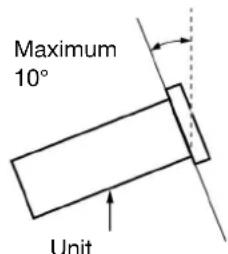
| Rack mount | Yes, standard 19 inches, 1U, tilt up to 10° |
| Maintenance | Wipe with a soft cloth; do not use benzene or solvents |
| Precautions | Avoid humidity, condensation, direct sunlight; unplug if not used for extended periods |
Frequently Asked Questions - DN300C MKII DENON
User questions about DN300C MKII DENON
0 question about this device. Answer the ones you know or ask your own.
Ask a new question about this device
Download the instructions for your Blu-ray player in PDF format for free! Find your manual DN300C MKII - DENON and take your electronic device back in hand. On this page are published all the documents necessary for the use of your device. DN300C MKII by DENON.
USER MANUAL DN300C MKII DENON
User Guide (English)
Introduction
Box Contents
DN-300C MKII
User Guide
Power Cable
Safety & Warranty Manual
Remote Control
RCA Cable
Support
For the latest information about this product (documentation, technical specifications, system requirements, compatibility information, etc.) and product registration, visit denonpro.com.
Safety Instructions
Please also see the included Safety & Warranty Manual for more information.
| Before turning the power on: | Make sure all connections are secure and correct and that there are no problems with the connection cables. |
| Power is supplied to some of the circuitry even when the unit is powered off. When the unit will not be used for long periods of time, disconnect the power cable from the power outlet. | |
| Proper ventilation: | If the unit is left in a room which is not properly ventilated or is full of smoke from cigarettes, dust, etc. for long periods of time, the surface of the optical pickup may get dirty, causing incorrect operation. |
| About condensation: | If there is a major difference in temperature between the inside of the unit and the surroundings, condensation may form inside the unit, causing the unit not to operate properly. If this happens, let the unit sit for an hour or two while powered off, and wait until there is little difference in temperature before using the unit. |
| Cautions on using mobile phones: | Using a mobile phone near this unit may cause noise. If this occurs, move the mobile phone away from this unit when it is in use. |
| Moving the unit: | Before moving the unit, turn off its power and disconnect the power cable from the power outlet. Next, disconnect its connection cables from other devices before moving it. |
| About care: | Wipe the cabinet and control panel clean with a soft cloth. |
| Follow the instructions when using a chemical cleaner. | |
| Do not use benzene, paint thinner, insecticide, or other organic solvents to clean the unit. These materials can cause material changes and discoloration. | |
| Rackmount warnings: | EIA standard 19-inch (48.3cm) rack |
| (required rack specifications for mounting the unit in a rack) | 1U-size installation compatible rack |
| Rack that has a guide rail or shelf board that can support this device | |
| Rack installation: | This product will work normally when the player unit is mounted within 10° off the vertical plane at the front panel. If the unit is tilted excessively, the disc may not load or unload properly. (See image.) |
Features
Front Panel

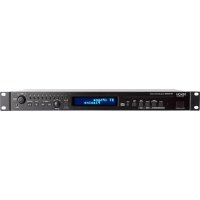
- Power Button: Press this button to turn the unit on or off. Make sure the AC In is properly connected to a power outlet. Do not turn the unit off during media playback—doing so could damage your media.
- Aux In: Connect an optional device to this input using a 1/8" (3.5mm) TRS cable. See Operation > Playing Audio from an External Device for more information.
- USB Port: Connect a mass-storage-class USB device to this port.
- CD Slot: Insert a CD into this slot. See Operation >Playing Audio CDs for more information.
- Source: Press this to enter Media Selection screen. See Operation > Selecting Media Playback Mode for more information.
- Repeat Button: In CD or USB Mode, press this button to switch between Repeat Playback modes: Repeat One, Repeat All, Repeat FLD (folder), and Repeat Off. See Operation >Playing Audio CDs for more information.
Power-On Play Button: Press and hold this button to turn Power-On Play on or off. See Operation > Additional Functions > Power-On Play for more information.
- Random Button: In CD or USB Mode, press this button to cycle through Random FLD/Random Play Mode , Single Play Mode S, and Normal Play Mode.
- Text Button: In CD or USB Mode, press this button to switch the display between the file name and other text information.
Lock Button Press and hold this button to turn Panel Lock on and off. See Operation > Additional Functions > Panel Lock for more information.
- Time Button: In CD or USB Mode, press this button to switch the Time Mode in the display. See Operation >Playing Audio CDs for more information. Folder Button: Press and hold this button to select a folder.
- Eject Button: Press this to eject the CD in the CD slot. To force-eject a CD, power off the unit, then press and hold the eject button while powering the unit back on. To exit force-eject mode, turn the unit off.
- Display: This screen indicates the unit's current operation. See Display for more information.
- Remote Sensor: Point the remote control at this sensor when operating it. See Remote Control > Operating Range for more information.
Note: If the remote sensor is exposed to direct sunlight, strong artificial light (like from an interverter-type fluorescent lamp), or infrared light, the unit or remote control may not function properly.
- Search Buttons: In CD or USB Mode, press and hold one of these buttons to rewind/fast-forward. The track will rewind/fast-forward at 5 times the normal playback speed.
- Stop Button: Press this button to stop playback. To view current firmware version, hold the stop button while powering on the unit.
- Play/Pause Button: Press this button to start, resume, or pause playback.
- Number Buttons (0-9): In CD Mode, Press one of these buttons to directly select a track to play. If the track number is two digits, press the buttons in succession (e.g., 1 then 2 for Track 12). See Operation > Playing Audio CDs for more information.
- Jog Dial: Turn this dial to browse the options shown in the display. Press this dial to confirm a selection. In CD and USB mode this is used to browse and select tracks.
- Tempo Control: In CD or USB Mode, turn the knob to adjust the tempo of the audio playback in a range from -15% to +15%. Press the knob to turn Tempo Lock on and prevent changes to the tempo setting. Press the knob again to turn off Tempo Lock.
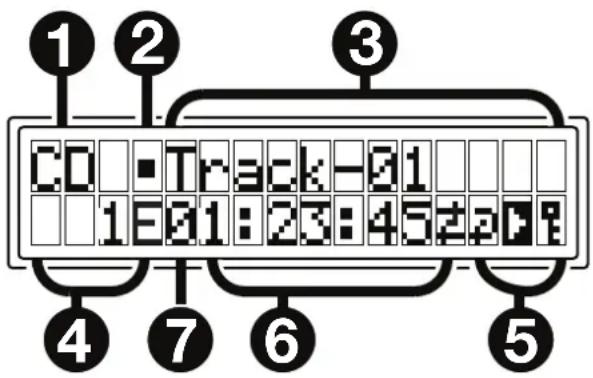
Display
- Media Type: This is the currently selected media: CD, USB, or Aux. See Operation > Selecting Media Playback Mode for more information.
- Playback Operation Icon: This shows various symbols to indicate the current playback status:
Playing Rewinding
11 Paused Fast Forwarding
■ Stopped
- Information: This shows extra information about the media being played.
TRK Elapsed: Time Elapsed
TRK Remain: Time Remaining
DISC Elapsed: Total Time Elapsed (for CD Mode only)
DISC Remain: Total Time Remaining (for CD Mode only)
- Track/File Number: This is the number of the track or file.
- Function Icons: This shows various symbols to indicate these current functions:
Random Playback (see Operation > Playing Audio CDs or more information)
Repeat One (see Operation >Playing Audio CDs for more information)
Repeat All (see Operation >Playing Audio CDs for more information)
Power-On Play (see Operation > Additional Functions > Power-On Play for more information)
- Time: In CD and USB Mode, this is how much time has elapsed or is remaining, shown as hh:mm:ss (hours, minutes, and seconds).
See Operation >Playing Audio CDs for more information.
- Folder View
Panel Lock (see Operation > Additional Functions > Panel Lock for more information)
Rear Panel

- Outputs (unbalanced RCA): These outputs send the audio signals from a CD, USB device (mass storage class), and device connected to the Aux In. Use RCA cables to connect these outputs to external speakers, sound system, etc. See Setup for more information.
- Outputs (balanced XLR): These outputs send the audio signals from a CD, USB device (mass storage class), and device connected to the Aux In. Use XLR cables to connect these outputs to external speakers, sound system, etc. See Setup for more information.
- AC In: Use the included power cable to connect this input to a power outlet. See Setup for more information.
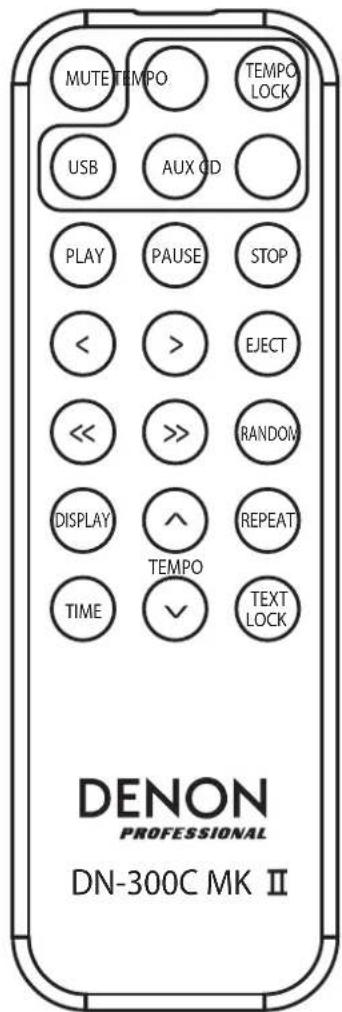
Remote Control
- Mute: Disables the sound from the audio outputs.
- Tempo Menu: Press to select the tempo function for adjustment.
Note: Tempo control will only function in CD and USB modes.
3. Tempo Lock: Press the knob to turn Tempo Lock on and prevent changes to the tempo setting.
4. USB: Switch to USB Mode.
5. AUX: Switch to Aux Mode.
6. CD: Switch to CD Mode.
7. Play: Plays audio from a CD or USB flash drive.
8. Pause: Pause audio from a CD or USB flash drive.
9. Stop: Stops audio from a CD or USB flash drive.
10. Eject: Ejects or inserts a CD.
11. Search Backward: Hold to rewind through a CD or USB track.
12. Search Forward: Hold to fast forward through a CD or USB track.
13. Skip Back: Press to skip to the previous track or chapter.
14. Skip Forward: Press to skip to the next track or chapter.
15. Random: Press to cycle through Random FLD/Random Play Mode or Single Play Mode () in CD or USB mode.
16. Display: Press and release the button to adjust the display brightness. Press and hold the button to open the options menu. Hold the button again to close the option menu.
17. Tempo Up: Adjust the tempo up.
18. Tempo Down: Adjust the tempo down.
19. Repeat: In CD or USB mode, switch between Repeat Playback modes: Repeat One , Repeat All and Repeat Off.
20. Time: In CD or USB Mode, press this button to switch the time in the display from Time Elapsed, Time Remaining, Total Elapsed Time, or Total Time Remaining (for CD Mode only).
21. Text/Lock: In CD or USB Mode, press to switch the display between the track name and artist name. Press and hold to turn Panel Lock on and off.
Setup
Important: Connect all cables securely and properly (with stereo cables: left with left, right with right), and do not bundle them with the power cable.
- Use XLR cables or a stereo RCA cable to connect the Outputs (balanced or unbalanced) to the analog inputs of your external receiver, amp, powered monitors, etc.
- After completing all the connections, use the included power cable to connect the AC In to a power outlet.
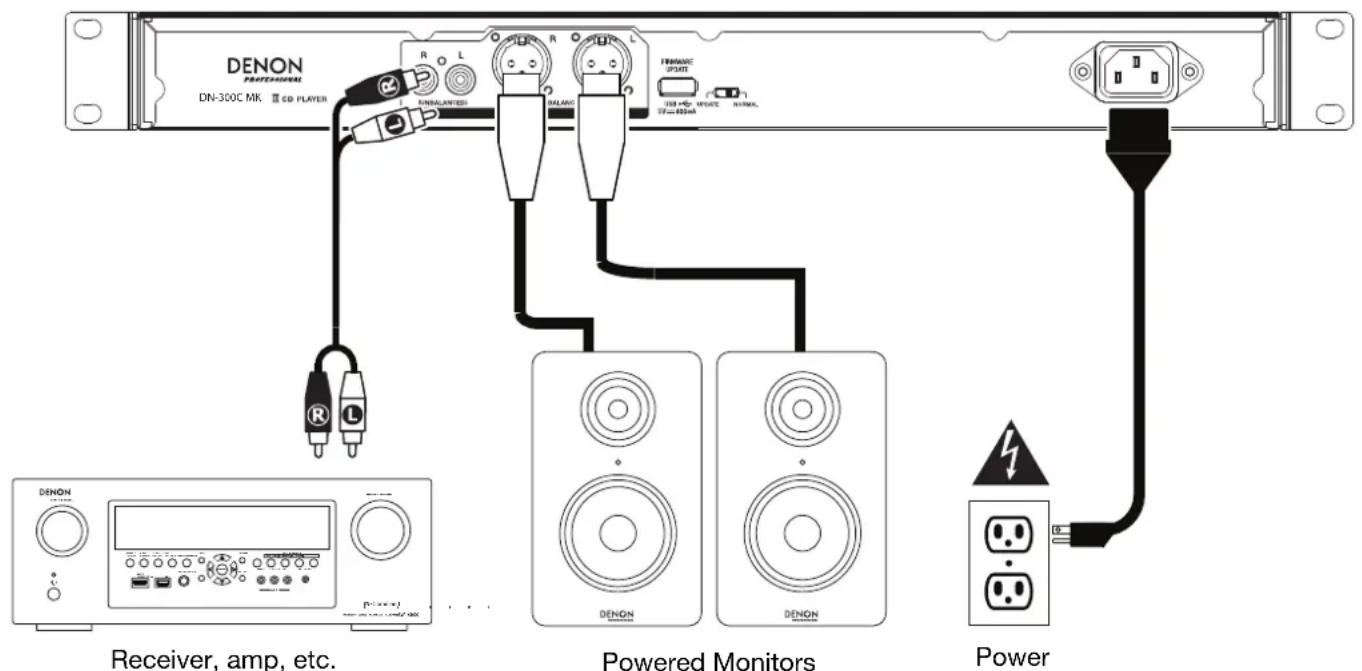
Example:
Operation
Selecting the Media Playback Mode
To select what kind of media you want to play:
To cycle through the available options, press the Source button.
- CD: audio CD, CD-DA, CD-ROM, or MP3 CD with audio files (CDR) (see Playing Audio CDs)
- USB: USB device (mass storage class). (see Playing Audio Files on a USB Drive)
- Aux: device connected to Aux In. (see Playing Audio from an External Device)
Playing Audio CDs
To play audio CDs:
- If the unit is off, press the Power button to power it on.
Important: Do not insert a CD when the power is off. Doing so may damage the unit.
- Insert a CD into the CD slot. (Hold the edges of the CD without touching the recorded surface. Be careful not to trap your fingers when the disc is drawn into the unit.)
- Select CD as the media type (described in Selecting the Media Playback Mode).
The CD will start playing automatically when Power-On Play mode is active.
In CD Mode, you can perform any of the following operations:
- To start, resume, or pause playback, press the Play/Pause button.
- To stop playback, press the Stop button.
- To rewind or fast-forward through the track, press and hold one of the Search buttons. The track will rewind/fast-forward at 5 times the normal playback speed. To resume playback, release the button.
-
To skip directly to a track:
-
Press one of the Number buttons (0-9) to enter the desired track number. If the track number is two digits, press the buttons in succession (e.g., 1 then 2 for Track 12). Alternatively, turn the Jog Dial to select a track and press the Jog Dial to load the track.
-
To select a Repeat Playback mode, press the Repeat button. It will cycle through Repeat One (the same track will repeat indefinitely), Repeat All (the list of all tracks will repeat indefinitely), Repeat FLD (tracks in the selected folder will repeat indefinitely), and Repeat Off (no tracks will repeat).
- To select the Play Mode, press the Random button. It will cycle through Random FLD (all tracks in the selected folder will play back in random order), Random All (all tracks on the CD will play back in a random order), Single Play (the current track will play until its end and then stop), and Normal (the CD will play from the current track to the end and then stop).
- To change the Time Mode in the display, press the Time button. It will cycle through the TRK Elapsed (E): how much time has elapsed of the current track. TRK Remaining (R): how much time remains of the current track. Disc Elapsed: how much time elapses of all remaining tracks. This applies only to CDs. Disc Remain: how much time remains of all remaining tracks. This applies only to CDs.
- To eject a CD, press the Eject button when the unit is stopped or paused. Ejecting will appear in the display while ejecting the CD. No Disc will appear when there is no disc in the CD slot.
Important: Please see Other Information > CDs to learn more about the types of CDs the DN-300C MKII supports and for more information about CD handling and care. When powering on the unit, hold the Eject button to engage Force Eject Mode.
Playing MP3 Files on a CD
To play MP3 files on a CD:
- If the unit is off, press the Power button to power it on.
Important: Do not insert a CD when the power is off. Doing so may damage the unit.
-
Do one of the following:
-
Insert a CD into the CD slot. (Hold the edges of the CD without touching the recorded surface. Be careful not to trap your fingers when the disc is drawn into the unit.)
-
Select CD as your desired media type: (described in Selecting the Media Playback Mode).
-
Select an audio file:
-
To move through audio files, turn the Jog Dial on the unit.
- To enter a folder, press and hold the Folder/Time button for 3 seconds and turn the Jog Dial to select a folder. Press the Jog Dial to enter the folder and scroll with the dial to find a track. Press the dial again to select a track and press the Play/Pause button to play the track.
Note: If a track is not selected after a few seconds of entering a folder, the unit will exit the folder and return back to the previously selected track/folder.
In CD Mode, you can perform any of the following operations:
- To start, resume, or pause playback, press the Play/Pause button.
- To stop playback, press the Stop button.
- To rewind or fast-forward through the track, press and hold one of the Search buttons. The track will rewind/fast-forward at 5 times the normal playback speed. To resume playback, release the button.
- To select a Repeat Playback mode, press the Repeat button. It will cycle through Repeat One (the same track will repeat indefinitely), Repeat All (the list of all tracks will repeat indefinitely), Repeat FLD (tracks in the selected folder will repeat indefinitely), and Repeat Off (no tracks will repeat).
- To select the Play Mode, press the Random button. It will cycle through Random FLD (all tracks in the selected folder will play back in random order), Random All (all tracks on the CD will play back in a random order), Single Play (the current track will play until its end and then stop), and Normal (the CD will play from the current track to the end and then stop).
- To change the Time Mode in the display, press the Time button. It will cycle through Elapsed (E) (how much time has elapsed of the current track) Remaining (R) (how much time remains of the current track), and Total Remaining (how much time remains for the total audio CD).
- To eject a CD, press the Eject button. Ejecting will appear in the display while ejecting the CD. No Disc will appear when there is no disc in the CD slot.
Playing Audio Files on a USB Flash Drive
To play audio files on a USB flash drive:
- If the unit is off, press the Power button to power it on.
- Connect your USB device (mass storage class) to the USB Port.
- Select USB as your desired media type (described in Selecting the Media Playback Mode).
-
Select an audio file:
-
To move through audio files, turn the Jog Dial on the unit.
- To enter a folder, press and hold the Folder/Time button for 3 seconds and turn the Jog Dial to select a folder. Press the Jog Dial to enter the folder and scroll with the dial to find a track. Press the dial again to select a track and press the Play/Pause button to play the track.
Note: If a track is not selected after a few seconds of entering a folder, the unit will exit the folder and return back to the previously selected track/folder.
In USB Mode, you can perform any of the following operations:
- To start, resume, or pause playback, press the Play/Pause button.
- To stop playback, press the Stop button.
- To rewind or fast-forward through the track, press and hold one of the Search buttons. The track will rewind/fast-forward at 5 times the normal playback speed. To resume playback, release the button.
To change the view mode, press the Folder/Time button. - To select another folder or audio file, follow the steps described in Step 4 above.
- To show different track information in the display, press the Text button. It will cycle through the file name and other text information.
- To select a Repeat Playback mode, press the Repeat button. It will cycle through Repeat One (the same track will repeat indefinitely), Repeat All (the list of all tracks will repeat indefinitely), Repeat FLD (tracks in the selected folder will repeat indefinitely), and Repeat Off (no tracks will repeat).
- To change the Time Mode in the display, press the Time button. It will cycle through Elapsed (E) (how much time has elapsed of the current track) and Remaining (R) (how much time remains of the current track).
- To remove a USB device, gently remove it from the USB Port when it is not playing. (Removing a USB device while it is playing can damage it.)
Playing Audio from an External Device
To play audio on an external device (e.g., smartphone, computer, portable music player, etc.) connected to the Aux In:
- If the unit is off, press the Power button to power it on.
- Connect the 1/8 (3.5 mm) stereo/headphone output of your external device to the Aux In.
- Select Aux as the media type (described in Selecting the Media Playback Mode). If your external device is connected, AUX Connected will appear in the display. If your external device is not connected, AUX Disconnect will appear in the display.
- To start playback, press the Play button on your external device.
Important: All buttons except for Power, Source, and Eject will be locked/disabled when you are in AUX Mode.
Additional Functions
Panel Lock
Use the Panel Lock feature to prevent accidental changes to the unit. When Panel Lock is activated, all buttons except for the Power button and Text/Lock button are locked/disabled on the unit. (The remote control will still function normally.)
To activate or deactivate Panel Lock, press and hold the Text/Lock button.
- When activated, P-Lock ON and will appear in the display.
- When deactivated, P-Lock OFF will appear in the display, and will disappear.
Power-On Play
Use the Power-On Play feature to set the unit to automatically start playback of the CD in the drive.
To activate or deactivate Power-On Play, press and hold the Pwr On Play button.
- When activated, P-OnPlay On will appear on the display.
- When deactivated, P-OnPlay Off will disappear on the display.
Other Information
CDs
When playing audio CDs, note the following:
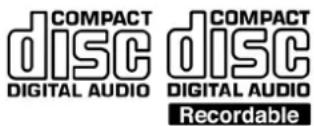
- DN-300C MKII can play Music CDs and CD-R discs. Both are usually marked with the Compact Disc Digital Audio logo (see image).
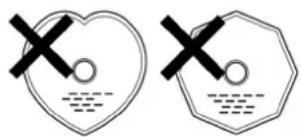
- Do not play discs in non-circular shapes (heart-shaped discs, octagonal discs, etc.; see image) or discs that have been repaired with adhesive or tape. These can damage the unit.
- DN-300C MKII can play finalized discs only. (Finalization is the process that makes recorded CD-R discs playable on compatible players.)
- Depending on the software used to burn a CD (or other conditions), some CDs may not play correctly.
When playing CDs with audio files, note the following:
- The writing software format must be ISO9660 Level 1.
- You can have up to 300 folders and up to 8 folder levels, including the root directory.
- You can have up to 300 audio files. If the CD contains more than 300 files, some audio files may not play or appear correctly.
- File names, folder names, and text characters can use up to 255 characters. Only uppercase letters, lowercase letters, numbers, and symbols can be displayed. Japanese file names will not be shown. File names that begin with a “.” will not be shown.
Copyright-protected files might not play properly and/or may appear as Unknown File.
Depending on the software used to burn a CD (or other conditions), some files may not play or appear correctly. - When playing audio files on a CD, DN-300C MKII supports the following tag data:
ID3 tags: Version 1.x and 2.x
- META-tags: compatible with title, artist, and album names
Sample rate: 44.1 kHz
Bit rate: 32 kbps to 320 kbps
Format: MPEG1 Audio Layer 3
File extension: .mp3
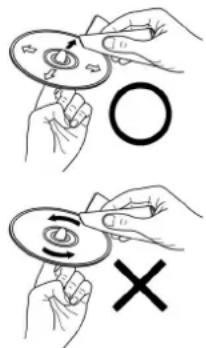
Be careful not to scratch discs when removing them from their cases. Do not bend or heat discs, and do not enlarge the hole in the center of the disc. Do not write on the labeled surface of the disc or attach new labels to discs.
If fingerprints, dirt, or condensation are on a disc, clean it with a commercially available disc cleaning set or a soft, dry cloth. Gently wipe it from the inside towards the outside, not in a circular motion. Do not use record spray, antistatic agents, benzene, thinner, or other solvents.
After using discs, remove them from the unit and store them in their cases to protect them from dust, scratches, warping, etc. Do not store discs in places exposed to long periods of direct sunlight or places exposed to heat, dust, humidity, etc.
USB Devices
When playing audio files on a USB device, note the following:
- DN-300C MKII does not charge any connected USB device and does not support USB hubs or USB extension cables.
- DN-300C MKII supports USB devices that are mass storage class or compatible with MTP.
- DN-300C MKII supports FAT16 or FAT32 file systems only.
- You can have up to 999 folders and up to 8 folder levels, including the root directory.
- You can have up to 999 audio files. If the USB device contains more than 999 files, some audio files may not play or appear correctly.
- File names, folder names, and text characters can use up to 255 characters. Only uppercase letters, lowercase letters, numbers, and symbols can be displayed. Japanese file names will not be shown. File names that begin with a “.” will not be shown.
Copyright-protected files might not play properly and/or may appear as Unknown File.
When playing audio files on a USB device, DN-300C MKII supports the following tag data:
- ID3 tags: Version 1.x and 2.x
for MP3 files:
Sample rate: 44.1 kHz
Bit rate: 32 kbps to 320 kbps
Format: MPEG1 Audio Layer 3
File extension: .mp3
Audio FilePlayback Order
When playing audio files stored within multiple folders, the playback order of each folder is automatically set when the unit reads the media. The files in each folder will play in the same order in which they were added to the media. (This order may appear differently on your computer and/or in your software than it does on the unit.)
The folder structure also determines the playback order:
For audio files on a CD-R, files in all folders on the first level will play, then files in all folders on the second level, then on the third level, and so on.
For audio files on a USB device, files in the first folder on the first level will play, then files on the second level in that same folder, then files on the third level in that same folder, and so on. After playing all files on all levels of that first folder, the same process will continue for files in the second folder on the first level.
Troubleshooting
If you encounter a problem, do the following:
- Make sure all cables, devices, antennae, and/or media are properly and securely connected.
- Make sure you are using the unit as described in this User Guide.
- Make sure your other devices or media are working properly.
- If you believe the unit is not working properly, check the following table for your problem and solution.
| Problem | Solution | Please | |
| Power does not turn on. Make sure the unit is connected to a power outlet. | Setup | ||
| CD cannot be inserted into CD slot. | Make sure the unit is connected to a power outlet and that it is powered on. Press the Eject button to make sure a CD is not already in the CD slot. | Setup | |
| No Disc appears even when a CD is inserted. | Press the Eject button to eject the CD and insert it again. | ||
| A specific section of the CD does not play properly. | |||
| Playback does not start even after pressing the Play button. | Clean the CD with a dry cloth or commercial CD cleaner. Insert a different CD. | Other Information > CDs | |
| The unit does not produce any sound, or the sound is distorted. | Make sure all cable, device, or media connections are secure and correct. Make sure none of the cables are damaged. Make sure the settings on your amplifier, mixer, etc. are correct. | Setup | |
| The unit cannot play a CD-R. | Make sure the CD-R has been finalized properly. Make sure the CD-R is of good quality. Clean the CD with a dry cloth or commercial CD cleaner. Make sure the CD uses a folder structure that the unit supports: up to 300 folders (up to 8 folder levels, including the root) and up to 300 files. Make sure the CD-R contains MP3 files. The unit cannot play other files on CD-R. | Other Information > CDs | |
| The CD will not eject. | Press and hold the Eject button while turning on the unit. |
| Problem | Solution | Please |
| No Device appears even when a USB device is inserted. | Disconnect and reconnect the USB device to make sure it is securely inserted. Make sure the USB device is of a mass storage class or compatible with MTP. Make sure the USB device is formatted using a FAT16 or FAT32 file system. Do not use a USB hub or USB extension cable. The unit does not supply power to USB devices. If your USB device requires a power source, connect it to one. Not all USB devices are guaranteed to work; some may not be recognized. | Other Information > USB Devices |
| Files on a USB device do not appear. | Make sure the files are of a supported file format. Files that are not supported by this unit will not appear. Make sure the USB device uses a folder structure that the unit supports: up to 999 folders (up to 8 folder levels, including the root) and up to 999 files. If your USB device is partitioned, make sure the files are in the first partition. The unit will not show other partitions. | Other Information > USB Devices |
| Files on a USB device cannot play. | Make sure the files are of a supported file format. Files that are not supported by this unit will not appear. Make sure the files are not copyright-protected. The unit cannot play copyright-protected files. | Other Information > USB Devices |
| File names do not appear properly. | Make sure the files are using only supported characters. Characters that are not supported will be replaced with a “.” | Other Information > USB Devices |
Assistance technique
Technical Specifications
| Digital Audio System | |
| System | Media player |
| Compatible Media | CD, USB device (mass storage class) |
| Supported Device Formats, File Systems | CD: CD-DA, CD-ROM (ISO9660) USB: FAT16, FAT32 |
| Supported File Formats MP3: | Sample rate: 44.1 kHz Bit rate: 32 kbps to 320 kbps and VBR Format: MPEG1 Audio Layer 3 File extension: .mp3 |
| Number of Channels | 1 (stereo), 2 (mono) |
| Audio Frequency Range | 20 Hz – 20 kHz (±1.0 dB) |
| Signal-to-Noise Ratio | >95 dB (A-weighted) |
| Total Harmonic Distortion | < 0.01% |
| Dynamic Range | >85 dB |
| Channel Separation | >80 dB |
| Outputs | |
| Analog Out L/R (unbalanced) | Type: RCA terminal Load impedance: > 10 kΩ Output level: 2 Vrms / at 10 kΩ load |
| Analog Out L/R (balanced) | Type: XLR Load impedance: > 10 kΩ Output level: +4 dBu |
| Inputs | |
| Aux In Type: 1/8" (3.5mm) | TRS terminal Input impedance: > 10 kΩ Maximum input level: 1 Vrms |
| Other / General | |
| File/Folder Limits | Storage capacity: up to 2 TB File size: up to 2 GB File name length: up to 255 characters Number of files: up to 999 (for 1 folder) Number of folders: up to 999 folders (including the root directory) Number of folder levels: up to 8 (including the root directory) Folder name length: up to 255 characters |
| Power | USA and Canada: 120 Europe and Asia Pacific Region: 230 V AC, 50/60 Hz Japan: 100 V AC, 50/60 Hz Power consumption: 19 W |
| Environmental Conditions | Operating temperature: 41 – 95 °F (5 – 35 °C) Operating humidity: 25 – 85%, no condensation |
| Dimensions (width x depth x height) | 19.00” x 13.66” x 1.73” / 483 x 347 x 44 mm (with rack ears) 17.09” x 13.66” x 1.73” / 434 x 347 x 44 mm (without rack ears) |
| Weight | 7.94 lbs. / 3.6 kg |
Trademarks & Licenses
Denon is a trademark of D&M Holdings Inc., registered in the U.S. and other countries. Denon Professional products are produced by inMusic Brands, Inc. All other product names, company names, trademarks, or trade names are those of their respective owners.
denonpro.com

- User Guide (English)
- Introduction
- Box Contents
- Support
- Safety Instructions
- Features
- Front Panel
- Display
- Rear Panel
- Remote Control
- Setup
- Operation
- Selecting the Media Playback Mode
- Playing Audio CDs
- To play audio CDs:
- Playing MP3 Files on a CD
- To play MP3 files on a CD:
- Playing Audio Files on a USB Flash Drive
- To play audio files on a USB flash drive:
- Playing Audio from an External Device
- Additional Functions
- Panel Lock
- Power-On Play
- Other Information
- CDs
- USB Devices
- Audio FilePlayback Order
- Troubleshooting
- Assistance technique
- Technical Specifications
- Trademarks & Licenses
- denonpro.com
Brand : DENON
Model : DN300C MKII
Category : Blu-ray player