ARVP600 - Speaker VOXX - Free user manual and instructions
Find the device manual for free ARVP600 VOXX in PDF.


User questions about ARVP600 VOXX
0 question about this device. Answer the ones you know or ask your own.
Ask a new question about this device
Download the instructions for your Speaker in PDF format for free! Find your manual ARVP600 - VOXX and take your electronic device back in hand. On this page are published all the documents necessary for the use of your device. ARVP600 by VOXX.
USER MANUAL ARVP600 VOXX
This warranty remains in effect for five years from date of purchase for speaker components, and year an subwoofer amplifiers and electronics components.
Porsa Protected. This warranty will only be ererseable by the original owner during the warrily period so long as proof of date of purchase from an autharcted daskier is
preseledwherewerewarthy serviceis required.
What is covered. Except as otherwise spealcd below his warranty covers all defects in materials and worrnship in this product. The following are not covered damage resuling
The product, does not occur during shipment (cubes must be pre-packed in the container), nor was purchased outside USA or Canada, on which the 7-day number has been dated, stamped or removed.
How You Can Get Service
U.S. Purchases, Please contact us at 1-803-225-8847 or write to ARPention Customer Service Department 17C Airport Drive Hopleside, MA 01747 We will either inform you of the name and address of an authorized receipt dial which will service the product or will activate you to send the product to a factory service center.
Canadian Purchases. The product should be returned to the dealer from which I was purchased and such dealer either will service or arrange for service of the product. If shipment of the product is required, it should be packaged properly. The original calibed bit of saics must always be included with the product as proof at warranty coverage.
What We Will Pay For: We will pay for all labor and material expenses required to resorb the product but you must pay any labor cost for the removal and installation of the product. This is an exclusive service and cannot be extended to anyone except for initial stock purchase, delivery, transport, storage, repair, warranty, or any other shipping charges. And Audiovox Technologies Corporation still pay the return shipping charges if the product is returned to an address inside the USA or Canada.
Limitation of Implied or Statutory Warranties and Conditions.
Exclusions. Audioex Electronics Corporation's liability is limited to the repair or replacement, at our option of its defective product and shall not include special, indirect, incidental or consequential damages of any kind. THIS WARRANTY IS EXCLUSIVE AND INUELE OF ANY AND ALL OTHER WARRANTYMENTS, EXPRESSED OR IMPLIED, INCLUDING WITHOUT LIMITATION THE IMPLIED WARRANTY OF CONTRACTUALITY AND FITNESS FOR A PARTICULAR PURPOSE AND ANY DELIVERY, LIABILITY, RIGHT, CLAIM ON REDEMPTION IN CONTRACT OR TOGET HETHERON OR NOT ADOING FROM THE COMPANY'S NEGLIGENCE ACTUAL OR IMputed. NO PERSON OR REPRESENTATIVE IS AUTHORIZED TO ASSUME FOR THE COMPANY ANY OTHER LIABILITY IN CONNECTION WITH THE SALE OF THIS PRODUCT. IN NO EVENT SHALL THE COMPANY BE LIABLE FOR SPECIAL, INDIRECT, INDECENTAL, OR CONCRETOITAL DAWAGES.
Cetsga n t a t t t t t t t t t t t t t t t t t t t t t t t t t t t t t t t t t t t t t t t t t t t t t t t t t t s e i i i i i i i i i i i i i i i i i i i i i i i i i i i i i i i i i i i i i i i i i i i i i i i i i i o o o o o o o o o o o o o o o o o o o o o o o o o o o o o o o o o o o o o o o o o o o o o o o o o o o
Audiovox Electronics Corporation
150 Marcus Bvd
Hauppauge, New York 11788
82004 Audiovox Electronics Corporation
Acoustic Research is a registered trademark of Audiovox Electronics Corporation. PRINTED IN CHINA

LOUDSPEAKERS
Important Notes
for Installation
Remarques importantes
What would the world sound like without us?
mastering acoustics for over 50 years (1954-2004).
INDEX/INHALT/INDICE
ENGLISH 2
FRANCAIS 5
ESPANOL 8
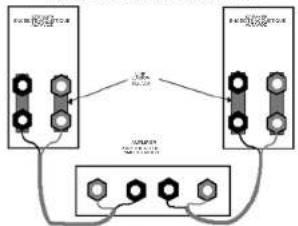
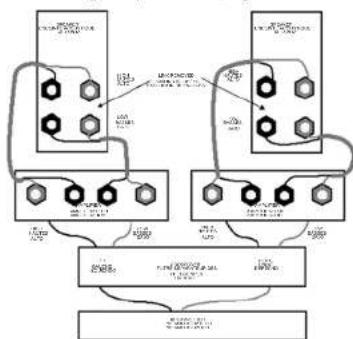
Standard Wiring Cabling Standard Cableado Normal Figure 1, Schema 1, Figure 2
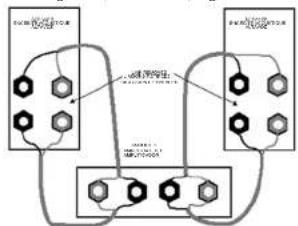
BI-Wire Bicablage BI-cabledo Figure 2. Schema 2, Figura 2
BI-Amp Bi-amplification Bi-amplificador Figure 3. Schema 3. Figura
ARVP Series Specifications
ARVP600
3-Way Tower
[2]5.5' Polypropylene Woolers
1 Soft Dome Tweeter
Frequency Response:35Hz-30kHz
Nominal Impedance: 8 ohms
Sensitivity: 90dB
Recommended Power: 10-200 Watts
First: Black Ash Vinyl
Dimensions: 39.25"×12.5"W×14"D
Bi-Wireable/Bi-Ampacible
Video Shielded
Dimensions:39.25coHx12.5poLx14po
Capacite de bicablage
Bindage video
Torre acustica de 3 vias
(2) Woofers de Polipropilleno de 6.5
Tweeter de cuspula suave de 1
Frequency Response: 45Hz-30kHz
Nominal Impedance: 8 ohms
Sensitivity: 80dB
Recommended Power: 10-100 Watts
Finish: Black Ash Vinyl
Dimensions: 18.25" Hx7.875" Wx12.875"D
Video Sheied
Frequency Response: 50Hz, 30kHz
Nominal Impedance: 8 ohms
Sensitivity: 87dB
Recommended Power: 15-75 Watts
Finish: Black Ash Vinyl
Dimensioes:12375Hx7"Wx11.5D
Video Shielded
Frequency Response: 56Hz-310kHz
Nominal Impedance & ohm
Kemihin I. PEGB Sosnitha H. SfDp
Sensitivity: 100%
Recommended Power: 15-65 Watts
Flesh Black Ash Vinyl Dispersion (107711)
Dimension: 113.75 H65.87 Wx10.5 D
Video Shielded
Dimensions: 11.375" alt to x 5.875" anchor x
10.5" long
Video blindado
ARVP42C
2-Way Center Channel
[2]4 Polypropylene Midranges
SoftDomeTweeter
Frequency Response: 59Hz-30kHz
Nominal Impedance Bchms
Sensitivity: 87dB
Recommended Power: 15-125 Watts
Finish: Black Ash Vinyl
Dimensions:5.75"Hx14.75"Wx11"D
Video Shielded
Congratulations! Your new AR loudspeakers are an outstanding home hi-fi product that will give you many years of reliable service. The superlative quality of AR products is renowned all over the world and meets or exceeds all official audio standards.
In order to avoid possible errors or damage please take the time to study the following important information before installing your new speakers.
Connecting your AR speakers
Strip the insulation from the connection cable ends and twist the ends tightly or tin them with solder. Then insert the ends in the connection terminals and secure them with the terminal screws.
Caution: Take care to ensure that the speaker cables are connected with the correct polarity!
Connect the negative amplifier output terminal (black) to the negative connection terminal of the AR speaker (also black). Proceed in the same way to connect the positive terminals, which are normally red. Standard speaker connection cables normally have a colored marking or indentation in the surface of the insulation to distinguish the two leads from one another.
Choosing the best position for your AR speakers
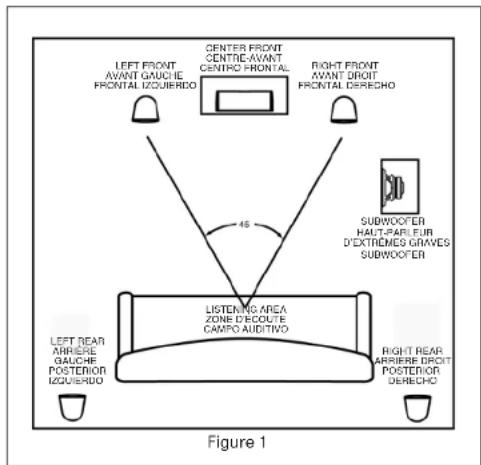
The optimum listening position is at the tip of the so-called "stereo triangle" (Pg. 11, Fig 1). The equilibrium between the right and left stereo channels is best in this position, providing the most balanced and realistic sound reproduction.
Your AR speakers will operate most efficiently when they are located in parts of the room with "hard" acoustics, i.e., areas including hard, smooth surfaces such as walls and wooden furniture. The speakers should radiate the sound from this hard area into the "softer" parts of the room containing sound-absorbing elements such as upholstered furniture, carpets and so on.
Make sure that there are no sound-absorbing obstacles between the speakers and your listening position, as this will muffle the sound and impair your listening pleasure.
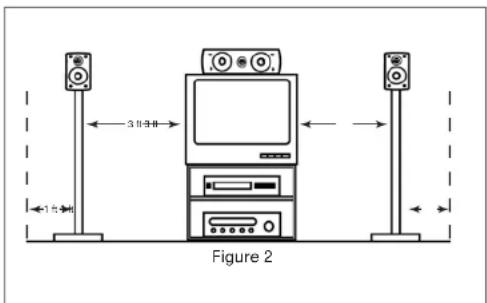
Your AR VP Series speakers are fully shielded for use in audio/video applications. This allows you to place any of the speakers next to the television without affecting picture quality. If you are using other speakers, be sure to locate them at least 3 feet away from the television to avoid interference to the set's picture (Pg. 11, Fig. 2).
Some other AR speakers are also shielded. Please see page 1 to check if your speaker(s) are video shielded before placing them near a television. The speakers should be installed at least 1 foot away from the side walls (Pg. 11, Fig. 2) and 8 inches from the rear wall. This prevents exaggerated "booming" bass and helps to produce more balanced, detailed sound reproduction.
If possible, bookshelf speakers should be installed so that the tweeters are on the same level as the listener's ears. If you install the speakers in a wall unit, take care to ensure that the fronts of the speakers are flush with the front of the wall unit.
Mounting your Speakers
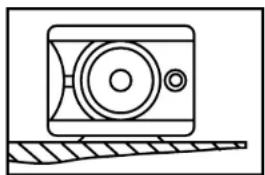
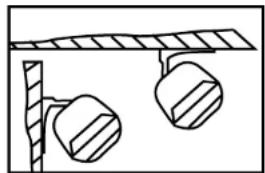
The speaker's foot bracket can be used to set the speaker on shelving in either a vertical or horizontal position, or to mount the speaker to the walls or ceilings. A clamp ring and four clamp screws hold the foot bracket to the speaker. Mount the foot bracket to a wall or ceiling using screws through the two holes in the foot bracket. Removing the foot bracket from the speaker may make mounting easier. After mounting, aim the speaker on its ball/swivel mount by loosening the clamp screws, adjusting the speaker, and retightening the screws.
Be sure that both the fasteners and the mounting surface can safely support the weight of the speaker, especially in earthquake prone regions.
Setting up and installing home cinema systems
The three-dimensional drawing on Pg.11, (Fig. 1), shows a typical configuration for a home cinema setup in a living room, using two floor-standing speakers and a special center speaker as the front speakers. Please study the manufacturers' instruction manuals carefully before connecting the equipment.
Bi-wiring and bi-amping
In conventional systems, the speaker connection cables carry all the frequencies together. The bass signals have much more power, however, this can cause losses in overall sound quality. "Bi-wiring," which means dividing the signal and using one set of cables for the high frequencies and another for the low frequencies, can bring an audible improvement in sound quality. "Bi-amping" goes one step further by using separate amplifiers as well as separate cables for the high and low frequency ranges. This method eliminates sound losses caused by the widely-different current levels in the lower and upper ranges by separating the signals right from the very start. Some AR speakers have specially designed connection terminals that can be used both for conventional operation and for bi-wiring/bi-amping.
This means that if you wish, you can use separate connections for the woofer and the mid/tweeter units. There are four screw terminals on each speaker: the top two are for the mid-range and tweeter units, the bottom two for the woofers.
When the speakers are delivered from the factory, the upper and lower terminals are connected with jumpers for operation in conventional mode (see Pg. 14, Fig. 1).
If you just wish to use one cable, simply leave the jumpers in place and connect the cable to either the upper or the lower terminals - which pair you use makes no difference.
If you wish to operate the speakers in bi-wiring, bi-amping mode, you must first remove the two jumpers from each speaker.
For bi-wiring (Pg.14, Fig. 2) you need two cables for each speaker and amplifier channel, or a special bi-wiring cable. Connect the two cables to the amplifier outputs in parallel - i.e., connect both positive
leads to the positive output terminal and both negative leads to the negative output terminal. Then connect the other ends of one cable to the mid/tweeter terminals and those of the other cable to the woofer terminals on the speaker. Taking care to maintain proper polarity of both sets of wires.
A bi-amping setup uses two amplifiers (Pg.14, Fig. 3), with the first handling the mid and high range frequencies and the second the low range frequencies.
The correct connections are very important: Connect the left output of the first amplifier to the upper terminals of the left speaker. Proceed in the same way to connect the outputs of the second amplifier to the lower terminal pairs on the speakers.
Only use tone controls when absolutely necessary
You will get the best sound from your speakers when all tone controls are in the middle position. This neutral setting enables the speakers to reproduce the music absolutely naturally and without distortion. AR speakers are designed to produce optimum sound without any bass or treble modifications.
WARNING: If you turn the tone controls too far at high volumes you may actually cause irreparable damage to the tweeters or woofers!
Use the volume control with care
You can also damage the speakers by using an amplifier whose power significantly exceeds the rated capacity of the speakers. In practice, however, this kind of damage is actually very rare. Surprisingly, weak amplifiers connected to speakers with a high power rating pose a much greater risk. In such a configuration it is quite possible to overdrive the music signal, even at medium volumes. This results in audible and measurable distortions, which cause excessive mechanical stresses that will ultimately destroy the speakers. Always remember that the power rating of your speakers is for clear music signals, not for distortion!
It is thus very important to match the output power of your amplifier to the capacity of your speakers. Always take care to adjust the volume so that there is no audible distortion. If you like listening to music at high volumes, ensure that the output power of your amplifier is at least as high as the capacity of your speakers.
CD's with "extended bass"
If the label of a CD indicates that it features "extended bass," this means that the recording includes subsonic frequencies below 30Hz . When played at high volumes these signals can cause serious mechanical damage to the speakers. Exercise great care when increasing the volume with such recordings and reduce it immediately if you notice any distortion.
Cher client de AR