ManualGo.com
LKIM08121V - Freezer LG - Free user manual and instructions
Find the device manual for free LKIM08121V LG in PDF.



Download the instructions for your Freezer in PDF format for free! Find your manual LKIM08121V - LG and take your electronic device back in hand. On this page are published all the documents necessary for the use of your device. LKIM08121V by LG.
USER MANUAL LKIM08121V LG
www.lg.com Copyright © 2017 LG Electronics Inc. All Rights Reserved. Read this owner’s manual thoroughly before operating the appliance and keep it handy for reference at all times. OWNER'S MANUAL REFRIGERATOR MFL69721103Rev.00_171012LKIM08121VGKIM08121V2 TABLE OF CONTENTS
3 PRODUCT FEATURES 4 SAFETY INSTRUCTIONS
TABLE OF CONTENTS3PRODUCT FEATURES
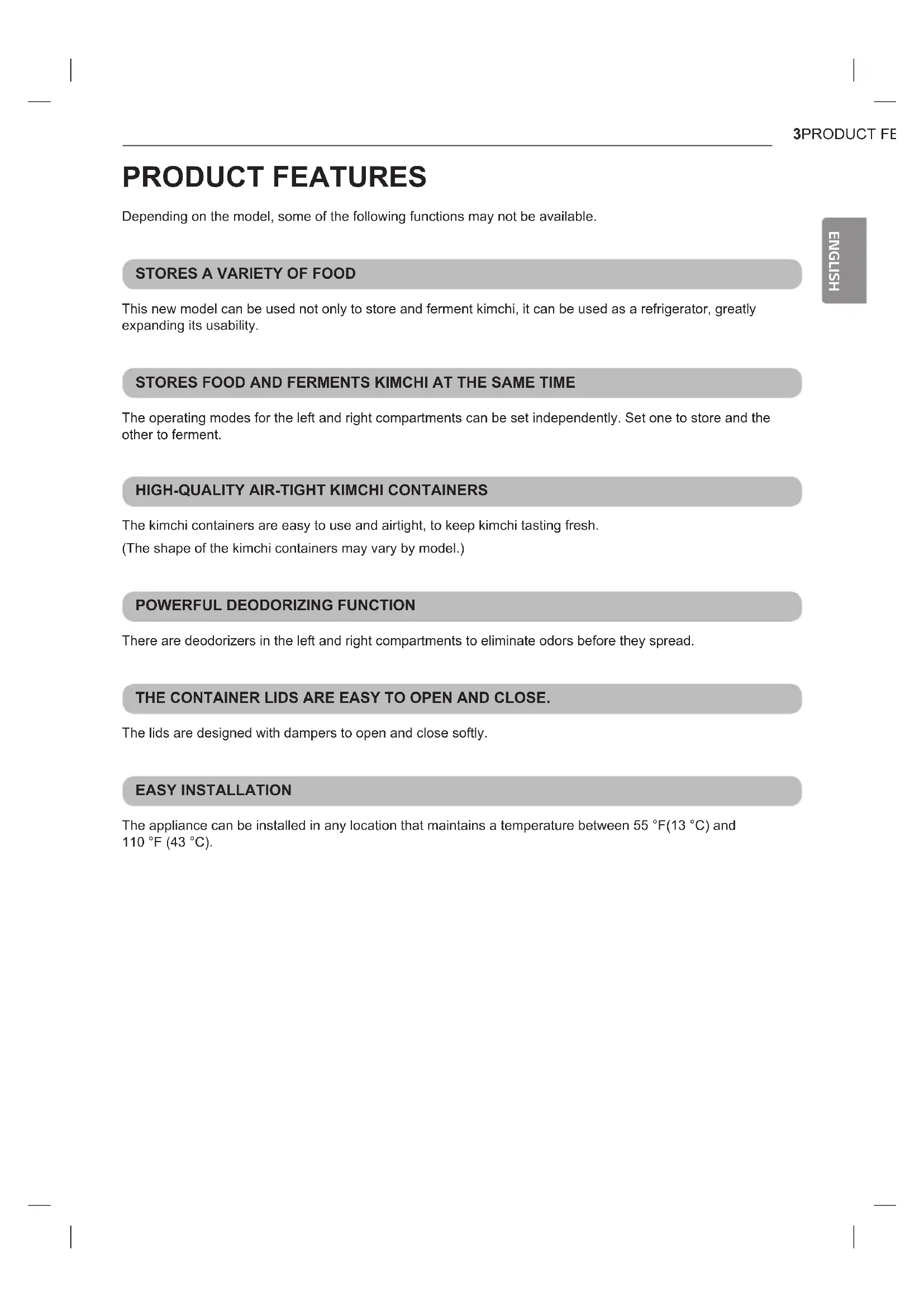
ENGLISH PRODUCT FEATURES Depending on the model, some of the following functions may not be available.
STORES A VARIETY OF FOOD
This new model can be used not only to store and ferment kimchi, it can be used as a refrigerator, greatly expanding its usability. STORES FOOD AND FERMENTS KIMCHI AT THE SAME TIME The operating modes for the left and right compartments can be set independently. Set one to store and the other to ferment.
HIGH-QUALITY AIR-TIGHT KIMCHI CONTAINERS
The kimchi containers are easy to use and airtight, to keep kimchi tasting fresh. (The shape of the kimchi containers may vary by model.)
POWERFUL DEODORIZING FUNCTION
There are deodorizers in the left and right compartments to eliminate odors before they spread. THE CONTAINER LIDS ARE EASY TO OPEN AND CLOSE. The lids are designed with dampers to open and close softly. EASY INSTALLATION The appliance can be installed in any location that maintains a temperature between 55 °F(13 °C) and
Your safety and the safety of others are very important. We have provided many important safety messages in this manual and on your appliance. Always read and follow all safety messages.This is the safety alert symbol. This symbol alerts you to potential hazards that can kill or injure you and others. All safety messages will follow the safety alert symbol and either the word WARNING or CAUTION.These words mean: WARNING You may be killed or seriously injured if you do not follow instructions. CAUTION You may be injured or cause damage to the product if you do not follow instructions.All safety messages will tell you what the potential hazard is, tell you how to reduce the chance of injury, and tell you what may happen if the instructions are not followed.
IMPORTANT SAFETY INSTRUCTIONS
WARNING To reduce the risk of explosion, re, death, electric shock, scalding or injury to persons when using this product, follow basic precautions, including the following: California Safe Drinking Water and Toxic Enforcement Act
This product contains chemicals known to the State of California to cause cancer and birth defects or other reproductive harm. Wash hands after handling. INSTALLATION
To reduce the risk of injury to persons, adhere to all industry recommended safety procedures including the use of long-sleeved gloves and safety glasses.
Never attempt to operate this appliance if it is damaged, malfunctioning, partially disassembled, or has missing or broken parts, including a damaged cord or plug.
Only connect this product to a dedicated grounded electrical outlet rated for use with this product (115 V, 60 Hz, AC only). It is the user’s responsibility to replace a standard 2-prong wall outlet with a standard 3-prong wall outlet.
Do not use an outlet that can be turned off with a switch. Do not use an extension cord.
The appliance must be positioned for easy access to a power source.
When moving the refrigerator, be careful not to roll over or damage the power cord.
Contact an authorized service center when installing or relocating the refrigerator.
Do not, under any circumstances, cut or remove the third (ground) prong from the power cord.
Keep packing materials out of the reach of children. Packaging material can be dangerous for children. There is a risk of suffocation.5SAFETY INSTRUCTIONS ENGLISH
Do not install the refrigerator in a damp or dusty place where insulation on electrical parts may deteriorate.
Do not place the refrigerator in direct sunlight or expose it to the heat from heating appliances such as stoves or heaters.
Do not bend or pinch the power cord excessively or place heavy objects on it. OPERATION
This appliance is intended to be used in household and similar applications such as - Staff kitchen areas in shops, ofces and other working environments; - Farm houses and by clients in hotels, motels and other residential type environments; - Bed and breakfast type environments; - Catering and similar non-retail applications.
This product is not to be used for special purposes such as the storage of medicine or test materials or for use on ships, etc.
DO NOT allow children to climb, stand, or hang on the refrigerator doors or on the shelves in the refrigerator. They could damage the refrigerator and seriously injure themselves.
Do not allow children to climb into the refrigerator. They could be trapped and suffocated.
Children should be supervised to ensure that they do not play with the refrigerator.
Keep ngers out of pinch point areas; clearances between the doors and cabinets are necessarily small. Be careful closing doors when children are nearby.
Do not touch frozen food or the metal parts in the freezer compartment with wet or damp hands. Doing so may cause frostbite.
Do not refreeze frozen food that has thawed completely. Doing so may result in a serious health hazard.
If the refrigerator is tted with light bulbs that require replacing, unplug the refrigerator or turn off the power before doing so.
Do not use an adapter plug or plug the power plug into a multi-outlet extension cord.
Do not use a cord that shows cracks or abrasion damage along its length or at either the plug or connector end. Immediately have all power cords that have become frayed or otherwise damaged repaired or replaced by qualied service personnel.
Do not operate the refrigerator or touch the power cord with wet hands.
Do not use an uncertied power outlet. Do not plug appliance into a damaged wall outlet.
Do not put hands, feet or other objects into the air vents or bottom of the refrigerator. Doing so could result in personal injury or electric shock.
In the event of a gas leak (propane/LPG), ensure the area is adequately ventilated and contact an authorized service center before resuming use. Do not touch the refrigerator or power cord of the refrigerator.
Disconnect the power cord immediately and contact an authorized service center if there is a strange noise, odor, or smoke coming from the appliance.
Do not use any fuse (such as copper, steel wire, etc.) other than a standard fuse.
Do not place or use an electrical appliance inside the refrigerator, unless it is of a type recommended by the manufacturer.
Do not put animals inside the appliance.
Do not place heavy or fragile objects, liquid lled containers, combustible substances, or ammable objects (such as candles and lamps) on the appliance.
Keep or dispose of the packing materials out of reach of children. Plastic packing materials pose a risk of suffocation.
If connected to a circuit protected by fuses, use time delay fuse.6 SAFETY INSTRUCTIONS MAINTENANCE
Do not use a hair dryer to dry the inside of the refrigerator.
Do not light a candle to remove odors in the refrigerator.
In the event of a refrigerant leak, move ammable objects away from the refrigerator. Ensure the area is adequately ventilated and contact an authorized service center.
Keep ammable materials and vapors, such as gasoline, away from the refrigerator.
Unplug the power plug before cleaning or repairing the refrigerator.
Unplug the power plug immediately in the event of a blackout or thunderstorm.
Turn the power off if water or dust penetrates into the refrigerator. Call a service agent.
Do not store glass containers or soda in the freezer compartment. Contents may expand when frozen, break the container and cause injury.
Do not store, disassemble or repair the appliance yourself or allow unqualied personnel to do so. DISPOSAL
Junked or abandoned refrigerators are dangerous, even if they are sitting for only a few days. When disposing of the refrigerator, remove the packing materials from the door or take off the doors but leave the shelves in place so that children may not easily climb inside.
If disposing of a refrigerator, make sure the refrigerant is removed for proper disposal by a qualied servicer. If you release the refrigerant, you may be ned or imprisoned in accordance with the relevant environmental law. WARNING
Keep ventilation openings, in the appliance enclosure or in the built-in structure, clear of obstruction.
Do not use mechanical devices or other means to accelerate the defrosting process, other than those recommended by the manufacturer.
Do not damage the refrigerant circuit.
Do not use electrical appliances inside the food storage compartments of the appliance, unless they are of the type recommended by the manufacturer.
The refrigerant and insulation blowing gas used in the appliance require special disposal procedures. When disposing, please consult with service agent or a similarly qualied person. This appliance contains a small amount of isobutane refrigerant (R600a), a natural gas with high environmental compatibility, but which is also combustible. When transporting and installing the appliance, care should be taken to ensure that no parts of the refrigerating circuit are damaged. Refrigerant squirting out of the pipes could ignite or cause an eye injury. If a leak is detected, avoid any naked flames or potential sources of ignition and air the room in which the appliance is standing for several minutes. In order to avoid the creation of a flammable gas air mixture if a leak in the refrigerating circuit occurs, the size of the room in which the appliance may be sited depends on the amount of refrigerant used. The room must be 10.8 square feet (1 square meter) in size for every 8g of R600a refrigerant inside the appliance. The amount of refrigerant in your particular appliance is shown on the identification plate inside the appliance. Never start up an appliance showing any signs of damage. If in doubt, consult your dealer.7SAFETY INSTRUCTIONS ENGLISH GROUNDING INSTRUCTIONS
Improper connection of the equipment-grounding conductor can result in a risk of electric shock. Check with a qualied electrician or service person if you are in doubt whether the appliance is properly grounded. Do not modify the plug provided with the appliance; if it will not t the outlet, have a proper outlet installed by a qualied electrician.
Have a certied electrician check the wall outlet and wiring for proper grounding.
Never unplug the appliance by pulling on the power cord. Always grip the plug rmly and pull straight out from the outlet. Failure to do so may damage the power cord, resulting in a risk of re and electric shock. CAUTION To reduce the risk of minor or moderate injury to persons, malfunction, or damage to the product or property when using this product, follow basic precautions, including the following: INSTALLATION
Do not install the refrigerator where there may be a danger of the unit falling.
The refrigerator must be properly installed in accordance with the Installation Instructions. OPERATION
Do not use aerosols near the refrigerator.
This appliance is intended to be used only in domestic and similar applications.
Do not strike or apply excessive force to any glass surface. Do not touch glass surfaces if they are cracked or broken.
Do not overll the appliance with food. Doing so may cause personal injury or property damage. MAINTENANCE
Do not use strong detergents like wax or thinners for cleaning. Clean with a soft cloth.
Remove foreign objects (such as dust and water) from the prongs of the power plug and contact areas. Do not use a wet or damp cloth when cleaning the plug.
Do not spray water directly on the inside or outside of the refrigerator.
Do not clean glass shelves or covers with warm water when they are cold. They may break if exposed to sudden temperature changes.
SAVE THESE INSTRUCTIONS8 PRODUCT SPECIFICATIONS
PRODUCT SPECIFICATIONS The appearance and specifications listed in this manual may vary due to constant product improvements. Electrical requirements: 115 V, 60 Hz Model LKIM08121V Description Refrigerator Net weight 137 lb (62 kg) Model GKIM08121V Description Refrigerator Net weight 137 lb (62 kg)9PRODUCT OVERVIEW ENGLISH PRODUCT OVERVIEW The images in this guide may be different from the actual components and accessories, which are subject to change by the manufacturer without prior notice for product improvement purposes. Exterior & Interior
Left Compartments Kimchi ContainerPlace food in the kimchi container and close securely before storing. Control PanelSet controls using temperature or food type. Right Compartments Leveling LegExtend or retract the legs to level the appliance.
Use two or more people to move and install the refrigerator. Failure to do so can result in back injury or other injury.
The refrigerator is heavy. Protect the oor when moving the refrigerator for cleaning or service. Always pull the refrigerator straight out when moving it. Do not wiggle or walk the refrigerator when trying to move it, as oor damage could occur.
Keep ammable materials and vapors, such as gasoline, away from the refrigerator. Failure to do so can result in re, explosion, or death. NOTE
Remove tape and any temporary labels from your refrigerator before using. Do not remove any warning labels, the model and serial number label, or the circuit diagram that is located behind the refrigerator.
To remove any remaining tape or glue, rub the area briskly with your thumb. Tape or glue residue can also be easily removed by rubbing a small amount of liquid dish soap over the adhesive with your ngers. Wipe with warm water and dry.
Do not use sharp instruments, rubbing alcohol, ammable uids, or abrasive cleaners to remove tape or glue. These products can damage the surface of your refrigerator.
Reinstall or adjust shelves as needed. Refrigerator shelves are installed in the shipping position. Reinstall shelves according to your individual storage needs. Choosing the Proper Location Electricity Use an individual, grounded outlet:115 Volts, 60 Hz, AC, 15 Amps minimum. WARNING
To reduce the risk of electric shock, do not install the refrigerator in a wet or damp area.
Do not install in any outdoor or sheltered outdoor location or direct sunlight. Flooring To avoid noise and vibration, the unit must be installed and leveled on a solidly constructed floor. If required, adjust the leveling legs to compensate for the unevenness of the floor. Leveling legs can be turned easily by tipping the cabinet slightly. Turn the leveling legs to the left to raise the unit or to the right to lower it. NOTE
Installing on carpeting, soft tile surfaces, a platform or weakly supported structure is not recommended. Ambient Temperature Install this appliance in an area where the temperature is between 55 °F(13 °C) and 110 °F (43 °C). If the temperature around the appliance is too low or high, cooling ability may be adversely affected.13INSTALLATION ENGLISH Turning on the Power
After installing, plug the refrigerator’s power cord into a 3-prong grounded outlet and push the refrigerator into the nal position. CAUTION
Connect to a rated power outlet.
Have a certied electrician check the wall outlet and wiring for proper grounding.
Do not damage or cut off the ground terminal of the power plug.14 OPERATION Before Use Clean the refrigerator. Clean the refrigerator thoroughly and wipe off all dust that accumulated during shipping. CAUTION
Do not scratch the refrigerator with a sharp object or use a detergent that contains alcohol, a ammable liquid or an abrasive when removing any tape or adhesive from the refrigerator. Remove adhesive residue by wiping it off with your thumb or dish detergent.
Do not peel off the model or serial number label or the technical information on the rear surface of the refrigerator. Open refrigerator door to ventilate the interior. The inside of the refrigerator may smell like plastic at first. Remove any adhesive tape from inside the refrigerator and open the refrigerator doors and the freezer drawers for ventilation. Connect the power supply. Check if the power supply is connected before use. Wait for the refrigerator to cool. Allow the refrigerator to run for at least two to three hours before putting food in it. Check the flow of cold air in the compartments to ensure proper cooling. CAUTION
Putting food in the refrigerator before it has cooled could cause the food to spoil, or a bad odor to remain inside the refrigerator. The refrigerator makes a loud noise after initial operation. This is normal. The volume will decrease as the temperature decreases. OPERATION15OPERATION ENGLISH Control Panel Depending on the model, some of the following functions may not be available.
Before storing or fermenting kimchi, use this section to become more familiar with the parts and functions of the control panel.
Before using the LG kimchi refrigerator, press and hold the Lock button for 3 seconds to unlock the display. Control Panel Features NOTE
Depending on the model, the appearance of the display and the Left/Right compartment doors may vary.
After 60 seconds of idle time, all lights on the display except the Lock icon ( ) are turned off to save power. This is normal operation. Press any button to wake the display and show current settings.
Before using functions, you must press and hold the Lock button for 3 seconds to unlock the display. Place items for storage or fermenting in the left or right compartments. The Lock function prevents children or others from accidentally changing settings.
Before changing settings, press and hold Lock for 3 seconds to unlock the display.
After changing settings, press and hold Lock for 3 seconds to lock the display and prevent accidental changes. The Lock function locks all display functions except for the Lock button. If a button is pressed, the Lock icon will blink 3 times. The Lock function is automatically turned on after 60 seconds if the control panel remains idle. The display turns on automatically when the refrigerator is plugged in. Press to select a temperature for storing kimchi. The left compartment also has a Storage setting for long-term storage of kimchi.Kimchi: M→H → L → Storage (left compartment only) Select the appropriate temperature for the type and salinity of kimchi. L=Low Cooling (cold) M=Medium Cooling (colder) H=High Cooling (coldest) Press to set up either compartment for refrigerating food.Storage: Produce → Meat/Fish Select the appropriate temperature for the type of food being stored. Press to set up the left compartment for fermenting kimchi or for Fast Chill.Ferment: Fer. → Fast Chill After fermentation is complete (about 6 days), Fer. Com. is displayed. Press to set up the right compartment for normal kimchi fermentation or for Kimchi+ fermentation.Ferment: Fer. → Kimchi+ When set to Kimchi+, the bars light up as the fermentation progresses. 6 2 4 3 1 2 5 3 616 OPERATION
The left and right compartments turn off and on independently.
To turn off only one compartment, press and hold the Lock button for 3 seconds, until the Unlock ( ) icon lights up. Then press and hold the left or right Power button for 3 seconds until the selected compartment turns off and the Off icon turns on.
To turn the power back on, press and hold the Lock button for 3 seconds until the Unlock
After 60 seconds of idle time, all lights on the display except the Lock icon ( ) are turned off to save power. This is normal operation. Press any button to wake the display and show current settings.17OPERATION ENGLISH Storing Kimchi Once the appliance is connected to power, the display is activated. If desired, the product can be used to store kimchi at the default settings without setting up additional refrigerator functions.
The display turns on automatically when the refrigerator is plugged in.
Turning on the refrigerator automatically turns on the left and right compartments.
Press and hold the Lock button for approximately 3 seconds to unlock the display.
The display must be unlocked before settings can be changed.
Press the Kimchi button for the desired compartment.
Press the button repeatedly to cycle through the settings for that compartment.
As the button is pressed, the settings change in the order shown. Kimchi: M→H → L → Storage (left compartment only)
L=Low Cooling (cold) M=Medium Cooling (colder) H=High Cooling (coldest)
Press and hold the Lock button for 3 seconds to lock the display. 2 1 3 218 OPERATION Fermenting Kimchi Kimchi ferments more quickly at the Fermentation setting than at the Storage setting.
The display turns on automatically when the refrigerator is plugged in.
Turning on the refrigerator automatically turns on the left and right compartments.
Press and hold the Lock button for approximately 3 seconds to unlock the display.
The display must be unlocked before settings can be changed.
Press the Ferment button for the desired compartment.
Press the button repeatedly to cycle through the settings for that compartment.
As the button is pressed, the settings change in the order shown. Left: Fer. → Fast Chill Right: Fer. → Kimchi+ NOTE
Once fermentation is complete, Fer. Com. lights up. Fermentation time depends on the season and the room temperature.
Press and hold the Lock button for 3 seconds to lock the display. Canceling Fermentation
To cancel fermentation, unlock the display and select a different setting for that compartment. Storing Fermented Kimchi
When fermentation is complete, the Fer. Com. (Fermentation Complete) text lights up and Kimchi M appears in the temperature display.
Unlock the display to turn off the Fer. Com. indicator and change settings. 2 1 3 219OPERATION ENGLISH Using the Produce and Meat/Fish Settings
Produce setting: Designed to keep vegetables and fruit fresh for a long time.
Meat/Fish setting: Designed to keep meat and sh fresh.
The display turns on automatically when the refrigerator is plugged in.
Turning on the refrigerator automatically turns on the left and right compartments. NOTE
If kimchi is stored at the Meat/Fish setting, it may freeze.
Press and hold the Lock button for approximately 3 seconds to unlock the display.
The display must be unlocked before settings can be changed.
Press the Storage button for the desired compartment.
Press the button repeatedly to cycle through the settings for that compartment.
As the button is pressed, the settings change in the order shown. Storage: Produce → Meat/Fish
The display turns on automatically when the refrigerator is plugged in.
Turning on the refrigerator automatically turns on the left and right compartments. Storage
This setting uses the Smart Cold Shock function to slow down fermentation and store kimchi at the lowest temperature. This is ideal for kimchi which will be stored for a long period before being consumed. Kimchi+
Use this setting to rapidly cool cabbage kimchi and encourage lactic acid fermentation to keep kimchi fresher longer.
Use this setting only for freshly prepared cabbage kimchi. Less salty types of kimchi may freeze if stored at this setting.
Using the setting twice may over-ferment the kimchi. Use it only once.
The light bars in the display indicate the fermentation process. The kimchi is ready to eat when all the bars are lit (approximately 6 days).
Press and hold the Lock button for approximately 3 seconds to unlock the display.
The display must be unlocked before settings can be changed.
Press the Kimchi button on the left compartment or the Ferment button on the right compartment.
Press the button repeatedly to cycle through the settings for that compartment.
As the button is pressed, the settings change in the order shown. Left (Kimchi): M → H → L → Storage Right (Ferment): Fer. → Kimchi+
Select the appropriate temperature for the food being stored.
Vegetables and fruit may freeze if stored at the Storage setting.
L=Low Cooling (cold) M=Medium Cooling (colder) H=High Cooling (coldest)
Press and hold the Lock button for 3 seconds to lock the display. 2 1 3 221OPERATION ENGLISH Using the Fast Chill Setting
The display turns on automatically when the refrigerator is plugged in.
Turning on the refrigerator automatically turns on the left and right compartments. Fast Chill
Use this setting to store commercially prepared kimchi. Kimchi purchased in a store has already been fermented, so it is best to cool it as rapidly as possible. NOTE
When using the Fast Chill function, be sure to separate purchased kimchi from kimchi already being stored.
Using this setting with kimchi that has already been cooled may freeze the kimchi.
Press and hold the Lock button for approximately 3 seconds to unlock the display.
The display must be unlocked before settings can be changed.
Press the Ferment button on the left compartment.
Press the button repeatedly to cycle through the settings for that compartment.
As the button is pressed, the settings change in the order shown. Ferment: Fer. → Fast Chill
Press and hold the Lock button for 3 seconds to lock the display. Canceling Fast Chill Once commercially prepared kimchi has been chilled, Fast Chill can be canceled by unlocking the display and changing the settings for the compartment. NOTE
Allow 48 hours before using the Fast Chill setting again.
To prevent kimchi from freezing, the Fast Chill setting cannot be reset within 48 hours of rst being set. 2 1 322 OPERATION Food Storage Guide Food Storage Tips Storing Vegetables and Fruit
The moisture left on vegetables after washing can make them spoil faster. Wait to wash vegetables until just before use.
Leafy greens like kale or lettuce have a limited storage life. Wrap them in newspaper or in sealed containers to help them stay fresh longer.
Do not store tropical fruits in the refrigerator.
Bananas or uncut pineapples are damaged by cold temperatures. Kimchi Storage Tips Do not overfill the kimchi containers.
Allow space for the kimchi to expand as it ferments or the contents may overow the container. Close the container lids completely to prevent the kimchi from fermenting too quickly or developing yeast mold. Fill the container with kimchi up to the ll line and make sure the lid is tightly closed before storing. Cover the surface of the kimchi with plastic wrap to extend the storage time. Do not place kimchi directly into the refrigerator compartment or store it in a plastic bag.
Use the kimchi container provided to store kimchi. Kimchi placed directly into the refrigerator compartment may freeze and taste off. Do not block the air outlet inside the refrigerator with food. Doing so could cause the food to freeze, affect product performance, or result in electric shock or injury. For best results, check on kimchi within 3 to 4 days of storing it.
If the kimchi has overowed from the container, it may ferment too quickly and not store well. Do not place foods that require different storage conditions in the same compartment.
If the left or right compartment is set to freezer mode, kimchi, vegetables or fruit may freeze if stored there. Select the appropriate settings for the food being stored. Be sure to use enough salt when preparing kimchi for longer storage.
The rate of fermentation is mostly determined by the amount of salt in the kimchi. Small batches of mild kimchi can be successfully stored for short periods, but add more salt if storing large amounts for use over an extended period. Use care when placing kimchi containers in the refrigerator.
Lift the container by the handles and avoid impacts to the bottom of the container. (The appearance of kimchi containers may vary by model.) A Guide to Kimchi The first step in fermenting kimchi is salt pickling.
The salt reacts with enzymes in the cabbage to break down proteins and begin fermentation immediately. This process continues even at cold temperatures. Traditionally, kimchi was allowed to ferment slowly during the cold winter weather. The taste of kimchi also depends on the seasonings used.
Typical seasonings include green onion, garlic, ginger, salted sh, and chili powder. The combination of spices chosen determines the overall taste of the kimchi. Fermentation Rates for Kimchi
Adding a lot of garlic, seafood, onions, chili powder, cucumber or green onions makes kimchi ferment more quickly. Adding salted oysters, salted shrimp or persimmon sauce really speeds up fermentation. On the other hand, adding leeks, mustard or ginseng slows down fermentation. Kimchi begins fermenting as soon as it is prepared.
Contact with air will make kimchi sour. If the kimchi is not covered in sauce or has too little salt, a thin skin of yeast will form on its surface. Keep air away from the vegetables by covering them in sauce or placing the kimchi in a plastic bag or covering it with plastic wrap. How Temperature Affects Kimchi
Temperature affects the fermentation rate of kimchi. When preparing kimchi for long-term storage, keep the temperature below 50°F (10°C). Long-Term Storage of Kimchi
Like cheese, kimchi is a living organism and will change over time. To keep kimchi fresh for long periods, increase the salt content and store at a low temperature, near 32°F (0°C). Press vegetables down so they are covered with sauce and cover the container with plastic wrap or a layer of cabbage leaves to keep air out and keep kimchi fresh longer. Choosing the Right Cabbage for Kimchi
There are many different kinds of cabbage available. For kimchi, choose a medium sized cabbage which is rounded rather than long and thin. The inner leaves should be sweet and paler than the outer leaves. Outer leaves should be thin and light green. Selecting Radishes for Kimchi
There are many types of radish kimchi, and different radishes are used for different types of kimchi.
For radish kimchi, use Korean radishes that have pale green tops and well-spread leaves.
For chonggak (young radish) kimchi, use Seoul radishes that have round, thick bottoms.
For kkakdugi (cubed radish kimchi), try to nd radishes with white rather than green tops.
For dongchimi, use radishes with soft leaves and white rather than green tops.23OPERATION ENGLISH Proper Food Storage Techniques Store kimchi in the kimchi container.
Fill the container with kimchi only up to the ll line and make sure the lid is tightly closed before storing.
If the lid is not closed properly, a thin lm of yeast can form on the surface of the kimchi or the kimchi may ferment too quickly. Cover the surface of the kimchi with plastic wrap or a layer of cabbage leaves before storing it to prevent yeast from forming. Store vegetables or fruit in the designated container.
Some vegetables and fruits are damaged by cold air.
Vegetables which are damp from being washed tend to spoil more quickly. For best results, don’t wash vegetables before storing them.
Do not refrigerate tropical fruits like bananas or pineapples, which are damaged by cold temperatures. Allow hot food to cool to room temperature before refrigerating it.
Placing hot food directly into the refrigerator can raise the temperature of surrounding food items, leading to spoilage and higher utility bills. Long-Term Storage of Kimchi
Place newly prepared kimchi into the refrigerator and select the Storage setting.
Depending on the type and saltiness of the kimchi, select the Low, Medium, or High setting.
For best long-term storage, make sure the vegetables are completely submerged in the sauce and cover the kimchi with plastic wrap. Storing Purchased Kimchi
If kimchi will be consumed within a short time, select the Fast Chill setting. If kimchi will be stored for a long time, select the Storage setting. Before storing vegetable oils in the refrigerator, read the storage instructions on the container.
Vegetable oil bottles can become messy with use.
Place oil bottles in disposable or left over plastic containers to avoid having to clean refrigerator shelves. Select the appropriate temperature for the food being stored.
Storing kimchi at the Fermentation setting may cause it to spoil.
Some types of kimchi may freeze if stored at the High setting. Check on kimchi often when using the High setting.
Storing other food along with kimchi in a storage container may result in the other food freezing. Using the Different Containers
For best results when using the Refrigeration setting, store containers which are similar in size, smaller containers, or bottles.
Storing kimchi in the provided kimchi container in the designated position makes the most delicious kimchi.
Do not store kimchi in glass bottles. The kimchi will expand when frozen and the bottle may break, causing a risk of injury.
Do not place containers near the air outlet in the refrigerator. The food may freeze. Fermenting Kimchi
Avoid opening the compartment door while kimchi is fermenting.
Allowing the warmer outside air in during fermentation can affect the taste of the kimchi. Getting Rid of Food Odors
Cover open food containers with plastic wrap before storing to prevent transfer of odors inside the refrigerator. After installation, allow the refrigerator to cool completely before storing food.
Food may spoil and cause odors to linger if it is stored before the refrigerator has been allowed to reach the set temperature. NOTE
If you are leaving home for a short period, like a short vacation, the refrigerator should be left on. Refrigerated foods that are able to be frozen will stay preserved longer if stored in the freezer.
If you are leaving the refrigerator turned off for an extended period, remove all food and unplug the power cord. Clean the interior, and leave the door open to prevent fungi from growing in the refrigerator.
Food packaging should be wiped down to prevent adjacent foods from being contaminated. CAUTION
Do not store glass containers in the freezer. Contents may expand when frozen, break the container and cause injury.24 OPERATION
If the refrigerator is kept in a hot and humid place, frequent opening of the door or storing a lot of vegetables in the refrigerator may cause condensation to form. Wipe off the condensation with a clean cloth or a paper towel.
If the refrigerator door is opened or closed too often, warm air may penetrate the refrigerator and raise its temperature. This can increase the running costs of the unit.25SMART FUNCTIONS ENGLISH SMART FUNCTIONS LG SmartThinQ Application The LG SmartThinQ application allows you to communicate with the appliance using a smartphone. Installing the LG SmartThinQ Application Search for the LG SmartThinQ application from the Google Play Store or Apple App Store on a smart phone. Follow instructions to download and install the application. NOTE
If you choose the simple login to access the LG SmartThinQ application, you must go through the appliance registration process each time you change your smartphone or reinstall the application. Smart Diagnosis™ Function Should you experience any problems with the appliance, it has the capability of transmitting data via your telephone to the LG Customer Information Center. NFC or Wi-Fi equipped models can also transmit data to a smartphone using the LG Smart ThinQ application. Smart Diagnosis™ through the Customer Information Center
For appliances with the or logoThis gives you the capability of speaking directly to our trained specialists. The specialist records the data transmitted from the appliance and uses it to analyze the issue, providing a fast and effective diagnosis. Call the LG Electronics Customer Information Center at:(LG U.S.A.) 1-800-243-0000(LG Canada) 1-888-542-2623 Hold the Lock button for three seconds.
If the display has been locked for over one minute, you must deactivate the lock and then reactivate it. Press and hold the Ferment button for the right compartment until the display screen turns off. As soon as the display turns off, hold the microphone on your phone next to the display screen.
The microphone on the phone must face the speaker opening on the refrigerator. Keep the phone in place until the data transmission has finished.
The transmission sounds last from 3 to 15 seconds. After the data transfer is complete, the service agent will explain the result of the Smart Diagnosis™.26 SMART FUNCTIONS NOTE
For best results, do not move the phone while the tones are being transmitted.
If the call center agent is not able to get an accurate recording of the data, you may be asked to try again.
The Smart Diagnosis™ function depends on the local call quality.
Bad call quality may result in poor data transmission from your phone to the call center, which could cause Smart Diagnosis™ to malfunction. Smart ThinQ Smart Diagnosis™
For appliances with the or logo Use the Smart Diagnosis feature in the Smart ThinQ application for help diagnosing issues with the appliance without the assistance of the LG Customer Information Center. Follow the instructions in the Smart ThinQ application to perform a Smart Diagnosis using your smartphone.27MAINTENANCE ENGLISH MAINTENANCE Cleaning WARNING
Use non-ammable cleaner. Failure to do so can result in re, explosion, or death. CAUTION
Do not use an abrasive cloth or sponge when cleaning the interior and exterior of the refrigerator.
Do not place your hand on the bottom surface of the refrigerator when opening and closing the doors. General Cleaning Tips
Both compartments defrost automatically; however, clean both sections once a month to prevent odors.
Wipe up spills immediately.
Unplug the refrigerator or disconnect power before cleaning.
Remove all removable parts, such as shelves.
Use a clean sponge or soft cloth and a mild detergent in warm water. Do not use abrasive or harsh cleaners.
Hand wash, rinse and dry all surfaces thoroughly. Interior If frost buildup inside the refrigerator makes it difficult to remove the kimchi containers, empty the affected compartment and turn it off. Leaving the compartment door open will speed up defrosting. After ice has melted, wipe the interior of the compartment with a dry cloth. Do not attempt to defrost the refrigerator using other means or appliances. Doing so could cause a fire. Exterior Waxing external painted metal surfaces helps provide rust protection. Do not wax plastic parts. Wax painted metal surfaces at least twice a year using appliance wax (or auto paste wax). Apply wax with a clean, soft cloth.For products with black stainless steel exterior, spray glass cleaner on a clean, microfiber cloth and rub in direction of grain. Do not spray glass cleaner directly at the display panel. Do not use harsh or abrasive cleaners. For products with a standard stainless steel exterior, use a damp microfiber cloth and rub in the direction of the grain. Dry with a paper towel to avoid streaks. For stubborn stains and fingerprints, use a few drops of liquid dish soap in water, and rinse with hot water before drying. Do not use abrasive or harsh cleaners. Inside Walls
Allow compartments to warm up so the cloth will not stick.To help remove odors, wash the inside of the refrigerator with a mixture of baking soda and warm water. Mix 2 tablespoons of baking soda to 1 quart of water (26 g soda to 1 liter water.) Be sure the baking soda is completely dissolved so it does not scratch the surfaces of the refrigerator. Door Liners and Gaskets Use a clean sponge or soft cloth and a mild detergent in warm water. Do not use cleaning waxes, concentrated detergents, bleaches, or cleaners containing petroleum on plastic refrigerator parts. Plastic Parts (covers and panels) Use a clean sponge or soft cloth and a mild detergent in warm water. Do not use glass cleaners, abrasive cleansers, or flammable fluids. These can scratch or damage the material. Condenser Coils Use a vacuum cleaner with a brush or crevice attachment to clean the condenser cover and vents. Do not remove the panel covering the condenser coil area.28 MAINTENANCE Maintaining Kimchi Containers Containers and bins can easily become dirty from spilled food. Remove them occasionally and rinse them out to avoid odors. Cleaning Kimchi Container Lids Before cleaning the container lids, remove the rubber packing from inside the lid. Remember to replace the rubber packing once the lids are clean. Do not clean the containers and lids in water hotter than 122°F (50°C). Gently clean the containers with a soft sponge to avoid scratching the surface.29TROUBLESHOOTING ENGLISH TROUBLESHOOTING FAQs Q: Why is my kimchi freezing? A: Kimchi’s storage temperature is around 32°F (0C°). The exact freezing point of kimchi varies depending on the type of kimchi, seasoning, and the amount of salt. If kimchi is freezing, change the storage temperature.
- If the storage temperature is (H), change it to (M) or (L).
- If the storage temperature is (M), change it to (L).
- L=Low Cooling (cold) M=Medium Cooling (colder) H=High Cooling (coldest) Q: Why is my kimchi fermenting too quickly? A: Storing kimchi at the Fast Chill setting will speed up the fermentation process. To avoid this, cancel the Fast Chill setting and select Storage. If the storage temperature is too high, kimchi will turn sour quickly. To avoid this, change the storage temperature. The storage temperature settings change in the order of (L) → (M) → (H). Kimchi may ferment at different speeds depending on the type of kimchi, seasoning, and temperature at which it is made. Cover kimchi containers with plastic wrap or tightly-fitting lids before storing them to keep kimchi fresh longer. Q: Why is my kimchi wilted or mushy? A: Adding too little salt will result in kimchi that looks okay at first but wilts and turns mushy as it ferments. Adding salty seafood can also cause kimchi to ferment more quickly and become mushy. Q: Why is my kimchi turning dark? A: If you store kimchi for a long time, contact with the air will cause it to oxidize and become dark. Cover the inside of the kimchi container with plastic wrap to prevent kimchi from becoming dark. Q: There is white mold on the surface of the Kimchi and the cabbage has dried out. What did I do wrong? A: If the lid of the kimchi container is not completely closed, the kimchi will come into contact with air, resulting in white yeast forming on the surface of the kimchi or cabbage drying out. Cover containers with plastic wrap before storing to prevent yeast from forming on kimchi. Q: Is it normal for ice to form on the lid of the kimchi container? A: When kimchi is stored at the best temperature for long-term storage, it is normal for some frost to form on the lid of the container.30 TROUBLESHOOTING Before Calling for Service Review this section before calling for service; doing so will save you both time and money. Cooling Problem Possible Cause Solutions Refrigerator compartments are not cooling. The refrigerator control is set to OFF (some models). Turn the control ON. Refer to the Setting the Controls section for proper temperature settings. Refrigerator is in the defrost cycle. During the defrost cycle, the temperature of each compartment may rise slightly. Wait 30 minutes and confirm the proper temperature has been restored once the defrost cycle has completed. Refrigerator was recently installed. It may take up to 24 hours for each compartment to reach the desired temperature. Refrigerator was recently relocated. If the refrigerator was stored for a long period of time or moved on its side, it is necessary for the refrigerator to stand upright for 24 hours before connecting it to power. Cooling system runs too much. Refrigerator is replacing an older model. Modern refrigerators require more operating time but use less energy due to more efficient technology. Refrigerator was recently plugged in or power restored. The refrigerator will take up to 24 hours to cool completely. The door is opened often or a large amount of food / hot food was added. Adding food and opening the door warms the refrigerator, requiring the compressor to run longer in order to cool the refrigerator back down. In order to conserve energy, try to get everything you need out of the refrigerator at once, keep food organized so it is easy to find, and close the door as soon as the food is removed. (Refer to the Food Storage Guide.) Doors are not closed completely. Firmly push the doors shut. If they will not shut all the way, see the "Doors will not close correctly or pop open" section. Refrigerator is installed in a hot location. The compressor will run longer under warm conditions. At normal room temperatures (70 °F) expect your compressor to run about 40% to 80% of the time. Under warmer conditions, expect it to run even more often. The refrigerator should not be operated above 110 °F. Condenser / back cover is clogged. Use a vacuum cleaner with an attachment to clean the condenser cover and vents. Do not remove the panel covering the condenser coil area.31TROUBLESHOOTING ENGLISH Cooling Problem Possible Cause Solutions Interior moisture buildup. Doors are opened often or for long periods of time. When the doors are opened often or for long periods of time, warm, humid air enters the compartment. This raises the temperature and moisture level within the compartment. To lessen the effect, reduce the frequency and duration of door openings. Doors are not closed correctly. See the "Doors will not close correctly or pop open" section. Weather is humid. Humid weather allows additional moisture to enter the compartments when the doors are opened leading to condensation or frost. Maintaining a reasonable level of humidity in the home will help to control the amount of moisture that can enter the compartments. Defrost cycle recently completed. During the defrost cycle, the temperature of each compartment may rise slightly and condensation may form on the back wall. Wait 30 minutes and confirm that the proper temperature has been restored once the defrost cycle has completed. Food is not packaged correctly. Food stored uncovered or unwrapped, and damp containers can lead to moisture accumulation within each compartment. Wipe all containers dry and store food in sealed packaging to prevent condensation and frost. Food is freezing in the refrigerator compartment. Food with high water content was placed near an air vent. Rearrange items with high water content away from air vents. Refrigerator temperature control is set incorrectly. If the temperature is too cold, adjust the control one increment at a time and wait for the temperature to stabilize. Refer to the Control Panel section for more information. Refrigerator is installed in a cold location. When the refrigerator is operated in temperature below 41°F (5°C), food can freeze in the refrigerator compartment. The refrigerator should not be operated in temperature below 55°F (13°C). Refrigerator or Freezer section is too warm. Refrigerator was recently installed. It may take up to 24 hours for each compartment to reach the desired temperature. The air vents are blocked. Cold air circulates from the freezer to the fresh food section and back again through air vents in the wall dividing the two sections. Locate air vents by using your hand to sense airflow and move all packages that block vents and restrict airflow. Rearrange items to allow air to flow throughout the compartment.32 TROUBLESHOOTING Cooling Problem Possible Cause Solutions Refrigerator or Freezer section is too warm. Doors are opened often or for long periods of time. When the doors are opened often or for long periods of time, warm, humid air enters the compartment. This raises the temperature and moisture level within the compartment. To lessen the effect, reduce the frequency and duration of door openings. Unit is installed in a hot location. The refrigerator should not be operated in temperatures above 110 °F. A large amount of food or hot food was added to the compartment. Adding food warms the compartment requiring the cooling system to run. Allowing hot food to cool to room temperature before putting it in the refrigerator will reduce this effect. Doors not closed correctly. See the Doors will not close correctly or pop open section in Parts & Features Troubleshooting. Temperature control is not set correctly. If the temperature is too warm, adjust the control one increment at a time and wait for the temperature to stabilize. Defrost cycle has recently completed. During the defrost cycle, the temperature of each compartment may rise slightly and condensation may form on the back wall. Wait 30 minutes and confirm the proper temperature has been restored once the defrost cycle has completed. Refrigerator is too cold. Incorrect temperature control settings. If the temperature is too cold, adjust the control one increment at a time and wait for the temperature to stabilize. Refer to the Control Panel for more information. Frost or ice crystals form on frozen food (inside of sealed package). Condensation from food with a high water content has frozen inside of the food package. This is normal for food items with a high water content. Food has been left in the freezer for a long period of time. Do not store food items with high water content in the freezer for a long period of time. Frost or ice crystals form on frozen food (outside of package). Door is opened frequently or for long periods of time. When the doors are opened often or for long periods of time, warm, humid air enters the compartment. This raises the temperature and moisture level within the compartment. Increased moisture will lead to frost and condensation. To lessen the effect, reduce the frequency and duration of door openings. Door is not closing properly. Refer to the Doors will not close correctly or pop open section in the Troubleshooting section.33TROUBLESHOOTING ENGLISH Parts & Features Problem Possible Cause Solutions Doors will not close correctly or pop open. Food packages are blocking the door open. Rearrange food containers to clear the door and door shelves. Refrigerator is not leveled properly. See Door Alignment in the installation instructions to level refrigerator. Door is difficult to open. The gaskets are dirty or sticky. Clean the gaskets and the surfaces that they touch. Rub a thin coat of appliance polish or kitchen wax on the gaskets after cleaning. Door was recently closed. When you open the door, warmer air enters the refrigerator. As the warm air cools, it can create a vacuum. If the door is hard to open, wait one minute to allow the air pressure to equalize, then see if it opens more easily. Refrigerator wobbles or seems unstable Leveling legs are not adjusted properly. Refer to the Leveling and Door Alignment section. Floor is not level. It may be necessary to add shims under the leveling legs or rollers to complete installation. Lights do not work. LED interior lighting failure. The refrigerator compartment lamp is LED interior lighting, and service should be performed by a qualified technician. The interior of the refrigerator is covered with dust or soot. The refrigerator is located near a fire source, such as a fireplace, chimney, or candle. Make sure that the refrigerator is not located near a fire source, such as a fireplace, chimney or candle.34 TROUBLESHOOTING Noises Problem Possible Cause Solutions Clicking The defrost control will click when the automatic defrost cycle begins and ends. The thermostat control (or refrigerator control on some models) will also click when cycling on and off. Normal Operation Rattling Rattling noises may come from the flow of refrigerant, the water line on the back of the unit, or items stored on top of or around the refrigerator. Normal Operation Refrigerator is not resting solidly on the floor. Floor is weak or uneven or leveling legs need to be adjusted. See the Leveling and Door Alignment section. Refrigerator with linear compressor was jarred while running. Normal Operation Whooshing Evaporator fan motor is circulating air through the refrigerator compartment. Normal Operation Air is being forced over the condenser by the condenser fan. Normal Operation Gurgling Refrigerant flowing through the cooling system. Normal Operation Popping Contraction and expansion of the inside walls due to changes in temperature. Normal Operation Sizzling Water dripping on the defrost heater during a defrost cycle. Normal Operation Vibrating If the side or back of the refrigerator is touching a cabinet or wall, some of the normal vibrations may make an audible sound. To eliminate the noise, make sure that the sides and back cannot vibrate against any wall or cabinet. Dripping Water running into the drain pan during the defrost cycle. Normal Operation Pulsating or high- pitched sound Your refrigerator is designed to run more efficiently to keep your food items at the desired temperature. The high efficiency compressor may cause your new refrigerator to run longer than your old one, but it is still more energy efficient than previous models. While the refrigerator is running, it is normal to hear a pulsating or high-pitched sound. Normal Operation35 ENGLISH WARRANTY (USA) WARRANTY (USA) WARRANTY: Should your LG Refrigerator (“Product”) fail due to a defect in materials or workmanship under normal home use, during the warranty period set forth below, LG will at its option repair or replace the product. This limited warranty is valid only to the original retail purchaser of the product and applies only when purchased and used within the United States including U.S. Territories. Proof of original retail purchase is required to obtain warranty service under this limited warranty. WARRANTY PERIOD Refrigerator Sealed System (Condenser, Dryer, Connecting Tube and Evaporator) Linear Compressor One (1) year from the date of original retail purchase One (1) year from the date of original retail purchase Seven (7) years from the date of original retail purchase Ten (10) years from the date of original retail purchase Parts and Labor (internal/ functional parts only) Parts and Labor Parts only (Consumer will be charged for labor) Part only (Consumer will be charged for labor) Noises associated with normal operation and failure to follow instructions found in the use and care and installation guides or operating the unit in an unsuitable environment will not be covered under this warranty.
Replacement products and parts are warranted for the remaining portion of the original warranty period or ninety (90) days, whichever is greater.
Replacement products and parts may be new or remanufactured. THIS WARRANTY IS IN LIEU OF ANY OTHER WARRANTY, EXPRESS OR IMPLIED, INCLUDING WITHOUT LIMITATION, ANY WARRANTY OF MERCHANTABILITY OR FITNESS FOR A PARTICULAR PURPOSE. TO THE EXTENT ANY IMPLIED WARRANTY IS REQUIRED BY LAW, IT IS LIMITED IN DURATION TO THE EXPRESS WARRANTY PERIOD ABOVE. NEITHER THE MANUFACTURER NOR ITS U.S. DISTRIBUTOR SHALL BE LIABLE FOR ANY INCIDENTAL, CONSEQUENTIAL, INDIRECT, SPECIAL, OR PUNITIVE DAMAGES OF ANY NATURE, INCLUDING WITHOUT LIMITATION, LOST REVENUES OR PROFITS, OR ANY OTHER DAMAGE WHETHER BASED IN CONTRACT, TORT, OR OTHERWISE. Some states do not allow the exclusion or limitation of incidental or consequential damages or limitations on how long an implied warranty lasts, so the above exclusion or limitation may not apply to you. This warranty gives you specific legal rights and you may also have other rights that vary from state to state. THIS LIMITED WARRANTY DOES NOT COVER:
Service trips to deliver, pick up, or install or repair the product; instruction to the customer on operation of the product; repair or replacement of fuses or correction of wiring or plumbing, or correction of unauthorized repairs/installation.
Failure of the product to perform during power failures and interrupted or inadequate electrical service.
Damage caused by leaky or broken water pipes, frozen water pipes, restricted drain lines, inadequate or interrupted water supply or inadequate supply of air.
Damage resulting from operating the product in a corrosive atmosphere or contrary to the instructions outlined in the product’s owner’s manual.
Damage to the product caused by accidents, pests and vermin, lightning, wind, re, oods, or acts of God.
Damage resulting from misuse, abuse, improper installation, repair, or maintenance. Improper repair includes use of parts not approved or specied by LG.
Damage or failure caused by unauthorized modication or alteration, or if it is used for other than the intended purpose, or any water leakage where the unit was not properly installed.36 WARRANTY (USA)
Damage or failure caused by incorrect electrical current, voltage, or plumbing codes, commercial or industrial use, or use of accessories, components, or consumable cleaning products that are not approved by LG.
Damage caused by transportation and handling, including scratches, dents, chips, and/or other damage to the nish of your product, unless such damage results from defects in materials or workmanship and is reported within one (1) week of delivery.
Damage or missing items to any display, open box, discounted, or refurbished product.
Products with original serial numbers that have been removed, altered, or cannot be readily determined. Model and serial numbers, along with original retail sales receipts, are required for warranty validation.
Increases in utility costs and additional utility expenses.
Replacement of light bulbs, lters, or any consumable parts.
Repairs when your product is used for other than normal and usual household use (e.g. commercial use, in ofces and recreational facilities) or contrary to the instructions outlined in the product’s owner’s manual.
Costs associated with removal of your product from your home for repairs.
The removal and reinstallation of the product if it is installed in an inaccessible location or is not installed in accordance with published installation instructions, including LG’s owner’s and installation manuals.
Shelves, door bins, drawers, handles, accessories, and other parts besides those that were originally included with this particular model. The cost of repair or replacement under these excluded circumstances shall be borne by the consumer. TO OBTAIN WARRANTY SERVICE AND ADDITIONAL INFORMATION For additional product information, visit the LG website at http://www.lg.com For assistance using this product or to schedule service, contact LG Electronics at 1-800-243-0000. For further assistance, write: LG Electronics, 201 James Record Road, Huntsville, Alabama 3581337WARRANTY (CANADA) WARRANTY (CANADA) WARRANTY: Should your LG Refrigerator (“Product”) fail due to a defect in material or workmanship under normal home use during the warranty period set forth below, LG Canada will at its option repair or replace the Product upon receipt of proof of original retail purchase. This warranty is valid only to the original retail purchaser of the product and applies only to a Product distributed in Canada by LG Canada or an authorized Canadian distributor thereof. The warranty only applies to Products located and used within Canada. WARRANTY PERIOD: (Note: If the original date of purchase cannot be verified, the warranty will begin sixty (60) days from the date of manufacture) Refrigerator/Freezer Sealed System (Condenser, Dryer, Connecting Tube and Evaporator) Linear Compressor One (1) year from the date of original retail purchase One (1) year from the date of original retail purchase Seven (7) years from the date of original retail purchase Ten (10) years from the date of original retail purchase Parts and Labor (internal/ functional parts only) Parts and Labor Parts only (Consumer will be charged for labor) Part only (Consumer will be charged for labor) Noises associated with normal operation and failure to follow instructions found in the use and care and installation guides or operating the unit in an unsuitable environment will not be covered under this warranty.
Replacement products and parts are warranted for the remaining portion of the original warranty period or ninety (90) days, whichever is greater.
Replacement products and parts may be new or remanufactured.
LG Authorized Service Center warranties their repair work for thirty (30) days. LG CANADA’S SOLE LIABILITY IS LIMITED TO THE WARRANTY SET OUT ABOVE. EXCEPT AS EXPRESSLY PROVIDED ABOVE, LG CANADA MAKES NO AND HEREBY DISCLAIMS ALL OTHER WARRANTIES AND CONDITIONS RESPECTING THE PRODUCT, WHETHER EXPRESS OR IMPLIED, INCLUDING, BUT NOT LIMITED TO, ANY IMPLIED WARRANTY OR CONDITION OF MERCHANTABILITY OR FITNESS FOR A PARTICULAR PURPOSE, AND NO REPRESENTATIONS SHALL BE BINDING ON LG CANADA. LG CANADA DOES NOT AUTHORIZE ANY PERSON TO CREATE OR ASSUME FOR IT ANY OTHER WARRANTY OBLIGATION OR LIABILITY IN CONNECTION WITH THE PRODUCT. TO THE EXTENT THAT ANY WARRANTY OR CONDITION IS IMPLIED BY LAW, IT IS LIMITED TO THE EXPRESS WARRANTY PERIOD ABOVE. LG CANADA, THE MANUFACTURER OR DISTRIBUTOR SHALL NOT BE LIABLE FOR ANY INCIDENTAL, CONSEQUENTIAL, SPECIAL, DIRECT OR INDIRECT DAMAGES, LOSS OF GOODWILL, LOST PROFITS, PUNITIVE OR EXEMPLARY DAMAGES OR ANY OTHER DAMAGE, WHETHER ARISING DIRECTLY OR INDIRECTLY FROM ANY CONTRACTUAL BREACH, FUNDAMENTAL OR OTHERWISE, OR FROM ANY ACTS OR OMISSIONS, TORT, OR OTHERWISE. This warranty gives you specific legal rights. You may have other rights which may vary from province to province depending on applicable provincial laws. Any term of this warranty that negates or varies any implied condition or warranty under provincial law is severable where it conflicts with provincial law without affecting the remainder of this warranty’s terms. THIS LIMITED WARRANTY DOES NOT COVER:
Service trips to deliver, pick up, or install or repair the product; instruction to the customer on operation of the product; repair or replacement of fuses or correction of wiring or plumbing, or correction of unauthorized repairs/installation.
Failure of the product to perform during power failures and interrupted or inadequate electrical service.
Damage caused by leaky or broken water pipes, frozen water pipes, restricted drain lines, inadequate or interrupted water supply or inadequate supply of air.
Damage resulting from operating the product in a corrosive atmosphere or contrary to the instructions outlined in the product’s owner’s manual.
Damage to the product caused by accidents, pests and vermin, lightning, wind, re, oods, or acts of God.38 WARRANTY (CANADA)
Damage resulting from the misuse, abuse, improper installation, repair, or maintenance of the Product. Improper repair includes use of parts not approved or specied by LG Canada.
Damage or product failure caused by unauthorized modication or alteration, or use for other than its intended purpose, or resulting from any water leakage due to improper installation.
Damage or Product failure caused by incorrect electrical current, voltage, or plumbing codes, commercial or industrial use, or use of accessories, components, or cleaning products that are not approved by LG Canada.
Damage caused by transportation and handling, including scratches, dents, chips, and/or other damage to the nish of your product, unless such damage results from defects in materials or workmanship and is reported within one (1) week of delivery.
Damage or missing items to any display, open box, discounted, or refurbished Product.
Products with original serial numbers that have been removed, altered, or cannot be readily determined. Model and Serial numbers, along with original retail sales receipt, are required for warranty validation.
Increases in utility costs and additional utility expenses.
Replacement of light bulbs, lters, or any consumable parts.
Repairs when your Product is used in other than normal and usual household use (including, without limitation, commercial use, in ofces or recreational facilities) or contrary to the instructions outlined in the Product owner’s manual.
Costs associated with removal of the Product from your home for repairs.
The removal and reinstallation of the Product if it is installed in an inaccessible location or is not installed in accordance with published installation instructions, including the Product owner’s and installation manuals.