
CDP-CE405 - CD Player SONY - Free user manual and instructions
Find the device manual for free CDP-CE405 SONY in PDF.



| Product type | CD player |
| Brand | Sony |
| Model | CDP-CE405 |
| Dimensions (w × h × d) | 430 × 120 × 385 mm (including projecting parts) |
| Weight | 5.6 kg |
| Power supply | 220-230 V AC, 50/60 Hz (Europe) or 120 V AC (Canada) or switchable 110-120/220-240 V AC |
| Power consumption | 14 W |
| Laser type | Semiconductor laser (λ = 780 nm), class 1 |
| Frequency response | 2 Hz - 20 kHz ± 0.5 dB |
| Signal-to-noise ratio | More than 102 dB |
| Dynamic range | More than 98 dB |
| Audio outputs | LINE OUT (phono jack, 2 V), DIGITAL OUT (optical, not supplied) |
| Main functions | Continuous, random, programmed playback, repeat, crossfade, track search, programmed recording |
| Changer capacity | 5 discs |
| Program memory | Up to 32 tracks |
| Custom playback files | Up to 172 discs, music clips and block erase |
| Remote control | Supplied (except CDP-CE305 and CDP-C661 models), R6 (AA) batteries included |
| Maintenance and cleaning | Clean the cabinet with a soft cloth and mild detergent. Clean discs from the center outward. Do not use solvents. |
| Safety | Class 1 laser, do not open the cabinet, avoid moisture and foreign objects. Unplug if problems occur. |
| Spare parts and repairability | The power cord can only be replaced by an authorized service center. The remote control batteries are standard (R6). |
| Supplied accessories | Audio cable (2 phono plugs), remote control, 2 Sony SUM-3 batteries (NS) |
Frequently Asked Questions - CDP-CE405 SONY
User questions about CDP-CE405 SONY
0 question about this device. Answer the ones you know or ask your own.
Ask a new question about this device
Download the instructions for your CD Player in PDF format for free! Find your manual CDP-CE405 - SONY and take your electronic device back in hand. On this page are published all the documents necessary for the use of your device. CDP-CE405 by SONY.
USER MANUAL CDP-CE405 SONY
To prevent fire or shock hazard, do not expose the unit to rain or moisture. To avoid electrical shock, do not open the cabinet. Refer servicing to qualified personnel only.
The laser component in this product is capable of emitting radiation exceeding the limit for Class 1.
CLASS 1 LASER PRODUCT LUOKAN 1 LASERLAITE KCLASS 1 LASERAPPARAT
This appliance is classified as a CLASS 1 LASER product. The CLASS 1 LASER PRODUCT MARKING is located on the rear exterior.
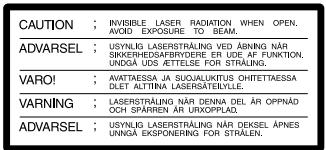
The following caution label is located inside of the unit.
NOTICE FOR CUSTOMERS IN THE UNITED KINGDOM
A moulded plug complying with BS 1363 is fitted to this equipment for your safety and convenience.
Should the fuse in the plug supplied need to be replaced, a 5 AMP fuse approved by ASTA or BSI to BS 1362, (i.e. marked with or mark) must be used.
If the plug supplied with this equipment has a detachable fuse cover, be sure to attach the fuse cover after you change the fuse. Never use the plug without the fuse cover. If you should lose the fuse cover, please contact your nearest Sony service station.
IMPORTANT
If the plug supplied is not suitable for the socket outlets in your home, it should be cut off and an appropriate plug fitted in accordance with the following instructions.
The wires in this mains lead are coloured in accordance with the following code:
Blue: Neutral
Brown: Live
As the colours of the wires in the mains lead of this apparatus may not correspond with the coloured markings identifying the terminals in your plug, proceed as follows:
The wire which is coloured blue must be connected to the terminal which is marked with the letter N or coloured black. The wire which is coloured brown must be connected to the terminal which is marked with the letter L or coloured red. Do not connect either wire to the earth terminal in the plug which is marked by the letter E or by the safety earth symbol or coloured green or green-and-yellow.
WARNING
To prevent shock hazard, do not insert the plug cut off from the mains lead into a socket outlet. This plug cannot be used and should be destroyed.
For the customers in Canada
CAUTION
TO PREVENT ELECTRIC SHOCK, DO NOT USE THIS POLARIZED AC PLUG WITH AN EXTENSION CORD, RECEPTACLE OR OTHER OUTLET UNLESS THE BLADES CAN BE FULLY INSERTED TO PREVENT BLADE EXPOSURE.
Precautions
On safety
- Caution — The use of optical instruments with this product will increase eye hazard.
- Should any solid object or liquid fall into the cabinet, unplug the player and have it checked by qualified personnel before operating it any further.
On power sources
- Before operating the player, check that the operating voltage of the player is identical with your local power supply. The operating voltage is indicated on the nameplate at the rear of the player.
- The player is not disconnected from the AC power source (mains) as long as it is connected to the wall outlet, even if the player itself has been turned off.
- If you are not going to use the player for a long time, be sure to disconnect the player from the wall outlet. To disconnect the AC power cord (mains lead), grasp the plug itself; never pull the cord.
- AC power cord must be changed only at the qualified service shop.
On placement
- Place the player in a location with adequate ventilation to prevent heat build-up in the player.
- Do not place the player on a soft surface such as a rug that might block the ventilation holes on the bottom.
- Do not place the player in a location near heat sources, or in a place subject to direct sunlight, excessive dust or mechanical shock.
On operation
- If the player is brought directly from a cold to a warm location, or is placed in a very damp room, moisture may condense on the lenses inside the player. Should this occur, the player may not operate properly. In this case, remove the disc and leave the player turned on for about an hour until the moisture evaporates.
On adjusting volume
- Do not turn up the volume while listening to a portion with very low level inputs or no audio signals. If you do, the speakers may be damaged when a peak level portion is played.
On cleaning
- Clean the cabinet, panel and controls with a soft cloth slightly moistened with a mild detergent solution. Do not use any type of abrasive pad, scouring powder or solvent such as alcohol or benzine.
If you have any questions or problems concerning your player, please consult your nearest Sony dealer.
Welcome!
Thank you for purchasing the Sony Compact Disc Player. Before operating the unit, please read this manual thoroughly and retain it for future reference.
About This Manual
The instructions in this manual are for models CDP-CE505, CDP-CE405, CDP-CE305 and CDP-C661. The CDP-CE505 is the model used for illustration purposes, unless otherwise mentioned. Any difference in operation is clearly indicated in the text, for example, "CDP-CE505 only."
Conventions
- Instructions in this manual describe the controls on the player. You can also use the controls on the remote if they have the same or similar names as those on the player.
- The following icons are used in this manual:

Indicates that you can do the task using the remote. (Note that the CDP-CE305 and CDP-C661 cannot do the tasks marked with this icon.)

Indicates hints and tips for making the task easier.
TABLE OF CONTENTS
Getting Started
Unpacking 4
Hooking Up the System 4
Playing a CD 6
Playing CDs
Using the Display 8
Replacing Discs While Playing a Disc 8
Locating a Specific Disc 9
Locating a Specific Track or a Particular Point in a Track 9
Playing Tracks Repeatedly 10
Playing in Random Order (Shuffle Play) 10
Creating Your Own Programme (Programme Play) 11
Recording From CDs
Recording Your Own Programme 13
Recording a CD by Specifying Tape Length (Time Edit) 13
Fading In or Out. 14
Adjusting the Recording Level (Peak Search) 15
Storing Information About CDs (Custom Files) (CDP-CE505 only)
What You Can Do With the Custom Files 16
Grouping Tracks (Music Clip) 16
Storing Specific Tracks (Delete Bank) 17
Additional Information
Notes on CDs. 18
Troubleshooting 19
Specifications 19
Index
Index 20
Unpacking
Check that you received the following items:
Audio connecting cord (1) - Remote commander (remote) (except for CDP-CE305 and CDP-C661) (1) - Sony SUM-3 (NS) batteries (except for CDP-CE305 and CDP-C661) (2)
Inserting batteries into the remote (except for CDP-CE305 and CDP-C661)
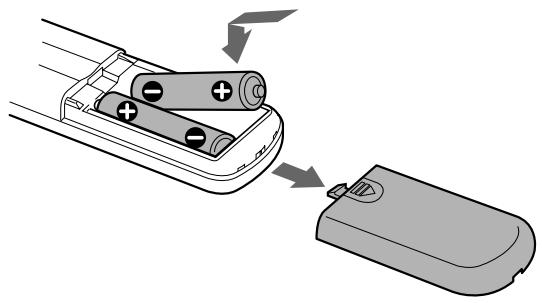
You can control the player using the supplied remote. Insert two R6 (size AA) batteries by matching the + and - on the batteries. When using the remote, point it at the remote sensor on the player.

When to replace batteries
With normal use, the batteries should last for about six months. When the remote no longer operates the player, replace all the batteries with new ones.
Notes
- Do not leave the remote near an extremely hot or humid place.
- Do not drop any foreign object into the remote casing, particularly when replacing the batteries.
- Do not expose the remote sensor to direct sunlight or lighting apparatuses. Doing so may cause a malfunction.
- If you don't use the remote for an extended period of time, remove the batteries to avoid possible damage from battery leakage and corrosion.
Hooking Up the System
Overview
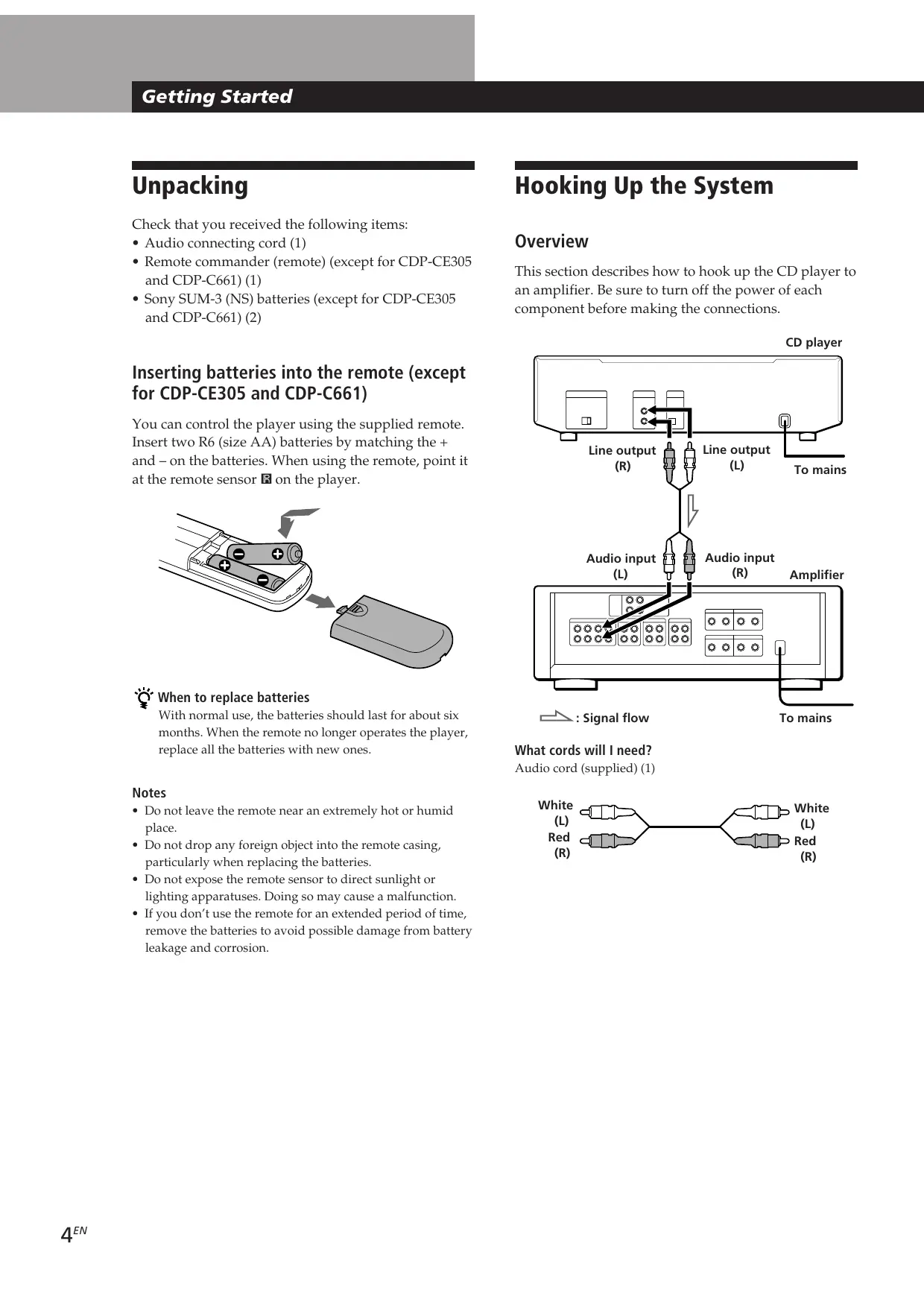
This section describes how to hook up the CD player to an amplifier. Be sure to turn off the power of each component before making the connections.
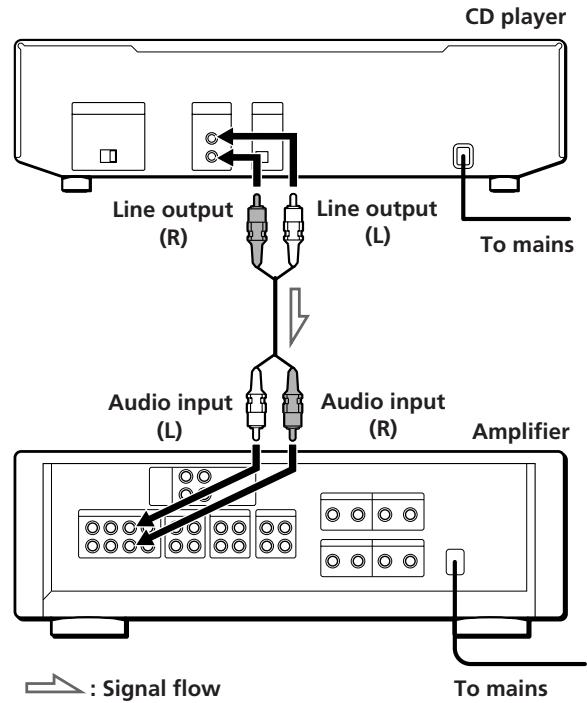
What cords will I need?
Audio cord (supplied) (1)
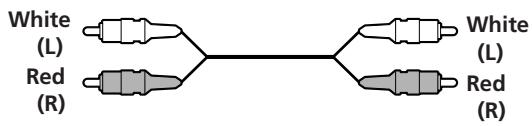
Hookups
When connecting an audio cord, be sure to match the colour-coded cord to the appropriate jacks on the components: Red (right) to Red and White (left) to White. Be sure to make connections firmly to avoid hum and noise.
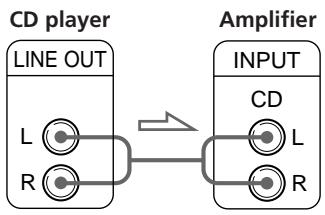

You can adjust the output level to the amplifier (except for CDP-CE305 and CDP-C661)
Press LINE OUT LEVEL + / - on the remote. You can reduce the output level up to -20dB
When you reduce the output level, appears in the display.
When you turn off the player, the output level automatically returns to the maximum level.
Note
If you press the LINE OUT LEVEL + / - buttons on the remote while recording, the recording level will change even when it is preset on the tape deck, etc. (except for CDP-CE305 and CDP-C661).
- If you have a digital component such as a digital amplifier, D/A converter, DAT or MD (CDP-CE505 only)
Connect the component via the DIGITAL OUT (OPTICAL)
connector using the optical cable (not supplied). Take off the cap and plug in the optical cable.
Note that you cannot use fading in or out (page 14) and
Time Fade (page 15) functions when making this connection.
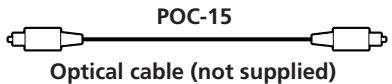
CD player Digital component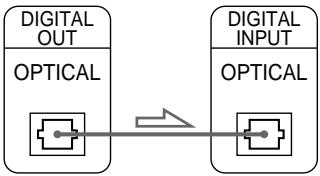
Note
When you connect via the DIGITAL OUT (OPTICAL)
connector, noise may occur when you play CD software other than music, such as a CD-ROM.

If you have a component with the CONTROL A1 connector (CDP-CE505 only)
Connect the component via the CONTROL A1 connector. You can control the player with the connected component. For details, refer to the supplementary instructions.
Setting the voltage selector (except for European, Canadian, and Chinese models, and CDP-CE505/CE405/CE305 models in Singapore)
Check that the voltage selector on the rear panel of the player is set to the local power line voltage. If not, set the selector to the correct position using a screwdriver before connecting the mains lead to a wall outlet.
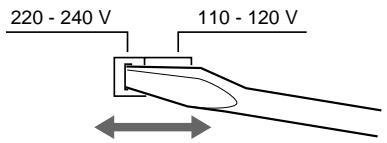
Connecting the mains lead
Connect the mains lead to a wall outlet.
Transporting the player
Before transporting the player, follow the procedure below to return the internal mechanisms back to their original position.
1 Remove all the discs from the disc tray. 2 Press OPEN/CLOSE to close the disc tray. "no DISC" appears in the display. 3 Wait for 10 seconds, then press POWER to turn off the player.
Playing a CD
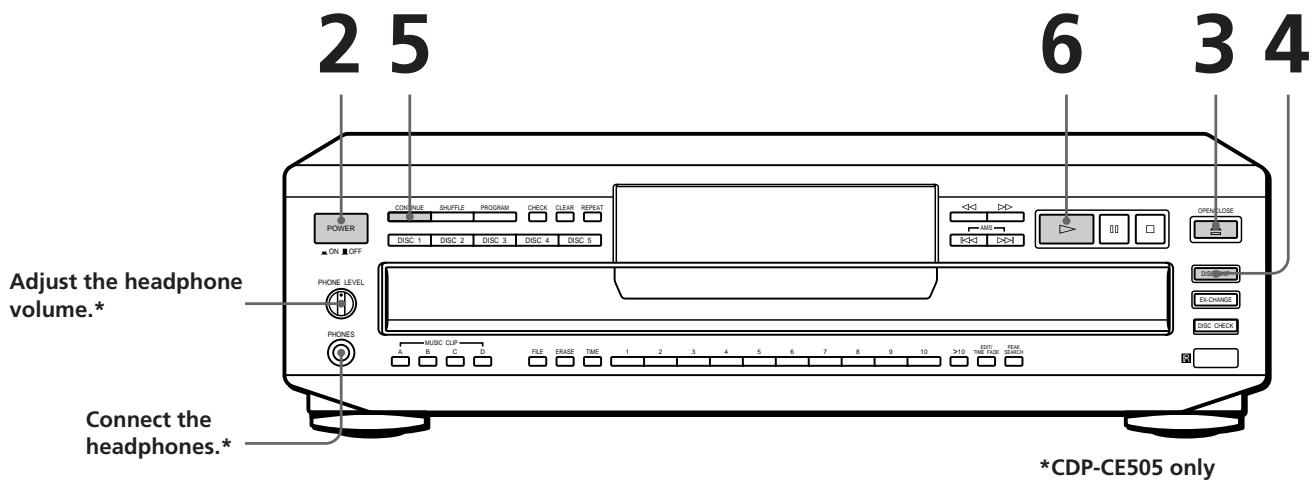
See pages 4-5 for the hookup information.
1 Turn on the amplifier and select the CD player position so that you can listen to the sound from this player. 2 Press POWER to turn on the player. Press OPEN/CLOSE, and place a disc on the disc tray.
With the label side up
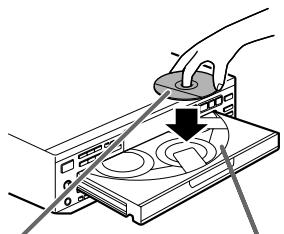
Disc number
4 To place other discs, press DISC SKIP and place the discs in the order you want to play.
Each time you press the button, the disc tray turns and you can place the discs in the empty disc compartments. The player plays the disc in front of you first.
5 Press CONTINUE to select ALL DISCS or 1 DISC Continuous Play mode.
Each time you press CONTINUE, "ALL DISCS" or "1 DISC" appears in the display.
| When you select | The player plays |
| ALL DISCS | All discs in the player consecutively in the order of disc number |
| 1 DISC | Only the disc you’ve selected |

You can select the disc you want to start playing first. Press one of the DISC 1-5 buttons.

When listening with the headphones (CDP-CE505 only) Connect the headphones to the PHONES jack on the player and adjust the volume with the PHONE LEVEL control on the player or with the LINE OUT LEVEL +/- buttons on the remote.

You can adjust the output level to the amplifier (except for CDP-CE305 and CDP-C661) Press LINE OUT LEVEL +/- on the remote. You can reduce the output level up to -20 dB. When you reduce the output level, FADE appears in the display. When you turn off the player, the output level automatically returns to the maximum level.
Note
If you press the LINE OUT LEVEL +/- buttons on the remote while recording, the recording level will change even when it is preset on the tape deck, etc. (except for CDP-CE305 and CDP-C661).

Press ▸. The disc tray closes and the player plays all the tracks once (Continuous Play). Adjust the volume on the amplifier.
To stop playback
Press ■.
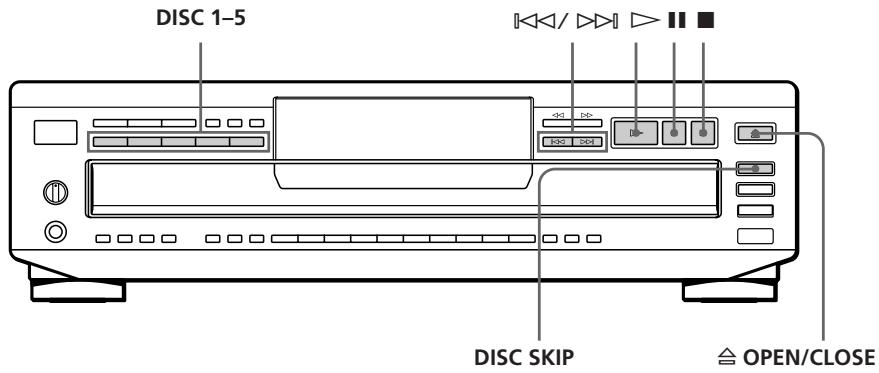
| To | Press |
| Pause | II |
| Resume play after pause | III or ▷ |
| Go to the next track | ▷▷ |
| Go back to the preceding track | ◁◁ |
| Go to the next disc | DISC SKIP |
| Select a disc directly | DISC 1-5 |
| Stop play and remove the CD | ≌ OPEN/CLOSE |
Using the Display
You can check information about the disc using the display.
Checking the total number and playing time of the tracks
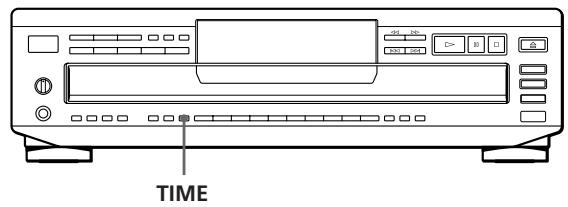
Press TIME before you start playing.
The display shows the current disc number, the total number of tracks, total playing time, and music calendar.
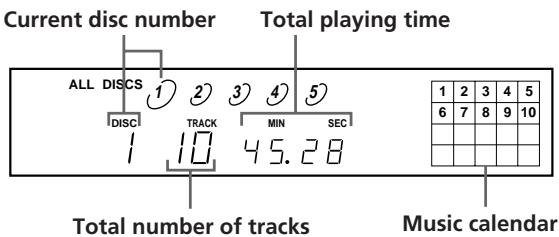
The information also appears when you press
OPEN/CLOSE to close the disc tray.
The tracks numbered over 20 cannot be displayed in the music calendar.
Notes on the disc number indications
- The red circle around a disc number indicates the disc is ready to be played.
- When all the tracks on a disc have been played, the semicircle around the disc number disappears.
- When a disc compartment is recognized as empty, the semicircular disc number disappears.
Display information while playing a disc
While playing a disc, the display shows the current disc number, track number, playing time of the track, and the music calendar.
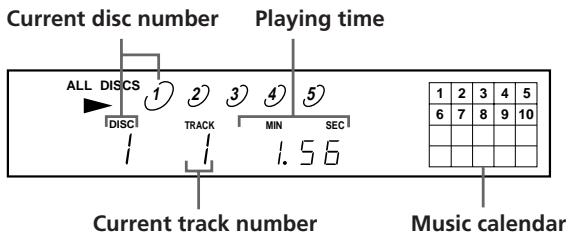
The track numbers in the music calendar disappear after they are played.
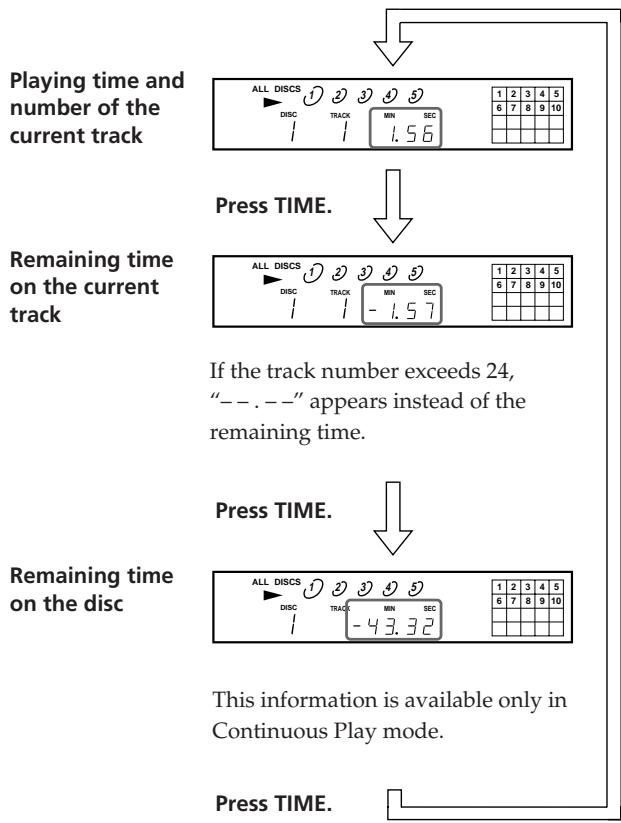
Checking the remaining time
Each time you press TIME while playing a disc, the display changes as shown in the chart below.
Replacing Discs While Playing a Disc
You can open the disc tray while playing a disc so that you can check what discs are to be played next and replace discs without interrupting playback of the current disc.
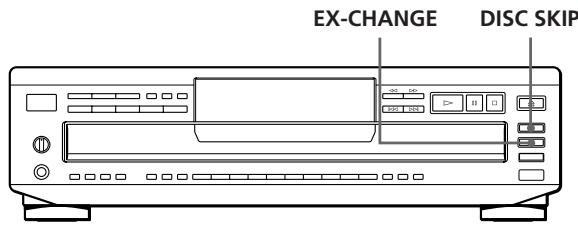
1 Press EX-CHANGE.
The disc tray opens and two disc compartments appear. Even if the player is playing a disc, it doesn't stop playing.
2 Replace discs in the compartments with new ones. The player plays the disc on the left side compartment after the current disc, and then the one on the right side compartment.
3 Press DISC SKIP. The disc tray turns and other two disc compartments appear. 4 Replace discs in the compartments with new ones. 5 Press EX-CHANGE. The disc tray closes.
While the disc tray is open by pressing EX-CHANGE
- If the playback of the current disc ends, the player stops playing. If the disc is played in 1 DISC Repeat Play mode (see page 10), the current disc starts playing again.
- In ALL DISCS Shuffle Play mode (see page 10), tracks are reshuffled on the current disc.
- In Programme Play mode (see page 11), only the tracks on the current disc are played.
- Do not push the disc tray to close it in Step 5, as you may damage the player.
Locating a Specific Disc
You can locate any disc before or while playing a disc.
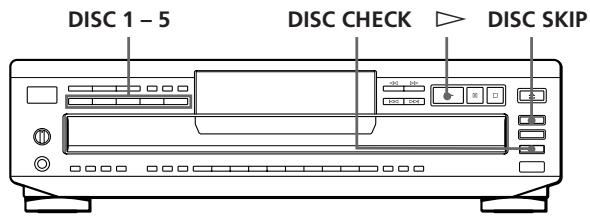
| To locate | Press |
| The next disc | DISC SKIP while playing a disc |
| A specific disc directly | DISC 1 – 5 |
| A disc while checking the labels | DISC CHECK while the disc tray is open. The disc tray turns to show you each disc label. When the disc you want comes in front of you, press ➔ to start playing. |
| A disc by scanning the first track of each disc for 10 seconds | DISC CHECK before you start playing while the disc tray is closed. When you find the disc you want, press ➔ to start playing. |

You can extend the playing time during scanning the discs.
Press DISC CHECK repeatedly until the playing time you want (10, 20 or 30) appears in the display. Each time you press the button, the playing time changes cyclically.
Notes
- When you press DISC CHECK, the play mode automatically changes to ALL DISCS Continuous Play mode.
- When you've opened the disc tray by pressing EX-CHANGE, you cannot use the DISC CHECK function.
- Even if you press DISC CHECK while "REPEAT" appears in the display (see page 10), the player stops after scanning all the discs once.
Locating a Specific Track or a Point in a Track
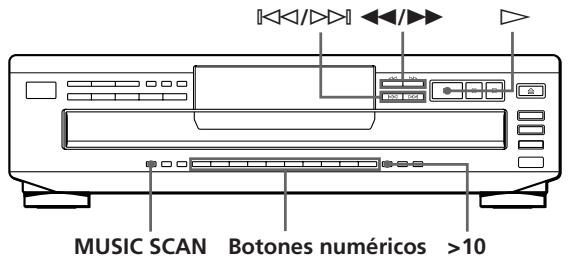
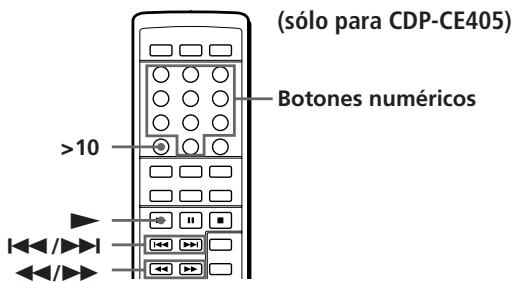
You can quickly locate any track while playing a disc using the AMS (Automatic Music Sensor) buttons or number buttons. You can also locate a specific point in a track while playing a disc.
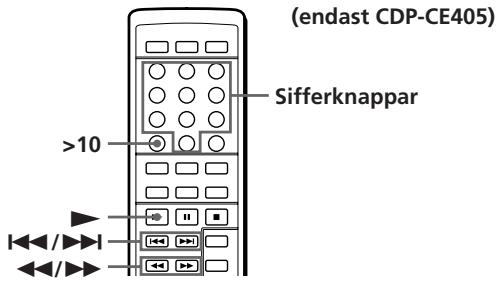
CDP-CE505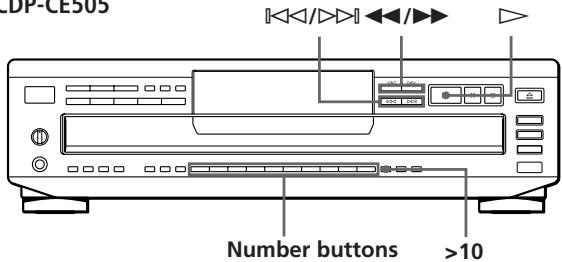
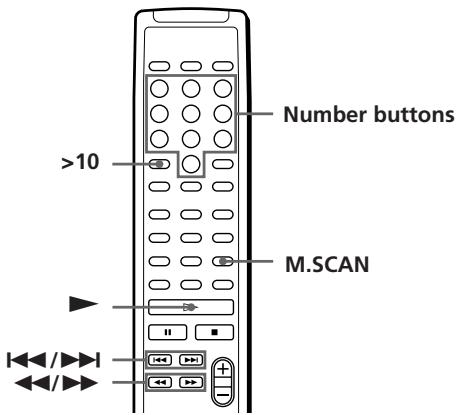
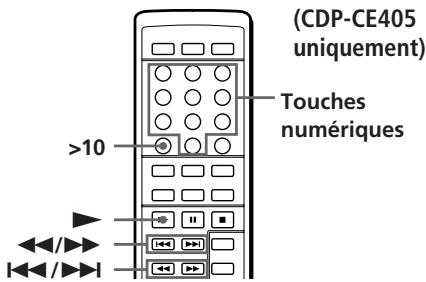
CDP-CE405/CE305/C661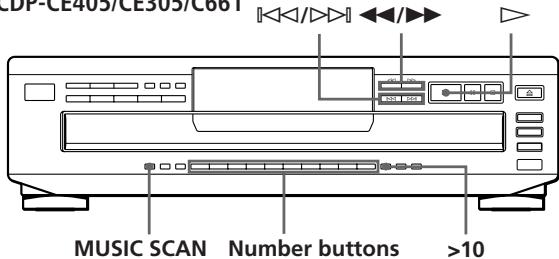
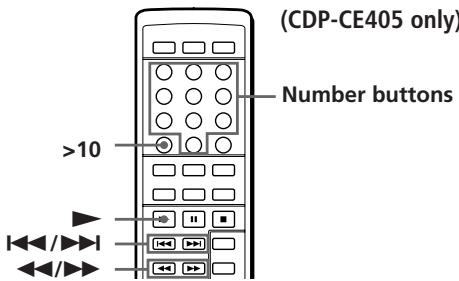
| To locate | Press |
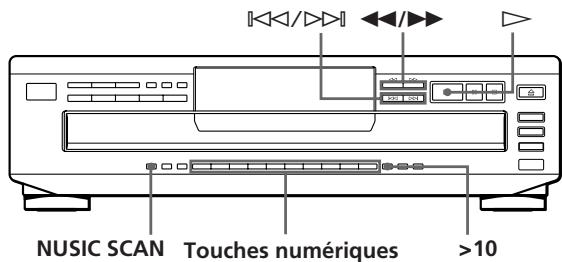
| The next or succeeding tracks | ▷▷ repeatedly until you find the track |
| The current or preceding tracks | ▷▷ repeatedly until you find the track |
| A specific track directly | Number button of the track |
| A track by scanning each track for 10 seconds (Music Scan) | MUSIC SCAN before you start playing. (For CDP-CE505, press M. SCAN on the remote.) When you find the track you want, press▷ to start playing. |
| A point while monitoring the sound | ▷ (forward) or ▽ (backward) and hold down until you find the point |
| A point quickly by observing the display during pause | ▷ (forward) or ▽ (backward) and hold down until you find the point. You will not hear the sound during the operation. |

When you directly locate a track numbered over 10
Press >10 first, then the corresponding number buttons.
To enter "0," use button 10.
Example: To play track number 30
Press >10 first, then 3 and 10.

You can extend the playing time during Music Scan
Press MUSIC SCAN repeatedly until the playing time you want (10, 20 or 30) appears in the display. (For CDP-CE505, press M. SCAN on the remote.) Each time you press the button, the playing time changes cyclically.
Note
If "" appears in the display, the disc has reached the end while you were pressing Press or to go back.
Playing Tracks Repeatedly
You can play discs/tracks repeatedly in any play mode.
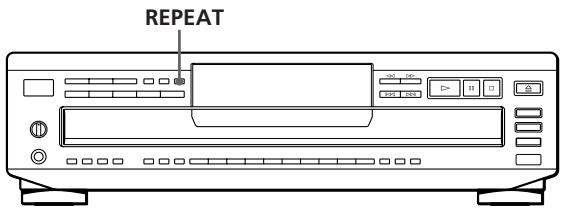
Press REPEAT while playing a disc.
"REPEAT" appears in the display. The player repeats the discs/tracks as follows:
| When the disc is played in | The player repeats |
| Continuous Play (ALL DISCS) (page 6) | All the tracks on all discs |
| Continuous Play (1 DISC) (page 6) | All the tracks on the current disc |
| Shuffle Play (ALL DISCS) (page 10) | All the tracks on all discs in random orders |
| Shuffle Play (1 DISC) (page 11) | All the tracks on the current disc in random orders |
| Programme Play (page 11) | The same programme |
To cancel Repeat Play
Press REPEAT repeatedly until "REPEAT" disappears from the display.
Repeating the current track
You can repeat only the current track while the disc is played in Continuous Play.
While the track you want is being played, press REPEAT repeatedly until "REPEAT 1" appears in the display.
Playing in Random Order (Shuffle Play)
You can have the player "shuffle" tracks and play in a random order. The player shuffles all the tracks on all discs or on the disc you've specified.
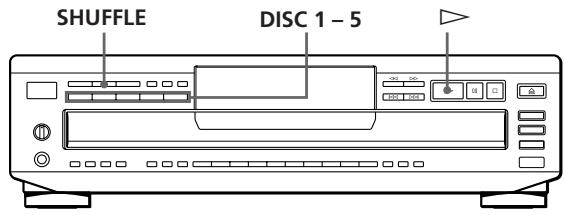
Shuffle Play on all discs
You can play all tracks on all discs in a random order.
1. Press SHUFFLE repeatedly until "ALL DISCS" appears in the display. 2. Press ▶ to start ALL DISCS Shuffle Play. The ▶ indication appears while the player is "shuffling" the tracks.
To cancel Shuffle Play
Press CONTINUE.
You can start Shuffle Play while playing
Press SHUFFLE, and Shuffle Play starts from the current track.
You can specify discs during Shuffle Play (Select Shuffle Play)
You can specify discs during ALL DISCS Shuffle Play mode, and the tracks on the specified discs are played in a random order.
Press DISC 1-5 to specify the discs after Step 1.
Semi-circles appear around the specified disc numbers in the display. To cancel the selected discs, press DISC 1-5 again. The semi-circles disappear.
To return to ALL DISCS Shuffle Play, press SHUFFLE twice.
Shuffle Play on one disc
You can play all tracks on the specific disc in a random order.
1 Press SHUFFLE repeatedly until "1 DISC" appears in the display. 2 Press DISC 1-5 to start 1 DISC Shuffle Play on the selected disc.
The ← indication appears while the player is "shuffling" the tracks.
To cancel Shuffle Play
Press CONTINUE.
You can start Shuffle Play while playing
Press SHUFFLE, and Shuffle Play starts from the current track.
Creating Your Own Programme (Programme Play)
You can arrange the order of the tracks on the discs and create your own programme. The programme can contain up to 32 tracks.
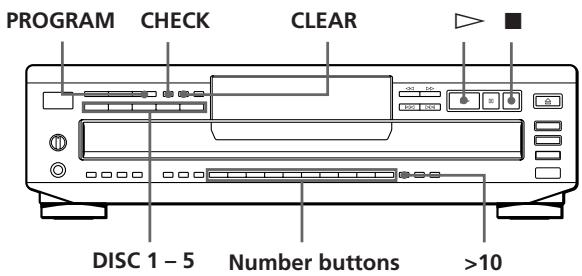
1 Press PROGRAM.
"PROGRAM" appears in the display.
If a programme is already stored, the last step of the programme appears in the display. When you want to erase the whole programme, hold down CLEAR until "ALL CLr" appears in the display (see page 12).
2 Press DISC 1 - 5 to select the disc.
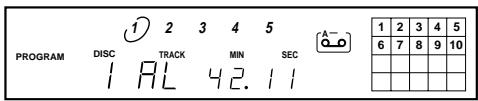
"AL" in the display stands for "all" tracks.
When you want to programme the whole disc as one step, skip Step 3 and go to Step 4.
3 Press the number buttons of the tracks you want to programme in the order you want.
To programme the track numbered over 10, use the >10 button (see page 10).
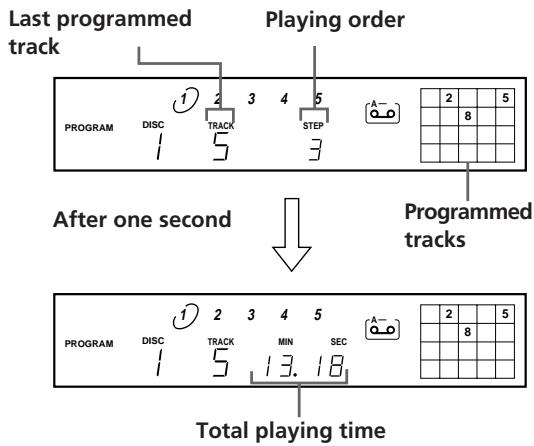
If you've made a mistake
Press CLEAR, then press the correct number button.
(Continued)
4 To programme other discs or tracks, do the following:
| To programme | Repeat Step(s) |
| Other discs | 2 |
| Other tracks on the same disc | 3 |
| Other tracks on other discs | 2 and 3 |
5 Press ▶ to start Programme Play.
To cancel Programme Play
Press CONTINUE.

You can create your programme while checking the disc labels
While the disc tray is open, follow Steps 1 to 5 with pressing DISC SKIP to check the disc labels. If you close the disc tray before Step 5, the total playing time appears in the display after a while.
Note that, if the programmed track number isn't found on the disc, that step is automatically erased.

The programme remains even after the Programme Play ends
When you press ▶, you can play the same programme again.

The programme remains until you erase it or turn off the player.
If you replace discs, the programmed disc and track numbers remain. So, the player plays only the existing disc and track numbers. However, the disc and track numbers that aren't found in the player or on the disc are deleted from the programme, and the rest of the programme is played in the programmed order.
Note
The total playing time doesn't appear when:
- You have programmed a track whose number exceeds 20. The total playing time of the programme exceeds 200 minutes.
Checking the track order
You can check your programme before or after you start playing.
Press CHECK.
Each time you press this button, the display shows the track (the disc and track numbers) or the disc (the disc number and "AL" indication) of each step in the programmed order. After the last step in the programme, the display shows "End" and returns to the original display. If you check the order after you start playing, the display shows only the remaining steps.
Changing the track order
You can change your programme before you start playing.
| To | Press |
| Erase a track | CHECK until the track you don’t want appears in the display, then press CLEAR |
| Erase the last track in the programme | CLEAR. Each time you press the button, the last track will be cleared. |
| Add tracks to the end of the programme | DISC 1 – 5 to select the disc, then number buttons of the tracks to be added |
| Change the whole programme completely | CLEAR until “ALL CLR” appears in the display. Create a new programme following the programming procedure. |
Recording Your Own Programme
You can record the programme you've created on a tape, etc. The programme can contain up to 32 tracks. By inserting a pause during programming, you can divide the programme into two for recording on both sides of a tape.
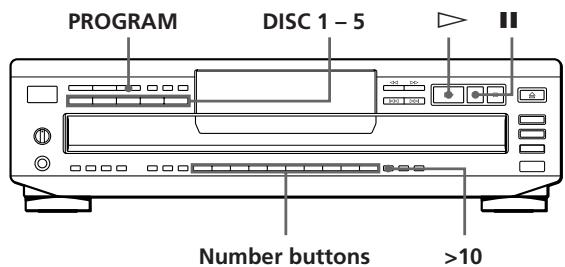
1 Create your programme (for side A when recording on a tape) while checking the total playing time indicated in the display. Follow Steps 1 to 4 in "Creating Your Own Programme" on page 11. The \boxed{a_{\bullet}} indication appears in the display. 2 When you record on both sides of the tape, press I to insert a pause. The "P" and \boxed{A - B} indications appear in the display and the playing time is reset to "0.00." When you record on one side of the tape, skip this step and go to Step 4. A pause is counted as one track. You can programme up to 31 tracks when you insert a pause. 3 Repeat Steps 2 to 4 in "Creating Your Own Programme" on page 11 to create the programme for side B. 4 Start recording on the deck and then press \triangleright on the player. When you record on both sides of the tape, the player pauses at the end of the programme for side A. 5 When you record on side B, reverse the tape and press \triangleright or \mathbf{I} on the player to resume playing.
You can check the total playing time while programming (Programme Edit).
To select a track, press ⏮ or ▸ and check the total playing time. Then press PROGRAM to confirm your selection.
To check and change your programme
See page 12. The [A⁻ O⁻] indication appears while checking the programme for side A and [B⁻ O⁻] while checking the programme for side B.
Recording a CD by Specifying Tape Length (Time Edit)
You can have the player create a programme that will fit the length of the tape.
The player automatically creates a programme, keeping the original order of the disc.
The programme can contain up to 32 tracks (a pause inserted between tracks is counted as one track).
Note that tracks numbered over 20 cannot be programmed automatically.
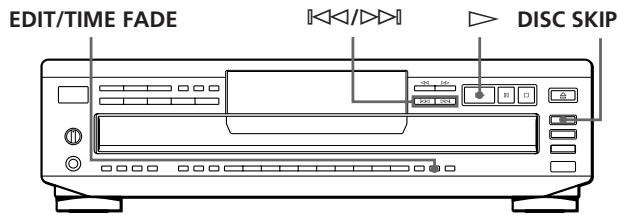
1 Press DISC SKIP to select the disc. 2 Press EDIT/TIME FADE repeatedly before you start playing until "EDIT" appears and "A" in the [a⁻⁰] indication flashes in the display. 3 Press ⏮ or ▸ to specify the tape length. Each time you press these buttons, the display changes as shown below, with the tape length of one side following each indication.

4 Press EDIT/TIME FADE to have the player create the programme. The display shows the tracks to be recorded. "B" in the [0] indication flashes in the display. 5 When you record on both sides of the tape, press EDIT/TIME FADE again. The player inserts a pause, then creates the programme for side B. The display shows the programmed tracks. When you record on one side of the tape, skip this step. 6 Start recording on the deck and then press ▸ on the player. When you record on both sides of the tape, the player pauses at the end of the programme for side A.
(Continued)
7 When you record on side B, reverse the tape and press ▸ or ⏹ on the player to resume playing.
To cancel Time Edit
Press CONTINUE.

You can programme the tracks you want in advance
Select the tracks before doing the above procedure. The player creates a programme from the remaining tracks.

You can freely specify the tape length.
Set the tape length using number buttons. To enter "0," use button 10.
Example: When the tape length of one side is 30 minutes and 15 seconds.
Press 3, 10, 1 and 5.

You can check and change the programme.
See page 12.
When track numbers flash in Step 3 or 4 (CDP-CE505 only)
This means that there is a portion remaining on the tape after the player has programmed all the tracks so that you can add more tracks to the portion (Link Edit). You can also select another disc and add the tracks on the disc you select if the tracks on the current disc are shorter than the remaining time.
Press EDIT/TIME FADE to have the player add the tracks, or press number buttons of the tracks flashing in the display. When you want to add tracks on another disc, press DISC SKIP to select the disc, and then press number buttons of the track. After adding the tracks, press ▸ to start playing.
If you don't need to add tracks, just press ▸ to start playing.

When "B" in the \(\left[ \begin{array}{ll}A & B\\ 0 & 0 \end{array} \right]\) indication flashes
This means that more than 1 minute remains on the tape but no track on the current disc fits the remaining portion. If you add tracks on other discs, select the disc you want and follow the procedure above.
Fading In or Out
You can manually fade in or out to prevent tracks from starting or ending abruptly.
Note that you cannot use this effect when you use the DIGITAL OUT (OPTICAL) connector.
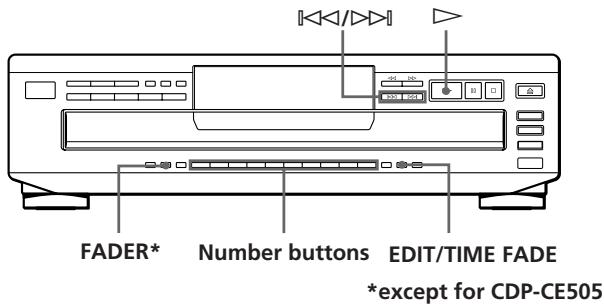
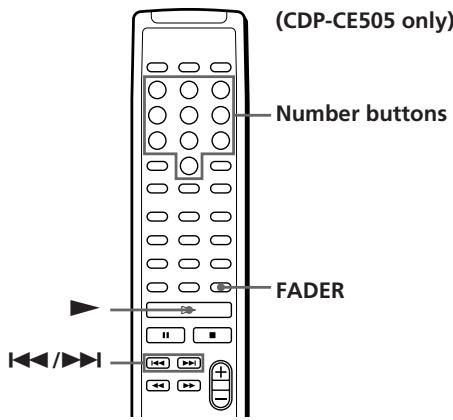
| To | Press FADER |
| Start play fading in | During pause. [FADE] lights up in the display and the -■ indication flashes. The play fades in. |
| End play fading out | When you want to start fading out. [FADE] lights up in the display and the -■ indication flashes. The play fades out and the player pauses. |
Note
Fading lasts for about 5 seconds. However, when you press FADER during Music Scan (see page 10), the play fades out for about 2 seconds.
Changing the fading time (CDP-CE505 only)
You can change the fading time from 2 to 10 seconds before fading in or out. If you don't change it, fading lasts for 5 seconds.
1 Press FADER on the remote before you start playing. 2 Press the number button corresponding to the fading time you want (2-10).
Fading out at the specified time (Time Fade)
You can have the player fade out automatically by specifying the playing time. Once you set the Time Fade, it works twice, that is, the play fades out at the end of both sides of a tape.
1 Press EDIT/TIME FADE repeatedly before you start playing until TIME and "A" in the indication appear in the display. 2 Press << or >> to specify the playing time. Each time you press these buttons, the display changes as shown below, with the playing time of one side following each indication.

3 Press > to start playing. At the specified time the play fades out and the player pauses. "B" in the 0 0 indication appears in the display. 4 To record on side B, reverse the tape and press > or ■ on the player to resume playing. Again, the play fades out at the specified time.
To cancel Time Fade
Press EDIT/TIME FADE.

You can freely specify the playing time
See "You can freely specify the tape length" on page 14.

You can change discs during Time Fade
If the play ends before the specified fade-out time (for example, when you record CD-singles on a tape), change the disc. The specified fade-out time is counted only during playing.

You can fade in to resume playing in Step 4.
After you reverse the tape, press FADER.
Note
If you press ◁ or ▷ during Time Fade, Time Fade will be cancelled.
Adjusting the Recording Level (Peak Search)
The player locates the highest level among the tracks to be recorded to let you adjust the recording level before you start recording.
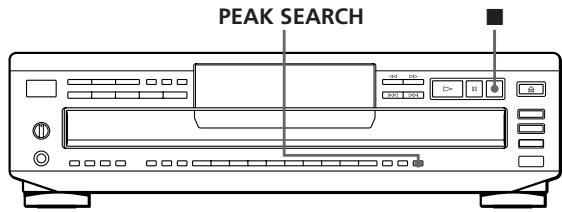
1. Before you start playing, press PEAK SEARCH. "PEAK" flashes in the display and the player repeats the portion of the highest level. 2. Adjust the recording level on the deck. 3. Press on the player to stop Peak Search. "PEAK" disappears from the display.
Notes
- The portion with the highest level may differ every time you try the adjustment on the same disc. The difference is, however, so slight that you won't find any problem in adjusting the recording level precisely.
- Peak Search does not operate while you open the disc tray by pressing EX-CHANGE.
What You Can Do With the Custom Files
The player can store 2 types of information called "Custom Files" for each disc. Once you have stored Custom Files for a disc, the player automatically recalls what you have stored whenever you select the disc. Note that Custom Files will be erased if you don't use the player for about 1 month.
You can store this information:
| When you use | You can |
| Music Clip (page 16) | Group the tracks on each disc into up to 4 groups |
| Delete Bank (page 17) | Delete unwanted tracks and store only the tracks you want |
The Custom File indication lights up when you store the corresponding information.
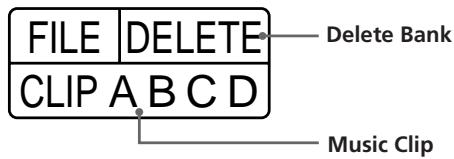
Where are Custom Files stored?
Custom Files are stored not on the disc but in the player's memory. This means you cannot use Custom Files when you play the disc on other players.
How many discs can you file?
You can file up to 172 discs in the Custom File.
Erasing Custom Files
If the memory for Custom Files becomes full, the player displays "FULL" when you press FILE to store the information and you cannot store any more disc information. If necessary, erase any unwanted Custom Files as follows:
To erase all Custom Files of one disc
If the disc you want to clear is stored in the Music Clip, remove all the tracks of the disc from the clip following the procedure in "Remove tracks from a clip" on page 17. If the disc you want to clear is stored in the Delete Bank, erase all the Delete Bank following the procedure in "Erasing the Delete Bank" on page 18.
To erase all Custom Files of all discs
While holding down ERASE and 1 on the player, press POWER to turn off and on the player. "ALL ErS" appears in the display and all the Custom Files will be erased.
Grouping Tracks (Music Clip)
You can group the track on each disc into up to 4 groups called "clips." Once you store a track into a clip, you can use the Music Clip every time you play the disc. You can also play only the tracks stored in a selected clip.
You can store one track into four clips, or all tracks on a disc into one clip.
Note that tracks numbered over 32 cannot be stored into a clip.
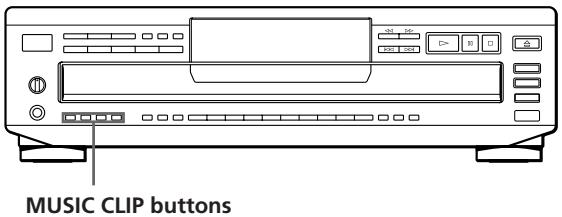
Storing tracks into clips
1 Play the track you want to store into a clip. 2 Press one of the MUSIC CLIP buttons (A, B, C or D).
"C-FILE" appears and the selected MUSIC CLIP button flashes for a while.
3 Repeat Steps 1 and 2 to store other tracks into clips.
Playing tracks in a clip (Clip Play)
Press one of the MUSIC CLIP buttons before you start playing.
"C-PLAY" appears in the display and the selected MUSIC CLIP button lights. The tracks stored in the clip appear in the music calendar. The player starts playing tracks in the selected clip.
To play tracks in another clip
Press to stop playing, then press one of the MUSIC CLIP buttons you want to play.
Notes
- Clip Play is available only in Continuous and Shuffle Play mode. If you press MUSIC CLIP in Programme Play mode, the player automatically enters Continuous Play mode and starts Clip Play.
- In ALL DISCS Play mode, the player plays the tracks in the selected clip on all discs consecutively.
- If you press MUSIC CLIP during Clip Play, the button does not operate.
Removing tracks from a clip
1 Before you start playing, press one of the MUSIC CLIP buttons to start Clip Play. 2 Press ⏩⏩ or ▶▶ to select the track you want to remove from the clip. 3 Press ERASE to remove the track. "ErASE" appears in the display for a while. The player starts playing the next track in the clip. 4 Repeat Steps 2 and 3 to remove other tracks. When you've removed all tracks from the clip, the MUSIC CLIP button goes off after the player plays the last track in the clip.
Storing Specific Tracks (Delete Bank)
You can delete unwanted tracks and store only the tracks you want. When you select the disc with the Delete Bank, you can play only the tracks you want. The player memorizes the Delete Bank for about 1 month, even if you turn off the player.
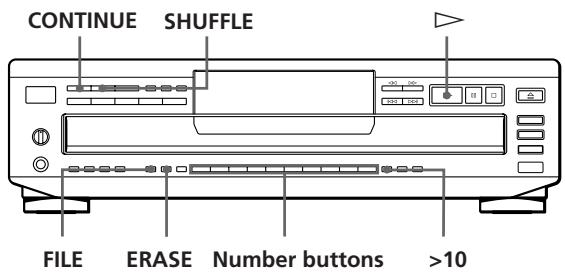
1 Insert or select the disc. 2 Press SHUFFLE to select "ALL DISCS" or "1 DISC". 3 Press the number buttons to delete the tracks you want to delete.
The track number and "OFF" appears in the display and the track numbers you've deleted disappear from the music calendar.
If you've made a mistake
Press the number button of the track. The track number and "On" appears in the display and the track will be restored.
4 Press FILE to store the remaining tracks. "FILE" and "DELETE" in the Custom File indication light up in the display.
You can delete unwanted tracks during playback
Press CLEAR while playing the track. The player starts playing the next track.
If you press FILE, the player stores the remaining tracks.
Playing using the Delete Bank
1 Insert or select the disc. "FILE" and "DELETE" in the Custom File indication light up in the display. 2 Press CONTINUE or SHUFFLE to select "ALL DISCS" or "1 DISC". 3 Press ▸ or one of the DISC1-5 buttons you want to start playing.
Erasing the Delete Bank
1 Insert or select the disc. "FILE" and "DELETE" in the Custom File indication light up in the display. 2 Press FILE. "FILE" appears in the display. 3 Press ERASE while "FILE" appears in the display. The Delete Bank is erased. "ErASE" appears in the display and "FILE" and "DELETE" in the Custom File indication disappear.
Notes on CDs
On handling CDs
- To keep the disc clean, handle the disc by its edge. Do not touch the surface.
- Do not stick paper or tape on the disc.
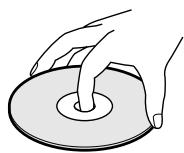
- Do not expose the disc to direct sunlight or heat sources such as hot air ducts, nor leave it in a car parked in direct sunlight as there can be considerable rise in temperature inside the car.
- Do not use any commercially available stabilizer. If you do, the disc and the player may be damaged. After playing, store the disc in its case.
On cleaning
- Before playing, clean the disc with a cleaning cloth. Wipe the disc from the centre out.
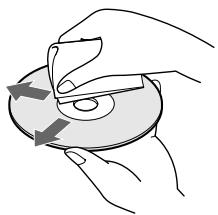
- Do not use solvents such as benzine, thinner, commercially available cleaners or anti-static spray intended for vinyl LPs.
Troubleshooting
If you experience any of the following difficulties while using the player, use this troubleshooting guide to help you remedy the problem. Should any problem persist, consult your nearest Sony dealer.
There's no sound.
→ Check that the player is connected securely. → Make sure you operate the amplifier correctly. Adjust the playback level using the PHONE LEVEL control on the player (CDP-CE505 only) or LINE OUT LEVEL +/- on the remote. (except for CDP-CE305 and CDP-C661)
The CD does not play.
There's no CD inside the player ("no DISC" appears). Insert a CD. Place the CD with the label side up on the disc tray correctly. → Clean the CD (see page 18). → Moisture has condensed inside the player. Remove the disc and leave the player turned on for about an hour (see page 2).
The remote does not function. (except for CDP-CE305 and CDP-C661)
Remove the obstacles in the path of the remote and the player. Point the remote at the remote sensor on the player. Replace all the batteries in the remote with new ones if they are weak.
The player functions incorrectly.
The microcomputer chips may be operating incorrectly. Turn the power off, then turn it back on to reset the player.
Specifications
Compact disc player
| Laser | Semiconductor laser (λ = 780 nm) Emission duration: continuous |
| Laser output | Max 44.6 μW* * This output is the value measured at a distance of 200 mm from the objective lens surface on the Optical Pick-up block with 7 mm aperture. |
| Frequency response | 2 Hz to 20 kHz ± 0.5 dB |
| Signal-to-noise ratio | CDP-CE505: More than 107 dB CDP-CE405/CE305/C661: More than 102 dB |
| Dynamic range | More than 98 dB |
| Harmonic distortion | CDP-CE505: Less than 0.0035% CDP-CE405/CE305/C661: Less than 0.0045% |
| Channel separation | More than 100 dB |
Output General
| Jack type | Maximum output level | Load impedance | |
| LINE OUT | Phono jacks | 2 V (at 50 kilohms) | Over 10 kilohms |
| DIGITAL OUT (OPTICAL) (CDP-CE505 only) | Optical output connector | -18dBm | Wave length: 660nm |
| PHONES (CDP-CE505 only) | Stereo phone jack | 10 mW | 32 ohms |
Power requirements
| Where purchased | Power requirements |
| Europe, China, and Singapore (except for the CDP-C661 in Singapore) | 220 V – 230 V AC, 50/60 Hz |
| Canada | 120 V AC, 60 Hz |
| Other countries, and the CDP-C661 in Singapore | 110 V – 120 V or 220 V – 240 V AC, adjustable, 50/60 Hz |
| Power consumption | 14 W |
| Dimensions (approx.) (w/h/d) | 430 × 120 × 385 mm(17 × 4 3/4 × 15 1/4 in.) incl. projecting parts |
| Mass (approx.) | 5.6 kg (12 lbs 6 oz) |
Supplied accessories
Audio cord (2 phono plugs - 2 phono plugs) (1) Remote commander (remote) (except for CDP-CE305 and CDP-C661) (1) Sony SUM-3 (NS) batteries (except for CDP-CE305 and CDP-C661) (2)
Design and specifications are subject to change without notice.
Index
A, B
AMS 9 Automatic Music Sensor. See AMS
C
Clip Play 17 Connecting 4 Continuous Play 6
D
Delete Bank 17
E
Editing. See Recording
F
Fading 14 Time Fade 15
H, I, J, K
Handling CDs 18 Hookups 4 overview 4
L
Link Edit 14
Locating by monitoring 10 by observing the display 10 by scanning 10 directly 10 using AMS 10 while checking the labels 10
M, N, O
Music Clip 16 Music Scan 10
P, Q
Peak search 15 Playback Continuous Play 0 Programme Play 10 Repeat Play 10 Shuffle Play 10 Programme 11 changing 12 checking 12 for recording 13 Programme Edit 13
R
Recording a programme 13, Using Time Edit 13, Remaining time 8, Remote control 4, Repeating 10, Replacing discs while playing a disc 8
S
Scanning. See Music Scan. Searching. See Locating. Select Shuffle Play 11, Shuffle Play 10
T
Time Edit 13, Time Fade 15, Total playing time 8, Troubleshooting 19
U
Unpacking 4
V, W, X, Y, Z
Voltage selector 5
Names of controls
Buttons
CHECK 12
CLEAR 12
CONTINUE 6
DISC1-56 DISC CHECK 9
DISC SKIP 7 EDIT/TIME FADE 13
ERASE 12
EX-CHANGE 8
FADER 14
FILE 17
LINE OUT LEVEL +/- 4
MUSICCLIP1-5 16
MUSIC SCAN 10 Number 10
OPEN/CLOSE 6 PEAK SEARCH 15
PROGRAM 11 REPEAT 10
SHUFFLE 10 TIME 8
7
7 7
10 9
10 10
Switch
POWER 6
Control
PHONE LEVEL 7
Jack
PHONES 7
Others
Disc tray 6 Display 8
B 4
WARNING
CDP-CE405/CE305/C661
Pulse LINE OUT LEVEL
CDP-CE405/CE305/C661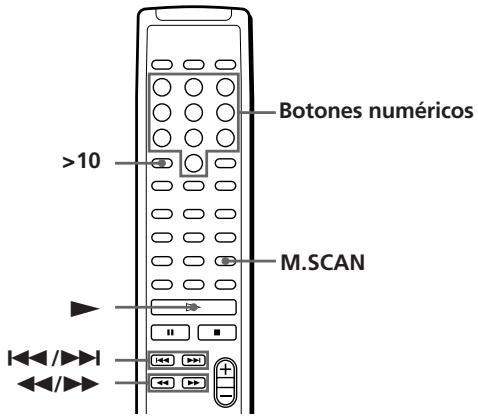
Delete a single track (Delete Bank) 17
Additional information
About CD discs 18
Troubleshooting 19
Technical data 19
Index
Index 20
Unpacking
CDP-CE405/CE305/C661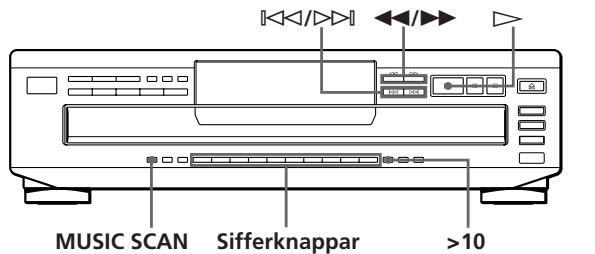
- NOTICE FOR CUSTOMERS IN THE UNITED KINGDOM
- IMPORTANT
- WARNING
- FOR THE CUSTOMERS IN CANADA
- CAUTION
- PRECAUTIONS
- ON SAFETY
- ON POWER SOURCES
- ON PLACEMENT
- ON OPERATION
- ON ADJUSTING VOLUME
- ON CLEANING
- WELCOME
- ABOUT THIS MANUAL
- CONVENTIONS
- TABLE OF CONTENTS
- GETTING STARTED
- PLAYING CDS
- RECORDING FROM CDS
- STORING INFORMATION ABOUT CDS (CUSTOM FILES) (CDP-CE505 ONLY)
- ADDITIONAL INFORMATION
- INDEX
- UNPACKING
- INSERTING BATTERIES INTO THE REMOTE (EXCEPT FOR CDP-CE305 AND CDP-C661)
- WHEN TO REPLACE BATTERIES
- NOTES
- HOOKING UP THE SYSTEM
- OVERVIEW
- WHAT CORDS WILL I NEED
- HOOKUPS
- YOU CAN ADJUST THE OUTPUT LEVEL TO THE AMPLIFIER (EXCEPT FOR CDP-CE305 AND CDP-C661)
- NOTE
- IF YOU HAVE A DIGITAL COMPONENT SUCH AS A DIGITAL AMPLIFIER, D/A CONVERTER, DAT OR MD (CDP-CE505 ONLY)
- IF YOU HAVE A COMPONENT WITH THE CONTROL A1 CONNECTOR (CDP-CE505 ONLY)
- SETTING THE VOLTAGE SELECTOR (EXCEPT FOR EUROPEAN, CANADIAN, AND CHINESE MODELS, AND CDP-CE505/CE405/CE305 MODELS IN SINGAPORE)
- CONNECTING THE MAINS LEAD
- TRANSPORTING THE PLAYER
- PLAYING A CD
- TO STOP PLAYBACK
- USING THE DISPLAY
- CHECKING THE TOTAL NUMBER AND PLAYING TIME OF THE TRACKS
- NOTES ON THE DISC NUMBER INDICATIONS
- DISPLAY INFORMATION WHILE PLAYING A DISC
- CHECKING THE REMAINING TIME
- REPLACING DISCS WHILE PLAYING A DISC
- WHILE THE DISC TRAY IS OPEN BY PRESSING EX-CHANGE
- LOCATING A SPECIFIC DISC
- YOU CAN EXTEND THE PLAYING TIME DURING SCANNING THE DISCS
- LOCATING A SPECIFIC TRACK OR A POINT IN A TRACK
- PLAYING TRACKS REPEATEDLY
- TO CANCEL REPEAT PLAY
- REPEATING THE CURRENT TRACK
- PLAYING IN RANDOM ORDER (SHUFFLE PLAY)
- SHUFFLE PLAY ON ALL DISCS
- YOU CAN START SHUFFLE PLAY WHILE PLAYING
- YOU CAN SPECIFY DISCS DURING SHUFFLE PLAY (SELECT SHUFFLE PLAY)
- SHUFFLE PLAY ON ONE DISC
- TO CANCEL SHUFFLE PLAY
- CREATING YOUR OWN PROGRAMME (PROGRAMME PLAY)
- PRESS PROGRAM
- IF YOU'VE MADE A MISTAKE
- TO CANCEL PROGRAMME PLAY
- YOU CAN CREATE YOUR PROGRAMME WHILE CHECKING THE DISC LABELS
- THE PROGRAMME REMAINS EVEN AFTER THE PROGRAMME PLAY ENDS
- THE PROGRAMME REMAINS UNTIL YOU ERASE IT OR TURN OFF THE PLAYER
- CHECKING THE TRACK ORDER
- CHANGING THE TRACK ORDER
- RECORDING YOUR OWN PROGRAMME
- YOU CAN CHECK THE TOTAL PLAYING TIME WHILE PROGRAMMING (PROGRAMME EDIT)
- TO CHECK AND CHANGE YOUR PROGRAMME
- RECORDING A CD BY SPECIFYING TAPE LENGTH (TIME EDIT)
- TO CANCEL TIME EDIT
- YOU CAN FREELY SPECIFY THE TAPE LENGTH
- YOU CAN CHECK AND CHANGE THE PROGRAMME
- WHEN TRACK NUMBERS FLASH IN STEP 3 OR 4 (CDP-CE505 ONLY)
- WHEN "B" IN THE \(\LEFT[ \BEGIN{ARRAY}{LL}A & B\\ 0 & 0 \END{ARRAY} \RIGHT]\) INDICATION FLASHES
- FADING IN OR OUT
- CHANGING THE FADING TIME (CDP-CE505 ONLY)
- FADING OUT AT THE SPECIFIED TIME (TIME FADE)
- TO CANCEL TIME FADE
- YOU CAN FREELY SPECIFY THE PLAYING TIME
- YOU CAN CHANGE DISCS DURING TIME FADE
- YOU CAN FADE IN TO RESUME PLAYING IN STEP
- ADJUSTING THE RECORDING LEVEL (PEAK SEARCH)
- WHAT YOU CAN DO WITH THE CUSTOM FILES
- WHERE ARE CUSTOM FILES STORED
- HOW MANY DISCS CAN YOU FILE
- ERASING CUSTOM FILES
- TO ERASE ALL CUSTOM FILES OF ONE DISC
- TO ERASE ALL CUSTOM FILES OF ALL DISCS
- GROUPING TRACKS (MUSIC CLIP)
- STORING TRACKS INTO CLIPS
- PLAYING TRACKS IN A CLIP (CLIP PLAY)
- TO PLAY TRACKS IN ANOTHER CLIP
- REMOVING TRACKS FROM A CLIP
- STORING SPECIFIC TRACKS (DELETE BANK)
- YOU CAN DELETE UNWANTED TRACKS DURING PLAYBACK
- PLAYING USING THE DELETE BANK
- ERASING THE DELETE BANK
- NOTES ON CDS
- ON HANDLING CDS
- TROUBLESHOOTING
- THERE'S NO SOUND
- THE CD DOES NOT PLAY
- THE REMOTE DOES NOT FUNCTION. (EXCEPT FOR CDP-CE305 AND CDP-C661)
- THE PLAYER FUNCTIONS INCORRECTLY
- SPECIFICATIONS
- SUPPLIED ACCESSORIES
- A, B
- C
- D
- E
- F
- H, I, J, K
- L
- M, N, O
- P, Q
- R
- S
- T
- U
- V, W, X, Y, Z
- NAMES OF CONTROLS
- BUTTONS
- SWITCH
- CONTROL
- JACK
- OTHERS
Brand : SONY
Model : CDP-CE405
Category : CD Player