
MDSJE320 - Dictaphone SONY - Free user manual and instructions
Find the device manual for free MDSJE320 SONY in PDF.


| Product type | MiniDisc recorder/player deck |
| Brand | Sony |
| Model | MDS-JE320 |
| Dimensions (W × H × D) | 430 × 93 × 280.5 mm |
| Weight | 3.5 kg |
| Power supply | Mains 220-230 V, 50/60 Hz (EU); 120 V, 60 Hz (US/Canada) |
| Power consumption | 19 W |
| Sampling frequency | 44.1 kHz |
| Audio inputs | LINE (ANALOG) IN (RCA), DIGITAL OPTICAL IN |
| Audio outputs | LINE (ANALOG) OUT (RCA) |
| Frequency response | 5 – 20,000 Hz ±0.3 dB |
| Signal-to-noise ratio | Greater than 96 dB (playback) |
| Laser | Semiconductor laser (λ = 780 nm), class 1 |
| Recording functions | Normal recording, on pre-existing tracks, with pre-store (6 s), manual/automatic track marking |
| Editing functions | Erase (ERASE), A-B erase, divide (DIVIDE), combine (COMBINE), move (MOVE), title (TITLE), undo (UNDO) |
| Display | Liquid crystal display with directory |
| Copy protection | SCMS (Serial Copy Management System) |
| Maintenance and cleaning | Soft cloth slightly moistened with a mild soap solution; avoid solvents, alcohol, gasoline |
| Safety precautions | Do not expose to rain or moisture; do not open the cabinet; refer servicing to qualified personnel |
| Supplied accessories | 2 audio connecting cords (RCA), 1 optical cable |
| Optional accessories | Recordable MiniDiscs MDW-60 (60 min), MDW-74 (74 min) |
Frequently Asked Questions - MDSJE320 SONY
User questions about MDSJE320 SONY
0 question about this device. Answer the ones you know or ask your own.
Ask a new question about this device
Download the instructions for your Dictaphone in PDF format for free! Find your manual MDSJE320 - SONY and take your electronic device back in hand. On this page are published all the documents necessary for the use of your device. MDSJE320 by SONY.
USER MANUAL MDSJE320 SONY
Operating Instructions EN
Mode d'emploi F

MDS-JE320
WARNING
To prevent fire or shock hazard, do not expose the unit to rain or moisture. To avoid electrical shock, do not open the cabinet. Refer servicing to qualified personnel only.
The laser component in this product is capable of emitting radiation exceeding the limit for Class 1.
CLASS 1 LASER PRODUCT LUOKAN 1 LASERLAITE KCLASS 1 LASERAPARAT
This appliance is classified as a CLASS 1 LASER product. The CLASS 1 LASER PRODUCT MARKING is located on the rear exterior.
The following caution label is located inside of the unit.


IN NO EVENT SHALL SELLER BE LIABLE FOR ANY DIRECT, INCIDENTAL OR CONSEQUENTIAL DAMAGES OF ANY NATURE, OR LOSSES OR EXPENSES RESULTING FROM ANY DEFECTIVE PRODUCT OR THE USE OF ANY PRODUCT.
For the customers in the United States

This symbol is intended to alert the user to the presence of uninsulated "dangerous voltage" within the product's enclosure that may be of sufficient magnitude to constitute a risk of electric shock to persons.

This symbol is intended to alert the user to the presence of important operating and maintenance (servicing) instructions in the literature accompanying the appliance.
CAUTION
The use of optical instruments with this product will increase eye hazard.
Owner's Record
The model and serial numbers are located on the rear of the unit. Record these numbers in the spaces provided below. Refer to them whenever you call upon your Sony dealer regarding this product.
Model No. MDS-JE320 Serial No.
INFORMATION
This equipment has been tested and found to comply with the limits for a Class B digital device, pursuant to Part 15 of the FCC Rules.
These limits are designed to provide reasonable protection against harmful interference in a residential installation. This equipment generates, uses, and can radiate radio frequency energy and, if not installed and used in accordance with the instructions, may cause harmful interference to radio communications. However, there is no guarantee that interference will not occur in a particular installation. If this equipment does cause harmful interference to radio or television reception, which can be determined by
turning the equipment off and on, the user is encouraged to try to correct the interference by one or more of the following measures:
- Reorient or relocate the receiving antenna.
- Increase the separation between the equipment and receiver.
- Connect the equipment into an outlet on a circuit different from that to which the receiver is connected.
- Consult the dealer or an experienced radio/TV technician for help.
CAUTION
You are cautioned that any changes or modifications not expressly approved in this manual could void your authority to operate this equipment.
For the customers in Canada
CAUTION
TO PREVENT ELECTRIC SHOCK, DO NOT USE THIS POLARIZED AC PLUG WITH AN EXTENSION CORD, RECEPTACLE OR OTHER OUTLET UNLESS THE BLADES CAN BE FULLY INSERTED TO PREVENT BLADE EXPOSURE.
Precautions
On safety
Should any solid object or liquid fall into the cabinet, unplug the deck and have it checked by qualified personnel before operating it any further.
On power sources
- Before operating the deck, check that the operating voltage of the deck is identical with your local power supply. The operating voltage is indicated on the nameplate at the rear of the deck.
- The unit is not disconnected from the AC power source (mains) as long as it is connected to the wall outlet, even if the unit itself has been turned off.
- If you are not going to use the deck for a long time, be sure to disconnect the deck from the wall outlet. To disconnect the AC power cord, grasp the plug itself; never pull the cord.
- AC power cord must be changed only at the qualified service shop.
On operation
If the deck is brought directly from a cold to a warm location, or is placed in a very damp room, moisture may condense on the lenses inside the deck. Should this occur, the deck may not operate properly. In this case, remove the MD and leave the deck turned on for about an hour until the moisture evaporates.
On the MiniDisc cartridge
- Do not open the shutter to expose the MD.
- Do not place the cartridge where it will be subject to extremes of sunlight, temperature, moisture or dust.
On cleaning
Clean the cabinet, panel and controls with a soft cloth slightly moistened with a mild detergent solution. Do not use any type of abrasive pad, scouring powder or solvent such as alcohol or benzine.
If you have any questions or problems concerning your deck, please consult your nearest Sony dealer.
Welcome!
Thank you for purchasing the Sony MiniDisc Deck. Before operating the deck, please read this manual thoroughly and retain it for future reference.
About This Manual
Convention
The following icon is used in this manual:

Indicates tips for making the task easier and hints.
TABLE OF CONTENTS
Getting Started
Unpacking 4 Hooking Up the System 4
Recording on an MD 6
Playing an MD 8
Recording on MDs
Notes on Recording 9 Useful Tips for Recording 10 Recording Over Existing Tracks 11 Adjusting the Recording Level. 11 Marking Track Numbers While Recording (Track Marking) 12 Starting Recording With 6 Seconds of Prestored Audio Data (Time Machine Recording) 13
Playing MDs
Using the Display 14 Locating a Specific Track 15 Locating a Particular Point in a Track 16
Editing Recorded MDs
Notes on Editing 17 Erasing Recordings (Erase Function) 17 Erasing a Part of a Track (A-B Erase Function) 18 Dividing Recorded Tracks (Divide Function) 19 Combining Recorded Tracks (Combine Function) 20 Moving Recorded Tracks (Move Function) 21 Labeling Recordings (Title Function) 22 Undoing the Last Edit (Undo Function) 23
Additional Information
Display Messages 24 System Limitations 24 Troubleshooting 25 Specifications 26 Guide to the Serial Copy Management System 27 Index 28
Unpacking
Check that you received the following items:
Audio connecting cords (2) Optical cable (1)
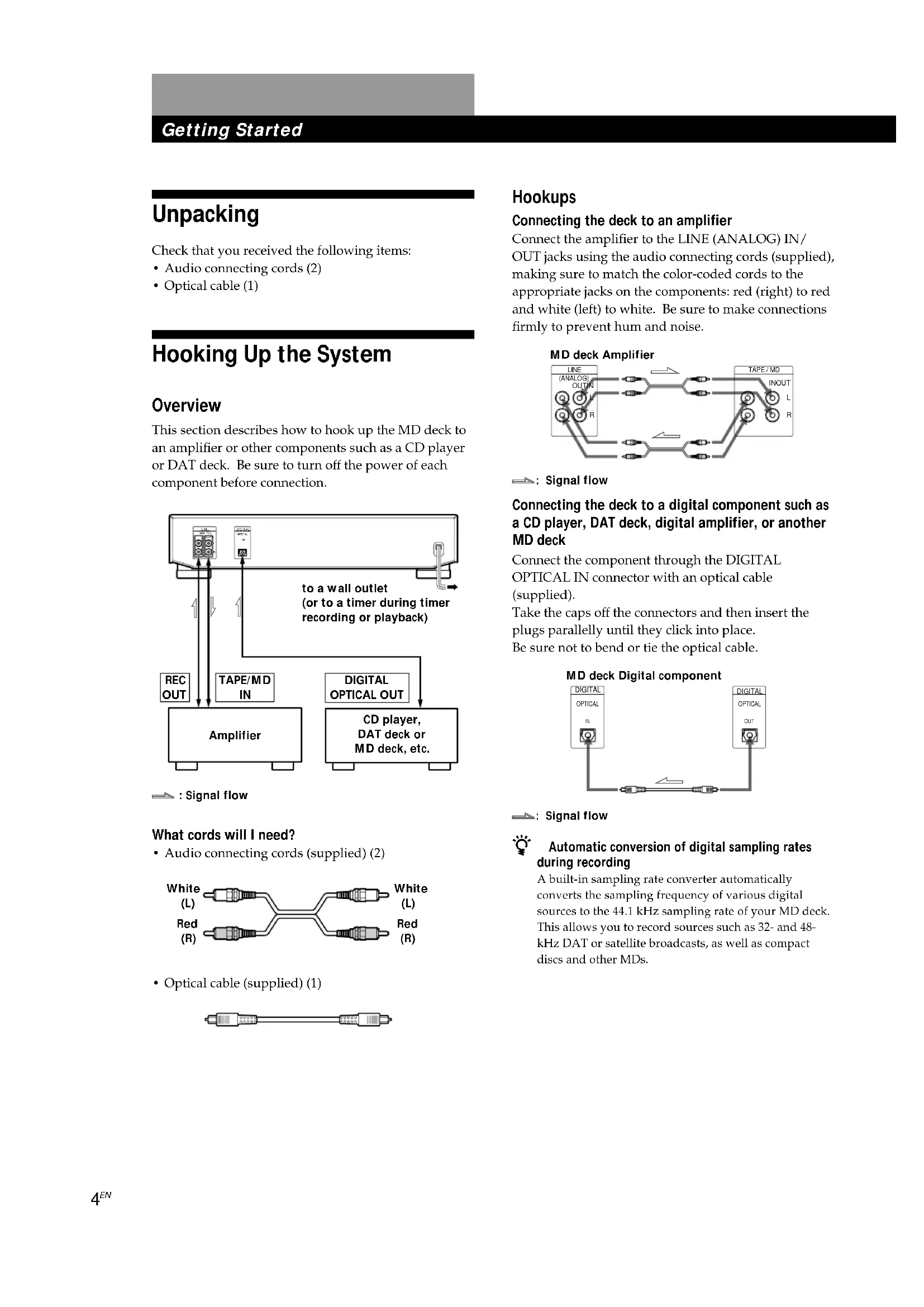
Hooking Up the System
Overview
This section describes how to hook up the MD deck to an amplifier or other components such as a CD player or DAT deck. Be sure to turn off the power of each component before connection.
Signal flow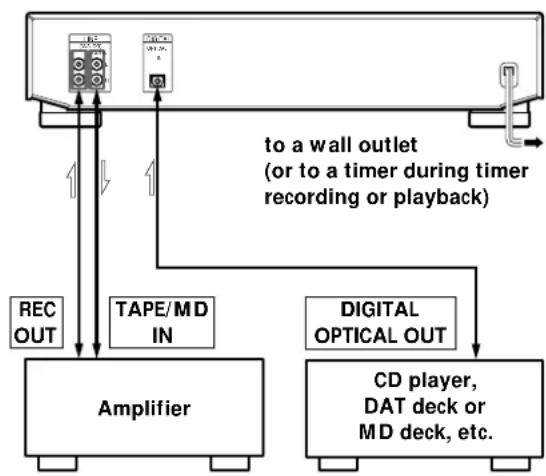
What cords will I need?
Audio connecting cords (supplied) (2)
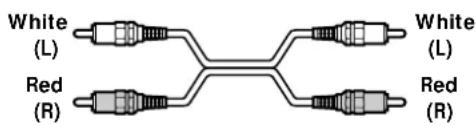
- Optical cable (supplied) (1)

Hookups
Connecting the deck to an amplifier
Connect the amplifier to the LINE (ANALOG) IN/OUT jacks using the audio connecting cords (supplied), making sure to match the color-coded cords to the appropriate jacks on the components: red (right) to red and white (left) to white. Be sure to make connections firmly to prevent hum and noise.
MD deck Amplifier : Signal flow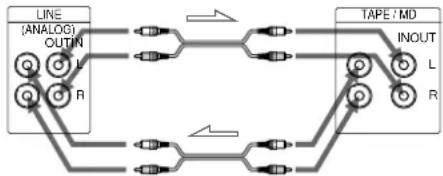
Connecting the deck to a digital component such as a CD player, DAT deck, digital amplifier, or another MD deck
Connect the component through the DIGITAL
OPTICAL IN connector with an optical cable (supplied).
Take the caps off the connectors and then insert the plugs parallelly until they click into place.
Be sure not to bend or tie the optical cable.
MD deck Digital component Signal flow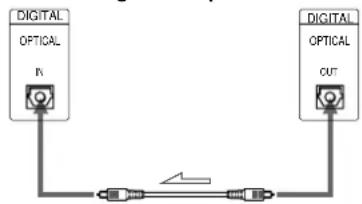

Automatic conversion of digital sampling rates during recording
A built-in sampling rate converter automatically converts the sampling frequency of various digital sources to the 44.1 kHz sampling rate of your MD deck. This allows you to record sources such as 32- and 48-kHz DAT or satellite broadcasts, as well as compact discs and other MDs.
Notes
- If "Din Unlock" or "Cannot Copy" appears in the display, recording through the digital connector is not possible. In this case, record the program source through the LINE (ANALOG) IN jacks with INPUT set to ANALOG.
- When recording through the DIGITAL OPTICAL IN connector, you cannot adjust the recording level.
Connecting the AC power cord
Connect the AC power cord to a wall outlet or to the outlet of a timer.
Basic Operations
Recording on an MD
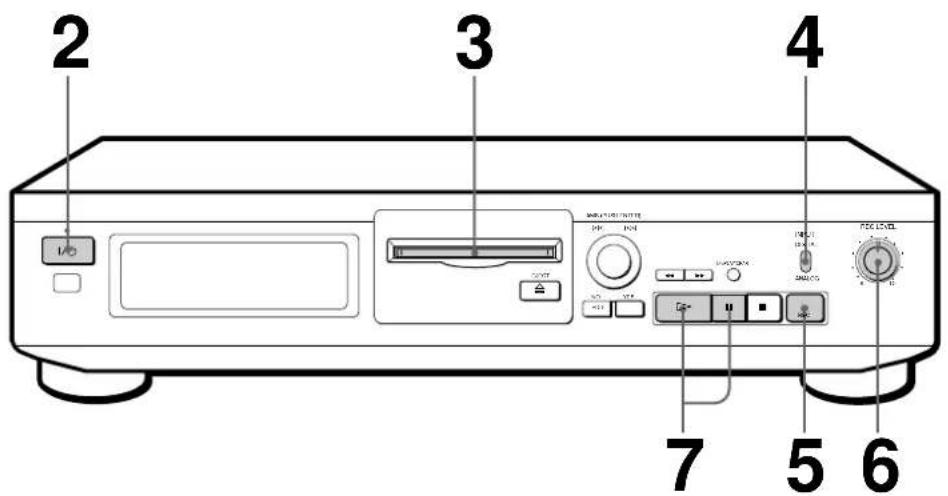
1 Turn on the amplifier and play the program source you want to record. 2 Press I/①. The I/ indicator changes from red to green. 3 Insert a recordable MD.
With the arrow pointing this way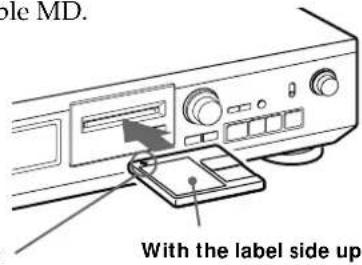
If the MD has recorded material on it, the deck will automatically start recording from the end of the last recorded track.
4 Set INPUT to the corresponding input connector.
To record through Set INPUT to
DIGITAL OPTICAL IN DIGITAL
LINE (ANALOG) IN ANALOG
When "TOC" flashes in the display
The deck is currently updating the Table Of Contents (TOC). Do not move the deck or pull out the AC power cord. Changes to an MD made through recording are saved only when you update the TOC by ejecting the MD or changing the deck to standby by pressing the switch.
Press ● REC. The deck becomes ready to record. 6 When recording the analog input signal, adjust the recording level with REC LEVEL. The fourth dot is satisfactory for most purposes. For details, refer to "Adjusting the Recording Level" on page 11. 7 Press ▶ or II. Recording starts. 8 Start playing the program source.
Do not disconnect the deck from the power source immediately after recording.
If you pull out the AC power cord during recording or while "TOC" flashes in the display, "STANDBY" flashes in the display when you turn on the deck next and the recorded material may not be saved correctly to the MD. To save the material, after recording, press EJECT to take out the MD or change the deck to standby by pressing I/TOC will flash in the display at this time. After "TOC" stops flashing and goes out, you can pull out the AC power cord.
To Press
Stop recording.
- Press the button again or press ▸ to resume recording.
Take out the MD ≜ EJECT after stopping.
- Whenever you pause recording, the track number increases by one. For example, if you paused recording while recording on track 4, the track number increases by one and recording continues on the new track when restarted.
To protect an MD against accidental erasure
To make it impossible to record on an MD, slide the tab in the direction of arrow, opening the slot. To allow recording, close the slot.

Basic Operations
Playing an MD

1 Turn on the amplifier and set the source selector to the position for MD deck. 2 Press I/①. The I/ indicator changes from red to green. 3 Insert an MD.
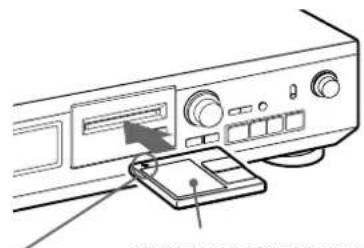
With the arrow pointing this way
4 Press. The deck starts playing. Adjust the volume on the amplifier.
To Do the following:
Press to stop playing.
Press to pause playing. Press the button again or press to resume playing.
to
Turn AMS clockwise to go to the next track.
Turn AMS counterclockwise to go to the current track or the preceding track.
Take out the MD: Press EJECT after stopping playing.

You can locate and play back a track while the deck is stopped.
1 Turn AMS until the number of the track you want to play appears.
2 Press AMS or .
Notes on Recording
If "Protected" appears in the display
The MD is record-protected. Close the slot to record on the disc (see "To protect an MD against accidental erasure" on page 7).
If "Din Unlock" flashes in the display
- The digital program source is not connected properly. To continue, connect the program source properly. The program source is not on. Turn on the program source.
Depending on the source being recorded, track numbers are marked in the following ways:
- When recording from a CD or MD with INPUT set to DIGITAL and the source connected through the DIGITAL OPTICAL IN connector: The deck automatically marks track numbers in the same sequence as the original. If, however, a track is repeated two or more times (e.g., by single-track repeat play) or two or more tracks with the same track number (e.g., from different MDs or CDs) are played, the track or tracks are recorded as part of a single, continuous track with a single track number. If the source is an MD, track numbers may not be marked for tracks of less than 4 seconds.
- When recording from a source connected through LINE (ANALOG) IN with INPUT at ANALOG, and "LEVEL-SYNC" does not light up (see "Marking Track Numbers While Recording" on page 12) or when recording from a DAT or satellite broadcast connected through the DIGITAL OPTICAL IN connector with INPUT set to DIGITAL: The source will be recorded as a single track. If "LEVEL-SYNC" appears in the display, the deck automatically marks track numbers when recording analog source or digital recording of DAT or a satellite broadcast (see "Marking track numbers automatically" on page 12).
- When recording from DAT or satellite broadcasts with INPUT set to DIGITAL, the deck automatically marks a track number whenever the sampling frequency of the input signal changes.

You can mark track numbers during or after recording.
For details, see "Marking Track Numbers While Recording" (page 12) and "Dividing Recorded Tracks" (page 19).
When "TOC" flashes in the display:
The deck is currently updating the Table Of Contents (TOC). Do not move the deck or pull out the AC power cord. Changes to an MD made through recording are saved only when you update the TOC by ejecting the MD or changing the deck to standby by pressing the I/ switch.
The MD deck uses the SCMS (Serial Copy Management System on page 27).
MDs recorded through the digital input connector cannot be copied onto other MDs or DAT tapes through the digital output connector.
Useful Tips for Recording
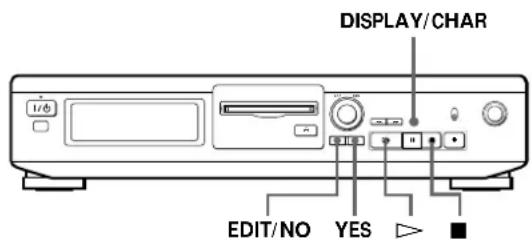
Checking the remaining recordable time on the MD:
- When you press DISPLAY/CHAR while recording, the remaining recordable time on the MD appears.
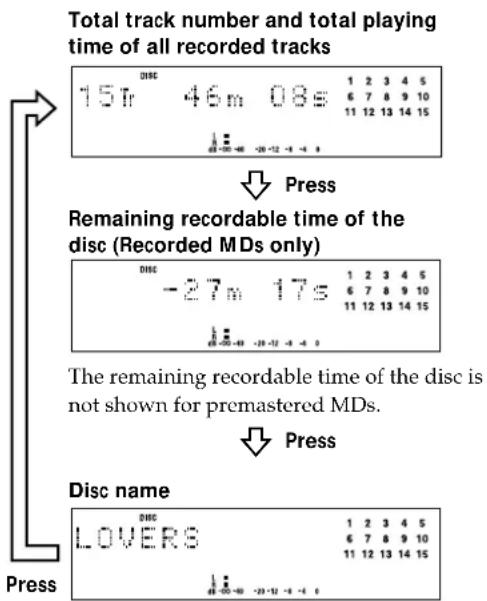
- When you press DISPLAY/CHAR repeatedly while the deck is stopped, the display changes as follows: total recorded time, remaining recordable time on the MD, disc name (see page 14).
If "Auto Cut" appears in the display (Auto Cut):
There has been no sound input for about 30 seconds during recording. The 30 seconds of silence are replaced by a blank of about 3 seconds and the deck changes to recording pause.
If the deck continues pausing for about 10 minutes after the Auto Cut Function has been activated, recording stops automatically.
Note that this function does not activate even if there has been no sound input for about 30 seconds when the deck started recording from a blank portion.

You can turn off the Auto Cut Function.
For details, see "To turn off the SmartSpace Function and AutoCut Function" on this page. Note that when you turn off the AutoCut Function, the SmartSpace Function is turned off automatically.
If "Smart Space" appears in the display (Smart Space)
There has been an extended silence of 4 to 30 seconds in length during recording. The silence is replaced with a blank of about 3 seconds and the deck continues recording. Note that new track numbers may not be marked for portions recorded while this function is activated. Also, the Smart Space Function does not activate even if there has been an extended silence of 4 to 30 seconds in length when the deck started recording from a blank portion.
To turn off the Smart Space Function and Auto Cut Function
1 During recording pause, press EDIT/NO repeatedly until "S. Space ?" appears in the display. 2 Press YES. 3 Press EDIT/NO to display "S. Space OFF."
To turn on the Smart Space Function and Auto Cut Function again
1 During recording pause, press EDIT/NO repeatedly until "S. Space ?" appears in the display. 2 Press YES twice to display "S. Space ON".
Notes
- When you turn off the SmartSpace Function, the AutoCut Function is also turned off automatically.
- The Smart Space Function and Auto Cut Function are factory set to on.
- If you turn off the deck or disconnect the AC power cord, the deck will recall the last setting (ON or OFF) of the SmartSpace and AutoCut Functions the next time you turn on the deck.
Playing back tracks just recorded
Do this procedure to immediately play back tracks that have just been recorded.
Press ▶ immediately after stopping recording. Playback starts from the first track of the material just recorded.
To play from the first track of the MD after recording
1 Press ▶ again after stopping recording. 2 Press ▶
Playback starts from the first track of the MD.
Recording Over Existing Tracks
Follow the procedure below to record over existing material just as you would on an analog cassette tape.
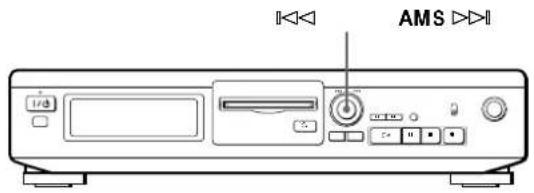
1 Do Steps 1 to 4 in "Recording on an MD" on page 6. 2 Turn AMS until the number of the track to be recorded over appears. 3 To record from the start of the track, continue from Step 5 in "Recording on an MD" on page 7.

While "TRACK" flashes in the display
The deck is recording over an existing track, and stops flashing when it reaches the end of the recorded portion.

To record from the middle of the track
1 After Step 2 above, press ▶ to start playback. 2 Press where you want to start recording. 3 Continue from Step 5 in "Recording on an MD" on page 7.
Adjusting the Recording Level
When recording with INPUT at ANALOG and the signal input through LINE (ANALOG) IN jacks, use REC LEVEL to adjust the recording level before starting recording.
You cannot adjust the recording level during digital recording.
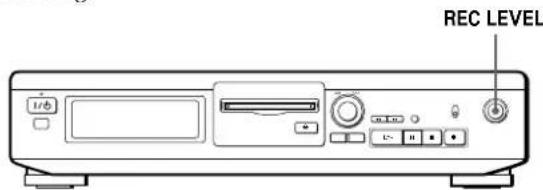
1 Do Steps 1 to 5 in "Recording on an MD" on pages 6 and 7. 2 Play the portion of the program source with the strongest signal level. 3 While monitoring the sound, turn REC LEVEL to adjust the recording level so that the peak level meters reach their highest point without turning on the OVER indication. Occasional lighting of "OVER" is acceptable.
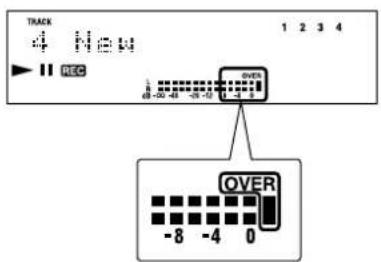
4 Stop playing the program source. 5 To start recording, do the procedure starting from Step 7 in "Recording on an MD" on page 7.
Marking Track Numbers While Recording (Track Marking)
You can mark track numbers either manually or automatically. By marking track numbers at specific points, you can quickly locate the points later using the AMS Function, or use various Editing Functions.
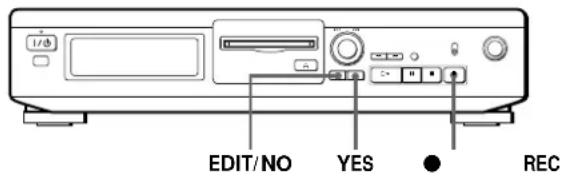
Marking track numbers manually (Manual Track Marking)
You can mark track numbers at any time while recording on an MD.
Press REC at the place you want to add a track mark while recording.
Marking track numbers automatically (Automatic Track Marking)
The deck adds track marks differently in the following cases:
- When recording from CDs or MDs with INPUT at DIGITAL and the source connected through the DIGITAL OPTICAL IN connector: The deck marks track numbers automatically. However, the Automatic Track Marking Function may not activate when recording from some CD players and multi disc players.
- When recording with INPUT at ANALOG and the source connected through LINE (ANALOG) IN, or when recording from DAT or satellite broadcasts with INPUT at DIGITAL and the DAT or satellite broadcasts connected through the DIGITAL OPTICAL IN connector: The deck marks a new track number whenever the signal level drops and rises to a certain point* (Automatic Track Marking). If "LEVEL-SYNC" does not light up, set the LevelSync to ON as follows:
1 Press EDIT/NO to display "LevelSync ?" during recording or recording pause. 2 Press YES twice to display "LevelSync ON." "LEVEL-SYNC" appears in the display.
To cancel Automatic Track Marking
1 Press EDIT/NO during recording or recording pause. "LevelSync ?" appears in the display. 2 Press YES. 3 Press EDIT/NO. "LevelSyncOFF" appears in the display.
- The signal level must remain low for 2 or more seconds before a new track number is marked.

When you want to mark track numbers after you've finished recording
Use the Divide Function (see "Dividing Recorded Tracks" on page 19).
Note
If you turn off the deck or disconnect the AC power cord, the deck will recall the last settings of the Automatic Track Marking Function ("ON" or "OFF") the next time you turn on the deck.
Starting Recording With 6 Seconds of Prestored Audio Data (Time Machine Recording)
When recording from an FM or satellite broadcast, the first few seconds of material are often lost due to the time it takes you to ascertain the contents and press the record button. To prevent the loss of this material, the Time Machine Recording Function constantly stores 6 seconds of the most recent audio data in a buffer memory so that when you begin recording the program source using this function, the recording actually begins with the 6 seconds of audio data stored in the buffer memory in advance as shown in the illustration below.
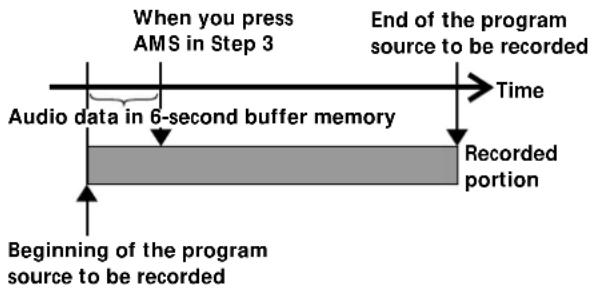
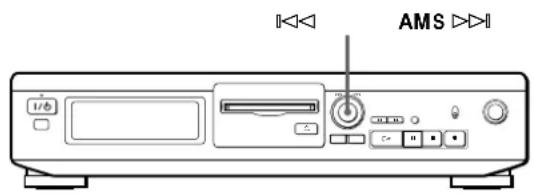
1 Do Steps 1 to 5 in "Recording on an MD" on pages 6 and 7. The deck changes to recording pause. 2 Start playing the program source you want to record. The most recent 6 seconds of audio data is stored in the buffer memory. 3 Press AMS to start Time Machine Recording. Recording of the program source starts with the 6 seconds of audio data stored in the buffer memory.
To stop Time Machine Recording
Press
Note
The deck starts storing audio data when the deck is in recording pause and you start playing the program source. With less than 6 seconds of playing of the program source and audio data stored in the buffer memory, Time Machine Recording starts with less than 6 seconds of audio data.
Using the Display
You can use the display to check disc and track information such as the total track number, total playing time of the tracks, remaining recordable time of the disc and disc name.
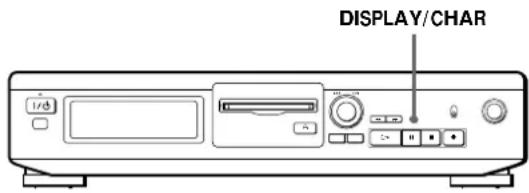
Checking the total track number, total disc playing time, remaining recordable time of the disc and the title of the disc
Each time you press DISPLAY/CHAR while the deck is stopped, you can change the display as follows:
When you insert an MD, the disc name, total number of tracks, total disc playing time, and the music calendar appear in the display as follows:
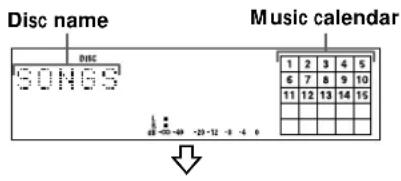
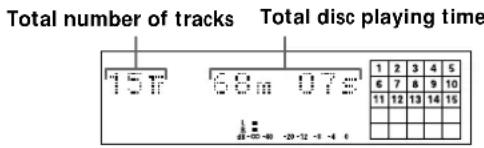
The disc name appears, followed by the total number of tracks (Tr) and total disc playing time.
A music calendar showing all the track numbers appears within a grid if the MD is a premastered disc, or without a grid if the MD is a recordable disc.
If the total track number exceeds 25, ▶ appears to the right of number 25 in the music calendar.
To label a recordable disc and its tracks, see "Labeling Recordings" on page 22.
Checking remaining time and the title of a track
Each time you press DISPLAY/CHAR while playing an MD, you can change the display as shown below. The track numbers in the music calendar disappear after they are played.
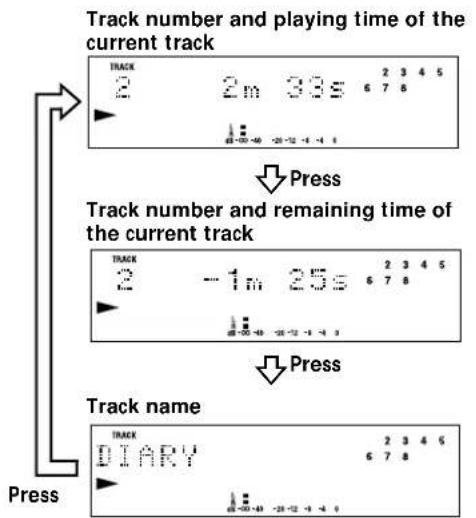
If no title is recorded, "No Name" appears, followed by the elapsed playing time.
Locating a Specific Track
You can quickly locate any track while playing a disc by using AMS (Automatic Music Sensor).
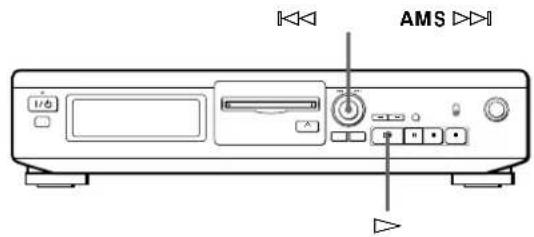
| To locate | Do the following: |
| The next or succeeding tracks | During playback, turn AMS clockwise until you find the track. |
| The current or preceding tracks | During playback, turn AMS counterclockwise until you find the track. |
| A specific track by using AMS | 1 Turn AMS until the track number you want to locate appears while the deck is stopped. (The track number is flashing.)2 Press AMS or >. |

To pause playing at the beginning of a track
Turn AMS after pausing playback.

To go quickly to the beginning of the last track
Turn AMS counterclockwise while the display shows the total track number and total disc playing time, remaining recordable time of the disc, or disc name (see page 14).
Locating a Particular Point in a Track
You can also use and to locate a particular point in a track during playback or playback pause.
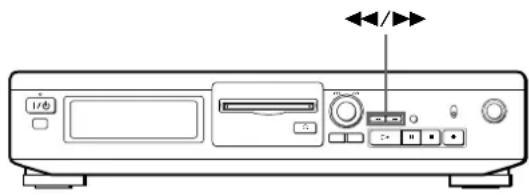
To locate a point, press
| While monitoring the sound | \( \blacktriangleright \) (forward) or \( \blacktriangleleft \) (backward) and keep pressing until you find the point. |
| Quickly by observing the display during playback pause | \( \blacktriangleright \) or \( \blacktriangleleft \) and keep pressing until you find the point. There is no sound output during this operation. |

If "OVER" appears while you are pressing during playback pause
The disc has reached its end. Press or turn AMS counterclockwise to go back.
Notes
- If the disc reaches the end while you are pressing during sound monitoring, the deck stops.
- Tracks that are only a few seconds long may be too short to scan using the search function. For such tracks, it is better to play the MD at normal speed.
Notes on Editing
You can edit the recorded tracks after recording, using the following functions:
- Erase Function allows you to erase recorded tracks simply by specifying the corresponding track number.
- A-B Erase Function allows you to specify a portion within a track to erase it.
- Divide Function allows you to divide tracks at specified points so that you can quickly locate those points afterwards, using the AMS function.
- Combine Function allows you to combine two consecutive tracks into one.
- Move Function allows you to change the order of tracks by moving a specific track to a track position you want.
- Title Function allows you to create titles for your recorded MDs and tracks.
- Undo Function allows you to cancel the last edit.
If "Protected" appears in the display
The deck could not edit because the record-protect slot on the MD is open. Edit after closing the slot.
When "TOC" flashes in the display
Do not move the deck or pull out the AC power cord. After editing, "TOC" lights continuously until you eject the MD or turn off the deck. "TOC" flashes while the deck is updating the TOC. When the deck finishes updating the TOC, "TOC" goes off.
Erasing Recordings (Erase Function)
Do the procedures below to erase following:
A single track All tracks
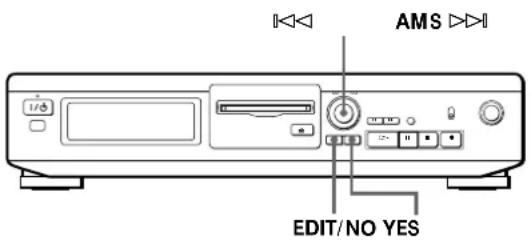
Erasing a single track
You can erase a track simply by specifying the respective track number. When you erase a track, the total number of tracks on the MD decreases by one and all tracks following the erased one are renumbered. Since erasing merely updates the TOC, there is no need to record over material.

To avoid confusion when erasing multiple tracks, you should proceed in order of high to low track number to prevent the renumbering of tracks that have not been erased yet.
Example: Erasing B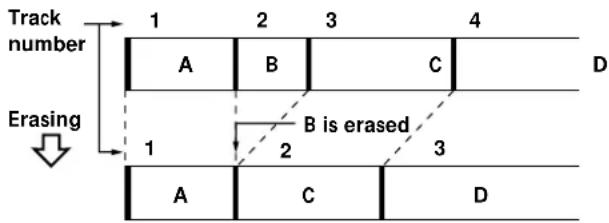
1 Turn AMS until the track number you want to erase appears in the display. 2 Press EDIT/NO repeatedly until "Erase ?" appears in the display. The track number you selected starts flashing in the music calendar. 3 Press YES. When the track selected in Step 1 has been erased, "Complete" appears for a few seconds and the total number of tracks in the music calendar decreases by one. If you erase a track during playback, the track following the deleted track begins playing afterwards. 4 Repeat Steps 1 to 3 to erase more tracks.
To cancel the Erase Function
Press EDIT/NO, , or turn AMS to change the track number.
Note
If "Erase!!?" appears in the display, the track was recorded or edited on another MD deck and is record-protected. If this indication appears, press YES to erase the track.
(Continued)
Erasing all tracks on an MD
Erasing a recordable MD deletes the disc name, all recorded tracks, and titles.
1 While the deck is stopped, press EDIT/NO repeatedly until "All Erase ?" appears in the display. 2 Press YES.
All tracks in the music calendar start flashing.
3 Press YES again.
When the disc name, all recorded tracks, and titles on the MD have been erased, "Complete" appears for a few seconds and the music calendar disappears.
To cancel the Erase Function
Press EDIT/NO or ■.

You can undo the Erase Function
Use the Undo Function immediately after you erased the track (see page 23).
Erasing a Part of a Track (A-B Erase Function)
You can specify a portion within a track and erase the portion with ease. It is convenient when erasing unnecessary sections after recording satellite broadcast or FM broadcast.
Example: Erasing a part of track A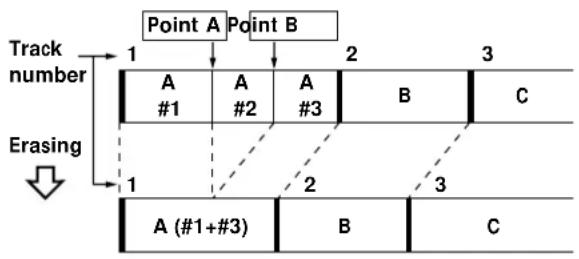
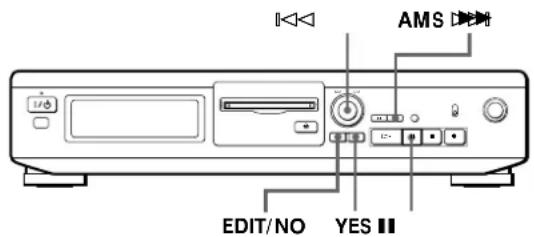
1 While playing a disc, press at the starting point (point A) of the portion to be erased. 2 Press EDIT/NO repeatedly until "A-B Erase ?" appears in the display. 3 Press YES.
"Rehearsal" alternates with "Point A ok?" in the display and the starting point A of the portion to be erased plays back repeatedly.
4 If point A is incorrect, press EDIT/NO. (If it is correct, go to Step 7.) 5 While monitoring the sound, turn AMS to find point A.
"Rehearsal" alternates with "Point A ok?" in the display and point A is played back repeatedly. Point A can be moved within a maximum range of -128 to +127 steps of about 0.06 second each within a track.
6 If point A is still incorrect, repeat Step 5 until it is correct.
7 Press YES or AMS when point A is correct.
After "Point B Set" appears for a few seconds, "▶" and "A-B" start flashing, and playback begins so that you can set point B.
8 Continue playing the track or press until you reach the ending point (point B) of the portion to be erased, then press YES.
"Rehearsal" alternates with "Point B ok?" in the display, and the "spliced" portion of the track (after the portion from point A to B has been erased) plays back repeatedly, starting a few seconds before point A and ending a few seconds after point B.
9 If point B is incorrect, press EDIT/NO. (If it is correct, go to Step 12.)
10 While monitoring the sound, turn AMS to find point B.
"Rehearsal" alternates with "Point B ok?" in the display, and the "spliced" portion of the track (after the portion from point A to B has been erased) plays back repeatedly.
Point B can be moved within a maximum range of -128 to +127 steps of about 0.06 second each within a track.
11 If point B is still incorrect, repeat Step 10 until it is correct.
12 Press YES or AMS when point B is correct. When the portion from point A to B has been erased, "Complete" appears for a few seconds.
To cancel the A-B Erase Function
Press
Notes
- If "Impossible" appears in the display, point B was specified before point A. Specify point B so that it comes after point A.
- If "Sorry" appears in the display, a portion of the track cannot be erased. This sometimes happens when you've edited the same track many times, and is due to a technical limitation of the MD system, not a mechanical error.
Dividing Recorded Tracks (Divide Function)
With the Divide Function you can mark a track number at places that you want to randomly access afterwards. Use this function to add tracks to MDs recorded from an analog source (and therefore contain no track numbers), or to divide an existing track into multiple portions for locating positions in the middle of a track. When you divide a track, the total number of tracks on the MD increases by one and all tracks following the divided track are renumbered.
Example: Dividing track 2 to create a new track for C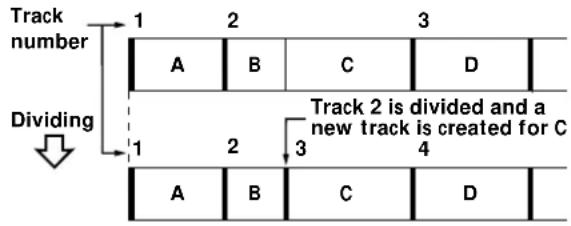
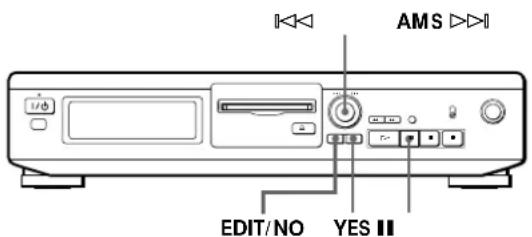
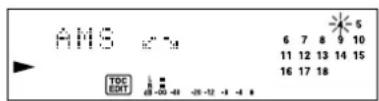
1 While playing the MD, press at the point where you want to create a new track. The deck pauses playing. 2 Press EDIT/NO repeatedly until "Divide ?" appears in the display. 3 Press YES to divide the track. "Rehearsal" alternates with "Position ok?" in the display, the track to be divided starts flashing in the music calendar, and the starting portion of the new track begins playing repeatedly. 4 If the starting position is incorrect, press EDIT/ NO. (If it is correct, go to Step 7.)
(Continued)
5 While monitoring the sound, turn AMS to find the starting position of the new track.
The starting portion of the new track is played back repeatedly.
"Rehearsal" alternates with "Position ok?" in the display.
The starting position can be moved within a maximum range of -128 to +127 steps of about 0.06 second each within a track.
6 If the starting position is still incorrect, repeat Step 5 until it is correct. 7 Press YES or AMS when the position is correct. When the track has been divided, "Complete" appears for a few seconds and the newly created track begins playing. The new track will have no track title even if the original track was labeled.
To cancel the Divide Function
Press.

You can undo the Divide Function
Use the Undo Function immediately after you divided the track (see page 23).

You can divide a track while recording
Use the Track Marking Function (see page 12).
Combining Recorded Tracks (Combine Function)
Use the Combine Function while the deck is stopped, playing or in pause to combine consecutive tracks on a recorded MD. This function is useful for combining several songs into a single medley, or several independently recorded portions into a single track. When you combine two tracks, the total number of tracks decreases by one and all tracks following the combined tracks are renumbered.
Example: Combining B and C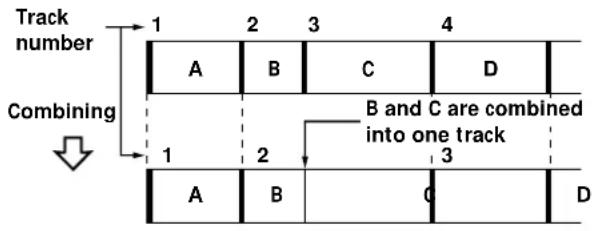
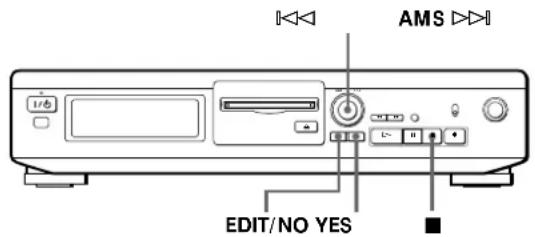
1 Turn AMS until the second track of the two to be combined appears. For example, when combining tracks 3 and 4, turn AMS until 4 appears. 2 Press EDIT/NO repeatedly until "Combine ?" appears in the display. 3 Press YES. "Rehearsal" alternates with "Track ok?" in the display. The place where the two tracks will join (i.e., the end of the first track and the beginning of the second track) repeatedly plays back and the respective track number flashes in the music calendar. 4 If the track is the wrong one, press EDIT/NO or then start from Step 1 again.
5 If the place is correct, press YES.
When the tracks have been combined, "Complete" appears for a few seconds and the total number of tracks in the music calendar decreases by one.
If both of the combined tracks have track titles, the title of the second track is erased.
To cancel the Combine Function
Press EDIT/NO or ■

You can undo the Combine Function
Use the Undo Function immediately after you combined the tracks (see page 23).
Note
If "Sorry" appears in the display, the tracks cannot be combined. This sometimes happens when you've edited the same track many times, and is due to a technical limitation of the MD system, not a mechanical error.
Moving Recorded Tracks (Move Function)
Use the Move Function to change the order of any track. After you move a track, the track numbers between the new and old track positions are automatically renumbered.
Example: Moving track C to track position 2
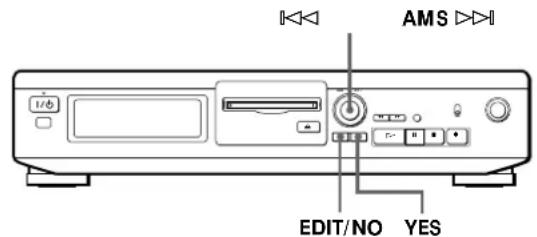
1 Turn AMS until the track number you want to move appears in the display. 2 Press EDIT/NO repeatedly until "Move ?" appears in the display. 3 Press YES.
The track number to be moved and the new track position appears.
Track number New track to be moved position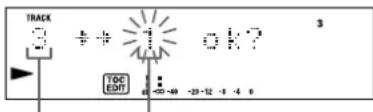
4 Turn AMS until the new track position appears.
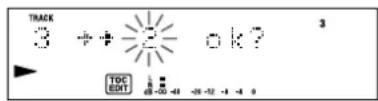
5 Press YES or AMS.
After you have moved the track, "Complete" appears for a few seconds and the moved track begins playing back if the deck is in playback mode.
To cancel the Move Function
Press EDIT/NO or ■.
Labeling Recordings (Title Function)
You can create titles for your recorded MDs and tracks. Titles — which may consist of uppercase and lowercase letters, numbers and symbols for a maximum of about 1,700 characters per disc — appear in the display during MD operation.
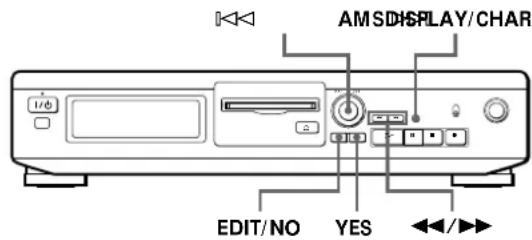
Use the following procedure to label a track or an MD. You can label a track while it is playing, pausing or recording. If the track is playing or recording, be sure to finish labeling before the track ends. If the track ends before you've completed the labeling procedure, the characters already entered are not recorded and the track will remain unlabeled.
1 Press EDIT/NO repeatedly until "Name in ?" appears in the display, then do the following:
To label Make sure that the deck is
To select Press DISPLAY/CHAR repeatedly until
| A track Playing, pausing, recording the track to be labeled, or stopped after locating the track to be labeled |
An MD Stopped with no track number appearing in the display
2 Press YES.
A flashing cursor appears in the display.
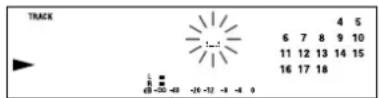
3 Press DISPLAY/CHAR to select the character type as follows:
Uppercase letters "A" appears in the display
Lowercase letters "a" appears in the display
Numbers "0" appears in the display
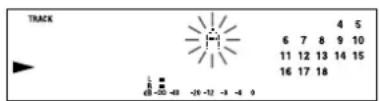
4 Turn AMS to select the character.
The selected character flashes.
Letters, numbers, and symbols appear in sequential order as you turn AMS.
You can use the following symbols in titles:
! ^ # \( % \ amp; ^ ( )* + , - . / : ; lt; = gt; ? @ _ -
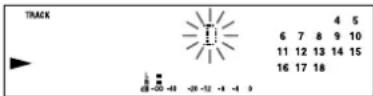
You can press DISPLAY/CHAR to change the character type at any time during Step 4 (see Step 3).
5 Press AMS to enter the selected character.
The cursor shifts rightward and waits for the input of the next character.
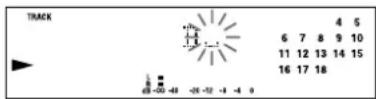
6 Repeat Steps 3 to 5 until you have entered the entire title.
If you entered the wrong character
Press or until the character to be corrected starts flashing, and repeat Steps 3 to 5 to enter the correct character.
To erase a character
Press or until the character to be erased starts flashing, then press EDIT/NO.
To enter a space
Press AMS or ▸ while the cursor is flashing.
7 Press YES.
This completes the labeling procedure and the title appears on the left side of the display.
To cancel labelling
Press
Note
You cannot label a track or an MD while you are recording over an existing track.
Erasing all titles on a disc (Name Erase)
Use this function to erase all titles on an MD simultaneously.
1 While the deck is stopped, press EDIT/NO repeatedly until "All Erase ?" appears in the display. 2 Press EDIT/NO again. "Name Erase ?" appears in the display. 3 Press YES. All titles are erased.
To cancel the Name Erase Function Press

You can undo the Name Erase Function. See "Undoing the Last Edit" on this page.

You can erase all recorded tracks and titles. See "Erasing all tracks on an MD" on page 18.
Undoing the Last Edit (Undo Function)
You can use the Undo Function to cancel the last edit and restore the contents of the MD to the condition that existed before editing was done. Note, however, that you cannot undo an edit if you do any of the following after the edit:
- Press the REC button on the deck.
- Update the TOC by turning off the deck or ejecting the MD.
- Disconnect the AC power cord.
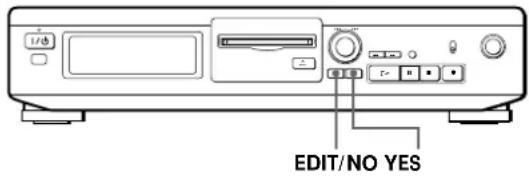
1 With the deck stopped and no track number appearing in the display, press EDIT/NO repeatedly until "Undo?" appears in the display. "Undo?" does not appear if no editing has been done. 2 Press YES.
One of the following messages appears in the display, depending on the type of editing to be undone:
Editing done: Message:
Erasing a single track
Erasing all tracks on an MD "Erase Undo ?"
Erasing a part of a track
Dividing a track "Divide Undo?"
Combining tracks "Combine Undo?"
Moving a track "Move Undo?"
Labeling a track or an MD
"Name Undo?"
Erasing all titles on an MD
3 Press YES again.
"Complete" appears for a few seconds and the contents of the MD are restored to the condition that existed before the edit.
To cancel the Undo Function
Press EDIT/NO or ■.
Display Messages
The following table explains the various messages that appear in the display.
| Message | Meaning |
| Blank Disc | A new (blank) or erased MD has been inserted. |
| Cannot Copy | An attempt was made to make a second copy from a digitally dubbed MD (see page 27). |
| Disc Error | The MD is scratched or missing a TOC. Erase all tracks on a new recordable MD before use (see “Erasing all tracks on an MD” on page 18). |
| Disc Full | The MD is full (see “System Limitations” on this page). |
| Impossible | An attempt was made to combine tracks while playing back the first track. An attempt was made to specify point B before point A for the “A-B Erase”. Point B can only be specified so that it comes after point A. |
| Name Full | The tilting capacity of the MD has reached its limit (about 1,700 characters). |
| NO DISC | There is no MD in the deck. |
| No Track | The inserted MD has a disc title but no tracks. |
| Protected | The inserted MD is record-protected. |
| Retry | The first recording attempt failed due to a disturbance or scratch on the MD, and a second attempt is being made. |
| Retry Error | Due to vibrations to the deck or scratches on the MD, several recording attempts were made but with no success. |
| Sorry | An attempt was made to combine tracks that cannot be combined. An attempt was made to erase a portion of a track that cannot be erased. |
System Limitations
The recording system in your MiniDisc deck is radically different from those used in cassette and DAT decks and is characterized by the limitations described below. Note, however, that these limitations are due to the inherent nature of the MD recording system itself and not to mechanical causes.
"Disc Full" lights up even before the MD has reached the maximum recording time (60 or 74 minutes)
When 255 tracks have been recorded on the MD, "Disc Full" lights up regardless of the total recorded time. More than 255 tracks cannot be recorded on the MD. To continue recording, erase unnecessary tracks or use another recordable MD.
"Disc Full" lights up before the maximum number of tracks is reached
Fluctuations in emphasis within tracks are sometimes interpreted as track intervals, incrementing the track count and causing "Disc Full" to light up.
The remaining recording time does not increase even after erasing numerous short tracks
Tracks under 12 seconds in length are not counted and so erasing them may not lead to an increase in the recording time.
Some tracks cannot be combined with others
Track combination may become impossible when tracks are edited.
The total recorded time and the remaining time on the MD may not total the maximum recording time (60 or 74 minutes).
Recording is done in minimum units of 2 seconds each, no matter how short the material. The contents recorded may thus be shorter than the maximum recording capacity. Disc space may also be further reduced by scratches.
Tracks created through editing may exhibit sound dropout during search operations.
Track numbers are not recorded correctly.
Incorrect assignment or recording of track numbers may result (1) when CD tracks are divided into several smaller tracks during digital recording, or (2) while recording certain CDs with the "LEVEL-SYNC" indication on (i.e., the automatic track marking function on).
"TOC Reading" appears for a long time.
If the inserted recordable MD is brand new, "TOC Reading" appears in the display longer than for MDs that have been used.
Limitations when recording over an existing track.
- The correct remaining recording time may not be displayed.
- You may find it impossible to record over a track if that track has been recorded over several times already. If this happens, erase the track using the Erase Function (see page 17).
- The remaining recording time may be shortened out of proportion to the total recorded time.
- Recording over a track to eliminate noise is not recommended since this may shorten the duration of the track.
- You may find it impossible to label a track while recording over it.
The correct recorded/playing time may not be displayed during playback of monaural-format MDs.
Troubleshooting
If you experience any of the following difficulties while using the deck, use this troubleshooting guide to help you remedy the problem. Should any problem persist, consult your nearest Sony dealer.
The deck does not operate or operates poorly.
The MD may be damaged ("Disc Error" appears). Take the MD out and insert it again. If "Disc Error" remains, replace the MD.
The deck does not play back.
Moisture has formed inside the deck. Take the MD out and leave the deck in a warm place for several hours until the moisture evaporates. The deck is not on. Press 1/0 to turn the deck on. The MD is inserted in the wrong direction. Slide the MD into the disc slot with the label side up and the arrow pointing towards the opening. The MD may not be recorded (the music calendar does not appear). Replace the disc with one that has been recorded.
The deck does not record.
The MD is record-protected ("Protected" appears). Close the record-protect slot (see page 7). The deck is not connected properly to the program source. Make connections properly to the program source. The recording level is not adjusted properly (in case of input through LINE (ANALOG) IN). Turn REC LEVEL to adjust the recording level properly (see page 11). A premastered MD is inserted. Replace it with a recordable MD. There is not enough time left on the MD. Replace it with another recordable MD with fewer recorded tracks, or erase unnecessary tracks. There has been a power failure or the AC power cord has been disconnected during recording. Data recorded to that point may be lost. Repeat the recording procedure.
The sound has a lot of static.
Strong magnetism from a television or a similar device is interfering with operations. Move the deck away from the source of strong magnetism.
Note
If the deck does not operate properly even after you've attempted the prescribed remedies, turn off the deck, then reinsert the plug into the power outlet.
Specifications
System MiniDisc digital audio system
Disc MiniDisc
Laser: Semiconductor laser (λ = 780 nm)
Emission duration: continuous
Laser output: Less than 44.6 μW*
- This output is the value measured at a distance of 200 mm from the objective lens surface on the Optical Pick-up Block with 7 mm aperture.
Laser diode properties: Material: GaAlAs
Revolutions (CLV): 400 rpm to 900 rpm
Error correction: Advanced Cross Interleave Reed Solomon Code (ACIRQ)
Sampling frequency: 44.1 kHz
Coding: Adaptive Transform Acoustic Coding (ATRAC)
Modulation system: EFM (Eight-to-Fourteen Modulation)
Number of channels: 2 stereo channels
Frequency response: 5 to 20,000 Hz ± 0.3 dB
Signal-to-noise ratio: Over 96 dB during playback
Wow and flutter: Below measurable limit
Inputs
| Jack type | Input impedance | Rated input | Minimum input | |
| LINE (ANALOG) IN | Phono jacks | 47 kilohms | 500 mVrms | 125 mVrms |
| DIGITAL OPTICAL IN | Square optical connector jack | Optical wave length: 660 nm | — | — |
Outputs
| Jack type | Rated output | Load impedance | |
| LINE (ANALOG) OUT | Phono jacks | 2 Vrms (at 50 kilohms) | Over 10 kilohms |
General
Power requirements
| Where purchased | Power requirements |
| Continental Europe | 220 – 230 V AC, 50/60 Hz |
| U.S.A and Canada | 120 V AC, 60 Hz |
Power consumption
Continental Europe: 20 W
U.S.A and Canada: 19 W
Dimensions (approx.) (w/h/d) incl. projecting parts
430·93·280.5 mm
(17·3 3/4·11 1/8 in.)
Mass (approx.)
3.5 kg (7 lbs 11 oz)
Supplied accessories
See page 4.
Optional accessories
Recordable MDs
MDW-60 (60 min), MDW-74 (74 min)
US and foreign patents licensed from Dolby Laboratories Licensing Corporation.
Design and specifications are subject to change without notice.
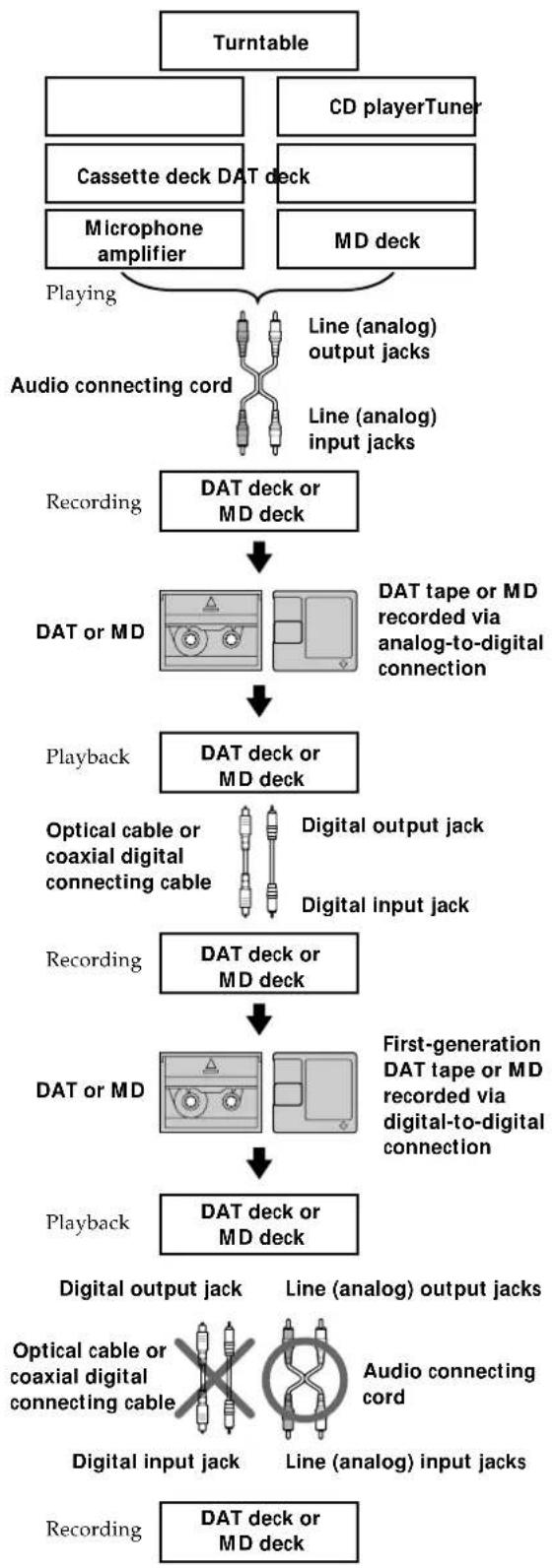
Guide to the Serial Copy Management System
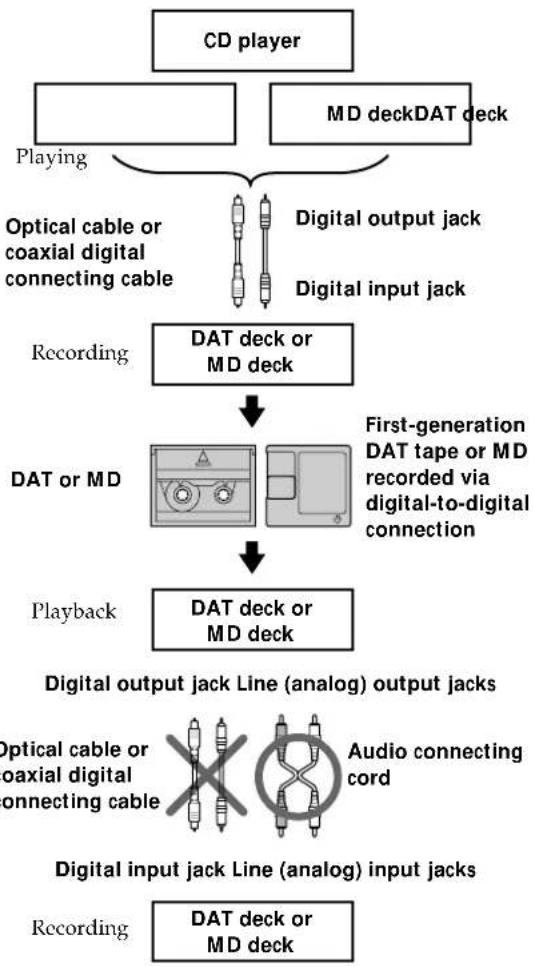
This MD deck uses the Serial Copy Management System, which allows only first-generation digital copies to be made of premastered software via the deck's digital input jack. An outline of this system appears below:
1 You can record from digital program sources (CDs, DATs or premastered MDs) onto a DAT tape or recordable MD via digital input jack on the DAT or MD deck. You cannot, however, record from this recorded DAT tape or MD onto another DAT tape or recordable MD via the digital input jack on the DAT or MD deck.
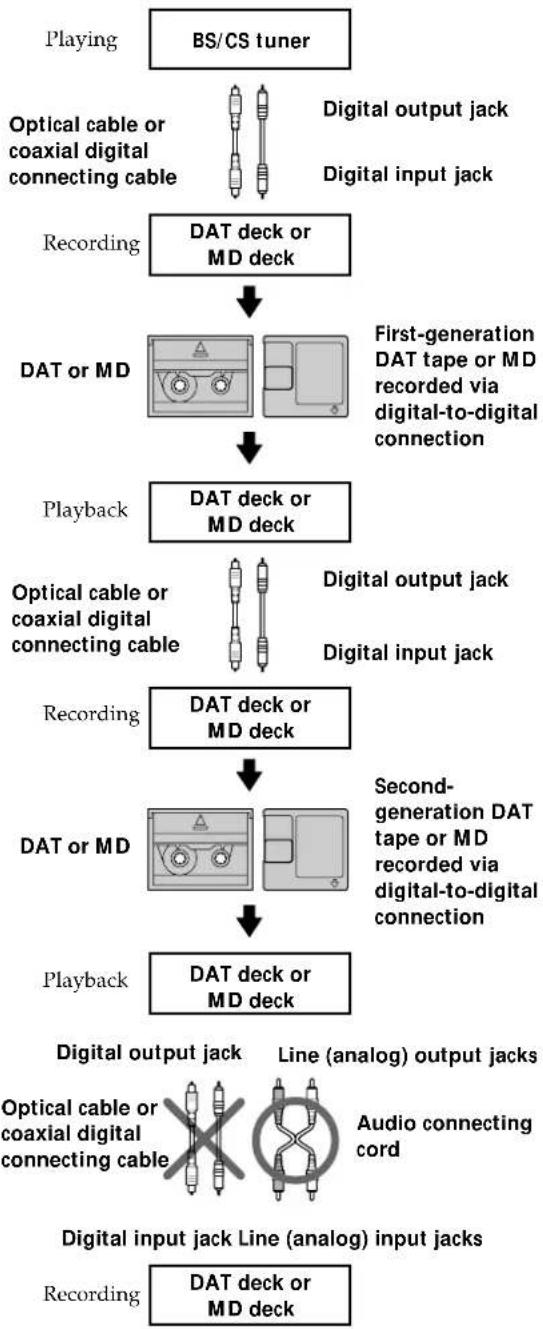
2 You can record the digital input signal of a digital satellite broadcast onto a DAT tape or recordable MD via the digital input jack on the DAT or MD deck which is capable of handling a sampling frequency of 32 kHz or 48 kHz. You can then record the contents of this recorded DAT tape or MD (first-generation) onto another DAT tape or recordable MD via digital input jack on the DAT or MD deck to create a second-generation digital copy. Subsequent recording from the second-generation copy onto another recordable DAT tape or MD is possible only through the analog input jack on the DAT or MD deck. Note, however, that on some BS/CS tuners, second-generation digital copying may not be possible.
(Continued)
Additional Information
3 You can record a DAT tape or MD recorded via the DAT or MD deck's analog input jack onto another DAT tape or MD via the DAT or MD deck's digital output jack. You cannot, however, make a second-generation DAT tape or MD copy via the DAT or MD deck's digital output jack.
Index
A,B
A-B erase 18 AMS (Automatic Music Sensor) 15 Audio connecting cord 4,27,28 Auto cut 10
C
Cable optical cable 4,27,28 Checking remaining recordable time on the MD 10,14 Cleaning 2 Combining 20
D
Display messages 24 Dividing 19
E, F, G
Erasing all titles 23 all tracks 18 a part of a track 18 a single track 17
H, I, J, K
Hooking up a digital component 4 an analog component 4
L
Labeling an MD 22 a track 22 LEVEL-SYNC 9, 12 Locating a particular point in a track 16 a specific track 15
M, N
MD inserting 6, 8 premastered 14 recordable 6, 14 taking out 7, 8 Moving 21
O Optional accessories 26
P, Q Pausing playback 8 recording 7 Playing normal play 8 Precautions 2
R Recording normal recording 6, 7 over existing tracks 11 time machine recording 13 Recording level 11 Record-protect tab 7
Sampling frequency 4, 27 Sampling rate converter 4 SCMS (Serial Copy Management System) 9, 2 Smart space 10 Specifications 26 Supplied accessories 4 System limitations 24
T Track marking automatic track marking 12 manual track marking 12 Troubleshooting 25
U, V, W, X, Y, Z Undoing the last edit 23
Names of controls
Buttons
DISPLAY/CHAR 10,14,22 EDIT/NO/YES 10,12,17 to 23 △ EJECT 7,8 • REC (recording) 7,12,23 ▷ (play) 7,8,10,15 Π (pause) 7,8,18,19 ■ (stop) 7,8,10,20 ◁ / ▷ (manual search) 16,18,22
Switches
INPUT 6,9 1/6 to 8
Connectors
DIGITAL OPTICAL IN 4,6,9, 12
Controls
AMSG8,11,13,15 17 to 22 REC LEVEL 7,11
Indicator
1/6,8
Jacks
LINE (ANALOG) IN/OUT 4,6,9,12
Others
Display 14 Music calendar 14 TOC (Table Of Contents) 7, 9, 17
WARNING
DIGITAL OPTICAL IN DIGITAL
LINE (ANALOG) IN ANALOG
adaptive transformation
(ATRAC: Adaptive Transform
Acoustic Coding)
(EFM : Eight-to-Fourteen
Modulation)
Number of channels
2-channel stereo
Power consumption
Continental Europe 20 W
DIGITAL OPTICAL IN 4,6,9, 12
Controls
AMS 8,11,13,15
17 to 22
REC LEVEL 7,11
Indicator
1/6,8
Jacks
LINE (ANALOG) IN/OUT
4,6,9,12
Miscellaneous
Display 14
Directory 14
- WARNING
- FOR THE CUSTOMERS IN THE UNITED STATES
- CAUTION
- OWNER'S RECORD
- INFORMATION
- FOR THE CUSTOMERS IN CANADA
- PRECAUTIONS
- ON SAFETY
- ON POWER SOURCES
- ON OPERATION
- ON THE MINIDISC CARTRIDGE
- ON CLEANING
- WELCOME
- ABOUT THIS MANUAL
- CONVENTION
- TABLE OF CONTENTS
- GETTING STARTED
- RECORDING ON AN MD
- PLAYING AN MD
- RECORDING ON MDS
- PLAYING MDS
- EDITING RECORDED MDS
- ADDITIONAL INFORMATION
- UNPACKING
- HOOKING UP THE SYSTEM
- OVERVIEW
- WHAT CORDS WILL I NEED
- HOOKUPS
- CONNECTING THE DECK TO AN AMPLIFIER
- CONNECTING THE DECK TO A DIGITAL COMPONENT SUCH AS A CD PLAYER, DAT DECK, DIGITAL AMPLIFIER, OR ANOTHER MD DECK
- AUTOMATIC CONVERSION OF DIGITAL SAMPLING RATES DURING RECORDING
- NOTES
- CONNECTING THE AC POWER CORD
- BASIC OPERATIONS
- WHEN "TOC" FLASHES IN THE DISPLAY
- DO NOT DISCONNECT THE DECK FROM THE POWER SOURCE IMMEDIATELY AFTER RECORDING
- TO PRESS
- TO PROTECT AN MD AGAINST ACCIDENTAL ERASURE
- TO DO THE FOLLOWING
- NOTES ON RECORDING
- IF "PROTECTED" APPEARS IN THE DISPLAY
- IF "DIN UNLOCK" FLASHES IN THE DISPLAY
- DEPENDING ON THE SOURCE BEING RECORDED, TRACK NUMBERS ARE MARKED IN THE FOLLOWING WAYS
- YOU CAN MARK TRACK NUMBERS DURING OR AFTER RECORDING
- THE MD DECK USES THE SCMS (SERIAL COPY MANAGEMENT SYSTEM ON PAGE 27)
- USEFUL TIPS FOR RECORDING
- CHECKING THE REMAINING RECORDABLE TIME ON THE MD
- IF "AUTO CUT" APPEARS IN THE DISPLAY (AUTO CUT)
- YOU CAN TURN OFF THE AUTO CUT FUNCTION
- IF "SMART SPACE" APPEARS IN THE DISPLAY (SMART SPACE)
- TO TURN OFF THE SMART SPACE FUNCTION AND AUTO CUT FUNCTION
- TO TURN ON THE SMART SPACE FUNCTION AND AUTO CUT FUNCTION AGAIN
- PLAYING BACK TRACKS JUST RECORDED
- TO PLAY FROM THE FIRST TRACK OF THE MD AFTER RECORDING
- RECORDING OVER EXISTING TRACKS
- WHILE "TRACK" FLASHES IN THE DISPLAY
- TO RECORD FROM THE MIDDLE OF THE TRACK
- ADJUSTING THE RECORDING LEVEL
- MARKING TRACK NUMBERS WHILE RECORDING (TRACK MARKING)
- MARKING TRACK NUMBERS MANUALLY (MANUAL TRACK MARKING)
- MARKING TRACK NUMBERS AUTOMATICALLY (AUTOMATIC TRACK MARKING)
- TO CANCEL AUTOMATIC TRACK MARKING
- WHEN YOU WANT TO MARK TRACK NUMBERS AFTER YOU'VE FINISHED RECORDING
- NOTE
- STARTING RECORDING WITH 6 SECONDS OF PRESTORED AUDIO DATA (TIME MACHINE RECORDING)
- TO STOP TIME MACHINE RECORDING
- USING THE DISPLAY
- CHECKING THE TOTAL TRACK NUMBER, TOTAL DISC PLAYING TIME, REMAINING RECORDABLE TIME OF THE DISC AND THE TITLE OF THE DISC
- CHECKING REMAINING TIME AND THE TITLE OF A TRACK
- LOCATING A SPECIFIC TRACK
- LOCATING A PARTICULAR POINT IN A TRACK
- IF "OVER" APPEARS WHILE YOU ARE PRESSING DURING PLAYBACK PAUSE
- NOTES ON EDITING
- ERASING RECORDINGS (ERASE FUNCTION)
- ERASING A SINGLE TRACK
- TO CANCEL THE ERASE FUNCTION
- ERASING ALL TRACKS ON AN MD
- YOU CAN UNDO THE ERASE FUNCTION
- ERASING A PART OF A TRACK (A-B ERASE FUNCTION)
- TO CANCEL THE A-B ERASE FUNCTION
- DIVIDING RECORDED TRACKS (DIVIDE FUNCTION)
- TO CANCEL THE DIVIDE FUNCTION
- YOU CAN UNDO THE DIVIDE FUNCTION
- YOU CAN DIVIDE A TRACK WHILE RECORDING
- COMBINING RECORDED TRACKS (COMBINE FUNCTION)
- TO CANCEL THE COMBINE FUNCTION
- YOU CAN UNDO THE COMBINE FUNCTION
- MOVING RECORDED TRACKS (MOVE FUNCTION)
- TO CANCEL THE MOVE FUNCTION
- LABELING RECORDINGS (TITLE FUNCTION)
- IF YOU ENTERED THE WRONG CHARACTER
- TO ERASE A CHARACTER
- TO ENTER A SPACE
- TO CANCEL LABELLING
- ERASING ALL TITLES ON A DISC (NAME ERASE)
- UNDOING THE LAST EDIT (UNDO FUNCTION)
- EDITING DONE: MESSAGE
- DISPLAY MESSAGES
- SYSTEM LIMITATIONS
- DISC FULL" LIGHTS UP EVEN BEFORE THE MD HAS REACHED THE MAXIMUM RECORDING TIME (60 OR 74 MINUTES)
- DISC FULL" LIGHTS UP BEFORE THE MAXIMUM NUMBER OF TRACKS IS REACHED
- THE REMAINING RECORDING TIME DOES NOT INCREASE EVEN AFTER ERASING NUMEROUS SHORT TRACKS
- SOME TRACKS CANNOT BE COMBINED WITH OTHERS
- THE TOTAL RECORDED TIME AND THE REMAINING TIME ON THE MD MAY NOT TOTAL THE MAXIMUM RECORDING TIME (60 OR 74 MINUTES)
- TRACKS CREATED THROUGH EDITING MAY EXHIBIT SOUND DROPOUT DURING SEARCH OPERATIONS
- TRACK NUMBERS ARE NOT RECORDED CORRECTLY
- TOC READING" APPEARS FOR A LONG TIME
- LIMITATIONS WHEN RECORDING OVER AN EXISTING TRACK
- TROUBLESHOOTING
- THE DECK DOES NOT OPERATE OR OPERATES POORLY
- THE DECK DOES NOT PLAY BACK
- THE DECK DOES NOT RECORD
- THE SOUND HAS A LOT OF STATIC
- SPECIFICATIONS
- GENERAL
- POWER CONSUMPTION
- SUPPLIED ACCESSORIES
- OPTIONAL ACCESSORIES
- GUIDE TO THE SERIAL COPY MANAGEMENT SYSTEM
- INDEX
- A,B
- C
- D
- E, F, G
- H, I, J, K
- L
- M, N
- NAMES OF CONTROLS
- BUTTONS
- SWITCHES
- CONNECTORS
- CONTROLS
- INDICATOR
- JACKS
- OTHERS
- MISCELLANEOUS
Brand : SONY
Model : MDSJE320
Category : Dictaphone