
CDP-CX250 - CD Player SONY - Free user manual and instructions
Find the device manual for free CDP-CX250 SONY in PDF.


| Product Type | 200-disc CD Changer |
| Brand and Model | Sony CDP-CX250 |
| Dimensions (W/H/D) closed | 430 × 200 × 480 mm |
| Dimensions (W/H/D) open | 430 × 200 × 600 mm |
| Weight | 9.0 kg |
| Power Supply | 110–120 V or 220–240 V AC, 50/60 Hz switchable |
| Power Consumption | 14 W |
| Changer Capacity | Up to 200 compact discs |
| Playback Modes | Continuous (all discs or 1 disc), random, programmed, repeat |
| Special Functions | Custom files: disc memo (13 characters), delete block, group file (8 groups) |
| Display | Display window with disc number, track, tempo, CD-TEXT information |
| Remote Control | Wireless (infrared) remote with CD1/2/3 selector |
| Audio Outputs | Line Out (RCA) and optical digital output (Toslink) |
| Frequency Response | 20 Hz – 20 kHz ± 0.5 dB |
| Signal-to-Noise Ratio | More than 107 dB |
| Dynamic Range | More than 98 dB |
| Harmonic Distortion | Less than 0.0035 % |
| Maintenance and Cleaning | Soft cloth slightly dampened with mild detergent; do not use alcohol or solvents |
| Safety | Class 1 laser; do not open the casing; risk of electric shock |
| Supplied Accessories | Audio cable, CONTROL A1 cord (Canada only), remote control, batteries, CD booklet holders (2), label |
Frequently Asked Questions - CDP-CX250 SONY
User questions about CDP-CX250 SONY
0 question about this device. Answer the ones you know or ask your own.
Ask a new question about this device
Download the instructions for your CD Player in PDF format for free! Find your manual CDP-CX250 - SONY and take your electronic device back in hand. On this page are published all the documents necessary for the use of your device. CDP-CX250 by SONY.
USER MANUAL CDP-CX250 SONY
Operating Instructions ____ EN
Mode d'emploi F
To prevent fire or shock hazard, do not expose the unit to rain or moisture. To avoid electrical shock, do not open the cabinet. Refer servicing to qualified personnel only.
CLASS 1 LASER PRODUCT LUOKAN 1 LASERLAITE KLASS 1 LASERAPPARAT
This appliance is classified as a CLASS 1 LASER product. The CLASS 1 LASER PRODUCT MARKING is located on the rear exterior.
The following caution label is located inside of the unit.
| CAUTION | ; INVISIBLE LASER RADIATION WHEN OPEN. AVOID EXPOSURE TO BEAM. |
| ADVARSEL | ; USYNLIG LASERSTRÄLING VED ABNING NÄR SIKKERHEDSAFBRYDERE ER UDE AF PUNKTION, UNDGA UDS DETTEISE FOR STRING. |
| VARO! | ; AVATTAESSA JA SUOJALUKITUS OHITTETAESSA LEDT ALTITNA LASERSATEBYLLE. |
| VARNING | ; LASERSTRÄLING NÄR DENNA DEL ÄR OPPNAD OCH SPÄRREN AR UROPPLAG. |
| ADVARSEL | ; USYNLIG LASERSTRÄLING NÄR DEKSEL ÄPNES UNKÖGA ESPONERING FOR STRALEN. |
This equipment is intended for home entertainment purposes only. The warranty shall be invalidated if used in commercial environments, such as by disc jockeys, etc., even within the Warranty Period.
For the customers in Canada
CAUTION
TO PREVENT ELECTRIC SHOCK, DO NOT USE THIS POLARIZED AC PLUG WITH AN EXTENSION CORD, RECEPTACLE OR OTHER OUTLET UNLESS THE BLADES CAN BE FULLY INSERTED TO PREVENT BLADE EXPOSURE.
Welcome!
Thank you for purchasing the Sony Compact Disc Player. Before operating the unit, please read this manual thoroughly and retain it for future reference.
About This Manual
The instructions in this manual are for model CDP-CX250.
Conventions
- Instructions in this manual describe the controls on the player. You can also use the controls on the remote if they have the same or similar names as those on the player.
- The following icons are used in this manual:

Indicates that you can do the task using the remote.

Indicates hints and tips for making the task easier.
TABLE OF CONTENTS
Getting Started
Unpacking.... 4
Hooking Up the System 4
Inserting CDs 6
Playing a CD 8
Playing CDs
Using the Display 10
Locating a Specific Disc 11
Specifying the Next Disc to Play 12
Locating a Specific Track or a Point in a Track 12
Playing Repeatedly 13
Playing in Random Order (Shuffle Play) 13
Creating Your Own Program (Program Play) 14
Playing Using a Timer 16
Storing Information About CDs (Custom Files)
What You Can Do With the Custom Files 17
Labeling Discs (Disc Memo) 17
Storing Specific Tracks (Delete Bank) 19
Grouping Discs (Group File) 20
Additional Information
Precautions 22
Notes on CDs 22
Troubleshooting 23
Specifications 23
Index 24
Unpacking
Check that you received the following items:
- Audio cord (1)
- Remote commander (remote) (1)
- Sony SUM-3 (NS) batteries (2) • CD booklet holders (2) and label (1)
- CONTROL A1 cord (1) (supplied for Canadian models only)

How to use the CD booklet holder
The CD booklet holder helps you locate the disc easily. After you have inserted discs into the player, you can put the CD booklet (which comes with a CD) into the supplied holder. Put two CD booklets facing back to back into a pocket. Stick the number label on each pocket, matching the number of the disc slot where you have inserted the disc. You can put up to 200 CD booklets into the holders.
Inserting batteries into the remote
You can control the player using the supplied remote. Insert two R6 (size AA) batteries by matching the + and – on the batteries. When using the remote, point it at the remote sensor R on the player.
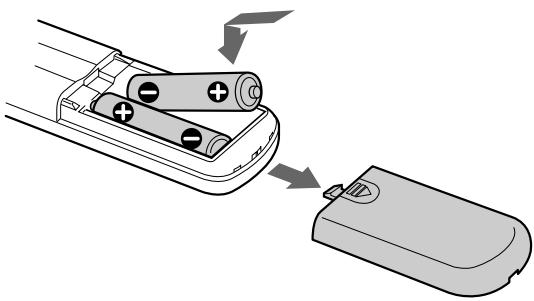

When to replace batteries
With normal use, the batteries should last for about six months. When the remote no longer operates the player, replace all the batteries with new ones.
Notes
- Do not leave the remote near an extremely hot or humid place.
- Do not drop any foreign object into the remote casing, particularly when replacing the batteries.
- Do not expose the remote sensor to direct sunlight or lighting apparatuses. Doing so may cause a malfunction.
- If you do not use the remote for an extended period of time, remove the batteries to avoid possible damage from battery leakage and corrosion.
Hooking Up the System
Overview
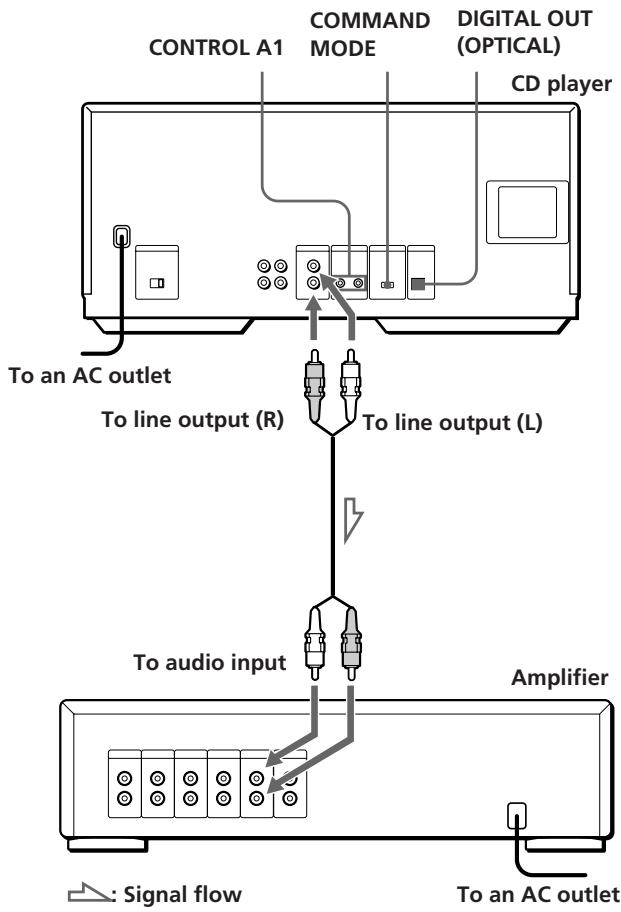
This section describes how to hook up the CD player to an amplifier. Be sure to turn off the power of each component before making the connections.
What cords will I need?
Audio cord (1) (supplied)
![graph LR A["White (L)"] --> C B["Red (R)"] --> C C --> D["White (L)"] C --> E["Red (R)"]](/content/2024/11/50752/images/14a4c858f3582faafb9eeb1d10beeaf5e438abdc1df8e4d5df12b5ed3c8c8631.jpg)
Hookups
When connecting the audio cord, be sure to match the color-coded cord to the appropriate jacks on the components: Red (right) to Red and White (left) to White. Be sure to make connections firmly to avoid hum and noise.
![graph LR A["CD player LINE OUT"] --> B["Amplifier INPUT"] A --> C["L"] A --> D["R"] B --> E["CD"] B --> F["L"] B --> G["R"]](/content/2024/11/50752/images/ce65295b81753d57f7e31d0b939129bccc175fd37c2edcc3c2248ce13b27ced3.jpg)
- If you have a Sony receiver (amplifier) equipped with the CONTROL A1 jack
Be sure to connect the player to the CD IN jacks on the receiver (amplifier). When making this connection, set the COMMAND MODE of the player to CD1 (see the illustration below). If you further connect the player and the receiver (amplifier) via the CONTROL A1 jacks with the CONTROL A1 cord (supplied for Canadian models only), you can use the Auto Function feature between these components. For details, refer to the supplementary "CONTROL-A1 Control System" instructions and the instructions supplied with the receiver (amplifier).
- If you have a digital component such as a digital amplifier, D/A converter, DAT or MD
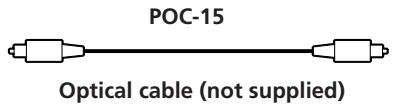
Connect the component via the DIGITAL OUT (OPTICAL) connector using an optical cable (not supplied). Take off the cap and plug in the optical cable.
![graph LR A["CD player"] --> B["DIGITAL OUT"] B --> C["OPTICAL"] C --> D["→"] D --> E["DIGITAL INPUT"] E --> F["OPTICAL"] F --> G["→"]](/content/2024/11/50752/images/fe19da298055a2c41296ca739f69c5041f4627dad54cf5b68722752e046f2a5e.jpg)
Note
When you connect via the DIGITAL OUT (OPTICAL) connector, noise may occur when you play CD software other than music, such as a CD-ROM.

When to use the COMMAND MODE selector
The COMMAND MODE selector is set to CD1 at the factory for normal use. You can control this player by connecting to a Sony CD Player with the player control function, via the CONTROL A1 jacks. When making this connection, set the COMMAND MODE selectors of each player to the appropriate position according to the connected line input jacks. For details, refer to the instructions supplied with the connected player.
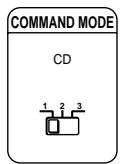

When using another Sony CD player together with this player
You can make the supplied remote effective only for this player.
- When using the player equipped with the COMMAND MODE selector: Set the COMMAND MODE selector of this player to CD1 and that of another player to CD2 or CD3. Then set the CD1/2/3 switch on the remote supplied for each player accordingly.
- When using the player not equipped with the COMMAND MODE selector: The command mode of the player without the COMMAND MODE selector is set to CD1. Set the COMMAND MODE selector of this player to CD2, and set the CD1/2/3 switch on the remote to CD2.
Setting the VOLTAGE SELECTOR (except for European, Canadian and Singaporean models)
Check that the VOLTAGE SELECTOR on the rear panel of the player is set to the local power line voltage. If not, set the selector to the correct position using a screwdriver before connecting the AC power cord to a wall outlet.
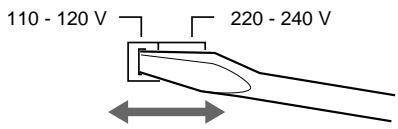
Connecting the AC power cord
Connect the AC power cord to a wall outlet.
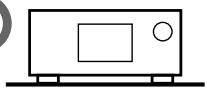
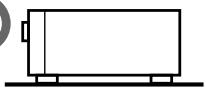
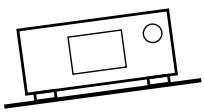
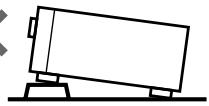
Note on placement
Be sure to place the player on a horizontal place.
If the player is slanted, it may cause malfunction or damage the player.




Inserting CDs
You can insert up to 200 discs into this player.
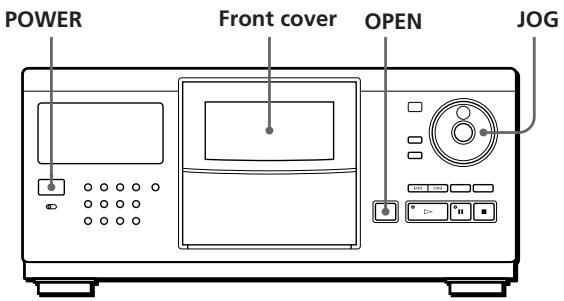
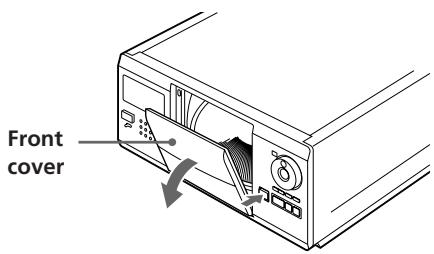
1 Press POWER to turn on the player. 2 Press OPEN.
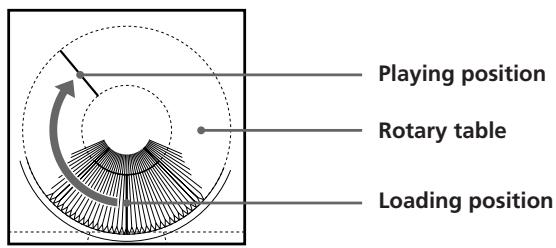
3 Turn the JOG dial until you find the disc slot where you want to insert a disc, while checking the disc number (written beside every five slots and also indicated in the display).
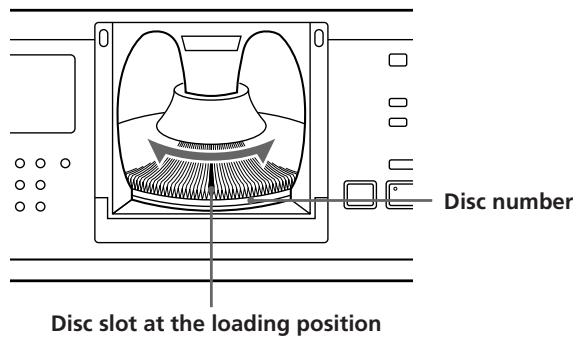
The disc number at the loading position appears in the display.* If the disc has the Disc Memo (see page 17), the Disc Memo appears instead of the disc number. As you turn the JOG dial, the disc number or the Disc Memo changes.
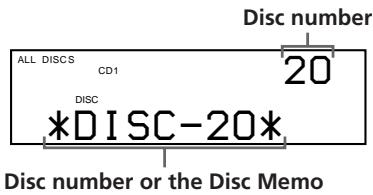
* If you have already inserted discs, the disc number at the playing position appears. When you turn the JOG dial, the displayed disc number changes to the one at the loading position.
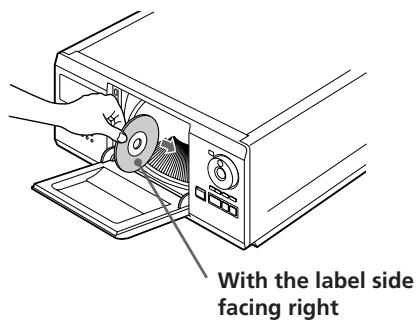
4 Insert a disc with the label side facing right.
Notes
- Make sure you have inserted the disc into each slot at a right angle to the rotary table. If the disc is not put in straight, it may damage the player or the disc.
- Make sure the rotary table comes to a complete stop before inserting or removing discs.
After inserting the disc, you can input the original disc titles instead of the disc numbers (see "Labeling Discs" on page 17) to locate it easily when you start playing.
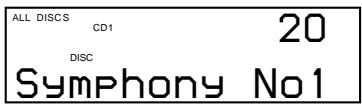
5 Repeat Steps 3 and 4 to insert more discs. 6 Close the front cover by pressing the right edge of the cover until it clicks.
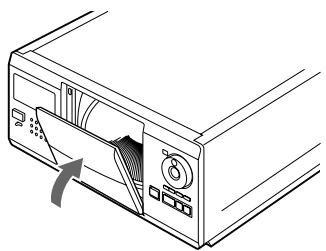
The rotary table turns and the disc slot at the loading position is set to the playing position.
Always close the front cover except when you insert or remove discs.

The supplied CD booklet holders help you locate a disc
You can store up to 200 CD booklets. Insert a booklet and stick the number label on the film of a pocket and the booklet so that you can locate the disc easily.
Notes
- When you insert an 8 cm (3-inch) CD, be sure to attach a Sony CSA-8 adaptor (not supplied) to the disc. Do not insert an empty 8 cm (3-inch) CD adaptor (CSA-8). It may damage the player.
- Do not attach anything such as seals or sleeves to CDs. It may damage the player or the disc.
- If you drop a disc into the player and the CD won't go into the slot correctly, consult your nearest Sony dealer.
- When transporting the player, remove all discs from the player.
Removing CDs
After following Steps 1 to 3 of "Inserting CDs" on page 6, remove the discs. Then close the front cover.
Note
The disc being played does not come to the loading position if you open the front cover during playback. (The disc number flashes in the display.)
If you want to remove the disc being played, press ENTER in the center of the JOG dial after opening the front cover. The disc comes to the loading position. Remove the disc after the rotary table comes to a complete stop.
Playing a CD
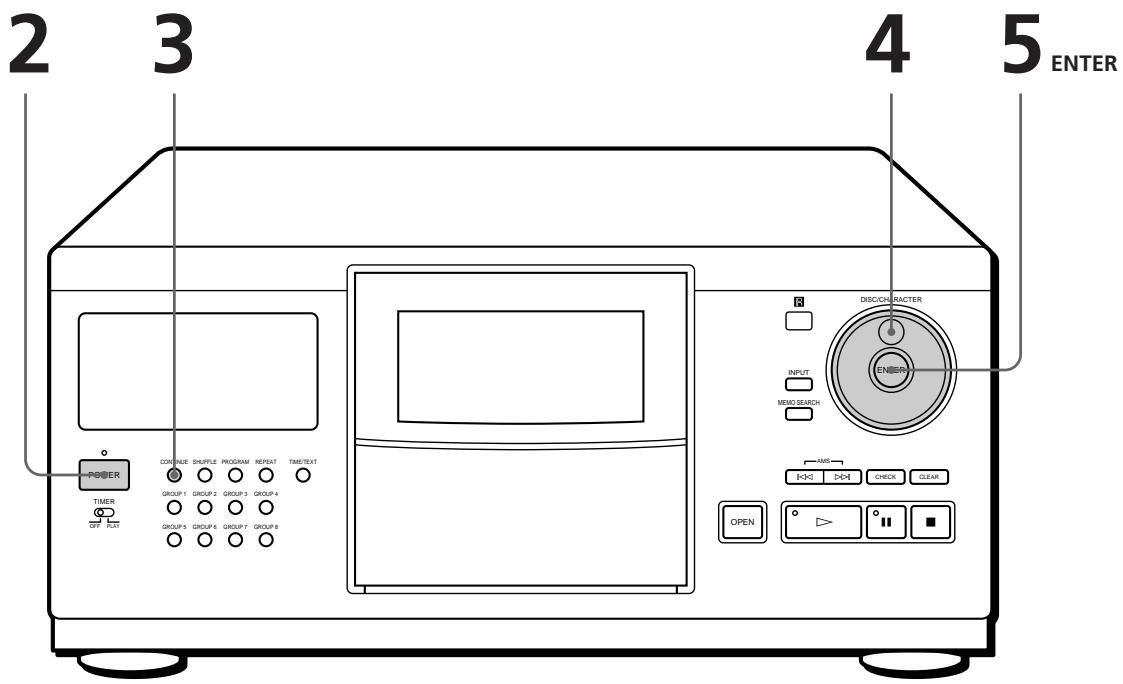
- See pages 4 – 5 for the hookup information.
- Make sure you have inserted the discs correctly as indicated on page 6.
- You can play all the tracks on a disc in the original order (Continuous Play). You can also play up to 200 discs consecutively.

You can turn on the player by pressing POWER on the remote
1 Turn on the amplifier and select the CD player position. 2 Press POWER to turn on the player. 3 Press CONTINUE to select ALL DISCS or 1 DISC Continuous Play mode. Each time you press CONTINUE, "ALL DISCS" or "1 DISC" appears in the display.
| When you select | The player plays |
| ALL DISCS | All discs in the player consecutively in the order of disc number. Empty disc slots are skipped. |
| 1 DISC | Only one disc you have selected |
4 Turn the JOG dial until the disc number or the Disc Memo (see page 17) you want appears in the display to select the first disc (ALL DISCS) or the disc you want (1 DISC).
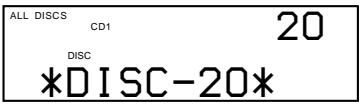

When you turn off the player The player remembers the last playing disc and the play mode (Continuous, Shuffle (see page 13) or Program (see page 14)). When you turn on the player again, therefore, the player plays the same disc in the same play mode.
5 Press ENTER to start playing.
The selected disc is set to the playing position, and the player plays all the discs from the selected one (ALL DISCS) or all the tracks once (1 DISC).
Adjust the volume on the amplifier.
To stop playback
Press ■.
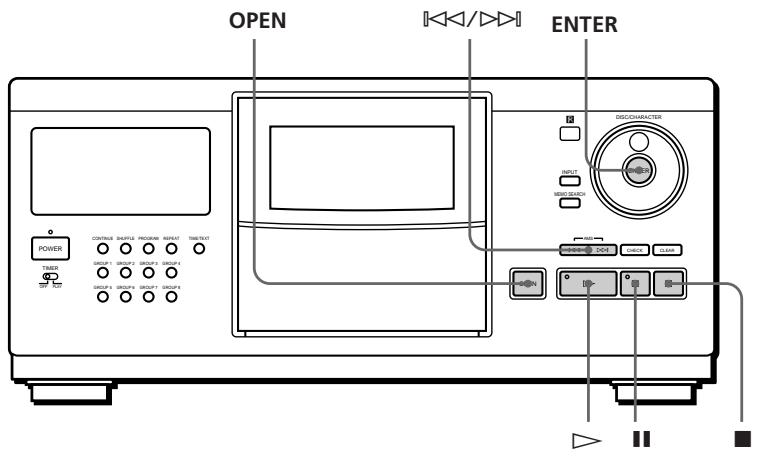
| To | Press |
| Pause | |
| Resume playing after pause | or |
| Go to the next disc | DISC SKIP + once.Hold down the button to skip discs. |
| Go back to the preceding disc | DISC SKIP – once.Hold down the button to skip discs. |
| Go to the next track | |
| Go back to the preceding track | |
| Stop playing and remove the disc | OPEN and then ENTER. The disc comes to the loading position. |
Using the Display
You can check information about the disc using the display.
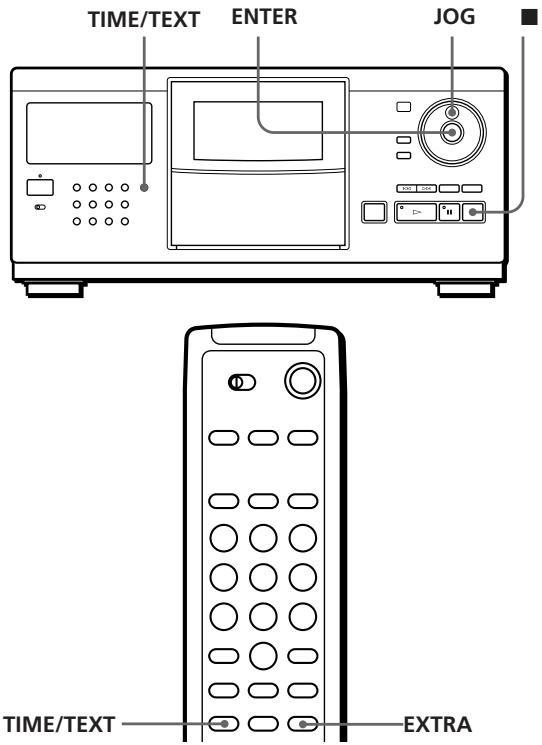
Checking the total number and playing time of the tracks
Select the disc you want to check, and press ENTER in the Continuous Play mode. As the player starts play automatically, press ■ to stop, and then TIME/TEXT. The display shows the current disc number, total number of tracks and total playing time of the disc.
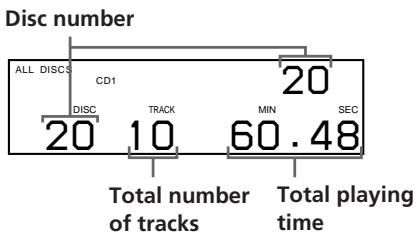

When you want to check another disc
Press DISC SKIP on the remote in the stop mode to select the disc you want to check. The total number of tracks and the total playing time of the selected disc appear for a while.
Display information while playing a disc
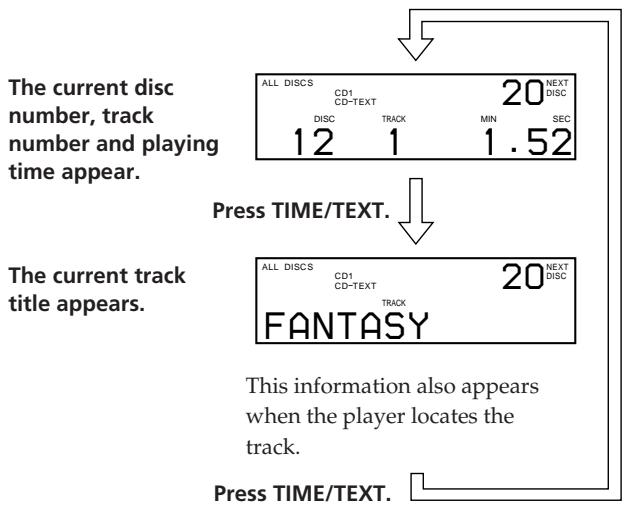
While playing a disc, the display shows the current disc number, track number, playing time of the track and the next disc number.
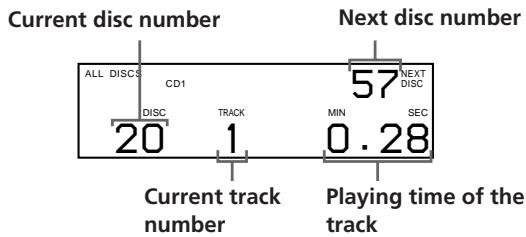
Checking the information of CD-TEXT discs
CD-TEXT discs have information, such as the disc titles or artist names, memorized in a blank space on the discs where there is no information on normal discs. The display shows the CD-TEXT information of the disc so that you can check the current disc title, track title and artist name. When you select a CD-TEXT disc, the “CD-TEXT” indication lights up in the display.
Display information before you start playing
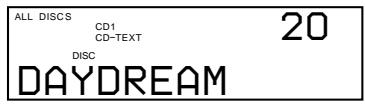
The display shows the disc title. When you press TIME/TEXT, the artist name scrolls in the display. If you press TIME/TEXT again, the display shows the current disc number, total number of tracks and total playing time of the disc. The display shows the disc title again after a while.
Display information while playing a disc
Each time you press TIME/TEXT, the display shows the information as shown below.
To play disc highlights
Some CD-TEXT discs have a feature to play only the
highlights of the discs.
Press EXTRA to start playing disc highlights in the stop mode.
“▷” flashes while playing disc highlights.
If you press EXTRA while selecting discs without this feature,
"NO EXTRA" appears in the display.
Locating a Specific Disc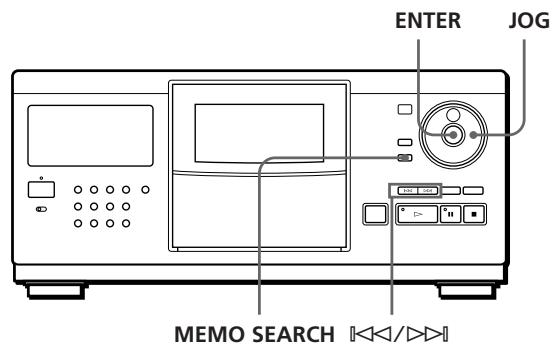
Selecting a disc on the player
Turn the JOG dial until the disc number or Disc Memo (see page 17) you want appears in the display. Press ENTER to start play.
Selecting a disc directly using the remote
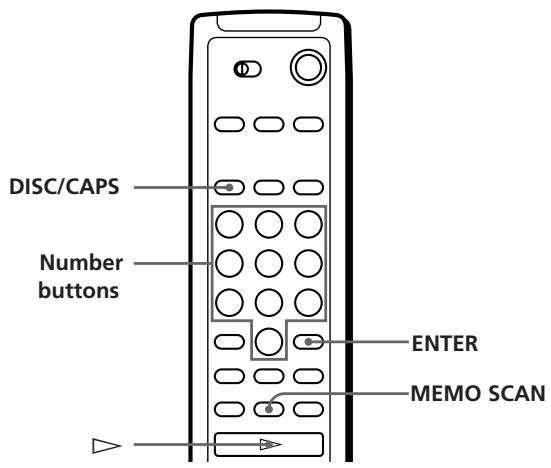
1 Press DISC/CAPS.
2 Press the number button of the disc.
Example: To enter number 35
Press 3, then 5.
To enter number 100
Press 1, then 0 twice.
3 Press ENTER to start play.
Locating a disc by scanning each Disc Memo (Memo Scan)
You can locate a disc you want to play quickly by scanning the Disc Memos (see page 17) in the display and start playing.
Note that you cannot use this function in the ALL DISCS Shuffle Play mode.
1 Press MEMO SCAN.
"MEMO SCAN" appears in the display, and the Disc Memos scroll in the display.
2 Press ▷ when the Disc Memo of the disc you want to play appears.
The disc is set to the playing position, and the player starts playing.
In Program Play mode, the disc will be added to the end of the program if you press ENTER instead of ▷.
Note
If “NO ENTRY” appears in the display, no disc has been labeled with the Disc Memo. Try the Memo Scan function again after labeling the discs.
Locating a disc by searching a specific Disc Memo (Memo Search)
You can search and locate a disc you want by inputting the first character used in the Disc Memo (see page 17).
1 Press MEMO SEARCH.
"MEMO SEARCH" appears in the display.
2 Press ◀◀◀/▶▶▶ repeatedly to input the first character.
Input character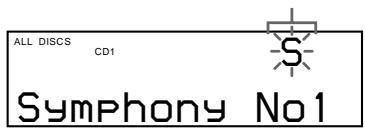
Each time you press ◀◀◀/▶▶▶, the characters appear in the following order.
ABCDEFGHIJKLMNOPQRSTUVWXYZ0123456789
If "NOT FOUND" appears in the display while inputting the first character with the ◀◀◀/▶▶▶ buttons, no disc has been labeled using the input character.
(Continued)
Notes
- When searching input characters, blanks and symbols before the first character in the Disc Memo are ignored.
- When searching input characters, upper and lower cases cannot be differentiated.
3 Turn the JOG dial to find the disc you want.
As you turn the JOG dial, the Disc Memos starting with the input character appear in the display.
4 Press ENTER to select the disc.
In Program Play mode, the disc will be added to the end of the program.
To cancel Memo Search
Press MEMO SEARCH again.

If there is no more Disc Memo starting with the input character in Step 3
The input character changes to the next one when you turn the JOG dial.
Specifying the Next Disc to Play
You can specify the next disc to play while playing a disc in Continuous or 1 DISC Shuffle Play mode.
While playing a disc, turn the JOG dial until the disc number or Disc Memo (see page 17) you want appears in the display.
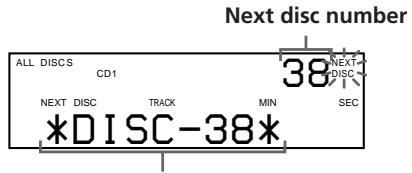
Next disc number or Disc Memo appears for a while.
After the current disc is played, the next disc you have specified starts playing.
If you want to skip to the next disc right away, press ENTER while playing the current disc.
To cancel the disc you have specified
Press CONTINUE twice.
Locating a Specific Track or a Point in a Track
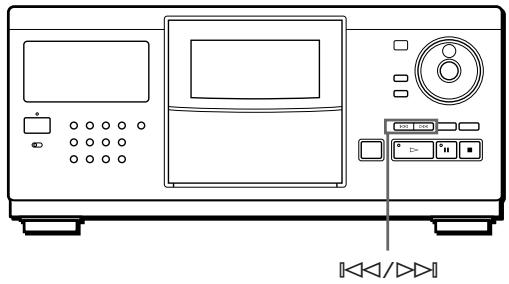
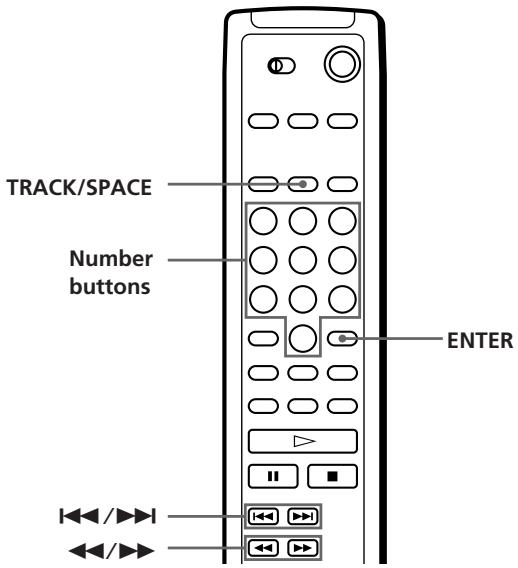
You can quickly locate any track while playing a disc using the ⚠/▶▶ (AMS: Automatic Music Sensor) buttons or number buttons on the remote. You can also locate a specific point in a track while playing a disc.
| To locate | Press |
| the next or succeeding tracks | repeatedly until you find the track |
| the current or preceding tracks | IK repeatedly until you find the track |
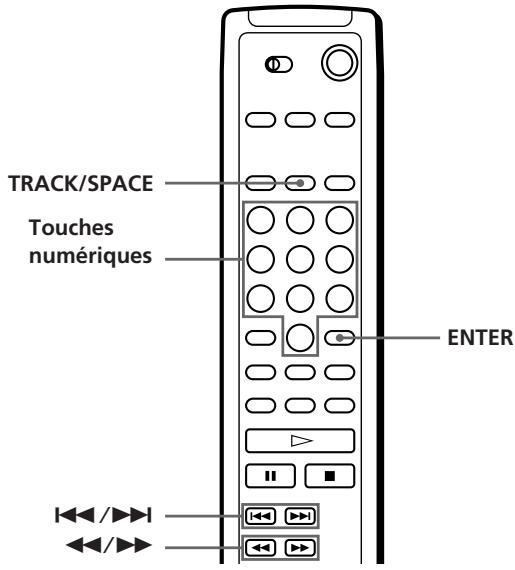
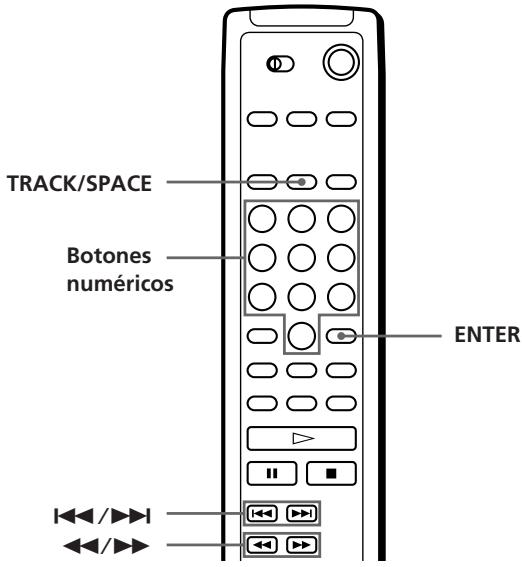
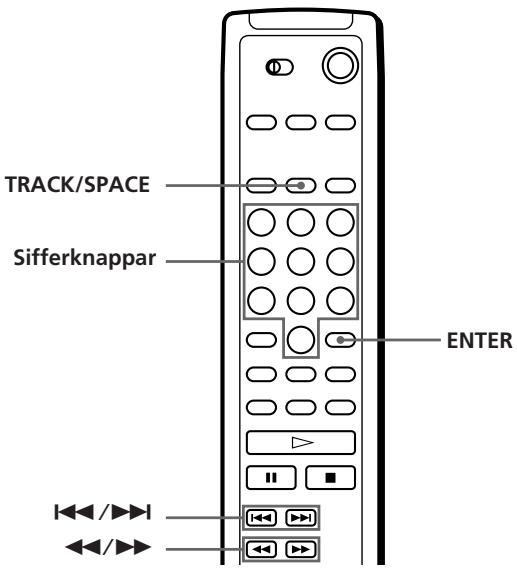
| a specific track directly [IMAGE] | TRACK/SPACE, the number button of the track, and then ENTER. When you locate a track with a number over 10, press the 10’s digit first, then the 1’s digit. |
| a point in a track while monitoring the sound [IMAGE] | (forward) or (backward) and hold down until you find the point |
| a point in a track quickly by observing the display [IMAGE] | (forward) or (backward) and hold down until you find the point during pause. You will not hear the sound during the operation. |
Note
If "OVER" appears in the display, the disc has reached the end while you were pressing ▶. Press ◀◀ or ◀◀◀ to go back.
Playing Repeatedly
You can play discs/tracks repeatedly in any play mode.
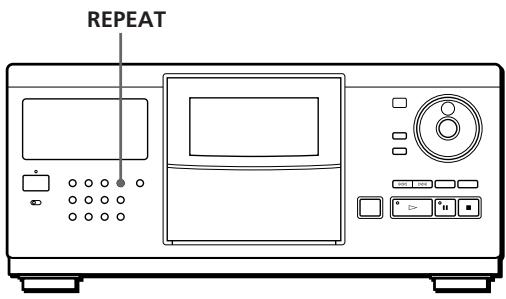
Press REPEAT while playing a disc.
"REPEAT" appears in the display. The player repeats the discs/tracks as follows:
| When the disc is played in | The player repeats |
| ALL DISCS Continuous Play (page 8) | All tracks on all discs |
| 1 DISC Continuous Play (page 8) | All tracks on the current disc |
| ALL DISCS Shuffle Play (page 13) | All tracks on all discs in random order |
| 1 DISC Shuffle Play (page 13) | All tracks on the current disc in random order |
| Program Play (page 14) | The same program |
To cancel Repeat Play
Press REPEAT repeatedly until "REPEAT OFF" appears in the display.
Repeating the current track
You can repeat only the current track.
While the track you want is being played, press REPEAT repeatedly until “REPEAT 1” appears in the display.
Playing in Random Order (Shuffle Play)
You can have the player “shuffle” the tracks and play in random order. The player shuffles all the tracks on all discs or on the disc you specified.
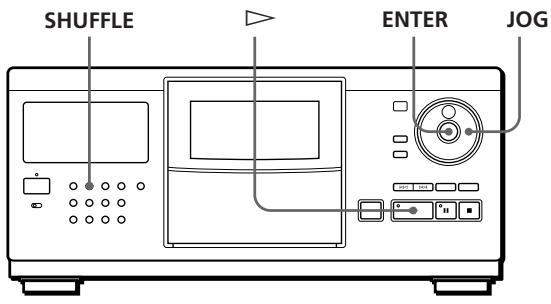
1 Press SHUFFLE to select ALL DISCS or 1 DISC Shuffle Play mode.
Each time you press SHUFFLE, "ALL DISCS" or "1 DISC" appears in the display.
| When you select | The player plays |
| ALL DISCS | All tracks on all discs in random order |
| 1 DISC | All tracks on the specific disc in random order |
2 When you want to specify the disc for 1 DISC Shuffle Play, turn the JOG dial until the disc number or Disc Memo (see page 17) you want appears in the display.
3 Press ENTER or ▷.
ALL DISCS or 1 DISC Shuffle Play starts.
“[ ]” appears in the display while the player is “shuffling” the discs or the tracks.
To cancel Shuffle Play
Press CONTINUE.
You can start Shuffle Play while playing
Press SHUFFLE, and Shuffle Play starts from the current track.
You can directly select a disc for 1 DISC Shuffle Play
See "Selecting a disc directly using the remote" on page 11.

You can go to the next disc during 1 DISC Shuffle Play.
Press DISC SKIP +.


You can specify the next disc to play during 1 DISC Shuffle Play.
Turn the JOG dial to specify the next disc. After all the tracks on the current disc are played in random order, the next disc starts playing. If you want to skip to the next disc right away, press ENTER while playing the current disc.
Notes
- You cannot specify the next disc to play during ALL DISCS Shuffle Play.
- Even if you press ■ or turn off the player during ALL DISCS Shuffle Play, the player remembers which discs/tracks were played and which were not. Therefore, if you want to start ALL DISCS Shuffle Play again from the beginning, be sure to repeat the procedure from Step 1.
Creating Your Own Program (Program Play)
You can arrange the order of the tracks and/or discs to create three different programs and programs are stored automatically. A program can contain up to 32 "steps" — one "step" may contain a track or a whole disc.
You can make programs using the controls on the remote as well as ones on the player. However, the programming procedures are different.
Creating a program on the player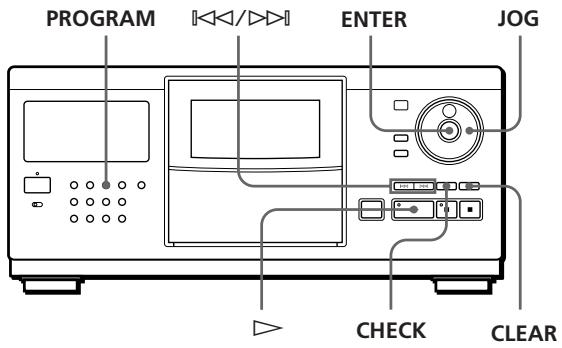
1 Press PROGRAM until the program number you want (PROGRAM 1, 2 or 3) appears in the display. If a program is already stored in the selected program number, the last step of the program appears in the display. When you want to erase the whole program, hold down CLEAR until "ALL CLEAR" appears in the display (see page 16). 2 Turn the JOG dial until the disc number you want appears in the display.

3 To program a whole disc, skip this step. Press <</>> until the track number you want appears in the display.
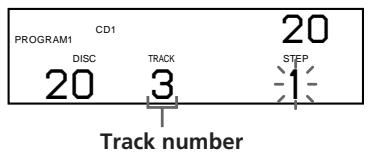
4 Press ENTER or PROGRAM.
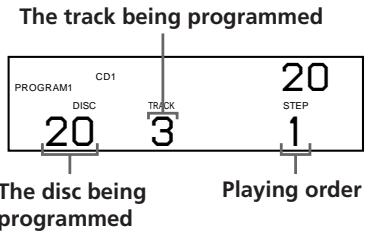
5 To program other discs/tracks, do the following:
| To program | Repeat Steps |
| Other discs | 2 and 4 |
| Other tracks on the same disc | 3 and 4 |
| Other tracks on other discs | 2 to 4 |
6 Press ▷ to start Program Play.
To cancel Program Play
Press CONTINUE.

The programs remain even after Program Play ends
When you press ▷, you can play the same program again.

When you press PROGRAM during Continuous or Shuffle Play
The program will be played after the current track.

The programs remain until you erase them
If you replace discs, the programmed disc and track numbers remain. So, the player plays only the existing disc and track numbers. However, the disc and track numbers that are not found in the player or on the disc are deleted from the program, and the rest of the program is played in the programmed order.
Creating a program using the remote
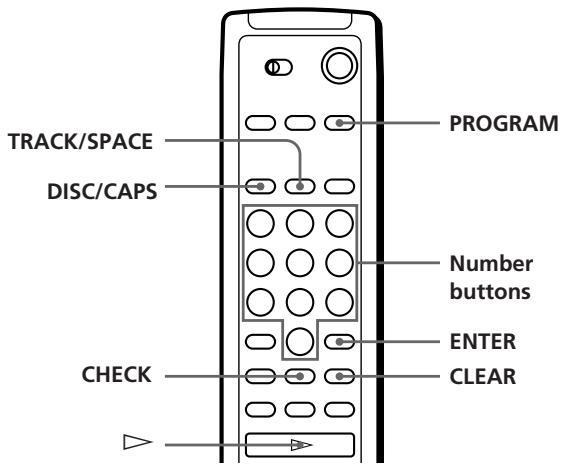
1 Press PROGRAM until the program number you want (PROGRAM 1, 2 or 3) appears in the display.
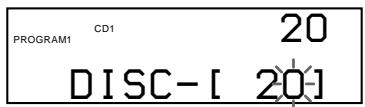
2 Press DISC/CAPS.
![PROGRAM1 CD1 20 DISC-[ *]](/content/2024/11/50752/images/347c9848315c1d3faa4bfbd24f9ea1769f1851dee3f78cb0a63f0c79bbc9088c.jpg)
3 Press the number button of the disc.
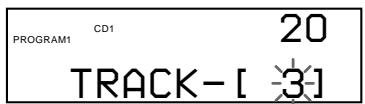
4 To program a whole disc, skip this step and go to Step 6. Press TRACK/SPACE.
![PROGRAM1 CD1 20 TRACK- [ * ]](/content/2024/11/50752/images/40d61a0d5ea75657295789cd3f28ffe9f57ce958967c887e27caea07d559b74a.jpg)
5 Press the number button of the track.
6 Press ENTER.
The disc being programmed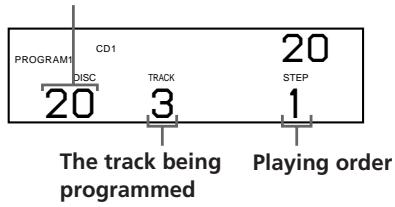
7 To program other discs/tracks, do the following:
| To program | Repeat Steps |
| Other discs | 2, 3 and 6 |
| Other tracks on the same disc | 4 to 6 |
| Other tracks on other discs | 2 to 6 |
8 Press ▷ to start Program Play.
To cancel Program Play
Press CONTINUE.
Checking the programmed order
You can check your program before or after you start playing.
Press CHECK.
Each time you press this button, the display shows the disc and track number of each step in the programmed order. (When a whole disc is programmed as one step, "ALL" appears instead of the track number.) After the last step in the program, the display shows "END" and returns to the original display.
Changing the programmed order
You can change your program before you start playing.
| To | You need to |
| Erase a track or disc | Press CHECK until the track or disc you do not want appears in the display, then press CLEAR |
| Erase the last track or disc in the program | Press CLEAR. Each time you press the button, the last track or disc will be cleared. |
| Add tracks or discs to the end of the program | Follow the programming procedure |
| Change the whole program completely | Hold down CLEAR until “ALL CLEAR” appears in the display to erase the whole program, then create a new program following the programming procedure |
Erasing the programs stored in memory
1 Press PROGRAM repeatedly in the stop mode until the program number (PROGRAM 1, 2 or 3) you want to erase appears in the display. 2 Hold down CLEAR until "ALL CLEAR" appears in the display.
Playing Using a Timer
You can start playing a disc at any time by connecting a timer (not supplied). Please also refer to the instructions for the timer if you need help.
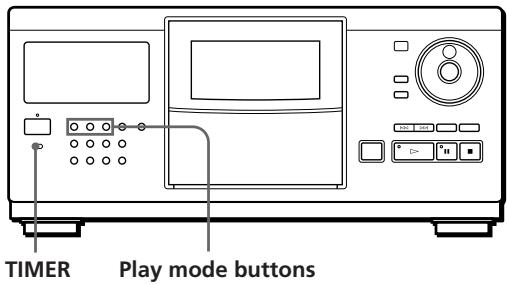
1 Press one of the play mode buttons to select the play mode you want. 2 Set TIMER on the player to PLAY. 3 Set the timer to the time you want. The player turns off. When the set time comes, the player turns on and starts playing. 4 After you have used the timer, set TIMER on the player to OFF.
What You Can Do With the Custom Files
The player can store three types of information called "Custom Files" for each disc. Once you have stored Custom Files for a disc, the player automatically recalls what you have stored whenever you select the disc. Note that Custom Files will be erased if you do not use the player for about one month.
You can store this information:
| When you use | You can |
| Disc Memo (page 17) | Label discs using up to 13 characters |
| Delete Bank (page 19) | Delete unwanted tracks and store only the tracks you want |
| Group File (page 20) | Group discs up to eight groups to locate them easily |
Where are Custom Files stored?
Custom Files are stored not on the disc, but in the player's memory. This means you cannot use Custom Files when you play the disc on other players.
If you replace discs you have filed in the Custom Files
The Custom File information you have stored remains, since each Custom File information is assigned to each slot. Erase all Custom Files (Disc Memo, Delete Bank and Group File) of the old disc, and then file the new disc information in the Custom Files.
Erasing all Custom Files of all discs
Turn off the player. While holding down CLEAR, press POWER to turn on the player. "ALL ERASE" appears in the display, and all Custom Files will be erased.
Labeling Discs (Disc Memo)
You can label discs using up to 13 characters and have the player display the Disc Memo each time you select the disc. The Disc Memo can be anything you like, such as a title, musician's name, category or date of purchase.

When you select a CD-TEXT disc
The disc title is stored as the Disc Memo automatically. If the disc title has more than 13 characters, the first 13 characters of the disc title are stored (see page 10).
When you replace a disc with a CD-TEXT disc, the disc title of the CD-TEXT disc is also stored automatically. Note that you cannot change the Disc Memo of the CD-TEXT disc.

You can label discs while the front cover is open.
Labeling discs on the player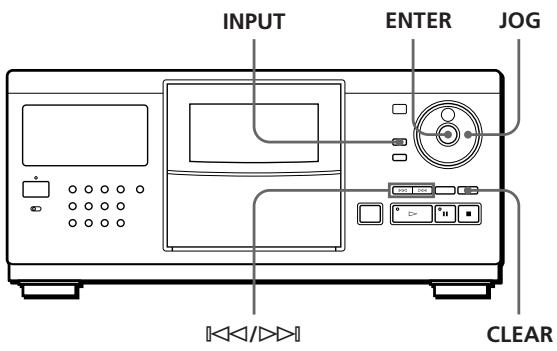
1 Turn the JOG dial until the disc number to which you want to assign a Disc Memo appears in the display.
When you label a disc with the front cover closed, the disc number of the disc at the playing position appears.
When you label a disc with the front cover open, the disc number at the loading position appears.
2 Press INPUT.
3 Turn the JOG dial until "DISC MEMO" appears in the display, and then press ENTER.
The flashing cursor (◀) appears.
(Continued)
4 Turn the JOG dial until the character you want appears in the display.
The cursor disappears and the first space for the Disc Memo flashes.
As you turn the JOG dial clockwise, the characters appear in the following order. Turn the JOG dial counterclockwise to go back to the previous character.
(space) A B C D E F G H I J K L M N O P Q R S T U V W X Y Z a b c d e f g h i j k l m n o p q r s t u v w x y z 0 1 2 3 4 5 6 7 8 9 ! " # $ % & ' () * + , - . / : ; < = > ? @ [ ¥ ] ^ _ \ { ! } \~
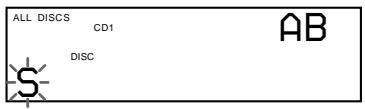
5 Press ENTER to select the character.
The selected character lights up, and the flashing cursor appears to indicate the next space to be input.
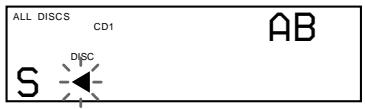
If you have made a mistake
Press CLEAR and begin again by inputting the correct characters.
6 Repeat Steps 4 and 5 to input more characters.
7 Press INPUT to store the Disc Memo.
The Disc Memo lights up in the display.
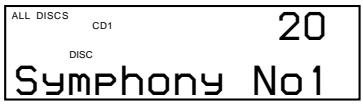
Repeat Steps 1 to 7 to assign Disc Memos to other discs.
Labeling discs using the remote

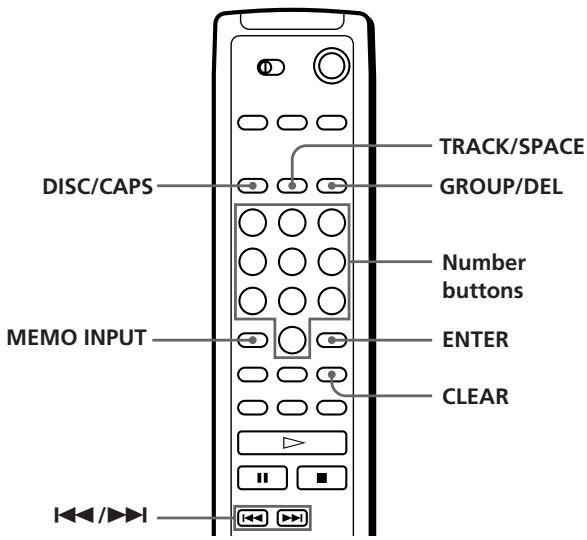
1 Press DISC/CAPS. 2 Press the number button of the disc you want to assign a Disc Memo, and then ENTER. 3 Press MEMO INPUT.
The flashing cursor (◀) appears.
4 Press DISC/CAPS to find the letter type you want. Each time you press the button, the letter type changes cyclically among capital letters (AB), small letters (ab) and numbers (12). The selected letter type appears in the upper right corner of the display. 5 Press the number button corresponding to the character you want (indicated beside each number button).
The cursor disappears and the first space for the Disc Memo flashes.
Each time you press the button, the character changes cyclically among the ones indicated beside the button.
![graph TD A["&I?"] --> B["ABC"] B --> C["DEF"] D["GHI"] --> E["JKL"] E --> F["MNO"] G["PRS"] --> H["TUV"] H --> I["WXY"] J["MEMO INPUT"] --> K["QZ"] K --> L["ENTER"]](/content/2024/11/50752/images/6f9cc169e56ae025740b347f5c0b604dc06a4c9151dd4ce1e6769ae7c26214d5.jpg)
Characters assigned to each number button
Example: To select the letter E
Press the number button 3 twice.
Press 3.
To insert a space, press TRACK/SPACE once. To input a number, press DISC/CAPS twice in Step 4, then press the number button you want. To input symbols, press the number button 1 repeatedly until the symbol you want appears in the display.
6 Press ENTER to select the character.
The selected character lights up, and the flashing cursor appears to indicate the next space to be input.
You can also go to the next space by pressing other number buttons.
7 Repeat Steps 4 through 6 to input more characters.
8 Press MEMO INPUT to store the Disc Memo.
The Disc Memo lights up in the display.
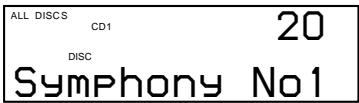
Repeat Steps 1 through 8 to assign Disc Memos to other discs.

If you have made a mistake while inputting the character
To correct the character which has been input
1 Press ◀◀ or ▶▶ until the cursor moves next to the incorrect character.
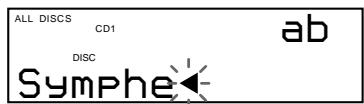
2 Press GROUP/DEL to delete the incorrect character.
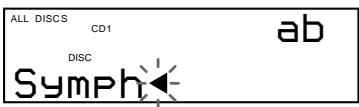
3 Input the correct character.
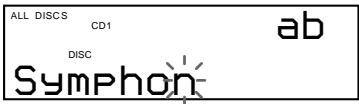
To correct the character currently being input
1 Press GROUP/DEL to delete the incorrect character. 2 Input the correct character.
To insert a character between the input characters
Press ◀◀◀ or ▶▶◀ until the cursor moves next to the point you want to insert, and enter the character.
Erasing the Disc Memo
1 Follow Steps 1 through 3 in "Labeling discs on the player" on page 17 or "Labeling discs using the remote" on page 18 to select the Disc Memo you want to erase. 2 Press CLEAR. The Disc Memo disappears. 3 Press INPUT.
Storing Specific Tracks (Delete Bank)
You can delete unwanted tracks and store only the tracks you want. When you select the disc containing a Delete Bank, you can play only the remaining tracks.
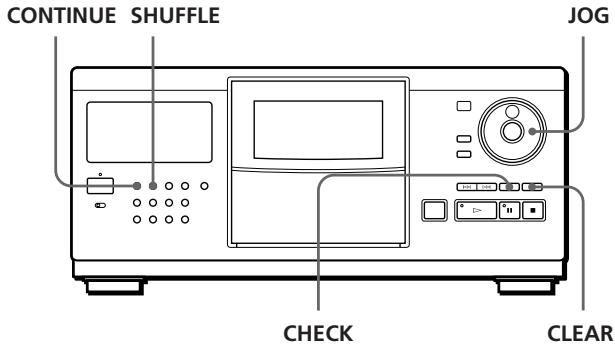
1 Press CONTINUE or SHUFFLE before you start playing. 2 Turn the JOG dial to select the disc. 3 Press CHECK repeatedly until the track you want to delete appears in the display.
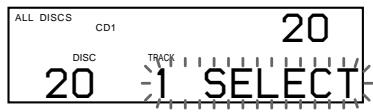
(Continued)
4 Press CLEAR.
"DELETE FILE" appears, and "DELETE" flashes in the display.
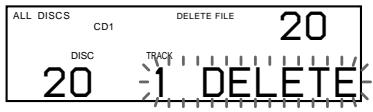
If you want to recover the track, press CLEAR again.
5 Repeat Steps 3 and 4 to delete more tracks.

You can recover all the tracks you have deleted
Hold down CLEAR until "ALL SELECT" appears in the display.
Note
The deleted tracks are skipped even in the Shuffle or Program Play mode (when the whole disc containing a Delete Bank is programmed as one step).
Grouping Discs (Group File)
You might find that too many discs make it hard to find the disc you want. This player has a feature that lets you classify discs into eight groups. One disc can be put into only one group.
Once you classify discs, you can enjoy Continuous, Shuffle or Repeat Play only within a certain group (Group Play).
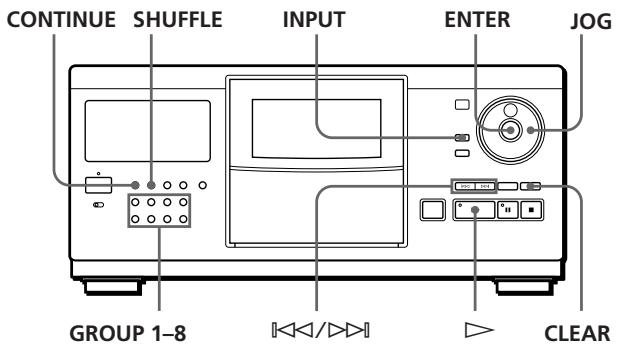
Putting discs into groups
1 Press CONTINUE or SHUFFLE before you start playing. 2 Turn the JOG dial to select the disc which you want to put into a group. 3 Press INPUT.
4 Turn the JOG dial until "GROUP FILE" appears in the display, and then press ENTER.
If the disc has not been put into any group, "NOT FILED" appears in the display.
5 Turn the JOG dial until the group number you want (e.g., GROUP 1) appears in the display.
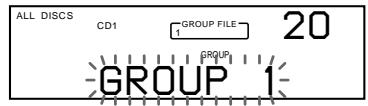
6 Press ENTER or INPUT to select the group.
Labeling groups (Group Memo)
You can change the preset group number to anything you like, such as a category, using up to 13 characters. Note that you cannot store the Group Memo if you have not put any disc into the group.
1 Press one of the GROUP 1–8 buttons to which you want to assign a Group Memo. 2 Press INPUT. 3 Turn the JOG dial until "GROUP MEMO" appears in the display, and then press ENTER. The flashing cursor (◀) appears. 4 Turn the JOG dial until the character you want appears in the display.
The cursor disappears and the first space for the Group Memo flashes.
As you turn the JOG dial clockwise, the characters appear in the following order. Turn the JOG dial counterclockwise to go back to the previous character.
(space) A B C D E F G H I J K L M N O P Q R S T U V W X Y Z a b c d e f g h i j k l m n o p q r s t u v w x y z 0 1 2 3 4 5 6 7 8 9 ! " # % & ' ( ) * + , - . / : ; < = > ? @ [ \ ] ^ _ ` { | } ~
5 Press ENTER to select the character.
The selected character lights up, and the flashing cursor appears to indicate the next space to be input.
If you have made a mistake
Press CLEAR and begin again by inputting the correct characters.
6 Repeat Steps 4 and 5 to input more characters. See also "Labeling discs on the player" on page 17 for details. 7 Press INPUT to store the Group Memo.
Erasing the Group Memo
1 Follow Steps 1 to 3 in "Labeling groups" to select the Group Memo you want to erase. 2 Press CLEAR. The Group Memo disappears. 3 Press INPUT.
Playing discs in a group (Group Play)
You can enjoy Continuous or Shuffle Play within a group.
1 Press CONTINUE or SHUFFLE to select the play mode you want before you start playing.
| When you select | The player plays |
| ALL DISCS Continuous Play | All tracks on all discs in the group consecutively |
| 1 DISC Continuous Play | All tracks on the specified disc in the group consecutively |
| ALL DISCS Shuffle Play | All tracks on all discs in the group in random order |
| 1 DISC Shuffle Play | All tracks on the specified disc in the group in random order |
2 Press one of the GROUP 1–8 buttons to select the group and press ▷.
Group Play starts from the disc which is the most upward number and located closest to the playing position. If the disc at the playing position is put into the selected group, the play starts from that disc.

You can specify the first disc to play when starting Group Play
After selecting the group, turn the JOG dial to select the disc, then press ENTER.

You can start Group Play using the remote
Before you start playing, press GROUP/DEL, the number button of the group you want to play, then ENTER.
Note
If "NO ENTRY" appears in the display, no disc has been put into the selected group.
Deleting discs from a group
• To delete a disc from a group
1 Follow Steps 1 through 4 in "Putting discs into groups" on page 20 to select the disc. 2 Press CLEAR.
"NOT FILED" appears in the display.
3 Press INPUT.
• To delete all discs from a group at once
While holding down one of the GROUP 1–8 buttons you want to clear, press CLEAR.
Precautions
On safety
- Caution — The use of optical instruments with this product will increase eye hazard.
- Should any solid object or liquid fall into the cabinet, unplug the player and have it checked by qualified personnel before operating it any further.
On power sources
- Before operating the player, check that the operating voltage of the player is identical with your local power supply. The operating voltage is indicated on the nameplate at the rear of the player.
- The player is not disconnected from the AC power source (mains) as long as it is connected to the wall outlet, even if the player itself has been turned off.
- If you are not going to use the player for a long time, be sure to disconnect the player from the wall outlet. To disconnect the AC power cord (mains lead), grasp the plug itself; never pull the cord.
- AC power cord must be changed only at the qualified service shop.
On placement
- Place the player in a location with adequate ventilation to prevent heat build-up in the player.
- Do not place the player on a soft surface such as a rug that might block the ventilation holes on the bottom.
- Do not place the player in a location near heat sources, or in a place subject to direct sunlight, excessive dust or mechanical shock.
On operation
- If the player is brought directly from a cold to a warm location, or is placed in a very damp room, moisture may condense on the lenses inside the player. Should this occur, the player may not operate properly. In this case, leave the player turned on for about an hour until the moisture evaporates.
On adjusting volume
- Do not turn up the volume while listening to a portion with very low level inputs or no audio signals. If you do, the speakers may be damaged when a peak level portion is played.
On cleaning
- Clean the cabinet, panel and controls with a soft cloth slightly moistened with a mild detergent solution. Do not use any type of abrasive pad, scouring powder or solvent such as alcohol or benzine.
On transportation
- When transporting the player, press OPEN then remove all the discs from the player and turn the power off.
If you have any questions or problems concerning your player, please consult your nearest Sony dealer.
Notes on CDs
On handling CDs
- To keep the disc clean, handle the disc carefully.
- Do not stick paper or tape on the disc.
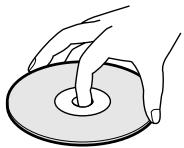
Not this way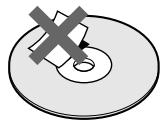
- Do not expose the disc to direct sunlight or heat sources such as hot air ducts, nor leave it in a car parked in direct sunlight as there can be considerable rise in temperature inside the car.
- After removing a disc from the disc slot, store the disc in its case.
On cleaning
- Before playing, clean the disc with a cleaning cloth. Wipe the disc from the center out.
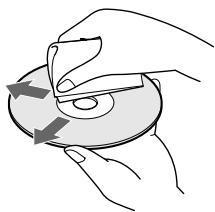
- Do not use solvents such as benzine, thinner, commercially available cleaners or anti-static spray intended for vinyl LPs.
Troubleshooting
If you experience any of the following difficulties while using the player, use this troubleshooting guide to help you remedy the problem. Should any problem persist, consult your nearest Sony dealer.
There is no sound.
→Check that the player is connected securely. →Make sure you operate the amplifier correctly.
The CD does not play.
→There is no CD in a slot (“-NO DISC-” appears). Insert a CD.
→Insert the CD with the label side facing right.
→Clean the CD (see page 22).
→Moisture has condensed inside the player. Press OPEN and leave the player turned on for about an hour (see page 22).
The remote does not function.
→Remove obstacles in the path of the remote and the player. →Point the remote at the remote sensor R on the player. →Replace all the batteries in the remote with new ones if they are weak. →Set the CD 1/2/3 switch on the remote according to the position of the COMMAND MODE selector displayed in the front panel display (see page 5).
The player functions incorrectly.
→The microcomputer chips may be operating incorrectly. Disconnect the AC power cord, then connect it back to the wall outlet to reset the player.
Specifications
Compact disc player
| Laser | Semiconductor laser ( λ = 780 nm)Emission duration: continuous |
| Laser output | Max 44.6 μW** This output is the value measured at a distance of 200 mm from the objective lens surface on the Optical Pick-up block with 7 mm aperture. |
| Frequency response | 20 Hz to 20 kHz ± 0.5 dB |
| Signal-to-noise ratio | More than 107 dB |
| Dynamic range | More than 98 dB |
| Harmonic distortion | Less than 0.0035% |
| Channel separation | More than 100 dB |
Outputs
| Jack type | Maximum output level | Load impedance | |
| LINE OUT | Phono jacks | 2 V (at 50 kilohms) | Over 10 kilohms |
| DIGITAL OUT (OPTICAL) | Optical output connector | -18 dBm | Wave length: 660 nm |
General
Power requirements
| Where purchased | Power requirements |
| Europe | 220 V – 230 V AC, 50 Hz |
| Canada | 120 V AC, 60 Hz |
| Other countries | 110 – 120 V or 220 – 240 V AC, adjustable, 50/60 Hz |
| Power consumption | 14 W |
| Dimensions (approx.) (w/h/d) | When the front cover is closed 430 × 200 × 480 mm (17 × 7\ 7/8 × 19 in.) incl. projecting partsWhen the front cover is open 430 × 200 × 600 mm (17 × 7\ 7/8 × 23\ 5/8 in.) incl. projecting parts |
| Mass (approx.) | 9.0 kg (19 lbs 14 oz) |
Supplied accessories: Audio cord (2 phono plugs - 2 phono plugs) (1), CONTROL A1 cord (1) (supplied for Canadian models only), Remote commander (remote) (1), Sony SUM-3 (NS) batteries (2), CD booklet holders (2), Label (1)
Audio cord (2 phono plugs - 2 phono plugs) (1) CONTROL A1 cord (1) (supplied for Canadian models only) Remote commander (remote) (1) Sony SUM-3 (NS) batteries (2) CD booklet holders (2) Label (1)
A, B
AMS 12
Automatic Music Sensor 12.
C
CD-TEXT 10
Connecting 4
Continuous Play 8
Custom Files
Delete Bank 19
Delete Bank 19
Disc Memo 17
Group File 20
what you can do with 17
D
Delete Bank 19
Disc Memo 17
E, F
Erasing
Custom Files 17
Delete Bank 20
Disc Memo 19
Group File 21
Group Memo 21
programs 16
G
Group File 20
Group Memo 20
Group Play 21
H
Handling CDs 22
Hookups
overview 4
|
Inserting CDs 6
J, K
JOG dial 6
L
Labeling a disc 17
Locating
a specific track 12
a specific point 12
by monitoring 12
by observing the display 12
directly 12
discs 11
using AMS 12
M, N, O
Memo Scan 11
Memo Search 11
P, Q
Playback
Continuous Play 8
Group Play 21
Program Play 14
Repeat Play 13
Shuffle Play 13
using a timer 16
Program
changing 16
checking 16
erasing 16
R
Remote control 4
Repeating 13
Rotary table 6
S
Searching. See Locating
Selecting a disc 11
Shuffle Play
on all discs 13
on one disc 13
Specifying the next disc 12
Storing
information about CDs 17
specific tracks 19
T
Timer Play 16
Total playing time 10
Troubleshooting 23
U
Unpacking 4
V, W, X, Y, Z
Voltage selector 5
Names of controls
Buttons
CHECK 16,19
CLEAR 16,19
CONTINUE 8
DISC/CAPS 11, 15, 18
DISC SKIP 9
ENTER 9
EXTRA 10
GROUP/DEL 19,21
GROUP 1-8 21
INPUT 17, 19, 20
MEMO INPUT 18
MEMO SCAN 11
MEMO SEARCH 11
Number 11
OPEN 6
PROGRAM 14
REPEAT 13
SHUFFLE 13
TIME/TEXT 10
TRACK/SPACE 12, 15
12
9
11 9
9

12
Switches
CD1/2/3 5
POWER 6
TIMER 16
Jacks
CONTROL A1 5
LINE OUT 5
Connectors
DIGITAL OUT (OPTICAL) 5
Others
COMMAND MODE selector 5
Disc slots 6
Display 10
Front cover 6
JOG dial 6,8
Rotary table 6
R 4
WARNING

Connections
DISC/CAPS 11, 15, 18
DISC SKIP 9
ENTER 9
EXTRA 10
GROUP/DEL 19,21
GROUP 1-8 21
INPUT 17, 19, 20
MEMO INPUT 18
MEMO SCAN 11
MEMO SEARCH 11
Numerics 11
OPEN 6
PROGRAM 14
REPEAT 13
SHUFFLE 13
TIME/TEXT 10
TRACK/SPACE 12, 15
12
9
11 9
9
◀◀/▶▶ 12
Switches
CD1/2/3 5
POWER 6
TIMER 16
Jacks
CONTROL A1 5
LINE OUT 5
Connectors
DIGITAL OUT OPTICAL 5
Miscellaneous
Front cover 6
JOG dial 6,8

1 Pulse MEMO SEARCH.
DIGITAL OUT (OPTICAL) 5
Others
Front cover 6 Disc slots 6 COMMAND MODE selector 5 JOG selector 6,8 Turntable 6 Display 10 R 4
WARNING
TABLE OF CONTENTS
Getting started
Unpacking 4
Connecting the system.... 4
Loading CDs 6
Playing a CD 8
Creating your own programs (Program Play).... 14

Create your own programs (Program Play)
DISC/CAPS 11, 15, 18
DISC SKIP 9
ENTER 9
EXTRA 10
GROUP/DEL 19,21
GROUP 1-8 21
INPUT 17, 19, 20
MEMO INPUT 18
MEMO SCAN 11
MEMO SEARCH 11
OPEN 6
PROGRAM 14
REPEAT 13
SHUFFLE 13
Number keys 11
TIME/TEXT 10
TRACK/SPACE 12,15
12
riangleright 9
|| 9
9

12
Switch
CD1/2/3 5
POWER 6
TIMER 16
Jack
CONTROL A1 5
LINE OUT 5
Connection
DIGITAL OUT (OPTICAL) 5
Other
Front cover 6
JOG dial 6,8
Rotating platter 6
Disc tray 6
Display window 10
COMMAND selector
MODE 5
R 4
- CAUTION
- WELCOME
- ABOUT THIS MANUAL
- CONVENTIONS
- TABLE OF CONTENTS
- GETTING STARTED
- PLAYING A CD
- PLAYING CDS
- STORING INFORMATION ABOUT CDS (CUSTOM FILES)
- ADDITIONAL INFORMATION
- INDEX
- UNPACKING
- HOW TO USE THE CD BOOKLET HOLDER
- INSERTING BATTERIES INTO THE REMOTE
- WHEN TO REPLACE BATTERIES
- NOTES
- HOOKING UP THE SYSTEM
- OVERVIEW
- WHAT CORDS WILL I NEED
- HOOKUPS
- IF YOU HAVE A SONY RECEIVER (AMPLIFIER) EQUIPPED WITH THE CONTROL A1 JACK
- IF YOU HAVE A DIGITAL COMPONENT SUCH AS A DIGITAL AMPLIFIER, D/A CONVERTER, DAT OR MD
- NOTE
- WHEN TO USE THE COMMAND MODE SELECTOR
- WHEN USING ANOTHER SONY CD PLAYER TOGETHER WITH THIS PLAYER
- SETTING THE VOLTAGE SELECTOR (EXCEPT FOR EUROPEAN, CANADIAN AND SINGAPOREAN MODELS)
- CONNECTING THE AC POWER CORD
- NOTE ON PLACEMENT
- INSERTING CDS
- THE SUPPLIED CD BOOKLET HOLDERS HELP YOU LOCATE A DISC
- REMOVING CDS
- PRESS ENTER TO START PLAYING
- TO STOP PLAYBACK
- USING THE DISPLAY
- CHECKING THE TOTAL NUMBER AND PLAYING TIME OF THE TRACKS
- WHEN YOU WANT TO CHECK ANOTHER DISC
- DISPLAY INFORMATION WHILE PLAYING A DISC
- CHECKING THE INFORMATION OF CD-TEXT DISCS
- DISPLAY INFORMATION BEFORE YOU START PLAYING
- TO PLAY DISC HIGHLIGHTS
- SELECTING A DISC ON THE PLAYER
- SELECTING A DISC DIRECTLY USING THE REMOTE
- LOCATING A DISC BY SCANNING EACH DISC MEMO (MEMO SCAN)
- LOCATING A DISC BY SEARCHING A SPECIFIC DISC MEMO (MEMO SEARCH)
- TURN THE JOG DIAL TO FIND THE DISC YOU WANT
- PRESS ENTER TO SELECT THE DISC
- TO CANCEL MEMO SEARCH
- IF THERE IS NO MORE DISC MEMO STARTING WITH THE INPUT CHARACTER IN STEP
- SPECIFYING THE NEXT DISC TO PLAY
- TO CANCEL THE DISC YOU HAVE SPECIFIED
- LOCATING A SPECIFIC TRACK OR A POINT IN A TRACK
- PLAYING REPEATEDLY
- TO CANCEL REPEAT PLAY
- REPEATING THE CURRENT TRACK
- PLAYING IN RANDOM ORDER (SHUFFLE PLAY)
- TO CANCEL SHUFFLE PLAY
- YOU CAN SPECIFY THE NEXT DISC TO PLAY DURING 1 DISC SHUFFLE PLAY
- CREATING YOUR OWN PROGRAM (PROGRAM PLAY)
- THE PROGRAMS REMAIN EVEN AFTER PROGRAM PLAY ENDS
- WHEN YOU PRESS PROGRAM DURING CONTINUOUS OR SHUFFLE PLAY
- THE PROGRAMS REMAIN UNTIL YOU ERASE THEM
- CHECKING THE PROGRAMMED ORDER
- CHANGING THE PROGRAMMED ORDER
- ERASING THE PROGRAMS STORED IN MEMORY
- PLAYING USING A TIMER
- WHAT YOU CAN DO WITH THE CUSTOM FILES
- WHERE ARE CUSTOM FILES STORED
- IF YOU REPLACE DISCS YOU HAVE FILED IN THE CUSTOM FILES
- ERASING ALL CUSTOM FILES OF ALL DISCS
- LABELING DISCS (DISC MEMO)
- WHEN YOU SELECT A CD-TEXT DISC
- LABELING DISCS USING THE REMOTE
- IF YOU HAVE MADE A MISTAKE WHILE INPUTTING THE CHARACTER
- TO CORRECT THE CHARACTER WHICH HAS BEEN INPUT
- TO CORRECT THE CHARACTER CURRENTLY BEING INPUT
- TO INSERT A CHARACTER BETWEEN THE INPUT CHARACTERS
- ERASING THE DISC MEMO
- STORING SPECIFIC TRACKS (DELETE BANK)
- PRESS CLEAR
- REPEAT STEPS 3 AND 4 TO DELETE MORE TRACKS
- YOU CAN RECOVER ALL THE TRACKS YOU HAVE DELETED
- GROUPING DISCS (GROUP FILE)
- PUTTING DISCS INTO GROUPS
- LABELING GROUPS (GROUP MEMO)
- IF YOU HAVE MADE A MISTAKE
- ERASING THE GROUP MEMO
- PLAYING DISCS IN A GROUP (GROUP PLAY)
- YOU CAN SPECIFY THE FIRST DISC TO PLAY WHEN STARTING GROUP PLAY
- YOU CAN START GROUP PLAY USING THE REMOTE
- DELETING DISCS FROM A GROUP
- PRECAUTIONS
- ON SAFETY
- ON POWER SOURCES
- ON PLACEMENT
- ON OPERATION
- ON ADJUSTING VOLUME
- ON CLEANING
- ON TRANSPORTATION
- NOTES ON CDS
- ON HANDLING CDS
- TROUBLESHOOTING
- THERE IS NO SOUND
- THE CD DOES NOT PLAY
- THE REMOTE DOES NOT FUNCTION
- THE PLAYER FUNCTIONS INCORRECTLY
- SPECIFICATIONS
- GENERAL
- SUPPLIED ACCESSORIES: AUDIO CORD (2 PHONO PLUGS - 2 PHONO PLUGS) (1), CONTROL A1 CORD (1) (SUPPLIED FOR CANADIAN MODELS ONLY), REMOTE COMMANDER (REMOTE) (1), SONY SUM-3 (NS) BATTERIES (2), CD BOOKLET HOLDERS (2), LABEL (1)
- A, B
- AMS
- CD-TEXT
- D
- E, F
- G
- H
- J, K
- L
- M, N, O
- P, Q
- R
- S
- T
- U
- V, W, X, Y, Z
- NAMES OF CONTROLS
- BUTTONS
- SWITCHES
- JACKS
- CONNECTORS
- OTHERS
- WARNING
- CONNECTIONS
- MISCELLANEOUS
- CREATE YOUR OWN PROGRAMS (PROGRAM PLAY)
- SWITCH
- JACK
- CONNECTION
- OTHER
Brand : SONY
Model : CDP-CX250
Category : CD Player