ET16JMXDN00 - Freezer WHIRLPOOL - Free user manual and instructions
Find the device manual for free ET16JMXDN00 WHIRLPOOL in PDF.


User questions about ET16JMXDN00 WHIRLPOOL
0 question about this device. Answer the ones you know or ask your own.
Ask a new question about this device
Download the instructions for your Freezer in PDF format for free! Find your manual ET16JMXDN00 - WHIRLPOOL and take your electronic device back in hand. On this page are published all the documents necessary for the use of your device. ET16JMXDN00 by WHIRLPOOL.
USER MANUAL ET16JMXDN00 WHIRLPOOL
USE AND CARE GUIDE GUIDE D'UTILISATION ET D'ENTRETIEN MANUAL DE USO Y MANEJO
16' TO 18' NO-FROST
TOP FREEZER REFRIGERATOR
RéFRIGERATEUR-CONGÉLATEUR
SANS GIVRE DE 453 à 510 DM³ (16 PI à 18 PI³)
REFRIGERADORES QUE NO HACEN
ESCARCHA DE 453 à 510 dm³ (16 A 18 pies³)
ENGLISH FRANÇAIS ESPÁNOL
Table of Contents
Page
A Note to You 1
Refrigerator Safety 2
Parts and Features 3
Before Using Your Refrigerator 5
Using Your Refrigerator 6
Setting the controls 6
Changing the control settings 6
Removing the drop-in door trim. 7
Removing the snap-on door trim 7
Adjusting the refrigerator shelves 7
Removing the meat drawer and cover 8
Removing the crispers and crisper cover
Adjusting the crisper cover track 9
Adjusting the freezer shelf. 9
Page
Using the ice cube trays 10
Using the optional automatic ice maker 10
Attaching the ice maker to a water supply 11
Removing the base grille 13
Changing the light bulbs 13
Understanding the sounds you may hear 14
Saving energy 14
Reversing the door swing 14
Caring for Your Refrigerator 15
Food Storage Guide 17
Troubleshooting 18
Requesting Assistance or Service 19
Warranties 21-22
A Note to You
Thank you for buying a WHIRLPOOL* appliance.
Because your life is getting busier and more complicated, WHIRLPOOL Refrigerators are easy to use, save time, and help you manage your home better. To ensure you enjoy years of trouble-free operation, we developed this Use and Care Guide. It contains valuable information about how to operate and maintain your appliance properly and safely. Please read it carefully. Also, please complete and mail the Ownership Registration Card provided with your appliance. This card helps us notify you about any new information on your appliance.
Please record your model's information.
Whenever you call to request service on your appliance, you need to know your complete model number and serial number. You can find this information on the model and serial number label (see diagram on page 3 for location of label).
Please also record the purchase date of your appliance and your dealer's name, address, and telephone number.
Model Number
Serial Number
Purchase Date
Dealer Name
Dealer Phone
Keep this book and the sales slip together in a safe place for future reference.
Our Consumer Assistance Center number is toll-free from anywhere in the U.S.A. 24 hours a day. 1-800-253-1301
Refrigerator Safety
Your safety is important to us.
This guide contains statements under warning symbols. Please pay special attention to these symbols and follow any instructions given. Here is a brief explanation of the use of the warning symbol.
AWARNING
This symbol alerts you to such dangers as fire, electrical shock, burns, and personal injury.
IMPORTANT SAFETY INSTRUCTIONS
AWARNING
- Read all instructions before using the refrigerator.
- Child entrapment and suffocation are not problems of the past. Junked or abandoned refrigerators are still dangerous ... even if they will "just sit in the garage a few days."
If you are getting rid of your old refrigerator, do it safely. Please read the enclosed safety booklet from the Association of Home Appliance Manufacturers. Help prevent accidents.
To reduce the risk of fire, electrical shock, or injury when using your refrigerator, follow these basic precautions:
- Never allow children to operate, play with, or crawl inside the refrigerator.
- Never clean refrigerator parts with flammable fluids. The fumes can create a fire hazard or explosion.
FOR YOUR SAFETY
DO NOT STORE OR USE GASOLINE OR OTHER FLammable VAPORS AND LIQUIDS IN THE VICINITY OF THIS OR ANY OTHER APPLIANCE. THE FUMES CAN CREATE A FIRE HAZARD OR EXPLOSION.
SAVE THESE INSTRUCTIONS
Help us help you
Please:
- Install and level the refrigerator on a floor that will hold the weight and in an area suitable for its size and use.
- Do not install the refrigerator near an oven, radiator, or other heat source.
- Do not use the refrigerator in an area where the room temperature will fall below 55^ (13^) .
- Keep the refrigerator out of the weather.
- Connect the refrigerator only to the proper kind of outlet, with the correct electrical supply and grounding. (Refer to the Electrical Requirements and Grounding Instructions Sheet.)
- Do not load the refrigerator with food before it has time to get properly cold.
- Use the refrigerator only for the uses described in this manual.
- Properly maintain the refrigerator.
- Be sure the refrigerator is not used by anyone unable to operate it properly.
Parts and Features
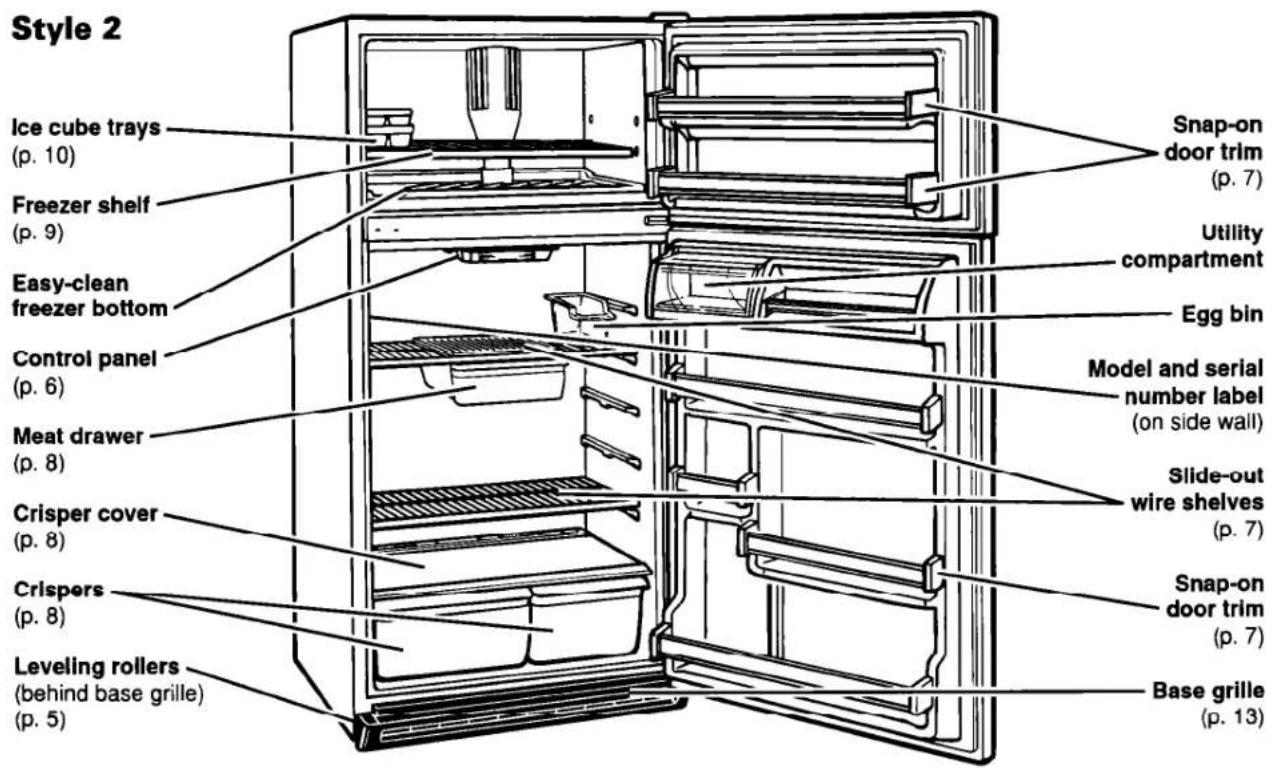
This section contains captioned illustrations of your appliance. Use them to become familiar with where all parts and features are located and what they look like. Page references are included for your convenience.
NOTE: The model you have purchased may have all or some of the parts and features shown and they may not match the illustration exactly. This manual covers several models.
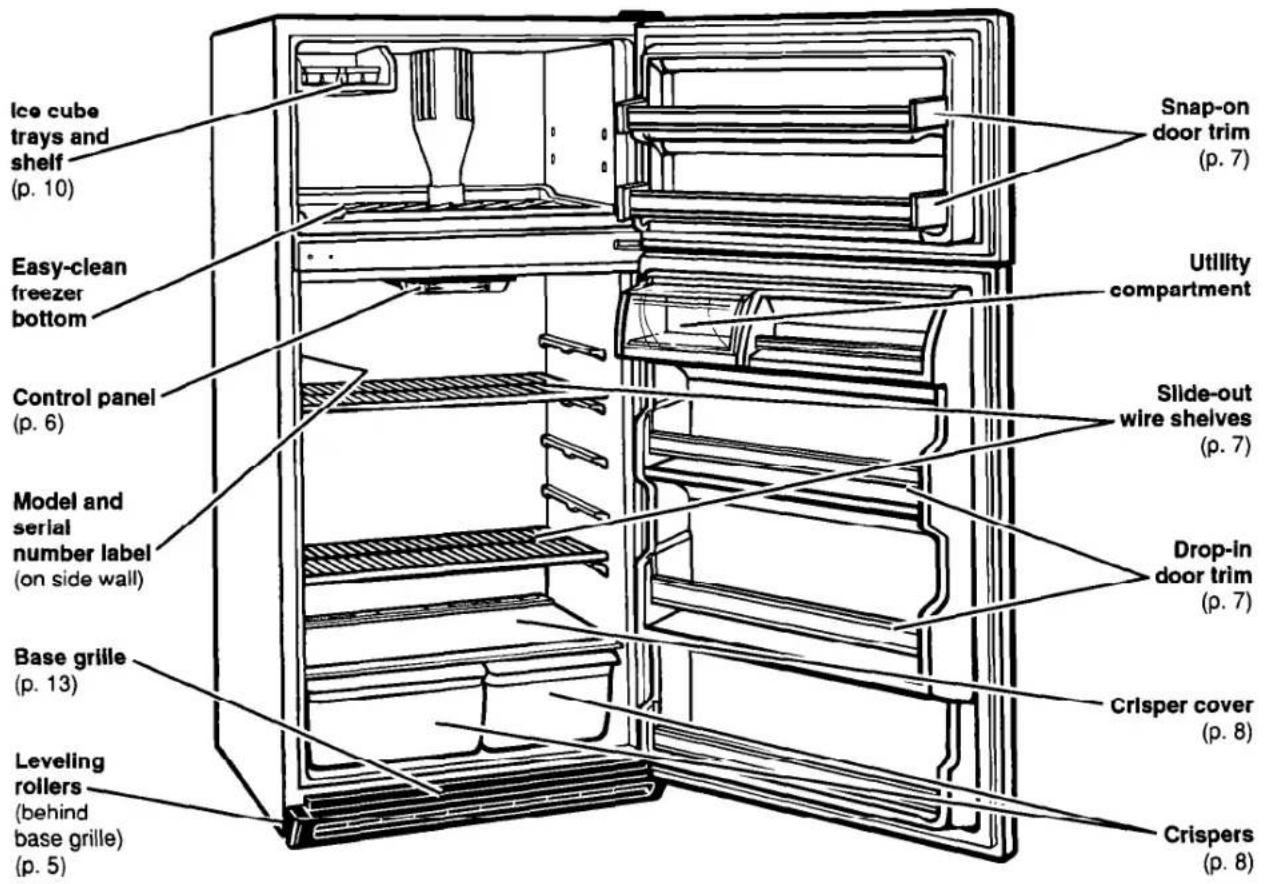
Style 1
Control panel
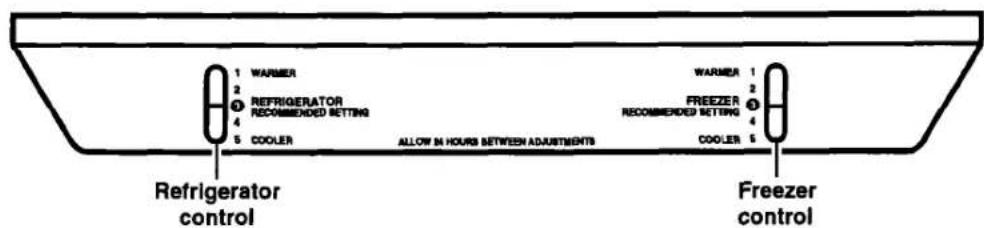
(all models)

Before Using Your Refrigerator
It is important to prepare your refrigerator for use. This section tells you how to clean it, connect it to a power source, install it, and level it.
Cleaning your refrigerator
Removing packaging materials
Remove tape and any inside labels (except the model and serial number label) before using the refrigerator.
To remove any remaining tape or label glue:
- Rub briskly with thumb.
OR
- Apply liquid hand-dishwashing detergent to area before removing glue as described above. Do not use sharp instruments, rubbing alcohol, flammable fluids, or abrasive cleaners. These can damage the material. See "Important Safety Instructions" on page 2.
NOTE: Do not remove any permanent instruction labels inside your refrigerator. Do not remove the Tech Sheet fastened under the refrigerator at the front.
Cleaning it before use
After removing all packaging materials, clean your refrigerator before using it, if necessary. See cleaning instructions on page 15.
Plugging it in
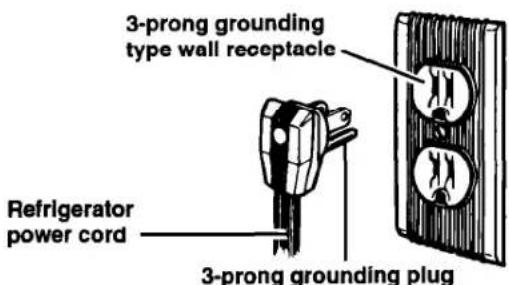
Recommended Grounding Method
A 115 Volt, 60Hz AC only 15 or 20 ampere fused and properly grounded electrical supply is required. It is recommended that a separate circuit serving only this appliance be provided. Use a receptacle which cannot be turned off with a switch or pull chain. Do not use an extension cord. See Electrical Requirements and Grounding Instructions Sheet in your Literature Package.
Installing it properly
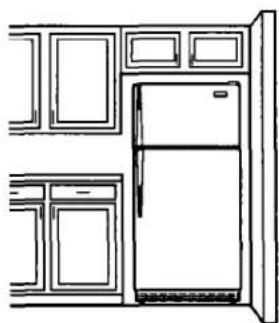
- Allow 12 inch (1.25 cm) space on each side and at the top of the refrigerator for ease of installation.
- If the hinge side of the refrigerator is to be against a wall, you might want to leave extra space so the door can be opened wider.
- The refrigerator can be flush against the back wall.
Leveling it
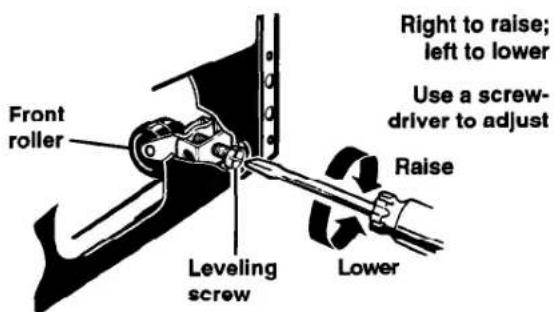
Your refrigerator has two front leveling screws - one on the right and one on the left. To adjust one or both of these, follow the directions below.
- Remove base grille. (See page 13.)
- To raise front, turn screw clockwise.
- To lower front, turn screw counterclockwise.
- Check with level.
- Replace base grille. (See page 13.)
Using Your Refrigerator
To obtain the best possible results from your refrigerator, it is important that you operate it properly. This section tells you how to set the controls, remove and adjust the features in your refrigerator, and how to save energy.
Setting the controls
Controls for the refrigerator and freezer are in the refrigerator. When you plug in the refrigerator for the first time:
- Set the Refrigerator Control to 3 (Recommended Setting). Refrigerator Control settings range from 1 (warmest) to 5 (coldest).
- Set the Freezer Control to 3 (Recommended Setting). Freezer Control settings range from 1 (warmest) to 5 (coldest).
Give the refrigerator time to cool down completely before adding food. This may take several hours. The settings indicated above should be correct for normal household refrigerator usage. The controls are set correctly when milk or juice is as cold as you like and when ice cream is firm. If you need to adjust these settings, see "Changing the control settings" below.
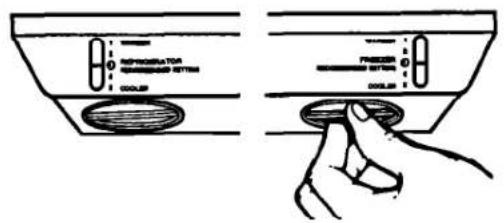
Changing the control settings
If you need to adjust temperatures in refrigerator or freezer, use the settings listed in the chart below as a guide. If you have any questions, call our Consumer Assistance Center number, 1-800-253-1301, from anywhere in the U.S.A.
- Adjust the Refrigerator Control first.
- Wait at least 24 hours between adjustments.
- Then adjust the Freezer Control if needed.
| CONDITION: | REASON: | RECOMMENDED SETTINGS: Refrigerator Freezer | |
| Refrigerator section too warm | ·Door opened often·Large amount of food added·Room temperature too warm | 4 | 2 |
| Freezer section too warm | ·Door opened often·Large amount of food added·Very cold room temperature (can't cycle often enough) | 3 | 4 |
| Refrigerator section too cold | ·Controls not set correctly for your conditions | 2 | 4 |
| Ice not made fast enough | ·Heavy ice usage·Very cold room temperature (can't cycle often enough) | 4 | 4 |
| Both sections too warm | ·Door opened often·Large amount of food added·Very warm or very cold room temperatures | 4 | 4 |
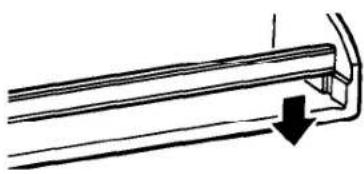
Removing the drop-in door trim (on some models)
To remove the trim piece:
- Remove all items from the shelf.
- Pull straight up on the trim piece at each end.
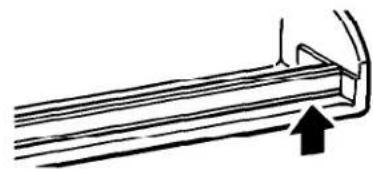
To replace the trim piece:
1.1. Locate each end of the trim piece above the trim pocket opening.
2. Push the trim piece straight down until it stops.
3. Replace items on the shelf.
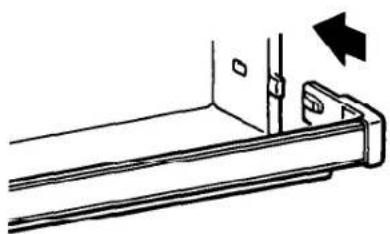
Removing the snap-on door trim
To remove the trim piece:
- Remove all items from the shelf.
- Pull out on the inside tab at each end.
- Lift trim piece straight out.
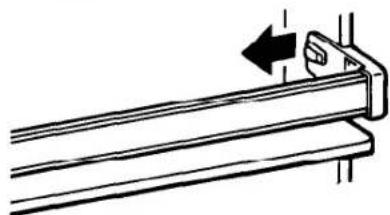
To replace the trim piece:
- Line up ends of the trim piece with the button on the door liner wall.
- Push trim piece straight back until it snaps securely into place.
- Replace items on the shelf.
Adjusting the refrigerator shelves
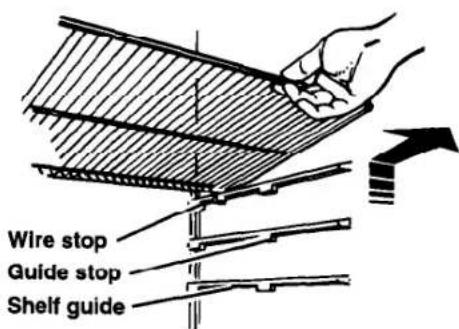
Adjust refrigerator shelves to match the way you use your refrigerator.
To remove the shelves:
- Remove all items from the shelf.
- Slide shelf straight out to the stop.
- Lift the front slightly.
- Slide shelf out the rest of the way.
To replace the shelves:
- Fit back of shelf on top of guide with wire stops on the bottom of the guide.
- Lift the front.
- Slide shelf in until it clears all stops.
Removing the meat drawer and cover
(on some models)
Remove the meat drawer and cover for easier cleaning.
To remove the meat drawer:
- Slide meat drawer out to the stop.
- Lift the front of the meat drawer.
- Slide meat drawer out the rest of the way.
- Replace in reverse order.
To remove the cover:
- Remove meat drawer.
- Push cover back to release the rear of the cover from the shelf.
- Tilt cover up at the front.
- Pull cover forward and out.
To replace the cover:
- Fit notches and rear edge of cover over rear and center crossbars on the shelf.
- Lower cover into place.
- Replace the meat drawer.
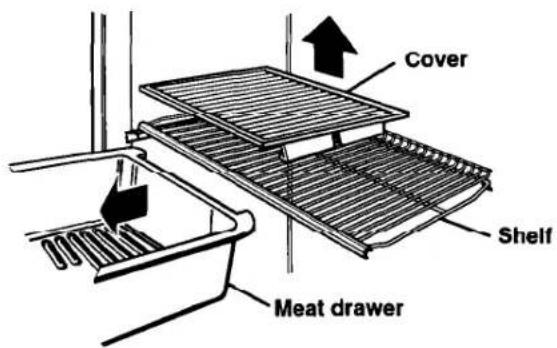
Remove meat drawer before cover.
Removing the crispers and crisper cover
(on some models)
For your convenience, one crisper is slightly larger than the other. This allows you to store celery and other longer items in a crisper.
To remove the crispers:
- Slide crisper straight out to the stop.
- Lift the front.
- Slide out the rest of the way.
- Replace in reverse order.
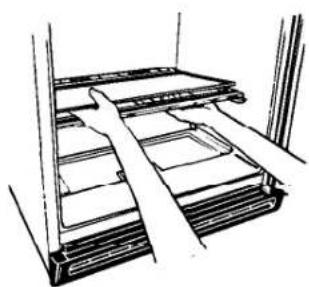
To remove the cover:
- Push up the cover insert from the bottom, then slide out with both hands.
- Lift front of cover frame.
- Lift cover frame up and out.
To replace the cover:
- Fit back of cover frame into notch supports on back wall of refrigerator, then lower the front into place.
- Slide back of cover insert into place, then lower the front.
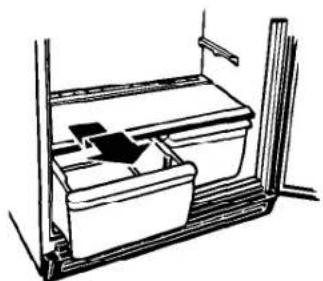
Pull out to the stop, lift the front, and pull again.
Remove the cover insert. Lift the cover front, then the back.
NOTE: If cover insert is glass, handle it with care. It could be heavy.
Adjusting the risper cover track
(on some models)
For your convenience, one crisper is larger than the other, and your crisper cover has an adjustable track so you can switch positions of the crispers. This allows you to store colery and other longer items in a crisper. You can adjust the cover track with the cover in the refrigerator by removing the crispers and the cover insert.
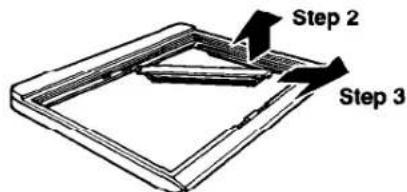
To remove the center track:
- Push up cover insert from bottom, then slide out with both hands.
- Gently pull up on front end of track.
- Pull rear end of track out of opening in cover.
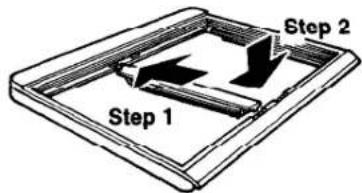
To replace the center track:
- Insert rear end of track (with hole) into opening in cover.
- Lower front end of track into slot.
- Make sure rear end of track snaps into place on underside of cover.
Adjusting the freezer shelf (on some models)
Adjust the freezer shelf to match the way you use your freezer.
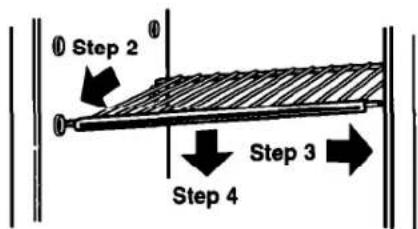
To remove the shelf:
- Lift entire shelf slightly.
- Move shelf all the way to one side.
- Tilt other side up and out of shelf support cups.
- Pull shelf up and out.
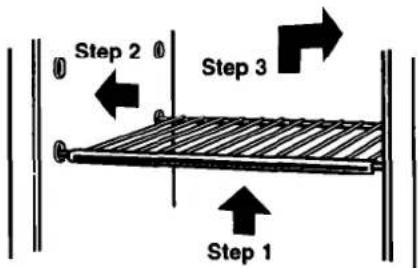
To replace the shelf:
- Tilt the shelf and insert into freezer compartment.
- Insert one end of the shelf all the way into the center of the shelf support cups.
- Lower other end of shelf and insert into the shelf support cups.
- Lower shelf into place.
NOTE: The shelf should lower slightly and lock into place. If the shelf does not appear sturdy, make sure both ends of the shelf are inserted into the shelf support cups.
Using the ice cube trays
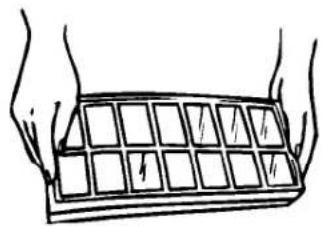
If cubes are not used, they may shrink. The moving cold air starts a slow evaporation. The longer you store cubes, the smaller they get.
To remove ice:
- Hold tray at both ends.
- Twist slightly.
Using the optional automatic ice maker
If your refrigerator has an automatic ice maker, or if you plan to add one later (contact the dealer for ice maker kit number), here are a few things you should know.
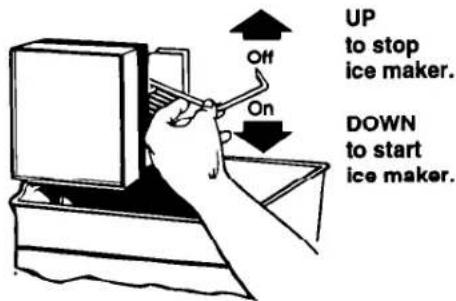
- The ON/OFF lever is a wire signal arm.
DOWN to make ice automatically UP to shut off the ice maker
IMPORTANT: Do not turn ice maker on until you connect it to the water supply.
- If you remove the ice bin, raise the signal arm to shut off the ice maker. When you replace the bin, push it in all the way and lower the ice maker signal arm to the ON position.
It is normal for ice crescents to be attached by a corner. They break apart easily.
The ice maker will not operate until the freezer is cold enough to make ice. This can take overnight. - If ice is not being made fast enough and more ice is needed, turn the Refrigerator Control toward a higher number. Wait a day and, if necessary, turn the Freezer Control toward 5.
- Good water quality is important for good ice quality. Try to avoid connecting the ice maker to a softened water supply. Water softener chemicals (such as salt from a malfunctioning softener) can damage the ice maker mold and lead to poor ice quality. If you cannot avoid a softened water supply, make sure the water softener is operating properly and is well maintained.
Solving common ice maker problems
| PROBLEM | POSSIBLE CAUSE/SOLUTION |
| Ice crescents attached at corners | This is normal. They break apart easily. Shake bin occasionally to keep cubes separated. |
| Ice maker will not operate or ice is not made fast enough | ON/OFF lever is in the OFF (up) position. Lower lever to the ON (down) position. Freezer is not cold enough. Adjust temperature controls and wait 24 hours. (See “Changing the control settings” on page 6.) |
| Off-taste or odor in ice | New plumbing connections can cause discolored or off-flavored ice. Discard the first few batches of ice. Cubes are stored too long. Throw them away and make a new supply. Food is not wrapped properly. See page 17. Freezer and ice bin need to be cleaned. See page 15. Water may contain minerals (such as sulfur). A filter may be required to remove them. |
Attaching the ice maker to a water supply
Read all directions carefully before you begin.
WARNING
Electrical Shock Hazard
Disconnect electrical supply to refrigerator before installing.
Electrical drill must be grounded before drilling holes in water line.
Failure to do so could result in death, electrical shock, or serious injury.
IMPORTANT:
It may take up to 24 hours for your ice maker to begin producing ice.
- If operating the refrigerator before installing the water connection, turn ice maker to the OFF position to prevent operation without water.
- All installations must be in accordance with local plumbing code requirements.
IMPORTANT:
- Use copper tubing only and check for leaks.
- Install ice maker tubing in areas where temperatures are above freezing.
INSTALLATION IS NOT WARRANTYED BY REFRIGERATOR OR ICE MAKER MANUFACTURER.
Tools required:
- Standard screwdriver
- 7/16-inch and 1/2-inch open-end wrenches or two adjustable wrenches
- 1/4-inch nut driver
- 1/4-inch drill bit
- Hand drill or electric drill (properly grounded)
NOTE: Your appliance dealer has a kit available with a 1/4 -inch saddle type shut-off valve, a union, and copper tubing. Before purchasing, make sure a saddle type valve complies with your local plumbing codes. Do not use piercing type or 3/6 -inch saddle valve which reduces water flow and clogs more easily.
Cold water supply
The ice maker water valve contains a flow washer which is used as a water pressure regulator. The ice maker needs to be connected to a cold water line with water pressure limitations of 20-120 psi. If a problem occurs, call your utility company.
Connecting to water line
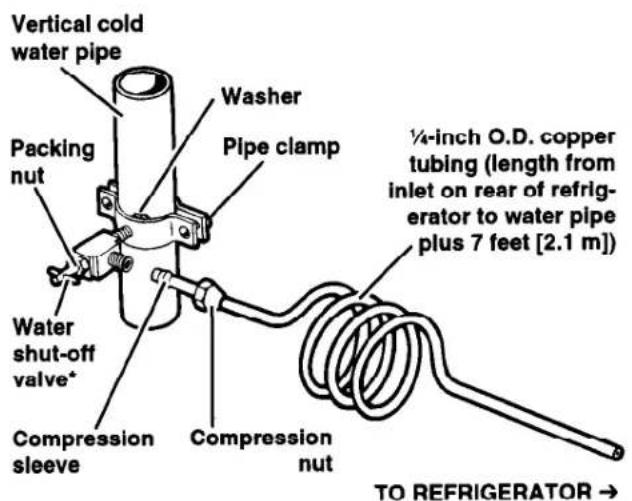
- Find a 12 -inch to 114 -inch vertical COLD water pipe near the refrigerator.
NOTE: Horizontal pipe will work, but the following precaution must be taken: Drill on the top side of the pipe, not the bottom. This will help keep water away from the drill. This also keeps normal sediment from collecting in the valve. - Measure from connection on rear of refrigerator to water pipe. Add 7 feet (2.1m) to allow for moving refrigerator for cleaning. This is the length of 1 / 4 -inch O.D.copper tubing you will need for the job (length from connection to water pipe PLUS 7 feet [2.1m] ). Be sure both ends of copper tubing are cut square.
- Turn OFF main water supply. Turn ON nearest faucet long enough to clear line of water.
- Using a grounded drill, drill a 1/4-inch hole on the cold water pipe you have selected.
- Fasten shut-off valve to cold water pipe with pipe clamp. Be sure outlet end is solidly in the 1/4 -inch drilled hole in the water pipe and that washer is under the pipe clamp. Tighten packing nut. Tighten the pipe clamp screws carefully and evenly so washer makes a watertight seal. Do not overtighten or you may crush the copper tubing, especially if soft (coiled) copper tubing is used. Now you are ready to connect the copper tubing.
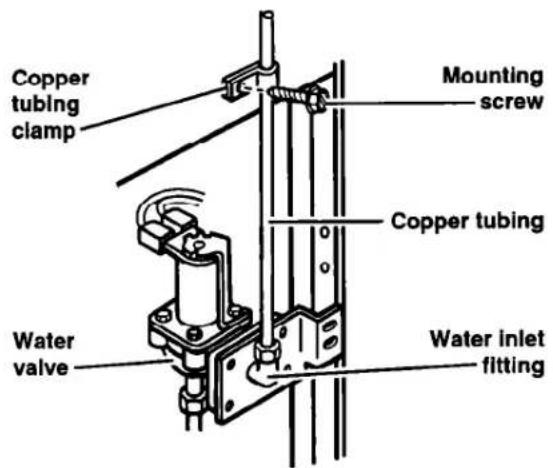
- Slip compression sleeve and compression nut on copper tubing as shown in diagram. Insert end of tubing into outlet end squarely as far as it will go. Screw compression nut onto outlet end with adjustable wrench. Do not overtighten. Turn ON main water supply and flush out tubing until water is clear. Turn OFF shut-off valve on the water pipe. Coil copper tubing.
*Controls water supply
Connecting to refrigerator
- (On kit models, assemble water valve to refrigerator per kit instructions.) Route the copper tubing through the tube clamp provided as shown at right. Connect the 14 -inch copper tube from the shut-off valve to the water valve at the lower, left rear of cabinet. Remove tape label from valve inlet and insert tubing until it bottoms out (approximately 12 inch). Tighten nut by hand as much as possible; then turn the nut an additional 12 turn using a wrench. Do not overtighten.
- Turn shut-off valve ON. CHECK FOR LEAKS. TIGHTEN ANY CONNECTIONS (INCLUDING CONNECTIONS AT THE VALVE) OR NUTS THAT LEAK.
- The ice maker is equipped with a built-in water strainer. If local water conditions require periodic cleaning or a well is your source of water supply, a second water strainer should be installed in the 1/4-inch water line. Obtain a water strainer from your nearest appliance dealer. Install at either tube connection.
- Reconnect electrical supply to refrigerator.
Removing the base grille
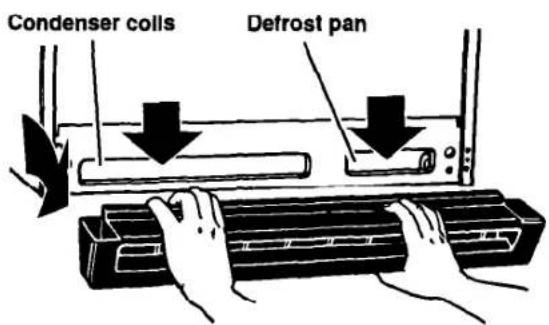
To remove the base grille:
- Open the refrigerator door.
- Grasp the grille with both hands.
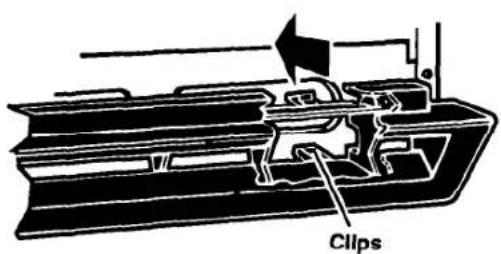
- Push down on the top edge of the grille to release the top clips.
- Tilt the grille toward you to release the bottom clips.
- Pull grille away from the refrigerator.
NOTE: Do not remove the Tech Sheet fastened behind the grille.
To replace the base grille:
- Line up the edges of the grille with the outside edges of the cabinet.
- Roll the grille toward you.
- Place lower clips in the openings in the metal panel.
- Roll the grille toward the cabinet until the top clips snap into place.
- Close the refrigerator door.
See cleaning instructions for defrost pan and condenser coils on page 15.
Changing the light bulbs
AWARNING
Electrical Shock Hazard
Before removing a light bulb or removing a light shield for cleaning, either unplug the refrigerator or disconnect the electricity leading to it at the main power supply.
Failure to do so could result in electrical shock.
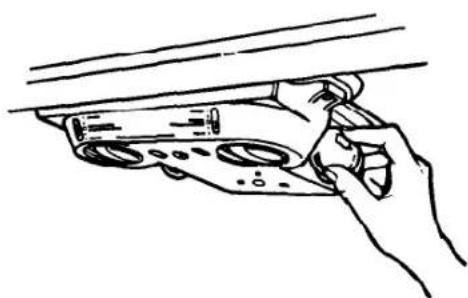
To change refrigerator light:
- Disconnect refrigerator from power supply.
- Reach behind Control Panel to remove bulb.
- Replace with a 40-watt appliance bulb.
- Reconnect refrigerator to power supply.
NOTE: Not all appliance bulbs will fit your refrigerator. Be sure to replace a bulb with one of the same size and shape.
Understanding the sounds you may hear
Your new refrigerator may make sounds that your old one didn't. Because the sounds are new to you, you might be concerned about them. Don't be. Most of the new sounds are normal. Hard surfaces like the floor, walls, and cabinets can make the sounds seem louder. The following describes the kinds of sounds that might be new to you, and what may be making them.
Slight hum, soft hiss
You may hear the refrigerator's fan motor and moving air.
Clicking or snapping sounds
The thermostat makes a definite click when the refrigerator stops running. It also makes a sound when the refrigerator starts. The defrost timer will click when the defrost cycle starts.
Water sounds
When the refrigerator stops running, you may hear gurgling in the tubing for a few minutes after it stops. You may also hear defrost water running into the defrost water pan.
Ice maker sounds
- trickling water
- thud (clatter of ice)
You may hear buzzing (from the water valve), trickling water, and the clatter of ice dumped into the bin.
Running sounds
Your refrigerator has a high-efficiency compressor and motor. It will run longer than older designs. It may even seem to run most of the time.
Saving energy
You can help your refrigerator use less electricity.
- Check door gaskets for a tight seal. Level the cabinet to be sure of a good seal.
- Clean the condenser coils regularly.
-
Open the door as few times as possible. Think about what you need before you open the door. Get everything out at one time. Keep food organized so you won't have to search for what you want. Close door as soon as food is removed.
-
Go ahead and fill up the refrigerator, but don't overcrowd it so air movement is blocked.
- It is a waste of electricity to set the refrigerator and freezer to temperatures colder than they need to be. If ice cream is firm in the freezer and drinks are as cold as your family likes them, that's cold enough.
- Make sure your refrigerator is not next to a heat source such as a range, water heater, furnace, radiator, or in direct sunlight.
Reversing the door swing
The doors on your refrigerator are reversible. If you need to reverse the door swing, refer to the instruction sheet included with your refrigerator.
Caring for Your Refrigerator
Your refrigerator is built to give you many years of dependable service. However, there are a few things you can do to help extend its product life. This section tells you how to clean your refrigerator and what to do when going on vacation, moving, or during a power outage.
Cleaning your refrigerator
Both the refrigerator and freezer sections defrost auto

matically. However, clean both about once a month to help prevent odors from building up. Wipe up spills right away.
To clean your refrigerator, unplug it, take out all removable parts, and clean the
refrigerator according to the following directions.
WARNING
Personal Injury Hazard
Refrigeration system tubes are near the defrost pan and can become hot. Remove and install defrost pan carefully.
Failure to do so could result in personal injury.
| PART | WHAT TO USE | HOW TO CLEAN |
| Removable parts(shelves,crisper,etc.) | Sponge or cloth with mild detergent and warm water | ·Hand wash,rinse,and dry thoroughly. |
| Outside | Sponge,cloth,or paper towel with mild detergent, warm water,and a good appliance wax (or good auto paste wax) | ·Wash outside of cabinet. Do not use abrasive or harsh cleaners. ·Wipe and dry thoroughly. ·Wax painted metal surfaces at least twice a year. Apply wax with a clean,soft cloth.Waxing painted metal surfaces provides rust protection. Do not wax plastic parts. |
| Inside walls(allow freezer towarm up so clothwon't stick) | Sponge,soft cloth,or paper towel with baking soda or mild detergent and warm water | ·Wash with mixture of warm water and: - mild detergent,or - baking soda (2 tbs to 1 qt [26 g to .95 L] of water) ·Wipe and dry thoroughly. |
| Door linersand gaskets | Sponge,soft cloth,or paper towel with mild detergent and warm water | ·Wash,wipe,and dry thoroughly. DO NOT USE cleaning waxes,concentrated detergents,bleaches,or cleaners containing petroleum on plastic parts. |
| Plastic parts(covers and panels) | Soft,clean sponge or soft, clean cloth with mild detergent and warm water | ·Wash,wipe,and dry thoroughly. DO NOT USE paper towels,window sprays, scouring cleansers,or flammable fluids. These can scratch or damage material. See “Important Safety Instructions” on page 2. |
| Defrost pan | Sponge or cloth with mild detergent and warm water | ·Remove base grille.(See page 13.) ·Reach into small opening at right edge and remove the defrost pan. ·Wash,rinse,and dry thoroughly. ·Replace defrost pan.Make sure to push it completely into the opening. ·Replace base grille. |
| Condensercoils | Vacuum cleaner with extended narrow attachment | ·Remove base grille. ·Vacuum coils when dusty or dirty. Coils may need to be cleaned as often as every other month. ·Replace base grille. |
Vacation and moving care
Short vacations
No need to shut off the refrigerator if you will be away for less than four weeks.
- Use up any perishables.
- Freeze other items.
-
If your refrigerator has an automatic ice maker:
-
Raise signal arm to OFF (up) position.
- Shut off water supply to the ice maker.
Long vacations
If you will be gone a month or more:
- Remove all food from the refrigerator.
-
If your refrigerator has an automatic ice maker:
-
Turn off the water supply to the ice maker at least one day ahead of time.
-
When the last load of ice drops, turn off the ice maker. Make sure all ice is dispensed out of the ice maker mechanism.
-
Unplug the refrigerator.
- Clean it, wipe well, and dry.
- Tape rubber or wood blocks to the tops of both doors to prop them open far enough for air to get in. This stops odor and mold from building up.
WARNING
Personal Injury Hazard
Do not allow children to climb on, play near, or climb inside the refrigerator when the doors are blocked open.
They may become injured or trapped.
To restart refrigerator, see page 6.
Moving
When you are moving the refrigerator to a new home:
-
If your refrigerator has an automatic ice maker:
-
Turn off the water supply to the ice maker at least one day ahead of time.
-
Disconnect the water line.
After the last load of ice drops, lift the signal arm to the OFF (up) position. -
Remove all food from the refrigerator.
- Pack all frozen food in dry ice.
- Unplug the refrigerator.
- Clean it thoroughly. Wipe well and dry.
- Take out all removable parts, wrap them well, and tape them together so they don't shift and rattle.
- Screw in the leveling rollers
- Tape the doors shut and tape the power supply cord to the cabinet.
When you get to your new home, put everything back and refer to page 5. Also, if your refrigerator has an automatic ice maker, remember to reconnect the water supply line.
Power interruptions
If electricity goes off, call the power company. Ask how long power will be off.
- If service will be interrupted 24 hours or less, keep both doors closed. This helps foods stay frozen.
- If service will be interrupted longer than 24 hours: (a) Remove all frozen food and store in a frozen food locker.
OR
(b) Place 2 lbs. (907 g) of dry ice in freezer for every cubic foot (liter) of freezer space. This will keep food frozen for two to four days. Wear gloves to protect your hands from dry ice burns.
OR
(c) If neither a food locker nor dry ice is available, use or can perishable food at once.
- A full freezer stays cold longer than a partly filled one. A freezer full of meat stays cold longer than a freezer full of baked goods. If food contains ice crystals, it may be safely refrozen, although the quality and flavor may be affected. If the condition of the food is poor, or if you feel it is unsafe, dispose of it.
Questions?
Call our Consumer Assistance Center telephone number, 1-800-253-1301, from anywhere in the U.S.A.
Food Storage Guide
There is a correct way to package and store refrigerated or frozen food. To keep food fresher, longer, take the time to study these recommended steps.
Storing fresh food
Wrap or store food in the refrigerator in airtight and moisture-proof material. This prevents food odor and taste transfer throughout the refrigerator. For dated products, check code date to ensure freshness.
Leafy vegetables
Remove store wrapping and bruised and discolored areas. Wash in cold water and drain. Place in plastic bag or plastic container and store in crisper.
Vegetables with skins
(carrots,peppers)
Store in crisp, plastic bags, or plastic container.
Fruit
Wash, let dry, and store in refrigerator in plastic bags or crisper. Do not wash or hull berries until they are ready to use. Sort and keep berries in original container in a crisper, or store in a loosely closed paper bag on a refrigerator shelf.
Eggs
Store without washing In original carton on Interior shelf. On some models, an egg storage container is provided for your convenience.
Milk
Wipe milk cartons. For best storage, place milk on interior shelf.
Butter or margarine
Keep opened butter in covered dish or closed compartment. When storing an extra supply, wrap in freezer packaging and freeze.
Cheese
Store in the original wrapping until you are ready to use it. Once opened, rewrap tightly in plastic wrap or aluminum foil.
Leftovers
Cover leftovers with plastic wrap or aluminum foil. Plastic containers with tight lids can also be used.
Meat
Store most meat in original wrapping as long as it is airtight and moisture-proof. Rewrap if necessary. See the following for storage times. When storing meat longer than the times given, freeze the meat.
Chicken 1-2 days Bacon 5-7 days
Ground beef .... 1-2 days Cold cuts .... 3-5 days
Steaks/roasts....3-5 days Variety meals ....1-2 days
Cured meats ... 7-10 days
NOTE: Use fresh fish and shellfish the same day as purchased.
Storing frozen food
The freezer section is designed for storage of commercially frozen food and for freezing food at home.
NOTE: For further information about preparing food for freezing or food storage times, contact your local Cooperative Extension Service or check a freezer guide or reliable cookbook.
Packaging
The secret of successful freezing is in the packaging. The way you close and seal the package must not allow air or moisture in or out. Packaging done in any other way could cause food odor and taste transfer throughout the refrigerator and drying of frozen food.
Packaging recommended for use:
Rigid plastic containers with tight-fitting lids
- Straight-sided canning/freezing jars
- Heavy-duty aluminum foil
- Plastic-coated paper
- Non-permeable plastic wraps (made from saran film) Follow package or container instructions for proper freezing methods.
Do not use:
- Bread wrappers
Non-polyethylene plastic containers - Containers without tight lids
Wax paper - Wax-coated freezer wrap
Thin, semi-permeable wrap
The use of these wrappings could cause food odor, taste transfer, and drying of frozen food.
Freezing
Do not expect your freezer to quick-freeze any large quantity of food. Put no more unfrozen food into the freezer than will freeze within 24 hours (no more than 2-3 lbs. of food per cubic foot [32-48 g per liter] of freezer space). Leave enough space for air to circulate around packages. Be careful to leave enough room at the front so the door can close tightly.
Storage times will vary according to the quality of the food, the type of packaging or wrap used (airtight and moisture-proof) and the storage temperature, which should be 0^ (-17.8^)
Troubleshooting
Performance problems often result from little things you can fix without tools. Please read through "Before calling for assistance ..." below before calling for service on your appliance.
Before calling for assistance ...
Listed in this chart are the most common problems consumers run into with their appliances. Please read through this and see if it can solve your problem.
| PROBLEM | CHECK THE FOLLOWING |
| Your refrigerator will not operate | Is the power supply cord firmly plugged into a live circuit with proper voltage? Has a household fuse or circuit breaker blown/tripped? Is the Refrigerator Control set to the OFF position? |
| The lights do not work | Is the power supply cord firmly plugged into a live circuit with proper voltage? Has a household fuse or circuit breaker blown/tripped? Is a bulb burned out? |
| The optional ice maker does not work | Is the freezer cold enough to make ice? It could take overnight for the freezer to reach the proper temperature. Is the ON/OFF lever in the ON (down) position? (See page 10.) Is the water valve turned on? Does the water line have a clog or leak? |
| Unfamiliar sounds or a rattling/ jingling noise | Is something on top of or behind the refrigerator? Some new sounds are normal. See "Understanding the sounds you may hear" on page 14. |
| There is water in the defrost pan | This is normal on hot, muggy days. Make sure the refrigerator is level so the pan does not overflow. |
| The motor seems to run too much | Are the condenser coils dirty? Has the door been opened often? Has a large amount of food been added at one time? The motor naturally runs longer if these things happen. Is the room hot? If the room is too warm, the motor runs longer to keep the unit cool. |
Requesting Assistance or Service
Before calling for assistance or service, please check "Troubleshooting" on page 18. It may save you the cost of a service call. If you still need help, follow the instructions below.
For assistance or service in the U.S.A.:
1. If you need assistance† ...
Call the Whirlpool Consumer Assistance Center
telephone number. Dial toll-free from anywhere in the U.S.A.:
1-800-253-1301
and talk with one of our trained consultants. The consultant can instruct you in
how to obtain satisfactory operation from your appliance or, if service is necessary, recommend a qualified service company in your area.
If you prefer, write to:
Mr. William Clark
Consumer Assistance Representative
Whirlpool Corporation
2000 North M-63
Benton Harbor, MI 49022-2692
Please include a daytime phone number in your correspondence.
2. If you need service† ...
Whirlpool has a nationwide network of authorized Whirlpool service companies. Whirlpool service technicians are trained to fulfill the product warranty and provide afterwarranty service, anywhere in the United States. To locate the authorized
Whirlpool service company in your area, call our Consumer Assistance Center telephone number (see Step 1) or look in your telephone directory Yellow Pages under:
3. If you need FSP\* replacement part
FSP is a registered trademark of Whirlpool
Corporation for quality parts. Look for this symbol of quality whenever you need a replacement part for your WHIRLPOOL* appliance. FSP replacement parts will fit right and work right, because they are made to the same exacting specifications used to build every new WHIRLPOOL appliance.
To locate FSP replacement parts in your area, refer to Step 2 or call the Whirlpool Consumer Assistance Center number in Step 1.
4. If you are not satisfied with how the problem was solved ...
- Contact the Major Appliance Consumer Action Program (MACAP). MACAP is a group of independent consumer experts that voices consumer views at the highest levels of the major appliance industry.
- Contact MACAP only when the dealer, authorized servicer, and Whirlpool have failed to resolve your problem.
Major Appliance Consumer Action Program 20 North Wacker Drive
Chicago, IL 60606
- MACAP will in turn inform us of your action.
APPLIANCE-HOUSEHOLD
MAJOR. SERVICE & REPAIR
See:Whirlpool Appliances or
Authorized Whirlpool Service
(Example: XYZ Service Co.)
WASHING MACHINES &
DRYERS. SERVICE & REPAIR
See:Whiripool Appliances or
Authorized Whirlpool Service
(Example: XYZ Service Co.)
'When asking for help or service:
Please provide a detailed description of the problem, your appliance's complete model and serial numbers, and the purchase date. (See page 1.) This information will help us respond properly to your request.
For assistance or service in Canada:
1. If the problem is not due to one of the items listed in "Troubleshooting"...
Contact the dealer from whom you purchased your appliance, or your nearest Inglis Limited Appliance Service Branch. Please include a daytime phone number in your correspondence.
2. If you need service ...
Contact your nearest Inglis Limited Appliance Service Branch or an authorized servicing outlet.
Inglis Limited Appliance Service - Consumer Services
Direct service branches:
| BRITISH COLUMBIA | Vancouver | Inglis Limited Appliance Service 3627 E. 4th Avenue | (604) 291-6426 1-800-665-6788 |
| Victoria | Inglis Limited Appliance Service 3117 Steele Street | (604) 383-2298 1-800-665-6788 | |
| ALBERTA | Calgary | Inglis Limited Appliance Service #15, 6025 12th Street S.E. | (403) 453-9267 1-800-661-1022 |
| Edmonton | Inglis Limited Appliance Service 16236 116th Avenue | (403) 453 3900 1-800-661-6291 | |
| ONTARIO | Toronto (Mississauga) | Inglis Limited Appliance Service 5945 Ambler Drive | (905) 821-3900 1-800-807-6777 |
| Toronto (Markham) | Inglis Limited Appliance Service Unit #1, 110 Torbay Road | (905) 475-9511 1-800-807-6777 | |
| Ottawa | Inglis Limited Appliance Service 28 Capital Drive | (613) 225-0510 1-800-267-3456 | |
| MANITOBA SASKATCHEWAN | Winnipeg | Inglis Limited Appliance Service 1683 Church Avenue | (204) 694-5308 1-800-665-1683 |
| QUEBEC | Montreal (Laval) | Inglis Limited Appliance Service 2750 Francis Hughes | (514) 382-8110 1-800-361-3032 |
| Brossard | Inglis Limited Appliance Service 9605 F. Ignace Street | (514) 397-1840 1-800-361-0950 | |
| Quebec City | Inglis Limited Appliance Service 5275 Blvd. Wilfrid Hamel, Suite 140 | (418) 871-5251 1-800-463-1523 | |
| Sherbrooke (Rock Forest) | Inglis Limited Appliance Service 3475 Industrial Blvd. | (819) 564-6565 1-800-567-6966 | |
| NOVA SCOTIA | Dartmouth | Inglis Limited Appliance Service 900 Windmill Road | (902) 468-6634 1-800-565-1598 |
For service in areas other than those listed, contact your Appliance Dealer.
Warranties
WHIRLPOOL* Refrigerator Warranty (U.S.A. only)
| LENGTH OF WARRANTY | WHIRLPOOL WILL PAY FOR |
| FULL ONE-YEARWARRANTYFrom Date of Purchase | FSP* replacement parts and repair labor to correct defects in materials or workmanship. Service must be provided by an authorized Whirlpool service company. |
| FULL FIVE-YEARWARRANTYFrom Date of Purchase | FSP replacement parts and repair labor to correct defects in materials or workmanship in the sealed refrigeration system. These parts are:1. Compressor2. Evaporator3. Condenser4. Drier5. Connecting tubingService must be provided by an authorized Whirlpool service company. |
| WHIRLPOOL WILL NOT PAY FOR | |
| A. Service calls to:1. Correct the installation of your refrigerator.2. Instruct you how to use your refrigerator.3. Replace house fuses or correct house wiring or plumbing.4. Replace light bulbs.B. Repairs when your refrigerator is used in other than normal, single-family household use.C. Pickup and delivery. Your refrigerator is designed to be repaired in the home.D. Damage to your refrigerator caused by accident, misuse, fire, flood, acts of God, or use of products not approved by Whirlpool.E. Any food loss due to product failure.F. Repairs to parts or systems caused by unauthorized modifications made to the appliance. | |
WHIRLPOOL CORPORATION SHALL NOT BE LIABLE FOR INCIDENTAL OR CONSEQUENTIAL DAMAGES. Some states do not allow the exclusion or limitation of incidental or consequential damages, so this exclusion or limitation may not apply to you. This warranty gives you specific legal rights, and you may also have other rights which vary from state to state.
Outside the United States, a different warranty may apply. For details, please contact your authorized Whirlpool distributor or military exchange.
If you need service, first see the "Requesting Assistance or Service" section of this book. After checking "Requesting Assistance or Service," additional help can be found by calling our Consumer Assistance Center telephone number, 1-800-253-1301, from anywhere in the U.S.A.
WHIRLPOOL* Refrigerator Warranty (Canada only)
Dear Customer:
Good performance. That's what our warranty is all about. Here's how the good performance that you expect from your Refrigerator is protected.
WARRANTY FOR YOUR REFRIGERATOR
During the first year after purchase, all parts of the appliance which prove to be defective in materials or workmanship will be repaired or replaced free of charge (parts and labour).
During the first five years after purchase, all parts of the sealed refrigeration system, which consists of the compressor, condenser, evaporator, and connecting tubing, which prove to be defective in materials or workmanship, will be repaired or replaced at no cost to you.
During the sixth through tenth years after purchase, should the compressor fail due to defective materials or workmanship, the compressor will be repaired or replaced and you pay for any labour charge.
There may be a charge for travel or transportation expenses in those instances where a customer resides in a remote area.
Parts repaired or replaced under this warranty are warranted throughout the remainder of the original warranty period only.
This protection covers your home use of the appliance. This same protection applies to any subsequent owner during the applicable warranty period based on the original owner's purchase date.
This warranty does not cover damage by accident, misuse, improper installation, fire, flood, or acts of God.
This is the only warranty covering this appliance given by the manufacturer.
The provisions of this warranty are in addition to and not a modification of or subtraction from the statutory warranties and the other rights and remedies contained in any applicable legislation.
Now about servicing. If your appliance does not operate properly, check "Troubleshooting" (page 18) to see if the problem can be resolved without the assistance of a serviceman. If it cannot, please immediately contact the retailer from whom it was purchased or one of our Company-owned Service Branches or Company-owned Service Depots located across Canada.
Please keep your sales slip with your Use and Care Guide. It's nice to know you'll have protection, even though you may never need it.
Sincerely,
INGLIS LIMITED
ADMINISTRATION CENTRE
1901 MINNESOTA COURT
MISSISSAUGA, ONTARIO L5N 3A7
Table des matieres
Page
Veuillez noter 1
Successales de service direct:
| COLOMBIE-BRITANNIQUE | Vancouver | Inglis Limitée Service d'appareils menagers 3627 E. 4th Avenue | (604) 291-6426 1-800-665-6788 |
| Victoria | Inglis Limitée Service d'appareils menagers 3117 Steele Street | (604) 383-2298 1-800-665-6788 | |
| ALBERTA | Calgary | Inglis Limitée Service d'appareils menagers #15, 6025 12th Street S.E. | (403) 453-9267 1-800-661-1022 |
| Edmonton | Inglis Limitée Service d'appareils menagers 16236 116th Avenue | (403) 453-3900 1-800-661-6291 | |
| ONTARIO | Toronto (Mississauga) | Inglis Limitée Service d'appareils menagers 5945 Ambler Drive | (905) 821-3900 1-800-807-6777 |
| Toronto (Markham) | Inglis Limitée Service d'appareils menagers Unit #1, 110 Torbay Road | (905) 475-9511 1-800-807-6777 | |
| Ottawa | Inglis Limitée Service d'appareils menagers 28 Capital Drive | (613) 225-0510 1-800-267-3456 | |
| MANITOBA SASKATCHEWAN | Winnipeg | Inglis Limitée Service d'appareils menagers 1683 Church Avenue | (204) 694-5308 1-800-665-1683 |
| QUÉBEC | Montréal (Laval) | Inglis Limitée Service d'appareils menagers 2750, ave Francis-Hughes | (514) 382-8110 1-800-361-3032 |
| Brossard | Inglis Limitée Service d'appareils menagers 9605 F. rue Ignace | (514) 397-1840 1-800-361-0950 | |
| Québec | Inglis Limitée Service d'appareils menagers 5275, boul. Wilfrid-Hamel, Bureau 140 | (418) 871-5251 1-800-463-1523 | |
| Sherbrooke (Rock Forest) | Inglis Limitée Service d'appareils menagers 3475, boul. Industriel | (819) 564-6565 1-800-567-6966 | |
| NOUVELLE-ÉCOSSE | Dartmouth | Inglis Limitée Service d'appareils menagers 900 Windmilli Road | (902) 468-6634 1-800-565-1598 |
1901 MINNESOTA COURT
MISSISSAUGA, ONTARIO L5N 3A7
Monterrey, N.L. Mexico
Tel. 329-22-00
FABRICADO POR:
Whirlpool Corporation
Benton Harbor, Michigan
E.E.U.U.
Centro Industrial Acros
Whirlpool.
Interior 6. Apodaca, N.L.
C.P. 66600
Tel. 329-21-00 y 386-21-31
Fax 329-21-03
Ave Alfonso Reyes No. 3210.
Col. Regina
C.P.64290 Monterrey N.L.
Tel. 351-27-37 y 351-27-03
CHIHUAHUA
Calle Sexta No. 3407. Col.
Sta Rosa
Chihuahua, Chih.
C.P. 31050
Tel./Fax 10-05-50
TORREON
Blvd. Aguila Nacional
2495 Ote
Col. Centro
Torreón, Coahuila,
C.P. 27000
Tel. 22-30-78, 18-12-20
Fax 18-12-21
TAMPICO
Av. Hidalgo No. 1205 Col.
Moctezuma, C.P. 89177
Tampico Tamps.
Tel. 19-26-20 y 19-26-21
Fax 19-27-52
Zona Occidente
CULIACAN
Calz.H.Colegio Militar No.165
Col. Benito Juarez,
Culiacan, Sin. C.P. 80120
Tel. 13-92-35 y 15-65-96
Fax 15-65-96
HERmosillo
Reformay Jesus
Siqueiros No.1
Hermosillo, Son. C.P. 83180
Tel. 10-46-80
Fax 15-59-39
GUADALAJARA
Calz.Glez.Gallo No.1269
Sector Reforma
Guadalajara Jal. C.P. 44870
Tel.619-16-50,619-15-15
y619-23-03
Fax 650-35-64
LEON
Av. Autotransporte No. 426
Central de Carga Cast
León Guanajuato, C.P. 37130
Tel./Fax 73-29-84
Canela No. 47-L, Col.
Granjas Mexico,
Mexico D.F., C.P. 08400
Tel.650-65-33y657-29-56
con 12 lines.
Fax 650-38-49
Poniente 134 No.559, Col.
Industrial Vallejo
Mexico D.F.,C.P. 02300
Tel.368-25-25,368-25-06
Guaycan No. 124, Co. del
Bosque,
Villahermosa, Tab. C.P. 86160
Tel./Fax 51-35-13
MERIDA
- Registered Trademark/TM Trademark of Whirlpool, U.S.A.
Trademark of Inglis Limited, Canada.