
HTST9 - Home Theater System SONY - Free user manual and instructions
Find the device manual for free HTST9 SONY in PDF.
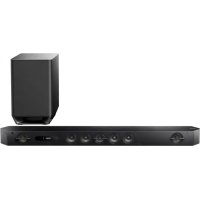


| Product Type | Soundbar with wireless subwoofer |
| Brand | Sony |
| Model | HT-ST9 |
| Dimensions (speaker bar, W x H x D) | Approx. 1180 x 64 x 127 mm |
| Dimensions (subwoofer, W x H x D) | Approx. 248 x 420 x 420 mm |
| Weight (speaker bar) | Approx. 6.0 kg |
| Weight (subwoofer) | Approx. 7.5 kg |
| Power supply | 220-240 V AC, 50/60 Hz |
| Power consumption (bar) | Approx. 75 W |
| Standby power consumption | Less than 0.5 W (with eco settings) |
| Amplifier | Digital, 7.1 channels (S-Force PRO Front Surround) |
| Output power | Total 400 W (bar: 300 W, subwoofer: 100 W) |
| Supported audio formats | Dolby Digital, Dolby TrueHD, DTS, DTS-HD Master Audio, LPCM, AAC, FLAC, DSD |
| Connectivity | 3 HDMI inputs, 1 HDMI output (ARC), digital optical input, stereo analog input, USB, Ethernet, built-in Wi-Fi, Bluetooth, NFC |
| Network functions | Google Cast, AirPlay, Spotify Connect, DLNA, network music, music services |
| Audio functions | ClearAudio+, DSEE HX, Football mode, Night mode, Voice mode, multiple sound fields |
| 4K compatibility | Yes, with HDCP 2.2 on HDMI inputs |
| Maintenance and cleaning | Clean with a dry, soft cloth. Do not use abrasive products or solvents. |
| Safety | Do not block ventilation openings, do not expose to water or open flames, use indoors only. |
| Repairability | Any repair should be carried out by qualified personnel. Spare parts available from Sony after-sales service. |
| Supplied accessories | Remote control, HDMI cable, optical cable, two AAA batteries, adjustment feet, grille frame (optional) |
Frequently Asked Questions - HTST9 SONY
User questions about HTST9 SONY
0 question about this device. Answer the ones you know or ask your own.
Ask a new question about this device
Download the instructions for your Home Theater System in PDF format for free! Find your manual HTST9 - SONY and take your electronic device back in hand. On this page are published all the documents necessary for the use of your device. HTST9 by SONY.
USER MANUAL HTST9 SONY
Operating Instructions
US
©2015 Sony Corporation Printed in Malaysia
4-58-49/16[1]
HT-ST9
Owner's Record
The model and serial numbers are located on the rear of the Bar Speaker. Record the serial numbers in the space provided below. Refer to them whenever you call upon your Sony dealer regarding this product.
Model No. HT-ST9
Serial No.
WARNING
To reduce the risk of fire or electric shock, do not expose this apparatus to rain or moisture.
The unit is not disconnected from the mains as long as it is connected to the AC outlet, even if the unit itself has been turned off.
To reduce the risk of fire, do not cover the ventilation opening of the appliance with newspapers, tablecloths, curtains, etc. Do not expose the appliance to naked flame sources (for example, lighted candles).
To reduce the risk of fire or electric shock, do not expose this appliance to dripping or splashing, and do not place objects filled with liquids, such as vases, on the appliance.
As the main plug is used to disconnect the unit from the mains, connect the unit to an easily accessible AC outlet. Should you notice an abnormality in the unit, disconnect the main plug from the AC outlet immediately.
Do not install the appliance in a confined space, such as a bookcase or built-in cabinet.
Do not expose batteries or appliances with battery-installed to excessive heat, such as sunshine and fire.
Indoor use only.
For the customers in the U.S.A.

This symbol is intended to alert the user to the presence of uninsulated "dangerous voltage" within the product's enclosure that may be of sufficient magnitude to constitute a risk of electric shock to persons.

This symbol is intended to alert the user to the presence of important operating and maintenance (servicing) instructions in the literature accompanying the appliance.
Important Safety Instructions
1) Read these instructions. 2) Keep these instructions. 3) Heed all warnings. 4) Follow all instructions. 5) Do not use this apparatus near water. 6) Clean only with dry cloth. 7) Do not block any ventilation openings. Install in accordance with the manufacturer's instructions. 8) Do not install near any heat sources such as radiators, heat registers, stoves, or other apparatus (including amplifiers) that produce heat. 9) Do not defeat the safety purpose of the polarized or grounding-type plug. A polarized plug has two blades with one wider than the other. A grounding type plug has two blades and a third grounding prong. The wide blade or the third prong are provided for your safety. If the provided plug does not fit into your outlet, consult an electrician for replacement of the obsolete outlet. 10) Protect the power cord from being walked on or pinched particularly at plugs, convenience receptacles, and the point where they exit from the apparatus. 11) Only use attachments/accessories specified by the manufacturer.
12) Use only with the cart, stand, tripod, bracket, or table specified by the manufacturer, or sold with the apparatus. When a cart is used, use caution when moving the cart/apparatus combination to avoid injury from tip-over.

13) Unplug this apparatus during lightning storms or when unused for long periods of time. 14) Refer all servicing to qualified service personnel. Servicing is required when the apparatus has been damaged in any way, such as power-supply cord or plug is damaged, liquid has been spilled or objects have fallen into the apparatus, the apparatus has been exposed to rain or moisture, does not operate normally, or has been dropped.
The following FCC statement applies only to the version of this model manufactured for sale in the U.S.A. Other versions may not comply with FCC technical regulations.
NOTE:
This equipment has been tested and found to comply with the limits for a Class B digital device, pursuant to Part 15 of the FCC Rules. These limits are designed to provide reasonable protection against harmful interference in a residential installation. This equipment generates, uses and can radiate radio frequency energy and, if not installed and used in accordance with the instructions, may cause harmful interference to radio communications.
However, there is no guarantee that interference will not occur in a particular installation. If this equipment does cause harmful interference to radio or television reception, which can be determined by turning the equipment off and on, the user is encouraged to try to correct the interference by one or more of the following measures:
Reorient or relocate the receiving antenna. - Increase the separation between the equipment and receiver. - Connect the equipment into an outlet on a circuit different from that to which the receiver is connected. - Consult the dealer or an experienced radio/TV technician for help.
Properly shielded and grounded cables and connectors must be used for connection to host computers and/or peripherals in order to meet FCC emission limits.
CAUTION
You are cautioned that any changes or modifications not expressly approved in this manual could void your authority to operate this equipment.
This equipment must not be co-located or operated in conjunction with any other antenna or transmitter.
This equipment complies with FCC radiation exposure limits set forth for an uncontrolled environment and meets the FCC radio frequency (RF) Exposure Guidelines. This equipment should be installed and operated keeping the radiator at least 20cm or more away from person's body (excluding extremities: hands, wrists, feet and ankles).
Compliance with FCC requirement 15.407(c)
Data transmission is always initiated by software, which is the passed down through the MAC, through the digital and analog baseband, and finally to the RF chip. Several special packets are initiated by the MAC. These are the only ways the digital baseband portion will turn on the RF transmitter, which it then turns off at the end of the packet. Therefore, the transmitter will be on only while one of the aforementioned packets is being transmitted. In other words, this device automatically discontinue transmission in case of either absence of information to transmit or operational failure.
Frequency Tolerance: ±20 ppm or less
continued
For the customers in Canada
Properly shielded and grounded cables and connectors must be used for connection to host computers and/or peripherals.
This device complies with Industry Canada's licence-exempt RSSs. Operation is subject to the following two conditions:
(1) This device may not cause interference; and (2) This device must accept any interference, including interference that may cause undesired operation of the device.
This equipment complies with IC radiation exposure limits set forth for an uncontrolled environment and meets RSS-102 of the IC radio frequency (RF) Exposure rules. This equipment should be installed and operated keeping the radiator at least 20cm or more away from person's body (excluding extremities: hands, wrists, feet and ankles).
5.15 - 5.25 GHz band is restricted to indoor operations only.
High-power radars are allocated as primary users (i.e. priority users) of the bands 5250-5350 MHz and 5650-5850 MHz and that these radars could cause interference and/or damage to LE-LAN devices.
About These Operating Instructions
- The instructions in these Operating Instructions describe the controls on the remote control. You can also use the controls on the Bar Speaker if they have the same or similar names as those on the remote control.
- Some illustrations are presented as conceptual drawings, and may be different from the actual products.
- The items displayed on the TV screen may vary depending on the area. The default setting is underlined.
- The text enclosed in brackets [ ] appears on the TV screen, and the text enclosed in double quotation marks " " appears on the front panel display.
Table of contents
Connecting → Startup Guide (separate document)
About These Operating Instructions 4
Listening/Viewing
Listening to Sound from a TV, Blu-ray Disc™ Player, Cable/Satellite Box, etc. 7
Playing Music/Photo from a USB Device 8
Listening to Music from a BLUETOOTH Device 8
Playing Music/Photo from Other Devices via the Network Function 8
Sound Adjustment
Enjoying Sound Effects (Football mode, etc.) 9
Using the DSEE HX Function (Reproducing Audio Codec Files with Natural Sound Quality) 10
BLUETOOTH Functions
Listening to Music from a BLUETOOTH Device 11
Listening to Sound by Transmitting to a BLUETOOTH-compatible Receiver 13
Network Functions
Connecting to a Wired Network 15
Connecting to a Wireless Network 16
Playing Music/Photo Files on a Home Network 16
Displaying the Screen of the Mobile Device on a TV (Screen mirroring) 18
Enjoying Various Online Services (Music Services) 18
Viewing Copyright-protected 4K Content
Connecting a 4K TV 20
Connecting 4K Devices 21
Settings and Adjustments
Using the Setup Display 22
Using the Options Menu 28
Other Functions
Controlling the System Using a Smartphone or Tablet (SongPal) 30
Using the Control for HDMI Function for "BRAVIA" Sync ....31
Enjoying multiplex broadcast sound (Dual Mono) 33
Deactivating Buttons on the Bar Speaker (Child Lock) 34
Changing the brightness 34
Saving Power in Standby Mode 34
Enabling the IR Repeater Function (when you cannot control the TV) 34
Further Setting for the Wireless System (Subwoofer) 35
Modifying the Angle of the Bar Speaker 37
Mounting the Bar Speaker on a Wall 37
Attaching the Grille Frame 38
continued
Additional Information
Precautions 39 Troubleshooting 42 Guide to Parts and Controls 47 Playable Types of Files 50 Supported Audio Formats 51 Specifications 51 On BLUETOOTH Communication 54 Index 56 END USER LICENSE AGREEMENT 58
Listening/Viewing
Listening to Sound from a TV, Blu-ray Disc™ Player, Cable/Satellite Box, etc.
1 Press HOME.
The home menu appears on the TV screen.
2 Press the arrow buttons to select the desired input, and then press ENTER.
You can also use INPUT on the remote control.
[TV]
"TV"
Device (TV, etc.) that is connected to the TV DIGITAL IN (TV) jack, or a TV that
is compatible with the Audio Return Channel function and connected to the HDMI OUT (ARC) jack
"HDMI1"/"HDMI2"/"HDMI3"
Device that is connected to HDMI IN 1, HDMI IN 2 or HDMI IN 3
[Bluetooth Audio]
"BT"
BLUETOOTH device that supports A2DP
[Analog]
"Analog"
Device that is connected to the ANALOG IN jacks
[USB]
"USB" USB device that is connected to the USB port
[Screen mirroring]
"SCR M"
Screen mirroring-compatible device
[Home Network]
"H.Net"
Content stored on a server
[Music Services]
"M.Serv"
Content of music services offered on the Internet
Tip
You can also press PAIRING and MIRRORING on the remote control to select [Bluetooth Audio] and [Screen mirroring] respectively.
Playing Music/Photo from a USB Device
You can play music/photo files stored on a connected USB device. For playable types of files, see "Playable Types of Files" (page 50).
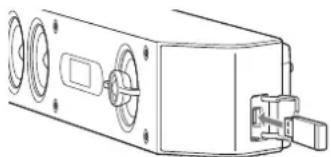
1 Connect the USB device to the (USB) port.
Refer to the operating instructions of the USB device before connecting.
2 Press HOME.
The home menu appears on the TV screen.
3 Press \/ \/ \ to select [USB], and then press \oplus .
4 Press \clubsuit / \clubsuit to select [Music] or [Photo].
5 Select the desired content using \/ \/ \ and \oplus
Note
Do not remove the USB device during operation. To avoid data corruption or damage to the USB device, turn the system off before connecting or removing the USB device.
Listening to Music from a BLUETOOTH Device
Refer to "BLUETOOTH Functions" (page 11).
Playing Music/Photo from Other Devices via the Network Function
Refer to "Network Functions" (page 15).
Sound Adjustment
Enjoying Sound Effects (Football mode, etc.)
You can easily enjoy pre-programmed sound effects that are tailored to different kinds of sound sources.
Selecting the Sound Field
Press SOUND FIELD repeatedly during playback.
[ClearAudio+]
The appropriate sound setting is automatically selected for the sound source.
[Movie]
Sound effects are optimized for movies. This mode replicates the density and rich expanse of sound.
[Movie 2]
Sound effects are optimized for movies. This mode replicates sound looping around the listener to the rear.
[Music]
Sound effects are optimized for music.
[Game Studio]
Sound effects are optimized for game play.
[Music Arena]
Sound effects allow you to enjoy live music concerts filled with great
excitement created by Sony's unique Audio DSP technology.
[Standard]
Sound effects are optimized for the individual source.
Tip
You can also press CLEARAUDIO+ to select [ClearAudio+].
To select the sound field from the options menu
1 Press OPTIONS and ↑/↓ to select [Sound Field], and then press. 2 Press ↑/↓ to select the desired sound field, and then press ✔.
Using the Football Mode Function
Sound effects are produced to give you a genuine in-stadium feeling when watching live football broadcasts.
Press FOOTBALL repeatedly while watching a football match broadcast.
- [Narration On]: Creates an immersive feeling of being in a football stadium through enhanced stadium cheers.
- [Narration Off]: Creates a more immersive feeling of being in a football stadium by minimizing the volume level of narration in addition to enhancing cheers.
- Off: The football mode is turned off.
Notes
- We recommend that you select the football mode when watching a football match broadcast.
- If you hear unnatural sound in the content when [Narration Off] is selected, you should use [Narration On]. The football mode is automatically set to Off when you perform the following.
- Turn off the system.
- Press any of the sound field buttons (page 49).
This feature does not support monaural sound. - If the stereo audio signal input is detected, Sony's proprietary up-mixer gets activated depending on the selected sound field.
Tips
- You can also select [Football] from the options menu (page 28).
- If a 5.1 channel audio stream is available, we recommend that you select it on your TV or cable/satellite box.
continued
Using the Night Mode Function
Sound is output at low volume with minimum loss of fidelity and clarity of dialogue.
Press NIGHT repeatedly.
- [On]: Activates the night mode function.
- Off: Deactivates the night mode function.
Tip
You can also select [Night] from the options menu (page 28).
Using the Voice Function
This helps make dialogues clearer.
Press VOICE repeatedly.
- [Type 2]: Dialogue range is enhanced.
- [Type 3]: Dialogue range is enhanced, and the parts of range difficult to be discerned by the elderly are boosted.
Tip
You can also select [Voice] from the options menu (page 28).
Using the DSEE HX Function (Reproducing Audio Codec Files with Natural Sound Quality)
DSEE HX upscales existing sound sources to near hi-resolution sound quality, and it makes you feel as if you are really there at the recording studio or concert.
This function is only available when [Music] is selected as the sound field.
Notes
- Only the fine sound restoration feature of the DSEE HX function will be applied to PCM audio sources with lossless compression. The DSEE HX function does not work for DSD (DSDIFF, DSF) format files. The file is expanded to a maximum 96 kHz/24 bit equivalent.
- This function works with 2-channel digital input signals of 44.1 kHz or 48 kHz.
- This function does not work when [Analog] is selected.
- This function does not work when [Transmitter] in [Bluetooth Mode] is selected. (page 24).
1 Press HOME.
The home menu appears on the TV screen.
2 Select [up] - [Audio Settings] from the home menu. 3 Select [DSEE HX]. 4 Select [On].
BLUETOOTH Functions
Listening to Music from a BLUETOOTH Device
Pairing this System with a BLUETOOTH Device
Indicator (blue)
To pair the system with the device
1 Press PAIRING.
The indicator (blue) of the Bar Speaker flashes quickly during BLUETOOTH pairing. 2 Turn on the BLUETOOTH function, and then select "HT-ST9" after searching for it on the BLUETOOTH device. If a Passkey is requested, enter "0000." 3 Make sure that the indicator (blue) of the Bar Speaker lights up. (This indicates that a connection has been established.)
To cancel pairing operation
Press the HOME or INPUT.
Tip
Once the BLUETOOTH connection is established, an indication recommending which application to download will be displayed according to what device you have connected. Following the instructions displayed, an application called SongPal, which will enable you to operate this system, can be downloaded. Refer to "Controlling the System Using a Smartphone or Tablet (SongPal)" (page 30) for details on SongPal.
To listen to sound from the paired device
1 Press HOME. The home menu appears on the TV screen. 2 Select [Bluetooth Audio]. This system automatically reconnects to the BLUETOOTH device it was most recently connected to. 3 Make sure that the indicator (blue) of the Bar Speaker is lit. (This indicates that a connection has been established.) If a connection has not been established, select "HT-ST9" on the BLUETOOTH device. 4 Start audio playback with the music app on the connected BLUETOOTH device.
Note
Once the system and the BLUETOOTH device are connected, you can control playback by pressing ▸, II, 日 4/4 and I4/4I.
continued
Connecting to a BLUETOOTH Device by One-touch Function (NFC)
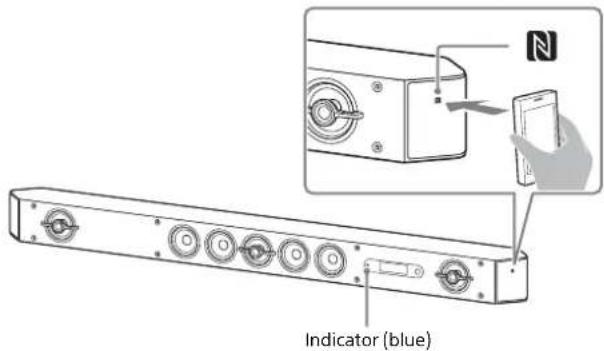
By holding an NFC-compatible BLUETOOTH device near to the N mark on the Bar Speaker, the system and BLUETOOTH device will pair and make a BLUETOOTH connection automatically.
Compatible devices
Smartphones, tablets, and music players with the NFC function built-in (OS: AndroidTM 2.3.3 or later, excluding Android 3.x)
Notes
- Depending on your device, you may need to perform the following items on your remote device in advance.
- Turn on the NFC function.
- Download the "NFC Easy Connect" application from Google Play™ and start the application. (The application may not be available in some countries/regions.) For details, refer to the operating instructions of your device.
- This feature does not work with BLUETOOTH-compatible receivers (such as headphones). To listen to sound using a BLUETOOTH-compatible receiver, see "Listening to Sound by Transmitting to a BLUETOOTH-compatible Receiver" (page 13).
1 Touch the N mark of the Bar Speaker with the BLUETOOTH device. 2 Make sure that the indicator (blue) of the Bar Speaker lights up. (This indicates that a connection has been established.) 3 Start playback of an audio source on the BLUETOOTH device.
Listening to Sound by Transmitting to a BLUETOOTH-compatible Receiver
You can listen to sound of the source playing via this system by using a BLUETOOTH-compatible receiver (such as headphones).
1 Press HOME. The home menu appears on the TV screen. 2 Select [staup] - [Bluetooth Settings] from the home menu. 3 Select [Bluetooth Mode]. 4 Select [Transmitter]. 5 Turn on BLUETOOTH function on the BLUETOOTH receiver. 6 Select the BLUETOOTH receiver's name from the [Device List] in [Bluetooth Settings] (page 24).
When the BLUETOOTH connection is established, the indicator (blue) lights up.
If you cannot find your BLUETOOTH receiver's name in the list, select [Scan].
Note
The [Device List] screen appears after a confirmation dialog when you change [Bluetooth Mode] to [Transmitter] from other modes.
7 Return to the home menu and select the desired input.
[B T TX] appears in the front panel display, and the sound is output from the BLUETOOTH receiver.
No sound is output from speakers of the system.
8 Adjust the volume.
Adjust the volume level of the BLUETOOTH receiver first. When connected with a BLUETOOTH receiver, volume level of the BLUETOOTH receiver can be controlled with VOLUME + / - on the Bar Speaker and + / - on the remote control.
Notes
- You may not be able to adjust the volume level depending on the BLUETOOTH receiver.
- [Screen mirroring], [Bluetooth Audio] and Home Theatre Control function are disabled when the system is in transmitter mode.
- When input of [Bluetooth Audio] or [Screen mirroring] is selected, you cannot set [Bluetooth Mode] to [Transmitter]. You cannot switch it with RX/TX on the remote control neither.
- You can register up to 9 BLUETOOTH receivers. If a 10th BLUETOOTH receiver is registered, the least recently connected BLUETOOTH receiver will be replaced by the new one. The system can display up to 15 detected BLUETOOTH receivers in the [Device List].
- You cannot change the sound effect or settings in the options menu while transmitting sound. Some content cannot be output due to content protection. -Playback of audio/music on the BLUETOOTH receivers is delayed compared to that on the system due to the characteristics of BLUETOOTH wireless technology.
- No sound is output from speakers and HDMI OUT (ARC) jack when a BLUETOOTH receiver is successfully connected to the system.
Tips
- You can enable or disable the reception of AAC or LDAC audio from the BLUETOOTH device (page 25).
- You can also switch the [Bluetooth Mode] using RX/TX on the remote control.
When the BLUETOOTH device in step 5 has finished pairing and is the most recently connected device, you can connect it to the system automatically by simply pressing RX/TX on the remote control. In this case, you do not need to perform step 6.
continued
To disconnect the BLUETOOTH receiver
Perform any of the following items.
- Disable the BLUETOOTH function on the BLUETOOTH receiver.
- Set [Bluetooth Mode] to [Receiver] or Off (page 24).
- Turn off the system or the BLUETOOTH receiver.
- Select the device name of the connected BLUETOOTH-compatible receiver from [Device List] in [Bluetooth Settings].
To delete a registered BLUETOOTH receiver from the device list
1. Follow steps 1 to 6 of "Listening to Sound by Transmitting to a BLUETOOTH-compatible Receiver." 2. Select the device, and then press OPTIONS. 3. Select [Remove], and then press . 4. Follow the on-screen instructions to delete the desired BLUETOOTH device from the device list.
Network Functions
Connecting to a Wired Network
Connecting the System to the Network Using a LAN Cable
The following illustration is an example configuration of the network. We recommend a wired connection for stable network functioning.
A Server 6 LAN cable (not supplied) Router Modem Internet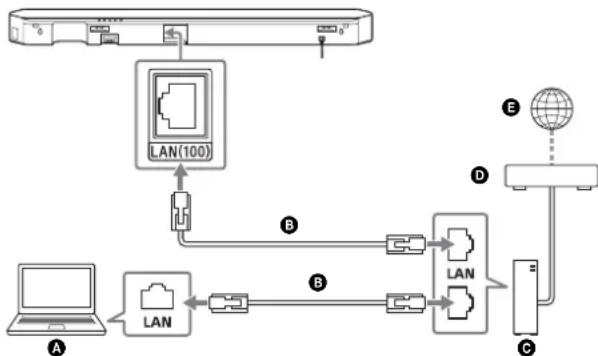
Tip: We recommend that you use a shielded straight interface cable (LAN cable).
Setting up a Wired Network Connection
You can set up a wired network connection by the following procedure.
1. Press HOME. The home menu appears on the TV screen. 2. Select [Setup] - [Network Settings] from the home menu. 3. Select [Internet Settings]. 4. Select [Wired Setup].
The screen for selecting the IP address acquisition method appears on the TV screen.
5. Select [Auto].
The system starts connecting to the network.
The confirmation screen appears.
6. Press ♣ / ♣ to browse information, and then press ♣. 7. Select [Save & Connect].
The system starts connecting to the network. For details, refer to the messages that appear on the TV screen.
If using a fixed IP address
Select [Custom] in step 5 and follow the on-screen instructions.
Tip
See [Network Connection Status] when checking the network connection status.
Connecting to a Wireless Network
Setting up a Wireless LAN Connection
Before performing network settings
When your wireless LAN router (access point) is Wi-Fi Protected Setup (WPS)-compatible, you can easily set the network settings with the WPS button.
If not, you will be required to select or enter the following information. Check the following information in advance.
- The network name (SSID) of the wireless LAN router/access point. The security key (password)** for the network. SSID (Service Set Identifier) is a name that identifies a particular access point. ** This information should be available from a label on your wireless LAN router/access point, from the operating instructions, from the person who set up your wireless network, or from the information provided by your Internet service provider.
1 Press HOME. The home menu appears on the TV screen. 2 Select [Settings] - [Network Settings] from the home menu. 3 Select [Internet Settings]. 4 Select [Wireless Setup (built-in)]. 5 Select [Wi-Fi Protected Setup (WPS)]. 6 Select [Start]. 7 Press the WPS button on the access point. The system starts connecting to the network.
If selecting the network name (SSID) you want
Select the network name (SSID) you want in step 5, enter the security key (or passphrase) using the software keyboard, and then select [Enter] to confirm the security key. The system starts connecting to the network. For details, refer to the messages that appear on the TV screen.
If using a fixed IP address
Select [New connection registration] in step 5 and follow the on-screen instructions.
If using a (WPS) PIN code
Select [New connection registration] in step 5, and then select [(WPS) PIN Method].
Tip
See [Network Connection Status] when checking the network connection status.
Playing Music/Photo Files on a Home Network
You can play music/photo files on other home network-compatible devices by connecting them to your home network.
This system can be used as a player and renderer. Server: Stores and shares digital media content. Player: Finds and plays digital media content from the server. Renderer: Receives and plays digital media content from the server and can be operated by another device (controller). Controller: Operates the renderer device.
Prepare to use the Home Network function.
- Connect the system to a network.
- Prepare another home network-compatible device. For details, refer to the operating instructions of the device.
Playing Files Stored on a Server via the System (Player)
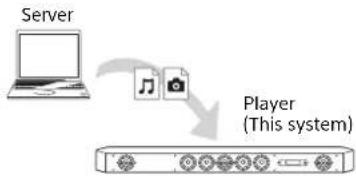
1. Press HOME. The home menu appears on the TV screen. 2. Select [Home Network]. 3. Select the desired device. 4. Press \u2191 / \u2193 to select [Music] or [Photo] and then press. 5. Select the desired content using \u2191 / \u2193 / \u2190 / \u2192 and press.
Playing Remote Files by Operating the System (Renderer) via a Home Network Controller
You can operate the system with a home network controller-compatible device (a mobile phone app, etc.), when playing files stored on a server.
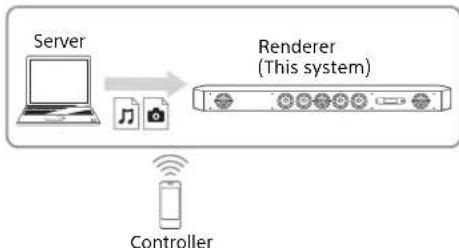
For details on operation, refer to the operating instructions of the home network controller-compatible device.
Note
Do not operate the system with the supplied remote control and a controller at the same time.
Tip
The system is compatible with the "Play To" function of Windows Media Player 12, which comes standard with Windows 7.
Displaying the Screen of the Mobile Device on a TV (Screen mirroring)
[Screen mirroring] is a function to display the screen of a mobile device on the TV by Miracast technology. The system can be connected directly with a Screen mirroring-compatible device (e.g. smartphone, tablet). You can enjoy using the display screen of the device on your large TV screen. No wireless router (or access point) is required to use this feature.
1 Press MIRRORING.
2 Follow the on-screen instructions.
Activate the Screen mirroring function from your mobile device. For details on how to activate the function, refer to the operating instructions supplied with your mobile device.
To connect to an Xperia smartphone using One-touch mirroring function (NFC)
Press MIRRORING, then hold the Xperia smartphone near to the N-Mark on the Bar Speaker.
To exit mirroring
Press HOME or INPUT.
Notes
- When using Screen mirroring, the quality of picture and sound may sometimes be deteriorated due to interference from other networks.
- Depending on the usage environment, the quality of the picture and sound may be deteriorated.
- Some network functions may not be available during Screen mirroring.
- Make sure that your device is compatible with Miracast. Connectivity with all Miracast compatible devices is not guaranteed.
Tip
If you see that the quality of picture and sound is often deteriorated, try setting the [Screen mirroring RF Setting] (page 27).
Enjoying Various Online Services (Music Services)
You can listen to music services offered on the Internet with this system. To use this function, the system must be connected to the Internet.
The operation below will display a guide to invite you to music services. Follow the guide to enjoy the music services.
1 Press HOME.
The home menu appears on the TV screen.
2 Select [Music Services].
The music services list appears on the TV screen.
Tip
You can update the service provider list by pressing OPTIONS,
followed by select [Update List].
3 Select the desired music service.
Using Google CastTM
Google Cast allows you to select music content from the Google Cast-enabled app and play back on the system. Google Cast requires the initial setup using SongPal.
1 Download free SongPal app to the mobile device such as smartphone. 2 Connect the device by Wi-Fi to the same network as that of the system (page 16). 3 Start SongPal, select [HT-ST9], and tap [Settings]-[Google Cast]-[Learn how to Cast]. 4 Check the operation and Google Cast-enabled apps, and download the app. 5 Start the Google Cast-enabled app, tap the cast button, and select [HT-ST9].
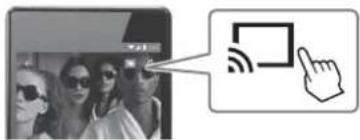
6 Select and play music on the Google Cast-enabled app. The music is played on the system.
Note
You cannot use Google Cast while "Google Cast Updating" is shown on the front panel display of the Bar Speaker. Wait until the update is complete, and then try again.
Viewing Copyright-protected 4K Content
Connecting a 4K TV
To view copyright-protected 4K content and listen to sound from the Bar Speaker, connect the Bar Speaker and the TV via an HDCP 2.2-compatible HDMI jack.
You can only view copyright-protected 4K content through the HDCP 2.2-compatible HDMI jack connection. For details on whether the TV is equipped with HDCP 2.2-compatible HDMI jack, refer to the operating instructions supplied with the TV.
When the TV's HDMI jack is labeled with ARC* and compatible with HDCP 2.2
*ARC (Audio Return Channel) The ARC function sends digital sound from a TV to this system using just an HDMI cable.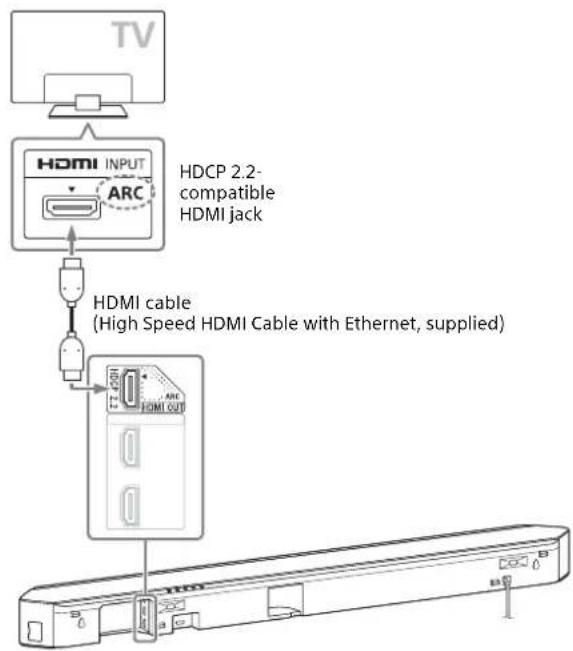
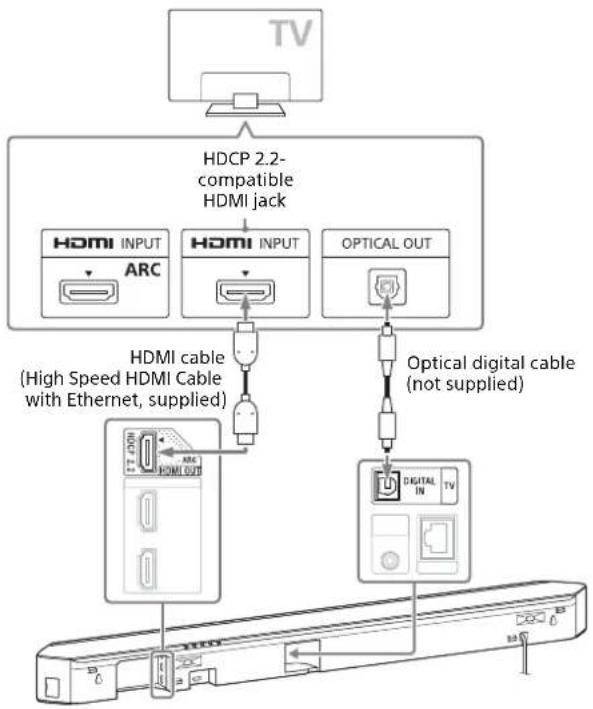
When the TV's HDMI jack is labeled with ARC and not compatible with HDCP 2.2
If your TV's HDMI jack is labeled with ARC and not compatible with HDCP 2.2, connect the system to your TV's HDMI jack that is compatible with HDCP 2.2 using an HDMI cable. Then, connect an optical digital cable to the optical output jack of the TV to listen to digital sound.
Connecting 4K Devices
Connect a 4K device to the HDMI IN 1 jack of the Bar Speaker. For details on whether the device is HDCP 2.2-compatible, refer to the operating instructions supplied with the device.
Note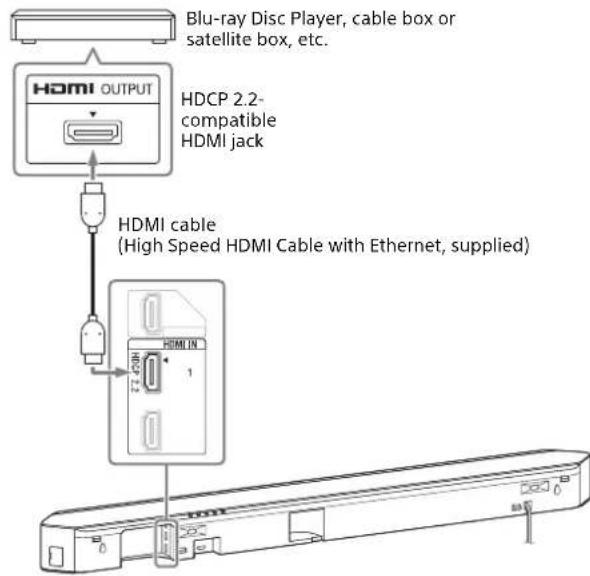
One HDMI cable (High Speed HDMI Cable with Ethernet) is supplied with this system.
Settings and Adjustments
Using the Setup Display
You can make various adjustments to items such as picture and sound. The default settings are underlined.
1 Press HOME. The home menu appears on the TV screen. 2 Press ▲/▼ to select [Setup]. 3 Press ▲/▼ to select the setup category icon, and then press ▶.
Icon Explanation
| [Software Update] (page 22) Updates the software of the system. | |
| [Screen Settings] (page 23) Makes the screen settings according to the type of TV. | |
| [Audio Settings] (page 24) Makes the audio settings according to the type of connection jacks. | |
| [Bluetooth Settings] (page 24) Makes detailed settings for the BLUETOOTH function. | |
| [System Settings] (page 25) Makes the system-related settings. | |
| [Network Settings] (page 26) Makes detailed settings for Internet and home network. |
Icon Explanation
| [Input Skip Setting] (page 27) Sets the input skip setting for each input. | |
| [Easy Setup] (page 27) Re-runs the Easy Setup to make the basic settings. | |
| [Easy Network Settings] (page 27) Runs [Easy Network Settings] to make the basic network settings. | |
| [Resetting] (page 27) Reset the system to the factory default settings. |
[Software Update]
By updating your software to the latest version, you can take advantage of the newest functions.
During a software update, "UPDT" appears in the front panel display. After the update is complete, the system automatically reboots. While the updating operation is in progress, do not turn on or off the system or operate the system or TV. Wait for the software update to complete.
Notes
- For information about update functions, visit the following website: http://www.sony.com/soundbarsupport
- Set [Auto Update] to [On] when you want to perform software updates automatically (page 26). Software update may be performed even if you select Off in [Auto Update] depending on the details of the updates.
[Update via Internet]
Updates the system's software using the available network. Make sure network is connected to the Internet.
[Update via USB Memory]
Updates software using USB memory. Make sure that the software update folder is correctly named "UPDATE."
![SONY HTST9 - [Update via USB Memory] - 1](/content/2026/03/501710/images/16507dd7ca1201f7231551711cd6d603bc1aeabeda1f499c6de2d44252ee3fba.jpg)
[Screen Settings]
[TV Type]
[16:9]: Select this when connecting to a wide-screen TV or a TV with a wide-mode function. [4:3]: Select this when connecting to a 4:3 screen TV without a wide-mode function.
[Output Video Resolution]
[Auto]: Outputs video signal according to the resolution of the TV or connected device.
[480i/576i] , [480p/576p] , [720p], [1080i], [1080p]: Outputs video signal according to the selected resolution setting.
- If the color system of the playback content is NTSC, the video signals resolution can be converted to [480i] and [480p] only.
[24p Output]
[Network content 24p Output]
This function sets the signals output from the HDMI OUT (ARC) jack on the system when using the Screen mirroring function.
[Auto]: Outputs 24p video signals only when you connect a 1080/24p-compatible TV via an HDMI connection and the [Output Video Resolution] is set to [Auto] or [1080p].
Off : Select this when your TV is not compatible with 1080/24p video signals.
[4K Output]
[Auto1]: Outputs 2K (1920 × 1080) video signals during video playback and 4K video signals during photo playback when connected to a 4K-compatible device manufactured by Sony. Outputs 4K video signals during playback of 24p video content or playback of photos when connected to a device other than 4K-compatible device manufactured by Sony.
This setting does not work for 3D video image playback.
[Auto2]: Automatically outputs 4K/24p video signals when you connect a 4K/24p-compatible device and make the appropriate settings for [Network content 24p Output] in [24p Output], and also outputs 4K/24p photo images when you play 2D photo files. Off: Turns off the function.
Note
If your device manufactured by Sony is not detected when [Auto1] is selected, the setting will have the same effect as [Auto2] setting.
YCbCr/RGB (HDMI)
[Auto]: Automatically detects the type of external device, and then switches to the matching color setting. [YCbCr (4:2:2)]: Outputs YCbCr 4:2:2 video signals. [YCbCr (4:4:4)]: Outputs YCbCr 4:4:4 video signals. [RGB]: Select this when connecting to a device with an HDCP compliant DVI jack.
[HDRI Deep Color Output]
[Auto]: Normally select this. [12bit], [10bit]: Outputs 12bit/10bit video signals when the connected TV is compatible with Deep Color. Off: Select this when the picture is unstable or colors appear unnatural.
[Video Direct]
You can disable the On-Screen Display (OSD) of the Bar Speaker when [HDMI1], [HDMI2] or [HDMI3] input is selected. This function is useful when playing a game, you can fully enjoy the game's screen. [On]: Disables the OSD. Information will not display on the TV screen and the OPTIONS and DISPLAY buttons will not work. Off: Displays information on the TV screen only when you change the settings, such as when selecting the sound field.
continued
23US
[On]: Smoths the gradation of video signals output from the HDMI OUT (ARC) jack.
Off: Select this if video signals are distorted or color is unnatural.
![SONY HTST9 - [Video Direct] - 1](/content/2026/03/501710/images/e42cef85f60ab7b427010284f35460bb62e39535d0fd0f1ffc0a958b536138cb.jpg)
[Audio Settings]
[DSEE HX]
This function is only available when [Music] is selected as the sound field.
[On]: Upscales the audio file to a High-Resolution Audio file and reproduces the clear high-range sound which is often lost (page 10). Off: Off
[Audio DRC]
You can compress the dynamic range of the sound track. [Auto]: Automatically compresses sound encoded in Dolby TrueHD. [On]: The system reproduces the sound track with the kind of dynamic range that the recording engineer intended. Off: No compression of dynamic range.
Attenuation settings - Analog
Distortion may occur when you listen to a device connected to the ANALOG IN jacks. You can prevent distortion by attenuating the input level on the system. [On]: Attenuates the input level. The output level will decrease at this setting. Off: Normal input level.
[Audio Output]
You can select the output method used for audio signal output. [Speaker]: Outputs multi-channel sound from the system's speakers only. [Speaker + HDMI]: Outputs multi-channel sound from the system's speakers and 2-channel linear PCM signals from the HDMI OUT (ARC) jack.
[HDMI]: Outputs sound from the HDMI OUT (ARC) jack only. Sound format depends on the connected device.
Note
When [Control for HDMI] is set to On, [Audio Output] is set to [Speaker + HDMI] automatically and this setting cannot be changed.
3 [Bluetooth Settings]
■ [Bluetooth Mode]
You can enjoy content from a BLUETOOTH device by using this system or listen to sound from this system by using BLUETOOTH receiver such as headphones. [Receiver]: This system is in receiver mode, which enables it to receive and output audio from the BLUETOOTH device. [Transmitter]: This system is in transmitter mode, which enables it to send audio to the BLUETOOTH receiver. If you switch the input of the system, [BT TX] appears on the front panel display. Off: The BLUETOOTH function is turned off and you cannot select the [Bluetooth Audio] input.
Note
You can connect to a BLUETOOTH device by using the One-touch function even if you have set [Bluetooth Mode] to Off.
[Device List]
Displays a list of paired and detected BLUETOOTH devices (SNK device) when [Bluetooth Mode] is set to [Transmitter].
[Bluetooth Standby]
You can set the [Bluetooth Standby] so that the system can be turned on by a BLUETOOTH device even when the system is in standby mode. This function is only available when you set [Bluetooth Mode] to [Receiver] or [Transmitter]. [On]: The system turns on automatically when you establish a BLUETOOTH connection from a paired BLUETOOTH device.
[Bluetooth Codec - AAC]
This function is only available when you set [Bluetooth Mode] to [Receiver] or [Transmitter].
[On]: Enable AAC codec.
Off: Disable AAC codec.
Note
You can enjoy high-quality sound if AAC is enabled and your device supports AAC. If you cannot listen to AAC sound with your device, select Off.
[Bluetooth Codec-LDAC]
This function is only available when you set [Bluetooth Mode] to [Receiver] or [Transmitter].
[On]: Enable LDAC codec.
Off: Disable LDAC codec.
Note
You can enjoy higher quality sound if LDAC is enabled and your device supports LDAC. If you cannot listen to LDAC sound with your device, select Off.
[Wireless Playback Quality]
You can set the transmission data rate of LDAC playback. This function is only available when you set [Bluetooth Mode] to
[Transmitter] and [Bluetooth Codec - LDAC] to [On].
[Auto]: The data transfer rate is automatically changed depending on the environment. If audio playback is unstable in this mode, use the other three modes.
[Sound Quality]: The highest bit rate is used. Sound is sent in higher quality; however, audio playback may sometimes become unstable when the link quality is not good enough.
[Standard]: The middle bit rate is used. It balances both sound quality and playback stability.
[Connection]: Stability is prioritized. Sound quality may be reasonable and connection status will most likely be stable. If the connection is unstable, this setting is recommended.
![SONY HTST9 - [Wireless Playback Quality] - 1](/content/2026/03/501710/images/0a1707a24ae5df9bf6c340f2d27a1bb8c0e89444cd42b9f3fd096fcfec0fde0a.jpg)
[System Settings]
[OSD Language]
You can select the language you want for the system on-screen display.
[Wireless Sound Connection]
You can make further settings for the wireless system. For details, see "Further Setting for the Wireless System (Subwoofer)" (page 35).
[IR-Repeater]
[On]: Remote signals for the TV are sent from the rear of the Bar Speaker (page 34).
Off: Turns off the function.
[HDRI Settings]
[Control for HDMI]
[On]: Turns on the [Control for HDMI] function. You can operate mutually between devices that are connected with an HDMI cable. Off: Off
[Audio Return Channel]
This function is available when you connect the system to a TV's HDMI IN jack that is compatible with the Audio Return Channel function and [Control for HDMI] is set to [On].
[Auto]: The system can receive the digital audio signal of the TV automatically via an HDMI cable.
[Standby Through]
You can output HDMI signals to the TV even when the system is in standby mode. This function is available when you set [Control for HDMI] to [On].
[Auto]: Outputs signals from the HDMI OUT (ARC) jack when the TV is turned on while the system is in the standby mode. This setting saves power in the standby mode compared to the [On] setting.
[On]: Always output signals from the HDMI OUT (ARC) jack when the system is in standby mode. If you connect a TV other than "BRAVIA," we recommend you to select this setting.
continued
25US
Off: No signals are output when the system is in standby mode. This setting saves power in standby mode compared to the [On] setting.
[Quick Start/Network Standby]
[On]: Shortens the startup time from standby mode. You can operate the system quickly after turning it on.
[Auto Standby]
[On]: Turns on the [Auto Standby] function. When you do not operate the system for about 20 minutes, the system enters standby mode automatically.
[Auto Display]
[On]: Automatically displays information on the TV screen when changing the audio signals, picture mode, etc. Off: Displays information only when you press DISPLAY.
[Software Update Notification]
[On]: Sets the system to inform you of the latest software version information (page 22).
[Auto Update Settings]
[Auto Update]
[On]: Software update is automatically executed between 2 a.m. and 5 a.m. local time in the selected [Time Zone] while this system is not in use. If you select Off in [Quick Start/Network Standby], software update is performed after you turn off the system.
[Time Zone]
Select your country/region.
Notes
- Software update may be performed even if you select Off in [Auto Update] depending on the details of the updates.
- Software update is performed automatically within 11 days of a new software release.
Device Name]
You can change the name of this system according to your preference so that it is more recognizable when using the [Bluetooth Audio] or [Screen mirroring] function. The name is also used with other networks, such as the home network. Follow on-screen instructions and use the software keyboard to enter the name.
System Information
You can display the system's software version information and the MAC address.
[Software License Information]
You can display the Software License Information.
[Network Settings]
Internet Settings]
Connect the system to the network beforehand. [Wired Setup]: Select this when you connect to a broadband router using a LAN cable. [Wireless Setup(built-in)] Select this when you use the built-in Wi-Fi function of the system to connect to a wireless network.
Tip
For further details, visit the following website and check the FAQ: http://www.sony.com/soundbarsupport
[Network Connection Status]
Displays the current network connection status.
Network Connection Diagnostics
You can run the network diagnostic to check if the network connection has been made properly.
[Screen mirroring RF Setting]
If you use multiple wireless systems, such as a wireless LAN, the wireless signals may be unstable. In this case, playback stability may be improved by setting the priority radio frequency channel for Screen mirroring. [Auto]: Normally select this. The system automatically selects the best channel for Screen mirroring. [CH 1]/[CH 6]/[CH 11]: The selected channel is prioritized for Screen mirroring connection.
[Connection Server Settings]
Sets whether or not to display the connected home network server.
[Auto Renderer Access Permission]
[On]: Allows automatic access from a newly detected home network controller.
■ [Renderer Access Control]
Displays a list of home network controller-compatible products and sets whether or not to accept commands from the controllers in the list.
External Control]
[On]: Allows the home automation controller to operate this system.
Remote Start
[On]: Allows you to turn on the system by a device linked via a network when the system is in standby mode.
Off: The system cannot be turned on by a device linked via a network.
[Input Skip Setting]
The skip setting is a convenient feature that allows you to skip unused inputs when selecting a function by pressing INPUT.
[Do not skip]: The system does not skip the selected input.
[Skip]: The system skips the selected input.
Note
When you press INPUT while the home menu is displayed, the input icon appears dimmed if it has been set to [Skip].
[Easy Setup]
Run [Easy Setup] to make the basic initial settings and the basic network settings for the system. Follow the on-screen instructions.
[Easy Network Settings]
Runs [Easy Network Settings] to make the basic network settings. Follow the on-screen instructions.
[Resetting]
[Reset to Factory Default Settings]
You can reset the system settings to the factory default by selecting the group of settings. All the settings within the group will be reset.
[Initialize Personal Information]
You can erase your personal information stored on the system.
Note
If you dispose, transfer or resell this system, please delete all Personal Information for security purposes. Please take appropriate measures such as logging out after using a network service.
Using the Options Menu
Various settings and playback operations are available by pressing OPTIONS. The available items differ depending on the situation.
Common options
[A/V SYNC]
Adjusts the time gap between picture and sound (page 29).
[Sound Field]
Changes the sound field setting (page 9).
[Football]
Selects the football mode (page 9).
[Night]
Selects the night mode (page 10).
[Voice]
Selects the voice mode (page 10).
[Repeat Setting]
Sets repeat playback.
[Play/Stop]
Starts or stops playback.
[Play from beginning]
Plays the item from the beginning.
[Change Category]
Switches between the [Music] and [Photo] category in [USB] or [Home Network] input. This item is only available when the display list is available for the category.
[Music] only
[Shuffle Setting]
Sets shuffle playback.
[Add Slideshow BGM]
Registers music files on the USB memory as slideshow background music (BGM).
[Slideshow]
Starts a slideshow.
[Slideshow Speed]
Changes the slideshow speed.
[Slideshow Effect]
Sets the effect when playing a slideshow.
[Slideshow BGM]
- Off: Turns off the function.
- [My Music from USB]: Sets the music files registered in [Add Slideshow BGM].
[Change Display]
Switches between [Grid View] and [List View].
[Rotate Left]
Rotates the photo counterclockwise by 90 degrees.
[Rotate Right]
Rotates the photo clockwise by 90 degrees.
[View Image]
Displays the selected picture.
Adjusting the Delay Between the Picture and Sound (A/V SYNC)
When the sound does not match the pictures on the TV screen, you can adjust the delay between the picture and sound for the following inputs.
The setting method differs depending on the input.
When the [HDMI1], [HDMI2] or [HDMI3] input is selected
1 Press OPTIONS.
The options menu appears on the TV screen.
2 Select [A/V SYNC]. 3 Adjust the delay using the left/right arrows and the plus/minus buttons.
You can adjust from 0 ms to 300 ms in 25 ms increments.
When the [TV] input is selected
1 Press OPTIONS.
"SYNC" appears in the front panel display.
2 Press or . 3 Adjust the delay using / and .
You can adjust from 0 ms to 300 ms in 25 ms increments.
4 Press OPTIONS.
The options menu in the front panel display turns off.
Other Functions
Controlling the System Using a Smartphone or Tablet (SongPal)
SongPal is a dedicated app for operating SongPal-compatible audio devices manufactured by Sony using a smartphone or tablet. Search for SongPal on Google Play or the App Store and download using your smartphone or tablet.
SongPal allows you to... - change commonly used settings, selecting the input of the system and adjusting the volume. - enjoy with the system music content stored on a home network server or smartphone. - enjoy music visually with your smartphone display. - configure Wi-Fi connection settings easily using SongPal if your Wi-Fi router does not have a WPS function. - use the SongPal Link function (page 31).
Notes
- Before you start to perform the operations below, be sure to set the [Bluetooth Mode] to [Receiver] (page 24).
- This system is compatible with SongPal version 3.0 or later.
- SongPal uses the network function (page 15) and BLUETOOTH function (page 11) of the system.
- Specifications and display design of SongPal change without notice.
When using an Android Device
1 Press I/ (on/standby). The display of the Bar Speaker lights. 2 Search for SongPal with the Android device and download that application. 3 Launch SongPal. 4 Connect the system and the Android device by the BLUETOOTH connection (page 11) or network connection (page 15).
Tip
You can connect the Android device with the NFC function (page 12).
5 Follow the instructions on SongPal.
When using an iPhone/iPod touch
1 Press I/ (on/standby). The display of the Bar Speaker lights. 2 Search for SongPal with the iPhone/iPod touch and download that application. 3 Launch SongPal. 4 Connect the system and an iPhone/iPod touch by BLUETOOTH connection (page 11) or network connection (page 15). 5 Follow the instructions on SongPal.
Listening to the Same Music on Multiple Devices/ Listening to Different Music in a Different Location (SongPal Link)
You can enjoy music stored on your computer or smartphone or from music services in multiple rooms at the same time. Refer to the following for details of SongPal Link http://www.sony.net/nasite
Using the Control for HDMI Function for "BRAVIA" Sync
This function is available on TVs with the "BRAVIA" Sync function. Operation is simplified with the features below by connecting via an HDMI cable products manufactured by Sony that are compatible with the Control for HDMI function. You can enable the Control for HDMI function by setting [Control for HDMI] to [On] (page 25).
Notes
- To use the "BRAVIA" Sync function, be sure to turn on the system and all connected devices after making the HDMI connection. Depending on the settings of the connected device, the Control for HDMI function may not work correctly. Refer to the operating instructions of the device.
System Power Off
When you turn off the TV, the system and the connected device will turn off automatically.
Notes
The system does not turn off automatically while playing music on this system. The System Power Off function may work with devices other than those manufactured by Sony, but operation is not guaranteed.
One-Touch Play
When you play content on a device (Blu-ray Disc Player, "PlayStation4," etc.) connected to the system with an HDMI cable, the system and TV are turned on automatically and the input of the system is switched to the appropriate HDMI input.
continued:
31US
Notes
The feature above may not operate with certain devices. - If you set [Standby Through] to [Auto] or [On] (page 25), and then play back the content on a connected device when the system is in standby mode, sound and image can only be output from the TV while the system remains in standby mode. - The One-Touch Play function may work with devices other than those manufactured by Sony, but operation is not guaranteed.
System Audio Control
If you turn on the system while you are watching the TV, the TV sound will be output from the speakers of the system automatically. The volume of the system will be adjusted when you adjust the volume using the TV's remote control.
If the TV sound was output from the speakers of the system the last time you watched the TV, the system will be turned on automatically when you turn on the TV again. You can also enjoy this feature when using the Twin Picture function (Picture and Picture (P&P)) on your TV.
- If the [TV], [HDMI1], [HDMI2] or [HDMI3] input is selected, the sound can be output from the system.
- If other than [TV], [HDMI1], [HDMI2] or [HDMI3] input is selected, the sound is only output from the TV when using the Twin Picture function. When you turn off the Twin Picture function, the sound is output from the system.
Notes
- The number for the system's volume level is displayed on the TV screen depending on the TV. The displayed volume number may differ from the number on the front panel display of the Bar Speaker.
- The System Audio Control function may work with devices other than those manufactured by Sony, but operation is not guaranteed.
Audio Return Channel
You can enjoy TV sound via the system by using just one HDMI cable. For details of the setting, see "[Audio Return Channel]" (page 25).
Note
The Audio Return Channel function may work with devices other than those manufactured by Sony, but operation is not guaranteed.
Control for HDMI sync function
The system's [Control for HDMI] function automatically becomes active by activating the TV's Control for HDMI (BRAVIA Sync) function. "DONE" appears in the front panel display of the Bar Speaker when this is done.
Notes
- You can set the [Control for HDMI] function manually if the above setting is not working. For details, see "[HDMI Settings]" (page 25).
- The control for HDMI sync function is a proprietary function of Sony. This function cannot operate with devices other than those manufactured by Sony.
Echo Canceling Sync
You can reduce the echo when you use the Social Viewing function while watching TV programs. Conversation becomes clearer.
- If the current selected input is [TV], [HDMI1], [HDMI2] or [HDMI3], the input is automatically changed to [TV] input. Sound of the Social Viewing and TV program is output from the system.
- If the current selected input is other than [TV], [HDMI1], [HDMI2] or [HDMI3], the sound of the Social Viewing and the playback content is output from TV.
Notes
- This feature only works for a TV that supports Social Viewing function. For details, refer to the operating instructions of your TV.
- Be sure to set the audio output setting on your TV so that the sound can be output through this system.
- The Echo Canceling Sync function is a proprietary function of Sony. This function cannot operate with devices other than those manufactured by Sony.
Home Theatre Control
The icon of the Home Theatre Control app appears on the TV screen. You can change the settings of the system (such as change an input or sound field) by using the remote control of your TV.
Notes
- Your TV must be connected to Internet to use the Home Theatre Control function. The Home Theatre Control function is a proprietary function of Sony. This function cannot operate with devices other than those manufactured by Sony.
Language Follow
When you change the language for the on-screen display of the TV, the system's on-screen display language is also changed.
Notes on HDMI connections
- Use an HDMI cable (High Speed HDMI Cable with Ethernet). If you use a standard HDMI cable, 1080p, Deep Color, 3D, and 4K content may not be displayed properly.
- Use an HDMI-authorized cable. Use an HDMI cable (High Speed HDMI Cable with Ethernet) manufactured by Sony bearing the logo indicating the cable type.
- We do not recommend using an HDMI-DVI conversion cable.
- Audio signals (sampling frequency, bit length, etc.) transmitted from an HDMI jack may be suppressed by the connected device.
- Sound may be interrupted when the sampling frequency or the number of channels of audio output signals from the playback device is switched.
- When [TV] input is selected, video signals via one of the HDMI IN 1/2/3 jacks selected last time are output from the HDMI OUT (ARC) jack.
- This system supports Deep Color, "x.v.Color," 3D, and 4K transmission.
- To enjoy 3D content, connect a 3D-compatible TV and video device (Blu-ray Disc Player, "PlayStation®4" etc.) to the system using HDMI cables (High Speed HDMI Cable with Ethernet), put on 3D glasses, and then play back a 3D-compatible Blu-ray Disc, etc.
- To enjoy 4K content, the TV and players that are connected to the system must be compatible with 4K content.
Enjoying multiplex broadcast sound (Dual Mono)
You can enjoy multiplex broadcast sound when the system receives a Dolby Digital multiplex broadcast signal.
Note
To receive a Dolby Digital signal, you need to connect a TV or other devices to the DIGITAL IN (TV) jack with an optical digital cable.
If your TV's HDMI IN jack is compatible with the Audio Return Channel function (page 25), you can receive a Dolby Digital signal via an HDMI cable.
Press AUDIO repeatedly until the signal you want appears in the front panel display.
- "MAIN": Sound of the main language will be output.
- "SUB": Sound of the sub language will be output.
- "MN/SB": Mixed sound of both the main and sub languages will be output.
Deactivating Buttons on the Bar Speaker (Child Lock)
You can deactivate buttons on the Bar Speaker (except for I/O) to prevent misoperation, such as child mischief. Be sure to use buttons on the Bar Speaker to perform this operation.
Press and hold INPUT followed by VOLUME-, VOLUME+, VOLUME - on the Bar Speaker.
"LOCK" appears in the front panel display. You can only operate the system by using the remote control. To cancel, press and hold INPUT followed by VOLUME -, VOLUME +, VOLUME - on the Bar Speaker. "UNLCK" appears in the front panel display.
Changing the brightness
You can change the brightness of the front panel display and blue LED indicator.
Press DIMMER repeatedly.
You can adjust the brightness in 3 levels.* * The brightness for "DIM1" and "DIM2" settings are the same.
Note
The front panel display is turned off when "DIM2" is selected. It turns on automatically when you press any buttons, then turns off again if you do not operate the system for about 10 seconds. However, in some cases, the front panel display may not turn off.
Saving Power in Standby Mode
Check that you have made the following settings:
- [Bluetooth Standby] is set to Off (page 24).
- [Standby Through] is set to Off (page 25).
- [Quick Start/Network Standby] is set to Off (page 26).
- [Remote Start] is set to Off (page 27).
Enabling the IR Repeater Function (when you cannot control the TV)
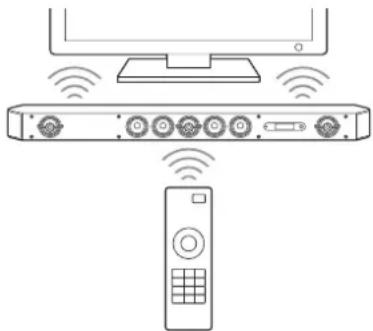
When the Bar Speaker obstructs the remote control sensor of the TV, the TV remote control may not work. In that case, enable the IR repeater function of the system.
You can control the TV with the remote control of the TV by sending the remote signal from the rear of the Bar Speaker.
Note
Be sure to check that the remote control of the TV cannot control the TV, and then set [IR-Repeater] to [On] (page 25). If it is set to [On] when the remote control can control the TV, appropriate operation may not be obtained because of the interference between the direct command from the remote control and the command via the system.
1 Press HOME. The home menu appears on the TV screen. 2 Select [Setup] - [System Settings] from the home menu. 3 Select [IR-Repeater]. 4 Select [On]. 5 Press HOME.
The menu goes off.
Note
On some TVs, this function may not work correctly. In this case, place the Bar Speaker slightly further away from the TV.
Further Setting for the Wireless System (Subwoofer)
On/standby indicator
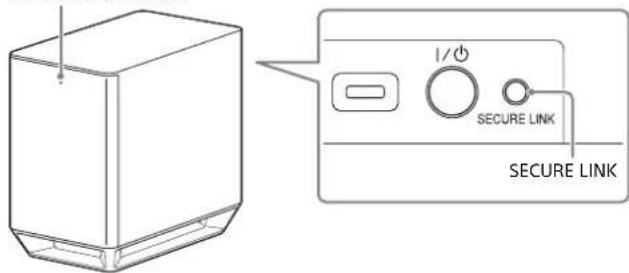
1 Press HOME.
The home menu appears on the TV screen.
2 Select [Setup] - [System Settings] from the home menu. 3 Select [Wireless Sound Connection].
The [Wireless Sound Connection] display appears.
- [Secure Link] RF Band]
continued
Activating Wireless Transmission Between Specific Devices
[Secure Link]
You can specify the wireless connection to link the system to the subwoofer using the Secure Link function.
This function can help prevent interference if you use multiple wireless products or your neighbors use wireless products.
1 Select [Wireless Sound Connection] in [System Settings] (page 35). 2 Select [Secure Link]. 3 Select [On]. 4 Press SECURE LINK on the rear of the subwoofer. Proceed to the next step within a few minutes. 5 Select [Start].
To return to the previous display, select [Cancel].
6 After the message [Secure Link setting is complete.] appears, press
The on/standby indicator on the subwoofer lights in orange. If the message [Cannot set Secure Link.] appears, follow the on-screen instructions.
To cancel the Secure Link function
For the Bar Speaker
Select Off on Step 3 above.
For the subwoofer
Press and hold the SECURE LINK on the rear of the subwoofer for several seconds until the on/standby indicator on the subwoofer turns green or flashes in green.
Be sure to press the SECURE LINK with the point of a pen, etc.
Selecting the Frequency Band
[RF Band]
You can select the frequency band.
1 Select [Wireless Sound Connection] in [System Settings] (page 35). 2 Select [RF Band]. 3 Select the setting you want.
- [Auto]: Normally select this. The system automatically selects the strongest frequency band for transmission.
- [5.2GHz], [5.8GHz]: The system transmits sound according to the selected frequency band.
Tip
We recommend you to set [RF Band] to [Auto].
Modifying the Angle of the Bar Speaker
You can modify the angle of the Bar Speaker by attaching the stands on the bottom of the Bar Speaker.
You can attach the stands on the bottom of the Bar Speaker as shown below.
Notes
- We recommend that you use the system without attaching stands if you will be listening to High-Resolution Audio.
- When you mount the Bar Speaker on the wall, detach the stands beforehand.
Attach the stands to both sides of the bottom of the Bar Speaker using the supplied screws.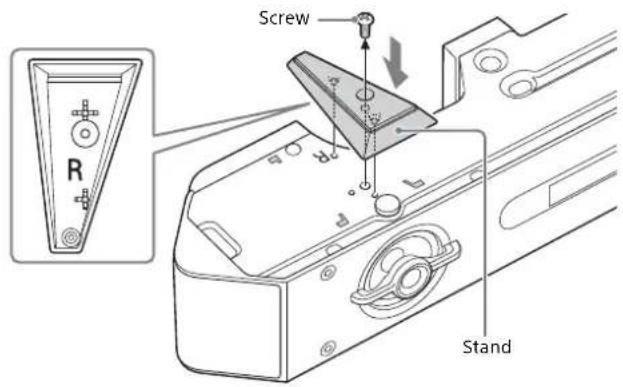
Tip
The stand shape differs for the right and left sides. Check the "R" or "L" mark engraved on the stand before attaching it.
Mounting the Bar Speaker on a Wall
You can mount the Bar Speaker on a wall.
Notes
- When you mount the Bar Speaker on the wall, detach the stands beforehand (page 37).
- Prepare screws (not supplied) that are suitable for the wall material and strength. As a plasterboard wall is especially fragile, attach the screws securely to two studs in the wall beam. Install the Bar Speaker horizontally, hung by screws in studs in a continuous flat section of the wall.
- Have the installation done by a Sony dealer or licensed contractor and pay special attention to safety during the installation.
- Sony shall not be held responsible for accidents or damage caused by improper installation, insufficient wall strength, improper screw installation or natural disaster, etc.
Prepare screws (not supplied) that are suitable for the holes on the rear of the Bar Speaker. More than 30 mm (13/16 in)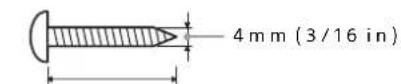
Hole on the rear of the Bar Speaker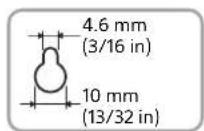
2 Fasten the screws to two studs in the wall.
The screws should protrude by 11 mm to 12 mm (approx. 7/16 in).
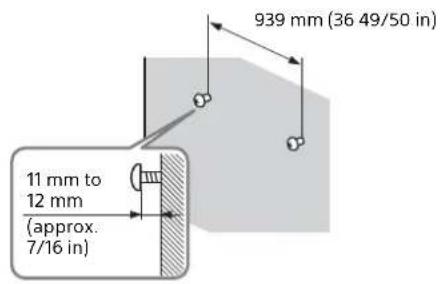
3 Hang the Bar Speaker on the screws.
Align the holes at the rear of the Bar Speaker with the screws, and then hang the Bar Speaker on the two screws.
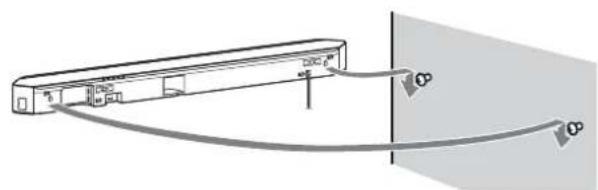
Note
When you use the HDMI IN 3 jack of the wall-mounted Bar Speaker, connect a right-angled HDMI cable (High Speed HDMI Cable with Ethernet).
Attaching the Grille Frame
Attach the grille frame in parallel with the front panel.
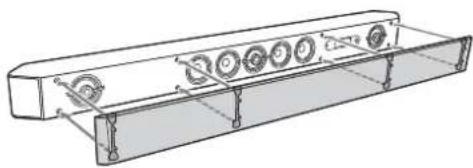
Note
We recommend that you use the system without attaching the grille frame if you will be listening to High-Resolution Audio.
Additional Information
Precautions
On safety
- Should any solid object or liquid fall into the system, unplug the system and have it checked by qualified personnel before operating it any further.
- Do not climb on the Bar Speaker and subwoofer, as you may fall down and injure yourself, or system damage may result.
On power sources
Before operating the system, check that the operating voltage is identical to your local power supply. The operating voltage is indicated on the nameplate at the rear of the Bar Speaker. - If you are not going to use the system for a long time, be sure to disconnect the system from the wall outlet (mains). To disconnect the AC power cord (mains lead), grasp the plug itself; never pull the cord. - One blade of the plug is wider than the other for the purpose of safety and will fit into the wall outlet (mains) only one way. If you are unable to insert the plug fully into the outlet, contact your dealer. - AC power cord (mains lead) must be changed only at a qualified service shop.
On heat buildup
Although the system heats up during operation, this is not a malfunction. If you continuously use this system at high volume, the system temperature at the rear and bottom rises considerably. To avoid burning yourself, do not touch the system.
On placement
- Place the system in a location with adequate ventilation to prevent heat buildup and prolong the life of the system.
- Do not place the system near heat sources or in a place subject to direct sunlight, excessive dust, or mechanical shock.
- Do not place anything at the rear of the Bar Speaker and subwoofer that might block the ventilation holes and cause malfunctions.
- If the system is being used in combination with a TV, VCR, or tape deck, noise may result and picture quality may suffer. In such a case, place the system away from the TV, VCR, or tape deck.
- Use caution when placing the system on a surface that has been specially treated (with wax, oil, polish, etc.), as staining or discoloration of the surface may result. Take care to avoid any possible injury from the corners of the Bar Speaker and subwoofer.
- Keep 3 cm or more space under the Bar Speaker when you hang it on a wall.
On handling the subwoofer
Do not place your hand into the slit of the subwoofer when lifting it. The speaker driver may be damaged. When lifting it, hold the bottom of the subwoofer.
On operation
Before connecting other devices, be sure to turn off and unplug the system.
If you encounter color irregularity on a nearby TV screen
Color irregularities may be observed on certain types of TV sets.
If color irregularity is observed...
Turn off the TV set, then turn it on again after 15 to 30 minutes.
If color irregularity is observed again...
Place the system further away from the TV set.
On cleaning
Clean the system with a soft, dry cloth. Do not use any type of abrasive pad, scouring powder, or solvent such as alcohol or benzine.
If you have any question or problem concerning your system, please consult your nearest Sony dealer.
continued
Disclaimer regarding services offered by third parties
Services offered by third parties may be changed, suspended, or terminated without prior notice. Sony does not bear any responsibility in these sorts of situations.
Notes on updating
This system allows you to update the software automatically when connected to the Internet via a wired or wireless network.
You can add new features and use the system with more convenience and safety by updating the system.
If you do not want to update automatically, you can disable the function by using SongPal installed on your smartphone or tablet. However, the system may update the software automatically for reasons such as safety, even if this function is disabled. You can also update the software using the settings menu when this function is disabled. Refer to "Using the Setup Display" (page 22) for details.
You may not use the system while the software is being updated.
Copyrights
This system incorporates Dolby Digital and the DTS * Digital Surround System.
- Manufactured under license from Dolby Laboratories. Dolby, and the double-D symbol are trademarks of Dolby Laboratories. ** For DTS patents, see http://patents.dts.com. Manufactured under license from DTS Licensing Limited. DTS, DTS-HD, the Symbol, & DTS and the Symbol together are registered trademarks, and DTS-HD Master Audio is a trademark of DTS, Inc. © DTS, Inc. All Rights Reserved.
The BLUETOOTH* word mark and logos are registered trademarks owned by Bluetooth SIG, Inc. and any use of such marks by Sony Corporation is under license. Other trademarks and trade names are those of their respective owners.
This system incorporates High-Definition Multimedia Interface (HDMI™) technology.
The terms HDMI and HDMI High-Definition Multimedia Interface, and the HDMI Logo are trademarks or registered trademarks of HDMI Licensing LLC in the United States and other countries.
The N Mark is a trademark or registered trademark of NFC Forum, Inc. in the United States and in other countries.
Android and Google Play are trademarks of Google Inc.
Google Cast is a trademark of Google Inc.
"Xperia" is a trademark of Sony Mobile Communications AB.
Apple, the Apple logo, iPhone, iPod, iPod touch, and Retina are trademarks of Apple Inc., registered in the U.S. and other countries. App Store is a service mark of Apple Inc.
"Made for iPod," and "Made for iPhone" mean that an electronic accessory has been designed to connect specifically to iPod or iPhone, respectively, and has been certified by the developer to meet Apple performance standards. Apple is not responsible for the operation of this device or its compliance with safety and regulatory standards. Please note that the use of this accessory with iPod or iPhone may affect wireless performance.
"BRAVIA" logo is a trademark of Sony Corporation.
"ClearAudio+" is a trademark of Sony Corporation.
"x.v.Color" and "x.v.Color" logo are trademarks of Sony Corporation.
"PlayStation" is a registered trademark of Sony Computer Entertainment Inc.
MPEG Layer-3 audio coding technology and patents licensed from Fraunhofer IIS and Thomson.
Windows Media is either a registered trademark or trademark of Microsoft Corporation in the United States and/or other countries. This product is protected by certain intellectual property rights of Microsoft Corporation. Use or distribution of such technology outside of this product is prohibited without a license from Microsoft or an authorized Microsoft subsidiary.
Opera Devices SDK from Opera Software ASA. Copyright 1995-2013 Opera Software ASA. All rights reserved.

POWERED BY OPERA®
Wi-Fi, Wi-Fi Protected Access, Wi-Fi Alliance and Wi-Fi CERTIFIED Miracast are registered trademarks of Wi-Fi Alliance.
Wi-Fi CERTIFIED™, WPA™, WPA2™, Wi-Fi Protected Setup™ and Miracast™ are trademarks of Wi-Fi Alliance.
LDAC™ and LDAC logo are trademarks of Sony Corporation.
LDAC is an audio coding technology developed by Sony that enables the transmission of High-Resolution (Hi-Res) Audio content, even over a Bluetooth connection. Unlike other Bluetooth compatible coding technologies such as SBC, it operates without any down-conversion of the Hi-Res Audio content*, and allows approximately three times more data** than those other technologies to be transmitted over a Bluetooth wireless network with unprecedented sound quality, by means of efficient coding and optimized packetization.
* excluding DSD format contents ** in comparison with SBC (Subband Coding) when the bitrate of 990 kbps (96/48 kHz) or 909 kbps (88.2/44.1 kHz) is selected
This product contains software that is subject to the GNU General Public License ("GPL") or GNU Lesser General Public License ("LGPL"). These establish that customers have the right to acquire, modify, and redistribute the source code of said software in accordance with the terms of the GPL or the LGPL.
For details of the GPL, LGPL and other software licenses, please refer to [Software License Information] in [System Settings] of the [Setup] menu on the product.
The source code for the software used in this product is subject to the GPL and LGPL, and is available on the Web. To download, please access the following:
URL: http://oss.sony.net/Products/Linux
Please note that Sony cannot answer or respond to any inquiries regarding the content of this source code.
"DSEE HX" is a trademark of Sony Corporation.
All other trademarks are trademarks of their respective owners.
Troubleshooting
If you experience any of the following difficulties while using the system, use this troubleshooting guide to help remedy the problem before requesting repairs. Should any problem persist, consult your nearest Sony dealer. Be sure to bring both your Bar Speaker and subwoofer, even if it seems as though only one has a problem, when you request to repair.
Power
The system does not power up. → Check that the AC power cord (mains lead) is connected securely. → Disconnect the AC power cord (mains lead) from the wall outlet (mains), and then reconnect after several minutes.
Picture
There is no picture or the picture is not output correctly. → Select the appropriate input (page 7). → While pressing and holding INPUT, press VOLUME +, VOLUME -, VOLUME + on the Bar Speaker to set the video output resolution setting to the lowest level.
There is no picture when you make an HDMI cable connection. → If you connect a device supporting HDCP 2.2, be sure to connect the device to the HDMI IN1 jack and the TV to the HDMI OUT (ARC) jack of the system. → The system is connected to an input device that is not HDCP (High-bandwidth Digital Content Protection) compliant. In this case, check the specifications of the connected device. → Disconnect the HDMI cable, then connect it again. Make sure that the cable is firmly inserted.
3D content from the HDMI IN 1/2/3 jack does not appear on the TV screen.
→ Depending on the TV or video device, 3D content may not appear. Check the supported HDMI video format (page 54).
4K content from the HDMI IN 1/2/3 jack does not appear on the TV screen.
→ Depending on the TV or the video device, 4K content may not appear. Check the video capability and settings of your TV and video device. → Use an HDMI cable (High Speed HDMI Cable with Ethernet).
No image is output from the TV when the system is in standby mode.
When the system enters standby mode, the image from the last selected HDMI device before you turned off the system is displayed. If you are enjoying content from another device, play the content on the device and perform the One-Touch Play operation, or turn on the system to select the HDMI device from which you want to enjoy content. Set [Standby Through] to [On] in [HDMI Settings] (page 25).
An image is not displayed on the entire TV screen.
Check the setting of [TV Type] in [Screen Settings] (page 23). The aspect ratio on the media is fixed.
Color irregularity occurs on the TV screen.
If the color irregularity persists, turn off the TV set, and then turn it on again after 15 to 30 minutes. Make sure that no magnetic object (magnetic latch on a TV stand, health care device, toy, etc.) is placed near the system.
Images from the HDMI jack is distorted.
Video from the device connected to the HDMI jack may be distorted. If this happens, set [Video Direct] to [On] (page 23).
Sound
No TV sound is output from the system. Select [TV] on the home menu (page 7). Depending on the order of turning on the TV and the system, the system may enter muting mode and "Muting" may appear in the front panel display. In this case, turn on the TV first, then the system. Set the speakers setting of the TV (BRAVIA) to Audio System. Refer to the operating instructions of the TV for the TV setting.
Check the connection of the HDMI cable, optical digital cable, or audio cable that is connected to the system and the TV (refer to the supplied Startup Guide). Increase the volume on the TV or cancel muting. When a TV compatible with Audio Return Channel (ARC) technology is connected with an HDMI cable, make sure the cable is connected to the HDMI input (ARC) terminal of the TV (refer to the supplied Startup Guide). If the TV is not compatible with Audio Return Channel (ARC) technology, connect the optical digital cable in addition to the HDMI cable in order to output sound (refer to the supplied Startup Guide). Set [Control for HDMI] to [On], and then set [Audio Return Channel] to [Auto] (page 25).
The sound is output from both the system and the TV.
Turn off the sound of the system or the TV.
The TV sound from this system lags behind the image.
Set [A/V SYNC] to [0ms] if it is set to the range between [25ms] and [300ms] (page 29).
No sound or only very low-level sound of the device connected to the system is heard.
Press + on the remote control and check the volume level (page 48). Press + or ++ on the remote control to cancel the muting function (page 48). Make sure the input source is selected correctly. You should try other input sources by pressing INPUT on the remote control several times (page 7). Check that all the cables and cords of the system and the connected device are firmly inserted.
No sound or only very low-level sound is heard from the subwoofer.
Press SW + on the remote control to increase the subwoofer volume (page 48). Make sure that the on/standby indicator on the subwoofer is lit in green. If not, refer to "No sound is heard from the subwoofer." in "Wireless sound" (page 45).
The subwoofer is for reproducing bass sound. In the case of input sources that contain very little bass sound components (i.e., a TV broadcast), the sound from the subwoofer may be difficult to hear. When you play content compatible with copyright protection technology (HDCP), it is not output from the subwoofer.
The surround effect cannot be obtained.
Depending on the input signal and the sound field setting, surround sound processing may not work effectively. The surround effect may be subtle, depending on the program or disc. To play multi-channel audio, check the digital audio output setting on the device connected to the system. For details, refer to the operating instructions supplied with the connected device.
USB device
The USB device is not recognized.
Try the following:
1. Turn the system off. 2. Remove and reconnect the USB device. 3. Turn the system on.
Make sure that the USB device is securely connected to the USB port (page 8).
Check to see if the USB device or a cable is damaged. Make sure that the USB device is on. If the USB device is connected via a USB hub, disconnect it and connect the USB device directly to the system.
BLUETOOTH
BLUETOOTH connection cannot be completed. Make sure that the indicator (blue) of the Bar Speaker is lit (page 11).
System status Indicator (blue) status
During BLUETOOTH pairing, flashes quickly.
The system is attempting to connect with a BLUETOOTH device.
continued
System status indicator (blue) status
The system has established a connection with a BLUETOOTH device.
The system is in BLUETOOTH standby mode (when the system is off).
Make sure the BLUETOOTH device to be connected with is turned on and the BLUETOOTH function is enabled. Bring this system and the BLUETOOTH device closer together. Pair this system and the BLUETOOTH device again. You may need to cancel the pairing with this system using your BLUETOOTH device first.
Pairing cannot be achieved.
Bring this system and the BLUETOOTH device closer together. Make sure this system is not receiving interference from a wireless LAN device, other 2.4 GHz wireless devices, or a microwave oven. If a device that generates electromagnetic radiation is nearby, move the device away from this system.
Cannot connect.
The pairing information has been erased. Perform the pairing operation again (page 11).
You cannot use the NFC function.
The NFC function does not work with BLUETOOTH-compatible receivers (such as headphones). To listen to sound using a BLUETOOTH-compatible receiver, see "Listening to Sound by Transmitting to a BLUETOOTH-compatible Receiver" (page 13).
No sound is output from the connected BLUETOOTH device.
Make sure that the indicator (blue) of the Bar Speaker is lit (page 11). Bring this system and the BLUETOOTH device closer together. If a device that generates electromagnetic radiation, such as a wireless LAN device, other BLUETOOTH devices, or a microwave oven is nearby, move the device away from this system. Remove any obstacle between this system and the BLUETOOTH device or move this system away from the obstacle. Reposition the connected BLUETOOTH device. Switch the wireless LAN frequency of any nearby Wi-Fi router or PC to 5 GHz range. Increase the volume on the connected BLUETOOTH device.
Network connection
The system cannot connect to the network.
→ Check the network connection (page 15) and the network settings (page 26).
Wireless LAN connection
You cannot connect your PC to the Internet after [Wi-Fi Protected Setup (WPS)] is performed.
→ The wireless settings of the router may change automatically if you use the Wi-Fi Protected Setup function before adjusting the settings of the router. In this case, change the wireless settings of your PC accordingly.
The system cannot connect to the network or the network connection is unstable.
→ Make sure the wireless LAN router is on. → Check the network connection (page 15) and the network settings (page 26). → Depending on the usage environment (including the wall material), radio wave reception conditions, or obstacles between the system and the wireless LAN router, the possible communication distance may be shortened. Move the system and the wireless LAN router closer to each other. Devices that use a 2.4 GHz frequency band, such as a microwave, BLUETOOTH, or digital cordless device, may interrupt communication. Move the Bar Speaker away from such devices, or turn off such devices. The wireless LAN connection may be unstable depending on the usage environment, especially while using the BLUETOOTH function of the system. In this case, adjust the usage environment.
The wireless router you want is not shown in the wireless network list.
→ Press BACK to return to the previous screen, and try [Wireless Setup(built-in)] again (page 16). If the wireless router you want is still not detected, select [New connection registration] from the network list, then select [Manual registration] to input a network name (SSID) manually.
Wireless sound (Subwoofer)
No sound is heard from the subwoofer.
→ Make sure the AC power cord (mains lead) of the subwoofer is connected properly (refer to the supplied Startup Guide). The on/standby indicator on the subwoofer does not light.
- Make sure the AC power cord (mains lead) of the subwoofer is connected properly.
- Press I/ (on/standby) of the subwoofer to turn on the power.
The on/standby indicator on the subwoofer flashes slowly in green or lights in red.
Move the subwoofer to a location near the Bar Speaker so that the on/standby indicator on the subwoofer lights in green.
- Follow the steps in "Further Setting for the Wireless System (Subwoofer)" (page 35).
- Check the connection status of the wireless sound system (page 35).
The on/standby indicator on the subwoofer flashes quickly in green.
Consult your nearest Sony dealer.
The on/standby indicator on the subwoofer flashes in red. - Press I/ (on/standby) of the subwoofer to turn off the power and check whether the ventilation opening of the subwoofer is blocked or not. The subwoofer is designed for playback of bass sound. When the input source does not contain much bass sound, as is the case with most TV programs, the bass sound may not be audible. → Press SW ◀ + on the remote control to increase the volume of the subwoofer (page 48).
Sound skips or has noise.
If there is a device nearby that generates electromagnetic waves, such as a wireless LAN or a microwave oven in use, locate the system apart from it. If there is an obstacle between the Bar Speaker and the subwoofer, move or remove it. → Locate the Bar Speaker and the subwoofer as close as possible. → Switch the wireless LAN frequency of any nearby Wi-Fi router or PC to 2.4 GHz range.
→ Switch the network connection of the TV or Blu-ray Disc Player from wireless to wired.
Remote control
The remote control of this system does not function.
→ Point the remote control at the remote control sensor on the Bar Speaker (page 47). → Remove any obstacles in the path between the remote control and the system. → Replace both batteries in the remote control with new ones, if they are weak. → Make sure you are pressing the correct button on the remote control.
TV remote control does not work.
→ This problem might be solved by enabling the IR repeater function (page 34).
Others
The Control for HDMI function does not work properly.
Check the HDMI connection (refer to the supplied Startup Guide). Set up the Control for HDMI function on the TV. Refer to the operating instructions supplied with the TV regarding how to set the TV. Make sure that any device connected is compatible with "BRAVIA" Sync. Check the Control for HDMI settings on the connected device. Refer to the operating instructions supplied with the connected device. If you connect/disconnect the AC power cord (mains lead), wait more than 15 seconds before operating the system. If you connect the audio output of video device with the system using a cable other than an HDMI cable, no sound may be output because of "BRAVIA" Sync. In such a case, set [Control for HDMI] to Off or connect the cable from the audio output jack of the video device directly to the TV (page 25).
The type and number of devices that can be controlled by the "BRAVIA" Sync feature is restricted by HDMI CEC standard as follows:
The type and number of devices that can be controlled by the "BRAVIA" Sync feature is restricted by the HDMI CEC standard as follows:
- Recording devices (Blu-ray Disc recorder, DVD recorder, etc.): up to 3 devices
- Playback devices (Blu-ray Disc Player, DVD player, etc.): up to 3 devices (including this system) Tuner-related devices: up to 4 devices
Audio system (receiver/headphone): up to 1 device (including this system)
"PRTCT," "PUSH" and "POWER" flash alternately in the front panel display.
Press I/ (on/standby) to turn off the system. After the indicator disappears, disconnect the AC power cord (mains lead) and make sure nothing is obstructing the ventilation holes of the system. [B T X] appears in the front panel display. Press RX/TX on the remote control to switch [Bluetooth Mode] to [Receiver]. [BT TX] appears if [Bluetooth Mode] is set to [Transmitter] (page 13). When you press RX/TX on the remote control, [Bluetooth Mode] is switched to [Receiver] and the selected input appears in the front panel display (page 24).
The Bar Speaker may block some sensors (such as the brightness sensor), the remote control receiver of your TV or the emitter for 3D glasses (infrared transmission) of a 3D TV that supports the infrared 3D glass system, or wireless communication. Move the Bar Speaker away from the TV within a range that allow those parts to operate properly. For the locations of the sensors and remote control receiver, refer to the operating instructions supplied with the TV.
The Bar Speaker may block some sensors (such as the brightness sensor), the remote control receiver of your TV, or the emitter for 3D glasses (infrared transmission) of a 3D TV that supports the infrared 3D glass system, or wireless communication. Move the Bar Speaker away from the TV within a range that allows those parts to operate properly. For the locations of the sensors and remote control receiver, refer to the operating instructions supplied with the TV.
If the system still does not operate properly, reset the system as follows:
If the system still does not operate properly, reset the system as follows:
1 Press I/O (on/standby) to turn the system on. 2 Press HOME.
The home menu appears on the TV screen.
3 Select [strip] - [Resetting] from the home menu. 4 Select [Reset to Factory Default Settings]. 5 Select the menu item you want to reset. 6 Select [Start].
To cancel resetting
Select [Cancel] in step 6.
Guide to Parts and Controls
Bar Speaker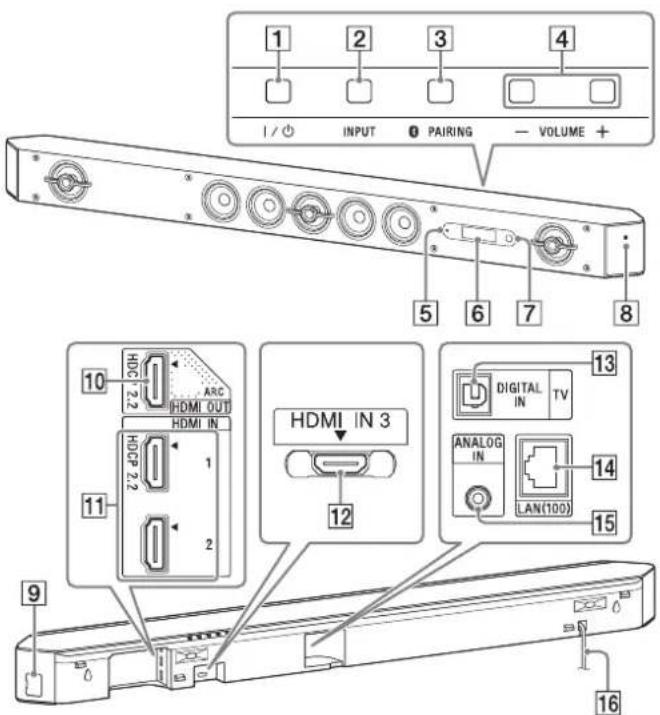
Front
1 I / (on/standby) button 2 INPUT button 3 PAIRING button 4 VOLUME +/- buttons 5 Indicator
- Flashes quickly (blue): BLUETOOTH pairing in progress.
- Flashes (blue): Attempting to connect with a BLUETOOTH device.
- Lit (blue): BLUETOOTH connection established.
6 Display Remote control sensor 8 Nmark
When using the NFC function, touch your NFC device to the mark.
Rear
9 (USB) port 10 HDMI OUT (ARC) jack This jack supports HDCP 2.2. 11 HDMI IN 1/2 jacks The HDMI IN 1 jack supports HDCP 2.2. 12 HDMI IN 3 jack When you use an HDMI IN 3 jack of the wall-mounted Bar Speaker, connect the right-angled HDMI cable (High Speed HDMI Cable with Ethernet). 13 DIGITAL IN (TV) jack LAN(100) port 15 ANALOG IN jack 16 AC power cord (mains lead)
continued
Subwoofer Remote Control
1 On/standby indicator - Lit (red): Power is off. - Lit (green): Power is on. - Lit (orange): SECURE LINK connection is established. 21/(on/standby)button 3 SECURE LINK button 4 AC power cord (mains lead)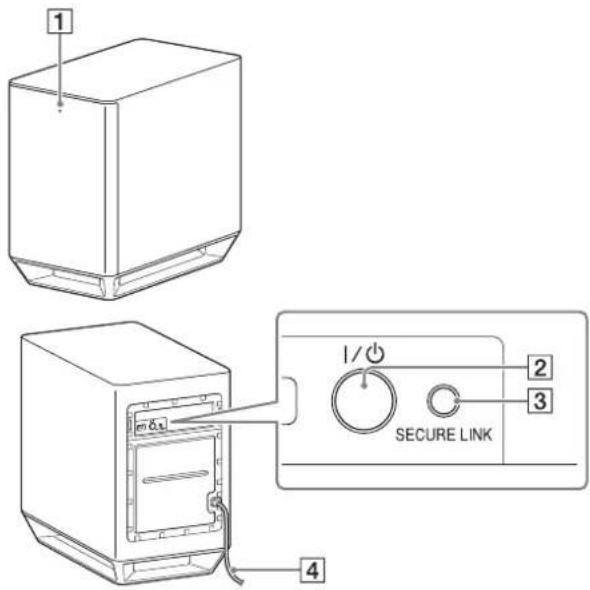
AUDIO, and + buttons have a tactile dot. Use the tactile dot as a reference when operating the remote control.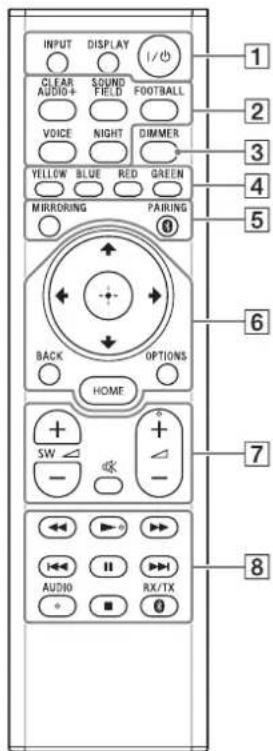
1 INPUT (page 7)
Selects the device you want to use.
DISPLAY
Displays playback and web browsing information on the TV screen.
1/(on/standby)
Turns on the system or sets it to standby mode.
Sound field buttons (page 9)
ClearAudio+, Movie, Movie 2, Music, Game Studio, Music Arena, Standard
CLEARAUDIO+, SOUND FIELD, FOOTBALL, VOICE, NIGHT
DIMMER (page 34)
Adjusts the brightness of the front panel display and LED indicator.
Color buttons
Shortcut keys for selecting items on some menus.
5 MIRRORING (page 18)
Selects [Screen mirroring].
PAIRING (page 11)
Attempt BLUETOOTH pairing.
6 OPTIONS (page 28)
Displays the options menu on the TV screen or in the front panel display. (The location differs depending on the selected function.)
BACK
Returns to the previous display.
+/4/(
Moves the highlight to a displayed item.
(enter)
Enters the selected item.
HOME (page 22)
Enters or exits the home menu.
[7] (muting)
Turns off the sound temporarily.
(volume) + / -
Adjusts the volume.
Adjusts the volume of the bass sound.
8 Playback operation buttons
See "Listening/Viewing" (page 7).
(rewind/fast forward)
Searches backward or forward.
(previous/next)
Selects the previous/next chapter, track, or file.
▶ (play)
Starts or re-starts playback (resume play).
II (pause)
Pauses or re-starts playback.
stop
Stops playback.
AUDIO (page 33)
Selects the audio format.
RX/TX (receiver/transmitter)
Switches [Receiver] and [Transmitter] of [Bluetooth Mode]
(page 24).
Playable Types of Files
Music
| Codec Extension | |
| MP3 (MPEG-1 Audio Layer III)1) | .mp3 |
| AAC/HE-AAC1,2) | .m4a, .aac3) |
| WMA9 Standard2) | .wma |
| WMA10 Pro3) | .wma |
| LPCM1) | .wav |
| FLAC2) | .flac, .fla |
| Dolby Digital1,3) | .ac3 |
| DSF2) | .dsf |
| DSDIFF2,4) | .dff |
| AIFF2) | .aiff, .aif |
| ALAC2) | .m4a |
| Vorbis3) | .ogg |
| Monkey's Audio3) | .ape |
Photo
| Format Extension | |
| JPEG.jpeg, jpg, jpe | |
| PNG.png | 5) |
| GIF.gif | 5) |
1) The system can play ".mka" files. These files cannot be played on a home network server. 2) The system may not play this file format on a home network server. 3) The system does not play this file format on a home network server. 4) The system does not play DST encoded files. 5) The system does not play animated PNG or animated GIF files.
Notes
- Some files may not play depending on the file format, the file encoding, the recording condition, or the home network server condition. Some files edited on a PC may not play.
- Fast forward or fast reverse may not be available with some files. The system does not play coded files such as DRM and Lossless.
- The system can recognize the following files or folders in USB devices: - up to folders in the 9th layer (including the root folder) - up to 500 files/folders in a single layer
- The system can recognize the following files or folders stored in the home network server:
- up to folders in the 19th layer
- up to 999 files/folders in a single layer. Some USB devices may not work with this system.
- The system can recognize Mass Storage Class (MSC) devices (such as flash memory or an HDD), Still Image Capture Devices (SICDs), and 101-key keyboards.
Supported Audio Formats
Audio formats supported by this system are as follows.
| Format | Function | |
| "HDMI1" "HDMI2" "HDMI3" | "TV" (DIGITAL IN) | |
| LPCM 2ch ○ ○ | ||
| LPCM 5.1ch ○ - | ||
| LPCM 7.1ch ○ - | ||
| Dolby Digital ○ ○ | ||
| Dolby TrueHD, Dolby Digital Plus ○ - | ||
| DTS ○ ○ | ||
| DTS-ES Discrete 6.1, DTS-ES Matrix 6.1 ○ | ○ | |
| DTS96/24 ○ ○ | ||
| DTS-HD High Resolution Audio | ○ - | |
| DTS-HD Master Audio | ○ - | |
| DTS-HD LBR | ○ - | |
| DSD | ○ - | |
| MPEG-2 AAC | ○ | ○ |
O: Supported format.
: Unsupported format.
Note
The HDMI IN 1/2/3 jacks do not input sound in the case of an audio format that contains copy protections, such as Super Audio CD or DVD-Audio.
Specifications
Bar Speaker (SA-ST9)
Amplifier section
U.S. models:
POWER OUTPUT AND TOTAL HARMONIC DISTORTION:
(FTC)
Front L + Front R:
With 6 ohm loads, both channels driven, from 200 - 20,000 Hz; rated 25 Watts per channel minimum RMS power, with no more than 1% total harmonic distortion from 250 milliwatts to rated output.
POWER OUTPUT (reference)
Front L/Front R speaker blocks: 75 Watts (per channel at 6 ohms, 1 kHz) Center speaker block: 75 Watts (per channel at 6 ohms, 1 kHz) Center tweeter block: 75 Watts (per channel at 6 ohms, 10 kHz)
Canadian models:
POWER OUTPUT (rated)
Front L + Front R: 45 W + 45 W
(at 6 ohms, 1 kHz, 1% THD)
POWER OUTPUT (reference) Front L/Front R speaker blocks: 75 Watts (per channel at 6 ohms, 1 kHz) Center speaker block: 75 Watts (per channel at 6 ohms, 1 kHz) Center tweeter block: 75 Watts (per channel at 6 ohms, 10 kHz)
Inputs
HDMI IN 1*/2/3
DIGITAL IN (TV)
ANALOG IN
Output HDMI OUT* (ARC)
* HDMI IN 1 and HDMI OUT (ARC) jacks support HDCP 2.2 protocol. HDCP 2.2 is newly enhanced copyright protection technology that is used to protect content such as 4K movies.
continued
HDMI section
Connector
Type A (19pin)
USB section
(USB) port:
Type A (For connecting USB memory, memory card reader, digital still camera)
LAN section
LAN (100) terminal
100BASE-TX Terminal
Wireless LAN section
Standards Compliance
IEEE 802.11 a/b/g/n
Frequency band
2.4 GHz, 5 GHz
BLUETOOTH section
Communication system
BLUETOOTH Specification version 3.0
Output
BLUETOOTH Specification Power Class 1
Maximum communication range
Line of sight approx. 30 m (98.4 ft) 1)
Maximum number of devices to be registered
9 devices
Frequency band
2.4 GHz band (2.4 GHz - 2.4835 GHz)
Modulation method
FHSS (Frequency Hopping Spread Spectrum)
Compatible BLUETOOTH profiles2
A2DP 1.2 (Advanced Audio Distribution Profile)
AVRCP 1.5 (Audio Video Remote Control Profile)
Supported Codes3)
SBC4), AAC5, LDAC
Transmission range (A2DP)
20 Hz - 20,000 Hz (Sampling frequency 44.1 kHz)
1) The actual range will vary depending on factors such as obstacles between devices, magnetic fields around a microwave oven, static electricity, cordless phone use, reception sensitivity, the operating system, software applications, etc. 2) BLUETOOTH standard profiles indicate the purpose of BLUETOOTH communication between devices. 3) Codec: Audio signal compression and conversion format 4) Subband Codec 5) Advanced Audio Coding
Front L/Front R speaker blocks
Speaker system
2-way coaxial speaker system, Acoustic suspension
Speaker
Woofer: 65 mm (2 5/8 in) cone type, Magnetic fluid speaker
Tweeter: 18 mm (23/32 in) soft dome type
Center speaker block
Speaker system
Center
2-way coaxial speaker system, Acoustic suspension
Satellite
Full range speaker system, Acoustic suspension
Speaker (5 speakers)
Center
Woofer: 65 mm (2 5/8 in) cone type, Magnetic fluid speaker
Tweeter: 18 mm (23/32 in) soft dome type
Satellite
65 mm (2 5/8 in) cone type, Magnetic fluid speaker
General
Power requirements
120VAC, 60Hz
Power consumption
On: 60 W
Standby mode: 0.5 W or less (For details on the setting, see page 34.)
Dimensions (approx.) (w/h/d)
1,130 mm × 88 mm × 128 mm (44 1/2 in × 3 1/2 in × 5 1/8 in)
(without grille frame, without stands, including projection portion)
1,130 mm × 88 mm × 133 mm (44 1/2 in × 3 1/2 in × 5 1/4 in)
(with grille frame, without stands)
1,130 mm × 100 mm × 129 mm (44 1/2 in × 4 in × 5 1/8 in)
(without grille frame, with stands, including projection portion)
1,130 mm × 101 mm × 136 mm (44 1/2 in × 4 in × 5 3/8 in)
(with grille frame, with stands)
Mass (approx.)
6.8 kg (14 lb 15 7/8 oz) (without grille frame, without stands)
Compatible iPod/iPhone models
The compatible iPod/iPhone models are as follows. Update your iPod/iPhone with the latest software before using with the system.
BLUETOOTH technology works with:
iPhone 6 Plus/iPhone 6/iPhone 5s/iPhone 5c/iPhone 5/iPhone 4s/
iPhone 4/iPhone 3GS
iPod touch (5th generation)/iPod touch (4th generation)
Subwoofer (SA-WST9)
POWER OUTPUT (reference)
200 W (at 2 ohms, 100 Hz)
Speaker system
Subwoofer, Passive radiator type
Speaker
180 mm (7 1/8 in) cone type
200 mm (7 7/8 in) × 300 mm (11 7/8 in) cone type, Passive radiator
Power requirements
120 V AC, 60 Hz
Power consumption
On: 30 W
Standby mode: 0.5 W or less
Dimensions (approx.) (w/h/d)
248 mm × 403 mm × 426 mm (9 7/8 in × 15 7/8 in × 16 7/8 in)
Mass (approx.)
16 kg (35 lb 4 3/8 oz)
Wireless transmitter/receiver section
Communication system
Wireless Sound Specification version 3.0
Frequency band
5.2 GHz (5.180 GHz - 5.240 GHz)
5.8 GHz (5.736 GHz - 5.814 GHz)
Modulation method
DSSS
continued
Video formats supported by the system Input/Output (HDMI Repeater block)
| Format 2D | 3D | ||
| Frame packing | Side-by- Side (Half) | Over-Under (Top-and-Bottom) | |
| \( {4096} \times {2160}\mathrm{p}@{59.94}/{60}{\mathrm{{Hz}}}^{1)} \) | O | - | - |
| \( {4096} \times {2160}\mathrm{p}@{50}{\mathrm{{Hz}}}^{1)} \) | O | - | - |
| \( {4096} \times {2160}\mathrm{p}@{23.98}/{24}{\mathrm{{Hz}}}^{2)} \) | O | - | - |
| \( {3840} \times {2160}\mathrm{p}@{59.94}/{60}{\mathrm{{Hz}}}^{1)} \) | O | - | - |
| \( {3840} \times {2160}\mathrm{p}@{50}{\mathrm{{Hz}}}^{1)} \) | O | - | - |
| \( {3840} \times {2160}\mathrm{p}@{29.97}/{30}{\mathrm{{Hz}}}^{2)} \) | O | - | - |
| \( {3840} \times {2160}\mathrm{p}@{25}{\mathrm{{Hz}}}^{2)} \) | O | - | - |
| \( {3840} \times {2160}\mathrm{p}@{23.98}/{24}{\mathrm{{Hz}}}^{2)} \) | O | - | - |
| \( {1920} \times {1080}\mathrm{p}@{59.94}/{60}{\mathrm{{Hz}}}^{O} \) | - | O | |
| \( {1920} \times {1080}\mathrm{p}@{50}{\mathrm{{Hz}}}^{O} \) | - | O | O |
| \( {1920} \times {1080}\mathrm{p}@{29.97}/{30}{\mathrm{{Hz}}}^{O} \) | O | O | O |
| \( {1920} \times {1080}\mathrm{p}@{25}{\mathrm{{Hz}}}^{O} \) | O | O | O |
| \( {1920} \times {1080}\mathrm{p}@{23.98}/{24}{\mathrm{{Hz}}}^{O} \) | O | O | O |
| \( {1920} \times {1080}\mathrm{i}@{59.94}/{60}{\mathrm{{Hz}}}^{O} \) | O | O | O |
| \( {1920} \times {1080}\mathrm{i}@{50}{\mathrm{{Hz}}}^{O} \) | O | O | O |
| \( {1280} \times {720}\mathrm{p}@{59.94}/{60}{\mathrm{{Hz}}}^{O} \) | O | O | O |
| \( {1280} \times {720}\mathrm{p}@{50}\mathrm{\;{Hz}} \) | O | O | O |
| \( {1280} \times {720}\mathrm{p}@{29.97}/{30}{\mathrm{{Hz}}}^{O} \) | O | O | O |
| \( {1280} \times {720}\mathrm{p}@{23.98}/{24}{\mathrm{{Hz}}}^{O} \) | O | O | O |
| \( {720} \times {480}\mathrm{p}@{59.94}/{60}{\mathrm{{Hz}}}^{O} \) | - | - | - |
| \( {720} \times {576}\mathrm{p}@{50}\mathrm{\;{Hz}} \) | O | - | - |
| \( {640} \times {480}\mathrm{p}@{59.94}/{60}{\mathrm{{Hz}}}^{O} \) | - | - | - |
YCbCr 4:2:0/Supports 8-bit only Supports 8-bit only
Design and specifications are subject to change without notice.
On BLUETOOTH Communication
- BLUETOOTH devices should be used within approximately 10 meters (33 feet) (unobstructed distance) of each other. The effective communication range may become shorter under the following conditions.
- When a person, metal object, wall or other obstruction is between the devices with a BLUETOOTH connection
- Locations where a wireless LAN is installed
- Around microwave ovens that are in use
- Locations where other electromagnetic waves occur
- BLUETOOTH devices and wireless LAN (IEEE 802.11b/g) use the same frequency band (2.4 GHz). When using your BLUETOOTH device near a device with wireless LAN capability, electromagnetic interference may occur. This could result in lower data transfer rates, noise, or inability to connect. If this happens, try the following remedies:
- Use this system at least 30 meters (99 feet) away from the wireless LAN device.
- Turn off the power to the wireless LAN device when using your BLUETOOTH device within 10 meters (33 feet).
- Install this system and BLUETOOTH device as closer to each other as possible.
- The radio waves broadcast by this system may interfere with the operation of some medical devices. Since this interference may result in malfunction, always turn off the power on this system and BLUETOOTH device in the following locations: -In hospitals, on trains, in airplanes, at gas stations, and any place where flammable gasses may be present
- Near automatic doors or fire alarms
- This system supports security functions that comply with the BLUETOOTH specification to ensure secure connection during communication using BLUETOOTH technology. However, this security may be insufficient depending on the setting content and other factors, so always be careful when performing communication using BLUETOOTH technology.
- Sony cannot be held liable in any way for damages or other loss resulting from information leaks during communication using BLUETOOTH technology.
- BLUETOOTH communication is not necessarily guaranteed with all BLUETOOTH devices that have the same profile as this system.
- BLUETOOTH devices connected with this system must comply with the BLUETOOTH specification prescribed by the Bluetooth SIG, Inc., and must be certified to comply. However, even when a device complies with the BLUETOOTH specification, there may be cases where the characteristics or specifications of the BLUETOOTH device make it impossible to connect, or may result in different control methods, display or operation.
- Noise may occur or the audio may cut off depending on the BLUETOOTH device connected with this system, the communications environment, or surrounding conditions.
If you have any questions or problems concerning your system, please consult your nearest Sony dealer.
Index
Numerics
24p Output 23
4K Output 23
A
A/V SYNC 29
Attenuation settings - Analog 24
Audio DRC 24
Audio Output 24
Audio Return Channel 25
Audio Settings 24
Auto Display 26
Auto Renderer Access Permission 27
Auto Standby 26
Auto Update 26
Auto Update Settings 26
B
BLUETOOTH 11
Bluetooth Codec - AAC 25
Bluetooth Codec - LDAC 25
Bluetooth Mode 24
Bluetooth Settings 24
Bluetooth Standby 24
"BRAVIA" Sync 31
C
Child Lock 34
Connection Server Settings 27
Control for HDMI 25, 31
D
Device List 24
Device Name 26
Dimmer 34
DSEEHX10,24
E
Easy Network Settings 27
Easy Setup 27
External Control 27
F
Football mode 9
Front panel 47
G
Google Cast 19
H
HDMI
YCbCr/RGB (HDMI) 23
HDMI Deep Color Output 23
HDMI Settings 25
Home Network 16
1
Initialize Personal Information 27
Input Skip Setting 27
Internet Settings 26
IR-Repeater 25,34
M
Multiplex broadcast sound 33
Music Services 18
N
Network 15
Network Connection Diagnostics 26
Network Connection Status 26
Network content 24p Output 23
Network Settings 26
NFC 12
Night mode 10
0
Options menu 28
OSD Language 25
Output Video Resolution 23
P
PRTCT 46
Q
Quick Start/Network Standby 26
R
Rear panel 47
Remote Control 48
Remote Start 27
Renderer Access Control 27
Reset 46
Reset to Factory Default Settings 27
Resetting 27
RF Band 36
S
SBM 24
Screen mirroring 18
Screen mirroring RF Setting 27
Screen Settings 23
Secure Link 36
Slideshow 28
Software License Information 26
Software Update 22
Software Update Notification 26
SongPal 30
Sound field 9, 28
Standby Through 25
Subwoofer 35, 45
System Information 26
System Settings 25
T
Time Zone 26
TV Type 23
U
Update 22
USB 8
V
Video Direct 23
Voice mode 10
W
Wireless Playback Quality 25
Wireless Sound Connection 25
END USER LICENSE AGREEMENT
IMPORTANT:
BEFORE USING THE SOFTWARE, PLEASE READ THIS END USER LICENSE AGREEMENT ("EULA") CAREFULLY. BY USING THE SOFTWARE YOU ARE ACCEPTING THE TERMS OF THIS EULA. IF YOU DO NOT ACCEPT THE TERMS OF THIS EULA, YOU MAY NOT USE THE SOFTWARE.
This EULA is a legal agreement between you and Sony Corporation ("SONY"). This EULA governs your rights and obligations regarding the SONY software of SONY and/or its third party licensors (including SONY's affiliates) and their respective affiliates (collectively, the "THIRD-PARTY SUPPLIERS"), together with any updates/upgrades provided by SONY, any printed, on-line or other electronic documentation for such software, and any data files created by operation of such software (collectively, the "SOFTWARE"). Notwithstanding the foregoing, any software in the SOFTWARE having a separate end user license agreement (including, but not limited to, GNU General Public license and Lesser/Library General Public License) shall be covered by such applicable separate end user license agreement in lieu of the terms of this EULA to the extent required by such separate end user license agreement ("EXCUSED SOFTWARE").
SOFTWARE LICENSE
The SOFTWARE is licensed, not sold. The SOFTWARE is protected by copyright and other intellectual property laws and international treaties.
COPYRIGHT
All right and title in and to the SOFTWARE (including, but not limited to, any images, photographs, animation, video, audio, music, text and "applets" incorporated into the SOFTWARE) is owned by SONY or one or more of the THIRD-PARTY SUPPLIERS.
GRANT OF LICENSE
SONY grants you a limited license to use the SOFTWARE solely in connection with your compatible device ("DEVICE") and only for your individual, non-commercial use. SONY and the THIRD-PARTY SUPPLIERS expressly reserve all rights, title and interest (including, but not limited to, all intellectual property rights) in and to the SOFTWARE that this EULA does not specifically grant to you.
REQUIREMENTS AND LIMITATIONS
You may not copy, publish, adapt, redistribute, attempt to derive source code, modify, reverse engineer, decompile, or disassemble any of the SOFTWARE, whether in whole or in part, or create any derivative works from or of the SOFTWARE unless such derivative works are intentionally facilitated by the SOFTWARE. You may not modify or tamper with any digital rights management functionality of the SOFTWARE. You may not bypass, modify, defeat or circumvent any of the functions or protections of the SOFTWARE or any mechanisms operatively linked to the SOFTWARE. You may not separate any individual component of the SOFTWARE for use on more than one DEVICE unless expressly authorized to do so by SONY. You may not remove, alter, cover or deface any trademarks or notices on the SOFTWARE. You may not share, distribute, rent, lease, sublicense, assign, transfer or sell the SOFTWARE. The software, network services or other products other than SOFTWARE upon which the SOFTWARE'S performance depends might be interrupted or discontinued at the discretion of the suppliers (software suppliers, service suppliers, or SONY). SONY and such suppliers do not warrant that the SOFTWARE, network services, contents or other products will continue to be available, or will operate without interruption or modification.
USE OF SOFTWARE WITH COPYRIGHTED MATERIALS
The SOFTWARE may be capable of being used by you to view, store, process and/or use content created by you and/or third parties. Such content may be protected by copyright, other intellectual property laws, and/or agreements. You agree to use the SOFTWARE only in compliance with all such laws and agreements that apply to such content. You acknowledge and agree that SONY may take appropriate measures to protect the copyright of content stored,
processed or used by the SOFTWARE. Such measures include, but are not limited to, counting the frequency of your backup and restoration through certain SOFTWARE features, refusal to accept your request to enable restoration of data, and termination of this EULA in the event of your illegitimate use of the SOFTWARE.
CONTENT SERVICE
PLEASE ALSO NOTE THAT THE SOFTWARE MAY BE DESIGNED TO BE USED WITH CONTENT AVAILABLE THROUGH ONE OR MORE CONTENT SERVICES ("CONTENT SERVICE"). USE OF THE SERVICE AND THAT CONTENT IS SUBJECT TO THE TERMS OF SERVICE OF THAT CONTENT SERVICE. IF YOU DECLINE TO ACCEPT THOSE TERMS, YOUR USE OF THE SOFTWARE WILL BE LIMITED. You acknowledge and agree that certain content and services available through the SOFTWARE may be provided by third parties over which SONY has no control. USE OF THE CONTENT SERVICE REQUIRES AN INTERNET CONNECTION. THE CONTENT SERVICE MAY BE DISCONTINUED AT ANY TIME.
INTERNET CONNECTIVITY AND THIRD PARTY SERVICES
You acknowledge and agree that access to certain SOFTWARE features may require an Internet connection for which you are solely responsible. Further, you are solely responsible for payment of any third party fees associated with your Internet connection, including but not limited to Internet service provider or airtime charges. Operation of the SOFTWARE may be limited or restricted depending on the capabilities, bandwidth or technical limitations of your Internet connection and service. The provision, quality and security of such Internet connectivity are the sole responsibility of the third party providing such service.
EXPORT AND OTHER REGULATIONS
You agree to comply with all applicable export and re-export restrictions and regulations of the area or country in which you reside, and not to transfer, or authorize the transfer, of the SOFTWARE to a prohibited country or otherwise in violation of any such restrictions or regulations.
HIGH RISK ACTIVITIES
The SOFTWARE is not fault-tolerant and is not designed, manufactured or intended for use or resale as on-line control equipment in hazardous environments requiring fail-safe performance, such as in the operation of nuclear facilities, aircraft navigation or communication systems, air traffic control, direct life support machines, or weapons systems, in which the failure of the SOFTWARE could lead to death, personal injury, or severe physical or environmental damage ("HIGH RISK ACTIVITIES"). SONY, each of the THIRD-PARTY SUPPLIERS, and each of their respective affiliates specifically disclaim any express or implied warranty, duty or condition of fitness for HIGH RISK ACTIVITIES.
EXCLUSION OF WARRANTY ON SOFTWARE
You acknowledge and agree that use of the SOFTWARE is at your sole risk and that you are responsible for use of the SOFTWARE. The SOFTWARE is provided "AS IS," without warranty, duty or condition of any kind.
SONY AND EACH OF THE THIRD-PARTY SUPPLIERS (for purposes of this Section, SONY and each of the THIRD-PARTY SUPPLIERS shall be collectively referred to as "SONY") EXPRESSLY DISCLAIM ALL WARRANTIES, DUTIES OR CONDITIONS, EXPRESS OR IMPLIED, INCLUDING, BUT NOT LIMITED TO, THE IMPLIED WARRANTIES OF MERCHANTABILITY, NONINFRINGEMENT AND FITNESS FOR A PARTICULAR PURPOSE. SONY DOES NOT WARRANT OR MAKE ANY CONDITIONS OR REPRESENTATIONS (A) THAT THE FUNCTIONS CONTAINED IN ANY OF THE SOFTWARE WILL MEET YOUR REQUIREMENTS OR THAT THEY WILL BE UPDATED, (B) THAT THE OPERATION OF ANY OF THE SOFTWARE WILL BE CORRECT OR ERROR-FREE OR THAT ANY DEFECTS WILL BE CORRECTED, (C) THAT THE SOFTWARE WILL NOT DAMAGE ANY OTHER SOFTWARE, HARDWARE OR DATA, (D) THAT ANY SOFTWARE, NETWORK SERVICES (INCLUDING THE INTERNET) OR PRODUCTS (OTHER THAN THE SOFTWARE) UPON WHICH THE SOFTWARE'S PERFORMANCE DEPENDS WILL CONTINUE TO BE AVAILABLE, UNINTERRUPTED OR UNMODIFIED, AND (E) REGARDING THE USE OR THE RESULTS OF THE USE OF THE SOFTWARE IN TERMS OF ITS CORRECTNESS, ACCURACY, RELIABILITY, OR OTHERWISE.
No oral or written information or advice given by Sony or an authorized representative of Sony shall create a warranty, duty, or condition or in any way increase the scope of this warranty. Should the software prove defective, you assume the entire cost of all necessary servicing, repair, or correction. Some jurisdictions do not allow the exclusion of implied warranties, so these exclusions may not apply to you.
LIMITATION OF LIABILITY
Sony and each of the third-party suppliers (for purposes of this section, Sony and each of the third-party suppliers shall be collectively referred to as "Sony") shall not be liable for any incidental or consequential damages for breach of any express or implied warranty, breach of contract, negligence, strict liability, or under any other legal theory related to the software, including, but not limited to, any damages arising out of loss of profits, loss of revenue, loss of data, loss of use of the software or any associated hardware, downtime, and user's time, even if any of them have been advised of the possibility of such damages. In any case, each and all of their aggregate liability under any provision of this EULA shall be limited to the amount actually paid for the product. Some jurisdictions do not allow the exclusion or limitation of incidental or consequential damages, so the above exclusion or limitation may not apply to you.
AUTOMATIC UPDATE FEATURE
From time to time, Sony or the third-party suppliers may automatically update or otherwise modify the software, including, but not limited to, for purposes of enhancement of security functions, error correction, and improvement of functions, at such time as you interact with Sony's or third parties' servers, or otherwise. Such updates or modifications may delete or change the nature of features or other aspects of the software, including, but not limited to, functions you may rely upon. You acknowledge and agree that such activities may occur at Sony's sole discretion and that Sony may condition continued use of the software upon your
complete installation or acceptance of such updates or modifications. Any updates/modifications shall be deemed to be, and shall constitute part of, the software for purposes of this EULA. By acceptance of this EULA, you consent to such update/modification.
ENTIRE AGREEMENT, WAIVER, SEVERABILITY
This EULA and Sony's privacy policy, each as amended and modified from time to time, together constitute the entire agreement between you and Sony with respect to the software. The failure of Sony to exercise or enforce any right or provision of this EULA shall not constitute a waiver of such right or provision. If any part of this EULA is held invalid, illegal, or unenforceable, that provision shall be enforced to the maximum extent permissible so as to maintain the intent of this EULA, and the other parts will remain in full force and effect.
GOVERNING LAW AND JURISDICTION
The United Nations Convention on Contracts for the International Sale of Goods shall not apply to this EULA. This EULA shall be governed by the laws of Japan, without regard to conflict of laws provisions. Any dispute arising out of this EULA shall be subject to the exclusive venue of the Tokyo District Court in Japan, and the parties hereby consent to the venue and jurisdiction of such courts.
EQUITABLE REMEDIES
Notwithstanding anything contained in this EULA to the contrary, you acknowledge and agree that any violation of or non-compliance with this EULA by you will cause irreparable harm to SONY, for which monetary damages would be inadequate, and you consent to SONY obtaining any injunctive or equitable relief that SONY deems necessary or appropriate in such circumstances. SONY may also take any legal and technical remedies to prevent violation of and/or to enforce this EULA, including, but not limited to, immediate termination of your use of the SOFTWARE, if SONY believes in its sole discretion that you are violating or intend to violate this EULA. These remedies are in addition to any other remedies SONY may have at law, in equity or under contract.
TERMINATION
Without prejudice to any of its other rights, SONY may terminate this EULA if you fail to comply with any of its terms. In case of such termination, you must cease all use, and destroy any copies, of the SOFTWARE.
AMENDMENT
SONY RESERVES THE RIGHT TO AMEND ANY OF THE TERMS OF THIS EULA AT ITS SOLE DISCRETION BY POSTING NOTICE ON A SONY DESIGNATED WEB SITE, BY EMAIL NOTIFICATION TO AN EMAIL ADDRESS PROVIDED BY YOU, BY PROVIDING NOTICE AS PART OF THE PROCESS IN WHICH YOU OBTAIN UPGRADES/UPDATES OR BY ANY OTHER LEGALLY RECOGNIZABLE FORM OF NOTICE. If you do not agree to the amendment, you should promptly contact SONY for instructions. Your continued use of the SOFTWARE after the effective date of any such notice shall be deemed your agreement to be bound by such amendment.
THIRD-PARTY BENEFICIARIES
Each THIRD-PARTY SUPPLIER is an express intended third-party beneficiary of, and shall have the right to enforce, each provision of this EULA with respect to the SOFTWARE of such party.
Should you have any questions concerning this EULA, you may contact SONY by writing to SONY at applicable contact address of each area or country.
Copyright © 2014 Sony Corporation.
[7] (sound cut-off)
FHSS (Frequency Hopping Spread Spectrum)
Compatible BLUETOOTH profiles2
A2DP 1.2 (Advanced Audio Distribution Profile)
AVRCP 1.5 (Audio Video Remote Control Profile)
Supported codecs31
SBC4), AAC5), LDAC
Transmission range (A2DP)
"HDMI 1"/"HDMI 2"/"HDMI 3"
[Bluetooth Codec - LDAC]
This is only available when the Bluetooth Mode is set to Receiver or Transmitter.
[Enable]: Enables the LDAC codec.
No: Disables the LDAC codec.
Note
"Echo Canceling Sync"
RX/TX (receiver/transmitter)
Switch [Receiver] and [Transmitter] in [Bluetooth Mode]
(page 25).
PLAYABLE FILE TYPES
Music
| Códec Extension | |
| MP3 (MPEG-1 Audio Layer III)1) | .mp3 |
| AAC/HE-AAC1,2) | .m4a, .aac3) |
| WMA9 Standard2) | .wma |
| WMA10 Pro3) | .wma |
| LPCM1) | .wav |
| FLAC2) | .flac, .fla |
| Dolby Digital1, 3) | .ac3 |
| DSF2) | .dsf |
| DSDIFF2,4) | .dff |
| AIFF2) | .aiff, .aif |
| ALAC2) | .m4a |
| Vorbis3) | .ogg |
| Monkey's Audio3) | .ape |
Photo
| Formato Extensaion | |
| JPEG.jpeg, jpg, jpe | |
| PNG.png | 5) |
| GIF.gif | 5) |
(at 6 ohms 1 kHz 1% THD)
BLUETOOTH specification version 3.0
Output
BLUETOOTH specification power class 1
Maximum communication range
Line of sight approx. 30 m (98.4 ft)
Copyright © 2014 Sony Corporation.
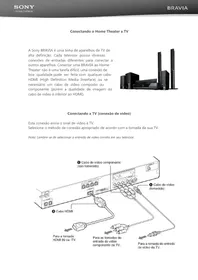
- OWNER'S RECORD
- WARNING
- TO REDUCE THE RISK OF FIRE OR ELECTRIC SHOCK, DO NOT EXPOSE THIS APPARATUS TO RAIN OR MOISTURE
- FOR THE CUSTOMERS IN THE U.S.A
- IMPORTANT SAFETY INSTRUCTIONS
- NOTE
- CAUTION
- COMPLIANCE WITH FCC REQUIREMENT 15.407(C)
- FOR THE CUSTOMERS IN CANADA
- ABOUT THESE OPERATING INSTRUCTIONS
- TABLE OF CONTENTS
- CONNECTING → STARTUP GUIDE (SEPARATE DOCUMENT)
- LISTENING/VIEWING
- SOUND ADJUSTMENT
- BLUETOOTH FUNCTIONS
- NETWORK FUNCTIONS
- VIEWING COPYRIGHT-PROTECTED 4K CONTENT
- SETTINGS AND ADJUSTMENTS
- OTHER FUNCTIONS
- ADDITIONAL INFORMATION
- LISTENING TO SOUND FROM A TV, BLU-RAY DISC™ PLAYER, CABLE/SATELLITE BOX, ETC
- PLAYING MUSIC/PHOTO FROM A USB DEVICE
- CONNECT THE USB DEVICE TO THE (USB) PORT
- PRESS HOME
- PRESS \/ \/ \ TO SELECT [USB], AND THEN PRESS \OPLUS
- PRESS \CLUBSUIT / \CLUBSUIT TO SELECT [MUSIC] OR [PHOTO]
- SELECT THE DESIRED CONTENT USING \/ \/ \ AND \OPLUS
- LISTENING TO MUSIC FROM A BLUETOOTH DEVICE
- PLAYING MUSIC/PHOTO FROM OTHER DEVICES VIA THE NETWORK FUNCTION
- ENJOYING SOUND EFFECTS (FOOTBALL MODE, ETC.)
- SELECTING THE SOUND FIELD
- PRESS SOUND FIELD REPEATEDLY DURING PLAYBACK
- [CLEARAUDIO+]
- [MOVIE]
- [MOVIE 2]
- [MUSIC]
- [GAME STUDIO]
- [MUSIC ARENA]
- [STANDARD]
- TIP
- TO SELECT THE SOUND FIELD FROM THE OPTIONS MENU
- USING THE FOOTBALL MODE FUNCTION
- NOTES
- TIPS
- USING THE NIGHT MODE FUNCTION
- USING THE VOICE FUNCTION
- USING THE DSEE HX FUNCTION (REPRODUCING AUDIO CODEC FILES WITH NATURAL SOUND QUALITY)
- PAIRING THIS SYSTEM WITH A BLUETOOTH DEVICE
- TO PAIR THE SYSTEM WITH THE DEVICE
- TO CANCEL PAIRING OPERATION
- TO LISTEN TO SOUND FROM THE PAIRED DEVICE
- CONNECTING TO A BLUETOOTH DEVICE BY ONE-TOUCH FUNCTION (NFC)
- COMPATIBLE DEVICES
- LISTENING TO SOUND BY TRANSMITTING TO A BLUETOOTH-COMPATIBLE RECEIVER
- ADJUST THE VOLUME
- TO DISCONNECT THE BLUETOOTH RECEIVER
- TO DELETE A REGISTERED BLUETOOTH RECEIVER FROM THE DEVICE LIST
- CONNECTING TO A WIRED NETWORK
- CONNECTING THE SYSTEM TO THE NETWORK USING A LAN CABLE
- SETTING UP A WIRED NETWORK CONNECTION
- IF USING A FIXED IP ADDRESS
- CONNECTING TO A WIRELESS NETWORK
- SETTING UP A WIRELESS LAN CONNECTION
- BEFORE PERFORMING NETWORK SETTINGS
- IF SELECTING THE NETWORK NAME (SSID) YOU WANT
- IF USING A (WPS) PIN CODE
- PLAYING MUSIC/PHOTO FILES ON A HOME NETWORK
- PREPARE TO USE THE HOME NETWORK FUNCTION
- PLAYING FILES STORED ON A SERVER VIA THE SYSTEM (PLAYER)
- PLAYING REMOTE FILES BY OPERATING THE SYSTEM (RENDERER) VIA A HOME NETWORK CONTROLLER
- DISPLAYING THE SCREEN OF THE MOBILE DEVICE ON A TV (SCREEN MIRRORING)
- PRESS MIRRORING
- FOLLOW THE ON-SCREEN INSTRUCTIONS
- TO CONNECT TO AN XPERIA SMARTPHONE USING ONE-TOUCH MIRRORING FUNCTION (NFC)
- TO EXIT MIRRORING
- ENJOYING VARIOUS ONLINE SERVICES (MUSIC SERVICES)
- SELECT [MUSIC SERVICES]
- SELECT THE DESIRED MUSIC SERVICE
- USING GOOGLE CASTTM
- CONNECTING A 4K TV
- WHEN THE TV'S HDMI JACK IS LABELED WITH ARC* AND COMPATIBLE WITH HDCP
- WHEN THE TV'S HDMI JACK IS LABELED WITH ARC AND NOT COMPATIBLE WITH HDCP
- CONNECTING 4K DEVICES
- USING THE SETUP DISPLAY
- [SOFTWARE UPDATE]
- [UPDATE VIA INTERNET]
- [UPDATE VIA USB MEMORY]
- [SCREEN SETTINGS]
- [TV TYPE]
- [OUTPUT VIDEO RESOLUTION]
- [24P OUTPUT]
- [4K OUTPUT]
- YCBCR/RGB (HDMI)
- [HDRI DEEP COLOR OUTPUT]
- [VIDEO DIRECT]
- [AUDIO SETTINGS]
- [DSEE HX]
- [AUDIO DRC]
- ATTENUATION SETTINGS - ANALOG
- [AUDIO OUTPUT]
- [BLUETOOTH SETTINGS]
- [BLUETOOTH MODE]
- [DEVICE LIST]
- [BLUETOOTH STANDBY]
- [BLUETOOTH CODEC - AAC]
- [BLUETOOTH CODEC-LDAC]
- [WIRELESS PLAYBACK QUALITY]
- [SYSTEM SETTINGS]
- [OSD LANGUAGE]
- [WIRELESS SOUND CONNECTION]
- [IR-REPEATER]
- [HDRI SETTINGS]
- [QUICK START/NETWORK STANDBY]
- [AUTO STANDBY]
- [AUTO DISPLAY]
- [SOFTWARE UPDATE NOTIFICATION]
- [AUTO UPDATE SETTINGS]
- DEVICE NAME]
- SYSTEM INFORMATION
- [SOFTWARE LICENSE INFORMATION]
- [NETWORK SETTINGS]
- INTERNET SETTINGS]
- [NETWORK CONNECTION STATUS]
- NETWORK CONNECTION DIAGNOSTICS
- [SCREEN MIRRORING RF SETTING]
- [CONNECTION SERVER SETTINGS]
- [AUTO RENDERER ACCESS PERMISSION]
- [RENDERER ACCESS CONTROL]
- EXTERNAL CONTROL]
- REMOTE START
- [INPUT SKIP SETTING]
- [EASY SETUP]
- [EASY NETWORK SETTINGS]
- [RESETTING]
- [RESET TO FACTORY DEFAULT SETTINGS]
- [INITIALIZE PERSONAL INFORMATION]
- USING THE OPTIONS MENU
- COMMON OPTIONS
- [MUSIC] ONLY
- ADJUSTING THE DELAY BETWEEN THE PICTURE AND SOUND (A/V SYNC)
- WHEN THE [HDMI1], [HDMI2] OR [HDMI3] INPUT IS SELECTED
- WHEN THE [TV] INPUT IS SELECTED
- CONTROLLING THE SYSTEM USING A SMARTPHONE OR TABLET (SONGPAL)
- WHEN USING AN ANDROID DEVICE
- WHEN USING AN IPHONE/IPOD TOUCH
- LISTENING TO THE SAME MUSIC ON MULTIPLE DEVICES/ LISTENING TO DIFFERENT MUSIC IN A DIFFERENT LOCATION (SONGPAL LINK)
- USING THE CONTROL FOR HDMI FUNCTION FOR "BRAVIA" SYNC
- SYSTEM POWER OFF
- ONE-TOUCH PLAY
- SYSTEM AUDIO CONTROL
- AUDIO RETURN CHANNEL
- CONTROL FOR HDMI SYNC FUNCTION
- ECHO CANCELING SYNC
- HOME THEATRE CONTROL
- LANGUAGE FOLLOW
- NOTES ON HDMI CONNECTIONS
- ENJOYING MULTIPLEX BROADCAST SOUND (DUAL MONO)
- PRESS AUDIO REPEATEDLY UNTIL THE SIGNAL YOU WANT APPEARS IN THE FRONT PANEL DISPLAY
- DEACTIVATING BUTTONS ON THE BAR SPEAKER (CHILD LOCK)
- PRESS AND HOLD INPUT FOLLOWED BY VOLUME-, VOLUME+, VOLUME - ON THE BAR SPEAKER
- CHANGING THE BRIGHTNESS
- PRESS DIMMER REPEATEDLY
- SAVING POWER IN STANDBY MODE
- ENABLING THE IR REPEATER FUNCTION (WHEN YOU CANNOT CONTROL THE TV)
- FURTHER SETTING FOR THE WIRELESS SYSTEM (SUBWOOFER)
- ACTIVATING WIRELESS TRANSMISSION BETWEEN SPECIFIC DEVICES
- [SECURE LINK]
- TO CANCEL THE SECURE LINK FUNCTION
- FOR THE BAR SPEAKER
- FOR THE SUBWOOFER
- SELECTING THE FREQUENCY BAND
- [RF BAND]
- MODIFYING THE ANGLE OF THE BAR SPEAKER
- MOUNTING THE BAR SPEAKER ON A WALL
- FASTEN THE SCREWS TO TWO STUDS IN THE WALL
- HANG THE BAR SPEAKER ON THE SCREWS
- ATTACHING THE GRILLE FRAME
- PRECAUTIONS
- ON SAFETY
- ON POWER SOURCES
- ON HEAT BUILDUP
- ON PLACEMENT
- ON HANDLING THE SUBWOOFER
- ON OPERATION
- IF YOU ENCOUNTER COLOR IRREGULARITY ON A NEARBY TV SCREEN
- IF COLOR IRREGULARITY IS OBSERVED
- IF COLOR IRREGULARITY IS OBSERVED AGAIN
- ON CLEANING
- DISCLAIMER REGARDING SERVICES OFFERED BY THIRD PARTIES
- NOTES ON UPDATING
- COPYRIGHTS
- TROUBLESHOOTING
- POWER
- PICTURE
- SOUND
- USB DEVICE
- BLUETOOTH
- SYSTEM STATUS INDICATOR (BLUE) STATUS
- PAIRING CANNOT BE ACHIEVED
- CANNOT CONNECT
- YOU CANNOT USE THE NFC FUNCTION
- NO SOUND IS OUTPUT FROM THE CONNECTED BLUETOOTH DEVICE
- NETWORK CONNECTION
- THE SYSTEM CANNOT CONNECT TO THE NETWORK
- WIRELESS LAN CONNECTION
- YOU CANNOT CONNECT YOUR PC TO THE INTERNET AFTER [WI-FI PROTECTED SETUP (WPS)] IS PERFORMED
- THE SYSTEM CANNOT CONNECT TO THE NETWORK OR THE NETWORK CONNECTION IS UNSTABLE
- THE WIRELESS ROUTER YOU WANT IS NOT SHOWN IN THE WIRELESS NETWORK LIST
- WIRELESS SOUND (SUBWOOFER)
- NO SOUND IS HEARD FROM THE SUBWOOFER
- SOUND SKIPS OR HAS NOISE
- REMOTE CONTROL
- THE REMOTE CONTROL OF THIS SYSTEM DOES NOT FUNCTION
- TV REMOTE CONTROL DOES NOT WORK
- OTHERS
- THE CONTROL FOR HDMI FUNCTION DOES NOT WORK PROPERLY
- IF THE SYSTEM STILL DOES NOT OPERATE PROPERLY, RESET THE SYSTEM AS FOLLOWS
- GUIDE TO PARTS AND CONTROLS
- FRONT
- REAR
- SUBWOOFER REMOTE CONTROL
- PLAYABLE TYPES OF FILES
- SUPPORTED AUDIO FORMATS
- SPECIFICATIONS
- BAR SPEAKER (SA-ST9)
- AMPLIFIER SECTION
- HDMI SECTION
- USB SECTION
- LAN SECTION
- WIRELESS LAN SECTION
- BLUETOOTH SECTION
- FRONT L/FRONT R SPEAKER BLOCKS
- CENTER SPEAKER BLOCK
- GENERAL
- COMPATIBLE IPOD/IPHONE MODELS
- SUBWOOFER (SA-WST9)
- WIRELESS TRANSMITTER/RECEIVER SECTION
- ON BLUETOOTH COMMUNICATION
- INDEX
- NUMERICS
- A
- B
- C
- D
- E
- F
- G
- H
- M
- N
- P
- Q
- R
- S
- T
- U
- V
- W
- END USER LICENSE AGREEMENT
- IMPORTANT
- SOFTWARE LICENSE
- COPYRIGHT
- GRANT OF LICENSE
- REQUIREMENTS AND LIMITATIONS
- USE OF SOFTWARE WITH COPYRIGHTED MATERIALS
- CONTENT SERVICE
- INTERNET CONNECTIVITY AND THIRD PARTY SERVICES
- EXPORT AND OTHER REGULATIONS
- HIGH RISK ACTIVITIES
- EXCLUSION OF WARRANTY ON SOFTWARE
- LIMITATION OF LIABILITY
- AUTOMATIC UPDATE FEATURE
- ENTIRE AGREEMENT, WAIVER, SEVERABILITY
- GOVERNING LAW AND JURISDICTION
- EQUITABLE REMEDIES
- TERMINATION
- AMENDMENT
- THIRD-PARTY BENEFICIARIES
- [BLUETOOTH CODEC - LDAC]
- PLAYABLE FILE TYPES
Brand : SONY
Model : HTST9
Category : Home Theater System