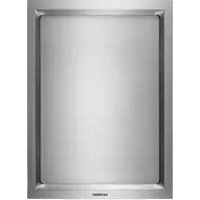
VP414610 - Cooker GAGGENAU - Free user manual and instructions
Find the device manual for free VP414610 GAGGENAU in PDF.



User questions about VP414610 GAGGENAU
0 question about this device. Answer the ones you know or ask your own.
Ask a new question about this device
Download the instructions for your Cooker in PDF format for free! Find your manual VP414610 - GAGGENAU and take your electronic device back in hand. On this page are published all the documents necessary for the use of your device. VP414610 by GAGGENAU.
USER MANUAL VP414610 GAGGENAU
Signal Words for Safety and Best Use 4
IMPORTANT SAFETY INSTRUCTIONS 5
Fire Safety 5
Burn Prevention 6
Child Safety 6
Cleaning Safety 6
Cookware Safety 7
Proper Installation and Maintenance 7
State of California Proposition 65 Warnings 7
Causes of Damage 8
Protecting the environment 8
Tips for saving energy 8
Your new appliance 9
Teppan Yaki 9
Control knob 9
Display on the illuminated ring 9
Accessories 9
Special accessories 10
Operation 10
Before first use 10
Turning on 10
Turning off 11
Residual heat display 11
Keeping warm setting 11
Safety lock 11
Settings table 11
Tips and tricks 13
Using the teppan yaki with cookware 14
Care and cleaning 14
Cleaning the appliance 14
Do not use these cleaning agents 15
Troubleshooting 16
Customer service 16
Additional information on products, accessories, replacement parts and services can be found at www.gaggenau.com and in the online shop www.gaggenau-eshop.com
Signal Words for Safety and Best Use

WARNING
This indicates that death or serious injuries may occur as a result of non-observance of this warning.

CAUTION
This indicates that minor or moderate injuries may occur as a result of non-observance of this warning.
NOTICE: This indicates that damage to the appliance or property may occur as a result of non-compliance with this advisory.
Note: This alerts you to important information and/or tips.

IMPORTANT SAFETY INSTRUCTIONS
READ AND SAVE THESE INSTRUCTIONS
WARNING
When properly cared for, your new appliance has been designed to be safe and reliable. Read all instructions carefully before use. These precautions will reduce the risk of burns, electric shock, fire, and injury to persons. When using kitchen appliances, basic safety precautions must be followed, including those in the following pages.
This appliance is not intended for operation with an external time switch or external remote control.
Fire Safety
Do not allow aluminum foil, plastic, paper or cloth to come in contact with a hot surface element, burner or grate. Do not allow pans to boil dry.
If the cooktop is near a window, forced air vent or fan, be certain that flammable materials such as window coverings do not blow over or near the burners or elements. They could catch on fire.
Always have a working smoke detector near the kitchen.
Never leave the cooktop unattended when in use. Boilovers cause smoking and greasy spillovers may ignite.
WARNING
TO REDUCE THE RISK OF A GREASE FIRE:
a) Never leave surface units unattended at high settings. Boilovers cause smoking and greasy spillovers that may ignite. Heat oils slowly on low or medium settings.
b) Always turn hood ON when cooking at high heat or when flambeing food (i.e. Crepes Suzette, Cherries Jubilee, Peppercorn Beef Flambé).
c) Clean ventilating fans frequently. Grease should not be allowed to accumulate on fan or filter.
d) Use proper pan size. Always use cookware appropriate for the size of the surface element.
In the event that personal clothing or hair catches fire, drop and roll immediately to extinguish flames.
Have an appropriate fire extinguisher available, nearby, highly visible and easily accessible near the appliance.
Smother flames from food fires other than grease fires with baking soda. Never use water on cooking fires.
WARNING
TO REDUCE THE RISK OF INJURY TO PERSONS IN THE EVENT OF A GREASE FIRE, OBSERVE THE FOLLOWING:
a) SMOTHER FLAMES with a close-fitting lid, cookie sheet, or metal tray, then turn off the burner. BE CAREFUL TO PREVENT BURNS. If the flames do not go out immediately, EVACUATE AND CALL THE FIRE DEPARTMENT.
b) NEVER PICK UP A FLAMING PAN – You may be burned.
c) DO NOT USE WATER, including wet dishcloths or towels – a violent steam explosion will result.
d) Use an extinguisher ONLY if:
- You know you have a Class ABC extinguisher, and you already know how to operate it.
- The fire is small and contained in the area where it started.
- The fire department is being called.
- You can fight the fire with your back to an exit.
Whenever possible, do not operate the ventilation system during a cooktop fire. However, do not reach through fire to turn it off.
WARNING
Use this appliance only for its intended use as described in this manual. NEVER use this appliance as a space heater to heat or warm the room. Doing so may result in overheating the appliance. Never use the appliance for storage.
WARNING
NEVER cover any slots, holes or passages in the oven bottom or cover an entire rack with materials such as aluminum foil. Doing so blocks air flow through the oven. Aluminum foil linings may also trap heat, causing a fire hazard.

IMPORTANT SAFETY INSTRUCTIONS
READ AND SAVE THESE INSTRUCTIONS
WARNING
Risk of burns
Putting water or ice cubes on the hot frying surface causes water to splash and steam.
WARNING
Risk of fire
Hot oil and fat catch fire fast. Never leave hot oil and fat unsupervised. Never extinguish a fire with water. Switch off the cooking position. Suffocate flames carefully with a lid, a fire blanket or similar.
WARNING
Risk of burns
Heat builds up when the appliance cover is closed. Let appliance cool down prior to closing the cover. Never switch on the appliance with the cover closed. Do not use the appliance cover to keep food warm or as a surface for placing objects on it.
Burn Prevention
DO NOT TOUCH SURFACE UNITS OR AREAS NEAR UNITS - Surface units may be hot even though they are dark in color. Areas near surface units may become hot enough to cause burns. During and after use, do not touch, or let clothing, potholders, or other flammable materials contact surface units or areas near units until they have had sufficient time to cool. Among these areas are the cooktop and areas facing the cooktop.
Do not heat or warm unopened food containers. Build-up of pressure may cause the container to burst and cause injury.
Always use dry potholders. Moist or damp potholders on hot surfaces may result in burns from steam. Do not let potholder touch hot heating elements. Do not use a towel or other bulky cloth.
Always turn hood ON when cooking at high heat or when flambeing food (i.e. Crêpes Suzette, Cherries Jubilee, Peppercorn Beef Flambe).
Use high heat settings on the cooktop only when necessary. To avoid bubbling and splattering, heat oil
slowly on no more than a low-medium setting. Hot oil is capable of causing extreme burns and injury.
Never move a pan of hot oil, especially a deep fat fryer. Wait until it is cool.
Secure all loose garments, etc. before beginning. Tie long hair so that it does not hang loose, and do not wear loose fitting clothing or hanging garments, such as ties, scarves, jewelry, or dangling sleeves.
WARNING
Risk of burns
If the appliance cover (VD) is fitted: do not close the appliance cover until the appliance has cooled down completely. Do not operate the appliance with the cover closed. Do not use the appliance cover for placing objects or for keeping things warm.
Child Safety
When children become old enough to use the appliance, it is the legal responsibility of the parents or legal guardians to ensure that they are instructed in safe practices by qualified persons.
Do not allow anyone to climb, stand, lean, sit, or hang on any part of an appliance, especially a door, warming drawer, or storage drawer. This can damage the appliance, and the unit may tip over, potentially causing severe injury.
Do not allow children to use this appliance unless closely supervised by an adult. Children and pets should not be left alone or unattended in the area where the appliance is in use. They should never be allowed to play in its vicinity, whether or not the appliance is in use.
CAUTION
Items of interest to children should not be stored in an appliance, in cabinets above an appliance or on the backsplash. Children climbing on an appliance to reach items could be seriously injured.
Cleaning Safety
Do not clean the appliance while it is still hot. Some cleaners produce noxious fumes when applied to a

IMPORTANT SAFETY INSTRUCTIONS
READ AND SAVE THESE INSTRUCTIONS
hot surface. Wet clothes and sponges can cause burns from steam.
Do not use steam cleaners to clean the appliance.
Do not soak removable heating elements - Heating elements should never be immersed in water.
Cookware Safety
Hold the handle of the pan when stirring or turning food. This helps prevent spills and movement of the pan.
Use Proper Pan Size.
The use of undersized cookware will expose a portion of the heating element or burner to direct contact and may result in ignition of clothing. Select cookware having flat bottoms large enough to cover the surface heating unit. This appliance is equipped with one or more surface units of different size. Proper relationship of cookware to heating element or burner will also improve efficiency.
Cookware not approved for use with ceramic cooktops may break with sudden temperature changes. Use only pans that are appropriate for ceramic cooktops (only certain types of glass, heatproof glass, ceramic, earthenware, or other glazed utensils are suitable).
Always position handles of utensils inward so they do not extend over adjacent work areas, burners, or the edge of the cooktop. This reduces the risk of fires, spills and burns.
Proper Installation and Maintenance
Have the installer show you the location of the circuit breaker or fuse. Mark it for easy reference.
This appliance must be properly installed and grounded by a qualified technician. Connect only to properly grounded outlet. Refer to Installation Instructions for details.
This appliance is intended for normal family household use only. It is not approved for outdoor use. See the Warranty. If you have any questions, contact the manufacturer.
Do not store or use corrosive chemicals, vapors, flammables or nonfood products in or near this appliance. It is specifically designed for use when heating or cooking food. The use of corrosive
chemicals in heating or cleaning will damage the appliance and could result in injury.
WARNING
Risk of electric shock
The cable insulation of electrical appliances can melt on hot parts of the appliance. Never let connecting cables of electrical appliances come into contact with hot parts of the appliance.
Make sure reflector pans or drip bowls are in place - Absence of these bowls or pans during cooking may subject wiring or components underneath to damage.
WARNING
Failure to operate knobs properly may result in personal injury and damage to the appliance.
Do not operate this appliance if it is not working properly, or if it has been damaged. Contact an authorized servicer.
Do not cook on a broken cooktop. Cleaning solutions and spillovers may create a risk of electric shock.
Do not repair or replace any part of the appliance unless specifically recommended in this manual. Refer all servicing to a factory authorized service center.
To avoid electrical shock hazard, before servicing the appliance, switch power off at the service panel and lock the panel to prevent the power from being switched on accidentally.
State of California Proposition 65 Warnings
WARNING
This product contains one or more chemicals known to the State of California to cause cancer.
WARNING
This product contains one or more chemicals known to the State of California to cause birth defects or other reproductive harm.
Causes of Damage
The stainless steel frying surface is tough and smooth, but will show signs of wear with time like any good pan. This, however, has no negative effect on its use. Slight yellow discoloration of the stainless steel frying surface is normal.

CAUTION
Scratches or nicks on the frying surface
Never cut with knives on the frying surface. Use the provided spatulas to turn the food. Don't bang on the frying surface with the spatulas.

CAUTION
Foils and plastics
Aluminum foil and plasticware will melt on the hot frying surface. Never warm up containers made of aluminum foil on the frying surface. Never place objects made of plastic or with plastic handles on the frying surface.

CAUTION
Inappropriate accessories
Never put the glass lid of the steamer on the teppan yaki.

CAUTION
Malfunction
Always set control knobs to the zero position when the appliance is not in operation.
Protecting the environment
Unpack the appliance and dispose of the packaging in line with environmental requirements.
Tips for saving energy
- Only preheat the Teppan Yaki for as long as is necessary to reach the required temperature.
- Exploit the opportunity to switch on only the front or the rear cooking zone to prepare small amounts.
- Use the frying surface's edge zone to keep pre-cooked food warm, while continuing to cook in the center.
Your new appliance
Here you will get to know your new appliance and obtain information about accessories.
Teppan Yaki
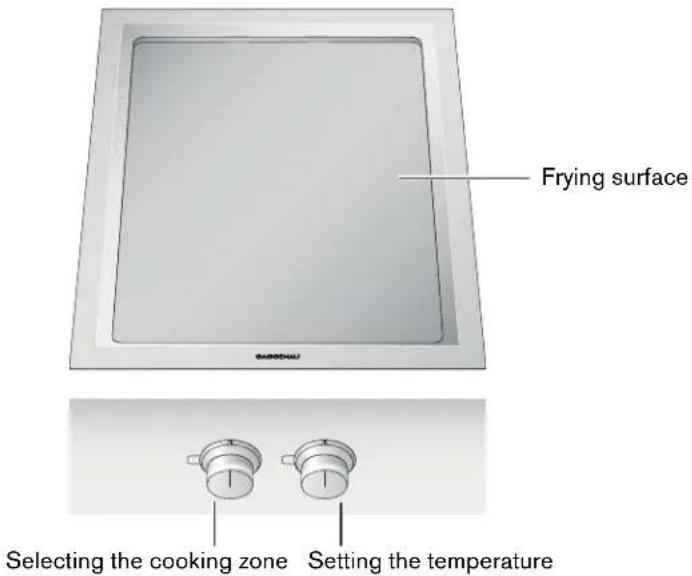
text_image
Frying surface Selecting the cooking zone Setting the temperatureControl knob
natural_image
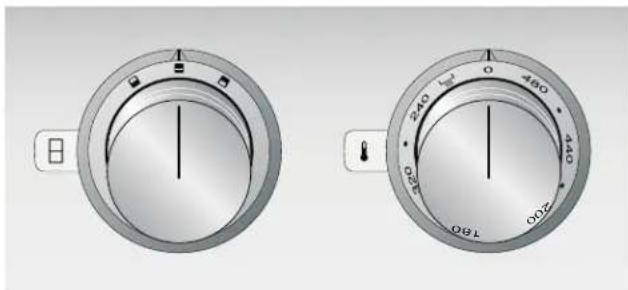
Two identical circular industrial gauges with dial indicators and a handle, shown side by side (no text or symbols on the gauges themselves)With the right-hand control knob you select the temperature between 240 and 480^ F (120 - 240 °C) or the keeping warm setting .
Use the left-hand control knob to select the cooking zones:
■ Both cooking zones in operation
Only the front cooking zone in operation
☐ Only the rear cooking zone in operation
Display on the illuminated ring
The control knobs have an illuminated ring that offers various display options. See the section entitled "Troubleshooting" for more information.
| Left Right Display Meaning | ||
| ○ | ○ | Off Appliance OFF |
| ○ | ● | Lit constantly Appliance ON |
| ○ | ● | Slow flashing Appliance ON, warming up |
| ○ | ● | Slow flashing Residual heat display |
| ○ | ● | Fast flashing Safety shut-off feature, power outage |
| ● | ● | Alternating fast flashing Installation error |
| ○ | Illuminated ring off | |
| ● | Illuminated ring lit | |
| ● | Illuminated ring flashing | |
Accessories
As standard, your device comes with the following accessories:
Spatulas (2) Spatulas to turn the food
Special accessories
You can order the following accessories from your specialist dealer:
VA 440 010 Stainless steel appliance cover
VA 420 000 Connection strip for combination with other Vario appliances in the 400 series for flush installation
VA 420 001 Connection strip for combination with other Vario appliances in the 400 series for flush installation with appliance cover/compensation strip
VA 420 010 Connection strip for combination with other Vario appliances in the 400 series for surface-mounted installation
VA 420 011 Connection strip for combination with other Vario appliances in the 400 series for surface-mounted installation with appliance cover/compensation strip
VA 450 400 Appliance extension 15" (38 cm)
Use the accessories only as indicated. The manufacturer assumes no liability for incorrect usage of the accessories.
Operation
Before first use
Bear in mind the following instructions before frying for the first time:
1 Thoroughly clean the appliance and accessories.
2 Heat appliance to 400°F for a few minutes. This eliminates potential contaminants and smells of newness.
Turning on
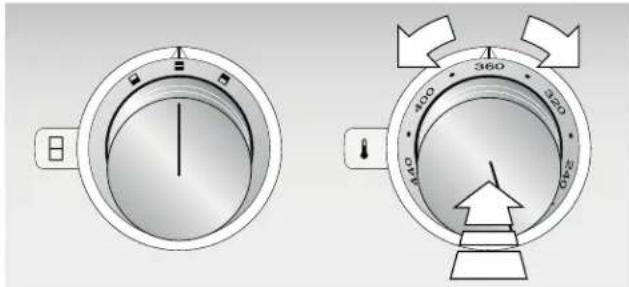
Press in the temperature control knob and turn the control knob to the left or right to the desired temperature between 240 and 480°F (120 - 240 °C).
text_image
Diagram showing two circular gauges with numerical labels and directional arrows indicating measurement or operation.If you do not want to roast on the entire heating zone, you can select only the front or the rear area with the left-hand control knob. Press in the left-hand control knob and select the required heating zone □ or □.
The illuminated ring behind the control knob flashes fast as soon as the appliance warms up. The illuminated ring lights up constantly once the set temperature has been reached.
After warming up, evenly coat some oil or fat on the roasting surface with a spatula or a heat-resistant brush (e.g. a silicone brush). Place food directly on the roasting surface, without a pot or a pan. Use the included spatula to turn food over.
Turning off
Turn the control knob to position 0.

WARNING
Risk of burns
Heat builds up when the appliance cover is closed. Let appliance cool down prior to closing the cover. Never switch on the appliance with the cover closed. Do not use the appliance cover to keep food warm or as a surface for placing objects on it.
Residual heat display
The illuminated ring behind the right-hand control knob flashes after turning off as long as the appliance is too hot to safely touch it.
Keeping warm setting
In the keeping warm setting, you can keep meals warm after preparing them.
Settings table
The values in the settings table apply to a preheated appliance. They should only be regarded as
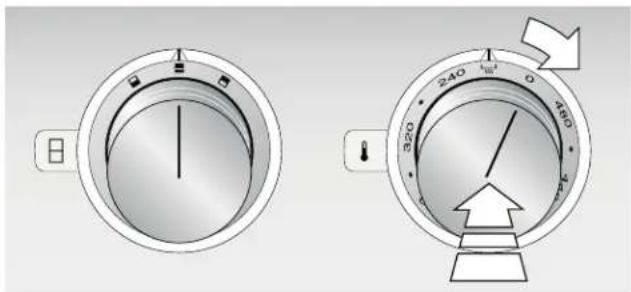
Turn the temperature control knob to the keeping warm setting ☐. With the left-hand control knob, you can choose the whole surface or only the front or rear section.
text_image
Diagram showing two circular gauges with directional arrows indicating movement or change, likely illustrating a mechanical or electrical component.Safety lock
For your protection, the appliance has a safety shut-off feature. Every heating operation is switched off after four hours if the appliance is not operated during this time. Even after a power outage, the heating element stays switched off. The illuminated ring behind the control knob flashes.
Turn the temperature control knob to 0. You can then operate the appliance in the way to which you are accustomed.
guidelines, since more or less heat may be required depending on the type and condition of the food.
Food Temperature Cooking time Notes
| Meat and poultry | |||
| Beefsteak, medium(2.5 - 3 cm; 1 - 11⁄4 in) | Sear at 460 - 480°F(230 - 240 °C)Continue at 360°F(180 °C) | Sear each side 2 min.Continue 6 - 11 min. | e.g. entrecote, fillet steak, rump steak. The steak is medium when meat juice appears on the surface. |
| Pork neck steak (2 cm; 3⁄4 in) 420 - 440°F(210 - 220 °C) | 15 - 18 min. | ||
| Veal cutlet, breaded (1.5 cm; (1⁄2 in) 380 - 400°F(190 - 200 °C) | 16 - 20 min. Use sufficient oil so that the bread crumbs don't dry out and burn. | ||
| Small slices of beef or pork (800 - 900 g; 1lb - 1lb 5oz) | 460 - 480°F(230 - 240 °C) | 6 - 8 min. Distribute the pieces of meat well.They shouldn't touch each other. | |
| Small slices of poultry 360 - 380°F(180 - 190 °C) | 10 - 12 min. | ||
| Ground meat (600 g; 1lb) 460 - 480°F(230 - 240 °C) | 7 - 8 min. | ||
| Saddle of lamb, medium (1.5 - 2.5 cm; 1⁄2 - 1 in) | Sear at 400°F(200 °C)continue at (320°F)(160 °C) | Sear each side 2 min.Continue 4 - 6 min. | |
| Food | Temperature | Cooking time | Notes |
| Turkey steak (1.5 cm; 1⁄2 in) 400°F - 420°F(200 - 210 °C) | 8 - 15 min. | ||
| Poultry liver (1 cm; 1⁄4 in) 400°F - 420°F(200 - 210 °C) | 3 - 5 min. | ||
| Fish and seafood | |||
| Fish fillet (1 cm; 1⁄4 in)(2 cm; 3⁄4 in)(2.5 cm; (1 in) | 210 - 220 °C(410°F - 430°F) | 5 - 7 min. e.g. perch, cod, catfish, haddock, plaice, angler, sole, zander | |
| 380 - 400°F(190 - 200 °C) | 7 - 10 min. | ||
| 360 - 380°F(180 - 190 °C) | 15 - 17 min. | ||
| Salmon steak (2.5 cm; 1 in)(3 cm; 11⁄4 in) | 360 - 380°F(180 - 190 °C) | 15 - 17 min. | |
| 160 - 170 °C(320°F - 340°F) | 18 - 20 min. | ||
| Tuna steak (2.5 - 3 cm; 1 - 13⁄4 in) 360 - 380°F(180 - 190 °C) | 17 - 20 min. | ||
| Shrimps (30 g; 1 oz) 380 - 400°F(190 - 200 °C) | 4 - 5 min. | ||
| Scallops (30 g; 1 oz) 380 - 400°F(190 - 200 °C) | 8 - 12 min. | ||
| Vegetables | |||
| Eggplant, in slices (600 g; 1 lb) 360 - 380°F(180 - 190 °C) | 6 - 8 min. Salt eggplants before frying, leave for 30 minutes and dry off. | ||
| Mushrooms, in slices (600 g; 1lb) 460 - 480°F(230 - 240 °C) | 10 - 12 min. | ||
| Carrot sticks (600 g; 1lb) 360 - 380°F(180 - 190 °C) | 8 - 10 min. | ||
| Boiled potatoes, in slices (600 g; 1lb) 400 - 440°F(200 - 220 °C) | 7 - 10 min. | ||
| Bell pepper, in strips (600 g; 1lb) 400 - 420°F(200 - 210 °C) | 4 - 6 min. | ||
| Zucchini, in slices (600 g; 1lb) 360 - 380°F(180 - 190 °C) | 8 - 10 min. | ||
| Onions or leek, in rings (600 g; 1lb) | 340 - 380°F(170 - 190 °C) | 5 - 7 min. | |
| Egg dishes and desserts | |||
| Fried eggs, scrambled eggs (4 - 6 eggs) | 360 - 380°F(180 - 190 °C) | 4 - 6 min. per side | |
| Crêpes (2 - 6) | 360 - 380°F(180 - 190 °C) | 1 - 2 min. per side | |
| Fruits, in slices (300 - 400 g; 10 - 14oz) | 360 - 380°F(180 - 190 °C) | 5 - 7 min. e.g. pineapple, apple, mango. Use clarified butter for frying. Sweeten to taste with honey or sugar. | |
| Banana breaded with coconut (4 halves) | 360 - 380°F(180 - 190 °C) | 6 - 9 min. | |
Food Temperature Cooking time Notes
| Side dishes and others | |
| Boiled rice (500 g; 1lb) 380 - 400°F | 5 - 7 min. |
| (190 - 200 °C) | |
| pine nuts (300 g; 10oz) 320°F (160 °C) | 5 - 7 min. Turn frequently |
| Boiled rice noodles (400 g; 14oz) 400 - 440°F | 4 - 5 min. |
| (200 - 220 °C) | |
| Tofu (300 g; 10oz) 400 - 440°F | 3 - 5 min. Turn frequently |
| (200 - 220 °C) | |
| Croutons (100 g; 14oz) 340°F (170 °C) | 10 - 12 min. Turn frequently at the start |
Tips and tricks
- Only put on the food once the heating indicator has gone out. This also applies to raising the temperature between two preparations.
- Press the meat, poultry and fish pieces flat onto the frying surface with the spatula. Only turn them once they can easily be removed from the surface, in order to not destroy the fibers. Otherwise fluid can come out, which causes the food to dry out.
- Meat, poultry and fish pieces shouldn't touch each other during frying so that they don't absorb any liquid.
- Don't pierce or cut meat prior to or during cooking, in order to prevent meat juice from escaping.
- Don't salt meat, poultry and fish prior to frying, in order to prevent the extraction of water and soluble nutrients.
- Fish fillet can be rolled in flour (floured) prior to frying. This prevents it from sticking as much.
-
Only turn fish fillet once if possible. First fry it on the skin side.
-
Only use oils and fats that can be heated up hot and are suitable for frying, e.g. refined plant oils or concentrated butter (clarified butter).
- The frying surface is hotter in the center than in the edge zone. You can optimally spread the food around the surface, especially when cooking meals with different cooking times and required temperatures at the same time. Also pay attention to this when choosing the amount of food to cook. Rule of thumb: the thinner the food you are frying, the higher the temperature and the shorter the cooking time.
- When working with only one heating zone: select the highest setting in the temperature range specified in the cooking table or set about 10 °C more than you are accustomed to when cooking with both heating zones. Use around half the specified amount.
Using the teppan yaki with cookware
You can also use the teppan yaki for cooking with cookware. It is appropriate for cooking with gentle heat. You can first quickly heat up food on the stove if necessary, and then continue cooking it on the teppan yaki.
Approx. 280^ F is sufficient for melting, thawing out and keeping warm, approx. 320 - 400^ F for soaking rice and cereals and warming small portions.
Use heat-resistant cookware with a lid. Carefully place the cookware on the heating surface so that you don't accidentally scratch the stainless steel frame. Bear in mind that this cooking procedure isn't energy-efficient when the cookware is smaller than the heated surface.
If you do not want to roast on the entire roasting zone, you can select only the front or the rear area with the left-hand control knob. You can find the optimum temperature for your needs by moving the cookware.
Care and cleaning
In this chapter you will find tips and information on optimal care and cleaning of your appliance.

WARNING
Risk of electrical shock
Moisture entering the appliance can cause an electrical shock. Don't use a high-pressure cleaner or steam cleaner.

WARNING
Risk of burns
The accessible parts get hot during operation.
Never touch hot parts. Keep children away.

WARNING
Risk of burns
Pouring water or ice cubes onto the hot frying surface produces splashes and steam. Do not bend over the appliance. Keep a safe distance.
Cleaning the appliance
Clean the appliance after each use, once it has cooled down. Burnt-on residue is difficult to eliminate.
Remove coarse residues with the spatulas.
Ice cubes are better suited to cleaning the warm appliance than water because there are fewer hot splashes and steam.
Carefully remove cleaner residue prior to next use.
Cleaning the warm appliance
1 Turn off the appliance. Allow it to cool down for at least 15 minutes!
2 Put ice cubes or water (up to 250 ml = about half a pint) on the frying surface. Add a few squirts of dishwashing liquid. Let grime soak.
3 Do not begin cleaning until the residual heat indicator has gone out.
Cleaning the cooled-down appliance
1 Pour a little warm water (up to 250 ml = about half a pint) and dishwashing liquid onto the frying surface so that it is lightly covered.
2 Let grime soak.
3 After grime has softened, begin cleaning.
Cleaning in between frying
1 Turn off the appliance.
2 Slide 4 - 5 ice cubes over the hot frying surface with the spatulas.
3 Remove softened grime with the spatulas.
4 Turn the appliance back on. Wait to put on any food until the appliance has reached the set temperature again.
| Appliance part/ surface | Recommended cleaning |
| Frying surface | Eliminate greasy residue with dish-washing liquid. |
| For heavy grime, use our stainless steel cleaner (order number 311413). This provides dull stainless steel with a new gleam. | |
| Whitish spots may remain on the frying surface, depending on the food. Remove these with lemon juice or vinegar. Then wipe thoroughly with a damp cloth. The stainless steel frame must not come into contact with lemon juice or vinegar. | |
| Frying surface, burnt-on grime | Once the appliance is cool, brush stub-born grime with our grill cleaner gel (order number 463582) and leave on for at least 2 hours, or overnight for heavy grime. Then rinse thoroughly and dry. Observe the information on the cleaner's packaging. |
| Stainless steel frame | Clean with a soft, damp cloth and a little dishwashing liquid. |
| Control knobs | Clean with a soft, moist cloth and a little dishwashing liquid; the cloth must not be too wet. |
Do not use these cleaning agents
- Caustic or corrosive cleaners
- Do not allow acidic cleaners (e.g. vinegar, citric acid, etc.) to come into contact with the frame.
- Cleaners containing chlorine or large proportions of alcohol
- Oven spray
- Hard, scratchy dish-washing sponges, brushes or scourers
- Thoroughly wash out new sponge cloths before using them.
Troubleshooting
You can often easily eliminate problems that may occur on your own. Before calling customer service, take into account the following information.
WARNING
Risk of electric shock
Incorrect repairs are dangerous. Repairs may only be carried out by one of our trained after-sales engineers. If the appliance is faulty, unplug the mains plug or switch off the fuse in the fuse box. Contact the after-sales service.
Malfunction Possible cause Solution
| Appliance does not heat up. Illuminated rings flash fast. | Safety shut-off: appliance has not been operated in the past four hours. | Turn the control knob to 0 and then switch on again, if necessary. |
| Power outage: after a power outage, the appliance stays switched off for safety reasons. | Turn the control knob to 0 and then switch on again, if necessary. | |
| Overheating protection: appliance has been operated at the highest level for a very long time. | Turn the control knob to 0 and let the appli-ance cool down. | |
| Appliance does not heat up. Illuminated rings do not light up. | Installation error Check correct fitting of the connecting cable to the control panel. The plug must engage. | |
| The frying surface becomes curved during operation. | This is due to material expansion during heating up. | This is normal. |
| The corners of the appliance curve upwards slightly during operation. | The heat causes the cooktop's metal to expand. | This is normal. No curving is visible after cooling down. |
Customer service
If your appliance needs repairs, our customer service is there for you. We work hard to help solve problems quickly and without unnecessary service calls, getting your appliance back up and running correctly in the least amount of time possible.
When you call, please indicate the product number (E-Nr.) and serial number (FD-Nr.) so that we can support you in a qualified manner. You will find the type plate with these numbers on the bottom of the appliance. To avoid having to search for a long time when you need it, you can enter your appliance data and the customer support telephone number here.
E-Nr. FD-Nr.
Customer Service
Please read the use and care instructions provided with your appliance. Failure to do so may result in an error in using the appliance. This could result in a service call that instead of fixing a mechanical issue is only needed for customer education. Such calls are not covered by the appliance warranty.
Please find the contact data of all countries in the enclosed customer service list.
To book an engineer visit and product advice
USA 877 442 4436
toll-free
CANADA 800 828 9165
You can rely on the manufacturer's expertise. Rest assured that the repair will be handled by trained service technicians who have the original replacement parts for your appliance.
Table des Matières
natural_image
Two identical circular industrial gauges with dial indicators and a directional arrow, shown side by side (no text or symbols on the gauges themselves)text_image
Technical diagram showing two circular gauges with labeled dimensions and directional arrows indicating measurement or operation.text_image
Diagram showing two circular gauges with numerical labels and directional arrows indicating movement or change.Coupure de sécurité
natural_image
Two identical circular industrial gauges with dial indicators and a directional arrow, shown side by side (no text or symbols on the gauges themselves)text_image
Technical diagram showing two circular gauges with numerical labels and directional arrows indicating measurement or operation.text_image
Diagram showing two circular gauges with directional arrows indicating movement or change, labeled with numerical values and symbols.1901 Main Street, Suite 600
Irvine, CA 92614
+1 877 4GAGGENAU
USA
www.gaggenau-usa.com
