EasyManual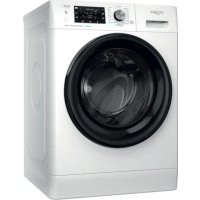
FFD 11489E BV BE - Washing machine WHIRLPOOL - Free user manual and instructions
Find the device manual for free FFD 11489E BV BE WHIRLPOOL in PDF.



Questions des utilisateurs sur FFD 11489E BV BE WHIRLPOOL
0 question sur cet appareil. Repondez a celles que vous connaissez ou posez la votre.
Poser une nouvelle question sur cet appareil
Download the instructions for your Washing machine in PDF format for free! Find your manual FFD 11489E BV BE - WHIRLPOOL and take your electronic device back in hand. On this page are published all the documents necessary for the use of your device. FFD 11489E BV BE by WHIRLPOOL.
USER MANUAL FFD 11489E BV BE WHIRLPOOL
– – – –Fijne was 30°C - 30°C 600 (***) 1,0 ** –
TRANSPORT ET MANUTENTION
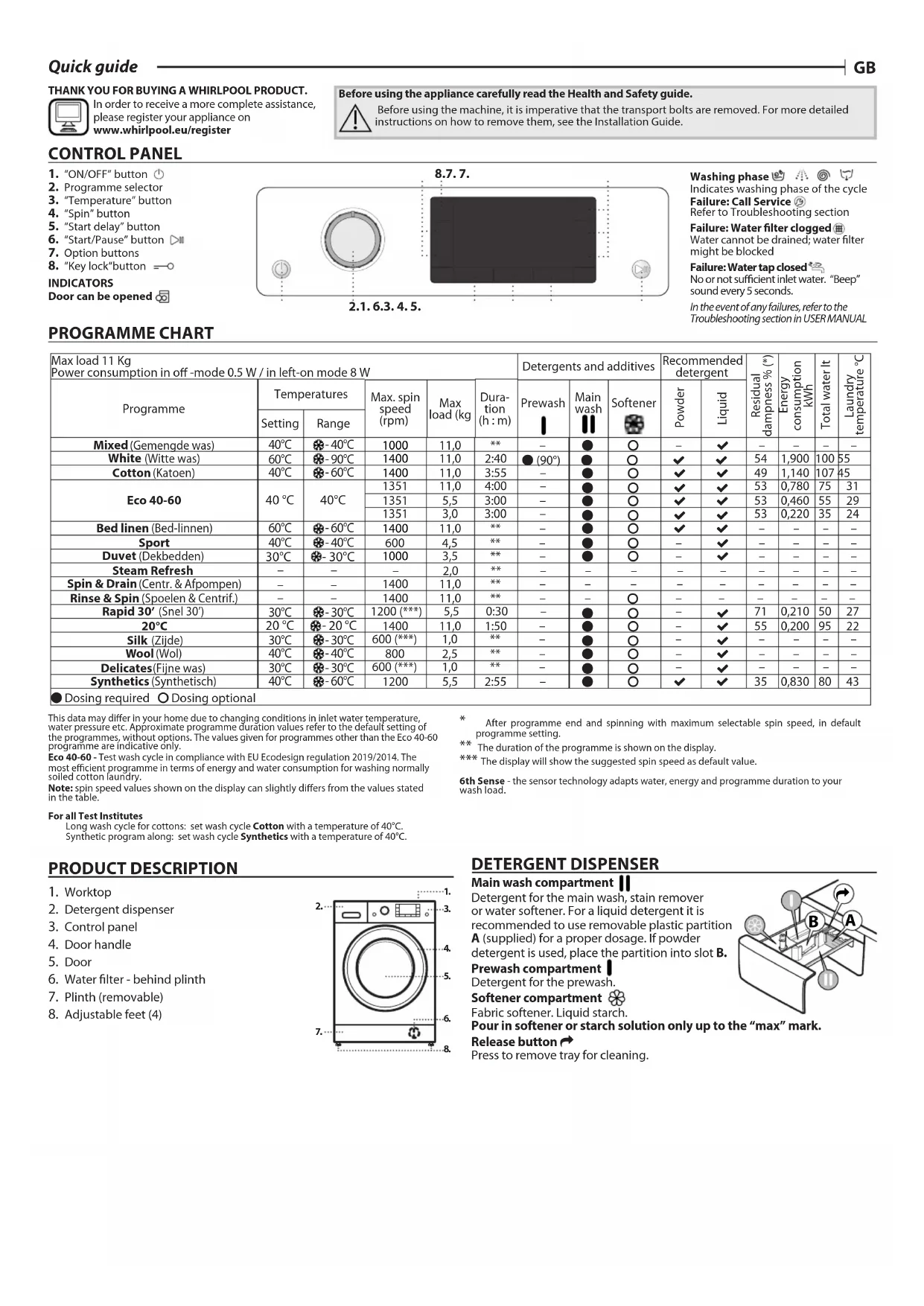
6. Water lter - behind plinth
7. Plinth (removable)
8. Adjustable feet (4)
DETERGENT DISPENSER Main wash compartment Detergent for the main wash, stain remover or water softener. For a liquid detergent it is recommended to use removable plastic partition A (supplied) for a proper dosage. If powder detergent is used, place the partition into slot B.Prewash compartment Detergent for the prewash.Softener compartment Fabric softener. Liquid starch.Pour in softener or starch solution only up to the “max” mark.Release button Press to remove tray for cleaning.
After programme end and spinning with maximum selectable spin speed, in default programme setting. The duration of the programme is shown on the display. *** The display will show the suggested spin speed as default value. 6th Sense - the sensor technology adapts water, energy and programme duration to your wash load.This data may dier in your home due to changing conditions in inlet water temperature, water pressure etc. Approximate programme duration values refer to the default setting of the programmes, without options. The values given for programmes other than the Eco 40-60 programme are indicative only.Eco 40-60 - Test wash cycle in compliance with EU Ecodesign regulation 2019/2014. The most ecient programme in terms of energy and water consumption for washing normally soiled cotton laundry.Note: spin speed values shown on the display can slightly diers from the values stated in the table.For all Test Institutes Long wash cycle for cottons: set wash cycle Cotton with a temperature of 40°C. Synthetic program along: set wash cycle Synthetics with a temperature of 40°C. Max load 11 KgPower consumption in o -mode 0.5 W / in left-on mode 8 WDetergents and additivesRecommended detergentResidual dampness % (*)Energy consumption kWh Total water ltLaundry temperature °CProgrammeTemperaturesMax. spin speed (rpm) Max load (kgDura-tion (h : m)PrewashMain wash SoftenerPowderLiquidSetting RangeMixed (Gemengde was) 40°C - 40°C 1000 11,0 ** –
– – – –Steam Refresh
– – – –Synthetics (Synthetisch) 40°C - 60°C 1200 5,5 2:55 – 35 0,830 80 43 Dosing required Dosing optionalPROGRAMMES For choosing the appropriate programme for your kind of laundry, always respect the instructions on the care labels of the laundry. The value given in the tub symbol is the maximum temperature possible for washing the garment. Mixed For washing lightly to normally soiled resilient garments in cotton, linen, synthetic bres and mixed bres. White (Whites) For washing normally to heavily soiled towels, underwear, table and bed linen, etc in resilient cotton and linen. Only when the temperature is selected at 90°C the cycle is provided with a prewash phase before main washing phase. In this case it is recommended to add detergent both, in the prewash and main wash section. Cotton Normally to heavily soiled and robust cottons . Eco 40-60 For washing normally soiled cotton garments declared to be washable at 40 °C or 60 °C, together in the same cycle. This is the standard cotton programme and the most ecient in terms of water and energy consumption. Bed linen Use this programme to wash bed linen an towels in one single cycle. It optimises softner performance and helps you save time and energy. We recommend to use powder detergent. Sport For washing lightly soiled sports clothing (tracksuits, shorts, etc.). For best results, we recommend not exceeding the maximum load indicated in the ‚‘‘‘PROGRAMME CHART‘‘. We recommend using liquid detergent , and adding the amount suitable for half-load. Duvet (Duvets) Designed for washing eiderdown padded items such as double or single duvets, cushions and anoraks. It is recommended to load such padded items in the drum with the edges folded inwards and not to exceed ¾ of the drum’s volume. For optimal washing, we recommend using a liquid detergent. Steam Refresh This programme refreshes garments by removing bad odours and relaxing the bres (2 kg, roughly 3 items). Insert dry items only (that are not dirty) and select programme “Steam Refresh”. Garments will be a little damp at the end of the cycle and can be worn after a few minutes. The “Steam Refresh” programme makes ironing easier. ! Not recommended for wool or silk garments. ! Do not add softeners or detergents. Spin & Drain (Spin + Drain) Spins the load then empties the water. For resilient garments. If you exclude the spin cycle, the machine will drain only Rinse & Spin (Rinse + Spin) Rinses and the spins. For resilient garments. Rapid 30’ For washing lightly soiled garments quickly. This cycle lasts only 30 minutes, saving time and energy. 20°C For washing lightly soiled cotton garments, at a temperature of 20 °C. Silk Use this cycle to wash all silk garments. We recommend the use of special detergent which has been designed to wash delicate clothes. Wool All wool garments can be washed using programme ‚“Wool“ even those carryng the “hand-wash only “ label. For best results, use special detergents and do not exceed max kg declaration of laundry. Delicates For washing particularly delicate garments. Preferably turn garments inside out before washing. Synthetics For washing soiled garments made from synthetic bres (such as polyester, polyacrylic, viscose, etc.) or cotton/synthetic blends.
The rst time the machine is switched on, you will be asked to select the language and the display will automatically show the language selection menu. To select the desired language press the “Temperature” button or “Start delay” button; to conrm the selection press the “Spin” button. To change the language switch o the washing machine and press buttons “Key lock” , “Intensive rinse” and “FreshCare+” simultaneously until an alarm is heard: the language-selection menu will be displayed again. To remove any residues from the manufacturing process. Select the “Cotton” programme at a temperature of 60°C. Add a small amount of heavy duty detergent to the main wash compartment of the detergent dispenser (maximum 1/3 of the quantity recommended by the detergent manufacturer for lightly soiled laundry). Start the programme without adding any laundry. DAILY USE Prepare your laundry according to the recommendations in the “HINTS AND TIPS” section. Load the laundry, close the door, open the water tap and press the “ON/OFF” button to switch the washing machine on, the “Start/ Pause” button ashes. Turn the programme selector to the desired programme and select any option if needed. The temperature and spin speed shown on the display can be changed by pressing the “Temperature” button or the “Spin” button. Pull out the detergent dispenser and add the detergent (and additives/softener) now. Observe the dosing recommendations on the detergent pack. STARTING CYCLE Close the detergent dispenser and press the “Start/Pause” button. The machine will lock the door ( symbol o) and the drum will start to rotate; the door will be unlocked ( symbol on) and then locked again ( symbol o) as preparation phase of each washing cycle. The “Clicking” noise is part of the door locking mechanism. Water will enter the drum and start the washing phase once the door is locked.
PAUSE A RUNNING PROGRAMME
To pause the wash cycle, press the button “Start/Pause” again; the indicator light will ash. If the symbol is illuminated, the door may be opened. To start the wash cycle from the point at which it was interrupted, press the button again.
OPEN THE DOOR, IF REQUIRED
Before starting and after end of a programme, the “Door open” symbol lights to show the door can be opened. As long as a wash programme is running, the door remains locked. To open the door while a programme is in progress, press the “Start/Pause” button. Provided the water level and/ or temperature is/are not too high, the “door open” indicator lights up and you can open the door. For example to add/ remove laundry. Press the “Start/Pause” button again to continue the programme. PROGRAMME END The “Door open” indicator lights up, and the display shows “Cycle end”. To switch o the washing machine after programme end press the “ON/OFF” button, the lights go o. If you do not press “ON/OFF” button, the washing machine will switch o automatically after about a 10 minutes. Close the water tap. Open the door and unload the machine. Leave the door ajar to allow the drum to dry. OPTIONS ! If the selected function is incompatible with the set programme, the incompatibility will be signalled by a buzzer (3 beeps) and the wording “No Selection” will appear on the display. ! If the selected function is incompatible with another previously set function, the wording “No Selection” will appear on the display and the function will not be enabled. Clean+ Clean+ is an option working on 3 dierent levels (Intensive, Daily and Fast) that are specially designed to set the right washing action, depending on your cleaning needs: Intensive: this option is designed for high levels of dirtiness, removing most stubborn stains. Daily: this option is designed to remove everyday stains. Fast: this option is designed to remove lightly soiled stains. Intensive rinse By selecting this option, the eciency of the rinse is increased and optimal detergent removal is guaranteed. It is particularly useful for sensitive skin. Press the button once, two or three times to select an additional 1, 2 or 3 rinses after the standard cycle rinse and remove all traces of detergent. Press the button again to go back to the “Normal rinse” rinse type. Delay Timer To set the selected programme to start at a later time , press the button to set the desired delay time. “Waiting” or “Starts in” is indicated on the display when this option is enabled. To cancel the delayed start, press the button again until the value ‚‘‘--:--‘‘ is shown on the display. This option enhances washing performance by generating steam to inhibit the proliferation of the main bad odour sources inside the machine. After steam phase, the washing machine will perform gentle tumbling through slow rotations of the drum. option starts after the cycle ends for a maximum duration of 6h and you can interrupt at any time by pressing any button on control panel or turning the knob. (*) Wait around 5’ before open the door.Steam Hygiene This option enhances washing performance by generating steam during the wash cycle that eliminates any bacteria from bres while treating them at the same time. Place the laundry in the drum, choose a compatible programme and select option “ “. ! The steam generated during washing machine operation may cause the porthole door to become hazy. Easy Iron By selecting this function, the wash and the spin cycles will be modied in order to reduce the formation of creases. Temperature Every programme has a predened temperature. If you want to change the temperature, press the “Temperature” button. The value appears on the display. Spin Every programme has a predened spin speed. If you want to change the spin speed, press the “Spin” button. The value appears on the display. Demo mode To deactivate this function, switch the washing machine OFF. Than press and hold “Start/Pause” button, within 5 seconds press also “ON/OFF” button and hold both buttons for 2 seconds. KEY LOCK To lock the control panel, press and hold the “KEY LOCK” button for approximately 3 seconds. When the display visualises “KEY LOCK ON” the control panel is locked (with the exception of the ON/OFF button). This prevents unintentional changes to programmes, especially with children near the machine. To unlock the control panel, press and hold the “KEY LOCK” button for approximately 3 seconds. BLEACHING If you wish to bleach the laundry, load the washing machine and set the “Rinse & Spin” programme. Start the machine and wait for it to complete the rst water lling cycle (roughly 2 minutes). Put the machine in pause mode by pressing the “Start/Pause” button , open the detergent drawer and pour the bleach (observe the recommended doses indicated on the package) into the main wash compartment where the partition was previously mounted. Restart the cycle by pressing the “Start/Pause” button . If desired, it is possible to add fabric softener into the appropriate compartment of the detergent drawer.
Sort your laundry according to Type of fabric/care label (cotton, mixed bres, synthetics, wool, handwash items). Colour (separate coloured and white items, wash new coloured items separately). Delicates (wash small items – like nylon stockings – and items with hooks – like bras – in a cloth bag or pillow case with zip). Empty all pockets Objects like coins or lighters can damage your laundry as well as the drum. Follow the dosage recommendation / additives It optimizes the cleaning result, it avoids irritating residues of surplus detergent in your laundry and it saves money by avoiding waste of surplus detergent Use low temperature and longer duration The most ecient programmes in terms of energy consumption are generally those that perform at lower temperatures and longer duration. Observe the load sizes Load your washing machine up to the capacity indicated in the “PROGRAMME CHART” table to save water and energy. Noise and remaining moisture content They are inuenced by the spinning speed: the higher the spinning speed in the spinning phase, the higher the noise and the lower the remaining moisture content. CYCLE COUNTER The cycle counter on your appliance allows you to track the total number of cycles it has performed. This feature is useful for moni- toring usage and maintenance. To access the cycle counter:
1. Press the “ON/OFF” button to turn on the appliance.
2. Press the “ON/OFF” button again to turn o the appliance.
3. Press and hold the Temperature button for approximately 5
seconds. The display will show the total number of cycles performed by the appliance. To exit the cycle counter mode, press any button. Note: The washer may have already performed a set of cycles due to an extended quality process carried out during production to ensure higher product quality.
DESCALE AND CLEAN PROCEDURE
A message on the display will regularly (roughly every 50 cycles) advise the user to run an automatic cleaning cycle to clean the washing machine and combat limescale build-up and bad odours. For optimal maintenance we suggest using WPRO Limescale and grease remover, according to the instructions shown on the package. The product can be purchased by contacting the technical assistance service or through the website www.whirlpool.eu. Whirlpool declines all liability for any damages to the appliance caused by the use of other cleaning products for washing machines available on the market. CLEANING & MAINTENANCE For any cleaning and maintenance, switch o and unplug the washing machine. Do not use ammable uids to clean the washing machine. Clean and maintain your washing machine periodically (at least 4 times per year). Cleaning the outside of the washing machine Use a soft damp cloth to clean the outer parts of the washing machine. Do not use glass or general purpose cleaners, scouring powder or similar to clean the control panel – these substances might damage the printing. Checking the water supply hose Check the inlet hose regularly for brittleness and cracks. If damaged, replace it by a new hose available through our After-Sales Service or your specialist dealer. Depending on the hose type: If the inlet hose has a transparent coating, periodically check if the colour intensies locally. If yes, the hose may have a leak and should be replaced Cleaning the water lter / draining residual water If you used a hot wash programme, wait until the water has cooled down before draining any water. Clean the water lter regularly, to avoid that the water cannot drain after the wash due to obstruction of the lter. If the water cannot drain, the display indicates that the water lter may be clogged. Remove the plinth by using the screwdriver: push downwards one side of the plinth with your hand, then push the screwdriver into the gap between plinth and front panel and pry open the plinth. Place a broad, at container beneath the water lter, to collect the drain water. Slowly turn the lter counterclockwise until water ows out. Let the water ow out, without removing the lter. When the container is full, close the water lter by turning it in clockwise. Empty the container. Repeat this procedure until all the water has drained. Lay a cotton cloth beneath the water lter, which can absorb a small amount of rest water. Then remove the water lter by turning it out anti clockwise. Clean the water lter: remove residues in the lter and clean it under running water. Insert the water lter and reinstall the plinth: Reinsert the water lter again by turning it in clockwise direction. Make sure to turn it in as far as it goes; the lter handle must be in vertical position. To test water tightness of the water lter, you can pour about 1 liter of water into the detergent dispenser. Then reinstall the plinth. ACCESSORIES Contact our After-Sales Service to check if the following accessories are available for your washing machine model. Stacking kit shelf By which your dryer can be xed on top of your washing machine to save space and to facilitate loading and unloading your dryer in the higher position.
TRANSPORT AND HANDLING
Never lift the washing machine by holding it at the worktop. Pull out the mains plug, and close the water tap. Make sure that door and detergent dispenser are properly closed. Disconnect the inlet hose from the water tap, and remove the drain hose from your draining point. Remove all rest water from the hoses, and x them so that they cannot get damaged during transport. Ret the transport bolts. Follow the instructions for removing the transport bolts in the INSTALATION GUIDE in reverse order.TROUBLESHOOTING The washing machine may sometimes not work properly for certain reasons. Before calling the Support Centre, it is recommended to check to see if the problem can be easily resolved using the following list. Anomalies: Possible causes / Solution: The washing machine does not turn on.
- The plug is not inserted into the electrical outlet, or not enough to make contact.
- There has been a power failure. The wash cycle does not start.
- The door is not fully closed.
- The ON/OFF button has not been pressed.
- The START/PAUSE button has not been pressed.
- The water tap is not open.
- A “start delay” has been set. The washing machine does not ll with water (the message “NO WATER”, Turn tap on” is shown on the display). “Beep” sound every 5 seconds.
- The water intake hose is not connected to the tap.
- The water tap is not open.
- The mains water supply has been shut o.
- There is not enough pressure.
- The START/PAUSE button has not been pressed. The washing machine loads and drains water continuously.
- The drain hose has not been installed at 65 to 100 cm from the ground.
- The end of the drain hose is immersed in water.
- The drain connector on the wall does not have an air vent. If the problem persists after having performed these checks, close the water tap, shut o the washing machine, and call the Support Centre.If the dwelling is located on one of the uppermost oors of a building, a siphon eect can sometimes occur, thus causing the washing machine to load and drain water continuously.Special anti-siphon valves are available on the market to prevent these types of problems. The washing machine does not drain or does not spin.
- The programme does not include the draining function: with certain programmes it must be activated manually.
- The drain hose is bent.
- The drain line is obstructed. The washing machine vibrates excessively during the spin cycle.
- At the time of installation, the drum was not properly unlocked.
- The washing machine is not level.
- The washing machine is squeezed between furniture and the wall. The washing machine leaks water.
- The water intake hose has not been tightened properly.
- The detergent dispenser is clogged.
- The drain hose has not been properly fastened. The machine is locked and the display ashes, indicating an error code (e.g. F-01, F-..).
- Shut o the machine, disconnect the plug from the outlet, and weight about 1 minute before turning it back on. If the problem persists, call the Support Centre. Too much foam is formed.
- The detergent is not compatible with the washing machine (it must bear the wording “for washing machines”, “ for hand washing and washing machines”, or something similar).
- The dosage was excessive. Door is locked, with or without failure indication, and the programme does not run.
- Door is locked in case of power breakdown. Programme will continue automatically as soon as the mains is available again.
- Washing machine is in a standstill. Programme will continue automatically after the origin of the standstill does not persist anymore. Regulatory documentation, standard documentation, ordering spare parts and other product information can be found:
- Using the QR code in your appliance
- By visiting our website docs .whirlpool. eu/docs and parts - selfservice .europeanappliances. com
- Alternatively, contact our After-sales Service (See phone number in the warranty booklet). When contacting our After-sales Service, please state the codes provided on your product’s identication plate. For User’s Repair & Maintenance Information visit www.whirlpool.eu You can nd more information about your model online at https://eprel.ec.europa.eu/ which is the ocial EU EPREL product database. After selecting the Product Category, enter the Model Identier of the product. The Model Identier is made up of letters and numbers and can be found on the identication plate, as Mod. (see image on the right). ®/TM/© 2025 Whirlpool. Produced under licence. xxxxxxxxxxxxCLEANING & MAINTENANCE For any cleaning and maintenance, switch o and unplug the washing machine. Do not use ammable uids to clean the washing machine. CLEANING THE OUTSIDE OF THE WASHING MACHINE Use a soft damp cloth to clean the outer parts of the washing machine. Do not use glass or general purpose cleaners, scouring powder or similar to clean the control panel – these substances might damage the printing.
CHECKING THE WATER SUPPLY HOSE
Check the inlet hose regularly for brittleness and cracks. If damaged, replace it by a new hose available through our After-Sales Service or your specialist dealer. Depending on the hose type: If the inlet hose has a transparent coating, periodically check if the colour intensies locally. If yes, the hose may have a leak and should be replaced. For water stop hoses: check the small safety valve inspection window (see arrow). If it is red, the water stop function was triggered, and the hose must be replaced by a new one. For unscrewing this hose, press the release button (if available) while unscrewing the hose. CLEANING THE MESH FILTERS IN THE WATER SUPPLY HOSE
1. Close water tap and unscrew the inlet hose.
2. Clean the mesh lter at the hose’s end carefully with a
3. Now unscrew the inlet hose on the back of the washing
machine by hand. Pull out the mesh lter from the valve on the back of the washing machine with pliers and carefully clean it.
4. Insert the mesh lter again. Connect the inlet hose to
water tap and washing machine again. Do not use a tool to connect the inlet hose. Open the water tap and check that all connections are tight.
1CLEANING THE DETERGENT DISPENSER
CLEANING THE WATER FILTER / DRAINING RESIDUAL WATER Switch o and unplug the washing machine before cleaning the water lter or draining residual water. If you used a hot wash programme, wait until the water has cooled down before draining any water. Clean the water lter regularly every three months to prevent it from clogging and prevent the water from draining properly. If the water cannot drain, the display indicates that the water lter may be clogged.1. Remove the kick panel: Using a screwdriver, do that which is shown in the following gure.2. Container for the drained water: Place a low and wide container under the water lter in order to collect the residual water.3. Drain the water: Slowly turn the lter counter-clockwise until all the water has come out. Allow the water to ow out without removing the lter. Once the container is full, close the water lter by turning it clockwise. Empty the container. Repeat the procedure until all the water has been drained.4. Remove lter: Lay a cotton cloth beneath the water lter, which can absorb a small amount of rest water. Then remove the water lter by turning it out anticlockwise.5. Clean the water lter: remove residues in the lter and clean it under running water.6. Insert the water lter and reinstall the plinth: Reinsert the water lter again by turning it in clockwise direction. Make sure to turn it in as far as it goes; the lter handle must be in vertical position. To test water tightness of the water lter, you can pour about 1 liter of water into the detergent dispenser. Then reinstall the plinth.
Remove the dispenser by raising it and pulling it out (see gure).Wash it under running water; this operation should be repeated frequently.
Never lift the washing machine by holding it at the worktop.
1. Pull out the mains plug, and close the water tap.
2. Make sure that door and detergent dispenser are properly
3. Disconnect the inlet hose from the water tap, and remove
the drain hose from your draining point. Remove all rest water from the hoses, and x them so that they cannot get damaged during transport.
4. Ret the transport bolts. Follow the instructions for
removing the transport bolts in the “Installation Guide” in reverse order. Important: Do not transport the washing machine without having xed the transport bolts. AFTER-SALES SERVICE
BEFORE CALLING THE AFTER-SALES SERVICE
1. See if you can solve the problem by yourself with the help
of the suggestions given in the TROUBLESHOOTING
2. Switch the appliance o and back on again to see if the
fault persists. IF AFTER THE ABOVE CHECKS THE FAULT STILL OCCURS, GET IN TOUCH WITH THE NEAREST AFTER-SALES SERVICE To receive assistance, call the number shown on the warranty booklet. When contacting our Client After sales service, always specify:
- a brief description of the fault;
- the type and exact model of the appliance; xxxxxxxxxxxx
- the service number (number after the word Service on the rating plate).
- your telephone number. If any repairs are required, please contact an authorised after- sales service (to guarantee that original spare parts will be used and repairs carried out correctly).