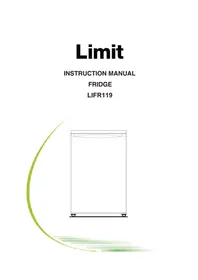
LIFR119 - Fridge Limit - Free user manual and instructions
Find the device manual for free LIFR119 Limit in PDF.


User questions about LIFR119 Limit
0 question about this device. Answer the ones you know or ask your own.
Ask a new question about this device
Download the instructions for your Fridge in PDF format for free! Find your manual LIFR119 - Limit and take your electronic device back in hand. On this page are published all the documents necessary for the use of your device. LIFR119 by Limit.
USER MANUAL LIFR119 Limit
Before installing and using your new appliance
- Read through the instructions supplied with your appliance - failure to install or use this appliance in accordance with the instruction book may invalidate any warranty.
-
This appliance is intended to be used in household and similar applications such as: - staff kitchen areas in shops, offices and other working environments;
-
farm houses and by clients in hotels, motels and other residential type environments;
-
bed and breakfast type environments;
-
catering and similar non-retail applications.
-
The manufacturer does not accept any liability for damage caused through improper use, or incorrect installation.
- Do not install this appliance if it has been damaged during transportation. This includes the plug and power supply cord.
- Always install this appliance in line with these instructions. Always read these instructions fully before using the appliance for the first time.
Warning
- Do not use mechanical devices or other means to accelerate the defrosting process (if applicable), other than those recommended by the manufacturer.
- Do not use electrical appliances inside the food storage compartments of the appliance, unless they are of the type recommended by the manufacturer.
- Do not allow the refrigerant circuit to become damaged while using or installing. Should it become damaged, do not use the appliance until you are instructed to do so by a service engineer. Refrigerant can ignite or cause damage to the eye when leaking.
- Always remember to unplug the appliance before cleaning. When disconnecting from the electricity supply, pull the plug, not the power cord.
- Do not use any electrical appliance inside the food storage area – unless they are recommended by the manufacturer.
-
All electrical repairs must be carried out by a qualified electrician. Inadequate repairs may result in a major source of danger for the user and invalidate any warranty.
-
Never store anything dangerous inside the appliance, such as combustibles, explosive substances (such as aerosol cans, ...), strong acid and alkali etc. Alcoholic beverages must be stored upright in an airtight container in the refrigerator.
- Always keep any ventilation openings clear of obstruction. Should they become blocked, clear them straight away.
- Do not allow children to play, sit or hang onto any part of the appliance.
- Make sure that the plug is in an accessible place when installation is complete. Remove all packaging. Only use this appliance for domestic purposes, for food refrigeration, in accordance with these instructions.
- This appliance is not intended for use by persons (including children) with reduced physical, sensory or mental capabilities, or lack of experience and knowledge, unless they have been given supervision or instruction concerning use of the appliance by a person responsible for their safety. Children should be supervised to ensure that they do not play with the appliance.
- Keep ventilation openings, in the appliance enclosure or in the built-in structure, clear of obstruction.
- Do not damage the refrigerant circuit.
- When positioning the appliance ensure the supply cord is not trapped or damaged.
- If the supply cord is damaged, it must be replaced by the manufacturer, its service agent or similarly qualified persons in order to avoid a hazard.
- Do not locate extension sockets or charging transformers/power supplies adjacent to the compressor as they could overheat
Before you start
- This appliance has a heavy weight. Be careful when transporting it.
- Do not lift the appliance by the pipes or the door when moving.
- This appliance must stand vertically on a flat, even surface, to level the appliance use the leveling feet by turning them until the appliance is as level as possible.
- Do not install onto carpeted surfaces as this prevent adequate ventilation.
- Install the appliance in a well ventilated room. The appliance should not be placed near to any heat sources (cookers, heaters etc.) or in any unheated rooms (garages, outhouses etc.) as the ambient temperature affects the performance of the appliance.
- Parts that become hot must never be exposed. The back of the appliance must therefore be placed against the wall not forgetting the customary distance for ventilation. Allow 300mm clearance at the rear of the appliance and on each side of the appliance and over the top to ensure proper ventilation.
- Do not expose the appliance to damp conditions, open air or rain.
After you remove all of the packaging materials, clean the inside of your refrigerator before using it. - Should the appliance become damaged, contact the service center and do not use the appliance until you are instructed to do so by a service engineer.
Getting started
Once you have installed your appliance in an appropriate location, follow the start up procedure below:
- Before you plug in the appliance, clean thoroughly the inside and all accessories.
- Leave the appliance to stand for 2 - 3 hours to allow the refrigerant to settle following installation and cleaning.
- If the appliance has been transported horizontally, it must be left to stand vertically for 12 hours before installation.
- Once dry, plug the appliance into the socket. Make sure the voltage of this appliance is in accordance with the voltage of your energy grid.
- Turn the thermostat to the required setting.
- When using the freezer for the first time or after defrosting, set the thermostat knob to the maximum position for at least 2 hours before introducing food to be stored, and then adjust it to the normal position.
Temperature control
The temperature selector knob is located on the right hand side wall of the refrigerator interior. The temperature of the chamber is adjusted through the thermostat knob. The numbers 1, 2, 3, 4, 5, 6, do not mean a specific temperature, the lower the number is, the higher the temperature inside will be and vice versa.
During high ambient temperatures e.g. on hot summer days, it may be necessary to set the thermostat to the coolest setting (position"Max"). This may cause the compressor running continuously in order to maintain a low temperature in the cabinet.
The first time you install your refrigerator, set the thermostat knob at "Med". Give your refrigerator time to cool down completely before adding food. Wait 24 hours before adding food.
The thermostat knob controls the temperature. When the thermostat control knob is set to OFF, the refrigerator will not be running.
Tips for using this appliance
- Before storing cooked foods in the refrigerator, allow them to cool to room temperature. Never put hot or even warm foodstuffs into the freezer.
- To maintain adequate air circulation, do not overfill the appliance. If there is too much food inside, the compressor does not work as effectively.
- Do not op en the door any more than necessary - this will keep the temperature as cold as possible inside.
- Wrap or cover food well before storing. Always make sure that any packaging is airtight and suitable for use inside a fridge.
- Successful freezing depends on the correct packaging. Prior to freezing the food, food should always be covered tightly with foil, plastic film, placed in plastic bags or stored in airtight containers. This will prevent food from dehydrating and to prevent any strong odors of some foods transferring to milder ones.
- All frozen food you purchase should be placed in the freezer as soon as possible to avoid them from defrosting and spoiling. All storage recommendations printed on the packaging of frozen food by the manufacturer should always be followed.
- You may hear gurgling noises or a humming sound while the appliance is in use and this is perfectly normal when the compressor is running and the coolant is moving through the system.
- A clicking sound may be heard, this is the thermostat and is normal.
- This appliance is designed to operate in an ambient temperature between 16 and 32^ .
- Do not exceed the storage times recommended by the food manufacturer and always check expiry dates.
Cleaning your refrigerator
Before you start to clean your refrigerator set the temperature control off and remove the plug from the power supply.
Use a clean sponge or a soft cloth and a mild detergent in warm water. Do not use abrasive or harsh cleaners.
Do not use cleaning waxes, concentrated detergents, bleaches or cleaners containing petroleum on plastics and rubber parts.
Never use paper towels, window sprays, scouring cleansers or flammable fluids on plastic parts as these can scratch or damage the appliance.
Hand wash, rinse and dry all surfaces thoroughly.
Avoid getting water into the electric components of the appliance (i.e. the thermostat) or spilling water on the fridge.
If the refrigerator is not in use for a long period of time, you should clean the appliance as detailed.
Leave the door open to prevent any unpleasant smells inside.
Defrosting
Defrosting refrigerator compartment:
- Defrosting process is automatic by thermostat knob. The melted frost flows into the drip tray and will automatically evaporate.
Defrosting freezer compartment:
-
Defrosting f or the freezer compartment is by manual process.
-
Remo ve the mains plug from the wall socket, open the door and remove all the food to a cool place. Defrost using a plastic scraper or let the temperature rise naturally until the frost melts. Then wipe away the remaining ice and water, after this plug the freezer back into the mains supply.
Note: To avoid damaging the freezing compartment wall, do not use any sharp objects to remove the frost or separate the frozen food.
Troubleshooting
In case of malfunction, you can solve many common problems easily.
Your Refrigerator will not operate... Check if
- the power supply cord is unplugged;
- the thermostat knob is set to "OFF" p.osition.
The light does not work... Check if
the power supply cord is unplugged;
- a household fuse or circuit breaker has tripped;
- a light bulb is loose in the socket;
- a light bulb has burned out.
Food in the refrigerator compartment is freezing... Check if
- the thermostat knob is set to 0 cold;
- the position of food stored touches the refrigerant power of refrigerator back wall.
Food in the refrigerator compartment is not cold... Check if
- the air vents are blocked in the compartment. This prevents the movement of cold air;
- the do or is opened too often or not closed properly;
- a large amount of f ood has just been added to the refrigerator;
- the position of thermostat knob is adjusted too low.
The refrigerator seems to make unusual noise... Check if
- the refrigerator is veled on the floor;
- the body of the refrigerator touches the wall;
the drip tray is not placed properly.
There is interior moisture build-up... Check if
- the air vents are blocked in the refrigerator;
- the do or is opened too often;
- the ro om is humid;
- the food is not packaged correctly;
- the control is not set correctly of the surrounding conditions.
The doors will not close completely... Check if
- the shelves are out of position;
- the gask ets are dirty;
the fridge is w ell levelled.
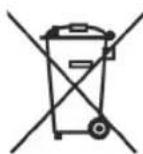
This marking indicates that this product should not be disposed with other household wastes throughout the EU. To prevent possible harm to the environment or human health from uncontrolled waste disposal, recycle it responsibly to promote the sustainable reuse of material resources. To return your used device, please use the return and collection systems or contact the retailer where the product was purchased. They can take this product for environmental safe recycling.
Imported by
This appliance complies with the appropriate EC directives and has been manufactured in accordance with the latest security techniques.
RoHS COMPLIANT