LIVDK485 - Fridge Limit - Free user manual and instructions
Find the device manual for free LIVDK485 Limit in PDF.


User questions about LIVDK485 Limit
0 question about this device. Answer the ones you know or ask your own.
Ask a new question about this device
Download the instructions for your Fridge in PDF format for free! Find your manual LIVDK485 - Limit and take your electronic device back in hand. On this page are published all the documents necessary for the use of your device. LIVDK485 by Limit.
USER MANUAL LIVDK485 Limit
Human-Machine Interface and Button Operation 006
Refrigerator Features
Names of components 009
Refrigerating chamber 009
Freezing chamber 009
■ Maintenance of refrigerators
Cleaning 010
Defrost 010
Stop using 010
Frequently asked questions 011
Safety warnings
This chapter describes the important security matters to prevent users from injury or property damage. Please understand fully the following text (logo, icon) and comply with the safety warnings.
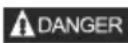
Indicates a hazardous situation which, if not avoided, will result in death or serious injury
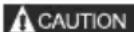
Indicates a hazardous situation which, if not avoided, could result in death or serious injury
Indicates a hazardous situation which, if not avoided, could result in minor or moderate injury.

Prohibition symbols
The symbols indicate prohibited matters, and those behaviors are forbidden. Non-compliance with the instructions may result in product damages or endanger the personal safety of users.

Warning symbols
The symbols indicate matters that must be followed, and those behaviors must be strictly executed in line with the operation requirements. Non-compliance with the instructions may result in product damages or endanger the personal safety of users.

Note symbols
The symbols indicate matters to pay attention to, and these behaviors shall be specially noted. Due precautions are needed or minor or moderate injuries or damages of the product will be caused.
WARNING
--- Keep ventilation openings, in the appliance enclosure or in the built-in structure, clear of obstruction.
--- Do not use mechanical devices or other means to accelerate the defrosting process, other than those recommended by the manufacturer.
--- Do not damage the refrigerant circuit.
--- Do not use electrical appliances inside the food storage compartments of the appliance, unless they are of the type recommended by the manufacturer.
--- The appliance has to be unplugged after use and before carrying out user maintenance on the appliance.
--- This appliance is not intended for use by persons (including children) with reduced physical, sensory or mental capabilities, or lack of experience and knowledge, unless they have been given supervision or instruction concerning use of the appliance by a person responsible for their safety.
--- Children should be supervised to ensure that they do not play with the appliance.
--- If the supply cord is damaged, it must be replaced by the manufacturer, its service agent or similarly qualified persons in order to avoid a hazard.
--- Please abandon the refrigerator according to local regulators for it use flammable blowing gas and refrigerant.
--- Please according to local regulations regarding disposal of the appliance for its flammable refrigerant and blowing gas. Before you scrap the appliance, please take off the doors to prevent children trapped.
--- This appliance is intended to be used in household and similar applications such as
-Staff kitchen areas in shops, offices and other working environments;
-farm houses and by clients in hotels, motels and other residential type environments;
-bed and breakfast type environments;
-catering and similar non-retail applications.
--- Do not store explosive substances such as aerosol cans with a flammable propellant in this appliance.
Safety warnings
This chapter describes the important security matters to prevent users from injury or property damage. Please understand fully the followingtext (logo, icon) and comply with the safety warnings.
Electricity related warnings
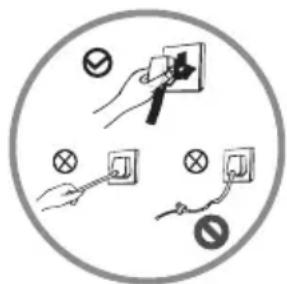
- Do not pull the power cord when pulling thepower plug of the refrigerator. Please firmlygrasp the plug and pull out it from the socket directly.
- Do not damage the power cord under any condition so as to ensure safety use, do not use when the power cord is damaged or the plug is worn.
- Worn or damaged power cord shall be replaced in manufacture-authorized maintenance stations.
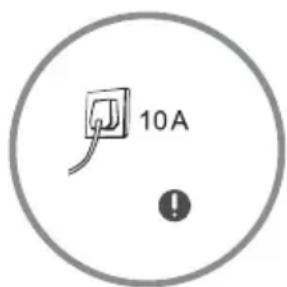
- Please use a dedicated three-hole power socket which is 10A or more and the power socket shall not be shared with other electrical appliances.
- The power cord should be firmly contacted with the socket or else fires might be caused. Please ensure that the grounding electrode of the power socket is equipped with a reliable grounding line.
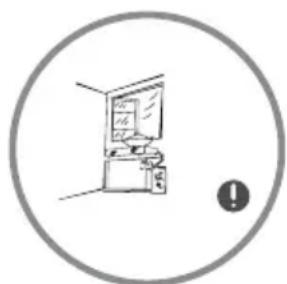
- The refrigerator adopts 220-240V/50Hz AC power, voltage fluctuations over the range of 220 - 240 ± 10% V will cause malfunction or even damage, so a 750 W automatic voltage regulator must be installed in concert with the AC power.
- Please turn off the valve of the leaking gas and then open the doors and windows in case of leakage of gas and other flammable gases. Do not unplug the refrigerator and other electrical appliances considering that spark may cause a fire.
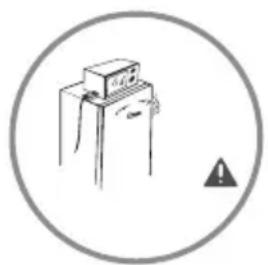
- To ensure safety, it is not recommended that to place regulators, rice cookers, microwave ovens and other appliances at the top of the refrigerator, those recommended by the manufacture are not included. Do not use electrical appliances in the food pantry.
Safety warnings
This chapter describes the important security matters to prevent users from injury or property damage. Please understand fully the followingtext (logo, icon) and comply with the safety warnings.
Related warnings for use
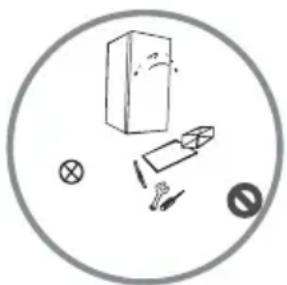
- Authorized demolition or renovation of the refrigerator is not prohibited. It is forbidden to damage the refrigerant lines and the repair and maintenance of the refrigerator must be carried out by professionals.
- Damaged power cord must be replaced by the manufacturer, its maintenance department or related professionals in order to avoid danger.
- The surrounding of the appliances around or the embedded structure shall not be obstructed while good ventilation shall be maintained.
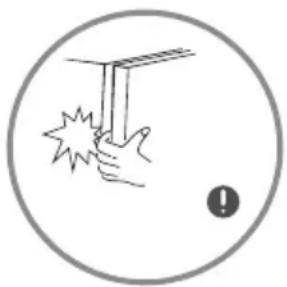
- The gaps between refrigerator doors and between doors and refrigerator body are small, be noted not to put your hand in these areas to prevent squeezing the finger. Please be gentle when switching off the refrigerator door to avoid falling articles.
- Do not pick foods or containers in the freezing chamber when the refrigerator is running, especially metal containers in order to avoid frostbite.
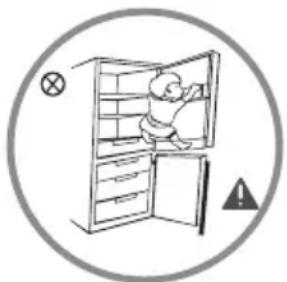
- Do not allow children to enter or climb the refrigerator to prevent that children are sealed in the refrigerator or children are injured by the falling refrigerator.
- Do not spray or wash the refrigerator; do not put the refrigerator in moist places easy to be splashed with water so as not to affect the electrical insulation properties of the refrigerator.

- Do not place heavy objects on the top of the refrigerator considering that objectives may fall when switching the door, and accidental injuries might be caused.
- Please pull of the plug in case of power failure or cleaning. Do not connect the freezer to power supply within five minutes to prevent damages to the compressor due to successive starts.
Safety warnings
This chapter describes the important security matters to prevent users from injury or property damage. Please understand fully the followingtext (logo, icon) and comply with the safety warnings.
Warnings related to placing items

- Do not put flammable, explosive, volatile and highly corrosive items in the refrigerator to prevent damages to the product or fire accidents.
- Do not place flammable items near the refrigerator to avoid fires.
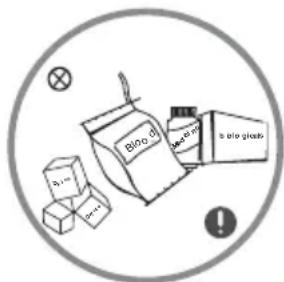
- This product is household refrigerators and shall be only suitable for the storage of foods. According to national standards, household refrigerators shall not be used for other purposes, such as storage of blood, drugs or biological products.
- Do not store or place dry ice in the refrigerator.
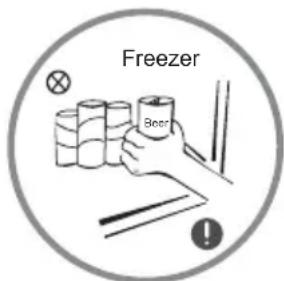
- Do not place items such as bottled or sealed container of fluid such as bottled beers and beverages in the freezer to prevent bursts and other losses.
Warnings related to disposal

The refrigerator's R600a refrigerant and cyclopentane foam materials are combustible materials and discarded refrigerators should be isolated from fire sources and can not be burned. Please transfer the freezer to qualified professional recycling companies for processing to avoid damages to the environment or other hazards.

Please remove the door of the refrigerator and shelves which shall be properly placed to avoid accidents of children entering and playing in the refrigerator.
Installation Instruction
Placement Start
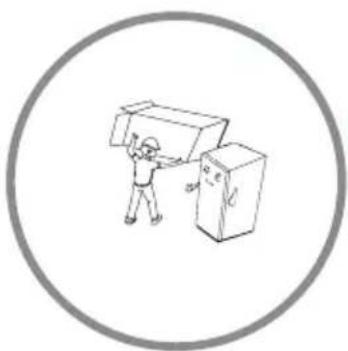
Placement
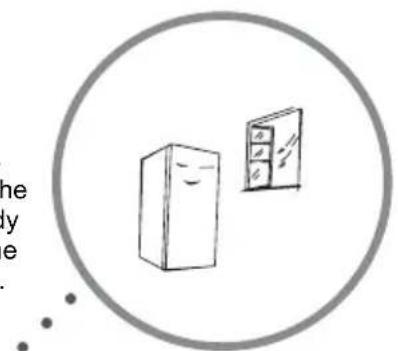
The refrigerator is placed in a well-ventilated indoor place; the ground shall be flat, and sturdy (rotate left or right to adjust the wheel for leveling if unstable).
Before using the refrigerator, remove all packaging materials including bottom cushions and foam pads and tapes inside the refrigerator, tear off the protective film on the door and the refrigerator body.
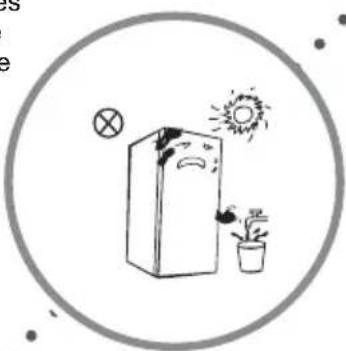
Keep away from heat and avoid direct sunlight. Do not place the freezer in moist or watery places to prevent rust or reduction of insulating effect.
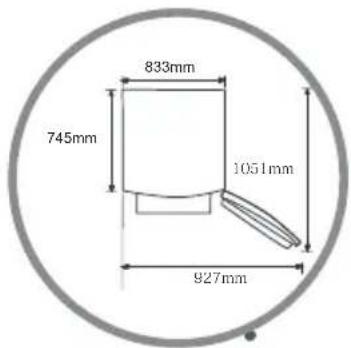
Please leave enough space to ensure feasible opening and drawer removal. Dimensions shown are for reference only.
Start
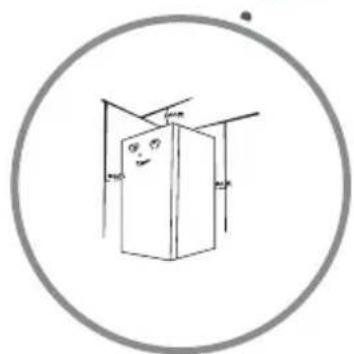
The top space of the refrigerator shall be greater than 30cm and the distances from both sides and backside shall be more than 10cm to facilitate the opening and closing and heat dissipation. Wipe the refrigerator inside and outside with warm moist rag (add a small amount of detergent in the warm water and wipe clean finally with clean water).
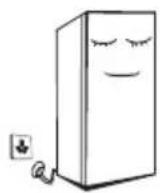
The refrigerator shall stay for half an hour before connecting 220-240V/50Hz power when it is firstly started. The refrigerator shall run 2 to 3 hours before loading fresh or frozen foods; the refrigerator shall run for more than 4 hours in summer in advance considering that the ambient temperature is high.
Human-Machine Interface and Button Operation
Display screen
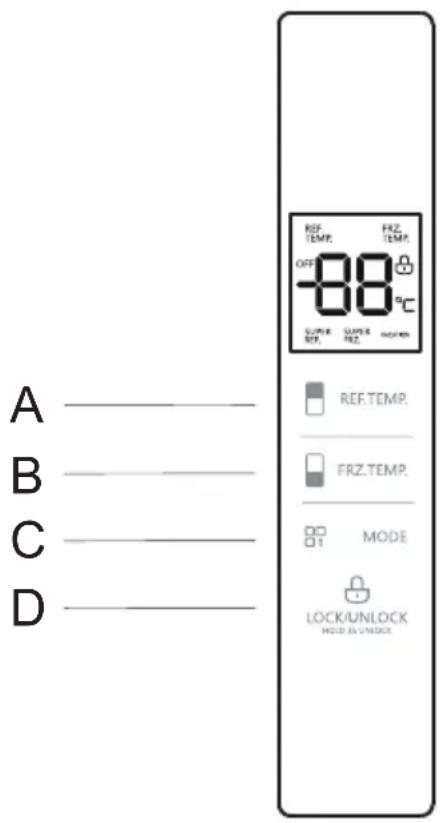
Keys
A.REF. TEMP
B.FRZ.TEMP
C.MODE
D.LOCK/UNLOCK
Display
For the first power-on, the full display lasts 3s while the start-up tone rings; then, the panel displays normally (The setting temperature of refrigerating chamber and freezing chamber is 5^ and -18^ , respectively, upon the first power-on).
Display of normal running
Display a fault code (loop display) when a failure occurs; display the setting temperature of refrigerating chamber when no failure occurs;
Display control
In normal cases, the display screen will display LOCK without door opening and key operations for 30s, and then die out after 30s under the locking state; when the display screen is off, it will light up normally with key operations; when a failure to the category of "Visible Fault Code", the display screen turns on and then dies out after 30s;
Lock/Unlock
Hold the key "LOCK/UNLOCK" for 2s under the unlocking state, the system enters the locking state and gives a buzzing sound of locking.
Hold the key "LOCK/UNLOCK" for 2s under the locking state, the system enters the unlocking state and gives a buzzing sound of unlocking.
The system enters the locking state automatically without any key operation for 30s.
Except that door opening alarm and fault alarm can be relieved under the locking state as well, the following key operations must be operated under the unlocking state. For any operation under the locking state, a buzzing sound of wrong operation will ring.
Settings of refrigerating chamber
Temperature setting of refrigerating chamber
Press the key REF. TEMP to select the area of refrigerating temperature and then press the key REF. TEMP to adjust the temperature of refrigerating chamber; the temperature drops 1^ for pressing the key REF. TEMP once; press the key REF. TEMP again after the temperature reaches 2^ , the refrigerating chamber is set to 8^ . The temperature setting of refrigerating chamber varies between 2 8^ , which will be effective upon locking.
Settings of freezing chamber
Temperature setting of freezing chamber
Press the key FRZ.temp to select the freezing temperature area and then press the key FRZ.temp to adjust the temperature of freezing chamber; the temperature drops 1^ for pressing the key FRZ.temp once; press the key FRZ.temp again after the temperature reaches -24^ , the freezing chamber is set to -16^ and the temperature setting varies between -24 -16^ , which will be effective upon locking.
Mode setting
Press the key "MODE", the corresponding modes will be circulated as below: When the refrigerating chamber is on, cycle settings SUPER COOL SUPER FRZ SUPER COOL/SUPER FRZ VACATION NONE SUPER COOL... When the refrigerating chamber is off, cycle settings SUPER FRZ VACATION NONE SUPER FRZ...
Under the SUPER COOL mode, the refrigerating chamber defaults to 2^ automatically; upon exiting the SUPER COOL mode, the setting temperature of refrigerating chamber will restore to that before the SUPER COOL mode. Under the SUPER FRZ mode, the freezing chamber defaults to -24^ automatically; upon exiting the SUPER FRZ mode, the setting temperature of freezing chamber will restore to that before the SUPER FRZ mode. Under the VACATION mode, the refrigerating chamber defaults to closed while the freezing chamber defaults to -18^ automatically;
Upon exiting the VACATION mode, the setting temperature of refrigerating chamber and freezing chamber will both be restored to those before the VACATION mode.
List of Fault Codes
| Error Code | Description |
| E1 | Temperature sensor failure of refrigerating chamber |
| E2 | Temperature sensor failure of freezing chamber |
| E4 | Failure of defrosting sensor in refrigerating chamber |
| E5 | Failure of freezing & defrosting sensor |
| E6 | Communication Failure |
| E7 | Failure of circulating temperature |
| EH | Humidity sensor failure |
Refrigerator Features
Names of components
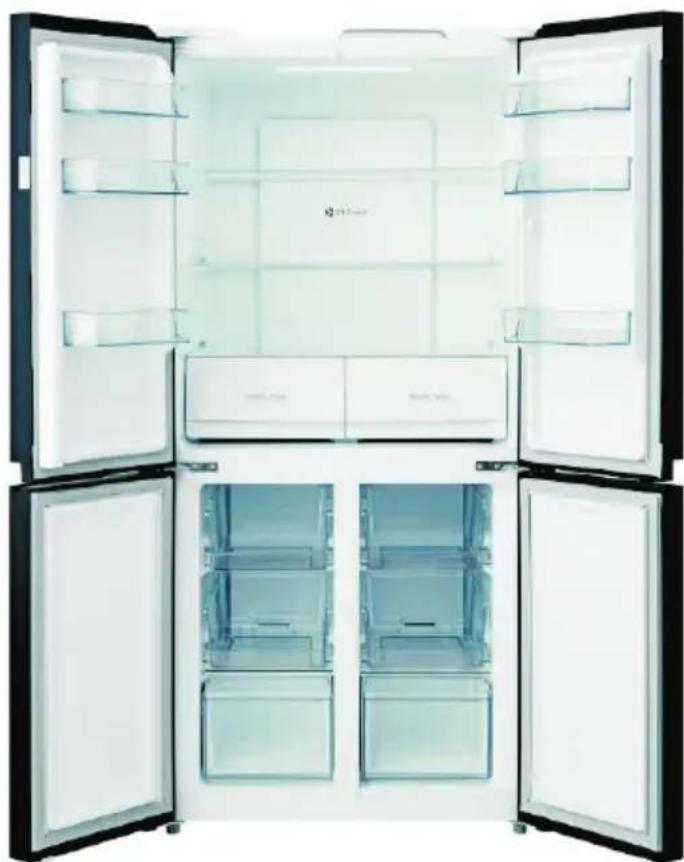
Refrigerating chamber
1.The RefsigntabtenlpCstamrager of a variety of fruits,
vegetables, beverages and other food consumed in the short term.
2. Cooking foods shall not be put in the refrigerating chamber until cooled to room temperature.
3.Foods are recommended to be sealed up before putting into the refrigerator. The glass shelves can be adjusted up or down for a reasonable amount of storage space and easy use.
Freezing chamber
- The low temperature freezing chamber may keep food fresh for a long time and it is mainly used to store frozen foods and making ice.
- The freezing chamber is suitable for storage of meat, fish, rice balls and other foods not to be consumed in short term.
3.Chunks of meat are preferably to be divided into small pieces for easy access. Please be noted food shall be consumed within the shelf time.
Maintenance of refrigerators
Cleaning
- Dusts behind the refrigerator and on the ground shall be timely cleaned to improve the cooling effect and energy saving. The interior of the refrigerator should be cleaned regularly to avoid odor. Soft towels or sponge dipped in water and non-corrosive neutral detergents are suggested for cleaning. The freezer of shall be finally cleaned with clean water and dry cloth. Open the door for natural drying before the power is turned on.
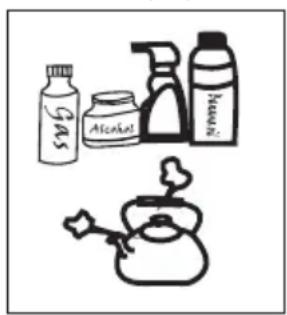
- Do not use hard brushes, clean steel balls, wire brushes, abrasives, such as toothpastes, organic solvents (such as alcohol, acetone, banana oil, etc.), boiling water, acid or alkaline items clean refrigerator considering that this may damage the fridge surface and interior.
- Do not rinse with water so as not to affect the electrical insulation properties. Please use a dry cloth when cleaning lighting lamps, temperature control knob and electrical components.
Please unplug the refrigerator for defrost and cleaning.
Defrost
- Defrost the freezing compartment whenever the layer of frost on the surface of the evaporator reaches 3 or 4mm . When defrosting remove all food and set the thermostat at "OFF" position. Put the drip tray under the evaporator to collect melted water. After the frost has melted, discard the melted water and dry up the interior of refrigerator. The refrigerator can then be restarted by turning its thermostat to the desired setting.
Do not use metal utensils or electric heater for defrost so as not to damage the appliance. Please remove the food and put in a cool place when defrosting before removing drawers and other accessories.
Stop using
Foods can be preserved for a couple of hours even in summer in case of power failure; it is recommended to reduce the frequency of opening door and do not put fresh foods into the freezer.
Please unplug the refrigerator left unused for a long time for cleaning. Keep the door open to avoid the bad odor.
Before moving the refrigerator, please remove all items in the refrigerator and fasten the glass partitions, fruit and vegetable boxes, freezer drawers with taps lest the door opens during displacement; Do not turn upside, horizontally place or vibrate the refrigerator, the carrying angle can not be greater than 45^ .
Continuous operation is recommended when the refrigerator is started. Please do not move the refrigerator under normal circumstances so as not to affect the refrigerator's service life.
Frequently asked questions
The following simple issues can be handled by the user. Please call the after-sale service department if the issues are not settled.
| Inoperation | Whether the freezer is plugged and connected to power; Low voltage; Failure power or tripping circuit |
| Odor | Odorous foods should closely wrapped; Whether foods are rotten; Whether the interior shall be cleaned. |
| Foods in the refrigerating chamber are frozen | Whether the thermostat is over adjusted; Whether foods containing water is put in inside the glass partition. |
| Long-term operation of compressor | It is normal that refrigerator operates for longer time in summer when the ambient temperature is higher; Do not put too much food in the freezer at one time; Do not put foods until they are cooled; Frequent opening of refrigerator door. Thick frost layer (defrost is needed) |
| The refrigerator door can not be properly closed. | The freezer door is stuck by food packages; Too much food; Tilt refrigerator. |
| Loud noises | Whether the food is leveled, whether the refrigerator is balanced; Whether the refrigerator parts are properly placed. |
Warm tips:
The refrigerator enclosure may emit heat during operation specially in summer, this is caused by the radiation of the condenser, and it is a normal phenomenon.
Condensation: condensation phenomenon will be detected on the exterior surface and door seals of the freezer when the ambient humidity is large, this is a normal phenomenon, and the condensation can be wiped away with a dry towel.
Airflow sound: Refrigerants circulating in the refrigerant lines will produce eruption of sound and grunts which is normal does not affect the cooling effect.
Buzz: Buzz will be generated by running compressor specially when starting up or shutting down.
Clatter: The solenoid valve or electric switch valve will clatter which is a normal phenomenon and does not affect the operation.
The refrigerating chamber will periodically frost and defrost (water drops will be generated on the backside of the refrigerating chamber when defrosting) which are normal.

Limit.
Handleiding
KOEL-VRIESCOMBINATIE
Model: LIVDK485