MDRIF230RK - Earphones SONY - Free user manual and instructions
Find the device manual for free MDRIF230RK SONY in PDF.


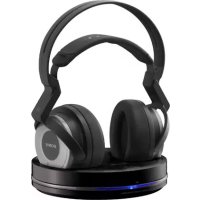
| Product type | Infrared wireless stereo headphones |
| Brand | Sony |
| Model | MDR-IF230RK |
| Transmitter dimensions | 152 × 40 × 72 mm (l/h/p) |
| Headphone weight | 180 g (with battery) |
| Headphone power supply | Provided rechargeable Ni-Cd NC-AA(HJ) battery or R6 (AA) 1.5V battery |
| Transmitter power supply | AC adapter (120 V or 220-230 V depending on country) |
| Battery life (charged battery) | Approximately 30 hours |
| Battery life (alkaline battery) | Approximately 100 hours |
| Charging time | 24 hours for full charge |
| Frequency response | 18 - 22,000 Hz |
| Modulation system | Frequency modulation (FM) |
| Carrier frequencies | Right: 2.8 MHz / Left: 2.3 MHz |
| Infrared range | Up to 7 m (23 ft) with 45° angle |
| Special features | Automatic power on/off, self-adjusting headband, auto mute |
| Maintenance | Clean with a dry cloth; replace earpads if worn |
| Safety | Do not expose to moisture; avoid high volume to prevent hearing damage |
| Spare parts | Earpads (contact Sony dealer), rechargeable battery NC-AA(HJ) |
| Repairability | Have servicing done by qualified personnel; do not open the case |
Frequently Asked Questions - MDRIF230RK SONY
User questions about MDRIF230RK SONY
0 question about this device. Answer the ones you know or ask your own.
Ask a new question about this device
Download the instructions for your Earphones in PDF format for free! Find your manual MDRIF230RK - SONY and take your electronic device back in hand. On this page are published all the documents necessary for the use of your device. MDRIF230RK by SONY.
USER MANUAL MDRIF230RK SONY
Cordless Stereo Headphone System
Operating Instructions page 2 ____
To avoid electrical shock, do not open the cabinet. Refer servicing to qualified personnel only.
WARNING
You are cautioned that any changes or modifications not expressly approved in this manual could void your authority to operate this equipment.
Owner's Record
The model number is located on the top of the transmitter and on the headphones housing.
The serial number is located at the bottom of the transmitter and the inner side of the headband.
Record these numbers in the spaces provided below. Refer to them whenever you call upon your Sony dealer regarding this product.
Model No. MDR-IF230RK
Transmitter TMR-IF230R
Headphones MDR-IF230
Serial No.
Transmitter
Headphones ____
For the customers in the USA and Canada
RECYCLING NICKEL-CADMIUM
BATTERIES

Ni-Cd
NICKEL-CADMIUM BATTERY. BATTERY MUST BE RECYCLED OR DISPOSED OF PROPERLY.
Nickel-Cadmium batteries are recyclable. You can help preserve our environment by returning your unwanted batteries to your nearest Sony Service Center or Factory Service Center for collection, recycling or proper disposal.
Note:
In some areas the disposal of nickel-cadmium batteries in household or business trash may be prohibited.
For the Sony Service Center nearest you call 1-800-222-SONY (United States only)
For the Factory Service Center nearest you call 416-499-SONY (Canada only)
Caution:
Do not handle damaged or leaking nickel-cadmium batteries.
Welcome!
Thank you for purchasing the Sony MDR-IF230RK Cordless Stereo Headphone System. Before operating the unit, please read this manual thoroughly and retain it for future reference.
Some features are:
- Cordless system that allows you to listen to a program free from the restriction of a cord.
- Broad horizontal listening area that gives you superb sound virtually anywhere in the room.
- Self-adjusting headband for fitting your head perfectly.
- The power of the headphones turns on and off automatically every time you put the headphones on and off (Auto power on/off function).
- The VOL control adjusts the volume level of both channels.
- The power source of the headphones can be selected from either a supplied rechargeable battery or a commercially available R6 (size AA) dry battery.
Table of contents
Getting started
Unpacking 4
Setting up the transmitter 4
Charging the rechargeable battery 6
Setting up the headphones .... 7
Operating the system
Listening to a program 8
About the infrared rays communication 9
Replacing the ear pads 9
Additional information
Precautions ......10
Troubleshooting ....11
Specifications ......12
Unpacking
Check that you have the following items:
- Transmitter
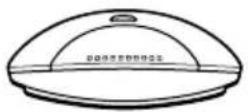
TMR-IF230R
- AC power adaptor
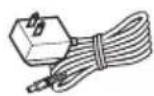
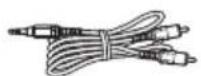
- Connecting cord (phono plugs stereo mini plug)
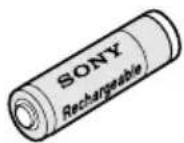
- Ni-Cd Rechargeable battery NC-AA (HJ)
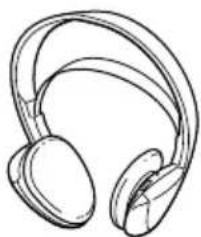
- Headphones
natural_image
Line drawing of an ear with earbuds and a curved headband (no text or symbols)MDR-IF230
Setting up the transmitter
1 Connect the transmitter to audio/video equipment.
①When connecting to your audio/video system's LINE OUT or REC OUT jacks, connect the cord to the transmitter's LINE IN jack only.
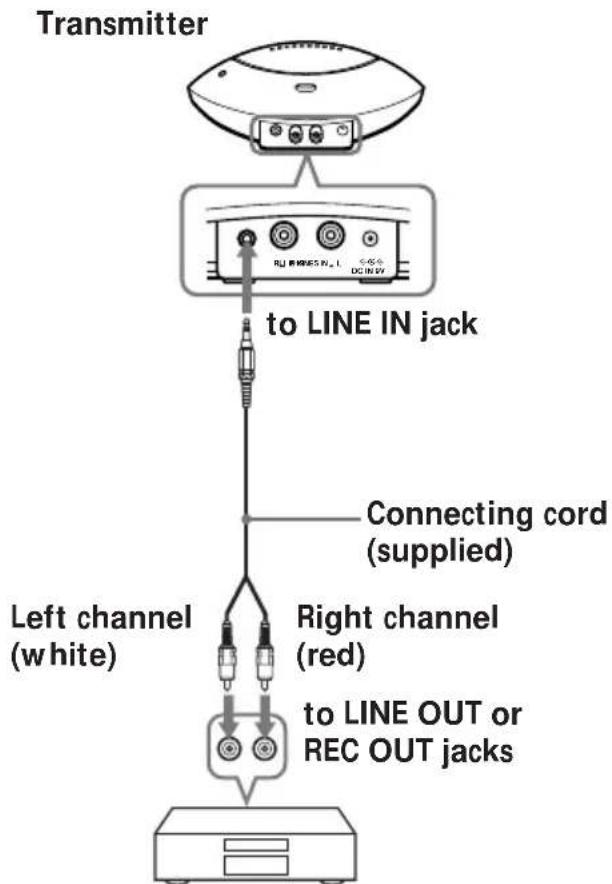
Stereo system, TV, VCR, etc.
Note
If your audio/video equipment has a stereo mini jack(LINE OUT), connect the stereo mini jack(LINE OUT) to LINE IN of the transmitter by using optional connecting cord RK-G136HG. Connecting the LINE OUT jack of your audio/video equipment to PHONES IN of the transmitter will cause low or muffled sound. To connect to PHONES IN of the transmitter with the supplied cord, use a headphones jack on the audio/video equipment.
⑥When connecting to your Discman's headphones jack, connect the cord to the transmitter's PHONES IN jack only.
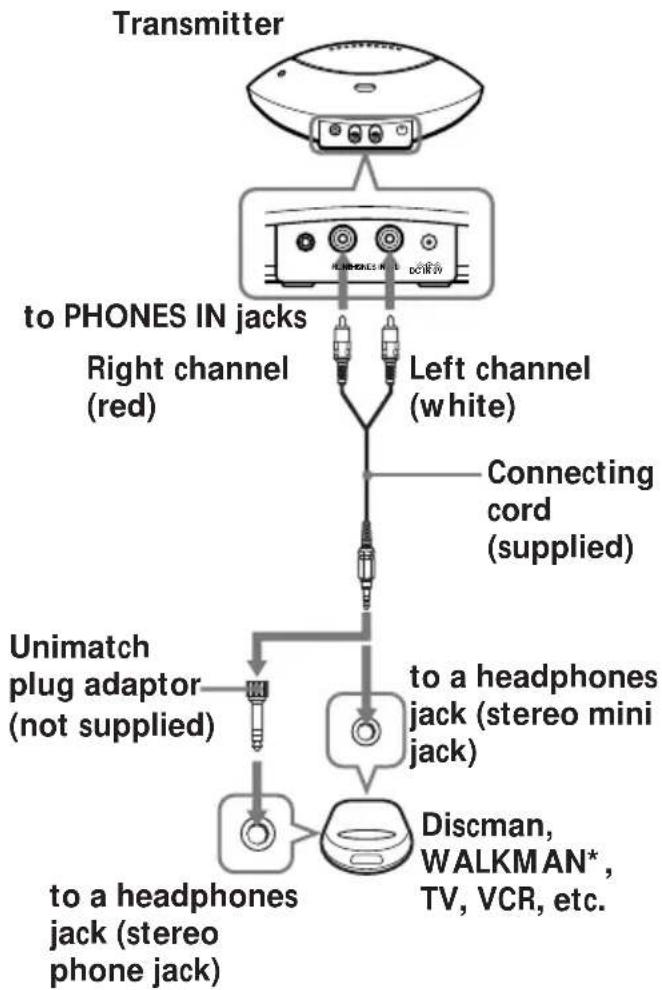
flowchart
graph TD
    A["Transmitter"] --> B["to PHONES IN jacks"]
    B --> C["Right channel (red)"]
    B --> D["Left channel (white)"]
    B --> E["Connecting cord (supplied)"]
    E --> F["to a headphones jack (stereo mini jack)"]
    F --> G["Discman, WALKMAN*, TV, VCR, etc."]
    F --> H["to a headphones jack (stereo phone jack)"]
    H --> I["Unimatch plug adaptor (not supplied)"]
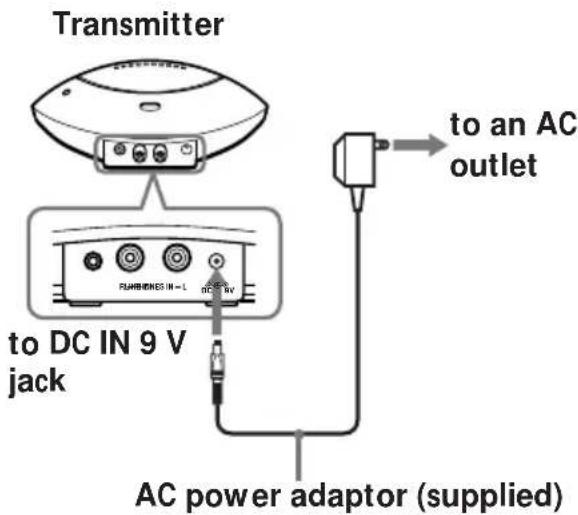
2 Connect the transmitter to a power source.
Notes
- Do not connect to the PHONES IN jacks and LINE IN jack at the same time. If you do so, the audio signals may be mixed.
- Use only the supplied AC power adaptor. Do not use any other AC power adaptor.
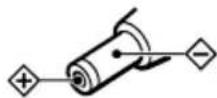
Polarity of the plug
- When you connect the connecting cord directly to an earphone jack, the audio signal will not be output through the right channel. In such a case, use the separately sold PC-236HG plug adaptor.
* WALKMAN is a registered trademark of Sony Corporation.
Charging the rechargeable battery
The headphones are powered by a rechargeable battery NC-AA (HJ) (supplied) or a dry cell battery (not supplied). Charge the rechargeable battery before use. NC-AA (HJ) is applicable only for Sony cordless/wireless headphone systems. Never use for any other purpose.
1 Check that the transmitter power is off.
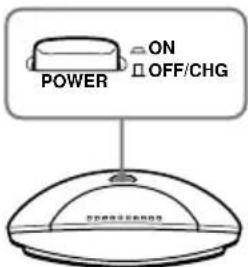
2 Open the battery charger lid on the transmitter.
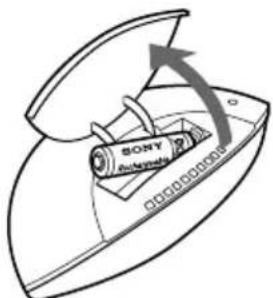
3 Insert the supplied rechargeable battery NC-AA (HJ), making sure to match battery polarity with the ⊕ and ● marks on the charger case. The CHARGE indicator then lights up and charging starts.
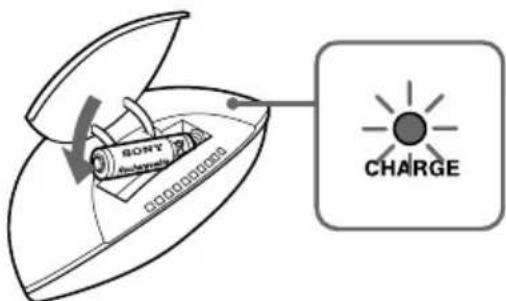
4 Close the battery charger lid on the transmitter.
Charging time and battery life
About 24 hours is required to fully charge the rechargeable battery. Once fully charged, the battery provides about 30 hours of operation.
One hour charging of the rechargeable battery enables about 1 hours and 30 minutes of operation.
Notes
- This system is designed to charge only the supplied rechargeable battery for safety. This system cannot charge other batteries even if they have the same shape.
- Since little electric current is used for charging, there is no need to worry about overcharging.
- As this system is not affected by the memory effect of the Ni-Cd battery, recharging the supplied battery before it is completely discharged is not a problem.
- When the transmitter power is turned on, the battery charger does not operate.
When to recharge the battery
Recharge the supplied battery when the POWER indicator on headphones dims, and hissing or noise occurs. If the POWER indicator dims even after full charging, the battery is completely dead. To purchase a new rechargeable battery, consult your nearest Sony dealer.
Setting up the headphones
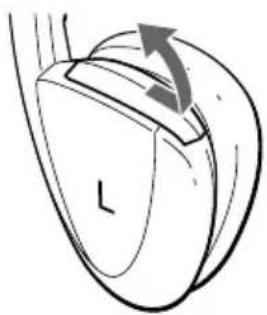
1 Open the battery compartment lid on top of the left housing.
natural_image
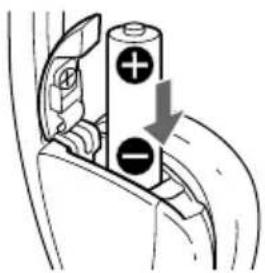
Simple line drawing of a curved mechanical component with an arrow indicating rotation (no text or symbols)2 Insert the supplied rechargeable battery NC-AA (HJ) by matching the ⊕ on the battery to the ⊕ terminal on the lid. Make sure that the battery is charged.
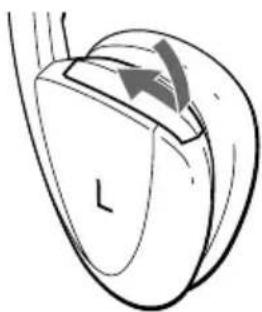
3 Close the battery compartment lid.
natural_image
Simple line drawing of a curved object with an arrow and label 'L' (no text or symbols beyond the label)Removing the battery
Open the battery compartment lid, while keeping the housing level and remove the battery from the battery compartment as illustrated below.
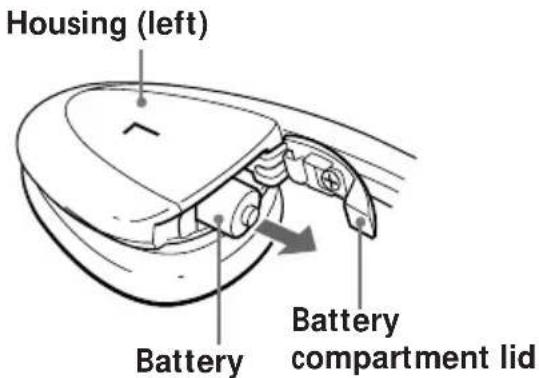
Using a dry cell battery
Insert the dry cell battery into the headphone battery compartment in the same way as when inserting the rechargeable battery.
Battery life
| Battery | Approx. hours |
| Sony alkaline battery LR6/AM3 (N) | 100 |
| Sony battery R6P/SUM-3 (NS) | 50 |
When to replace the battery
Replace the battery with a new one when the POWER indicator on the headphones dims, and a hissing noise increases.
Listening to a program
1 Turn on the audio/video equipment connected to the transmitter.
2 Turn on the transmitter. The infrared emitters light up.
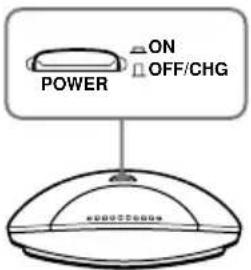
3 Put on the headphones and the power turns on automatically. The power indicator glows red when the power turns on.

natural_image
Line drawing of a person wearing headphones (no text or symbols)4 Adjust the volume.
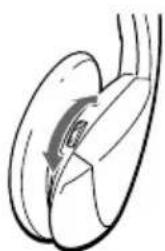
natural_image
Diagram of a mechanical or fluidic component with internal flow arrows (no text or symbols)Auto power on/off function
When you remove the headphones, the power turns off automatically. Do not pull up the self adjusting band when not using the headphones, otherwise the headphones will be switched on.
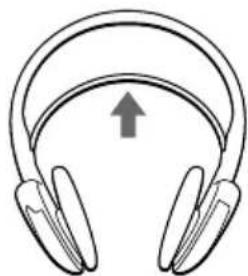
natural_image
Illustration of a pair of headphones with an upward arrow indicating growth (no text or symbols)Mute function
If a hissing noise is heard when the infrared rays are obstructed, or the headphones are used outside of the effective range (see "About the infrared rays communication"), the mute function will be activated and the sound will not be heard from the headphones. To restore the sound, move nearer toward the transmitter or remove the obstruction.
After listening to a program
Take the headphones off before turning off the transmitter. Otherwise you may hear some noise when the infrared rays are suddenly cut off.
Note
The infrared emitters light up when the transmitter is turned on. The brightness of the emitters may not be uniform, however, this is not a malfunction.
About the infrared rays communication
The illustration below shows the approximate area covered by the infrared rays emitted from the transmitter.
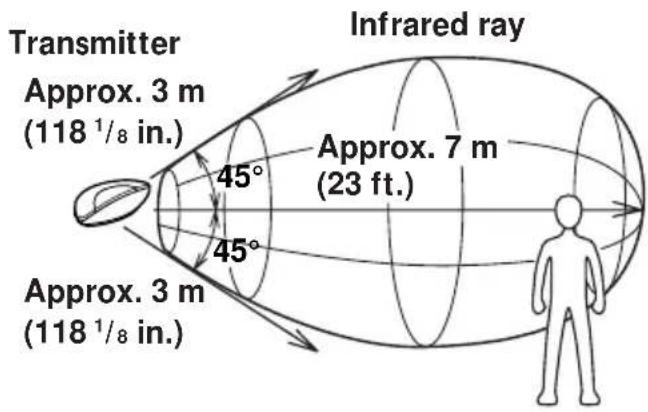
Notes
- If you use the headphones at too great a distance from the transmitter, you may hear a hissing noise and if there is an object between the receiver and the transmitter, the sound may be interrupted. These phenomena are inherent to infrared ray communication and do not mean that there is a problem with the unit itself.
- The infrared rays will not penetrate walls or opaque glass, therefore, be sure to stay within sight of the transmitter.
- When you use the headphones inside the area illustrated in the diagram, the transmitter can be placed in the front, behind or by the side of the listener.
• The sound you hear varies according to your position and the transmitter position. Try finding a position which yields the best sound.
Replacing the Ear Pads
When the ear pads become dirty or damaged, consult your nearest Sony dealer and replace them as illustrated below.
Remove the old ear pad by pulling it out.
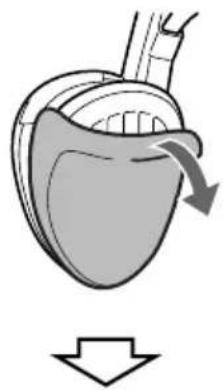
natural_image
Diagram of a heart valve with directional arrow indicating movement (no text or labels)Place the new ear pad around the driver unit as illustrated.
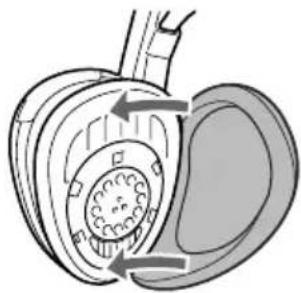
natural_image
Cross-sectional diagram of a human stomach showing internal organs and fluid flow arrows (no text or labels)Precautions
- Before operating the system, check that the operating voltage of your system is identical with the voltage of your local power supply.
- The CE mark on the unit is valid only for products marketed in the European Union.
- When the headphones is not to be used for a long period of time, remove the battery to avoid damage caused by battery leakage and subsequent corrosion.
- When the transmitter is not to be used for a long period of time, disconnect the AC power adaptor from the AC outlet holding the plug. Do not pull on the cord.
- Do not leave the cordless stereo headphone system in a location subject to direct sunlight, heat or moisture.
Notes on headphones Preventing hearing damage
Avoid using headphones at high volume. Hearing experts advise against continuous, loud and extended play. If you experience a ringing in your ears, reduce the volume or discontinue use.
Caring for others
Keep the volume at a moderate level. This will allow you to hear outside sounds and to be considerate to the people around you.
If you have any questions or problems concerning the system that are not covered in this manual, please consult the nearest Sony dealer.
Be sure to bring the headphones and the transmitter to the Sony dealer when requiring repair work.
Troubleshooting
No sound/Muffled sound
→Turn on the transmitter and the headphones first, then put on the headphones.
→Check the connection of the audio/video equipment or the AC power adaptor.
→Check that the audio/video equipment is turned on.
→Turn up the volume on the connected audio/video equipment, if the transmitter is connected to the headphones jack. (Around level 5 or 6 on the volume control should be appropriate.)
→The mute function is activated.
- Check if there is any object between the transmitter and the headphones.
- Use the headphones near the transmitter.
- Change the position and angle of the transmitter.
→ The headphones' power indicator light is weak or turned off.
- Charge the rechargeable battery because the headphones' battery is weak, or if the power indicator is still off after charging the battery, take the headphones to a Sony dealer for a replacement of the rechargeable battery.
- If you are using the conventional dry battery, replace it with a new one.
When the LINE OUT jack of your audio/video equipment is connected to PHONES IN jack of the transmitter, the sound will be low. Connect the LINE OUT jack to the LINE IN jack as described in “Setting up the transmitter”.
Distortion
→If the transmitter is connected to the headphones jack, turn down the volume of the connected audio/video equipment. (Around level 5 or 6 on the volume control should be appropriate.)
→ The headphones' power indicator light is weak or turned off.
- Charge the rechargeable battery because the headphones' battery is weak, or if the power indicator is still off after charging the battery, take the headphones to a Sony dealer for a replacement of the rechargeable battery.
- If you are using the conventional dry battery, replace it with a new one.
When the headphone's jack output is connected to the LINE IN jack of the transmitter, increasing the volume of the connected audio/video equipment may cause distortion. Connect the headphones jack output instead to PHONES IN jack as described in "Setting up the transmitter".
Loud background noise
→Move closer to the transmitter. As you move away from the transmitter, more noise is likely to be heard. This is inherent to infrared ray communication and does not mean that there is a problem with the unit itself.
→Check that there is no object between the transmitter and the headphones.
→Check that the infrared sensors are not covered with your hands or hair.
→Change the position or angle of the transmitter.
- The headphones are used by a window where the sunlight is too strong.
→Draw the curtains/blind to shut out the direct sunlight, or use the headphones away form the sunlight.
→If the transmitter is connected to the headphones jack, turn up the volume of the connected audio/video equipment. (Around level 5 or 6 on the volume control should be appropriate.)
→ The headphones' power indicator light is weak or turned off.
- Charge the rechargeable battery because the headphones' battery is weak, or if the power indicator is still off after charging the battery, take the headphones to a Sony dealer for a replacement of the rechargeable battery.
- If you are using the conventional dry battery, replace it with a new one.
Specifications
General
Modulation system
Frequency modulation
Carrier frequency
Right 2.8 MHz
Left 2.3 MHz
Frequency response
18 - 22,000 Hz
Transmitter TMR-IF230R
Power source DC IN 9 V jack accepts power supplied from the AC power adaptor for use on the following voltages:
| Where purchased | Operating voltage |
| U.S.A./Canada | 120 V AC, 60 Hz |
| U.K. | 220 – 230 V AC, 50 Hz |
| European countries | 220 – 230 V AC, 50 Hz |
| Other countries | 220 – 230 V AC, 50/60 Hz or 120 V AC, 60 Hz |
| Japan (Except for Japanese domestic model) | 110 – 120 V/220 – 240 V AC, 50/60 Hz |
Audio input Phono jacks/stereo mini jack
Dimensions Approx. 152 · 40 · 72 mm
(6 · 1^1/2 · 2^3/4 in.) (w/h/d)
Mass Approx. 85 g (3.0 oz.)
Headphone MDR-IF230
Power source Supplied Ni-Cd rechargeable
battery NC-AA (HJ) or
DC 1.5 V, 1 · R6 (size AA)
battery
Mass Approx. 180 g (6.4 oz.) including
battery
Supplied Ni-Cd rechargeable battery
Model name NC-AA (HJ)
Type Ni-Cd
Voltage 1.2 V
Capacity 600 mAh
Optional accessories
Plug adaptor
PC-236HG
Design and specifications are subject to change without notice.
AVERTISSEMENT
natural_image
Line drawing of a pair of earphones (no text or symbols)MDR-IF230
natural_image
Simple line drawing of a curved mechanical component with an arrow indicating rotation (no text or symbols)natural_image
Diagram of a battery with positive and negative terminals, showing internal components and an arrow indicating direction (no text or symbols)natural_image
Diagram of a mechanical component with a curved surface and directional arrow, no text or symbols presentRetrait de la pile
natural_image
Line drawing of a person wearing headphones (no text or symbols)4 Réglez le volume.
natural_image
Diagram of a mechanical component with a central shaft and curved ends (no text or symbols)natural_image
Line drawing of a pair of headphones with an upward arrow indicating growth (no text or symbols)Silencieux
natural_image
Diagram of a human heart with a hand pulling a valve, showing internal organs and a curved arrow indicating rotation (no text or labels)
natural_image
Cross-sectional diagram of a human stomach showing internal organs and fluid flow arrows (no text or labels)Précautions
Poids Env. 85 g (3,0 on.)
Casque MDR-IF230
Pile rechargeable Ni-Cd fournie
Nom du modèle
NC-AA (HJ)
Type Ni-Cd
Tension 1,2 V
Capacité 600 mAh
Accessoires en option
Adaptateur de fiche
PC-236HG
(minijack stéréo ↔ minifiche mono)
PC-234HG
natural_image
Line drawing of a pair of earphones (no text or symbols)MDR-IF230
natural_image
Simple line drawing of a curved mechanical component with an arrow indicating rotation (no text or symbols)natural_image
Diagram of a battery holder with two labeled terminals and a downward arrow indicating a change (no text or symbols present)natural_image
Diagram of a curved mechanical component with an arrow indicating direction (no text or symbols)natural_image
Line drawing of a person wearing headphones (no text or symbols)natural_image
Diagram of a mechanical component with a central shaft and curved surfaces (no text or symbols)natural_image
Line drawing of a pair of headphones with an upward arrow indicating growth (no text or symbols)natural_image
Diagram of a human heart with a hand pulling a valve, showing internal organs and a curved arrow indicating rotation (no text or labels)
natural_image
Cross-sectional diagram of a human stomach showing internal organs and fluid flow arrows (no text or labels)Precauciones

- Cordless Stereo Headphone System
- WARNING
- Owner's Record
- Note:
- Caution:
- Welcome!
- Table of contents
- Getting started
- Operating the system
- Additional information
- Unpacking
- Setting up the transmitter
- Note
- Notes
- Polarity of the plug
- Charging the rechargeable battery
- Charging time and battery life
- When to recharge the battery
- Setting up the headphones
- Removing the battery
- Using a dry cell battery
- When to replace the battery
- Listening to a program
- Auto power on/off function
- Mute function
- After listening to a program
- About the infrared rays communication
- Replacing the Ear Pads
- Precautions
- Notes on headphones Preventing hearing damage
- Caring for others
- Troubleshooting
- No sound/Muffled sound
- Distortion
- Loud background noise
- Specifications
- General
- Transmitter TMR-IF230R
- Headphone MDR-IF230
- Supplied Ni-Cd rechargeable battery
- Optional accessories
- AVERTISSEMENT
- Retrait de la pile
- Silencieux
- Précautions
- Casque MDR-IF230
- Pile rechargeable Ni-Cd fournie
- Accessoires en option
- Precauciones
Brand : SONY
Model : MDRIF230RK
Category : Earphones