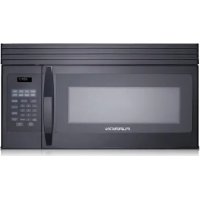
FMCM15BL - Microwave Oven Furrion - Free user manual and instructions
Find the device manual for free FMCM15BL Furrion in PDF.


| Product Type | Over The Range (OTR) Convection Microwave Oven |
| Brand | Furrion |
| Model | FMCM15BL |
| Capacity | 1.5 cu ft (42 L) |
| Dimensions (W×H×D) | 759.5 × 419.1 × 381 mm |
| Net Weight | 30.1 kg |
| Electrical Supply | 120 V ~ 60 Hz |
| Input Power (Microwave) | 1500 W |
| Output Power (Microwave) | 900 W |
| Output Power (Convection) | 1450 W |
| Turntable Diameter | 345 mm |
| Main Functions | Microwave, convection, combination cooking, defrost (by weight and time), reheat, auto cook (popcorn, potatoes, beverage), timer, control lock |
| Number of Power Levels | 10 (from 10% to 100%) |
| Convection Temperatures | 100 °C to 425 °C (selectable range) |
| EasySet Function | Quick cook for 1, 2, or 3 minutes at 100% power |
| Ventilation | Ventilation hood with 2 speeds + off |
| Surface Lighting | Replaceable 30 W bulbs |
| Oven Light | Replaceable 30 W bulb |
| Filters | Ventilation filters (cleanable) and charcoal filter (replaceable every 6 to 12 months) |
| Safety | Child safety lock, grounding, auto shut-off, arc protection |
| Maintenance | Clean with mild soap and damp cloth; turntable and support are dishwasher safe |
| Warranty | 1 year from purchase by the original end user |
| Included Accessories | Glass tray, metal rack for convection, air deflector, filters (×2), installation screws, instruction manual, warranty card |
Frequently Asked Questions - FMCM15BL Furrion
User questions about FMCM15BL Furrion
0 question about this device. Answer the ones you know or ask your own.
Ask a new question about this device
Download the instructions for your Microwave Oven in PDF format for free! Find your manual FMCM15BL - Furrion and take your electronic device back in hand. On this page are published all the documents necessary for the use of your device. FMCM15BL by Furrion.
USER MANUAL FMCM15BL Furrion
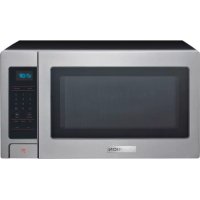
- Product picture is for reference only, please make the object as the standard.
Welcome
Thank you for purchasing this Furrion® 1.5 cu. ft. OTR Convection Microwave Oven. Before placing your new product into operation, please read these operating instructions carefully. They contain important information for safe use, installation and maintenance of the product. Please keep this instruction manual in a safe place for future reference. Pass it onto possible new owners of the product.
The manufacturer does not accept responsibility for any damages that may arise due to non-observation of these instructions.
If you have any further questions regarding our products, please contact us at support@furrion.com
Contents
Welcome 1
Contents 2
Important Safety Instructions 3
Safety Precautions 3
Grounding Instructions 4
Radio Interference 5
Precautions To Avoid Possible Exposure To Excessive Microwave Energy.....5
Utensils 6
Parts and Features 8
Microwave Oven 8
Control Panel and Features 9
Control Panel 9
Before Using 10
What's in Box 10
Learn more about your microwave oven 10
Microwave utensil guide 10
Operation 11
Setting the Clock. 11
Setting the timer 11
Control Lock. 11
Using the Stop/Cancel key. 11
Using the Start/+ 30SEC. key 11
Combination Cooking 17
Cookware Tips 19
Auto Cooking 21
Cooking Charts 22
Cooking Meat in Your Microwave 22
Cooking poultry in your microwave 22
22Cooking Eggs in Your Microwave 23
Cooking Vegetables in Your Microwave 23
Cooking Seafood in Your Microwave 23
Care and Maintenance 24
Cleaning suggestions 26
How to Clean the Inside 26
How to Clean the Outside 27
Specifications 28
Troubleshooting 29
Warranty. 30
Important Safety Instructions
Safety Precautions
WARNING: To reduce the risk of burns, electric shock, fire, injury to persons or exposure to excessive microwave energy.
When using electrical appliances basic safety precautions should be followed, including the following:
- Read all instructions before using the appliance.
- Read and follow the specific "Precautions To Avoid Possible Exposure To Excessive Microwave Energy" on page 5.
-
To reduce the risk of fire in the oven cavity:
-
Do not overcook food. Carefully attend the appliance when paper, plastic, or other combustible materials are placed inside the oven to facilitate cooking.
- Remove wire twist-ties and metal handles from paper or plastic containers/bags before placing them in the oven.
- If materials inside the oven ignite, keep the oven door closed. Turn the oven off, and unplug the appliance. Disconnect the power cord, shut off power at the fuse or circuit breaker panel.
-
Do not use the oven cavity for storage purposes. Do not leave paper products, cooking utensils, or food in the cavity when not in use.
-
This oven must be grounded. Connect only to properly grounded outlet. See "GROUNDING INSTRUCTIONS" found on page 4.
- Install or locate this oven only in accordance with the installation instructions provided.
-
Some products such as whole eggs and sealed containers-for example, closed glass jars-are able to explode and should not be heated in the oven.
-
Use this appliance only for its intended uses as described in this manual. Do not use corrosive chemicals or vapors in this appliance. This oven is specifically designed to heat or cook or dry food. It is not designed for industrial or laboratory use.
- As with any appliance, close supervision is necessary when used by children.
- Do not operate this oven if it has a damaged cord or plug, if it is not working properly or if it has been damaged or dropped.
-
Liquids, such as water, coffee, or tea are able to be overheated beyond the boiling point without appearing to be boiling. Visible bubbling or boiling when the container is removed from the microwave oven is not always present. THIS COULD RESULT IN VERY HOT LIQUIDS SUDDENLY BOILING OVER WHEN THE CONTAINER IS DISTURBED OR A SPOON OR OTHER UTENSIL IS INSERTED INTO THE LIQUID.
-
Do not overheat the liquid.
- Stir the liquid both before and halfway through heating it.
- Do not use straight-sided containers with narrow necks.
- After heating, allow the container to stand in the microwave oven for a short time before removing the container.
-
Use extreme care when inserting a spoon or other utensil into the container.
-
Do not cover or block any openings on the oven.
- Do not store or use this appliance outdoors.
- Do not use this oven near water, for example, near a kitchen sink, in a wet basement, near a swimming pool, or similar locations.
- Do not immerse cord or plug in water. Keep cord away from heated surface. Do
Important Safety Instructions
not let cord hang over edge of table or counter.
- This appliance should be serviced only by qualified service technicians. Contact the nearest authorized service facility for examination, repair or adjustment.
- When cleaning surfaces of door and oven that comes together on closing the door, use only mild, nonabrasive soaps or detergents applied with a sponge or soft cloth.
-
Ventilating Hoods
-
Clean Ventilating Hoods Frequently-Grease should not be allowed to accumulate on hood or filter.
-
When flaming foods under the hood, turn the fan on.
-
Use care when cleaning the vent-hood filter. Corrosive cleaning agents, such as lye-based oven cleaners, may damage the filter.
- Do not Operate any heating or cooking appliance beneath the appliance.
- Do not mount unit over or near any portion of heating or cooking appliance.
- Do not mount over sink.
- Do not store anything directly on top of the appliance surface when the appliance is in operation.
- Suitable for use above both gas and electric cooking equipment.
- As with most cooking appliances, close supervision is necessary to reduce the risk of a fire in the oven cavity.
Grounding Instructions
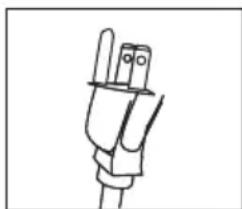
This appliance must be grounded. In the event of an electrical short circuit, grounding reduces the risk of electric shock by providing an escape wire for the electric current. This appliance is equipped with a cord having a grounding wire with a grounding plug. The plug must be plugged into an outlet that is properly installed and grounded.
Consult a qualified electrician or serviceman if the grounding instructions are not completely understood, or if doubt exists as to whether the appliance is properly grounded. If it is necessary to use an extension cord, use only a 3-wire extension cord that has a 3-blade grounded plug, and 3-slot receptacle that will accept the plug on the appliance.
The marked rating of the extension cord shall be equal to or greater than the electrical of the appliance.
DANGER: Electric Shock Hazard Touching some of the internal components can cause serious personal injury or death. Do not disassemble this appliance.
WARNING: Electric Shock Hazard Improper use of the grounding can result in electric shock. Do not plug into an outlet until appliance is properly installed and grounded.
Power Supply Cord
- A short power supply cord is provided to reduce the risks resulting from becoming entangled in or tripping over a longer cord.
- Longer cord sets or extension cords are available and may be used if care is exercised in their use.
- If a long cord or extension cord is used:
1) The marked electrical rating of the cord set or extension cord should be at least as great as the electrical rating of the appliance.
2] The extension cord must be a
grounding-type 3-wire cord.
3) The longer cord should be arranged so that it will not drape over the
counter top or tabletop where it can be pulled on by children or tripped over unintentionally.
Important Safety Instructions
NOTE:
- If you have any questions about the grounding or electrical instructions, consult a qualified electrician or service person.
- Neither Furrion nor the dealer can accept any liability for damage to the oven or personal injury resulting from failure to observe the electrical connection procedures.
Radio Interference
- Operation of the microwave oven may cause interference to your radio, TV or similar equipment.
- When there is interference, it may be reduced or eliminated by taking the following measures:
1) Clean door and sealing surface of the oven
2) Reorient the receiving antenna of radio or television.
3) Relocate the microwave oven with respect to the receiver.
4) Move the microwave oven away from the receiver.
5) Plug the microwave oven into a different outlet so that microwave oven is on different branch circuits.
Precautions To Avoid Possible Exposure To Excessive Microwave Energy
- Do not attempt to operate this oven with the door open since this can result in harmful exposure to microwave energy. It is important not to defeat or tamper with the safety interlocks.
- Do not place any object between the oven front face and the door or allow dirt or cleaner residue to accumulate on sealing surfaces.
- Do not operate the oven if it is damaged. It is particularly important that the oven door closes properly and that there is no damage to the:
(1)DOOR [bent]
(2) HINGES AND LATCHES (broken or loosened)
(3) DOOR SEALS AND SEALING SURFACE
- The oven should not be adjusted or repaired by anyone except properly qualified service personnel.
Save these instructions for future reference
Utensils
CAUTION
Personal Injury Hazard
Tightly-closed utensils could explode. Closed containers should be opened and plastic pouches should be pierced before cooking.
See the instructions on "Materials you can use in microwave oven or to be avoided in microwave oven."
There may be certain non-metallic utensils that are not safe to use for microwaving. If in doubt, you can test the utensil in question following the procedure below.
Utensil Test:
- Fill a microwave-safe container with 1 cup of cold water (250ml) along with the utensil in question.
- Cook on maximum power for 1 minute.
- Carefully feel the utensil. If the empty utensil is warm, do not use it for microwave cooking.
- Do not exceed 1 minute cooking time.
Materials you can use in microwave oven
| Utensils Remarks | |
| Aluminum foil | Shielding only. Small smooth pieces can be used to cover thin parts of meat or poultry to prevent overcooking. Arcing can occur if foil is too close to oven walls. The foil should be at least 1 inch (2.5cm) away from oven walls. |
| Browning dish | Follow manufacturer's instructions. The bottom of browning dish must be at least 3/16 inch (5mm) above the turntable. Incorrect usage may cause the turntable to break. |
| Dinnerware | Microwave-safe only. Follow manufacturer's instructions. Do not use cracked or chipped dishes. |
| Glass jars | Always remove lid. Use only to heat food until just warm. Most glass jars are not heat resistant and may break. |
| Glassware | Heat-resistant oven glassware only. Make sure there is no metallic trim. Do not use cracked or chipped dishes. |
| Oven cooking bags | Follow manufacturer's instructions. Do not close with metal tie. Make slits to allow steam to escape. |
| Paper plates and cups | Use for short-term cooking/warming only. Do not leave oven unattended while cooking. |
| Paper towels | Use to cover food for reheating and absorbing fat. Use with supervision for a short-term cooking only. |
| Parchment paper | Use as a cover to prevent splattering or a wrap for steaming. |
| Plastic | Microwave-safe only. Follow the manufacturer's instructions. Should be labeled "Microwave Safe". Some plastic containers soften, as the food inside gets hot. "Boiling bags" and tightly closed plastic bags should be slit, pierced or vented as directed by package. |
| Plastic wrap | Microwave-safe only. Use to cover food during cooking to retain moisture. Do not allow plastic wrap to touch food. |
| Thermometers | Microwave-safe only (meat and candy thermometers). |
| Wax paper Use | as a cover to prevent splattering and retain moisture. |
Utensils
Materials to be avoided in microwave oven
| Utensils Remarks | |
| Aluminum tray May cause arcing. Transfer food into microwave-safe dish. | |
| Food carton with metal handle | May cause arcing. Transfer food into microwave-safe dish. |
| Metal or metal-trimmed utensils | Metal shields the food from microwave energy. Metal trim may cause arcing. |
| Metal twist ties May cause arcing and could cause a fire in the oven. | |
| Paper bags May cause a fire in the oven. | |
| Plastic foam | Plastic foam may melt or contaminate the liquid inside when exposed to high temperature. |
| Wood Wood will dry out when used in the microwave oven and may split or crack. | |
Parts and Features
Microwave Oven
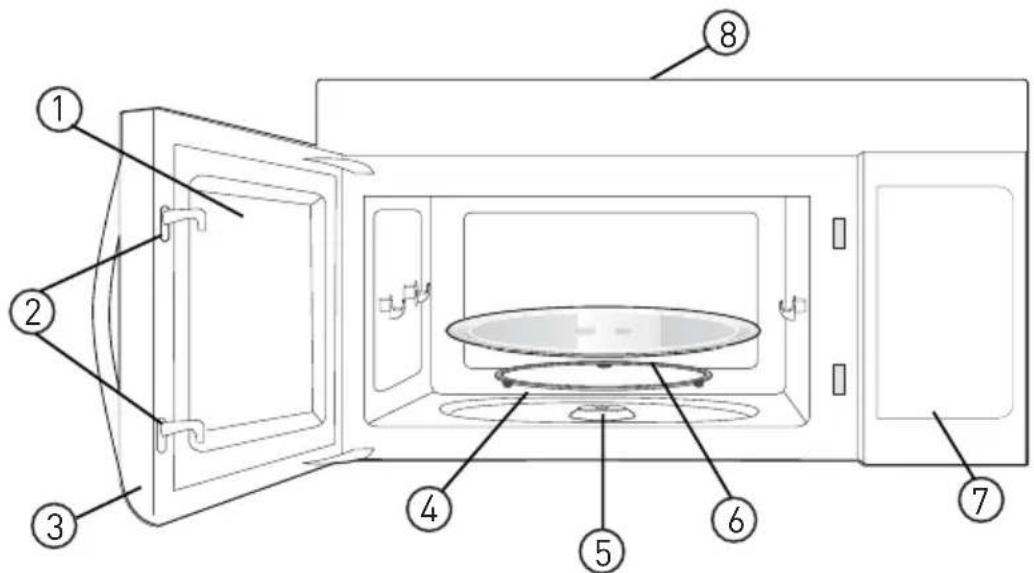
Front View
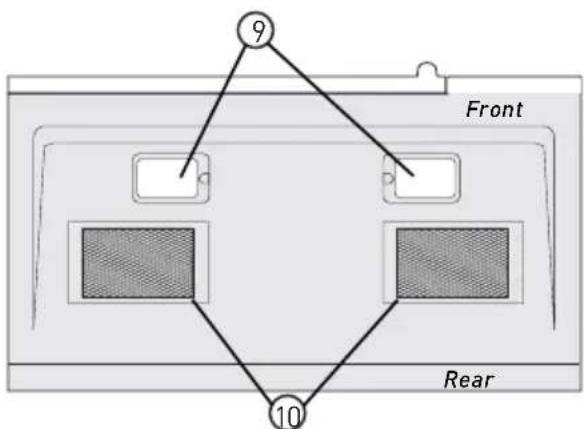
Bottom View
Item Part Name
| ① | Window |
| ② | Interlock system |
| ③ | Door assembly |
| ④ | Turntable ring assembly |
| ⑤ | Turntable Shaft |
| ⑥ | Turntable glass tray |
Item Part Name
| 7 | Control panel |
| 8 | Ventilation openings (on top) |
| 9 | Surface lights |
| 10 | Ventilation filters |
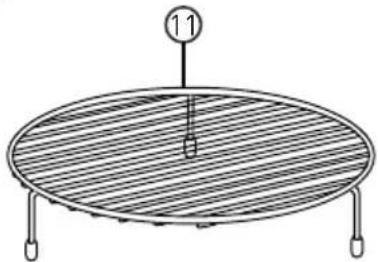
| 11 | Wire rack (use in convection and combination cooking on the removable turntable) |
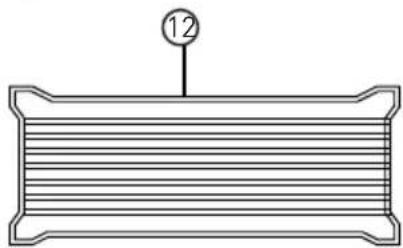
| 12 | Shelf (use in microwave cooking) |
Control Panel and Features
Control Panel
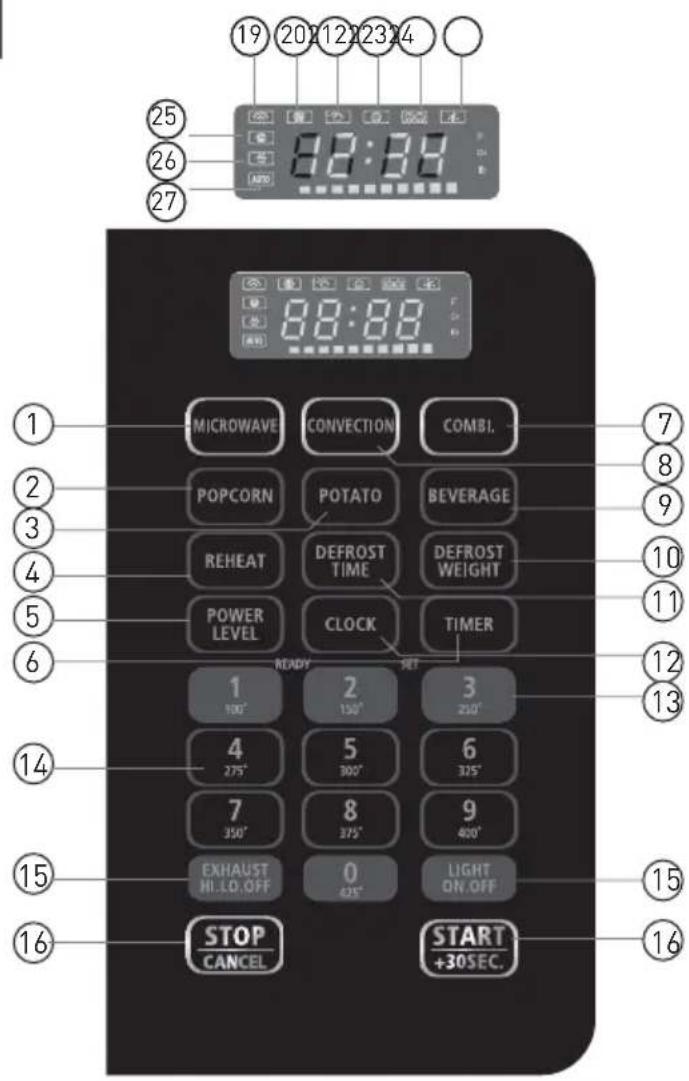
| ITEM Part Name | |
| ① | Microwave |
| ② | Popcorn |
| ③ | Potato (1-4 potatoes) |
| ④ | Reheat (3 different settings) |
| ⑤ | Power Level (10 power levels available) |
| ⑥ | Timer |
| ⑦ | Combination |
| ITEM Part Name | |
| 8 | Convection |
| 9 | Beverage |
| 10 | Defrost weight |
| 11 | Defrost Time |
| 12 | Clock |
| 13 | EasySet (3 instant key settings) |
| 14 | Numeric pads (0 thru 9) |
| 15 | Exhaust (High/Low/Off) ~ Use to turn the exhaust fan on, off, or to adjust fan speed. |
| 16 | Stop/Cancel |
| 17 | Light ON. OFF ~ Press this pad to turn the surface lights on or off. |
| 18 | START/+30 sec |
| 19 | Microwave indicator |
| 20 | Convection indicator |
| 21 | Lock indicator |
| 22 | Vent Fan Of Low-Speed indicator |
| 23 | Vent Fan Of High-Speed indicator |
| 24 | Stove Lamp indicator |
| 25 | Timer indicator |
| 26 | Defrost indicator |
| 27 | Auto Cook indicator |
Before Using
What's in Box
Make sure you have the following listed items included in the packaging. If any item is damaged or missing, contact your dealer.
- Microwave Oven Body
- Grill Rack
Air Baffle
Glass Tray - Filters*2
- Roller Ring
Installation Screws
Instruc tion Manual
Installation Manual
Rear Wall Template
Top Cabinet Template
Warranty Card
Learn more about your microwave oven
CAUTION
- To avoid risk of personal injury or property damage, do not operate the microwave oven empty.
- To avoid risk of personal injury or property damage, do not use stoneware, aluminum foil, metal utensils, or metal trimmed utensils in the microwave oven.
NOTE: Do not to use paper products when using bake brown.
Microwave utensil guide
USE DO NOT USE
- Oven proof glass (specifically treated for high intensity heat):
Utility dishes, loaf dishes, pie plates, cake plates, liquid measuring cups, casseroles and bowls without metallic trim.
China:
Bowls, cups, serving plates and platters without metallic trim.
Plastic:
Plastic wrap (as a cover) - lay the plastic wrap loosely over the dish and press it to the sides. Vent plastic wrap by turning back one edge slightly to allow excess steam to escape. The dish should be deep enough so that the plastic wrap will not touch the food. Use plastic dishes, cups, semi-rigid freezer containers and plastic bags for short cooking times. Use these with care because the plastic may soften from the heat of the food.
Paper:
Paper towls, waxed paper, paper napkins and paper plates with no metallic trim or design. Look for the manufacturer's label for any special instructions for use in the microwave oven.
Metal utensils:
Metal shields the food from microwave energy and produces uneven cooking. Also, avoid metal skewers, thermometers or foil trays. Metal utensils can cause arcing, which can damage your microwave oven.
Metal decoration:
Bowls, cups, serving plates and platters with metallic trim.
- Aluminum foil:
Avoid large sheets of aluminum foil because they hinder cooking and may cause harmful arcing. Use small pieces of foil to shield poultry legs and wings. Keep ALL aluminum foil at least 1 inch from the side walls of the oven cavity and door of the microwave.
Wood:
Wooden bowls and boards will dry out and may split or crack when you use them in the microwave oven. Baskets made of wood will react in the same way.
Tightly covered utensils:
Be sure to leave openings for steam to escape from covered cookware. Pierce plastic pouches of vegetables or other food items before cooking. Tightly closed pouches may explode.
Brown paper:
Avoid using brown paper bags. They absorb heat and can burn.
- Flawed or chipped cooking utensils:
Any utensil that is cracked, flawed or chipped may break in the oven.
Metal twist ties:
Remove metal twist ties from plastic or paper bags. They become hot and could cause a fire.
Operation
Setting the Clock
Example: setting clock display for 9:00:
- Touch Clock pad once for AM, touch twice for PM.
- Enter time using number pads.
- Touch Clock pad again.
Setting the timer
Example: setting timer for 5 minutes:
- Touch Timer pad once.
- Enter desired time using number pads.
- Touch Timer pad.
NOTE: When the timer has reached the end of set time, you will hear beep alerts indicating the timer has run out.
Control Lock
You may lock the control panel to prevent the microwave from being accidentally started or used by children.
The control lock feature is very useful when cleaning the control panel. The lock will prevent accidental programming when wiping the control panel clean.
- Example: to set the control lock ON:
Touch and hold the Stop/Cancel pad for more than 3 seconds. The Lock icon will appear in the display window along with 2 beeps.
- Example: to change the control lock from ON to OFF:
Touch and hold the Stop/Cancel pad for more than 3 seconds. The Lock icon will disappear in the display window.
Using the Stop/Cancel key
This feature will let you quickly stop or cancel the cooking process.
Touch the Stop/Cancel pad to:
- Erase if you have entered wrong information.
- Cancel timer.
- Press pad once to pause the oven temporarily during cooking. (Touch START/+30SEC. pad again to resume cooking.)
- Return the time of day (clock) to the display after cooking cycle is completed.
- Cancel a program during cooking, touch twice.
Using the Start/+ 30SEC. key
This feature will let you quickly start or add 30 seconds
Touch the START/+30SEC. pad to:
- Start programmed cooking.
- Start cooking for 30 seconds at 100% power level.
- Extend cooking time in multiples of 30 seconds each time this pad is touched during microwave cooking.
Example: to add 1 minute of cook time during 80% microwave cooking:
Press START/+30 sec pad twice.
Heating with High Power Level
Example: to heat for 5 minutes at 100% power:
- Press Microwave pad.
- Use the number pads to enter desired heating time (cook time may be set up to 99 minutes and 99 seconds).
- Touch START/+30SEC. pad.
When heating has finished you will hear beeps.
Operation
Heating with Lower Power Levels
Using the highest power level to heat foods with does not always give the best results when some types of food need slower cooking, such as roasts, baked goods or custards. Your Oven has nine other power levels you may choose.
Example: to heat for 4 minutes at 70% power:
- Press Microwave pad.
- Use the number pads to enter desired heating time (cook time may be set up to 99 minutes and 99 seconds).
- Press Power Level pad once for power level 10 (100% power).
- Use the number key to change the power level to 7. PL7 appears in the display (70% power).
- Touch START/+30SEC pad.
When heating has finished you will hear beeps.
Suggested power levels for cooking
The 10 power levels available with this microwave will help you to adjust to the power output best suited for the food type you are preparing. As with any food preparation in the microwave, it is best to follow the microwave instructions that are printed on food packaging.
The table below provides suggested power levels for various types of food that you can be prepare in the microwave.
| Power Level | Microwave Output | Use To Prepare When: |
| 10 High | 100 % | Boiling water. Cooking ground beef. Making candy. Cooking fresh fruits & vegetables Cooking fish & poultry. Preheating browning dish. Reheating beverages. Cooking bacon slices. |
| 9 | 90 % | Reheating meat slices quickly. Saute onions, celery & green peppers. |
| 8 | 80 % | All reheating. Cooking scrambled eggs. |
| 7 | 70 % | Cooking breads & cereal products. Cooking cheese dishes & veal. Cakes, muffins, brownies & cupcakes. |
| 6 | 60 % • | Cooking pasta. |
| 5 | 50 % | Cooking meats & whole poultry. Cooking custard. Cooking spare ribs, rib roast & sirloin roast. |
| 4 | 40 % | Cooking less tender cuts of meat. Reheating frozen packaged foods. |
| 3 | 30 % | Thawing meat, poultry & seafood. Cooking small quantities of food. Finish cooking casseroles, stew & some sauces. |
| 2 | 20 % | Softening butter & cream cheese. Heating small amounts of food. |
| 1 | 10 % | Softening ice cream. Raise yeast dough. |
Operation
Heating with Multiple Cooking Stages
For best results, some microwave recipes call for different power levels or different lengths of time for cooking. Your microwave may be set to change from one stage to another automatically (2 stages maximum). Example: to cook food for 3 minutes at 80% power and then 50% power for 6 minutes 30 seconds:
- Press Microwave pad.
- Use the number pads to enter heating time for the 1st stage (cook time may be set up to 99 minutes and 99 seconds).
- Press Power Level pad once.
- Use the number keys to enter power level for the 1st stage. PL8 appears in the display (80% power).
- Press Microwave pad for 2nd stage.
- Use the number pads to enter heating time for the 2nd stage (cook time may be set up to 99 minutes and 99 seconds).
- Press Power Level pad for 2nd stage.
- Use the number key to enter power level for the 2nd stage. PL5 appears in the display (50% power).
- Press START/+30SEC.pad.
When heating has finished you will hear beeps.
NOTE: Power level must always be programmed for first stage - 100% = 10
Suggestions for getting the Best Results
To help you achieve the best possible results from your microwave oven, read the following suggestions below;
Storage temperature
Foods taken from the freezer or refrigerator take longer to cook than the same foods would at room temperature.
Size
Small pieces of food cook faster than large ones. Pieces similar in size and shape will cook more evenly when cooked
together. For more even results, reduce the power levels when cooking large pieces of food.
Natural moisture
Very moist foods cook more evenly because microwave energy heats water molecules very efficiently.
- Stirring
Stir foods such as casseroles and vegetable from the outside to the center to distribute the heat more evenly. This will allow the food to cook faster. Constant stirring is not necessary.
- Turn over items
Turn over foods such as pork chops, roasts or whole cauliflower halfway through the cook time. This will help to expose all sides equally to microwave energy.
Food placement
Place delicate areas of food items, such as asparagus tips, toward the center of the turntable tray.
Food arrangement
Arrange unevenly shaped foods, such as chicken pieces or salmon, with the thicker or meatier parts toward the outside of the turntable tray.
- Let the food stand
After removing the food from the microwave, cover the food with foil or a casserole lid and let it stand to finish cooking. This will help the food finish in the center and avoids overcooking the out edges. The length of stand time depends on the density and surface area of the food items.
- Wrapping in paper towels or waxed paper
Sandwiches and many other food types containing prebaked bread should be wrapped prior to placing in the microwave to help prevent the food items fro drying out while heating.
Operation
Using Ready Set
1 2 3
Microwave heating or cooking may be quickly set at 100% power level for 1, 2 or 3 minutes. Use the number keys 1, 2 or 3 to choose the desired minutes of cook time (this option will only work using the 1, 2 or 3 numeric pads): Example: to quickly heat for 2 minutes at 100% power:
Touch number pads 1, 2 or 3 for desired minutes of cook time.
NOTE: the Ready Set function cannot be set when using the Defrost (by weight) feature.
Exhaust High / Low / Off
The exhaust ventilation moves steam and other cooking vapors from the cooking surface of the range below the microwave oven.
To operate the exhaust vent, Touch the
Exhaust HI. LO. OFF pad once for the highest speed setting. Touch the pad again to choose the Low speed setting and a 3rd time to turn the exhaust ventilation off.
NOTE: If the temperature gets too hot around the microwave oven, the fan in the exhaust vent hood will automatically turn on at the LOW setting to cool the oven. When this occurs, the vent cannot be turned off.
Surface Light / On / Off
Touch the Light/On/Off pad once for a cooking surface light. Press the pad again to turn the light off.
Setting Defrost by Weight
Example: to defrost 1lb. of food with the default power level and cook time determined automatically:
-
Press Defrost Weight pad once. 0.0 will appear in the display.
-
Use the numeric pads to input weight of food to defrost in pounds (10 = 1lb.) You may enter any weight from 0.1 to 6.0lbs.
-
Press START /+30SEC. pad.
When defrosting has finished you will hear beeps.
NOTE: The weight amount must be a valid entry for this feature to start. A valid weight entry is 0.1 to 6.0 pounds.
Setting Defrost by Time
Example: to defrost food with the default 30% power level for 5 minutes:
-
Press Defrost Time pad once. 0.0 will appear in the display.
-
Use the number pads to enter desired defrost time (defrost time may be set up to 99 minutes and 99 seconds).
-
Press START/+30SEC.pad.
When heating has finished you will hear beeps.
NOTE: Power levels cannot be changed for both defrost (by weight) or defrost (by time) because the defrost performance will be adversely affected.
Special notes for defrosting by time
After pressing START +30SEC key, the display will count down remaining defrost time. The oven will beep twice during the defrost cycle. At this time open the door and turn the food if needed and remove any portions that have already thawed. Touch the START +30SEC key to resume the defrost cycle.
- When heating has finished you will hear beeps.
Defrosting tips
- When using the Defrost Weight feature, the weight entered should always be pounds (valid entries are from 0.1 to 6.0 pounds).
Use both Defrost Weight and Defrost Time features for raw food items only. Defrosting gives best results when food to be thawed is a minimum of 0^ (taken
Operation
directly from a true freezer]. If the food has been stored in a refrigerator-freezer that does not maintain a temperature of 5^ F or below, always program a lower food weight or lower cook time to prevent cooking the food.
- If the frozen food is stored outside the freezer for up to 20 minutes, enter a reduced cook time or weight.
- The shape of the package will alter the defrosting time. Shallow rectangular food packets defrost more quickly than a deep frozen block of food.
- Separate pieces as they begin to defrost. Separated frozen pieces of food defrost better.
- Shield warm areas of food with small pieces of foil if they start to become warm.
- You may use small pieces of aluminum foil to shield food items like chicken wings, leg tips and fish tails, but do not allow the foil to touch the oven cavity walls when defrosting.
Defrosting suggestions for meats
For best results, please read these suggestions when defrosting meats.
| Meat Normal amount | Suggestions | |
| Roast beef or pork | 2.5 to 6 lbs. (40 to 96 oz.) | Start with the food placed fat side down. After each stage, turn the food over and shield any warm portions with narrow strips of aluminum foil. Let stand, covered for 15-30 minutes. |
| Steaks, chops or fish | 0.5 to 3 lbs. (8 to 48 oz.) | After each stage, rearrange the food. If there are any warm or thawed portions of food, shield them with narrow flat pieces of aluminum foil. Remove any pieces of food that are nearly defrosted. Let stand, covered for about 5 to 10 minutes. |
| Ground meat | 0.5 to 3 lbs. (8 to 48 oz.) | After each stage, remove any pieces of food that are nearly defrosted. Let stand, covered with foil for 5 to 10 minutes. |
| Whole chicken | 2.5 to 6 lbs. (40 to 96 oz.) | Remove giblets before freezing poultry. Start defrosting with the breast side down. After the 1st stage, turn the chicken over and shield any warm portions with narrow strips of aluminum foil. After the 2nd stage, again shield any warm portions with narrow strips of aluminum foil. Let stand, covered, for 30 to 60 minutes in the refrigerator. |
| Chicken pieces | 0.5 to 3 lbs. (8 to 48 oz.) | After each stage, rearrange or remove any pieces of food that are nearly defrosted. Let stand for 10-20 minutes. |
Operation
Reheat
The reheat feature provides 3 quick preset settings based on serving size to reheat food for your cooking convenience.
Example: to reheat 24 ounces of food.
- Press Reheat pad 3 times to reheat 24oz. of food. 24.00oz will appear in the display (see reheat category table).
- Press START/+30SEC.pad.
| Reheat Category Press Display | ||
| 8 ounces of food once 8.00 oz | ||
| 16 ounces of food twice 16.00 oz | ||
| 24 ounces of food 3 times 24.00 oz | ||
Reheat cooking suggestions
| Reheat Directions | Amount | |
| Dinner plate | Use only pre-cooked, refrigerated foods. Cover plate with vented plastic wrap or waxed paper, tucked under plate. If food is not as hot as you prefer after heating with Reheat, continue heating using manual time and power level settings. Contents: · 3-4 oz. meat, poultry or fish (up to 6 oz. with bone · 1/2 cup starch (potatoes, pasta, rice, etc.) · 1/2 cup of vegetables (about 3-4 oz.) | 1 serving (1 plate) |
| Casserole | Cover plate with lid or vented plastic wrap. If food is not as hot as you prefer after heating with Reheat, continue heating using manual time and power level settings. Stir foods once before serving. Contents: · Casserole-refrigerated foods (for example beef stew or lasagna) · Pasta-Canned spaghetti and ravioli, refrigerated foods. | 1 to 4 servings |
| Pasta | ||
CONVECTION Cooking
There are ten temperatures of convection: 100^, 150^, 250^, 275^, 300^, 325^, 350^, 375^, 400^, 425^.
Convection cooking uses a heating element to raise the temperature of the air inside the oven. Any oven temperature from 100^ to 425^ may be set. A fan gently circulates this heated air throughout the oven, over and around the food, producing golden brown exteriors and rich, moist interiors.
Because the heated air is kept constantly moving, not permitting a layer of cooler air to develop around the food, some foods cook faster than in regular oven cooking.
For Best Result...
Always use the shelf when convection cooking. Reduce package/recipe temperature 25^ for baked goods.
The shelf is required for good air circulation and even browning.
See the Cookware Tips section (P20) for information on suggested cookware.
Using CONVECTION With preheating
Example: to cook food for 5 minutes at 250^ using CONVECTION with preheating
- Press CONVECTION pad once.
- Press the temperature key to select the temperature you need. Do not enter cook time now. (The cook time will be entered later, after the own is preheated.)
- Press START+30SEC. pad to start preheating. (When the oven is preheated, it will signal.)
- Place the food in the own. Press the number keys to set cooking time.
- Press START+30SEC. to start cooking. When cooking is complete, the oven will signal and turn off.
Operation
Using CONVECTION Without preheating
Example: to cook food for 5 minutes at 250^ using CONVECTION without preheating
- If your recipe does not require preheating, press the CONVECTION pad once.
- Press the temperature key to select the temperature you need.
- Press CONVECTION to confirm the temperature.
- Press the number keys to set cooking time.
- Press the START+30SEC pad to start the oven.
Combination Cooking
Combination Cooking offers the best features of microwave energy and convection cooking. Microwaves rook food fast and convection circulation of heated air browns foods beautifully. Any oven temperature from 100^ to 425^ may be set.
For Bast Results...
Always use the shelf when combination cooking. The shelf is required for good air circulation and even browning.
See the Cookware Tips section (P19) for information on suggested cookware.
Microwave + Convection Combination Cooking
Example: to cook food for 5 minutes using combination cooking.
- Press COMBI. pad once.
- Press the number keys to set cooking time.
- Press START+30SEC. pad to start cooking.
NOTES:
-
Check the Cookware Tips section for correct cookware when Combination Cooking
-
Do not use metal cookware when Combination Cooking
- Place meat on a trivet in a glass dish to collect juices and prevent spattering.
- For best roasting and browning results, whole roasts should be cooked in a glass dish placed directly on the oven shelf.
- For foods that are too tall to fit in the oven, you can leave out the trivet. If necessary, you may take out the shelf and place the dish directly on the turntable.
Convection baking
- Use the wire rack during convection baking.
Always preheat the oven before convection baking. - Avoid opening the oven door during cooking - each time the door is opened the oven loses heat and this can cause uneven baking.
Biscuits and bread
| Type | Temperature | Time | Notes |
| Biscuits 400°F | 20-30 minutes | Canned refrigerated biscuits take 2 to 4 minutes less time. | |
| Muffins 350°F | 15-20 minutes | Remove from tin straight away and place on cooling rack. | |
| Nut bread or fruit bread | 350°F | 55-70 minutes | |
| Bread 350°F | 55-65 minutes | ||
| Plain or sweet rolls | 350°F | 40-50 minutes | Lightly grease baking sheet. |
Operation
Cakes
| Type | Temperature | Time | Notes |
| Cheesecake | 350°F 65-75 minutes | After baking op,en oven door slightly and leave cheesecake to stand in oven for 30 minutes | |
| Coffee cake 350°F 30-40 minutes | |||
| Cup cakes 350°F 20-30 minutes | |||
| Fruit cake 300°F 85-95 minutes | |||
| Gingerbread | 350°F 40-45 minutes | ||
Combination cooking
Combination cooking helps to brown and crisp foods.
| Type Quantity Time | Notes | ||
| Beefburgers 4oz | 16-19 minutes | Place on microwave-proof plate, drain fat and turn halfway through cooking. | |
| Beef rump roast | 1.0kg | Rare: 15-20 minutes Medium: 21-25 minutes Well done: 26-30 minutes | Place fat side down on low rack, season, shield if necessary. After cooking, leave to stand for 15 minutes. |
| Lamb roast, rolled, boneless | 1.0kg | Rare: 15 -20 minutes Medium: 21-25 minutes Well done: 26-30 minutes | Place fat side down on low rack, brush with marinade and season, shield if necessary. After cooking, leave to stand for 15 minutes. |
| Pork 2 chops | Rare: 13-17 minutes Medium: 18-23 minutes Well done: 24-29 minutes | Place on high rack, brush with marinade and season. Cook until no longer pink or internal temperature reaches 170°F. Turn halfway through cooking. After cooking, cover with foil and leave to stand for 5 minutes. | |
| Pork 4 chops | Rare: 15-19 minutes Medium: 20-25 minutes Well done: 26-32 minutes | Place on high rack, brush with marinade and season. Cook until no longer pink or internal temperature reaches 170°F. Turn halfway through cooking. After cooking, cover with foil and leave to stand for 5 minutes. | |
| Pork loin roast, rolled, boneless | 1.0kg | Rare: 20-25 minutes Medium: 26-30 minutes Well done: 30-35 minutes | Place fat side down on low rack, season, shield if necessary. After cooking, cover with foil and leave to stand for 15 minutes. |
| Chicken breasts | lb. 16-26 minutes | Wash and dry meat, remove skin, place thickest portion to outside on high rack. | |
| Chicken boneless portions | 1 lb. 13-24 minutes | Place on high rack, brush with butter and season as required. Turn halfway through cooking. Cook until no longer pink and juices run clear. After cooking, cover with foil and leave to stand for 3-5 minutes. | |
| Chicken, whole 1.3kg | 25 - 40 minutes | Wash and dry bird, place breast down on low rack, brush with butter and season as required. Turn and drain halfway through cooking. Cook until no longer pink and juices run clear. After cooking, cover with foil and leave to stand for 10 minutes. Temperature in thigh should be approx 185°F. | |
Operation
Cookware Tips
Convection Cooking
Metal Pans are recommended for all types of baked products, but especially where browning or crusting is important.
Dark or dull finish metal pans are best for breads and pies because they absorb heat and produce crisper crust.
Shiny aluminum pans are better for cakes, cookies or muffins because these pans reflect heat and help produce a light tender crust.
Glass or Glass-Ceramic casserole or baking dishes are best suited for egg and cheese recipes due to the cleanliness of glass.
Combination Cooking
Glass or Glass-Ceramic baking containers are recommended. Be sure not to use items with metal trim as it may cause arcing (sparking) with oven wall or oven shelf, damaging the cookware, the shelf or the oven.
Heat-Resistant Plastic microwave cookware (safe to 450^ ) may be used, but it is recommended for foods requiring crusting or all-around browning, because the plastic is a poor conductor of heat.
| Cookware Microwave Bake/brown | Combination | ||
| Heat-Resistant Glass, Glass-Ceramic (Pyrex, Fire King, Corning Ware, etc.) | Yes Yes Yes | ||
| Metal No Yes No | |||
| Non Heat-Resistant Glass No No No | |||
| Microwave-Safe Plastics Yes No Yes | |||
| Plastic Films and Wraps Yes No No | |||
| Paper Products | Yes No No | ||
| Straw, Wicker and Wood | Yes No No | ||
Use only microwave cookware that is safe to 450^ .
Operation
Select the best method of cooking.
Use the following guide to select the best method of cooking. Specific recipes can be adapted to any method of cooking.
Best method
2 - Alternate method
N/R - Not recommended
| Foods Microwave Combination | Bake/Brown | ||
| Appetizers • Dips and Spreads • Pastry Snacks | 1 2 | N/R 1 | N/R 2 |
| Beverages | 1 N/R N/R | ||
| Sauces and Toppings | 1 N/R N/R | ||
| Soups and Stews | 1 | 2 N/R | |
| Meats • Defrosting • Roasting | 1 2 | N/R 1 | N/R 2 |
| Poultry • Defrosting • Roasting | 1 2 | N/R 1 | N/R 2 |
| Fish and Seafood • Defrosting • Cooking | 1 1 | N/R 2 | 2 1 |
| Casseroles | 2 | 1 | 2 |
| Eggs and Cheese • Scrambled, Omelets • Quiche, Souffle | 1 2 | N/R 2 | 2 1 |
| Vegetables, (fresh) | 2 | 1 | 2 |
| Breads • Quick • Yeast | 2 N/R | 1 2 | 2 1 |
| Muffins, Coffee Cake | 2 | 1 | 2 |
| Muffins, Coffee Cake • Cakes, Layer and Bundt • Angel Food and Chiffon • Custard and Pudding • Bar Cookies • Fruit • Pies and Pastry • Candy | 2 N/R 1 2 1 | 1 N/R 1 N/R 1 N/R 2 | 2 1 N/R 2 N/R 1 N/R |
| Blanching Vegetables | 1 N/R N/R | ||
| Frozen Convenience Foods | 1 | 2 | 2 |
Operation
Popcorn

CAUTION
DO NOT leave microwave oven unattended while popping corn.
The popcorn feature lets you pop 3 different commercially packaged microwave popcorn sized bags. Use the table below to determine the setting to use.
| Amount | Press popcorn pad |
| 1.75 oz. (default setting) | once |
| 3.00 oz. | 2 times |
| 3.5 oz. | 3 times |
Example: to pop a 3.0 oz. bag of popcorn automatically.
- Press Popcorn pad (1, 2 or 3 times - refer to table above to change for bag size).
- Press START/+30SEC.pad.
The microwave will beep when finished.
Potato
The potato feature cooks 1, 2,3 or 4 (cooking times based on 8 to 32 oz.) potatoes automatically. Use the table below to determine the setting to use.
| Amount | Press potato pad |
| 1 potato (default setting) | once |
| 2 potatoes 2 times | |
| 3 potatoes 3 times | |
| 4 potatoes 4 times |
Example: to cook 1 potato automatically.
- Press Potato pad (1, 2, 3 or 4 times - refer to table above to change quantity).
- Press START/+30SEC.pad.
The microwave will beep when finished.
NOTE:
- Before cooking, pierce potatoes with fork several times.
After cookings, let potatoes stand for 5 minutes.
Beverage
The beverage feature heats 1, 2 or 3 cups of beverage. Use the table below to determine the setting to use.
| Amount | Press beverage pad |
| 1 cup (about 8 oz.) | once (default setting) |
| 2 cups (about 16 oz.) | 2 times |
| 3 cups (about 24 oz.) | 3 times |
Example: to heat 1 cup of a beverage.
- Press Beverage pad (1, 2 or 3 times - refer to table above to change number of servings).
- Press START/+30SEC.pad.
The microwave will beep when finished.
Auto Cooking
Convenience Cooking Suggestions
| Convenience category | Amount | Suggestions |
| Popcorn | 1.75, 3.0, 3.5 oz. 1 pkg. | Cook a single “microwave-only” bag of popcorn at a time. Use caution when removing and opening the hot popcorn bag from the oven. Let microwave oven cool down at least 5 minutes before using again. |
| Potato | 1,2,3,4 potatoes 8,16,24 32 oz. | Pierce each potato several times using a fork. Place on turntable in spoke-like fashion. After cooking, let stand for 3-5 minutes. Let oven cool for at least 5 minutes before using again. Use the start/+30sec pad to increase cook time for larger potatoes. |
| Beverage | 1,2,3 cups (8 oz,16 oz,24 oz.) | Use a microwave-safe measuring cup or mug; do not cover. Place the beverage in the microwave. After heating, stir well. Let oven cool for at least 5 minutes before using again. Beverages heated with the beverage category may be very hot. Remove the container with care. |
Cooking Charts
Cooking Meat in Your Microwave
Be sure to place prepared meats on a microwave-safe roasting rack in a microwave-safe dish. Start cooking the meat fat side down and if necessary, use narrow strips of aluminum foil to shield any bone tips or thin meat areas. After cooking, check the temperature in several places before letting the meat stand the recommended time. Please note that the temperatures in the following charts are temperatures at removal time; the temperature will rise during the standing period.
| Meat Power level | Cook Time | Directions | |
| Roast beef boneless (up to 4 lbs.) | High (10) for first 5 minutes, then medium (5) | 12-17 min./lb. for 160°F (Medium) | Place roast beef fat-side down on roasting rack. Cover with wax paper. Turn over half way through cooking. Let stand* 10-15 minutes. |
| 14-19 min./lb. for 170°F (Well Done) | |||
| Roast pork boneless or bone-in (up to 4 lbs.) | High (10) for first 5 minutes, then medium (5) | 15-20 min./lb. for 170°F (Well Done) | Place roast pork fat-side down on roasting rack. Cover with wax paper. Turn over half way through cooking. Let stand* 10-15 minutes. |
- Expect a 10^ F rise in the temperature during the standing period.
| Meat Done | ness Remove from oven | After standing (10-15 min.) | |
| Beef | Medium | 150 °F | 150 °F |
| Well Done | 160 °F | 160 °F | |
| Pork | Medium | 150 °F | 150 °F |
| Well Done | 160 °F | 160 °F | |
| Poultry | Dark meat | 170 °F | 170 °F |
| Light meat | 160 °F | 160 °F |
Cooking poultry in your microwave
Be sure to place poultry on a microwave-safe roasting rack in a microwave-safe dish. Cover poultry with wax paper to prevent splattering. Use narrow strips of aluminum foil to shield any bone tips or thin meat areas, or areas that start to overcook. After cooking, check the temperature in several places before letting the meat stand the recommended time.
| Poultry Cook time/power level | Directions | |
| Whole chicken (up to 4 lbs.) | Cook time: 7-10 min. /lb. 180° F dark meat 170° F dark meat Power level: medium high (7) | Place chicken breast-side down on roasting rack. Cover with wax paper. Turn over half way through cooking. Cook until juices run clear and meat near bone is no longer pink. Let stand for 5-10 min. |
| Chicken pieces (up to 4 lbs.) | Cook time: 7-10 min. /lb. 180° F dark meat 170° F dark meat Power level: medium high (7) | Place chicken bone-side down on dish, with thickest portions toward the inside of dish. Cover with wax paper. Turn over half way through cooking. Cook until juices run clear and meat near bone is no longer pink. Let stand for 5-10 min. |
Cooking Charts
Cooking Eggs in Your Microwave
- Never cook eggs in the shell and never warm hard-cooked eggs in the shell; they can explode.
Always pierce whole eggs to keep them from bursting.
Cook eggs just until set; they will become tough if overcooked.
Cooking Vegetables in Your Microwave
Vegetables should be washed just before cooking. Rarely is extra water needed. If dense vegetables such as potatoes, carrots and greens are being cooked, add about 1/4 cup of water.
- Small vegetables (sliced carrots, peas, lima beans, etc.) will cook faster than larger vegetables.
Whole vegetables, such as potatoes, acorn squash or corn on the cob, should be arranged in a circle on the turntable before cooking. The will cook more evenly if turned over halfway through cooking.
- Always place vegetables like asparagus and broccoli with the stem ends pointing towards the edge of the dish and the tips toward the center.
- When cooking cut vegetables, always cover the dish with a lid or vented microwavable plastic wrap.
Whole, unpeeled vegetables such as potatoes, squash, eggplant, etc., should have their skin pricked in several locations before cooking to prevent them from bursting.
- For more even cooking, stir or rearrange whole vegetables halfway through the cook time.
- Most of the time, the denser the food the longer the required standing time. For example, a baked potato should stand for 5 minutes before serving, while a dish of peas may be served immediately.
Cooking Seafood in Your Microwave
Place fish on a microwave-safe roasting rack in a microwave-safe dish. Be sure to always cook fish until it flakes easily with a fork. Use a tight cover to steam fish; a lighter cover of wax paper or paper towel provides less steaming. And be sure not to overcook fish; check it for doneness at a minimum cooking time before cooking longer.
| Seafood | Cook time/ power level | Directions |
| Fish steaks Up to 1½ lbs. | Cook time: 7-11 min./lb. Power level: med-high (7) | Arrange fish on roasting rack with meaty portions towards the outside of rack. Cover with wax paper. Turn over and rearrange halfway through cook time. Cook until fish flakes easily with fork. Let stand 3-5 mins. |
| Fish fillets Up to 1½ lbs. | Cook time: 4-8 min./lb. Power level: med-high (7) | Arrange fillets in a baking dish, thuring any thin pieces under. Cover with wax paper. If over 1/2 inch thick, turn over and rearrange halfway through cook time. Cook until fish flakes easily with fork. Let stand 2-3 mins. |
| Shrimp Up to 1½ lbs. | Cook time: 4-6½ min./ lb. Power level: med-high (7) | Arrange shrimp in a baking dish without overlapping or layering. Cover with wax paper. Cook until firm and opaue, stirring 2 or 3 times. Let stand 5 mins. |
Demonstration Mode
When the oven is electrified within one minute, to demonstrate, press "MICROWAVE" pad and hold for 6 seconds, "dE" will appear in the display. The buzzer sounds twice.
To cancel, press "MICROWAVE" pad and hold for 6 seconds, "End" will appear in the display.
The buzzer will sound twice. If easier, unplug the oven from the electrical outlet.
Care and Maintenance
NOTE: Disconnect the power cord before cleaning or leave the door open to deactivate the oven during cleaning.
Cleaning the exhaust filters
The oven ventilation exhaust filters should be removed and cleaned often; generally at least once every month.

CAUTION
To avoid risk of personal injury or property damage, do not operate oven hood without filters properly in place.
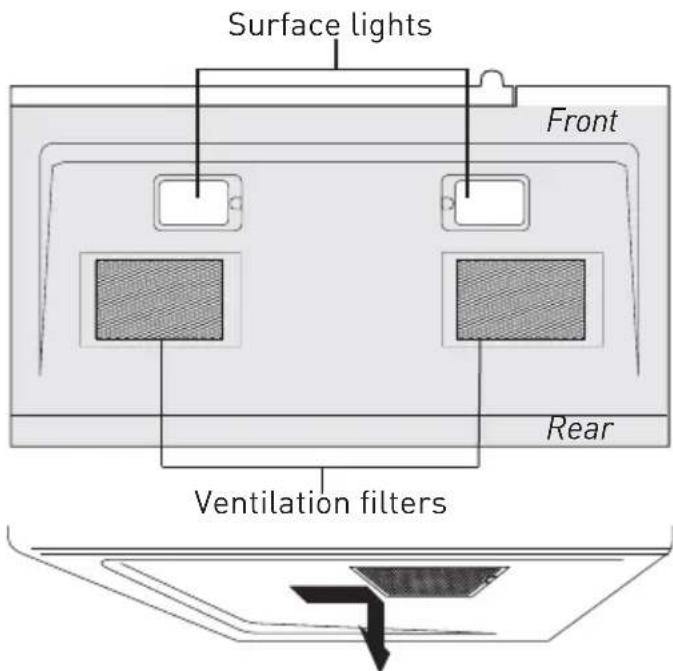
- To remove the exhaust ventilation filters, slide the filter to the rear. Then pull filter downward and push to the other side. The filter will drop out. Repeat for the 2nd filter.
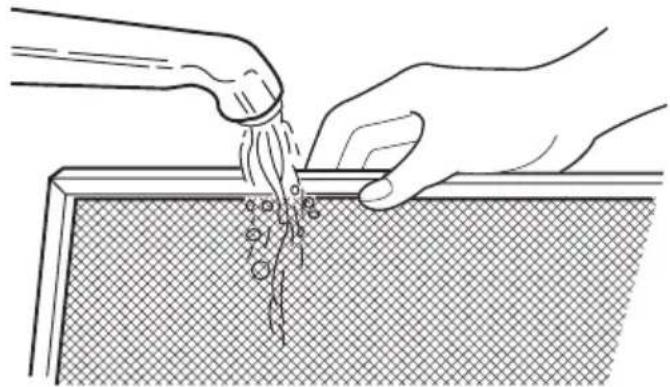
- Soak the ventilation filters in hot water using a mild detergent. Rinse well and shake to dry or wash in a dishwasher. Do not use ammonia. The aluminum on the filter will corrode and darken.
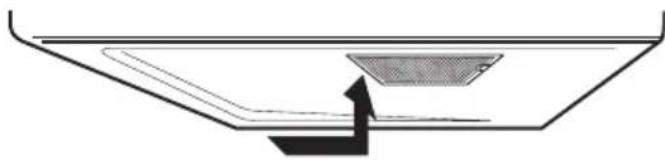
- To reinstall the exhaust ventilation filter, slide it into the side slot, then push up and toward oven to lock. Reinstall the 2nd filter using the same procedure.
Surface light replacement

CAUTION
To avoid risk of personal injury or property damage, wear gloves when replacing the light bulbs.
- Unplug the microwave oven or turn off power at the main circuit breaker.
- Remove the bulb cover mounting screws at both light positions under the microwave.
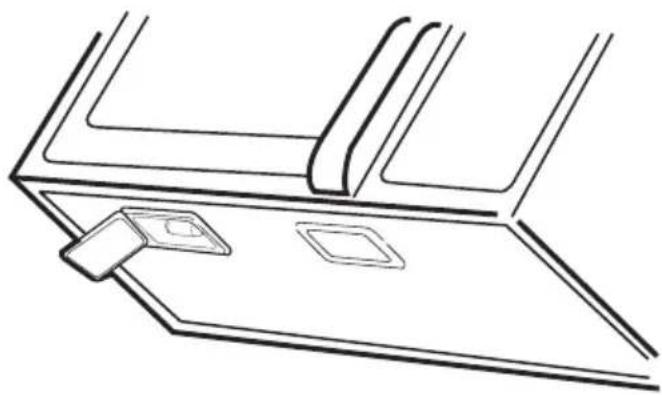
- Replace bulb with 30 watt appliance bulb.
- Re-install bulb cover and mounting screw.
- Plug the microwave back into the power supply or turn the power back on at the main circuit breaker.
Care and Maintenance
English
Charcoal filter replacement
Charcoal Filter installed in your microwave oven, is used for nonvented, recirculated installation. The filter should be changed every 6 to 12 months depending on use.
- Disconnect power to the microwave oven at the circuit breaker panel or by unplugging.
- Remove the vent grill mounting screws.
- Pull the vent grill away from the unit.
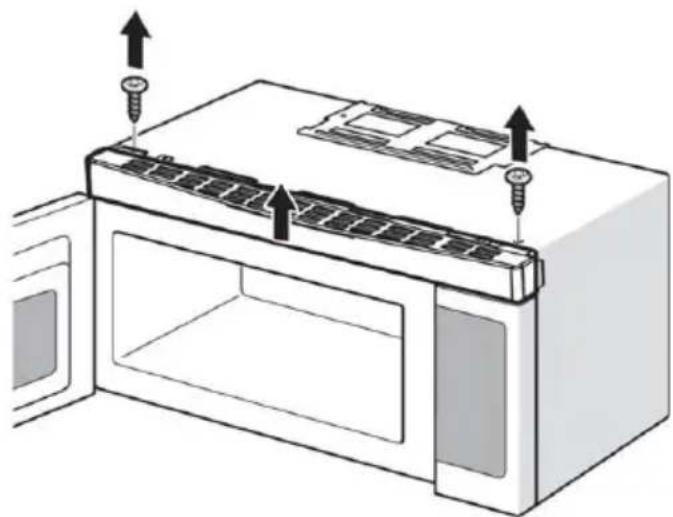
- Remove the charcoal filter by pushing it inwards, then turn and pull it away from the unit.
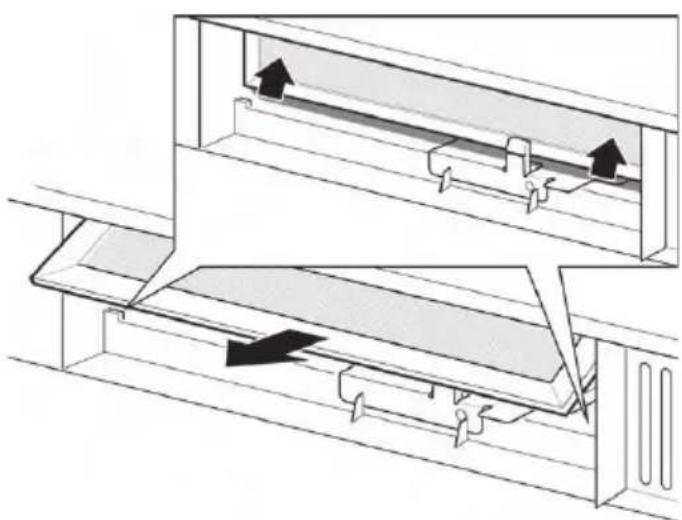
Oven light replacement
Remove the vent grill per instructions 1-4 above and charcoal filter, if used.
- Open light cover located behind filter mounting by care fully pulling up on the front edge.
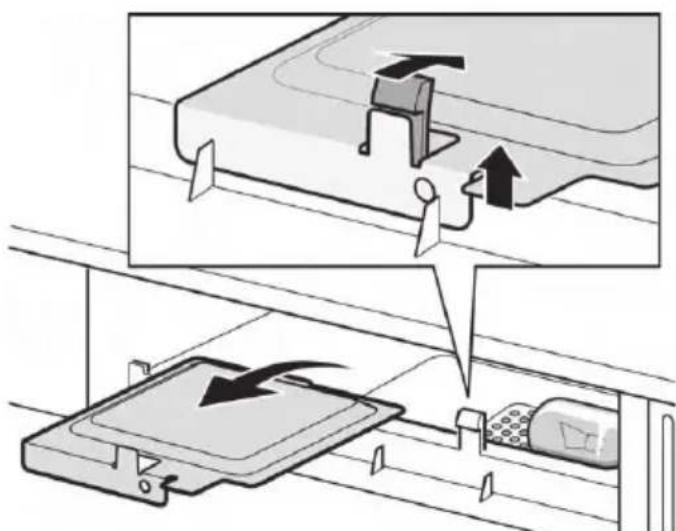
- Remove old light bulb and replace only with equivalent 30 watt bulb available from parts distributor. Bulbs are also available at most hardware stores or lighting centers.
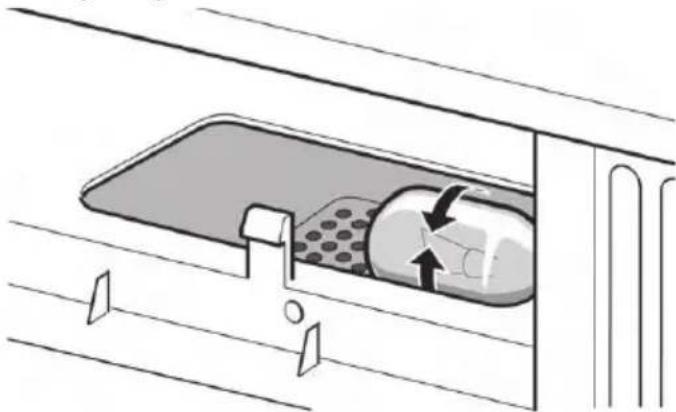
NOTE: DO NOT USE BULB LARGER THAN 30 WATTS.
- Replace the microwave oven light cover by carefully pushing into place. Replace the charcoal filter. Push the vent grill back into place (engaging both the bottom and top tabs) and replace the vent grill mouting screws.
Care and Maintenance
Cleaning suggestions
For best performance and for safety reasons, keep the oven clean inside and outside. Take special care to keep the inner door panel and oven front frame free of food and grease build-up.
Never use rough scouring powder or pads on the microwave. Wipe the microwave oven inside and out with a soft cloth and warm (not hot) mild detergent solution. Then rinse and wipe completely dry.
Wipe spatters immediately with a wet paper towel, especially after cooking greasy foods like chicken or bacon.
Clean your microwave oven weekly or more often, if needed.
Follow these instructions to clean and care for your microwave oven:
- Keep the inside (cavity) of the oven clean. Food particles and spilled liquids can stick to the oven walls, causing the oven to work less efficiently.
- Wipe up spills immediately. Use a damp, clean cloth and mild soap. DO NOT use harsh detergents or abrasive cleaners.
- To help loosen baked-on food particles or liquids, heat 2 cups of water (add the juice of 1 lemon if you desire to keep the oven fresh smelling) in a 4 cup measuring glass at High power for 5 minutes or until boiling. Let stand in oven cavity for 1 or 2 minutes.
- Remove the glass turntable tray from the oven when cleaning the oven cavity or tray. To prevent the glass turntable from breaking, handle with care and do not put it in water immediately after cooking. Wash the turntable tray in warm sudsy water or in the dishwasher.
-
Clean the outside surface of the microwave with soap and a clean damp cloth. Dry with a clean soft cloth. To prevent damage to the operating parts of the oven, do not let water seep into any vents or openings.
-
Wash the oven door window with very mild soap and water. Be sure to use a soft clean cloth to avoid scratching.
- If steam accumulates inside or outside the oven door, wipe with a soft cloth. Steam can accumulate when operating the oven in high humidity and in no way indicates microwave leakage.
- Never operate the oven without food in the oven cavity; this can damage the magnetron tube or glass tray. You may wish to leave a cup of water standing inside the oven when it is not in use to prevent damage if the oven is accidentally turned on.
How to Clean the Inside
Walls,Floor, Inside Widow, Metal and Plastic Patrs on the Door.
Some spatters can be removed with a paper towel, others may require a damp cloth.
Remove greasy spatters with a sudsy cloth, then rinse with a damp cloth. Do not use abrasive cleaners or sharp utensils on oven walls.
To clean the surface of the door and the surface of the oven that come together upon closing, use only mild, non-abrasive soaps or detergents using a sponge or soft cloth.
Rinse with a damp cloth and dry.
Never use a commercial oven cleaner on any part of your microwave.
Removable Turntable and Turntable Support
To prevent breakage, do not place the turntable into water just after cooking. Wash it carefully in warm, sudsy water or in the dishwasher. The turntable and support can be broken if dropped. Remember, do not operate the oven without the turntable and support in place.
Care and Maintenance
How to Clean the Outside
Do not use cleaners containing ammonia or alcohol on the microwave oven. Ammonia or alcohol can damage the appearance of the microwave.
Case
Clean the outside of the microwave with a sudsy cloth.
Rinse with a damp cloth and then dry. Wipe the window clean with a damp cloth.
Control Panel and Door
Wipe with a damp cloth. Dry thoroughly. Do not use cleaning sprays, large amounts of soap and water, abrasives or sharp objects on the panel—they can damage it. Some paper towels can also scratch the control panel.
Door Surface
It is important to keep the area clean where the door seals against the microwave. Use only mild, non-abrasive detergents applied with a clean sponge or soft cloth. Rinse well.
Power Cord
If the cord becomes soiled, unplug and wash with a damp cloth.
For stubborn spots, sudsy water may be used, but be certain to rinse with a damp cloth and dry thoroughly before plugging cord into outlet.
Stainless Steel
Do not use a steel-wool pad;it will scratch the surface. To clean stainless steel surfaces, use a hot, damp cloth with a mild detergent suitable for stainless steel surfaces. Use a clean, hot,damp cloth to remove soap. Dry with a dry, clean cloth.
If food soil remains, try a general kitchen cleaner, such as Fantastik®, Simple Green® or Formula 409®.
For hard-to-clean soil, use a standard stainless-steel cleaner, such as Bon-Ami® or Cameo®.
Apply cleaner with a damp sponge. Use a clean, hot, damp cloth to remove cleaner. Dry with a dry, clean cloth. Always scrub lightly in the direction of the grain.
After cleaning, use a stainless-steel polish, such as tainless Steel Magic®, Revere Copper and Stainless Steel Cleaner® or Wenol All Purpose Metal Polish®. Follow the product instructions for cleaning the stainless-steel surface.
Specifications
| Specifications | ||
| Model FMCM15-BL FMCM15 | -SS | |
| Rated Voltage 120V~60Hz 12 | 0V~60Hz | |
| Rated Input Power(Microwave) | 1500W 1500W | |
| Rated Output Power(Microwave) | 900W 900W | |
| Rated Output Power(Convection) | 1450W 1450W | |
| Oven Capacity 1.5 cu. ft. (42L) | 1.5 cu. ft. (42L) | |
| Turntable Diameterø13.6 inch (345mm)ø13.6 inch (345mm) | ||
| Product Dimensions (W*H*D) | 29 15/16" x 16 1/2" x 15" (759.5 x 419.1 x 381mm) | 29 15/16" x 16 1/2" x 15" (759.5 x 419.1 x 381mm) |
| Net Weight (kg/lbs) Approx. | 66.4 Lbs (30.1kg) Approx. 69.4 Lbs (31.5kg) | |
Troubleshooting
Check your problem by using the chart below and try the solutions for each problem. If the microwave oven still does not work properly, contact the nearest authorized service center.
| Trouble Possible Cause Possible Remedy | ||
| Oven will not start | 1. Electrical cord for oven is not plugged in. 2. Door is open. 3. Wrong operation is set. | 1. Plug into the outlet. 2. Close the door and try again. 3. Check instruction. |
| Arcing or sparking | 1. Materials to be avoided in microwave oven are used. 2. The oven is operated when empty. 3. Spilled food remains in the cavity. | 1. Use microwave-safe cookware only. 2. Do not operate with oven empty. 3. Clean cavity with wet towel. |
| Unevenly cooked foods | 1. Materials to be avoided in microwave oven are used. 2. Food is not defrosted completely. 3. Cooking time, power level is not suitable. 4. Food is not turned or stirred. | 1. Use microwave-safe cookware only. 2. Completely defrost food. 3. Use correct cooking time, power level. 4. Turn or stir food. |
| Overcooked foods | Cooking time, power level is not suitable. | Use correct cooking time, power level. |
| Undercooked foods | 1. Materials to be avoided in microwave oven are used. 2. Food is not defrosted completely. 3. Oven ventilation ports are restricted. 4. Cooking time, power level is not suitable. | 1. Use microwave-safe cookware only. 2. Completely defrost food. 3. Check to see that oven ventilation ports are not restricted. 4. Use correct cooking time, power level. |
| Improper defrosting | 1. Materials to be avoided in microwave oven are used. 2. Cooking time, power level is not suitable. 3. Food is not turned or stirred. | 1. Use microwave-safe cookware only. 2. Use correct cooking time, power level. 3. Turn or stir food. |
Warranty
FURRION WARRANTY FOR A PERIOD OF 1 YEAR FROM DATE OF RETAIL PURCHASE BY THE ORIGINAL END-USE PURCHASER, THAT THIS PRODUCT, WHEN DELIVERED TO YOU IN NEW CONDITION, IN ORIGINAL PACKAGING, FROM A FURRION AUTHORIZATION RESELLER AND USED IN NORMAL CONDITIONS, IS FREE FROM ANY DEFECTS IN MANUFACTURING, MATERIALS, AND WORKMANSHIP. IN CASE OF SUCH DEFECT, FURRION SHALL REPLACE OR REPAIR THE PRODUCT AT NO CHARGE TO YOU. THIS WARRANTY DOES NOT COVER: PRODUCTS WHERE THE ORIGINAL SERIAL NUMBERS HAVE BEEN REMOVED, ALTERED OR CANNOT READILY BE DETERMINED; DAMAGE OR LOSS CAUSED BY ACCIDENT, MISUSE, ABUSE, NEGLECT, PRODUCT MODIFICATION, FAILURE TO FOLLOW INSTRUCTIONS IN OWNER'S MANUAL, COMMERCIAL OR INDUSTRIAL USE; DAMAGE OR LOSS CAUSED TO THE DECORATIVE SURFACE OF PRODUCT; TO ANY DATA, SOFTWARE OR INFORMATION; AND NORMAL WEAR AND TEAR. THIS WARRANTY ONLY PROTECTS THE ORIGINAL END-USER ("YOU") AND IS NOT TRANSFERRABLE; ANY ATTEMPT TO TRANSFER THIS WARRANTY SHALL MAKE IT IMMEDIATELY Void. THIS WARRANTY IS ONLY VALID IN THE COUNTRY OF PURCHASE.
THIS WARRANTY AND REMEDIES SET FORTH ABOVE ARE EXCLUSIVE AND IN LIEU OF ALL OTHER WARRANTYES, REMEDIES AND CONDITIONS, WHETHER ORAL OR WRITTEN, EXPRESS OR IMPLIED. FURRION SPECIFICALLY DISCLAIMS ANY AND ALL IMPLIED WARRANTYES, INCLUDING, WITHOUT LIMITATION, WARRANTYES OF MERCHANTABILITY AND FITNESS FOR A PARTICULAR PURPOSE. IF FURRION CANNOT LAWFULLY CLAIM IMplied WARRANTYES UNDER THIS LIMITED WARRANTY, ALL SUCH WARRANTYES, INCLUDING WARRANTIES OF MERCHANTABILITY AND FITNESS FOR A PARTICULAR PURPOSE ARE LIMITED IN DURATION TO THE DURATION OF THIS WARRANTY.
No Furrion reseller, agent, or employee is authorized to make any modification, extension, or addition to this warranty.
FURRION IS NOT RESPONSIBLE FOR DIRECT, INDIRECT, SPECIAL, INCIDENTAL OR CONSEQUENTIAL DAMAGES RESULTING FROM ANY BREACH OF WARRANTY OR CONDITION, OR UNDER ANY OTHER LEGAL THEORY, INCLUDING BUT NOT LIMITED TO LOST PROFITS, DOWNTIME, GOODWILL, DAMAGE TO OR REPLACEMENT OF ANY EQUIPMENT OR PROPERTY, ANY COSTS OF RECOVERING, REPROGRAMMING, OR REPRODUCING ANY PROGRAM OR DATA STORED IN OR USED WITH FURRION PRODUCTS. FURRION'S TOTAL LIABILITY IS LIMITED TO THE REPAIR OR REPLACEMENT OF THIS PRODUCT PURSUANT TO THE TERMS OF THIS WARRANTY.
SOME STATES DO NOT ALLOW THE EXCLUSION OR LIMITATION OF INCIDENTAL OR CONSEQUENTIAL DAMAGES OR EXCLUSIONS OR LIMITATIONS ON THE DURATION OF IMPLIED WARRANTYES OR CONDITIONS, SO THE ABOVE LIMITATIONS OR EXCLUSIONS MAY NOT APPLY TO YOU. THIS WARRANTY GIVES YOU SPECIFIC LEGAL RIGHTS, AND YOU MAY ALSO HAVE OTHER RIGHTS THAT VARY BY STATE OR (WHERE APPLICABLE IN THE COUNTRIES WHERE FURRION HAS NON-US/CANADIAN AUTHORIZED DEALERS) COUNTRY. NO ACTION OR CLAIM TO ENFORCE THIS WARRANTY SHALL BE COMMENCED AFTER THE EXPIRATION OF THE WARRANTY PERIOD.
Keep your receipt, delivery slip, or other appropriate payment record to establish the warranty period. Service under this warranty must be obtained by contacting Furrion at warranty@furrion.com
Product features or specifications as described or illustrated are subject to change without notice.
Bienvenue
ATTENTION: Electric Shock Hazard
Avoid using brown paper bags. They absorb heat and can burn.
The microwave will beep when finished.
Pomme de terre
Furrion Innovation Center & Institute of Technology
52567 Independence Ct., Elkhart, IN 46514, USA Toll free:1-888-354-5792
Email: support@furrion.com
©2007-2018 Furrion Ltd. Furrion® and the Furrion logo are trademarks licensed for use by Furrion Ltd. and registered in the U.S. and other countries.
- Welcome
- Contents
- Important Safety Instructions
- Safety Precautions
- Grounding Instructions
- Power Supply Cord
- NOTE:
- Radio Interference
- Precautions To Avoid Possible Exposure To Excessive Microwave Energy
- Save these instructions for future reference
- Utensils
- CAUTION
- Personal Injury Hazard
- Utensil Test:
- Materials to be avoided in microwave oven
- Parts and Features
- Microwave Oven
- Control Panel and Features
- Control Panel
- Before Using
- What's in Box
- Learn more about your microwave oven
- Microwave utensil guide
- USE DO NOT USE
- China:
- Plastic:
- Paper:
- Metal utensils:
- Metal decoration:
- - Aluminum foil:
- Wood:
- Tightly covered utensils:
- Brown paper:
- - Flawed or chipped cooking utensils:
- Metal twist ties:
- Operation
- Setting the Clock
- Example: setting clock display for 9:00:
- Setting the timer
- Example: setting timer for 5 minutes:
- Control Lock
- Using the Stop/Cancel key
- Using the Start/+ 30SEC. key
- Heating with High Power Level
- Example: to heat for 5 minutes at 100\% power:
- Heating with Lower Power Levels
- Example: to heat for 4 minutes at 70\% power:
- Suggested power levels for cooking
- Heating with Multiple Cooking Stages
- Suggestions for getting the Best Results
- Storage temperature
- Size
- Natural moisture
- - Stirring
- - Turn over items
- Food placement
- Food arrangement
- - Let the food stand
- - Wrapping in paper towels or waxed paper
- Using Ready Set
- Exhaust High / Low / Off
- Surface Light / On / Off
- Setting Defrost by Weight
- Setting Defrost by Time
- Special notes for defrosting by time
- Defrosting tips
- Defrosting suggestions for meats
- Reheat
- Reheat cooking suggestions
- CONVECTION Cooking
- For Best Result...
- Using CONVECTION With preheating
- Using CONVECTION Without preheating
- Example: to cook food for 5 minutes at 250°F using CONVECTION without preheating
- Combination Cooking
- For Bast Results...
- Microwave + Convection Combination Cooking
- Example: to cook food for 5 minutes using combination cooking.
- NOTES:
- Convection baking
- Biscuits and bread
- Cookware Tips
- Select the best method of cooking.
- Popcorn
- Example: to pop a 3.0 oz. bag of popcorn automatically.
- Potato
- Example: to cook 1 potato automatically.
- Beverage
- Example: to heat 1 cup of a beverage.
- Auto Cooking
- Convenience Cooking Suggestions
- Cooking Charts
- Cooking Meat in Your Microwave
- Cooking poultry in your microwave
- Cooking Eggs in Your Microwave
- Cooking Vegetables in Your Microwave
- Cooking Seafood in Your Microwave
- Demonstration Mode
- Care and Maintenance
- Cleaning the exhaust filters
- Surface light replacement
- English
- Charcoal filter replacement
- Oven light replacement
- NOTE: DO NOT USE BULB LARGER THAN 30 WATTS.
- Cleaning suggestions
- Follow these instructions to clean and care for your microwave oven:
- How to Clean the Inside
- Walls,Floor, Inside Widow, Metal and Plastic Patrs on the Door.
- Removable Turntable and Turntable Support
- How to Clean the Outside
- Case
- Control Panel and Door
- Door Surface
- Power Cord
- Stainless Steel
- Specifications
- Troubleshooting
- Warranty
- Bienvenue
- ATTENTION: Electric Shock Hazard
- Pomme de terre
- Furrion Innovation Center & Institute of Technology
Brand : Furrion
Model : FMCM15BL
Category : Microwave Oven