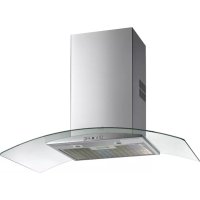
NC 985 - Basket TEKA - Free user manual and instructions
Find the device manual for free NC 985 TEKA in PDF.

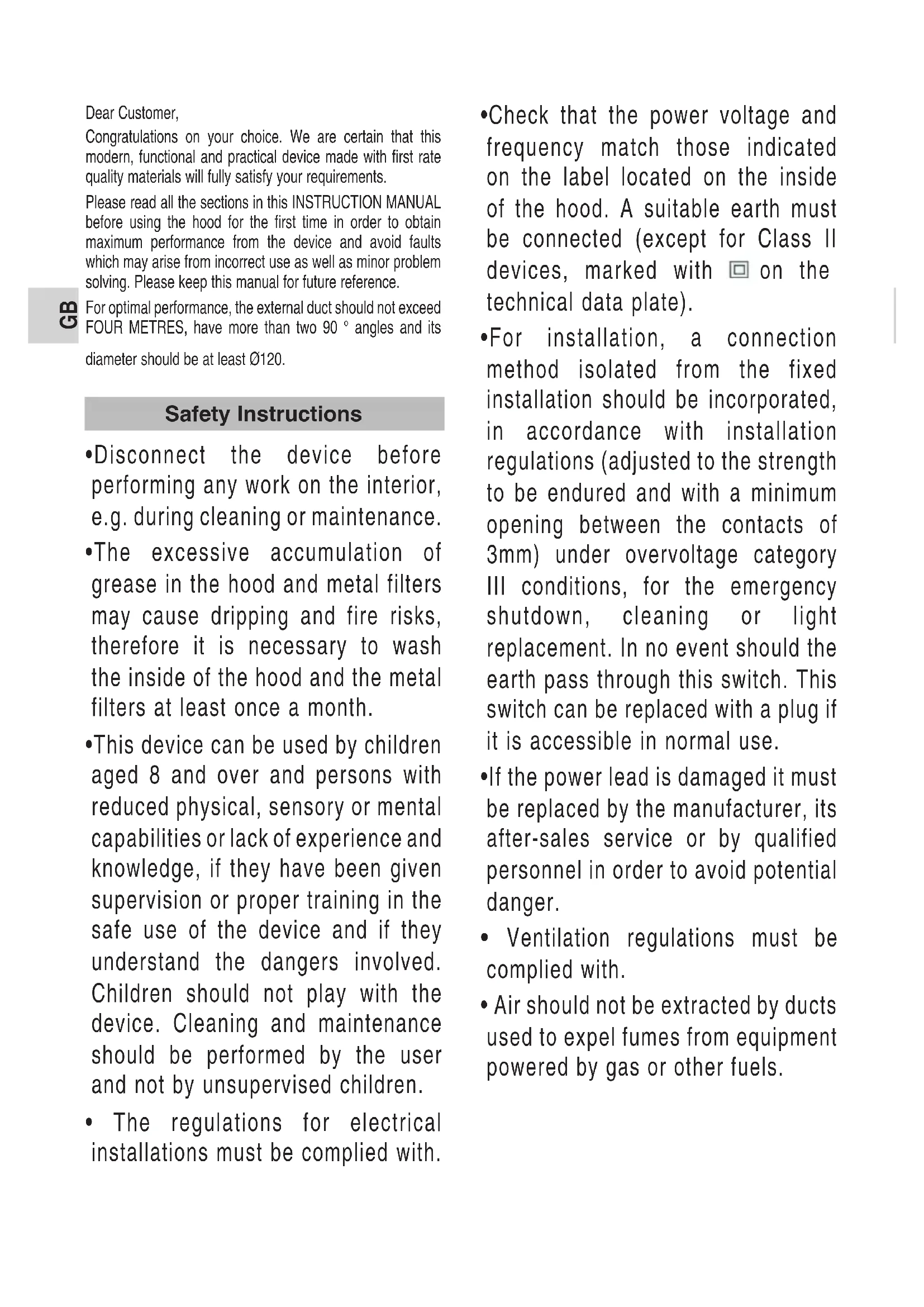


| Product Type | Range Hood |
| Brand | Teka |
| Model | NC 985 |
| Use | Domestic, for extraction and purification of cooking fumes |
| Minimum installation height | 65 cm above gas or mixed cooktops |
| Exhaust duct diameter | At least ∅120 mm |
| Maximum duct length | 4 meters, with maximum 2 90° angles |
| Ventilation speeds | 3 normal speeds + intensive speed (H) |
| Control | Electronic with display and timer |
| Lighting | Integrated |
| Timer | Programmable from 1 to 99 minutes |
| Metal filters | Dishwasher safe, monthly cleaning recommended |
| Activated carbon filter | Optional (may reduce airflow) |
| Filter saturation indicator | Yes, 'F' light signal |
| Body material | Stainless steel or painted (depending on version) |
| Interior cleaning | At least once a month, with gloves and without abrasive products |
| Safety | Automatic shutdown of intensive speed after 10 minutes |
| Installation | Above a maximum 4-zone cooktop |
| Power supply | See rating plate inside the hood |
| Repairability | Original spare parts, manufacturer after-sales service |
| Standards | Compliant with European directives (safety, EMC, performance) |
Frequently Asked Questions - NC 985 TEKA
User questions about NC 985 TEKA
0 question about this device. Answer the ones you know or ask your own.
Ask a new question about this device
Download the instructions for your Basket in PDF format for free! Find your manual NC 985 - TEKA and take your electronic device back in hand. On this page are published all the documents necessary for the use of your device. NC 985 by TEKA.
USER MANUAL NC 985 TEKA
natural_image
Modern kitchen interior with black wood cabinets and ovens, featuring a 'TEKA' logo in the top-right corner (no other text or symbols visible)DG #80/85
NC #80/85
ES CA DE GB FR PT GR TR PL HU RU UA SK CZ RO BG AR
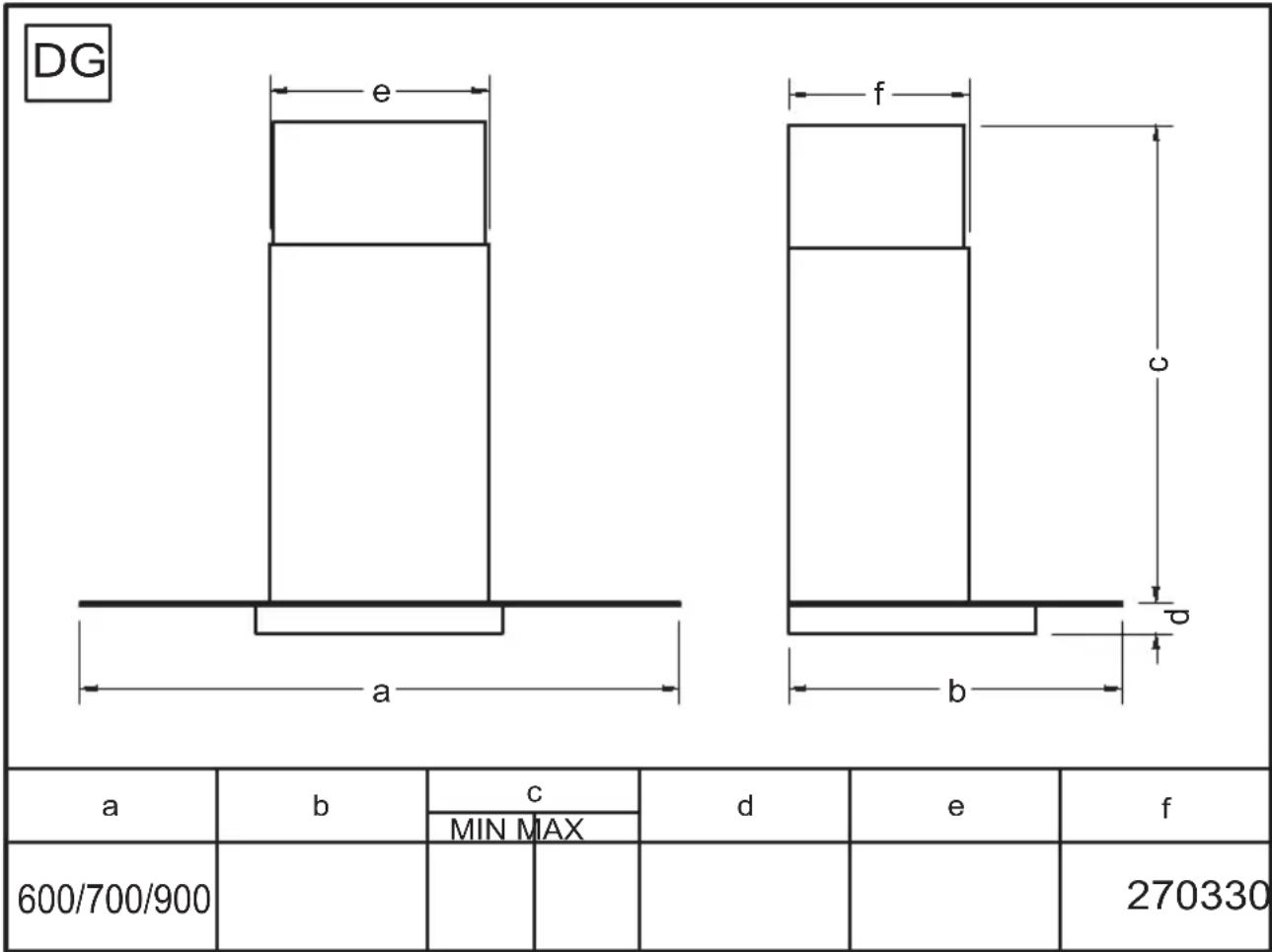
| a | b | c | d | e | f | |
| MIN MAX | ||||||
| 600/700/900 | 270330 | |||||
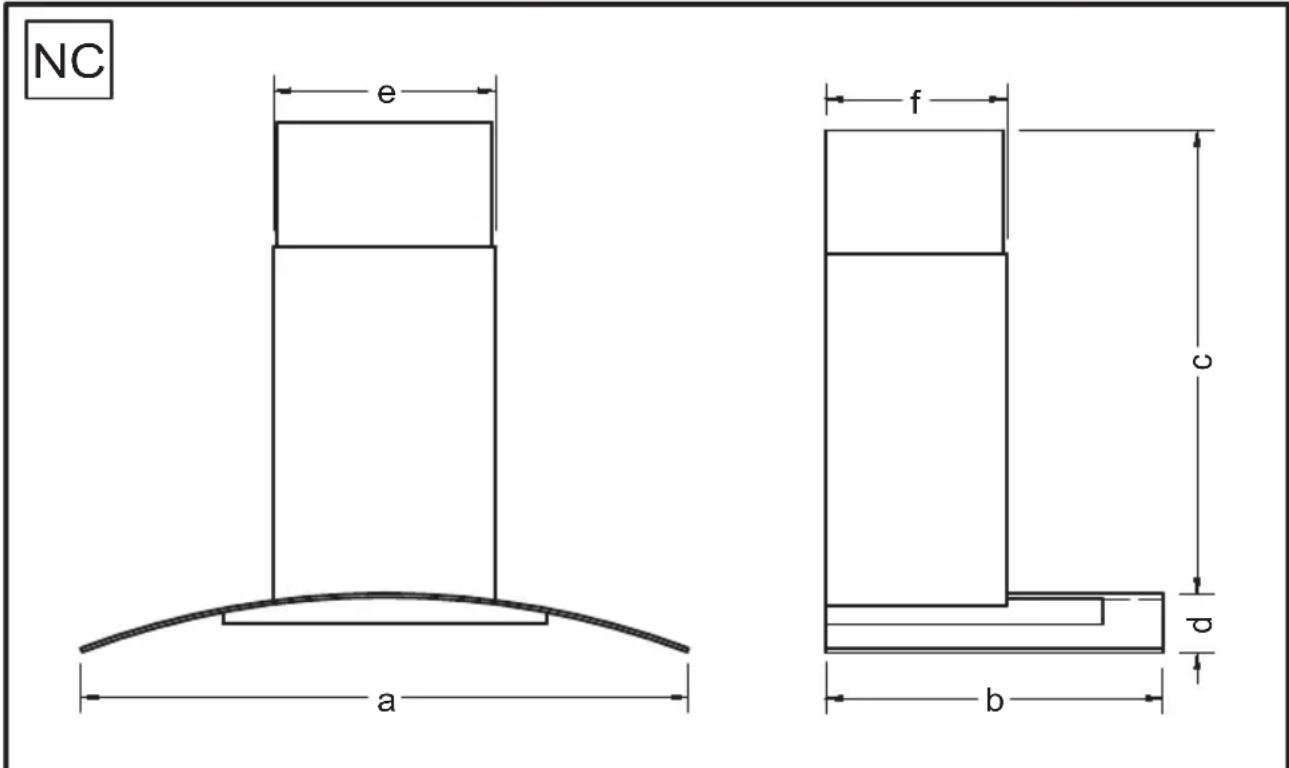
| a | b | c | d | e | f | |||
| MIN MAX | 900 700 | 600 | ||||||
| 600 / 700 | 90 | 44 | 27033 | |||||
| 760 / 900 | ||||||||
0:
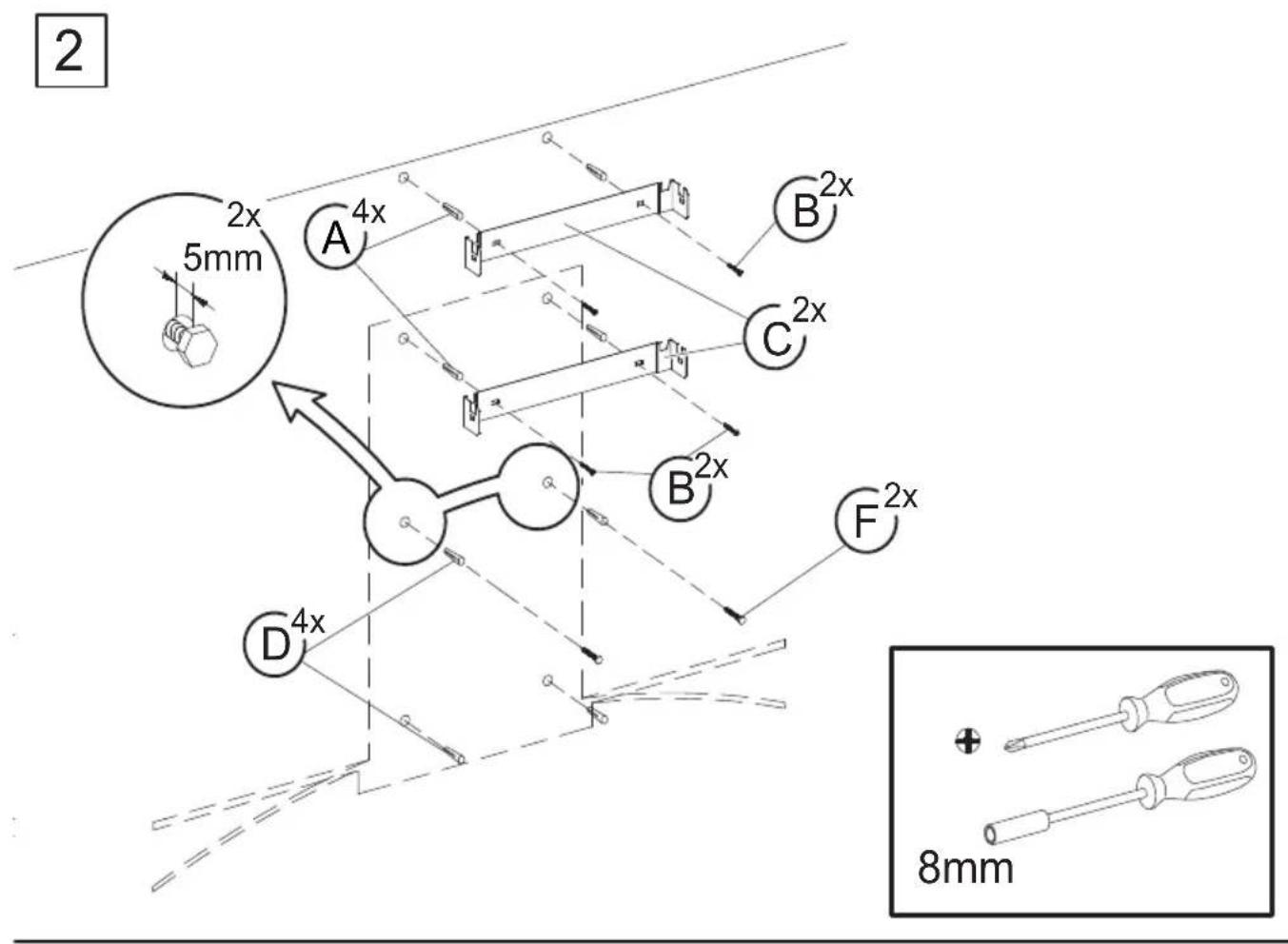
| A |  | ∅6x30 | 4x |
| B |  | ∅4x30 | 4x |
| C | 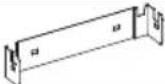 | 2x | |
| D |  | ∅8x40 | 4x |
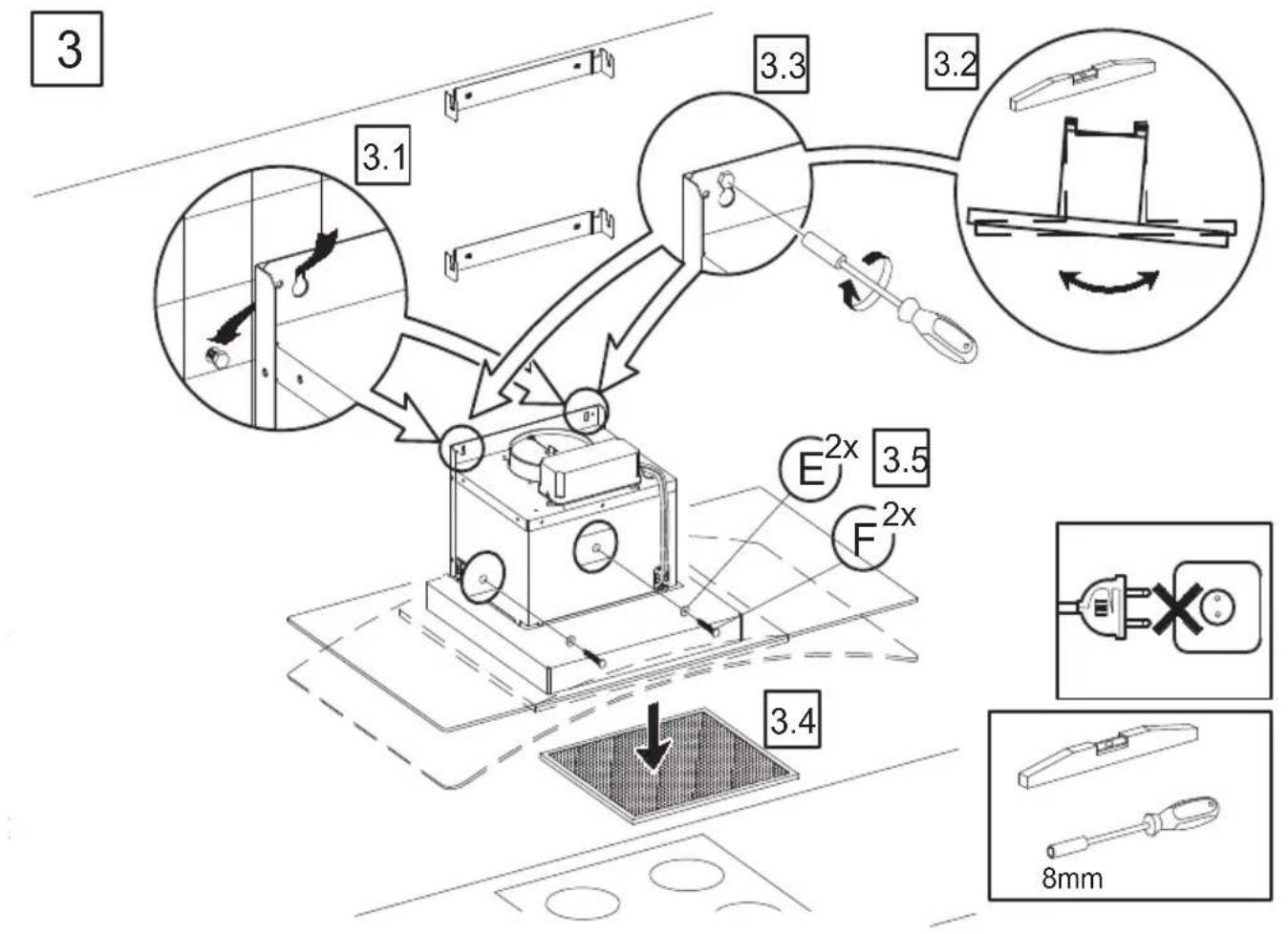
| E |  | ∅6.4x18 | 2x |
| F |  | ∅5x40 | 4x |
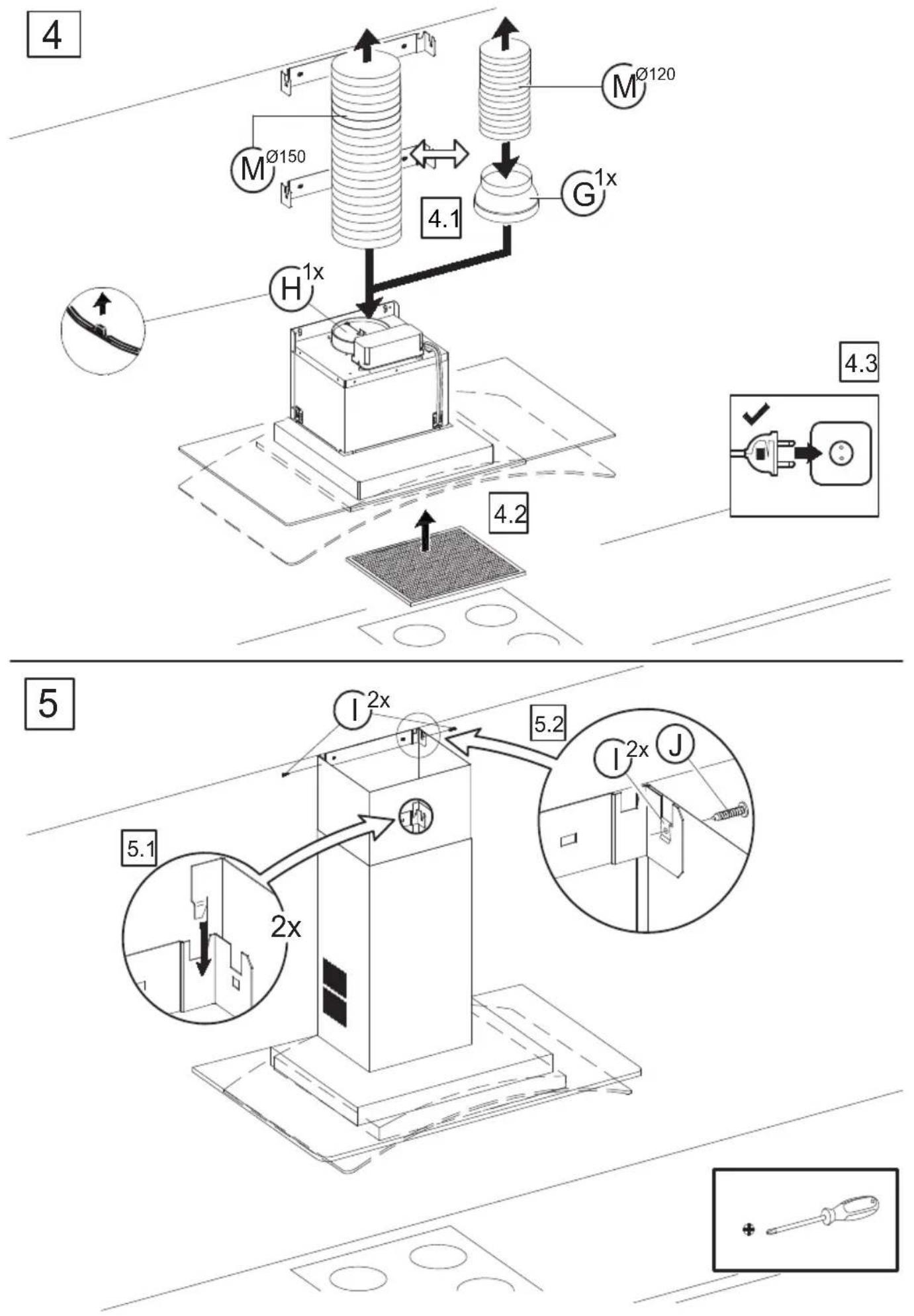
| G |  | 1x∅150-120 | |
| H |  | ∅150 | 1x |
| I | ### | 2x | |
| J | [DA06] | ∅3.9x19 | 2x |
| M |  | ∅150/120 | × |
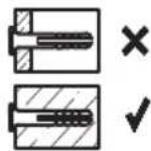

natural_image
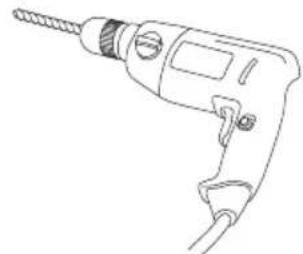
Line drawing of a drill bit with screwdriver and handle (no text or symbols)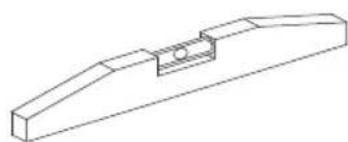
natural_image
Technical line drawing of a mechanical component with a flanged base and central slot (no text or symbols)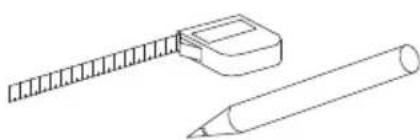
natural_image
Simple line drawing of a ruler and a pencil (no text or symbols)
natural_image
Illustration of two gloves and a triangular warning symbol (no text or labels)
natural_image
Line drawing of a screwdriver with a plus symbol (no text or labels)
natural_image
Line drawing of a screwdriver with a cylindrical shaft (no text or symbols)8mm
Estimado cliente:
Congratulations on your choice. We are certain that this modern, functional and practical device made with first rate quality materials will fully satisfy your requirements.
Please read all the sections in this INSTRUCTION MANUAL before using the hood for the first time in order to obtain maximum performance from the device and avoid faults which may arise from incorrect use as well as minor problem solving. Please keep this manual for future reference.
For optimal performance, the external duct should not exceed FOUR METRES, have more than two 90° angles and its diameter should be at least ∅120.
Safety Instructions
- Disconnect the device before performing any work on the interior, e.g. during cleaning or maintenance.
- The excessive accumulation of grease in the hood and metal filters may cause dripping and fire risks, therefore it is necessary to wash the inside of the hood and the metal filters at least once a month.
- This device can be used by children aged 8 and over and persons with reduced physical, sensory or mental capabilities or lack of experience and knowledge, if they have been given supervision or proper training in the safe use of the device and if they understand the dangers involved. Children should not play with the device. Cleaning and maintenance should be performed by the user and not by unsupervised children.
-
The regulations for electrical installations must be complied with.
-
Check that the power voltage and frequency match those indicated on the label located on the inside of the hood. A suitable earth must be connected (except for Class II devices, marked with ☐ on the technical data plate).
- For installation, a connection method isolated from the fixed installation should be incorporated, in accordance with installation regulations (adjusted to the strength to be endured and with a minimum opening between the contacts of 3mm) under overvoltage category III conditions, for the emergency shutdown, cleaning or light replacement. In no event should the earth pass through this switch. This switch can be replaced with a plug if it is accessible in normal use.
- If the power lead is damaged it must be replaced by the manufacturer, its after-sales service or by qualified personnel in order to avoid potential danger.
-
Ventilation regulations must be complied with.
• Air should not be extracted by ducts used to expel fumes from equipment powered by gas or other fuels. -
The room must be provided with adequate ventilation. When the extractor hood operates at the same time as other appliances powered by energy other than electricity, the air outlet pressure must not exceed 4 Pa ( 4 × 10^-5 bar).
- Do not produce flames under the hood.
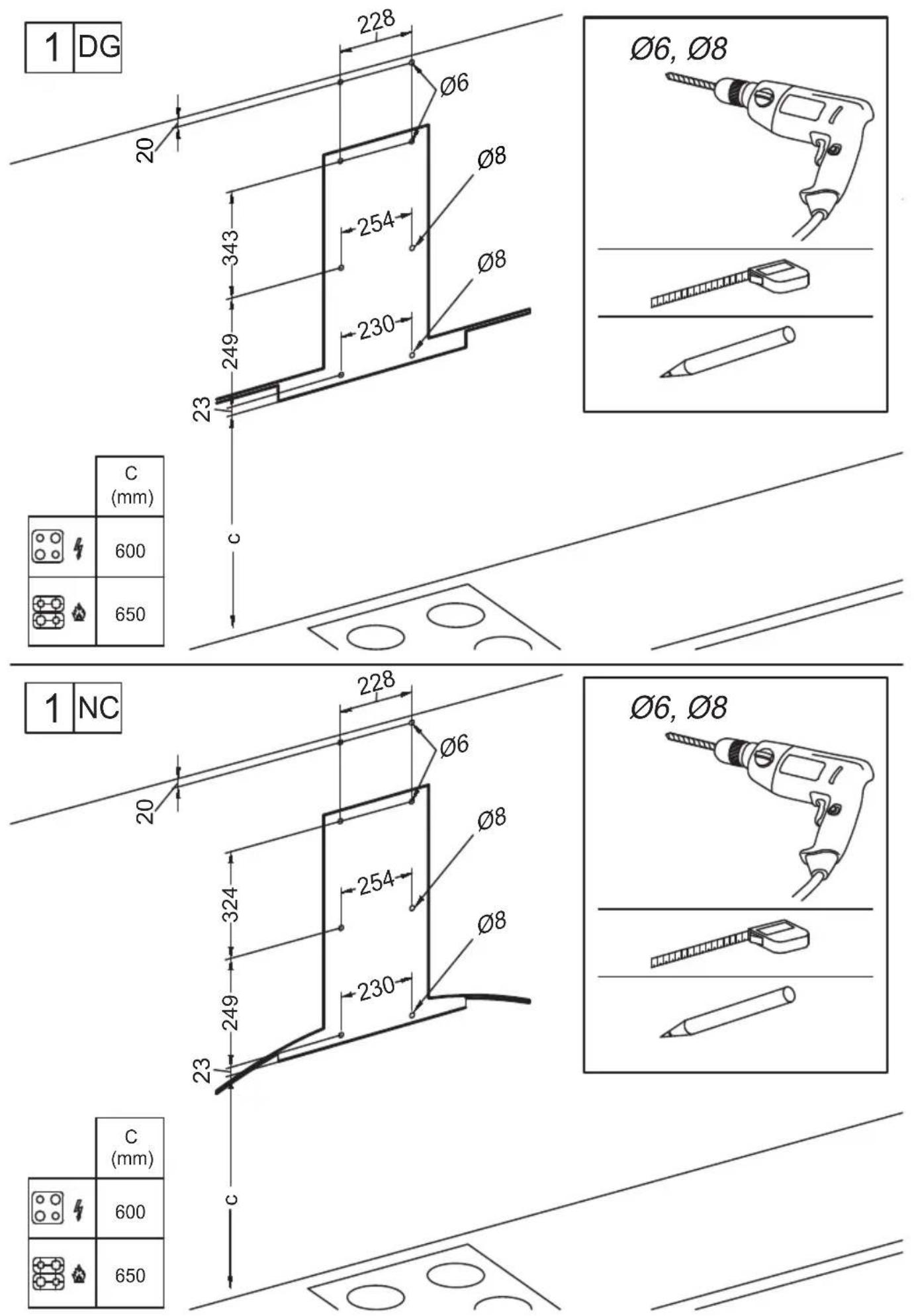
- The bottom of the hood must be fitted at least 65cm above gas or combination hobs. Observe the minimum limits set by worktop manufacturer's. This distance may be reduced if mentioned in the hood installation instructions.
- Accessible parts can be heated when used with cooking appliances.
- Never leave gas burning without a pan above it. The grease accumulated in the filters may drip or catch fire when the temperature is increased.
- Avoid cooking under the hood if the metal filters are not fitted e.g. while they are being cleaned in the dishwasher.
- We recommend you wear gloves and use extra caution when cleaning the inside of the hood.
- Your hood is designed for domestic use and only for the extraction and purification of gases from food preparation. Use for other purposes is at your own risk and may be dangerous. The manufacturer is not responsible for damage caused by improper use of the device.
- For repairs please contact the manufacturer's nearest Technical Assistance Department which will always use genuine parts. Repairs or modifications by unauthorized personnel may result in damage to equipment or malfunction, endangering safety.
•This device complies with the European Directive 2012/19/EU on electrical and
electronic devices entitled “Electrical and Electronic Equipment Waste”. The directive provides the framework applicable throughout the European Union for the return and recycling of electrical and electronic equipment waste [symbol] responsible for his/her safety. Keep children away from the device and never let them play with it
- Range hoods and other cooking fume extractors may adversely affect the safe operation of appliances burning gas or other fuels (including those in other rooms) due to back flow of combustion gases. These gases can potentially result in carbon monoxide poisoning. After installation of a range hood or other cooking fume extractor, the operation of flued gas appliances should be tested by a competent person to ensure that back flow of combustion gases does not occur.
(AS/NZS 60335.2.31:2020)
Installation
- The installation instructions are defined on the images at the beginning of this user manual.
- First, remove the protective foil from the back of the appliance and, following installation, remove the foil completely.
- Failure to follow the installation instructions for screws or fastening devices may result in an electrical fault.
- This cooker hood is intended to be installed only above a hob with no more than four cooking zones according to UNE-EN 60335-2-31:2015 A1:2023;7.12.1.
Instructions for use
You can activate or deactivate the cooker hood by operating the functions shown in the diagram.
Switch on the extractor fan a few minutes before you start to cook in order to ensure that a steady air flow has been established before fumes appear.
Allow the extractor fan to run for several minutes after you have finished cooking (between 3 to 5 minutes) in order to expel all the grease from the outlet duct. This prevents the return of grease, smoke and smells.
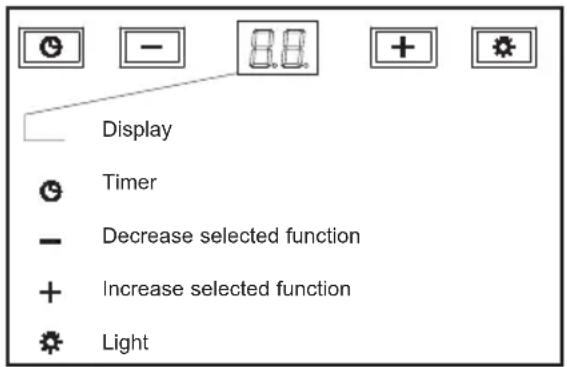
Program the working time
1) Switch on the cooker hood and choose the required aspiration speed.
2) Push 'Timer'.
3) Select the required programming time from 1 to 99 minutes by using the buttons '+' and '-'
4) The display will alternately show the clock and the remaining programming time. The maximum speed 'H' can only be selected manually and will be changed automatically to the second speed level after approximately 10 minutes.
Filter saturation indicator "F"
1) When the sign ‘Saturation of the filters’ is on, the filters should be cleaned.
2) After cleaning the filters, simultaneously push “+” and “-” for at least 3 seconds whereupon the sign will be switched off. It can also be switched off by unplugging mains.
Cleaning the metal filters
During cleaning and maintenance work, make sure the safety instructions are complied with.
Cleaning and maintenance
- If your kitchen hood is made of stainless steel, use proprietary cleaners mentioned in the product instructions.
- If your kitchen hood is painted, use lukewarm water and a neutral soap.
- Never use metallic scourers, nor abrasive or corrosive products.
- Dry the kitchen hood using a cloth that does not produce fibres.
- Do not use vapour cleaners
Cleaning the hood body
- To remove the filters from their fittings, press lightly on the locks and then pull them off.
- The metal filters can be cleaned by soaking them in hot water with neutral detergent until the fat dissolves and then rinsing them under the tap or using special anti-grease products. They can also be washed in a dishwasher. In this case, it is advisable to stack them vertically to avoid food residues to stick to them.
- Cleaning in a dishwasher may damage the metallic surface (blackening it), although this will not affect its fat retention capacity.
- Once clean, leave them to dry off and then fit them onto the kitchen hood.
Lights
For changing the light bulbs please contact the manufacturer's nearest Technical Service.
Lamp code: 81455067
Problem solving
Proceed with the following checks before calling the Technical Service:
| Problem Possible cause Solution | ||
| The kitchen hood does not work. | The mains cable is not connected to the network.There is no current in the network. | Connect the mains cable to the network.Provide current to the network. |
| The kitchen hood does not extract sufficiently or vibrates. | Filters are saturated with fat.Obstruction in the air outlet. | Change or clean the active charcoal and/or metal filters.Remove the obstruction. |
Active charcoal filters (Optional)
- To install the active carbon filter follow the instructions supplied with it.
- The manufacturer reserves the right to make any corrections it deems necessary to its devices without damaging its essential characteristics.
- It is possible that with the installation of carbon filters, a reduction in the extraction flow can be observed in the hood.
Environmental protection information.
Energy Saving
- This appliance is energy efficient. Here are some tips to save even more energy:
- Ensure adequate airflow while cooking so the range hood operates efficiently and quietly.
- Adjust the fan speed to the amount of steam generated during cooking. Use the intensive setting only when necessary; the lower the fan speed, the less energy is consumed.
- When steam is generated, select the highest fan speed at the right time. If the steam has already spread throughout the kitchen, the range hood will have to run for longer and therefore consume more energy.
- Turn off the range hood and lights when they are no longer needed or not in use.
- Clean and replace the filter regularly to increase the effectiveness of the ventilation system and avoid the risk of fire.
- Cover pots and pans while cooking to reduce steam and condensation.
Disposal of Packaging
- Dispose of packaging materials such as cardboard, polyurethane, and film in suitable containers. This ensures that the materials are reused.
Appliance Disassembly
- Disconnect the power supply.
- Remove the duct cover above the extractor hood.
-
Disconnect the duct.
-
Remove the screws securing the appliance to the wall while supporting it.
-
Dispose of any waste in accordance with applicable environmental protection regulations.
Disposal of Old Appliances
- According to European Directive 2012/19/EU (WEEE), old household appliances must not be disposed of with household waste. They must be collected separately to optimize the recovery and recycling of their components and materials and to reduce the impact on human health and the environment. • The crossed-out wheeled bin symbol on all products reminds you of the obligation to collect waste separately. For information on the correct disposal of your old appliance, contact your local council or retailer.
- Make your appliance unusable before disposal. Cut off the power cord and dispose of it.
Technical Information:
Electrical Specifications (SEE LABEL)
This device has been designed, tested, and manufactured in accordance with the following standards:
- Safety: EN/IEC 60335-1; EN/IEC 60335-2-31, EN/IEC 62233
• Performance: EN/IEC 61591; ISO 5167-1; ISO 5167-3; ISO 5168; EN/IEC 60704-1; EN/IEC 60704-2-13; EN/IEC 60704-3; ISO 3741; EN 50564/IEC 62301 - EMC: EN 55014-1 / CISPR 14-1; EN 55014-2/CISPR14-2;EN/IEC61000-3-2; EN/IEC 61000-3-3
Cher client:
For changing the light bulbs please contact the manufacturer's nearest Technical Service.
Lamp code: 81455067