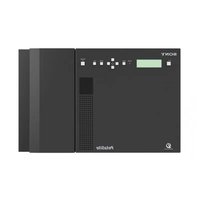
SCD777ES - Cd player/recorder SONY - Free user manual and instructions
Find the device manual for free SCD777ES SONY in PDF.


User questions about SCD777ES SONY
0 question about this device. Answer the ones you know or ask your own.
Ask a new question about this device
Download the instructions for your Cd player/recorder in PDF format for free! Find your manual SCD777ES - SONY and take your electronic device back in hand. On this page are published all the documents necessary for the use of your device. SCD777ES by SONY.
USER MANUAL SCD777ES SONY
Super Audio CD Player
Operating Instructions GB
To prevent fire or shock hazard, do not expose the unit to rain or moisture. To avoid electrical shock, do not open the cabinet. Refer servicing to qualified personnel only.
For the customers in the United States
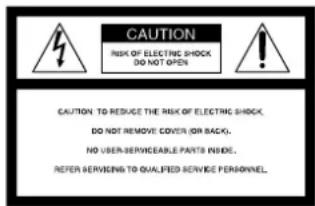
text_image
CAUTION RISK OF ELECTRIC SHOCK DO NOT OPEN CAUTION TO REDUCE THE RISK OF ELECTRIC SHOCK, DO NOT REMOVE COVER (OR BACK), NO USER-SERVICEABLE PARTS INSIDE, REFER SERVINGS TO QUALIFIED SERVICE PERSONNEL.
This symbol is intended to alert the user to the presence of uninsulated “dangerous voltage” within the product’s enclosure that may be of sufficient magnitude to constitute a risk of electric shock to persons.

This symbol is intended to alert the user to the presence of important operating and maintenance (servicing) instructions in the literature accompanying the appliance.
INFORMATION
This equipment has been tested and found to comply with the limits for a Class B digital device, pursuant to Part 15 of the FCC Rules. These limits are designed to provide reasonable protection against harmful interference in a residential installation. This equipment generates, uses, and can radiate radio frequency energy and, if not installed and used in accordance with the instructions, may cause harmful interference to radio communications. However, there is no guarantee that interference will not occur in a particular installation. If this equipment does cause harmful interference to radio or television reception, which can be determined by turning the equipment off and on, the user is encouraged to try to correct the interference by one or more of the following measures:
– Reorient or relocate the receiving antenna.
– Increase the separation between the equipment and receiver.
- Connect the equipment into an outlet on a circuit different from that to which the receiver is connected.
- Consult the dealer or an experienced radio/TV technician for help.
CAUTION
You are cautioned that any changes or modification not expressly approved in this manual could void your authority to operate this equipment.
Owner's Record
The model and serial numbers are located at the rear of the unit.
Record the serial number in the space provided below. Refer to them whenever you call upon your Sony dealer regarding this product.
Model No. SCD-777ES
Serial No.
The following caution label is located on the rear enclosure.
For the customers in Canada CAUTION
TO PREVENT ELECTRIC SHOCK, DO NOT USE THIS POLARIZED AC PLUG WITH AN EXTENSION CORD, RECEPTACLE OR OTHER OUTLET UNLESS THE BLADES CAN BE FULLY INSERTED TO PREVENT BLADE EXPOSURE.
For the customers in Europe
This appliance is classified as a CLASS 1 LASER product.
The CLASS 1 LASER PRODUCT
MARKING is located on the rear exterior.
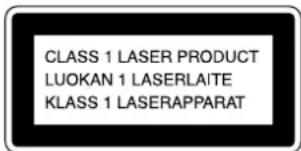
text_image
CLASS 1 LASER PRODUCT LUOKAN 1 LASERLAITE KLASS 1 LASERAPPARATWelcome!
Thank you for purchasing the Sony Super Audio CD Player. Before operating the unit, please read this manual thoroughly and retain it for future reference.
About This Manual
The instructions in this manual are for model SCD-777ES.
Conventions
- Instructions in this manual describe the controls on the player.
You can also use the controls on the remote if they have the same or similar names as those on the player. - The following icons are used in this manual:

Indicates that you can do the task using the remote.

Indicates hints and tips for making the task easier.
Features
Playback of the Super Audio CD recorded in the DSD format
The DSD (Direct Stream Digital) format is the core technology of a Super Audio CD, allowing music reproduction that is extremely faithful to the original sound.
The DSD format, using a 2.8224 MHz sampling frequency 64 times higher than that of a conventional CD, and the 1-bit quantization, makes possible recording of more than four times the data information of the PCM format which is used for a conventional CD.
Different from the PCM format which performs data decimation and interpolation via digital filters, the DSD format adopts the simple playback process. In other words, the A/D converted 1-bit digital signal only passes through an analog low-pass filter before playback. As a whole, the DSD format achieves both a wide frequency range of theoretically over 100 kHz, and a wide dynamic range across the audible frequency range at the same time, and results in high-quality music reproduction faithful to the original sound.
To play back a Super Audio CD recorded in the DSD format with exceptional quality, the SCD-777ES employs a newly developed DSD decoder and D/A converter system, as well as a chassis and loading mechanism especially designed for this unit.
Playback of a conventional CD with higher quality
The SCD-777ES can also play back a conventional CD with higher quality than a conventional CD player. To provide enhanced quality, the SCD-777ES employs various advanced technologies. For example, two independent optical pickups are incorporated; one is for Super Audio CDs, and the other for conventional CDs. In addition, a 24-bit precision variable coefficient (V.C.) digital filter is provided for CD playback (see page 19). By selecting one of five filters which have different cutoff characteristics, you can adjust the tone quality in accordance with the music source or your audio system.
Others
- A Super Audio CD can mark up to 255 track/index numbers. Corresponding to that format, the SCD-777ES incorporates a large 3-digit display.
- The supplied remote is capable of controlling either the SCD-777ES and a conventional Sony CD player. (See 2 COMMAND MODE selector on page 10 and 1 CD1/CD2 selector on page 11.)
TABLE OF CONTENTS
Getting Started 4
Before You Start the Hookup 4
Hooking Up the Audio Components 5
About the Switch Marked "STANDARD" on the rear panel of the player 6
Hooking Up the Power 6
Compatible Disc Types 7
Location and Functions of Parts 8
Front Panel Parts Descriptions 8
Rear Panel Parts Descriptions 10
Remote Parts Descriptions 11
Playing Discs 12
Playing a Disc 12
Using the Display 13
Locating a Specific Track 15
Locating a Particular Point in a Track 16
Playing Tracks Repeatedly 16
Playing Tracks in Random Order (Shuffle Play) 17
Creating Your Own Programme (Programme Play) 18
Listening to a CD Using a Filter (Digital Filter Function) 19
Additional Information 20
Precautions 20
Notes on Discs 21
Cleaning the Turntable 21
Troubleshooting 22
Specifications 22
Index 23
Getting Started
This chapter provides information on the supplied accessories and how to connect various audio components to the Super Audio CD player. Be sure to read this chapter thoroughly before you actually connect anything to the player.
Before You Start the Hookup
Checking the supplied accessories
This player comes with the following items:
• Audio connecting cord
- Mains lead (1)
- Plug adapter (U.S.A. and Canadian models only) (1)
- Stabilizer (1)
- Remote commander (remote) RM-DS1 (1)
• R03 (size-AAA) batteries (2)
$$ (\text { phono jack } \cdot 2 \leftrightarrow \text { phono jack } \cdot 2) (1) $$
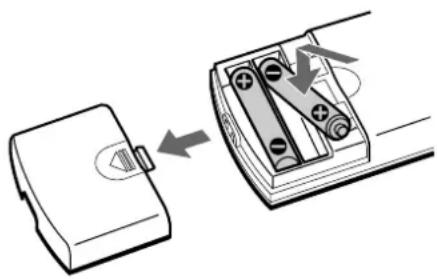
Inserting batteries into the remote
Insert two R03 (size-AAA) batteries into the battery compartment with the + and - correctly oriented to the markings. When using the remote, point it at the remote sensor R on the player.
natural_image
Diagram showing a battery component being placed into a housing, with arrows indicating direction of movement (no text or symbols present)
When to replace the batteries
Under normal conditions, the batteries should last for about six months. When the remote no longer operates the player, replace both batteries with new ones.
Notes
- Do not leave the remote in an extremely hot or humid place.
- Do not drop any foreign object into the remote casing, particularly when replacing the batteries.
- Do not use a new battery with an old one.
- Do not expose the remote sensor to direct sunlight or lighting apparatus. Doing so may cause a malfunction.
- If you do not intend use the remote for an extended period of time, remove the batteries to avoid possible damage from battery leakage and corrosion.
Hooking Up the Audio Components
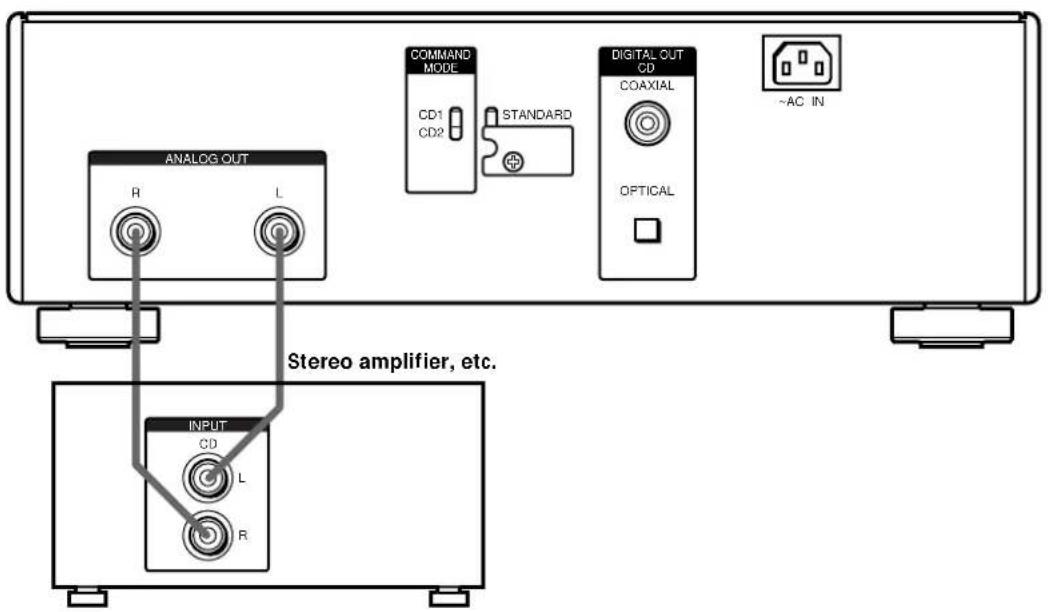
Connect the Super Audio CD player to an audio component. Be sure to turn off the power of all components before making connections and connect securely to prevent noise.
Connecting via ANALOG OUT jacks
Use an audio connecting cord for this connection. Be sure to match the colour-coded pin to the appropriate jacks: white (left) to white and red (right) to red.
Audio connecting cord (supplied)

text_image
White (L) Red (R) White (L) Red (R)Connecting via DIGITAL OUT CD OPTICAL connector
Use an optical digital cable for this connection. When connecting the optical digital cable to the DIGITAL OUT CD OPTICAL connector, take the cap off the connectors and push the cable plugs in until they click into place.
Be sure to show "16 bit" in the display by pressing DIGITAL OUT on the upper side of the player. Be careful not to bend or twist the optical cable.
Optical digital cable (not supplied)

Note
Only the audio signals of the CD can be output from the DIGITAL OUT CD connectors. Those of the Super Audio CD cannot be output through DIGITAL OUT CD.
Connecting via DIGITAL OUT CD COAXIAL connector
Use a coaxial digital cable to connect the audio components equipped with coaxial digital input connectors. When connecting the coaxial digital cable, be sure to show "16 bit" in the display by pressing DIGITAL OUT on the upper side of the player.
Coaxial digital cable (not supplied)

Note
Only the audio signals of the CD can be output from the DIGITAL OUT CD connectors. Those of the Super Audio CD cannot be output through DIGITAL OUT CD.
text_image
ANALOG OUT R L COMMAND MODE CD1 CD2 STANDARD DIGITAL OUT CD COAXIAL OPTICAL ~AC IN Stereo amplifier, etc. INPUT CD L RAbout the Switch Marked "STANDARD" on the rear panel of the player
The Super Audio CD includes high frequencies beyond the audible range, although the design of normal amplifiers and speakers is based on characteristics corresponding to the audible range.
Therefore, if you increase the volume or treble excessively during Super Audio CD playback, noise may occur or the amplifier's protect circuit may be activated. To prevent these problems, set the switch at the rear of this player in accordance with the connected amplifier. This enables you to match the output signal to the amplifier characteristics.
Connecting to a normal amplifier
This switch is set to "STANDARD" at the factory. When you connect this player to a normal amplifier, leave the switch as it is. Never set it to "CUSTOM," otherwise noise may be produced or the speakers and the amplifier may be damaged.
Connecting to the units described below
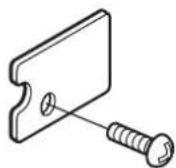
When you connect this player to the following units, remove the cover as illustrated below, then set the switch to "CUSTOM."
• TA-E1 (stereo preamplifier) and TA-N1 (stereo power amplifier)
— European models only
• TA-FA777ES (integrated stereo amplifier)
The "CUSTOM" mode enables you to enjoy a wider range of frequencies.
Note
When you record the audio signals of a Super Audio CD to a tape deck (Cassette deck etc.), set the switch to "STANDARD" even if the player is connected to the one of the units described above.
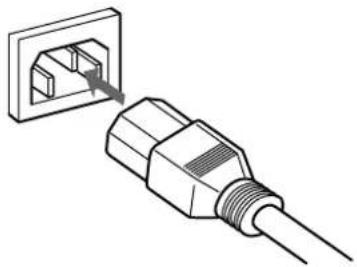
Hooking Up the Power
Connect the supplied mains lead to the AC IN terminal on the player.
natural_image
Diagram of a plug with a connector inserted into a socket (no text or symbols present)About the mains lead
European models only
Connect the supplied mains lead to the mains.
U.S.A. and Canadian models only
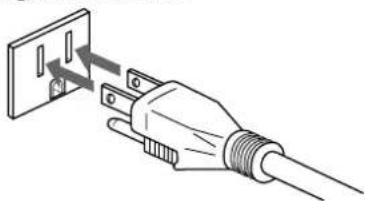
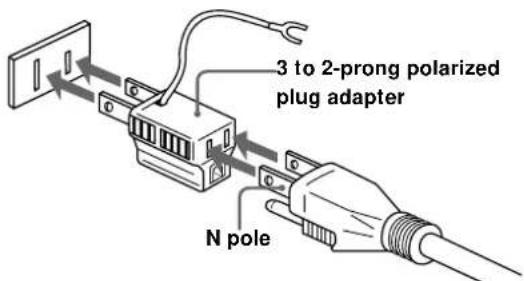
The supplied mains lead has a 3-pronged grounded plug. If you are using 3-pronged grounded mains, the plug can be inserted directly into the mains. However, if the socket is a 2-pronged grounded mains, use the supplied plug adapter or a commercially available plug adapter.
3-pronged grounded mains
natural_image
Illustration of a hand inserting a plug into an electrical outlet (no text or symbols)2-pronged polarized mains
- When the width of the mains are a different size
Use the supplied plug adapter.
text_image
3 to 2-prong polarized plug adapter N pole- When the width of the mains are the same size
Use a commercially available plug adapter. In this case, you can check the polarity of the mains with a commercially available spark-testing screwdriver. It is the pronged ground that does not light the neon grow lamp even if you insert the spark-testing screwdriver into the mains. Insert the blades so that the "N pole" can be inserted to the ground on the plug.
If noise (hum) is produced
Noise may be caused by an electric potential difference on the ground circuit.* In this case, use the supplied plug adapter and be careful not to connect the ground lead to anything.
* Although the ground of the domestic mains is normally a safety ground, a few electrical potential differences may be produced, depending on the mains. Therefore, use of the supplied 3-pronged mains lead may lessen the quality of the audio signal or may produce humming noise.
Compatible Disc Types
You can play the following discs with this player.
Depending on the type of disc to be played, select the appropriate indicator by pressing SACD/CD (pages 8, 12).
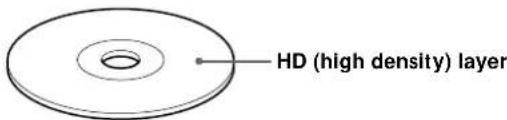
Super Audio CD (single layer disc)
This disc consists of a single HD layer*.
Press SACD/CD repeatedly so that the SACD indicator on the upper side of the player lights.
*High density signal layer for the Super Audio CD
text_image
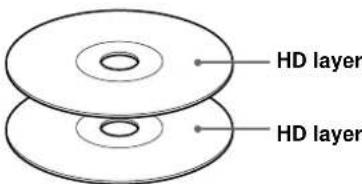
HD (high density) layerSuper Audio CD (dual layer disc)
This disc consists of dual HD layers and is capable of extended play over long periods.
Press SACD/CD repeatedly so that the SACD indicator on the upper side of the player lights.
Also, as the dual layer disc consists of dual HD layers on one side only, it is not necessary to turn the disc over.
text_image
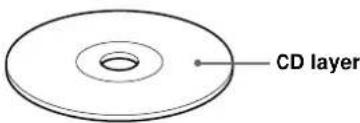
HD layer HD layerConventional CD
This disc is the current format.
Press SACD/CD repeatedly so that the CD indicator on the upper side of the player lights.
text_image
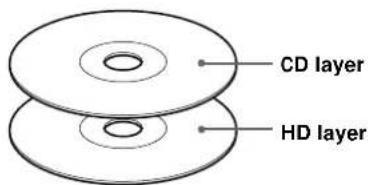
CD layerSuper Audio CD + CD (Hybrid disc)
This disc consists of an HD layer and a CD layer. Press SACD/CD to select the layer you want to listen to. Also, as the dual layers are on one side, it is not necessary to turn the disc over. You can play the CD layer using a conventional CD player.
text_image
CD layer HD layerIncompatible Discs
This player cannot play the following discs. If you try to play them, the error message "TOC Error" will appear or there will be no sound.
- CD-ROM
• DVD etc.
Location and Functions of Parts
This chapter tells you about the location and functions of the various buttons and controls on the front and rear panels and the supplied remote. Further details are provided on the pages indicated in parentheses. It also tells you about the information that appears in the display window.
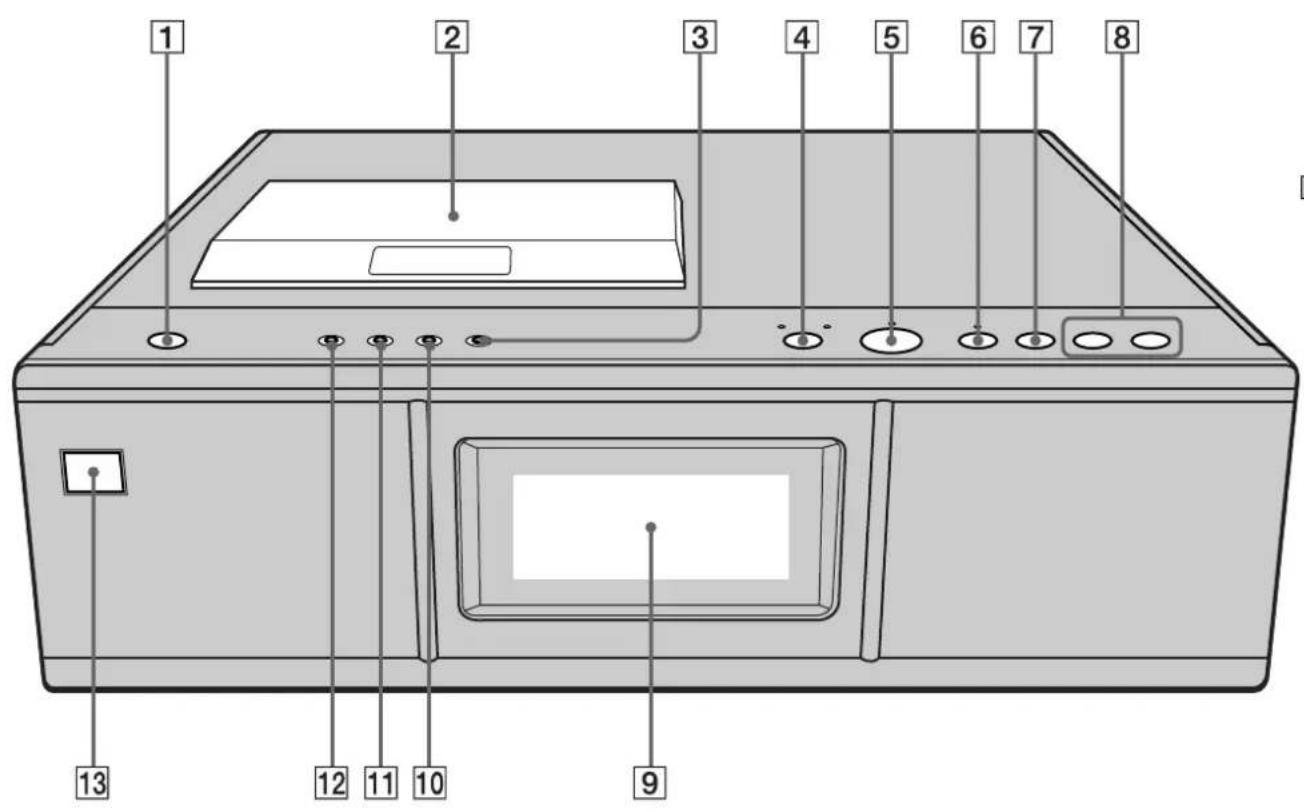
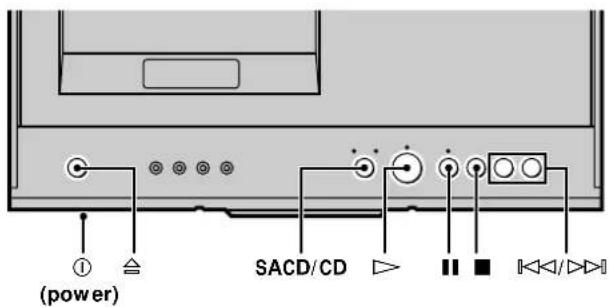
Front Panel Parts Descriptions
1 ≜ button (12)
Press to open the disc lid.
2 Disc lid (12)
Press to open/close the disc lid.
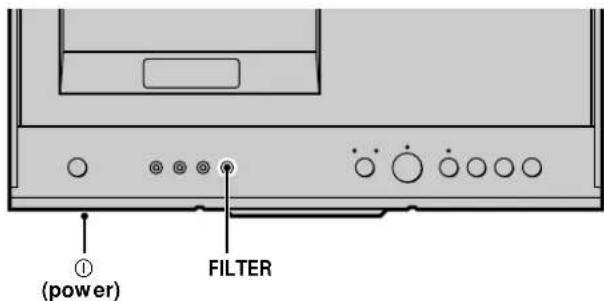
3 FILTER button (19)
Press to select the digital filter type when playing a CD.
4 SACD/CD button (12)
Each time you press the button while the player is stopped, the SACD or CD indicator on the upper side of the player lights. Select the indicator that matches the type of CD you want to play. For details on the type of discs you can play, see “Compatible Disc Types” on page 7.
5 ▷ button (12)
Press to start play.
6 II button (13)
Press to pause play.
text_image
1 2 3 4 5 6 7 8 9 10 11 12 137 ■ button (13)
Press to stop play.
8 ◀◀/▶▶ button (13)
Each time you press ◀◀◀, you go back to the preceding track; each time you press ▷▶▶, you go to the succeeding track.
9 Display window (Remote sensor) (13)
Shows various information.
10 DIGITAL OUT button (5)
Press when a component is connected to the DIGITAL OUT CD connectors. Each time you press the button, the display switches between "16 bit" (the audio signals of a CD can be output) and "OFF" (the audio signals of a CD cannot be output).
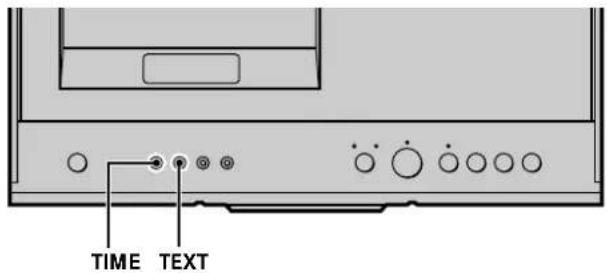
11 TEXT button (14)
Shows TEXT information when the player detects a TEXT disc.
12 TIME button (13)
Each time you press the button, the playing time of the track and the total remaining time on the disc appear in the display.
13 ① (power) switch (12)
Press to turn on the player.
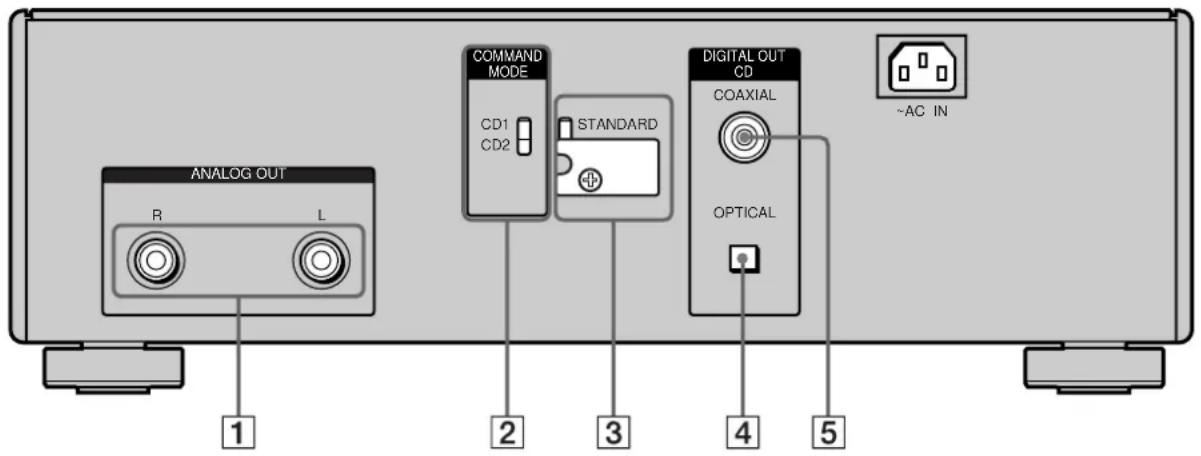
Rear Panel Parts Descriptions
text_image
ANALOG OUT R L COMMAND MODE CD1 CD2 STANDARD DIGITAL OUT CD COAXIAL OPTICAL ~AC IN 1 2 3 4 51 ANALOG OUT jacks (5)
Connect to an audio component using the audio connecting cord.
2 COMMAND MODE selector
Normally set to CD1. When you connect a Sony CD player other than this player, set to CD2. In this case, you can control both the other Sony CD player and this player with CD1/CD2 on the remote. Set to CD1 to control the other Sony CD player, or CD2 to control this player.
3 Switches depending on amplifier to be connected. For details, see "About the Switch Marked "STANDARD" on the rear panel of the player" on page 6.
4 DIGITAL OUT CD OPTICAL connector (5)
Connect to an audio component using an optical digital cable.
5 DIGITAL OUT CD COAXIAL connector (5)
Connect to an audio component using the coaxial digital cable.
Note
Only the audio signals of the CD can be output from the DIGITAL OUT CD connectors shown in 4 and 5 . Those of the Super Audio CD cannot be output through DIGITAL OUT CD.
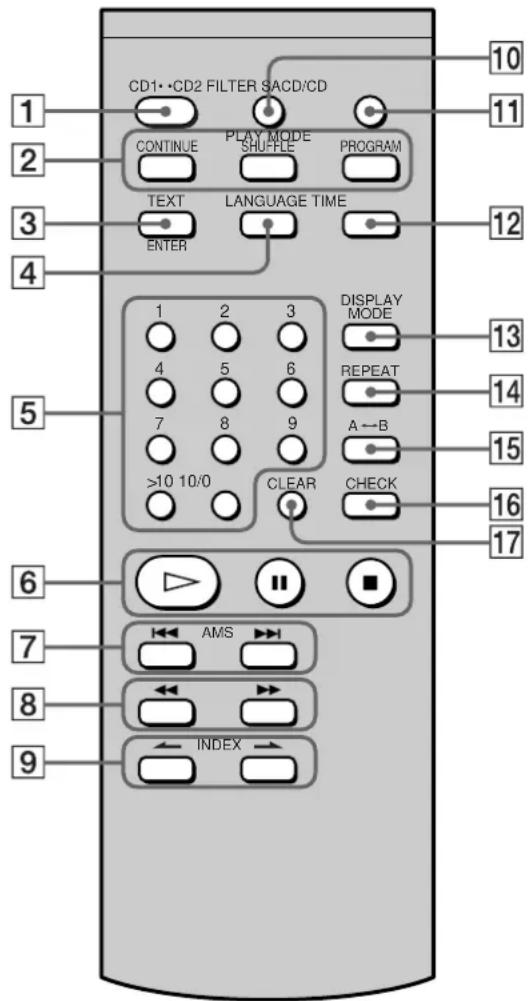
Remote Parts Descriptions
1 CD1/CD2 selector
Select when you connect a Sony CD player other than this player. Set to CD1 to control the other Sony CD player, or CD2 to control this player. In this case, you have to set the COMMAND MODE selector on the rear panel to CD2.
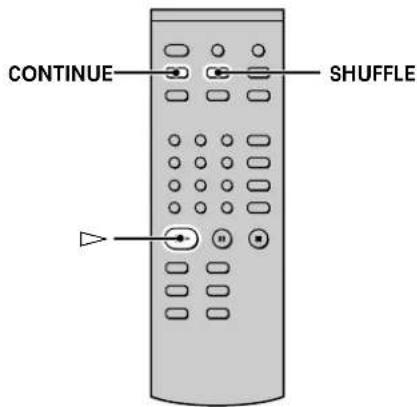
2 CONTINUE button (17, 18)
Press to resume normal play from Shuffle Play or Programme Play.
SHUFFLE button (17)
Press to select Shuffle Play.
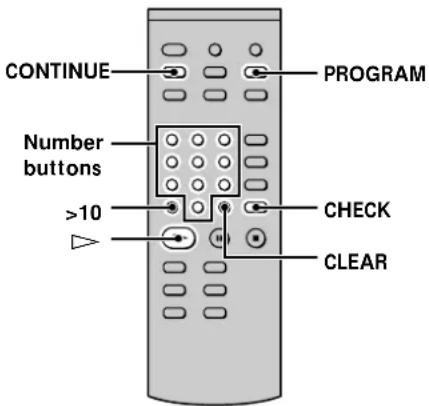
PROGRAM button (18)
Press to select Programme Play.
3 TEXT/ENTER button (14, 15)
Shows the TEXT information when the player detects a TEXT disc.
4 LANGUAGE button (15)
Press to change the displayed language if the TEXT disc has several languages.
5 Number buttons (15)
Press to enter the track numbers.
6 ▷ button (12)
Press to start play.
II button (13)
Press to pause play.
■ button (13)
Press to stop play.
7 AMS I◄◄/►►I (AMS: Automatic Music Sensor) buttons (13, 15)
Press to locate a specific track.
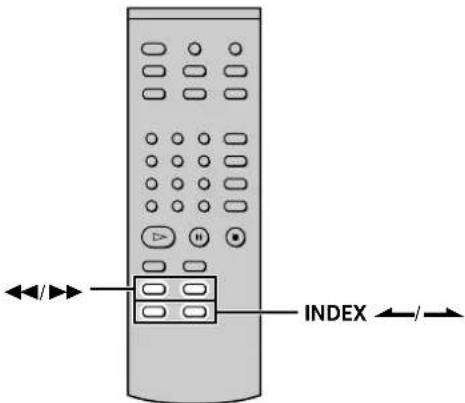
8 ◀◀/▶▶ buttons (16)
Press to locate a portion you want to play within a track.
9 INDEX ←/→ buttons (16)
Press to locate a specific point marked with an index signal when you play a disc that has index signals.
10 FILTER button (19)
Press to select the digital filter type when a CD is played.
11 SACD/CD button (12)
Each time you press the button, the SACD or CD indicator on the front of the player lights. Select the indicator that matches the type of CD you want to play.
12 TIME button (13)
Each time you press the button, the playing time of the track and the remaining time on the disc appear in the display.
13 DISPLAY MODE button (14)
Press to turn off the information.
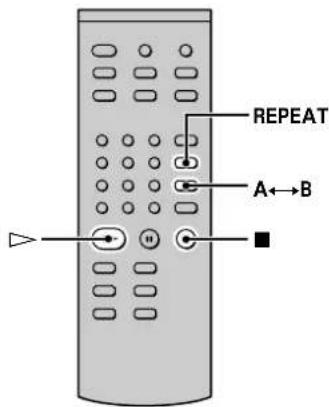
14 REPEAT button (16)
Press repeatedly to play all tracks or only one track on the disc.
15 A←→B button (17)
Press to select Repeat A-B Play.
16 CHECK button (18)
Press to check the programmed order.
17 CLEAR button (18)
Press to delete a programmed track number.
text_image
CD1••CD2 FILTER SACD/CD CONTINUE PLAY MODE SHUFFLE PROGRAM TEXT LANGUAGE TIME ENTER DISPLAY MODE REPEAT A ←B >10 10/0 CLEAR CHECK 1 2 3 4 5 6 7 8 9 6 AMS INDEX 10 11 12 13 14 15 16 17 7 8 9Playing Discs
This chapter explains the various ways to play discs.
Playing a Disc
The operations for normal play and the basic operations during play are explained below.
text_image
(power) SACD/CD1 Turn on the amplifier.
2 Select the player position using the input selector on the amplifier.
3 Press ① (power) to turn on the player.
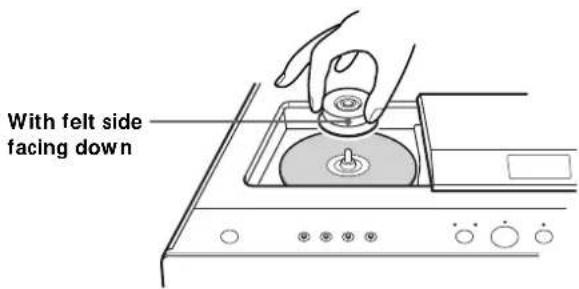
4 Press to open the disc lid, and place a disc on the tray.
Place the supplied stabilizer on the disc. If you do not, "NoStabilizer" appears in the display.
text_image
With felt side facing down5 Press SACD/CD to select the SACD or CD indicator. Each time you press the button, the SACD or CD indicator lights. Select the indicator that corresponds to the type of discon the tray. For details, see page 7.
6 Press ▷. When the disclid is closed, "CLOSE," "Loading," and "TOC Reading" appear in sequence in the display. Then, playback starts from the first track. If you want to start tplaying fr om a specific track, pr ess <<|, >>| repeatedly to select the track number before pressing ▷.
7 Adjust the volume on the amplifier.
Basic operations during play
| To | Press |
| Stop play | ■ |
| Pause play | ■ |
| Resume play after pausing | ■ or ▷ |
| Locate a succeeding track | ▶▶ |
| Locate the beginning of the current track or a preceding track | ◀◀ |
| Eject the disc | △ |

If you turn on the player when a disc is already loaded
Playback starts automatically. If you connect a commercially available timer, you can set it to start playing the disc at any time you want.

To select a layer you want to listen to when playing a hybrid: (page 7)
After you stop play using ■, press SACD/CD repeatedly to light either the SACD or CD indicator.
Notes
- Remove the stabilizer when there is no disc in the player.
- The Super Audio CD player takes longer than a conventional CD player to start playing after the disc is loaded. This is not a malfunction. The player is automatically identifying the type of disc, adjusting the servomechanism or verifying the copyright protection in internal mechanisms of the inserted disc.
Using the Display
The display window shows various information about the disc or track being played. This section describes the information that appears for each play status.
text_image
TIME TEXT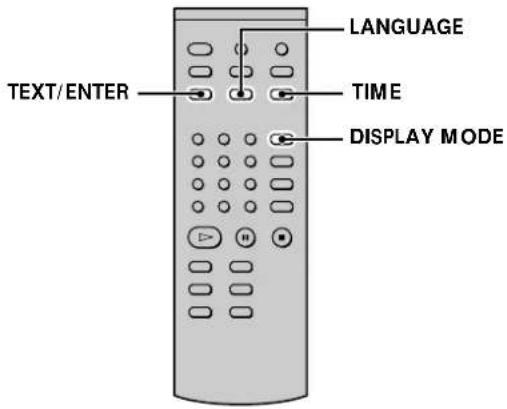
text_image
LANGUAGE TEXT/ENTER TIME DISPLAY MODEDisplaying information while the player is stopped
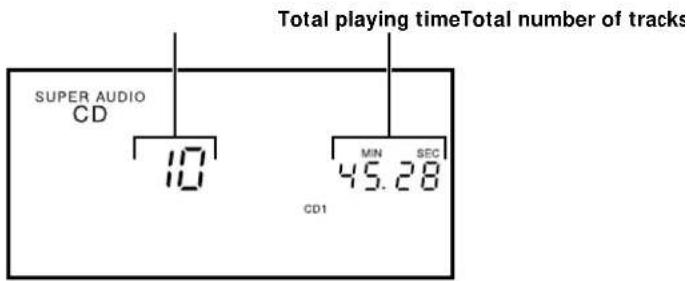
Press TIME.
The display shows the total number of tracks and total playing time on the disc.
text_image
SUPER AUDIO CD 10 Total playing time Total number of tracks MIN SEC 45.28 CD1Using the Display
Displaying information while the player is playing
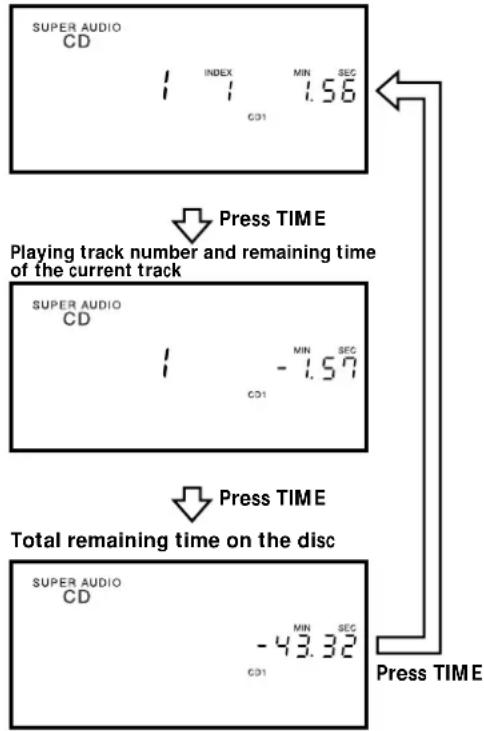
Press TIME.
Each time you press the button, the current track number and its elapsed time or remaining time appears, or the total remaining time for the disappears in the display.
Playing track number and elapsed playing time of the current track (default display)
text_image
SUPER AUDIO CD INDEX MIN SEC 1.56 CD1 Press TIME Playing track number and remaining time of the current track SUPER AUDIO CD MIN SEC 1 - 1.57 CD1 Press TIME Total remaining time on the disc SUPER AUDIO CD MIN SEC -43.32 CD1 Press TIMETurning off the information in the display
Press DISPLAY MODE while the player is stopped or while playing a disc.
- For a disc which does not have TEXT
When you press DISPLAYYMODE once, "Display Off" appears in the display. When you press it while playing a disc, the whole display disappears after one second.
To return to then normal display, press it again. - For a disc which has TEXT
When you press DISPLAY MODE once, the information of the TEXT disc disappears. When you press it again,
"DisplayOf f" appears. When you press it while playing a disc, the whole display disappears after one second.
To return to then normal display, press it again.
Displaying the information of a TEXT disc
TEXT discs contain information, such as the disc name or artist name, as well as the audio signals. This player can display the disc name, artist name, and current track name as TEXT information.
When the player detects a TEXT disc, "TEXT" appears in the display. If your TEXT disc has several languages,
"TEXT" and "MUL TI" appear in the display . When you want to check the information in another language, see
"Displaying the information of a TEXT disc in other languages" on page 15.
Displaying the information of a TEXT disc in stop mode
Press TEXT.
Each time you press the button, the discname or ar tist name appears in the display . When you select the ar tist name, "AR TIST" appears in the display .
Display information of a TEXT disc while playing a disc
The current track name appears. If the discname has more than 16 characters, the first 15 characters will remain after the names scrolls by in the display.
Notes
- The display may not show all the characters, depending on the disc.
- This player can display only the disc name, artist name and track names from TEXT discs. Other information cannot be displayed.
Displaying the information of a TEXT disc in other languages
You can change the displayed language if the TEXT disc has multi language capacity. When the player detects such a TEXT disc, "TEXT" and "MULTI" appear in the display. Change the language according to the procedures below.
1 Press LANGUAGE in stop mode.
The current selected language (English, French, German, etc.) flashes.
If the player cannot display the language memorized in a TEXT disc, "Other Lang" appears in the display.
2 Press LANGUAGE repeatedly until the desired language appears in the display.
3 Press TEXT/ENTER.
The information appears in the selected language.
Notes
- If your TEXT disc memorized in one language, the name of that language appears for a few seconds in the display when you press LANGUAGE.
- When you press LANGUAGE while playing a TEXT disc, the name of the current selected language appears for a few seconds in the display.
Locating a Specific Track
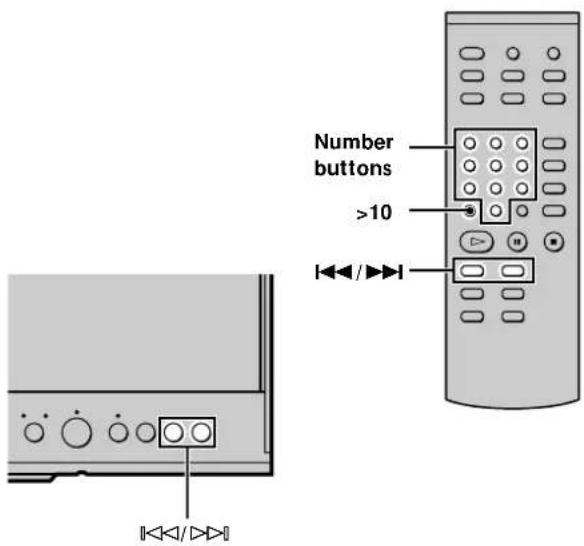
During stop or play mode, you can locate any track to be played.
text_image
Number buttons >10 /▶▶▶▶▶▶▶▶▶▶▶▶▶▶▶▶▶▶▶▶▶▶▶▶▶▶▶▶▶▶▶▶▶▶▶▶▶▶▶▶▶▶▶▶▶▶▶▶▶▶▶▶▶▶▶▶▶▶▶▶▶▶▶▶▶▶▶▶▶▶▶▶▶▶▶▶▶▶▶▶▶▶▶▶▶▶▶▶▶▶▶▶▶▶▶▶▶▶▶▶◀◀/◀◀To go to Do the following:
| The next track (AMS*) | Press >> |
| A preceding track (AMS*) | Press << repeatedly |
| The beginning of the current track (AMS*) | Press << during play |
* Automatic Music Sensor
Locating a track directly by entering the track number
Press the number button(s) to enter the track number.

To enter a track number over 11
1 Press >10.
2 Enter the corresponding digits.
To enter 0, press 10/0 instead.
Examples:
• To play track number 30, press >10, then 3 and 10/0.
- To play track number 100, press >10 twice, then 1, and 10/0 twice.

If you enter a track number while the player is paused
You cannot locate a track in pause mode. The player will still remain paused.
Locating a Particular Point in a Track
You can locate a particular point in a track during play or play pause.
text_image
INDEX ←/→Locating a point while monitoring the sound (Search)
Press and hold ◀◀/▶▶ during play.
You will hear intermittent playback as the disc goes forward or reverses.
When your reach the desired point, release the button.
Note
Tracks that are only a few seconds long may be too short for monitoring. In this case, the player may not search correctly.
Locating a point by observing the time indication (High-Speed Search)
Press down ◀◀/▶▶ during play pause.
You will not hear the playback sound.

When "Over!!" appears in the display
The disc has reached its end. Press ◀◀ or ◀◀ to go back.
Locating a point using the index function (Index Search)
Press INDEX→ or INDEX← repeatedly in play or pause mode.

What's an INDEX?
Some CDs are provided with an index marking system which divides tracks or discs into smaller segments. This is especially useful when you want to locate a certain point within a long track (in classical music for example). The index search function works only when you use a commercially available indexed discs (usually indicated on the label).
Playing Tracks Repeatedly

You can play an entire disc or portions thereof repeatedly. This function can be used with Shuffle Play to repeat all the tracks in random or der(page 17),or with Pr ogramme Play to repeat all the tracks in a pr ogramme(page 18). You can also repeat a specific track or por tion within a track.
text_image
REPEAT A←→BNote
If you turn off the player or disconnect the mains lead, the player will store the last setting of repeat play ("Repeat All" or "Repeat 1") and recall it the next time you turn on the player. However, the setting of the Repeat A-B Play will be cancelled if you turn off the player or disconnect the mains lead.
Repeating all the tracks on the disc (Repeat All Play)
Press REPEAT once, then press ▷.
"REPEAT" appears in the display and Repeat All Play starts.
The repeat play changes depending on the play mode you select.
| When the play mode is | The player repeats |
| Normal play (page 12) | All the tracks in sequence |
| Shuffle Play (page 17) | All the tracks in random order |
| Programme Play (page 18) | All the tracks in the programme in sequence |
To stop Repeat All Play
Press ■.
To resume normal play
Press REPEA T repeatedly until "REPEA T" goes of f.
Repeating the current track (Repeat 1 Play)
While the track you want to repeat is being played, press REPEAT repeatedly until "REPEAT 1" appears in the display.
Repeat1 Play starts.
To stop Repeat 1 Play
Press ■.
To resume normal play
Press REPEAT repeatedly until "REPEAT" goes off.
Repeating a specific portion within a track (Repeat A-B Play)
You can specify one portion within a track to be played repeatedly. Note that the portion that you specify must be within the boundaries of a single track.
1 While the player is playing, press A←→B at the starting point (point A) of the portion to be played repeatedly.
"REPEAT" appears and "A-" flashes in the display.
2 Continue playing the track (or press ▶▶) to locate the ending point (point B), then press A↔B.
"REPEAT A-B" appears and Repeat A-B Play starts.
To stop Repeat A-B Play and resume normal play Press REPEA Tor ■.
You can set a new starting point and ending point during Repeat A-B Play
You can change the current ending point to a new starting point, then specify a new ending point to repeat another portion right after the current portion.
1 During Repeat A-B Play, press A↔B. The current ending point changes to the new starting point (point A). "REPEAT" lights up and "A-" flashes in the display.
2 Locate the new ending point (point B) and press A←→B. "REPEAT A-B" lights up and the player starts to repeat the newly specified portion.
Playing Tracks in Random Order (Shuffle Play)
When you select Shuffle Play, the player plays all the tracks on the disc in random order.
text_image
CONTINUE SHUFFLE1 Press SHUFFLE in stop mode.
2 Press ▷.
Shuf flePlaystar ts. "E3" appears while the player is "shuf fling" the tracks. The player will stop after playing all the tracks once.
To resume normal play
Press CONTINUE.

You can locate tracks during Shuffle Play
Press ◀◀/▶▶.
Press ▶▶▶ to locate the next track or press ◀◀◀ to locate the beginning of the current track. The player does not go back to tracks which have already been played.
Creating Your Own Programme (Programme Play)

You can pick out the tracks that you like and specify the playback order in a programme containing up to 99 tracks (or 999 min.59 sec. in total programme time)
text_image
CONTINUE PROGRAM Number buttons >10 CHECK CLEAR1 Press PROGRAM in stop mode.
"PROGRAM" appears in the display.
2 Press the number buttons to enter the track number.
If you entered the wrong track number
Press CLEAR to erase the track number and reenter the correct track number using the number buttons.
To select a track number over 11
Press>10(page 15).
3 Repeat step 2 to enter other tracks.
Each time you enter a track number, the total programme time appears in the display.
4 Press ▷.
Programme Play starts.
To resume normal play
Press CONTINUE.

The programme remains even after Programme Play ends
Press to play from the beginning of the programme again. The programme remains even if you stop play.
Notes
- When tracks which are not numerically consecutive on the disc are programmed consecutively (i.e. 1, 3, 5, etc.), the actual playing time may become longer than the total playing time appeared in the display.
- If you turn off the player, disconnect the mains lead, or press , the programme will be erased.
Checking the contents of the programme
Before you start playing or while the player is playing, press CHECK.
Each time you press the button, in programmed order, the track number and the total programme time appear in the display. When you press CHECK while the player is playing, the track number appears from the next track numbers of the current playing track number.
Changing the contents of the programme
You can change the contents of the pr mode.
ogrammeinstop
| To | Do the following: |
| Erase a track | 1 Press CHECK repeatedly until the track number you want to erase appears.2 Press CLEAR. |
| Erase from the last track in the programme | Press CLEAR.Each time you press the button, the last track of the programme is erased. |
| Add a track to the end in the programme | Press || / >> to select the track you want to add, then press PROGRAM. When using the remote, press the number button of the track to be added. |
| Erase all tracks | Press CLEAR repeatedly until “All Clear” appears. |
Listening to a CD Using a Filter (Digital Filter Function)
This player is equipped with a variable coefficient (V.C.*) digital filter. By selecting one of five types of filters ("STD," "1," "2," "3," and "4"), you can adjust the sound to match your listening environment and the music source.
*V.C. is a trademark of Variable Coefficient. For details, see "What is a variable coefficient (V.C.) digital filter?"
Note
Digital filters are effective only when you play a conventional CD. You cannot select the digital filter when you play a Super Audio CD.
text_image
(power) FILTERPress FILTER repeatedly until you locate the filter you want.
If you press FILTER to change the type of filters during play, "D-Fil Setting" appears in the display and the sound will be interrupted momentarily.
Characteristics of each digital filter
The contents and characteristics of the five digital filters are as follows:
STD: Standard (sharp roll-off)
Provides a wide frequency range and spatial feeling, as it holds the most information among the five filters. Suitable for playback of classical music.
1 : Clear (slow roll-off)
Provides smooth and powerful sound with clear image position. Suitable for playback of jazz band performances and jazz vocals.
2: Plain (slow roll-off)
Provides fresh and energy gets sound with rich vocal expression. Suitable for playback of vocal performances.
3: Fine (slow roll-off)
Provides well-balanced natural sound, with a lar gescale feel and richr everberation. Suitable for listening to any kind of music when you are relaxed.
4: Silky (slow roll-off)
Provides a wide scale feel with associated subtleties. Suitable for light classical music, especially strings.
What is a variable coefficient (V.C.) digital filter?
CD players use digital filters to eliminate the noise generated during sampling. You can change the tone of your music by changing the cutoff characteristics of the digital filter.
Sharp roll-off and slow roll-off
Digital filters can be oughly classified into sharp r oll-of f types and slow r oll-of ftypes, according to their cutoff f characteristics.
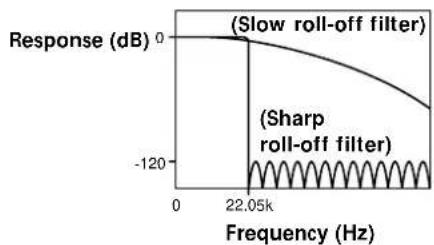
line
| Frequency (Hz) | Response (dB) | | -------------- | ------------- | | 0 | 0 | | 22.05 | -120 |Comparison of cutoff characteristics for sharp roll-off filter and slow roll-off filter
Sharp roll-off filters quickly cut of noise over 22.05 kHz generated during sampling. This is a superior way of completely reproducing signals below 20 kHz and is the basic principle behind digital audio.
On the other hand, slow roll-off filters cut of noise generated during sampling, and are able to hold pre-ringing and post-ringing (a kind of sound smearing) in the impulse response signal to a minimum.
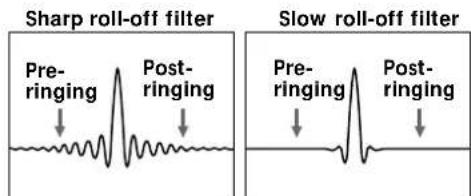
text_image
Sharp roll-off filter Pre- ringing Post- ringing Slow roll-off filter Pre- ringing Post- ringingComparison of impulse response for sharp roll-off filter and slow roll-off filter
Note
The Digital Filter function primarily changes characteristics outside the audible frequency. They cannot affect changes within the audible frequency such as those provided by the tone controls of the amplifier. Therefore, with certain combinations of hardware and software, there may be no noticeable effect after switching the filter.
Additional Information
This chapter provides additional information that will help you understand and maintain your Super Audio CD player.
Precautions
On safety
- Caution — The use of optical instruments with this product will increase eye hazard.
- Should any solid object or liquid fall into the cabinet, unplug the player and have it checked by qualified personnel before operating it any further.
On power sources
- Before operating the player, check that the operating voltage of the player is identical with your local power supply. The operating voltage is indicated on the nameplate at the rear of the player.
- The player is not disconnected from the mains as long as it is attached to the mains, even if the player itself has been turned off.
- If you are not going to use the player for a long time, be sure to disconnect the player from the mains. To disconnect the mains lead, grasp the plug itself; never pull the cord.
On placement
- Place the player in a location with adequate ventilation to prevent heat build-up in the player.
- Do not place the player on a soft surface such as a rug that might block the ventilation holes on the bottom.
- Do not place the player in a location near heat sources, or in a place subject to direct sunlight, excessive dust or mechanical shock.
On avoiding deterioration of sound quality
- Do not touch the lens inside.
On operation
- If the player is brought directly from a cold to a warm location, or is placed in a very damp room, moisture may condense on the lenses inside the player. Should this occur, the player may not operate properly. In this case, remove the disc and leave the player turned on for about an hour until the moisture evaporates.
On adjusting the volume
- Do not turn up the volume too much while listening to a portion with very low level inputs or no audio signals. If you do, the speakers may be damaged when a peak level portion is played.
On inserting a disc
- You may hear a transmission or a mechanical sound from the player. This indicates that the player is automatically adjusting its internal mechanisms according to the inserted disc. You may also hear the mechanical sound from the player when you insert a warped disc.
On using the stabilizer
- Be sure to use the supplied stabilizer. The use of any other stabilizer may damage the player.
On cleaning
- Clean the cabinet, panel, and controls with a soft cloth slightly moistened with a mild detergent solution. Do not use any type of abrasive pad, scouring powder, or solvent such as alcohol or benzine.
On transportation
- Be sure to remove the disc and the stabilizer on the tray. - Be sure to close the disc lid.
Note
The Super Audio CD player takes longer than a conventional CD player to start playing after the disc is loaded. This is not a malfunction. The player is automatically identifying the type of disc, adjusting the servomechanism or verifying the copyright protection in internal mechanisms of the inserted disc.
If you have any questions or problems concerning your player, please consult your nearest Sony dealer.
Notes on Discs
On handling discs
- To keep the disc clean, handle the disc by its edge. Do not touch the surface. - Do not stick paper or tape on the disc.
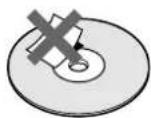
- Use only round-shaped discs. If you use a special shaped disc (e.g., star-shaped or heart-shaped etc.), the player may be damaged. - Do not use a disc with a seal attached on such as on a used disc or rental disc.
On keeping discs
- Do not expose the disc to direct sunlight or heat sources such as hot air ducts. - After playing, store the disc in its case. If you put it on top of another disc without the case, the disc may be damaged.
On placing discs on the disc tray
- Make sure the disc is positioned securely on the tray's spindle. If not, the player or the disc may be damaged.
On cleaning
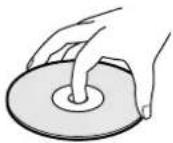
- If the disc is dirty with fingerprints or dust, it may lessen the quality of the audio out. - Before playing, clean the disc with a cleaning cloth. Wipe the disc from the centre out.
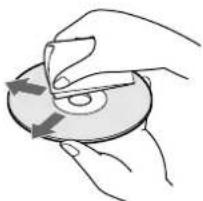
natural_image
Illustration of a hand holding a CD or DVD disc with a circular arrow indicating rotation (no text or symbols)- Clean the disc with a soft cloth slightly moistened with water, and remove moisture with a dry cloth. - Do not use solvents such as benzine, thinner, record cleaners, or anti-static spray.
Cleaning the Turntable
If the turntable becomes dirty, it may lessen the quality of the audio signal. Gently hold a dry swab to the turntable, and turn the side of turntable with the fingers as illustrated below.
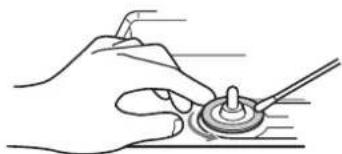
natural_image
Illustration of a hand using a tool to press or adjust a circular component (no text or symbols visible)Troubleshooting
If you experience any of the following difficulties while using the player, use this troubleshooting guide to help you remedy the problem. Should any problem persist, consult your nearest Sony dealer.
There is no sound.
→ Check that the player is connected securely.
→ Makesure you operate the amplifier correctly.
There is no sound from the DIGITAL OUT CD connectors.
→ The audio signals of the super audio CD cannot be output from the DIGITAL OUTCD connectors.
→ Press DIGIT AL OUT to display "16 bit" in the display when the player is playing the CD.
The disc does not play.
→ There is no disc inside the player
→ There is no stabilizer on the disc.
→ The disc is placed upside down on the tray
→ Place the disc on the disc tray with the label side up.
→ The disc is placed at an angle. Reload the disc and the stabilizer.
→ Clean the disc(see page21).
→ Moisture has condensed inside the player . Remove the disc and leave the player turned on for about an hour (see page 20).
→ There is an incompatible discon the tray (see page 7).
→ Clean the turntable(seepage21).
The remote does not function.
→ Remove any obstacles in the path of the emote and the player.
→ Pointther emotatther emotesensoronthe player.
→ If the batteries in ther emotear eweak, r eplace with new ones.
Specifications
When a super audio CD is played
Playing frequency range 2 Hz to 100 kHz
Frequency response 2 Hz to 50 kHz (-3 dB)
Dynamic range 105 dB or more
Total harmonic distortion rate
0.0012 % or less
Wow and flutter Value of measurable limit ( ±0.001% W. PEAK) or less
When a CD is played
Frequency response 2 Hz to 20 kHz
Dynamic range 100 dB or more
Total harmonic distortion rate
0.0017% or less
Wow and flutter Value of measurable limit ( ±0.001% W. PEAK) or less
Output connector
| Jack type | Output level | Load impedance | |
| ANALOG OUT | Phono jacks | 2 Vrms (at 50 kilohms) | Over 10 kilohms |
| DIGITAL OUT CD OPTICAL* | Square optical output connector | -18 dBm | ( Light emitting wave length: \ 660 nm ) |
| DIGITAL OUT CD COAXIAL* | Coaxial output connector | 0.5 Vp-p | 75 ohms |
*Output only the audio signals of the CD
General
Laser radiant power: 1.52uW at 780nm (for CD) 5.47uW at 650nm (for SACD)
*These output is the value measured at a distance of about 200mm from the objective lens surface on the optical pick-up.
Power requirements
European models: 230 V AC, 50/60 Hz
USA and Canadian models: 120 V AC, 60 Hz
Power consumption 36 W
Dimensions (w/h/d) 430 · 149 · 436 mm (17 · 5 ^7 /s · 17 ^1 /4 in.) incl. projecting parts
Mass (approx.) 25 kg (55 lbs 2 oz.)
Supplied accessories
See page 4.
Design and specifications are subject to change without notice.
Index
A
Accessories 4
Amplifier (not supplied) 6
AMS (Automatic Music Sensor) 15
ANALOG OUT 5
B
Batteries 4
C
Cable
Coaxial digital 5
Optical digital 5
Cord
Audio connecting 5
D, E
Digital filter 19
DIGITAL OUT CD 5
Displaying information 13
F, G
Filter 19
H, I, J, K
Hooking Up
Audio Components 5
Power 6
L, M, N, O
Locating
a specific track 15
a particular point 16
by entering the track number 15
by observing the time indication (High-speed Search) 16
using the index function (Index Search) 16
while monitoring the sound (Search) 16
P, Q
Pause play 13
Place a disc 12
Playing
a disc 12
by entering the track number 15
track in random order 17
Programme Play
Checking the contents of the programme 18
Changing the contents of the programme 18
how to create your own programme 18
R
Remote commander (remote) 11
Repeat
A-B Play 17
All Play 16
1 Play 17
S
Search
High-speed search 16
Index search 16
Shuffle Play 17
STANDARD 6
Super Audio CD 3,7
T, U, V, W, X, Y, Z
TEXT 14
TOC 12
Turntable 21
AVERTISSEMENT
natural_image
Diagram showing a battery terminal connected to a box with three terminals, illustrating the process (no text or symbols present)
text_image
Blanc (L) Rouge (R) Blanc (L) Rouge (R)natural_image
Diagram of a plug with a connector inserted into a socket (no text or symbols)natural_image
Illustration of a hand inserting a plug into an electrical outlet (no text or symbols)text_image
ANALOG OUT R L COMMAND MODE CD1 CD2 STANDARD DIGITAL OUT CD COAXIAL OPTICAL ~AC IN 1 2 3 4 51 Prises ANALOG OUT (5)
2 Touche CONTINUE (17, 18)
text_image
(alimentation) SACD/CDtext_image
INDEX ←/→text_image
REPEAT A←→BRemarque
text_image
CONTINUE SHUFFLEtext_image
(allimentation) FILTERtext_image
Pre- oscillations Post- oscillationstext_image
Pre- oscillations Post- oscillationsnatural_image
Illustration of hands holding a CD or DVD disc with a ruler, no text or symbols presentnatural_image
Illustration of a hand holding a small mechanical component with a lever (no text or symbols)Dépannage
saillantes comprises
Masse (approx.) 25 kg (55 lbs 2 oz.)
Accessoires fournis
Voir page 4.