D862L - Tumble dryer Campomatic - Free user manual and instructions
Find the device manual for free D862L Campomatic in PDF.


| Product type | Tumble dryer |
| Brand | Campomatic |
| Model | D862L |
| Loading type | Front-loading |
| Maximum capacity (cotton) | 8 kg |
| Dimensions (W x H x D) | 59.5 x 85.0 x 57.0 cm |
| Power supply | 220-240 V, 50 Hz |
| Rated power | 2000 W (approx.) |
| Drying programs | Cotton/Linen, Synthetics, Mixed |
| Special functions | Intensive/delicate drying, timer |
| Exhaust system | Air exhaust hose |
| Filter | Clean after each cycle |
| Safety | Automatic stop when door opened, child lock |
| Adjustable feet | Yes |
| Door | Wide, easy opening |
| Included accessories | Exhaust hose, hose holder |
| Maintenance | Clean filter regularly, do not use extension cord |
| Repairability | Original spare parts, authorized technical assistance |
Frequently Asked Questions - D862L Campomatic
User questions about D862L Campomatic
0 question about this device. Answer the ones you know or ask your own.
Ask a new question about this device
Download the instructions for your Tumble dryer in PDF format for free! Find your manual D862L - Campomatic and take your electronic device back in hand. On this page are published all the documents necessary for the use of your device. D862L by Campomatic.
USER MANUAL D862L Campomatic
natural_image
Diagram showing a computer monitor with a circular interface and directional arrows, no readable text or symbols present.MESSA IN PIANO DELL'ASCIUGATORE
natural_image
Illustration of a hand holding a small object near a counter, with motion arrows indicating rotation (no text or symbols)natural_image
Diagram of a coiled spring with directional arrows indicating motion (no text or symbols)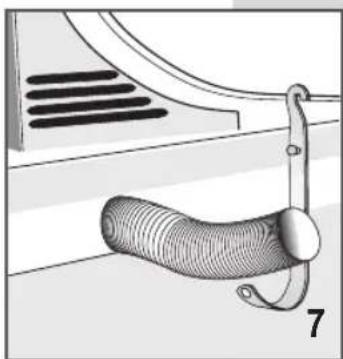
natural_image
Diagram of a coiled spring attached to a curved hook, with no visible text or symbols
natural_image
Hand inserting a plug into an electrical socket, with a symbol indicating the power outlet (no text or labels present)
natural_image
Illustration of a hand pressing down on a circular component, labeled with number 9 (no text or symbols on the diagram itself)natural_image
Illustration of a hand holding a square object on a circular object, with directional arrows indicating rotation (no text or symbols)PER ASCIUGARE LA BIANCHERIA CORRETTAMENTE
Thank you for choosing our product.
Please read these instructions carefully before connecting and using the appliance.
Knowledge of the operating principles will help guarantee correct and safe use of the appliance. This instruction booklet contains the technical characteristics of the drier and is full of useful information regarding its operation, all designed to help you get the best out of your appliance. If the appliance is sold or handed over for use by others, remember to give the new user the instruction booklet.
MODEL: DATE OF PURCHASE: / /
SERIAL NUMBER:
CONTENTS
NOTES AND ADVICE FOR THE USER 11-12
• Technical information 11
DESCRIPTION OF THE APPLIANCE 113
INSTALLING THE APPLIANCE 13-15
- Installation 13-14
• Levelling the appliance 14 - Connecting the air exhaust tube 14
- Connecting to the mains supply 15
USING THE APPLIANCE 15-17
• Description of the functions 15-16
- Door 16
- Drying the washing correctly 16
• Precautions for fabrics types 17
- Program table 17
- Weights of washing 17
MAINTENANCE
- Cleaning the filter 18
- Fault finding 18
- Resolving problems 18
- Optional accessories 18
NOTES AND ADVICE FOR THE USER
TECHNICAL INFORMATION
| Dimensions: | Width cm.: | 59.5 |
| Height cm.: | 85.0 | |
| Depth cm.: | 57.0 | |
| Max. capacity | see characteristics plate | |
| Power rating | see characteristics plate | |
| Voltage | see characteristics plate | |

Before connecting the appliance read these instructions carefully.
Repairing the failure arising from inappropriate connections or use of the appliance is not covered by the guarantee.
This appliance has been designed for use as a ▼ domestic drier. Any other use is to be considered as improper and therefore dangerous.
- Keep this instruction book near to the appliance at all times, so that it can be easily consulted when necessary.
▼ Any modifications or attempts to interfere with the appliance can be dangerous for the user and may damage the product.
On delivery of the appliance, check that it has not been damaged during transport. If damage is discovered, report the matter to the retailer immediately.
Do not cover the drier with washing or any other items.
When positioning the appliance, ensure that the power supply cable is not kinked or squashed and is accessible.
▼ Always close the door after using the drier.
This will prevent children from leaning on the door and possibly overturning the drier.
Remember that the exhaust tube will heat up during a drying cycle and can reach temperatures of up to 60°. Do not touch this part before the cooling cycle has been completed.
▼ Do not use the drier for drying dirty clothes.
▼ Never dry items that have been soiled substances such as cooking oil, petroleum, acetone, alcohol, petrol, kerosene, stain remove comma after turpentine, and wax.
▼ Remove these substances in a hot wash using an additional quantity of detergent prior to loading the items in the drier.
▼ Never dry unwashed items..
Do not dry items such as foam rubber, latex, raincoats, waterproof fabrics, rubber mats, preformed items, clothes or cushions with foam rubber inserts, as these may melt and damage other items or even the appliance itself.
If the appliance is sold or given away, remember to hand over this instruction book with it. This will help the new owner use the drier both correctly and safely.
Do not attempt to repair any appliance faults alone, repairs carried out by a non-professional may cause serious damage and will invalidate any rights to repairs under guarantee.
▼ Repairs to the appliance can only be carried out by personnel authorised by the customer service centres. All repairs must make use of original spare parts only.
Spin dry or wring the washing well before loading it into the drier. Spun dry washing will dry quicker.
Clean the filter thoroughly each time the drier is used in order to guarantee perfect air circulation.
▼ Never insert or remove the plug from the mains socket with wet hands.
The drier must be connected to a mains socket fitted with an efficient earth complying with current safety standards.
▼any Do not use extension leads or multiple plug adapters to connect the appliance to the mains supply.
Do not expose the appliance to atmospheric agents.
When servicing or cleaning the appliance, remember to disconnect it from the mains supply. Do not pull the power supply cable to unplug the appliance from the mains supply. Pull the plug only.
This appliance is not intended for use by persons (including children) with reduced physical, sensory or mental capabilities, or lack of experience and knowledge, unless they have been given supervision or instruction concerning use of the appliance by a person responsible for their safety.
This appliance is not intended for use by persons (including children) with reduced physical, sensory or mental capabilities, or lack of experience and knowledge, unless they have been given supervision or instruction concerning use of the appliance by a person responsible for their safety.

WARNING!!! The final part of a drying cycle is the cooling down phase. Consequently, never switch off the drier before the cycle has
been completed. Otherwise, the washing must be taken out quickly and hung out to allow the heat to dissipate.
THE MANUFACTURER WILL NOT BE HELD RESPONSIBLE FOR ANY INCIDENTS RESULTING FROM NON-COMPLIANCE WITH SAFETY STANDARDS OR THE REQUIREMENTS OF THIS INSTRUCTION BOOK.
The drier is a domestic appliance capable of drying any type of fabric at any time.
The machine has been constructed in steel panels which have been treated and painted to guarantees that its aesthetic qualities remain unaltered over time.
▼ The motor and all moving parts have been designed and manufactured to guarantee the minimum possible noise levels
The control panel has been designed to enable the user to run the desired drying program without diffi culty.
▼ The wide door makes loading and unloading the washing much easier.
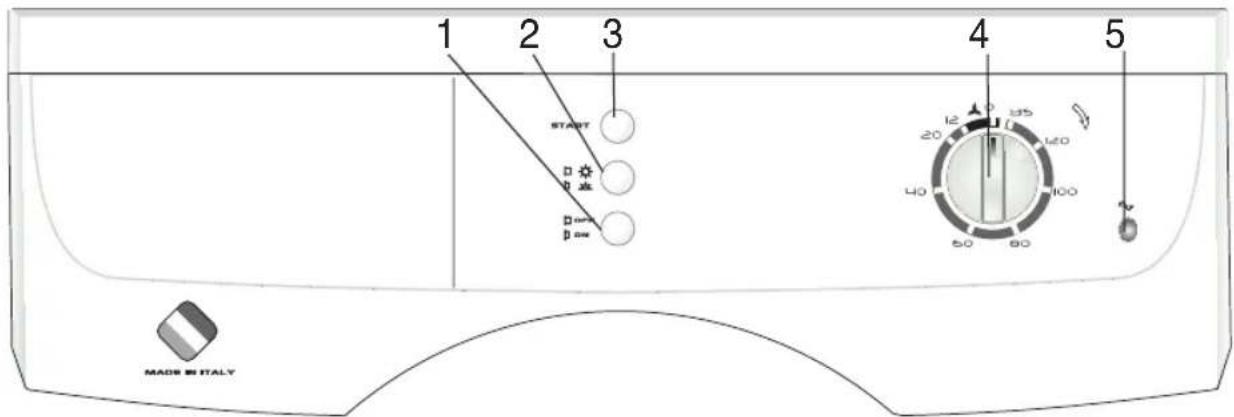
1 - ON/OFF button
2 - Delicate or energetic drying button
3 - Start button
4 - Drying time control knob
5 - Spin function active indicator light
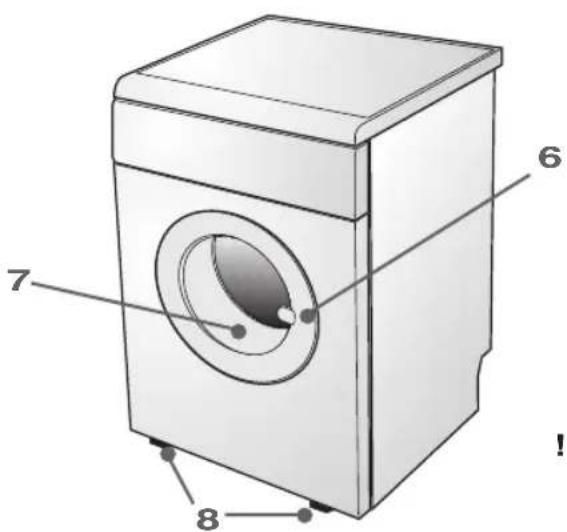
6 - Door
7 - Filter
8 - Adjustable feet
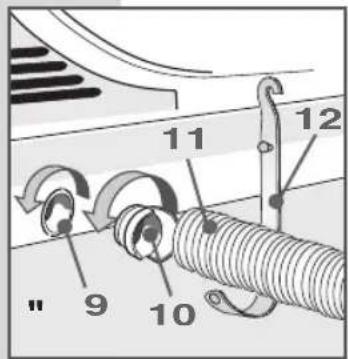
9 - Exhaust outlet
10 - Outlet coupling
11 - Exhaust tube
12 - Tube support
INSTALLING THE APPLIANCE

INSTALLATION
Installation must be carried out by qualified personnel in line with the instructions supplied by the manufacturer. Incorrect installation may result in damage and injury.
▼ Install the drier near to a window to facilitate the evacuation of the damp air from the drier.
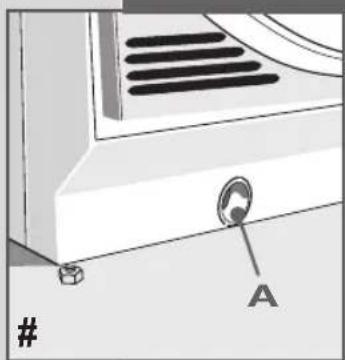
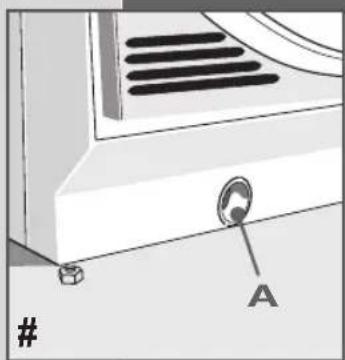
The exhaust tube must be used to prevent condensation, and must be inserted in hole A at the bottom of the back panel of the appliance (fig. 3).
INSTALLATION
▼ Never cover the air intake at the back of the appliance.
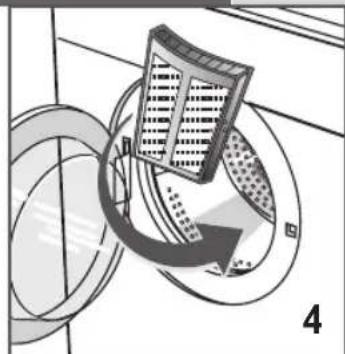
▼ Place the filter in its normal position as shown (fi g. 4).
▼ Clean the inside of the drying drum using a damp cloth to remove any dust deposits.
natural_image
Diagram showing a curved arrow interacting with a grid-patterned object, no text or symbols presentLEVELLING THE DRIER
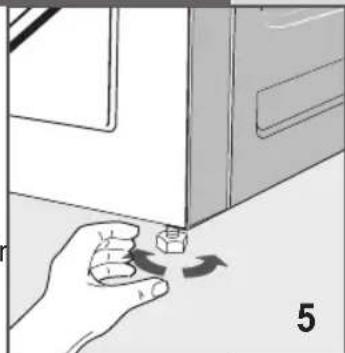
Adjustable feet. Place the drier upright so that it rests firmly on all four feet. Level the drier by adjusting the feet as follows:
▼ Lift the drier slightly.
▼ Adjust the feet to the correct height (fi g. 5).
(Do not unscrew the feet to much and do not use a screwdriver).
▼ Lower the drier.
A badly levelled machine may cause damage to the bearings and lead to their premature wear. This drier does not need to be anchored to the floor.
natural_image
Illustration of a hand pressing down on a surface with directional arrows indicating motion (no text or symbols)CONNECTING THE AIR EXHAUST TUBE
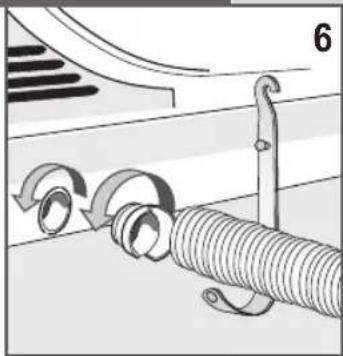
Connect the exhaust tube to the outlet on the back of the drier (fi g.6), as follows:
▼ Connect one end of the tube to the connector piece supplied.
▼ Rotate the connecting piece (together with the tube) anticlock-wise in the drier outlet hole.
Carry the tube away from the back of the drier to the left or right by means of the recess at the bottom of the drier body.
▼ Position the other end of the tube near to a window or a ventilation outlet on an external wall. If this is not possible, ensure that the room is well ventilated when the drier is being used. Use the support supplied to anchor the tube (fi g. 7).
natural_image
Diagram of a coiled spring with directional arrows indicating motion (no text or symbols)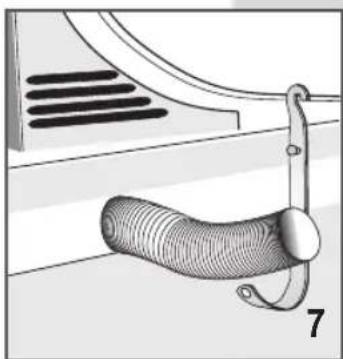
natural_image
Diagram of a coiled spring attached to a curved hook, with no visible text or symbols
Important: The air exhaust tube must be connected even if the air is not discharged outdoors, otherwise the drier will re-absorb the discharged damp air and thus prolong the drying time.
Damp air can also damage the drier. Although the air discharged from the exhaust tube is only warm and damp and does not constitute a danger, it must never be directed towards people, animals or plants.
Important: The exhausted air must not be conveyed to a chimney discharging fumes generated by gas or other fuel burning appliances.
ELECTRICAL CONNECTION
natural_image
Hand inserting a plug into an electrical socket, with a symbol below (no text or labels)
▼ Make sure that the voltage indicated on the identification plate attached to the back of the appliance corresponds to that of the mains supply.
▼ On completion of the installation, the appliance must be connected to the mains supply through a two-pole switch.
All cutouts, electric wiring and mains sockets must have a rating such that enables them to support the maximum load indicated on the identification plate.
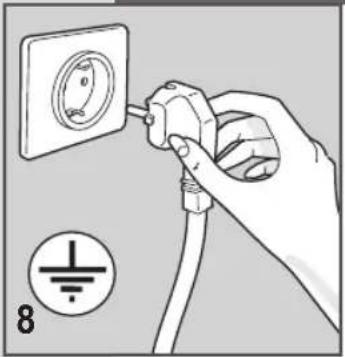
The mains supply to which the appliance is connected must be fitted with an earthing system. If this is not the case, the manufacturer will not be held liable for any incidents that may occur (fi g. 8).
If the power supply cable is damaged in any way, contact the appropriate specialised customer technical service centre.
The drier must not be connected to the mains supply using indirect methods such as extension leads or multiple adapters.
▼ Position the appliance so that the power supply cable is easily accessible for disconnection when the need arises.
Important: On completion of the drying cycle, disconnect the appliance from the mains supply to prevent young children from operating the drier.
USING THE APPLIANCE
DESCRIPTION OF THE FUNCTIONS
natural_image
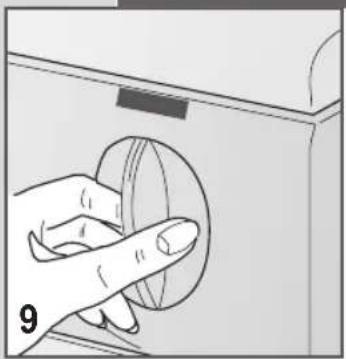
Illustration of a hand inserting a circular component into a device casing (no text or symbols)Drying time control knob: Rotate the knob to select the required drying times (fi g._9).
(Refer to the program table to select the program according to the type of fabric)
▼ At the end of each drying cycle, the appliance effects a 10 - 15 minute cooling cycle, during which time the appliance is still switched on.
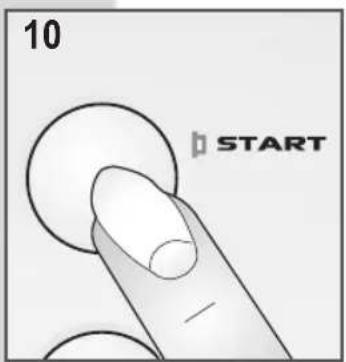
▼ Start button: Press this button to start the drying cycle (the indicator will light up).
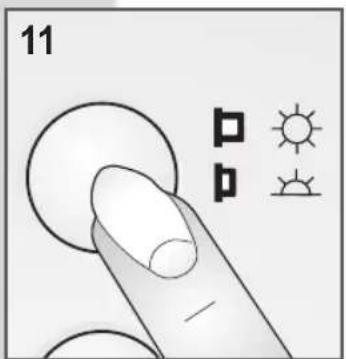
Delicate or energetic drying button: This button is used to select the type of drying cycle to run: Energetic or delicate (fi g.11).
DESCRIPTION OF THE FUNCTIONS
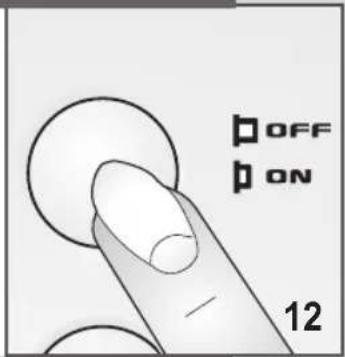
▼ ON/Off button: Press the button to switch on the appliance.
DOOR
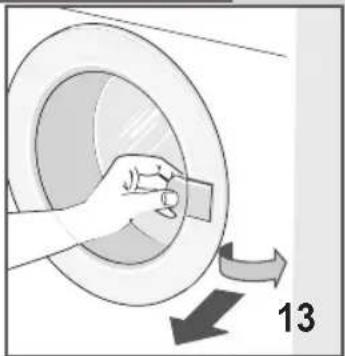
The drier is the front-loading type. Pull the handle outwards, without forcing it, and gently open the door. The appliance will stop if the door is opened during a drying cycle. The drum will continue to rotate for a while, slowing down gradually to a stop.

Important:
Obviously, during a drying cycle the washing in the drum will be hot. The washing is cooled during the cooling cycle.
▼ To avoid being scalded by steam or burned by the hot washing, do not open the door during the drying phase.
natural_image
Illustration of a hand holding a small object over a circular ring, with arrows indicating direction (no text or symbols)DRYING THE WASHING CORRECTLY
Proceed as follows:
A
▼ Spin the washing.
B
▼ Separate the items into types or fabrics.
▼ Close any zips and fasten buttons and remember to empty the pockets of any clothing.
▼ Turn jumpers inside out.
C
▼ Open the door
▼ Load the washing in the drum and remember to load sheets from a corner first.
▼ It is advisable to load small and large items together.
D
▼ Close the door
▼ Dry your hands (never touch electric appliances with wet hands).
▼ Insert the plug in the mains socket.
E
▼ Press the ON/OFF button to switch on the appliance.
▼ Select the drying cycle recommended for the load (see program table)
▼ Press the start button to start the drying cycle
F
▼ To stop the machine during a drying cycle, simply open the door (the drum will slow down then stop).
▼ To continue the drying cycle, close the door and press the start button.
G
▼ After having removed the dry washing, clean the fi Iter as follows:
- Lift the fi Iter
- Open it and clean it using a soft brush
- Close it and replace it in its seating
- The filter must be washed periodically using soapy water in order to remove very small particles.
▼ Unplug the appliance from the mains supply.
PRECAUTIONS FOR FABRIC TYPES
In the case of doubt as to the type of fabric, read the label on the item itself. Almost all items that can be machine dried have this information specified on the label. To avoid static electricity being generated in the items, add a conditioner to the rinse cycle of the washing machine.
Remove synthetic materials from the drum immediately to prevent them from creasing.
PROGRAM TABLE
| Fabric | Weight of dry washing | Type of drying utilities | Times in minutes | ||
| Wardrobe dry | iron dry | Slightly damp | |||
| TIMER CONTROLLED PROGRAM | |||||
Cotton/  Linen Linen | 8,0 kg |  | 80-120 min. | 50-80 min. | 50-80 min. |
Cotton/  Linen Linen | 4,0 kg | [2H52] | 60-100 min. | 40-60 min. | 30-50 min. |
| TIMER CONTROLLED PROGRAM | |||||
| Synthetics | 4,0 kg | 50-80 min. | 40-60 min. | — | |
| Mixed fabric | 2,0 kg | 30-40 min. | 20-30 min. | — | |
TIMER CONTROLLED PROGRAM
Synthetics  | 4,0 kg |  | 50-80 min. | 40-60 min. | — |
| Mixed fabric [BHA] | 2,0 kg |  | 30-40 min. | 20-30 min. | — |
ENERGETIC DRYING
□ DELICATE DRYING
Important: The drying time is dependent on a number of factors: weight, size of the items, type of fabric, degree of dampness. Well wrung/spun items dry quicker. To prevent items from creasing, do not overload the drier.
WASHING WEIGHTS
The indicated weights are approximate and may vary according to their manufacture, quality and finish.
| Bedding | Large tablecloth | 1000 g | |
| Quilt | 700 g | Napkin | 80 g |
| Bottom sheet | 550 g | ||
| Top sheet | 600 g | Men's clothing | |
| Pillowcase | 180 g | Wash 'n wear shirt | 250 g |
| Household linen | Vest (sleeveless) | 120 g | |
| Tea towel (dishes) | 90 g | Briefs | 80 g |
| Tea towel (glasses) | 70 g | Long johns | 250 g |
| Flannel | 20 g | Pyjamas | 480 g |
| Hand towel | 200 g | Nightshirt | 400 g |
| Handkerchief | 25 g | ||
| Other linen items | |||
| Bath robe | 1200 g | Ladies' clothing | |
| Bath towel | 800 g | Blouse | 100 g |
| Lady's blouse | 300 g | Jumper | 100 g |
| Man's shirt | 600 g | Briefs | 80 g |
| Blouse/shirt in synthetic material 300 g | Slip | 150 g | |
| Nightdress | 180 g | ||
| Table linen | Pyjamas | 450 g | |
| Tablecloth | 250 g | Handkerchief | 15 g |
CLEANING THE FILTER
In order to guarantee optimum drying results under all circumstances, remember that the fi Iter must be cleaned regularly. Remember to check and clean the fi Iter after each drying cycle.
Important:
The fi Iter must only be cleaned when the appliance is cold! Clean the fi Iter following the procedure described below:
▼ Open the door.
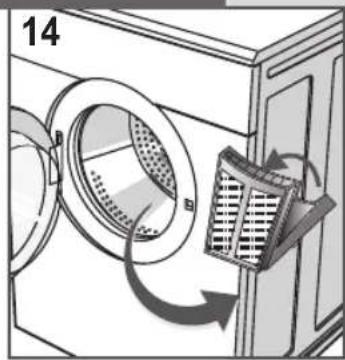
Grasp the filter in both hands and push it upwards to remove it.
▼ Carefully widen the top edge and open the filter.
▼ Remove the woollen particles.
▼ Close the filter, making sure that the catch closes at the correct position.
▼ Clean the filter slide guides on the appliance, using a vacuum cleaner if necessary.
▼ Reposition the fi Iter in the slide guides (fi g. 14).
natural_image
Diagram of a washing machine with a fan and vent, showing airflow direction (no text or symbols)FAULT FINDING
All electric appliance may breakdown at some time. Remember to call a qualified electrician in these cases. However, many problems can be resolved without the need for external intervention.

Important: If a fault occurs, disconnect the appliance from the mains supply immediately.
Before calling the customer service centre, check the points listed below.
RESOLVING PROBLEMS
If the drier doesn't start
- Check that:
1) The appliance is plugged into the mains supply.
2) The mains socket is working correctly:
2a) The fuse has not blown. (Check by plugging in another appliance such as a table lamp).
2b) All the instructions in the manual have been followed.
If the drier doesn't start
- Check that:
1) The door is closed properly.
2) The "START" button has been pressed.
The washing does not dry
- Check that:
1) The air exhaust tube is not twisted or kinked.
2) The filter is not blocked. (Remember that when the door is opened, the internal parts of the drier and the washing may be very hot).
If, after all these checks have been carried out, the appliance still does not work, inform the nearest customer service centre.
When contacting the service centre, inform them of the appliance model, serial number and type of fault.
This information will help the service centre operator in procuring the necessary spare parts, thus guaranteeing a speedy and efficient repair.
OPTIONAL ACCESSORIES
The retailer can provide an accessory to enable the drier to be mounted on top of a front-loading washing machine, thus saving space. The installer will inform you of the appliance model for which this option is possible.
Cher client,
INSTALLATION DE LA MACHINE

INSTALLATION
natural_image
Diagram showing a curved arrow and circular components with no visible text or symbolsNIVELLEMENT DU SÈCHE-LINGE
natural_image
Illustration of a hand pressing down on a surface with a small object and motion arrows (no text or symbols)CONNEXION DU TUYAU D'ÉVACUATION DE L'AIR
natural_image
Diagram of a coiled spring with directional arrows indicating motion (no text or symbols)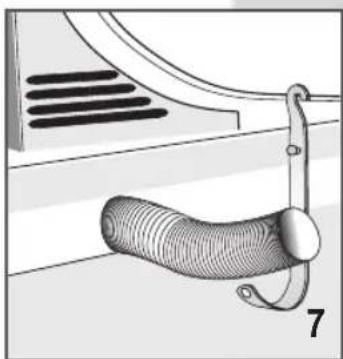
natural_image
Diagram of a coiled cable or spring attached to a wall-mounted device, with no visible text or symbols.
natural_image
Hand inserting a plug into an electrical socket, with a symbol indicating 8 ohms (no text or labels present)
natural_image
Hand inserting a circular component into a machine (no text or symbols visible)natural_image
Illustration of a hand holding a rectangular object with a curved arrow indicating rotation (no text or symbols)POUR EFFECTUER CORRECTEMENT LE SÉCHAGE DU LINGE
natural_image
Diagram of a door with a vent and airflow direction arrow, no text or symbols presentThis appliance is marked as complying with European Directive 2002/96/EC, Waste Electrical and Electronic Equipment (WEEE). Make sure that the product is disposed of in a correct manner. The user is obliged to contribute towards preventing any negative consequences for health and the environment.

The symbol affixed to the product or accompanying documents signifies that the product must not be treated as normal domestic refuse, but must be delivered to an authorised collection centre to enable the electric and electronic equipment to be recycled.
When disposing of the appliance, comply with local waste disposal regulations. For further information on the treatment, recovery and recycling of this product, refer to the appropriate offices, local domestic waste collection service or the retailer from where the appliance was purchased.
natural_image
Symbol of a trash bin crossed with no visible text or labels
- MESSA IN PIANO DELL'ASCIUGATORE
- PER ASCIUGARE LA BIANCHERIA CORRETTAMENTE
- CONTENTS
- NOTES AND ADVICE FOR THE USER
- INSTALLING THE APPLIANCE
- INSTALLATION
- LEVELLING THE DRIER
- CONNECTING THE AIR EXHAUST TUBE
- ELECTRICAL CONNECTION
- USING THE APPLIANCE
- DESCRIPTION OF THE FUNCTIONS
- DOOR
- Important:
- DRYING THE WASHING CORRECTLY
- Proceed as follows:
- PRECAUTIONS FOR FABRIC TYPES
- CLEANING THE FILTER
- FAULT FINDING
- RESOLVING PROBLEMS
- If the drier doesn't start
- The washing does not dry
- OPTIONAL ACCESSORIES
- Cher client,
- INSTALLATION DE LA MACHINE
- NIVELLEMENT DU SÈCHE-LINGE
- CONNEXION DU TUYAU D'ÉVACUATION DE L'AIR
- POUR EFFECTUER CORRECTEMENT LE SÉCHAGE DU LINGE
Brand : Campomatic
Model : D862L
Category : Tumble dryer