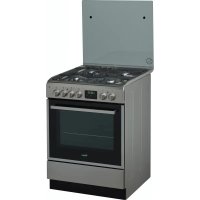
ACMT 6332IX1 - Cooker WHIRLPOOL - Free user manual and instructions
Find the device manual for free ACMT 6332IX1 WHIRLPOOL in PDF.

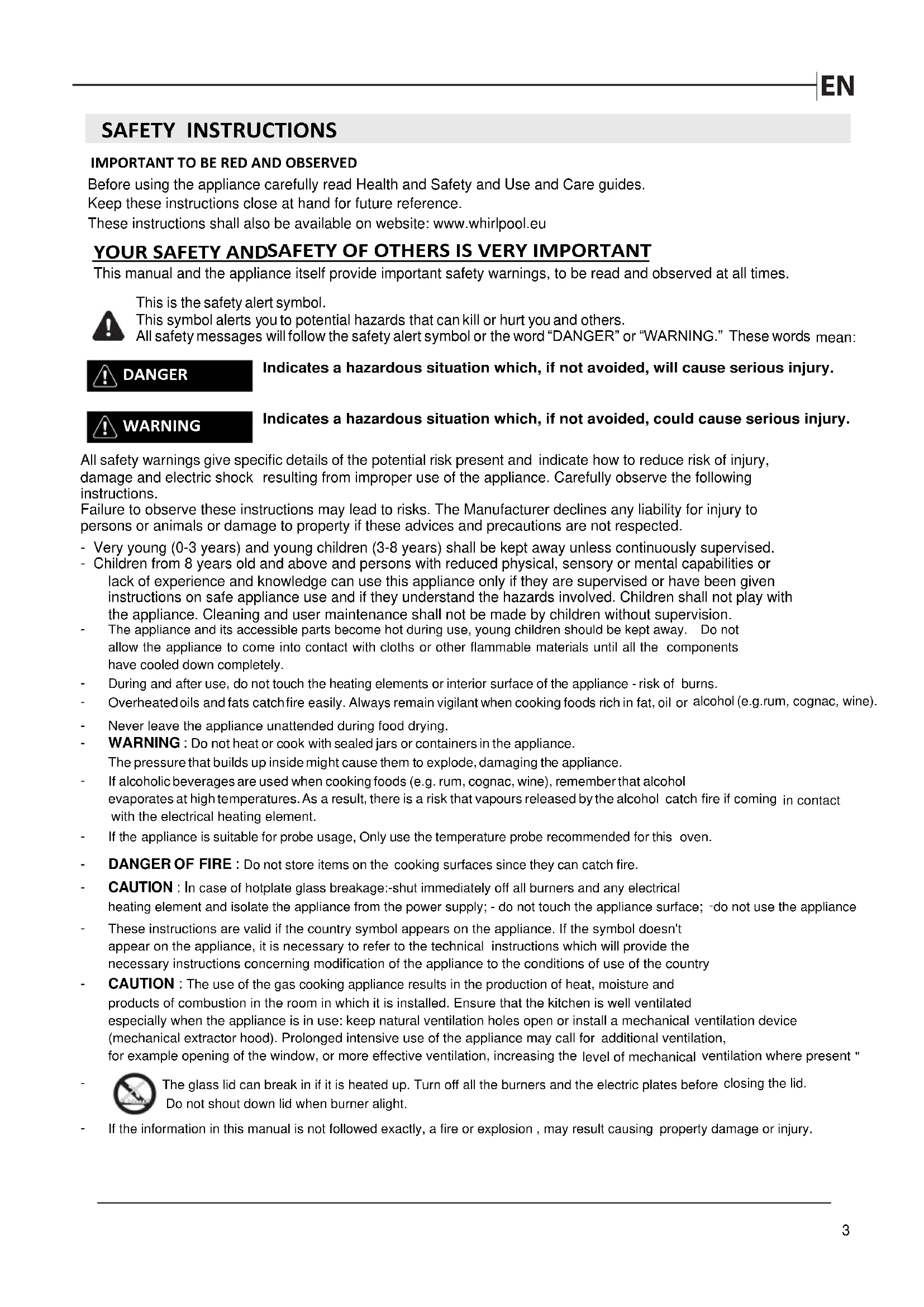


| Product type | Cooker |
| Brand | Whirlpool |
| Model | ACMT 6332IX1 |
| Oven dimensions (H x W x D) | 32.4 x 45.5 x 40.3 cm |
| Oven capacity | 61 liters |
| Hob type | Gas |
| Number of gas burners | 3 |
| Burner power | Rapid 3.00 kW, Semi-rapid 1.90 kW, Auxiliary 1.00 kW |
| Gas supply | LPG or natural gas (depending on adjustment) |
| Oven type | Electric |
| Cooking modes | Traditional, Pastry, Fast cooking, Multifunction, Pizza, Grill, Gratin, Defrost, Bottom, Bottom fan |
| Oven temperature range | 50 °C - Max (250 °C) |
| Electrical supply | 220-240 V ~ 50/60 Hz (confirm on rating plate) |
| Special features | Duration and end-of-cooking programming, timer, electronic clock |
| Safety | Anti-tip safety chain, electronic ignition, flame safety device |
| Cleaning | Manual cleaning, removable glass door, removable dishwasher-safe racks |
| Supplied accessories | Grill, drip tray |
| Material | Stainless steel (likely) |
| Warming drawer dimensions | W 42 x D 44 x H 8.5 cm |
| Smoke extraction | Via hood or natural ventilation |
Frequently Asked Questions - ACMT 6332IX1 WHIRLPOOL
User questions about ACMT 6332IX1 WHIRLPOOL
0 question about this device. Answer the ones you know or ask your own.
Ask a new question about this device
Download the instructions for your Cooker in PDF format for free! Find your manual ACMT 6332IX1 - WHIRLPOOL and take your electronic device back in hand. On this page are published all the documents necessary for the use of your device. ACMT 6332IX1 by WHIRLPOOL.
USER MANUAL ACMT 6332IX1 WHIRLPOOL
Operating Instructions
COOKER AND OVEN
Contents
Operating Instructions,2
SAFETYINSTRUCTIONS3
Description of the appliance-Overall view,23
Description of the appliance-Control Panel,23
Installation,24
Start-up and use,28
Using the hob,28
Cooking modes,29
Clock/Minute Minder Operation,31
Care and maintenance,33
FR
Français
Mode d'emploi
CUISINIERE ET FOUR
Sommaire
Mode d'emploi,2
CONSIGNES DE SECURITE 12
Before using the appliance carefully read Health and Safety and Use and Care guides.
Keep these instructions close at hand for future reference.
These instructions shall also be available on website: www.whirlpool.eu
YOUR SAFETY ANDSAFETY OF OTHERS IS VERY IMPORTANT
This manual and the appliance itself provide important safety warnings, to be read and observed at all times.

This is the safety alert symbol.
This symbol alerts you to potential hazards that can kill or hurt you and others.
All safety messages will follow the safety alert symbol or the word "DANGER" or "WARNING." These words mean:

DANGER
Indicates a hazardous situation which, if not avoided, will cause serious injury.

WARNING
Indicates a hazardous situation which, if not avoided, could cause serious injury.
All safety warnings give specific details of the potential risk present and indicate how to reduce risk of injury, damage and electric shock resulting from improper use of the appliance. Carefully observe the following instructions.
Failure to observe these instructions may lead to risks. The Manufacturer declines any liability for injury to persons or animals or damage to property if these advices and precautions are not respected.
- Very young (0-3 years) and young children (3-8 years) shall be kept away unless continuously supervised.
- Children from 8 years old and above and persons with reduced physical, sensory or mental capabilities or lack of experience and knowledge can use this appliance only if they are supervised or have been given instructions on safe appliance use and if they understand the hazards involved. Children shall not play with the appliance. Cleaning and user maintenance shall not be made by children without supervision.
The appliance and its accessible parts become hot during use, young children should be kept away. Do not allow the appliance to come into contact with cloths or other flammable materials until all the components have cooled down completely.
During and after use, do not touch the heating elements or interior surface of the appliance - risk of burns.
Overheated oils and fats catch fire easily. Always remain vigilant when cooking foods rich in fat, oil or alcohol (e.g.rum, cognac, wine). - Never leave the appliance unattended during food drying.
WARNING: Do not heat or cook with sealed jars or containers in the appliance.
The pressure that builds up inside might cause them to explode, damaging the appliance.
If alcoholic beverages are used when cooking foods (e.g. rum, cognac, wine), remember that alcohol evaporates at high temperatures. As a result, there is a risk that vapours released by the alcohol catch fire if coming in contact with the electrical heating element.
If the appliance is suitable for probe usage, Only use the temperature probe recommended for this oven.
DANGER OF FIRE: Do not store items on the cooking surfaces since they can catch fire.
- CAUTION : In case of hotplate glass breakage:-shut immediately off all burners and any electrical heating element and isolate the appliance from the power supply; - do not touch the appliance surface; -do not use the appliance
These instructions are valid if the country symbol appears on the appliance. If the symbol doesn't appear on the appliance, it is necessary to refer to the technical instructions which will provide the necessary instructions concerning modification of the appliance to the conditions of use of the country
- CAUTION : The use of the gas cooking appliance results in the production of heat, moisture and products of combustion in the room in which it is installed. Ensure that the kitchen is well ventilated especially when the appliance is in use: keep natural ventilation holes open or install a mechanical ventilation device (mechanical extractor hood). Prolonged intensive use of the appliance may call for additional ventilation, for example opening of the window, or more effective ventilation, increasing the level of mechanical ventilation where present "

The glass lid can break in if it is heated up. Turn off all the burners and the electric plates before closing the lid. Do not shout down lid when burner alight.
If the information in this manual is not followed exactly, a fire or explosion , may result causing property damage or injury.
INTENDED USE OF THE PRODUCT
This appliance is designed solely for domestic usage. No other use is permitted (e.g. heating rooms). To aim the appliance as professional use is forbidden. The manufacturer declines all responsibility for innapropriate use or incorrect setting of the controls.
- This appliance is intended to be used in household and similar applications such as:
- Staff kitchen areas in shops, offices and other working environments;
- Farm houses;
- By clients in hotels, motels and other residential environments;
-
Bed and breakfast type environments.
-
CAUTION : The appliance is not intended to be operated by means of an external timer or separate remote controlled supply system.
-
Do not use the appliance outdoors.
-
Do not store explosive or flammable substances such as aerosol cans and do not place or use gasoline or other flammable materials in or near the appliance: a fire may break out if the appliance is inadvertently switched on.
Do not store explosive or flammable substances such as aerosol cans and do not place or use gasoline or other flammable materials in or near the appliance: a fire may break out if the appliance is inadvertently switched on.
INSTALLATION
Installation and repairs must be carried out by a qualified technician, in compliance with the manufacturer's instructions and local safety regulations. Do not repair or replace any part of the appliance unless specifically stated in the user manual.
- The electrical and gas connections must comply with local regulation.
- Children should not perform installation operations. Keep children away during installation of the appliance.
- Keep the packaging materials (plastic bags, polystyrene parts, etc.) out of reach of children, during and after the installation of the appliance.
- WARNING : Modification of the appliance and its method of installation are essential in order to use the appliance safely and correctly in all the additional countries
- Use protective gloves to perform all unpacking and installation operations.
- After unpacking the appliance, make sure that the appliance door closes properly. In the event of problems, contact the dealer or your nearest After-sales Service. To prevent any damage, only remove the oven from its polystyrene foam base at the time of installation.
- The appliance must be handled and installed by two or more persons.
- The appliance must be disconnected from the power supply before carrying out any installation operation.
- During installation, make sure the appliance does not damage the power cable.
- Only activate the appliance when the installation procedure has been completed.
- Kitchen units in contact with the appliance must be heat resistant (min 90^ ).
GAS CONNECTION
-WARNING: Prior to installation, ensure that the local gas delivery conditions (nature or pressure) are compatible with the setting of the hob (see the rating plate and injector table).
- Use pressure regulators suitable for the gas pressure indicated in the instruction.
-WARNING : The adjustment conditions for this appliance are stated on the lable (or data plate).
WARNING : This appliance is not connected to a combustion products evacuation device. It shall be installed and connected in accordance with current installation regulations. Particulat attention shall be given to therelevant requirements regarding ventilation.
- WARNING : These operations must be perfomed by a qualified technician.
- If the appliances is connected to liquid gas, the regulation screw must be fastned as tightly as possible.
- When gas cylinder is adopted, the gas cylinder or gas container must be properly settled (vertical orientation).
- Use only flexible or rigid metal hose for gas connection.
- IMPORTANT : If a stainless steel hose is used, it must be installed so as not touch any mobile part of the furniture (e.g.drawer). It must pass thorough an area where there are no obstructions and where it is possible to inspect it on all its length.
After connection to the gas supply, check for leaks with soapy water. Light up the burners and turn the knobs from max position 1^ to minimum position 2^ to check flame stability.
ELECTRICALWARNINGS
- Make sure the voltage specified on the rating plate corresponds to that of your home.
- For installation to comply with current safety regulations, an omnipolar switch with minimum contact gap of 3mm is required.
- Regulation require that the appliance is earthed.
- For appliances with fitted plug, if the plug is not suitable for you socket outlet, contact a qualified technician.
- Do not use extension leads, multiple sockets or adapters. Do not connect the appliance to a socket which can be operated by remote control.
The power cable must be long enough for connecting the appliance, once fitted in its housing, to the main power supply.
- Do not pull the power supply cable.
If the power cable is damaged it must be replaced with an identical one. The power cable must only be replaced by a qualified technician in compliance with the manufacturer instruction and current safety regulations. Contact an authorized service center.
Do not operate this appliance if it has a damaged mains cord or plug, if it is not working properly, or if it has been damaged or dropped. Do not immerse the mains cord or plug in water. Keep the cord away from hot surfaces.
The electrical components must not be accessible to the user after installation.
Do not touch the appliance with any wet part of the body and do not operate it when barefoot.
It must be possible to disconnect the appliance from the power supply by unplugging it if plug is accessible, or by means of an accessible multi-pole switch installed upstream of the socket in conformity with national electrical safety standards.
The rating plate is on the front edge of the oven (visible when the door is open).
CORRECT USE
CAUTION : The cooking process has to be supervised. A short cooking process has to be supervised continuously.
- Do not use the hob as a work surface or support.
WARNING : Unattended cooking on a hob with fat or oil can be dangerous and may result in fire. Never try to extinguish a fire with water, but switch off the appliance and then cover flame e.g. with a lid or a fire blanket.
IMPORTANT : Should you experience difficulty in turning the burners knobs, please contact After Sales Service for replacement of the burner tap if found to be faulty. - The openings use for the ventilation and dispersion of heat must never be covered.
- Use pots and pans with bottoms the same width as that of the burners or slightly larger (see specific table).
Make sure pots on the grates do not protrude beyond the edge of the hob.
WARNING : Do not let the burner flame extend beyond the edge of the pan. - IMPORTANT : Improper use of the grids can result in damage to the hob: do not position the grids upside down or slide them across the hob.
Do not use : Cast iron griddles, ollar stones, terracotta pots and pans. Heat diffusers such as metal mesh, or any other types. Two burners simultaneously for one receptacle (e.g. Fish kettle).
Note : should particular local conditions of the delivered gas make the ignition of burner difficult, it is advisable to repeat the operation with the knob turned to small flame setting.
Note : In case of installation of a hood above the cooktop, please refer to the hood instructions for the correct distance
WARNING : The protective rubber feet on the grids represent a chocking hazard for young children. After removing the grids, please ensure that all the feet are correctly fitted. - Remove any liquid from the lid before opening it
CLEANING AND MAINTANCE
The appliance must be disconnected from the power supply before carrying out any cleaning or maintenance operation.
- Never use steam cleaning equipment.
Ensure that the appliance is switched off before replacing the lamp to avoid the possibility of electric shock.
Do not use harsh abrasive cleaners or sharp metal scrapers to clean the appliance door glass since they can scratch the surface, which may result in shattering of the glass.
Do not use abrasive or corrosive products, chlorine-based cleaners or pan scourers.
To avoid damaging the electric ignition device, do not use it when the burners are not in their housing.
SAFEGUARDING THE ENVIRONMENT
DISPOSAL OF PACKAGING MATERIALS
The packaging material is 100% recyclable and is marked with the recycle symbol. The various parts of the packaging must therefore be disposed of responsibility and in full compliance with local authority regulations governing waste disposal.
SCRAPPING OF HOUSEHOLD APPLIANCES
-
When scrapping the appliance, make it unusable by cutting off the power cable and removing the doors and shelves (if present) so that children cannot easily climb inside and become trapped.
This appliance is manufactured with recyclable or reusable materials. Dispse of it in accordance with local waste disposal regulations. -
For further information on the treatment, recovery and recycling of household electrical appliances, contact your competent local authority, the collection service for household waste or the store where you purchase the appliance.
- This appliance is marked in compliance with European Directive 2012/19/EU, Waste Electrical and Electronic Equipment (WEEE).
- By ensuring this product is disposed of correctly, you will help prevent potential negative consequences for the environment and human health, which could otherwise be caused by inappropriate waste handling of this product.
The symbol on the product or on the accompanying documentation indicates that it should not be treated as domestic waste but must be taken to an appropriate collection center for the recycling of electrical and electronic equipment.
ENERGY SAVING TIPS
- Only preheat the oven if specified in the cooking table or your recipe.
- Use dark lacquered or enamelled baking moduls as they absorb heat far better.
- Switch the oven off 10/15 minutes before the set cooking time. Food requiring prolonged cooking will continue to cook even once the oven is switched off."
DECLARATION OF CONFORMITY
- This appliance has been designed, constructed and distributed in compliance with the safety requirements of European Directives :
^ 2006/95/EC Low Voltage Directive
^ 2004/108/EC Electromagnetic Compatibility Directive
- This appliance, which is intended to come into contact with foodstuffs, complies with European Regulation (LOGO CE) n. 1935/2004.
- This appliance meets the Eco Design requirements of European Regulations n. 65/2014, and n. 66/2014 in
conformity to the European standard EN 60350-1.
| TABLE OF CHARACTERISTICS | |
| Oven dimensions (HxWxD) | 32,4x45.5x40,3 cm |
| Volume 61 l | |
| Useful measurements relating to the oven compartment | width 42 cm depth 44 cm height 8.5 cm |
| Burners | may be adapted for use with any type of gas shown on the data plate |
| Voltage and frequency | see data plate |
| ENERGY LABEL and ECODESIGN | Energy consumption for Natural convection - heating mode: Convection mode Declared energy consumption for Forced convection Class - heating mode: Baking |
AFTER-SALES SERVICE
Before calling the After-Sales Service
- See if you can eliminate the problem on your own (see "Troubleshooting Guide").
- Switch the appliance off and on again to see if the problem persists.
If the fault persists after the above checks, contact your nearest After-Sales Service.
Specify: the type of fault;
- exact type and model of oven;
- the After-Sales Service number (the number given after the word "Service" on the dataplate) located inside
the storage compartment flap. The service number is also given in the warranty booklet; - your full address;
- your telephone number.
For repairs, contact an Authorised After-Sales Service, indicated in the warranty.
If any work is carried out by technicians not belonging to the Manufacturer's authorised After-Sales Service centres, request a receipt specifying the work performed and make sure the replacement parts are original.
Failure to comply with these instructions can compromise the safety and quality of the product.
INSTRUCTIONS DE SIGURANTA
IMPORTANT DE CITIT ŞI RESPECTAT
Inainte de a folosi echipamentul, cititi cu atentie ghidurile de Sanatate si Siguranta si
Folosire si Ingrijire. Tinei aceste instruktioni la indemnan a partir referinta viitoare.
Specifications: tipul defectionuii;
MISE AU REBUT DES APPAREILS ÉLECTROM É NAGERS
LIMPEZA E MANUTENCAO
Read the safety instructions carefully before using the product
PRODUCT DESCRIPTION
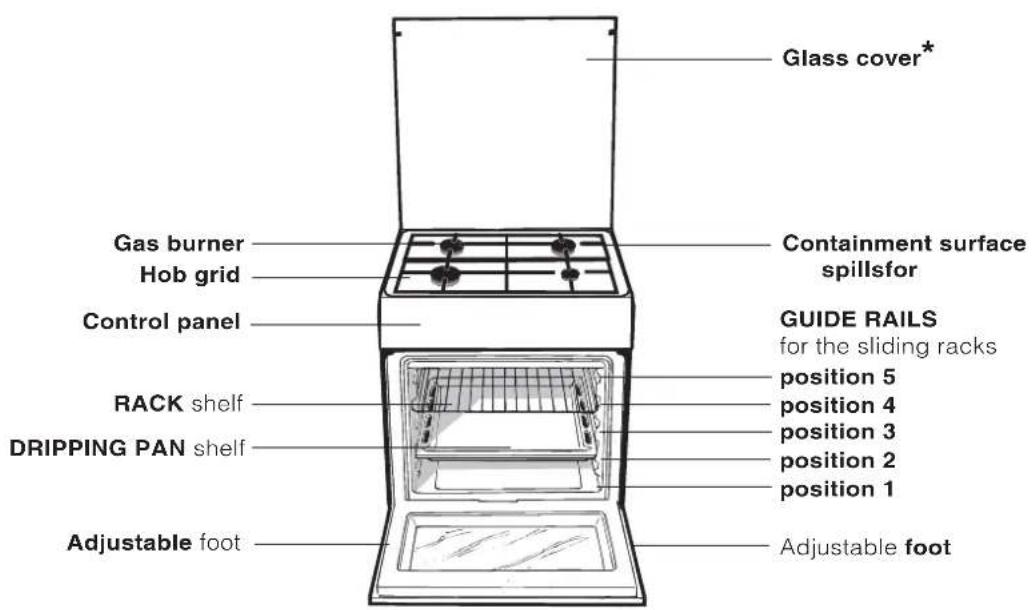
CONTROL PANEL
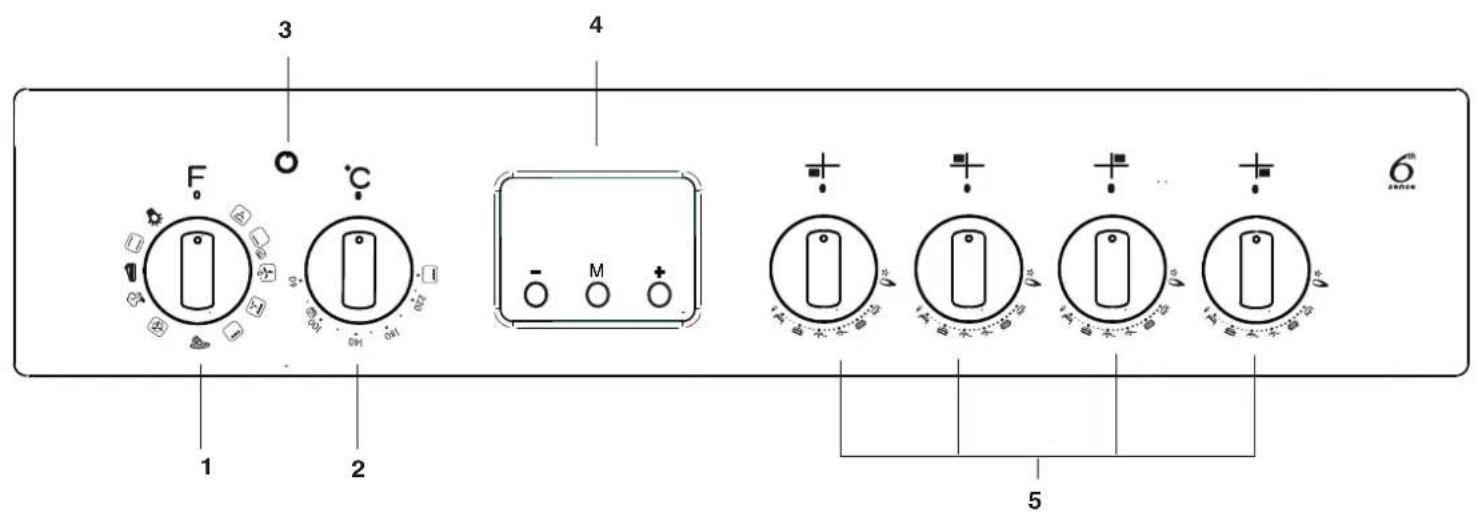
Description of the appliance Control panel
1.SELECTIONR knob
2.THERMOSTAT knob
3.THERMOSTAT indicator light
4. Electronic cooking programmer
5.Hob BURNER control knob
INSTALLATION TIPSINSTALLATION TIPSINSTALLATION T
Room ventilation
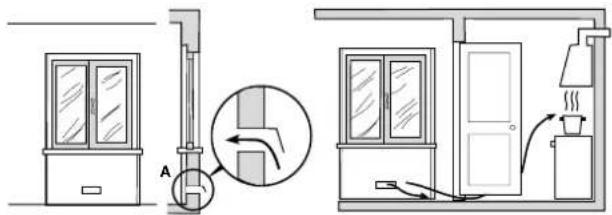
The appliance may only be installed in permanentlyventilated rooms, according to current national legislation and any subsequent amendments in force.
The room in which the appliance is installed must be ventilated adequately in order to provide as much air as is needed by the normal gas combustion process (the flow of air must not be lower than 2m^3 /h per kW of installed power).
The air inlets, protected by grilles, should have a duct with an inner cross section of at least 100cm^2 and should be positioned so that they are not liable to even partial obstruction (see figure A).
These inlets should be enlarged by 100% - with a minimum of 200~cm^2 - whenever the surface of the hob is not equipped with a flame failure safety device. When the flow of air is provided in an indirect manner from adjacent rooms (see figure B), provided that these are not communal parts of a building, areas with increased fire hazards or bedrooms, the inlets should be fitted with a ventilation duct leading outside as described above.
Adjacent room Room requiring ventilation
A
Ventilation opening for comburent air
Increase in the gap between the door and the flooring
After prolonged use of the appliance, it is advisable to open a window or increase the speed of any fans used.
Disposing of combustion fumes
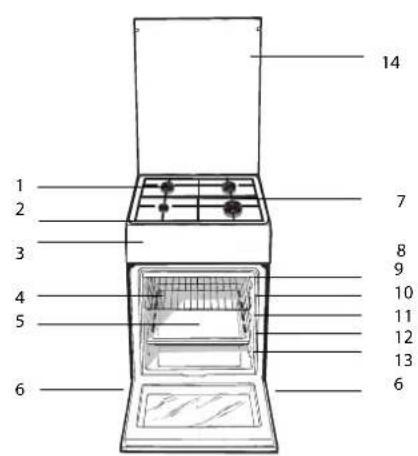
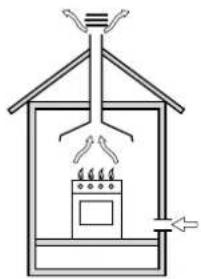
The efficient removal of combustion fumes should be guaranteed using a hood which is connected to a safe and efficient natural suction chimney, or using an electric fan which begins to operate automatically every time the appliance is switched on (see figure).
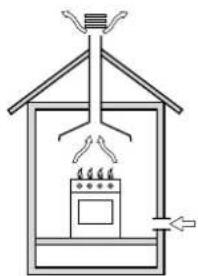
Fumes channelled straight outside
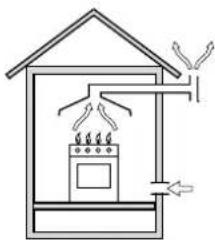
Fumes channelled through a chimney or a branched flue system (reserved for cooking appliances)
The liquefied petroleum gases are heavier than air and collect by the floor, therefore all rooms containing LPG cylinders must have openings leading outside so that any leaked gas can escape easily.
LPG cylinders, therefore, whether partially or completely full, must not be installed or stored in rooms or storage areas which are below ground level (cellars, etc.). Only the cylinder currently in use should be stored in the room; this should also be kept well away from sources of heat (ovens, chimneys, stoves) which may cause the temperature of the cylinder to rise above 50^ .
Positioning and levelling
The appliance may be installed alongside any cupboards whose height does not exceed that of the hob surface.
Make sure that the wall which is in contact with the back of the appliance is made from a nonflammable, heat-resistant material (T 90^ ).
To install the appliance correctly:
- Place it in the kitchen, the dining room or the studio flat (not in the bathroom).
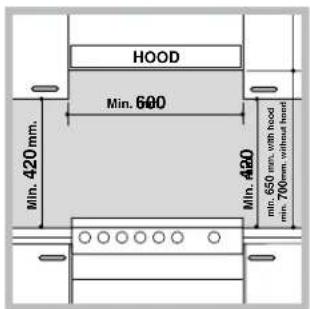
- If the top of the hob is higher than the cupboards, the appliance must be installed at least 600mm away from them.
INSTALLATION TIPS
-
If the cooker is installed underneath a wall cabinet, there must be a minimum distance of 420mm between this cabinet and the top of the hob. This distance should be increased to 700 mm if the wall cabinets are flammable (see figure).
-
Do not position blinds behind the cooker or less than 200mm away from its sides.
- Any hoods must be installed in accordance with the instructions listed in the relevant operating manual.
Levelling
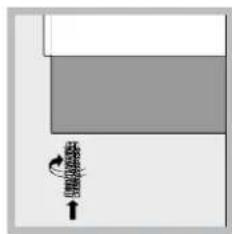
If it is necessary to level the appliance, screw the adjustable feet into the positions provided on each corner of the base of the cooker (see figure).
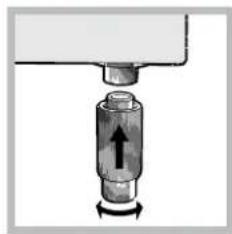
The legs* fit into the slots on the underside of the base of the cooker.
The appliance must not be installed behind a decorative door in order to avoid overheating
Electrical connection
Install a standardised plug corresponding to the load indicated on the appliance data plate (see Technical data table).
The appliance must be directly connected to the mains using an omnipolar switch with a minimum contact opening of 3mm installed between the appliance and the mains. The switch must be suitable for the charge indicated and must comply with current electrical regulations (the earthing wire must not be interrupted by the switch). The supply cable must be positioned so that it does not come into contact with temperatures higher than 50^ at any point.
* Only available in certain models.
Before connecting the appliance to the power supply, make sure that:
The appliance is earthed and the plug is compliant with the law.
- The socket can withstand the maximum power of the appliance, which is indicated by the data plate.
The voltage falls between the values indicated on the data plate.
- The socket is compatible with the plug of the appliance. If the socket is incompatible with the plug, ask an authorised technician to replace it. Do not use extension cords or multiple sockets.
Once the appliance has been installed, the power supply cable and the electrical socket must be easily accessible.
The cable must not be bent or compressed.
The cable must be checked regularly and replaced by authorised technicians only.
The manufacturer declines any liability should these safety measures not be observed.
Gas connection
Connection to the gas network or to the gas cylinder may be carried out using a flexible rubber or steel hose, in accordance with current national legislation and any subsequent amendments in force, after making sure that the appliance is suited to the type of gas with which it will be supplied (see the rating sticker on the cover: if this is not the case see below). When using liquid gas from a cylinder, install a pressure regulator which complies with current national regulations and any subsequent amendments in force. To make connection easier, the gas supply may be turned sideways*: reverse the position of the hose holder with that of the cap and replace the gasket supplied with the appliance.
Make sure that the gas supply pressure is consistent with the values indicated in the Table of burner and nozzle specifications (see below). This will ensure the safe operation and durability of your appliance while maintaining efficient energy consumption.
Gas connection using a flexible rubber hose
Make sure that the hose complies with current national legislation. The internal diameter of the hose must measure: 8 mm for a liquid gas supply; 13 mm for a methane gas supply.
INSTALLATION TIPSINSTALLATION TIPSINSTALLATION TII
Once the connection has been performed, make sure that the hose:
- Does not come into contact with any parts which reach temperatures of over 50^ .
Is not subject to any pulling or twisting forces and that it is not kinked or bent. - Does not come into contact with blades, sharp corners or moving parts and is not compressed.
- Is easy to inspect along its whole length so that its condition may be checked.
Is shorter than 1500mm - Fits firmly into place at both ends, where it will be fixed using clamps which comply with current national regulations.
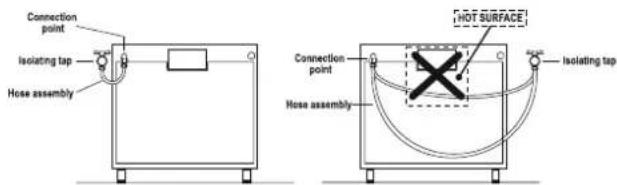
If one or more of these conditions is not fulfilled or if the cooker must be installed in accordance with the conditions listed for class 2 - subclass 1 appliances (installed between two cupboards), the flexible steel hose must be used instead (see below).
Connecting a flexible jointless stainless steel pipe to a threaded attachment
Make sure that the hose complies with current national regulations and that the aluminium gaskets comply with UNI 9001-2, or the rubber gaskets comply with current national regulations.
To begin using the hose, remove the hose holder on the appliance (the gas supply inlet on the appliance is a cylindrical threaded 1/2 gas male attachment).
Perform the connection in such a way that the hose length does not exceed a maximum of 2 metres, making sure that the hose is not compressed and does not come into contact with moving parts.
Checking the connection for leaks
When the installation process is complete, check the hose fittings for leaks using a soapy solution. Never use a flame.
Adapting to different types of gas
It is possible to adapt the appliance to a type of gas other than the default type (this is indicated on the rating label on the cover).
Adapting the hob
Replacing the nozzles for the hob burners:
- Remove the hob grids and slide the burners off their seats.
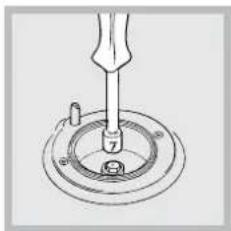
-
Unscrew the nozzles using a 7mm socket spanner (see figure), and replace them with nozzles suited to the new type of gas (see Table of burner and nozzle specifications).
-
Replace all the components by following the above
instructions in reverse.
Adjusting the hob burners' minimum setting:
- Turn the tap to the minimum position.
- Remove the knob and adjust the regulatory screw, which is positioned inside or next to the tap pin, until the flame is small but steady.
If the appliance is connected to a liquid gas supply, the regulatory screw must be fastened as tightly as possible.
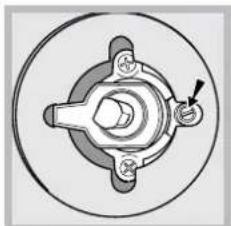
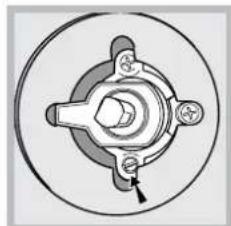
- While the burner is lit, quickly change the position of the knob from minimum to maximum and vice versa several times, checking that the flame is not extinguished.
The hob burners do not require primary air adjustment.
After adjusting the appliance so it may be used with a different type of gas, replace the old rating label with a new one which corresponds to the new type of gas (these labels are available from Authorised Technical Assistance Centres).
Should the gas pressure used be different (or vary slightly) from the recommended pressure, a suitable pressure regulator must be fitted to the inlet hose in accordance with current standards EN 88-1 and EN 88-2 relating to "regulators for channelled gas".
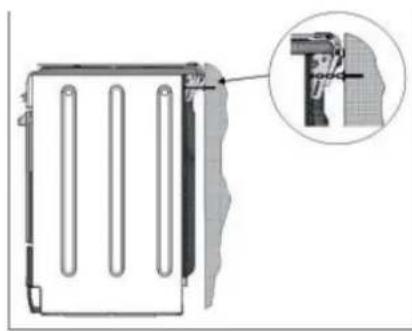
Safety Chain
In order to prevent accidental tipping of the appliance, for example by a child climbing onto the oven door, the supplied safety chain MUST be installed!
The cooker is fitted with a safety chain to be fixed by means of a screw (not supplied with the cooker) to the wall behind the appliance, at the same height as the chain is attached to the appliance.
Choose the screw and the screw anchor according to the type of material of the wall behind the appliance. If the head of the screw has a diameter smaller than 9mm , a washer should be used. Concrete wall requires the screw of at least 8mm of diameter, and 60mm of length.
Ensure that the chain is fixed to the rear wall of the cooker and to the wall, as shown in figure, so that after installation it is tensioned and parallel to the ground level.
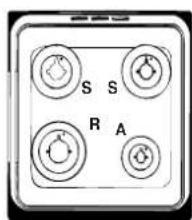
Table of burner and nozzle specifications
| Table1 (for Poland) | G20 (GZ50) | G2.350 (GZ35) | G30 (GPB) | ||||||
| Burner | Diameter (mm) | Thermal Power kW (p.c.s.* | Nozzle 1/100 (mm) | Flow* l/h | Nozzle 1/100 (mm) | Flow* l/h | Thermal power (p.c.i.)* kW | Dysza 1/100 (mm) | Flow* g/h |
| Fast (Large)(R) | 100 | 3,00 | 128 | 286 | 170 | 397 | 8,40 | 87 | |
| Semi Fast (Medium)(S) | 75 | 1,90 | 104 | 181 | 140 | 251 | 2,20 | 69 | |
| Auxiliary (Small)(A) | 51 | 1,00 | 78 | 95 | 102 | 132 | 1,10 | 50 | 80 |
| Supply Pressures | Nominal (mbar) | 16 | 10 | 29 | |||||
| Minimum (mbar) | 20 | 13 | 37 | ||||||
| Maximum (mbar) | 25 | 16 | 44 | ||||||
A 15^ 1013 mbar dry gas G20 (GZ50) p.c.i. = 37,78MJ / m^3 G2.350 (GZ35) p.c.i. = 27,20MJ / m^3 G30 (GPB) p.c.i. = 125,81MJ / m^3
Using the hob
Lighting the burners
For each BURNER knob there is a complete ring showing the strength of the flame for the relevant burner.
To light one of the burners on the hob:
- Bring a flame or gas lighter close to the burner.
- Press the BURNER knob and turn it in an anticlockwise direction so that it is pointing to the maximum flame setting
- Adjust the intensity of the flame to the desired level by turning the BURNER knob in an anticlockwise direction. This may be the minimum setting , the maximum setting or any position in between the two.
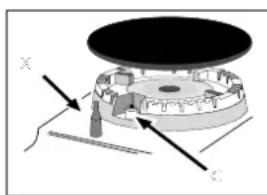
If the appliance is fitted with an electronic lighting device (C) see figure), press the BURNER knob and turn it in an anticlockwise direction, towards the minimum flame
setting, until the burner is lit. The burner might be extinguished when the knob is released. If this occurs, repeat the process, holding the knob down for a longer period of time.
If the appliance is equipped with a flame failure safety device (X), press and hold the BURNER knob for approximately 3-7 seconds to keep the flame alight and to activate the device.
If the flame is accidentally extinguished, switch off the burner and wait for at least 1 minute before attempting to relight it.
If the appliance is equipped with a flame failure safety device*, press and hold the BURNER knob for approximately 2-3 seconds to keep the flame alight and to activate the device.
To switch the burner off, turn the knob until it reaches the stop position
Flame adjustment according to levels
| Ideal for gentle cooking (e.g: rice, sauces, roasts, sh) with liquids (water, wine, broth, milk) | |
| Ideal for stewing (for a long period of me) and thickening. Creaming pasta, | |
| Ideal for sauteing. | |
| Cooking on a high ame and browning (roast, steaks, escalopes, sh llets, fried eggs.) | |
| Ideal for grilling and browning, starng to cook, frying deep frozen products. | |
| Ideal for rapidly increasing the temperature of food to fast boiling in the case of water or rapidly heang cooking liquids. |
Advice when using burners
For the burners to work in the most efficient way possible and to save on the amount of gas consumed, it is recommended that only pans which have a lid and a flat base are used. They should also be suited to the size of the burner.
| Burnercheckware Diameter (cm) |
| Fast (R) 24 - 26 |
| Semi Fast (S) 16 - 20 |
| Auxiliary (A) 10 - 14 |
To identify the type of burner, please refer to the diagrams contained in the paragraph "Burner and nozzle specifications."
For models equipped with a reducer grid, the latter must be used only for the auxiliary burner, when pans with a diameter of less than 12cm are used.
Using the oven
The first time you use your appliance, heat the empty oven with its door closed at its maximum temperature for at least half an hour. Ensure that the room is well ventilated before switching the oven off and opening the oven door. The appliance may emit a slightly unpleasant odour caused by protective substances used during the manufacturing process burning away.
Before operating the product, remove all plastic film from the sides of the appliance.
Never put objects directly on the bottom of the oven; this will avoid the enamel coating being damaged.
- Select the desired cooking mode by turning the SELECTOR knob.
- Select the recommended temperature for the cooking mode or the desired temperature by turning the THERMOSTAT knob.
A list detailing cooking modes and suggested cooking temperatures can be found in the relevant table (see Oven cooking advice table).
During cooking it is always possible to:
- Change the cooking mode by turning the SELECTOR knob.
- Change the temperature by turning the THERMOSTAT knob.
- Stop cooking by turning the SELECTOR knob to the "0" position.
Always place cookware on the rack(s) provided.
All cooking modes have a default cooking
* Only available in certain models.
Cooking modes
All cooking modes have a default cooking temperature which may be adjusted manually to a value between 40^ and 250^ as desired.
THERMOSTAT indicator light
When this is illuminated, the oven is generating heat. It switches off when the inside of the oven reaches the selected temperature. At this point the light illuminates and switches off alternately, indicating that the thermostat is working and is maintaining the temperature at a constant level.
Oven light
This is switched on by turning the SELECTOR knob to any position other than "0". It remains lit as long as the oven is operating. By selecting with the knob, the light is switched on without any of the heating elements being activated.
| Function | Function | Function |
| TRADITIONAL OVEN | Both the top and bottom heating elements will come on. When using this traditional cooking mode, it is best to use one cooking rack only. If more than one rack is used, the heat will be distributed in an uneven manner. | |
| BAKING | The rear heating element and the fan are switched on, thus guaranteeing the distribution of heat in a delicate and uniform manner throughout the entire oven. This mode is ideal for baking and cooking temperature sensitive foods (such as cakes that need to rise) and for the preparation of pastries on 3 shelves simultaneously. | |
| FAST COOKING | The heating elements and the fan come on, guaranteeing the distribution of heat consistently and uniformly throughout the oven. Preheating is not necessary for this cooking mode. This mode is particularly suitable for cooking pre-packed food quickly (frozen or pre-cooked). The best results are achieved using one cooking rack only. | |
| MULTI-COOKING | All the heating elements (top, bottom and circular) switch on and the fan begins to operate. Since the heat remains constant throughout the oven, the air cooks and browns food in a uniform manner. A maximum of two racks may be used at the same time. | |
| PIZZA | The circular heating elements and the elements at the bottom of the oven are switched on and the fan is activated. This combination heats the oven rapidly by producing a considerable amount of heat, particularly from the element at the bottom. If you use more than one rack at a time, switch the position of the dishes halfway through the cooking process. | |
| GRILL | The central part of the top heating element is switched on. The high and direct temperature of the grill is recommended for food that requires a high surface temperature (veal and beef steaks, fillet steak and entrecôte). This cooking mode uses a limited amount of energy and is ideal for grilling small dishes. Place the food in the centre of the rack, as it will not be cooked properly if it is placed in the corners. | |
| GRATIN | The top heating element and the rotisserie (where present) are activated and the fan begins to operate. This combination of features increases the effectiveness of the unidirectional thermal radiation provided by the heating elements through forced circulation of the air throughout the oven. This helps prevent food from burning on the surface and allows the heat to penetrate right into the food. | |
| DEFROSTING | The fan located on the bottom of the oven makes the air circulate at room temperature around the food. This is recommended for the defrosting of all types of food, but in particular for delicate types of food which do not require heat, such as for example: ice cream cakes, cream or custard desserts, fruit cakes. By using the fan, the defrosting time is approximately halved. In the case of meat, fish and bread, it is possible to accelerate the process using the "multi-cooking" mode and setting the temperature to 80° - 100°C | |
| BOTTOM | The lower heating element is activated. This position is recommended for perfecting the cooking of dishes (in baking trays) which are already cooked on the surface but require further cooking in the centre, or for desserts with a covering of fruit or jam, which only require moderate colouring on the surface. It should be noted that this function does not allow the maximum temperature to be reached inside the oven (250°C) and it is therefore not recommended that foods are cooked using only this setting, unless you are baking cakes (which should be baked at a temperature of 180°C or lower). | |
| BOTTOM VENTILATED | The bottom heating element and the fan is activated, which allows for the heat distribution within the whole cavity of the oven. This combination is useful for light cooking of vegetables and fish |
Practical cooking advice
In the GRILL cooking mode, place the dripping pan in position 1 to collect cooking residues (fat and/or grease).
GRILL
- Insert the rack in position 3 or 4. Place the food in the centre of the rack.
We recommend that the power level is set to maximum. The top heating element is regulated by a thermostat and may not always operate constantly.
PIZZA
- Use a light aluminium pizza pan. Place it on the rack provided.
For a crispy crust, do not use the dripping pan as it prevents the crust from forming by extending the total cooking time. - If the pizza has a lot of toppings, we recommend adding the mozzarella cheese on top of the pizza halfway through the cooking process.
Cooking on several shelves simultaneously
If it is necessary to use two racks, use the FAN
ASSITED mode, as this is the only cooking mode suited to this type of cooking. We also recommend that:
-
Positions 1 and 5 are not used. This is because excessive direct heat can burn temperature sensitive foods.
-
Positions 2 and 4 are used and that food that requires more heat is placed on the rack in position 2.
-
When cooking foods that require different cooking times and temperatures, set a temperature that is halfway between the two recommended temperatures (see Oven cooking advice table) and place the more delicate food on the rack in position 4. Remove the food that requires a shorter cooking time first.
-
When cooking pizzas on several racks with the temperature set to 220^ , the oven is preheated for 15 minutes. Generally speaking, cooking on the rack in position 4 takes longer: we recommend that the pizza cooked on the lowest rack position is removed first, followed by the pizza cooked in position 4 a few minutes later.
- Place the dripping pan on the bottom and the rack on top.
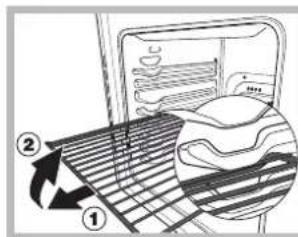
The oven is provided with a stop system to extract the racks and prevent them from coming out of the oven.(1)
As shown in the drawing, to extract them completely, simply lift the racks, holding them on the front
part, and pull (2).
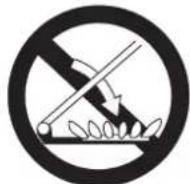
WARNING! The glass lid can break in if it is heated up. Turn off all the burners and the electric plates before closing the lid. *Applies to the models with glass cover only.
Clock/Minute Minder Operation
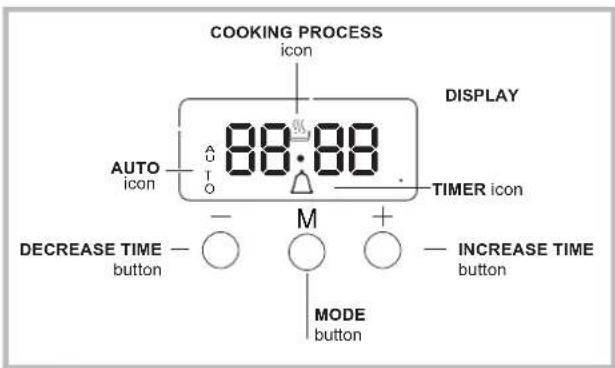
Setting the clock
The clock may be set when the oven is switched off or when it is switched on, provided that the end time of a cooking cycle has not been programmed previously. After the appliance has been connected to the mains,
or after a blackout, the 00:00 digits on the DISPLAY will begin to flash.
- Press the "+" and "-" button simultaneously Then the colon between hours and minutes is flashing.
- Use the "+" and "-" buttons to adjust the time; if you press and hold either button, the display will scroll through the values more quickly, making it quicker and easier to set the desired value.
Changing the buzzer frequency
- First press "+" and "-" button simultaneously and then press the button for selecting the menu for changing the buzzer frequency. While the text tonX is visible the buzzer signal frequency can be changed by touching the "- " repeatedly.
Setting the minute minder
This function does not interrupt cooking and does not affect the oven; it is simply used to activate the buzzer when the set amount of time has elapsed.
- Press the button several times until the icon and the three digits on the display begin to flash.
- Use the "+" and "-" buttons to set the desired time; if you press and hold either button, the display will scroll through the values more quickly, making it quicker and easier to set the value.
- Wait for 5 seconds, If you press the buttom one more time the display will then show the time as it counts down. When this period of time has elapsed the buzzer will be activated.
Programming cooking
A cooking mode must be selected before programming can take place.
Programming the cooking duration
- Press the button several times until icon and the DUR digits on the DISPLAY begin to flash.
- Use the "+" and "-" buttons to set the desired duration; if you press and hold either button, the display will scroll through the values more quickly, making it quicker and easier to set the value.
- Wait for 5 seconds, after that the icon will be visible on the display.
- When the set time has elapsed and the oven will stop cooking, you will hear a buzzer sounds. Press any button to stop the buzzer.
- For example: it is 9:00 a.m. and a time of 1 hour and 15 minutes is programmed. The programme will stop automatically at 10:15 a.m.
Cancelling a programme
To cancel a programme:
- press the button until the icon corresponding to the setting you wish to cancel and the digits on the display are flashing. Press the " - " button until the digits 00:00 appear on the display.
- Press and hold the "+" and "-" buttons; this will cancel all the settings selected previously, including timer settings.
Oven cooking advice table
| Cooking modes | Foods | Weight (in kg) | Rack Position | Pre-heating time (minutes) | Recommended temperature | Cooking time (minutes) |
| Traditional Oven | Duck | 1 | 3 | 15 | 200 | 65-75 |
| Roast veal or beef | 1 | 3 | 15 | 200 | 70-75 | |
| Pork roast | 1 | 3 | 15 | 200 | 70-80 | |
| Biscuits (short pastry) | - | 3 | 15 | 180 | 15-20 | |
| Tarts | 1 | 3 | 15 | 180 | 30-35 | |
| Baking Mode | Tarts | 0.5 | 3 | 15 | 180 | 20-30 |
| Fruit cakes | 1 | 2 or 3 | 15 | 180 | 40-45 | |
| Plum cake | 0.7 | 3 | 15 | 180 | 40-50 | |
| Sponge cake | 0.5 | 3 | 15 | 160 | 25-30 | |
| Stuffed pancakes (on 2 racks) | 1.2 | 2 and 4 | 15 | 200 | 30-35 | |
| Small cakes (on 2 racks) | 0.6 | 2 and 4 | 15 | 190 | 20-25 | |
| Cheese puffs (on 2 racks) | 0.4 | 2 and 4 | 15 | 210 | 15-20 | |
| Cream puffs (on 3 racks) | 0.7 | 1 and 3 and 5 | 15 | 180 | 20-25 | |
| Biscuits (on 3 racks) | 0.7 | 1 and 3 and 5 | 15 | 180 | 20-25 | |
| Meringues (on 3 racks) | 0.5 | 1 and 3 and 5 | 15 | 90 | 180 | |
| Fast cooking | Frozen food | |||||
| Pizza | 0.3 | 2 | - | 250 | 12 | |
| Courgette and prawn pie | 0.4 | 2 | - | 200 | 20 | |
| Country style spinach pie | 0.5 | 2 | - | 220 | 30-35 | |
| Turnovers | 0.3 | 2 | - | 200 | 25 | |
| Lasagne | 0.5 | 2 | - | 200 | 35 | |
| Golden Rolls | 0.4 | 2 | - | 180 | 25-30 | |
| Chicken morsels | 0.4 | 2 | - | 220 | 15-20 | |
| Pre-cooked food | ||||||
| Golden chicken wings | 0.4 | 2 | - | 200 | 20-25 | |
| Fresh Food | ||||||
| Biscuits (short pastry) | 0.3 | 2 | - | 200 | 15-18 | |
| Plum cake | 0.6 | 2 | - | 180 | 45 | |
| Cheese puffs | 0.2 | 2 | - | 210 | 10-12 | |
| Multi-cooking | Pizza (on 2 racks) | 1 | 2 and 4 | 15 | 230 | 15-20 |
| Lasagne | 1 | 3 | 10 | 180 | 30-35 | |
| Lamb | 1 | 2 | 10 | 180 | 40-45 | |
| Roast chicken + potatoes | 1+1 | 2 and 4 | 15 | 200 | 60-70 | |
| Mackerel | 1 | 2 | 10 | 180 | 30-35 | |
| Plum cake | 1 | 2 | 10 | 170 | 40-50 | |
| Cream puffs (on 2 racks) | 0.5 | 2 and 4 | 10 | 190 | 20-25 | |
| Biscuits (on 2 racks) | 0.5 | 2 and 4 | 10 | 180 | 10-15 | |
| Sponge cake (on 1 rack) | 0.5 | 2 | 10 | 170 | 15-20 | |
| Sponge cake (on 2 racks) | 1 | 2 and 4 | 10 | 170 | 20-25 | |
| Savoury pies | 1.5 | 3 | 15 | 200 | 25-30 | |
| Pizza Mode | Pizza | 0.5 | 3 | 15 | 220 | 15-20 |
| Roast veal or beef | 1 | 2 | 10 | 220 | 25-30 | |
| Chicken | 1 | 2 or 3 | 10 | 180 | 60-70 | |
| Grill | Soles and cuttlefish | 0.7 | 4 | - | Max | 10-12 |
| Squid and prawn kebabs | 0.6 | 4 | - | Max | 8-10 | |
| Cuttlefish | 0.6 | 4 | - | Max | 10-15 | |
| Cod filet | 0.8 | 4 | - | Max | 10-15 | |
| Grilled vegetables | 0.4 | 3 or 4 | - | Max | 15-20 | |
| Veal steak | 0.8 | 4 | - | Max | 15-20 | |
| Sausages | 0.6 | 4 | - | Max | 15-20 | |
| Hamburgers | 0.6 | 4 | - | Max | 10-12 | |
| Mackerel | 1 | 4 | - | Max | 15-20 | |
| Toasted sandwiches (or toast) | 4 and 6 | 4 | - | Max | 3-5 | |
| Gratin | Grilled chicken | 1.5 | 2 | 10 | 200 | 55-60 |
| Cuttlefish | 1.5 | 2 | 10 | 200 | 30-35 | |
| Bottom Ventilated | Bream | 0.5 | 3 | \(18^{\prime}\) | 170-180 | 25-35 |
| Codfish fillet | 0.5 | 3 | \(16^{\prime}\) | 160-170 | 15-20 | |
| Sea bass in foil | 0.5 | 3 | \(24^{\prime}\) | 200-210 | 35-45 | |
| Mixed vegetables (Ratatouille type) | 0.8-1,0 | 3 | \(21^{\prime}\) | 190-200 | 50 - 60 | |
| Well-done vegetables | 1,5-2,0 | 3 | \(20^{\prime}\) | 180 - 190 | 55 - 60 | |
| Bottom | For perfecting cooking | |||||
* cooking times are approximate and may vary according to personal taste. When cooking using the grill or fan assisted grill, the dripping pan must always be placed on the 1st oven rack from the bottom.
Care and maintenance
Switching the appliance off
Disconnect your appliance from the electricity supply before carrying out any work on it.
Cleaning the appliance
Never use steam cleaners or pressure cleaners on the appliance.
- The stainless steel or enamel-coated external parts and the rubber seals may be cleaned using a sponge which has been soaked in lukewarm water and neutral soap. Use specialised products for the removal of stubborn stains. After cleaning, rinse well and dry thoroughly. Do not use abrasive powders or corrosive substances.
- The hob grids, burner caps, flame spreader rings and burners may be removed to make cleaning easier; wash them in hot water and non-abrasive detergent, making sure all burnt-on residue is removed before drying them thoroughly.
- Clean the terminal part of the flame failure safety devices* frequently.
- The inside of the oven should ideally be cleaned after each use, while it is still lukewarm. Use hot water and detergent, then rinse well and dry with a soft cloth. Do not use abrasive products.
- Clean the glass part of the oven door using a sponge and a non-abrasive cleaning product, then dry thoroughly with a soft cloth. Do not use rough abrasive material or sharp metal scrapers as these could scratch the surface and cause the glass to crack.
- The accessories can be washed like everyday crockery, and are even dishwasher safe.
- Do not close the cover when the burners are alight or when they are still hot.
Inspecting the oven seals
Check the door seals around the oven regularly. If the seals are damaged, please contact your nearest Authorised After-sales Service Centre. We recommend that the oven is not used until the seals have been replaced.
*
Only available in certain models.
Replacing the oven light bulb
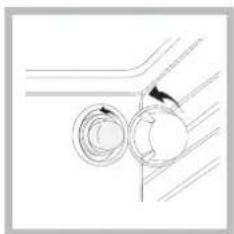
- After disconnecting the oven from the electricity mains, remove the glass lid covering the lamp socket (see figure).
-
Remove the light bulb and replace it with a similar one: voltage 230 V, wattage 25 W, cap E 14.
-
Replace the lid and reconnect the oven to the electricity supply.
This product contains a light source of energy efficiency class E.
Gas tap maintenance
Over time, the valves may become jammed or difficult to turn. If this occurs, the valve must be replaced.
This procedure must be performed by aThis procedure mu qualified technician who has been authorised byqualified to the manufacturer.the manufacturer.
Oven shelf supports
The shelf supports are removable and dishwasher safe. To remove hold the support at the front and pull away from the oven side, this can then be cleaned in a sink or a dishwasher.
When removed it allows access to the oven side, which can be cleaned with warm soapy water.
To refit the support, insert the longer leg into the rear fixing hole and push in the front leg.
Removing and fitting the oven door:
1.Open the door
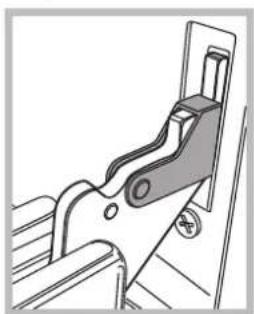
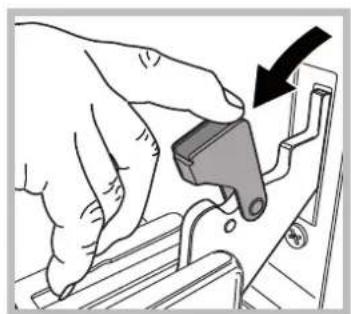
2.Make the hinge clamps of the oven door rotate backwards completely (see photo)
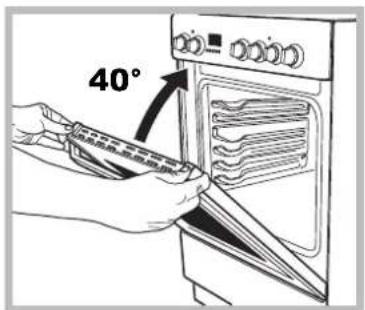
3.Close the door until the clamps stop (the door will remain open for 40^ approx.) (see photo)
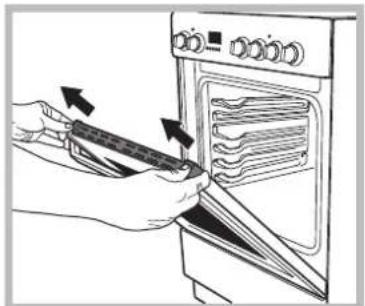
- Press the two buttons on the upper profile and
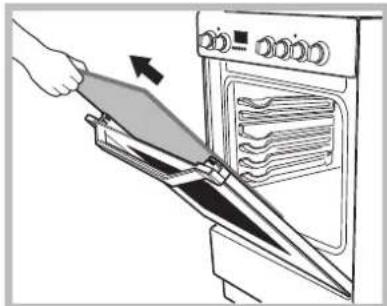
extract the profile (see photo)
5.Remove the glass sheet and do the cleaning as indicated in chapter: "Care and maintenance".
6. Replace the glass.
WARNING! Oven must not be operated with inner door glass removed!
WARNING! When reassembling the inner door glass insert the glass panel correctly so that the text written on the panel is not reversed and can be easily legible.
- Replace the profile, a click will indicate that the part is positioned correctly.
8.Open the door completely.
9.Close the supports (see photo).
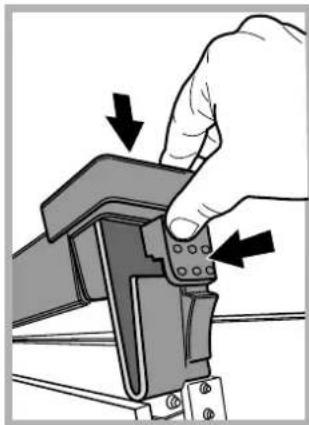
- Now the door can be completely closed and the oven can be started for normal use.
This method of cleaning is recommended especially after cooking very fatty (roasted)meats.
This cleaning process allows to facilitate the removal of dirt of the walls of the oven by the generation of steam that is created inside the oven cavity for easier cleaning.
! Important! Before you start steam -cleaning:
-Remove any food residue and grease from the bottom of the oven.
- Remove any oven accessories (grids and drip pans).
Perform the above operations according to the following procedure:
- pour 300ml of water into the baking tray in the oven, placing it in the bottom shelf. In the models where the drip pan is not present, use a baking sheet and place it on the grill at the bottom shelf;
- select the function of the oven and set the temperature to 100^
- keep it in the oven for 15min;
- turn off the oven;
- Once cooled the oven, you can open the door to complete the cleaning with water and a damp cloth;
- eliminate any residual water from the cavity after finishing cleaning
When the steam -cleaning is done, after cooking especially fatty foods, or when grease is difficult to remove, you may need to complete the cleaning with the traditional method, described in the previous paragraph.
Perform cleaning only in the cold oven!
ONLY FOR SOUTH AFRICA
Additional notes
Important: Read these instructions for use carefully so as to familiarize yourself with the appliance before connecting it to its gas container. Keep these instructions for future reference.
IF YOU SMELL GAS:
- Turn off gas supply at bottle
- Extinguish all naked flames
- Do not operate any electrical appliances
- Ventilate the area
- Check for leaks as detailed in this manual
If odour persists, contact your dealer or gas supplier immediately.
Do not tamper or modify the appliance.
BURN-BACK (FIRE IN BURNER TUBE OR CHAMBER)
In the event of a burn-back, where the flame burns back to the jet, immediately turn the gas supply off at the control valve on the panel. After ensuring the flame is extinguished, wait for 1 minute and re-light the appliance in the normal manner. Should the appliance again burn back, close the control valve and call a service technician. Do not use the appliance again until the service technician has declared that it is safe to do so.
This appliance requires an operating pressure of 2,8kPa at the appliance. This appliance is set as NG, a suitable LPG regulator, that complies with the requirements of SANS 1237, must be installed.
IMPORTANT INFORMATION FOR THE USER
This appliance may only be installed by a registered SAQCC Gas installer. All registered installers are issued with a card carrying their registration number. Ask to be shown the card before allowing the installation work to commence and make a note of the Installer registration number. Upon completion of the installation, the installer is required to explain the operational details of the appliance together with the safety instructions. You will be asked to sign acceptance of the installation and be provided with a completion certificate. You should only sign for acceptance of the installation when the installation is completed to your satisfaction.
Note that your invoice is required in the event that you wish make a guarantee claim.
IMPORTANT INFORMATION FOR THE INSTALLER
This appliance may only be installed by a gas installer registered with the South African qualification and certification committee (SAQCC). The appliance must be installed in accordance with the requirements of SANS 10087-1 for use with LPG, SANS 827 for use with NG and any fire department regulations and/or local bylaws applicable to the area. If in doubt, check with the relevant authority before undertaking the installation. Upon completion of the installation you are required to fully explain and demonstrate to the user the operational details and safety practices applicable to the appliance and the installation.
Table of burner and nozzle specifications
| Table1 (for Poland) | NATURAL GAS (Methane) NG LIQUEFIED GAS (Butane) LPG | ||||||
| Burner | Diameter (mm) | Thermal Power kPa | Nozzle 1/100 (mm) | Flow* l/h | Thermal power kPa | Dysza 1/100 (mm) | Flow* g/h |
| Fast (Large)(R) | 100 | 3,00 | 128 | 286 | 3,40 | 87 | 247 |
| Semi Fast (Medium)(S) | 75 | 1,90 | 104 | 181 | 2,20 | 69 | |
| Auxiliary (Small)(A) | 51 | 1,00 | 78 | 95 | 1,10 | 50 | 80 |
| Supply Pressures | 2,0 kPa | 2,8 kPa | |||||
160
GHID DE REFERINTA
PENTRU UTILIZARE ZILNICA
! Inainte de a utiliza aparatul, citi ci atentie Ghidul privind sanataea si siguranta.
DESCRIEREA PRODUSULUI
Evacuation directement a
- Operating Instructions
- COOKER AND OVEN
- Contents
- Mode d'emploi
- CUISINIERE ET FOUR
- Sommaire
- YOUR SAFETY ANDSAFETY OF OTHERS IS VERY IMPORTANT
- DANGER
- WARNING
- INTENDED USE OF THE PRODUCT
- INSTALLATION
- GAS CONNECTION
- ELECTRICALWARNINGS
- CORRECT USE
- CLEANING AND MAINTANCE
- DISPOSAL OF PACKAGING MATERIALS
- SCRAPPING OF HOUSEHOLD APPLIANCES
- ENERGY SAVING TIPS
- DECLARATION OF CONFORMITY
- AFTER-SALES SERVICE
- Before calling the After-Sales Service
- If the fault persists after the above checks, contact your nearest After-Sales Service.
- INSTRUCTIONS DE SIGURANTA
- IMPORTANT DE CITIT ŞI RESPECTAT
- MISE AU REBUT DES APPAREILS ÉLECTROM É NAGERS
- LIMPEZA E MANUTENCAO
- PRODUCT DESCRIPTION
- CONTROL PANEL
- Description of the appliance Control panel
- INSTALLATION TIPSINSTALLATION TIPSINSTALLATION T
- Room ventilation
- Disposing of combustion fumes
- Positioning and levelling
- INSTALLATION TIPS
- Levelling
- The appliance must not be installed behind a decorative door in order to avoid overheating
- Electrical connection
- The manufacturer declines any liability should these safety measures not be observed.
- Gas connection using a flexible rubber hose
- INSTALLATION TIPSINSTALLATION TIPSINSTALLATION TII
- Connecting a flexible jointless stainless steel pipe to a threaded attachment
- Checking the connection for leaks
- Adapting to different types of gas
- Adapting the hob
- Using the hob
- Lighting the burners
- Flame adjustment according to levels
- Advice when using burners
- Using the oven
- Cooking modes
- THERMOSTAT indicator light
- Oven light
- Practical cooking advice
- GRILL
- PIZZA
- Cooking on several shelves simultaneously
- Clock/Minute Minder Operation
- Setting the clock
- Changing the buzzer frequency
- Setting the minute minder
- Programming cooking
- Programming the cooking duration
- Cancelling a programme
- Care and maintenance
- Switching the appliance off
- Cleaning the appliance
- Inspecting the oven seals
- Replacing the oven light bulb
- Gas tap maintenance
- Oven shelf supports
- Removing and fitting the oven door:
- ONLY FOR SOUTH AFRICA
- Additional notes
- IF YOU SMELL GAS:
- BURN-BACK (FIRE IN BURNER TUBE OR CHAMBER)
- IMPORTANT INFORMATION FOR THE USER
- IMPORTANT INFORMATION FOR THE INSTALLER
- GHID DE REFERINTA
- PENTRU UTILIZARE ZILNICA
- DESCRIEREA PRODUSULUI
Brand : WHIRLPOOL
Model : ACMT 6332IX1
Category : Cooker