Force 1400 - Pressure washer Euromac - Free user manual and instructions
Find the device manual for free Force 1400 Euromac in PDF.



| Product type | High-pressure cleaner |
| Brand | Euromac |
| Model | Force 1400 |
| Connection voltage | AC 220-240 V, 50 Hz |
| Power consumption | 1400 W |
| Maximum pressure | 10 MPa (100 bars) |
| Water flow rate | 330 l/h |
| Max water inlet pressure | 0.7 MPa (7 bars) |
| High-pressure hose length | 5 m |
| Max water temperature | 40 °C |
| Automatic on/off | Yes |
| Protection class | II |
| Protection degree | IPX5 |
| Sound level | 77 dB(A) |
| Dimensions (L × W × H) | 24.5 × 26.5 × 68 cm |
| Weight | 4.35 kg |
| Turbo lance included | Yes |
| Usage type | Domestic |
| Safety features | Gun safety lock, motor thermal protection, pressure regulator |
| Recommended maintenance | Regular cleaning of nozzle and water inlet filter, lubricating O-rings |
| Original spare parts | Available (recommended) |
| Recycling | Do not dispose of with household waste - take to a collection center |
Frequently Asked Questions - Force 1400 Euromac
User questions about Force 1400 Euromac
0 question about this device. Answer the ones you know or ask your own.
Ask a new question about this device
Download the instructions for your Pressure washer in PDF format for free! Find your manual Force 1400 - Euromac and take your electronic device back in hand. On this page are published all the documents necessary for the use of your device. Force 1400 by Euromac.
USER MANUAL Force 1400 Euromac
Before using this device for the first time, please read the instruction manual carefully and completely and follow the instructions, warnings and safety regulations.
Store this booklet in order to be able to consult it in future.
Save the packaging in order to be able to store the cleaner temporarily.
TECHNICAL DATA
| Model Force 1200 Force 1400 | ||
| Voltage AC 220-240V, 50Hz AC 220-240V, 50Hz | ||
| Power consumption 1200 Watts 1400W | ||
| Max. pressure 9MPa (90 bar) 10MPa (100 bar) | ||
| Water consumption 330 l/h 330 l/h | ||
| Max. pressure water intake | 0,7MPa (7 bar) 0,7MPa (7 bar) | |
| Length hp hose 3 metres | 5 metres | |
| Water temperature | 0-40°C | 0-40°C |
| Automatic start-stop | + | + |
| Protection class | II | II |
| Protection level | IPX5 | IPX5 |
| Noise level | 77 dB(A) | 77 dB(A) |
| Dimensions | 20 x 25 x 42 cm | 24.5 x 26.5 x 68 cm |
| Weight | 4.1 kg 4.35 kg | |
Technical changes reserved
IMPORTANT SAFETY REGULATIONS
- Check your machine for visible damage before every use (incl. cable, plug, hose and nozzle). Do not use a machine that is damaged or did not work perfectly on the previous occasion, but take it to your supplier for repairs/replacement.
- The Voltage and frequency stated on the machine must correspond with those of the socket to be used. The electrical installations must be approved (IEC 60364-1) and secured with an earth leakage switch (max. 30mAmp ). Never alter the plug or socket in order to make them fit! Faults in the electrical connection may cause electric shocks!
- If an extension cable is unavoidable, use a cable of sufficient thickness: 1mm^2 for cables to 12.5 metres, 1.5mm^2 for cables to 20 metres and 2.5mm^2 for cables to 30 metres in length. Unroll the cable completely during use in order to prevent overheating. The female plug/socket must be watertight and the connection must be kept dry and may not lie on the ground. Defective extension cables are dangerous!
- Take the greatest care when the machine is used near children, handicapped people or senior citizens. Never leave them with a working machine unsupervised!
- This machine is unsuitable for use by persons (including children) with a physical, sensory or mental handicap, or with a lack of knowledge, regardless of whether there is supervision or instructions have been given on the use of the machine by a person who is responsible for their safety. Ensure that children cannot play with the machine.
- Damaged components (incl. plug, electrical cable, hose and nozzle) must be replaced immediately by an appropriately trained mechanic or a qualified electrician. Ensure that only original parts are used - hoses and connectors are also extremely important for safety! Never carry out repairs!
-
Ensure that the machine is placed on a robust, even and horizontal surface during use and also during transportation and storage. It may be damaged if it falls over!
-
Warning! The jet of the high-pressure cleaner can be dangerous if the machine is not used in accordance with the instructions. Never point the jet at people or the user (also not to clean clothing/footwear!), animals, electrical equipment or installations on the cleaner!
- The user and persons who must be in the vicinity must wear protective clothing and footwear. We strongly recommend that you use hearing protection.
- Do not use the cleaner in circumstances or environments where there is a danger of explosions.
- Always take the plug out of the socket when carrying out maintenance on the machine, before you change the nozzle and when the cleaner is not in use.
- Water that has been in the machine, the hose or the nozzle is unsuitable for consumption.
- Do not use the machine at temperatures exceeding 40^ or under 2^ , and keep it frost-free.
- Never change anything on the machine, the jet lance, the nozzle or any other component.
- Never cover the machine, jet lance, nozzle or any other part during use.
- Switch the machine off immediately in the case of accidents or power failures.
- Only spray clean water. If you spray water that may contain, for example, sand (from a well or similar source) an extra filter must be installed.
DESCRIPTION
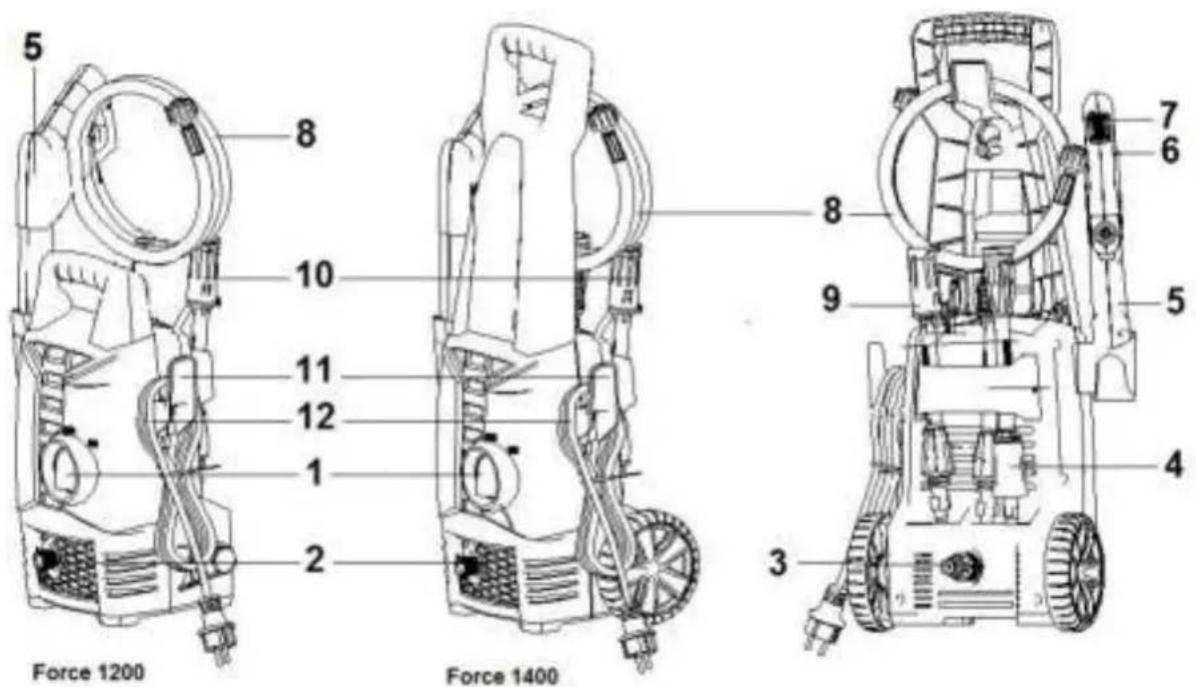
- On/off switch
- Water outlet
- Water inlet
- Turbo-lance (only Force 1400)
- Handle
-
Trigger
-
Handle lock
- High-pressure hose
- Lance extension
- Jet lance
- Cable hook
- Electrical cable
This high-pressure cleaner was developed for household use, such as the washing/spraying of cars, boats, terraces, small walls, etc. So use it exclusively for this type of work and not for (excessively) heavy and/or industrial purposes!
The machine contains a number of components, including a pump in a shock-absorbing housing - the handle has an anti-slip profile.
You can spray cold and lukewarm water to a maximum of 40^ . Hotter water can damage the pump. Do not use water that contains dirt, sand or chemicals – this may damage the machine and the operation and shorten the life span of the machine.
The safety regulations specified elsewhere in this booklet must be taken into account at all times in order to prevent damage to the machine and the surface to be cleaned and personal injury.
ASSEMBLY
- Place the cleaner as close as possible to the water supply.
- The cleaner must be placed upright on a robust, flat and horizontal surface (handle on top).
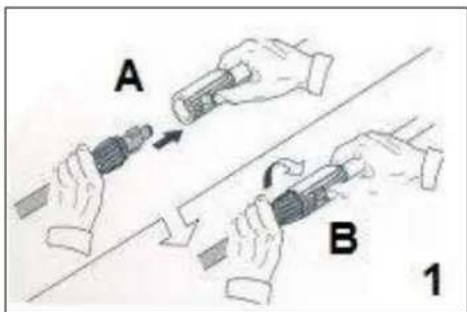
- Insert the end of the lance extension completely into the handle (A) and secure it with a quarter turn (B). Then fasten the connection by tightening the coupling nut. See diagram 1.
- Fasten the jet lance to the lance extension by inserting the end of the jet lance completely into the lance extension and securing it with a quarter turn.
- The Force 1400 also has a turbo-lance as standard, which can be used instead of the normal jet lance if desired.
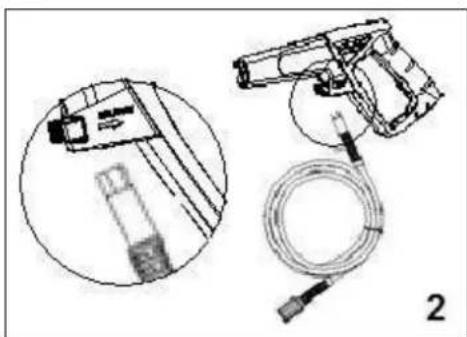
- Connect the handle to the high-pressure hose. See diagram2.
- Connect the high-pressure hose to the water inlet of the machine.
- Fasten the female quick-lock to the water supply hose and then connect them to the water inlet of the machine. The (not supplied) water supply hose must have a minimum diameter of 13mm (1/2^ ) and be reinforced.
Attention!
- The water supply must supply at least the water consumption of the machine (330 l/h)! The pump must always be supplied with sufficient water. 'Dry operation' causes damage.
The water temperature may not exceed 40^ . The pressure of the water supplied may not exceed 0.7 MPA (7 bar).
Only use clean water with this machine. Impurities or aggressive chemicals damage the machine!
OPERATION
- Turn the On/Off switch to the OFF/O (Off) position.
- Check that the specifications of the socket that you wish to use correspond with those on the type plate of the machine. If this is the case, insert the plug into the socket.
- Open the water supply completely.
- Unlock the safety lock under the handle.
- Now squeeze the trigger for several seconds in order to de-aerate the hose.
- Switch the machine on by switching the On/Off button to I/ON. The motor will start briefly, but will stop again as long as the trigger is not squeezed.
- Now squeeze the trigger - the machine will start.
- The automatic start/stop system means that the motor only works when the trigger is squeezed.
The jet produced by the jet lance can be adjusted from narrow to wide by turning the head of the lance. Never do this while spraying! - The turbo-lance (Force1400) creates a narrow rotating jet.
TIPS FOR USE
- When the water jet leaves the nozzle it causes the handle to recoil. You must therefore ensure that you are standing in a stable position and have a firm grip. Also ensure that the high pressure of the water jet does not cause objects to move out of place or fall or fly around and cause damage. Also select a safe location for yourself!
-
Keep your work environment clean and tidy.
-
The high-pressure jet can cause damage to, for example, tyres if you move the jet too close. Always maintain a minimum distance of 30~cm from the object to be cleaned! Always adjust the distance to the object to be cleaned (and therefore the pressure) appropriately.
- Work from the bottom to the top in the case of vertical surfaces.
- Prevent water from splashing onto undesired places.
- Do not move the cleaner by pulling the electrical cable. Do not lift the machine up with the cable. Prevent damage to the cable caused by oil, solvents, sharp edges, etc. Do not cover the machine during use.
- Do not use the machine in an insufficiently ventilated room.
- It is forbidden to clean surfaces containing asbestos with high-pressure.
- If the machine is not used for longer than 5 minutes it must be switched off.
SWITCHING OFF
- Switch the machine off (Button to OFF/O).
- Close the water supply.
- Allow any pressure to escape by squeezing the trigger until no more water comes out of the nozzle.
- Close the safety lock on the handle.
Pull the plug out of the socket.
STORAGE
- Before clearing the machine away, the water must be removed from the pump, the hose and the accessories. You do this by switching the machine off with the switch and disconnecting the water supply hose. Now start the machine again and squeeze the handle. Allow the machine to operate until no more water comes out of the jet lance. Then switch the machine off immediately. Never allow it to 'run dry'!
- Remove the plug from the socket, wind the cable up and hang it on the hook.
- Place the handle and the lances in the holders on the machine.
- Roll up the hose and secure the bundle in the handle.
- The machine must be stored frost-free. If this is impossible, have the machine suck in anti-freeze before you store it. Remember to flush the machine thoroughly with water before using it again! If the machine nevertheless freezes, have it checked before use. Frost damage is not covered by the guarantee. Never start a frozen high-pressure cleaner!
SAFETY FEATURES
The nozzle is fitted with a 'lock' for safety. If you push the switch away, the handle is locked and will not function. Unlock the handle by pushing this switch back to the original position.
The motor is fitted with a thermal safety feature that switches it off when it overheats. In principle, it will start again automatically when it is sufficiently cooled. But it is better to switch the machine off for 5 to 10 minutes, wait, and then start it again. Identify the cause of the overheating and remove it. If this problem recurs, stop using the machine and contact your supplier / repair service.
The pressure regulator can reduce the pressure when it exceeds the values set by the manufacturer.
MAINTENANCE
Attention: Always take the plug out of the socket before you execute maintenance!
- Flush the water supply hose, the high-pressure hose, the jet lance, the nozzle and other accessories thoroughly before you use them.
- Carefully remove dust, sand or other dirt from the connections.
-
Regularly clean the nozzle with the pin supplied and then flush it thoroughly (against the direction of the jet). To do this you must remove the nozzle from the lance.
-
Regularly clean the filter in the water inlet. To do this, unscrew the water inlet connector, remove the filter with a screwdriver or similar tool and check that it is undamaged. Fasten everything firmly and correctly in the appropriate place. Never use the cleaner without a filter!
- Keep the ventilation openings of the machine clean in order to prevent obstruction of the cooling function.
- Regularly grease the O-rings of the connectors in order to prevent them from drying out.
- Repairs and inspections must only be carried out by your supplier or appropriately trained and authorised persons. Inexperity executed repairs will nullify the guarantee.
Never carry out repairs!
RECYCLING
Your high-pressure cleaner is not normal household waste. When you finish using it, take it to a waste collection point designated by your local council.
PROBLEMS AND SOLUTIONS
The machine does not start
- Is the plug inserted into the socket?
- Is the socket not in good working order? Try another.
- Is the fuse burnt out? Replace it.
- Extension cable broken. Use another cable.
The pressure fluctuates
- The pump is sucking air in. Seal the connections correctly.
- Valves are dirty, worn or broken. Have them replaced.
- Pump seal work. Have it replaced.
- The nozzle is partially blocked. Clean it.
The machine stops
- Fuse burnt out. Replace it and switch other equipment off.
- Check that the socket has the correct Voltage.
- The thermal safety feature is activated. Allow it to cool and remove the cause of the overheating.
- The nozzle is partially blocked. Clean it.
The fuse burns out
- The electrical installation is too light. Connect the machine to an installation that has greater Amperage than the machine. Do not use an extension cable.
The machine vibrates
- Air in the water supply hose. Allow it to escape by running water through the machine while it is switched off.
- Problems with the water supply. Does it meet the requirements? Do not use an excessively long or thin hose (min. 12 ).
- The nozzle is partially blocked. Clean it.
- Water inlet filter is dirty. Clean it
- There is a kink in the hose. Straighten it.
The machine regularly starts and stops by itself
- Pump or spray lance are leaking. Have them repaired or replaced.
The machine starts but does not supply water
- Pump, hose or accessories are frozen. Allow them to thaw and then check them.
- No water supply. Ensure that there is a water supply.
- Filter blocked. Clean the filter.
- Nozzle blocked. Clean the nozzle.
CE - declaration
The undersigned hereby declares: Euromac bv., Kokosstraat 20, 8281 JC Genemuiden that the electrical high-pressure cleaners - 230V known under the brand name EUROM, type Force 1200 and Force 1400 meet the requirements of the Machinery Directive 2006/42/EC and the EMC Directive 2004/108/EC and meet the following standards:
EN 60335-1/A14:2010
EN 60335-2-79:2009
EN 62233:2008
EN 55014-1/A1:2009
EN 55014-2/A2 :2008
EN 61000-3-2/A2:2009
EN 61000-3-3 :2008
Genemuiden, 31 October 2012
W.J. Bakker, Gen. Man.