ManualGo.com
HIIP057C - Cooker BOSCH - Free user manual and instructions
Find the device manual for free HIIP057C BOSCH in PDF.


Download the instructions for your Cooker in PDF format for free! Find your manual HIIP057C - BOSCH and take your electronic device back in hand. On this page are published all the documents necessary for the use of your device. HIIP057C by BOSCH.
USER MANUAL HIIP057C BOSCH
3 Environmental protection and energy-saving ...... 12
4 Familiarizing yourself with your appliance ........... 13
6.1 Cleaning the appliance before using it for the first
7.1 Setting the heating mode and temperature ............. 21
9.5 Warming empty serving bowls and plates ................ 36
13.1 What this warranty covers & Who it applies to........ 48
13.2 How long the warranty lasts ................................... 48
13.3 Repair/replace as your exclusive remedy ............... 48
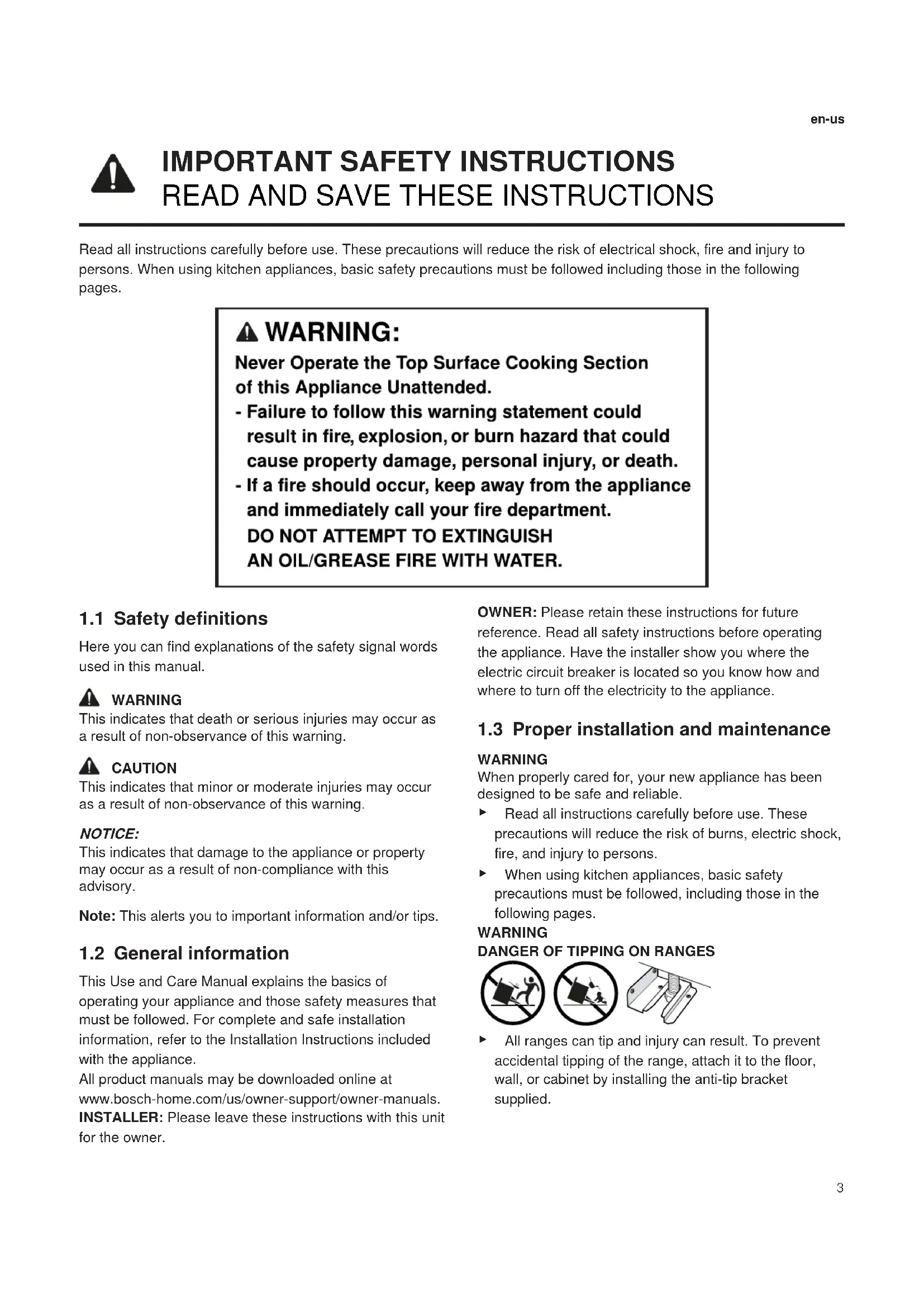
Read all instructions carefully before use. These precautions will reduce the risk of electrical shock, fire and injury to persons. When using kitchen appliances, basic safety precautions must be followed including those in the following pages. 1.1 Safety definitions Here you can find explanations of the safety signal words used in this manual. WARNING This indicates that death or serious injuries may occur as a result of non-observance of this warning. CAUTION This indicates that minor or moderate injuries may occur as a result of non-observance of this warning. NOTICE: This indicates that damage to the appliance or property may occur as a result of non-compliance with this advisory. Note:This alerts you to important information and/or tips. 1.2 General information This Use and Care Manual explains the basics of operating your appliance and those safety measures that must be followed. For complete and safe installation information, refer to the Installation Instructions included with the appliance. All product manuals may be downloaded online at www.bosch-home.com/us/owner-support/owner-manuals. INSTALLER: Please leave these instructions with this unit for the owner. OWNER: Please retain these instructions for future reference. Read all safety instructions before operating the appliance. Have the installer show you where the electric circuit breaker is located so you know how and where to turn off the electricity to the appliance. 1.3 Proper installation and maintenance WARNING When properly cared for, your new appliance has been designed to be safe and reliable. ▶ Read all instructions carefully before use. These precautions will reduce the risk of burns, electric shock, fire, and injury to persons. ▶ When using kitchen appliances, basic safety precautions must be followed, including those in the following pages. WARNING
DANGER OF TIPPING ON RANGES
▶ All ranges can tip and injury can result. To prevent accidental tipping of the range, attach it to the floor, wall, or cabinet by installing the anti-tip bracket supplied.
▶ A child or adult can tip the range over and be killed or seriously injured. Verify that the anti-tip bracket is securely installed. Ensure the anti-tip bracket is engaged when the range is moved. ▶ DO NOT operate the range without the anti-tip bracket in place. Failure to follow the instructions in this manual can result in death or serious burns to children and adults. ▶ If the range is moved for cleaning, service, or any other reason, ensure that the anti-tip bracket is properly reengaged when the range is pushed back into place. In the event of abnormal usage (such as a person standing, sitting, or leaning on an open door), failure to take this precaution can result in tipping of the range. Personal injury might result from spilled hot liquids or from the range itself. ▶ Check for proper installation and use of anti-tip bracket. Carefully tip range forward pulling from the back to ensure that the anti-tip bracket engages the range and prevents tip-over. Range should not move more than 1'' (2.5cm). WARNING In the event of a malfunction, it might become necessary to turn off the power supply. ▶ Have the installer show you the circuit breaker or fuse. Mark it for easy reference. To avoid electrical shock hazard, before servicing the appliance, turn power off at the service panel and lock the panel to prevent the power from being switched on accidentally. Proper Installation - Improper installation or grounding can cause electric shock. ▶ This appliance must be properly installed and grounded by a qualified technician. ▶ Connect only to properly grounded outlet. ▶ Refer to installation instructions for details. User Servicing - Do not repair or replace any part of the appliance unless specifically recommended in this manual. ▶ All other servicing should be referred to an authorized service provider. Light socket is live when door is open if main power supply is not turned off. ▶ Turn off main power supply at the service panel before changing the light bulbs. WARNING Make sure the appliance and lights are cool and power to the appliance has been turned off before replacing the light bulb(s). Failure to do so could result in electrical shock or burns. ▶ The lenses must be in place when using the appliance. ▶ The lenses serve to protect the light bulb from breaking. ▶ The lenses are made of glass. Handle carefully to avoid breaking. Broken glass can cause an injury. Failure to follow these instructions when removing the oven door may lead to personal injury or product damage. ▶ Make sure oven is cool and power to the oven has been turned off before removing the door. Failure to do so could result in electrical shock or burns. ▶ The oven door is heavy and parts of it are fragile. Use both hands to remove the oven door. ▶ The door front is glass. Handle it carefully to avoid breakage. ▶ Grasp only the side of the oven door. Do not grasp the handle. It may swing in your hand and cause damage or injury. Failure to grasp the oven door firmly and properly could result in personal injury or product damage. ▶ To avoid injury from hinge bracket snapping closed, be sure both levers are securely in place before removing the door. ▶ Do not force the door open or closed. The hinge could be damaged and cause damage or injury. ▶ Do not lay the removed door on sharp or pointed objects as this could break the glass. Lay it on a flat, smooth surface, positioned so that the door cannot fall over. WARNING If the supply cord is damaged, it must be replaced by the manufacturer, its authorized service provider or similar qualified persons in order to avoid hazard. WARNING Grease and fat can ignite when heated. ▶ Keep the oven free from grease build up. CAUTION In the event of an error the display flashes and beeps continuously. ▶ Disconnect appliance from the power supply and call an authorized service provider.
WARNING Malfunctions can cause injuries. ▶ Do not operate this appliance if it is not working properly, or if it has been damaged. Contact an authorized service provider. 1.4 Safe use WARNING This appliance is intended for normal family household use only. It is not approved for outdoor use. See the Statement of Limited Product Warranty. If you have any questions, contact the manufacturer. WARNING - TO REDUCE THE RISK OF INJURY TO PERSONS IN THE EVENT OF A RANGE TOP GREASE FIRE, OBSERVE THE FOLLOWING. ▶ SMOTHER FLAMES with a close-fitting lid, cookie sheet, or metal tray, then turn off the burner. BE CAREFUL TO PREVENT BURNS. If the flames do not go out immediately, EVACUATE AND CALL THE FIRE DEPARTMENT. ▶ NEVER PICK UP A FLAMING PAN – You may be burned. ▶ DO NOT USE WATER, including wet dishcloths or towels – a violent steam explosion will result. ▶ Use an extinguisher ONLY if: - You know you have a Class ABC extinguisher, and you already know how to operate it. - The fire is small and contained in the area where it started. - The fire department is being called. - You can fight the fire with your back to an exit. To eliminate the risk of burns or fire by reaching over heated surface units, cabinet storage space located above the surface units should be avoided. CAUTION The oven vents are important for air circulation. Covering the oven vents will cause the oven to overheat. Refer to the appliance overview for the location of the oven vents.
"Appliance", Page13 ▶ Do not obstruct oven vents. WARNING Do not heat or warm unopened food containers. Build-up of pressure may cause the container to burst and cause injury. WARNING A fire could occur during cooking. ▶ Always have a working smoke detector near the kitchen. ▶ Have an appropriate fire extinguisher available, nearby, highly visible and easily accessible near the appliance. In the event that personal clothing or hair catches fire, drop and roll immediately to extinguish flames. Do Not Use Water on Grease Fires. ▶ Smother fire or flame or use dry chemical or foam-type extinguisher. Wear Proper Apparel. Loose-fitting or hanging garments, such as ties, scarves, jewelry, or dangling sleeves, should never be worn while using the appliance. ▶ Tie long hair so that it does not hang loose. ▶ Secure all loose garments, etc. before beginning. WARNING Storage in or on Appliance - The use of corrosive chemicals in heating or cleaning will damage the appliance and could result in injury. ▶ Flammable materials, corrosive chemicals, vapors or non-food products should not be stored or used in an oven or on or near surface units. ▶ The appliance is specifically designed for use when heating or cooking food. WARNING Using this appliance other than for its intended use can cause fire or injury to persons. ▶ Use this appliance only for its intended use as described in this manual. ▶ NEVER use your appliances as a space heater for warming or heating the room. Doing so may result in overheating the appliance. ▶ Never use the appliance for storage. WARNING Avoid reaching or leaning over the appliance. ▶ Be aware that certain clothing and hair sprays may contain flammable chemicals that could be ignited if brought in to contact with hot surface units or heating elements and may cause severe burns. Use Only Dry Potholders - Moist or damp potholders on hot surfaces may result in burns from steam. ▶ Do not let potholders touch hot heating elements. ▶ Do not use a towel or other bulky cloth.
WARNING Moisture intrusion may cause an electric shock. ▶ Do not use any steam cleaners or high-pressure cleaners to clean the appliance. Safe use of the cooking surface WARNING Overheated materials can cause fire or burns. ▶ Do not allow aluminum foil, plastic, paper or cloth to come in contact with a hot surface element, burner or grate. ▶ Do not allow pans to boil dry. Unattended cooking on a cooktop with fat or oil can be dangerous and may result in a fire. ▶ Do not leave the cooktop unattended when in use. If the cooktop is near a window, forced air vent or fan, be certain that flammable materials such as window coverings do not blow over or near the burners or heating elements. They could catch on fire. WARNING TO REDUCE THE RISK OF A RANGE TOP GREASE FIRE ▶ Never Leave Surface Units Unattended at High Settings - Boilovers cause smoking and greasy spillovers that may ignite. Heat oils slowly on low or medium settings. ▶ Always turn hood ON when cooking at high heat or when flambeing food (i.e. Crepes Suzette, Cherries Jubilee, Peppercorn Beef Flambe’). ▶ Clean ventilating fans frequently. Grease should not be allowed to accumulate on fan or filter. ▶ Use proper pan size. Always use cookware appropriate for the size of the surface element. Flames can be drawn into the ventilation system. ▶ Whenever possible, do not operate the ventilation system during a cooktop fire. However, do not reach through fire to turn it off. Cookware Handles Should be Turned Inward and Not Extend Over Adjacent Surface Units. ▶ To reduce the risk of burns, ignition of flammable materials, and spillage due to unintentional contact with the cookware, the handle of a cookware should be positioned so that it is turned inward, and does not extend over adjacent surface units. Use Proper Pan Size - This appliance is equipped with one or more surface units of different sizes. ▶ Select cookware having flat bottoms large enough to cover the surface unit cooking zone. ▶ The use of undersized cookware will expose a portion of the cooking zone to direct contact and may result in ignition of clothing. Proper relationship of cookware to cooking zone will also improve efficiency. Controls may be operated unintentionally by spills covering the control panel. ▶ Never use the appliance if liquids or foods have spilled around the control panel. ▶ Always turn off the cooktop and dry the control panel. Boilovers can cause smoke and some foods and oils may catch fire if left on high temperature settings. ▶ When using a timer, always supervise the cooktop. ▶ Do not allow anything to boil over or burn. WARNING If the frying sensor is not working properly, overheating may result causing smoke and damage to the pan or fire.
WHEN COOKING WITH THE FRYING SENSOR
FUNCTION OBSERVE THE FOLLOWING
▶ Always use a sensor frying pan. ▶ Always put the pan in the center of the cooking zone. ▶ Do not place a lid on the pan. ▶ Never leave hot fat or oil unattended. If the cooktop turns off automatically and can no longer be operated, it may turn itself on unintentionally at a later point. ▶ Switch off the circuit breaker or fuse in the electrical panel. ▶ Contact Customer Service for support. If the display does not work when a cooking area is heating up disconnect the circuit breaker or fuse in the electrical panel. ▶ Contact an authorized service provider. To avoid risk of fire do not store items on the cooking surfaces. WARNING Hot oil is capable of causing extreme burns and injury. ▶ Use high heat settings on the cooktop only when necessary. ▶ To avoid bubbling and splattering, heat oil slowly on no more than a low-medium setting. ▶ Never move a pan of hot oil, especially a deep fat fryer. Wait until it is cool. Spills of hot food may cause burns. ▶ Hold the handle of the pan when stirring or turning food. This helps prevent spills and movement of the pan.
DO NOT TOUCH SURFACE UNITS OR AREAS NEAR UNITS. Surface units may be hot even though they are dark in color. Areas near surface units may become hot enough to cause burns. ▶ During and after use, do not touch, or let clothing, potholders, or other flammable materials contact surface units or areas near units until they have had sufficient time to cool. Among these areas are the cooktop and areas facing the cooktop. WARNING Do not place metallic objects such as knives, forks, spoons, and lids on the cooktop surface since they can get hot. Clean Cooktop With Caution. ▶ If a wet sponge or cloth is used to wipe spills on a hot cooking area, be careful to avoid steam burn. ▶ Some cleaners can produce noxious fumes if applied to a hot surface. ▶ Do not clean the appliance while it is still hot. WARNING The pan detection shut-off feature may not turn off the cooking zone due to spilled food or objects placed on the cooktop. ▶ Keep the cooktop clean and do not store objects on the cooking zones. WARNING Liquid between the pot base and the cooktop may build up steam pressure. This may cause the pot to jump suddenly causing injury. ▶ Always keep the cooktop and bases of pots dry. When cooking with a double-boiler, the cooktop and cooking vessel may crack due to overheating. ▶ The cooking vessel in the double-boiler must not come in direct contact with the bottom of the pot filled with water. ▶ Use only heat-resistant cookware. WARNING If the surface is cracked, switch off the appliance to avoid the possibility of electric shock. Do Not Cook on a Broken Cooktop - If the cooktop should break, cleaning solutions and spillovers may penetrate the broken cooktop and create a risk of electric shock. ▶ Contact an authorized service provider immediately. Safe use of the oven cavity WARNING If materials inside an oven or warming drawer should ignite, keep door closed. ▶ Turn off the appliance and disconnect the circuit at the circuit breaker box. NEVER cover any slots, holes or passages in the oven bottom or cover an entire rack with materials such as aluminum foil. ▶ Doing so blocks air flow through the oven. ▶ Aluminum foil linings may also trap heat, causing a fire hazard. Keep oven vent ducts unobstructed. WARNING DO NOT TOUCH HEATING ELEMENTS OR INTERIOR SURFACES OF OVEN - Heating elements may be hot even though they are dark in color. Interior surfaces of an oven become hot enough to cause burns. ▶ During and after use, do not touch, or let clothing, potholders, or other flammable materials contact heating elements or interior surfaces of oven until they have had sufficient time to cool. Other surfaces of the appliance may become hot enough to cause burns. Among these surfaces are oven vent openings, surfaces near these openings and oven doors. CAUTION Use caution when cooking foods with high alcohol content (e.g. rum, brandy, bourbon) in the oven. Alcohol evaporates at high temperatures. There is a risk of burning as the alcohol vapors may catch fire in the oven. ▶ Use only small quantities of alcohol in foods, and open the oven door carefully. WARNING Use Care When Opening Door - Let hot air or steam escape before removing or replacing food. ▶ Standing to the side, open the door (or drawer) slowly and slightly to let hot air and/or steam escape. ▶ Keep your face clear of the opening and make sure there are no children or pets near the appliance. ▶ After the release of hot air and/or steam, proceed with your cooking. ▶ Keep doors shut unless necessary for cooking or cleaning purposes. ▶ Do not leave open doors unattended.
CAUTION Placement of Oven Racks - Always place oven racks in desired location while oven is cool. If the rack must be moved while the oven is hot, do not let potholders contact the hot heating elements in the oven. Use caution when removing oven racks from the lowest rack position to avoid contact with the hot oven door. CAUTION To avoid possible injury or damage to the appliance, ensure oven rack is installed exactly per installation instructions and not backwards or upside down. Do not place anything on the oven cavity bottom. Do not cover it with aluminum foil. A build-up of heat could damage the appliance or cause injury. WARNING Scratched glass in the appliance door may develop into a crack. ▶ Do not use any harsh or abrasive cleaners or sharp metal scrapers to clean the glass on the oven door, as they may scratch the surface. WARNING Protective Liners - Do not use aluminum foil to line surface unit drip bowls or oven bottoms. Improper installation of these liners may result in a risk of electric shock, or fire. Safe use of the meat probe WARNING The oven interior and the meat probe become very hot. ▶ Use oven mitts to plug and unplug the meat probe. WARNING Use of a wrong meat probe can damage the insulation. Use only the meat probe intended for this appliance. WARNING Do not allow meat probes or other utensils to come into contact with the heating elements. Safe use of the warming drawer WARNING Do not touch the interior surfaces of the drawer while it is in use. The interior of the drawer could become hot enough to cause burns. ▶ Allow drawer and rack (if equipped) to cool before handling. 1.5 Child safety This appliance is not intended for use by persons (including children) with reduced physical, sensory or mental capabilities, or lack of experience and knowledge, unless they have been given supervision or instruction concerning use of the appliance by a person responsible for their safety. When children become old enough to use the appliance, it is the responsibility of the parents or legal guardians to ensure that they are instructed in safe practices by qualified persons. Children should be supervised to ensure that they do not play with the appliance. WARNING Do not allow children to use this appliance unless closely supervised by an adult. ▶ Children and pets should not be left alone or unattended in the area where the appliance is in use. They should never be allowed to play in its vicinity, whether or not the appliance is in use. Do not allow anyone to climb, stand, lean, sit, or hang on any part of an appliance, especially a door, warming drawer, or storage drawer. ▶ This can damage the appliance, and the unit may tip over, potentially causing severe injury. CAUTION Do not store items of interest to children in cabinets above a range or on the backguard of a range. Children climbing on the range to reach items could be seriously injured. Do Not Leave Children Alone. ▶ Children should not be left alone or unattended in the area where the appliance is in use. ▶ They should never be allowed to sit or stand on any part of the appliance. ▶ Always check inside the oven before turning it on. WARNING To avoid the risk of suffocation: ▶ Do not allow children to play with packaging material. 1.6 Food safety CAUTION To maintain food safety, follow these guidelines ▶ DO NOT use a warming drawer to heat cold food. It is safe to use the drawer to crisp crackers, chips or dry cereal and to warm plates.
▶ Be sure to maintain proper food temperature. The USDA recommends holding hot food at 140°F or warmer. ▶ DO NOT leave food in the warming drawer for more than one hour before or after cooking. ▶ Plastic containers, plastic wrap or aluminum foil can melt if in direct contact with the drawer or a hot cooking container. If it melts onto the drawer, it may not be removable. 1.7 Cleaning function Follow these safety instructions when using the cleaning function. WARNING Do not block the oven vent(s) during the self-cleaning cycle. Doing so may cause injury or damage to the appliance. WARNING During the elimination of soil during self-cleaning, small amounts of carbon monoxide can be created and the fiberglass insulation could give off very small amounts of formaldehyde during the first several cleaning cycles. ▶ To minimize exposure to these substances, provide good ventilation with an open window, or use a ventilation fan or hood. The oven heats up to a very high temperature during self cleaning. Opening the door can result in injury. ▶ When self-cleaning, confirm that the door locks and will not open. ▶ If the door does not lock, do not run Self Clean. Contact Customer Service. WARNING The outside of the appliance gets very hot when the cleaning function is in progress. ▶ Never touch the appliance door. ▶ Allow the appliance to cool down. ▶ Keep children at a safe distance. WARNING Do not leave food or cooking utensils, etc., in an oven during the pyrolytic self-cleaning mode of operation. CAUTION Remove broiler pans, pots, and other utensils and excess spillage before self-cleaning. CAUTION Birds have very sensitive respiratory systems. ▶ Keep pet birds out of the kitchen or other rooms where kitchen fumes could reach them. ▶ During self clean, fumes are released that may be harmful to birds. WARNING Do not clean the door gasket – The door gasket is essential for a good seal. Care should be taken not to rub, damage, or move the gasket. WARNING Do not use a protective coating to line the oven and do not use commercial oven cleaner. Clean only parts listed in this manual. Please note that some pets or humans can be sensitive to the odors created during the self-cleaning process whether it is a manufacturing residue burn off or food. It is recommended that those potentially affected be removed from the kitchen area during the self-clean process. 1.8 Electromagnetic interference WARNING This induction cooktop generates and uses ISM frequency energy that heats cookware by using an electromagnetic field. It has been tested and complies with Part 18 of the FCC Rules for ISM equipment. This induction cooktop meets the FCC requirements to minimize interference with other devices in residential installation. Induction cooktops may cause interference with television or radio reception. If interference occurs, the user should try to correct the interference by ▶ Relocating the receiving antenna of the radio or television. ▶ Increasing the distance between the cooktop and the receiver. ▶ Connecting the receiver into an outlet different than the cooktop. ▶ It is the user's responsibility to correct any interference. CAUTION Persons with a pacemaker or similar medical device should exercise caution when standing near an induction cooktop while it is in use. ▶ Consult your doctor or the manufacturer of the pacemaker or similar medical device for additional information about its effects with electromagnetic fields from an induction cooktop.
1.9 Remote operation CAUTION This appliance may be configurable to allow remote operation at any time. ▶ Do not store any flammable materials or temperature sensitive items inside, on top or near surface units of the appliance. 1.10 State of California Proposition 65 Warnings This product may contain a chemical known to the State of California, which can cause cancer or reproductive harm. Therefore, the packaging of your product may bear the following label as required by California: IMPORTANT SAFETY NOTICE: The California Safe Drinking and Toxic Enforcement Act requires the Governor of California to publish a list of substance known to the state to cause cancer, birth defect or other reproductive harm, and requires businesses to warn customers of potential exposure to such substances. The burning of gas cooking fuel and the elimination of soil during self-cleaning can generate small amounts of carbon monoxide. The fiberglass insulation in self clean ovens gives off very small amounts of formaldehyde during the first several cleaning cycles. California lists formaldehyde as a potential cause of cancer. Carbon monoxide is a potential cause of reproductive toxicity. Exposure to these substances can be minimized by: ¡ Providing good ventilation when cooking with gas. ¡ Providing good ventilation during and immediately after self-cleaning the oven. ¡ Operating the unit according to the instructions in this manual.
IMPORTANT SAFETY INSTRUCTIONS
READ AND SAVE THESE INSTRUCTIONSPreventing material damage en-us Preventing material damage 2 Preventing material damage Preventing material damage 2.1 Preventing oven cavity damage NOTICE: The presence of objects on the oven cavity bottom will cause heat to build up. The baking and roasting times will no longer be correct and the enamel will be damaged. ▶ Do not cover the oven cavity bottom with any sort of foil or greaseproof paper. ▶ Do not place accessories on the oven cavity bottom. Do not allow aluminum foil in the oven cavity to come into contact with the door glass, it could cause permanent discoloration. Never pour water into the oven cavity when it is still hot. Never place cookware containing water on the oven cavity bottom. The prolonged presence of moisture in the appliance cavity leads to corrosion. ▶ Allow the appliance cavity to dry after use.▶ Do not keep moist food in the appliance cavity for a long time with the door closed. ▶ Do not store food in the appliance cavity. Leaving the appliance to cool down with the door open will damage the front of neighboring kitchen units over time. ▶ Always allow the appliance cavity to cool down with the door closed after cooking at high temperatures. Only leave the appliance cavity to dry with the door open if a lot of moisture was produced during operation. Fruit juice dripping from the baking tray leaves stains that cannot be removed. ▶ When baking very juicy fruit pies, do not pack too much on the baking tray. If the seal is very dirty, the appliance door will not close properly when the appliance is in operation. This may damage the front of adjacent kitchen units. ▶ Never operate the appliance if the seal is damaged or missing. Sitting or placing objects on the appliance door may damage it. ▶ Do not place or hang objects on the appliance door.▶ Do not place cookware or accessories on the appliance door. With certain models, accessories may scratch the door glass when closing the appliance door. ▶ Always push accessories fully into the appliance cavity. Carrying the appliance by the door handle could break it. The door handle cannot support the weight of the appliance. ▶ Do not carry or hold the appliance by the door handle. 2.2 Preventing cooktop damage NOTICE: Cookware with rough bottoms scratch the glass ceramic surface. ▶ Check the bottom of the cookware before setting it down. Salt, sugar or grains of sand scratch the glass ceramic surface. ▶ Never use the cooktop as a working surface or for setting things down. Overheating can damage the cookware. ▶ Do not heat empty pots or pans. Hot cookware can cause the electronics to overheat. ▶ Never set down hot pans and pots on the control panel or the cooktop frame. When hard or sharp objects fall on the cooktop, they can cause damage. ▶ Do not let hard or pointed objects fall on the cooktop. Aluminum foil and plastic melt on hot cooking zones. ▶ Do not let aluminum foil or plastic come into contact with hot cooking zones. ▶ Do not use cooktop protective film. Unsuitable cleaning agents can cause shimmering metallic discolorations on the glass ceramic surface. ▶ Refer to the cleaning recommendations in this manual.
"Cleaning and maintenance", Page36 Overview of the most common types of damage Here you can find an overview of the most common types of damage and suggestions how to avoid them. Stains Cause How to avoid Boiled-over food Remove boiled-over food immediately with a glass scraper. Unsuitable cleaning agents Use cleaning agents that are suitable for glass ceramic cooktops. Scratches Cause How to avoid Salt, sugar and sand Do not use the cooktop as a work surface or storage space. Cookware with rough bases Check the cookware. Discolorations Cause How to avoid Unsuitable cleaning agents Use cleaning agents that are suitable for glass ceramic cooktops. Pot abrasion (e.g. aluminum) Lift pots and pans when moving them. Blisters Cause How to avoid Sugar, food with a high sugar content Remove boiled-over food immediately with a glass scraper.en-us Environmental protection and energy-saving
Environmental protection and energy-saving 3 Environmental protection and energy-saving Environmental protection and energy-saving 3.1 Disposal of packaging The packaging materials are environmentally compatible and can be recycled. ▶ Sort the individual components by type and dispose of them separately. 3.2 Saving energy when using the oven If you follow these tips, your appliance consumes less energy. Only preheat the appliance if the recipe or the recommended settings tell you to do so.
Not preheating the appliance can reduce the energy used. Use dark-colored, black-coated or enameled baking pans.
These types of baking pans absorb the heat particularly well. Open the appliance door as little as possible during operation.
This will maintain the temperature in the appliance cavity and eliminate the need for the appliance to reheat. When baking multiple dishes, do so in succession or at the same time.
The oven cavity is heated after baking the first dish. This reduces the baking time for the second dish. If the cooking time is relatively long, you can switch the appliance off 10minutes before the cooking time ends.
There will be enough residual heat to finish cooking the dish. Remove any accessories that are not being used from the oven cavity.
An extra pan without food affects the browning and cooking. Allow frozen food to defrost before cooking.
This will save the energy that would otherwise be required to defrost it. 3.3 Saving energy when using the cooktop If you follow these tips, your appliance consumes less energy. Select cookware with a base diameter that matches the cooking zone. Center the cookware on the cooking zone. Tip:Cookware manufacturers usually state the top diameter of the cookware. The diameter of the cookware base is usually smaller.
The energy is targeted at the cookware. If you use cookware that is too small, energy is wasted. If the cookware is too large, much energy is used to heat up the cookware. Close cookware with a fitting lid.
If you lift the lid, a lot of energy can escape. Use a glass lid.
If you use a glass lid, you can look inside the cookware without lifting the lid. Use cookware with a solid flat bottom.
Curved cookware bases increase energy consumption. Use a cookware size that matches the amount of food you want to cook.
Cookware with little content consumes a lot of energy. Cook with a small amount of water.
More water requires more energy to heat it up. Select a lower power level as soon as possible. Select a suitable power level to continue cooking.
For ongoing cooking a lower power level is sufficient.Familiarizing yourself with your appliance en-us Familiarizing yourself with your appliance 4 Familiarizing yourself with your appliance Familiarizing yourself with your applianceThis Use and Care Manual covers several models. Your model may have some but not all of the features listed. 4.1 Appliance Here you can find an overview of the parts of your appliance. Note:The graphics are representative. Your appliance may have different graphic or design appearances.
Cooktop control panel
Socket for meat probe
Warming drawerOven cavityHere you can find information about the features of theoven cavity.CAUTIONDo not place anything on the oven cavity bottom. Do notcover it with aluminum foil. A build-up of heat coulddamage the appliance or cause injury.en-us Familiarizing yourself with your appliance Convection fanConvection baking uses a fan to circulate the oven’s heatevenly and continuously within the oven.This improved heat distribution allows for even cookingand excellent results using multiple racks at the sametime.Cooling fanThe cooling fan runs during all cooking modes.The fan can be heard when it is running, and warm airmay be felt as it is released from the appliance vent. Thefan may also run after the appliance is off.Oven ventsWarm air may be released from the oven vents before,during and after cooking. It is normal to see steamescaping from the vents, and condensation may collect inthis area. This area may be warm when the oven is in use.CAUTIONThe oven vents are important for air circulation. Coveringthe oven vents will cause the oven to overheat. Refer tothe appliance overview for the location of the oven vents. "Appliance", Page13▶ Do not obstruct oven vents. Cooking zones Here you can find an overview of the cooking zonesavailable on your rangetop. Place the cookware on thecooking zone that best matches its size.Only use cookware that is suitable for induction cooking.Cooking zone dimensions 800Series
Single cooking zone: 9" (21cm)
Single cooking zone: 11" (28cm)
Flex zone¡ As 2single cooking zones:8 x 9" (20cmcm x 21.5cm)¡ As combined cooking zone:16 x 9" (40cm x 21.5cm)
Single cooking zone: 11" (28cm)
Single cooking zone: 6" (15cm)Residual heat indicatorThe cooktop is equipped with a residual heat indicator foreach cooking zone.The cooking zone indicator at the front of the cooktopsurface stays lit as long as the cooking zone is still warm.Do not touch the cooking zone while the indicator lights up. 4.2 Control panels You can use the control panel to configure all functions ofyour appliance and to obtain information about theoperating status.Note:This Use and Care Manual covers several models.Your model may have some but not all of the features ordisplays listed.Familiarizing yourself with your appliance en-us
Display Depending on your oven model the display shows information on the currentlyactive modes and features.In standby mode the display shows the time of day.
Touch keys Touch keys are touch sensitive areas. You only have to press on the keys lightly tooperate them. The touch keys will not work if you press several of them at once,such as when cleaning them.
Numeric keypad Used for entering numeric values, such as timer values.Basic featuresHere you can find information on the basic operatingfeatures of your oven.Touch key FunctionOven Clear/ Off Clear entered value / turn appliance offEnter Confirm entered values / Start heating mode Settings Access the basic settingsPanel Lock Activate or deactivate the panel lockTouch key Function is displayed.Oven Light While the oven door is closed, press theoven light keypad to turn the light on andoff. When the oven door is opened, theoven light will automatically turn on.During self clean the oven light cannot beturned on.WarmingDrawerActivating the warming drawerHeating modes and functionsHere you can find a list of heating modes and other features of your appliance. Note:This Use and Care Manual covers several models. Your model may have some but not all of the features or displays listed.Function/Mode Symbol Temperature range°F (°C)How it works and what it is used forBake 100-550 (38-285) Cooks with dry, heated air.For a variety of foods, such as cakes, cookies, pastries,quick breads, quiche and casseroles.
"How to use Bake mode", Page24en-us Familiarizing yourself with your appliance
Function/Mode Symbol Temperature range °F (°C) How it works and what it is used for Conv Bake 100-550 (38-285) Similar to bake, but air is circulated by a fan at the back of the oven. Best for baked goods such as cakes, cornbread, pies, quick breads, tarts, and yeast breads.
"How to use Conv Bake mode", Page24 Conv Multi-Rack 100-550 (38-285) Well suited for cooking individual serving-sized foods such as cookies and biscuits. It is also good for cooking on multiple racks (2 or 3) at the same time.
"How to use Conv Multi-Rack mode", Page25 Broil (high/low) 450-550 (230-285) Use for tender cuts of meat 1'' (2.5mm) or less thick, poultry, browning bread and casseroles. Conv Broil 450-550 (230-285) Combines intense heat from upper element with fan circulation. Use for tender cuts of meat more than 1'' (2.5mm) thick, poultry and fish. Not for browning.
"How to use Conv Broil mode", Page25 Press More Modes to access this mode. Warm 150-225 (65-105) Maintains a low temperature in order to keep food hot. Best for baked goods such as cakes, cornbread, pies, quick breads, tarts, and yeast breads. Press More Modes to access this mode. Roast 100-550 (38-285) Best suited for meats, poultry, less tender cuts of meats and roasting vegetables.
"How to use Roast mode", Page25 Press More Modes to access this mode. Conv Roast 100-550 (38-285) Uses intense heat and air circulated by a fan. Use for tender cuts of meat and poultry and roasting vegetables. Meats are more juicy and moist than results with roast mode.
"How to use Conv Roast mode", Page25 Proof 85-125 (30-52) Maintains the warm, non-drafty environment needed for proofing yeast leavened products.
"How to use Proof mode", Page25 Press More Modes to access this mode. Pizza 100-550 (38-285) Heat is circulated throughout the oven by the convection fan. Use for fresh or frozen pizza.
"How to use Pizza mode", Page25 Press More Modes to access this mode. Probe - Use to determine the internal temperature of many foods, especially meats and poultry during cooking.
"Meat probe", Page22 More Modes - - Some models have a More Modes button for accessing additional heating modes. Depending on your model these may include: ¡ Convection broil In the More Modes menu Convection Broil has two choices HI/LO. Press the #2 to change ¡ Pizza ¡ Proof ¡ Roast ¡ Warm Fast Preheat - Fast preheat heats the oven quicker than standard preheat.
"Fast preheat", Page21Familiarizing yourself with your appliance en-us
Function/Mode Symbol Temperature range °F (°C) How it works and what it is used for Sabbath - - The Sabbath mode enables those of particular faiths to use their ovens on the Sabbath.
"Sabbath mode", Page23 Self Clean - The oven reaches a high temperature to burn off food soil.
"Self clean function", Page40 Door locked (800 series) Oven Timer - - The oven timer is a countdown timer which upon reaching 00:00 turns the oven off, stopping the current mode. The oven timer is used to set how long a mode will run.
"Oven timer", Page23 Kitchen Timer - - The kitchen timer is a countdown timer that has no affect on oven heating. The kitchen timer is used for general kitchen timing needs.
AutoChef® frying level Display Name Timer value Timer indicator Cooktop control panel - Benchmark® Series Touch keys - Benchmark Series Touch keys are touch sensitive areas. Touch a symbol to activate the corresponding function. ¡ The indicators above the touch keys that currently can be selected light up. ¡ The touch keys for functions that currently cannot be selected do not light up. ¡ The indicators for selected functions or cooking zones light up brighter. Touch key Function Main switch ... Settings area / Select cooking zone panel lock Wipe protection / Panel lock speed boost SpeedBoost® and Short Boost function power move PowerMove® function flex join/split FlexInduction™ flexible cooking zone kitchen timer Kitchen timer count up timer Count-up timer keep warm Keep warm function Notes ¡ Keep the controls clean and dry. Moisture can impair the function of the controls. ¡ Do not place cookware close to the displays and sensors. The electronics may overheat. Displays - Benchmark Series The displays show active settings and functions. When you select a cooking zone, the settings for this cooking zone light up brighter. Display Name Cooktop ready - Power levels / Residual heat indicator Indicated function active SpeedBoost® funciton active ShortBoost function active Kitchen timer value Count-up timer value Keep warm function active Wipe protection active Panel lock activeAccessories en-us
Accessories 5 Accessories Accessories Only use original accessories. These are designed especially for your appliance. The accessories supplied may differ depending on the appliance model. Accessories Use Wire rack ¡ These racks can be used for most cooking. ¡ You can use multiple racks at the same time. Note:Do not clean using the Self Clean function. Telescopic rack Use with heavier dishes to make placement into the oven easier. Note:Do not clean using the Self Clean function. Meat probe The meat probe can be used to determine the internal temperature of many foods, especially meats and poultry. Notes ¡ Do not clean using the Self Clean function. ¡ Do not clean in the dishwasher. 5.1 Other accessories You can purchase other accessories from our Customer Service, specialist retailers or online. You will find a comprehensive range of products for your appliance in our brochures and online: www.bosch-home.com Accessories are appliance-specific. When purchasing, always check for compatibility with your appliance model number (E-Nr). You can find out which accessories are available for your appliance in our online shop or from our Customer Service. Other accessories Use Broiler pan and grid Use for broiling and roasting. Notes ¡ Do not clean using the Self Clean function. ¡ You can clean this accessory in the dishwasher.en-us Accessories
5.2 Rack positions Your oven has six rack positions. The rack positions are counted from bottom to top. Use rack positions 1 through 6 only. DO NOT attempt to use the top guide to support an oven rack. Rack position Best for 6 Broiling hamburgers and 1" (2.5cm) steaks 5 Broiling 1½" (4cm) steaks, broiling most meats, melting cheese 4 Thicker meats 3 Broiling poultry, most baked goods on a cookie sheet or baking pan using a single rack, includes frozen convenience foods, cakes, casseroles, frozen pizza, Bundt®
cakes 2 Small roasts or poultry, pies, breads 1 Large roasts, turkey, angel food cake
These marks are registered trademarks of their respective owners. All other trademarks are trademarks of BSH Home Appliances Corporation or its affiliated companies. 5.3 Safe use of oven racks For your safety, follow these recommendations on how to use the oven racks correctly. CAUTION Placement of Oven Racks - Always place oven racks in desired location while oven is cool. If the rack must be moved while the oven is hot, do not let potholders contact the hot heating elements in the oven. Use caution when removing oven racks from the lowest rack position to avoid contact with the hot oven door. CAUTION To avoid possible injury or damage to the appliance, ensure oven rack is installed exactly per installation instructions and not backwards or upside down. Do not slide any accessories between the rack positions, or they may tip. 5.4 Inserting the wire rack Requirement:You have read the recommendation on
"Safe use of oven racks", Page20
1. Grasp the rack firmly on both sides.
2. Tilt the rack up to allow the stop into rack guide .
3. Bring the rack to a horizontal position and push it in the
rest of the way . The rack should be straight and flat, not crooked. 5.5 Inserting the telescopic rack Requirement:You have read the recommendation on
"Safe use of oven racks", Page20
1. Slide the rack in evenly until the rear of the rack is about
2'' (5cm) from the back of the oven.
2. Tilt the front of the rack up about 3/4'' (2cm) and
finish pushing the rack all the way back . Note:Avoid striking the oven light cover glass when pushing the rack into position. a The back of the telescopic rack drops in to place.
3. Pull the rack forward to engage the bottom of the rack
onto the rear of the rack position guide.Before using for the first time en-us
4. Lower the front of the rack to finish seating it on the rack
guide. The rack should feel stable when properly seated.
5. Slide the movable part of the telescopic rack in and out
a few times to make sure it is able to move freely and that the non-moving part of the telescopic rack is securely anchored. Before using for the first time 6 Before using for the first time Before using for the first time Carry out these steps before using your appliance. ¡ The appliance must be properly installed by a qualified service provider before use. ¡ Read and understand all safety precautions → Page3 and information in the Use and Care Manual prior to operating. ¡ Download the HomeConnect® (America) app to remotely control your appliance, get cooking inspiration, and access service tips and support. ¡ This Use and Care Manual covers several models. Not all features are available on all models. 6.1 Cleaning the appliance before using it for the first time Clean the oven cavity and accessories before using the appliance to prepare food for the first time. 1. Remove all packaging materials from the oven cavity.2. Keep the room ventilated while the appliance is heating.3. Set the heating mode and temperature. Heating mode Bake Temperature 475°F (245°C) Duration 30minutes
4. Switch off the appliance after the specified cooking
5. Wait until the oven cavity has cooled down.6. Clean the smooth surfaces with soapy water and a dish
7. Clean the accessories using soapy water and a dish
cloth or soft brush. Note:There may be a slight odor during first uses. This is normal and will disappear. 6.2 Setting the clock Requirement:The oven is in standby mode.
a The display shows "SET CLOCK".
2. Press Enter.3. Use the numeric keypad to enter the desired time.
The numbers fill in from right to left. To enter 10:45, type 1, 0, 4, 5.
4. Press Enter.Oven operation
7 Oven operation Oven operation Here you will find out everything you need to know about operating your oven. 7.1 Setting the heating mode and temperature
1. Press the button for the desired heating mode.
a The heating mode and the default temperature are displayed. a The temperature flashes to show it can be edited.
2. If desired, enter a temperature using the numeric
a The oven begins to preheat. The "preheating" is displayed and the preheat bar begins to fill up until the set temperature is reached. 7.2 Turning the oven off ▶ Press Oven Clear/Off. a The oven turns off and the clock is displayed. 7.3 Heating time limitation The maximum heating time is limited. If you forget to turn off the oven, it turns off automatically after a set period of time. The maximum time for Sabbath mode is 74hours. For all other heating modes the maximum allowed time is 24hours. Temperature °F (°C) Max. time allowed without activity 100-200 (30-120) 24hours 201-550 (121-300) 12hours 7.4 Fast preheat With this function you can shorten the time the oven needs to reach the set temperature. Fast preheat is available for the following heating modes: ¡ Bake ¡ Conv Multi-Rack ¡ Conv Bake ¡ Conv Roast ¡ Pizza Setting fast preheat
Note:If fast preheat is not allowed for the selected heating mode an error tone sounds.
7.5 Meat probe The meat probe measures the internal temperature of the food. You can set a core temperature and the heating mode turns off automatically as soon as the set temperature is reached. WARNING Use of a wrong meat probe can damage the insulation. ▶ Use only the meat probe intended for this appliance. The meat probe can be used with the following heating modes: ¡ Bake ¡ Roast ¡ Conv Bake ¡ Conv Multi-Rack ¡ Conv Roast ¡ The probe function is not available when an oven timer has been set. ¡ The meat probe measures the temperature on the inside of the food between 85°F (30°C) and 210°F (99°C). ¡ To prevent the meat probe from being damaged, do not set an oven temperature above 480°F (250°C). ¡ Use only the meat probe supplied with your appliance. Additional or replacement meat probes can be ordered from Customer Service ¡ Do not store the probe in the oven cavity. Inserting the meat probe Requirements ¡ Food must be completely thawed before inserting the probe into the meat. ¡ The probe ships with a black plastic safety cap over the pointed metal end of the probe. The cap must be removed prior to use.
1. Insert the tip of the probe in the middle and thickest part
of the meat or the breast for poultry. Make sure the probe is not touching fat, bone or parts of the oven or the pan. Always use the handle of the probe for inserting and removing. Note:The handle of the probe becomes hot during cooking. Always use oven mitts when touching the probe handle.
2. Insert the plug of the probe into the socket at the side of
the oven cavity. Push the probe in all the way and pull back until it catches in the socket. Setting the meat probe Requirement:→ "Inserting the meat probe", Page22
1. Set the desired heating mode and temperature.2. Press Probe.
a and "SET PROBE TEMP" is displayed. a A three digit input prompt "- - -" blinks on the display.
3. Set the desired core temperature with the numeric
a The current and target temperature of the probe are displayed. a When the set probe temperature is reached, the heating mode turns off. "COOKING COMPLETE" blinks in the display. An alarm tone sounds every 10seconds for 2minutes.
5. Press Oven Clear/Off or remove the probe to turn off
the display. – Always use the handle of the probe for inserting and removing. – The probe becomes hot during use. Always use potholders to remove the probe. a The display goes to standby mode. 7.6 Turning the panel lock on or off With the panel lock you can disable all touch keys on the control panel. Requirement:The oven is in standby mode.
1. Press and hold Panel Lock for 3seconds.2. Press and hold Panel Lock again for 3seconds to turn
off the panel lock. a The display returns to standby mode. 7.7 Kitchen timer The kitchen timer is a countdown timer that has no affect on oven heating. You can set a kitchen timer value up to 99:59 hours. Setting the kitchen timer
1. Press Kitchen Timer.
a The timer starts to count down. a When the kitchen timer has counted down an alarm tone sounds for 2minutes. a Press Kitchen Timer to cancel the timer or to turn off the alarm tone. Editing the kitchen timer
1. Press Kitchen Timer.
a The current timer value blinks and can be edited.
7.8 Oven timer If you set an oven timer, the oven stops heating automatically once this time has elapsed. Setting the oven timer The oven timer automatically ends a heating mode after a set period of time. Note:The oven timer is not available for the heating modes broil, convection broil, proof, or self clean.
1. Set a heating mode and temperature.
a The oven timer starts to count down. a When the oven timer reached 0:00 the cooking mode ends and "OVEN TIMER FINISHED" is displayed. a The oven timer alarm tone sounds every 10seconds for 2minutes. 7.9 Sabbath mode The Sabbath mode enables those of particular faiths to use their ovens on the Sabbath. ¡ Sabbath mode is only available in bake mode. ¡ The temperature range may be set between 100°F (38°C) and 450°F (230°C). ¡ You can set a duration of up to 74hours. ¡ Kitchen timer, oven timer or probe feature are not available in Sabbath mode. ¡ Pressing any of the buttons while the oven is in Sabbath mode will have no effect. ¡ If the oven light is on when Sabbath Mode is set, the light remains on. If it is off when Sabbath Mode is set, the light remains off. Setting Sabbath mode Requirement:No kitchen timer or oven timer is running, otherwise the display indicates that Sabbath mode is not available.
1. Set Bake mode and a temperature within the allowed
temperature range of 100-450°F (38-230°C).
2. Press Enter to start the heating mode.
If you want to use Sabbath mode for the warming drawer, set the warming drawer temperature before you continue.
3. Press and hold Oven Timer for 5seconds.
want to keep the default value you do not have to enter anything.
5. Press Oven Timer.
a Sabbath mode begins. If you do not press Enter within 5seconds Sabbath mode auto starts. a "SABBATH ON" is displayed. a The timer counts down until it reaches :00, then "SABBATH" is displayed. a The heating mode ends, but the oven stays in Sabbath mode. No changes can be made at this point. Tip:You can change the temperature while Sabbath mode is running. Enter the desired value with the numeric keypad and press Enter. There is no visual or audible response to the input. Canceling Sabbath mode ▶ Press Oven Clear/Off. a Sabbath mode is ended. 7.10 Basic settings You can configure the basic settings for your appliance to meet your needs. Overview of the basic settings Here you can find an overview of the basic settings and factory settings. The basic settings depend on the features of your appliance. Menu item Description Settings 1 Temperature unit ¡ °F (Fahrenheit)
Factory setting (may vary according to model)en-us Oven operation
¡ FR 9 Temperature offset Sets the temperature offset value for bake, convection bake, roast, convection roast and convection multi-rack. When an offset value is entered, the actual oven temperature is increased or decreased by this value. This feature is useful if food is either too brown or too light. Between +/- 35°F (+/- 19°C) in 1° increments
Factory setting (may vary according to model) Changing the basic settings
3. Press Settings to cycle through the settings list.
4. Press Enter to access the menu for a setting.
5. Enter the desired value with the numeric keypad.
a The new value is automatically accepted as the display reverts from edit mode back to standby mode.
6. Press Oven Clear/Off to leave the basic settings menu.
Oven temperature offset The oven is calibrated to provide accurate results. This feature is useful if you prefer your foods lighter or darker. ¡ When an offset temperature is selected, the actual oven temperature is raised or lowered by this value. ¡ Do not use residential oven thermometers to evaluate oven temperatures as they will fluctuate throughout cooking. ¡ You can set a temperature offset from the factory baseline. Each time you call up the temperature offset option in the basic settings menu, the factory baseline temperature is restored so you can set a new offset value. Auto convection conversion Convection bake and convection multi-rack modes require a 25°F reduction in temperature. Auto convection conversion reduces the temperature you enter automatically. ¡ Simply enter the package or recipe temperature when setting the mode. The control calculates the correct temperature and it is shown in the display. 7.11 General tips for heating modes How to use Bake mode Use the Bake mode to prepare a variety of food items, from pastries to casseroles. Refer to recipe or package directions for oven temperature and baking time. Note ¡ Fully preheat the oven before baking items like cakes, biscuits and breads. ¡ Use the convection bake function for best results when baking cookies on multiple racks. ¡ Allow at least 2'' (5cm) of space between bakeware for proper air circulation. ¡ Dark or dull bakeware absorbs more heat than shiny bakeware, resulting in dark or over browned foods. It may be necessary to reduce oven temperature or cook time to prevent overbrowning of some foods. ¡ Shiny pans are recommended for cakes, cookies, and muffins. ¡ Do not open oven door often. Opening the door will reduce the temperature in the oven and may increase cook time. ¡ For cakes stagger pans so that one is not directly above the other. How to use Conv Bake mode Use the Conv Bake mode for bar cookies and breads. This mode takes advantage of the bottom heat, yielding a better crust on baked items. The benefits of convection bake include a slight decrease in cook time and a higher dough volume, for example yeast items rise higher with this mode. Note ¡ Reduce recipe temperature by 25°F.Oven operation en-us
¡ Place food in shallow, uncovered pans, such as cookie sheets without sides. ¡ If baking more than one pan on a rack, allow at least 1" to 1½'' (2.5 to 4cm) of air space around the pan. ¡ Allow at least 2'' (5cm) of space between bakeware for proper air circulation. ¡ For cakes stagger pans so that one is not directly above the other. How to use Conv Multi-Rack mode Use Conv Multi-Rack for cooking individual serving-sized foods such as cookies and biscuits. It is also good for cooking on multiple racks (2 or 3) at the same time. The benefits of Conv Multi-Rack include even browning and time savings as a result of using multiple racks at one time. Note ¡ Baking cookies is possible on 6racks simultaneously (additional wire or telescopic racks can be purchased separately). In this case, the baking time increases slightly. ¡ Reduce recipe temperature by 25°F if auto convection conversion is not activated. ¡ Place food in low-sided, uncovered pans such as cookie sheets without sides. ¡ If baking more than one pan on a rack, allow at least 1" to 1½" (2.5 to 4cm) of air space around the pan. ¡ Stagger pans so that one is not directly above the other. How to use Pizza mode Note Follow these recommendations: ¡ There might be a slight decrease in baking time. Check before minimum package time. ¡ When baking a frozen pizza: For a crispy crust, place directly on the rack. For a softer crust, use a pizza pan. ¡ If par baking handmade pizza dough, prick the dough with a fork before baking. ¡ If using a pizza pan, choose a dark, perforated pan for a more crisp crust and a non-perforated pan for a softer crust. ¡ Preheat baking stones following manufacturer’s recommendations while the oven is preheating. ¡ Bake homemade pizzas on rack position 2 in the center of the rack. ¡ Follow manufacturer’s directions for frozen pizza. ¡ The convection fan cycles on and off when using pizza mode. How to use Roast mode Use Roast mode for large cuts of meat and poultry. Note ¡ Preheating the oven is not necessary. ¡ Use a high-sided broil pan or roasting pan. Cover dish with a lid or foil for less tender cuts of meat. ¡ For less tender cuts of meat, add liquids, such as water, juice, wine, bouillon or stock for flavor and moisture. ¡ Roasting bags and using a liquid are suitable for use in this mode. ¡ When roasting whole chicken or turkey, tuck wings behind back and loosely tie legs with kitchen string. ¡ When cooking large meats (e.g. turkey over 10lbs) do not use the lowest rack position. How to use Conv Roast mode Use the Conv Roast mode for preparing tender cuts of meat and poultry. It is also suitable for roasting vegetables. The benefits of Conv Roast mode include as much as 25% faster cooking than non-convection modes and rich, golden browning. Note ¡ Preheating the oven is not necessary. ¡ Use the same temperature as indicated in the recipe. ¡ Check doneness early, since roasting time may decrease. ¡ Do not cover meat or use cooking bags. ¡ Use a broil pan with a rack and grid or a shallow, uncovered pan with a rack for roasting. ¡ Use a meat thermometer to determine the internal temperature of the meat. ¡ If the meat is browned to your liking, but is not yet done, foil can be placed over the meat to prevent overbrowning. ¡ Let meat stand covered with foil 10-15 minutes after removing it from the oven. ¡ When cooking large meats (e.g. turkey over 10lbs) do not use the lowest rack position. How to use Conv Broil mode Use the Conv Broil mode for cooking thick, tender cuts of meat, poultry and fish. This mode is not recommended for browning breads, casseroles and other foods. In addition to the benefits of standard broiling, convection broiling is faster. Note ¡ Always use convection broil with the oven door closed. ¡ Preheat the oven for 3 to 4minutes. Do not preheat for more than 5minutes. ¡ Steaks and chops should be at least 1½" (4cm) thick. ¡ Use the broil pan and grid or a deep pan with a metal rack, for broiling. ¡ Do not cover the broil grid with foil. It is designed to drain fats and oils away from the cooking surface to prevent smoking and spattering. ¡ Turn meats once during the recommended cook time. Fish does not need to be turned. ¡ Never use heat-proof glass, such as Pyrex®; it cannot tolerate the high temperature. How to use Proof mode Use the Proof mode to raise yeast dough. Note ¡ Start with a cool oven when using this mode. ¡ Allow frozen dough to thaw first.en-us Cooktop operation
¡ The ideal temperature for proofing will be maintained until the mode is turned off. Dough has proofed when it has doubled in size. ¡ Loosely cover the bowl or pan and use any rack that accommodates the size of the container. ¡ Keep the door closed and use the oven light to check the rising of the dough. Size Time in min. Loaf, 1lb (4.5kg) 60-75 Rolls, 0.1lb (50g) 30-45 7.12 Getting the best results ¡ Minimize opening the oven door. ¡ Use the rack position recommended by the recipe. ¡ Use the bakeware recommended in the recipe. ¡ Store pans outside the oven. An extra pan without food affects the browning and cooking. ¡ The type of pan used affects the browning. – For tender, golden brown crusts, use light non-stick/ anodized or shiny metal pans. – For brown crisp crusts, use dark non-stick, anodized or dark, dull metal pans or glass bakeware. These may require lowering the bake temperature 25°F. Preheating the oven ¡ Most cooking times in recipes are designed for a preheated oven and require that the oven already be at a certain temperature before cooking starts. Refer to your recipe for preheating recommendations. ¡ Preheating time depends on the temperature setting and the number of racks in the oven. Remove unused oven racks to shorten the preheat time. ¡ Preheating is not necessary for Roast and Conv Roast. Bakeware type ¡ Metal bakeware with or without a non-stick finish, heat- proof glass, glass-ceramic, pottery, or other utensils are suitable for the oven. ¡ Suitable cookie sheets have a small lip on one side. Heavy sheets or those with more than one side may affect the baking time. Pan placement ¡ Allow at least 1'' (2.5cm) of space between the pans and the oven walls so heat can circulate around each pan. ¡ Stagger bakeware so that one is not directly above another. Allow 1½'' (4cm) above and below each pan. High altitude baking When cooking at high altitudes, recipes and cooking times will vary. For accurate information, go to www.csuextstore.com, or write to the Extension Service, Colorado State University, Fort Collins, Colorado 80521. There may be a cost for the guides. Specify which high altitude food preparation guide you prefer: general information, cakes, cookies, breads, etc. Condensation It is normal for a certain amount of moisture to evaporate from the food during any cooking process. The amount depends on the moisture content of the food. The moisture will condense on any surface cooler than the inside of the oven, such as the control panel. Cooktop operation 8 Cooktop operation Cooktop operation Here you will find out everything you need to know about operating your cooktop. 8.1 Suitable cookware Cookware that is suitable for induction cooking must have a ferromagnetic base, i.e. it must be attracted by a magnet. The base must also match the size of the cooking zone. If cookware is not detected on a cooking zone, place it on the cooking zone with the next smallest diameter. Size and characteristics of the cookware To correctly detect the cookware, take the size and the material of the cookware into consideration. All cookware bases must be perfectly flat and smooth. Use Cookware test to check whether your cookware is suitable. You can find more information about this under
Cookware Materials Properties Recommended cookware Stainless steel cookware in a sandwich design that distributes the heat well. This cookware distributes the heat evenly, heats up quickly, and ensures that it can be detected easily. Ferromagnetic cookware made of enameled steel, cast iron or special induction cookware made of stainless steel. This cookware heats up quickly and ensures that it can be detected easily. Suitable The base is not fully ferromagnetic. If the ferromagnetic area is smaller than the base of the cookware, only the area that is ferromagnetic heats up. As a result, the heat is not distributed evenly.Cooktop operation en-us
Cookware Materials Properties Cookware bases with aluminum content. These reduce the ferromagnetic area, which means that less power is emitted to the cookware. This cookware may not be sufficiently detected or may not be detected at all, and therefore does not heat sufficiently. Not suitable Cookware made from normal thin steel, glass, clay, copper or aluminum. Notes ¡ Do not use adapter plates between the hob and the cookware. ¡ Do not heat up empty cookware and do not use cookware with a thin base, as this may become very hot. 8.2 Turning the cooktop on ▶ Press the cooktop main switch. a The indicator above the cooktop main switch turns on. a The symbols for the cooking zones and functions available at this time light up. a lights up in the cooking zone displays. 8.3 Turning the cooktop off ▶ Press and hold the cooktop main switch until all indicators go out. a All cooking zones are turned off. a The residual heat indicators remain lit until the cooking zones have cooled off sufficiently. Note:The cooktop turns off automatically when all the cooking zones have been turned off for more than 20seconds. 8.4 Cooking zone settings In order to make settings on a cooking zone, the cooking zone has to be selected. Set the desired power level for each cooking zone in the settings area. Setting Power level lowest power level highest power level Intermediate setting for all power levels Depending on your model, the intermediate level is displayed on the cooking zone display ¡ as a dot, for example . lights up when you set the intermediate level between power level and . ¡ as . , for example . Note:The cooktop may temporarily reduce the power automatically to protect the fragile parts of your appliance and to prevent the appliance from producing excess noise. Setting the power level - 800 Series Requirement:The cooktop is turned on.
1. Place the cookware on the cooking zone.
2. Press to select the cooking zone .
a lights up in the cooking zone display. a lights up under the cooking zone display.
3. Set the power level in the settings area
Press to set an intermediate level. Setting the power level - Benchmark® Series Requirement:The cooktop is turned on.
1. Place the cookware on the cooking zone.
2. Press or to select the cooking zone .
a lights up in the cooking zone display.
3. Set the power level in the settings area
Press to set an intermediate level. Changing the power level
1. Select the desired cooking zone.en-us Cooktop operation
2. Set the power level in the settings area.
Turning the cooking zone off
1. Select the desired cooking zone.2. Select in the settings area.
a The residual heat indicator lights up after approximately 10seconds. General tips Notes ¡ If there is no cookware on the cooking zone, the cooking zone display blinks. This means that the cooking zone tries to detect the cookware. Place cookware on the cooking zone within 30seconds, or the cooking zone will switch itself off. ¡ If the indicators blink while cookware is present on the cooking zone, check whether the cookware is suitable for induction cooking. ¡ If there is cookware on the cooking zone before switching the cooktop on, it is detected within 20seconds after touching the main switch and the cooking zone is selected automatically. Set the power level within 10seconds. Otherwise, the cooking zone switches off after 20seconds. ¡ If there are several pieces of cookware on the cooktop when it is switched on, only one piece of cookware is detected. ¡ Place cookware on the flexible cooking zone in the correct position according to size. 8.5 Recommended cooking settings Here you can find recommendations on cooking and an overview of various dishes with suitable heat levels. ¡ Select power level 8 or 9 for bringing water to a boil or heating up the pan. ¡ Stir thick liquids occasionally. ¡ Food that needs to be seared quickly, or food which loses a lot of liquid during initial frying, is best seared in several small portions. ¡ When you cook with a lid on, turn the heat setting down as soon as steam escapes between lid and cookware. ¡ Keep the lid on the cookware after cooking until you serve the food. ¡ When you cook with a pressure cooker, observe the manufacturer's instructions. ¡ Do not cook food for too long or in too much water. Otherwise the nutrients will be lost. You can use the kitchen timer to set the optimum cooking time.
"Kitchen timer", Page30 ¡ Do not heat oil or grease until it smokes. You will achieve healthier cooking results. ¡ When you brown food, fry small portions one after the other. ¡ Cookware may become very hot during cooking. We recommend the use of pot holders. Cooking charts The cooking chart shows which power level is suitable for each type of food. The cooking time may vary depending on the type, weight, thickness and quality of the food. CAUTION Stews or liquids can heat up very quickly during cooking and may overflow or spatter, e.g. soups, sauces or drinks. ▶ Stir continuously.▶ Heat the food at a suitable power level. Note:Intermediate levels are indicated with a dot behind the number. Power level 2.5 is displayed as 2. in the cooking zone display as well as the cooking charts. Melting Type of food Power level Chocolate 1.5 Butter 1.0-2.0 Heating Frozen vegetables, e.g. spinach 2.5-3.5 Broth 7.0-8.0 Thick soup 1.5-2.5 Milk
Ongoing cooking without lid Cooking Rice, with double amount of water 2.0-3.0 Potatoes boiled in their skins, with 1-2cups of water 4.0-5.0 Boiled potatoes, with 1-2cups of water 4.0-5.0 Fresh vegetables, with 1-2cups of water 2.0-3.5 Frozen vegetables, with 1-2cups of water 3.5-4.5 Pasta, with 2-4qt. water
Ongoing cooking without lid
Turn the food several times.Cooktop operation en-us
Turn the food several times. Deep-fat frying Fry in 1-2qt. oil without a lid. Deep-frozen foods, e.g. chicken nuggets (0.5lb per serving) 8.0-9.0 Other, e.g. donuts (0.5lb per serving) 4.5-5.5 Keep warm Tomato sauce 1.5 8.6 FlexInduction™ cooking zone You can use the flexible cooking zone as one large cooking zone, or as two separate cooking zones. The flexible cooking zone has 4induction elements, which are controlled independently from each other. When you use the FlexInduction™ function, only the area that is covered by cookware is activated. Cookware recommendations for the flexible cooking zone Place the cookware in the middle of the cooking zone. This assures optimal pot detection and heat distribution. Flexible cooking zone as one large cooking zone Possible cookware positions Explanation The cookware diameter is smaller than or equal to 5⅛" (13 cm). Place the cookware on one of the four positions shown in the illustration. The cookware diameter is larger than 5⅛" (13 cm). Place the cookware on one of the three positions shown in the illustration. The cookware takes up more than one of the positions shown above. Position the cookware starting on the upper or lower edge of the flexible cooking zone. Flexible cooking zone as two separate cooking zones Possible cookware positions Explanation The front and rear cooking zones each have two induction elements. They can be used independently of each other. Use only one item of cookware on each cooking zone. Select the required heat setting for each of the cooking zones. Using the flexible zone as two separate cooking zones ▶ Make the settings for each cooking zone independently. Note:The flexible cooking zone operates as two separate cooking zones as a default. If you want the FlexInduction™ function to be activated automatically you can adjust the basic settings. Activating the FlexInduction™ function
1. Place the cookware on the flexible cooking zone.2. Select one of the two cooking zones that belong to the
flexible cooking zone.
3. Press flex join/split.
4. Set the power level.
a The power level is displayed on both cooking zone displays. Note:If both cooking zones are set to different power levels before being linked, both cooking zones switch to 0. Changing the power level for the flexible cooking zone
1. Select one of the two cooking zones of the flexible
2. Change the power level in the settings area.
Adding cookware to the flexible cooking zone You can add a piece of cookware while you are cooking on the flexible cooking zone.
1. Place the additional piece of cookware on the flexible
2. Select one of the two cooking zones of the flexible
3. Press flex join/split twice.
a The additional cookware is detected. a The power level stays the same. Note:If you remove the cookware from the cooking zone, or lift it up, the cooking zone begins to search for the cookware. The power level stays the same. Deactivating the FlexInduction™ function
1. Select one of the two cooking zones of the flexible
cooking zone.en-us Cooktop operation
2. Press flex join/split.
a The flexible cooking zone is split into two separate cooking zones. Note:If the cooking zone is switched off, and then switched back on again later, the flexible cooking zone is reset to function as two independent cooking zones. 8.7 PowerMove® function This function activates the entire flexible cooking zone, and divides it into three cooking areas with different preset power levels. You can move an item of cookware during the cooking process to another cooking area with a different power level without making any settings. Preset power levels ¡ Front area = power level ¡ Middle area = power level ¡ Back area = power level . General information for using this function: ¡ You can preset different power levels for each cooking zone in the basic settings. ¡ Only use one item of cookware. ¡ If more than one item of cookware is detected on the flexible cooking zone, the function is deactivated. ¡ When you move or lift up the cookware, the cooktop automatically starts searching and the power level of the area in which the cookware was detected is set. Cooking areas for PowerMove® function The size of the cooking area depends on the cookware used and whether it is positioned correctly. Cooking areas for small pans Cooking areas for large pans Activating PowerMove®
1. Select one of the two cooking zones in the flexible
2. Press power move.
a The indicator above power move lights up. a The flexible cooking zone is activated as a joined cooking zone. a The power level in the area in which the cookware is located lights up in the cooking zone display. Changing the power level for PowerMove® You can change the power levels for the individual cooking areas during the cooking process.
1. Set the cookware down on the cooking area.2. Change the power level in the settings area.
a Only the power level for the cooking area on which the cookware is located is changed. Deactivating PowerMove® ▶ Press power move. a The indicator above power move goes out. Notes ¡ If you set one of the cooking areas to , the function is deactivated after a few seconds. ¡ When the function is deactivated, the power levels for the three cooking areas are reset to the preset values. 8.8 Kitchen timer You can use the Kitchen timer to set a time of up to 99minutes. The Kitchen timer is independent from other settings and does not switch off a cooking zone. You can also use the Kitchen timer when the cooktop is turned off or the panel lock is activated. Setting the kitchen timer - 800 Series WARNING Boilovers can cause smoke and some foods and oils may catch fire if left on high temperature settings. ▶ When using a timer, always supervise the cooktop. ▶ Do not allow anything to boil over or burn.
a and light up on the timer display.
2. Set the desired time in the settings area.
a The time starts to count down.Cooktop operation en-us
a When the time has elapsed, a beep sounds. a and blink in the timer display.
3. Press Timer to stop the signals. After 10seconds the
signals stop automatically. Changing or canceling the kitchen timer - 800 Series
1. Press Timer.2. Set the desired time in the settings area.
To cancel the kitchen timer, set the time to . Setting the kitchen timer - Benchmark® Series WARNING Boilovers can cause smoke and some foods and oils may catch fire if left on high temperature settings. ▶ When using a timer, always supervise the cooktop. ▶ Do not allow anything to boil over or burn.
1. Press kitchen timer.
a lights up in the timer display. a The indicator above kitchen timer lights up.
2. Set the desired time in the settings area.3. Press kitchen timer to confirm.
a The time starts to count down after a few seconds. a When the time has elapsed, a beep sounds. blinks in the timer display. a The indicator above kitchen timer blinks.
4. Press any key to turn off the signals. After 10seconds
the signals stop automatically. Changing or canceling the kitchen timer - Benchmark Series
1. Press kitchen timer.2. Set the desired time in the settings area.
To cancel the kitchen timer, set the time to .
3. Press kitchen timer to confirm.
8.9 Count-up timer The Count-up timer displays the time that has elapsed since activating the function. The Count-up timer works independently from the cooking zones and from other settings. This function does not automatically switch off a cooking zone. Starting the Count-up timer WARNING Boilovers can cause smoke and some foods and oils may catch fire if left on high temperature settings. ▶ When using a timer, always supervise the cooktop. ▶ Do not allow anything to boil over or burn. ▶ Press count up timer. a lights up on the timer display. a The indicator above count up timer lights up. a The timer starts to count up. Canceling the Count-up timer
1. Press count up timer.
a The timer stops running.
2. Press count up timer again.
a The timer is cleared and turns off. 8.10 SpeedBoost® With this function you can heat larger quantities of water faster than with power level 9. This function temporarily increases the top output of the selected cooking zone. You can also use this function on the flexible cooking zone if it is used as a joined cooking zone. Restrictions for using the SpeedBoost® function ¡ This function can only be used on one cooking zone of the same cooktop segment at a time. The illustration shows these segments of your cooktop. ¡ If the function is not available, and blink on the display of the selected cooking zone. The power level is set automatically. 800 Series Benchmark® Series Activating SpeedBoost®
1. Select the desired cooking zone.2. Touch speed boost/Speed Boost.
a lights up in the cooking zone display. Deactivating SpeedBoost®
1. Select the required cooking zone.2. Press speed boost/Speed Boost.
a goes out. a The cooking zone switches to power level . Notes ¡ In certain circumstances, this function may switch off automatically in order to protect the electronic elements inside the cooktop.en-us Cooktop operation
¡ If you have set a power level before activating the function, this power level is used automatically after the function has been deactivated. 8.11 ShortBoost With this function you can heat cookware faster than with power level . You can also use this function on the flexible cooking zone if it is used as a joined cooking zone. Recommendations for using this function: ¡ Always use cookware that has not been pre-heated. ¡ Use cookware with a flat base. ¡ Do not use cookware with a thin base. ¡ Never leave empty cookware, oil, butter or lard to heat up unattended. ¡ Do not place a lid on the cookware. ¡ Place the cookware on the center of the cooking zone. ¡ Ensure that the diameter of the base of the cookware matches the size of the cooking zone. ¡ Refer to the information on cooking with induction for information on the type, size and positioning of the cookware. Restrictions for using the ShortBoost function ¡ This function can only be used on one cooking zone of the same cooktop segment at a time. The illustration shows these segments of your cooktop. ¡ If the function is not available, and blink on the display of the selected cooking zone. The power level is set automatically. Activating ShortBoost WARNING Oil and fat heat up quickly with the ShortBoost function. Overheated oil and fat may ignite. ▶ Never leave the cooktop unattended during cooking.
1. Select the desired cooking zone.2. Press speed boost twice.
a . lights up on the cooking zone display. Deactivating ShortBoost The function is turned off automatically after 30seconds. You can turn it off manually before that.
1. Select the desired cooking zone.2. Press speed boost.
a . goes out. a The cooking zone switches to power level . 8.12 Keep warm This function is suitable for melting chocolate or butter and for keeping food warm. CAUTION Food might spoil when left standing for too long. ▶ To maintain food safety, do not keep food warm for more than one hour after cooking. Activating the keep warm function
1. Select the cooking zone.2. Press keep warm.
a lights up on the cooking zone display. Deactivating the keep warm function
1. Select the cooking zone.2. Press keep warm.
a goes out. a The cooking zone turns off and the residual heat indicator lights up. 8.13 AutoChef® - 800Series only With the AutoChef® function, a sensor controls the temperature of the pan. You can fry while the pan maintains the selected temperature. Advantages when using the AutoChef® function: ¡ The cooking zone only continues heating for as long as this is necessary to maintain the temperature. This saves energy and prevents the oil or fat from overheating. ¡ The frying function reports when the empty frying pan has reached the optimum temperature for adding oil and then for adding the food. General notes for using the AutoChef® function: ¡ Do not place a lid on the frying pan. This will prevent the function from activating correctly. Use a splatter guard to prevent fat from spitting out. ¡ Use suitable oil or fat. If you are using butter, margarine, cold-pressed olive oil or lard, use temperature setting 1 or 2. ¡ Never leave fat or oil unattended while you are heating it. ¡ If the cooking zone is a higher temperature than the cookware or vice versa, the cooking sensor is not activated correctly. WARNING If the frying sensor is not working properly, overheating may result causing smoke and damage to the pan or fire.
WHEN COOKING WITH THE FRYING SENSOR
FUNCTION OBSERVE THE FOLLOWING
▶ Always use a sensor frying pan. ▶ Always put the pan in the center of the cooking zone. ▶ Do not place a lid on the pan. ▶ Never leave hot fat or oil unattended.Cooktop operation en-us
Suitable pans for AutoChef® A suitable sensor frying pan for the AutoChef® function is available as an optional accessory. You can purchase suitable sensor frying pans from Customer Service, in our online shop www.bosch- home.com/us/shop or in specialized stores. Always indicate the relevant reference number. Reference number Special accessory HEZ390210 Sensor frying pan Ø6" (15cm) HEZ390230 Sensor frying pan Ø8¼" (21cm) The sensor frying pans have a non-stick coating, which means that very little oil is needed for frying. Conventional frying pans CAUTION When using a conventional frying pan observe the following notes. ▶ The AutoChef® function has been configured specifically for our system pans. ▶ Other frying pans may overheat. They may reach a temperature above or below the selected frying level. Try the lowest frying level first and then change it according to your requirements. ▶ Make sure that the diameter of the base of the frying pan corresponds to the size of the cooking zone. Place the pan in the center of the cooking zone. Frying levels The AutoChef® function offers 4 frying levels. Frying level Temperature Suitable for min Low Chicken breast, omelettes, french toast, hash browns, fried food in butter or olive oil low Medium-low Thick pan-fried foods such as pork chop, hamburger, pancakes med Medium-high Veal cutlet, ground meat, thin slices of meat, vegetables max High Steaks medium-rare, fried boiled potatoes Setting AutoChef® CAUTION Hot oil or fat may ignite. ▶ Never leave hot fat or oil unattended. ▶ Do not place a lid on the frying pan. This will prevent the AutoChef® function from activating correctly. Use a mesh splatter guard to prevent fat from spitting out. ▶ Only use fat or oil that is suitable for frying. ▶ When you are using butter, margarine, olive oil or lard, select frying level min. ▶ Do not use AutoChef® for boiling. Requirements ¡ The cooktop is turned on. ¡ You have selected a suitable frying level from the frying levels chart.
1. Place the empty frying sensor pan in the center of the
cooking zone with the AutoChef® feature.
2. Select the cooking zone.3. Press Auto Chef.
a lights up on the cooking zone display. a The frying levels light up.
4. Select the desired frying level with the number keys in
the settings area. a blinks. a The preheat icon lights up. a When the set frying temperature is reached a beep sounds and stops blinking. a goes out.
5. Add the frying oil to the pan.6. Add the ingredients.
Turn the food over as usual to avoid burning. Turning AutoChef® off
1. Select the cooking zone.2. Press Auto Chef.
8.14 Panel lock You can use the panel lock to prevent the cooktop from being turned on accidentally. CAUTION The panel lock may be turned on and off accidentally due to: ▶ water spilled during cleaning ▶ food that has overflowed ▶ objects being placed on the panel lock touch key. Activating the panel lock Requirement:The cooktop is turned off. ▶ Touch panel lock/Panel Lock for 4seconds. a The indicator over the panel lock key lights up for 10seconds. a The control panel is locked. Deactivating the panel lock Requirement:The cooktop is turned off. ▶ Touch panel lock/Panel Lock for 4seconds. a The control panel is unlocked.en-us Cooktop operation
Automatic panel lock This function automatically activates the panel lock when you switch off the cooktop. The automatic panel lock can be activated in the basic settings → Page34
8.15 Wipe protection With this function you can avoid changing the settings while cleaning the control panel during cooking. This function does not lock the main switch. You can turn the cooktop off at any time. Activating the wipe protection ▶ Press panel lock/Panel Lock. a The indicator above the panel lock key lights up. a The control panel is locked for 35seconds. a After 30seconds a beep indicates that the wipe protection is about to turn off. Deactivating the wipe protection ▶ Press panel lock/Panel Lock. a The indicator above the panel lock key goes out. 8.16 Basic settings You can configure the basic settings for your appliance to meet your needs. Basic settings overview Here you can find an overview of the basic settings and the preset factory settings. Display Function Panel lock – Manual
– Automatic – Function deactivated Signal tones – Confirmation signal and error signal are off. The main switch signal remains on. – Only error signal is on. – Only confirmation signal is on. – Confirmation signal and error signal are
Display energy consumption – Deactivated
– Activated Duration of timer end signal – 10seconds
– 30seconds – 1minute Power management function. Limiting the total power of the cooktop. The available settings depend on the maximum power of the cooktop.
Factory setting (may vary according to model) Display Function – Deactivated
– 3.000W recommended for 13A . – 3.500W recommended for 16A – 4.000W . – 4.500W recommended for 20A
or . – Maximum power of the cooktop Changing the preset power levels for PowerMove® - Preset power level for the front cooking zone. - Preset power level for the middle cooking zone. - Preset power level for the rear cooking zone. Results for suitability test for cookware – Not suitable. – Not ideal. –Suitable. Configuring status of FlexInduction™ cooking zone when the cooktop is turned on – As two independent cooking zones
– As a joined cooking zone. Restore factory settings – Off
– Restore appliance to factory settings
Factory setting (may vary according to model) Changing the basic settings Requirement:The cooktop is turned off.
1. Turn on the cooktop.
2. Within the next 10seconds, press kitchen timer/Timer
for about 4seconds. The first four displays provide the product information. To call up the individual displays, touch the control panel. Product information Display Customer Support index (CI) Production number Production number1 Production number2 .
3. Press kitchen timer/Timer to enter the basic settings
menu. a In the left display and flash alternately. a In the timer display lights up.
4. Press kitchen timer/Timer repeatedly until the desired
setting lights up in the left display.
5. Set the desired option in the settings area.Warming drawer operation en-us
6. Press kitchen timer/Timer for about 4seconds.
a The setting is saved. Tip:Press the cooktop main switch to leave the basic settings and turn off the cooktop. 8.17 Energy consumption display This function indicates the total amount of energy consumed between turning the cooktop on and turning it off again. Once cooktop is turned off, the energy consumption is displayed in kWh for 10seconds, e.g. 1.08kWh. The accuracy of the display depends on various factors such as the voltage quality of the power supply. You can activate or deactivate this function in the basic settings menu. 8.18 Power limitation You can use the PowerManager function to set the total power of the cooktop. The cooktop is set at the factory; the cooktop's maximum power is shown on the rating label. You can use this function to adjust the configuration to the requirements of each electrical installation. In order to not exceed this set value, the cooktop automatically distributes the available power as needed between the cooking zones that are switched on. While this function is activated, the output of each cooking zone may temporarily fall below the nominal value. In order to not exceed this set value, the cooktop automatically distributes the available power as needed between the cooking zones that are switched on . The appliance regulates and selects the highest power level automatically. For more information, go to
"Basic settings", Page34 Warming drawer operation 9 Warming drawer operation Warming drawer operation The warming drawer will keep hot, cooked foods at serving temperature. Always start with hot food. DO NOT use to heat cold food. It is safe to use the drawer to crisp crackers, chips or dry cereal and to warm plates. CAUTION To maintain food safety, follow these guidelines ▶ DO NOT use a warming drawer to heat cold food. It is safe to use the drawer to crisp crackers, chips or dry cereal and to warm plates. ▶ Be sure to maintain proper food temperature. The USDA recommends holding hot food at 140°F or warmer. ▶ DO NOT leave food in the warming drawer for more than one hour before or after cooking. ▶ Plastic containers, plastic wrap or aluminum foil can melt if in direct contact with the drawer or a hot cooking container. If it melts onto the drawer, it may not be removable. The warming drawer has a push-to-open (PTO) mechanism. Press on the center of the warming drawer front panel to open it. 9.1 Warming drawer levels You can set 3different heating levels for the warming drawer. For best results, preheat the warming drawer when warming food. Level Preheat time in min. Recommendation LOW 10 Best for roasts and breads MED 15 Recommended for side dishes, casseroles, and sauces HIGH 20 Recommended for pizza, fried foods, and plate warming 9.2 Turning the warming drawer on You can operate the warming drawer with the oven control panel.
1. Press Warming Drawer.
a The default level "MED" is displayed.
2. Press Warming Drawer to cycle the available warming
3. Press Enter to confirm.
a The warming drawer icon is displayed below the clock. 9.3 Turning the warming drawer off ▶ Press Warming Drawer. a The warming drawer symbol turns off. 9.4 Using the warming drawer in Sabbath mode You can use the warming drawer in Sabbath Mode, while the oven is in Sabbath mode. It is not possible to run Sabbath Mode only in the warming drawer.
1. Set the desired warming drawer temperature.2. Set Sabbath mode for the oven cavity.
"Sabbath mode", Page23 a The warming drawer and oven will operate in Sabbath mode until the oven timer reaches zero.en-us Cleaning and maintenance
9.5 Warming empty serving bowls and plates Requirements ¡ Do not preheat drawer prior to placing dishes. ¡ Use only heat-safe dishes.
1. Place empty plates or dishes in the cold warming
2. Select the warming drawer temperature "LOW".3. Check the dish temperature during the warming period.
9.6 Crisping stale items 1. Place the food in a low-sided dish or pan.2. Select the warming drawer temperature "LOW".3. Preheat the warming drawer for 10minutes, then place the food in the warming drawer.
4. Set the warming timer.5. Check the crispness after 45minutes. Continue crisping
if needed. 9.7 General tips for the warming drawer ¡ To keep several different foods hot, set the temperature for the food needing the highest setting. ¡ Place items needing the highest setting toward the side of the drawer and items needing less heat in the center of the drawer. ¡ You can warm empty serving dishes while the warming drawer is preheating. ¡ Place cooked, hot food in the warming drawer in its original cooking container or in a heat-safe serving dish. ¡ You can use aluminum foil to cover the food. DO NOT line the warming drawer with aluminum foil. ¡ Do not use the warming drawer for storage purposes. Cleaning and maintenance 10 Cleaning and maintenance Cleaning and maintenance To keep your appliance working efficiently for a long time, it is important to clean and maintain it carefully. 10.1 Cleaning agents Only use suitable cleaning agents to avoid damage to the appliance surfaces. Brand names ¡ The use of brand names is intended only to indicate a type of cleaner. This does not constitute an endorsement. ¡ The omission of any brand name cleaner does not imply its adequacy or inadequacy. ¡ Many products are regional in distribution and can be found in local markets. ¡ It is imperative that all cleaning products be used in strict accordance with the instructions on its package. Avoid these cleaners Do not use commercial oven cleaners such as Easy Off®
They may damage the appliance finish or parts. Chlorine or chlorine compounds in some cleansers are corrosive to stainless steel. Check ingredients on label. Never use scouring pads or abrasive cleaners. WARNING Be sure the entire appliance (including the light bulb) has cooled and grease has solidified before attempting to clean any part of the appliance. WARNING To avoid risk of electrical shock, DO NOT use a steam cleaner or high pressure cleaners to clean the appliance. Penetrating moisture may cause electrical shock. 10.2 Cleaning the warming drawer Note:You can remove the warming drawer for cleaning. Refer to the Installation Instructions for your appliance. WARNING To prevent burns, do not remove the drawer while hot. ▶ Be sure the drawer is empty before removing. Part Recommendations Drawer interior, polished stainless steel ¡ Use dish detergent. Wash, rinse well and dry. ¡ For hard water spots or scale, use white vinegar. Apply with a sponge or cloth, rinse and dry. ¡ Chlorine or chlorine compounds in some cleansers are corrosive to stainless steel and can cause injury. Check the ingredients on the label. Painted surfaces ¡ Use hot, soapy water or mild cleaners such as Fantastik®
. Wash, rinse well and dry. ¡ Do not use abrasive cleaning agents, steel wool pads and oven cleaners. Drawer exterior frame, brushed stainless steel ¡ Always wipe or rub in the direction of the grain. ¡ Clean with a soapy sponge, then rinse and dry or wipe with Fantastik®
sprayed on a paper towel. ¡ Protect and polish with Stainless Steel Magic®
and a soft cloth. ¡ Remove water spots with a cloth dampened with white vinegar.
These marks are registered trademarks of their respective owners. All other trademarks are trademarks of BSH Home Appliances Corporation or its affiliated companies.
These marks are registered trademarks of their respective owners. All other trademarks are trademarks of BSH Home Appliances Corporation or its affiliated companies.Cleaning and maintenance en-us
remove heat discoloration. ¡ Chlorine or chlorine compounds in some cleansers are corrosive to stainless steel and can cause injury. Check the ingredients on the label.
These marks are registered trademarks of their respective owners. All other trademarks are trademarks of BSH Home Appliances Corporation or its affiliated companies. 10.3 Cooktop cleaning and maintenance Cleaning agents You can purchase suitable cleaners and glass scrapers from Customer Support or in our online shop www.bosch- home.com/us/shop. Tip:Bosch cleaners have been tested and approved for use on Bosch appliances. Other recommended cleaners do not constitute an endorsement of a specific brand. Recommended cleaning agents ¡ Glass ceramic cooktop cleaner ¡ Bosch glass cooktop cleaner ¡ BonAmi®
(without bleach) ¡ White vinegar Unsuitable cleaning agents ¡ Glass cleaners which contain ammonia or chlorine bleach. These cleaners may damage or permanently stain the cooktop. ¡ Caustic cleaners such as Easy Off®
. These cleaners may stain the cooktop surface. ¡ Abrasive cleaners. ¡ Metal scouring pads and scrub sponges such as Scotch Brite®
. These cleaners may scratch the cooktop surface and/or leave metal marks. ¡ Soap-filled scouring pads such as SOS®
. These cleaners may scratch the cooktop surface. ¡ Powdery cleaners containing chlorine bleach. These cleaners may permanently stain the cooktop surface. ¡ Flammable cleaners such as lighter fluid or WD-40®
¡ Do not use knives or sharp objects to clean the gap between the cooktop surface and the control panel. ¡ Do not use steam cleaners. Cleaning the glass ceramic cooktop WARNING Clean Cooktop With Caution. ▶ If a wet sponge or cloth is used to wipe spills on a hot cooking area, be careful to avoid steam burn. ▶ Some cleaners can produce noxious fumes if applied to a hot surface. ▶ Do not clean the appliance while it is still hot. CAUTION Do not use any kind of cleaner on the glass while the surface is hot; use only the glass scraper. The resulting fumes can be hazardous to your health. Heating the cleaner can chemically attack and damage the surface. Requirements ¡ The cooktop has cooled off. ¡ Exception: Remove dry sugar, sugar syrup, milk and tomato products immediately.
"Cleaning recommendations", Page37
1. Wipe off splatters with a clean, damp sponge or a paper
towel. 2. Rinse and dry.3. If a smudge remains use white vinegar.4. Rinse and dry again.5. Apply a small amount of cooktop cleaner with a clean paper towel or cloth and let it dry.
6. Buff the surface with a clean paper towel or cloth.
Cleaning recommendations Follow these cleaning instructions for removing common soiling. WARNING The blade of the glass scraper is extremely sharp. You can cut yourself. ▶ Replace the blade immediately, when you see any imperfections. ▶ Follow the manufacturer's instructions. NOTICE: Diamond rings may scratch the ceramic cooktop surface. ▶ Take off any rings before you clean the ceramic cooktop surface. Type of soil Recommendation ¡ Dry sugar ¡ Sugar syrup ¡ Milk ¡ Tomato spills ¡ Melted plastic film or foil REMOVE IMMEDIATELY. Failure to remove these substances immediately can permanently damage the ceramic cooktop surface. Remove the soil with the glass scraper while the cooktop surface is still hot. Use a new, sharp razor in the glass scraper. ¡ Remove the cookware and turn off the cooking zone. ¡ Put on an oven mitt.
These marks are registered trademarks of their respective owners. All other trademarks are trademarks of BSH Home Appliances Corporation or its affiliated companies.
These marks are registered trademarks of their respective owners. All other trademarks are trademarks of BSH Home Appliances Corporation or its affiliated companies.en-us Cleaning and maintenance
Type of soil Recommendation ¡ Hold the glass scraper at 30° angle and scrape off the soil. Be careful not to gouge or scratch the glass ceramic surface. ¡ Push the soil off the heated area. ¡ Let the surface cool. ¡ Remove the residue and apply glass ceramic cooktop cleaner. ¡ Burned-on food soil ¡ Dark streaks ¡ Dark specks ¡ Lay a damp paper towel or sponge on top of the soil for 30minutes to soften the soil. ¡ Remove the soil with a plastic scrubber and glass ceramic cooktop cleaner or with the glass scraper. ¡ Rinse the cooktop surface and dry it. Greasy spatters ¡ Remove grease with a soapy sponge or cloth. ¡ Rinse the cooktop surface thoroughly and dry it. ¡ Apply glass ceramic cooktop cleaner. Metal marks: iridescent stain Pans with aluminum, copper or stainless steel bases may leave marks. Treat metal marks immediately after the cooktop surface has cooled off. Failure to do so makes removal very difficult. ¡ Clean the cooktop surface with glass ceramic cooktop cleaner. ¡ If this does not remove the marks, clean the cooktop surface with a damp paper
These marks are registered trademarks of their respective owners. All other trademarks are trademarks of BSH Home Appliances Corporation or its affiliated companies. Type of soil Recommendation towel and a mild abrasive (Bon Ami®
without bleach). ¡ Rinse the cooktop surface and apply glass ceramic cooktop cleaner. Hard water spots Hot cooking liquids may drip or spill on the cooktop surface. The minerals in some water can be transferred onto the surface and cause stains. Remove boilovers and stains before using the cooktop again. ¡ Clean the cooktop surface with undiluted white vinegar. ¡ Rinse the cooktop surface and dry it. ¡ Apply glass ceramic cooktop cleaner. Surface scratches Small scratches are common and do not affect cooking. They become smoother and less noticeable with daily use of the glass ceramic cooktop cleaner. ¡ Apply glass ceramic cooktop cleaner before cooking to remove sand-like grains and grit such as salt and seasoning. ¡ Scratches can be reduced by using pans with bases that are smooth, clean, and dry before use. Use recommended glass ceramic cooktop cleaner daily.
These marks are registered trademarks of their respective owners. All other trademarks are trademarks of BSH Home Appliances Corporation or its affiliated companies. Maintenance This appliance requires no maintenance other than daily cleaning. For best results, apply cooktop cleaning cream daily. 10.4 Oven cleaning and maintenance Cleaning recommendations Clean only those parts of you oven that are listed in this cleaning chart.Cleaning and maintenance en-us
Part Suitable cleaning method Recommendations Flat rack ¡ Wash with soapy water. ¡ Rinse thoroughly and dry, or gently rub with cleansing powder or soap-filled pads as directed. ¡ DO NOT CLEAN USING THE SELF CLEAN FUNCTION. ¡ If the flat racks remain in the oven during the self clean mode, they will loose their shiny finish and may not glide smoothly. If this happens, wipe the rack edges with a small amount of vegetable oil. Then wipe off excess oil. Telescopic rack ¡ Wash with soapy water. ¡ Rinse thoroughly and dry, or gently rub with cleansing powder or soap-filled pads as directed. ¡ DO NOT CLEAN USING THE SELF CLEAN FUNCTION. ¡ Avoid getting cleansing powder in the telescopic slides. Re-lubrication may become necessary. Use only high- temperature food-grade lubricants to re-lubricate the slides. Door gasket ¡ None ¡ DO NOT CLEAN THE DOOR GASKET. ¡ The door gasket is essential for a good seal. Care should be taken not to rub, damage, or move the gasket. Glass ¡ Wash with soap and water or glass cleaner. ¡ Use Fantastik®
on a clean sponge or paper towel and wipe clean. ¡ Avoid using powder cleaning agents, steel wool pads and oven cleaners. Painted surfaces ¡ Clean with hot soapy water or apply Fantastik®
to a clean sponge or paper towel and wipe clean. ¡ DO NOT use powder cleaning agents, steel wool pads and oven cleaners. Porcelain surfaces ¡ Immediately wipe up acid spills like fruit juice, milk, and tomatoes with a dry cloth. ¡ When cool, clean with hot soapy water or apply Bon-Ami®
to a damp sponge. Rinse and dry. ¡ For stubborn stains, use soap- filled pads. ¡ Do not use a moistened sponge/cloth on hot porcelain. It is normal for porcelain to show fine lines with age due to exposure to heat and food soil. Heat resistant enamel and polished components in the oven cavity ¡ Use the self clean function for heavy soiling. ¡ These surfaces can become discolored over time. This is normal and does not affect operation. ¡ Do not use scouring pads or abrasive cleaners to treat discolorations. Stainless steel surfaces ¡ Clean with soapy water and soft cloth, then rinse and dry with a soft cloth. ¡ Condition steel with the Bosch Stainless Steel Conditioner (part # 00576696). ¡ Remove water spots with a cloth dampened with white vinegar. ¡ Remove heat discoloration with Bar Keeper's Friend®
¡ Never allow food stains or salt to remain on stainless steel for any length of time. ¡ Always wipe or rub in the direction of the grain. ¡ Chlorine or chlorine compounds in some cleansers are corrosive to stainless steel. Check the ingredients on the label of the cleanser. Black stainless surfaces/ anti- fingerprint surfaces ¡ Clean with a soft, dry towel. ¡ For stubborn dirt, use warm water diluted with a non- abrasive, mild cleansing soap. ¡ Never use stainless steel polish. Plastic and controls ¡ When cool, clean with soapy water, rinse and dry.
These marks are registered trademarks of their respective owners. All other trademarks are trademarks of BSH Home Appliances Corporation or its affiliated companies.en-us Cleaning and maintenance
Part Suitable cleaning method Recommendations Probe ¡ Wipe with soapy water. ¡ Do not submerge in water. ¡ Do not wash in the dishwasher. Printed areas (words and numbers) ¡ Do not use abrasive cleaners or petroleum based solvents.
These marks are registered trademarks of their respective owners. All other trademarks are trademarks of BSH Home Appliances Corporation or its affiliated companies. Self clean function With pyrolytic self cleaning the oven is heated to a very high temperature. Stubborn soil is burnt off and can be wiped out after self clean is finished and the oven has cooled. After the completion of a self-clean cycle, the oven will not allow you to start another self-clean cycle for 24hours. All surface elements are automatically disabled during Self Clean. This is normal. Once the Self Clean cycle is complete and the oven has cooled, the elements become operable once again. WARNING To avoid risk of personal injury, while the Self Clean cycle is operating, do not operate the cooktop and ensure that all surface controls are turned off. Surface elements disabled during self clean WARNING To avoid risk of personal injury, while the Self Clean cycle is operating, do not operate the cooktop and ensure that all surface controls are turned off. All surface elements are automatically disabled during Self Clean operation only. This is normal. Once the Self Clean cycle is complete and the oven has cooled, the elements become operable once again. Preparing self clean WARNING During the elimination of soil during self-cleaning, small amounts of carbon monoxide can be created and the fiberglass insulation could give off very small amounts of formaldehyde during the first several cleaning cycles. ▶ To minimize exposure to these substances, provide good ventilation with an open window, or use a ventilation fan or hood. During the self clean cycle, parts of the appliance may become potentially harmful to persons who lack adult knowledge of appliances and adult reactions to potentially harmful conditions. ▶ Children should not be left alone or unattended in an area where appliances are in use. The oven heats up to a very high temperature during self cleaning. Opening the door can result in injury. ▶ When self-cleaning, confirm that the door locks and will not open. ▶ If the door does not lock, do not run Self Clean. Contact Customer Service. CAUTION Remove broiler pans, pots, and other utensils and excess spillage before self-cleaning. Do not leave food or cooking utensils, etc., in the oven during the pyrolytic self-cleaning mode of operation. CAUTION The oven vents are important for air circulation. Covering the oven vents will cause the oven to overheat. Refer to the appliance overview for the location of the oven vents.
"Appliance", Page13 ▶ Do not obstruct oven vents. NOTICE: Do not clean parts or accessories with the self clean function. ▶ Wipe out excessive spillage from the oven cavity. Starting self clean Requirements ¡ All heating modes or timers are canceled. ¡ You have carried out the steps for preparing the oven for self clean.
2. You can set a self clean time between 2 and 4hours
with the numeric keypad. Tip:Use a longer setting for a heavily soiled oven.
a The oven door locks. blinks on the display and then remains lit until the oven has cooled down after self clean is finished. a "SELF CLEAN" lights up on the display. a The timer starts to count down. a When self clean is finished, the display shows 0:00. The oven remains locked until it has cooled down sufficiently. "COOLING DOWN" is displayed. a When the oven has cooled down the door unlocks and "SELF CLEAN FINISHED" is displayed.
4. Press Oven Clear/Off.
5. Wipe the remaining ash from the oven with a moist
cloth. Canceling self clean
a "COOLING DOWN" is displayed. a The door remains locked. a When the oven has cooled down the door unlocks and "SELF CLEAN FINISHED" is displayed.
2. Press Oven Clear/Off.3. Wipe the remaining ash from the oven with a moist
cloth. Maintenance Replacing an oven light bulb When the oven light fails you can replace the light bulbs. WARNING Light socket is live when door is open if main power supply is not turned off. ▶ Turn off main power supply at the service panel before changing the light bulbs. WARNING Make sure the appliance and lights are cool and power to the appliance has been turned off before replacing the light bulb(s). Failure to do so could result in electrical shock or burns. ▶ The lenses must be in place when using the appliance. ▶ The lenses serve to protect the light bulb from breaking. ▶ The lenses are made of glass. Handle carefully to avoid breaking. Broken glass can cause an injury. Light bulb specifications Refer to this chart for information on the light bulb you have to use for your oven model. Bulb description Bulb image 25Watt, halogen bulb, G9base, 120Volts Replacing a G9 base oven light with round glass cover Note:The graphics are representative. Your appliance may have different graphic appearances. Requirements ¡ Refer to the oven light bulb chart for the oven light specification of your oven. ¡ Follow the safety instructions on replacing a light bulb.
1. Turn off the power to the oven at the main power supply
(fuse or breaker box). 2. Remove the oven racks.3. Turn the glass cover counterclockwise to remove it .4. Remove the old bulb by grasping and sliding the bulb straight back until the two prongs have cleared the ceramic holder .
5. Do not touch the glass of the new replacement bulb
directly as oil from your fingers may cause the bulb to fail prematurely. Instead, grasp the replacement bulb with a clean dry cloth. Locate the two prongs in the ceramic holder, gently poking until the two prongs locate in the ceramic socket .
6. Press in to seat the bulb.7. Screw the glass cover back on.8. Turn on the circuit breaker.
Removing the oven door from bottom hinge conventional ovens For ease of cleaning you can remove the oven door of bottom hinge ovens. WARNING Failure to follow these instructions when removing the oven door may lead to personal injury or product damage. ▶ Make sure oven is cool and power to the oven has been turned off before removing the door. Failure to do so could result in electrical shock or burns. ▶ The oven door is heavy and parts of it are fragile. Use both hands to remove the oven door. ▶ The door front is glass. Handle it carefully to avoid breakage. ▶ Grasp only the side of the oven door. Do not grasp the handle. It may swing in your hand and cause damage or injury. Failure to grasp the oven door firmly and properly could result in personal injury or product damage. ▶ To avoid injury from hinge bracket snapping closed, be sure both levers are securely in place before removing the door. ▶ Do not force the door open or closed. The hinge could be damaged and cause damage or injury. ▶ Do not lay the removed door on sharp or pointed objects as this could break the glass. Lay it on a flat, smooth surface, positioned so that the door cannot fall over.
1. Open the oven door to its fully open position.en-us Cleaning and maintenance
2. Flip levers on hinges toward you.
If necessary, use a tool, such as a screwdriver, to gently pry the upper part of the lever away from the housing. Take care to avoid scratching the housing.
3. Bring both door hinge levers to their fullest down
position. The left and right door hinges differ slightly but operate in the same manner.
CAUTION Follow the instructions below to prevent the latch from slamming shut and pinching or cutting your hand. Close the oven door until it catches on the hinge stop levers, locking the hinges at the proper angle for door removal. a The door will be open about 7" (18cm) at the top.
CAUTION The door is heavy. ▶ Do not grip the door by the handle. ▶ Use both hands to firmly grip it by the sides. Maintaining the door angle, lift the door straight up approximately 3/4" (2cm) to unhook the hinges from the slots and then pull it out towards you until the hinges are clear of the oven housing.
6. Place the door in a convenient and stable location.
Do not lay the door on its handle. This could cause dents or scratches. Reinstalling the oven door
1. Hold the door firmly in both hands. Grip it on either side,
2. Tilt the door back slightly towards you at an angle that
would open the door about 7" (18cm) at the top.
3. Slide the hinges into the slots as far as they will go
and lower the door straight down . The angle of the door may need to be adjusted slightly to allow the hinges to engage properly and the door to be lowered into place. The door should lower about 3/4" (2cm) and stop. If it does not, the hinges have not engaged properly and the door could fall if it is released.
4. Once both hinges are fully engaged, gently open the
door until it is fully open.Cleaning and maintenance en-us
5. Push the levers on both the hinges up and forward until
they are locked into the slot and flush with the front of the oven body.
6. Close and open the door slowly to be sure it is correctly
and securely in place.en-us Troubleshooting
Troubleshooting 11 Troubleshooting Troubleshooting You can eliminate minor issues on your appliance yourself. Please read the information on eliminating issues before contacting Customer Service. This may avoid unnecessary repair visits. WARNING Improper repairs are dangerous. ▶ Repairs to the appliance should only be performed by authorized service providers. ▶ If the power cord of this appliance becomes damaged, it must be replaced by the manufacturer, the manufacturer's Customer Service, or an authorized service provider in order to prevent injury. ▶ Only original spare parts may be used to repair the appliance. ▶ If the appliance has an issue, call Customer Service. WARNING The cooktop switches off automatically and can no longer be operated. It may switch on unintentionally at a later point. ▶ Switch off the circuit breaker or fuse in the electrical panel. ▶ Call Customer Service. 11.1 Oven troubleshooting Issue Cause and troubleshooting Oven door is locked and will not open, even after cooling The door lock is engaged
1. Turn the oven off at the circuit breaker and wait five minutes.2. Turn breaker back on.
a The oven should reset itself and will be operable. Oven is not heating There is no power supply to the appliance
1. Check circuit breaker or fuse box to your house.2. Make sure there is proper electrical power to the appliance.
There is no cooking temperature set ▶ Set a heating mode temperature. Baking results are not as expected The rack position is not ideal ▶ Check "Getting the most out of your appliance" for tips and suggestions. Food takes longer to cook than expected The oven temperature needs to be recalibrated Note:The oven is carefully calibrated to provide accurate results. ▶ If food is consistently too brown or too light the temperature can be offset.
"Oven temperature offset", Page24 Food is overcooked The oven temperature needs to be recalibrated Note:The oven is carefully calibrated to provide accurate results. ▶ If food is consistently too brown or too light the temperature can be offset.
"Oven temperature offset", Page24 Oven light is not working properly The oven light bulb is loose or burnt out ▶ Replace or reinsert the light bulb.
"Replacing an oven light bulb", Page41 Tip:Touching the bulb with fingers may cause the bulb to burn out. Oven light does not turn off The oven door does not close properly
1. Check the appliance door for obstructions.2. Check to see if the hinge is bent.
The oven light is turned on ▶ Press the oven light button to turn the oven light off. Cannot remove lens cover on light There is soil build-up around the lens cover
1. Let the oven cavity cool off.2. Wipe the lens cover area with a clean, dry towel, then try to remove the lens
cover.Troubleshooting en-us
Issue Cause and troubleshooting Oven is not self-cleaning properly The oven is too hot to start self clean
1. Allow the oven to cool before running self clean.
2. Always wipe out loose soils or heavy spillovers before running self clean.
3. If the oven is heavily soiled, set the maximum self clean time.
Clock and timer are not working properly There is no power supply to the appliance
1. Check circuit breaker or fuse box to your house.
2. Make sure there is proper electrical power to the appliance.
"E" and a number appears in display and control beeps An electronics fault has occured
1. Press any button or turn any knob to stop the beeping.
2. Reset the oven if necessary.
3. Call an authorized service provider.
With a new oven there is a strong odor when oven is turned on This is normal with a new oven and will disappear after a few uses ▶ Operate the self clean mode to burn-off the smell more quickly. Control does not react when a key is touched The control is wet or soiled ▶ Clean the control panel an wipe it dry. The touch keys are not pressed correctly
1. Press the center of the button.
2. Use the flat part of your finger.
Warm air or steam escapes from oven vent It is normal to see or feel steam or warm air escaping from the oven vent CAUTION The oven vents are important for air circulation. Covering the oven vents will cause the oven to overheat. Refer to the appliance overview for the location of the oven vents. → "Appliance", Page13 ▶ Do not obstruct oven vents. Cooling fan runs even when the oven is turned off The cooling fan will continue to run, even after the oven has been turned off, until the oven has cooled sufficiently ▶ This is normal. There is no action required. 11.2 Cooktop troubleshooting Issue Cause and troubleshooting None The power supply has been disconnected. ▶ Check whether the lighting in your kitchen or other appliances in the room are working. The appliance has not been connected as shown in the circuit diagram.
1. Disconnect the appliance from the power supply.
2. Make sure the appliance has been connected as shown in the circuit diagram.
There is an electronics fault ▶ If the fault cannot be eliminated, call Customer Service. All displays flash The control panel is wet or objects are lying on it. ▶ Dry the control panel or remove the object. is flashing in the cooking zone displays. There is an electronics fault ▶ Briefly cover the control panel with your hand to acknowledge the fault. The electronics have overheated. The corresponding cooking zone has been switched off.
1. Wait until the electronics have cooled down sufficiently.
2. Touch any control element.
a When error message disappears, the electronics have cooled down sufficiently. You can continue to cook.en-us Troubleshooting
Issue Cause and troubleshooting / The electronics have overheated. The corresponding cooking zone has switched off.
1. Wait until the electronics have cooled down sufficiently.
2. Touch any control element.
a When error message disappears, the electronics have cooled down sufficiently. You can continue to cook. The electronics have overheated. All cooking zones have switched off.
1. Wait until the electronics have cooled down sufficiently.
2. Touch any control element.
a When error message disappears, the electronics have cooled down sufficiently. You can continue to cook. / The electronics have overheated. All cooking zones have switched off.
1. Wait until the electronics have cooled down sufficiently.
2. Touch any control element.
a When error message disappears, the electronics have cooled down sufficiently. You can continue to cook. and the power level flash alternately. A signal tone sounds. There is hot cookware near the control panel. The electronics are at risk of overheating. ▶ Remove the cookware from the control panel. a You can continue to cook. and audible signal There is hot cookware near the control panel. The cooking zone has switched off to protect the electronics.
1. Remove the cookware from the control panel.
2. Wait a few seconds.
3. Touch any control element.
a When error message disappears, the electronics have cooled down sufficiently. You can continue to cook. / The cooking zone has overheated. It has switched off to protect the work surface.
1. Wait until the electronics have cooled down sufficiently.
2. Switch the cooking zone back on.
a You can continue to cook. + / and cooking zones not heating The cooking zone has been operating continuously for an extended period of time without interaction. The automatic time limitation has been triggered. ▶ Touch any control element. a You can set the cooking zone and continue to cook. The supply voltage is incorrect. It is outside the normal operating range. is displayed. The cooktop is unable to connect to your home network or to the hood.
1. Switch the appliance off and on again.
a If the fault was a one-off occurrence, the message disappears.
"Customer Service", Page47 / The supply voltage is incorrect. It is outside the normal operating range. ▶ Contact your electrical utility provider. The appliance is not connected properly.
1. Disconnect the appliance from the power supply.
2. Make sure the appliance has been connected as shown in the circuit diagram.
and cooking zones do not heat
Demo mode is activated.
1. Disconnect the appliance from the power supply for 30 seconds by switching off
the circuit breaker or fuse in the electrical panel.
2. Touch any touch field within the next 3minutes.Customer Service en-us
Issue Cause and troubleshooting The cookware produces a crackling noise. The cookware is made from different multilayered materials ▶ Refer to the section on Cooking with Induction to learn more about suitable cookware. You are using cookware of different sizes and different materials. ▶ Refer to the section on Cooking with Induction to learn more about suitable cookware. Additional information Notes ¡ If lights up on the display, press and hold the touch key for the cooking zone in question, in order to read the fault code. ¡ If the fault code is not listed in the table, disconnect the cooktop from the power supply, wait 30seconds, and then reconnect it again. If the display appears again, contact Customer Support and tell them the precise fault code. ¡ If a fault occurs, the appliance will not switch to standby mode. Cookware test With this function you can check the speed and quality of the cooking process for individual pieces of cookware. Requirements ¡ The cookware is cold. ¡ You have read the recommendations for induction cooking.
1. Fill the cookware with approximately 8oz. (200ml) of
2. Place the cookware on the cooking zone that best
matches the base of the cookware. Center the cookware on the cooking zone. If the diameter of the cooking zone is much smaller than the diameter of the cookware, only the middle of the cookware will heat up. This may have a negative effect on the cooking results.
3. Select in the basic settings.4. Touch any control element in the settings range.
a flashes in the cooking zone display. a The result of the test appears in the cooking zone display after 10seconds.
"Possible Results for Cookware Suitability Test", Page47 Note:The flexible cooking zone only counts as a single cooking zone; place no more than one item of cookware on it. Possible Results for Cookware Suitability Test There are three possible outcomes for the cookware suitability test. Dis pla
Meaning The cookware is not suitable for the cooking zone. It will not heat up. If possible, test the cookware again on a smaller cooking zone. The cookware takes longer than expected to heat up. The cooking process is not ideal. If possible, test the cookware again on a smaller cooking zone. The cookware heats up correctly. The cooking process is good. Customer Service 12 Customer Service Customer Service With any warranty repair, we will make sure your appliance is repaired by an authorized service provider using genuine replacement parts. We use only genuine replacement parts for all repairs. Detailed information on the warranty period and terms of warranty can be found in the Statement of Limited Product Warranty, from your retailer, or on our website. If you contact Customer Service, you will need the model number (E-Nr.) and the production number (FD) of your appliance. USA: 1-800-944-2904 www.bosch-home.com/us/owner-support/get-support www.bosch-home.com/us/shop CA: 1-800-944-2904 www.bosch-home.ca/en/service/get-support www.bosch-home.ca/en/service/cleaners-and-accessoriesen-us STATEMENT OF LIMITED PRODUCT WARRANTY
For assistance with connecting to HomeConnect®, you can also view instructions here: www.home-connect.com/us/en/help-support/set-up 12.1 Model number (E-Nr.) and production number (FD) You can find the model number (E-Nr.) and the production number (FD) on the appliance's rating plate. Making a note of your appliance's details and the Customer Service telephone number will enable you to find them again quickly. 12.2 Rating plate location You can find the rating plate of your appliance: ¡ on the backside of the drawer front. Open the drawer to view it. Rating plate 12.3 Product registration Register your Bosch product to access information related to your product. You may register your product through one of the following ways: ¡ Register with your phone (USA only): – Take a photo of the camera icon on the registration card, including the points ( ). – Text the photo to 21432. (USA only, text and data rates may apply.) ¡ Mail in the completed product registration card to the address printed on the card. ¡ Register your product online at – US: www.bosch-home.com – Canada: www.bosch-home.ca/en/service/get-support ¡ Call Bosch Customer Service at 1-800-944-2904.
13.1 What this warranty covers & Who it applies to The limited warranty provided by BSH Home Appliances (“Bosch“) in this Statement of Limited Product Warranty applies only to the Bosch appliance sold to you (“Product“), provided that the Product was purchased: ¡ For your normal, household (non-commercial) use, and has in fact at all times only been used for normal household purposes. ¡ New at retail from a BSH authorized dealer or directly from BSH (not a display, "as is", or previously returned model), and not for resale, or commercial use. ¡ Within the United States or Canada, and has at all times remained within the country of original purchase. The warranties stated herein apply to the original purchaser of the product warranted herein and to each succeeding owner of the product purchased for ordinary home use during the term of the warranty. Please make sure to register your Product; while not necessary to effectuate warranty coverage, it is the best way for Bosch to notify you in the unlikely event of a safety notice or product recall. 13.2 How long the warranty lasts Bosch warrants that the Product is free from defects in materials and workmanship for a period of three hundred and sixty-five (365) days from the date of the original delivery. The foregoing timeline begins to run upon the date of the original delivery, and shall not be stalled, tolled, extended, or suspended, for any reason whatsoever. This Product is also warranted to be free from cosmetic defects in material and workmanship (such as scratches of stainless steel, paint/porcelain blemishes, chips, dents, or other damage to the finish) of the Product, for a period of thirty (30) days from the date of delivery or closing date for new construction. This cosmetic warranty excludes slight color variations due to inherent differences in painted and porcelain parts, as well as differences caused by kitchen lighting, product location, or other similar factors. This cosmetic warranty specifically excludes any display, floor, “As Is”, or “B” stock appliances. 13.3 Repair/replace as your exclusive remedy During this warranty period, Bosch or one of its authorized service providers will repair your Product without charge to you (subject to certain limitations stated herein) if your Product proves to have been manufactured with a defect in materials or workmanship. If reasonable attempts toSTATEMENT OF LIMITED PRODUCT WARRANTY en-us
repair the Product have been made without success, then Bosch will replace your Product (upgraded models may be available to you, in Bosch’s sole discretion, for an additional charge). Nothing in this warranty requires damaged or defective parts to be replaced with parts of a different type or design than the original part. All removed parts and components shall become the property of Bosch at its sole option. All replaced and/or repaired parts shall assume the identity of the original part for purposes of this warranty and this warranty shall not be extended with respect to such parts. Bosch's sole liability and responsibility hereunder is to repair manufacturer- defective Product only, using a Bosch authorized service provider during normal business hours. For safety and property damage concerns, Bosch highly recommends that you do not attempt to repair the Product yourself, or use a non-authorized service provider; Bosch will have no responsibility or liability for damage resulting from repairs or work performed by a non-authorized service provider. Authorized service providers are those persons or companies that have been specially trained on Bosch products, and who possess, in Bosch's opinion, a superior reputation for customer service and technical ability (note that they are independent entities and are not agents, partners, affiliates or representatives of Bosch). Nevertheless, taking your product to be serviced by a repair shop that is not affiliated with or an authorized dealer of Bosch will not void this warranty. Also, using third-party parts will not void this warranty. Notwithstanding the foregoing, Bosch will not incur any liability, or have responsibility, for the Product if it is located in a remote area (more than 100 miles from an authorized service provider) or is reasonably inaccessible, hazardous, threatening, or treacherous locale, surroundings, or environment; in any such event, if you request, Bosch would still pay for labor and parts and ship the parts to the nearest authorized service provider, but you would still be fully liable and responsible for any travel time or other special charges by the service company, assuming they agree to make the service call. Further, to the extent you have installed the Product in a difficult-to- access location or have otherwise installed temporary or permanent fixtures that create barriers to accessing or removing the Product, Bosch will not incur any liability for, or have responsibility, for work or costs associated with moving the Product or otherwise creating access to the Product in order to repair or replace it. All such costs shall be your sole responsibility. 13.4 Out of warranty product Bosch is under no obligation, at law or otherwise, to provide you with any concessions, including repairs, prorates, or Product replacement, once this warranty has expired. 13.5 Warranty exclusions The warranty coverage described herein excludes all defects or damage that are not the direct fault of Bosch, including without limitation, one or more of the following: ¡ Use of the Product in anything other than its normal, customary and intended manner (including without limitation, any form of commercial use, use or storage of an indoor product outdoors, use of the Product in conjunction with air or water-going vessels). ¡ Any party's willful misconduct, negligence, misuse, abuse, accidents, neglect, improper operation, failure to maintain, improper or negligent installation, tampering, failure to follow operating instructions, mishandling, unauthorized service (including selfperformed "fixing" or exploration of the appliance's internal workings). ¡ Adjustment, alteration or modification of any kind. ¡ A failure to comply with any applicable state, local, city, or county electrical, plumbing and/or building codes, regulations, or laws, including failure to install the product in strict conformity with local fire and building codes and regulations. ¡ Ordinary wear and tear, spills of food, liquid, grease accumulations, or other substances that accumulate on, in, or around the Product. ¡ Any external, elemental and/or environmental forces and factors, including without limitation, rain, wind, sand, floods, fires, mud slides, freezing temperatures, excessive moisture or extended exposure to humidity, lightning, power surges, structural failures surrounding the appliance, and acts of God. ¡ Service calls to correct the installation of your Product, to instruct you how to use your Product, to replace house fuses or correct house wiring or plumbing. ¡ Removal and replacement of trim or decorative panels that interfere with servicing the Product. ¡ Damage or defects caused by labor or parts installed by any non-authorized service provider, unless approved by Bosch before service is performed. In no event shall Bosch have any liability or responsibility whatsoever for damage to surrounding property, including cabinetry, floors, ceilings, and other structures or objects around the Product. Also excluded from this warranty are Products, on which the serial numbers have been altered, defaced, or removed; service visits to teach you how to use the Product, or visits where there is nothing wrong with the Product; correction of installation problems (you are solely responsible for any structure and setting for the Product, including all electrical, plumbing or otheren-us STATEMENT OF LIMITED PRODUCT WARRANTY
connecting facilities, for proper foundation/flooring, and for any alterations including without limitation cabinetry, walls, floors, shelving, etc.); and resetting of breakers or fuses TO THE EXTENT ALLOWED BY LAW, THIS WARRANTY
ARISES IN CONTRACT OR TORT (INCLUDING STRICT
LIMITATIONS MAY NOT APPLY TO YOU. THIS WARRANTY GIVES YOU SPECIFIC LEGAL RIGHTS, AND YOU MAY ALSO HAVE OTHER RIGHTS WHICH VARY FROM STATE TO STATE. No attempt to alter, modify or amend this warranty shall be effective unless authorized in writing by an officer of BSH. 13.6 Obtaining warranty service To obtain warranty service for your product, you should contact Bosch Customer Support at 1-800-944-2904 to schedule a repair. 13.7 Product information For handy reference, copy the information below from the rating plate. Keep your invoice and/or delivery documents for warranty validation. Model number (E-Nr.) Production number (FD) Date of deliveryfr-ca
- Discounts for filters, cleaners, accessories & parts
- Easy access to manuals & appliance specifications
- Easy access to part lists
- Customized offer for the Bosch Appliance Service Plan (sent by mail after appliance registration) Register here: www.bosch-home.com/us/owner-support/mybosch Looking for help? You'll find it here. No matter what, no matter when: Bosch is here to support you. We’re here to assist with usage instructions, cleaning tips, accessories & parts, troubleshooting, and repairs. Find online resources such as FAQs, how-to-videos, manuals, warranties and authorized Bosch servicers at: www.bosch-home.com/us/owner-support/get-support Contact us: Please have your Model Number (E-Nr) ready when contacting us. 1-800-944-2904 www.bosch-home.com/us/owner-support/contact-us BSH Home Appliances Corporation1901 Main Street, Suite 600Irvine, CA 92614 USA www.bosch-home.com1-800-944-2904© 2023 BSH Home Appliances Corporation *8001290358* 8001290358 (031009)en-us, fr-ca