ManualGo.com
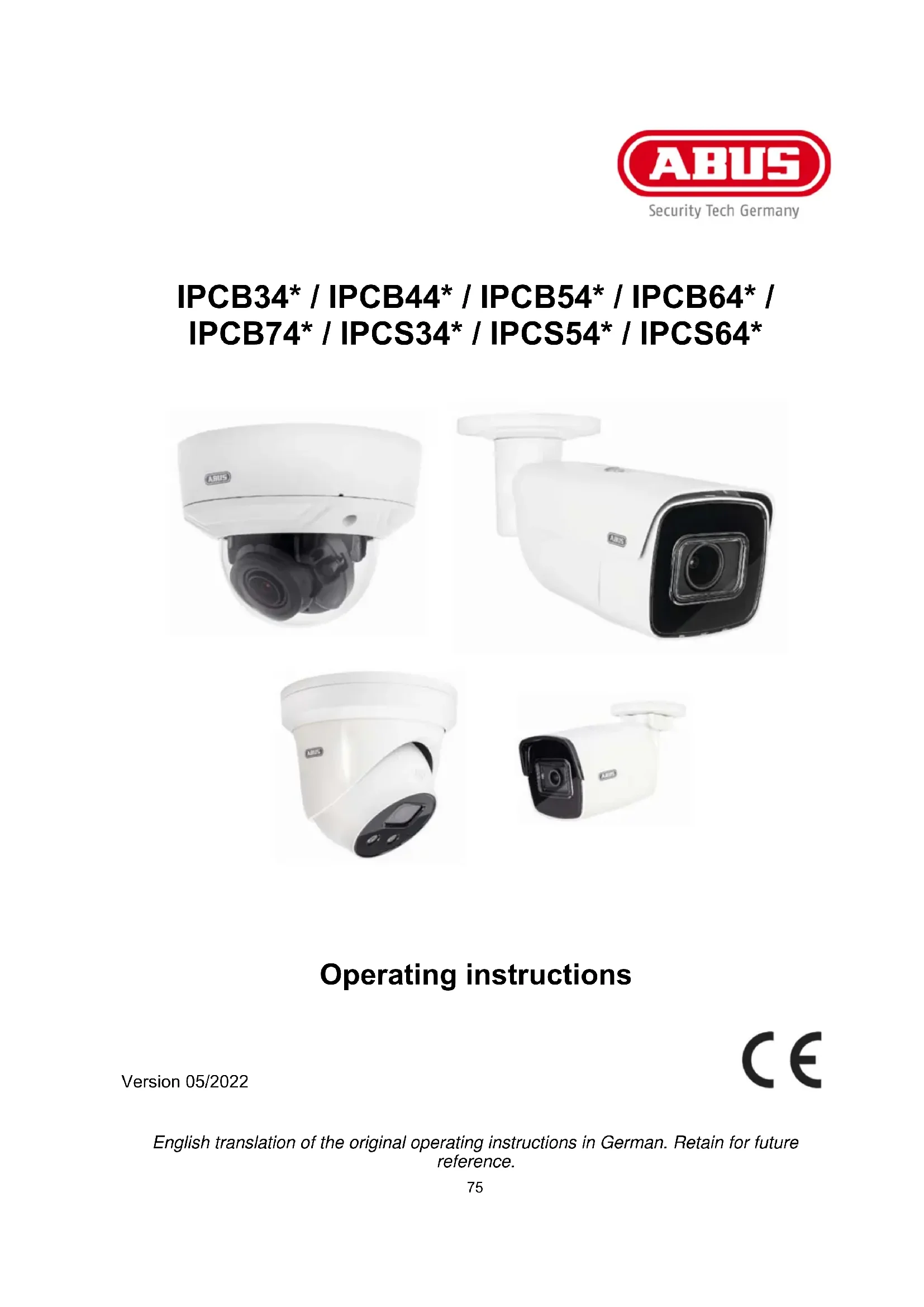
IPCB74521 - Surveillance Camera ABUS - Free user manual and instructions
Find the device manual for free IPCB74521 ABUS in PDF.



| Technical Specifications | 1080p resolution, night vision, 110 field of view, Wi-Fi connectivity, motion detection |
|---|---|
| Usage | Ideal for indoor and outdoor surveillance, compatible with mobile apps for remote access |
| Maintenance and Repair | Regular lens cleaning, recommended firmware updates, network connection checks |
| Security | Data encryption, secure access via password, notifications on motion detection |
| General Information | Easy installation, technical support available, 2-year warranty |
Frequently Asked Questions - IPCB74521 ABUS
Download the instructions for your Surveillance Camera in PDF format for free! Find your manual IPCB74521 - ABUS and take your electronic device back in hand. On this page are published all the documents necessary for the use of your device. IPCB74521 by ABUS.
USER MANUAL IPCB74521 ABUS
These user manual contains important information for installation and operation. This should be also noted when this product is passed on to a third party. Therefore look after these operating instructions for future reference! A list of contents with the corresponding page number can be found in the index on page 79.
Operating instructions
English translation of the original operating instructions in German. Retain for future reference.76 Introduction
Dear customer, Thank you for purchasing this product. The device complies with the requirements of the following EU directives: EMC Directive 2014/30/EU and the RoHS Directive 2011/65/EU. IPCB44561A ABUS Security-Center hereby declares that the device IPCB44561A complies with Radio Equipment Directive (RED) 2014/53/EU. Additionally, this device complies with the requirements of the following EU directives: EMC Directive 2014/30/EU and the RoHS Directive 2011/65/EU. The full EU Declaration of Conformity text can be found at the following internet address: www.abus.com/IPCB44561A To ensure this remains the case and to guarantee safe operation, it is your obligation to observe these operating instructions! Please read the entire user guide carefully before commissioning the product and pay attention to all operating instructions and safety information. All company names and product descriptions are trademarks of the corresponding owner. All rights reserved.
If you have any questions, please contact your specialist installation contractor or specialist dealer!
Disclaimer This user guide has been produced with the greatest of care. Should you discover any omissions or inaccuracies however, please inform us in writing at the address provided on the back of the manual. ABUS Security-Center GmbH & Co. KG does not accept any liability for technical and typographical errors, and reserves the right to make changes to the product and user guides at any time and without prior warning. ABUS Security-Center GmbH is not liable or responsible for direct or indirect damage resulting from the equipment, performance and use of this product. No guarantee is made for the contents of this document.77 Explanation of symbols
The triangular high voltage symbol is used to warn of the risk of injury or health hazards (e.g. caused by electric shock). The triangular warning symbol indicates important notes in this user guide which must be observed. This symbol indicates special tips and notes on the operation of the unit.
All guarantee claims are invalid in the event of damage caused by non-compliance with this user guide. We cannot be held liable for resulting damage. We cannot be held liable for material or personal damage caused by improper operation or non-compliance with the safety information. All guarantee claims are void in such cases.
The following safety information and hazard notes are not only intended to protect your health, but also to protect the device from damage. Please read the following points carefully: There are no components inside the product that require servicing. Dismantling the product invalidates the CE certification and the guarantee/warranty. The product may be damaged if it is dropped, even from a low height. Install the device so that the image sensor is not subjected to direct sunlight. Pay attention to the installation instructions in the corresponding section of this user manual. The device is designed for indoor and outdoor use (IP66). Avoid the following adverse conditions during operation: Moisture or excess humidity Extreme heat or cold Direct sunlight Dust or flammable gases, vapours or solvents Strong vibrations Strong magnetic fields (e.g. next to machines or loudspeakers) The camera must not be installed on unstable surfaces. General safety information: Do not leave packaging material lying around. Plastic bags, sheeting, polystyrene packaging, etc. can pose a danger to children if played with. The video surveillance camera contains small parts which could be swallowed and must be kept out of the reach of children for safety reasons. Do not insert any objects into the device through the openings. Only use replacement devices and accessories that are approved by the manufacturer. Do not connect any non-compatible products. Please pay attention to the safety information and user manuals for the other connected devices. Check the device for damage before putting it into operation. Do not put the device into operation if you identify any damage. Adhere to the normal voltage limits specified in the technical data. Higher voltages could destroy the device and pose a health risk (electric shock).78 Safety information
1. Power supply: Note the information provided on the type plate for supply voltage and power
Avoid overloading electrical sockets, extension cables and adapters, as this can result in fire or electric shock.
Only use a damp cloth to clean the device. Do not use corrosive cleaning materials. Disconnect the device from the power supply before cleaning. Warnings Observe all safety and operating instructions before putting the device into operation for the first time.
1. Observe the following information to avoid damage to the power cable and plug:
Do not pull the cable when disconnecting the device from the power – always take hold of the plug. Ensure that the power cable is positioned as far away as possible from any heating equipment, as this could otherwise melt the plastic coating.
2. Follow these instructions. Non-compliance with these instructions could lead to electric shock:
Never open the housing or power supply unit. Do not insert any metallic or flammable objects into the device. Use surge protection to prevent damage caused by overvoltage (e.g. in electrical storms).
3. Disconnect defective devices from the power immediately and contact your specialist dealer.
When installing the device in an existing video surveillance system, ensure that all devices have been disconnected from the mains power circuit and low-voltage circuit.
If in doubt, have a specialist technician carry out assembly, installation and connection of the device. Improper or unprofessional work on the mains network or domestic installations puts both you and others at risk. Connect the installations so that the mains power circuit and low-voltage circuit always run separately from each other. They should not be connected at any point or become connected as a result of a malfunction.
Unpacking the device Handle the device with extreme care when unpacking it.
This camera is used for indoor and outdoor video surveillance (depending on the model) in conjunction with a recording device or appropriate display unit (e.g. PC).
Use of this product for any other purpose than that described above may lead to damage to the product and other hazards. All other uses are not as intended and will result in the invalidation of the product guarantee and warranty. No liability can be accepted as a result. This also applies to any alterations or modifications made to the product. Read the operating instructions fully and carefully before using the product. The operating instructions contain important information on installation and operation.
2. Explanation of symbols
The triangular high voltage symbol is used to warn of the risk of injury or health hazards, e.g. caused by electric shock.
The triangular warning symbol indicates important notes in this user guide which must be observed.
This symbol indicates special tips and notes on the operation of the unit.83
3. Features and functions
The effective IR range will depend on the installation location. If there are surfaces that absorb light or no objects that reflect IR light in the field of view, the IR range will be reduced and/or the video image will be too dark. Furthermore, reflective objects in the immediate vicinity of the camera (e.g. roof gutter or wall) may also result in the reflection of IR light, which can disrupt the image.84
4. Device description
For more information on connections and the correct installation of the IP camera, please refer to the installation instructions at www.abus.com .
5. Description of the connections
For more information on connections and the correct installation of the IP camera, please refer to the installation instructions at www.abus.com .85
6.1 Using the ABUS IP Installer for camera search
Install and start the ABUS IP Installer. This is available for each respective product from the ABUS website www.abus.com. The IP camera should now appear in the selection list without the relevant IP address for the target network, where appropriate. The IP settings for the camera can be changed using the IP installer. Using the "Browser" button, a previously selected camera can be opened directly in the internet browser (the default browser for Windows will be used).86
6.2 Accessing the network camera via a web browser
Enter the camera's IP address into the browser’s address bar (if a different HTTP port is used in Internet Explorer you must also enter „ http:// “ before the IP address.)
Description Save settings that have been made on the page. Please note that the new settings will only apply after the save button has been pressed.
Function deactivated
Internet Explorer A plugin called ActiveX is used for displaying videos in Internet Explorer. This plugin must be installed in the browser. You will be asked to confirm the installation directly after entering your user name and password.
If the ActiveX Plugin installation is blocked by Internet Explorer, you will need to reduce your security settings to install/initialise ActiveX.87 Mozilla Firefox/Google Chrome/Microsoft Edge A further video plugin is required for displaying videos in these browsers. In the area to the upper right of the live view, this plugin is offered for download and installation on the PC.
6.5 Initial password assignment
For IT security reasons, use of a secure password with the appropriate usage of lower-case letters, capital letters, numbers and special characters is recommended. Passwords are not factory set and must be assigned when the camera is used for the first time. This can be done via the ABUS IP installer (‘Enable’ button), or via the website. A secure password must meet the following minimum requirements: - 8–16 characters - Valid characters: Numbers, lower-case letters, capital letters, special characters ( !"#$%&()*+,- ./:;<=>?@[\]^_{|}~space ) - You must use at least two different types of character88
6.6 Home page (login page)
After entering the IP address in the browser's address bar and opening up the page, the home page will appear.89
6.7 User accounts and passwords
Overview of the types of user with the user name descriptions, the default passwords and the corresponding privileges: User type User name Default password Privileges Administrator
(for access via web browser, mobile app or recording device) installer <can be modified by installer> <assigned and modified by admin>
Full access Operator <assigned and modified by admin> <assigned and modified by admin> Can be activated individually: Live view Playback SD/NAS Single frame search SD/NAS (PT)Z Control Manual recording Restart Two-way Audio Formatting the SD card Changing parameters in settings User (for access via web browser) <assigned and modified by admin> <assigned and modified by admin> Live view Playback SD/NAS Single frame search SD/NAS
6.8 Connecting the camera to ABUS NVR
The following information is required to connect the camera to ABUS NVR: IP address/domain name Server Port (Standard 8000) User name: installer Password: <Password> (assigned and modified by installer)
6.9 Connecting the camera to ABUS Link Station app
About P2P Cloud function: QR code or 9-digit part of the software serial number ( example: IPCS6213020210121AAWRF12345678 ) Assigned password for the P2P Cloud function Alternative: The following information is required to connect the camera via the IP address: IP address/domain name Server Port (Standard 8000) User name: installer Password: <Password> (assigned and modified by installer)90
6.10 Connecting the camera to ABUS CMS
The following information is required to connect the camera to ABUS CMS software: IP address/domain name http port (default 80) rtsp port (default 554) User name: installer Password: <Password> (assigned and modified by installer)
The camera's object detection can detect people and vehicles as objects. Other disturbances are thus ignored. For the object detection to perform optimally, certain frame conditions must be observed during installation or with the camera’s field of view.
1. The installation height of the camera should be selected between 2.5 and 5 metres. The inclination
should not exceed 10 degrees.
2. The object height in the selected image section must be between 1/16 and 1/2 of the image height. If
objects in the image are shown too large or too small, they may not be detected correctly.
3. Note that below the camera a certain area is not under surveillance.
4. The maximum surveillance distance depending on the focal length of the camera is as follows:
5. Reflective surfaces in the image section can confuse object detection.
6. Make sure that there are no branches or leaves in close proximity to the camera in the image section.
7. Dome cameras are less suitable for outdoor surveillance with object detection, as light scatter or light
reflection can occur in the dome. This affects the object detection.
8. Do not use object detection in areas with a correspondingly high number or frequency of lenses (people,
vehicles). This results in a high number of alarms. Focal len
Open the network camera home page. The interface is divided into the following main areas:
Make a selection by clicking on the appropriate tab: "Live View", "Playback", "Image" or "Configuration". Button Description Display of the currently logged in user User logout Live view Live image display Playback Playback of video data on the microSD card Image Image retrieval of stored individual images (e.g. captured number plates
Configuration Configuration pages of the IP camera
You can switch to the full-screen view by double-clicking. At the bottom left of the control bar is a button for adjusting the display format. Button Description Activate 4:3 view Activate 16:9 view Display original size Automatically adjust view to browser
Activating the microphone on the PC for two-way audio communication Pixel counter (function to determine the minimum horizontal number of pixels of a number plate
In this menu, recordings can be searched for on the corresponding data storage device or drive and downloaded to the PC (e.g. SD card). Button Description Stop playback Slow Forward Pause Fast Forward Frame forwards Save single frame to PC Video clip function Digital zoom (also during playback) Activating the loudspeaker on the PC, incl. volume setting Downloading recorded video files
Calendar with day selection. A blue triangle indicates that recordings exist for a particular day.
Marking of the recording type (continuous recording, event recording)
It may be necessary to start the browser with so-called admin rights in order to successfully save files on the PC.94
In this menu, single frames can be downloaded from the corresponding data storage device or drive and downloaded to the PC (e.g. SD card). File type: Select the event type that caused the single frame to be saved and that you want to search for Start time / End time: Date and time constraints Search: Start search Download: First select the files you want to download. Press this button to start the download.
It may be necessary to start the browser with so-called admin rights in order to successfully save files on the PC.9596
8.1 Local configuration
Under the “Local configuration” menu item, you can select settings for the live view, file paths of the recordings and snapshots.
Live view parameters Here you can set the protocol type and the live view performance of the camera. Protocol TCP: Transmission Control Protocol: Transmission protocol with safeguarding against transmission errors. If there is a transmission error, packages are resent. However, if the error frequency is too high, this protocol is negative for real-time transmission. UDP: Real-time audio and video transmission without security mechanism MULTICAST: Use of the multicast protocol (the network components must support multicast). Additional multicast settings can be found under Configuration/Network. HTTP: Control and video data are tunnelled via the HTTP port.
Live view performance You can set the performance level for the live view here. Live Indicator (Rules Information) As soon as this function has been enabled, a frame will be displayed around the triggered area in the live image for used and triggered motion detection.97 Image format Setting of the format in which the single frame from the live view (Instant image button) should be saved (JPEG, BMP). Record file settings You can define the file size for recordings, the recording path and the path for downloaded files here. To apply the changes, click "Save". Recording file size You can choose between 256 MB, 512 MB and 1 GB as the file size for recordings and downloaded videos. Save recordings to You can determine the file path that is to be used for manual recordings here. The default path used is C:\\<User>\<Computer name>\Web\RecordFiles. Save downloaded files to You can store the file path for downloaded videos here. The following path is set by default: C:\\<User>\<Computer_Name>\Web\DownloadFiles
Image save settings Here you can store the path for snapshots taken during playback as well as for video clips. Save snapshots in live view to Select the file path for instant images from the live view. The following path is set by default: C:\\<User>\<Computer_Name>\Web\CaptureFiles Save snapshots during playback to You can store the path here for saving snapshots taken during playback. The following path is set by default: C:\\<User>\<Computer_Name>\Web\PlaybackPics Save clips to You can specify the save path for storing edited video clips here. The following path is set by default: C:\\<User>\<Computer_Name>\Web\PlaybackFiles98
Basic information Device name: You can specify a device name for the camera here. Click on "Save" to apply the change. Model: Model number display Serial No.: Serial No. display Firmware version: Firmware version display Encoding version: Encoding version display Number of Channels: Display of the number of channels Number of HDDs/SDs: Number of installed storage media (SD card, max. one) Number of Alarm Input: Display of the number of alarm inputs Number of Alarm Output: Display of the number of alarm outputs99
Time zone Time zone selection (GMT). Time setting methods NTP Using the Network Time Protocol (NTP), it is possible to synchronise the time of the camera with a time server. Activate NTP to use the function. Server Address IP server address of the NTP server. NTP Port Network port number of the NTP service (default: port 123) NTP update interval 1–10080 min.
Manual Time Sync. Device time Computer device time display. Set time Display of the current time using the time zone setting. Click on “Sync. with computer time” to adopt the computer's device time.100
Summer Time Enable DST Activate the “Enable DST” checkbox to adjust the system time automatically to daylight saving time. Start time Specify the time for switching to daylight saving time. End time Specify the time for switching to standard time.
The RS-232 interface for service purposes.
Apply the settings by clicking “Save”.
Apply the settings by clicking “Save”.101
8.2.1.5 VCA Resource
The IP camera can be operated in 2 different modes. This setting has a direct influence on certain features or menu displays in the browser. Smart Event Mode (Default): In this mode, only 2 video streams are available (1st and 2nd video stream). This is sufficient for most applications. In particular, VCA functions with object detection (human, vehicle) are available (e.g. tripwire or intrusion detection).
Surveillance mode: In this mode, 3 video streams are available. VCA functions (Video Content Analysis) such as Tripwire or Intrusion Detection are not available for selection. All DSP resources are used to generate the video streams.
8.2.2.1 Upgrade and maintenance
Restart Click "Reboot" to reboot the device. Standard Restore Click on "Restore" to reset all the parameters, except the IP parameters and user information, to the default settings. Standard Select this item to restore all parameters to default settings. Import Config. File Config File Select a file path to import a configuration file here. Status Display of the import status. Export Config. File Click "Export" to export a configuration file. Remote Upgrade Firmware Select the path to upgrade the camera with new firmware. Status Display of the upgrade status. Automatic restart103 Activate automatic restart / restart time: An automatic restart is possible once a week. To do this, select the day and time.
The camera’s log information can be displayed here. An SD card must be installed in the camera in order to save log information.
8.2.2.3 Security Audit Protocol
This protocol shows more details about the accesses of clients to the camera. This list can be exported as an Excel file. Alternatively, the log information can be sent directly to a TCP server (log server) (e.g. using the software "Hercules SETUP utility" from "HW-group.com"). Furthermore, it is possible to create a self-signed certificate or upload a CA certificate on this menu page.
In this menu item, settings for security or encryption of access to the website for the camera as well as the retrieval of the video stream via the RTSP protocol can be made. RTSP authentication: The authentication mechanisms "digest" and "basic" are supported. The "digest" setting is recommended if the client supports it. RTSP Digest algorithm: MD5 – cryptographic hash function SHA256 – security-enhanced cryptographic hash function Apply the settings by clicking “Save”.104 WEB authentication: The authentication mechanisms "digest" and "basic" are supported. The "digest/basic" setting offers greater compatibility with different clients. WEB Digest authentication: MD5 – cryptographic hash function SHA256 – security-enhanced cryptographic hash function
8.2.3.2 IP address filter
Enable IP address filter Ticking the selection box enables the filter function. IP Address Filter Type Allowed: The IP addresses detailed further below can be used to access the camera. Forbidden: The IP addresses detailed further below are blocked. An IP is entered in the format xxx.xxx.xxx.xxx.
Apply the settings by clicking “Save”.105
8.2.3.3 Security service
Enable SSH This function enables the Telnet port and the Telnet protocol. Enable illegal login lock If this function is activated, camera access via the web interface is blocked if the user name or password are entered incorrectly (3 times... 20 times).
8.2.3.4 Enhanced security
Activate control timeout: If there is no active operation of the camera via the web interface for a certain time (1 – 60 min., default 15 min.), the user is logged out.106
With this menu item, you can add, edit or delete users. To add or modify a user, click "Add" or "Modify". A new window with the data and authorisations appears. User name Here you assign the user name that needs to be entered for access to the camera. User type Select an individual user type for the user ID. You can choose between two predefined levels: "Operator" or "User". As a user, the following remote functions are available to you: playback, browse/query operating status. To add further functions, select the corresponding checkbox. Password Here you assign the password that the corresponding user must enter to access the camera. Confirm Confirm the password by entering it again.
Display of the currently logged on users with IP address and time of activity.
Apply the settings by clicking "OK". Click "Cancel" to discard the data.107
To be able to operate the camera via a network, the TCP/IP settings must be configured correctly. NIC settings NIC Type Select the setting for your network adapter. You can choose from the following values: 10M Half-dup; 10M Full-dup; 100M Half-dup; 100M Full-dup; 10M/100M/1000M Auto. DHCP If a DHCP server is available, click DHCP to apply an IP address and other network settings automatically. The data is transferred automatically from the server and cannot be changed manually. If no DHCP server is available, please enter the following data manually. IPv4 address Setting of the IP address for the camera IPv4 Subnet Mask Manual setting of the subnet mask for the camera IPv4 Default Gateway Setting the default router for the camera. IPv6 Mode Manual: Manual configuration of IPv6 data. DHCP: The IPv6 connection data is provided by the DHCP server.108 Route Advertisement: The IPv6 connection data is provided by the DHCP server (router) in connection with the ISP (Internet Service Provider). IPv6 Address Display of the IPv6 address. The address can be configured in the IPv6 "manual" mode. IPv6 Subnet mask Display of the IPv6 subnet mask. IPv6 Standard gateway Display of the IPv6 default gateway (default router). MAC address The IPv4 hardware address of the camera is displayed here. This cannot be changed. MTU Setting of the transmission unit. Select a value between 500 and 9676. 1500 is set by default. DNS Server Preferred DNS server DNS server settings are required for some applications (for example, sending emails). Enter the address of the preferred DNS server here. Alternative DNS Server If the preferred DNS server cannot be reached, this alternative DNS server is used. Please store the address of the alternative DNS server here. Domain name settings A dynamic domain name can be configured in this menu item. The camera can then be addressed in the local network using this name.
Activate DDNS: ticking the checkbox activates the DDNS function. DDNS type: Select a service provider for the DDNS service (default: ABUS server) Server Address: IP address of the service provider (already filled in for the ABUS server option)109 Domain: registered host name with the DDNS service provider (if available) Port: port for the service (if available) User name: User account identification with the DDNS service provider (ABUS server user) Password: Account password with the DDNS service provider (ABUS server account password)
If you wish to enable external access to the camera, the following ports must be configured. HTTP Port The default port for HTTP transmission is 80. As an alternative, this port can be assigned a value in the range 1024~65535. If several cameras are located on the same subnetwork, each camera should have its own unique HTTP port. RTSP port The default port for RTSP transmission is 554. As an alternative, this port can be assigned a value in the range 1024~65535. If several cameras are located on the same subnetwork, each camera should have its own unique RTSP port. HTTPS Port The standard port for HTTPS transmission is 443. Server port The standard port for SDK transmission is 8000. Communication port for internal data. As an alternative, this port can be assigned a value in the range 1025 ~ 65535. If several IP cameras are located in the same subnetwork, each camera should have its own unique server port. Advanced SDK Service Port This port is required for encrypted communication as an alternative to the server port. WebSocket Port / WebSocket(s) Port These ports are used for video display in browsers such as Google Chrome or Mozilla Firefox. The installation of a second web plugin is required for this.110
Enable UPnP: Activation or deactivation of the UPnP interface. Upon activation, the camera, for example, will appear in the Windows network environment. Name: Definition of the name for the UPnP interface (this name will be assigned to the camera, for example, in the Windows network environment.) Port Mapping Mode Select here whether you wish to conduct port mapping automatically or manually. You can choose between "Auto" or "Manual". Protocol Name: HTTP The default port for HTTP transmission is 80. As an alternative, this port can be assigned a value in the range 1025 ~ 65535. If several IP cameras are located on the same subnetwork, each camera should have its own unique HTTP port.
RTSP The default port for RTSP transmission is 554. As an alternative, this port can be assigned a value in the range 1025 ~ 65535. If several IP cameras are located on the same subnetwork, each camera should have its own unique RTSP port. Server port (control port)
Apply the settings by clicking “Save”.111 The standard port for SDK transmission is 8000. Communication port for internal data. As an alternative, this port can be assigned a value in the range 1025 ~ 65535. If several IP cameras are located in the same subnetwork, each camera should have its own unique server port. External Port You can only change ports manually here if the "Port Mapping Mode" was set to manual. Status Displays whether the external port entered is valid or not valid.
Not all routers support the UPnP port-mapping function (also know as Auto UPnP).
A multicast server is used to duplicate video streams for access by several clients without placing an additional load on the IP camera. IP address: IP address of the multicast server Stream type: Selection of the video stream to be made available to the multicast server Video connection: Video port Audio connection: Audio port
SNMP v3 Activate SNMPv3: Activation of SNMPv3 Read user name: Allocate user name Security level: auth, priv: No authentication, no encryption auth, no priv.: Authentication, no encryption no auth, no priv.: No authentication, encryption Authent. algorithm: Select authentication algorithm: MD5, SDA Authentication Password: Password assignment Private-key Algorithm: Select encryption algorithm: DES, AES Private-key password: Password assignment Write user name: Allocate user name Security level: auth, priv: No authentication, no encryption auth, no priv.: Authentication, no encryption no auth, no priv.: No authentication, encryption Auth. algorithm: Select authentication algorithm: MD5, SDA Authentication Password: Password assignment Private-key Algorithm: Select encryption algorithm: DES, AES112 Private-key password: Password assignment
To upload recorded videos or images onto an FTP server, the following settings must be selected. Server Address Enter the IP address of the FTP server here. Port Enter the port number of the FTP server here. The standard port for FTP servers is 21. User name User name of the account that was configured in the FTP server. Password Password of the account that was configured in the FTP server. Confirm Re-enter the password here. Directory Structure Select the save location for the uploaded data here. You can choose between "Save in the root directory."; "Save in the parent directory”; “Save in the child directory”. Parent Directory This menu item is only available if “Save in the parent directory” or “Save in the child directory” was selected under Directory Structure. You can select the name for the parent directory here. The files are saved in a folder on the FTP server. Choose between “Use Device Name”, “Use Device Number” and “Use Device IP address”. Child Directory113 Select the name for the child directory here. The folder is created in the parent directory. You can choose between “Use Camera Name” or “Use Camera Number”. Picture filing interval This function prevents too many image files from being stored in one folder over time. The server's file system may no longer be able to process or display such a large amount of files. Example: The setting "2 days" saves images from 2 days in a subfolder. The folder designation in each case is the start and end date of this period. Image name The image name can be assigned a user-defined part name at the beginning (prefix). Upload image Select “Upload image” to upload images to the FTP server.
You can apply the settings for sending emails here. Sender Sender Enter a name here to be displayed as the sender. Sender's Address Enter the email address of the sender here. Apply the settings by clicking “Save”.114
SMTP server Enter the IP address or host name of the SMTP server here. (For example: smtp.googlemail.com) SMTP port Enter the SMTP port here. This is configured as 25 by default. Email encryption Select the encryption required by the email server (SSL, TLS, STARTTLS) Interval Set the interval between sending emails with image attachments here. Attached Image Enable this function if images are to be attached to the email in the event of an alarm.
Authentication If the email server in use requires authentication, enable this function to be able to log onto the server with authentication. User names and passwords can only be entered once this function has been enabled. User name Enter the user name of the email account here. This is the part before the @ symbol. Password Enter the password of the email account here. Confirm Confirm the password by entering it again. Receiver Receiver1 / Receiver2 Enter the name of the receiver here. Receiver1's Address / Receiver2's Address Enter the email address of the person to be informed here.
The ABUS Link Station function is used to make it easier to access your ABUS device remotely via the Link Station app (iOS / Android). Products can be easily set up and released via QR code - with no complex configurations in the router (no port forwarding necessary). Activate the function and assign a verification code (6-12 characters, A-Z, a-z, 0-9, min. 2 different character types recommended). The QR code can then be photographed in the ABUS Link Station app.
Apply the settings by clicking “Save”.115
Push function in ABUS Link Station app
1. Activate ABUS Link Station function in IP camera
2. Add IP camera to ABUS Link Station app via QR code or 9-digit serial number part
3. Activate Push notification in app (More/Function settings/Push notification)
4. Activate "Alarm notification" in the individual camera settings in the Link Station app.
5. Activate and configure the desired detector in the IP camera (Motion detection, Tripwire or Intrusion
6. Activate "Event-controlled single frame recording" in IP camera under Storage/Single frame
recording/Capture parameters
7. Add rule in Event Manager in IP Camera and select "Notify NVR/CMS" as action
Push result in the smartphone: - Push info in status bar - 1 single frame under "News" in Link Station app - optional: with SD card installed and duration or event video recording, short video sequence can also be viewed
Activate HTTPS: enables the HTTPS function. This enables a secure connection with connection certificate. Please note that further steps are necessary for configuring the HTTPS function.
Video/Audio DSCP: (Differentiated Service Code Point) (0~63): Priority for video/audio IP packages. The higher the value, the higher the priority. Event/Alarm DSCP: (0~63): Priority for event/alarm IP packages. The higher the value, the higher the priority. Management DSCP: (0~63 ): Priority for management IP packages. The higher the value, the higher the priority.116
Enable IEEE 802.1X: Enable 802.1X authentication Protocol: Protocol type EAP-MD5 (only) EAPOL version: Extensible Authentication Protocol over LAN, choice between version 1 or 2 User name: Enter the user name Password: Enter the password Confirm: Password confirmation
8.3.13 Integration protocol
In this menu, the ONVIF protocol (Open Network Video Interface) can be activated and configured. For this purpose, an independent user must be created who can then use the ONVIF protocol.
To increase IT security, certain services can be deactivated in this menu item if they are not being used.
In this menu, the transmission of an XML telegram to an HTTP server can be configured. When an event (e.g. motion detection) or smart event (e.g. tripwire) is triggered, this XML telegram is then transmitted and can be further processed in a third-party application.117
Stream Type Select the stream type for the camera. Select "Main Stream (Normal)" for recording and live view with good bandwidth. Select "Sub Stream" for live view with restricted bandwidth. A total of 5 video streams are available, but their use depends on the client. Video Type This type of camera does not have an audio function. The video type is fixed to "video stream". Resolution Set the resolution of the video data here. Depending on the camera model you can choose between 1280*720p; 1280*960; 1920*1080p. Bitrate Type Specifies the bitrate of the video stream. The video quality can differ depending on the intensity of movement. You have the choice between a constant bitrate and a variable bitrate. Video Quality This menu item is only available if you have selected a variable bitrate. Set the video quality for video data here.The video quality can differ depending on the intensity of movement. You can select from six different video qualities: "Lowest", "Lower", "Low", "Medium", "Higher" or "Highest” (represented by "+"). Frame rate Specifies the frame rate in frames per second.
Max. Bitrate118 The bitrate of the video stream is set to a certain value. Set a max. bitrate of between 32 and 16384 Kbps. A higher value means better video quality; however, this requires more bandwidth. Video Encoding Select a standard for video encoding. You can choose between H.264, H.265 and MJPEG. Profile Select a profile here. You can choose between 'Basic Profile', 'Main Profile' and 'High Profile'. I frame interval Set the I frame interval here. The value must lie between 1 and 400.
Audio Encoding select the audio encoding for audio transmission here (G.722.1, G.711ulaw, G.711alaw, MP2L2, G.726). Audio input enables the audio input (only for cameras with built-in microphone and microphone input). Input volume adjustment of the input amplification for the microphone. Environmental noise filter enable the digital noise reduction function for audio transmission here.
8.4.3 ROI (Region of Interest)
The Region-of-Interest function can transmit certain areas in the video image with higher quality than the rest of the video image. This accordingly makes it possible save transmission bandwidth. There is 1 area available for each video stream (1, 2). Note: The video bit rate of the desired video stream can be set very low (see "Video stream settings"). The selected area in the image is automatically increased to a certain quality level, but the rest of the image remains at low quality/bit rate. Fixed region: A rectangular frame can be drawn around an area of interest. There is 1 area available for each video stream (1, 2). ROI level: 1: lower quality of the area, 6: highest quality of the area Region Name: Assigning a name to the area.
8.4.4 Stream information
Dual VCA: This function transmits the details of the smart event detectors with the video stream to the NVR. Independent evaluations based on this data can then be carried out in the NVR or CMS, even if the recording was configured as a continuous recording.
Apply the settings by clicking “Save”.119
8.4.5 Stream extraction (VCA Resource: Surveillance)
The 3rd video stream can be cropped to a desired image section. Only this area is then transmitted. The maximum resolution that can be set is 1920 x 1080 pixels. If the resolution is lower than 1920 x 1080, the image section can also be moved. This menu item is only available with the VCA resource setting "Surveillance".120
Image Adjustment Brightness Image brightness settings. A value between 0 and 100 can be set. Contrast Image contrast settings. A value between 0 and 100 can be set. Saturation Image saturation settings. A value between 0 and 100 can be set. Sharpness Image sharpness settings. A higher sharpness value can increase image noise. A value between 0 and 100 can be set.
Exposure Settings Iris Mode Exposure parameters can only be set manually for this camera. Exposure time Setting the maximum exposure time. This setting is dependent on iris mode.
The higher the speed of the objects in the image, the shorter the exposure time must be set. This reduces the brightness of the image. Additional lighting may then be necessary. A common value for the exposure time for fast-moving objects is 1/250.121
Focus The camera focuses automatically after restarting or after operating the zoom function. However, the focus can also be adjusted manually afterwards, this is done directly on the live view page. This manually set focal point is then set again even after the camera is restarted, because the camera has saved this point.
Day and night switching Day/Night Switch Day/Night Switch provides options for “Auto”, “Day” and “Night”. Auto Depending on the light conditions, the camera switches between day and night mode automatically. The sensitivity can be set between 0 and 7. Day In this mode, the camera only outputs colour pictures.
ht conditions remain constant. Night In this mode, the camera only outputs black/white pictures.
ht conditions are poor. Schedule Sensitivity Setting for the switching threshold for automatic day/night switching (0–7). A lower value means that there is a lower lighting level for switching to night mode. Delay time ("filter time") Setting a delay time between recognising that a switching is required and carrying out the process. Smart IR (“Intelligent additional light") This function can reduce the cross-fade of the video image, in the event that light is reflected from nearby objects. Additional lighting mode Depending on the model type, you will have the options "IR light" or "white light". The integrated lighting can also be completely deactivated. Light brightness control The general intensity of the lighting can be set. Auto: Automatic control with maximum value. Manual: Fixed manual setting
Backlight Settings WDR With the aid of the WDR function, the camera can return clear pictures even in disadvantageous backlight conditions. If there are both very bright and very dark areas in the picture area, the brightness level of the overall picture is balanced to provide a clear, detailed image.122 Click on the checkbox to enable or disable the WDR function. Set the Wide Dynamic Level higher to enhance the WDR function.
HLC (High Light Compensation) Overexposure at the edge of bright light sources is reduced (e.g. car headlights). A higher threshold means high reduction. Function only with deactivated WDR. White balance Here you select the lighting conditions in which the camera is installed. You can choose from the following options: “Manual”, “AWB1”, “WB Locked”, “Fluorescent Lamp”, “Incandescent Lamp”, “Warm Light”, “Natural Light”. Manual You can adjust the white balance with the following values manually.
Locked WB The white balance is performed once and saved. Other Use additional white balance options to adjust the function to the light levels. Fluorescent Lamp Adjusts the white balance to fluorescent lamp lighting conditions.
Image enhancement Digital Noise Reduction You can enable (Normal Mode) or disable the noise reduction. Noise Reduction Level / 2D/3D DNR Set the level for noise reduction here. Grey Scale This function limits the range of the grey scale representation. This can be beneficial in the case of very light image content.
Video Settings Mirroring Three different options for image mirroring are possible (horizontal, vertical, hor. + vert.) Rotate (Vertical display) This setting rotates the image to increase the vertical angle of view. It is necessary to rotate the camera module by 90° when doing this.
Please note: Rotate (Vertical Display) function is not available in "Smart Event Mode", only in "Surveillance Mode".123
Video Standard Select the video standard corresponding to the available power frequency.
You can use this menu item to select which date and time format are displayed in the live picture.
Display Name Activate this checkbox if you wish to display the camera name. Display Date Activate this checkbox if you wish to display the date in the camera image. Camera Name Enter the camera name that is to be displayed in the image here. Time Format Choose here whether you would like to display the time in 24-hour or 12-hour format. Date format Select the format for the date display here. (D = day; M = month, Y = year) Display Mode Here you can select the display mode for the elements displayed. You have the following options: "Transparent & Flashing", "Transparent & Not Flashing", "Not Transparent & Flashing", "Not Transparent & Not Flashing". OSD Size Here it is possible to adjust the font size of all text overlays.124 Font Colour White, black and self-adapting are available as colours for text overlays. A self-adapting font changes the colour of each digit to either black or white, depending on whether the background is lighter or darker. Adaptation This function can be used to set the placement of the text fields as well as the text in the text fields. Borders left and right Setting the distances to the left and right edge. Borders top and bottom Setting the distances to the top and bottom.
You can use privacy masks to hide certain areas in the live view to prevent these areas from being recorded and viewed in the live view. A maximum of 4 rectangular privacy masks can be set up in the video image. Follow the steps below to set up a privacy mask. Select the checkbox "Enable Privacy Mask". To add a privacy mask, click "Draw Area". You can now select an area on the camera image using your mouse. You can then select three additional areas. By clicking on "Clear All", you can delete all configured privacy masks.
In the image settings, it is possible to make different settings for different scenes (e.g. different brightness or backlight setting). These scene settings can now be used or set via a calendar menu for each month and for the hours for each day of that month. This function helps to compensate for different lighting phases in the different months of the year so that an optimal image can always be achieved.
Apply the settings by clicking “Save”. Apply the settings by clicking “Save”.125
Area settings Activate motion detection by clicking the "Enable Motion Detection" checkbox. Clicking “Enable Dynamic Analysis for Motion” means that movements are recorded in the preview image and the live view (dynamic recording according to motion). Mode There are 2 different modes available for marking areas. Normal: Max. 4 areas, each area as a polygon with max. 10 corners, sensitivity setting is the same for each area Expert: Max. 8 areas, each area as a rectangle, individual sensitivity setting for each area To select an area, click the "Set area" button. To discard the selection, click on "clear all". Click with the left mouse button to define the corners of the polygon, or drag the mouse pointer over the desired area. When drawing the polygons, a right click ends the drawing. For rectangles, click on the "Stop drawing" button. Set the sensitivity using the regulation control bar.126 Detection target This menu item is the setting for object detection. Object detection detects people and vehicles on a neural basis.
1. Object detection (human / vehicle) and the subsequent filtered display of these recordings
can only be used in conjunction with an ABUS NVR.
2. On the ABUS NVR, video recordings can be displayed filtered by people or vehicles via the
connected monitor (HDMI/VGA) in the "Smart Search" menu. Other motion detection recordings beyond people and vehicles can be displayed in playback as usual.
3. Filtering of the entire motion-controlled recordings according to people and vehicles is also
possible in the CMS software of connected ABUS NVRs
Sensitivity Determines the required intensity of the pixel change. The higher the value, the fewer pixel changes are required to trigger motion. Schedule To save a schedule for motion-controlled recording, click on "Activate schedule". Specify here on which days of the week and at which times the motion-controlled recording should take place. The period selection is made by holding down the left mouse button. By clicking on an already marked period, the details can also be set via keypad or deleted again. To copy the time selection to other weekdays, move the mouse pointer behind the bar of the weekday already set and use the "Copy to ..." function. Apply the settings made by clicking "Save".
Linkage method Here you can set the action to be performed following motion detection. Normal Linkage Send email: You receive an email as notification; check the checkbox to activate this. Notify the surveillance centre: If an event is triggered, the ABUS CMS software can be informed. You may then get a picture pop-up, for example. Uploading to FTP/Memory card/NAS: Check this check box to upload single frames to an FTP server, the SD card or a connected NAS drive during an event. Audible warning: This function can output preset or custom tones or sound media. This requires a camera model with audio output or an integrated loudspeaker. Trigger alarm output When an event is triggered, existing alarm outputs on the camera can be activated. The behaviour of the alarm output can be set under "Events / Alarm output". Trigger recording Enable this in order to record motion detections onto an SD card.127
With this menu item you can configure the camera so that video tampering is triggered as soon as the lens is covered (so-called cover detection). Area settings Activate video tampering alarm by clicking the “Activate video tampering” checkbox. To select an area, click on the "Draw Area" button. The entire area is selected by default. To discard this selection, click on "Clear All". Drag the mouse pointer over the desired area. Set the sensitivity using the regulation control bar. To apply the setting for the area, click on "Stop Drawing". Right: low sensitivity level. Left: high sensitivity level. Schedule To save a schedule, click on "Activate schedule". Specify here on which days of the week and at which times the function should be active. The period selection is made by holding down the left mouse button. By clicking on an already marked period, the details can also be set via keypad or deleted again. To copy the time selection to other weekdays, move the mouse pointer behind the bar of the weekday already set and use the "Copy to ..." function. Apply the settings made by clicking "Save".
Apply the settings by clicking “Save”.128 Linkage method Here you can set the action to be performed when an event occurs. Normal Linkage Send email: You receive an email as notification; check the checkbox to activate this. Notify the surveillance centre: Alarm triggering of the NVR/CMS for further processing (e.g. recording on NVR, or full-screen display when alarm is triggered in CMS)
Trigger alarm output When an event is triggered, existing alarm outputs on the camera can be activated. The behaviour of the alarm output can be set under "Events / Alarm output".
You can configure the camera's alarm input under this menu item Alarm Input No. Here you can select the alarm input that you wish to configure. Alarm name You can specify a device name for the alarm input here. Please do not use the alarm input number or any special characters. Alarm Type Apply the settings by clicking “Save”.129 Select the alarm type here. You can choose between “NO” (normally open) or “NC” (normally closed). Schedule To save a schedule, click on "Activate schedule". Specify here on which days of the week and at which times the alarm input should be active. The period selection is made by holding down the left mouse button. By clicking on an already marked period, the details can also be set via keypad or deleted again. To copy the time selection to other weekdays, move the mouse pointer behind the bar of the weekday already set and use the "Copy to ..." function. Apply the settings made by clicking "Save".
Linkage method Here you can set the action to be performed when an event occurs. Normal Linkage Send email: You receive an email as notification; check the checkbox to activate this. Notify the surveillance centre: If an event is triggered, the ABUS CMS software can be informed. You may then get a picture pop-up, for example. Uploading to FTP/Memory card/NAS: Check this check box to upload single frames to an FTP server, the SD card or a connected NAS drive during an event. Audible warning: This function can output preset or custom tones or sound media. This requires a camera model with audio output or an integrated loudspeaker. Trigger alarm output When an event is triggered, existing alarm outputs on the camera can be activated. The behaviour of the alarm output can be set under "Events / Alarm output". Trigger recording Enable this in order to record motion detections onto an SD card.
Apply the settings by clicking “Save”.130
You can configure the two alarm outputs here. Alarm Output No. Here, select the alarm output that you wish to configure. Delay With the "Manual" setting, the alarm output is not reset after an event. This must then be confirmed and reset manually via the "Manual alarm" button by clicking it twice. The regular active time of the output after the event is 5 seconds. A further active time of up to 10 minutes can be programmed. Alarm name You can specify a name for the relevant alarm output here. Please do not use the alarm output no. or any special characters. Schedule To save a schedule, click on "Activate schedule". Specify here on which days of the week and at which times the alarm output should be active. The period selection is made by holding down the left mouse button. By clicking on an already marked period, the details can also be set via keypad or deleted again. To copy the time selection to other weekdays, move the mouse pointer behind the bar of the weekday already set and use the "Copy to ..." function. Apply the settings made by clicking "Save".131
Events can trigger the following exceptions: - HDD full: If the internal SD card or a linked NAS drive is full - HDD error: SD card or NAS drive error - Network disconnected: Ethernet cable removed - IP address conflict - Illegal login: a reaction can be programmed to follow an incorrect login The following reactions can be programmed: - Send email: - Notify surveillance centre (NVR/CMS) - Activate alarm output
The acoustic alarm output can play predefined sounds or individual short sound media. This function can only be used with a camera with audio output or integrated loudspeaker.
Sound type: Warning (warning tone, selection), Prompt (short acoustic indication), User-defined audio (from file) A more detailed setting of the selected option is made in the next menu item.
Warning: Select an acoustic message from the list (English-language messages)
User-def. audio: Add: Selecting the audio file (Format: *.wav file, max. 512 KByte file size, sampling rate 8 kHz) Converting an audio file into the corresponding format can be done using an online converter or freeware software. Alarm time: Playback duration Sound volume: Playback volume Schedule: Schedule definition (procedure is the same as setting other schedules)132
The function can detect if the camera has been turned. Sensitivity: The higher the value, the smaller the change in image content must be to trigger an event. Schedule To save a schedule, click on "Activate schedule". Specify here on which days of the week and at which times the alarm output should be active. The period selection is made by holding down the left mouse button. By clicking on an already marked period, the details can also be set via keypad or deleted again. To copy the time selection to other weekdays, move the mouse pointer behind the bar of the weekday already set and use the "Copy to ..." function. Apply the settings made by clicking "Save". Linkage method Here you can set the action to be performed when an event occurs. Normal Linkage Send email: You receive an email as notification; check the checkbox to activate this. Notify the surveillance centre: If an event is triggered, the ABUS CMS software can be informed. You may then get a picture pop-up, for example. Uploading to FTP/Memory card/NAS: Check this check box to upload single frames to an FTP server, the SD card or a connected NAS drive during an event.133
Trigger alarm output When an event is triggered, existing alarm outputs on the camera can be activated. The behaviour of the alarm output can be set under "Events / Alarm output". Trigger recording Enable this in order to record motion detections onto an SD card.
8.6.8 Intrusion detection
Enable intrusion detection: The intrusion detection function triggers an event if an object stays in the area to be monitored for longer than the set time. Preview video: configure the area to be monitored Max. size: This function determines the maximum size of the object to be detected. This is done by drawing a rectangle in the preview video. The rectangle can be drawn anywhere in the preview video. Min. size: This function determines the minimum size of the object to be detected. This is done by drawing a rectangle in the preview video. The rectangle can be drawn anywhere in the preview video. Detection area: The area to be monitored can be drawn in the video image (quadrilateral area). Operation: Press button -> set corner points using left mouse button (max. 4) -> press right mouse button to finish drawing Delete: delete the area. Detection target This menu item is the setting for object detection. Object detection detects people and vehicles on a neural basis.134
1. When using object detection, video recordings on the internal SD card only contain
recordings of detected people or vehicles. Other objects do not resolve a recording on the SD card.
2. When using object detection and recording the video data to an ABUS NVR, all intruding
objects are first saved as a recording. Filtering can be done subsequently via the ABUS NVR (local operator interface) or the CMS software (LAN/WAN).
3. Object detection (human / vehicle) and the subsequent filtered display of these recordings
can only be used in conjunction with an ABUS NVR.
4. On the ABUS NVR, video recordings can be displayed filtered by people or vehicles via
the connected monitor (HDMI/VGA) in the "Smart Search" menu. Other motion detection recordings beyond people and vehicles can be displayed in playback as usual.
5. Filtering of the entire motion-controlled recordings according to people and vehicles is also
possible in the CMS software of connected ABUS NVRs
Region: Number of available areas: 4 Threshold: The higher the value (0-10 seconds), the longer an object has to stay in the area to be monitored in order to trigger an event. Sensitivity: higher sensitivity allows smaller objects to be detected.
Schedule To save a schedule, click on "Activate schedule". Specify here on which days of the week and at which times the alarm output should be active. The period selection is made by holding down the left mouse button. By clicking on an already marked period, the details can also be set via keypad or deleted again. To copy the time selection to other weekdays, move the mouse pointer behind the bar of the weekday already set and use the "Copy to ..." function. Apply the settings made by clicking "Save".
Linkage method Here you can set the action to be performed when an event occurs. Normal Linkage Send email: You receive an email as notification; check the checkbox to activate this. Notify the surveillance centre: If an event is triggered, the ABUS CMS software can be informed. You may then get a picture pop-up, for example. Uploading to FTP/Memory card/NAS: Check this check box to upload single frames to an FTP server, the SD card or a connected NAS drive during an event. Audible warning: This function can output preset or custom tones or sound media. This requires a camera model with audio output or an integrated loudspeaker. Trigger alarm output135 When an event is triggered, existing alarm outputs on the camera can be activated. The behaviour of the alarm output can be set under "Events / Alarm output". Trigger recording Enable this in order to record motion detections onto an SD card.
Enable tripwire: The tripwire function detects whether an object crosses a virtual line in the video image in a certain direction or both directions. Then, an event can be triggered. Preview video: configure the virtual line here. Max. size: This function determines the maximum size of the object to be detected. This is done by drawing a rectangle in the preview video. The rectangle can be drawn anywhere in the preview video. Min. size: This function determines the minimum size of the object to be detected. This is done by drawing a rectangle in the preview video. The rectangle can be drawn anywhere in the preview video. Drawing: a virtual line appears in the preview video after the button is pressed. It is then possible to click on this line and move it using the mouse and the red corner points. "A" and "B" indicate the directions. Line: number of available virtual lines: 4 Delete: delete the virtual line136
Detection target This menu item is the setting for object detection. Object detection detects people and vehicles on a neural basis.
1. When using object detection, video recordings on the internal SD card only contain
recordings of detected people or vehicles. Other objects do not resolve a recording on the SD card.
2. When using object detection and recording the video data to an ABUS NVR, all intruding
objects are first saved as a recording. Filtering can be done subsequently via the ABUS NVR (local operator interface) or the CMS software (LAN/WAN).
3. Object detection (human / vehicle) and the subsequent filtered display of these recordings
can only be used in conjunction with an ABUS NVR.
4. On the ABUS NVR, video recordings can be displayed filtered by people or vehicles via
the connected monitor (HDMI/VGA) in the "Smart Search" menu. Other motion detection recordings beyond people and vehicles can be displayed in playback as usual.
5. Filtering of the entire motion-controlled recordings according to people and vehicles is also
possible in the CMS software of connected ABUS NVRs
Direction: definition of the direction(s) in which an object crosses and triggers an event. Sensitivity: The higher the value, the earlier a crossing object is detected. Schedule To save a schedule, click on "Activate schedule". Specify here on which days of the week and at which times the alarm output should be active. The period selection is made by holding down the left mouse button. By clicking on an already marked period, the details can also be set via keypad or deleted again. To copy the time selection to other weekdays, move the mouse pointer behind the bar of the weekday already set and use the "Copy to ..." function. Apply the settings made by clicking "Save".
Linkage method Here you can set the action to be performed when an event occurs. Normal Linkage Send email: You receive an email as notification; check the checkbox to activate this. Notify the surveillance centre: If an event is triggered, the ABUS CMS software can be informed. You may then get a picture pop-up, for example. Uploading to FTP/Memory card/NAS: Check this check box to upload single frames to an FTP server, the SD card or a connected NAS drive during an event. Audible warning: This function can output preset or custom tones or sound media. This requires a camera model with audio output or an integrated loudspeaker. Trigger alarm output When an event is triggered, existing alarm outputs on the camera can be activated. The behaviour of the alarm output can be set under "Events / Alarm output".137
Trigger recording Enable this in order to record motion detections onto an SD card.
This function detects the entry of an object into a marked area and immediately triggers an event. Preview video: configure the area to be monitored Max. size: This function determines the maximum size of the object to be detected. This is done by drawing a rectangle in the preview video. The rectangle can be drawn anywhere in the preview video. Min. size: This function determines the minimum size of the object to be detected. This is done by drawing a rectangle in the preview video. The rectangle can be drawn anywhere in the preview video. Detection area: The area to be monitored can be drawn in the video image (quadrilateral area). Operation: Press button -> set corner points using left mouse button (max. 4) -> press right mouse button to finish drawing Delete: delete the area.
Detection target This menu item is the setting for object detection. Object detection detects people and vehicles on a neural basis.138
1. When using object detection, video recordings on the internal SD card only contain
recordings of detected people or vehicles. Other objects do not resolve a recording on the SD card.
2. When using object detection and recording the video data to an ABUS NVR, all intruding
objects are first saved as a recording. Filtering can be done subsequently via the ABUS NVR (local operator interface) or the CMS software (LAN/WAN).
3. Object detection (human / vehicle) and the subsequent filtered display of these recordings
can only be used in conjunction with an ABUS NVR.
4. On the ABUS NVR, video recordings can be displayed filtered by people or vehicles via
the connected monitor (HDMI/VGA) in the "Smart Search" menu. Other motion detection recordings beyond people and vehicles can be displayed in playback as usual.
5. Filtering of the entire motion-controlled recordings according to people and vehicles is also
possible in the CMS software of connected ABUS NVRs
Region: Number of available areas: 4 Sensitivity: higher sensitivity allows smaller objects to be detected.
Schedule To save a schedule, click on "Activate schedule". Specify here on which days of the week and at which times the alarm output should be active. The period selection is made by holding down the left mouse button. By clicking on an already marked period, the details can also be set via keypad or deleted again. To copy the time selection to other weekdays, move the mouse pointer behind the bar of the weekday already set and use the "Copy to ..." function. Apply the settings made by clicking "Save".
Linkage method Here you can set the action to be performed when an event occurs. Normal Linkage Send email: You receive an email as notification; check the checkbox to activate this. Notify the surveillance centre: If an event is triggered, the ABUS CMS software can be informed. You may then get a picture pop-up, for example. Uploading to FTP/Memory card/NAS: Check this check box to upload single frames to an FTP server, the SD card or a connected NAS drive during an event. Audible warning: This function can output preset or custom tones or sound media. This requires a camera model with audio output or an integrated loudspeaker. Trigger alarm output When an event is triggered, existing alarm outputs on the camera can be activated. The behaviour of the alarm output can be set under "Events / Alarm output". Trigger recording Enable this in order to record motion detections onto an SD card.139
This function detects the exit of an object into a marked area and immediately triggers an event. Preview video: configure the area to be monitored Max. size: This function determines the maximum size of the object to be detected. This is done by drawing a rectangle in the preview video. The rectangle can be drawn anywhere in the preview video. Min. size: This function determines the minimum size of the object to be detected. This is done by drawing a rectangle in the preview video. The rectangle can be drawn anywhere in the preview video. Detection area: The area to be monitored can be drawn in the video image (quadrilateral area). Operation: Press button -> set corner points using left mouse button (max. 4) -> press right mouse button to finish drawing Delete: delete the area. Region: Number of available areas: 4
Detection target This menu item is the setting for object detection. Object detection detects people and vehicles on a neural basis.
1. When using object detection, video recordings on the internal SD card only
contain recordings of detected people or vehicles. Other objects do not resolve a recording on the SD card.140
2. When using object detection and recording the video data to an ABUS NVR, all intruding
objects are first saved as a recording. Filtering can be done subsequently via the ABUS NVR (local operator interface) or the CMS software (LAN/WAN).
3. Object detection (human / vehicle) and the subsequent filtered display of these recordings
can only be used in conjunction with an ABUS NVR.
4. On the ABUS NVR, video recordings can be displayed filtered by people or vehicles via
the connected monitor (HDMI/VGA) in the "Smart Search" menu. Other motion detection recordings beyond people and vehicles can be displayed in playback as usual.
5. Filtering of the entire motion-controlled recordings according to people and vehicles is also
possible in the CMS software of connected ABUS NVRs
Sensitivity: higher sensitivity allows smaller objects to be detected. Schedule To save a schedule, click on "Activate schedule". Specify here on which days of the week and at which times the alarm output should be active. The period selection is made by holding down the left mouse button. By clicking on an already marked period, the details can also be set via keypad or deleted again. To copy the time selection to other weekdays, move the mouse pointer behind the bar of the weekday already set and use the "Copy to ..." function. Apply the settings made by clicking "Save".
Linkage method Here you can set the action to be performed when an event occurs. Normal Linkage Send email: You receive an email as notification; check the checkbox to activate this. Notify the surveillance centre: If an event is triggered, the ABUS CMS software can be informed. You may then get a picture pop-up, for example. Uploading to FTP/Memory card/NAS: Check this check box to upload single frames to an FTP server, the SD card or a connected NAS drive during an event. Audible warning: This function can output preset or custom tones or sound media. This requires a camera model with audio output or an integrated loudspeaker. Trigger alarm output When an event is triggered, existing alarm outputs on the camera can be activated. The behaviour of the alarm output can be set under "Events / Alarm output". Trigger recording Enable this in order to record motion detections onto an SD card.141
Here, you can set the configuration for time and event-triggered recordings in order to be able to save them to an SD card. Post-record Set the duration for recording of the image data after a basic event here. Overwrite Here, you can set whether the recordings should be automatically overwritten if the storage capacity is full. Elapsed time: With this function it is possible to limit how long data is stored for on the SD card. Schedule To save a schedule, click on "Activate schedule". Specify here on which days of the week and at which times the alarm output should be active. The period selection is made by holding down the left mouse button. By clicking on an already marked period, the details can also be set via keypad or deleted again. To copy the time selection to other weekdays, move the mouse pointer behind the bar of the weekday already set and use the "Copy to ..." function. Apply the settings made by clicking "Save". Under Record Type, select the recording mode for the desired schedule. You can choose between the following recording types: Normal: Continuous recording Motion: motion-triggered recording. Alarm: Alarm input (if available)142 Motion detection | Alarm: recording triggered by motion or by alarm input. Camera begins recording either following motion detection or an alarm input. Motion detection & Alarm: recording triggered by motion and by alarm input. Camera only starts recording if motion and alarm input are triggered simultaneously. Event: Recording of all smart events (e.g. Tripwire)
To apply the changes, click "OK" and to discard them click "Cancel".
You can configure time and event-triggered snapshots here to upload them to an FTP server. Timing Enable Timing Snapshot Enable this function to save images at certain intervals. Format The format for the pictures is preconfigured as JPEG. Resolution Set the resolution of the picture here. Quality Select the quality for the saved pictures here. Interval Set the interval to occur between the saving of two pictures here. Event-Triggered Enable Event-Triggered Snapshot Enable this function to save event-triggered pictures.
Please note that the alarm input is only available in certain models.143 Format The format for the pictures is preconfigured as JPEG. Resolution Set the resolution of the picture here.
Quality Select the quality for the saved pictures here. Interval Set the interval to occur between the saving of two pictures here.
Here you can format the inserted microSD card and display its properties. Furthermore, the data on the storage medium can be encrypted. A percentage distribution of the storage space of video data and single frames can also be made. First set all the desired options and parameters and then format the storage medium.
This menu can be used to set the NAS storage locations; these are then available in the camera as a drive (HDD) for storage. Server Address IP address of the NAS drive File Path: path on the NAS drive144
9. Maintenance and cleaning
Regularly check the technical safety of the product, e.g. check the housing for damage. If it appears to no longer be possible to operate the product safely, stop using it and secure it to prevent unintentional use. It is likely that safe operation is no longer possible in the event that: the device shows signs of visible damage the device no longer works correctly
Please note: You do not need to perform any maintenance on the product. There are no components to service and nothing inside the product to check. Never open it.
Clean the product with a clean, dry cloth. The cloth can be dampened with lukewarm water to remove stubborn dirt.
Do not allow any liquids to enter the device. Do not use any chemical cleaning products as they could damage the surface of the housin
Attention: EU Directive 2002/96/EC regulates the proper return, treatment and recycling of used electronic devices. This symbol means that, in the interest of environmental protection, the device must be disposed of separately from household or industrial waste at the end of its lifespan in accordance with applicable local legal guidelines. Used devices can be disposed of at official recycling centres in your country. Obey local regulations when disposing of material. Further details on returns (also for non-EU countries) can be obtained from your local authority. Separate collection and recycling conserve natural resources and ensure that all the provisions for protecting health and the environment are observed when rec
More technical information on each individual camera is available via the product search at www.abus.com.
12. Open Source Licence information
We also wish to inform you at this point that the network surveillance camera, among others, includes open source software. Please read the open source licence information enclosed with the product.146
in of Quicktime Video Plu