ManualGo.com
PS60 - Saw BOSCH - Free user manual and instructions
Find the device manual for free PS60 BOSCH in PDF.



Download the instructions for your Saw in PDF format for free! Find your manual PS60 - BOSCH and take your electronic device back in hand. On this page are published all the documents necessary for the use of your device. PS60 by BOSCH.
USER MANUAL PS60 BOSCH
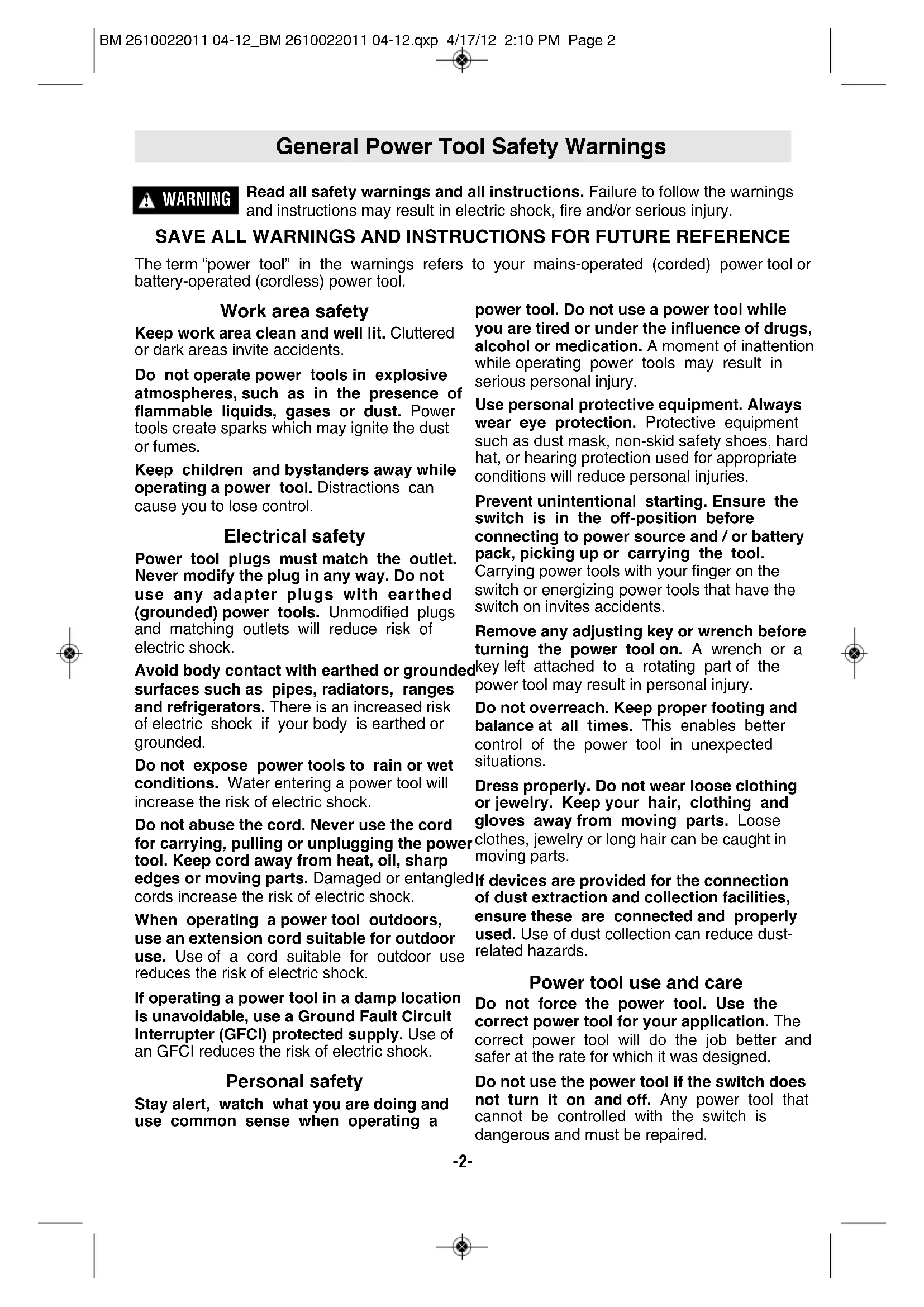
IMPORTANT: IMPORTANT : IMPORTANTE: Read Before Using Lire avant usage Leer antes de usar For English Version Version française Versión en español See page 2 Voir page 15 Ver la página 28 Operating/Safety Instructions Consignes de fonctionnement/sécurité Instrucciones de funcionamiento y seguridad 1-877-BOSCH99 (1-877-267-2499) www.boschtools.com Call Toll Free for Consumer Information & Service Locations Pour obtenir des informations et les adresses de nos centres de service après-vente, appelez ce numéro gratuit Llame gratis para obtener información para el consumidor y ubicaciones de servicio PS60 BM 2610022011 04-12_BM 2610022011 04-12.qxp 4/17/12 2:10 PM Page 1-2- Work area safety Keep work area clean and well lit. Cluttered or dark areas invite accidents. Do not operate power tools in explosive atmospheres, such as in the presence of flammable liquids, gases or dust. Power tools create sparks which may ignite the dust or fumes. Keep children and bystanders away while operating a power tool. Distractions can cause you to lose control. Electrical safety Power tool plugs must match the outlet. Never modify the plug in any way. Do not use any adapter plugs with earthed (grounded) power tools. Unmodified plugs and matching outlets will reduce risk of electric shock. Avoid body contact with earthed or grounded surfaces such as pipes, radiators, ranges and refrigerators. There is an increased risk of electric shock if your body is earthed or grounded. Do not expose power tools to rain or wet conditions. Water entering a power tool will increase the risk of electric shock. Do not abuse the cord. Never use the cord for carrying, pulling or unplugging the power tool. Keep cord away from heat, oil, sharp edges or moving parts. Damaged or entangled cords increase the risk of electric shock. When operating a power tool outdoors, use an extension cord suitable for outdoor use. Use of a cord suitable for outdoor use reduces the risk of electric shock. If operating a power tool in a damp location is unavoidable, use a Ground Fault Circuit Interrupter (GFCI) protected supply. Use of an GFCI reduces the risk of electric shock. Personal safety Stay alert, watch what you are doing and use common sense when operating a power tool. Do not use a power tool while you are tired or under the influence of drugs, alcohol or medication. A moment of inattention while operating power tools may result in serious personal injury. Use personal protective equipment. Always wear eye protection. Protective equipment such as dust mask, non-skid safety shoes, hard hat, or hearing protection used for appropriate conditions will reduce personal injuries. Prevent unintentional starting. Ensure the switch is in the off-position before connecting to power source and / or battery pack, picking up or carrying the tool. Carrying power tools with your finger on the switch or energizing power tools that have the switch on invites accidents. Remove any adjusting key or wrench before turning the power tool on. A wrench or a key left attached to a rotating part of the power tool may result in personal injury. Do not overreach. Keep proper footing and balance at all times. This enables better control of the power tool in unexpected situations. Dress properly. Do not wear loose clothing or jewelry. Keep your hair, clothing and gloves away from moving parts. Loose clothes, jewelry or long hair can be caught in moving parts. If devices are provided for the connection of dust extraction and collection facilities, ensure these are connected and properly used. Use of dust collection can reduce dust- related hazards. Power tool use and care Do not force the power tool. Use the correct power tool for your application. The correct power tool will do the job better and safer at the rate for which it was designed. Do not use the power tool if the switch does not turn it on and off. Any power tool that cannot be controlled with the switch is dangerous and must be repaired. Read all safety warnings and all instructions. Failure to follow the warnings and instructions may result in electric shock, fire and/or serious injury. SAVE ALL WARNINGS AND INSTRUCTIONS FOR FUTURE REFERENCE The term “power tool” in the warnings refers to your mains-operated (corded) power tool or battery-operated (cordless) power tool.
WARNING General Power Tool Safety Warnings BM 2610022011 04-12_BM 2610022011 04-12.qxp 4/17/12 2:10 PM Page 2Disconnect the plug from the power source and/or the battery pack from the power tool before making any adjustments, changing
ccessories, or storing power tools. Such preventive safety measures reduce the risk of starting the power tool accidentally. Store idle power tools out of the reach of children and do not allow persons unfamiliar with the power tool or these instructions to operate the power tool. Power tools are dangerous in the hands of untrained users. Maintain power tools. Check for misalignment or binding of moving parts, breakage of parts and any other condition that may affect the power tool’s operation. If damaged, have the power tool repaired before use. Many accidents are caused by poorly maintained power tools. Keep cutting tools sharp and clean. Properly maintained cutting tools with sharp cutting edges are less likely to bind and are easier to control. Use the power tool, accessories and tool bits etc. in accordance with these instructions, taking into account the working conditions and the work to be performed. Use of the power tool for operations different from those intended could result in a hazardous situation. Battery tool use and care Recharge only with the charger specified by the manufacturer. A charger that is suitable for one type of battery pack may create a risk of fire when used with another battery pack. Use power tools only with specifically designated battery packs. Use of any other battery packs may create a risk of injury and fire. When battery pack is not in use, keep it away from other metal objects like paper clips, coins, keys, nails, screws, or other small metal objects that can make a connection from one terminal to another. Shorting the battery terminals together may cause burns or a fire. Under abusive conditions, liquid may be ejected from the battery, avoid contact. If contact accidentally occurs, flush with water. If liquid contacts eyes, additionally seek medical help. Liquid ejected from the battery may cause irritation or burns. Service Have your power tool serviced by a qualified repair person using only identical replacement parts. This will ensure that the safety of the power tool is maintained. Hold power tool by insulated gripping surfaces, when performing an operation where the cutting tool may contact hidden wiring. Cutting tool contacting a "live" wire may make exposed metal parts of the power tool "live" and could give the operator an electric shock. Use clamps or another practical way to secure and support the workpiece to a stable platform. Holding the work by hand or against your body leaves it unstable and may lead to loss of control. Do not drill, fasten or break into existing walls or other blind areas where electrical wiring may exist. If this situation is unavoidable, disconnect all fuses or circuit breakers feeding this worksite. Keep hands away from cutting area. Do not reach under the material being cut. The proximity of the blade to your hand is hidden from your sight. Keep hands from between the gear housing and saw blade clamp (plunger). The reciprocating blade clamp (blade plunger) can pinch your fingers. Do not use dull or damaged blades. Bent blades can break easily or cause kickback. Before starting to cut, turn tool "ON" and allow the blade to come to full speed. Tool can chatter or vibrate if blade speed is too slow at beginning of cut and possibly kickback. Always wear safety goggles or eye protection when using this tool. Use a dust mask or respirator for applications, which generate dust. Secure material before cutting. Never hold it in your hand or across legs. Small or thin material may flex or vibrate with the blade, causing loss of control.
Safety Rules for Cordless Reciprocating Saws BM 2610022011 04-12_BM 2610022011 04-12.qxp 4/17/12 2:10 PM Page 3Battery/Charger Before using battery charger, read all instructions and cautionary markings on (1) battery charger, (2) battery pack, and (3) product using battery. Use only the charger which accompanied your product or direct replacement as listed in the catalog or this manual. Do not substitute any other charger. Use only Bosch approved chargers with your product. See Functional Description and Specifications. Do not disassemble charger or operate the charger if it has received a sharp blow, been dropped or otherwise damaged in any way. Replace damaged cord or plugs immediately. Incorrect reassembly or damage may result in electric shock or fire. Do not recharge battery in damp or wet environment. Do not expose charger to rain or snow. If battery case is cracked or otherwise damaged, do not insert into charger. Battery short or fire may result. Charge only Bosch approved rechargeable batteries. See Functional Description and Specifications. Other types of batteries may burst causing personal injury and damage. Charge battery pack in temperatures above +32 degrees F (0 degrees C) and below +113 degrees F (45 degrees C). Store tool and battery pack in locations where temperatures will not exceed 120 degrees F (49 degrees C). This is important to prevent serious damage to the battery cells.
Make certain all adjusting screws (knobs) and the blade clamp are tight before
aking a cut. Loose adjusting screws and clamps can cause the tool or blade to slip and loss of control may result. When removing the blade from the tool avoid contact with skin and use proper
rotective gloves when grasping the blade or accessory. Accessories may be hot after prolonged use. GFCI and personal protection devices like electrician’s rubber gloves and footwear will further enhance your personal safety. Do not use AC only rated tools with a DC power supply. While the tool may appear to work, the electrical components of the AC rated tool are likely to fail and create a hazard to the operator. Keep handles dry, clean and free from oil and grease. Slippery hands cannot safely control the power tool. Develop a periodic maintenance schedule for your tool. When cleaning a tool be careful not to disassemble any portion of the tool since internal wires may be misplaced or pinched or safety guard return springs may be improperly mounted. Certain cleaning agents such as gasoline, carbon tetrachloride, ammonia, etc. may damage plastic parts. Ensure the switch is in the off position before inserting battery pack. Inserting the battery pack into power tools that have the switch on invites accidents. Some dust created by power sanding, sawing, grinding, drilling, and other construction activities contains chemicals known to cause cancer, birth defects or other reproductive harm. Some examples of these chemicals are:
- Lead from lead-based paints,
- Crystalline silica from bricks and cement and other masonry products, and
- Arsenic and chromium from chemically- treated lumber. Your risk from these exposures varies, depending on how often you do this type of work. To reduce your exposure to these chemicals: work in a well ventilated area, and work with approved safety equipment, such as those dust masks that are specially designed to filter out microscopic particles. Additional Safety Warnings
WARNING *==.;B*;. 8 78= *==.69= =8 -2<*< <.6+5. =1. +*==.;B 8; ;.68?. *7B ,86987.7= 9;83.,=270 /;86 =1. +*==.;B =.;627*5< Fire or injury may result. Prior to disposal, protect exposed terminals with heavy insulating tape to prevent shorting.
If equipped with a lithium-ion battery, the battery must be collected, recycled or disposed of in an environ mentally sound manner. “The EPA certified RBRC Battery Recycling Seal on the lithium-ion (Li-ion) battery indicates Robert Bosch Tool Corporation is voluntarily participating in an industry program to collect and recycle these batteries at the end of their useful life, when taken out of service in the United States or Canada. The RBRC program provides a convenient alterative to placing used Li-ion batteries into the trash or the munici pal waste stream, which may be illegal in your area. Please call 1-800-8-BATTERY for information on Li-ion battery recycling and disposal bans/restrictions in your area, or return your batteries to a Skil/Bosch/Dremel Service Center for recycling. Robert Bosch Tool Corporation’s involvement in this program is part of our commitment to preserving our environment and conserving our natural resources.”
iquid is caustic and could cause chemical burns to tissues. If liquid comes in contact with skin, wash quickly with soap and water. If the liquid contacts your eyes, flush them with water for a minimum of 10 minutes and seek medical attention. 5*,. ,1*;0.; 87 /5*= 787/5*66*+5. <>;/*,.< *7- *@*B /;86 /5*66*+5. 6*=.;2*5< @1.7 ;.,1*;0270 +*==.;B 9*,4 The charger and battery pack heat during charging. Carpeting and other heat insulating surfaces block proper air circulation which may cause overheating of the charger and battery pack. If smoke or melting of the case are observed unplug the charger immediately and do not use the battery pack or charger. $<. 8/ *7 *==*,16.7= 78= ;.,86 6.7-.- 8;<85-+B8<,1 6*B;.<>5= 27* ;2<48/ /2;. .5.,=;2, <18,4 8; 273>;B =8 9.;<87< BM 2610022011 04-12_BM 2610022011 04-12.qxp 4/17/12 2:10 PM Page 5-6- IMPORTANT: Some of the following symbols may be used on your tool. Please study them and learn their meaning. Proper interpretation of these symbols will allow you to operate the tool better and safer. Symbol Name Designation/Explanation V Volts Voltage (potential) A Amperes Current Hz Hertz Frequency (cycles per second) W Watt Power kg Kilograms Weight min Minutes Time s Seconds Time Diameter Size of drill bits, grinding wheels, etc.
No load speed Rotational speed, at no load n Rated speed Maximum attainable speed .../min Revolutions or reciprocation Revolutions, strokes, surface speed, per minute orbits etc. per minute 0 Off position Zero speed, zero torque... 1, 2, 3, ... Selector settings Speed, torque or position settings. I, II, III, Higher number means greater speed Infinitely variable selector with off Speed is increasing from 0 setting Arrow Action in the direction of arrow Alternating current Type or a characteristic of current Direct current Type or a characteristic of current Alternating or direct current Type or a characteristic of current Class II construction Designates Double Insulated Construction tools. Earthing terminal Grounding terminal Warning symbol Alerts user to warning messages Li-ion RBRC seal Designates Li-ion battery recycling program Ni-Cad RBRC seal Designates Ni-Cad battery recycling program Read manual symbol Alerts user to read manual Wear eye protection symbol Alerts user to wear eye protection Symbols
BM 2610022011 04-12_BM 2610022011 04-12.qxp 4/17/12 2:10 PM Page 6-7- This symbol designates that this tool is listed by Underwriters Laboratories. This symbol designates that this tool is listed by the Canadian Standards Association. This symbol designates that this tool is listed by the Canadian Standards Association, to United States and Canadian Standards. This symbol designates that this tool complies to NOM Mexican Standards.
This symbol designates that this tool is listed by the Intertek Testing Services, to United States and Canadian Standards. Symbols (continued) IMPORTANT: Some of the following symbols may be used on your tool. Please study them and learn their meaning. Proper interpretation of these symbols will allow you to operate the tool better and safer. This symbol designates that this tool is recognized by Underwriters Laboratories. BM 2610022011 04-12_BM 2610022011 04-12.qxp 4/17/12 2:10 PM Page 7Model number PS60 Voltage rating 10.8V/12V MAX No load speed n
Functional Description and Specifications Disconnect battery pack from tool or place the switch in the locked or off position before making any assembly, adjustments or changing accessories. Such preventive safety measures reduce the risk of starting the tool accidentally.
rom tool before making any assembly, adjustments or changing accessories. Such preventive safety measures reduce the risk of starting the tool accidentally. Preparing the Saw BLADE SELECTION No one blade can be efficient on all cutting jobs. Different materials require specially designed blades. Since your reciprocating saw can cut so many materials, many types of BOSCH blades are available. Be sure to use the proper blade to ensure proper cutting performance.
1. Insert the blade into the blade holder by
twisting the collar in direction of arrow until it stops (Fig. 2).
2. Insert a blade into blade slot until blades
shoulder rests against the collar.
3. Release collar and spring loaded collar will
securely clamp the blade. (Note: If the collar does not return to it’s original position, rotate the collar in direction opposite of the arrow.) 4 Push in and pull out on the blade to be sure the pin in the clamp housing goes through the hole in the blade to hold the blade
ecurely. The blade may be inserted with the teeth facing down or up.
5. To remove the blade, rotate the collar in
direction of arrow while pulling the blade out of the blade slot. (Note: be careful, blade may be hot.) Make sure that the front end of the blade extends through the footplate for the entire stroke length. Do not use specialty blades that are very short or those with a significant cant. Blade must not contact footplate. A blade which is too short or tilted could jam inside the foot and snap.
PROTECTION AGAINST DEEP
DISCHARGING The lithium ion battery is protected against deep discharging by the “Electronic Cell Protection (ECP)”. When the battery is empty, the tool is switched off by means of a protective circuit. LOCK-OFF SWITCH Your tool is equipped with a lock-off switch located above the trigger. This lever is designed for locking the trigger in the "OFF" position to help prevent accidental starts and accidental battery discharge. To activate the trigger lock, move the switch to the far right position (Fig. 1). To unlock trigger, move switch to the far left position.
VARIABLE SPEED CONTROLLED
TRIGGER SWITCH Your tool is equipped with a variable speed controlled trigger switch. The tool can be turned "ON" or "OFF" by squeezing or releasing the trigger. The blade plunger stroke rate can be adjusted from the minimum to maximum nameplate stroke rate by the pressure you apply to the trigger. Apply more pressure to increase the speed and release pressure to decrease speed.
our tool is equipped with charge condition indicator lights (Fig. 1). The indicator lights shows the charge condition of the battery for a few second when the On/Off trigger is pressed halfway or fully.
TEMPERATURE/STALL PROTECTION
INDICATOR LIGHT Your tool has a red indicator light built into it to protect the motor and battery (Fig. 1). If the red indicator light illuminates continuously
he battery temperature is too hot and the tool will automatically shut itself off. Turn tool off and let the battery cool down before resuming use. If the red indicator light is blinking the tool has stalled and tool will automatically shut itself off. Simply take the tool out of the material you were stalled in, and the tool will begin to operate again at the selected speed.
INSERTING AND RELEASING
BATTERY PACK Release battery pack from tool by pressing on both sides of the battery release tabs and pull downward (Fig. 3). To insert battery, align battery and slide battery pack into tool until it locks into position. Do not force. If battery release tabs are cracked or otherwise damaged, do not insert into tool. Battery can fall out during operation. LED Capacity Continuous lighting 3 x green > 2/3 Continuous lighting 2 x green > 1/3 Continuous lighting 1 x green < 1/3 Flashing light 1 x green reserve
1. The charger was designed to fast charge
the battery only when the battery temperature is between 32˚F (0˚C) and 113˚F (45˚C). If the battery pack is too hot or too cold, the charger will not fast charge the battery. (This may happen if the battery pack is hot from heavy use). When the battery temperature returns to between 32˚F (0˚C) and 113˚F (45˚C), the charger will automatically begin charging.
2. A substantial drop in operating time per
charge may mean that the battery pack is nearing the end of its life and should be replaced.
3. Remember to unplug charger during
4. If battery does not charge properly:
a. Check for voltage at outlet by plugging in some other electrical device. b. Check to see if outlet is connected to a light switch which turns power “off” when lights are turned off. c. Check battery pack terminals for dirt. Clean with cotton swab and alcohol if necessary. d. If you still do not get proper charging, take or send tool, battery pack and charger to your local Bosch Service Center. See “Tools, Electric” in the Yellow Pages for names and addresses. Note: Use of chargers or battery packs not sold by Bosch will void the warranty. BM 2610022011 04-12_BM 2610022011 04-12.qxp 4/17/12 2:10 PM Page 10The lithium ion battery is protected against deep discharging by the “Electronic Cell Protection (ECP)”. When the battery is empty, the tool is switched off by means of a protective circuit. The battery is supplied partially charged. Completely charge the battery before using your cordless screwdriver for the first time. The lithium ion battery can be charged at any time, without reducing its service life. Interrupting the charging procedure does not damage the battery. Plug charger cord into your standard power outlet, then insert battery pack into charger (Fig. 4). The charger’s green indicator light will begin to “BLINK”. This indicates that the battery is receiving a fast charge. Fast-charging will automatically stop when the battery pack is fully charged. When the indicator light stops “BLINKING” (and becomes a steady green light) fast charging is complete. The battery pack may be used even though the light may still be blinking. The light may require more time to stop blinking depending on temperature. When you begin the charging process of the battery pack, a steady red light could also mean the battery pack is too hot or too cold. The purpose of the green light is to indicate that the battery pack is fast-charging. It does not indicate the exact point of full charge. The light will stop blinking in less time if the battery pack was not completely discharged. When charging several batteries in sequence, the charge time may slightly increase. When the battery pack is fully charged, unplug the charger (unless you're charging another battery pack) and slip the battery pack back into the tool. CHARGING BATTERY PACK (Model BC430) If the indicator lights are “OFF”, the charger is not receiving power from power supply outlet. If the green indicator light is “ON”, the charger is plugged in but the battery pack is not inserted, or the battery pack is fully charged and is being trickle charged. If the green indicator light is “BLINKING”, the battery pack is being fast-charged. Fast- charging will automatically stop when the battery pack is fully charged. If the red indicator light is “ON”, the battery pack is too hot or cold for fast-charging. The charger will switch to trickle charge, until a suitable temperature is reached, at which time the charger will switch automatically to fast-charging. If the red indicator light is “BLINKING”, the battery pack cannot accept a charge or the contacts of the charger or battery pack are contaminated. Clean the contacts of the charger or battery pack only as directed in these operating instructions or those supplied with your tool or battery pack.
HARGER INDICATORS, SYMBOLS AND MEANING (Model BC430)
2. Mark the line of cut and grasp the tool with
one hand on the handle and the other placed on the insulated rubber boot over the front housing. Always hold the saw by the insulated boot on the front housing. If you saw into a blind area where live wiring exists, you may be shocked or electrocuted.
3. Keep the saw footplate firmly against the
work to minimize counter-force (jumping) and vibration.
4. Squeeze the trigger to start the tool. Let the
saw reach full speed before starting the cut. Guide the saw so that the blade will move along the marked line. SAWING TIPS Following a few simple tips will reduce the wear on the workpiece, the tool and the operator.
1. Blades cut on the draw or back stroke. On
fine work, such as paneling, fiberglass, etc., place the good side of workpiece facing down.
2. Use the correct saw blade for the material
being cut and keep extra blades on hand to use when others become dull. Replace cracked or bent blades immediately.
3. Select the appropriate cutting speed.
4. To reduce the risk of injury, be sure the
blade always extends beyond the footplate and work throughout the stroke. Blades may shatter if the front on the blade hits the work and/or the footplate.
5. When cutting metal:
- Apply a lubricant for easier, smoother, faster cutting and longer blade life. - For non-ferrous metals, aluminum, bronze or brass, use a stick wax on the blade. - For ferrous metals, iron and steel, use machine or cutting oil along the surface to be cut.
WARNING WRONG RIGHT The manufacturer is not responsible for radio interference caused by unauthorized modifications to this equipment. Such modifications could void the user’s authority to operate the equipment. This device complies with Part 15 of the FCC Rules. Operation is subject to the following two conditions:
1) This device may not cause harmful
2) This device must accept any interference
received, including interference that may cause undesired operation. NOTE! This equipment has been tested and found to comply with the limits for a Class B digital devices, pursuant to Part 15 of the FCC rules. These limits are designed to provide reasonable protection against harmful
nterference in a residential installation. This equipment generates uses and can radiate radio frequency energy and, if not installed and used in accordance with the instructions, may cause harmful interference to radio communications. However, there is no guarantee that interference will not occur in a particular installation. If this equipment does cause harmful interference to radio or television reception, which can be determined by turning the equipment off and on, the user is encouraged to try to correct the interference by one or more of the following measures:
- Reorient or relocate the receiving antenna.
- Increase the separation between the equipment and receiver.
- Connect the equipment into an outlet on a circuit different from that to which the receiver is connected.
. When cutting thin metal, "sandwich" the material between two pieces of scrap wood. Clamp or put in a bench vise. One piece of lumber on top of the metal can be used with adequate clamping. Place your cut lines or design on the wood.
7. Don’t force the cutting. Let the saw and
The reciprocating saw can be used to make plunge cuts into softer material, (for example, wood or light building materials for walls), without a starting hole (Fig. 5).
1. Mark the line to be cut clearly on the work.
2. Set the tool with one edge of the footplate
firmly against the material.
3. Place the tip of the blade (not running) on
4. Tilt the saw so that the blade clears the
. Squeeze the trigger switch and carefully engage the moving saw blade into the material.
6. After the blade penetrates through the work,
continue sawing along the marked outline. NOTES: To make plunge cutting easier, use a heavy gauge blade, install the blade with the teeth facing upward, and hold the saw upside down as shown (Fig. 6). Do not plunge cut in metal surfaces. In thick materials and in harder materials, such as metal, plunge cutting should not be attempted. Such materials can be cut with the recip saw only by starting the cut from the edge of the material or from a hole drilled all the way through the material that is large enough to fit the saw blade. The use of any accessories not specified in this manual may create a hazard.
.*5.;=/8;+*==.;B9*,4<=1*=*;.7.*;270 =1.2; .7- 8/ 52/. If you notice decreased tool performance or significantly shorter running time between charges then it is time to replace the battery pack. Failure to do so can cause the tool to operate improperly or damage the charger.
Your Bosch tool has been properly lubricated and is ready for use.
The motor in your tool has been engineered for many hours of dependable service. To maintain peak efficiency of the motor, we recommend it be examined every six months. Only a genuine Bosch replacement motor specially designed for your tool should be used. 5.*7270 #8*?82-*,,2-.7=<*5@*B< -2<,877.,= =1.=885*7-8; ,1*;0.;/;86 =1. 98@.; <>995B +./8;. ,5.*7270 The tool may be cleaned most effectively with com pressed dry air. 5@*B< @.*; <*/.=B 08005.< @1.7 ,5.*7270 =885< @2=1,869;.<<.-*2; Ventilation openings and switch levers must be kept clean and free of foreign matter. Do not attempt to clean by inserting pointed objects through opening. .;=*27 ,5.*7270 *0.7=< *7- <85?.7=< -*6*0. 95*<=2,9*;=< Some of these are: gasoline, car bon tetrachloride, chlorinated cleaning solvents, ammonia and household detergents that contain ammonia.
obert Bosch Tool Corporation (“Seller”) warrants to the original purchaser only, that all BOSCH portable and benchtop power tools will be free from defects in material or workmanship for a period of one year from date of purchase. SELLER’S SOLE OBLIGATION AND YOUR EXCLUSIVE REMEDY under this Limited Warranty and, to the extent permitted by law, any warranty or condition implied by law, shall be the repair or replacement of parts,
ithout charge, which are defective in material or workmanship and which have not been misused, carelessly handled, or misrepaired by persons other than Seller or Authorized Service Station. To make a claim under this Limited Warranty, you must return the complete portable or benchtop power tool product, transportation prepaid, to any BOSCH Factory Service Center or Authorized Service Station. For Authorized BOSCH Power Tool
ervice Stations, please refer to your phone directory. THIS LIMITED WARRANTY DOES NOT APPLY TO ACCESSORY ITEMS SUCH AS CIRCULAR SAW BLADES, DRILL BITS, ROUTER BITS, JIGSAW
LADES, SANDING BELTS, GRINDING WHEELS AND OTHER RELATED ITEMS.