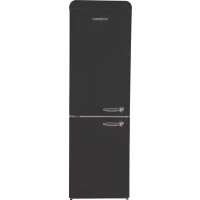
SL 300 NF BCB A++ - Fridge SCHNEIDER - Free user manual and instructions
Find the device manual for free SL 300 NF BCB A++ SCHNEIDER in PDF.


| Features | Details |
|---|---|
| Product type | Refrigerator |
| Energy class | A++ |
| Net capacity | 300 liters |
| Dimensions (HxWxD) | 185 x 60 x 65 cm |
| Weight | 70 kg |
| Cooling system | Static cooling |
| Noise level | 40 dB |
| Number of drawers | 3 drawers |
| Interior lighting | LED |
| Additional features | Temperature control, door open alarm |
| Maintenance | Manual defrost recommended |
| Warranty | 2 years |
| Annual energy consumption | 250 kWh |
| Color | White |
| Included accessories | Adjustable shelves, vegetable drawer |
Frequently Asked Questions - SL 300 NF BCB A++ SCHNEIDER
User questions about SL 300 NF BCB A++ SCHNEIDER
0 question about this device. Answer the ones you know or ask your own.
Ask a new question about this device
Download the instructions for your Fridge in PDF format for free! Find your manual SL 300 NF BCB A++ - SCHNEIDER and take your electronic device back in hand. On this page are published all the documents necessary for the use of your device. SL 300 NF BCB A++ by SCHNEIDER.
USER MANUAL SL 300 NF BCB A++ SCHNEIDER
natural_image
Exterior view of a black electric refrigerator with two side doors (no visible text or symbols)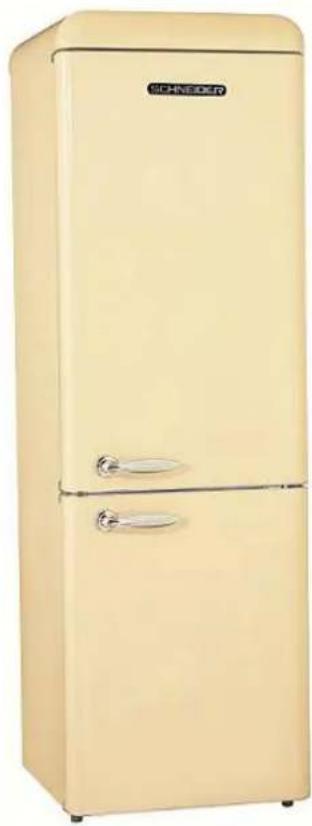
natural_image
Exterior view of a beige vintage refrigerator with two doors and a 'SCHNEEDER' logo on the top (no other text or symbols visible)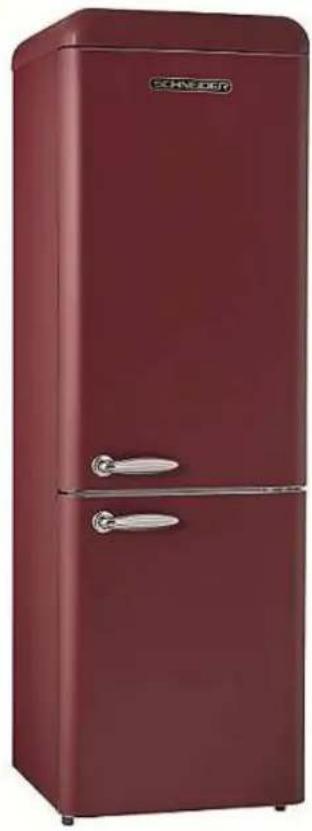
natural_image
Exterior view of a maroon refrigerator with two doors and a logo on the front (no visible text or symbols beyond branding)natural_image
3D mechanical component with angular dimensioning arrows (45° and 45°), no visible text or symbols4. Bedienung
text_image
Technical diagram of a refrigerator with numbered parts for identificationnatural_image
Technical line drawing of a mechanical or electrical cabinet assembly (no text or symbols visible)
text_image
Freezer 3sec -16 -18 -20 -22 -24°C super holiday 2 3 4 6 8°C Fridge 3secchemical
Thermodynamic cycle diagram showing temperature progression from 8°C to 4°C with order and equilibrium pointsSCHNEIDER
chemical
Thermodynamic cycle diagram showing temperature changes at different temperatures: -24°C, -22°C, -20°C, -16°C, and -18°Cnatural_image
Illustration of two hands holding a rectangular object with upward arrows indicating motion or force (no text or symbols)natural_image
Diagram of a hand holding a tray with arrows indicating motion or movement (no text or symbols)(Abb. ähnlich)
natural_image
Diagram showing a hand pressing down on a panel with an arrow indicating force or movement (no text or symbols present)Dear customer! We would like to thank you for purchasing a product from our wide range of domestic appliances. Read the complete instruction manual before you operate the appliance for the first time. Retain this instruction manual in a safe place for future reference. If you transfer the appliance to a third party, also hand over this instruction manual.
NOTICE!
Please check the position of the doors before the first use and/or after transport of the appliance. If the doors do not close properly, proceed as follows:
- Loose the retaining screws of the hinges.
- Adjust the doors properly.
- Tighten the screws.
Index
- Safety information....35
1.1 Signal words ....36
1.2 Safety instructions....36
-
Climatic classes ....40
-
Installation 41
3.1 Unpacking and positioning....41
3.2 Ventilation....42
3.2.2 Spacers....42
- Operation....43
4.1 Description of the appliance ....43
4.2 Before initial operation....44
4.3 Setting of the temperature 45
4.3.1 Refrigerator 45
4.3.2 Freezer....45
4.3.3 Super Freeze....46
4.3.4 Holiday....46
4.3.5 Door alarm....47
4.3.6 Internal box (depending on model)......47
4.4 The fridge 48
SCHNEIDER
4.4.1 Door trays....48
4.4.2 Glass shelves....49
4.5 The freezer .... 49
4.5.1 Freezer drawers....50
4.6 Operation parameters....50
4.7 Helpful hints / Energy saving....51
5. Cleaning and maintenance....52
5.1 Defrosting....53
5.2 Replacing of the illuminant....54
6. Trouble shooting....54
7. Decommissioning....57
8. Technical data....58
9. Waste management....59
10. Guarantee conditions ....60
Do not dispose of this appliance together with your domestic waste. The appliance must be disposed of at a collecting centre for recyclable electric and electronic appliances. Do not remove the symbol from the appliance.
The figures in this instruction manual may differ in some details from the current design of your appliance. Nevertheless follow the instructions in such a case. Delivery without content.
Any modifications, which do not influence the functions of the appliance. shall remain reserved by the manufacturer. Please dispose of the packaging with respect to your current local and municipal regulations.
The appliance you have purchased may be an enhanced version of the unit this manual was printed for. Nevertheless, the functions and operating conditions are identical. This manual is therefore still valid. Technical modifications as well as misprints shall remain reserved.
EU - DECLARATION OF CONFORMITY
★ The products, which are described in this instruction manual, comply with the harmonized regulations.
★ The relevant documents can be requested from the final retailer by the competent authorities.
READ THE SAFETY INFORMATION AND THE SAFETY INSTRUCTIONS CAREFULLY BEFORE YOU OPERATE THE APPLIANCE FOR THE FIRST TIME.
All information included in those pages serve for the protection of the operator. If you ignore the safety instructions, you will endanger your health and life.
Store this manual in a safe place so you can use it whenever it is needed. Strictly observe the instructions to avoid damage to persons and property.
Check the technical periphery of the appliance! Do all wires and connections to the appliance work properly? Or are they time-worn and do not match the technical requirements of the appliance? A check-up of existing and newly made connections must be done by an authorized professional. All connections and energy-leading components (incl. wires inside a wall) must be checked by a qualified professional. All modifications to the electrical mains to enable the installation of the appliance must be performed by a qualified professional.
The appliance is intended for private use only as well as to be used (1) in staff kitchen areas of shops, offices and other working environments; (2) by clients in hotels, motels, B&B and other residential type environments; (3) for catering and similar non-retail applications.
The appliance is intended for cooling food only.
The appliance is intended for indoor-use only.
The appliance is not intended to be operated for commercial purposes, during camping and in public transport.
Operate the appliance in accordance with its intended use only.
Do not allow anybody who is not familiar with this instruction manual to operate the appliance.
This appliance may be operated by children aged from 8 years and above as well as by persons with reduced physical, sensory and mental capabilities or lack of experience and knowledge if they are supervised or have been instructed concerning the safe use of the appliance and do comprehend the hazards involved. Children must not play with the appliance. Cleaning and user-maintenance must not be carried out by children unless they are supervised.
MAKE SURE THAT THIS MANUAL IS AVAILABLE TO ANYONE USING THE APPLIANCE AND MAKE SURE THAT IT HAS BEEN READ AND UNDERSTOOD PRIOR TO USING THE DEVICE.
1.1 Signal words
⚠️ DANGER! indicates a hazardous situation which, if ignored, will result in death or serious injury.
WARNING! indicates a hazardous situation which, if ignored, could result in death or serious injury.
CAUTION! indicates a hazardous situation which, if not avoided, may result in minor or moderate injury.
NOTICE! indicates possible damage to the appliance.
1.2 Safety instructions
DANGER!
To reduce the risk of electrocution:
- Non-compliance of the orders of this instruction manual will endanger the life and health of the operator and/or can result in damages to the appliance.
- Do not connect the appliance to the mains if the appliance itself or the power cord or the plug are visibly damaged.
- The technical data of your energy supplier must meet the data on the rating plate of the appliance.
- Do not modify the plug provided with the appliance, if it will not fit the outlet, have a proper outlet installed by a qualified electrician (not covered by the guarantee).
- Never try to repair the appliance yourself. If the appliance does not operate properly, please contact the shop you purchased the appliance at. Original spare parts should be used only.
- Always check that the power cord is not placed under the appliance or damaged by moving the appliance.
- When the power cord is damaged, it must be replaced by the manufacturer or an authorized aftersales service or a qualified professional only.
- Never pull the power supply cable to unplug the appliance. Always use the power plug itself to unplug the appliance. RISK OF ELECTRIC SHOCK!
-
Never touch the power plug, the power switch or other electrical components with wet or damp hands. RISK OF ELECTRIC SHOCK!
-
This appliance is equipped with the environmental-friendly refrigerant R600a. The refrigerant R600a is inflammable. The components of the cooling circuit must neither be damaged during transport nor use.
- If any part of the cooling circuit is damaged, the appliance must not stand near a fire, naked light or spark-generating devices. Contact the shop you purchased the appliance at immediately.
- If gas is set free at the installation site:
a) Open all windows.
b) Do not unplug the appliance and do not use the control panel or thermostat.
c) Do not touch the appliance until all the gas has gone.
d) Otherwise sparks can be generated which will ignite the gas.
- Keep all components of the appliance away from fire and other sources of ignition when you dispose of or decommission the appliance.
- Do not install the appliance near of volatile or combustible materials(e.g. gas, fuel, alcohol, paints) and in rooms which may have poor air circulation (e.g. garage).
- EXPLOSION HAZARD! Do not store any explosive materials or sprays, which contain flammable propellants, in your appliance. Explosive mixtures can explode there.
- While unpacking, the packaging materials (polythene bags, polystyrene pieces, etc.) should be kept away from children and pets. CHOKING HAZARD! RISK OF INJURY!
- Always observe the required minimum distances for proper ventilation.
- Do not connect the appliance to the electric supply unless all packaging and transit protectors have been removed.
- Operate the appliance with 220\~240V/50Hz/AC only. All connections and energy-leading components must be replaced by an authorized professional. Do not use a socket board or a multi socket when connecting the appliance to the mains.
- A dedicated and properly grounded socket meeting the data of the plug is required to minimize any kind of hazard. The appliance must be grounded properly.
- Always check that the power cord is not placed under the appliance or damaged by moving the appliance.
- The technical data of your energy supplier must meet the data on the model plate of the appliance.
-
Your domestic circuit must be equipped with an automatic circuit breaker.
-
Do not modify the appliance.
- Turn off the power before you install the appliance and before you connect it to the mains. RISK OF FATAL ELECTRIC SHOCK!
- Disconnect the appliance from the mains before you clean or maintain it. RISK OF ELECTRIC SHOCK!
- Remove possible dust accumulation at the power plug, at the safety power socket and at all plug connectors regularly. RISK OF FIRE!
- Keep the cord away from heated surfaces.
- The power plug must always be accessible after installation.
- Do not use any electric appliances inside the food storage compartments of your appliance unless they are recommended by the manufacturer of your refrigerator.
- Do not put any heat-radiating appliances onto your appliance.
- Do not install the appliance in a place where it may come in contact with water/rain; otherwise the insulation of the electrical system will be damaged.
- Do not put a water-boiler or vases onto your appliance. The electrical components of your appliance can be seriously damaged by water over-boiling or spilled water.
- Do not use any steam cleaners to clean or defrost the appliance. The steam can get into contact with the electrical parts and cause an electrical short. RISK OF ELECTRIC SHOCK!
- Never use mechanic devices, knives or other sharp-edged items to remove encrusted ice inside the appliance. RISK OF ELECTRIC SHOCK caused by damaging the interior of the appliance.
- Do not eat food which is still frozen. Children should not eat ice-cream straight from the freezer. The coldness can cause injuries in the mouth.
- Contact with frozen food, ice and metal components in the freezer compartment can cause injuries similar to burns.
- Children must never play with the appliance.
- If you decommission your appliance (even temporarily), ensure that children cannot get into the appliance. Strictly observe the corresponding safety instructions numbers. 1 and 4, chapter DECOMMISSIONING, ultimate
- Strictly observe the instructions in chapter INSTALLATION.
CAUTION!
- The condenser and the compressor, located at the rear of the appliance, can reach high temperatures during ordinary operation. Carry out the installation according to this manual. An insufficient ventilation of the appliance will impair its operation and will damage the appliance. Do not cover or block the ventilation slats at any time.
- Do not put any bottled or canned beverages (neither still nor carbonated) into the freezer compartment of the appliance as their containers could explode.
- Do not touch the extremely cooled surfaces with wet or damp hands, because your skin may stick on these surfaces.
NOTICE
- Do not store dry ice in the appliance.
- When you move the appliance, hold it at its base and lift it carefully. Keep the appliance in an upright position.
- When you move the appliance using the rollers (depending on model), only move it forwards or backwards as the rollers are not pivotable and do not allow any lateral motion. Lateral motion can damage the appliance and floor seriously.
- Do not tilt the appliance more than 45^0 .
- If the appliance is transported in a horizontal position, some oil may flow from the compressor into the refrigerant circuit.
- Leave the appliance in an upright position for 4-6 hours before you switch it on to ensure, that the oil has flowed back into the compressor.
- If you use the appliance for the first time or the appliance has been disconnected from the mains for a longer period of time, allow the appliance to cool down for 3 until 4 hours on medium temperature setting before you place any fresh or frozen food in the appliance. If you place food in the appliance before it has reached its normal operating temperature, this foods can thaw and / or spoil.
- Never use the door for moving the appliance as you will damage the hinges.
- The appliance must be transported and installed by at least two persons.
- When you unpack the appliance, you should take note of the position of every part of the interior accessories in case you have to repack and transport it at a later point of time.
-
Do not operate the appliance unless all components are installed properly.
-
Do not stand or lean on the base, the drawers, the doors etc of the appliance.
- Never close the doors of the appliance while shelves or drawers are extended, otherwise you will damage the shelves / drawers and the appliance.
- Do not put hot liquids or hot foodstuff into the appliance.
- The air vents of the appliance or its built-in structure (if the appliance is suitable for being built-in) must be completely open, unblocked and free of any kind of dirt.
- Do not place any food directly against the air outlet on the rear wall.
- Do not overfill the shelves / drawers /door trays to protect them from damage.
- Clean the appliance at least once a month (s. chapter CLEANING AND MAINTENANCE).
- The rating plate must not be removed or made illegible, otherwise all terms of the warranty become invalid!
SAVE THESE INSTRUCTIONS.
★ The manufacturer and distributor are not responsible for any damage or injury in the event of failure to comply with these instructions.
2. Climatic classes
Look at chap. TECHNICAL DATA for information about the climatic class of your appliance. Your appliance can be operated in rooms with relevant room temperatures as named below.
| CLIMATIC CLASS | AMBIENT TEMPERATURE | |
| SN | +10^0 +32^0 C | e.g. unheated cellar |
| N | +16^0 +32^0 C | inner home temperature |
| ST | +16^0 +38^0 C | inner home temperature |
| T | +16^0 +43^0 C | inner home temperature |
3.1 Unpacking and positioning
WARNING! While unpacking, the packaging materials (polythene bags, polystyrene pieces, etc.) should be kept away from children and pets. CHOKING HAZARD! RISK OF INJURY!
-
Unpack the appliance carefully. Dispose of the packaging as described in chapter waste management.
-
Completely remove the transport-protection (adhesive tape) of the accessories. Be very careful and do not use any aggressive or abrasive detergents to remove residuals of the transport-protection.
-
Install the appliance in a suitable position with an adequate distance from sources of heat and cold.
-
Install the appliance in a dry and well-ventilated place.
-
Protect the appliance from direct sunlight.
-
The doors must open completely and without hindrance.
-
Install the appliance on a level, dry and solid floor. Check the correct installation with a bubble level.
-
Check that the appliance and the power cord are not damaged.
-
Connect the appliance to the mains properly.
-
The nameplate is situated inside the appliance or at the back.
i Observe the possible (additional) lateral space requirement of the open door(s) relevant to the door opening angle of the appliance.
ADJUSTABLE FEET:

Clockwise down
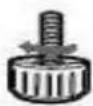
Anti-clockwise up
3.2 Ventilation
i Observe the required minimum distances for proper ventilation.
MINIMUM DISTANCES REQUIRED FOR PROPER VENTILATION:
| Back ↔ wall | min. 20 mm |
| Sides ↔ wall | min. 20 mm |
| Free space above | min. 100 mm |
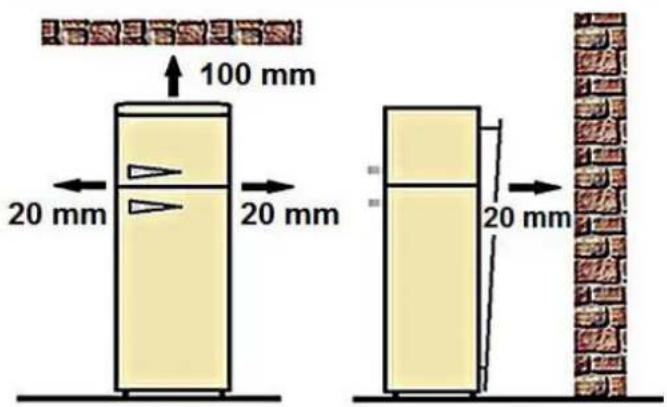
text_image
100 mm 20 mm 20 mm 20 mm◆ Fig. similar: The figure above serves as an example only.
The following minimum distances are recommended by the manufacturer to ensure optimum efficiency of the appliance:
| Back ↔ wall | min. 100 mm |
| Right / left ↔ any piece of furniture / wall | min. 100 mm |
| Free space above | min. 300 mm |
These minimum distances may be less, but to do so can increase the power consumption of the appliance.
3.2.2 Spacers
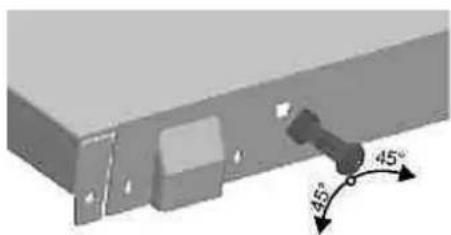
Depending on model, the appliance is supplied with two plastic spacers. After installation of these spacers, the appliance cannot be pushed against the wall to maintain proper ventilation. Insert the spacers into the relevant openings on the back of the appliance, then turn by 45^0 to the right or left.
natural_image
3D diagram of a mechanical component with angular annotations (45°) indicating specific angles, no readable text or symbols present.SCHNEIDER
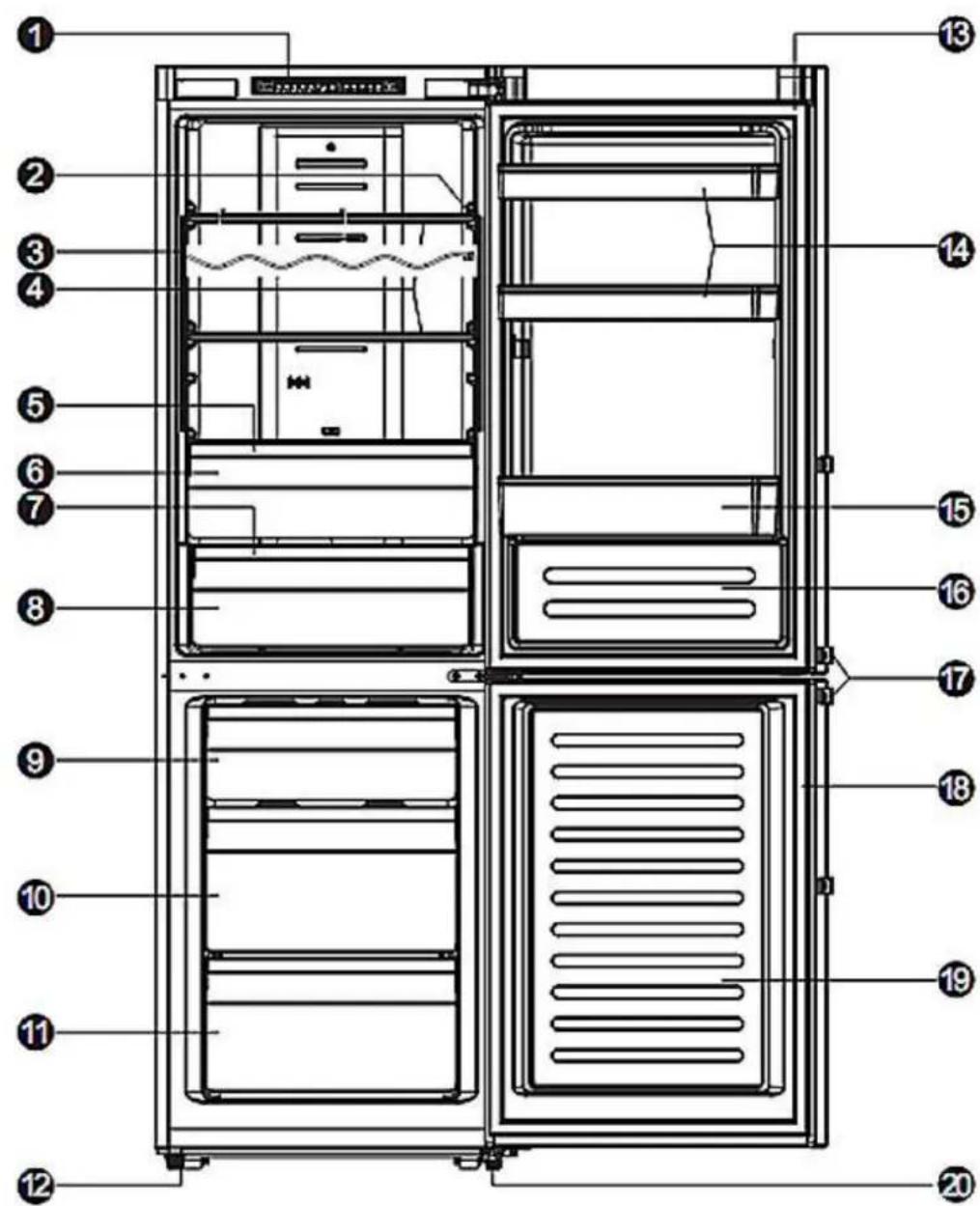
4.1 Description of the appliance
text_image
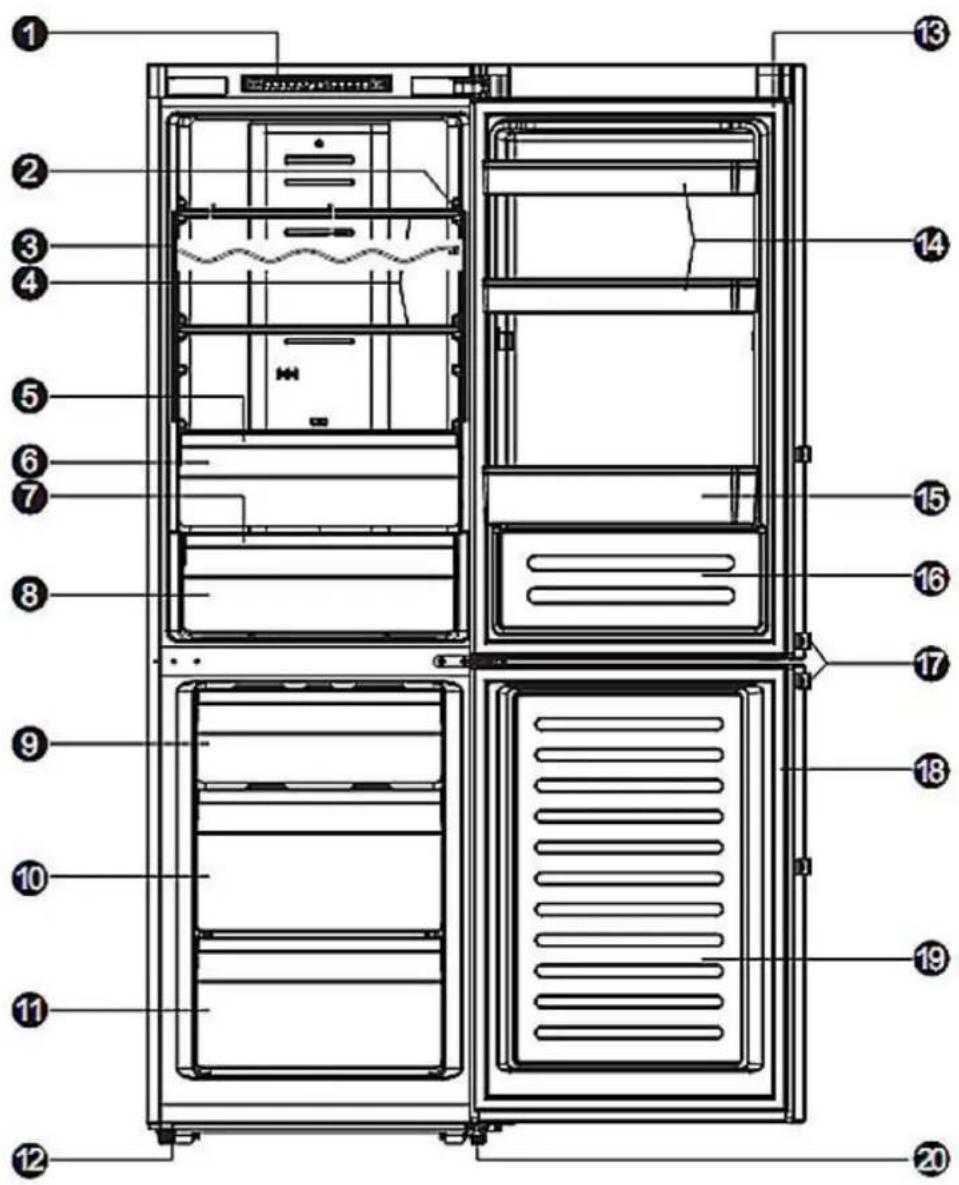
Technical diagram of a refrigerator with numbered parts for identificationThe figure above is an example only. Modifications are possible.
| 1 | Display-control | 2 | LED-light |
| 3 | Wine rack | 4 | Glass shelf |
| 5 | Cover / internal box (depending on model) | 6 | Internal box (depending on model) |
| 7 | Cover / crisper | 8 | Crisper |
| 9 | Freezer drawer | 10 | Freezer drawer |
| 11 | Freezer drawer | 12 | Left front foot |
| 13 | Gasket/refrigerator | 14 | Door trays |
| 15 | Bottle pocket | 16 | Door / refrigerator |
| 17 | Handle | 18 | Gasket / freezer |
| 19 | Door / freezer | 20 | Right front foot |
4.2 Before initial operation
WARNING! While unpacking, the packaging materials (polythene bags, polystyrene pieces, etc.) should be kept away from children and pets. CHOKING HAZARD! RISK OF INJURY!
NOTICE! Leave the appliance in an upright position for at least 4-6 hours before you connect it to the mains to ensure, that the oil has flowed back into the compressor.
NOTICE! If you use the appliance for the first time or the appliance has been disconnected from the mains for a longer period of time, allow the appliance to cool down for 3 until 4 hours on medium temperature setting (s. chapter 4.3 SETTING OF THE TEMPERATURE) before you place any fresh or frozen food in the appliance. If you place food in the appliance before it has reached its normal operating temperature, this foods can thaw and / or spoil.
- Clean the appliance thoroughly. Be very careful especially inside the appliance.
- After having installed the appliance wait 4-6 hours before you connect it to the mains.
- Afterwards operate the appliance after 24 hours for the first time.
- The temperature of the freezer should reach -18 ^0 C or colder. You can check the exact temperature of the cooling and freezer compartments using a suitable thermometer ^10 .
⚠ WARNING! To disconnect the appliance from the mains, you must unplug the appliance or use a cut-off device.
4.3 Setting of the temperature
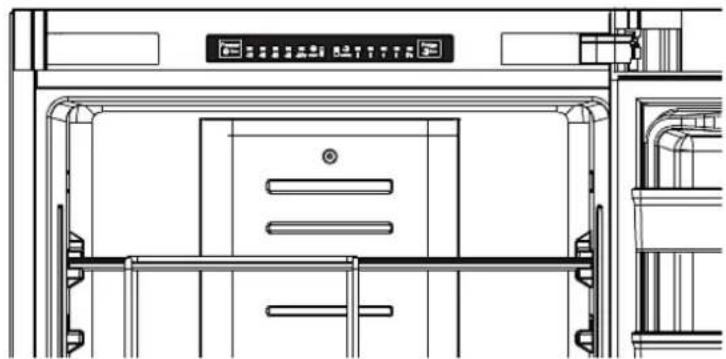
When the appliance is powered on for the first time, the backlighting of the icons on the display starts working. If no buttons have been pressed and the doors are closed, the backlighting will turn off.
natural_image
Technical line drawing of a cabinet or enclosure with internal compartments and mounting brackets (no text or symbols)
text_image
Freezer 3sec -16 -18 -20 -22 -24°C super holiday 2 3 4 6 8°C Fridge 3sec4.3.1 Refrigerator
✿ Press FRIDGE to set the desired temperature from +2 ^0C to +8 ^0C .
The display indicates the relevant values as shown below.

chemical
Thermodynamic cycle diagram showing temperature progression from 8°C to 4°C with intermediate steps at 2°C, 3°C, and 4°C4.3.2 Freezer
✿ Press FREEZER to set the desired temperature from -14^ to -24^ .
The display indicates the relevant values as shown below.

chemical
Thermodynamic cycle diagram showing temperature transitions between -24°C, -22°C, and -20°C with intermediate steps at -16°C and -18°C
4.3.3 Super Freeze
✿ SUPER FREEZE will decrease the temperature quickly. Your food, the vitamins and nutrients will be kept fresh for a longer period of time
SUPER FREEZE automatically switches off after 26 hours and the freezer temperature setting displays -24°C.
ACTIVATION:
- Press and hold the SUPER FREEZE button for 3 seconds.

DEACTIVATION:
In case of the maximum amount of food to be frozen (see chapter TECHNICAL DATA), please wait approx. 24 h.
- If you want to switch off SUPER FREEZE, press and hold the SUPER FREEZE button for 3 seconds again.
- The freezer temperature setting will revert back to the previous setting.
4.3.4 Holiday
You can use this function, when you are not at home for a longer period of time (e.g. holidays).
The temperature of the refrigerator is automatically switched to +15 °C to minimize the energy consumption. Do not store any food in the fridge during this time!
ACTIVATION:
- Press and hold the HOLIDAY button for 3 seconds.

DEACTIVATION:
-
If you want to switch off HOLIDAY, press and hold the HOLIDAY button for 3 seconds again.
-
The freezer temperature setting will revert back to the previous setting.

4.3.5 Door alarm
When the door of fridge is open for more than 2 minutes, the door alarm will sound. In case of door alarm, an acoustic signal will sound 1 time every 1 min and will stop alarming automatically after 10 minutes.
To save energy, please avoid keeping the door open for a long time when using the appliance. The door alarm can also be cleared by closing the fridge door.
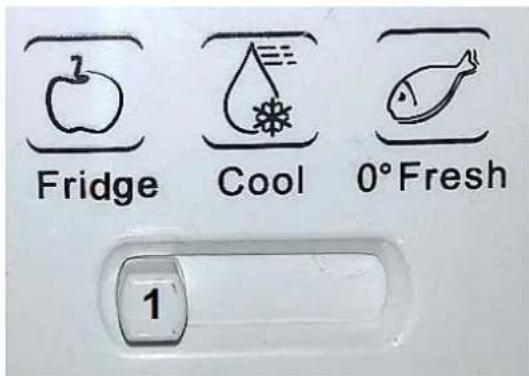
4.3.6 Internal box (depending on model)
text_image
Fridge Cool 0°Fresh 1CONTROL BUTTON (INNER WALL OF THE FRIDGE):
 | The temperature inside the INTERNAL BOX meets the temperature of the refrigerator. |
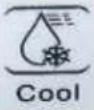 | The temperature inside the INTERNAL BOX lies 1 ^0C below the temperature of the refrigerator. |
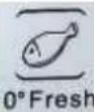 | The temperature inside the INTERNAL BOX lies 2 ^0C below the temperature of the refrigerator. |
4.4 The fridge
The cooling compartment is not intended for storing food for a longer period of time. So, use the cooling compartment for short-term storage only. Different temperature areas due to the air circulation occur in the appliance. Use these different temperature areas to store different kinds of food.
| Shelves | Food from wheat flour, milk etc. The shelves are removable for cleaning. Adjust the shelves relevant to your needs. |
| Crisper | Fruit, vegetable, etc. |
| Door trays | Eggs, beverage cans, bottled beverages, packaged foodstuffs etc. |
Store covered or packaged food in the appliance only so the smell or taste of the food will not diffuse. The following materials are suitable for proper packaging:
◆ Food safe cling film / airtight bags and aluminium foil.
◆ Food safe covering hoods.
◆ Food safe containers made of plastic / glass / ceramics.
- Store fresh, packaged food on the shelves, fresh fruit and vegetable in the crisper.
- Store fresh meat packaged in protective foil for max. 2 days.
Let warm food such as cooked meals cool down before you store them in the appliance.
◆ Store food in such a way that the cooled air can circulate properly.
Do not place heavy bottles in the bottle pocket as it can come off the door.
4.4.1 Door trays
◆ Depending on model the door trays can be removed.
HOW TO REMOVE / INSERT THE DOOR TRAYS:
- Remove all stored food of the relevant door trays before.
- Lift the door tray vertically.
- Insert the door tray by proceeding vice versa.
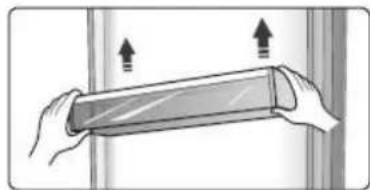
natural_image
Illustration of two hands holding a rectangular object with upward arrows indicating motion or force (no text or symbols)The door trays can be removed and inserted for cleaning as shown above (depending on model).
SCHNEIDER
4.4.2 Glass shelves
◆ Depending on model the glass shelves can be removed.
HOW TO REMOVE / INSERT THE GLASS SHELVES:
- The glass shelves can be inserted into different positions ^11 if required.
- Pull the glass shelf on the guide rails forward carefully and lift it slightly until you can remove it.
- To reinsert the glass shelf, push it back in position on the guide rails carefully.
- Ensure that the area is free and has no obstacles.
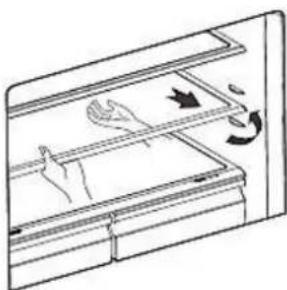
natural_image
Diagram of a hand holding a device inside a storage cabinet, with arrows indicating motion (no text or symbols)(fig. similar)
The glass shelves can be removed and inserted for cleaning as shown above (depending on model).
4.5 The freezer
WARNING! Do not eat food which is still frozen. Children should not eat ice-cream straight from the freezer. The coldness can cause injuries in the mouth.
WARNING! Contact with frozen food, ice and metal components in the freezer compartment can cause injuries similar to burns.
CAUTION! Do not put any bottled or canned beverages (neither still nor carbonated) into the freezer compartment of the appliance as their containers could explode.
The freezer is intended for long-term storage of food. Please observe the advice for max. storage time on the packaging of frozen food products. Do not refreeze defrosted food.
Protect fresh food you want to freeze using aluminium foil, cling film, air and water tight plastic bags, polyethylene containers or other suitable plastic containers with a lid.
Leave some free space between the single pieces of frozen food as proper air circulation is required.
The food is frozen completely after 24 hours (you find the relevant information about the maximum freezing capacity within 24 hours in chapter TECHNICAL DATA).
Only buy frozen food, when its packaging is not damaged. Damaged packaging may indicate an interruption of the cold chain.
Avoid or reduce variations in temperature: buy frozen food at the end of shopping and transport it in thermally insulated bags.
Do not refreeze defrosted and semi-defrosted food. Consume within 24 hours.
- Observe the complete information on the packaging of frozen food.
4.5.1 Freezer drawers
◆ Depending on model the freezer drawers can be removed.
HOW TO REMOVE / INSERT THE FREEZER DRAWERS:
- Pull the freezer drawers forward carefully and lift it slightly until you can remove it.
- Insert the freezer drawers by proceeding vice versa.

natural_image
Pure diagram of a hand pressing down on a rectangular object with an upward arrow, no text or symbols presenti Any of the freezer drawers can be removed and inserted for cleaning as shown above (depending on model).
4.6 Operation parameters
- The appliance can only reach the relevant temperatures when
a) the a ambient temperature meets the climatic class.
b) the doors close properly.
c) you do not open the doors too often or too long.
d) door seals are in proper condition.
e) the appliance is properly positioned.
f) you have not overfilled the appliance.
g) you do not store warm or hot food in the appliance.
- High ambient temperatures and simultaneously operating at the coldest setting may make the compressor operate permanently to keep the temperature constant inside the appliance.
4.7 Helpful hints / Energy saving
Do not line the drawers with aluminium foil, waxed paper or paper layers; otherwise optimum circulation of the cold air is impeded so the appliance cannot work at best performance.
◆ Cooked food can be stored in the appliance. Let it cool down to room temperature before you put it into your appliance.
◆ Store your food in colourless, airtight and tasteless materials.
Some food like meat, fish etc. may become dry and release strong odours. You can avoid these by wrapping them into aluminium foil or plastic wrap or putting them into an airtight bag or container.
Allow ample storage place for your food. Do not overfill your appliance.
- Wrap your food in plastic wrap or suitable paper and place each kind of food in a particular location in your appliance. This will prevent any contamination, a loss of water and a mingling of odours.
Let warm or hot food cool down to room temperature before you put it into your appliance. Otherwise the energy consumption will increase and encrusted ice will be generated.
If you buy frozen food, the packaging must not be damaged and the product must be properly stored (sales container -18°C or lower).
How to defrost frozen food depends on your kitchen-equipment and the purpose, you want to use the frozen food for.
√ room temperature
√ in the cooling-compartment of your appliance
√ in an electrical oven12
√ in a microwave13
✿ Try opening the door as little as possible, especially when the weather is warm and humid. If you open the door, close it as fast as possible.
- Permanently check, that the appliance is well-ventilated. The appliance has to be well-ventilated from all sides.
◆ Defrost the appliance periodically (if necessary) as encrusted ice will decrease the power and increase the energy consumption of the appliance.
Put the frozen food you want to defrost into the cooling-compartment of you appliance.
⚠️ DANGER! Never touch the power plug, the power switch or other electrical components with wet or damp hands. RISK OF ELECTRIC SHOCK!
⚠ WARNING! Disconnect the appliance from the mains before you clean or maintain it. RISK OF ELECTRIC SHOCK!
⚠ WARNING! To disconnect the appliance from the mains, you must unplug the appliance or use a cut-off device.
⚠ WARNING! Remove possible dust accumulation at the power plug, at the safety power socket and at all plug connectors regularly. RISK OF FIRE!
NOTICE! Clean the appliance at least once a month.
- Always keep the appliance clean so that unpleasant odours do not occur.
- Dust deposits on the condenser will increase the energy consumption. Clean the condenser twice a year with a vacuum cleaner or a soft brush.
- Take off all rings and bracelets before cleaning or maintaining the appliance; otherwise you will damage the surface of the appliance.
DETERGENT:
Do not use any harsh, abrasive or aggressive detergents.
Do not use any solvents.
Do not use any abrasive detergents! Do not use any organic detergents! ^14 Do not use essential oils!
These instructions are valid for all surfaces of your appliance.
EXTERNAL CLEANING:
- Use a moist cloth and a mild, non-acidic detergent. Use a suitable detergent for stubborn stains.
- Use clear water to rinse.
- Dry the cleaned surfaces with a cloth.
INTERNAL CLEANING:
- Clean the shelves and the inside with warm water and a mild detergent.
- Use clear water to rinse.
- Dry the cleaned surfaces with a cloth.
- Check the water drain and clean it if needed.
DOOR SEALS:
Clean with warm water and a mild, non-acidic detergent. Do not restart the appliance until the door seals have dried completely.
5.1 Defrosting
FRIDGE:
The fridge is defrosted automatically (NoFrost).
FREEZER:
The freezer is defrosted automatically (NoFrost).
FREEZER
(optional procedure if encrusted ice should have occurred):
⚠ WARNING! Switch off the appliance by turning the thermostat (depending on model) to position 0 / AUS / OFF and disconnect it from the mains.
⚠ WARNING! To disconnect the appliance from the mains, you must unplug the appliance or use a cut-off device.
⚠ WARNING! Never use any mechanical items, knives or other sharpedged objects to remove the encrusted ice. Never use a steam cleaner. RISK OF ELECTRICAL SHOCK!
- Remove the contents from the freezing-compartment and put them into a cooling box.
- Place a container in front of the appliance to catch the water.
- When the encrusted ice melts put some dry cloths into the freezer-compartment to hold the water back.
- Remove the big pieces of ice first.
-
Afterwards remove the small pieces of ice.
-
Wipe and dry the appliance and door seals with dry and soft cloths.
- After cleaning leave the door open for some time to ventilate the appliance.
5.2 Replacing of the illuminant
⚠ WARNING! The LED-illuminant must be replaced by a competent person only. If the LED-illuminant is damaged, please contact a qualified professional. Illuminants and the replacing of illuminants are not included in guarantee.
6. Trouble shooting
| MALFUNCTION | |
| POSSIBLE CAUSE | MEASURE |
| THE APPLIANCE DOES NOT WORK AT ALL. | |
| 1. The plug of the appliance is not connected to the socket.2. The plug has become loose.3. The socket is not supplied with energy.4. The fuse is switched off.5. The voltage is too low. | 1. Connect the appliance to the mains properly.2. Check the plug.3. Check the corresponding socket by connecting it with another appliance.4. Check the fuse box.5. Compare the data on the model plate with the data of your energy supplier. |
| THE COMPRESSOR DOES NOT WORK AT ALL. | |
| 1. Incorrect energy supply. | 1. Check the energy supply. |
| THE COMPRESSOR OPERATES FOR TOO LONG. | |
| 1. The appliance has been switched off for a while.2. Too much or too hot food in the appliance.3. Doors opened too often or too long. | 1. The appliance needs some time to reach the preset temperature.2. Remove any hot food.3. Do not open the door too often/too long. |
FORMATION OF ENCRUSTED ICE.
- The air outlets may be blocked by food.
- The door is not properly closed.
- The door seal is damaged or soiled.
- Store the food in another place.
- Close the door properly.
- Clean and / or replace the door seal.
THE DOOR MAKES A STRANGE SOUND WHEN OPENED.
-
The door seals are soiled:
-
Clean the door seals.
UNCOMMON NOISE.
-
The appliance is not installed on a flat and level ground.. The appliance touches a wall or another object.
-
Frozen food is stored improperly.
-
Items have dropped behind the appliance.
-
Install the appliance properly.
-
Store food properly.
-
Remove the items.
WATER DRIPS ON THE FLOOR.
-
The water pan ^15 (located at the rear bottom of the cabinet) may not be properly levelled, or the draining spout (located underneath the top of the compressor depot) may not be properly positioned to direct water into this pan, or the water spout is blocked.
-
You may need to pull the refrigerator away from the wall to check the pan and spout.
THE LIGHT IS NOT WORKING.
-
The LED illuminant may be damaged.
-
The control system (depending on model) has disabled the lights due to the door being kept open too long.
-
s. chapter REPLACING OF THE ILLUMINANT
-
Close and reopen the door to reactivate the lights.
If the appliance shows a malfunction not noted on the schedule above or if you have checked all items on the above schedule but the problem still exists, please contact the aftersales service.

THE OPERATING CONDITIONS DESCRIBED BELOW ARE NORMAL AND DO NOT INDICATE A MALFUNCTION.
The refrigerant generates a sound similar to flowing water.
Sometimes you may hear a sound which is generated by the injection process of the cooling circuit.
The sides of the appliance may get warm while the appliance is running.
DISTINCT NOISE:
When you operate the appliance for the first time or the temperature falls below a certain level, the appliance will operate with high power to reach the preset temperature.
CONDENSED WATER IN / ON THE APPLIANCE:
may be generated inside or outside the appliance by high humidity or very warm ambient temperatures.
CLICKING:
You will hear the compressor click if it is activated or deactivated.
HUM:
is caused by the compressor while running.
KNOCKING / SNAPPING:
may be generated by sequential expansion and shrinkage of the components of the cooling system. It is caused by variation of temperature before and after the compressor is activated or deactivated.
DECOMMISSIONING, TEMPORARILY:
IF THE APPLIANCE IS NOT USED FOR A LONGER PERIOD OF TIME:
- Switch off the appliance (0 / AUS / OFF; depending on model) and disconnect it from the mains (unplug).
- Remove all food stored in the appliance.
- Dry the inside of the appliance with a cloth and leave the door open for a few days.
WHILE AWAY ON AN AVERAGE VACATION/HOLIDAY (14-21 DAYS):
-
Do the same as described above, or
-
let the appliance operate.
a. remove all perishable food from the cooling compartment.
b. clean the cooling compartment.
c. freeze all food which is suitable to be frozen.
IF YOU WANT TO MOVE THE APPLIANCE:
- Secure all removable parts and the contents of the appliance. Pack them separately if necessary.
- Transport the appliance in an upright position only. All other positions can cause damage to the compressor.
- Do not damage the feet of the appliance.
DECOMMISSIONING, ULTIMATE:
- Switch off the appliance (0 / AUS / OFF; depending on model) and disconnect it from the mains (unplug).
- Cut off the power cord at the appliance.
- Completely remove every door of the appliance.
- Leave the shelves in their position so that children are not able to get into the appliance.
- Follow the advice for the disposal of the appliance in chapter WASTE MANAGEMENT.
8. Technical data
| Model | Freezer fridge |
| NoFrost fridge / freezer | yes / yes |
| Climatic class | N / ST(ambient temperature 16 - 38 ^ ) |
| Energy efficiency class* | A++ |
| Annual energy consumption in kW/h** | 226.00 |
| Voltage / frequency | 220 - 240 V AC / 50Hz |
| Volume gross / net / freezer in l | 320 / 228 / 92 |
| Stars | 4*** |
| Freezing capacity/24 hours | 5.00 kg |
| Max. storage time/malfunction | 19.00 h |
| Noise emission | 42 dB/A |
| Adjustable thermostat | yes |
| Compressor | 1 |
| Refrigerant | R600a / 46 g |
| Control light operation / warning light | yes / yes |
| Control light Super Freeze | - |
| Changeable hinge position | - |
| Adjustable feet | 2 in front |
| Defrosting cooling compartment / freezer | NoFrost / NoFrost |
| Dimensions appliance H*W*D in cm | 192.50*59.60*70.50 |
| Weight net / gross in kg | 83.00 / 90.00 |
◆ Technical modifications reserved.
* On a scale from A+++ (highest efficiency) to D (lowest efficiency).
** Based on standard measurement results within 24 hours. The current energy consumption depends on the way the appliance is used as well as on its site.
9. Waste management
-
Dispose of the appliance relevant to the current legislation in view of explosive gases. The cooling systems and insulation of refrigerators and freezers contain refrigerants and gases which have to be deposed of properly. Do not damage the cooling fins and tubes. If refrigerants escape there is FIRE HAZARD!
-
While unpacking, the packaging materials (polythene bags, polystyrene pieces, etc.) should be kept away from children and pets. CHOKING HAZARD! RISK OF INJURY!
-
Old and unused appliances must be send for disposal to the responsible recycling centre. Never expose to open flames.
-
Before you dispose of an old appliance, render it inoperative. Unplug the appliance and cut off the entire power cord. Dispose of the power cord and the plug immediately. Remove the door completely so children are not able to get into the appliance as this endangers their lives!
-
Dispose of any paper and cardboard into the corresponding containers.
-
Dispose of any plastics into the corresponding containers.
-
If suitable containers are not available at your residential area, dispose of these materials at a suitable municipal collection point for waste-recycling.
-
Receive more detailed information from your retailer or your municipal facilities.
REFRIGERANT:
-
The refrigerant circuit of the appliance contains the refrigerant R600a, a natural gas of high environmental compatibility.
-
⚠WARNING! Do not damage any components of the refrigerant circuit while transporting the appliance. FIRE HAZARD!

Materials marked with this symbol are recyclable.

Please contact your local authorities to receive further information.

The refrigerant R600a is flammable!
This appliance includes a 24-month guarantee for the consumer given by the manufacturer, dated from the day of purchase, referring to its flawless material-components and its faultless fabrication. The consumer is accredited with both the dues of the guarantee given by the manufacturer and the vendor's guarantees. These are not restricted to the manufacturer's guarantee. Any guarantee claim has to be made immediately after the detection and within 24 months after the delivery to the first ultimate vendee. The guarantee claim has to be verified by the vendee by submitting a proof of purchase including the date of purchase and/or the date of delivery. The guarantee does not establish any entitlement to withdraw from the purchase contract or for a price reduction. Replaced components or exchanged appliances demise to us as our property.
The guarantee claim does not cover:
- fragile components as plastic, glass or bulbs;
- minor modifications of the SCHNEIDER-products concerning their authorized condition if they do not influence the utility value of the product;
- damage caused by handling errors or false operation;
- damage caused by aggressive environmental conditions, chemicals, detergents;
- damage caused by non-professional installation and haulage;
- damage caused by non common household use;
- damages which have been caused outside the appliance by a SCHNEIDER-product unless a liability is forced by legal regulations.
The validity of the guarantee will be terminated if:
- the prescriptions of the installation and operation of the appliance are not observed.
- the appliance is repaired by a non-professional.
- the appliance is damaged by the vendor, the installer or a third party.
- the installation or the start-up is performed inappropriately.
- the maintenance is inadequately or incorrectly performed.
- the appliance is not used for its intended purpose.
- the appliance is damaged by force majeur or natural disasters, including, but with not being limited to fires or explosions.
The guarantee claims neither extend the guarantee period nor initiate a new guarantee period.
The geographical scope of the guarantee is limited with respect to appliances, which are purchased and used in Germany, Austria, Belgium, Luxembourg and the Netherlands.

MISE EN GARDE! attire
natural_image
3D mechanical component with a 45-degree angle标注, showing no readable text or symbolstext_image
Technical diagram of a refrigerator with numbered parts for identificationnatural_image
Technical line drawing of a cabinet or enclosure interior with door, windows, and control panel (no text or symbols)
text_image
Freezer 3sec -16 -18 -20 -22 -24°C super holiday 2 3 4 6 8°C Fridge 8secFREEZER = Zone de congélation
chemical
Thermodynamic cycle diagram showing temperature progression from 8°C to 4°C with intermediate steps at 2°C, 3°C, and 4°Cchemical
Thermodynamic cycle diagram showing temperature transitions between -24°C, -22°C, and -20°C with intermediate steps at -16°C and -18°CSCHNEIDER
4.3.3 Super Freeze
natural_image
Illustration of two hands holding a rectangular object with upward arrows indicating motion or force (no text or symbols)natural_image
Diagram of a door handle with hand gestures and motion arrows indicating movement (no text or symbols)natural_image
Pure mechanical diagram showing a lever and pivot point without any text or symbolsnatural_image
3D mechanical component with angular dimension标注 (45°) and no visible text or symbols4.1 Uitzicht
text_image
Technical diagram of a refrigerator with numbered parts for identificationnatural_image
Illustration of hands holding a rectangular object with upward arrows indicating motion or force (no text or symbols)natural_image
Diagram of a person inside a drawer with arrows indicating motion or movement (no text or symbols)(fig. soortgelijk)
natural_image
Pure mechanical diagram showing a lever mechanism with an upward arrow, no text or symbols presentALS U HET APPARAAT WILT VERPLAATSEN:
Aftersales service information on the leaflet inside this instruction manual.