UV10 - Car radio with screen JENSEN - Free user manual and instructions
Find the device manual for free UV10 JENSEN in PDF.



| Product Type | Car Radio with Screen |
| Brand / Model | Jensen UV10 |
| Chassis Dimensions (DIN) | 178 x 178 x 50 mm |
| Screen Size | 7 inches (diagonal), 16:9 format |
| Screen Type | TFT LCD Active Matrix, motorized retractable |
| Screen Resolution | 336,960 sub-pixels (1440 x 234) |
| Compatible Disc Formats | DVD+R/RW (single and dual layer), CD-R/RW |
| Supported Audio Formats | CD-DA, MP3, WMA |
| Supported Video Formats | DVD, VCD, SVCD, AVI, MPEG1/2 |
| FM Tuner | Range 87.5-107.9 MHz (depending on region), 30 presets (18 FM / 12 AM) |
| AM Tuner | Range 530-1720 kHz |
| Output Power | 13 Watts RMS x 4 channels (4 ohms, ≤1% THD+N) |
| Signal-to-Noise Ratio (audio) | >70 dBA (reference 1 Watt) |
| Power Supply | 11-16 VDC, negative ground |
| Fuse | 15 A mini ATM |
| Operating Temperature | -20°C to 65°C |
| Connectivity | Front/Rear/Subwoofer line output, front A/V input, USB, rear camera input, SWC interface (compatible with PAC SWI-PS) |
| Wireless Functions | Bluetooth (optional BTM10), infrared remote control |
| Additional Features | Direct iPod, Navigation (optional NAV102), 3-band equalizer with 8 EQ curves, touch calibration, tilt adjustment |
| Safety | Do not use the video function while driving (except backup camera). Use the recommended 15 A fuse. |
| Maintenance and Cleaning | Use a soft silicone cloth and a neutral detergent. Do not use abrasive or alcohol-based products. |
Frequently Asked Questions - UV10 JENSEN
User questions about UV10 JENSEN
0 question about this device. Answer the ones you know or ask your own.
Ask a new question about this device
Download the instructions for your Car radio with screen in PDF format for free! Find your manual UV10 - JENSEN and take your electronic device back in hand. On this page are published all the documents necessary for the use of your device. UV10 by JENSEN.
USER MANUAL UV10 JENSEN
Thank you for choosing a Jensen Phase Linear product. We hope you will find the instructions in this owner's manual clear and easy to follow. If you take a few minutes to look through it, you'll learn how to use all the features of your new Jensen Phase Linear UV10 Mobile Multimedia Receiver for maximum enjoyment.
Preparation. 1
Controls and Indicators 2
Remote Control 3
Using the TET Monitor 5
Using the TPT Monitor 5
Operating Instructions 6
Setup Menu 8
Tuner Operation 11
DVD/VCD Video Operation 13
DVD/CD Audio Operation 16
NPOVCAO
MP3/WMA Operation 17
PdClO- 18
Pod Operation 19
Bluetooth Operation 31
Troubleshooting 24
Specifications 26
CONTENIDO
Congratulations on your purchase of the Jensen Phase Linear UV10 Mobile Multimedia Receiver.
It's a good idea to read all of the instructions before beginning the installation. We recommend having your Jensen Phase Linear UV10 installed by a reputable installation shop.
Features
DVD
- Aspect Ratio - Full and Normal
Fast Forward -2X, 4X, 8X and 32X
Slow Motion - 1/2, 1/4, 1/6 and 1/7 - Play, Pause, Stop, Next Chapter and Previous Chapter
CD/MP3/WMA
CD-Text Compatible
- ID3 Tag Compatible
- Directory Search (MP3 / WMA Only)
- Direct Track Access via Remote Control
Burn up to 1500 MP3 and WMA Files onto a DVD+ R/ RW
Audible Forward/Reverse Track Search (CD-DA Only)
- Random, Repeat and Intro
- Play, Pause, Stop, Next Track and Previous Track
AM-EM
USA / Europe / Latin America / Asia Frequency Spacing
30 Station Presets (18 FM / 12 AM)
- Auto Stereo / Mono
- Local / Distance
- Auto Store / Preview Scan
iPod
- iPod via USB
- High Speed Direct Connect Interface to Access iPod Playlists, Artists, Albums and Songs. Play music and view video/photo files from your iPod. Video/photo playback requires jLink-USB iPod interface cable (sold separately).
- Power Management Charges iPod while Connected
Chassls
- 1.0 DIN (Import / ISO-DIN Mountable)
- Motorized Flip-Out / Flip-Up LCD Screen
- 8 Character / Segment Type Secondary LCD Display
- 7" TFT Active Matrix LCD
- 336,960 Sub Pixels (1440W X 234H)
- Screen Tilt / Angle Adjustment
- Beep Tone Confirmation (On-OFF Option)
- Heal Management System - Forced Air-Cooling To Keep The Chip-Sets Operating at Nominal Temperatures
General
- Navigation Ready (NAV102)
- Bluetooth Ready (with purchase of BTM10) providing hands-free profile for safety / convenience and A2DP profile for streaming music from a PDA / PMP
- 44-Key Infrared Remote Control
One Composite Video Output for Additional Screens - Front Panel Audio/Video Input
- Three-Band Tone control (Bass, Mid and Treble) w/ Eight Preset EQ Curves
- Front Panel A/V Aux Input for Portable Media Devices
- Front, Rear and Subwoofer Line Output
Programmable Volume Control
Rear Camera Input (Normal and Mirror Image View) - Touch Screen Calibration Mode
- 2VRMS Line Output - All Channels
- Rotary Encoder Audio Control
- SWC Interface - Compatible with PAC adapter SWI-PS Steering Wheel Control Interface, sold separately
Optional Equipment
- NAV102
The UV10 is "navigation ready." Before accessing any navigation features, you must purchase and install the navigation module (NAV102). All installation and operating instructions will be included with the navigation module.
Once the navigation module is connected and operating properly, the NAV source mode will become active. While the navigation module is not installed, the NAV option appears gray, indicating the function is not available.
- BTM10
Before you can connect to a Bluetooth enabled device, you must purchase and install the Jensen BTM10.
- Bluetooth Phone
See "Bluetooth Operation" on page 21.
Rear Camera
The UV10 is "camera ready." Before accessing any camera features, you must purchase and install a rear video camera. Once the rear camera is connected and operating properly, the CAMERA source mode will become active. While the camera is not installed, the CAMERA option appears gray, indicating the function is not available.
WARNING! Never install this unit where operation and viewing could interfere with safe driving conditions.
WARNING: To reduce the risk of a traffic accident (except when using for rear view video camera) never use the video display function while driving the vehicle. This is a violation of federal law.
WARNING! Never disassemble or adjust the unit.
WARNING! To prevent injury from shock or fire, never expose this unit to moisture or water.
WARNING! Never use Irregular discs.
WARNING! To prevent damage to the mechanism inside this unit, avoid impact to the TFT monitor.
WARNING! The monitor employs an automatic motorized mechanism. To prevent damage to the core mechanism, please do not push, pull or swivel the monitor manually.
CONTROLS AND INDICATORS
1. CLOSE/OPEN
Press to activate the automatic mechanical system and move the TFT monitor into viewing position. Press again to close the TFT.
2.PIC/BAND
Press to adjust the Brightness and Contrast (see "Image/Display Settings" on page 5).
With the monitor closed, press BAND to change between three FM and two AM bands.
3.DISCSLOT
4. WIDE/ |< < |
Press to adjust the display aspect of the picture to one of two settings: Full, Normal or STANDBY.
With the monitor closed, press to seek backward.
When the NAV102 is connected to the UV10, press and hold to display the navigation user interface. The TFT screen must be open for this function to operate.
5. TILT/>>
Press to activate the tilt function. Use the rotary encoder to make adjustments while the yellow tilt icon is flashing.
With the monitor closed, press to seek forward.
6.EJECT
Press to eject a disc.
Press and hold to reset core mechanism position.
7. LCD Display
8. DISP
With the monitor closed, press to view alternate LCD display information.
9. IR Remote Control Receiver
10.SBC
Press to turn unit on. Press and hold to turn the unit off.
When on, press once to select playing mode.
11. Rotary Encoder
Rotate to adjust the volume. Press and release to enter and/or confirm audio settings.
Press to activate the MUTE function and silence the receiver. Press again to resume sound.
Press and hold to activate the Local (LOC) setting. Press and hold again to turn Local reception off.
12. RESET
Press to reset system settings to factory default (except the password and parental lock setting).
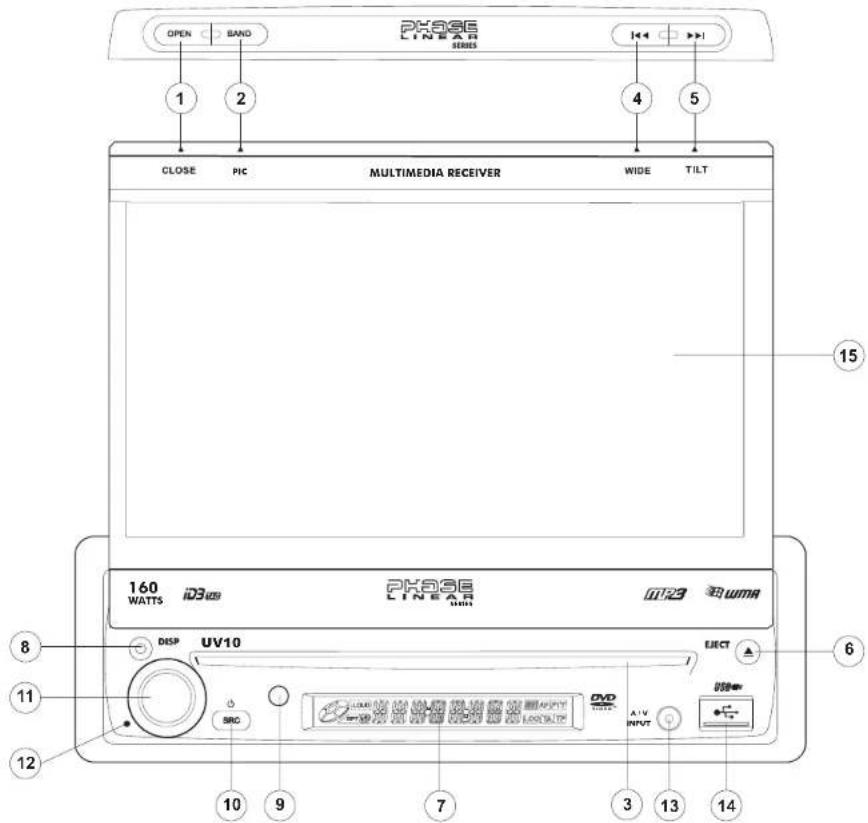
13. A/V Input
15.TFTDisplay
Attach a compatible A/V device.
- USB Interface Connector
Connect a USB device for playback of music/video files.
REMOTE CONTROL
Table 1: Remote Control Functions
| Button Function | ||||||
| Name Ref# DVD | VCD TUNER CD/MP3/USB iPod | |||||
| MENUE 1 Enters the main menu of the disc | Tums on/off PBC when playing VCD | Selects Photo mode | ||||
| TITLE 2 Enters the title menu of the disc | Plays first ten seconds of each chapter/title | Selects Music mode | ||||
| MUTE 3 Toggles on/off audio output | Toggles on/off audio output | Toggles on/off audio output | Toggles on/off audio output | Toggles on/off audio output | ||
| POWER | 4 Tums the power on/off Turns the power on/off Turns the power on/off Turns the power on/off turns the power on/off | Toggles on/off audio output | ||||
| AUDIO 5 Changes the audio language for disc play-back | Selects Music mode | |||||
| REPT A-B | 6 Setup to repeat play-back from time frame A to time frame B | Setup to repeat play-back from time frame A to time frame B | ||||
| REPT | 7 Reparts playback of current chapter | Reparts playback of current chapter | Reparts playback of current track | Reparts playback of current track | ||
| SRC | 8 Selects playing mode | Selects playing mode | Selects playing mode | Selects playing mode | Selects playing mode | |
| SUBTITLE | 9 Language selection for subtitle | Selects Photo mode | ||||
| DISP/CLEAR | 10 Displays playing information | Displays playing information | Displays playing information | Display playing information | Displays playing information | |
| Delete entry or move backwards to correct error in Direcl Access mode | Delete entry or move backwards to correct error in Direcl Access mode | Delete entry or move backwards to correct error in Direcl Access mode | Delete entry or move backwards to correct error in Direcl Access mode | Delete entry or move backwards to correct error in Direcl Access mode | ||
| PRESET | 11 | Navigatos the preset station list | ||||
| PRESET | 12 | Navigatos the preset station list | ||||
| ANGLE | 13 | Plays back disc in different angle for a scene | Plays back Picture CD with different angle of picture displayed | Selects Video mode | ||
| >> | 14 | Fast forwards the disc content | Fast forwards the disc content | Fast forwards the disc content | Accesses iPod Menu | |
| VOL- | 15 | Decreases volume | Decreases volume | Decreases volume | Decreases volume | Decreases volume |
| VOL+ | 16 | Increases volume | Increases volume | Increases volume | Increases volume | Increases volume |
| << | 17 | Selects the previous chapter for playback | Selects the previous chapter for playback | Searches an available radio station by decreasing tuning frequency | Selects the previous track for playback | Pauses playback/start playback |
| >>| | 18 | Pauses playback/start playback | Pauses playback/start playback | Pauses playback/start playback | ||
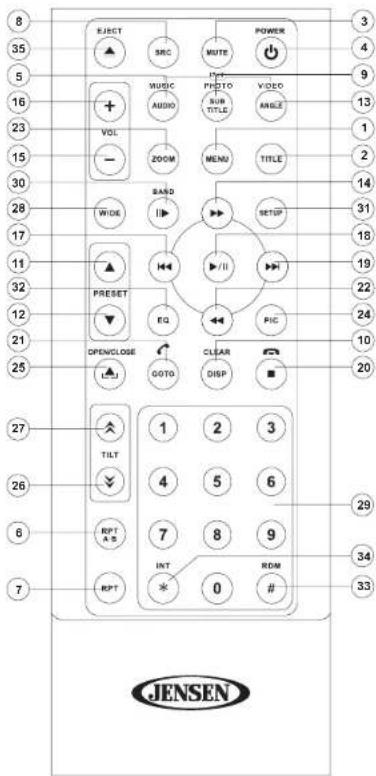
NOTE: Your remote control may differ slightly from the one pictured here. The above diagram is for illustrative purposes only.
Table 1: Remote Control Functions
| Button | Function | |||||
| Name | Ref# | DVD | VCD | TUNER | CD/MP3/USB | IPod |
| >>| 19 Selects the next chaper for playback | Selects the next chaper for playback | Searches an available radio station by increasing tuning frequency | Selects the next track for playback | Selects the next track for playback | ||
| ■/▲ | 20 Stops playback Stops playback | Stops playback | ||||
| GOTO 21 Open direct entry search screen | Open direct entry search screen | |||||
| << 22 Slow playback/slow rewind playback | Slow playback/slow rewind playback | |||||
| ZOOM 23 Zooms in/out on an image | Zooms in/out on an image | |||||
| PIC 24 Displays set-up param-eters | Displays set-up param-eters | |||||
| OPEN/CLOSE | 25 Opens/closes the TFT monitor | Opens/closes the TFT monitor | Opens/closes the TFT monitor | Opens/closes the TFT monitor | Opens/Closes the TFT monitor | |
| × | 26 Decreases monitor tilt angle | Decreases monitor tilt angle | Decreases monitor tilt angle | Decreases monitor tilt angle | Decreases monitor tilt angle | |
| △ | 27 Increases monitor tilt angle | Increases monitor tilt angle | Increases monitor tilt angle | Increases monitor tilt angle | Increases monitor tilt angle | |
| WIDE 28 Selects display mode: FULL or NORMAL | Selects display mode: FULL or NORMAL | |||||
| 1, 2, 3, 4, 5, 6, 7, 8, 9, 0 (Numeric Keypad) | 29 Directly accesses chapter | 1-6 selects preset for current band | Directly accesses track | |||
| |> / BAND 30 Press repeatedly for slow motion forward/backward | Press repeatedly for slow motion forward/backward | Selects FM/AM band | ||||
| SETUP | 31 | Displays Setup menu | Displays Setup menu | Displays Setup menu | Displays Setup menu | Displays Setup menu |
| EQ 32 Access equalizer menu | Accesses equalizer menu | Accesses equalizer menu | Accesses equalizer menu | Accesses equalizer menu | Accesses equalizer menu | |
| RDM 33 Plays all chapters in random order | Plays all tracks in random order | Plays all tracks in random order | ||||
| INT 34 | Plays the first ten seconds of each track | |||||
| EJECT | 35 | Ejects disc | Ejects disc | Ejects disc | Ejects disc | Ejects disc |
USING THE TFT MONITOR
Open/ Close TFT Monitor
Open TFT Monitor
Press the OPEN button (1) on the front panel or press the button (25) on the remote control to activate the mechanism that moves the display panel into the viewing position.
Close TFT Monitor
Press the OPEN button (1) on the front panel or press the button (25) on the remote control to load the display panel back into the compartment.
TFT Monitor Auto Open
If "TFT Auto Open" is "on" when the unit is turned on, the monitor automatically moves to the viewing position.
If "TFT Auto Open" is "off" when the unit is turned on, press the OPEN button (1) or (2) button (25) on the remote control to move the monitor into the viewing position. If "TFT Auto Open" is set to "Manual", the TFT will not close when the key is turned off.
Monitor Tilt Angle Adjustment
A known characteristic of LCD panels is the quality of the display in relationship to the viewing angle. The monitor angle can be adjusted for optimum viewing using one of the following methods:
Step by Step Angle Adjustment
Press the () or A button on the remote control to adjust the tilt angle of the screen one step at a time.
Press the TILT button (5) on the unit. While the yellow tilt icon is flashing, turn the rotary encoder to adjust the screen angle.
Continuous Angle Adjustment
Press and hold the ( ) byton on the remote control to adjust the tilt angle in a continuous motion.
Aspect Ratio
Press the DISP button (10) on the remote control or WIDE button (4) on the monitor to adjust the aspect ratio as follows:
FULL The entire screen is extended horizontally to the aspect ratio of 16 to 9. The extension ratio is the same at any point. NORMAL
The conventional display image has a 4 to 3 ratio of horizontal to vertical, leaving a blank area on the right and left sides of the display.
STANDBY Screen becomes black. Touch screen to resume.
Image/Display Settings
Video Output Modes
Table 2 shows the video output mode for each playing source.
Table 2: Video Output Modes
| Playing Source Video | Output Modes |
| AM/FM TUNER RGB Mode | |
| DVD RGB Mode | |
| AUX IN CVBS Mode |
CVBS Composite Video Baseband Signal Picture Adjustment
To adjust monitor display settings, perform the flooring steps:
- Press the PIC button (24) on the remote control or monitor (2) repeatedly to move from the "BRIGHT" setting to "CONTRAST", "COLOR" and "HUE."
- Turn the rotary encoder to adjust the setting level.
- Press the PIC button (24) on the remote control or monitor (2) 1-3 times to exit the picture adjustment menu.
Parking Brake Inhibit
When the pink "Parking" wire is connected to the vehicle Parking Brake circuit, the front TFT monitor will display video
when the Parking Brake is engaged. (When the pink wire is grounded via the Parking Brake circuit, video will be displayed.)
Monitor Movement Mechanism
If an obstruction occurs in the monitor path, the following protective measurements can be executed to prevent damage to the mechanism or monitor:
Table 3: Monitor Protective Measures
| Obstruction | Self Protection | OPEN Button Pressed | Power Reconnected |
| Monitor loading out horizontally | Monitor is automatically loaded into unit | Monitor fully extended horizontally | Monitor is automatically loaded into unit |
| Monitor loading in horizontally | Unit stops at obstruction point | Monitor fully extended horizontally | Monitor is automatically loaded into unit |
| Monitor loading out vertically | Unit stops at obstruction point | Monitor swivels back to the unit | Monitor swivels back to the unit |
| Monitor loading in vertically | Unit stops at obstruction point | Monitor swivels back to the unit | Monitor swivels back to the unit |
After the protective procedure is executed, normal operation is resumed by pressing the OPEN button (1) or disconnecting and reconnecting the power.
OPERATING INSTRUCTIONS
Power On/Off
Press the SRC button (10) on the unit (or the button (4) on the remote control) to turn the unit on. The buttons on the front of the unit light up and the current mode status appears in the LCD (7). You can also turn on the unit by pressing the OPEN button (1) and opening the TFT screen.
Press and hold the button to power off the unit. The monitor is drawn back into the main compartment.
Audible Beep Confirmation
An audible beep tone confirms each function selection. The Beep tone can be disabled through the Setup menu.
Mute/Line Mute
Press the rotary encoder button (11) on the front panel or the MUTE button (3) on the remote to mute the volume from the unit. Press the rotary encoder button again to restore the volume. "MUTE" is displayed on the LCD. Adjusting the volume or using any of the audio setup features cancels the mute function.
If the "MUTE" wire is connected, audio output mutes when a telephone call is received by the car phone (using optional BTM10) or when verbal navigation is performed (using optional NAV102).
Playing Source Selection
When the monitor is closed, press the SRC button on the front panel (10) or remote control (8) to change between available audio playing sources in the following order: AM/ FM, DISC, USB1, USB2, BT, NAV, AUX IN and CAMERA. The mode is displayed on the LCD screen.
Source Menu
You can also use the touch screen to change the source through the SOURCE MENU. To access the SOURCE
MENU, touch the top left corner of the screen or press the SRC button on the front panel (10) or remote control (8).
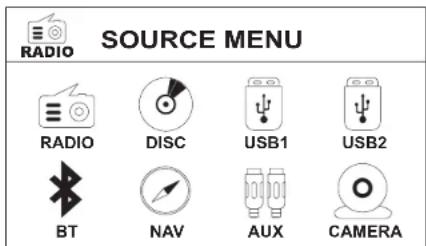
Touch the DISC, RADIO, USB1, USB2, NAVI, AUX or CAMERA button to select the corresponding source.
NOTE: If an iPod is attached to a USB1 port, "IPOD" appears instead of the text "USB1."
External Devices
External peripheral devices, including a game console, camcorder, navigation unit, iPod, Zune, etc. can be connected to this unit via RCA output using an A/V Media Adapter Cable (not included).
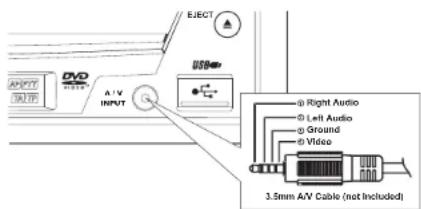
Connect the external device to the A/V Media Adapter Cable and then plug the cable into the A/V INPUT connector (13) on the front of the radio. Select "AUX" or "AUX IN" (when monitor is closed) mode to access auxiliary devices. You cannot directly control external devices connected to the A/V INPUT. For information regarding the use of USB devices, see "Inserting a USB Device" on page 17.
Volume Adjustment
Volume Increase/Decrease
To increase or decrease the volume level, turn the rotary encoder (11) on the front panel or press the VOL-/+ buttons (15, 16) on remote control. When the volume level reaches "0" or "40", a beep sounds, indicating that the adjustment limit has been reached. The LCD or TFT screen displays the volume level for 3 seconds.
Programmable Turn-On Volume
This feature allows the user to select a turn-on volume setting regardless of the volume setting prior to turning the unit off. To use this feature, the TFT monitor must be displayed. To program a specific turn-on volume level, turn the rotary encoder (11) to adjust the volume to the desired turn-on volume. Push and hold the rotary encoder while the yellow speaker icon and level indication is displayed on the screen. The unit will beep to confirm your turn-on volume setting.
Audio Control Menu
The Audio Control feature allows you to easily adjust your audio system to meet the acoustical characteristics of your vehicle, which vary depending on the type of vehicle and its measurements. Proper setting of the Fader and Balance boosts the effects of the cabin equalizer.
Touch the EQ button on the left side of the screen or press the EQ button (32) on the remote control to display the audio menu.
- Use the touch screen +/- buttons to adjust the settings for an audio feature.
- To adjust an audio feature using the remote control, perform the following steps:
a. Press the () /( ) buttons (19, 17) to highlight the audio feature to be adjusted.
b. Press the > / || button (18) to select the highlighted option.
UV10

c. Press the | < , > |, > > , or < < buttons (12, 15, 17, 20) on the remote control to adjust the selected feature to the desired setting.
Table 4: Audio Adjustments
| Audio Function Adjustable Range | |
| EQ User | |
| Acoustic | |
| Urban | |
| Rave | |
| Latin | |
| Dance | |
| Hip Hop | |
| Rock | |
| BASS -14 to +14 | |
| MID -14 to +14 | |
| TREBLE -14 to +14 | |
| SUB -14 to 0 | |
| FAD Grid | |
| BAL Grid | |
NOTE: The EQ mode will automatically change to "USER" when individual audio functions are adjusted.
The Audio menu will automatically exit after a few seconds of inactivity. To exit quickly, touch the top left corner of the screen or press and hold the rotary encoder (11).
System Reset
To correct a system halt or other illegal operation, use the tip of a pen to press the reset button (12) located on the front bottom-right corner of the unit. After a system reset, the unit restores all factory default settings.
NOTE: If the unit is reset while a DVD is playing, the DVD resumes play once the reset is complete.
Steering Wheel Control (SWC)
The UV10 is compatible with the PAC (Pacific Accessory Corporation) steering wheel control adapter SWI-PS. A 3.5mm female connector (labeled "SWC Interface") on the back of the head unit allows connectivity to the PAC adapter. Please refer to the instructions included with the PAC adapter for detailed installation information.
SWC Functions
The following controls are available for most vehicles:
-
Vol Down
-
Vol Up
-
Mute
-
Seek Down / Previous Track / Preset Down
-
Seek Up/ Next Track/Preset Up
-
SRC (Source)
-
Select
-
** Select
9.Band
If additional steering wheel control buttons are available on the vehicle, function 7 / 8 may be assigned the "Select" feature. This feature / function may not be available on some vehicles.
Select Operation
If "Select" (function 7 or 8) is held down and function 4 is pressed momentarily, Preset Up will be selected. If "Select" (function 7 or 8) is held down and function 5 is pressed momentarily, Preset Down will be selected.
SETUP MENU
To access system settings, press the SETUP button (29) on the remote control or touch the button on the screen to enter the "SETUP" menu. The "GENERAL" sub menu appears highlighted in yellow.
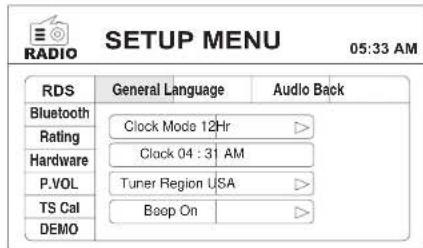
Accessing Menu Items
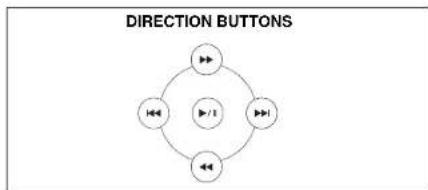
Touch the sub-menu name, press the << , >> , | , direction buttons (22, 14, 17, 19) on the remote control to select a sub-menu (Language, Audio, RDS, etc.).
The features available for adjustment under the highlighted sub-menu option will appear in the center of the screen.
Adjusting a Feature
- Use the touchscreen to select the feature to be adjusted.
- Enter the option field for the feature you want to adjust by using the touchscreen or pressing the >/|| button (18) on the remote control. A submenu appears in a second row with the selected option highlighted in blue.
-
Select a new value by using the touchscreen or pressing the or buttons (14, 22) on the remote control.
-
Use the touchscreen or press the >1|1 button (18) on the remote control to confirm setup.
General Sub-menu Features
| Setting Options Function | |
| Clock Mode | 2Hr Clock displays 12 hour time using AM and PM. |
| 24Hr Clock displays 24 hour time up to 23:59. | |
| Clock | (HH:MM)Clock appears in the top right corner of the screen and on the LCD screen during certain operations. NOTE: The AM/PM indication will change as you continue to adjust the hour past 12. |
| Tuner Region | USAAMF Frequency Spacing - 10kHzAMF Frequency Band-530kHz~1720kHzFM Frequency Spacing - 200kHzFM Frequency Band-87.5MHz~107.9MHz |
| S.Amer1AMF Frequency Spacing - 10kHzAMF Frequency Band-530kHz~1720kHzFM Frequency Spacing - 100kHzFM Frequency Band-87.5MHz~108.0MHz | |
| ArabiaAMF Frequency Spacing - 9kHzAMF Frequency Band-531kHz~1620kHzFM Frequency Spacing - 100kHzFM Frequency Band-87.5MHz~108.0MHz | |
| ChinaAMF Frequency Spacing - 9kHzAMF Frequency Band-522kHz~1620kHzFM Frequency Spacing - 100kHzFM Frequency Band-87.5MHz~108.0MHz | |
| S.Amer2AMF Frequency Spacing - 5kHzAMF Frequency Band-520kHz~1600kHzFM Frequency Spacing - 100kHzFM Frequency Band-87.5MHz~108.0MHz | |
| EuropeAMF Frequency Spacing - 9kHzAMF Frequency Band-520kHz~1600kHzFM Frequency Spacing - 50kHzFM Frequency Band-87.5MHz~108.0MHz | |
| KoreaAMF Frequency Spacing - 9kHzAMF Frequency Band-531kHz~1600kHzFM Frequency Spacing - 200kHzFM Frequency Band-88.1MHz~107.9MHz | |
| Setting | Options | Function |
| Beep | On | When turned on, an audible beep tone confirms each func-tion selection. |
| Off | No beep sounds. |
Language Sub-menu Features
If a DVD supports more than 1 Subtitle or Audio language, all the languages are available for selection during playback. If the selected language is not supported by the DVD, then the default language is used.
| Setting | Options | Function |
| Language | English | On Screen Display appears in English. |
| Subtitle | English | DVD subtitles automatically appear in English when available. |
| Auto | DVD subtitles appear according to the default subtitle language specified on the disc. | |
| Off | DVD subtitles do not appear automatically. | |
| Audio | English | DVD Audio is heard in English when the option is available. |
| DVD Menu | English | DVD menu (if applicable) is displayed in English. |
Audio Sub-menu Features
| Setting Options Function | |
| DRC Off Employ the Dynamic Range | |
| On | Control for better playback for low volumes. |
| Loudness Off | Turn bass boost on/off |
| On | |
| Subwoofer Off Turn the subwoofer on/off. | |
| On | |
| Sub Filter 80Hz Selecting a crossover fre-quence sets a cut-off frequency of the subwoofer's LPF (low-pass filter). | |
| 120Hz | |
| 160Hz | |
RDS Sub-menu Features
| Setting Options Function | |
| RDS Off | |
| On | |
| CR Off | |
| On | |
Bluetooth Sub-menu Features
| Setting Options Function | ||
| Bluetooth Off | Isable Bluetooth function. | |
| On Enable Bluetooth function. | ||
| Connect | Manual | Connect the last active mobile phone by touching the CONNECT icon when disconnected. |
| Auto | Automatically connect when your paired phone is in range. | |
| Auto Answer | Manual | Manually answer calls by touching the "call" button. |
| Auto | The unit automatically answers all incoming calls. | |
| Pairing Code | The default code is "1234". Touch the keypad icon to open the keypad and enter the pairing code or pass key required for Bluetooth connec tion to your mobile phone. Not all phones/devices require a pairing code. The default code is "0000" for many models. | |
Rating Sub-menu Features
The DVD system has a built-in parental lock feature to prevent unauthorized persons from viewing restricted disc
content. By default, the rating system is unlocked. Once setup, the parental lock is released only by entering the correct password. Once the password is entered, rating is available for setup.
| Setting Options Function | |
| Password | ----- Enter a 4-digit password to activate the "Rating" feature. |
| Parental Ctrl | 1. Kid Safe Select the appropriate rating level for the intended audience. 2. G You may override higher ratings by using your password. |
| 3. PG | |
| 4. PG-13 | |
| 5. PG-R | |
| 6. R | |
| 7. NC-17 | |
| 8. Adult | |
| Load Fac-tory | Reset Select "Reset" to restore the factory default settings for the Rating system only. |
To reset the password, access the "RATING" menu and enter the current password. Once the correct password is entered, you can access the "Password" field and enter a new one.
NOTE: Record the password and keep it in a safe place for future reference. The rating for each disc is marked on the disc, disc packing, or documentation. If the rating is not available on the disc, the parental lock feature is unavailable. Some discs restrict only portions of the disc and the appropriate content will play. For details, please refer to the disc description.
Hardware Sub-menu Features
If the rear-view video camera is connected, the unit is on, and the TFT monitor is retracted inside the unit, the TFT monitor automatically moves into the viewing position and Camera mode is selected upon shifting into REVERSE gear. When shifting into DRIVE gear, the TFT monitor is retracted back inside unit.
| Setting Options Function | ||
| Camera In | Normal | |
| Mirror | Reverse the camera image as if looking through a rear-view mirror. | |
| Setting Options Function | |
| TFT Auto Open | On The TFT panel automatically opens when the unit is turned on. |
| Off You must press the OPEN but- ton (1) to open the TFT panel. | |
| Manual When the ignition is turned OFF, the TFT panel DOES NOT retract if it was previously out | |
| Video Input (Input cir-cuilty auto-detects the video sig-nal from the Aux In source). | NTSC The color signals are output in the standard NTSC format. |
| PAL The color signals are output in the standard PAL format. | |
| Auto The color signal output is switched automatically based on the current video input sig-nal - NTSC or PAL. | |
If the monitor is in display mode, the monitor automatically switches to CAMERA mode upon reverse driving. When the reverse driving stops, the monitor returns to its original input mode.
P.VOL Sub-menu Features
| Setting Options Function | ||
| Source | Radio | Choose a source for which you would like to increase the relative volume (LEVEL). |
| Disc | ||
| USB1 | ||
| USB2 | ||
| AUX IN | ||
| NAV | ||
| BT | ||
| Level | 0-6 | Increase relative volume for specified source up to 6 deci-bels. |
TS Cal (Screen Calibration)
To access the "Screen Calibration" function from the SETUP menu, select the "TS CAL" option.
After entering calibration mode, a crosshair appears in a corner quadrant of the screen. To begin calibration, press and hold the crosshair for one second until it moves to the next quadrant. Continue for each quadrant until the calibration is completed.

UV10
Demo Sub-Menu Features
You can stop/run demonstration mode or turn Demo Auto Run on/off by choosing the "Demo" option from the SETUP MENU.
When Demo "Auto Run" is Off, you can select "Demo > Run" to start Demo Mode. Demo scrolls through the various source screens, simulating activity on the display. "Demo" is discreetly displayed in yellow text (above the clock), to indicate the unit is in Demo Mode. To stop Demo Mode, press the upper-left quadrant of the TFT (Source select).
When Demo "Auto Run" is On, the unit will automatically display Demo Mode when powered on.
Exiting the System Setup Menu
To exit setup mode and resume normal playback, press the SETUP button (31) on the remote control or touch the BACK button on the screen.
TUNER OPERATION
Tuner TFT Display
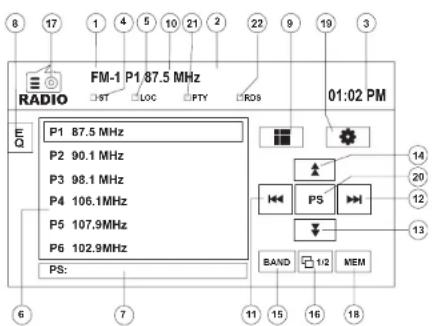
- Current radio band indicator
- Radio frequency indicator
- Clock
- Stereo broadcasting indicator
- Strong Local signal broadcasting indicator
- Preset radio stations: Touch to recall preset stations
- Information about the current function
- EQ: Touch for quick access to Equalizer level settings
- : Tach to access the direct entry screen
- Current preset station indicator
- |<<| Touch to seek backward
-
|: Touch to seek forward
- <<: Touch to tune backward one step
-
: Touch to tune forward one step
- BAND: Touch to change between AM/FM bands
-
1/2: Touch to view a second screen of menu choices
-
:ch to view the SOURCE MENU and select a new playback source
- MEM: View screen used to enter current channel into preset memory
- : Much to view the SETUP menu
- PS (Preview Scan): Touch to scan all stations available, stopping for 5 seconds at each and continuing until a station is selected
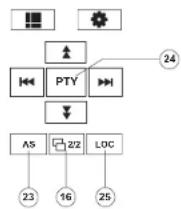
21.PTY Ind.
22.BDS Indicators - AS: Touch to automatically store stations
- PTY: Touch to activate the PTY function
- LOC: Press to activate/deactivate the Local function
Switching to Radio Tuner Source
- Touch the top left corner of the screen (the RADIO circle) to view the SOURCE MENU. Touch "Radio".
Press the SRC button (10) on the front panel or remote control (8) to switch to the AM/FM or RADIO source.
Selecting FM/AM Band
Touch the BAND button (15) on the screen, or press the | BAND button on the remote control (30) to change between the following bands: FM1, FM2, FM3, AM1, and AM2.
NOTE: The BAND button on the unit only works when the TFT is closed.
Seek Tuning
To seek the next higher station:
- Touch the >>| button on screen.
- Press the >> button (19) on the remote control.
To seek the next lower station: - Touch the |<< button on screen.
- Press the |<< button (17) on the remote control.
Manual Tuning
To increase or decrease the tuning frequency one step:
- Touch the or buttons on screen.
Press the >> or << buttons (14, 22) on the remote control.
Direct Tuning
To enter a radio station directly, touch the button or press the GOTO button (21) on the remote control to display the direct entry menu.
| FM: . . MHz | |||
| 1 | 2 | 3 | Exit |
| 4 | 5 | 6 | |
| 7 | 8 | 9 | Enter |
| 0 | Clear | ||
Enter the desired radio station using the on-screen number pad. Press the Enter button to tune to the selected station. To exit the screen without changing the station, touch Exit. To clear your entry and start over, touch Clear.
Using Preset Stations
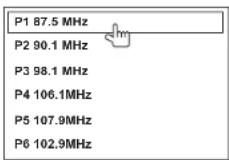
Six numbered preset buttons store and recall stations for each band. All six stored stations (P1-P6) for the current band appear on the screen.
Storing a Station
- Select a band (if needed), then select a station.
- Touch the on-screen MEM button (18) to open the preset screen.
| Preset:_ | ||
| P1 | P2 | P3 |
| P4 | P5 | P6 |
| Ex i t | ||
- Touch the preset number in which you would like to store the current station (or touch Exit to cancel and close the menu). The preset number and station appears highlighted.
Recalling a Station
- Select a band (if needed).

UV10
- Touch an on-screen preset button (6) to select the corresponding stored station.
Auto Store/ Preview Scan (AS/ PS)
Auto Store (AS)
To select six strong stations and store them in the current band:
- Select a band (if needed).
- Touch the AS button (23) on page 2/2 of the on-screen controls to activate the Auto Store function.
The new stations replace stations already stored in that band. Preview Scan (PS)
To scan the AM or FM band for a preview of available stations in your particular area, touch the PS button (20). Touch again to stop preview scan.
Local Radio Station Seeking (LOC)
When the Local function is on, only radio stations with a strong local radio signal are played. To activate the Local function in AM/FM tuner mode, press and hold the rotary encoder button (11) on the front panel. Press and hold the rotary encoder again to turn Local off. When the Local function is active, the LOC indicator at the top of the screen is illuminated,
NOTE: When properly installed, DVD video cannot be displayed on the main TFT screen unless the parking brake is applied. If you attempt to play a DVD while the vehicle is moving, the TFT screen displays "PARKING" with a blue background. Rear video screens, if applicable, will operate normally.
Opening/ Closing the TFT Video Screen
Opening the TFT Screen
To open the TFT video screen, press the OPEN button (1). The unit beeps and then opens.
Closing the TFT Screen
Press the OPEN button (1) again to close the TFT screen. If the screen is in the "IN" position, it moves out before closing.
Inserting a Disc
Upon inserting a DVD disc, DVD mode is entered and disc play begins.
NOTE: If Parental Lock (Rating) is activated and the disc inserted is not authorized, the 4-digit code must be entered and/or the disc must be authorized (see "Rating Sub-menu Features" on page 9).
You cannot insert a disc if there is already a disc in the unit or if the power is off.
NOTE: DVD-R and DVD-RW will not play unless the recording session is finalized and the DVD is closed.
Ejecting a Disc
Press the button (6) on the unit or remote control (35) to eject the disc. The unit automatically reverts to Tuner mode. You may eject a disc with the unit powered off. The unit will remain off after the disc is ejected.
Resetting the Loading Mechanism
If the disc loads abnormally or an abnormal core mechanism operation occurs, press and hold the button (6) on the unit or remote control (35) to reset the loading mechanism. Normal operation resumes.
Accessing DVD Mode
To switch to DVD mode when a disc is already inserted, press the SRC button (10) on the front panel or remote control (8).
Controlling Playback
To access the on-screen controls, touch the bottom 1/3 of the screen while a DVD is playing. Touch the 1/2 button to view a second page of controls
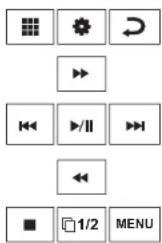
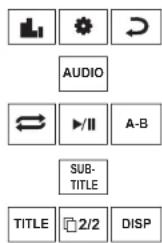
Stopping Playback
Touch the stop button (串) on the screen or press the ||| - | BAND button (20) on the remote control to stop DVD play. Pausing Playback
Touch the play/pause button (≥) on the screen or press the × /|| button on the remote control (18) to suspend or resume disc play.
Slow Motion Playback
Press the << button (22) on the remote control or the << button on the screen to play the current title in slow motion. Keep pressing and releasing the button to increase the rate from "x2" to "x4", "x8", and "x20".
Press (16) on the remote control or touch the on-screen play button (>) to resume normal play.
Fast Forward Playback
Press the >> button (14) on the remote control or the >> button on the screen to fast forward. Keep pressing and releasing the button to increase the rate from "x2" to "x4", "x8", and "x20".
Press 11 (18) on the remote control or touch the on-screen play button (≥) to resume normal play.
Repeat Playback
Press the RPT button (7) on the remote control or the button on screen to alter repeat mode according to the following:
DVD: Repeat Chapter, Repeat Title, Repeat Off
VCD (PBC Off): Repeat Single, Repeat Off
NOTE: For VCD play, the repeat function is not available if PBC is on.
Sectional Repeat Function (A-B)
Use the A-B function to define a specific area of a disc to repeat.
Press the REPT A-B button (6) on the remote control (or the A-B button on screen) to set the start point (A) of the repeated section.
- Press the REPT A-B button again once you reach the desired end point (B) of the repeated section. The selected portion of the DVD will now repeat continuously.
- Press the REPT A-B button again to cancel the A-B section setting and stop repeat play.
Accessing the DVD Menu
Press the MENU button (1) on the remote control to recall the main DVD menu. Use the directional (arrow) buttons on the remote control to select a title from the menu or touch the title on screen.
Press the TITLE button (2) on the remote control or on screen to select a different title for playback.
Press the >| button (18) on the remote control or press the rotary encoder (11) to confirm your selection and begin playback. You can also select a title using the touch screen
Moving Through Chapters
Press the >> button (19) on the remote control or the >> button on screen to advance to the next chapter on the DVD. Press the << button (17) on the remote control or the << button on screen to move to the previous chapter.
Goto Search
During DVD or VCD playback, perform the following steps to use the GOTO feature to access a specific location on a disc:
- Press the GOTO button (21) on remote control to access the "Search" screen.
- Press the >> or << buttons (14, 22) on the remote control to select a category (highlighted in yellow).

- For DVD mode, you can choose Time or Title/ Chapter search.
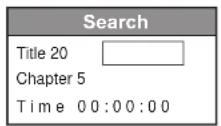
DVD Search
Title - Go to specific title
Chapter - Go to specific chapter
Time - Go to specific time in current title
- For VCD mode, press the GOTO button to choose between Time search.
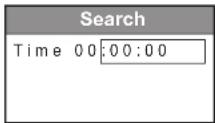
VCD Track Search
Time - Go to specific time in the current track
- Enter a time into the field using the numeric keypad (29) on the remote control.
- Press the × / button (18) on the remote control or press the rotary encoder (11) to go to the specified location on the disc.
- Press the GOTO button again to exit.
Direct Chapter / Track Selection
Remote Control Direct Entry
During DVD, VCD and CD playback, you can use the numeric keypad on the remote control (29) to access a track directly.
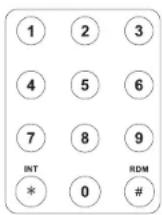
Touch Screen Direct Entry
To select a chapter/track directly, touch the button on screen control to display the direct entry menu.
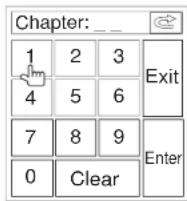
Enter the desired chapter/track using the on-screen number pad. Press the Enter button to tune to the selected station. To exit the screen without changing the station, touch Exit. To clear your entry and start over, touch Clear.
Viewing an Alternate Picture Angle (DVD Only)
Some DVDs contain scenes that have been shot simultaneously from different angles. For discs recorded with multiple angles, press the ANGLE button (13) on the remote control to toggle available angles of the on-screen image.
Zooming
Press the ZOOM button (23) on the remote control to enlarge and pan through the video image using the following options: "O1", "O2", "O3" and "OFF".
Multi-Language Discs (DVD Only)
Changing Audio Language
If you are watching a disc recorded in multiple languages, press the AUDIO button (5) on the remote control to choose a language.
Changing Subtitle Language
If you are watching a disc recorded in multiple languages with subtitles, press the SUBTITLE button (9) on the remote control to choose the language in which you would like the subtitles to appear.
NOTE: During VCD playback, press the AUDIO button (5) on the remote control to choose between Left Channel, Right Channel, and Stereo.
UV10
PBC - Play Back Control (VCD Only)
For VCDs with play back functionality, play back control (PBC) provides additional controls for VCD playback. Press the MENU button (1) on the remote control to toggle the PBC function "On"/"Off". Once PBC is on, playback starts from track one of the play list.
NOTE: When PBC is activated, fast forward, slow playback, and previous/next track are available. Repeat and direct track selection are not available.
When PBC is activated, selecting random, scan, or search playback automatically deactivates PBC.
Playback Information
During DVD and VCD playback, press the DISP button (10) on the remote control to display playback information on the screen, including the media playing and current playback time.
DVD Playback Information
DVD Video-Format of current disc.
- Time 00:01:30/00:36:10 - Indicates the playback time of the current track.
Title 5/08 - Indicates the fifth of 8 titles on the DVD is currently playing.
- Chapter 2/16 - Indicates that the second of 16 titles on the DVD is currently playing.
VCD Playback Information
VCD2.0-Format of current disc.
- Time 00:01:30/00:36:10 - Indicates the playback time of the current track.
- PBC On/Off - Indicates whether Play Back Control is On or Off.
General Disc Information
Table 5:Disc Properties
| Symbol | 12cm Disc Properties | Max Play Time |
| DVD | Single side single layer (DVD-5) | (MPEG 2 Method) |
| VIDEO | Single side double layer (DVD-9) | 133 minutes |
| DVD | Double side single layer (DVD-10) | 242 minutes |
| VIDEO | Double side double layer (DVD-18) | 266 minutes |
| VIDEO | Single side single layer (VCD) | 484 minutes |
| CONSERV | (MPEG 1 Method) | |
| DISC | 74 minutes | |
| CONSERV | Single side single layer 74 m | nutes |
| DISC |
Table 6:Disc Symbols
| Symbol Meaning | |
| 8) | Number of voice languages recorded. The number inside the icon indicates the number of languages on the disc (maximum of 8). |
| 32 | Number of subtitle languages available on the disc (maximum of 32). |
| 91 | Number of angles provided (maximum of 9). |
| 16:9 LB | Aspect ratios available, "LB" stands for Letter Box and "PS" stands for Pan/Scan. In the example on the left, the 16:9 video can be converted to Letter Box video. |
Table 6:Disc Symbols
| Symbol Meaning | |
| Indicates the region code where the disc can be played. • Region 1: USA, Canada, East Pacific Ocean Islands • Region 2: Japan, Western Europe, Northern Europe, Egypt, South Africa, Middle East • Region 3: Taiwan, Hong Kong, South Korea, Thailand, Indonesia, South-East Asia • Region 4: Australia, New Zealand, Middle and South America, South Pacific Ocean Islands/Oceania • Region 5: Russia, Mongolia, India, Middle Asia, Eastern Europe, North Korea, North Africa, North-West Asia • Region 6: Mainland China • ALL: All regions | |
Instructions for TFT control and Insert/Eject are the same for DVD and CD operation. Please see the DVD/Disc Video Operation section for information about these topics.
The UV10 will play music or other audio files from the following disc media:
CD-DA
CD-R/RW
DVD
• D V D + R / R W • D V D - R / R W
Upon inserting a disc with the TFT screen open, the disc and track title (if available), along with the track number and playing time appear on the screen.
CD Player User Interface
The on-screen indicators and touch key areas for CD playback are outlined below.
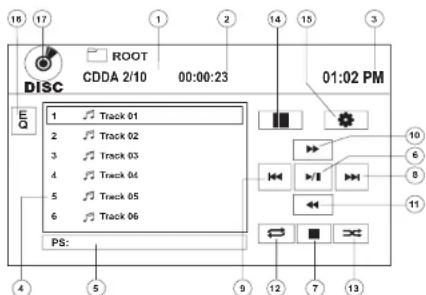
- Current track and total number of tracks on disc
- Elapsed playing time
- Current time
- Track titles
- Disc title
- /||Touch to play/pause disc playback
- : Touch to stop disc playback
-
: Touch to move to next track
- 1 < < : Touch to move to previous track
-
: Touch to fast forward current track
- Touch to rewind current track
- Touch to activate/deactivate Repeat play mode
-
Touch to activate/deactivate Random mode
-
: much to access the direct entry screen
-
:uch to view the SETUP menu
- Touch for quick access to Equalizer level settings
- Touch to view the SOURCE MENU and select a new playback source
Controlling Playback
Stopping Playback
Touch the button on screen or press the 1 > 1 BAND button (30) on the remote control to stop disc play.
To resume playback, touch the | button on screen or press the >|| button on the remote control (18).
Pausing Playback
Touch the | button on screen or press the x | button on the remote control (18) to suspend or resume disc play.
Moving Through Tracks
Press the >> button (19) on the remote control or on screen to advance to the next track on the disc.
Press the |< button (17) on the remote control or on screen to move to the previous track.
Repeat Playback
Touch the button on screen or press the RPT button (7) on the remote control to alter repeat mode according to the following:
DVD: Repeat Chapter, Repeat Title, Repeat Off
CDDA: Repeat Single, Repeat Folder, Repeat Off
- CD-R/RW: Repeat Single, Repeat Off
DVD-R/RW:Repeat Single,Repeat Off
Track Scan Select (CD-DA discs only)
During disc play, press the INT button (34) on the remote control to play the first 10 seconds of each track. When a desired track is reached, press the INT button again to cancel the function and play the selected track.
Random Play Select
While disc play is stopped, touch the button on screen or the RDM button (33) on the remote control to play the tracks on the disc in a random, shuffled order. Press the × (RDM) button again to cancel Random Play mode.
NOTE: CD-R and CD-RW will not play unless the recording session is finalized.
Fast Forward
Touch the >> button on screen or press the >> button (14) on the remote control to fast forward. Keep pressing and releasing the button to increase the rate from "x2" to "x4", "x8", and "x20". Press the > / || button to resume normal playback.
Direct Track Entry
To select a track directly, touch the button on screen control to display the direct entry menu.
| Chapter: | ||
| 1 | 2 | 3 |
| 4 | 5 | 6 |
| 7 | 8 | 9 |
| 0 | Clear | |
Enter the desired track using the on-screen number pad. Press the enter button (arrow) to tune to the selected station. To exit the screen without changing the station, touch Exit. To clear your entry and start over, touch Clear.
MP3/WMA OPERATION
Instructions for TFT control and Insert/Select are the same for DVD and MP3 operation. Please see the DVD/Disc Video Operation section for information about these topics.
Media and File Requirements
This player allows you to play back MP3 and WMA files recorded onto CD-R/RWs, DVD+R/RWs, and DVD-R/RWs. For CD-RW discs, please make sure it is formatted using the full method and not the quick method to prevent illegal disc operation.
Up to 1500 songs/files can be burned onto a disc for a MEGA DVD music mix. Do not exceed this number of songs/files or disc readability problems may occur.
MP3 Format Compatibility
The file naming formats listed below are compatible with this unit:
ISO 9660 - file name: 12 characters, file extension: 3 characters
- ISO 9660 - file name: 31 characters, file extension: 3 characters
Joliel-64 characters
If the file or folder name does not conform to ISO 9660 file system standards, it may not be displayed or played back correctly. Use the following settings when compressing audio data for your MP3 disc:
- Transfer Bit Rate: 128kbps
Sampling Frequency: 48kHz
When recording MP3 up to the maximum disc capacity, disable additional writing. For recording on an empty disc up to maximum disc capacity, use the "Disc at once" setting.
MP3 Playing Order
When selected for play, files and folders (Folder Search, File Search or Folder Select) are accessed in the order they were written by the CD writer. As a result, the order in which they are expected to be played may not match the order in which they are actually played. You may be able to set the order in which MP3/WMA files are to be played by writing them onto a medium such as a CD-R with their file names beginning with play sequence numbers such as "01" to "99".
For example, a medium with the following folder/file hierarchy is subject to Folder Search, File Search or Folder Select, as shown below.
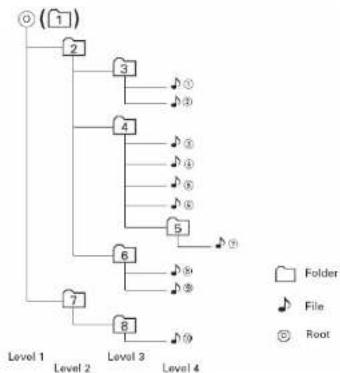
The UV10 player will only recognize three folder levels and does not display folders containing only other folders. In the example above, the unit will display folders 3, 4, 6, and 8, but not 2 and 7 since they do not contain any tracks directly. Folder 5 is not recognized at all since it is at the fourth level.
Inserting a USB Device
NOTE: The USB port will recognize most USB flash memory devices and portable hard drives (hard drives must be formatted to FAT32, NTFS is not supported).
- Locate the USB connector (14) on the front of the radio.
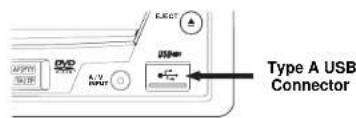
- Lift the protective cover to reveal the USB slot.
- Insert the USB device into the USB connector. The unit will read the audio/video files on the USB device automatically.
To remove the USB device, press the SRC button (10) to switch to another mode and then remove the USB device from the USB connector.

UV10
MP3 User Interface
The on-screen indicators and touch key areas for MP3 playback are outlined below.
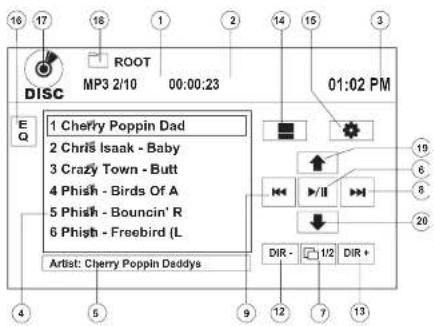
- Current track and total number of tracks on disc
- Elapsed playing time
- Current time
- Track titles
- ID3 information
- /I: Touch to play/pause disc playback
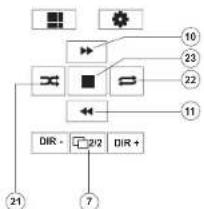
- 1/2, 2/2: Touch to move between page 1 and 2 of the on-screen controls
-
: Touch to move to next track
- 1 < < 1 Touch to move to previous track
-
: Touch to Fast Forward x2, x4, x8, x20
11.<<: Touch to Fast Backward x2, x4, x8, x20 - DIR : Touch to view the previous folder
- DIR+: Touch to view the next folder
- : much to access the direct entry screen
-
: much to view the SETUP menu
-
Touch for quick access to Equalizer level settings
- Touch to view the SOURCE MENU and select a new
playback source - Folder name
- Page Up
- Page Down
- Random On > Random Off
- Repeat Single > Repeat Folder > Repeat Off
- : much to stop disc playback
Controlling Playback
Playing MP3/WMA Files
After inserting a MP3/WMA disc, files will play in the sequence of the "Root" directory.
NOTE: When burning MP3 / WMA files onto a DVD disc, use the 2X or 4X burning option, if available. This slower burning speed will help eliminate buffer errors and increase disc reading reliability. Also, use folders when burning large numbers of songs / files to a disc for easy music navigation. Select the "Disc at Once" option and close your disc.
Stopping Playback
Touch the button on screen or press the BAND button (30) on the remote control to stop disc play.
To resume playback, touch the button on screen or press the >/I button on the remote control (18).
Pausing Playback
Touch the button on screen or press the >| button on the remote control (18) to suspend or resume disc play.
Moving Through Tracks
Press the >> button (19) on the remote control or on screen to advance to the next track on the disc.
Press the |<< button (17) on the remote control or on screen to move to the previous track.
Repeat Playback
Press the RPT button (7) on the remote control to alter repeat mode according to the following: Repeat Single, Folder Repeat, Repeat Off
NOTE: CD-R and CD-RW will not play unless the
recording session is finalized.
Direct Track Entry
Use the numeric keypad (29) on the remote control to access files directly or press the button (see "Direct Track Entry" on page 16).
iPod OPERATION
NOTE: Be sure your iPod has the latest Apple firmware installed to avoid connectivity issues.
Accessing iPod Mode
This unit is Made for iPod. You can control your iPod via touch screen to access Playlist, Artist, Album, Songs, etc. Supported models include, but are not limited to, the following:
- iPod Classic
- iPod Touch
- iPod Touch 2G
- iPod Nano 3G
iPod Nano 4G
The unit will automatically switch to iPod mode when an iPod is plugged into the front or rear USB connector.
NOTE: For basic iPod connectivity, you can use the white 30-pin to USB iPod cable that came with your Apple device. For iPod video or photo playback, you must purchase the JLink-USB cable.
To return to the iPod menu from any other source menu, press the SRC button (10) on the front panel or remote control (8) until the iPod menu appears on the screen. The on-screen indicators and touch key areas for iPod playback are outlined below.
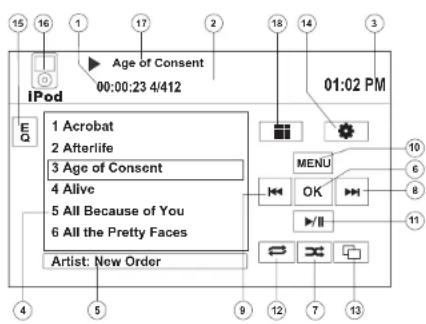
- Elapsed playing time for current file
-
File number and total number of files on the disc
-
Current time
- File titles
- ID3 information (Artist/Album)
- OK: Touch to "Enter"
- Touch to play all files in random order
-
|: Touch to move to next file
- 1 < < 1 Touch to move to previous file
- MENU: Touch to view the iPod main menu
- : touch to play/pause disc play
- Touch for Repeat File > Repeat Folder
- Touch to view the album art screen
- : much to view the SETUP menu
- Touch for quick access to Equalizer level settings
- View SOURCE MENU and select a new source
- Current file title
- : much to access the direct entry screen
Controlling your iPod
Touch the MENU button or press the following remote control buttons to access the main iPod menu.
| Menu Remote Control | |
| Music | AUDIO |
| Photos | SUBTITLE |
| Videos | ANGLE |
Use the touchscreen or the directional keys on the remote control to navigate the iPod menus.
File Playback
To access files, touch the MENU button on screen until you return to the main iPod menu and then select "MUSIC," "VIDEO" or "PHOTO" or press the remote control button indicated in the table above.
- Touch the > button on screen to play/pause.
- Touch >> on screen or press the >> button (19) on the remote control to move to the next item on the menu.
- Touch | < < | on screen or press the | < < | button (17) on the remote control to move to the previous item on the menu.
- Use the touch screen or press the || button (18) on the remote control to select the highlighted menu option.
- Press the >> button (14) on the remote control or touch the MENU button on screen, to return to the previous menu.
During music playback, the following screen is displayed:
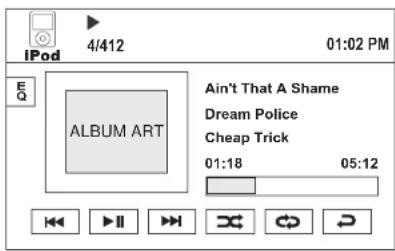
To return to the iPod music menu from the album art screen, press
To return to the Video or Photo menu while viewing video or photo, touch the screen.
Fast Forward/Fast Reverse
Press and hold the |< or >> buttons on screen or on the remote control (17, 19) for 1 second and continue to hold for fast forward or fast reverse. Release to resume normal play.
Search Playlist/Artist/Album/Song
To search through Playlists, Artists, Albums and Songs, press the MENU button (1) on the remote control while in one of the following directories: Playlist, Artist, Album or Song. The selected directory will be accessed with the number of pages and files in that directory displayed at the top of the page. To access the page or file, enter the page or file number directly from the remote control keypad. Press the |<< or >> button (17, 19) on the remote control to select the desired song or file.
Direct Track Entry
| Track: | |||
| 1 | 2 | 3 | Exit |
| 4 | 5 | 6 | |
| 7 | 8 | 9 | Enter |
| 0 | Clear | ||
To select a track directly, touch the button on screen control to display the direct entry menu.
Enter the desired track using the on-screen number pad. Press Enter to tune to the selected station. To exit the screen without changing the station, touch Exit. To clear your entry and start over, touch Clear.

UV10
NOTE: To transmit the video from your IPod to the UV10 screen, you must set the following options through the IPod video settings menu: TV Out = On, TV Signal = NTSC, and Widescreen = On.
NOTE: After disconnecting your iPod, the UVI0 will always return to the last mode accessed when the iPod is plugged back into the unit.
BLUETOOTH OPERATION
NOTE: Bluetooth operation requires optional BTM10 accessory.
About Bluetooth
Bluetooth is a short-range wireless radio connectivity technology that is developed as a cable replacement for mobile phones, handheld PCs and other devices. Bluetooth operates in 2.4 GHz frequency range and transmits voice and data at speeds up to 1 megabit per second. Bluetooth was launched by a special interest group (SIG) comprised of Ericsson Inc., Intel Corp., Nokia Corp., Toshiba and IBM in 1998, and it is currently developed by nearly 2,000 companies worldwide. The Bluetooth word mark and logos are owned by the Bluetooth SIG, Inc. and any use of such marks by Audiovox Corporation is under license. Other trademarks and trade names are those of their respective owners.
NOTE: The line-of-sight distance between this unit and your cellular phone must be 8 meters or less for sending and receiving voice and data via Bluetooth wireless technology. However, the transmission distance may become shorter than the estimated distance, depending on the environment in use.
Before attempting to use the Bluetooth functions on the UV10, you must purchase and install the BTM10. When connected properly, the blue light appears illuminated. Bluetooth features are only available when the BTM10 is installed.
Please make sure your mobile phone supports Bluetooth functions (Headset or Handfree profiles or both). Adhere to the following guidelines for successful operation.
Before using Bluetooth functions, you must pair your mobile phone to the UV10 head unit (see "Pairing the Bluetooth System with Your Mobile Phone and Head Unit"). To ensure the best reception for pairing and reconnection, please make sure the phone battery is fully charged before you begin.
- Try to perform pairing within a few minutes of the phone being turned on.
- Once the unit has been paired with the phone, the unit's model number, "UV10", will be displayed on the mobile phone.
- To achieve the best performance, always keep the mobile phone within 3 meters of the head unit.
- Always keep a clear path between the mobile phone and the head unit. Never place a metal object or any other obstacle between the mobile phone and the head unit.
Some mobile phones (like Sony Ericsson) may have a "Power Saving Mode" option. PLEASE DO NOT use the power saving mode with the UV10.
Before accepting or making a call, make sure your mobile phone's "Bluetooth function" is turned on.
To ensure the best conversation quality/performance, stay within one meter of the BTM10 when talking. - To "disconnect" the mobile phone from the head unit, turn the Bluetooth connectivity off on the mobile phone or touch the button.
- Phone Book direct searching through the head unit is only available if the mobile phone supports Phone Book Download. If the feature is not supported, the head unit will display "Phone book not provided by this phone" when an attempt is made to download a phone book.
Bluetooth User Interface
The on-screen indicators and touch key areas for Bluetooth operation are outlined below.
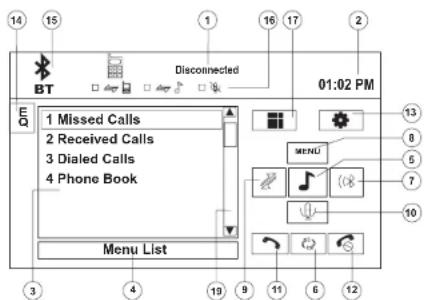
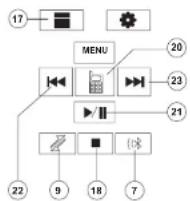
PHONE INTERFACE
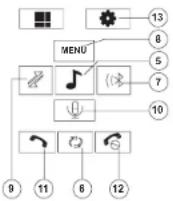
MUSIC INTERFACE
- Current connection status/device connected
- Current time
- Bluetooth menu
- Current operation status
- Toggle Music/Phone menu
- Transfer active call back to handset
- Pair your Bluetooth phone (first time use)
8.Exit call listing display - Connect/disconnect Bluetooth device (phone, PDA, personal music player, etc.) with hand-free function
- Mute/un-mute microphone during active call
- Answer incoming call/make call
- Reject incoming call/end call/quit pairing process/quit reading phone book or call listing
- :uch to view the SETUP menu
- Touch to view the equalizer
- Touch to view the SOURCE MENU and select a new playback source
- Status indicators (phone mode, music mode, mic mute)
- : much to access the direct entry screen
- :uch to stop A2DP playback
- Touch the scroll bar and arrows to view the previous/ next page of choices (only visible when needed)
- Toggle Music/Phone menu/mode
-
/||: Play/Pause selected file
- 1 < < : Touch to move to the previous file
- : Touch to move to the next file

Hands Free Profile (HFP)
To use a phone wirelessly with this unit, it is necessary to first establish a connection using Bluetooth wireless technology. Connection is normally established using HFP (Hands Free Profile), which gives you full control of functions available on the telephone source. However, depending on your phone, the connection may be made using HSP (Head Set Profile), making some functions unavailable. This is a limitation of your phone, not the UV10.
Since there are a number of Bluetooth mobile phone implementations available on the market, operations with your Bluetooth mobile phone using this unit vary greatly. Please refer to the instruction manual that came with your Bluetooth mobile phone along with this manual while operating your phone with this unit.
Pairing the Bluetooth System with Your Mobile Phone and Head Unit
- Press the (按钮 button (7) to initiate the pairing process. Keep the mobile phone within 2 meters of the head unit when pairing. (To terminate the pairing process, press the (button again.)
- Select the Bluetooth setup option on the mobile phone to be paired (please refer to the phone's instruction manual to learn how to enter Bluetooth setup, turn Bluetooth on/off, and perform pairing).
NOTE: Some phones require a "pass key" or pairing code to connect. If your phone requires a pass key or pairing code, you will need to enter this number in the Pairing Code field under the Bluetooth SETUP menu. The default pairing code for many phones is "0000". The default code for the UV10 is "1234". See "Bluetooth Submenu Features" on page 9 for instructions on entering the pairing code.
- Select "UV10" from the pairing list on the mobile phone. If pairing is successful, the TFT will display the paired mobile phone model number or name (as specified in your phone's Bluetooth Setup menu).
- If pairing fails, "Phone Pairing Fail" is displayed at the bottom of the screen.
Reconnecting
Once the Bluetooth device has been paired, you can touch the connect button (9) to reconnect.
NOTE: You can only connect to a phone using the buttons on the on-screen Phone Interface.
Each time the button is pressed, the head unit will automatically reconnect with the mobile phone once (only if the mobile phone was previously paired with the head unit).
Managing Incoming Calls
When connected to a Bluetooth phone, the unit will mute audio output, pause CD play, and change to the Bluetooth screen when a call is received. An incoming phone number will appear at the top of the screen.
Answering an Incoming Call
To answer the call, touch the button (11).
NOTE: The TALK button on the BTM10 can be used to answer calls or hang up.
For best reception, speak loudly and clearly.
To end the conversation, press the button (12). The screen will display the call duration for 3 seconds, and then return to the previous mode.
Rejecting an Incoming Call
Touch the button to reject an incoming call. The call will revert to your phone and can be answered directly or left for voice mail.
Volume Control
To increase or decrease the volume level, turn the AUDIO control (5) on the front panel or press the VOL+VOL- buttons on the remote control (15, 16).
Microphone Mute
To mute the microphone, touch the button (10). Touch again to resume microphone functionality.
Making an Outgoing Call
NOTE: Press the button from the main Bluetooth screen to automatically dial the last call received.
- Touch the button to open the direct dial screen.
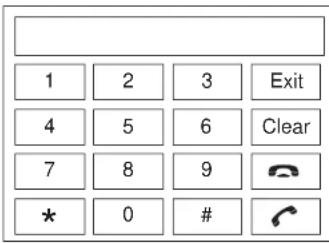
- Use the 0-9, *, and # buttons to input the phone number.
- Touch the CLEAR button to clear the last digit.
- Touch the button to clear the entire number and start over.
- After entering the phone number, press the button to
dial the call. The direct dial screen will close once your call is connected.
To end the conversation, press the button.
Call Transfer
While talking, to transfer audio from the head unit back to the mobile phone, touch the button (6). The TFT will display "Transfer". You can only transfer a call after it has been answered.
Menu List
The menu list appears on the left side of the screen and can be accessed from other modes by touching the MENU button on the right side of the screen.
NOTE: Not all phones allow access to missed, received or dialed calls and some will not allow uploading of your phone's address book.
Missed Calls
The Missed Calls list retrieves the list of Missed numbers from your phone. The last missed number is the first number on the list. Touch the Missed Calls menu option to view the list. To make a call from the Missed Calls list, touch the number and then touch the button. The TFT will display "Cannot get missed record" when the feature is not available.
UV10

Dialed Calls
The Dialed Calls list retrieves the list of dialed numbers from your phone. The last dialed number is the first number on the list. Touch the Dialed Calls menu option to view the list. To make a call from the Dialed Calls list, touch the number and then touch the button. The TFT will display "Cannot get dialed record" when the feature is not available.
Received Calls
Use the Received Calls list to view the last 10 received numbers stored on your phone. To access the Received list, touch the Received Calls menu option. The last received number is the first number on the list. To make a call from the
Received Calls list, touch the number and then touch the button. The TFT will display "Cannot get received record" when the feature is not available.
Phone Book
- Touch the Phone Book menu option to display the phone book stored on your mobile phone, if compatible. The screen will display "Ready..." while the phone book is downloading.
- Once the download is completed, you can use the arrow buttons and scroll bar on the right side of the window to navigate the list. Since the unit downloads one page of entries at a time, there may be a slight delay while the next page of numbers is downloaded.
- Touch to highlight the number you want to dial and then touch the button.
NOTE: Some mobile phones do not support Phone Book upload through Bluetooth. This is a limitation of the phone, not the UV10.
Bluetooth Setup
Auto Answer
You can choose to have the UV10 automatically answer incoming calls to your paired Bluetooth phone. To turn "Auto answer" on:
- Touch the button to view the SETUP menu.
- Select the "Bluetooth" sub-menu.
- Touch the area to the right of "Auto answer" to select "Auto".
Auto Connect
The auto Connect option will allow the UV10 to automatically connect to your previously paired Bluetooth when it is in range. When the Connect option is set to "Manual", you must
press the button to re-establish a connection with your phone. To turn auto "Connect" on:
- Touch the button to view the SETUP menu.
- Select the "Bluetooth" sub-menu.
- Touch the area to the right of "Connect" to select "Auto".
Advanced Audio Distribution Profile (A2DP)
The UV10 allows you to play back audio files from your phone, PDA or personal music player using a Bluetooth connection.
Before using an audio player, it may be necessary to enter a PIN code into the unit. Enter the PIN code referring to "Bluetooth Sub-menu Features" on page 9.
NOTE: Please quit A2DP mode before attempting to make a phone call, as unexpected results may occur depending on your mobile phone model.
The UV10 can control a Bluetooth audio player via Advanced Audio Distribution Profile (A2DP) or Audio/Video Remote Control Profile (AVRCP). Bluetooth audio players (or Bluetooth adapters) compatible with these profiles can be connected to this unit. Functionality varies depending on the profile used.
TROUBLESHOOTING
Table 7: Troubleshooting
| Problem Cause Corrective Action | ||
| GENERAL | ||
| Unit will not power on Radio Fuse blown Install new fuse with correct rating | ||
| Remote control does not function Battery depleted Replace battery with new one | ||
| No/low audio output Improper audio output connection Check wiring and correct | ||
| Volume set too low Increase volume level | ||
| Improper "MUTE" connection | Review wiring diagram and check "MUTE" connection | |
| Speakers damaged | Replace speakers | |
| Heavily biased volume balance | Adjust the channel balance to the center position | |
| Speaker wiring is in contact with metal part of car | Insulate all speaker wiring connections | |
| Poor sound quality or distortion | Pirated disc is in use | Use original copy |
| Speaker power rating not compatible with unit | Connect proper speakers | |
| Speaker is shorted | Check speaker contact | |
| Unit resets itself when engine is off | Incorrect connection between ACC and positive battery wire | Check wiring and correct |
| TFT MONITOR | ||
| Monitor does not open automatically | TFT Auto Open is turned off | Turn TFT Auto Open on |
| No image | Incorrect connection to parking brake wire | Check wiring and correct |
| Parking brake is not engaged | Stop vehicle in safe place and apply parking brake | |
| Flashing image or interference appears on screen | DVD is not compatible with current TV system settings | Change setup to accommodate disc |
| Improper video signal connections | Check wiring and correct | |
| Prolonged image or improper height/width ratio display | Improper aspect ratio setup | Use correct aspect ratio setting |
| Monitor stops at incorrect position | Moving path is blocked | Press OPEN key to restart monitor movement |
| TUNER | ||
| Weak station searching | Auto antenna is not fully extended | Connect the auto antenna control cable properly |
| Auto antenna not properly connected | Connect the auto antenna control cable properly | |
| LOCAL function is activated | Turn LOCAL function off | |
| Cannot insert disc | Disc already inside unit | Eject current disc and insert new one |
| Image blurred, distorted, or dark | Disc is illegally copied | Use original disc |
Table 7: Troubleshooting
Error Messages
| Problem | Cause | Corrective Action |
| Disc does not play back Disc is warped or scratched Use disc in good condition | ||
| Disc is dirty or wet Clean disc with soft cloth | ||
| Laser pickup is dirty Clean laser pickup with clean ng disc | ||
| Incompatible disc is used Use compatible disc | ||
| Disc rating exceeds Parental Lock rating limit Cha ge Parental Lock settings to lower restriction | ||
| Disc region code is not compatible with unit Use d sc with proper region code | ||
| Disc is inserted upside down Insert disc with label side up | ||
| PBC cannot be used during VCD playback PCB is not available on the disc | ||
| No repeat or searching while playing VCD PCB is on Turn PCB off | ||
| MP3 | ||
| Interruption occurred during playback Disc is dirty or scratched Clean disc or replace | ||
| File is damaged/bad recording | Recreate disc with good files | |
| Incorrect playback message displayed | Message is longer than LCD can display | |
Table 8: Error Messages
| Message Displayed | Cause | Corrective Action |
| Loading | Disc is being read | |
| No Disc | Disc is dirty | Clean disc with soft cloth |
| Disc is upside down | Insert disc with label side up | |
| Disc not present in loading compartment | Insert disc | |
| Bad Disc | Disc is dirty | Clean disc with soft cloth |
| Disc is upside down | Insert disc with label side up | |
| Unknown disc Disc format is not compatible with this unit | ||
| Region Error | DVD is not compatible with region code of unit | |
| Error | Illegal mechanism operation | Press EJECT key for 5 seconds to reset loading mechanism |
Care and Maintenance
- Use only a clean silicone cloth and neutral detergent to clean the front panel or monitor. A rough cloth and non-neutral detergent (such as alcohol) may result in scratching or discoloration.
- Do not get water or cleaning fluids on the unit.
-
If the temperature inside the player gets too hot, a protective circuit automatically stops play of the disc. If this occurs, allow the unit to cool before operating the player again.
-
Never insert anything other than a 5 (12 cm) compact disc into the player as the mechanism can be damaged by foreign objects.
- Do not attempt to use a 3° (8 cm) CD-Single disc in this unit, either with or without an adaptor, as damage to the player and/or disc may occur. Such damage is not covered by the Warranty on this product.
- The CD player may not operate properly in extreme hot or cold. If such conditions occur, allow the interior of the
vehicle to reach a normal temperature before using player.
- When the vehicle warms up during cold weather or under damp conditions, condensation may appear on the LCD panel. Should this occur, the screen will not operate properly until the moisture has evaporated.
- We suggest you use a cleaning disc in this unit more frequently than in the unit in your home due to the environmental conditions of the vehicle.
SPECIFICATIONS
DVD/CD Player
Compatible Disc Media: DVD + R / RW (Single and Dual
Layer) and CD-R / RW
Compatible Media Formats: CD-DA, MP3, WMA, VCD
SVCD, Xvid, AVI, MPEG1/
Signal to Noise Ratio: >95dBA
Dynamic Range: >95dB
Frequency Response: 20Hz to 20 kHz, -3dB
Channel Separation: >60dB @ 1 kHz
D/A Converter: High performance 24-bit / 192 kHz sample
rate, Multi-Bit Sigma-Delta Modulator
Video
Format: NTSC, PAL (auto-detection)
Output: 1Vp-p (75-ohm)
Input: 1Vp-p (75 ohm)
FM Tuner
Tuning Range: 87.5MHz - 107.9MHz
Mono Sensitivity (-30dB): 9dBf
Quieting Sensitivity (-50dB): 15dBf
Alternate Channel Selectivity: 70dB
Signal to Noise Ratio @ 1 kHz: 58dB
Image Rejection: 80dB
Stereo Separation @ 1 kHz: >30dB
Frequency Response: 30Hz - 15 kHz, -3d
AM Tuner
Tuning Range: 530kHz -1720 kHz
Sensitivity (-20dB): 15uV
Signal to Noise Ratio @ 1 kHz: 50dB
Image Rejection: 60dB
Frequency Response: 50Hz - 2 kHz, -3dB
Monitor
Screen Size: 7.0° (Measured diagonally), 16:9 Widescreen,
6.06" (154.1mm) W X 3.42" (87mm) H
Screen Type: TFT Liquid Crystal Display (LCD) active matrix
Resolution: 336.960 sub pixels, 1440 (W) X 234 (H)
General
Auxiliary Input impedance: 10k
Power Supply: 11 to 16VDC, negative ground
Power Antenna (Blue): 500mA max, current limited protection
Amplifier Remote (Blue/White): 500mA max, current limited
protection
Operating Temperature: -20C ~ 65C
DIN chassis dimensions: 7'' × 7'' × 2'' (178mm x 178mm x
50mm)
CEA Power Ratings

Power Output: 13 Watts RMS x 4 channels into 4-Ohms @ <
1%THD+N
Signal to Noise Ratio: 70dBA below reference (Reference: 1)
Wait, 4-Ohms)
Frequency Response: 20 Hz - 20 kHz, -3dB. (Aux Input used
as reference input)
Reference Supply Voltage: 14.4VDC
*Specifications subject to change without notice.
PREPARACION
Felicaciones por su compra del Jensen Phase Linear UV10 Mobile Multimedia Receiver.
| FM: __. MHz | |||
| 1 | 2 | 3 | Exit |
| 4 | 5 | 6 | |
| 7 | 8 | 9 | Enter |
| 0 | Clear | ||
• D V D + R / R W • D V D - R / R W
Widescreen, 6.06" (154.1mm) W X 3.42" (87mm) H
Tipde Pantalla: Pantalla de Cristal Liquido (LCD) TFT
matriz activa
Resolution: 336,960 sub pixeles, 1440 (W) X 234 (H)
General
9. IR Remote Control Receiver
10. SRC
-
Seek Down / Previous Track / Preset Down
-
Seek Up/ Next Track / Preset Up
-
SRC (Source)
-
** Select
-
** Select
9.Band
TS Cal (Screen Calibration)
Commander la reproduction
D V + R / R W D V D - R / R W
Commander la reproduction
Arreter la reproduction
Commander la reproduction
Adaptateur D/A: High performance 24-bit / 192 kHz sample rate, Multi-Bit Sigma-Delta Modulator
Video
Format: NTSC, PAL (auto-detection)
Sortie:1Vp-p(75-ohm)
Entree:1Vp-p(75-ohm)
Tuner FM
Gamme de syntonisation : 87.5MHz - 107.9MHz
Widescreen, 6.06" (154.1mm) W X 3.42" (87mm) H
Reference Supply Voltage: 14.4VDC
DO NOT RETURN THIS PRODUCT TO THE STORE
Audiovox Electronics Corporation ("the Company") is committed to quality and customer service, and are pleased to offer you this Warranty. Please read it thoroughly and contact the Company at 1-800-323-4815 with any questions.
Who is covered?
The Company extends this warranty to the original retail purchaser of products purchased through an authorized Audiovox retailer in the U.S.A., Puerto Rico or Canada. This warranty is not transferable or assignable. Proof of purchase is required in the form of an original sales receipt.
What is covered?
The Company warrants that should this product or any part thereof, under normal use, be proven defective in material or workmanship within 12 months from the date of original purchase, such defect(s) will be repaired or replaced with a new or reconditioned product (at the Company's option) without charge for parts and repair labor.
What is not covered?
This Warranty does not cover the following:
- Damage incurred during shipping or transporting the product to the Company or a service center
- Elimination of car static or motor noise
- Defects in cosmetic, decorative or non-operative structural parts
- Correction of antenna problems
Costs incurred for installation, removal or reinstallation of the product
- Consequential damage to compact discs, USB devices, digital media cards, accessories or vehicle electrical systems
- Damage caused by improper installation, mishandling, misuse, neglect, accident, blown fuse, battery leakage, theft or improper storage
- Products whose factory serial number/bar code label(s) or markings have been removed or defaced
- Damage resulting from moisture, humidity, excessive temperature, extreme environmental conditions or external natural causes
Please review the "Care and Maintenance" section of your Installation and Operation Manual for additional information regarding the proper use of your product.
Limitations
THE EXTENT OF THE COMPANY'S LIABILITY UNDER THIS WARRANTY IS LIMITED TO THE REPAIR OR REPLACEMENT PROVIDED ABOVE AND, IN NO EVENT, SHALL THE COMPANY'S LIABILITY EXCEED THE PURCHASE PRICE PAID BY PURCHASER FOR THE PRODUCT.
This Warranty is in lieu of all other express warranties or liabilities. ANY IMPLIED WARRANTY, INCLUDING ANY IMPLIED WARRANTY OF MERCHANTABILITY, SHALL BE LIMITED TO THE DURATION OF THIS WRITTEN WARRANTY. ANY ACTION FOR BREACH OF ANY WARRANTY HEREUNDER INCLUDING ANY IMPLIED WARRANTY OF MERCHANTABILITY MUST BE BROUGHT WITHIN A PERIOD OF 24 MONTHS FROM DATE OF ORIGINAL PURCHASE. IN NO CASE SHALL THE COMPANY BE LIABLE FOR ANY CONSEQUENTIAL OR INCIDENTAL DAMAGES FOR BREACH OF THIS OR ANY OTHER WARRANTY, EXPRESS OR IMPLIED, WHATSOEVER. No person or representative is authorized to assume for the Company any liability other than expressed herein in connection with the sale of this product.
Some states do not allow limitations on how long an implied warranty lasts or the exclusion or limitation of incidental or consequential damage so the above limitations or exclusions may not apply to you. This Warranty gives you specific legal rights and you may also have other rights which vary from state to state.
Obtaining Warranty Service
- To obtain repair or replacement within the terms of this Warranty, call 1-800-323-4815 for the location of a warranty station serving your area.
- You must prepay the initial shipping charges to the Company. The Company will pay the return shipping charges for all warranted products returned to an address within the U.S.A., Puerto Rico or Canada.
- Please package the product securely to avoid shipping damage. We recommend using a carrier that provides tracking service to prevent lost packages. Lost or damaged packages are not covered by this warranty.
- Provide a detailed description of the problem(s) for which you require service.
Garantía Limitada
NE RENVOYEZ PAS CE PRODUIT AU MAGASIN
Audiovox Electronics Corporation
Hauppauge, NY 11788
Technical Assistance: 1-800-323-4815
www.jensen.com
© 2009 Audiovox
Ver. 072809
Printed in China
- CONTENIDO
- Features
- DVD
- CD/MP3/WMA
- AM-EM
- iPod
- Chassls
- General
- Optional Equipment
- - NAV102
- - BTM10
- - Bluetooth Phone
- Rear Camera
- CONTROLS AND INDICATORS
- CLOSE/OPEN
- 2.PIC/BAND
- 3.DISCSLOT
- WIDE/ |< < |
- TILT/>>
- 6.EJECT
- LCD Display
- DISP
- IR Remote Control Receiver
- 10.SBC
- Rotary Encoder
- RESET
- A/V Input
- 15.TFTDisplay
- REMOTE CONTROL
- USING THE TFT MONITOR
- Open/ Close TFT Monitor
- Open TFT Monitor
- Close TFT Monitor
- TFT Monitor Auto Open
- Monitor Tilt Angle Adjustment
- Step by Step Angle Adjustment
- Continuous Angle Adjustment
- Aspect Ratio
- Image/Display Settings
- Video Output Modes
- Parking Brake Inhibit
- Monitor Movement Mechanism
- OPERATING INSTRUCTIONS
- Power On/Off
- Audible Beep Confirmation
- Mute/Line Mute
- Playing Source Selection
- Source Menu
- External Devices
- Volume Adjustment
- Volume Increase/Decrease
- Programmable Turn-On Volume
- Audio Control Menu
- UV10
- System Reset
- Steering Wheel Control (SWC)
- SWC Functions
- Select Operation
- SETUP MENU
- Accessing Menu Items
- Adjusting a Feature
- Language Sub-menu Features
- Rating Sub-menu Features
- Hardware Sub-menu Features
- TS Cal (Screen Calibration)
- Demo Sub-Menu Features
- Exiting the System Setup Menu
- TUNER OPERATION
- Tuner TFT Display
- Switching to Radio Tuner Source
- Selecting FM/AM Band
- Seek Tuning
- Manual Tuning
- Direct Tuning
- Using Preset Stations
- Storing a Station
- Recalling a Station
- Auto Store/ Preview Scan (AS/ PS)
- Auto Store (AS)
- Local Radio Station Seeking (LOC)
- Opening/ Closing the TFT Video Screen
- Inserting a Disc
- Ejecting a Disc
- Resetting the Loading Mechanism
- Accessing DVD Mode
- Controlling Playback
- Stopping Playback
- Slow Motion Playback
- Fast Forward Playback
- Repeat Playback
- NOTE: For VCD play, the repeat function is not available if PBC is on.
- Sectional Repeat Function (A-B)
- Accessing the DVD Menu
- Moving Through Chapters
- Goto Search
- DVD Search
- VCD Track Search
- Direct Chapter / Track Selection
- Remote Control Direct Entry
- Touch Screen Direct Entry
- Viewing an Alternate Picture Angle (DVD Only)
- Zooming
- Multi-Language Discs (DVD Only)
- Changing Audio Language
- Changing Subtitle Language
- PBC - Play Back Control (VCD Only)
- Playback Information
- DVD Playback Information
- VCD Playback Information
- CD Player User Interface
- Pausing Playback
- Moving Through Tracks
- Track Scan Select (CD-DA discs only)
- Random Play Select
- Fast Forward
- Direct Track Entry
- MP3/WMA OPERATION
- Media and File Requirements
- MP3 Format Compatibility
- MP3 Playing Order
- Inserting a USB Device
- MP3 User Interface
- Playing MP3/WMA Files
- NOTE: CD-R and CD-RW will not play unless the
- recording session is finalized.
- iPod OPERATION
- Accessing iPod Mode
- Controlling your iPod
- File Playback
- Fast Forward/Fast Reverse
- Search Playlist/Artist/Album/Song
- BLUETOOTH OPERATION
- NOTE: Bluetooth operation requires optional BTM10 accessory.
- About Bluetooth
- Bluetooth User Interface
- Hands Free Profile (HFP)
- Pairing the Bluetooth System with Your Mobile Phone and Head Unit
- Reconnecting
- NOTE: You can only connect to a phone using the buttons on the on-screen Phone Interface.
- Managing Incoming Calls
- Making an Outgoing Call
- Call Transfer
- Menu List
- Missed Calls
- Dialed Calls
- Received Calls
- Phone Book
- Bluetooth Setup
- Auto Answer
- Auto Connect
- Advanced Audio Distribution Profile (A2DP)
- Care and Maintenance
- SPECIFICATIONS
- CEA Power Ratings
- PREPARACION
- SRC
- Commander la reproduction
- Arreter la reproduction
- DO NOT RETURN THIS PRODUCT TO THE STORE
- Who is covered?
- What is covered?
- What is not covered?
- Limitations
- Obtaining Warranty Service
- Garantía Limitada
- NE RENVOYEZ PAS CE PRODUIT AU MAGASIN
Brand : JENSEN
Model : UV10
Category : Car radio with screen