ManualGo.com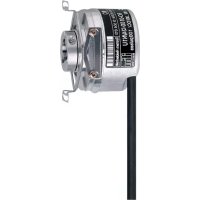
RO6350 - Industrial sensor IFM - Free user manual and instructions
Find the device manual for free RO6350 IFM in PDF.



Frequently Asked Questions - RO6350 IFM
Download the instructions for your Industrial sensor in PDF format for free! Find your manual RO6350 - IFM and take your electronic device back in hand. On this page are published all the documents necessary for the use of your device. RO6350 by IFM.
USER MANUAL RO6350 IFM
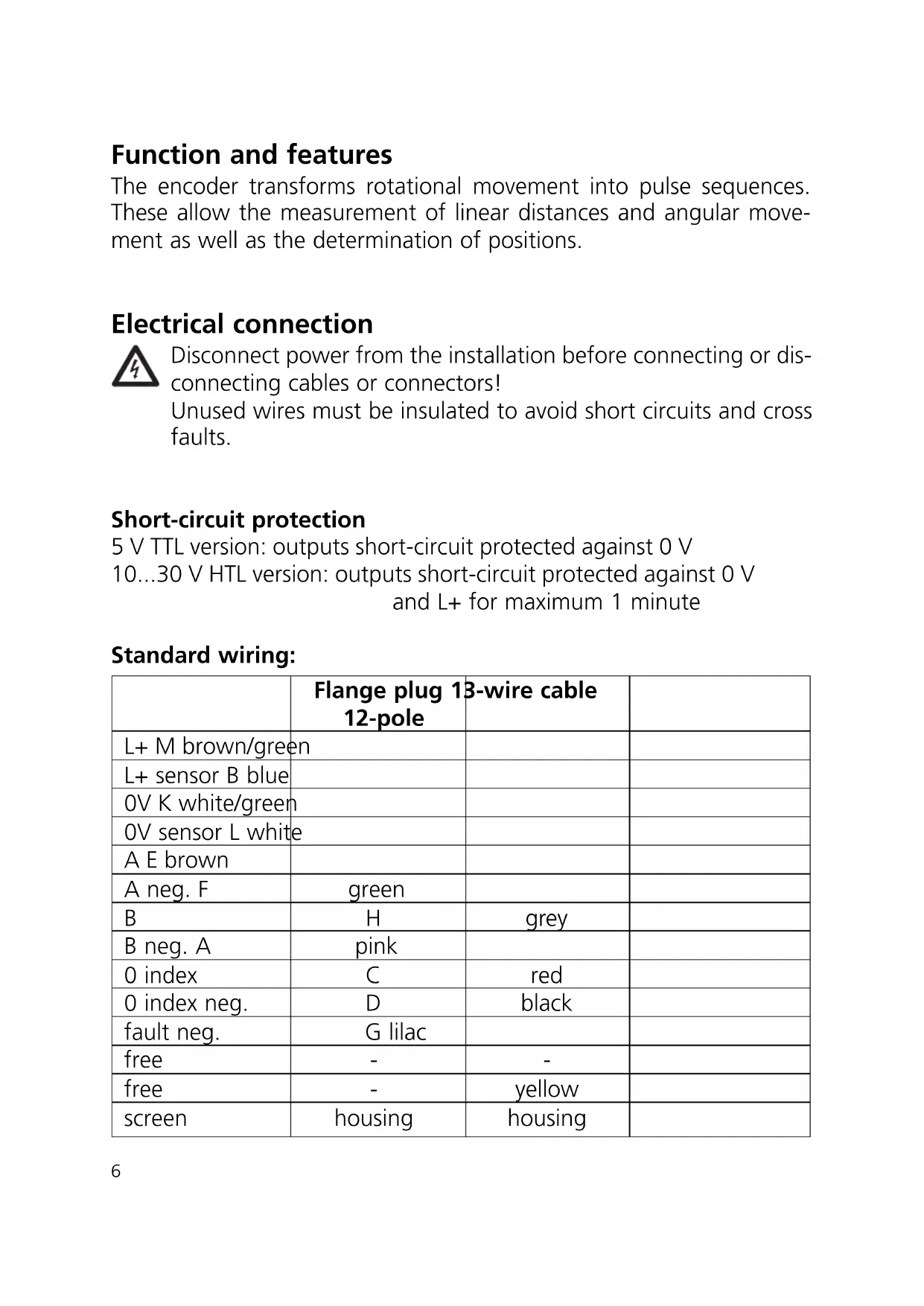
Wellenklemmring Statorkupplung Einseitig offene HohlwelleFunction and features The encoder transforms rotational movement into pulse sequences. These allow the measurement of linear distances and angular move- ment as well as the determination of positions. Electrical connection Disconnect power from the installation before connecting or dis- connecting cables or connectors! Unused wires must be insulated to avoid short circuits and cross faults. Short-circuit protection 5 V TTL version: outputs short-circuit protected against 0 V 10...30 V HTL version: outputs short-circuit protected against 0 V and L+ for maximum 1 minute Standard wiring:
Flange plug 13-wire cable 12-pole L+ M brown/green L+ sensor B blue 0V K white/green 0V sensor L white A E brown A neg. F green BHgrey B neg. A pink 0 index C red 0 index neg. D black fault neg. G lilac free - - free - yellow screen housing housingWiring is also indicated on the housing cap. If there is a deviation, the encoder must be connected as indicated on the label on the housing cap. The wires L+ (sensor) and 0V (sensor) are internally connected to the supply voltage. When using external electronics which regulate the supply voltage these wires can be used as test wires. If unused, these wires must be connected to the supply voltage or insulated. Depending on the version, the electrical connection is made via the cable or via cables to be obtained separately. When using suitable cables the maximum cable length is 100 m for the 5 V TTL version and 300 m for the 10...30 V HTL version. The cables must be laid separately from interfering sources, the mini- mum distance is 20 cm. The braided screen in the cable is connected to the encoder housing. Output signals The encoder provides digital pulse sequences at the output stages. The outputs A and B are electrically offset by 90°. Thus the direction of rotation can be evaluated in the external electronics.
180° 180° 90° output A output B 0 indexThe combined zero index is provided once in a mechanical revolution of the shaft. In case of power failure it can be used as a reference point within a revolution. The inverted output signals are used for external electronics with dif- ferential voltage input to filter interference. Installation Do not hit the shaft, do not use a file or similar tool on the shaft: This could destroy the unit!
pling by means of four M3 screws.
3. Tighten the screws of the clamping nut.
clamping nut stator coupling Continuous hollow shaft1. Place the clamping nut on the encoder.
2. Slip the encoder onto the shaft (min. 10 mm) and fix the stator
coupling by means of four M3 screws.
3. Tighten the screws of the clamping nut.
Linear movements can be transformed into a rotational movement using a measuring wheel or rack and pinion. For mounting the maxi- mum permissible shaft loads of the encoder must be taken into account. The data sheet, further documents and suitable accessories are avail- able on our website at www.ifm.com.