
DWE6423 - Sander DEWALT - Free user manual and instructions
Find the device manual for free DWE6423 DEWALT in PDF.



| Brand | DeWALT |
| Model | DWE6423 |
| Product type | Sander |
| Rated voltage | 230/115 V |
| Power consumption | 280 W |
| Pad diameter | 125 mm |
| No-load speed | 8000-12000 min^-1 |
| Orbit diameter | 2.6 mm |
| Weight | 1.28 kg |
| Sound pressure level | 80 dB(A) |
| Sound power level | 91 dB(A) |
| Sound uncertainty | 3 dB(A) |
| Vibration emission value | < 2.5 m/s² |
| Vibration uncertainty | 1.5 m/s² |
| Electronic speed control | Yes |
| Dust extraction system | Dust bag and vacuum cleaner connection |
| On/Off switch | Yes |
| Replaceable sanding pad | Yes |
| Replaceable speed limiter belt | Yes |
| Double insulation | Yes (Class II) |
| Intended use | Professional surface sanding |
| Pad material | Composite |
| Recommended extension cord (minimum section) | 1.5 mm² up to 30 m |
| Recommended fuse | 10 A |
Frequently Asked Questions - DWE6423 DEWALT
User questions about DWE6423 DEWALT
0 question about this device. Answer the ones you know or ask your own.
Ask a new question about this device
Download the instructions for your Sander in PDF format for free! Find your manual DWE6423 - DEWALT and take your electronic device back in hand. On this page are published all the documents necessary for the use of your device. DWE6423 by DEWALT.
USER MANUAL DWE6423 DEWALT
English (original instructions) 18
Figure 3

Figure 4
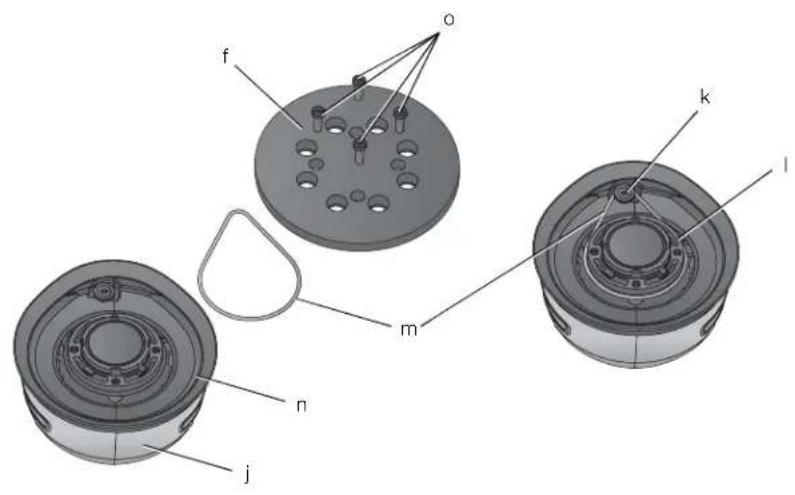
Figure 5
natural_image
Illustration of two Dewal brand power shaver machines, one with a hand adjusting the other (no text or symbols present)EXCENTERSLIBER 125 mm (5")
DWE6423
Tillykke!
RSEL: For at reducere
D-65510, Idstein, Germany
27.02.2015

You have chosen a DEWALT tool. Years of experience, thorough product development and innovation make DEWALT one of the most reliable partners for professional power tool users.
Technical Data
| DWE6423 | |||
| Voltage | V_AC | 230/115 | |
| Type 1 | |||
| Power input W | 280 | ||
| Pad diameter | mm | 125 | |
| Orbits | min ^1 | 8,000–12,000 | |
| Orbit ø | mm | 2.6 | |
| Weight kg | 1.28 | ||
Noise values and vibration values (triax vector sum) according to EN 60745-2-4:
| L_at | (emission sound pressure level) | dB(A) | 80 |
| L_at. | (sound power level) | dB(A) | 91 |
| K_at. | (uncertainty for the given sound level) | dB(A) | 3 |
| Vibration emission value a_th = | m/s2 | <2.5 | |
| Uncertainty K = | m/s2 | 1.5 | |
The vibration emission level given in this information sheet has been measured in accordance with a standardised test given in EN 60745 and may be used to compare one tool with another. It may be used for a preliminary assessment of exposure.

WARNING: The declared vibration emission level represents the main applications of the tool. However if the tool is used for different applications, with different accessories or poorly maintained, the vibration emission may differ. This may significantly increase the exposure level over the total working period.
An estimation of the level of exposure vibration should also take into account the times when the tool is switched off or when it is running but not actually doing the job. This may significantly reduce the exposure level over the total working period.
Identify additional safety measures to protect the operator from the effects of vibration such as: maintain the tool and the accessories, keep the hands warm, organisation of work patterns.
Fuses
Europe 230 V tools 10 Amperes, mains
U.K. & Ireland 230 V tools 13 Amperes, in plugs
Definitions: Safety Guidelines
The definitions below describe the level of severity for each signal word. Please read the manual and pay attention to these symbols.

DANGER: Indicates an imminently hazardous situation which, if not avoided, will result in death or serious injury.

IG: Indicates a potentially hazardous situation which, if not avoided, could result in death or serious injury.

N: Indicates a potentially hazardous situation which, if not avoided, may result in minor or moderate injury.
NOTICE: Indicates a practice not related to personal injury which, if not avoided, may result in property damage.

Denotes risk of electric shock.

Denotes risk of fire.
EC-Declaration of Conformity
MACHINERY DIRECTIVE

PALM GRIP SANDER DWE6423
DEWALT declares that these products described under Technical Data are in compliance with: 2006/42/EC, EN 60745-1, EN 60745-2-4.
These products also comply with Directive 2004/108/EC (until 19.04.2016), 2014/30/EU (from 20.04.2016) and 2011/65/EU. For more information, please contact DEWALT at the following address or refer to the back of the manual.
ENGLISH
The undersigned is responsible for compilation of the technical file and makes this declaration on behalf of DEWALT.
Horst Grossmann
Vice President Engineering
D-65510, Idstein, Germany
27.02.2015

WARNING: To reduce the risk of injury, read the instruction manual.
General Power Tool Safety Warnings

WARNING! Read all safety warnings and all instructions. Failure to follow the warnings and instructions may result in electric shock, fire and/or serious injury.
SAVE ALL WARNINGS AND INSTRUCTIONS FOR FUTURE REFERENCE
The term "power tool" in the warnings refers to your mains-operated (corded) power tool or battery-operated (cordless) power tool.
1) WORK AREA SAFETY
a) Keep work area clean and well lit.
Cluttered or dark areas invite accidents.
b) Do not operate power tools in explosive atmospheres, such as in the presence of flammable liquids, gases or dust. Power tools create sparks which may ignite the dust or fumes.
c) Keep children and bystanders away while operating a power tool. Distractions can cause you to lose control.
2) ELECTRICAL SAFETY
a) Power tool plugs must match the outlet. Never modify the plug in any way. Do not use any adapter plugs with earthed (grounded) power tools. Unmodified plugs and matching outlets will reduce risk of electric shock.
b) Avoid body contact with earthed or grounded surfaces such as pipes, radiators, ranges and refrigerators. There is an increased risk of electric shock if your body is earthed or grounded.
c) Do not expose power tools to rain or wet conditions. Water entering a power tool will increase the risk of electric shock.
d) Do not abuse the cord. Never use the cord for carrying, pulling or unplugging the power tool. Keep cord away from heat, oil, sharp edges or moving parts. Damaged or entangled cords increase the risk of electric shock.
e) When operating a power tool outdoors, use an extension cord suitable for outdoor use. Use of a cord suitable for outdoor use reduces the risk of electric shock.
f) If operating a power tool in a damp location is unavoidable, use a residual current device (RCD) protected supply. Use of an RCD reduces the risk of electric shock.
3) PERSONAL SAFETY
a) Stay alert, watch what you are doing and use common sense when operating a power tool. Do not use a power tool while you are tired or under the influence of drugs, alcohol or medication. A moment of inattention while operating power tools may result in serious personal injury.
b) Use personal protective equipment. Always wear eye protection. Protective equipment such as dust mask, non-skid safety shoes, hard hat, or hearing protection used for appropriate conditions will reduce personal injuries.
c) Prevent unintentional starting. Ensure the switch is in the off position before connecting to power source and/or battery pack, picking up or carrying the tool. Carrying power tools with your finger on the switch or energising power tools that have the switch on invites accidents.
d) Remove any adjusting key or wrench before turning the power tool on. A wrench or a key left attached to a rotating part of the power tool may result in personal injury.
e) Do not overreach. Keep proper footing and balance at all times. This enables better control of the power tool in unexpected situations.
i) Dress properly. Do not wear loose clothing or jewellery. Keep your hair, clothing and gloves away from moving parts. Loose clothes, jewellery or long hair can be caught in moving parts.
g) If devices are provided for the connection of dust extraction and collection facilities, ensure these are connected and properly used. Use of dust collection can reduce dust-related hazards.
4) POWER TOOL USE AND CARE
a) Do not force the power tool. Use the correct power tool for your application.
ENGLISH
The correct power tool will do the job better and safer at the rate for which it was designed.
b) Do not use the power tool if the switch does not turn it on and off. Any power tool that cannot be controlled with the switch is dangerous and must be repaired.
c) Disconnect the plug from the power source and/or the battery pack from the power tool before making any adjustments, changing accessories, or storing power tools. Such preventive safety measures reduce the risk of starting the power tool accidentally.
d) Store idle power tools out of the reach of children and do not allow persons unfamiliar with the power tool or these instructions to operate the power tool. Power tools are dangerous in the hands of untrained users.
e) Maintain power tools. Check for misalignment or binding of moving parts, breakage of parts and any other condition that may affect the power tool's operation. If damaged, have the power tool repaired before use. Many accidents are caused by poorly maintained power tools.
f) Keep cutting tools sharp and clean. Properly maintained cutting tools with sharp cutting edges are less likely to bind and are easier to control.
g) Use the power tool, accessories and tool bits etc., in accordance with these instructions taking into account the working conditions and the work to be performed. Use of the power tool for operations different from those intended could result in a hazardous situation.
5) SERVICE
a) Have your power tool serviced by a qualified repair person using only identical replacement parts. This will ensure that the safety of the power tool is maintained.
Additional Specific Safety Rules for Sanders

WARNING: Contact with or inhalation of dusts arising from sanding applications may endanger the health of the operator and possible bystanders. Wear a dust mask specifically designed for protection against toxic dust and fumes and ensure that persons within or entering the work area are also protected.

WARNING: Use this tool in a well-ventilated area when sanding ferrous
metals. Do not operate the tool near flammable liquids, gases or dust. Sparks or hot particles from sanding or arcing motor brushes may ignite combustible materials.

WARNING: We recommend the use of a residual current device with a residual current rating of 30mA or less.
Sanding Paint

WARNING: Observe the applicable regulations for sanding paint. Pay special attention to the following:
- Whenever possible, use a vacuum extractor for dust collection.
• Take special care when sanding paint which is possibly lead based:
- Do not let children or pregnant women enter the work area.
– All persons entering the work area should wear a mask specially designed for protection against lead paint dust and fumes.
- Do not eat, drink or smoke in the work area.
- Dispose of dust particles and any other removal debris safely.
Residual Risks
In spite of the application of the relevant safety regulations and the implementation of safety devices, certain residual risks cannot be avoided.
These are:
- Impairment of hearing.
– Risk of personal injury due flying particles.
- Risk of burns due to accessories becoming hot during operation.
– Risk of personal injury due to prolonged use.
Markings on Tool
The following pictograms are shown on the tool:

Read instruction manual before use.
DATE CODE POSITION (FIG. 1)
The Date Code (h), which also includes the year of manufacture, is printed into the housing.
Example:
2015 XX XX
Year of Manufacture
Package Contents
The package contains:
1 Palm grip sander
1 Dust bag
1 Sanding disc
1 Instruction manual
- Check for damage to the tool, parts or accessories which may have occurred during transport.
• Take the time to thoroughly read and understand this manual prior to operation.
Description (Fig. 1)
WARNING: Never modify the power tool or any part of it. Damage or personal injury could result.
a. On/off switch
b. Electronic speed control dial
c. Dust extraction outlet
d. Dust bag
e. Dust bag collar
f. Sanding pad
g. Strain relief
h. Date code
INTENDED USE
Your sander has been designed for professional sanding applications.
DO NOT use under wet conditions or in presence of flammable liquids or gases.
These sanders are professional power tools.
DO NOT let children come into contact with the tool. Supervision is required when inexperienced operators use this tool.
- Young children and the infirm. This appliance is not intended for use by young children or infirm persons without supervision.
- This product is not intended for use by persons (including children) suffering from diminished physical, sensory or mental abilities; lack of experience, knowledge or skills unless they are supervised by a person responsible for their safety. Children should never be left alone with this product.
Electrical Safety
The electric motor has been designed for one voltage only. Always check that the power supply corresponds to the voltage on the rating plate.

Your DEWALT tool is double insulated in accordance with EN 60745; therefore no earth wire is required.
If the supply cord is damaged, it must be replaced by a specially prepared cord available through the DEWALT service organisation.
Mains Plug Replacement (U.K. & Ireland Only)
If a new mains plug needs to be fitted:
• Safely dispose of the old plug.
- Connect the brown lead to the live terminal in the plug.
- Connect the blue lead to the neutral terminal.
WARNING: No connection is to be made to the earth terminal.
Follow the fitting instructions supplied with good quality plugs. Recommended fuse: 13 A.
Using an Extension Cable
If an extension cable is required, use an approved 3-core extension cable suitable for the power input of this tool (see Technical Data). The minimum conductor size is 1.5 mm ^2 ; the maximum length is 30 m.
When using a cable reel, always unwind the cable completely.
ASSEMBLY AND ADJUSTMENTS
WARNING: To reduce the risk of injury, turn unit off and disconnect machine from power source before installing and removing accessories, before adjusting or changing set-ups or when making repairs. Be sure the trigger switch is in the OFF position. An accidental start-up can cause injury.
Fitting Sanding Discs (Fig. 2)
The tool uses 125 mm (5") hook and loop sanding discs with an 8 hole dust extraction pattern.
- Place the tool on a table, sanding pad (f) up.
- Place the sanding disc (i) directly on top of the sanding pad.
- Hold the sanding pad with one hand and align the dust extraction holes.
- Press the disc firmly onto the sanding pad.
ENGLISH
Setting the Electronic Speed Control Dial (Fig. 1)
The speed is infinitely variable from 8,000–12,000 min ^-1 using the electronic speed control dial (b).
Turn the electronic speed control dial to the required level. The correct setting, however, is a matter of experience.
Generally, harder materials require a higher setting.
Dust Extraction (Fig. 3, 4)

WARNING: Since woodworking with a sander produces dust, always install a dust bag designed in compliance with the applicable directives regarding dust emission.

WARNING: Do not use a dust bag or vacuum extractor without proper spark protection when sanding metal.
Your sander has two dust extraction methods: a built-in outlet (c) which allows either the supplied dust bag (d) or a shop vacuum system to be connected; and a dust skirt (n, Fig. 4). The built-in outlet utilizes the DEWALT airlock connection making it compatible with the DEWALT dust extractor and airlock accessory DWV9000.
TO ATTACH THE DUST BAG
- While holding the sander, fit the dust bag collar (e) to the outlet (c) as shown in Figure 3.
- Turn the collar (e) clockwise to lock the dust bag (d) in place.
TO EMPTY THE DUST BAG
NOTE: Be sure to wear approved eye protection and approved dust mask when performing this procedure.
For efficient dust extraction, empty the dust collector when it is about one third full.
- While holding the sander, turn the collar (e) anticlockwise to unlock the dust bag (d).
- Remove dust bag from the sander and gently shake or tap the dust bag to empty.
- Reattach the dust bag back onto the outlet and lock into place by turning the dust bag collar clockwise.
You may notice that all the dust will not come free from the bag. This will not affect sanding performance but will reduce the sander's dust collection efficiency. To restore your sander's dust collection efficiency, depress the spring inside the dust bag when you are emptying it and tap it on the side of the waste bin or dust receptacle.
OPERATION
Instructions for Use

IG: Always observe the safety instructions and applicable regulations.

IG: To reduce the risk of serious personal injury, turn tool off and disconnect tool from power source before making any adjustments or removing/installing attachments or accessories.

WARNING:
• Make sure all materials to be sanded are well secured.
- Apply only a gentle pressure to the workpiece. Excessive pressure does not improve the sanding effect, but only results in an increased load on the machine and causes the abrasive to tear.
- Avoid overloading.

WARNING: Do not sand magnesium!
NOTICE: If you wrap the cord around the tool when you store it, leave a generous loop of cord such that the strain relief (g, Fig. 1) does not bend. This helps prevent premature cord failure.
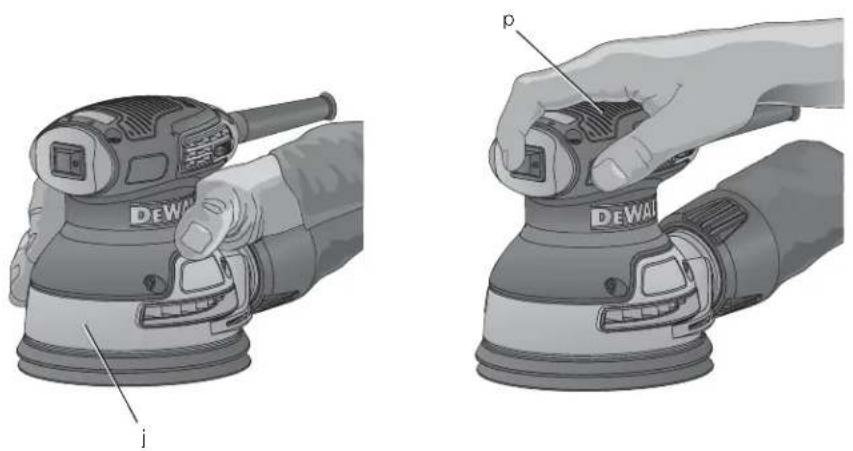
Proper Hand Position (Fig. 5)

To reduce the risk of rious personal injury, ALWAYS use oper hand position as shown.

IG: To reduce the risk of serious personal injury, ALWAYS hold securely in anticipation of a sudden reaction.
Proper hand position requires either one hand on the sander body (j) or one hand on the main grip (p) as shown.
Switching On and Off (Fig. 1)
Set the sanding speed using the electronic speed control dial (b).
To switch the tool on, set the on/off switch to position I.
To switch the tool off, set the on/off switch to position O.
Sanding
Start with the coarsest grit size.
As the tool produces small abrasion marks in all directions, it is not necessary to sand with the grain.
Check your work at short intervals.
Always switch off the tool when work is finished and before unplugging.
MAINTENANCE
Your DEWALT power tool has been designed to operate over a long period of time with a minimum of maintenance. Continuous satisfactory operation depends upon proper tool care and regular cleaning.

WARNING: To reduce the risk of injury, turn unit off and disconnect machine from power source before installing and removing accessories, before adjusting or changing set-ups or when making repairs.
Be sure the trigger switch is in the OFF position. An accidental start-up can cause injury.
Replacing the Sanding Pad and the Speed Limiter Belt (Fig. 4)
Your sander is equipped with a replaceable belt (m) which is located between the pad (f) and the sander body (j). It is designed to control the pad speed while the unit is off the work surface. The belt and the sanding pad (f) are designed to be consumable parts and will occasionally need to be replaced. The sanding pad needs replacement when signs of wear become evident. Replacement of the belt is necessary when the pad speed increases very dramatically when the unit is lifted from the work surface. These parts are available at extra cost from your local dealer or authorised DEWALT service centre.
- Holding the platen firmly, remove the four screws (o) from the bottom of the pad.
- Remove the pad (f).
- Replace worn or damaged belt (m) by wrapping it around the shoulder screw (k) and bearing retainer (l) as shown in Figure 4.
- Reinstall pad (replace with new pad if necessary). Replace the four screws (o). Be careful not to over-tighten screws.

Lubrication
Your power tool requires no additional lubrication.

Cleaning
NOTE: After the tool is used in metal sanding applications without dust bag, clean the tool using low-pressure air.

WARNING: Blow dirt and dust out of the main housing with dry air as often as dirt is seen collecting in and around the air vents. Wear approved eye protection and approved dust mask when performing this procedure.

IG: Never use solvents or other harsh chemicals for cleaning the non-metallic parts of the tool. These chemicals may weaken the materials used in these parts. Use a cloth dampened only with water and mild soap. Never let any liquid get inside the tool; never immerse any part of the tool into a liquid.
Optional Accessories

WARNING: Since accessories, other than those offered by DEWALT, have not been tested with this product, use of such accessories with this tool could be hazardous. To reduce the risk of injury, only DEWALT, recommended accessories should be used with this product.
Consult your dealer for further information on the appropriate accessories.
Protecting the Environment

Separate collection. This product must not be disposed of with normal household waste.
Should you find one day that your DEWALT product needs replacement, or if it is of no further use to you, do not dispose of it with household waste. Make this product available for separate collection.
ENGLISH

Separate collection of used products and packaging allows materials to be recycled and used again. Re-use of recycled materials helps prevent environmental pollution and reduces the demand for raw materials.
Local regulations may provide for separate collection of electrical products from the household, at municipal waste sites or by the retailer when you purchase a new product.
DEWALT provides a facility for the collection and recycling of DEWALT products once they have reached the end of their working life. To take advantage of this service please return your product to any authorised repair agent who will collect them on our behalf.
You can check the location of your nearest authorised repair agent by contacting your local DEWALT office at the address indicated in this manual. Alternatively, a list of authorised DEWALT repair agents and full details of our after-sales service and contacts are available on the Internet at: www.2helpU.com.
LIJADORA DE AGARRE PALMAR DE 125 mm (5") DWE6423
¡Enhorabuena!
LEVIGATRICE PALMARE DWE6423
HANDPALMSCHUURMACHINE 125 mm DWE6423
HANDPALMSCHUURMACHINE DWE6423
NEDERLANDS
Vice President Engineering
WAARSCHUWING! Lees alle
BEWAAR ALLE WAARSCHUWINGEN EN INSTRUCTIES ALS TOEKOMSTIG REFERENTIEMATERIAAL
1) SIKKERHET PÅ ARBEIDSOMRÅDET
Vice President Engineering
DEWALT, Richard-Klinger-Strasse 11,
D-65510, Idstein, Germany
27.02.2015

HANDSLIPMASKIN DWE6423
DATUMKODPLACERING (FIG. 1)
IG: Do not use a dustbag or vacuum extractor without proper spark protection when sanding metal.
natural_image
Pure horizontal line with endpoints and no text or symbols| Belgique et Luxembourg België en Luxemburg | DEWALT - Belgium BVBAEgicie Walschaertsstraat 162800 Mechelen | Tel: NL 32 15 47 37 63Tel: FR 32 15 47 37 64Fax: 32 15 47 37 99 | www.dewalt.beenduser.BE@sbdinc.com |
| Danmark D | EWALTRoskidevej 222620 Albertslund | Tel: 70 20 15 10Fax: 70 22 49 10 | www.dewalt.dkkundeservice.dk@sbdinc.com |
| Deutschland D | EWALTRichard Klinger Str. 1165510 Idstein | Tel: 06126-21-1Fax: 06126-21-2770 | www.dewalt.deinfodwgo@sbdinc.com |
| Ελλάς D | EWALT (Ελλάς) A.E.ΕΔΡΑ-ΓΡΑΦΕΙΑ : Στράβωνος 7&Λ. Βουλιαγμένης, Γλυφάδα 166 74, ΑθήναSERVICE : Ημερος Τόπος 2 (Χάνι Αδάμ) –193 00 Ασπρόπυργος | Thå: 00302108981616Φαξ: 00302108983570 | www.dewalt.grGreece.Service@sbdinc.com |
| España D | EWALT Ibérica, S.C.A.Parc de Negocios “Mas Blau”Edificio Muntadas, c/Bergadá, 1, Of. A608820 El Prat de Llobregat (Barcelona) | Tel: 934 797 400Fax: 934 797 419 | www.dewalt.cresspuesta.postventa@sbdinc.com |
| France D | EWALT5, allée des HêtresBP 30084, 69579 Limonost Codex | Tel: 04 72 20 39 20Fax: 04 72 20 39 00 | www.dewalt.frscufr@sbdinc.com |
| SchweizSuisseSvizzera | DEWALTIn der Luberzen 428902 Urdorf | Tel: 044 - 755 60 70Fax: 044 - 730 70 67 | www.dewalt.chservice@rofoag.ch |
| Ireland D | EWALTCalpe House Rock HillBlack Rock, Co. Dublin | Tel: 00353-2781800Fax: 00353-2781811 | www.dewalt.ie |
| Italia D | EWALTvia Energypark20871 Vimercate (MB), IT | Tel: 800-01435339 039 9590200Fax: 39 039 9590313 | www.dewalt.it |
| Nederlands | DEWALT Netherlands BVHolturn Noordweg 356121 RE BORN, Postbus 83, 6120 AB BORN | Tel: 31 164 283 063Fax: 31 164 283 200 | www.dewalt.nl |
| Norge | DEWALTPostboks 4613, Nydalen0405 Oslo | Tel: 45 25 13 00Fax: 45 25 08 00 | www.dewalt.nokundeservice.no@sbdinc.com |
| Österreich | DEWALTWerkzeug Vertriebsges m.b.HOberlaaerstrasse 248, A-1230 Wien | Tel: 01 - 66116 - 0Fax: 01 - 66116 - 614 | www.dewalt.atservice.austria@sbdinc.com |
| Portugal | DEWALT Limited, SARLCentro de Escritórios de Sintra AvonidaAlmirante Gago Coutinho, 132/134, Edificio 142710-418 Sintra | Tel: 214 66 75 00Fax: 214 66 75 80 | www.dewalt.ptresposta.posvenda@sbdinc.com |
| Suomi D | EWALTPL 4700521 Helsinki | Puh: 010 400 4333Faksi: 0800 411 340 | www.dewalt.fiasiakaspalvelu.fi@sbdinc.com |
| Sverige D | EWALTBox 94431 22 Mölndal | Tel: 031 68 61 60Fax: 031 68 60 08 | www.dewalt.sekundservice.so@sbdinc.com |
| Türkiye | KALE Hirdavat ve Makina A.Ş.Deflerdar Mah. Savaklar Cad. No:15Edirnekapi / Eyüp / İSTANBUL 34050TÜRKİYE | Tel: 0212 533 52 55Faks: 0212 533 10 05 | www.dewalt.com.tr |
| UnitedKingdom | DEWALT, 210 Bath Road;Slough, Berks SL1 3YD | Tel: 01753-567055Fax: 01753-572112 | www.dewalt.co.ukameaservice@sbdinc.com |
| Australia | DEWALT82 Taryn Drive, EppingVIC 3076 Australia | Tel: Aust 1800 338 002Tel: NZ 0800 339 258 | www.dewalt.com.auwww.dewalt.co.nz |
| Middle East Africa | DEWALTP.O. Box - 17164,Jebel Ali Free Zone (South), Dubai, UAE | Tel: 971 4 812 7400Fax: 971 4 2822765 | www.dewalt.aEService.MEA@sbdinc.com |


- EXCENTERSLIBER 125 mm (5")
- DWE6423
- Tillykke!
- Fuses
- Definitions: Safety Guidelines
- EC-Declaration of Conformity
- MACHINERY DIRECTIVE
- PALM GRIP SANDER DWE6423
- ENGLISH
- General Power Tool Safety Warnings
- SAVE ALL WARNINGS AND INSTRUCTIONS FOR FUTURE REFERENCE
- 1) WORK AREA SAFETY
- 2) ELECTRICAL SAFETY
- 3) PERSONAL SAFETY
- 4) POWER TOOL USE AND CARE
- 5) SERVICE
- Additional Specific Safety Rules for Sanders
- Sanding Paint
- Residual Risks
- Markings on Tool
- DATE CODE POSITION (FIG. 1)
- Package Contents
- Description (Fig. 1)
- INTENDED USE
- Electrical Safety
- Mains Plug Replacement (U.K. & Ireland Only)
- Using an Extension Cable
- ASSEMBLY AND ADJUSTMENTS
- Fitting Sanding Discs (Fig. 2)
- Setting the Electronic Speed Control Dial (Fig. 1)
- Dust Extraction (Fig. 3, 4)
- TO ATTACH THE DUST BAG
- TO EMPTY THE DUST BAG
- OPERATION
- Instructions for Use
- WARNING:
- Proper Hand Position (Fig. 5)
- Switching On and Off (Fig. 1)
- Sanding
- MAINTENANCE
- Replacing the Sanding Pad and the Speed Limiter Belt (Fig. 4)
- Lubrication
- Cleaning
- Optional Accessories
- Protecting the Environment
- LIJADORA DE AGARRE PALMAR DE 125 mm (5") DWE6423
- ¡Enhorabuena!
- LEVIGATRICE PALMARE DWE6423
- HANDPALMSCHUURMACHINE 125 mm DWE6423
- NEDERLANDS
- BEWAAR ALLE WAARSCHUWINGEN EN INSTRUCTIES ALS TOEKOMSTIG REFERENTIEMATERIAAL
- 1) SIKKERHET PÅ ARBEIDSOMRÅDET
- HANDSLIPMASKIN DWE6423
- DATUMKODPLACERING (FIG. 1)
Brand : DEWALT
Model : DWE6423
Category : Sander