
HI414 - Food Processor PHILIPS - Free user manual and instructions
Find the device manual for free HI414 PHILIPS in PDF.
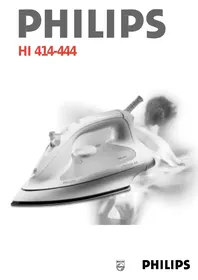


| Product type | Steam iron |
| Model | HI414 |
| Brand | Philips |
| Power | Not specified, typical 2000-2400 W |
| Voltage | 220-240 V (check on the device) |
| Water tank capacity | 240 ml |
| Temperature setting | Yes, from ● (synthetics) to MAX (cotton/linen) |
| Steam flow rate | Adjustable from 0 to 4 (stop to max) |
| Spray function | Yes, via dedicated button |
| Steam boost function | Yes, via ⓤ button |
| Vertical steam ironing | Yes |
| Auto shut-off | No (only on model HI444) |
| Anti-drip system | No (on HI414) |
| Self-cleaning | Yes, via self-cleaning button |
| Soleplate | Not specified, probably stainless steel or ceramic |
| Cord length | Not specified, approximately 2 m |
| Weight | Not specified, approximately 1.2 kg |
| Dimensions (L x W x H) | Not specified, typical 30 x 15 x 15 cm |
| Maintenance | Clean soleplate with damp cloth; regular descaling via self-cleaning |
| Safety | Do not immerse in water; unplug before filling |
| Included accessories | Filling cup (M) |
| Cord storage | Wrap around base with hook |
Frequently Asked Questions - HI414 PHILIPS
User questions about HI414 PHILIPS
0 question about this device. Answer the ones you know or ask your own.
Ask a new question about this device
Download the instructions for your Food Processor in PDF format for free! Find your manual HI414 - PHILIPS and take your electronic device back in hand. On this page are published all the documents necessary for the use of your device. HI414 by PHILIPS.
USER MANUAL HI414 PHILIPS
English
- Keep pages 3 and 62 open when reading these operating instructions.
Français
- Read the instructions for use and look at the illustrations before you start using the steam iron.
- To prevent damage: check if the voltage indicated on the appliance corresponds to the local mains voltage before you connect the appliance.
- Never use the iron if it is damaged or does not function properly.
- Make sure that children cannot touch the hot appliance and that they cannot pull at the mains cord.
- The ejected steam is very hot and therefore dangerous. Never direct the steam at people.
- Remove the mains plug from the socket before you fill the iron with water and before you pour out the remaining water after use.
- Never immerse the iron in water.
- When you have finished ironing and also when you leave the iron for even a short while, always:
- set the steam control dial to position O
- put the iron on its heel
- remove the mains plug from the wall socket
- Some parts of the iron have been slightly greased. As a result, the iron may smoke slightly when you use it for the first time. This phenomenon is harmless and will soon cease.
- Remove any sticker or protective foil from the soleplate before you use the appliance for the first time. Clean the soleplate with a soft cloth.
- Do not put vinegar or other descaling agents in the water reservoir.
- Do not use chemically descaled water for steaming.
- Do not allow the cord to touch the soleplate when it is hot.
- If the mains cord of this appliance is damaged, it may only be replaced by an authorised service centre, as repair requires special tools and/or parts.
General description (fig. 1)
A Temperature control dial B Steam control dial
O = no steam
1 = minimum steam output 4 = maximum steam output
© Spray button (press) D Spray nozzle E Shot-of-steam button (press) F Filling opening with lid for easy filling and ironing without spilling water G Soleplate H Temperature pilot light (orange) (only types HI 414 - 434) ① Self-clean button for self-cleaning or descaling J Water reservoir K Cord storage L Type plate M Filling jug N Cord clip - Auto-stop pilot light (red) (only type HI 444) P Temperature pilot light (orange) (only type HI 444) - Temperature indicator showing the temperature setting selected with the temperature control dial (A)
Filling with water (for steam-ironing and spraying)
- Use tap water the first time you fill the iron.
- After the first time, you can still use tap water. However, if the water is very hard (harder than 17° DH / 21° Clarke), it is advisable to use demineralised or distilled water, which can be obtained from e.g. chemists.
- Unplug the iron before filling it. Set the steam control (B) to position O (= no steam).
- Open the lid of the filling opening (fig. 2).
- Fill the filling jug (M) with water (max. 240 ml). Hold the iron in a tilted position and pour the water into the filling opening (fig. 3).
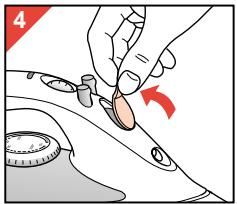
- Close the lid of the filling opening (fig. 4).
Ironing temperature
- First check if the article to be ironed contains a label with ironing instructions (see table). Always follow the instructions on the label.
- If there are no ironing instructions but you do know what kind of fabric the article is made of, you can use the table below.
- The table is valid for plain materials only; it does not take into account any kind of finish (gloss, crinkle, relief, etc.) that has been applied to the material. Materials to which some kind of finish has been applied, are best ironed at lower temperatures.
- Sort the laundry according to the ironing temperature allowed before you start ironing.
Table
| Instructions on label | Type of fabric | Temperature control | Steam control | Shot of steam | Spraying | Vertical shot of steam |
 |  |  |  |  |  |  |
 | Synthetic fabrics e.g. acrylic viscose polyamide (nylon) polyester Silk |  | 0 |  |  | |
| [062Y] | Wool | D4730 | 1 - 2 | [076] | [0VCD] |  |
| [A42W] | Cotton Linen | WCCD | 3 - 4 | [4400] | [027T] | [000H] |
| [9TCC] | Please note that ☑ on the label means that a this article may not be ironed! | |||||
The iron heats up more quickly than it cools down, so always start with the fabrics that require the lowest ironing temperature (synthetic fabrics).
- If the article consists of various kinds of fibres, always select the temperature required by the most delicate fibre (so the lowest temperature). If, for example, a piece of fabric consists of 60% polyester and 40% cotton, it should be ironed at the temperature required by polyester (•) without any steam.
If you are not sure what fabric the article to be ironed is made of, find out which temperature is appropriate (starting at a relatively low temperature) by ironing a piece of material that will not be visible when you wear or use the article.
- 100% woollen fabrics may be pressed with the iron set to a steam position. It is advisable to set the steam control to position 2 and to use a dry pressing cloth.
When woollen fabrics are steam-ironed, shiny patches may occur. You can prevent this by ironing the article inside out.
- Velvet and other fabrics that tend to acquire shiny patches should be ironed in one direction only (along with the nap) without exerting any pressure. Keep the iron moving constantly.
- Synthetic materials and silk should preferably be ironed inside out to prevent the fabric from becoming shiny. Do not spray any water onto the fabric since this might cause stains.
Setting the temperature
- Put the iron on its heel.
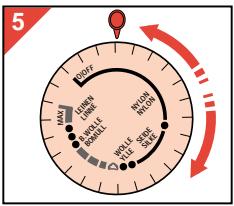
- Set the temperature control dial (A) to the temperature as indicated on the label of the article or in the table (fig. 5).
- Put the mains plug in the socket.
- The iron is ready to be used as soon as the orange temperature pilot light (H) has gone out and then comes on again.
Type HI 444: the iron is ready to be used as soon as the orange pilot light (P) has gone out and then comes on again.
- While you are ironing, the orange pilot light will go on from time to time.
- If you set the temperature control dial to a lower setting after ironing at a high temperature, do not begin ironing again until the orange pilot light has come on and has gone out again.
Spraying
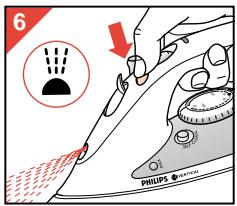
By pressing the spray button (C) a few times, you can moisten the article to be ironed at any selected temperature (fig. 6). Make sure there is enough water in the water reservoir.
Steam-ironing
- As the temperature control dial (A) and the table indicate, steam-ironing is only possible at higher ironing temperatures:
●● to ●●● for a little steam.
●●● to MAX for a lot of steam.
- If the selected temperature is too low, water may drip from the soleplate of the iron. This may cause stains. The HI 424, HI 434 and HI 444 irons have been equipped with a 'Drip Stop' steam shut-off system, which will automatically stop the iron from steaming if the selected temperature is too low. When this happens, you may hear a 'click'. Now set the temperature control dial (A) to the recommended setting. The steaming will start again as soon as the iron has reached the appropriate (higher) temperature.
- Make sure there is enough water in the water reservoir (J).
- Put the iron on its heel.
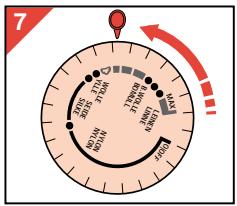
- Set the temperature control dial (A) to one of the settings in the 'steam area' (●● to MAX) (fig. 7).
- Put the mains plug into the socket.
- As soon as the orange temperature pilot light (H) has gone out and then comes on again you can start ironing.
Type HI 444: the iron is ready to be used as soon as the orange pilot light (P) has gone out and then comes on again.
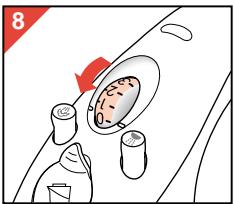
- Set the steam control dial (B) to the desired position (fig. 8).
Shot of steam
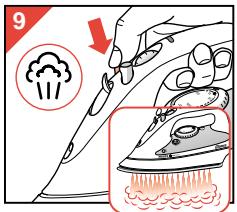
When you press the shot-of-steam button ⏻ (E), a powerful burst of steam will be ejected from the soleplate (fig. 9). This function is very useful, e.g. for removing stubborn creases.
The shot-of-steam function can only be used when the iron has been set to a high temperature (settings ●● to MAX).
Vertical shot of steam
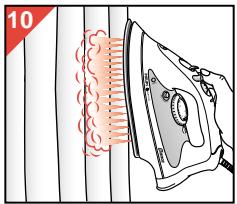
The shot-of-steam function can also be used when the iron is held in vertical position (fig. 10). This is very useful if you want to remove creases from hanging curtains, clothes etc. (settings ●●● to MAX).
Ironing without steam
If you want to iron without steam, follow the same procedure as described for steam-ironing, yet set the steam control dial to position O (= no steam).
"Auto Stop" automatic safety shut-off (Only for type HI 444)
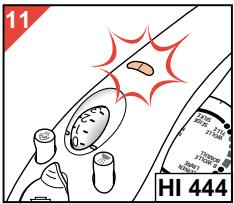
If the iron is not moved for some time, the heating element is shut off automatically. To indicate that the appliance has switched itself off, the red auto-stop pilot light (O) will start to blink (fig. 11).
If the iron is in horizontal position, it will be shut off after 30 seconds. If the iron is in vertical position, it will be shut off after 8 minutes.
- When you pick up the iron again, the red auto-stop pilot light (O) will go out.
- The orange temperature pilot light (P) will go on, indicating that the iron is heating up again.
- Wait for the orange temperature pilot light (P) to go out before you start ironing again.
Maintenance
- It is important to clean the appliance at least once every two weeks by means of the self-clean function to remove scale and other impurities.
- Depending on the hardness of the water used to fill the iron with, you will have to use the self-clean function more often. The harder the water, the more the iron will have to be descaled.
Self-cleaning
- Set the stream control dial (B) to O (= no steam).
- Open the lid of the filling opening (F) and fill the water reservoir (J) to the maximum level (MAX).
- Close the lid of the filling opening (F).
- Set the temperature control dial (A) to MAX.
- Put the mains plug in the socket.
- Leave the iron to heat up until the orange temperature pilot light (H) has gone out (pilot light (P) for type HI 444).
- Unplug the appliance.
- Hold the iron horizontally over the sink.
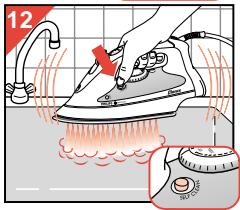
- Press the self-clean button (I) (fig. 12) and keep pressing it. Boiling water and steam will now be ejected through the vents in the soleplate, washing away impurities and scale (if any) from the iron.
- Gently shake the iron from side to side while it is self-cleaning.
- Release the self-clean button after one minute or if the water reservoir is empty.
- If the water reservoir still contains scale or other impurities, repeat the self-clean procedure.
- After the self-clean procedure, put the iron on its heel.
- Put the mains plug in the socket again and leave the iron to heat up again.
- Move the iron backwards and forwards over an (old) cloth to make sure that the soleplate is dry when you put the iron away.
- Types HI 434/444 only: the built-in Anti Calc Cassette guarantees a longer working life of the appliance.
Cleaning
- Before you start cleaning the iron, unplug the appliance and leave it to cool down sufficiently.
- Scale or other dirt can be wiped off the soleplate by means of a damp cloth and some non-abrasive (liquid) cleaner.
Keep the surface of the soleplate smooth: avoid hard contact with metal objects.
- The upper part of the iron can be cleaned with a damp cloth.
Clean the water reservoir from time to time by filling it with water and shaking the iron well. Afterwards, empty the reservoir again.
Storage
- Unplug the appliance.
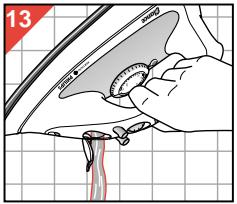
- Pour the remaining water, if any, out of the water reservoir (fig. 13).
- Set the steam control dial to O.
- Put the iron on its heel and leave it to cool down sufficiently.
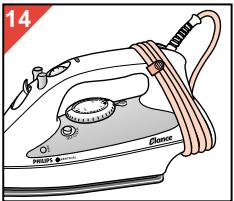
- Wind the cord around the heel of the appliance (fig 14). Make a loop first before winding the rest of the cord.
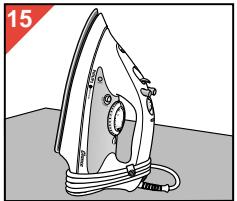
- Always put the iron away on its heel (fig. 15).
Regularly check if the cord is still in good and safe condition.
Important


- ENGLISH
- FRANÇAIS
- GENERAL DESCRIPTION (FIG. 1)
- FILLING WITH WATER (FOR STEAM-IRONING AND SPRAYING)
- IRONING TEMPERATURE
- SETTING THE TEMPERATURE
- SPRAYING
- STEAM-IRONING
- SHOT OF STEAM
- VERTICAL SHOT OF STEAM
- IRONING WITHOUT STEAM
- AUTO STOP" AUTOMATIC SAFETY SHUT-OFF (ONLY FOR TYPE HI 444)
- MAINTENANCE
- SELF-CLEANING
- CLEANING
- STORAGE
- IMPORTANT
Brand : PHILIPS
Model : HI414
Category : Food Processor