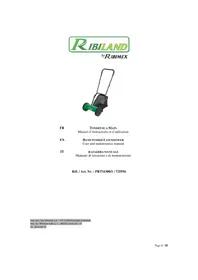
PRTB300LA RazerB300 - Lawn mower Ribiland - Free user manual and instructions
Find the device manual for free PRTB300LA RazerB300 Ribiland in PDF.


| Product type | Battery-powered push lawn mower |
| Brand | Ribiland |
| Model | PRTB300LA / 725571 |
| Power supply | Lead-acid battery 24V / 7Ah |
| Charging time | 5 to 7 hours |
| Runtime | 40 to 60 minutes (indicative depending on use) |
| Cutting width | 300 mm |
| Cutting height | 4 positions: 28, 40, 52, 64 mm |
| Grass catcher capacity | 30 liters |
| Wheel diameter | 15 cm |
| No-load speed | 3800 min⁻¹ |
| Sound pressure level | 72 dB(A) (K=3dB) |
| Sound power level | 92 dB(A) (K=3dB) |
| Vibration level | 0.63 m/s² (K=1.5 m/s²) |
| Net weight | 14 kg (without battery); 20 kg (with battery) |
| Charger | Model QL-09005: input 230V AC, output 24V DC 1800mA |
| Protection fuse | 250V / 12A |
| Intended use | Domestic, outdoor, small and medium surfaces |
| Warranty | 1 year minimum (according to legislation) |
Frequently Asked Questions - PRTB300LA RazerB300 Ribiland
User questions about PRTB300LA RazerB300 Ribiland
0 question about this device. Answer the ones you know or ask your own.
Ask a new question about this device
Download the instructions for your Lawn mower in PDF format for free! Find your manual PRTB300LA RazerB300 - Ribiland and take your electronic device back in hand. On this page are published all the documents necessary for the use of your device. PRTB300LA RazerB300 by Ribiland.
USER MANUAL PRTB300LA RazerB300 Ribiland
EN CORDLESS HAND-PUSH LAWNMOWER User and maintenance manual
Carefully read this instruction manual before operating this appliance.
Incorrect operation may cause injury and/or damages.
Please keep this manual for future reference.

AVVERTENZA:
VI. Maintenance and Storage
I. PRESENTATION
1.1- Presentation
Cordless Hand pushed lawnmower (24V).
The blade allows a working width of 300mm
1.2- Intended Use:
The cordless hand pushed lawnmower is intended for mowing small and medium areas of lawn & grass in the private domain i.e. household use in outdoors within the characteristic limits of the tool.
1.3- Not Intended Use:
The cordless hand pushed lawnmower is not intended for professional and/or industrial use.
Do not use for applications not covered in this manual.
Do not use other blades and / or accessories than those provided or recommended by the manufacturer, to avoid a danger
1.4-Residual Risks
Even when the tool is used as prescribed it is not possible to eliminate all residual risk factors (Read the safety warnings).
1.5- Parts List
1-Top handle
2- On/Off lever
3-Safety button
4-Locking knob
5-Lower tube
6-Battery level indicator
7-Battery compartment
8-Housing
9-Wheels
10-Cutting height adjustment lever
11- Grass collection box
12-Safety switch
13-Fuse

Fig.1a
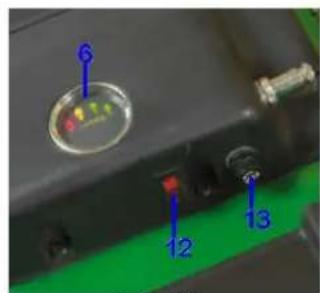
Fig.1b
II. CHARACTERISTICS
| Description | Cordless Hand Pushed Lawnmower |
| Reference | PRTB300LA / 725571 |
| Model / Type | XSS30-ED |
| Engine power source | Battery PB/Ac 24V / 7Ah |
| Charging time | 5-7 h |
| Operating time | 40-60min (*) (* Value for information purpose, as it may vary depending on the environment and actual conditions of use of the lawnmower. |
| Blade rotation speed | 3800 rpm |
| Working width max. | 300mm |
| Adjustable cutting heights | 4 positions from 28 to 64mm |
| Capacity of grass collecting bag | 30 L (approx.) |
| Wheels dimensions | Ø 6” (or ± 15cm) |
| Sound pressure level (LPA) | 72 dB(A) (K=3dB) |
| Sound Power level (LWA) | 92 dB(A) (K=3dB) |
| Vibrations level | ah = 0,63 m/s² (K=1,5 m/s²) |
| Weight (approx.) | 14kg (without battery); 20kg (with battery) |
| Description | Battery Charger for Cordless Hand Pushed Lawnmower |
| Model / Type | QL-09005 |
| Power | PRI: a.c. 230V; SEC: d.c. 24V 1800mA |
Symbols
| Warning! Read the instruction manual before operating this machine or prior to carrying any intervention (e.g. cleaning, maintenance, repair ...) on the tool. Follow all warnings and safety precautions to avoid a danger | |
| Caution! Risk of injury and/or damage and/or deterioration of product in case of non compliance to safety requirements | |
| Do not expose to rain or weather conditions to avoid the risk of rust. Do not use or leave outdoors under rain. | |
| Danger! Rotating blades. Do not touch. Keep hands and feet away from the cutting cylinder during operation. Keep all parts of your body (and especially the hands and feet) outside the cutting area. Do not attempt to clean debris when the blades rotate | |
| Keep persons (esp. children) and animals away from product and working area. Stop tool as soon as someone enters the working area. Warning! Projection hazard (e.g. stones or other objects...) | |
| Wear proper protective equipment such as carmuff, goggles... | |
| Wear protective gloves when using or for any intervention on the tool. Wear protective boots with non-slippery soles during operation. | |
| Warning! The blade continues to rotate after the motor is switched off. Wait until the cutting blade has come to a complete stop before touching it. Wear protective gloves when clearing debris around the blade. The blade is very sharp and can cause serious injuries. | |
| Switch off safety switch before proceeding to any maintenance, cleaning or any intervention on product; before leaving tool unattended or when tool is not used for prolonged periods of time. | |
| Only use charger indoors in a dry and clean room. | |
| Do not dispose of this product with household rubbish. Disposition of this product in the nearest recycle centre. Please contact your local authority or local recycle centre for further information for its safe disposal. |
III. SAFETY INSTRUCTIONS
WARNING! When using electric tools basic safety precautions should always be followed to reduce the risk of fire, electric shock and personal injury including the following.
Read all these instructions before attempting to operate this product
Keep these instructions for future reference and use them to train others who may use the tool. If you lend or pass the tool, ensure to attach these instructions so that any user can refer to them.
3.1- General safety instructions
- Consider work area environment
- Do not expose tool to rain, moisture or humidity.
Water entering a tool may increase the risk of electrical hazard and damage. - Work only if there is good lighting (i.e. sunlight or sufficient artificial light).
-
Beware of your stability when working on wet, frozen ground or slopes.
-
Keep other persons away
-
Do not let persons, especially children, not involved in the work touch the tool and keep them away from tool and work area.
Any distraction can make you lose control of the tool.
If someone calls you, stop the mower before turning towards the caller.
- Only operator or user must be in working area. Keep children, animals and spectators at a safe distance
-
Keep the product away from children or from their environment. Never allow children to operate the tool. Children should be supervised to ensure that they do not play with the tool.
-
Store idle tools
When not in use, tools should be stored in a dry locked-up place, out of reach of children.
-
Use the right tool
-
Do not force small tools to do the job of a heavy duty tool.
- Do not use tool for purposes not intended or for unsuitable purposes
-
Only use the machine for the purposes described in the instruction manual
-
Dress properly - Wear proper working clothing!
-
Do not wear loose clothing or jewellery; they can be caught in moving parts.
- Non-skid footwear are recommended when working outdoors.
Never operate the machine with barefoot or open sandals. - Wear Rubber gloves.
-
Wear protective hair covering to contain long hair.
-
Use protective equipment
-
Use safety glasses or goggles
- Use face or dust protection mask if working operations create dust.
-
The noise level in the working area is above 85dB(A) . Therefore, wear ear protection (to avoid hearing loss hazard).
-
Do not overreach
Avoid any abnormal posture. Keep proper footing and balance at all times.
-
Maintain tools with care
-
Abide by the maintenance and accessories replacement regulations
- Keep cutting tools sharp and clean for better and safer performance.
- Follow instructions for lubricating and changing accessories.
- Keep handles dry, clean and free from oil and grease.
- It is your own interest to keep your machine clean at any time.
-
After you finish working, check the machine for any damage.
-
Stay alert
Watch what you are doing. Use common sense. Do not operate tool when you are tired, under the influence of alcohol, prescription medicines or drugs.
-
Check damaged parts
-
Before further use or reuse of the tool, tool should be carefully checked to determine that it will operate properly and perform its intended function.
- Check for alignment of moving parts, binding of moving parts, breakage of parts, mounting and any other conditions that may affect its operation.
- Any parts should be installed properly to comply with the conditions of the machine safe operation.
- A guard or other part that is damaged should be properly repaired or replaced by an authorized service centre unless otherwise indicated in this instruction manual.
- Have defective switches replaced by an authorized service centre
- Do not use the tool if the switch does not turn it on and off.
11. Warning
The use of any accessory or attachment, other than one recommended in this instructions manual may present a risk of injury (to persons or animals) and may cause damages.
The user and/or operator are responsible for any damages or injury caused to properties and/or persons.
- Have your tool repaired by a qualified person
This electric tool complies with the relevant safety rules.
Repairs should only be carried out by qualified persons using original spare parts; otherwise this may result in considerable danger to the user.
The use of unauthorized parts or failure to follow the maintenance instructions may result in injury or damage.
13. Remarks
The safety precautions and instructions given in this manual are unable to cover in detail all the conditions and situations that may arise.
The operator and/or user must use common sense and caution when operating the product especially for any matters that are not referred in the above.
- The protection device (if any) must be set in the appropriate position to avoid a danger for the user.
3.2-Safety warnings regarding the use
Important notice! Observe any national safety regulations regarding installation, operation and maintenance.
- Become familiar with the controls and the proper use of the equipment.
- The use of this product by children is forbidden.
- Only well-instructed adults should operate the product. This product is not intended for use by persons (including children) with reduced physical, sensory or mental capabilities, or lack of experience and knowledge, unless they have been given supervision or instruction concerning use of the product by a person responsible for their safety.
- Use only cutting accessories with a permissible speed at least as high as the no-load speed of the machine.
- Do not use tool if it is damaged, eccentric or vibrating.
- Do not use tool if the blade is damaged, cracked, eccentric or vibrating.
- Never seize or touch the blade during operation.
- Work may create dust and projection of debris. Wear appropriate protective equipment (dust mask, safety goggles...).
- Residual risks
Even when the tool is used as prescribed it is not possible to eliminate all residual risk factors.
9.1. The following hazards may arise in connection with the tool's construction and design:
a. Damage to lungs if an effective dust mask is not worn.
b. Damage to hearing if effective hearing protection is not worn.
c. Risk of injury if you touch the blade while in use
d- Exposure to electricity by using a defective battery.
e. Risk of body injury or property damage from flying debris.
f. Health defects resulting from vibration emission if the power tool is being used over longer period of time or not adequately managed and properly maintained.
The declared vibration total value has been measured in accordance with a standard test method and may be used for comparing one tool with another, especially applicable when other tools as same construction and is operated with the same power supply.
The declared vibration total value may also be used in a preliminary assessment of exposure.
Warning: The vibration emission during actual use of the power tool can differ from the declared total value depending on the ways in which the tool is used.
There is the need to identify safety measures to protect the operator that are based on an estimation of exposure in the actual conditions of use (taking account of all parts of the operating cycle such as the times when the tool is switched off and when it is running idle in addition to the trigger time).
9.2. Fire hazard
a. Never charge batteries near acids or flammable materials.
b. Charge battery only at ambient temperatures between 0^ and 45^ .
After heavy use, allow battery to cool down before charging it.
9.3. Risk of explosion
a. Protect the battery against heat and fire!
b. Do not place the battery on radiators. Avoid prolonged direct exposure to sunlight.
c. Use battery only at ambient temperatures between 0^ et 45^ .
9.4. Risk of short circuit
a. For disposal, transport or storage, pack the battery in a plastic bag or a cardboard box, or isolate the contacts with adhesive tape.
b. Do no open the battery pack.
9.5. WARNING! This machine produces an electromagnetic field during operation.
This field may under some circumstances interfere with active or passive medical implants.
To reduce the risk of serious or fatal injury, we recommend persons with medical implants to consult their physician and the medical implant manufacturer before operating this machine.
9.6. WARNING! A certain level of noise emitted from this machine is not avoidable.
Plan noisy works according to local laws and at specific times.
Keep rest periods and if necessary restrict the working hours to a minimum.
For your own personal protection and the protection of bystanders have suitable hearing protection worn.
10. Before you begin:
- The machine must be properly assembled before use.
- The machine should be carefully checked before each use. You should only work with a machine that is in good condition. If you notice a fault on the machine that may cause danger to the operator or the environment, do not operate the unit until the default has been repaired.
10.1. Browse the mowing area to:
- remove all objects and foreign materials that may be thrown by the moving blade,
- identify hard objects or risk areas to avoid damaging the lawnmower
10.2. Check the blades' condition, the safety features and cutting device conditions. Replace or repair any defective part.
10.3. Remove all people or animals of the area.
11. Work only in daylight or under sufficient artificial light.
12. Proper use:
The user is solely responsible of others when working with the machine.
-
Persons not familiar with the instructions, children, minors who have not yet reached the minimum age to use the machine, and persons under the influence of alcohol, drugs or medications are not allowed to operate the machine.
-
Make sure that all safety devices (if any) are well assembled and in good condition.
- For a safe operation, do not operate the machine on steep slopes. Whenever using the machine on a slope, slow down and ensure that you have proper balance.
- Hold the handle tightly, with both hands. Never use the machine only with one hand.
- Proceed walking with the lawnmower, never running. Guide the machine at slow speed. Do not adopt abnormal positions. At all times. Maintain a proper balance.
13. Pay particular attention:
- When working on slopes. Never work in areas too steep.
- Pulling the lawnmower towards you
- Make sure the blades stop running when:
- You tilt the lawnmower to move it over an area without grass.
-
You transport the lawnmower.
-
If the machine bumps against a foreign object, examine the unit for any sign of damage and make the necessary repairs before using the unit again.
- Never use the lawnmower with defective blade guards or without the security features in place.
- If the unit starts to vibrate abnormally, stop the engine immediately and check the reason.
Vibration is generally a sign of trouble.
- Keep in mind that the lawnmower can, unexpectedly, kickback or make a leap forward if the blade hits on hard ground, frozen ground, or obstacles such as stones, roots ...
- Do not put hands, feet or any part of the body or clothing near the rotating blade. Warning! Risk of injury!
- It is forbidden to remove or modify electrical and mechanical safety features.
- Never use the lawnmower when it rains. Avoid getting the lawnmower wet and do not expose it to moisture. Do not leave the lawnmower outside overnight. Do not cut wet grass.
- Protection against overload.
The unit is equipped with an overload protection fuse. In the case where the machine is blocked by a foreign body, the connection between the engine and the transmission shaft of the blade will cut off automatically. If this occurs:
- Stop the engine,
-
Solve the cause of the blockage. Replace the blade (if necessary) before restarting.
-
Switch OFF the safety switch
- Whenever you leave the mower
- Before cleaning a blockage
- Before checking, cleaning or any verification, maintenance on the machine
- After striking a foreign object. Check the machine for any damage and perform repairs if necessary.
- If the machine starts vibrating abnormally (check immediately).
Warning! The blade does not stop immediately after engine shutdown. Wait until the blade stops before making an intervention.
-
WARNING
-
Do not assume of your knowledge of the mower.
Remember that a split second of negligence is sufficient to cause serious damage.
3.3- In the event of emergency
Stop immediately the engine.
Assist the injured person with first aid and call for medical assistance as quickly as possible.
IV-GETTING STARTED
4.1- Unpacking
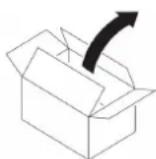
- Remove product from its packaging.
- Check that tool and accessories are not damage
4.2- Presentation
The machine is delivered pre-assembled.
However, certain parts need to be assembled by the user.
4.3-Assembly
4.3.1- Wheels assembly
- Slide the wheels (9) in their axis on the support (Fig.2a)
- Secure wheels with the provided washers and screws (Fig.2b)
- Assemble the wheel cover (Fig.2c)
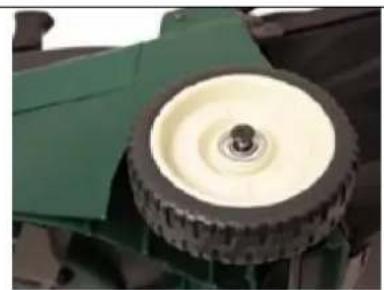
Fig.2a

Fig.2b
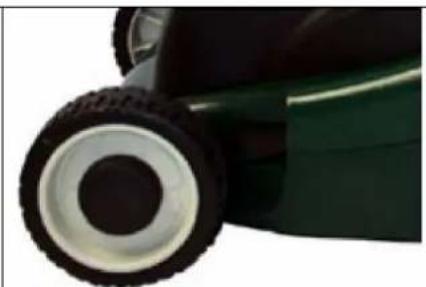
Fig.2c
4.3.2- Handle assembly
- Secure the lower handle tube (5) to their support located on the mower rear body (Fig.3a)
- Secure with the provided screws.
- Assemble the upper handle tubes (1) on lower handle tubes (5) (Fig,3b).
- Secure with the knobs (4) (Fig.3c)
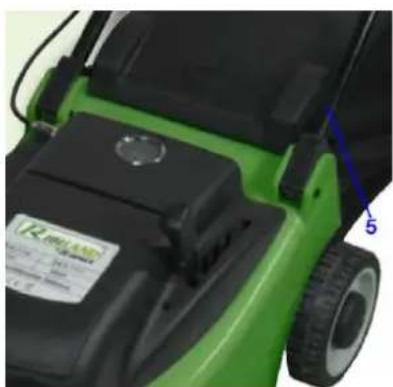
Fig.3a
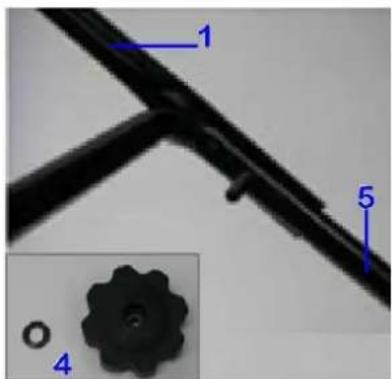
Fig.3b
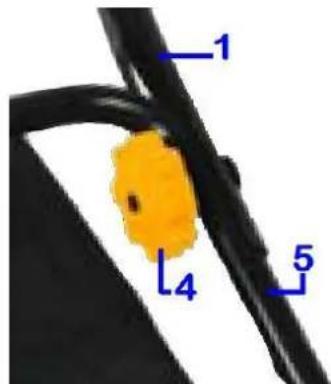
Fig.3c
4.3.3- Grass collection box
Note: The grass collection box must be fitted to the mower before operation. Insert the grass box (11) to the rear side of the mower as shown in Fig.4a &
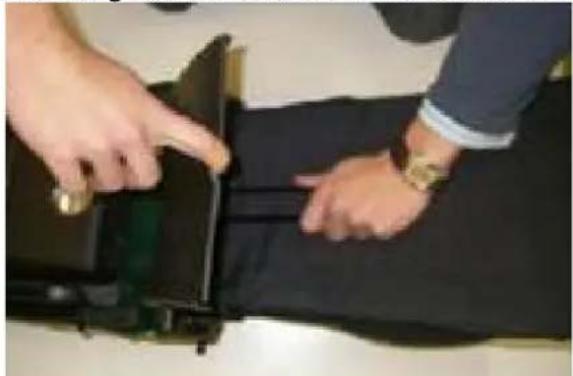
Fig.4a
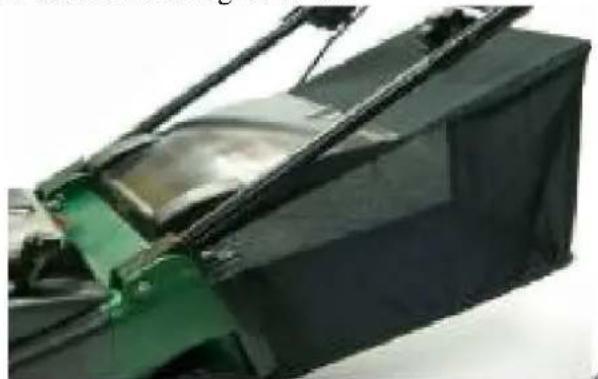
Fig.4b
4.4- Setting the cutting height (Fig.5)
Warning: Before adjusting the cutting height, make sure
- to switch off the mower
- to check that the blade has completely stopped rotating.
- to switch off the safety switch.
Push the lever (11) and set it on one of the four positions.
4 cutting heights: 28mm , 40mm , 52mm and 64mm .
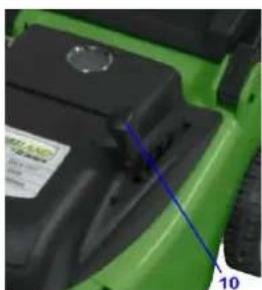
Fig.5
4.5-Battery
Before using the lawnmower for the first time, charge the battery for approx. 5hours.
Refer to chapter 6 regarding instructions and precautions related to the battery and its charging.
4.6-Starting (Fig. 6)
- To start the mower: press and hold safety button (3), then squeeze the switch lever (2) towards the handle.
The engine starts and blade starts to rotate.
- Keep switch lever (2) squeezed and release the safety button (3).
- To stop the mower: fully release the switch lever (2)
Caution! The blade continues to rotate after the machine is switched off. Wait until blade comes to a complete stop before leaving the mower and before proceeding to any intervention on the mower.
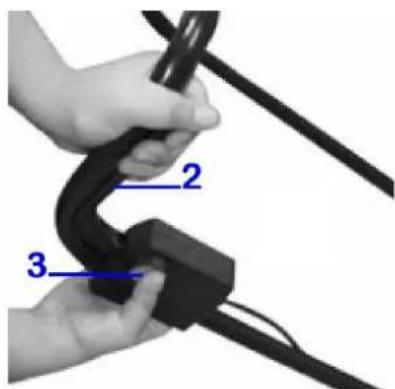
Fig.6
V. OPERATION
5.1- Intended use
- The product is intended for outdoor domestic use in private gardens or lawns.
- The product is intended for mowing lawn or grass within the limits of its characteristics.
- This tool may not be used to do other things outside of the described scope in this manual.
- Do not use the machine for unsuitable purposes (for ex. for cutting wood ...)
- The tool is not intended for professional or industrial use (for ex.: in public parks, sports grounds...).
5.2-Operation:
Before any operation:
-- always visually inspect that the product does not show signs of use or damage
-- check that the screws, bolts and nuts are well tightened.
Replace any used or damaged part, and tighten firmly the screws, bolts and nuts when needed.
Before first use: charge battery for approx 5 hours
- Always move the lawnmower on the work area before starting work.
- Hold the machine firmly with both hands by the handle
- Start engine (see 4.5)
- Guide the mower in the work area. Walk, do not run.
- Always work moving forward, never backwards.
- When working on slopes, mow across the face of the slope, never up and down.
- It is recommended to make several crossings over the same area of work, especially when the grass is long or hard.
- When you have finished your work, switch off the mower and switch off the safety switch.
- Clean and store the lawnmower.
- We recommend you follow the below tips.
5.3- Advice
- Never mow while persons or animals are nearby the working area.
- Remove all foreign objects in the working area (e.g.: stones, branches, pipes...)
- Operate the unit only when it is appropriate to do so. For example, do not work when it is raining, on frozen ground or waterlogged.
- Do NOT use the lawnmower if temperature is below 0^ or above 45^ .
- Walk, never run with the mower.
- During operation, avoid motor overload or blocking. Pay attention to changes in motor sound, when this occurs and motor speed drops, release the switch lever (2) and adjust the cutting height to allow blade rotating more easily and hence alleviate motor, Failure to do so may result in damage to the product or to the battery.
- To turn the mower: press on main handle so as to lower the centre of gravity to the rear wheels, then turn lawnmower.
- If the blades touch foreign objects, stop the machine immediately, switch off the safety switch, and
check the unit with its blades stopped. Continue your work only if the machine was not damaged.
- When working on slopes always stand diagonally to the slope, through a strong and stable position. Always stands across the slope, never up or down directly. Be especially careful when you change direction.
Do not work on very steep slopes.
- When you go to areas without grass (e.g. to change the workplace, over a driveway, ...), make sure the blades are stopped.
- To avoid tripping, use extreme caution when reversing or when pulling the lawnmower towards you.
- Protect the battery from heat (eg. do not leave the battery under direct sunlight ...), fire, water (eg. do not store in damp places, do not leave it outside when raining ...)
- Overload protection: In case of overload or blocking, the fuse will operate and shuts down automatically.
Turn off the motor and switch off the safety switch
Overload may be due to: a cutting height too low (re-adjust if necessary); at a cutting speed too fast (reduce your speed).
The blockage may be due to the presence of debris on the blade (clean blade) or objects in the work area (eg remove the branches or other objects ...)
Be sure to change the fuse with a fuse of the same technical data (fuse: AC 250V, 12A)
-
Never pick up or carry an appliance while the motor is running.
-
If the battery is running out of power, it should be charged accordingly. The battery can only be charged using the correct charger (provided with the lawnmower).
Incorrect use may result in electric shock, overheating or leakage of corrosive liquid from the battery.
5.4- Working speed
The working speed may vary depending on the geography of the working area (e.g. flat ground, hilly...), depending on the grass properties (e.g.: thickness, length, humidity ... and the selected cutting height.
It is important to maintain a working speed that allows full control of the mower at all times.
VI. MAINTENANCE AND STORAGE

Before any intervention on the product, make sure that the mower is switched off and switch off the safety switch.
Any operation, maintenance, adjustment must be carried out with the machine at a standstill.
6.1- Maintenance and Cleaning
a) Have your tool serviced by a qualified person using only identical replacement parts.
This will ensure that the safety of your tool is maintained.
b) Have your tool repaired by a qualified person
Unless otherwise indicated in this instruction manual, repairs or replacement of any damaged part in an authorised service centre is recommended.
c) Maintain tool with care.
Keep tool clean for better and safer performance.
6.1.1- Before each use
- Check the mower for any signs of damage or ageing.
- Check cutting blade condition, do not use it if worn out or cracked.
- Check battery charge level, and recharge if necessary.
- Make sure all screws and nuts are tight.
- If the mower shows any defect, return the device to a certified service center for repair if necessary.
6.1.2- After each use
- Same as 6.1.1
- Clean the mower of all debris and dirt.
- Store mower (see 6.6)
6.1.3- Once a year
- Lubricate the blade and its shaft.
- Upon season's end, have your lawnmower checked and maintained in an authorised service centre.
6.1.4- Blade maintenance
During operation, a stone or root can bump against the blade, or tall grass or weeds can wrap around the blades and its shaft.
To clean the blade, first stop the lawnmower (by releasing the lever switch). Switch off the safety switch. Wait until the blade comes to a complete stop, then remove all debris on the blade and shaft. If necessary, dis-assemble the blade for easy cleaning
6.2-Battery
a) Battery Precautions:
Make sure the battery is in good condition.
Use only the battery supplied with the mower or recommended by the manufacturer.
The use of any other battery may result in hazards to persons (e.g. electric discharge, acid leakage, ...) or to property (eg fire, explosion, ...).
- Charge the battery only with the charger supplied or specified by the manufacturer.
- Do not short-circuit the battery terminals. Keep the battery away from small metal objects, do not store battery with metal objects (eg.: Paper clips, coins, keys, nails, screws ...) that could create a short circuit between the terminals.
- In case of misuse, there may be a risk of electric shock, overheating or leakage. Avoid contact with battery fluid or other contaminants.
In case of contact, rinse thoroughly with water. If the liquid gets in your eyes, consult a doctor. Fluid leakage from the battery can cause skin irritation or burns.
- Do not dispose of battery into fire, into the environment, with household waste.
- Do not expose the battery to high heat or direct sunlight.
- Do not expose the battery to cold (always store the mower protected from cold).
b) Battery charger precautions:
- Make sure the charger is in good condition.
- Use only the charger supplied with the mower or recommended by the manufacturer.
- Check that the voltage on the nameplate of the charger matches the voltage of your mains supply.
- Warning! The charger should only be used indoors, in a dry place!
c) To extend the life of the battery, read and follow the instructions below:
- If the battery voltage is too low, the mower stops automatically. In such case, charge the battery.
- The lead-acid battery must be recharged before prolonged periods of non use or for example before of winter
6.2.1- Checking the battery charge level (Fig.7)
To check the battery charge level, switch on the security switch in the battery cover, and turn right, the indicator (6) on the cover will indicate the level of charge, where:
- “F” = Full (green LED)
- “E” = Empty (red LED)
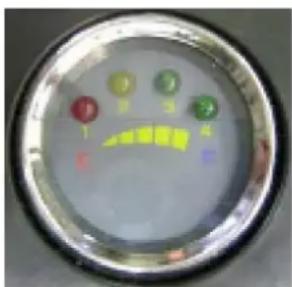
Fig.7
6.2.2- Charging the battery
- Lift the battery cover (Fig.8a)
- Switch off the safety switch
- Remove the battery from its compartment (Fig.8b)
- Plug the charger to the battery (Fig.8c)
- Connect the charger to a power source.
-
The charging time for a completely flat battery is approx. 5-7 hours.
-
Red LED is on: indicates the charging process is ongoing.
-
Green LED is on: indicates that charging process is completed.
-
At the end of charging time:
-
Unplug the charger from the mains and disconnect the battery.
-
Store the charger
-
Replace the battery in the compartment (Fig.8b)
-
Close the battery cover (Fig.8a)
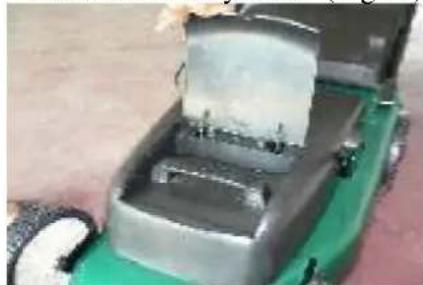
Fig.8a
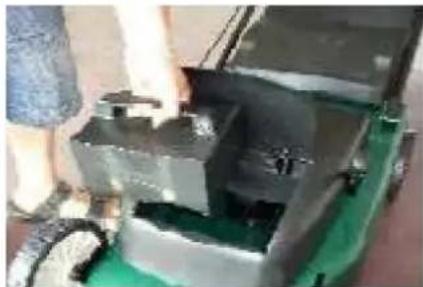
Fig.8b
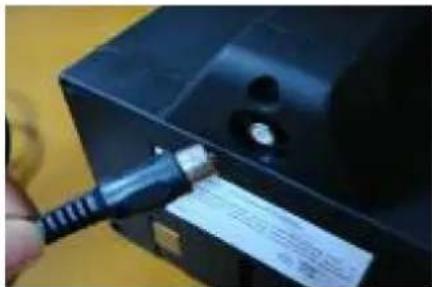
Fig.8c
6.3- Blade
6.3.1- Blade assembly and/or replacement
Warning! Switch off the security switch before proceeding to any intervention.
Wear protective gloves.
Warning! Do not use a worn out, broken, cracked or damaged blade.
Use only an original blade or a blade recommended by the manufacturer
a) A worn out blade may lead to poor performance and motor overload.
Before each operation, check the condition of the blade.
Sharpen or replace blade if necessary.
It is recommended to perform the replacement by qualified specialist.
b) To remove the blade from its axis (Fig. 9)
-
Block the blade (eg. using a wedge)
-
Remove the bolt and nut.
-
Remove the blade from the axis
-
Install or assemble a blade, and then proceed with above steps in reverse.
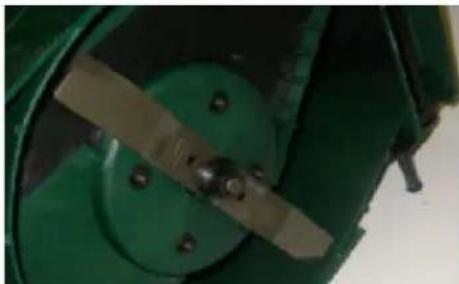
Fig.9
6.3.2- Sharpening the blade
Remove blade by following steps "b" in 6.3.1
Sharpen the blade with sharpener or mini-grinder.
Once blade is sharpened, re-assemble it on its axis.
Make sure that blade is tightened properly, to avoid a danger
6.3.3- Blade Lubrication
At the end of the season, before storing lawnmower for winter or before any extended period of non use, clean and lubricate the blade and its shaft.
6.4-Cleansing
- Clean plastic parts with a soft and clean cloth
- Do not use aggressive cleansers (solvents or abrasive cleansers), or an abrasive sponge.
- Do not use any caustic to clean the plastic parts.
- Do not put or immerse tool in water or any other liquid.
a) Clean the plastic parts with a soft cloth and clean.
Do not use aggressive cleaning agents (solvents, abrasive cleansers) or an abrasive sponge or any sharp objects.
- Do not use any caustic chemicals to clean the plastics parts.
- Never put or immerse the mower in water or any liquid, and ensure that water does not penetrate
inside.
b) Caution! Injury hazard when working on or near the blade. Wear protective gloves.
c) Caution! It is recommended to clean the tool after use.
Failure to maintain proper cleaning may cause damage to tool or cause malfunctions.
-
Whenever possible, clean the unit immediately after completing your work.
-
Clean the underside of the casing around the blade with a brush or a soft cloth dampened with a mixture of mild soap and water.
Never wash the mower by spraying water!
-
Clean the grass catcher making sure to remove any grass or dirt present.
-
After cleaning, wipe the blade and shaft and then apply a thin layer of oil.
6.5- Transport
Warning! Before transporting or moving the lawnmower, switch off the engine.
-
The blade and the unit may be damaged even if you move the mower with the engine off, for example on a hard surface.
-
Avoid the blade to hit the ground while holding the mower by the handle and lifting the front wheels.
-
Firmly tie or latch the mower during transport (eg.: in a van or a trailer ...) to avoid any risk.
6.6-Storage
-
Keep product, user manual and accessories in the original packaging.
-
It is recommended to store the product in a clean, dry location, and keep it out of children's reach (e.g. lock it up).
-
Do not place or store any object on top of the product.
-
Do not store any object above the mower so you do not have to tread upon the mower to reach it.
-
During long storage periods (for ex. during the winter), ensure that the device is protected against corrosion and freezing.
-
At the end of the season, or if the mower is not used for more than a month:
-
Clean the mower,
-
Wipe down all metal surfaces with a cloth soaked in oil to protect them from corrosion (non-resinous oil), or spraying a thin layer of oil.
-
Fold down the handle, and store the mower in a suitable location.
6.7- Disposal
Battery: Do not dispose with household garbage. Do not throw into the environment.
Dispos of battery in a collection centre for batteries, or seek advice from our local municipality.
Lawnmower: Do not dispose with household garbage. Do not throw into the environment.
Dispose of the tool in a collection centre for waste of electrical and electronic equipment, or a waste drop-off centre; or seek advice from your local municipality.
7-Warranty Information
The manufacturer or its authorised representative provides warranty in accordance with the legislation of the customer's own country of residence, with a minimum of 1 year, starting from the date on which the appliance is sold to the end user.
The warranty only covers defects in material or workmanship.
The repairs under warranty may only be carried out by an authorized service centre.
When making a claim under the warranty, the original bill of purchase (with purchase date) must be submitted.
The warranty will not apply in cases of:
- Normal wear and tear
- Incorrect use, e.g. overloading of the appliance, use of non-approved accessories
- Use of force, damage caused by external influences
- Damage caused by non-observation of the user manual, e.g. connection to an unsuitable mains supply or non-compliance with the installation instructions
- Partially or completely dismantled tool.
- Partially or completely modified tool with parts not recommended by the manufacturer.
- Damage or loss occurred during transportation.