JKTB18U - Rice cooker Tiger - Free user manual and instructions
Find the device manual for free JKTB18U Tiger in PDF.



Frequently Asked Questions - JKTB18U Tiger
User questions about JKTB18U Tiger
0 question about this device. Answer the ones you know or ask your own.
Ask a new question about this device
Download the instructions for your Rice cooker in PDF format for free! Find your manual JKTB18U - Tiger and take your electronic device back in hand. On this page are published all the documents necessary for the use of your device. JKTB18U by Tiger.
USER MANUAL JKTB18U Tiger
Thank you for purchasing this TIGER rice cooker/warmer.
Please read these instructions carefully before use and observe them during use.
When using electrical appliances, basic safety precautions should always be followed including the following:
- Read all instructions.
- Do not touch hot surfaces. Use handles or knobs.
- To protect against electrical shock do not immerse cord, plugs, or (state specific part or parts in question) in water or other liquid.
- Close supervision is necessary when any appliance is used by or near children.
- Unplug from outlet when not in use and before cleaning. Allow to cool before putting on or taking off parts.
- Do not operate any appliance with a damaged cord or plug or after the appliance malfunctions or has been damaged in any manner. Return appliance to the nearest authorized service facility for examination, repair, or adjustment.
- The use of accessory attachments not recommended by the appliance manufacturer may cause injuries.
- Do not use outdoors (this item may be omitted if the product is specifically intended for outdoor use).
- Do not let cord hang over edge of table or counter, or touch hot surfaces.
- Do not place on or near a hot gas or electric burner, or in a heated oven.
- Extreme caution must be used when moving an appliance containing hot oil or other hot liquids.
- Always attach plug to appliance first, then plug cord into the wall outlet. To disconnect, turn any control to "off", then remove plug from wall outlet.
- Do not use appliance for other than intended use.
SAVE THESE INSTRUCTIONS
Servicing should be performed by an authorized service representative.
This rice cooker is intended for household use.
A short power supply cord is provided to reduce the risk of becoming entangled in or tripping over a longer cord. Extension cords may be used if care is exercised in their use. If an extension cord is to be used: (1) the marked electrical rating of the extension cord should be at least as great as the electrical rating of the appliance; (2) if the appliance is of the grounded type, the extension cord should be a grounding-type 3-wire cord; and (3) the cord should be arranged so that it will not drape over the countertop or tabletop where it can be pulled down by children or tripped over accidentally.
The following instructions are applicable to 120V only:
This appliance has a polarized plug (one blade is wider than the other). To reduce the risk of electrical shock, this plug is intended to fit into a polarized outlet in only one way. If the plug does not fit fully into the outlet, reverse the plug. If it still does not fit, contact a qualified electrician. Do not attempt to defeat this safety feature.
The appliance is not intended for use by young children or disabled persons without supervision. Ensure that young children do not play with the rice cooker.
GARANTIES DE SECURITE IMPORTANTES
1 Safety Instructions 6
2 Names and Functions of Component Parts 11
Menu options and features 13
Tips on making delicious rice 14
3 Before Cooking Rice 16
4 How to Cook Rice 18
Cooking time guidelines 19
5 Once the Rice Is Done Cooking 20
6 How to Cook Oatmeal ("Oatmeal" menu) 21
7 Setting the Timer 22
8 Keeping the Rice Warm 24
9 Reheating Cooked Rice 25
10 Cleaning and Maintenance 27
11 If Rice Does Not Cook Properly 32
12 Troubleshooting 34
If these indications appear 35
Setting the present time 36
Specifications 37
In case of a power outage 37
Purchasing consumables and optional accessories 37
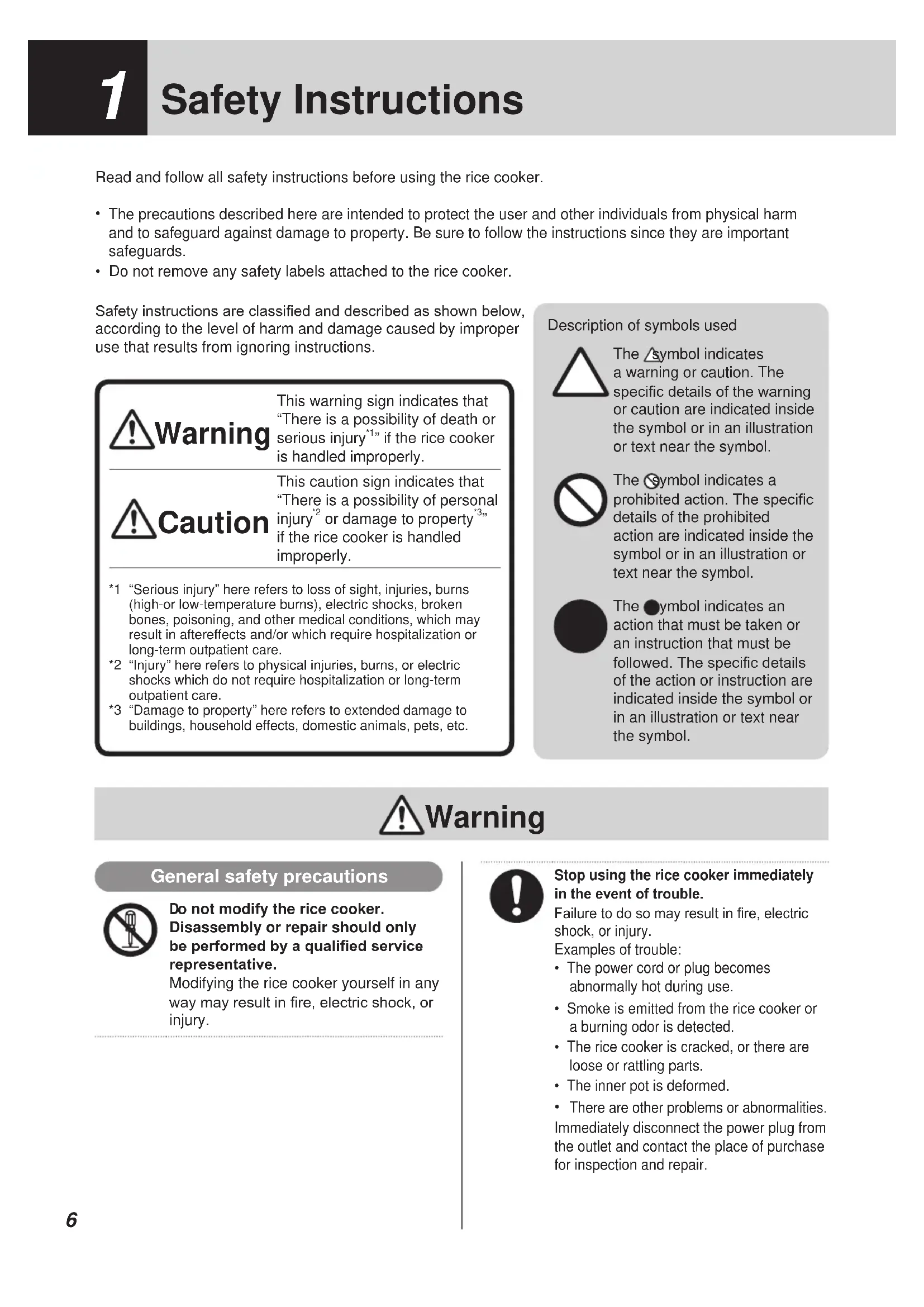
1 Safety Instructions
Read and follow all safety instructions before using the rice cooker.
- The precautions described here are intended to protect the user and other individuals from physical harm and to safeguard against damage to property. Be sure to follow the instructions since they are important safeguards.
- Do not remove any safety labels attached to the rice cooker.
Safety instructions are classified and described as shown below, according to the level of harm and damage caused by improper use that results from ignoring instructions.

This warning sign indicates that "There is a possibility of death or serious injury" if the rice cooker is handled improperly.

This caution sign indicates that "There is a possibility of personal injury" or damage to property if the rice cooker is handled improperly.
1 "Serious injury" here refers to loss of sight, injuries, burns (high-or low-temperature burns), electric shocks, broken bones, poisoning, and other medical conditions, which may result in aftereffects and/or which require hospitalization or long-term outpatient care.
2 "Injury" here refers to physical injuries, burns, or electric shocks which do not require hospitalization or long-term outpatient care.
*3 "Damage to property" here refers to extended damage to buildings, household effects, domestic animals, pets, etc.
Description of symbols used

The symbol indicates a warning or caution. The specific details of the warning or caution are indicated inside the symbol or in an illustration or text near the symbol.

The symbol indicates a prohibited action. The specific details of the prohibited action are indicated inside the symbol or in an illustration or text near the symbol.

The symbol indicates an action that must be taken or an instruction that must be followed. The specific details of the action or instruction are indicated inside the symbol or in an illustration or text near the symbol.
Warning
General safety precautions

Do not modify the rice cooker. Disassembly or repair should only be performed by a qualified service representative.
Modifying the rice cooker yourself in any way may result in fire, electric shock, or injury.

Stop using the rice cooker immediately in the event of trouble.
Failure to do so may result in fire, electric shock, or injury.
Examples of trouble:
The power cord or plug becomes abnormally hot during use.
Smoke is emitted from the rice cooker or a burning odor is detected.
The rice cooker is cracked, or there are loose or rattling parts.
- The inner pot is deformed.
- There are other problems or abnormalities. Immediately disconnect the power plug from the outlet and contact the place of purchase for inspection and repair.
Warning
Who should use the rice cooker

Do not allow children to use the rice cooker unsupervised. Keep out of reach of infants.
Unsupervised use by children or infants may result in burns, electric shock, or injury.

This rice cooker is not intended for use by persons with physical difficulties or lack of adequate knowledge of its proper use.
A person with sufficient knowledge should always be present to confirm the appropriate use of the rice cooker.
Inappropriate use may result in burns, electric shock, or injury.
Using the rice cooker

Do not use the rice cooker in any ways not specifically covered in this instruction manual.
Doing so may enable steam or the contents of the rice cooker to spray out, resulting in burns or other injury.
Examples of procedures that should not be performed:
- Heating ingredients or seasoning inside of plastic bags, etc.
- Using a cooking sheet or other utensils to cover food in the rice cooker.
Power supply

Use only 120 V AC power.
Use of any other power source may result in fire or electric shock.

Use an independent outlet rated for 15 A or higher.
Connecting other instruments to the same outlet may cause the branch socket to overheat, resulting in fire.
Power cord and plug

Do not use a damaged power cord. Also, be careful not to damage the power cord yourself.
(Do not modify, forcibly bend, pull, twist, or bundle the cord. Do not expose it to heat.
Do not rest anything heavy on the power cord or sandwich it between any objects.) Doing so may result in fire or electric shock.

Clean the power plug if it is dirty.
Failure to do so may result in fire.

Insert the power plug fully into the outlet.
Failure to do so may result in electric shock, short-circuiting, smoke, or fire.

Do not use the rice cooker if there is any damage to the power cord or plug, or if the plug cannot be securely inserted into the outlet.
Doing so may result in electric shock, short-circuiting, or fire.

Do not connect or disconnect the power plug with wet hands.
Doing so may result in electric shock or injury.

Do not expose the power plug to steam.
Doing so may result in electric shock or fire. When using the rice cooker on a sliding tabletop, position the cooker so that the power plug is not exposed to the emitted steam.
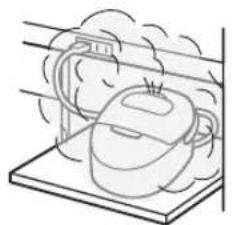
Warning
Handling the rice cooker
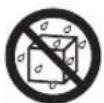
Do not immerse the rice cooker in or splash it with water.
Doing so may result in short-circuiting or electric shock.

Do not insert pins, needles, or other metal objects, etc., into the air inlet or air outlet, or gaps between parts.
Doing so may result in electric shock or in injury due to malfunction.
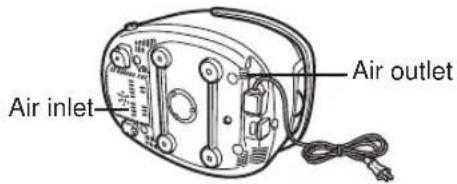
During and after cooking

Never open the lid during cooking. Doing so may result in burns.

Do not place your face or hands near the steam cap or steam vent.
Doing so may result in burns. Be especially careful to keep out of reach of small children.
Caution
General safety precautions

Handle the rice cooker with care.
Dropping the rice cooker or exposing it to a strong impact may result in injury or in malfunction of the unit itself.

Do not touch the handle of the inner pot with your bare hands when the rice cooker is or has recently been in operation; use oven mitts to pick up the pot.
Touching the hot pot may result in burns.
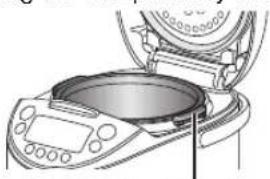
Handle of the inner pot

People who use medical pacemakers should consult a medical specialist before using the rice cooker.
Operation of the rice cooker may cause adverse effects on pacemakers.
Environment for use

Do not use the rice cooker on unstable surfaces or heat sensitive tables or mats.
Doing so may result in fire or damage to the table or mat.

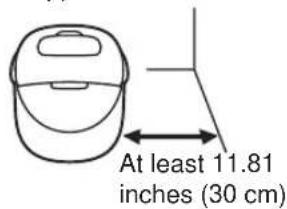
Do not use the rice cooker near walls or furniture.
Steam and heat may cause damage, discoloration and/or deformation. Use the rice cooker at least 11.81 inches (30 cm) away from walls or furniture. When using the rice cooker in a hide-away-type of shelf or counter, be careful not to allow the steam to remain trapped inside the enclosed area.
Caution

Do not use the rice cooker on a sliding tabletop that can not easily bear its weight.
Falling from the tabletop may result in injury, burns, or malfunction of the unit itself.
Before using the rice cooker, confirm that the sliding tabletop is sufficiently able to bear its weight.

Do not use the rice cooker near a heat source or where it may be splashed with water.
Doing so may result in electric shock, short-circuiting, fire, or deformation or malfunction of the rice cooker.

Do not use the rice cooker in a small space where the operation panel is exposed to steam.
Steam and heat may result in deformation of the operation panel, and/or damage, discoloration, deformation, and/or malfunction of the rice cooker. When using the rice cooker on a sliding tabletop, pull the tabletop out so that the operation panel is not exposed to the emitted steam.

Do not use the rice cooker in situations where the air inlet or air outlet may be blocked or where the room temperature is high.
Do not place the rice cooker on top of carpets, plastic bags, etc.
Doing so may result in electric shock, short-circuiting, fire, or malfunction of the rice cooker.

Do not use the rice cooker on an IH cooking heater.
Doing so may result in malfunction.

Do not use the rice cooker on an aluminum sheet or electric carpet.
Doing so may generate heat from the aluminum material, which could result in smoke or fire.
Power cord and plug

Be sure to hold the power plug when disconnecting the cord from an outlet. Failure to do so may cause an electric shock or short-circuiting, resulting in fire.
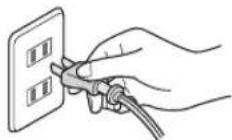

Do not plug multiple appliances into a single outlet. Doing so may result in fire.
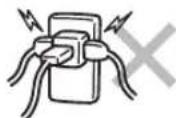
Handling the rice cooker

Only use the inner pot made exclusively for this rice cooker. Using any other pot may result in overheating or malfunction.

Do not cook with the inner pot empty. Doing so may result in overheating or malfunction.

Do not place anything susceptible to magnetism near the rice cooker, as the rice cooker generates magnetic waves. If the rice cooker is located near a TV or radio, it may generate noise in the TV or radio. If it is located near a cash card, commuter pass for automatic ticket gates, cassette tape, or video tape, it may erase the data on those devices.

Be careful of the escaping steam when opening the lid. Exposure to steam may result in burns.

Disconnect the power plug from the outlet when the rice cooker is not in use.
Failure to do so may result in injury or burns, or in electric shock or a short-circuit-induced fire due to degradation of the insulation.
Caution

Do not touch the open/lock button while carrying the rice cooker.
Doing so may cause the lid to open, resulting in injury or burns.
During and after cooking

Do not touch hot parts during or immediately after cooking.
Doing so may result in burns.

Do not move the rice cooker during cooking.
Doing so may result in burns or enable the contents to boil over.
Cleaning the rice cooker

Wait until the rice cooker has cooled down before cleaning it.
Failure to do so may result in burns.

Do not wash the entire rice cooker.
Do not wash the entire rice cooker or pour water into the rice cooker or its bottom section. Doing so may result in short-circuiting or electric shock.
Cautions towards enabling the long-term use of this rice cooker
- Remove burned rice and any other remaining grains of rice.
Failure to do so may cause steam to leak out or the contents to boil over, resulting in a malfunction of the unit or simply in improperly cooked rice. - Do not cover the rice cooker with a cloth or other object during cooking.
Doing so may cause the rice cooker or the lid to become deformed or discolored. - The holes on the rice cooker are designed to maintain its functions and performance. In extremely rare cases, dust or even insects may enter these holes and cause a malfunction. To prevent this, a commercially available insect-prevention sheet, etc., is recommended. If a malfunction does occur due to this problem, it will not be covered by warranty. Contact the place of purchase.
- The inner pot's fluorocarbon resin coating may wear and peel with extended use. This material is harmless to humans and this situation presents no hindrance to actual cooking or to the rice cooker's heat insulating capability.
If you would like, or if the inner pot becomes deformed or corroded, a new one may be purchased. Contact the place of purchase.
- Strictly observe the following to keep the fluorocarbon resin coating from blistering or peeling:
- Do not place the inner pot over a gas fire, or use it on an electromagnetic cooker or in a microwave oven, etc.
- Use the Keep Warm function for white rice (rinse-free rice) only; do not use for seasoned rice, etc.
- Do not use vinegar inside the inner pot.
- Use only the supplied spatula or a wooden spatula.
- Do not use hard utensils such as metal ladles, spoons, or whisks.
- Do not place a basket inside the inner pot.
- Do not place tableware and other hard utensils or objects inside the inner pot.
- Do not clean the inner pot with hard materials such as metal spatulas or nylon scouring sponges.
- Do not use a dishwasher/dryer to clean the inner pot.
- Be careful not to scratch the inner pot when washing rice.
- If the inner pot becomes deformed, contact the place of purchase.
2 Names and Functions of Component Parts
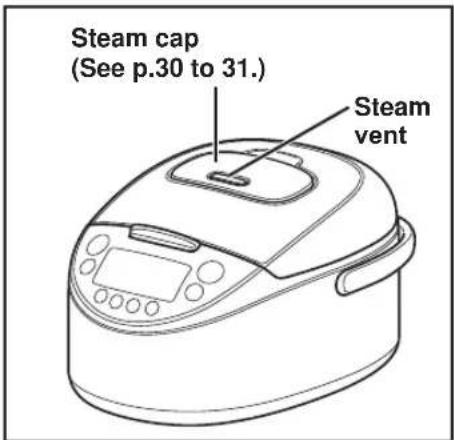
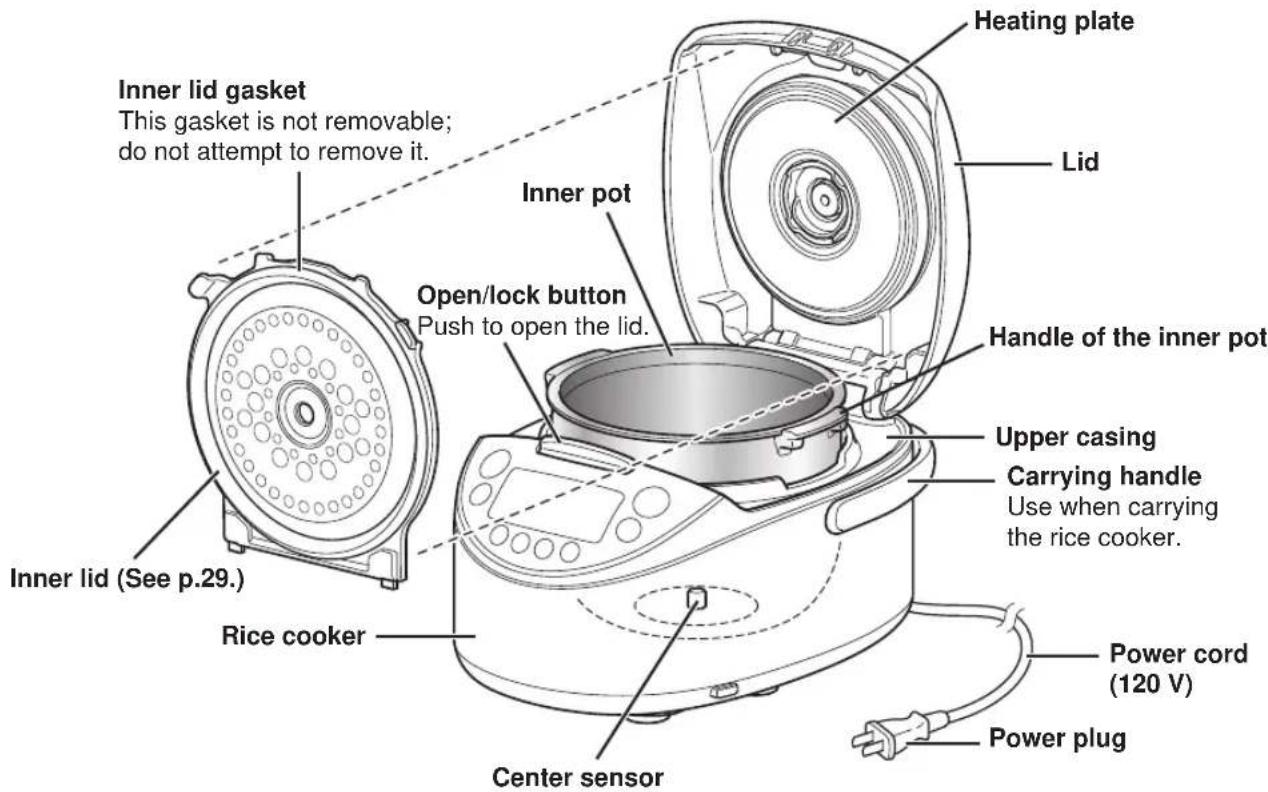
Operation panel
Display
Displays the symbol (menu cursor) and the present time, etc.
[Cancel] key
Press to cancel the Keep Warm function or to cancel the current operation.
[Keep Warm] key
Used to keep the rice warm.
Keep Warm lamp
Lit when the Keep Warm function is on.
[←] [→(Menu) key
Press to select the desired cooking menu.
Start lamp
Lit or blinks during cooking, etc.
[Start/Rinse-free] key
Press to start cooking, etc.
[Timer] key
Press to select the desired Timer setting.
Timer lamp
Lit or blinks when the Timer function is set.
[Hour] and [Min] keys
Use to set the present time and the time under the Timer function.
The reliefs (O) on the [Start/Rinse-free] and [Cancel] keys are to aid persons with a visual impairment.
■ Checking the accessories
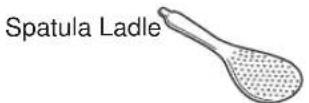
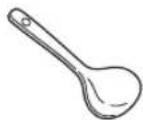
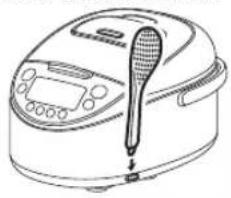
The spatula can be inserted into this holder.
Measuring cup About 1 cup (0.18 L), about 5.29 oz (150 g)

■ Sounds emitted by the rice cooker
The following sounds coming from the rice cooker during cooking, reheating, or when the Keep Warm function is on is normal and does not indicate a problem:
- Humming (This is the sound of the rotating fan.)
- Buzzing or tweeting (This is the sound of IH operation.)
Checking the present time
The time is displayed in a 12-hour format. It should be adjusted if the correct time is not displayed. (See p.36.)
The lithium battery
The rice cooker has a built-in lithium battery that stores the present time and the preset timer settings even with the power plug disconnected.
- This lithium battery has a four-to-five-year life expectancy with the power plug disconnected.
- If the lithium battery runs out, "0:00" will blink on the display when the power cord is plugged back in. Normal cooking is still possible, but the present time, preset timer settings, and elapsed Keep Warm time will no longer be stored in memory when the power plug is disconnected.
Note
- Do not attempt to replace the lithium battery yourself.
To replace the battery, contact the place of purchase.
Menu options and features
| Menu | Rinse-free rice function availability | Timer function availability | Keep Warm function availability | Feature |
| Plain ○ ○ | Select when cooking white rice (rinse-free) rice. | |||
| Ultra ○ ○ | Select when cooking white rice (rinse-free rice) to bring out its maximum sweetness, flavor, and stickiness. Cooking using this menu will soak the rice twice as long as with the "Plain" menu and take extra time to heat and cook delicious rice. | |||
| Quick | ○ | N/A | ○ | Select when quickly cooking white rice (rinse-free rice). |
| Mixed ○ N/A | △ | Select when cooking seasoned rice or steamed sweet rice. | ||
| Jasmine N/A ○ Select when cooking long-grain rice. | ||||
| Brown N/A ○ Select when cooking brown rice and/or multi-grain rice. | ||||
| Porridge ○ ○ Select when making porridge. | ||||
| Oatmeal (Steel cut) | N/A ○ N/A Select when cooking steel cut oatmeal. | |||
See p.37 for cooking capacities.
: Rice can be kept warm. However, its flavor may not be maintained.
Note
- Rinse-free rice can be cooked using the "Plain", "Ultra", "Quick", "Mixed", and "Porridge" menus. You can cook delicious rinse-free rice easily without being concerned about the water amount or soaking time.
Since the bran has already been removed, rinse-free rice does not require washing. It is also good for the environment because the water left over after rinsing the rice does not affect the rivers or ocean. - When using the "Porridge" menu, the porridge can become pasty if kept warm for too long; serve as soon as possible.
Tips on making delicious rice
Read p.16 to 17 for preparations before cooking rice, and p.18 to 23 for how to cook rice.
Select high quality rice and store it in a cool location.
Choose freshly polished, glossy rice with a uniform grain size. Store in a cool, dark, well-ventilated place.
Carefully measure the rice with the supplied measuring cup.
One cup equals about 5.29 oz (0.18 L). Use the supplied measuring cup for rinse-free rice as well. This product contrives the cooking method. It is not necessary to use the measuring cup for rinse-free rice.
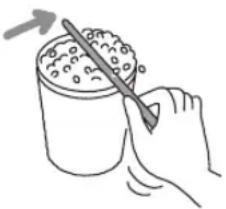
Wash the rice quickly.
Stir the rice around with your hand in a generous amount of water, pour out the water, and repeat until the water remains clear.
When cooking germinated brown rice, whole rice or semi-polished rice, select the "Plain" or "Ultra" menu.
Cooking rinse-free rice
- Add the rinse-free rice and water, and then stir well from the bottom so that every individual grain of rice becomes immersed in the water. (Merely adding water to the rice will prevent it from soaking in the water and may result in improperly cooked rice.)
- If the added water turns white, we recommend you wash the rice thoroughly by replacing the water once or twice. (The water turning white is due to the starch in the rice and not its bran; however, cooking it with the starch left in the water may result in burned rice, the contents boiling over, or improperly cooked rice.)
Adding other ingredients to the rice
The total amount of ingredients should be no more than 2.5 oz (70 g) per cup of rice. Stir in any seasoning well and then add the extra ingredients on top of the rice. If other ingredients are to be added to the rice, be sure to use no more than the acceptable maximum amount (refer to the table below).
| Type of rice | 1.0 L (5.5-cup) type | 1.8 L (10-cup) type |
| Mixed 4 cups or less | 6 cups or less | |
| Sweet 3 cups or less | 5 cups or less | |
| Brown 3 cups or less | 5 cups or less | |
| Porridge • Hard 0.5 cups or less | 1.5 cups or less | cups or less |
- Add water prior to adding the ingredients. Adding water after the ingredients will result in the cooked rice being too firm.
Add water according to the type of rice and your personal preference.
- Amount of water to add
| Type of rice | Corresponding scale (Use the corresponding scale on the inner pot as a guide and add water according to your personal preference.) |
| PlainQuick | “Plain” scale |
| UltraMixed | “Ultra” scale |
| Jasmine “Jasmine” scale | |
| Brown “Brown” scale | |
| Porridge | Hard porridge: “Porridge • Hard” scaleSoft porridge: “Porridge • Soft” scale |
Water levels in the above table also apply to rinse-free rice.
- If you choose to use more or less water than the recommended amount, do not deviate from that amount by any more than 1/3 of one line.
- When cooking germinated brown rice, whole rice or semi-polished rice, use the "Plain" or "Ultra" scale as a reference.
- When cooking steamed sweet rice, use the "Sweet" scale as a reference.
When cooking sweet and non-sweet rice mixed together, use the scale between "Plain" and "Sweet" as a reference. (In this case, add a little extra water to the level used when cooking only sweet rice.)
- If the amount of water to add is specified on a package of germinated brown rice or multi-grain rice, follow those directions and add water according to your personal preference.
Cooking brown rice and/or multi-grain rice mixed in with white rice
- If the rice to be cooked includes more brown rice and/or multi-grain rice than white rice, use the "Brown" menu.
- If there is an equal amount of brown rice and white rice, or there is more white rice than brown rice, use the "Plain" menu. (The brown rice should be soaked separately for 1 to 2 hours before cooking.)
- If there is an equal amount of multi-grain rice and white rice, or there is more white rice than multi-grain rice, use the "Plain" menu. (The multi-grain rice should be soaked separately for 1 to 2 hours before cooking.)
Cooking sweet rice
When cooking sweet rice, select the "Mix menu.
Wash the rice, and then level it out so that all of the rice is under water.
Cooking grains together with white rice
- The amount of multi-grain rice should equal less than 20% of the volume of the white rice. The maximum acceptable amount for the combination of white rice and grains is 5.5 cups with the 1.0 L type and 10 cups with the 1.8 L type.
- The grains should be placed on top of the white rice. Mixing them together may result in improperly cooked food.
Cooking grains together with brown rice
Always use the "Brown" menu.
- The maximum acceptable amount for the combination of brown rice and grains is 3.5 cups with the 1.0L type and 6 cups with the 1.8L type.
Cooking short-grain rice
- When cooking short-grain rice, select the "Plain" menu.
When cooking seasoned rice with various ingredients using short-grain rice, select the "Mixed" menu.
Selecting any other menu may result in the contents boiling over or in improperly cooked food.
Cooking long-grain rice
- When cooking long-grain rice, select the "Jasmine" menu. When cooking seasoned rice with various ingredients using long-grain rice, select the "Mixed" menu. Selecting any other menu may result in the contents boiling over.
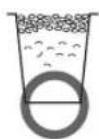
1 Measure the rice.
Always use the measuring cup supplied with the rice cooker (for rinse-free rice as well). A level filling of rice in the supplied measuring cup equals about 5.29 oz (0.18 L).

ill the measuring cup as shown below.
Correct measurement
Incorrect measurement
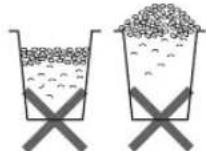
Note
- Always use the specified volume of rice (see "Specifications" on p.37). Otherwise the rice may not cook properly. If other ingredients are to be added to the rice, see p.14.
2 Wash the rice. (This can be done using the inner pot.)
For rinse-free rice, see p.14.
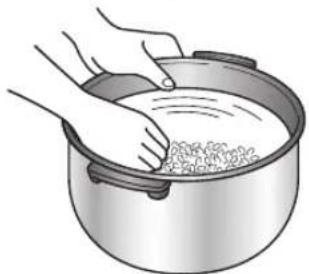
Note
- Do not use hot water (over 95^ [35^] ) to wash the rice or when adding water. It may prevent the rice from cooking properly.
3 Adjust the water level.
Place the inner pot on a level surface and adjust the water level to the appropriate line of the corresponding scale on the inside of the pot.

- The water level should be selected according to the type of rice and the selected cooking menu, but can be fine-adjusted to your personal preference. (See the guidelines on p.14.)
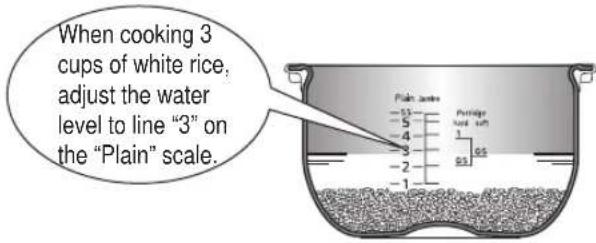
4 Wipe off any water and rice, etc.
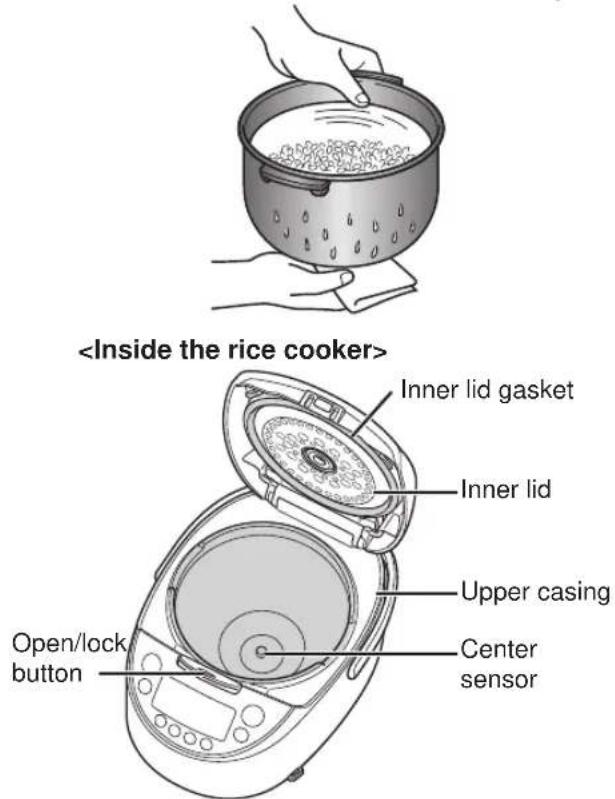
Caution
- Be sure to remove any rice or other material adhering to and around the center sensor, upper casing, and the open/lock button. (See p.28.) Adhering material can prevent the lid from closing, allow steam to leak out during cooking, or enable the lid to open and the contents to spray out, resulting in burns or other injury.
5 Place the inner pot in the rice cooker.
(1) Be sure to set the pot properly (not set at an angle).
(2) Close the lid.
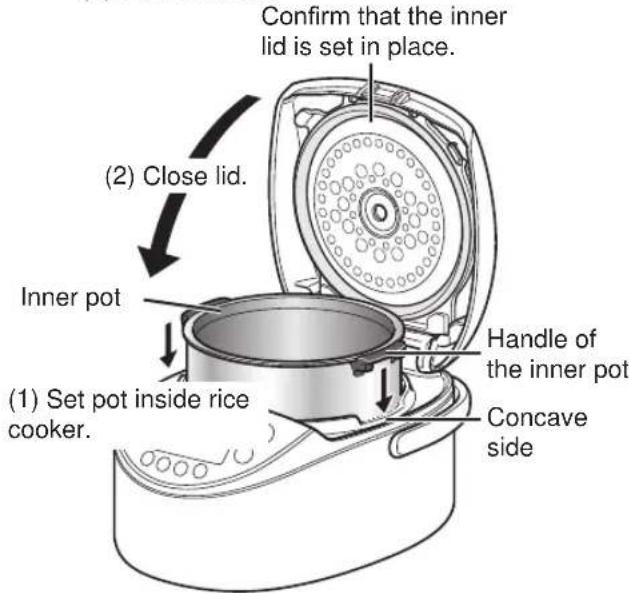
6 Connect the power plug to an outlet.
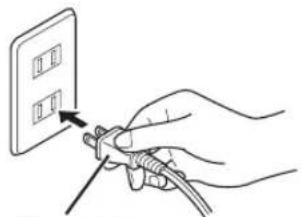
Power plug
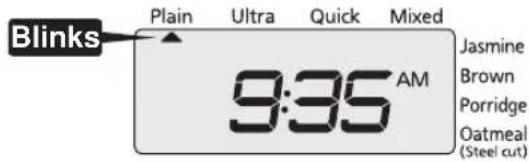
The power will turn on and the symbol will blink.
Note
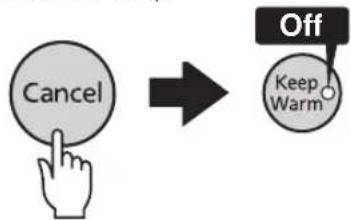
- If the Keep Warm lamp is on, press the [Cancel] key to turn off the lamp.
1 Press the [or] key to select the desired menu.
![Tiger JKTB18U - Press the [or] key to select the desired menu. - 1](/content/2026/02/403913/images/c50ced34d9e6a6915c9303f857c8980f27d7538e980595276539608e46c9a959.jpg)
Each time the [Menu] key is pressed, the selected menu will change in the order shown below. The symbol will blink while the menu is being selected.
![Tiger JKTB18U - Press the [or] key to select the desired menu. - 2](/content/2026/02/403913/images/6fdd2a9868c2e9ce7c12dc6bb6b009a1688d9c2ddd76a47d3845ff754a2135a8.jpg)
![Tiger JKTB18U - Press the [or] key to select the desired menu. - 3](/content/2026/02/403913/images/c502bb29cb27318445efa3a34fee9807972135ac048661df70590d75af1ccd29.jpg)
- It is not necessary to press the [Menu] key if the desired menu is already selected.
2 If you selected the "Porridge" menu, use the [Hour] and [Min] keys to set the desired cooking time.
Each time the [Hour] key is pressed, the set time will increase by 5 minutes. Each time the [Min] key is pressed, that time will decrease by 5 minutes.
The cooking time can be set to any 5-minute increment between 40 and 90 minutes.
![Tiger JKTB18U - If you selected the "Porridge" menu, use the [Hour] and [Min] keys to set the desired cooking time. - 1](/content/2026/02/403913/images/364a1a33c602ea0e9b432d8ee532f405313bb543d353c6f45ce1556af427a77d.jpg)
The default setting is for 60 minutes. Adjust as desired.
3 Press the [Start/Rinse-free] key once. When cooking rinse-free rice, press the key twice.
![Tiger JKTB18U - Press the [Start/Rinse-free] key once. When cooking rinse-free rice, press the key twice. - 1](/content/2026/02/403913/images/79b82a8300ef4a60e02c8b31f3873a7bd886ff47c73b923c34cc7f7b77b4c7a8.jpg)
- Rinse-free rice can be cooked under the "Plain", "Ultra", "Quick", "Mixed", and "Porridge" menus.
- To cancel "Rinse-free", press the [Start/Rinse-free] key again within 20 seconds.
For normal cooking
When you selected the "Plain" menu, a one-short, one-long beep alarm will sound. In other menus, only a one-beep alarm will sound.
When cooking rinse-free rice
"Rinse-free" appears on the display. When you selected the "Plain" menu, a one-short, one-long, another one-short beep alarm will sound. In other menus, a one-long, one-short beep alarm will sound.
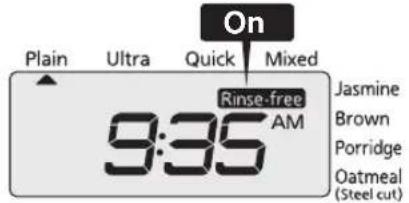
Cooking will start.
Appropriate amounts
See p.14 to 15 for the appropriate amounts of grains and ingredients.
Cooking time guidelines
| Type of rice Unit size | Plain Ultra Quick Jasmine | ||
| 1.0 L (5.5-cup) type 40 | to 49 min 62 to 70 min 1 | 8 to 40 min 18 to 33 min | |
| 1.8 L (10-cup) type 45 | to 54 min 63 to 73 min 1 | 7 to 43 min 16 to 35 min | |
| Type of rice Unit size | Brown Mixed Oatmeal (Steel cut) | ||
| 1.0 L (5.5-cup) type 62 | to 73 min 40 to 69 min 42 to 47 min | ||
| 1.8 L (10-cup) type 66 | to 77 min 40 to 69 min 42 to 47 min |
- The above times indicate the amount of time to the end of steaming after cooking is completed when the rice is not soaked prior to cooking. (Voltage: 120 V, Room temperature: 73.4^ [23°C], Water temperature: 73.4^ [23°C], Amount of water: normal level)
- When rinse-free rice is selected, cooking takes 1 to 10 minutes longer than each menu time.
- Cooking times will differ somewhat depending upon the amount being cooked, the type of rice, the type and quantity of ingredients, the room temperature, the water temperature, the amount of water, electrical voltage, and whether the Timer function is used or not, etc.
Once the final steaming process begins, the remaining time will be displayed.
The time until steaming is completed will be shown on the display in 1-minute increments.
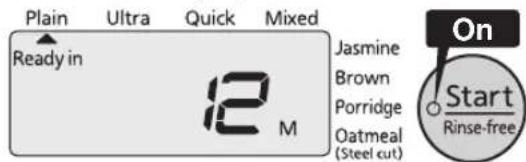
- Steaming times will vary depending upon the selected menu.
Once the rice is fully cooked, the Keep Warm function will automatically engage (the Start lamp will turn off).
The Keep Warm lamp will turn on and an alarm (8 beeps) will sound.
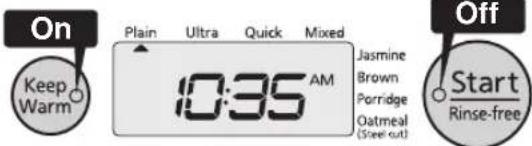
-
If you added ingredients under the "Porridge" menu, or a longer cooking time is required, etc., you can set the desired additional cooking time. Simply press the [Hour] and [Min] keys once the Keep Warm lamp turns on, and then press the [Start/Rinse-free] key. The cooking time can be extended up to 15 minutes in increments of 1 minute, a maximum of 3 times.
-
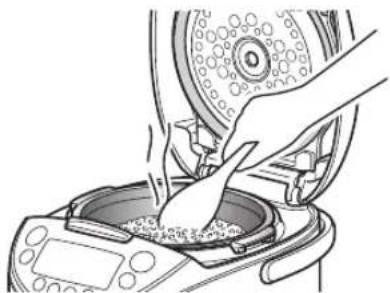
Stir the rice well before reheating.
1 Stir and loosen the cooked rice.
Be sure to stir and loosen the rice as soon as cooking is complete.
- Due to the shape of the inner pot, the rice is slightly sunken at the center when cooking is finished.
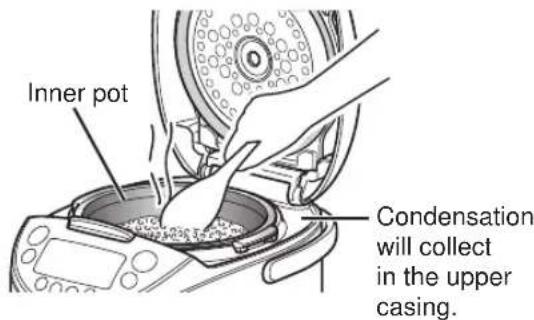
Note
- Be sure to wipe off any hot water that collects on the upper casing or that runs onto the outside of the rice cooker when you open the lid immediately after cooking or while the Keep Warm function is on.
When you are done using the rice cooker...
1 Press the [Cancel] key to turn off the Keep Warm function.
The Keep Warm lamp will turn off.
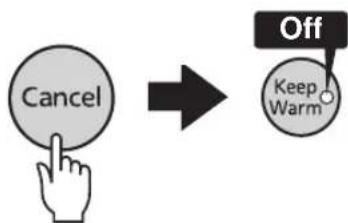
2 Disconnect the power plug from the outlet. (See p.11.)
3 Clean the rice cooker. (See p.27 to 31.)
6 How to Cook Oatmeal ("Oatmeal" menu)
You can easily make oatmeal (steel cut).
1 Set oatmeal and water into the inner pot, and close the lid.
Amount of oatmeal
| 1.0 L type 1.8 L type |
| 1.0 to 2.5 cups 1.0 to 3.0 cups |
- Amount of water to add
- Be sure to use the measuring cup supplied with the rice cooker.
| Amount of oatmeal | 1.0 L type 1.8 | L type |
| 1.0 cup 3.0 | cups 3.5 cups | |
| 1.5 cups 4.5 | cups 4.5 cups | |
| 2.0 cups 5.0 | cups 5.0 cups | |
| 2.5 cups 5.5 | cups 6.5 cups | |
| 3.0 cups - 7.0 | cups |
2 Connect the power plug to an outlet. (See p.17.)
3 Press the [or [key to select [Oatmeal (Steel cut)].
![Tiger JKTB18U - Press the [or [key to select [Oatmeal (Steel cut)]. - 1](/content/2026/02/403913/images/290d47411a304734e52d87c0b54c024e9a3db165a41dab829c1c3559e7a8c96b.jpg)
4 Press the [Start/Rinse-free] key once.
The Rinse-free function is not available.
![Tiger JKTB18U - Press the [Start/Rinse-free] key once. - 1](/content/2026/02/403913/images/5d8a2ae186aa2b813847f328ac60ad8c2d03cb22a6f3a0c6db466cf4935b5e4e.jpg)
A one-long beep will sound and cooking will start.
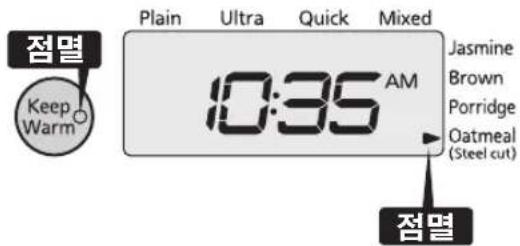
5 Once cooking is completed, an alarm (8 beeps) will sound (the Start lamp will turn off).
The Keep Warm lamp will blink and the present time will appear on the display.
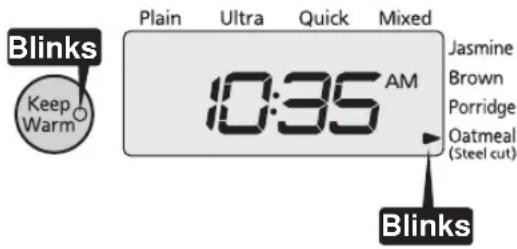
6 Stir the oatmeal well and even it out in the inner pot.
- Serve the cooked oatmeal as soon as possible, as it is not kept warm.
When you are done using the rice cooker...
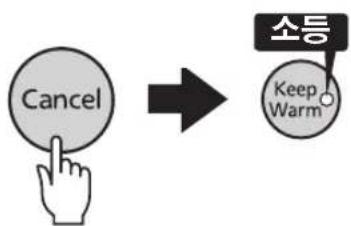
1 Press the [Cancel] key to turn off the Keep Warm function.
The Keep Warm lamp will turn off.
![Tiger JKTB18U - Press the [Cancel] key to turn off the Keep Warm function. - 1](/content/2026/02/403913/images/729ce0e5dd8cee54e9e98a93ff86e9eb5773fc4275ad12e5330e055dd8e8971f.jpg)
2 Disconnect the power plug from the outlet. (See p.11.)
3 Clean the rice cooker. (See p.27 to 31.)
7 Setting the Timer
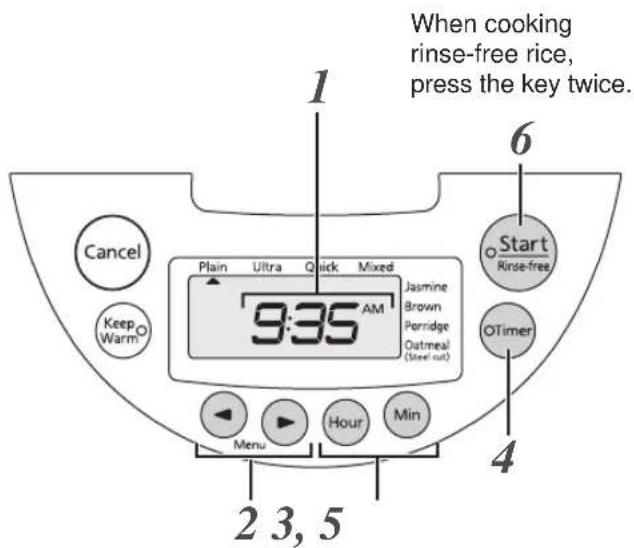
Using the Timer function (Timer 1 / Timer 2)
You can preset the time that you want cooking to be actually completed.
- Select either "Timer 1" or "Timer 2" and set the desired completion time. The start of cooking will be automatically adjusted so that the operation is completed at the preset time.
Each timer can be set to different times. e.g. "Timer 1" for breakfast and "Timer 2" for dinner. - The preset timer settings will be stored in memory.

- Example setting: If "Timer 1" is set to 1:30 PM, cooking will be completed at 1:30 PM.
1 Check the present time.
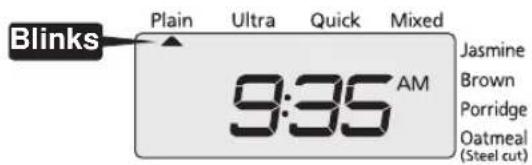
See p.36 for the procedure to set the present time.
2 Press the [+] key to select the desired menu.
![Tiger JKTB18U - Press the [+] key to select the desired menu. - 1](/content/2026/02/403913/images/ee41c3aca8be991e8f088a133e3f6f3c14248ca1f4dbbf9d7264301fc020e63a.jpg)
The symbol will blink while the menu is being selected.
![Tiger JKTB18U - Press the [+] key to select the desired menu. - 2](/content/2026/02/403913/images/0d280f66bdc34cd84d29285fe30e724a16a77db2ec7145c8b4bcb7d032042f90.jpg)
- Confirm that the Keep Warm lamp is off.
![Tiger JKTB18U - Press the [+] key to select the desired menu. - 3](/content/2026/02/403913/images/509649ff75502bd94247a76c6c697666f3374dcd1bbb412b36cab0625d4c9cae.jpg)
- It is not necessary to press the [Menu] key if the desired menu is already selected.
3 If you selected the "Porridge" menu, use the [Hour] and [Min] keys to set the desired cooking time.
Each time the [Hour] key is pressed, the set time will increase by 5 minutes. Each time the [Min] key is pressed, that time will decrease by 5 minutes.
The cooking time can be set to any 5-minute increment between 40 and 90 minutes.
![Tiger JKTB18U - If you selected the "Porridge" menu, use the [Hour] and [Min] keys to set the desired cooking time. - 1](/content/2026/02/403913/images/d99672a390e2a412b79b6ceafab85f2f06d41b9ae8dd1157f35c1df2af2f5d0f.jpg)
The default setting is for 60 minutes. Adjust as desired.
4 Press the [Timer] key to select either "Timer 1" or "Timer 2".
![Tiger JKTB18U - Press the [Timer] key to select either "Timer 1" or "Timer 2". - 1](/content/2026/02/403913/images/1ede4ee55700c9f5098af2564c190fbabd52fc505d32d2ec4068e0dc4b6ecccc.jpg)
The selected setting will switch back and forth between "Timer 1" and
"Timer 2" each time the [Timer] key is pressed. Both the Timer lamp and the displayed "Timer 1" or "Timer 2" will blink.
![Tiger JKTB18U - Press the [Timer] key to select either "Timer 1" or "Timer 2". - 2](/content/2026/02/403913/images/7ce12c8a7bade507be26ae030ab4c4581016537ebc39ce48dfefc70ca06e8de0.jpg)
- The previously preset time will be displayed. It is not necessary to set the timer again if the desired completion time is already displayed.
Note
The Timer function is not available in the following cases.
- When the "Quick" or "Mixed" menu is selected
- When the preset time is less than that indicated in the following table (The times in the table below also apply to rinse-free rice.)
| Menu Minimum preset time | |
| Plain 1 h 10 min | |
| Ultra 1 h 30 min | |
| Jasmine 45 min | |
| Brown 1 h 25 min | |
| Porridge Cooking time + 1 min | |
| Oatmeal (Steel cut) | 55 min |
- When "0:00" is blinking on the display
- If the Keep Warm lamp is on, press the [Cancel] key to turn off the lamp. (The Timer function is not available while the Keep Warm lamp is on.)
- If you do not operate the rice cooker within about 30 seconds after pressing the [Timer] key, an alarm (3 beeps) will sound.
- If the [Timer] or [Start/Rinse-free] key is pressed while the rice cooker is in a state where the Timer function is not available, an alarm (3 beeps) will sound.
Use the [Hour] and [Min] keys to set the desired completion time.
![Tiger JKTB18U - Use the [Hour] and [Min] keys to set the desired completion time. - 1](/content/2026/02/403913/images/cd201c2b0da573d66d48eaaa3ef9ec0015c42b114cb8da495772b372900ab91b.jpg)
Press the [Hour] key to change the set time in 1-hour increments. Press the [Min] key to change that time in 10-minute increments. Hold down the corresponding key to change the time more rapidly.
![Tiger JKTB18U - Use the [Hour] and [Min] keys to set the desired completion time. - 2](/content/2026/02/403913/images/fbaf0893bad58a5c7643a3224a1af5e4395a21b0d07a2b7395d10a882a989b06.jpg)
The time is displayed in a 12-hour format.
Note
- Do not set the timer to more than 12 hours, as it may result in spoiled rice.
- Check whether "AM" or "PM" currently displayed.
6 Press the [Start/Rinse-free] key once. When cooking rinse-free rice, press the key twice.
![Tiger JKTB18U - Press the [Start/Rinse-free] key once. When cooking rinse-free rice, press the key twice. - 1](/content/2026/02/403913/images/61f2325a2111307f974b2a54c3ab1b0aa845fbe3f4db990e5e819d3a33a04b5c.jpg)
The Timer lamp will turn on and the Timer function is set.
- Rinse-free rice can be cooked under the "Plain", "Ultra", and "Porridge" menus.
For normal cooking
When you selected the "Plain" menu, a one-short, one-long beep alarm will sound. In other menus, only a one-beep alarm will sound.
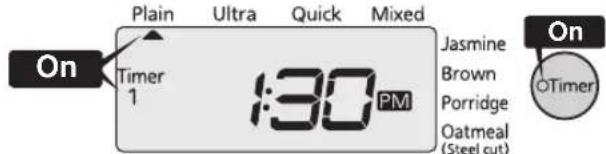
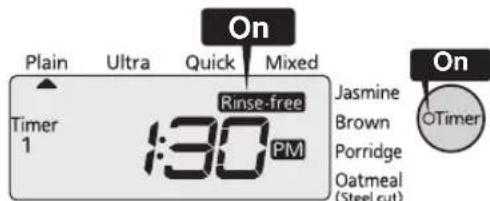
When cooking rinse-free rice
"Rinse-free" appears on the display. When you selected the "Plain" menu, a one-short, one-long, another one-short beep alarm will sound. In other menus, a one-long, one-short beep alarm will sound.
If you make a mistake or otherwise want to reset the timer, press the [Cancel] key and repeat the procedure from step 2 on p.22.
8
Keeping the Rice Warm
The Keep Warm function will especially maintain the shiny, delicious taste of white rice (rinse-free rice). The Keep Warm function will automatically engage when cooking is completed.
Turning off the Keep Warm function
Press the [Cancel] key.
The Keep Warm lamp will turn off.
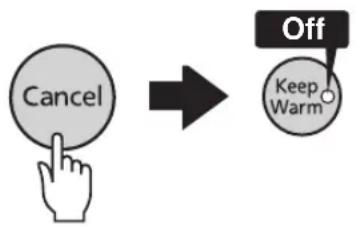
- Restarting the Keep Warm function
Confirm that the Keep Warm lamp is off and press the [Keep Warm] key.
The Keep Warm lamp will turn on.
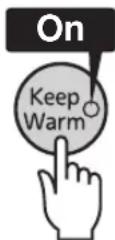
- Keeping a small amount of rice warm
Gather the rice at the center of the inner pot; serve as soon as possible.
■ Elapsed Keep Warm time display
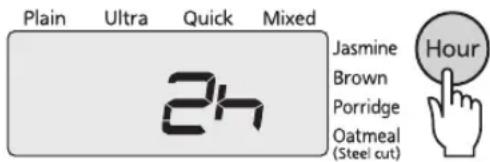
Hold down the [Hour] key to display the elapsed Keep Warm time. The elapsed time will be displayed in 1-hour increments up to 24 hours ("24h").
After 24 hours have elapsed, "24" will blink and "h" will turn on.
Note
- Avoid the following, as they may result in unusual odors, dryness, discoloration, and spoiling of the rice, or corrosion of the inner pot.
- Using the Keep Warm function with cold rice
- Adding cold rice to rice that is being kept warm
- Leaving a spatula in the inner pot while the Keep Warm function is on
- Using the Keep Warm function with the power plug disconnected
- Using the Keep Warm function for longer than 24 hours
- Keeping less than the minimum required amount of rice warm (See "Specifications" on p.37.)
- Using the Keep Warm function for anything other than white rice (including rinse-free rice)
- When using the "Porridge" menu, the porridge can become pasty if kept warm for too long; serve as soon as possible.
- Be sure to remove any grains of rice that adhere to the brim of the inner pot as well as to any gaskets. Failure to do so can result in dryness, discoloration, odors, and stickiness of the rice being cooked.
- Serve cooked rice as soon as possible in cold climates and high temperature environments.
For piping hot rice, reheat the rice that is being kept warm before serving it.
Note
- Rice will not be fully heated if more than half of the inner pot is full.
The rice will end up being dry if reheated under any of the following conditions. - The rice is still hot, such as immediately after cooking.
- There is less than the minimum required amount of rice (1 cup with the 1.0 L type, 2 cups with the 1.8 L type).
The rice is reheated 3 times or more.
1 Stir and loosen the rice that was being kept warm.
2 Add 1 to 2 tablespoons of water evenly over the rice.
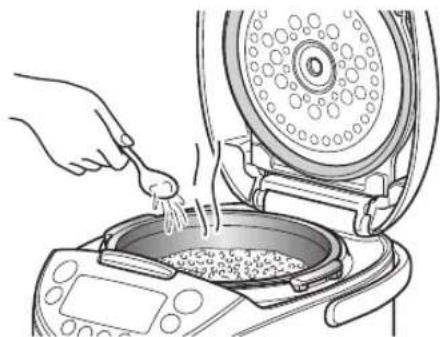

- Adding water will prevent the rice from drying out and result in plumper rice.
3 Make sure that the Keep Warm lamp is on.
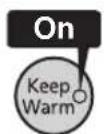
- Reheating is not available if the Keep Warm lamp is not on. If the lamp is not on, press the [Keep Warm] key. (See p.24.)
4 Press the [Start/Rinse-free] key.
The Start lamp will blink and reheating will start.
The remaining time will be displayed and an alarm (3 long beeps) will sound when the operation is completed.
![Tiger JKTB18U - Press the [Start/Rinse-free] key. - 1](/content/2026/02/403913/images/c26b307297e8d1d641af295551030f48e0462e4080914b714a81f371eadff867.jpg)
![Tiger JKTB18U - Press the [Start/Rinse-free] key. - 2](/content/2026/02/403913/images/a6e73c60ed8b01edc93c663ee4cecffea9329509d741884eaf8b11cf9c1888a1.jpg)
![Tiger JKTB18U - Press the [Start/Rinse-free] key. - 3](/content/2026/02/403913/images/88d21759d8669dab27afd17ff231a81c0cb81a611b3da09f8dfee43b441ae716.jpg)
- To stop reheating, press the [Cancel] key.
- Reheating is not available if the rice is too cold (131°F [55°C] or lower as a guideline). In this case, a repeated beeping alarm will sound.
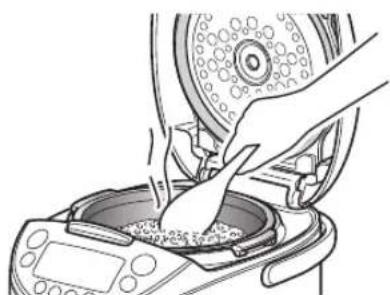
5 Stir and loosen the reheated rice well, and even it out in the inner pot.
How to reheat oatmeal
Note
- Oatmeal will end up being dry if reheated under any of the following conditions.
The oatmeal is reheated without adding water or milk. - The volume of oatmeal is below the minimum required volume (1 cup).
The oatmeal is reheated 3 times or more.
1 Stir the cooked oatmeal.

- You can add some water or milk to the cooked oatmeal and reheat it.
Note
- When adding water or milk, add it immediately after cooking. Otherwise, the temperature will decrease and the oatmeal may not be reheated.
Maximum cooking amount when adding some water or milk to reheat oatmeal
1.0 L type: 5.5 scale for "Plain"
1.8 L type: 8 scale for "Plain"
2 Make sure that the Keep Warm lamp is blinking.

- Reheating is not available if the [Cancel] key is pressed after the oatmeal has been cooked.
3
Press the [Start/Rinse-free] key.
The Start lamp will blink and reheating will start.
The remaining time will be displayed and an alarm (3 long beeps) will sound when the operation is completed.
![Tiger JKTB18U - Press the [Start/Rinse-free] key. - 1](/content/2026/02/403913/images/c8799b625c079e631204da9fe189acfbf1160a9a168b577c662d894ec79ebf37.jpg)
![Tiger JKTB18U - Press the [Start/Rinse-free] key. - 2](/content/2026/02/403913/images/5c2bcaa65df434805181114c6a6cc5dc846b7c741b8694079b588b2992893523.jpg)
Note
- Reheating is not available if the oatmeal is too cold (131°F [55°C] or lower as a guideline). In this case, a repeated beeping alarm will sound.
4
Stir the heated oatmeal well and even it out in the inner pot.
10
Cleaning and Maintenance
Perform cleaning and maintenance procedures as described on the following p.27 to 31.
Any other servicing should be performed by an authorized service representative.
Clean all parts by hand. Do not use a dishwasher/dryer.
To maintain cleanliness, always clean the rice cooker on the same day it is used. Also clean the rice cooker at regular intervals as well.
Note
- Be sure to disconnect the power plug and allow the rice cooker, inner pot, inner lid, and steam cap to cool down before cleaning.
- When cleaning the rice cooker with a detergent, use only standard kitchen detergent (for tableware and kitchen utensils).
- Clean with a soft sponge and cloth.
- Rinse the parts thoroughly since detergent constituent remaining on them may result in deterioration and discoloration of part's materials such as resin.
Parts to wash after every use
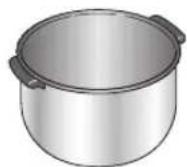
Inner pot
Clean with a soft sponge and with tap or lukewarm water.
2 Wipe off water with a dry cloth and completely dry all parts.
Note
- Do not clean the inner pot with the abrasive side of a heavy-duty scrub sponge. Doing so may damage the fluorocarbon resin coating.

Measuring cup
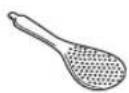
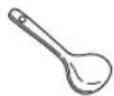
Spatula Ladle
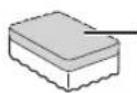
Do not use the abrasive side of a heavy-duty scrub sponge.
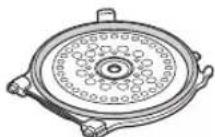
Inner lid
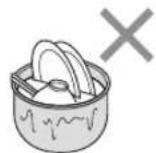
- Do not wash dishes, etc., inside the inner pot. Also, do not place the inner pot upside down on top of dishes, etc., to dry. Doing so may damage the fluorocarbon resin coating or cause it to peel.
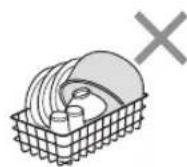
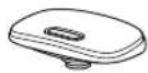
Steam cap (Can be disassembled into two parts. See p.30 to 31.)
These parts can be washed under running water.
1 Clean with a sponge using tap or lukewarm water.
2 Wipe off water with a dry cloth and completely dry all parts.
Note
- Do not wash parts in the following manners as they can cause those parts to become deformed.
- Washing with hot water
Soaking - Washing the hot inner pot with running water immediately after cooking rice
- Always wash the steam cap after cooking with grains (amaranths, etc.). The steam cap may clog and cause problems, like preventing the lid from opening, resulting in improperly cooked food.
Parts to wash when dirty
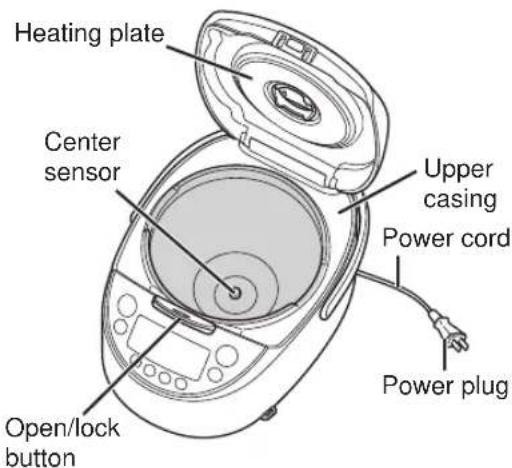
Inside and outside the rice cooker
Wet a towel or cloth, wring out excess water, and wipe.
Center sensor
Remove burned rice and any other adhering grains of rice. If adhering objects are hard to remove, use commercially available sandpaper (around #320), then wet a towel or cloth, wring out excess water, and wipe.
Around the upper casing and open/lock button
Remove any adhering grains of rice, etc.
Note
- Do not allow water to get inside the rice cooker unit.
- Do not immerse the power cord in or splash it with water. Doing so may result in short-circuiting or electric shock.
Power cord and plug
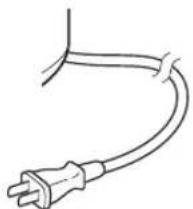
Wipe with a dry cloth.
Note
Always keep the inner pot and lid clean to prevent corrosion and odors.
- Do not clean the rice cooker or its parts with thinner, cleanser, bleach, disposable cloth, metal spatulas, nylon scouring sponges or the like.
Always clean each part separately.
- Do not immerse the steam cap, measuring cup, spatula or ladle in hot water. Doing so may cause them to become deformed.
- Do not use a dishwasher/dryer to clean the rice cooker or its parts. Doing so may cause them to become deformed.
- When cleaning the rice cooker with a detergent, do not use alkaline kitchen detergent.
Removing and attaching the inner lid
■ Removing the inner lid
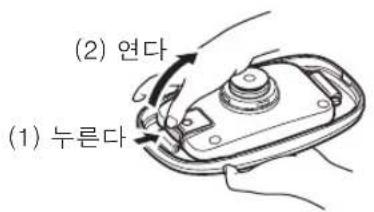
Push down and pull the inner lid levers to the front to detach.
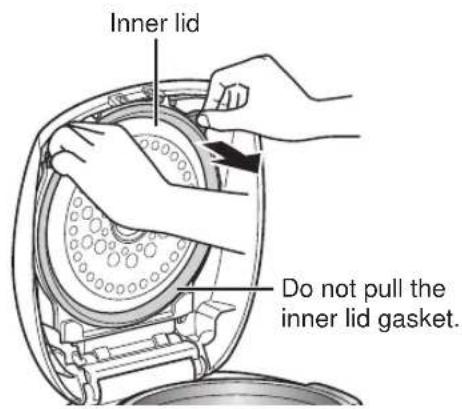
- Attaching the inner lid
Set the inner lid securely in the lid as shown in the figure below.
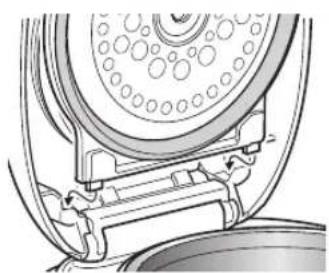
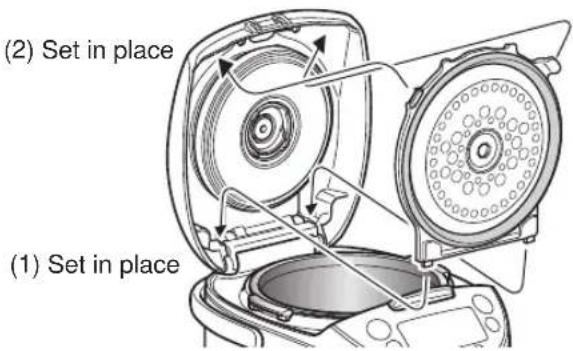
Note
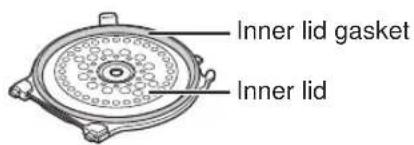
- Do not pull the lid gasket.
Once it is detached, it cannot be reattached. If the lid gasket is detached, contact the place of purchase.
Removing and attaching the steam cap
Removing the steam cap
1 Insert your finger into the hole in the lid and lift the steam cap upward.
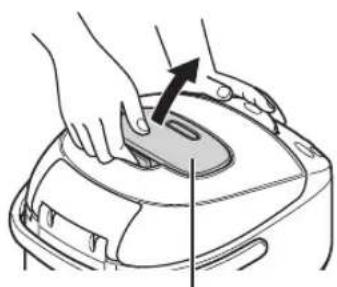
Steam cap
Note
- Be careful of the hot steam contained in the steam cap immediately after cooking.
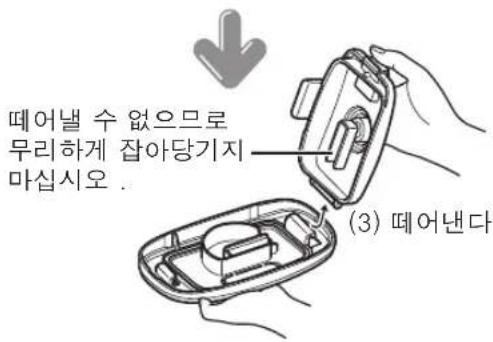
2 Flip the steam cap over and remove the cap lid as shown in the figure below.
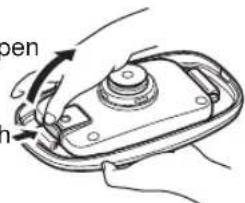
(2) Open
(1)Push

This part is not removable; do not attempt to remove it.
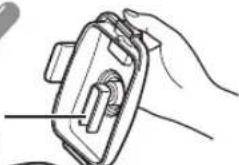
(3) Remove
- Attaching the steam cap
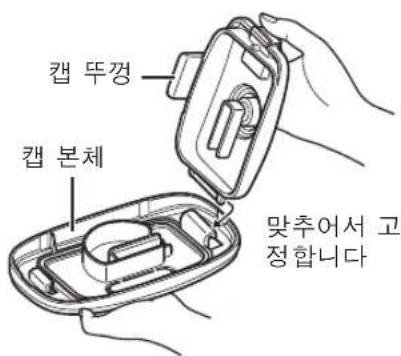
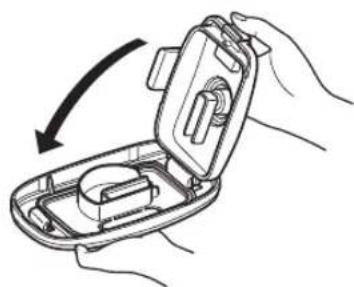
1 Hook the cap lid onto the cap.
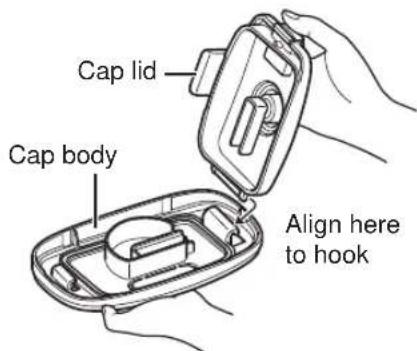
2 Push the lid until you can here it clicks.
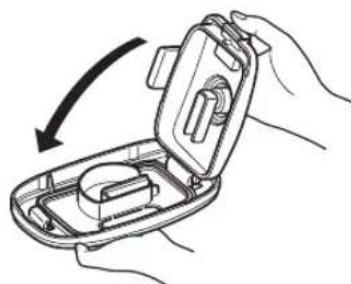
3 Attach the cap lid securely onto the cap body.
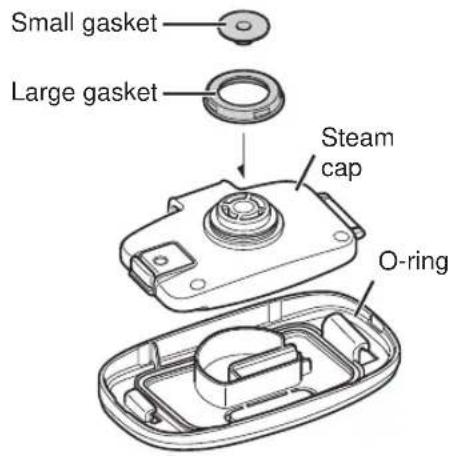
■ Installing the steam cap gaskets
Set the gaskets securely onto the steam cap as shown in the figure below. If the gaskets are not set securely, they can become loose and this may result in problems due to steam leaking out, etc.
Note
- Do not remove the O-ring. If it is removed, set it back in place securely.
If it is difficult to attach, slightly moisten the O-ring with water to make it easier to attach.
Removing odors (When odors remain in the rice cooker)
The following procedure should be performed if odors become bothersome.
Note
- Be careful of the hot inner pot and rice cooker after cleaning. Touching them may result in burns.
■ Rice cooker
1 Fill the inner pot to about 70 to 80% with water, select the "Plain" menu and press the [Start/Rinse-free] key.
Confirm that the Keep Warm lamp is on and press the [Cancel] key.
Note
- If odors become bothersome, use about 0.71 oz (20 g) of citric acid added to the water for more effective deodorizing.
It may be impossible to remove some odors completely. In this case, contact the place of purchase.
2 Wash the inner pot, inner lid, and steam cap with a standard kitchen detergent, and then rinse sufficiently with water.
3 Allow the rice cooker and all parts to dry in a well-ventilated location.
11 If Rice Does Not Cook Properly
Check the following points if you experience a problem with the cooked rice or with the operation of the rice cooker, etc.
| Problem\Check point | Is too hard···········································································································································································································. Is too soft·····································································································································································································. Is not cooked completely | ··· | ||||||||||
| Has a hard center······································································································································································································ | ······ | |||||||||||
| Is burned····································································································································································································· | ||||||||||||
| During cooking | Steam leaks······ | |||||||||||
| Boils over······ | ||||||||||||
| The cooking time is excessively long | ······ | ··· | ||||||||||
| Reference page | 14-16,37 | 37-- | 18-20 | 16,27-31 | -20 | 37 | ||||||
| Problem\Check point | Is too hard | ● | ● | ● | ● | ● | ||||||||
| Is too soft | ● | ● | ● | ● | ● | ● | ● | ● | ● | |||||
| Is not cooked completely | ● | ● | ● | |||||||||||
| Has a hard center | ● | ● | ● | ● | ||||||||||
| Is burned | ● | ● | ● | ● | ● | |||||||||
| Smells like rice bran | ● | |||||||||||||
| Cooked rice | Steam leaks | ● | ● | ● | ||||||||||
| Boils over | ● | ● | ● | ● | ||||||||||
| The cooking time is excessively long | ● | |||||||||||||
| Reference page | 16,27-31 | 14, 16 | 16 - | - | 17,27-31 | 14 - | - | 27-31 | ||||||
| Problem Cause | |
| There is a thin film covering the rice. | A thin, tissue-like film is formed by melted and dried starch. This is not harmful to your health. |
| Rice sticks to the inner pot. Soft rice and sticky rice can easily stick to the pot. | |
| Problem\Check point | Was the amount of rice and water correct? | 16,27-31 | 20 | 16,27-31 | 14, 16 | 25 | 23 | 24 | 37 | |||
| Is discolored········ | ||||||||||||
| Is dry········ | ||||||||||||
| Is sticky········ | ||||||||||||
| Reheated rice is dry··· | ||||||||||||
| Reference page | 14-16,37 | 16,27-31 | 20 | 16,27-31 | 14, 16 | 25 | 23 | 24 | 37 |
| Problem\Check point | Is other than white rice or rinse- free rice being kept warm? | Was less than the minimum required amount of rice being kept warm or reheated? | Was the rice concentrated around the outer portions of the inner pot (less rice in the middle of the pot)? | Was cold rice added? | Was a spatula left in the inner pot? | Was the rice cooker and its parts cleaned sufficiently? | Was the rice cooking and its parts cleaned sufficiently? | Was the rice cooker and its parts cleaned sufficiently? |
| Has an odor | ● | ● | ● | ● | ● | |||
| Is discolored | ● | ● | ● | ● | ● | |||
| Is dry | ● | ● | ● | ● | ● | |||
| Is sticky | ● | ● | ● | ● | ||||
| Reheated rice is dry | ● | ● | ||||||
| Reference page | 24 | 24, 25 | - | 24 | 24 | 27-31 | 25 |
Check the following before requesting repair service.
| Symptom Check point Action | Reference page | ||
| The rice have not been cooked. Is the power plug properly connected to an outlet? | Insert the power plug fully into an outlet. | 17 | |
| Rice was not cooked completely by the preset time. | Does the display show the correct present time? | Set the correct present time. | 36 |
| Check "The cooking time is excessively long" under "If Rice Does Not Cook Properly" and take the necessary action. | 32 | ||
| The Timer function cannot be set. Does the display show the correct present time? | Set the correct present time. | 36 | |
| Is "0:00" blinking on the display? Set the present time. | |||
| Was the "Quick" or "Mixed" menu selected? | The Timer function is not available under those menus. | 23 | |
| Was an unacceptable time set? Set a time that is acceptable under the Timer function. | |||
| The display is blurred. Are there any grains of burned rice or any other remaining grains of rice adhering to gaskets or the brim of the inner pot? | Completely remove all remaining rice. | 16, 27-31 | |
| Is the outer surface of the inner pot wet? | Wipe with a dry cloth. | ||
| Reheating is disabled. An alarm (3 beeps) will sound if you press the [Start/Rinse-free] key. | The rice is cold. Rice of below approximately 131°F (55°C) cannot be reheated. | 25 | |
| Is the Keep Warm lamp off? Press the [Keep Warm] key and check that the Keep Warm lamp lights up. Then, press the [Start/Rinse-free] key again. | 23 | ||
| Sound is heard during cooking, reheating, or when the Keep Warm function is on. | Do you hear a humming sound? The fan is operating. It is not a malfunction. | 12 | |
| Do you hear a buzzing or twittering sound? | The IH is operating. It is not a malfunction. | ||
| Do you hear a completely different sound from the above? | Contact the place of purchase. | - | |
| An alarm (3 beeps) will sound if you press the [Start/Rinse-free] or [Keep warm] key. | Is the inner pot set in the rice cooker? | Set the inner pot in the rice cooker. | 17 |
| An alarm (3 beeps) sounds when the Timer function is set. | An alarm will sound if you do not operate the rice cooker within about 30 seconds after pressing the [Timer] key. Continue setting the Timer function. | 23 | |
| Water or rice has gotten inside the rice cooker unit. | Water or rice inside the rice cooker unit may cause problems. Contact the place of purchase. | - | |
| When setting the present time, pressing the [Hour] or [Min] key does not access the time setting mode. | The time cannot be set during cooking, when the Keep Warm function is on, when the Timer function is in use, or during reheating. 36 | ||
| The Keep Warm lamp is blinking. | Was the "Oatmeal" menu set? | Oatmeal can become pasty if it is left in the rice cooker. Serve it as soon as possible. | 21 |
| The elapsed Keep Warm time blinks on the display when the [Hour] key is pressed while the Keep Warm function is on. | Was the Keep Warm function used continuously for more than 24 hours? | The elapsed Keep Warm time will blink on the display when the Keep Warm function has been on for more than 24 hours. | 24 |
| The present time, preset timer settings, and elapsed Keep Warm time are lost when the power plug is disconnected. | Does "0:00" blink on the display when the power plug is connected again? | The lithium battery has run out. Contact the place of purchase. | 12 |
| The lid will not open, or it opens during cooking. | Are there any grains of rice adhering to the upper casing, inner lid gasket, or around the open/lock button? | Completely remove all remaining rice. | 16, 27-31 |
| Nothing happens when a key is pressed. | Is the power plug properly connected to an outlet? | Insert the power plug fully into an outlet. | 17 |
| Is the Keep Warm lamp on? Press the [Cancel] key to turn off the Keep Warm function, then try the operation again. | 17 | ||
| Sparks fly from the power plug. | Inserting/disconnecting the power plug may sometimes cause small electric sparks. This is specific to the IH feature and therefore not a malfunction. | - | |
| There is a smell of plastic. | Such smells may occur when the rice cooker is first used, but they should go away over time as the rice cooker gets used. | - | |
| There are stripes or waves on plastic parts. | Such stripes and waves are produced when the resin is being molded. They do not affect the performance of the rice cooker. | - | |
| Bubbles can be seen coming from the steam vent of the steam cap during cooking. | It is due to boiling and therefore not a malfunction. | - | |
| The lid cannot be closed. Is the inner lid attached? Attach the inner lid. 29 | |||
If these indications appear
| Display Action | Reference page |
| “Err” appears on the display and a long-lasting or continuous beeping alarm sounds. Plain Ultra Quick Mixed Jasmine Brown Porridge Oatmeal (Steel cut) | If the rice cooker is placed on the carpet or where the room temperature is high, the air inlet and outlet can be blocked, causing the temperature inside to rise. In this case, the rice cooker may not respond to any key operations. Resolve the problem according to the following procedure. (1) Disconnect the power plug. (2) Relocate the rice cooker to where the air inlet and outlet are not blocked and the room temperature is low. (3) Insert the power plug into the outlet again and operate the keys. If the rice cooker does not respond to key operations, it is a malfunction of the rice cooker. Disconnect the power plug and contact the place of purchase. |
Plastic parts
Plastic parts that come into contact with heat or steam will deteriorate over time. In this case, contact the place of purchase.
Setting the present time
The present time is displayed in a 12-hour format.
The time cannot be set during cooking, when the Keep Warm function is on, when the Timer function is in use, or during reheating.
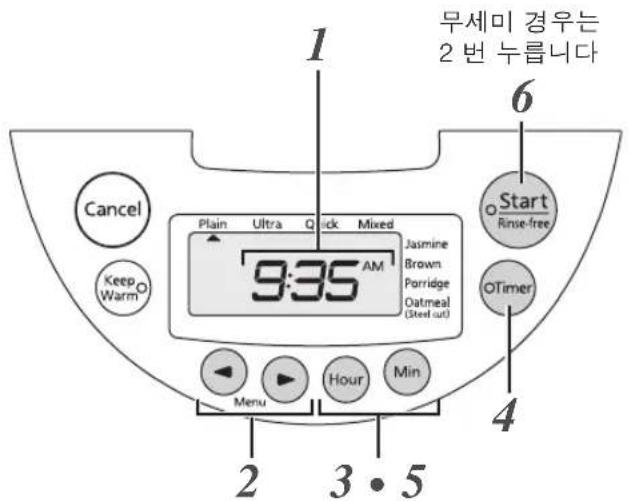
Example: Changing the present time from "9:30" to "9:35"
1 Connect the power plug to an outlet.
2 Display the time setting mode.
Press the [Hour] or [Min] key to display
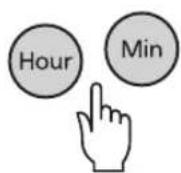
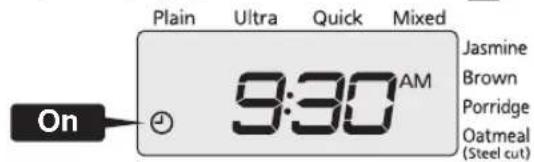
3 Set the present time. Set the hour with the [Hour] key and the minute with the [Min] key. Hold down the corresponding key to change the time more rapidly.
4 Once you are finished setting the time, press the [ ] key.
![Tiger JKTB18U - Once you are finished setting the time, press the [ ] key. - 1](/content/2026/02/403913/images/b85e6a440234444de6a5dec9fa35905ddd9839735d120a56d367a5f392971ad4.jpg)
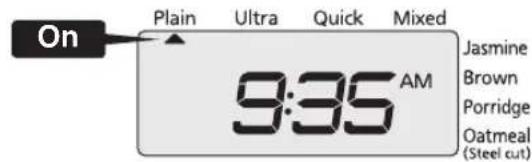
The present time is set.
will go out and “:” will blink on the display.
![Tiger JKTB18U - Once you are finished setting the time, press the [ ] key. - 2](/content/2026/02/403913/images/d1ebb34f2e8cc75e8a3797ace154b6c4bc9ef87aaa7348d9f25c328359259b16.jpg)
Note
- The present time setting may vary about 30 to 120 seconds a month from the actual time depending on room temperature and the conditions of use.
Specifications
| Unit size 1.0 L (5.5-cup) type 1.8 L | (10-cup) type | ||
| Power source 120 V, 60 Hz | |||
| Rated power (W) 1,080 1,198 | |||
| Cooking capacity (L) | Plain 0.18 to 1.0 | (1 to 5.5 cups [5.29 to 29.10 oz]) | 0.36 to 1.8(2 to 10 cups [10.58 to 52.91 oz]) |
| Ultra 0.18 to 1.0 | (1 to 5.5 cups [5.29 to 29.10 oz]) | 0.36 to 1.8(2 to 10 cups [10.58 to 52.91 oz]) | |
| Quick 0.18 to 1.0 | (1 to 5.5 cups [5.29 to 29.10 oz]) | 0.36 to 1.8(2 to 10 cups [10.58 to 52.91 oz]) | |
| Mixed 0.18 to 0.72 | (1 to 4 cups [5.29 to 21.16 oz]) | 0.36 to 1.08(2 to 6 cups [10.58 to 31.74 oz]) | |
| Sweet 0.18 to 0.54 | (1 to 3 cups [5.29 to 15.87 oz]) | 0.36 to 0.9(2 to 5 cups [10.58 to 26.48 oz]) | |
| Jasmine 0.18 to 1.0 | (1 to 5.5 cups [5.29 to 29.10 oz]) | 0.36 to 1.8(2 to 10 cups [10.58 to 52.91 oz]) | |
| Brown 0.18 to 0.63 | (1 to 3.5 cups [5.29 to 18.52 oz]) | 0.36 to 1.08(2 to 6 cups [10.58 to 31.74 oz]) | |
| Porridge Hard 0.09 to 0.18 | (0.5 to 1 cup [2.65 to 5.29 oz]) | 0.09 to 0.36(0.5 to 2 cups [2.65 to 10.58 oz]) | |
| Soft | 0.09(0.5 cups [2.65 oz]) | 0.09 to 0.27(0.5 to 1.5 cups [2.65 to 7.94 oz]) | |
| Oatmeal (Steel cut) | 0.18 to 0.45(1 to 2.5 cups [5.29 to 13.23 oz]) | 0.18 to 0.54(1 to 3 cups [5.29 to 15.87 oz]) | |
| Outside dimensions (inch) | Width | 10.2 (26.0 cm) | 11.3 (28.8 cm) |
| Depth | 13.9 (35.4 cm) | 15.2 (38.6 cm) | |
| Height | 8.4 (21.3 cm) | 9.8 (25.0 cm) | |
| Weight (oz) | 137.6 (3.9 kg) | 176.4 (5.0 kg) | |
Note
- One cup of white rice is about 5.29 oz (150 g).
In case of a power outage
If a power outage does occur, the rice cooker will resume its normal functions once power is restored.
| State when power outage occurs | Once power is restored |
| While the Timer function is set | The timer will resume operation. (If the power outage lasts for an extended period of time and the preset time has passed when power is restored, the rice cooker will immediately begin cooking.) |
| During cooking (reheating) | The rice cooker will resume cooking (reheating). Cooking may not be completed properly. |
| While the Keep Warm function is on | The Keep Warm function is cancelled in case of a power outage for over 30 minutes. |
Purchasing consumables and optional accessories
Gaskets will need replacing over time. Though the amount of wear will vary according to conditions of use, gaskets will wear down as they are used. For stubborn dirt, odors, or serious damage, contact the place of purchase.
The inner pot's fluorocarbon resin coating may wear and peel with extended use. (See p.10.)
Table des matieres
Touche [Start/Rinse-free]
| Quantité de gruau | Cuisur de 1,0 L | Cuisur de 1,8 L |
| 1,0 tasse 3,0 | tasses 3,5 tasses | |
| 1,5 tasses 4,5 | tasses 4,5 tasses | |
| 2,0 tasses 5,0 | tasses 5,0 tasses | |
| 2,5 tasses 5,5 | tasses 6,5 tasses | |
| 3,0 tasses - | 7,0 tasses |
Specifications techniques
신체가부자유스려운 사配偶이내 사용방CPP 言Confidently, you should be aware that the use of this service may not be appropriate for your specific situation.
JiJiJiJiJiJiJiJiJiJiJiJiJiJiJiJiJiJi

前用内也习是
和日

内用我
! 推の

自
·L1IeTJHnNtJHnHnHnHnHnHnHnHnHnHnHnHnHnHnHnHnHnHnHnHnHnHnHnHnHnHnHnHnHnHnHnHnHnHnHnHnHnHnHnHnHnHnHnHnHnHnHnHnHnHnH
·拉链前径为多于步可到达,当在音符上时,要先将音符的音节固定在音符的前边。
Note
| ).[5] | [1] |
| "Plain" of the king | |
| "Plain" of the king | |
| "Plain" of the king | |
| "Plain" of the king | |
| "Plain" of the king | |
| "Plain" of the king | |
| "Plain" of the king | |
| "Plain" of the king | |
| "Plain" of the king | |
| "Plain" of the king | |
| "Plain" of the king | "Jasmine" of the king |
| "Jasmine" of the king | |
| "Brown" of the king | |
| "Brown" of the king | |
| Porridge | [5] |
6 Oetlil J (Oatmeal"
OeT(sEETA)
1 内含在鸟和龙的身上
- 原式:
| 1.0LTKIN 1.8LTKIN |
| 1.0~2.5cm 1.0~3.0cm |
·默的上用大一国中
| 류사류 1.0 | 타워 1.8L 키�� | |
| 1.0 썸 3.0 | ège 3.5 썸 | |
| 1.5 썸 4.5 | ège 4.5 썸 | |
| 2.0 썸 5.0 | ège 5.0 썸 | |
| 2.5 썸 5.5 | ège 6.5 썸 | |
| 3.0 썸 - | 7.0 썸 |
2 2 P116
3 [←][→]버닝을 흦로고 [Oatmeal(Steel cut)]을선棄해내다
![Tiger JKTB18U - [←][→]버닝을 흦로고 [Oatmeal(Steel cut)]을선棄해내다 - 1](/content/2026/02/403913/images/e5cc50588da76649e7e856902da4c9039c07864ec4f475553a907581e4a6b8d3.jpg)
4 [Start/Rinse-free]버닝을 1단지라다
·末期可到者在单击后将歌合
![Tiger JKTB18U - [Start/Rinse-free]버닝을 1단지라다 - 1](/content/2026/02/403913/images/b7df315a68f58160f11b2817362cdc68f8992ff47ebd6a103e0a06d44fe8e0af.jpg)
「」有之,如古人,言其为“天子”也。
5 廖曦曦「」」有云人8年日 1
把运澳元加,当默加,丰自用,是
6 6
BouLEmPfKa SuDmDnNiTa
2 核苷酸序列的种类 2
3 生成物P.126~130
7 崩사에어kestार機能
2 Sttngnre wiridner hck tng to glnr and
■
1 1
2 「摺摺」하는소리가일 때 기재
3 3
■스티울용고무만류의상품명법
上
Note
0 0 0 0 0 0 0 0 0 0 0 0 0 0 0 0 0 0 0 0 0 0 0 0 0 0 0 0 0 0 0 0 0 0 0 0 0 0 0 0 0 0 0 0 0
- 10k48-10k48-10k48-10k48-10k48-10k48-10k48-10k48-10k48-10k48-10k48-10k48-10k48-10k48-10k48-10k48-10k48-10k
Declaration of Conformity
Model Number: JKT-B10U, JKT-B18U
Trade Name: TIGER
Responsible party: Japan Tiger Corporation of U.S.A.
Address: 2730 Monterey Street Suite 105 Torrance, CA 90503
Phone: (310) 787-1985
The device complies with part 18 of the FCC Rules.
This ISM device complies with Canadian ICES-001.
For the United States and Canada
U.S.A. 1-866-55-TIGER (84437)
Canada 1-866-9090-TCD (823)
URL: http://www.japantigercorp.com
For All Other Countries
Please contact the nearest Tiger Customer Service in your area, or the dealer where the original purchase was made.

TIGER
TIGER CORPORATION