
G 23MR - Grinder HITACHI - Free user manual and instructions
Find the device manual for free G 23MR HITACHI in PDF.



| Product type | Angle grinder |
| Brand | Hitachi |
| Model | G 23MR |
| Power consumption | 2400 W |
| Supply voltage | 220-240 V (depending on region) |
| No-load speed | 6600 min⁻¹ |
| Outer diameter of grinding wheel | 230 mm |
| Inner diameter of grinding wheel | 22.23 mm |
| Maximum peripheral speed | 80 m/s |
| Weight (without accessories) | 5.4 kg |
| Included accessories | Mounting wrench, side handle |
| Recommended applications | Grinding, cutting, deburring of metals and construction materials |
| Sound pressure level (LpA) | 90 dB(A) |
| Sound power level (LwA) | 103 dB(A) |
| Weighted vibration (ah) | < 2.5 m/s² |
| Protective device | Adjustable protective guard |
| Auxiliary handle | Yes, side |
| Lockable switch | Yes, for continuous operation |
| Routine maintenance | Checking and replacing carbon brushes, cleaning vents |
| After-sales service | Hitachi authorized center |
Frequently Asked Questions - G 23MR HITACHI
User questions about G 23MR HITACHI
0 question about this device. Answer the ones you know or ask your own.
Ask a new question about this device
Download the instructions for your Grinder in PDF format for free! Find your manual G 23MR - HITACHI and take your electronic device back in hand. On this page are published all the documents necessary for the use of your device. G 23MR by HITACHI.
USER MANUAL G 23MR HITACHI
natural_image
Line drawing of a power tool with a circular base and central blade (no text or symbols)G23MR
Read through carefully and understand these instructions before use.
3
4
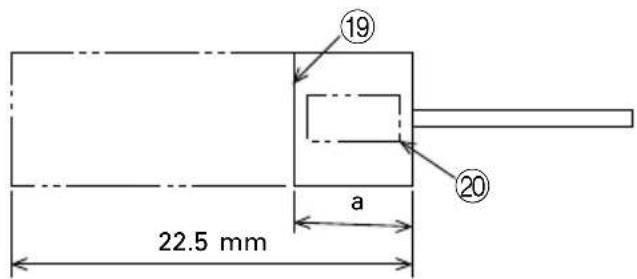
| 20a | ||
| 2161 | 6.5 mm | |
| 2289 | 8.5 mm |
| English Deutsch | Français Italiano | |||
| 1 | Brush cover | Bürstenabdeckung | Couvercle de charbon | Coperchio spazzole |
| 2 | Socket for side handle | Sockel für Seitengriff | Douille pour poignée latérale | Presa per l'impugnatura laterale |
| 3 | Push button (Spindle lock) | Druckknopf (Sperrplatte) | Bouton-poussoir (blocage d'arbre) | Tasto di blocco dell'asse |
| 4 | Spindle | Spindel | Arbre | Asse |
| 5 | Across flats | Quervertiefungen | Aplats en couronne | Apertura della chiave |
| 6 | Wheel guard | Schutzhaube | Couvre-meule | Carter della mola |
| 7 | Wheel washer | Unterlegscheibe | Rondelle de la meule | Rondella "grover" |
| 8 | Depressed center wheel | Schleifscheibe | Meule | Mola |
| 9 | Wheel nut | Mutter für die Schleifscheibe | Ecrou de la meule | Dado ad anello |
| 10 | Wrench | Schlüssel | Clef | Chiave |
| 11 | Diamond wheel | Diamantscheibe | Disque diamant | Disco diamantato |
| 12 | Side handle | Handgriff | Poignée latérale | Impugnatura laterale |
| 13 | Lock button | Sperrknopf | Touche de verrouillage | Tasto di blocco |
| 14 | Switch | Schalter | Interrupteur | Interruttore |
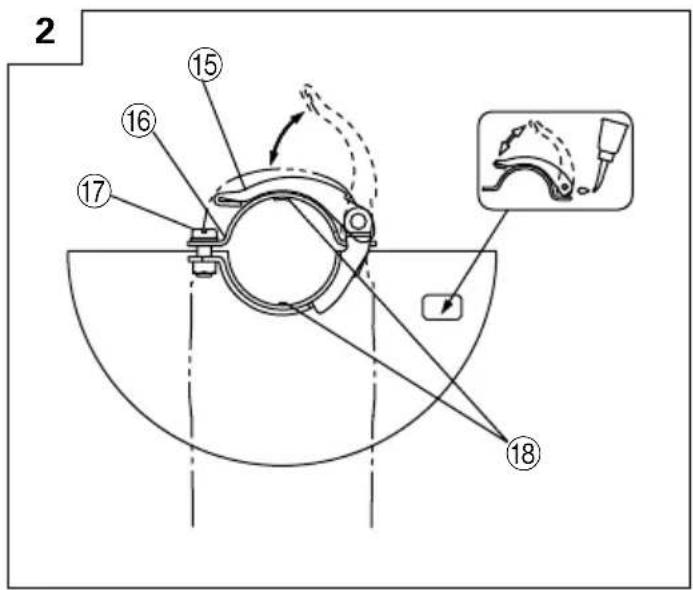
| 15 | Lever | Hebel | Levier | Leva |
| 16 | Set piece | Stellstück | Pièce fixée | Pezzo di arresto |
| 17 | Screw | Schraube | Vis | Vite |
| 18 | Locating pin | Passstift | Tige de positionnement | Perno di posizionamento |
| 19 | Wear limit | Verschleißgrenze | Limite d'usure | Limite di usura |
| 20 | No. of carbon brush | Nr. der Kohlebürste | No. du balai en carbone | N. della spazzola di carbone |
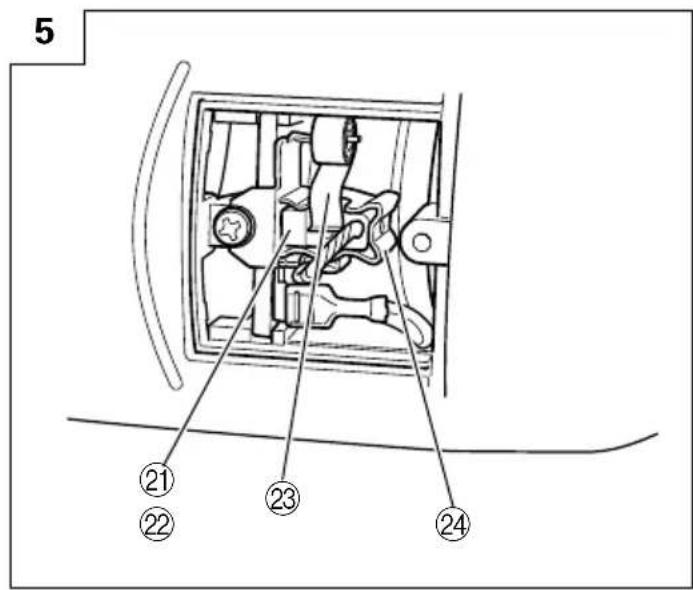
| 21 | Usual carbon brush | Gewöhnliche Kohlebürste | Balai en carbone ordinaire | Spazzola di carbone comune |
| 22 | Auto-stop carbon brush | Auto-Stop Kohlebürste | Balai en carbone à arrêt | Spazzola di carbone ad arresto |
| 23 | Spring | Feder | Ressort | Molla |
| 24 | Brush holder | Bürstenhalter | Support de balai | Portaspazzola |
| Nederlands Español | Português Ελληνικά | |||
| 1 | Borstel-afdekking | Cubierta de la escobilla | Protetor da escova | Κάλυμμα ψήκτρας |
| 2 | Bevestigingspunt voor zijhandgreep | Rosca para el asa lateral | Rosca para a empunhadeira lateral | Υποδοχή για τη πλευρική λαβή |
| 3 | Drukknop (as-vergrendeling) | Botón pulsador (bloqueo del eje) | Botão de pressão (Bloqueio do eixo) | Κουμπί ώθησης (ασφάλιση άξονα) |
| 4 | As | Eje | Eixo | Άξονας |
| 5 | Dwarse vlak | Distancia entre caras | Superfície transversal | Διάκενο |
| 6 | Beschermkap | Cubierta protectora de muela | Proteção de roda | Προφυλακτήρας τροχού |
| 7 | Onderlegschijf | Arandela molar | Porca de roda | Ροδέλλα τροχού |
| 8 | Schuurschijf | Muela de alisado | Esmeril | Χαμηλωμένος κεντρικά τροχός |
| 9 | Moer voor de schuurschijf | Contratuerca molar | Arruela de roda | Παξιμάδι τροχού |
| 10 | Sleutel | Llave para tuercas | Chave inglesa | Κλειδί |
| 11 | Diamantzaagblad | Adiamantado | Disco adiamantado | Διαμαντένιος τροχός |
| 12 | Handgreep | Asidero lateral | Empunhadeira lateral | Πλευρική λαβή |
| 13 | Vergrendelknop | Botón de seguridad | Botão de bloqueio | Κουμπί κλειδώματος |
| 14 | Schakelaar | Conmutador | Interruptor | Διακόπτης |
| 15 | Hendel | Palanca | Alavanca | Μοχλός |
| 16 | Stelstuk | Pieza de ajuste | Peça de ajuste | Τμήμα σύνδεσης |
| 17 | Schroef | Tornillo | Parafuso | Βίδα |
| 18 | Paspen | Pasador de posicionamiento | Pino de localização | Περόνη συναρμογής |
| 19 | Slijtagegrens | Límite de uso | Limite de desgaste | Όριο φθοράς |
| 20 | Nr. van de koolborstel | No. de carbón de contacto | No de escova de carvão | Αρ. Καρβουνακίων |
| 21 | Normale koolborstel | Escobilla de carbón usual | Escova de carvão comum | Συνηθισμένα καρβουνάκια |
| 22 | Auto-stop koolborstel | Escobilla de carbón de parada | Escova de carvão de parada automática | Καρβουνάκια αυτομάτης διακοπής |
| 23 | Veer | Resorte | Mola | Ελατήριο |
| 24 | BorstelhouderSymbols⚠ WARNINGThe following show symbols used for the machine. Be sure that you understand their meaning before use. | PortaescobillaSymbole⚠ WARNINGDie folgenden Symbole werden für diese Maschine verwendet. Achten Sie darauf, diese vor der Verwendung zu verstehen. | Suporte de escovaSymboles⚠ AVERTISSEMENTLes symboles suivants sont utilisés pour l’outil.Bien se familiariser avec leur signification avant d’utiliser l’outil. | Θήκη ψύκτραςSimboli⚠ AVVERTENZADi seguito mostriamo i simboli usati per la macchina. Assicurarsi di comprenderne il significato prima dell’uso. |
 | Read all safety warnings and all instructions.Failure to follow the warnings and instructions may result in electric shock, fire and/or serious injury. | Lesen Sie sämtliche Sicherheitshinweise und Anweisungen durch.Wenn die Warnungen und Anweisungen nicht befolgt werden, kann es zu Stromschlag, Brand und/oder ernsthaftenVerletzungen kommen. | Lire tous les avertissements de sécurité et toutes les instructions.Tout manquement à observer ces avertissements et instructions peut engendrer des chocs électriques, des incendies et/ou des blessures graves. | Leggere tutti gli avvertimenti di sicurezza e tutte le istruzioni.La mancata osservanza degli avvertimenti e delle istruzioni potrebbe essere causa di scosse elettriche, incendi e/o gravi lesioni. |
 | Always wear eye protection. | Tragen Sie immer einen Augenschutz. | Toujours porter des verres de protection. | Indossate sempre le protezioni oculari. |
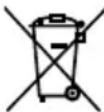 | Only for EU countriesDo not dispose of electric tools together with household waste material!In observance of European Directive 2002/96/EC on waste electrical and electronic equipment and its implementation in accordance with national law, electric tools that have reached the end of their life must be collected separately and returned to an environmentally compatible recycling facility. | Nur für EU-LänderWerfen Sie Elektrowerkzeuge nicht in den Hausmüll!Gemäss Europäischer Richtlinie 2002/96/EG über Elektro- und Elektronik-Altgeräte und Umsetzung in nationales Recht müssen verbrauchte Elektrowerkzeuge getrennt gesammelt und einer umweltgerechtenWiederververtung zugeführt werden. | Pour les pays européens uniquementNe pas jeter les appareils électriques dans les ordures ménagères!Conformément à la directive européenne 2002/96/EG relative aux déchets d’équipements électriques ou électroniques (DEEE), et à sa transposition dans la législation nationale, les appareils électriques doivent être collectés à part et être soumis à un recyclage respectueux de l’environnement. | Solo per Paesi UENon gettare le apparecchiature elettriche tra i rifiuti domestici.Secondo la Direttiva Europea 2002/96/CE sui rifiuti di apparecchiature elettriche ed elettroniche e la sua attuazione in conformità alle norme nazionali, le apparecchiature elettriche esauste devono essere raccolte separatamente, al fine di essere reimpiegate in modo eco-compatibile. |
 | Symbolen⚠ WAARSCHUWINGHieronder staan symbolen afgebeeld die van toepassing zijn op deze machine. U moet de betekenis hiervan begrijpen voor gebruik. | Símbolos⚠ ADVERTENCIAA continuación se muestran los símbolos usados para la máquina. Asegúrese de comprender su significado antes del uso. | Símbolos⚠ AVISOA seguir aparecem os símbolos utilizados pela máquina. Assimile bem seus significados antes do uso. | Σύμβολα⚠ ΠΡΟΣΟΧΗΤα παρακάτω δείχνουν τα σύμβολα που χρησιμοποιούνται στο μηχάνημα. Βεβαωθείτε ότι κατανοείτε τη σημασίας τους πριν τη χρήση. |
 | Lees alle waarschuwingen en instructies aandachtig door.Nalating om de waarschuwingen en instructies op te volgen kan in een elektrische schok, brand en/of ernstig letsel resulteren. | Lea todas las instrucciones y advertencias de seguridad.Si no se siguen las advertencias e instrucciones, podría producirse una descarga eléctrica, un incendio y/o daños graves. | Leia todas as instruções e avisos de segurança.Se não seguir todas as instruções e os avisos, pode provocar um choque eléctrico, incêndio e/ou ferimentos graves. | Διαθάζετε όλες τις προειδοποιησεις ασφαλείας και όλες τις οδηγίες.Η μη τηρηση των προειδοποιησεων και οδηγιών μπορεί να προκαλέσει ηλεκτροπληξία, πυρκαγιά καυή σοβαρό τραυματισμό. |
 | Draag altijd oogbescherming. | Utilice siempre una protección ocular. | Utilize sempre protecção para os olhos. | Φοράτε πάντα τον κατάλληλο εξοπλισμό για την προστασία των ματιών. |
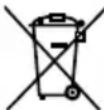 | Alleen voor EU-landenGeef elektrisch gereedschap niet met het huisvuil mee!Volgens de Europese richtlijn 2002/96/EG inzake oude elektrische en elektronische apparaten en de toepassing daarvan binnen de nationale wetgeving, client gebruikt elektrisch gereedschap gescheiden te worden ingezameld en te worden afgevoerd naar een recycle bedrijf dat voldoet aan de geldende milieu-eisen. | Sólo para países de la Unión Europea¡No deseche los aparatos eléctricos junto con los residuos domésticos!De conformidad con la Directiva Europea 2002/96/CE sobre residuos de aparatos eléctricos y electrónicos y su aplicación de acuerdo con la legislación nacional, las herramientas eléctricas cuya vida útil haya llegado a su fin se deberán recoger por separado y trasladar a una planta de reciclaje que cumpla con las exigencias ecológicas. | Apenas para países da UE Não deite ferramentas eléctricas no lixo doméstico!De acordo com a directiva europeia 2002/96/CE sobre ferramentas eléctricas e electrónicas usadas e a transposição para as leis nacionais, as ferramentas eléctricas usadas devem ser recolhidas em separado e encaminhadas a uma instalação de reciclagem dos materiais ecológica. | Μόνο για τις χώρες της ΕΕ Μην πετάτε τα ηλεκτρικά εργαλεία στον κάδο οικιακών απορριμμάτων!Σύμφωνα με την ευρωταϊκή οδηγία 2002/96/ΕΚ περί ηλεκτρικών και ηλεκτρονικών συσκεωών και την ενσωμάτωσή της στο εθνικό δικαιο, τα ηλεκτρικά εργαλεία πρέτει να συλλέγονται ξεχωριστά και να επιστρέφονται για ανακύκλωση με τρόπο φιλικό προς το περιβάλλον. |
GENERAL POWER TOOL SAFETY WARNINGS
WARNING
Read all safety warnings and all instructions.
Failure to follow the warnings and instructions may result in electric shock, fire and/or serious injury.
Save all warnings and instructions for future reference.
The term "power tool" in the warnings refers to your mains-operated (corded) power tool or battery-operated (cordless) power tool.
1) Work area safety
a) Keep work area clean and well lit.
Cluttered or dark areas invite accidents.
b) Do not operate power tools in explosive atmospheres, such as in the presence of flammable liquids, gases or dust.
Power tools create sparks which may ignite the dust or fumes.
c) Keep children and bystanders away while operating a power tool.
Distractions can cause you to lose control.
2) Electrical safety
a) Power tool plugs must match the outlet.
Never modify the plug in any way.
Do not use any adapter plugs with earthed (grounded) power tools.
Unmodified plugs and matching outlets will reduce risk of electric shock.
b) Avoid body contact with earthed or grounded surfaces, such as pipes, radiators, ranges and refrigerators.
There is an increased risk of electric shock if your body is earthed or grounded.
c) Do not expose power tools to rain or wet conditions.
Water entering a power tool will increase the risk of electric shock.
d) Do not abuse the cord. Never use the cord for carrying, pulling or unplugging the power tool.
Keep cord away from heat, oil, sharp edges or moving parts.
Damaged or entangled cords increase the risk of electric shock.
e) When operating a power tool outdoors, use an extension cord suitable for outdoor use.
Use of a cord suitable for outdoor use reduces the risk of electric shock.
f) If operating a power tool in a damp location is unavoidable, use a residual current device (RCD) protected supply.
Use of an RCD reduces the risk of electric shock.
3) Personal safety
a) Stay alert, watch what you are doing and use common sense when operating a power tool.
Do not use a power tool while you are tired or under the influence of drugs, alcohol or medication.
A moment of inattention while operating power tools may result in serious personal injury.
b) Use personal protective equipment. Always wear eye protection.
Protective equipment such as dust mask, non-skid safety shoes, hard hat, or hearing protection used for appropriate conditions will reduce personal injuries.
c) Prevent unintentional starting. Ensure the switch is in the off-position before connecting to power source and/or battery pack, picking up or carrying the tool.
Carrying power tools with your finger on the switch or energising power tools that have the switch on invites accidents.
d) Remove any adjusting key or wrench before turning the power tool on.
A wrench or a key left attached to a rotating part of the power tool may result in personal injury.
e) Do not overreach. Keep proper footing and balance at all times.
This enables better control of the power tool in unexpected situations.
f) Dress properly. Do not wear loose clothing or jewellery. Keep your hair, clothing and gloves away from moving parts.
Loose clothes, jewellery or long hair can be caught in moving parts.
g) If devices are provided for the connection of dust extraction and collection facilities, ensure these are connected and properly used.
Use of dust collection can reduce dust related hazards.
4) Power tool use and care
a) Do not force the power tool. Use the correct power tool for your application.
The correct power tool will do the job better and safer at the rate for which it was designed.
b) Do not use the power tool if the switch does not turn it on and off.
Any power tool that cannot be controlled with the switch is dangerous and must be repaired.
c) Disconnect the plug from the power source and/or the battery pack from the power tool before making any adjustments, changing accessories, or storing power tools.
Such preventive safety measures reduce the risk of starting the power tool accidentally.
d) Store idle power tools out of the reach of children and do not allow persons unfamiliar with the power tool or these instructions to operate the power tool. Power tools are dangerous in the hands of untrained users.
e) Maintain power tools. Check for misalignment or binding of moving parts, breakage of parts and any other condition that may affect the power tool's operation.
If damaged, have the power tool repaired before use. Many accidents are caused by poorly maintained power tools.
f) Keep cutting tools sharp and clean.
Properly maintained cutting tools with sharp cutting edges are less likely to bind and are easier to control.
g) Use the power tool, accessories and tool bits etc. in accordance with these instructions, taking into account the working conditions and the work to be performed.
Use of the power tool for operations different from those intended could result in a hazardous situation.
5) Service
a) Have your power tool serviced by a qualified repair person using only identical replacement parts.
This will ensure that the safety of the power tool is maintained.
PRECAUTION
Keep children and infirm persons away.
When not in use, tools should be stored out of reach of children and infirm persons.
SAFETY WARNINGS COMMON FOR GRINDING OR ABRASIVE CUTTING-OFF OPERATIONS
a) This power tool is intended to function as a grinder or cut-off tool. Read all safety warnings, instructions, illustrations and specifications provided with this power tool.
Failure to follow all instructions listed below may result in electric shock, fire and/or serious injury.
b) Operations such as sanding, wire brushing or polishing are not recommended to be performed with this power tool.
Operations for which the power tool was not designed may create a hazard and cause personal injury.
c) Do not use accessories which are not specifically designed and recommended by the tool manufacturer.
Just because the accessory can be attached to your power tool, it does not assure safe operation.
d) The rated speed of the accessory must be at least equal to the maximum speed marked on the power tool.
Accessories running faster than their rated speed can break and fly apart.
e) The outside diameter and the thickness of your accessory must be within the capacity rating of your power tool.
Incorrectly sized accessories cannot be adequately guarded or controlled.
f) The arbour size of wheels, flanges, backing pads or any other accessory must properly fit the spindle of the power tool.
Accessories with arbour holes that do not match the mounting hardware of the power tool will run out of balance, vibrate excessively and may cause loss of control.
g) Do not use a damaged accessory. Before each use inspect the accessory such as abrasive wheels for chips and cracks, backing pad for cracks, tear or excess wear, wire brush for loose or cracked wires. If power tool or accessory is dropped, inspect for damage or install an undamaged accessory. After inspecting and installing an accessory, position yourself and bystanders away from the plane of the rotating accessory and run the power tool at maximum no-load speed for one minute.
Damaged accessories will normally break apart during this test time.
h) Wear personal protective equipment. Depending on application, use face shield, safety goggles or safety glasses. As appropriate, wear dust mask, hearing protectors, gloves and workshop apron capable of stopping small abrasive or workpiece fragments. The eye protection must be capable of stopping flying debris generated by various operations. The dust mask or respirator must be capable of filtrating particles generated by your operation. Prolonged exposure to high intensity noise may cause hearing loss.
i) Keep bystanders a safe distance away from work area. Anyone entering the work area must wear personal protective equipment.
Fragments of workpiece or of a broken accessory may fly away and cause injury beyond immediate area of operation.
j) Hold power tool by insulated gripping surfaces only, when performing an operation where the cutting accessory may contact hidden wiring or its own cord. Cutting accessory contacting a "live" wire may make exposed metal parts of the power tool "live" and shock the operator.
k) Position the cord clear of the spinning accessory. If you lose control, the cord may be cut or snagged and your hand or arm may be pulled into the spinning accessory.
I) Never lay the power tool down until the accessory has come to a complete stop.
The spinning accessory may grab the surface and pull the power tool out of your control.
m) Do not run the power tool while carrying it at your side.
Accidental contact with the spinning accessory could snag your clothing, pulling the accessory into your body.
n) Regularly clean the power tool's air vents.
The motor's fan will draw the dust inside the housing and excessive accumulation of powdered metal may cause electrical hazards.
o) Do not operate the power tool near flammable materials.
Sparks could ignite these materials.
p) Do not use accessories that require liquid coolants.
Using water or other liquid coolants may result in electrocution or shock.
KICKBACK AND RELATED WARNINGS
Kickback is a sudden reaction to a pinched or snagged rotating wheel, backing pad, brush or any other accessory. Pinching or snagging causes rapid stalling of the rotating accessory which in turn causes the uncontrolled power tool to be forced in the direction opposite of the accessory's rotation at the point of the binding.
For example, if an abrasive wheel is snagged or pinched by the workpiece, the edge of the wheel that is entering into the pinch point can dig into the surface of the material causing the wheel to climb out or kick out. The wheel may either jump toward or away from the operator, depending on direction of the wheel's movement at the point of pinching. Abrasive wheels may also break under these conditions.
Kickback is the result of power tool misuse and/or incorrect operating procedures or conditions and can be avoided by taking proper precautions as given below.
a) Maintain a firm grip on the power tool and position your body and arm to allow you to resist kickback forces. Always use auxiliary handle, if provided, for maximum control over kickback or torque reaction during start-up. The operator can control torque reactions or kickback forces, if proper precautions are taken.
b) Never place your hand near the rotating accessory. Accessory may kickback over your hand.
c) Do not position your body in the area where power tool will move if kickback occurs.
Kickback will propel the tool in direction opposite to the wheel's movement at the point of snagging.
d) Use special care when working corners, sharp edges etc. Avoid bouncing and snagging the accessory. Corners, sharp edges or bouncing have a tendency to snag the rotating accessory and cause loss of control or kickback.
e) Do not attach a saw chain woodcarving blade or toothed saw blade.
Such blades create frequent kickback and loss of control.
SAFETY WARNINGS SPECIFIC FOR GRINDING AND ABRASIVE CUTTING-OFF OPERATIONS
a) Use only wheel types that are recommended for your power tool and the specific guard designed for the selected wheel.
Wheels for which the power tool was not designed cannot be adequately guarded and are unsafe.
b) The guard must be securely attached to the power tool and positioned for maximum safety, so the least amount of wheel is exposed towards the operator. The guard helps to protect operator from broken wheel fragments and accidental contact with wheel.
c) Wheels must be used only for recommended applications. For example: do not grind with the side of cut-off wheel.
Abrasive cut-off wheels are intended for peripheral grinding, side forces applied to these wheels may cause them to shatter.
d) Always use undamaged wheel flanges that are of correct size and shape for your selected wheel. Proper wheel flanges support the wheel thus reducing the possibility of wheel breakage. Flanges for cut-off wheels may be different from grinding wheel flanges.
e) Do not use worn down wheels from larger power tools.
Wheel intended for larger power tool is not suitable for the higher speed of a smaller tool and may burst.
ADDITIONAL SAFETY WARNINGS SPECIFIC FOR ABRASIVE CUTTING-OFF OPERATIONS
a) Do not "jam" the cut-off wheel or apply excessive pressure. Do not attempt to make an excessive depth of cut.
Overstressing the wheel increases the loading and susceptibility to twisting or blinding of the wheel in the cut and the possibility of kickback or wheel breakage.
b) Do not position your body in line with and behind the rotating wheel.
When the wheel, at the point of operation, is moving away from your body, the possible kickback may propel the spinning wheel and the power tool directly at you.
c) When wheel is binding or when interrupting a cut for any reason, switch off the power tool and hold the power tool motionless until the wheel comes to a complete stop. Never attempt to remove the cut-off wheel from the cut while the wheel is in motion otherwise kickback may occur.
Investigate and take corrective action to eliminate the cause of wheel binding.
d) Do not restart the cutting operation in the workpiece. Let the wheel reach full speed and carefully reenter the cut.
The wheel may bind, walk up or kickback if the power tool is restarted in the workpiece.
e) Support panels or any oversized workpiece to minimize the risk of wheel pinching and kickback. Large workpieces tend to sag under their own weight. Supports must be placed under the workpiece near the line of cut and near the edge of the workpiece on both sides of the wheel.
f) Use extra caution when making a "pocket cut" into existing walls or other blind areas.
The protruding wheel may cut gas or water pipes, electrical wiring or objects that can cause kickback.
PRECAUTIONS ON USING DISC GRINDER
- Never operate these power tools without Wheel Guards.
- Check that speed marked on the wheel is equal to or greater than the rated speed of the grinder. Use only depressed center wheels rated at 80m/s or more.
- Ensure that the wheel dimensions are compatible with the grinder and that the wheel fits the spindle.
- Abrasive wheels shall be stored and handled with care in accordance with manufacturer's instructions.
- Inspect the depressed center wheel before use, do not use chipped, cracked or otherwise defective products.
- Always hold the body handle and side handle of the power tool firmly. Otherwise the counterforce produced may result in inaccurate and even dangerous operation.
- Do not use cutting-off wheels for side grinding.
- Do not use of separate reducing bushings or adapters to adapt large hole abrasive wheels.
- The wheel continues to rotate after the tool is switched off.
SPECIFICATIONS
| Model G18MR G18MRU G23MR G23MRU | |||||
| Voltage (by areas) ^*1 | (110V, 220V, 230V, 240V) | ||||
| Input ^*1 | 2400 W 2500 W | W 2400 W 2500 W | |||
| No-load speed 8500 min | -1 | 6600 min ^-1 | |||
| Wheel H | Outer dia. 180 mm 230 mm | ||||
| Hole dia. 22.23 mm | |||||
| Peripheral speed 80 m/s | |||||
| Weight ^*2 | 5.4 kg | ||||
| Starting current limiter ^*3 | No Yes No Yes | ||||
*1 Be sure to check the nameplate on product as it is subject to change by areas.
*2 Weight: Only main body
*3 The starting current limiter produces the starting current to such an extent that a fuse (16 A, slow-blow) is not tripped.
STANDARD ACCESSORIES
(1) Wrench 1
Depressed center wheels are not provided as standard accessories.
Standard accessories are subject to change without notice.
APPLICATIONS
○ Removal of casting fin and finishing of various types of steel, bronze and aluminum materials and castings.
○ Grinding of welded sections or sections cut by means of a cutting torch.
○ Grinding of synthetic resins, slate, brick, marble, etc.
○ Cutting of synthetic concrete, stone, brick, marble and similar materials.
PRIOR TO OPERATION
1. Power source
Ensure that the power source to be utilized conforms to the power requirements specified on the product nameplate.
2. Power switch
Ensure that the power switch is in the OFF position. If the plug is connected to a receptacle while the power switch is in the ON position, the power tool will start operating immediately, which could cause a serious accident.
3. Extension cord
When the work area is removed from the power source, use an extension cord of sufficient thickness and rated capacity. The extension cord should be kept as short as practicable.
4. Fitting and adjusting the wheel guard
The wheel guard is a protective device to prevent injury should the depressed center wheel shatter during operation. Ensure that the guard is properly fitted and fastened before commencing grinding operation.
[Installing and adjusting the wheel guard]
Open the lever and insert the locating pin of wheel guard, bringing it into line with the across flats of packing ground.
○ Then, turn the wheel guard to a desired position (for use).
○ Close the lever and fix it. If and when required, carry out adjustments by tightening or loosening the screw.
○ If the lever does not move smoothly, apply some lubricating oil to the sliding section between the set piece and the lever.
- Fasten the wheel guard at the position where the across flats of the wheel guard positioning pin and packing ground are aligned (the position where the wheel guard is inserted), but do not use it.
5. Ensure that the depressed center wheel to be utilized is the correct type and free of cracks or surface defects. Also ensure that the depressed center wheel is properly mounted and the wheel nut is securely tightened, refer to the section on "Depressed Center Wheel Assembly".
Ensure that the abrasive products is correctly mounted and tightened before use and run the tool at no-load for 30 seconds in a safe position, stop immediately if there is considerable vibration or if other defects are detected.
If this condition occurs, check the machine to determine the cause.
Confirm that the spindle lock is disengaged by pushing push button two or three times before switching the power tool on (See Fig. 1).
Screw the side handle into the gear cover.
6. Conducting a trial run
7. Confirm the spindle lock mechanism
8. Fixing the side handle
PRACTICAL GRINDER APPLICATION
1. Pressure
To prolong the life of the machine and ensure a first class finish, it is important that the machine should not be overloaded by applying too much pressure. In most applications, the weight of the machine alone is sufficient for effective grinding. Too much pressure will result in reduced rotational speed, inferior surface finish, and overloading which could reduce the life of the machine.
2. Grinding angle
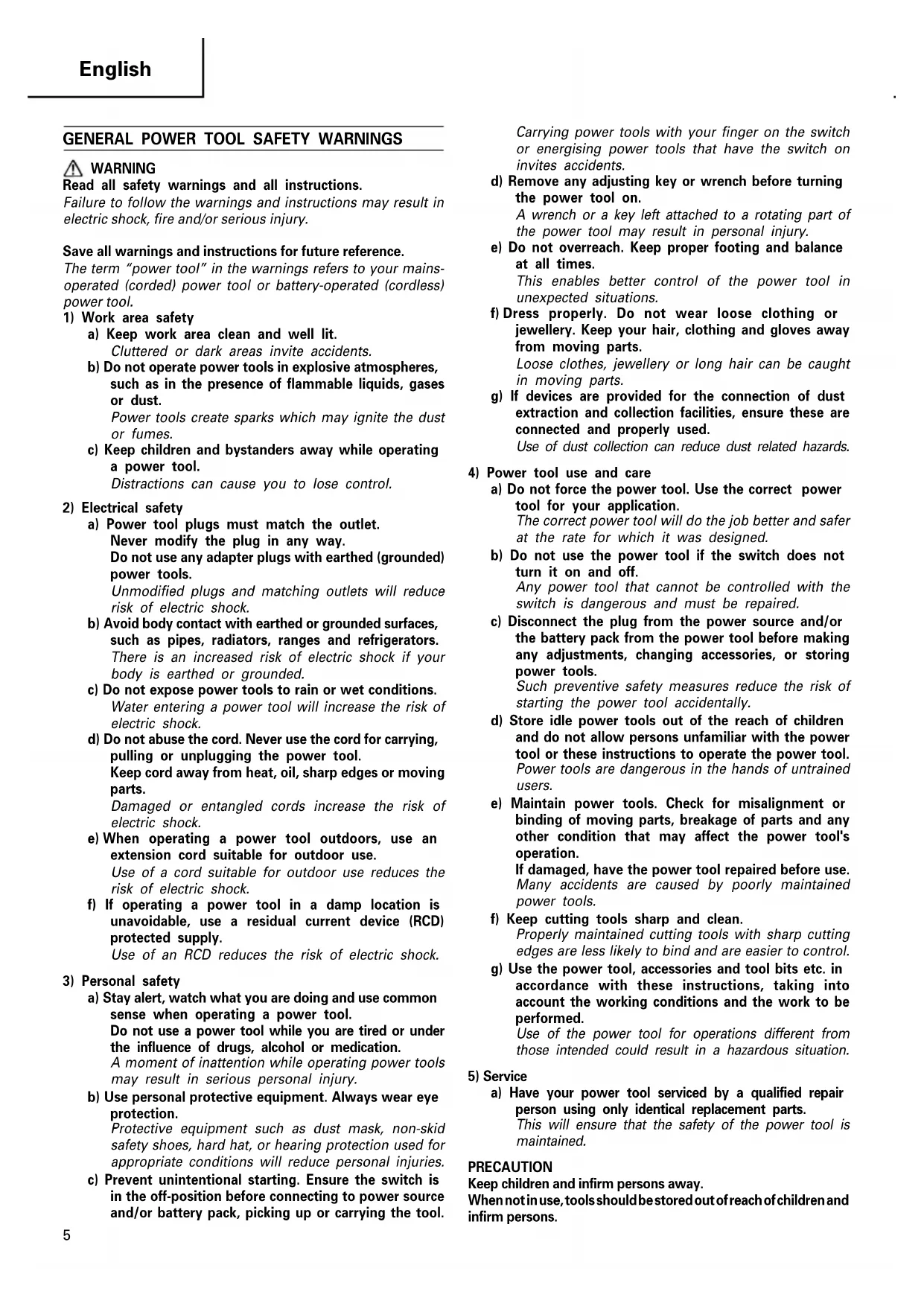
Do not apply the entire surface of the depressed center wheel to the material to be ground. As shown in Fig. 3, the machine should be held at an angle of 15^-30^ so that the external edge of the depressed center wheel contacts the material at an optimum angle.
- To prevent a new depressed center wheel from digging into the workpiece, initial grinding should be performed by drawing the grinder across the workpiece toward the operator (Fig. 3 direction B). Once the leading edge of the depressed center wheel is properly abraded, grinding may be conducted in either direction.
4. Switch operation
Switch ON: Push the locking button forward and then press the switch lever.
* For continuous use, press the switch lever. The switch lever is locked by pushing the locking button forward once again.
(*Subject to change depending on area.)
Switch OFF: Press and release the switch lever.
5. Precautions immediately after finishing operation
After switching off the machine, do not put it down until the depressed center wheel has come to a complete stop. Apart from avoiding serious accidents, this precaution will reduce the amount of dust and swarf sucked into the machine.
CAUTIONS
○Check that the work piece is properly supported.
○Ensure that ventilation openings are kept clear when working in dusty conditions.
If it should become necessary to clear dust, first disconnect the tool from the mains supply (use non-metallic objects) and avoid damaging internal parts.
○Ensure that sparks resulting from use do not create a hazard e.g. do not hit persons, or ignite flammable substances.
○Always use eye and ear protection.
Other personal protective equipment such as dust mask, gloves, helmet and apron should be worn when necessary.
If in doubt, wear the protective equipment.
○When the machine is not use, the power source should be disconnected.
ASSEMBLING AND DISASSEMBLING THE DEPRESSED CENTER WHEEL
CAUTION Be sure to switch OFF and disconnect the attachment plug from the receptacle to avoid a serious accident.
1. Assembling (Fig. 1)
(1) Turn the machine upside down so that the spindle is facing upward.
(2) Mount the wheel washer onto the spindle.
(3) Fit the protruding part of the depressed center wheel or diamond wheel onto the wheel washer.
(4) Screw the wheel nut onto the spindle.
(For diamond wheel assembling, use the wheel nut with the convex side against the diamond wheel.)
(5) Insert the push button to prevent rotation of the spindle, and tighten the wheel nut with the accessory wrench, as shown in Fig. 1.
2. Disassembling
Follow the above procedures in reverse.
CAUTIONS
○Comfirm that the depressed center wheel is mounted firmly.
○Confirm that the push button is disengaged by pushing push button two or three times before switching the power tool on.
MAINTENANCE AND INSPECTION
1. Inspecting the depressed center wheel
Ensure that the depressed center wheel is free of cracks and surface defects.
2. Inspecting the mounting screws
Regularly inspect all mounting screws and ensure that they are properly tightened. Should any of the screws be loose, retighten them immediately. Failure to do so could result in serious hazard.
3. Inspecting the carbon brushes (Fig. 4)
The motor employs carbon brushes which are consumable parts.
When they become worn to or near the "wear limit", it could result in motor trouble. When an auto-stop carbon brush is equipped, the motor will stop automatically.
At that time, replace both carbon brushes with new ones which have the same carbon brush numbers shown in the figure. In addition, always keep carbon brushes clean and ensure that they slide freely within the brush holders.
4. Replacing carbon brushes (Fig. 5)
(1) Loosen the D4 tapping screw retaining the brush cover and remove the brush cover.
(2) Use the auxiliary hexagonal wrench or small screwdriver to pull up the edge of the spring that is holding down the carbon brush. Remove the edge of the spring toward the outside of the brush holder.
(3) Remove the end of the pig-tail on the carbon brush from the terminal section of brush holder and then remove the carbon brush form the brush holder. (Assembly)
(1) Insert the end of the pig-tail of the carbon brush in the terminal section of brush holder.
(2) Insert the carbon brush in the brush holder.
(3) Use the auxiliary hexagonal wrench or small screwdriver to return the edge of the spring to the head of the carbon brush.
(4) Mount the tail cover and tighten the D4 tapping screw.
5. Maintenance of the motor
The motor unit winding is the very "heart" of the power tool. Exercise due care to ensure the winding does not become damaged and/or wet with oil or water.
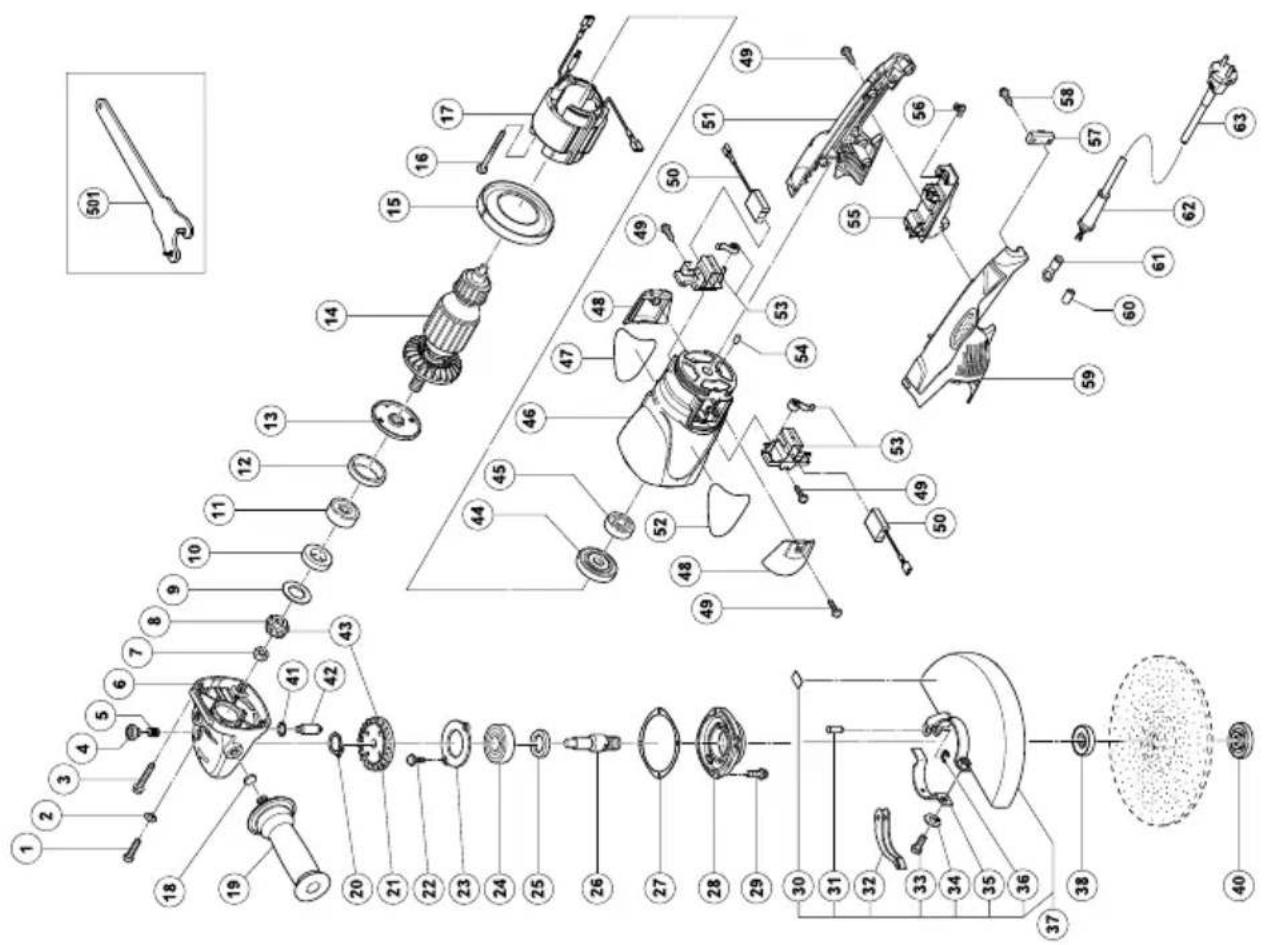
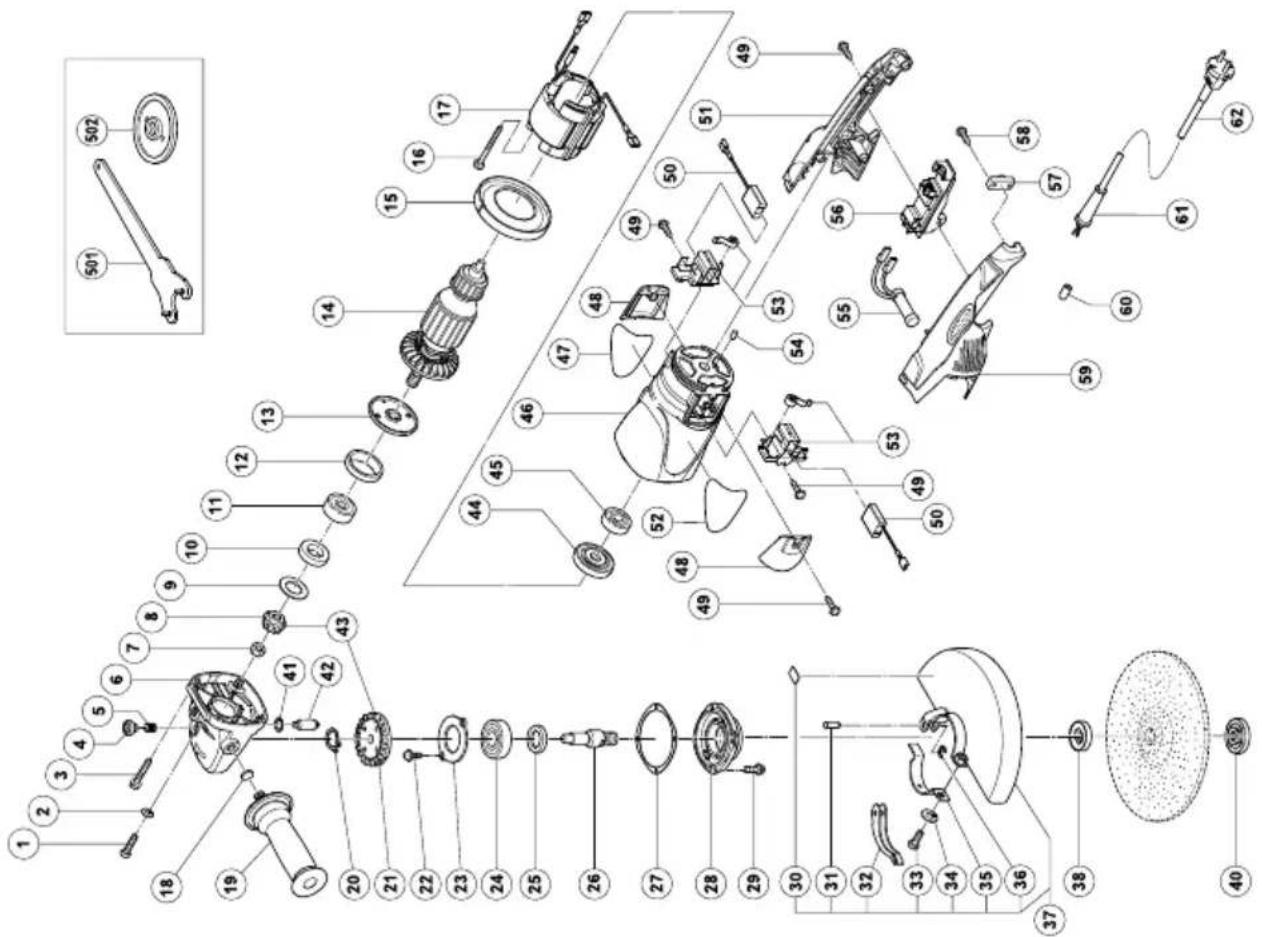
6. Service parts list
A: Item No.
B: Code No.
C: No. Used
D: Remarks
CAUTION
Repair, modification and inspection of Hitachi Power Tools must be carried out by a Hitachi Authorized Service Center.
This Parts List will be helpful if presented with the tool to the Hitachi Authorized Service Center when requesting repair or other maintenance.
In the operation and maintenance of power tools, the safety regulations and standards prescribed in each country must be observed.
MODIFICATIONS
Hitachi Power Tools are constantly being improved and modified to incorporate the latest technological advancements.
Accordingly, some parts (i.e. code numbers and/or design) may be changed without prior notice.
GUARANTEE
We guarantee Hitachi Power Tools in accordance with statutory/country specific regulation. This guarantee does not cover defects or damage due to misuse, abuse, or normal wear and tear. In case of complaint, please send the Power Tool, undismantled, with the GUARANTEE CERTIFICATE found at the end of this Handling instruction, to a Hitachi Authorized Service Center.
NOTE
Due to HITACHI's continuing program of research and development, the specifications herein are subject to change without prior notice.
IMPORTANT:
Correct connection of the plug
The wires of the main lead are coloured in accordance with the following code:
Blue: -Neutral
Brown: -Live
As the colours of the wires in the main lead of this tool may not correspond with the coloured markings identifying the terminals in your plug proceed as follows: The wire coloured blue must be connected to the terminal marked with the letter N or coloured black. The wire coloured brown must be connected to the terminal marked with the letter L or coloured red. Neither core must be connected to the earth terminal.
NOTE:
This requirement is provided according to BRITISH STANDARD 2769: 1984.
Therefore, the letter code and colour code may not be applicable to other markets except The United Kingdom.
Information concerning airborne noise and vibration The measured values were determined according to EN50144.
The typical A-weighted sound pressure level: 90 dB (A) The typical A-weighted sound power level: 103 dB (A)
Wear ear protection.
The typical weighted root mean square acceleration value does not exceed 2.5 m/s ^4 .
●Information about power supply system of nominal voltage 230 V\~ (For G18MR, G23MR only)
Under unfavorable mains conditions, this power tool may cause transient voltage drops or interfering voltage fluctuations.
This power tool is intended for the connection to a power supply system with a maximum permissible system impedance Z_MAX of 0.23 Ohm at the interface point (power service box) of the user's supply.
The user has to ensure that this power tool is connected only to a power supply system which fulfills the requirement above.
If necessary, the user can ask the public power supply company for the system impedance at the interface point.
(1) Schlüssel 1
(2) Handgriff .... 1
G23MR
| A B C D | A B C D | |
| 1 984-509 2 M5×14 | 40 937-909Z 1 | |
| 2 949-454 2 M5 | 41 320-218 1 | |
| 3 313-585 4 M5×30 | 42 306-890 1 | |
| 4 306-888 1 | 43 320-223 1 | |
| 5 320-219 1 | 44 320-216 1 | |
| 6 322-544 1 "4, 5, 18, 41, 42" | 45 620-0VV 1 6200VVCMPS2L | |
| 7 320-226 1 M10 | 46 322-543 1 | |
| 8 320-225 1 | 47 _ 1 | |
| 9 320-221 1 | 48 322-547 2 | |
| 10 320-222 1 | 49 305-812 8 D4×16 | |
| 11 630-1DD 1 6301DDCMPS2L | 50 1 999-061 1 | |
| 12 994-208 1 | 50 2 999-089 1 | |
| 13 320-220 1 | 51 322-546 1 | |
| 14 360-594E 1 220V-230V | 52 _ 1 | |
| 15 320-215 1 | 53 322-323 2 | |
| 16 984-271 2 D5×75 | 54 946-362 1 | |
| 17 340-546E 1 220V-230V | 55 1 320-239 1 | |
| 18 937-033 1 | 55 2 320-238 1 | |
| 19 322-411 1 | 56 322-549 1 | |
| 20 939-542 1 | 57 960-266 1 | |
| 21 320-224 1 | 58 984-750 2 D4×16 | |
| 22 949-236 2 M5×10 | 59 322-545 1 | |
| 23 320-229 1 | 60 981-373 2 | |
| 24 630-2DD 1 6302DDCMPS2L | 61 930-804 2 | |
| 25 990-852 1 | 62 1 958-049 1 D8.2 | |
| 26 320-234 1 | 62 2 940-778 1 D10.7 | |
| 27 320-228 1 | 63 __ _ _ _ _ _ _ _ _ _ _ _ _ _ _ _ _ _ _ _ _ _ _ _ _ _ _ _ _ _ _ _ _ _ _ _ _ _ _ _ _ _ _ _ _ _ _ _ _ _ _ _ _ _ _ _ _ _ _ _ _ _ _ _ _ _ _ _ | |
| 28 320-227 1 | 501 937-913Z 1 | |
| 29 994-192 4 M5×16 | ||
| 30 311-492 1 | ||
| 31 321-546 1 | ||
| 32 321-545 1 | ||
| 33 306-887 1 M8×22 | ||
| 34 949-457 1 M8 | ||
| 35 321-544 1 | ||
| 36 673-489 1 | ||
| 37 321-547 1 "30-36" | ||
| 38 937-907Z 1 |
G23MRU
| A | B | C | D | A | B | C | D |
| 1 984-509 | 2 M5×14 | 38 937-907Z | 1 | ||||
| 2 949-454 | 2 M5 | 40 937-909Z | 1 | ||||
| 3 313-585 | 4 M5×30 | 41 320-218 | 1 | ||||
| 4 306-888 | 1 | 42 306-890 | 1 | ||||
| 5 320-219 | 1 | 43 320-223 | 1 | ||||
| 6 322-544 | 1 "4, 5, 18, 41, 42" | 44 320-216 | 1 | ||||
| 7 320-226 | 1 M10 | 45 620-0VV | 1 6200VVCMPS2L | ||||
| 8 320-225 | 1 | 46 322-543 | 1 | ||||
| 9 320-221 | 1 | 47 _ _ _ _ _ _ _ _ _ _ _ _ _ _ _ _ _ _ _ _ _ _ _ _ _ _ _ _ _ _ _ _ _ _ _ _ _ _ _ _ _ _ _ _ _ _ _ _ _ _ _ _ _ _ _ _ _ | |||||
| 10 320-222 | 1 | 48 322-547 | 2 | ||||
| 11 630-1DD | 1 6301DDCMPS2L | 49 305-812 | 8 D4×16 | ||||
| 12 994-208 | 1 | 50 1 999-061 | 1 | ||||
| 13 320-220 | 1 | 50 2 999-089 | 1 | ||||
| 14 360-594E | 1 220V-230V | 51 322-546 | 1 | ||||
| 15 320-215 | 1 | 52 _ _ _ _ _ _ _ _ _ _ _ _ _ _ _ _ _ _ _ _ _ _ | |||||
| 16 984-271 | 2 D5×75 | 53 322-323 | 2 | ||||
| 17 340-546E | 1 220V-230V | 54 946-362 | 1 | ||||
| 18 937-033 | 1 | 55 320-236 | 1 | ||||
| 19 322-411 | 1 | 56 1 320-371 | 1 | ||||
| 20 939-542 | 1 | 56 2 320-235 | 1 | ||||
| 21 320-224 | 1 | 57 960-266 | 1 | ||||
| 22 949-236 | 2 M5×10 | 58 984-750 | 2 D4×16 | ||||
| 23 320-229 | 1 | 59 322-545 | 1 | ||||
| 24 630-2DD | 1 6302DDCMPS2L | 60 981-373 | 2 | ||||
| 25 990-852 | 1 | 61 1 958-049 | 1 D8.2 | ||||
| 26 320-234 | 1 | 61 2 940-778 | 1 D10.7 | ||||
| 27 320-228 | 1 | 62 _ _ _ _ _ _ _ _ _ _ _ | |||||
| 28 320-227 | 1 | 501 937-913Z | |||||
| 29 994-192 | 4 M5×16 | ||||||
| 30 311-492 | 1 | ||||||
| 31 321-546 | 1 | ||||||
| 32 321-545 | 1 | ||||||
| 33 306-887 | 1 M8×22 | ||||||
| 34 949-457 | 1 M8 | ||||||
| 35 321-544 | 1 | ||||||
| 36 673-489 | 1 | ||||||
| 37 321-547 | 1 "30-36" | ||||||
| English | Nederlands | ||
| GUARANTEE CERTIFICATE1Model No.2Serial No.3Date of Purchase4Customer Name and Address5Dealer Name and Address(Please stamp dealer name and address) | GARANTIEBEWIJS1Modelnummer2Serienummer3Datum van aankoop4Naam en adres van de gebruiker5Naam en adres van de handelaar(Stempel a.u.b. naam en adres vande de handelaar) | ||
| Deutsch | Español | ||
| GARANTIESCHEIN1Modell-Nr.2Serien-Nr.3Kaufdaturn4Name und Anschrift des Kunden5Name und Anschrift des Händlers(Bitte mit Namen und Anschrift des Handlers abstempeln) | CERTIFICADO DE GARANTIA1Número de modelo2Mùmero de serie3Fecha de adquisición4Nombre y dirección del cliente5Nombre y dirección del distribudor(Se ruega poner el sellú del distribudor con su nombre y dirección) | ||
| Français Português | |||
| CERTIFICAT DE GARANTIE1No. de modèle2No de série3Date d'achat4Nom et adresse du client5Nom et adresse du revendeur(Cachet portant le nom et l'adresse du revendeur) | CETTIFICADO DE GARANTIA1Número do modelo2Número do série3Data de compra4Nome e morada do cliente5Nome e morada do distribuidor(Por favor, carímbe o nome e morada do distribuidor) | ||
| Italiano Ελληνικά | |||
| CERTIFICATO DI GARANZIA1Modello2N° di serie3Data di acquisto4Nome e indirizzo dell'acquirente5Nome e indirizzo del rivenditore(Si prega di apporre il timbro con questi dati) | ΠΙΣΤΟΠΟΙΗΤΙΚΟ ΕΓΓΥΗΣΗΣ1Ap. Movτέλου2Αύξων Ap.3Ημερομηνία αγοράς4Όνομα και διεύθυνση πελάτη5Όνομα και διεύθυνση μεταπωλητή(Παρακαλούμε να χρησιμοποιηθεί σφραγίδα) | ||
HITACHI
| 1 | |
| 2 | |
| 3 | |
| 4 | |
| 5 |

natural_image
Line drawing of a quill pen with inkwell (no text or symbols)
natural_image
Line drawing of a quill pen with inkwell (no text or symbols)Hitachi Power Tools Europe GmbH
Siemensring 34, 47877 willich 1, F. R. Germany
Tel: +49 2154 49930
Fax: +49 2154 499350
URL: http://www.hitachi-powertools.de
Hitachi Power Tools Netherlands B. V.
Brabanthaven 11, 3433 PJ Nieuwegein, The Netherlands
Tel: +31 30 6084040
Fax: +31 30 6067266
URL: http://www.hitachi-powertools.nl
Hitachi Power Tools (U. K.) Ltd.
Precedent Drive, Rooksley, Milton Keynes, MK 13, 8PJ, United Kingdom
Tel: +44 1908 660663
Fax: +44 1908 606642
URL: http://www.hitachi-powertools.co.uk
Hitachi Power Tools France S. A. S.
Prac del' Eglantier 22, rue des Crerisiers Lisses, C. E. 1541,
91015 EVRY CEDEX, France
Tel: +33 1 69474949
Fax: +33 1 60861416
URL: http://www.hitachi-powertools.fr
Hitachi Power Tools Belgium N.V. / S.A.
Koningin Astridlaan 51, 1780 Wemmel, Belgium
Tel: +32 2 460 1720
Fax: +32 2 460 2542
URL http://www.hitachi-powertools.be
Hitachi Fercad Power Tools Italia S.p.A
Via Retrone 49-36077, Altavilla Vicentina (VI), Italy
Tel: +39 0444 548111
Fax: +39 0444 548110
URL: http://www.hitachi-powertools.it
Hitachi Power Tools Iberica, S.A.
C / Migjorn, s/n, Poligono Norte, 08226 Terrassa, Barcelona, Spain
Tel: +34 93 735 6722
Fax: +34 93 735 7442
URL: http://www.hitachi-powertools.es


- GENERAL POWER TOOL SAFETY WARNINGS
- WARNING
- Save all warnings and instructions for future reference.
- 1) Work area safety
- 2) Electrical safety
- 3) Personal safety
- 4) Power tool use and care
- 5) Service
- PRECAUTION
- SAFETY WARNINGS COMMON FOR GRINDING OR ABRASIVE CUTTING-OFF OPERATIONS
- KICKBACK AND RELATED WARNINGS
- SAFETY WARNINGS SPECIFIC FOR GRINDING AND ABRASIVE CUTTING-OFF OPERATIONS
- ADDITIONAL SAFETY WARNINGS SPECIFIC FOR ABRASIVE CUTTING-OFF OPERATIONS
- PRECAUTIONS ON USING DISC GRINDER
- STANDARD ACCESSORIES
- APPLICATIONS
- PRIOR TO OPERATION
- Power source
- Power switch
- Extension cord
- Fitting and adjusting the wheel guard
- Conducting a trial run
- Confirm the spindle lock mechanism
- Fixing the side handle
- PRACTICAL GRINDER APPLICATION
- Pressure
- Grinding angle
- Switch operation
- Precautions immediately after finishing operation
- CAUTIONS
- ASSEMBLING AND DISASSEMBLING THE DEPRESSED CENTER WHEEL
- Assembling (Fig. 1)
- Disassembling
- MAINTENANCE AND INSPECTION
- Inspecting the depressed center wheel
- Inspecting the mounting screws
- Inspecting the carbon brushes (Fig. 4)
- Replacing carbon brushes (Fig. 5)
- Maintenance of the motor
- Service parts list
- CAUTION
- MODIFICATIONS
- GUARANTEE
- NOTE
- IMPORTANT:
- Correct connection of the plug
- NOTE:
- ●Information about power supply system of nominal voltage 230 V\~ (For G18MR, G23MR only)
- Hitachi Power Tools Europe GmbH
- Hitachi Power Tools Netherlands B. V.
- Hitachi Power Tools (U. K.) Ltd.
- Hitachi Power Tools France S. A. S.
- Hitachi Power Tools Belgium N.V. / S.A.
- Hitachi Fercad Power Tools Italia S.p.A
- Hitachi Power Tools Iberica, S.A.
Brand : HITACHI
Model : G 23MR
Category : Grinder