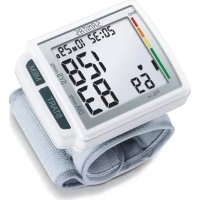
SBC 41 - Blood pressure monitor SANITAS - Free user manual and instructions
Find the device manual for free SBC 41 SANITAS in PDF.


| Product type | Wrist blood pressure monitor |
| Brand | Sanitas |
| Model | SBC 41 |
| Measurement method | Oscillometric, non-invasive |
| Measurement range - Cuff pressure | 0 to 300 mmHg |
| Measurement range - Systolic | 60 to 260 mmHg |
| Measurement range - Diastolic | 40 to 199 mmHg |
| Measurement range - Pulse | 40 to 180 beats/min |
| Accuracy | Pressure: ±3 mmHg, Pulse: ±5% of displayed value |
| Memory | 60 memory slots |
| Dimensions (L x W x H) | 86 x 70 x 28 mm |
| Weight | Approx. 105 g (without batteries, with cuff) |
| Wrist circumference | 14.0 to 19.5 cm |
| Power supply | 2 AAA 1.5 V batteries (alkaline LR03) |
| Battery life | Approx. 180 measurements |
| Display | Date, time, systolic/diastolic pressure, pulse, risk indicator, arrhythmia symbol |
| Functions | Arrhythmia detection, graphical risk indicator, auto-off after 1 min |
| Operating conditions | +5°C to +40°C, relative humidity ≤90% |
| Storage conditions | -20°C to +55°C, relative humidity ≤95% |
| Cleaning | Slightly damp cloth, without solvent or detergent |
| Warranty | 2 years |
| Included accessories | Cuff, 2 AAA batteries, storage case, instruction manual |
Frequently Asked Questions - SBC 41 SANITAS
User questions about SBC 41 SANITAS
0 question about this device. Answer the ones you know or ask your own.
Ask a new question about this device
Download the instructions for your Blood pressure monitor in PDF format for free! Find your manual SBC 41 - SANITAS and take your electronic device back in hand. On this page are published all the documents necessary for the use of your device. SBC 41 by SANITAS.
USER MANUAL SBC 41 SANITAS
Quelle: WHO, 1999 (World Health Organization)
- Getting to know your instrument 15
- Important information 16
- Unit description 20
4.Prepare measurement 20 - Measuring blood pressure. 21
6.Evaluating results 22
Included in delivery:
Blood pressure monitor with cuff
Instructions for use
2 x 1.5 V AAA batteries
Storage box
Please read these instructions for use carefully and keep them for later use, be sure to make them accessible to other users and observe the information they contain.
1. Getting to know your instrument
Check that the device packaging has not been tampered with and make sure that all contents are present. Before use, ensure that there is no visible damage to the device or accessories and that all packaging material has been removed. If you have any doubts, do not use the device
- Saving, retrieving and deleting results 24
- Error messages/troubleshooting 24
- Cleaning and Care 24
- Technical details 24
- Warranty/service.. 26
and contact your retailer or the specified Customer Services address.
The wrist blood pressure monitor is used for non-invasive measurement and monitoring of adults' arterial blood pressure.
You can use it to measure your blood pressure quickly and easily, storing the results and displaying the progression of readings. A warning is issued for anyone suffering from cardiac arrhythmia.
The recorded values are classified and evaluated graphically.
2. Important information

Signs and symbols
The following symbols are used in these instructions for use, on the packaging and on the type plate for the device and accessories:
| ! | Attention |
| i | Note Note on important information |
| Observe the instructions for use | |
| Application part, type BF | |
| - - - | Direct current |
| Disposal in accordance with the Waste Electrical and Electronic Equipment EC Directive – WEEE | |
| 20 PAP | Disposition of packaging in an environ- mentally friendly manner |
| Manufacturer |
| Storage / Transport | Permissible storage and transport temperature and humidity |
| Operating | Permissible operating temperature and humidity |
| Protect from moisture | |
| SN | Serial number |
| CE0483 | The CE labelling certifies that the product complies with the essential requirements of Directive 93/42/EEC on medical devices |
| EAC | Certification symbol for products that are exported to the Russian Federation and members of the CIS |

Advice on use
-
In order to ensure comparable values, always measure your blood pressure at the same time of day.
Before every measurement, relax for about five minutes. -
If you want to perform several measurements on the same person, wait five minutes between each measurement.
- Do not take a measurement within 30 minutes after eating, drinking, smoking or exercising.
- Repeat the measurement if you are unsure of the measured value.
- The measurements taken by you are for your information only - they are not a substitute for a medical examination! Discuss the measurements with your doctor, and never base any medical decisions on them (e.g. medicines and their administration)!
- Using the blood pressure monitor outside your home environment or whilst on the move (e.g. whilst travelling in a car, ambulance or helicopter, or whilst undertaking physical activity such as playing sport) can influence the measurement accuracy and cause incorrect measurements.
- Do not use the blood pressure monitor on newborns or patients with preeclampsia. We recommend consulting a doctor before using the blood pressure monitor during pregnancy.
-
In the case of restricted circulation on the arm as a result of chronic or acute vascular diseases (including vascular constriction), the accuracy of the wrist measurement is limited. In this case you should avoid using an upper arm blood pressure monitor.
-
This device is not intended for use by people (including children) with restricted physical, sensory or mental skills or a lack of experience and/or a lack of knowledge, unless they are supervised by a person who is responsible for their safety or are instructed by such a person in how to use the device. Supervise children around the device to ensure they do not play with it.
- Cardiovascular diseases may lead to incorrect measurements or have a detrimental effect on measurement accuracy. The same also applies to very low blood pressure, diabetes, circulatory disorders and arrhythmias as well as chills or shaking.
- The blood pressure monitor must not be used in connection with a high-frequency surgical unit.
- Only use the unit on people who have the specified wrist measurement for the device.
- Please note that when inflating, the functions of the limb in question may be impaired.
- During the blood pressure measurement, blood circulation must not be stopped for an unnecessarily long time. If the device malfunctions, remove the cuff from the arm.
- Do not allow sustained pressure in the cuff or frequent measurements. The resulting restriction of the blood flow may cause injury.
- Ensure that the cuff is not placed on an arm in which the arteries or veins are undergoing medical treatment,
e.g. intravascular access or therapy, or an arteriovenous (AV) shunt.
- Do not use the cuff on people who have undergone a mastectomy.
- Do not place the cuff over wounds as this may cause further injury.
- The blood pressure monitor can only be operated with batteries.
- To conserve the batteries, the monitor switches off automatically if no buttons are pressed for one minute.
- The device is only intended for the purpose described in these instructions for use. The manufacturer is not liable for damage resulting from improper or careless use.

Storage and Care
- The blood pressure monitor is made up of precision electronic components. Accuracy of readings and the instrument's service life depend on careful hand ling.
- You should protect the device from impact, moisture, dirt, major temperature fluctuations and direct exposure to the sun's rays.
- Never drop the device.
- Do not use near strong electromagnetic fields, i.e. keep it away from any radio systems and mobile phones.
-
Do not press any buttons until the cuff is in position.
-
If the instrument is not used for any length of time, we recommend removing the batteries.

Advice on batteries
- Batteries can be fatal if swallowed. You should therefore store the batteries and products where they are inaccessible to small children. If a battery has been swallowed, call a doctor immediately.
- Batteries should not be charged or reactivated with any other means, nor should they be taken apart, thrown in the fire or short-circuited.
- Remove the batteries from the instrument if they are worn out or if you are not going to use the instrument for any length of time. This prevents any damage as a result of leakage. Always replace all the batteries at the same time.
- Never use different types of battery, battery brands or batteries with different capacities. You should preferably use alkaline batteries.

Notes on handling batteries
If your skin or eyes come into contact with battery fluid, flush out the affected areas with water and seek medical assistance.
- Choking hazard! Small children may swallow and choke on batteries. Store the batteries out of the reach of small children.
- Observe the plus (+) and minus (-) polarity signs.
- If a battery has leaked, put on protective gloves and clean the battery compartment with a dry cloth.
- Protect the batteries from excessive heat.
- Risk of explosion! Never throw batteries into a fire.
- Do not charge or short-circuit batteries.
- If the device is not to be used for a long period, take the batteries out of the battery compartment.
- Use identical or equivalent battery types only.
Always replace all batteries at the same time. - Do not use rechargeable batteries.
- Do not disassemble, split or crush the batteries.

Repair and disposal
- Batteries do not belong in domestic refuse. Used batteries should be disposed of at the collection points provided.
- Never open the instrument. If these instructions are not heeded, the warranty will be null and void.
-
Never attempt to repair the instrument or adjust it yourself. We can no longer guarantee perfect functioning if you do.
-
Repairs may only be performed by Customer Service or authorized dealers. However, always check the batteries and replace them if necessary prior to making any complaint.
- For environmental reasons, do not dispose of the device in the household waste at the end of its useful life. Dispose of the unit at a suitable local collection or recycling point. Dispose of the device in accordance with EC Directive - WEEE (Waste Electrical and Electronic Equipment). If you have any questions, please contact the local authorities responsible for waste disposal.

Notes on electromagnetic compatibility
- The device is suitable for use in all environments listed in these instructions for use, including domestic environments.
- The use of the device may be limited in the presence of electromagnetic disturbances. This could result in issues such as error messages or the failure of the display/device.
-
A void using this device directly next to other devices or stacked on top of other devices, as this could lead to faulty operation. If, however, it is necessary to use the device in the manner stated, this device as well as the other devices must be monitored to ensure they are working properly.
-
The use of accessories other than those specified or provided by the manufacturer of this device can lead to an increase in electromagnetic emissions or a decrease in the device's electromagnetic immunity; this can result in faulty operation.
- Failure to comply with the above can impair the performance of the device.
3. Unit description
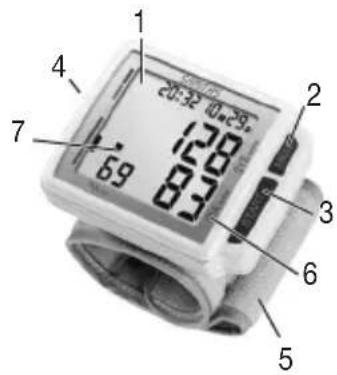
- Display
- Memory button MEM
- START
- Battery cover
- Wrist cuff
- mmHg unit
- Pulse icon

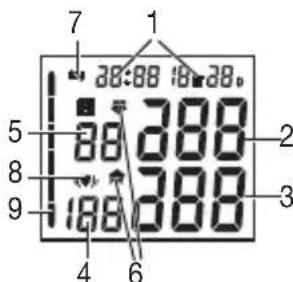
Icons in the display:
- Time and date
- Systolic pressure
- Diastolic pressure
- Measured pulse
- Number of memory space
- Inflate/deflate arrow
- Change battery icon
8.Cardiac arrhythmia icon (心) - Risk indicator
4. Prepare measurement
Inserting battery
- Remove the battery cover (left side of the unit).
- Insert two 1.5 V micro batteries (alkaline, type LR03). Make absolutely sure that you insert the batteries with the correct polarity as marked. Do not use rechargeable batteries.
- Replace the battery cover carefully.
If the change battery icon is displayed, measurement is no longer possible and you must replace all the batteries.
Battery disposal
- The empty, completely flat batteries must be disposed of through specially designated collection boxes, recycling points or electronics retailers. You are legally required to dispose of the batteries.
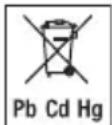
- The codes below are printed on batteries containing harmful substances:
Pb = Battery contains lead, Cd = Battery contains cadmium, Hg = Battery contains mercury.
Setting date and time
It is vital to set date and time. Only in this way is it possible to save and subsequently retrieve your measured values with the right date and time. Time is shown in 24 hour format.
Note: If you hold down MEM, you can set the values faster.
- Press START and MEM simultaneously. The month starts flashing. Using the MEM button, set the month 1 to 12 and confirm with START.
- Set the hour and minute and confirm in each case with START.
5. Measuring blood pressure
Ensure the device is at room temperature before measuring. The measurement can be performed on the left or right wrist.
Positioning cuff
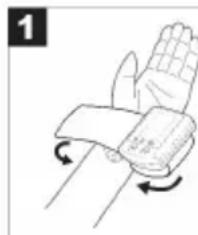
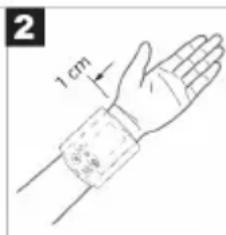
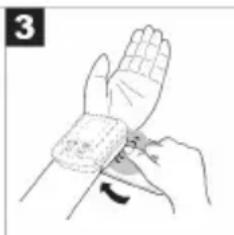
- Expose your wrist. Making sure that the circulation in the arm is not restricted by any clothes etc. that are too tight. Position the cuff on the inside of your wrist.
- Fasten the cuff with the Velcro fastening so that the upper edge of the monitor is positioned approx. 1 cm below the ball of your thumb.
- The cuff has to be fitted tightly around the wrist but should not constrict it.
Blood pressure may vary between the right and left wrist, which may mean that the measured blood pressure values are different. Always perform the measurement on the same wrist.
If the values between the two wrists are significantly different, please consult your doctor to determine which wrist should be used for the measurement.
Important: The instrument should only be operated with the original cuff.
Correct posture
- Rest for approx. 5 minutes before each measurement. Otherwise there may be divergences.
- You can perform the measurement while sitting or lying. To carry out a blood pressure measurement, make sure you are sitting comfortably with your arms and back leaning on something. Do not cross your legs.
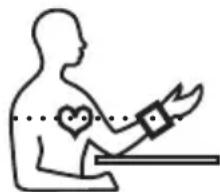
Place your feet flat on the ground. Make sure to rest your arm and move it. Always make sure that the cuff is at heart level. Otherwise significant deviations can occur. Relax your arm and the palm of your hand.
- In order not to distort the result, it is important to keep still during the measurement and not talk.
Measuring blood pressure
-
Switch on the blood pressure monitor with the START button.
-
Before the measurement, the last saved test result is briefly displayed. If there is no measurement in the memory, the instrument always displays the value 0
- The cuff is pumped up to 180mmHg . Cuff air pressure is released slowly. If a tendency towards high blood pressure is already detectable, the cuff is pumped up again and cuff pressure increased further. As soon as a heart rate is detected, the heart rate symbol displayed.
- Heart rate, systolic and diastolic blood pressure are displayed.
- You can interrupt measurement at any time by pressing the START button.
- Erappears if it has not been possible to perform the measurement properly. Observe the section in these instructions on error messages/troubleshooting and repeat the measurement.
- The test result is saved automatically.
6. Evaluating results
Cardiac arrhythmia:
This instrument can identify possible cardiac arrhythmia disorders during measurement and if necessary indicates the measurement with the flashing icon (心) This may be an indicator for arrhythmia. Arrhythmia is a condition where the heart rhythm is abnormal as a result of defects in the bioelectrical system controlling the
heart beat. The symptoms (omitted or premature heart beats, slow or excessively fast heart rate) may be caused, among other things, by heart disease, age, physical predisposition, excessive use of stimulants, stress or lack of sleep. Arrhythmia can only be ascertained through examination by your doctor.
Repeat the measurement if the flashing icon (心) displayed after the measurement. Please note that you should rest for 5 minutes between measurements and not talk or move during the measurement. If the icon (心) appears often, please contact your doctor. Any self-diagnosis and treatment based on the test results may be dangerous. It is vital to follow your doctor's instructions.
Risk indicator:
The measurements can be classified and evaluated in accordance with the following table.
However, these standard values serve only as a general guideline, as the individual blood pressure varies in different people and different age groups etc.
It is important to consult your doctor regularly for advice. Your doctor will tell you your individual values for normal blood pressure as well as the value above which your blood pressure is classified as dangerous.
The classification on the display and the scale on the unit show which category the recorded blood pressure values fall into. If the values of systole and diastole fall
into two different categories (e.g. systole in the ,High normal' category and diastole in the ,Normal' category), the graphical classification on the device always shows the higher category; for the example given this would be ,High normal'.
| Blood pressure value category | Systole (in mmHg) | Diastole (in mmHg) | Action |
| Setting 3: severe hypertension | ≥180≥110 | seek medical attention | |
| Setting 2: moderate hypertension | 160–179 | 00–109 | seek medical attention |
| Setting 1: mild hypertension | 140–159 | 0–99 | regular monitoring by doctor |
| High normal 130– | 13985–89 | regular monitoring by doctor | |
| Normal 120–129 | 80–84 | self-monitoring | |
| Optimal <120<80 | self-monitoring |
Source: WHO, 1999 (World Health Organization)
7. Saving, retrieving and deleting results
- The results of each successful measurement are stored together with date and time. With more than 60 items of measured data, the earliest items of data measured are lost.
- In order to retrieve measurement results again, press the memory button MEM. The instrument first displays the number of memory spaces occupied and then automatically switches to the last saved test result. If you continue pressing the memory button MEM, the last results in each case are measured and displayed with date, time and graphic classification.
- You can clear the memory by holding down the memory button MEM for 3 seconds.
8. Error messages/troubleshooting
In case of faults, the Ermessage appears in the display. Error messages can occur when
- inflation takes longer than 3 minutes (EaPears in the display),
-
the cuff is too tight or too loose (Ee3 appears in the display),
the blood-pressure values are unusually high or low (Erd appears in the display),
the inflation pressure is higher than 300mmHg (Er5 appears in the display), -
there is a system or device error (Er0 Er7 Er8 Er9 ErR appears in the display)
- the batteries are almost flat; the batteries must be replaced
In such cases, repeat the measurement. Ensure that you do not move or speak during the measurement. If necessary, reinsert or replace the batteries.
9. Cleaning and storing the device and cuff
- Clean the device and cuff carefully using a slightly damp cloth only.
- Do not use any cleaning agents or solvents.
- Under no circumstances hold the device and cuff under water, as this can cause liquid to enter and damage the device and cuff.
- If you store the device and cuff, do not place heavy objects on the device and cuff. Remove the batteries. The cuff line should not be bent sharply.
10. Technical details
Model no. SBC 41
| Measurement method | Oscillometric, non-invasive blood pressure measurement on the wrist |
| Measurement range | Cuff pressure 0-300 mmHg, systolic 60-260 mmHg, diastolic 40-199 mmHg, Pulse 40-180 beats/minute |
| Display accuracy | Systolic ± 3 mmHg, diastolic ± 3 mmHg, pulse ± 5 % of the value shown |
| Measurement inaccuracy | Max. permissible standard deviation according to clinical testing: systolic 8 mmHg /diastolic 8 mmHg |
| Memory 60 memory spaces | |
| Dimensions L 86 mm x W 70 mm x H 28 mm | |
| Weight Approx. 105 g (without batteries, with cuff) | |
| Cuff size 14.0 to 19.5 cm | |
| Permissible operating conditions | +5 °C to +40 °C, ≤ 90 % relative air humidity (non-condensing) |
| Permissible storage conditions | -20 °C to +55 °C, ≤ 95 % relative air humidity, 800-1050 hPa ambient pressure |
| Power supply | 2x1,5V AAA batteries |
| Battery life For approx. 180 measurements, depending on the blood pressure level and/or pump pressure |
| Classification Internal supply, IPX0, no AP or APG, continuous operation, type BF applied part |
Technical information is subject to change without notification to allow for updates.
-
This unit is in line with European Standard EN 60601-1-2 (In accordance with CISPR 11, IEC 61000-4-2, IEC 61000-4-3 and IEC 61000-4-8) and is subject to particular precautions with regard to electromagnetic compatibility (EMC). Please note that portable and mobile HF communication systems may interfere with this unit.
-
This device is in line with the EU Medical Devices Directive 93/42/EC, the "Medizinproduktegesetz" (German Medical Devices Act) and the standards EN 1060-1 (non-invasive sphygmomanometers, Part 1: General requirements), EN 1060-3 (non-invasive sphygmomanometers, Part 3: Supplementary requirements for electro-mechanical blood pressure measuring systems) and IEC 80601-2-30 (Medical electrical equipment - Part 2 - 30: Particular requirements for the safety and essential performance of automated non-invasive blood pressure monitors).
-
The accuracy of this blood pressure monitor has been carefully checked and developed with regard to a long useful life. If using the device for commercial medical purposes, it must be regularly tested for accuracy by appropriate means. Precise instructions for checking accuracy may be requested from the service address.
11. Warranty/service
In case of a claim under the warranty please contact your local dealer or the local representation which is mentioned in the list "service international". In case of returning the unit please add a copy of your receipt and a short report of the defect.
The following warranty terms shall apply:
- The warranty period for SANITAS products is either 2 years or- if longer- the country specific warranty period from date of Purchase. In case of a warranty claim, the date of purchase has to be proven by means of the sales receipt or invoice.
- Repairs (complete unit or parts of the unit) do not extend the warranty period.
- The warranty shall not be valid for damages because of a. improper treatment, e.g. nonobservance of the user instructions.
b. repairs or tampering by the customer or unauthorised third parties.
c. transport from the manufacturer to the consumer or during transport to the service centre.
d. The warranty shall not be valid for accessories which are subject to normal wear and tear (cuff, batteries etc.).
- Liability for direct or indirect consequential losses caused by the unit are excluded even if the damage to the unit is accepted as a warranty claim.
FRANÇAIS
Sommaire
Source: WHO, 1999 (World Health Organization)
Fonte: WHO, 1999 (World Health Organization)
HCTpyKZnno npImHeHHIO
26atapeyn AAA,1,5B LR03
Kopo6kaДЯхpaHeHnA
BHHMaTeJIbHO IpOHTHe DaHHyU INCTpyKcHIO NO 3Kc- pIyatauH, CoXpaHryTe ee dJaIbHeuWero NcNoJIb- 3OBaHn, DaIe ee npOHTaTb I DpyrIM NOp3OBaTeJAM n CToPO cJeDyIte PpNBEdEHbIM B HeYka3aHnM.
1. O3HaKOMJIeHne
Y6eHITecb B TOM, YTO ynaKOBka npi6opa He noBpeX-DeHa, IN pOBepbTe KOMnJIeKTHOCTb NOCTaBKn. IpePd
- Coхранене, Вьзов и удалене pe3yntaTOB n3Mepenna 63
- Coo6uHnO HeNCpabHocTax/YcTaPHeHne HeNCpabHocTei 63
- OuicTka n XpaHeHne npnbopa n MaHkeTbI .64
- TexHHueckne daHHbIe 64
- rapaHTn/cePbUChOe 6cbnyKuBaHne 66
IcnoJIb3OBAHnEM y6eUITecb TOM, YTO npu6op n erO npnuHaJIeXHOCTn He IMeOT BvIMMbIX NOBpeJxDeHn, n ydaJIte BCE ynaKoBOHbIe MaTePuaJIbI. Pnp HauINuHm COMHeHn He IcNoJIb3yUte np6op n O6paTtEc b K npOdaBuCy nIIN PO yKa3aHHOMy aDpcy cepBncHoi cLyjX6bl. AnnapaT dJa N3MepeHnja KPOBAnHO r DaBLeHn Ha 3aIa-CTbe Cnyknt dJa HeINHBa3NHBoro N3MepeHn I KOHTpOJIa apTePuaJIbHO r daBJeHn y B3pocJIbIX naCneHToB.
C ero nmou Bb moKeTe 6bICTpo n npocTo n3MepeBt BaWe KpOBaHoe DaBHeHne, BBOHTb BnAmrTb pe3yIbTaTb I3MepeHn N oKa3bIBaTb N3MeHeHn DaBHeHn. Bbl 6yTe npdeynpeXdEhBi pRn BO3MOxHO MeIOxxCn HapUeHNx PNTMa cepDca.
IOnyuHbIe pe3yIbTaTbI n3MepeHn KlaaccuPnyOTcN OTo6paXaOTcB rpaΦnueckOM Bunde.
2. Baxhble yka3aHn
ПОЯСЕняксIMВОЛам
B INHCTpyKcnnn no npimHeHHo, Ha ynaKOBKe n Ha TINOBOI Ta6JIuHKe np6Opa n npHaJnxHocTe nCNoJb3yIOTc cJeDyUOune CmBOJI:
Yka3aHnB OTHoUeHn 6aTapeek
- PpOrIaTbIbAHne 6aTapeeK MoXeT npNBOuNTb K ONaCHOCTn Dn JxN3Hn. Po3Tomy XpaHnte 6aTapeeKn n H3dJIINB HeNoCTynHom DnJ DeTee MeCTe. B Cnyae PpOrIaTbIbAHn 6aTapeeKn He3aMeDInTeJbHo o6paTNTecb K BpaUy.
3anpeaaetc3apkaTb nIpeakTNBnpoBaTb 6atapeKINHbIMCNocO6aMn,pa3bnpaTb nx,6pocTaB B OROH nIIN 3ambiKaTb HAKOPOTko. - BbTaunTe 6aTapeKn n3 annapaTa, ecn OH pa3pJxHe bI eCn Bbl dInTeBHOe BpeM He noJIb3yeTeCb np6Opom. TaKIM o6pa3OM Bbl npedOTbpaUaeteyueep6, KOTOpBI MOKeT 6bITb Bbl3BaH BblNBUMcra 3JIeKTPOJNTOM. Bcerda 3aMeHrTe BCE 6aTapeKn ODHOBpeMeHHo.
He nCnoJb3yUte 6aTapeKn pa3JNUHbIX TINOB, Mapok nn 6aTapeKn c pa3JNUHoi emKOcTBIO. PpenMyeCTBeHHO nC nOJIb3yUte 7eJIoCHIbe 6aTapeKn.

06paueHne c 3JeMeHTaMn NITaHna
- Ppi nonaahan nn KIOCTn n3 aKKyMyJrTopa Ha KOxy nn B rna3a Heo6xOIMN pPOMbITb COOTBcTcByUuYnn yactOK 60JIbUIM KOINcETBOM BObl N O6paNTbcra K BpaCy.
OnachOCTb npOrIaTbIBaHnMeJKNx Yacte! MaJIeHbKne DeTn MOrT npOrIOTNb 6aTapeiKn I NOdABuTbcra HmN. Po3ToM y 6aTapeiKn Heo6XoIMMo XpaHtB B HeIOCTyINHom DnA dTee MeCTe!
- Ośpɑaŋte BhɪməHne Ha oɒbɔɜnæHne nɒlərphocTɪn: nɪtioC (+) n MɪnHyc (-).
- Ecni 6atapeiKa noteKla, oHcTnTe OTdeneHne dIra 6ataeck cyxoi caJIpeTKoN, HaeB 3aunTHbIe nepuATkn.
3aunuTe 6aTapeKn OT Upe3MepHOro BO3dEiCTBnA Tennla.
Onachoctb B3pbIb! He 6pocaiTe 6aTapeiKn B OROHb.
- He 3apjaKeIe n He 3aMbkaIe 6aTapeiKn HAKOPOTko.
- Ecnn npnbop dntteBHOe Bpemr He nCnoJIb3yeTcR, n3BleKnTe n3 Hero 6aTapeuKn.
- IcnoIb3yIte 6aTapeeKn TOIbKO OndHoro Tnna nn paBHOceHHbIX TINOB.
- 3aMeHnTe Bce 6aTapeuKu cpa3y.
He nCnoB3yIte nepe3apXkaembIe aKkymyIaTOpbl!
He OTKpbIbAIte n He pa36nBaIte 6aTapeiKn.
iYka3aHnI NO pEmOHTy N yTnIn3aCnN
-БатAPEикн 3aPpeuzaeTcBbIbpaCbIBaTb B 6bITOBMycop.YtINn3UpyInTe NcNoJIb3OBAHhbIe 6aTapeKnYepe3 COOTBeTCTByIOUmpyHKT c6opApOTxOoB.
He otKpbBaIte npnbop. HecobJIOJeHne BeTe K nOTepe rapaHTn.
3anpeaetcramocToTebHo pemOHnpoBaTb nI nperynpoBaTb np6op. B 3tOM cnyae 60JIbe He rapaHTnpyeTc 6e3ynpueHOCtb pa60Tbl.
- PemOH pa3peWaeTcBbINOJHrTb ToJIbKO cepBnCHoClyX6e fnpMbI NIN aBTOpN3uPObaHHbIM cepBnCHbIM opraHn3aunm. Ho nepeI IIO6bIMn peKJaMaunMn BhaJANE npOBepbTe 6aTaapeiKn N, npn Heo6xOdmoCTN, 3aMeHInTe INX.
B INHTepecax 3aunTbI OKpykaIOSeI cpebl no OOKHuaHHn Cpoka cnJxkbI cneyET yTuIN3NPOBaTB np6Op OTdEJIbHOOT bITOBORo Mycopa. YTuIN3aUNI DOJXHA pON3BOuNTbcAyee3 COOTBeCTByUOune NynKtbl c6opabBaWei CTpaHe.Ipn6Op cJeYET yTuIN3NPOBaTB corNaCHO DInpeKTNBc EC no OTXoAM 3NeKTPnueCKoro n 3JeKTPoHOrO o6OpyDbaHn - WEEE (Waste Electrical and Electronic Equipment). B cnyae Bonpocob ObpaauTeCB MeCTHyIO KOMMyHaJIbHyIO cnJx6by, OTBEcTBeHHyIO 3a yTuIN3aUHIO OTXODOB.
Yka3aHnI NO 3JIeKTPOMaHTHOn COBMECTMIOCTN
- Pnp6op npedHa3Naeh dIpa0bTB yCIOBnX, nepeHcJIeHHbIX B HAcTOraIe NHCtpyKUIN NO npImHeHIO, B TOM YNCJIe B DoMaUHIX ycIOBnX.
-Пин haInuHn 3JIeKTpMaHrHHTbIX NOMEX BO3MOxHOCTn INcNoJIb3OBAHnR npI6opa MOryt 6bITb orpaHueHbI. B pe3yJIbTaTe, HApPIMep, MOryt NOBIAJTBcCoo6UeHnO 6 OwN6kax IIN npOn3oIeT BixOD n3 CTPOr DIncJIpe/camOr npI6opa.
He nCnoIb3yIte DaHHbI np6op pIaOM C dpYrIMu yCTPOINCTBAMn H He ycTaHaBnBaIe erO Ha dpYrIe np6Opbl, 3TO MOKeT Bbl3BaTb OUn6Kn B pa6oTe. OHaKo, ecIn nCNoJIb3OBAHne np6Opa BCE-TaKn Heo6XoIMo B TOM BnDE, KaK ONiCAHO BbiWe, CJeDyET Ha6JIIOJaTB 3a HmN DpyrIMu YCTPOINCTBAMn, YTO6bl Y6eIITbcra, YTO OHn pa6OtaOT HaJIeXaUIm o6pa3OM.
-Приимеонис CTOPOHINx npHnadJIeKHOCTeN, OTINuOUIXCS OITnpINaRaEMOROK DaHHOMy np6OpY, MOKeT pINBeCTN K POCTy 3JIeKTPomarHHTbIX NOMEX INOCla6JIeHNIO NOMExOYCTOuINBOcTN np6Opa IN TEM cMbIM Bbl3BaTb OUn6Kn B pa6Te. - HecobJIOHeHne daHHoro yka3aHnma MoKTe OtpuTaJIbHO cKa3aTbCra Ha xapaKTePncTnKax MOUHOCTn np6opa.
3.Опсане пибopa
- Ducnnnei
- KhoNka BBOda B nAMrTb MEM
- KhonKa START
- Kpbiuka oTceka dna 6aTaapeek
5.MaHxeta 3a - EunHua n3MepeHn: MM pT. CT.
7.ПИKTOrpamMa «Пульс
HndkaucnaHa dncnnee:
- Bpemn n daTa
2.CnctOnuueckoe daBJeHne
3.ДиactoJIuYeCKoeДaBJIeHnE
4.N3MepeHHoe3HaueHne yactotblIyIbca.
5.HomepeKn namTn
6.CtpeJIka-nOdkaaytB, BblnyCTNTb BO3dyX.
7.ПИКTORpMaMma3aMeHbI 6aTapeek
8.ПиКТOrpammaHapyшЕня рNTMa cepdua - INdkaTOp pncKa
- HacTpoIte Yac N MInHyTu KHOIpKoN I NOITBepDITe Bbl6Op KHOIpKoN START.
IcToUHk: WHO, 1999 (World Health Organization)
7. CoxpaHeHne, Bbl3OB u ydaJeHne pe3yIbTaTOB n3MepeHn
- Pe3yNbTaTb KaKdOrO yCneuHOro n3MepEnn coXpaHrOTcB namrtn BmecTe C daToN BVpeMeHem. Pp60nee yem 60 pe3yNbTaTcx cambi cTapbi pe3yNbTaYdaJIaETc.
-ДЯ ВьзOBa pe3yЛbTaTOB ИЗМepeHЯнHaЖMITE KHOПКУ BBOdaВ пamЯТь MEM. Пибор ВЧаJaTe yKa3bIBAe TИСLO 3aHЯТыIX YacheEК пamЯТи, a 3aTeM aВToMaTnueCkInпeрхODIT K NOcJIeДHEmy COxpaHehHomy pe3yЛbTaTu ИЗМepeHЯ. - Pn daJIbHeiXn HaKaTnX KONKn BBOa B nAmrTB MEM noka3bIbaIOc TocneHnpe3yNbTaTbI n3MepeHn C DaToB, BpeMeHem I rpaΦnueckm IpeDCTabNeHnEM KlaaccnKauu.
BbMOxTe CTepeTb NaMBy, HaxaB KHOKNy BBOa MEM u ydepXnBaay ee 3 cekyHbl.
8. Coo6eHnO HeNCnpaBHOCTx/ YcTpaHHeNHe HncnpaBHOCTeN
Pn HncnpabHocTnx Ha dncnnee nOBnreTc coo6ueHne Er.
Co06ueHnO HeuCnpaBHOCTx MOryT NOBbTbcR,ecn
HaKaHbAHne DnTc8 Boonee 3 MHyT (HaDnCnnee NOBJIaETc86
MaHKeTa HAnOKeHa CInIeKOM CnIbHO NIN CInIeKOM cna6o (Ha ducnnee noBnEeTcA Enn), Er4
3haueHne apTepnaIbHO rDaBHeHr qpe3BbIaHOBbICOKoe HnIype3BbIaHr HO HN3Koe (Ha DnCJIeE NOBJIaETcAEn), Er2
JaBJIeHHe HakaunBaHHn npebblaaet 300 MM pT. CT.(Ha DnCnnee NOBnEeTcE)5
- IMeetcHHeNCpPaBHOCTb CnCTembl Nll npnbopa (HaDnCnIee NOBnEETcER0Er)Er8 Er9 ErR
- 6aTaapeKn NOHTN NOHOCbIO pa3pXKeHbI, 6aTaapeKn Heo6xOJIMO 3aMeHHTb
B TaKnx CnyuaRx BbINOJHnTe NOBTOpHOe N3MepeHne.
POMHnTe, YTO Bbl He DoJIxHbI DBrVaTbCra UIN ROBOpNTb BO BpeMg N3MepeHnR. PIn Heo6XoJIMocTn yCTaHOBnTe 6aTaapeKn 3aHOBO INN 3aMeHnTe INX.
9. OuIncTkau xpaHHe nIpn6opau MaHXKeTbI
-
PpOu3BOUInTe OOnCTKy npu6opa n MaHKeTbIC ocToPOxKHOCTbIO. NcNoJIb3yIte TOnbKO CJIeRka yBnaxHHyIO caIΦeTKy.
He nCnoJIb3yIte YnCTaIe CpeIcTBA nn paCTBOpITeI.
HnB Koem clyuae He onyckaIte npnbop mHaXeTb B BOy, TaK KaK IonoJaHne BObl npNBedet K NOBpeXdEHHIO np6opa n MaHXeTbI. -
Pn XpaHEnHa np6ope n MaXKeTe He doJXHbI cTOrTb TJeBle IpEaMeTbI. N3BLeKnte 6aTapeuKn. HEnb3r CnUHKOM CunbHO CrN6aTb UJNaHMaHXeTbI.
10. TexHHueckne daHHbIe
MoIeNb Nc SBC 41

- Included in delivery:
- Getting to know your instrument
- Important information
- Signs and symbols
- Advice on use
- Storage and Care
- Advice on batteries
- Notes on handling batteries
- Repair and disposal
- Notes on electromagnetic compatibility
- Unit description
- Icons in the display:
- Prepare measurement
- Inserting battery
- Battery disposal
- Setting date and time
- Measuring blood pressure
- Positioning cuff
- Correct posture
- Measuring blood pressure
- Evaluating results
- Cardiac arrhythmia:
- Risk indicator:
- Saving, retrieving and deleting results
- Error messages/troubleshooting
- Cleaning and storing the device and cuff
- Technical details
- Warranty/service
- FRANÇAIS
- Sommaire
- O3HaKOMJIeHne
- Baxhble yka3aHn
- ПОЯСЕняксIMВОЛам
- Yka3aHnB OTHoUeHn 6aTapeek
- 06paueHne c 3JeMeHTaMn NITaHna
- iYka3aHnI NO pEmOHTy N yTnIn3aCnN
- Yka3aHnI NO 3JIeKTPOMaHTHOn COBMECTMIOCTN
- 3.Опсане пибopa
- HndkaucnaHa dncnnee:
- CoxpaHeHne, Bbl3OB u ydaJeHne pe3yIbTaTOB n3MepeHn
- Coo6eHnO HeNCnpaBHOCTx/ YcTpaHHeNHe HncnpaBHOCTeN
- OuIncTkau xpaHHe nIpn6opau MaHXKeTbI
- TexHHueckne daHHbIe
Brand : SANITAS
Model : SBC 41
Category : Blood pressure monitor