CECP102RP - Cooker CONTINENTAL EDISON - Free user manual and instructions
Find the device manual for free CECP102RP CONTINENTAL EDISON in PDF.


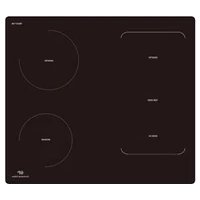
| Product type | Ceramic hob |
| Brand | Continental Edison |
| Model | CECP102RP |
| Number of cooking zones | 2 |
| Total power | 3000 W |
| Front cooking zone | 1200 W, diameter 155 mm |
| Rear cooking zone | 1800 W, diameter 190 mm |
| Electrical supply | 230 V ~ 50/60 Hz, single-phase |
| Control type | Touch controls |
| Built-in dimensions | 490 x 280 mm |
| Minimum distance to wall | 50 mm |
| Minimum distance to extractor hood | 760 mm |
| Residual heat indicator | Display [H] |
| Safety shut-off | Yes (triggered after forgetting or covering the keys) |
| Surface material | Ceramic glass |
| Care and cleaning | Soapy water or special ceramic glass cleaner, no abrasives |
| Sealing gasket supplied | Yes, adhesive |
| Protection class | Y |
| Recommended cable cross-section | 3 x 1.5 mm² (H05VV-F or H05RR-F) |
| Protection rating | 16 A |
Frequently Asked Questions - CECP102RP CONTINENTAL EDISON
User questions about CECP102RP CONTINENTAL EDISON
0 question about this device. Answer the ones you know or ask your own.
Ask a new question about this device
Download the instructions for your Cooker in PDF format for free! Find your manual CECP102RP - CONTINENTAL EDISON and take your electronic device back in hand. On this page are published all the documents necessary for the use of your device. CECP102RP by CONTINENTAL EDISON.
USER MANUAL CECP102RP CONTINENTAL EDISON
natural_image
Symbol of a trash bin crossed out by two diagonal lines (no text or numbers present)INSTRUCTIONS D'INSTALLATION
Thank you for having chosen our ceramic hob.
In order to make the best use of your appliance, we would advise you to read carefully the following notes and to keep them for later consulting.
SUMMARY
SAFETY....10
PRECAUTIONS BEFORE USING....10
USING THE APPLIANCE....10
PRECAUTIONS NOT TO DAMAGE THE APPLIANCE 10
PRECAUTIONS IN CASE OF APPLIANCE FAILURE....11
OTHER PROTECTIONS 11
DESCRIPTION OF THE APPLIANCE....11
TECHNICAL DATA....11
CONTROL PANEL 11
USE 12
SENSITIVE TOUCHES....12
DISPLAY 12
STARTING UP THE APPLIANCE....12
BEFORE USING YOUR NEW HOB....12
STARTING-UP 12
RESIDUAL HEAT INDICATION 12
COOKING ADVICES....13
EXAMPLES OF POWER SETTING: 13
MAINTENANCE AND CLEANING 13
WHAT TO DO IN CASE OF A PROBLEM....13
ENVIRONMENT PROTECTION 14
INSTALLATION INSTRUCTIONS....14
ELECTRICAL CONNECTION 15
Precautions before using
- Unpack all the materials.
- The installation and connecting of the appliance have to be done by approved specialists. The manufacturer cannot be responsible for damage caused by installation or connecting errors.
- To be used, the appliance must be well-equipped and installed in a kitchen unit and an adapted and approved work surface.
- This domestic appliance is exclusively for the cooking of food, to the exclusion of any other domestic, commercial or industrial use.
- Remove all labels and self-adhesives from the ceramic glass.
- Do not change or alter the appliance.
• The cooking plate cannot be used as freestanding or as working surface.
• The appliance must be grounded and connected conforming to local standards. - Do not use any extension cable to connect it.
- The appliance cannot be used above a dishwasher or a tumble-dryer: as steam may cause damage.
Using the appliance
- Switch the heating zones off after using.
- Keep an eye on the hob whilst cooking using grease or oils that may quickly ignite.
- Be careful not to burn yourself while or after using the appliance.
- Make sure no cable of any fixed or moving appliance contacts with the glass or the hot saucepan.
- Magnetically objects (credit cards, floppy disks, calculators) should not be placed near to the engaged appliance.
- Do not place any metallic object on the hob except for pans or cooking utensils. In case of untimely engaging or residual heat, this one may heat, melt or even burn.
- Never cover the appliance with a cloth or a protection sheet. This could become very hot and catch fire.
- This appliance is not intended for use by persons (including children) with reduced physical, sensory or mental capabilities, or lack of experience and knowledge, unless they have been given supervision or instruction concerning use of the appliance by a person responsible for their safety.
• Children should be supervised to ensure that they do not play with the appliance. - Metallic objects such as knives, forks, spoons and lids should not be placed on the hob surface since they can get hot.
Precautions not to damage the appliance
- Raw pan bottoms or damaged saucepans (not enamelled cast iron pots,) may damage the ceramic glass.
- Sand or other abrasive materials may damage ceramic glass.
- Avoid dropping objects, even little ones, on the vitroceramic.
- Do not hit the edges of the glass with saucepans.
- Make sure that the ventilation of the appliance works according to the manufacturer's instructions.
-
Do not put or leave empty saucepans on the vitroceramic hobs.
-
Sugar, synthetic materials or aluminium sheets must not contact with the heating zones. These may cause breaks or other alterations of the vitroceramic glass by cooling: switch on the appliance and take them immediately out of the hot heating zone (be careful: do not burn yourself).
- Never place any hot container over the control panel.
- If a drawer is situated under the embedded appliance, make sure the space between the content of the drawer and the underside of the appliance is large enough (2cm). This is essential to guarantee correct ventilation.
- Never put any inflammable object (ex. sprays) into the drawer situated under the vitroceramic hob. All cutlery drawers must be resistant to heat.
Precautions in case of appliance failure
- If a defect is noticed, switch off the appliance and turn off at the main electrical supply.
- If the ceramic glass is cracked or fissured, you must unplug the appliance and contact the after sales service.
• Repairing has to be done by specialists. Do not open the appliance by yourself. - WARNING: If the surface is cracked, switch off the appliance to avoid the possibility of electric shock.
Other protections
- Note sure that the container pan is always centred on the cooking zone. The bottom of the pan must have to cover as much as possible the cooking zone.
- For the users of pacemaker, the magnetic field could influence its operating. We recommend getting information from the retailer or from the doctor.
- Do not to use aluminium or synthetic material containers: they could melt on still hot cooking zones.
DESCRIPTION OF THE APPLIANCE
Technical data
| Type Total power Heating zone location Power Diameter | ||||
| CECP102RP 3000 W | FrontRear | 1200 W1800 W | 155 mm190 mm | |
Control panel
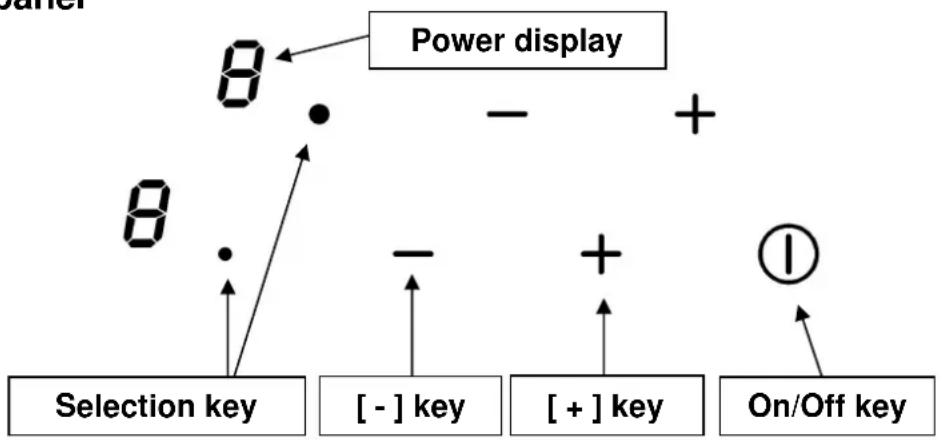
flowchart
graph TD
    A["Selection key"] --> B["Power display"]
    C["[-"] key] --> B
    D["[+"] key] --> E["On/Off key"]
    B --> F["Power display"]
    E --> G["Power display"]
    style A fill:#f9f,stroke:#333
    style C fill:#f9f,stroke:#333
    style D fill:#f9f,stroke:#333
    style E fill:#f9f,stroke:#333
    style F fill:#ccf,stroke:#333
    style G fill:#ccf,stroke:#333
Sensitive touches
Your ceramic hob is equipped with electronic controls with sensitive touch keys. When your finger touches the key, the corresponding command is activated. This activation is validated by a control light, a letter or a number in the display and/or a “beep” sound.
Touch only one key on the same time.
Display
| Display | Designation | Function | ||
| 0 | Zero | The heating zone is activated | ||
| 1...9 | Power level | Selection of the cooking level | ||
| E | Error message | Electronic failure | ||
| H | Residual heat | The heating zone is hot | ||
STARTING UP THE APPLIANCE
Before using your new hob
Clean your hob with a damp cloth, and then dry the surface thoroughly. Do not use detergent which risks causing blue-tinted colour on the glass surface.
Starting-up
| • Start-up/ switch off the hob | ||
| Action | Control panel | Display |
| To start | press key [1] | 2 x [0] |
| To stop | press key [1] | nothing or [H] |
- Start-up/ switch off a heating zone
| Action | Control panel | Display | |
| Zone selection | press selection key | display is on | |
| Increase power | press key [ + ] | [ 1 ] to [ 9 ] | |
| Decrease power | press key [ - ] | [ 9 ] to [ 1 ] | |
| Stop | press simultaneous [ + ] and [ - ] | [ 0 ] or [ H ] | |
| or press key [ - ] | [ 0 ] or [ H ] | ||
Residual heat indication
After the switch-off of the hob, the heating zone is still hot and indicates [H] on the display. The symbol [H] disappears when the heating zone may be touched safely. When the residual heat indicator light is on, don't touch the heating zone and don't put any heat sensitive object on them. There are risks of burn and fire.
Examples of power setting:
(The values below are indicative)
| 1 to 2 | Melting, Reheating | Sauces, butter, chocolate, gelatineDishes prepared beforehand |
| 2 to 3 | Simmering, Defrosting | Rice, pudding, sugar syrupDried vegetables, fish, frozen products |
| 3 to 4 | Steam Vegetables, fish, meat | |
| 4 to 5 | Water | Steamed potatoes, soups, pasta, fresh vegetables |
| 6 to 7 | Medium cooking, Simmering | Meat, liver, eggs, sausages, |
| 7 to 8 | Cooking Potatoes, fritters, waffles | |
| 9 | Frying, roasting, Boiling water | Steaks, omelettes, fried dishes, water |
MAINTENANCE AND CLEANING
Switch-off the appliance before cleaning
Do not clean the hob if the glass is hot: risk of burn.
- Remove light marks with a damp cloth with washing up liquid diluted in a little water. Then rinse with cold water and dry the surface thoroughly.
- Highly corrosive or abrasive detergents and cleaning equipment are likely to cause scratches and must be avoided.
- Do not ever use any steam-driven or pressure appliance.
- Do not use any object that may scratch the ceramic.
- Ensure that the bottom of pans is dry and clean. Ensure that there are no grains of dust on your ceramic hob or on the bottom of the pan. Sliding rough saucepans will scratch the surface.
- Spillages of sugar, jam, jelly, etc. must be removed immediately. You will thus prevent the surface being damaged.
WHAT TO DO IN CASE OF A PROBLEM
The hob or the cooking zone doesn't start-up:
- The hob is badly connected to the electrical system.
- The protection fuse has blown.
- The sensitive keys are covered by grease or water.
- An object is covering the control panel.
The symbol [E] displays :
- Call the After-sales Service.
One or all cooking zones cut-off:
- The safety system has engaged
-
You forgot to cut-off the cooking zone for a long time.
• One or more sensitive keys are covered. -
The packaging material is ecological and can be recycled.
-
The worn appliances contain certain noble metals. Apply to the local government about the possibilities of recycling.
-
Don't dispose of your appliance with general household waste
- Get in touch with the waste collection centre of your local council that control the recycling of household appliances.
natural_image
Symbol of a trash bin crossed out by two crossed lines, representing waste sorting or restriction (no text present)INSTALLATION INSTRUCTIONS
The installation comes under the exclusive responsibility of specialists.
The installer is held to respect the legislation and the standards enforce in his home country.
How to stick the gasket:
The gasket supplied with the hob avoids all infiltration of liquids in the cabinet. His installation has to be done carefully, in conformity of the following drawing.
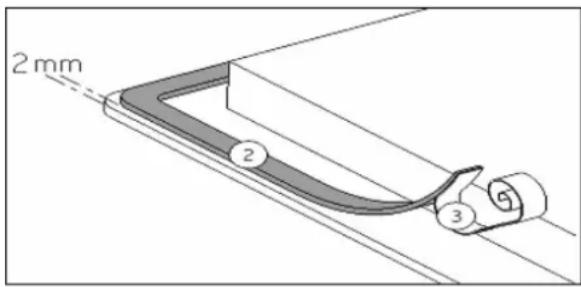
Stick the gasket (2) two millimeters from the external edge of the glass, after removing the protection sheet (3).
Fitting - installing:
• The cut out sizes are:
| Reference Cut-size | |
| CECP102RP | 490 x 280 mm |
- Ensure that there is a distance of 50 mm between the hob and the wall or sides.
- The hobs are classified as "Y" class for heat protection. Ideally the hob should be installed with plenty of space on either side. There may be a wall at the rear and tall units or a wall at one side. On the other side, however, no unit or divider must stand higher than the hob.
- The piece of furniture or the support in which the hob is to be fitted, as well as the edges of furniture, the laminate coatings and the glue used to fix them, must be able to resist temperatures of up to 100 °C.
- The mural rods of edge must be heat-resisting.
- Not to install the hob to the top of a not ventilated oven or a dishwasher.
- To guarantee under the bottom of the hob casing a space of 20 mm to ensure a good air circulation of the electronic device.
- If a drawer is placed under the work, avoid to put into this drawer flammable objects (for example: sprays) or not heat-resistant objects.
-
Materials which are often used to make worktops expand on contact with water. To protect the cut out edge, apply a coat of varnish or special sealant. Particular care must be given to applying the adhesive joint supplied with the hob to prevent any leakage into the supporting furniture. This gasket guarantees a correct seal when used in conjunction with smooth work top surfaces.
-
The safety gap between the hob and the cooker hood placed above must respect the indications of the hood manufacturer. In case of absence of instructions respect a distance minimum of 760 mm.
- The connection cord should be subjected, after building, with no mechanical constraint, such for example of the fact of the drawer.
ELECTRICAL CONNECTION
- The installation of this appliance and the connection to the electrical system should be entrusted only to a qualified electrician.
- Protection against the parts under tension must be ensured after installation
- The data of connection necessary are on the stickers place on the hob casing near the connection box.
- The connection to the mains must be made using an earthed plug or via an omnipolar circuit breaking device with a contact opening of at least 3 mm.
- The electrical circuit must be separated from the network by adapted devices, for example: circuit breakers, fuses or contactors.
Caution!
This appliance has only to be connected to a network 230 V\~ 50/60 Hz Always connect the earth wire.
Respect the connection diagram.
The connection box is located underneath at the back of the hob casing. To open the cover, use a medium screwdriver. Place it in the slits and open the cover.
| Mains | Connection | Cable diameter | Cable | Protection calibre |
| 230V~ 50/60Hz | 1 Phase + N | 3 x 1,5 mm ^2 | H 05 VV - FH 05 RR - F | 16 A * |
( * ) calculated with the simultaneous factor following standard EN 60 335-2-6/1990
Connection of the hob
Monophase 230V\~1P+N
Attach the earth to the terminal “earth”, the neutral N to terminal N, the Phase L1 to one of the terminals L1.
Caution! Be careful that the cables are correctly engaged and tightened.
We cannot be held responsible for any accident resulting from incorrect connection or which could arise from the use of an appliance which has not been earthed or has been equipped with a faulty earth connection

- INSTRUCTIONS D'INSTALLATION
- SUMMARY
- SAFETY....10
- DESCRIPTION OF THE APPLIANCE....11
- USE 12
- STARTING UP THE APPLIANCE....12
- COOKING ADVICES....13
- MAINTENANCE AND CLEANING 13
- WHAT TO DO IN CASE OF A PROBLEM....13
- ENVIRONMENT PROTECTION 14
- INSTALLATION INSTRUCTIONS....14
- ELECTRICAL CONNECTION 15
- Precautions before using
- Using the appliance
- Precautions not to damage the appliance
- Precautions in case of appliance failure
- Other protections
- DESCRIPTION OF THE APPLIANCE
- Sensitive touches
- STARTING UP THE APPLIANCE
- Before using your new hob
- Residual heat indication
- Examples of power setting:
- MAINTENANCE AND CLEANING
- Switch-off the appliance before cleaning
- WHAT TO DO IN CASE OF A PROBLEM
- INSTALLATION INSTRUCTIONS
- How to stick the gasket:
- Fitting - installing:
- ELECTRICAL CONNECTION
- Caution!
- Connection of the hob
Brand : CONTINENTAL EDISON
Model : CECP102RP
Category : Cooker